AWS Solutions Architect Associate
Certification Overview and Introduction
• Certification Level: Associate-level certification
validating ability to design distributed systems on
AWS.
• Exam Details: 65 questions, 130 minutes, passing
score 720, multiple choice & response.
• Who Should Take It: Ideal for developers,
engineers, and sysadmins with 1+ year AWS
experience.
• Recognition & Benefits: Globally recognized
credential leading to cloud architect and consulting
roles.
Exam Structure and Content Domains
Understanding the AWS SAA-C03 Blueprint
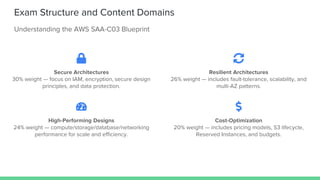
Secure Architectures
30% weight — focus on IAM, encryption, secure design
principles, and data protection.
Resilient Architectures
26% weight — includes fault-tolerance, scalability, and
multi-AZ patterns.
High-Performing Designs
24% weight — compute/storage/database/networking
performance for scale and efficiency.
Cost-Optimization
20% weight — includes pricing models, S3 lifecycle,
Reserved Instances, and budgets.
Design Secure Architectures
Best Practices for AWS Identity and Data Protection
• Identity Access Management: Apply IAM best
practices: least privilege, role-based access, and
multi-factor authentication.
• Data Encryption: Use KMS for key management,
enforce encryption at rest and in transit.
• Secure Network Design: Segment using VPC,
subnets, NACLs, security groups, and private
endpoints.
• Auditing & Compliance: Enable CloudTrail, Config,
and GuardDuty for visibility and continuous
compliance.
Design Resilient Architectures
Ensuring Availability and Fault Tolerance on AWS
• Multi-AZ Deployment: Distribute workloads across
availability zones for fault isolation and continuity.
• Elastic Load Balancing: Distribute traffic using ALB,
NLB, or Gateway Load Balancer for seamless
failover.
• Auto Scaling: Automatically adjust capacity based
on demand using scaling policies and groups.
• Decoupling: Design loosely coupled systems with
SQS, SNS, and EventBridge to minimize
dependency failures.
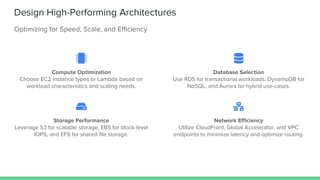
Design High-Performing Architectures
Optimizing for Speed, Scale, and Efficiency
Compute Optimization
Choose EC2 instance types or Lambda based on
workload characteristics and scaling needs.
Database Selection
Use RDS for transactional workloads, DynamoDB for
NoSQL, and Aurora for hybrid use-cases.
Storage Performance
Leverage S3 for scalable storage, EBS for block-level
IOPS, and EFS for shared file storage.
Network Efficiency
Utilize CloudFront, Global Accelerator, and VPC
endpoints to minimize latency and optimize routing.
Design Cost-Optimized Architectures
Maximizing Efficiency and Budget Alignment
• Storage Efficiency: Apply S3 lifecycle policies,
Glacier for archives, and intelligent-tiering for
dynamic data access.
• Compute Cost Reduction: Use EC2 Spot Instances,
Savings Plans, or Lambda for unpredictable
workloads.
• Right-Sizing Resources: Monitor usage with
CloudWatch and Trusted Advisor to scale services
appropriately.
• Budgeting Tools: Set budgets and alerts using
AWS Budgets, and analyze spend with Cost
Explorer.
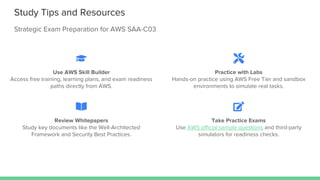
Study Tips and Resources
Strategic Exam Preparation for AWS SAA-C03
Use AWS Skill Builder
Access free training, learning plans, and exam readiness
paths directly from AWS.
Practice with Labs
Hands-on practice using AWS Free Tier and sandbox
environments to simulate real tasks.
Review Whitepapers
Study key documents like the Well-Architected
Framework and Security Best Practices.
Take Practice Exams
Use AWS official sample questions and third-party
simulators for readiness checks.
Conclusion & Next Steps
Your Road to AWS Certification Success
• Review All Domains: Focus on secure, resilient,
performant, and cost-optimized design patterns.
• Schedule the Exam: Register through Pearson VUE
and plan study milestones backward from your
target date.
• Keep Practicing: Continue lab work and take at
least 2–3 practice exams before your test date.
• Advance Your Career: Leverage certification for
roles in architecture, consulting, and cloud strategy.

AWS Solutions Architect Associate Exam Preparation.pdf

  • 1.
    AWS Solutions ArchitectAssociate Certification Overview and Introduction • Certification Level: Associate-level certification validating ability to design distributed systems on AWS. • Exam Details: 65 questions, 130 minutes, passing score 720, multiple choice & response. • Who Should Take It: Ideal for developers, engineers, and sysadmins with 1+ year AWS experience. • Recognition & Benefits: Globally recognized credential leading to cloud architect and consulting roles.
  • 2.
    Exam Structure andContent Domains Understanding the AWS SAA-C03 Blueprint Secure Architectures 30% weight — focus on IAM, encryption, secure design principles, and data protection. Resilient Architectures 26% weight — includes fault-tolerance, scalability, and multi-AZ patterns. High-Performing Designs 24% weight — compute/storage/database/networking performance for scale and efficiency. Cost-Optimization 20% weight — includes pricing models, S3 lifecycle, Reserved Instances, and budgets.
  • 3.
    Design Secure Architectures BestPractices for AWS Identity and Data Protection • Identity Access Management: Apply IAM best practices: least privilege, role-based access, and multi-factor authentication. • Data Encryption: Use KMS for key management, enforce encryption at rest and in transit. • Secure Network Design: Segment using VPC, subnets, NACLs, security groups, and private endpoints. • Auditing & Compliance: Enable CloudTrail, Config, and GuardDuty for visibility and continuous compliance.
  • 4.
    Design Resilient Architectures EnsuringAvailability and Fault Tolerance on AWS • Multi-AZ Deployment: Distribute workloads across availability zones for fault isolation and continuity. • Elastic Load Balancing: Distribute traffic using ALB, NLB, or Gateway Load Balancer for seamless failover. • Auto Scaling: Automatically adjust capacity based on demand using scaling policies and groups. • Decoupling: Design loosely coupled systems with SQS, SNS, and EventBridge to minimize dependency failures.
  • 5.
    Design High-Performing Architectures Optimizingfor Speed, Scale, and Efficiency Compute Optimization Choose EC2 instance types or Lambda based on workload characteristics and scaling needs. Database Selection Use RDS for transactional workloads, DynamoDB for NoSQL, and Aurora for hybrid use-cases. Storage Performance Leverage S3 for scalable storage, EBS for block-level IOPS, and EFS for shared file storage. Network Efficiency Utilize CloudFront, Global Accelerator, and VPC endpoints to minimize latency and optimize routing.
  • 6.
    Design Cost-Optimized Architectures MaximizingEfficiency and Budget Alignment • Storage Efficiency: Apply S3 lifecycle policies, Glacier for archives, and intelligent-tiering for dynamic data access. • Compute Cost Reduction: Use EC2 Spot Instances, Savings Plans, or Lambda for unpredictable workloads. • Right-Sizing Resources: Monitor usage with CloudWatch and Trusted Advisor to scale services appropriately. • Budgeting Tools: Set budgets and alerts using AWS Budgets, and analyze spend with Cost Explorer.
  • 7.
    Study Tips andResources Strategic Exam Preparation for AWS SAA-C03 Use AWS Skill Builder Access free training, learning plans, and exam readiness paths directly from AWS. Practice with Labs Hands-on practice using AWS Free Tier and sandbox environments to simulate real tasks. Review Whitepapers Study key documents like the Well-Architected Framework and Security Best Practices. Take Practice Exams Use AWS official sample questions and third-party simulators for readiness checks.
  • 8.
    Conclusion & NextSteps Your Road to AWS Certification Success • Review All Domains: Focus on secure, resilient, performant, and cost-optimized design patterns. • Schedule the Exam: Register through Pearson VUE and plan study milestones backward from your target date. • Keep Practicing: Continue lab work and take at least 2–3 practice exams before your test date. • Advance Your Career: Leverage certification for roles in architecture, consulting, and cloud strategy.