SUBMITTED BY:-
DEEPAK
14-MBA-06
AVERAGES
Course Content
 Introduction to Average
 Types of average
 Characteristics of average
 Purpose and functions of average
Introduction to Average
“An average is a single figure that
represents the whole group”
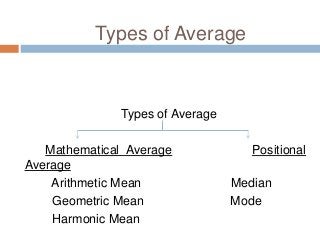
Types of Average
Mathematical Average Positional
Average
Arithmetic Mean Median
Geometric Mean Mode
Harmonic Mean
Types of Average
ARITHMETIC MEAN
Arithmetic mean is the most popular and widely
used measure of central tendency. Generally
when we talk of “average”, it signifies arithmetic
mean. It is generally know as MEAN. Arithmetic
mean is defined as the value which is obtained
by adding all the item of a series and dividing
this total by the number of items. Arithmetic
mean may be of two types :
(a) Simple Arithmetic Mean
(b) Weighted Arithmetic Mean
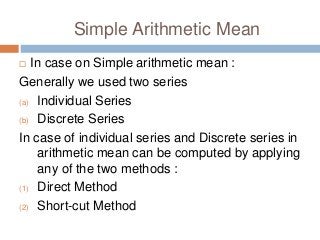
Simple Arithmetic Mean
 In case on Simple arithmetic mean :
Generally we used two series
(a) Individual Series
(b) Discrete Series
In case of individual series and Discrete series in
arithmetic mean can be computed by applying
any of the two methods :
(1) Direct Method
(2) Short-cut Method
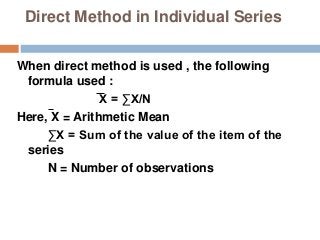
Direct Method in Individual Series
When direct method is used , the following
formula used :
X = ∑X/N
Here, X = Arithmetic Mean
∑X = Sum of the value of the item of the
series
N = Number of observations
Short-cut Method in Individual Series
When the number of observation are large , the arithmetic
mean can be calculated by using short-cut method or
assumed mea method. When deviations are taken from
an assumed mean , the following formula is used :
X = ∑d / N
Where , d = Deviations of the items from the assumed mean ,
i.e., X-A
A = Assumed Mean
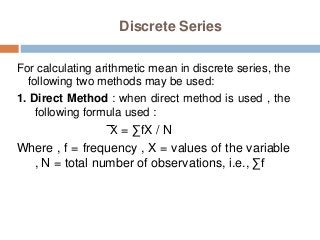
Discrete Series
For calculating arithmetic mean in discrete series, the
following two methods may be used:
1. Direct Method : when direct method is used , the
following formula used :
X = ∑fX / N
Where , f = frequency , X = values of the variable
, N = total number of observations, i.e., ∑f
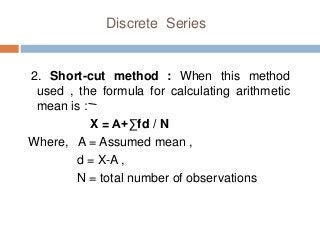
Discrete Series
2. Short-cut method : When this method
used , the formula for calculating arithmetic
mean is :
X = A+∑fd / N
Where, A = Assumed mean ,
d = X-A ,
N = total number of observations
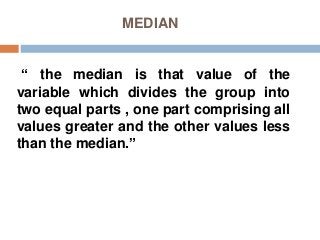
MEDIAN
“ the median is that value of the
variable which divides the group into
two equal parts , one part comprising all
values greater and the other values less
than the median.”
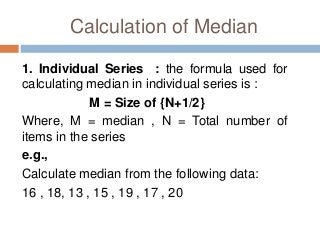
Calculation of Median
1. Individual Series : the formula used for
calculating median in individual series is :
M = Size of {N+1/2}
Where, M = median , N = Total number of
items in the series
e.g.,
Calculate median from the following data:
16 , 18, 13 , 15 , 19 , 17 , 20
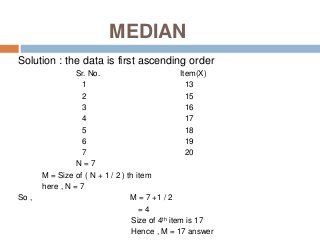
MEDIAN
Solution : the data is first ascending order
Sr. No. Item(X)
1 13
2 15
3 16
4 17
5 18
6 19
7 20
N = 7
M = Size of ( N + 1 / 2 ) th item
here , N = 7
So , M = 7 +1 / 2
= 4
Size of 4th item is 17
Hence , M = 17 answer
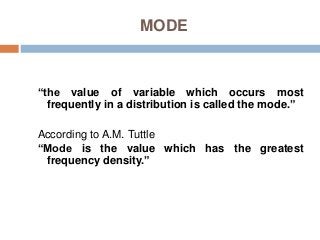
MODE
“the value of variable which occurs most
frequently in a distribution is called the mode.”
According to A.M. Tuttle
“Mode is the value which has the greatest
frequency density.”
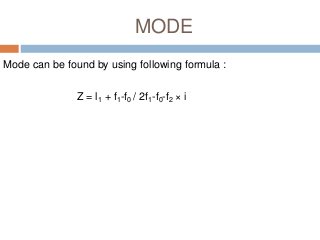
MODE
Mode can be found by using following formula :
Z = l1 + f1-f0 / 2f1-f0-f2 × i
averages-150503020959-conversion-gate01.pdf

averages-150503020959-conversion-gate01.pdf

  • 1.
  • 2.
    Course Content  Introductionto Average  Types of average  Characteristics of average  Purpose and functions of average
  • 3.
    Introduction to Average “Anaverage is a single figure that represents the whole group”
  • 4.
    Types of Average MathematicalAverage Positional Average Arithmetic Mean Median Geometric Mean Mode Harmonic Mean Types of Average
  • 5.
    ARITHMETIC MEAN Arithmetic meanis the most popular and widely used measure of central tendency. Generally when we talk of “average”, it signifies arithmetic mean. It is generally know as MEAN. Arithmetic mean is defined as the value which is obtained by adding all the item of a series and dividing this total by the number of items. Arithmetic mean may be of two types : (a) Simple Arithmetic Mean (b) Weighted Arithmetic Mean
  • 6.
    Simple Arithmetic Mean In case on Simple arithmetic mean : Generally we used two series (a) Individual Series (b) Discrete Series In case of individual series and Discrete series in arithmetic mean can be computed by applying any of the two methods : (1) Direct Method (2) Short-cut Method
  • 7.
    Direct Method inIndividual Series When direct method is used , the following formula used : X = ∑X/N Here, X = Arithmetic Mean ∑X = Sum of the value of the item of the series N = Number of observations
  • 8.
    Short-cut Method inIndividual Series When the number of observation are large , the arithmetic mean can be calculated by using short-cut method or assumed mea method. When deviations are taken from an assumed mean , the following formula is used : X = ∑d / N Where , d = Deviations of the items from the assumed mean , i.e., X-A A = Assumed Mean
  • 9.
    Discrete Series For calculatingarithmetic mean in discrete series, the following two methods may be used: 1. Direct Method : when direct method is used , the following formula used : X = ∑fX / N Where , f = frequency , X = values of the variable , N = total number of observations, i.e., ∑f
  • 10.
    Discrete Series 2. Short-cutmethod : When this method used , the formula for calculating arithmetic mean is : X = A+∑fd / N Where, A = Assumed mean , d = X-A , N = total number of observations
  • 11.
    MEDIAN “ the medianis that value of the variable which divides the group into two equal parts , one part comprising all values greater and the other values less than the median.”
  • 12.
    Calculation of Median 1.Individual Series : the formula used for calculating median in individual series is : M = Size of {N+1/2} Where, M = median , N = Total number of items in the series e.g., Calculate median from the following data: 16 , 18, 13 , 15 , 19 , 17 , 20
  • 13.
    MEDIAN Solution : thedata is first ascending order Sr. No. Item(X) 1 13 2 15 3 16 4 17 5 18 6 19 7 20 N = 7 M = Size of ( N + 1 / 2 ) th item here , N = 7 So , M = 7 +1 / 2 = 4 Size of 4th item is 17 Hence , M = 17 answer
  • 14.
    MODE “the value ofvariable which occurs most frequently in a distribution is called the mode.” According to A.M. Tuttle “Mode is the value which has the greatest frequency density.”
  • 15.
    MODE Mode can befound by using following formula : Z = l1 + f1-f0 / 2f1-f0-f2 × i