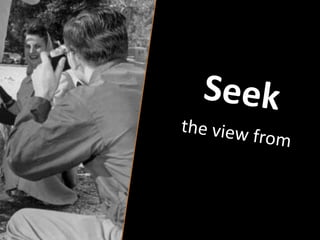
How do you
 describe
 yourself?
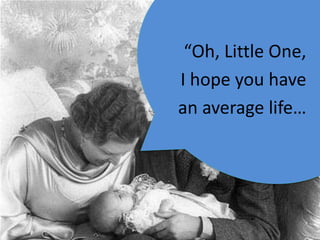
On the day you
 were born,
“Oh, Little One,
I hope you have
an average life…
and average
    abilities
and average
opportunities.”
Your mother wanted to give
            you the moon.
You
  are
  not
average.

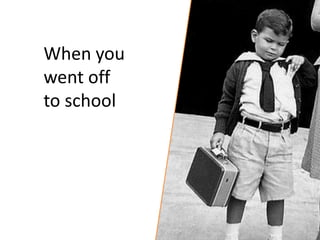
When you
went off
to school
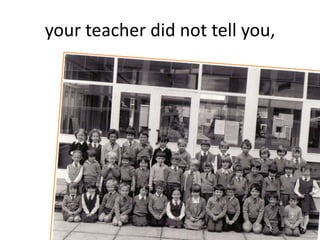
your teacher did not tell you,
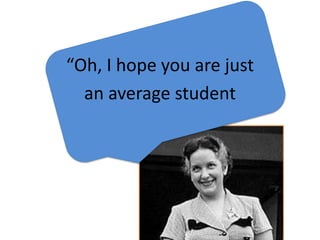
“Oh, I hope you are just
  an average student
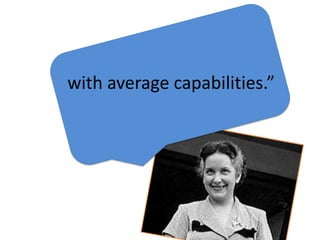
with average capabilities.”
Your teacher wanted
               you
   to do your best.
You
  are
  not
average.

What
changed you?
Who
changed you?
I think it was


YOU.
What ifyou
don’t live
up to your

potential
because you let

social media
         stop you?
because you let

       fear
     stop you?
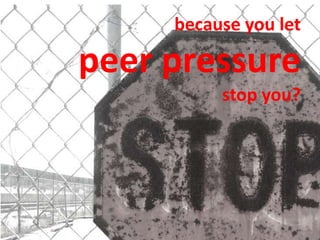
because you let

peer pressure
          stop you?
because you let

anxiety
     stop you?
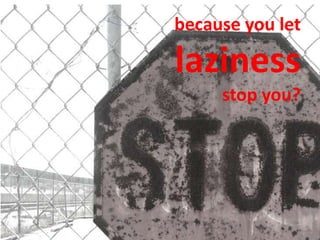
because you let

laziness
     stop you?
because you let

      YOU
     stop you?
Live up to
your potential.
Discover
your talents.
Use
your life.
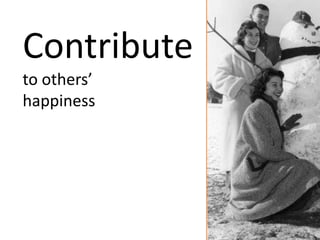
Contribute
to others’
happiness
and in return

      you
will be happy.
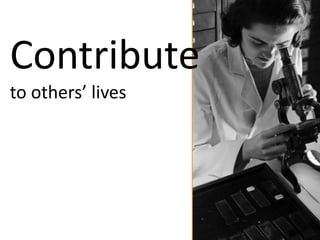
Contribute
to others’ lives
and in return

       you
will feel alive.
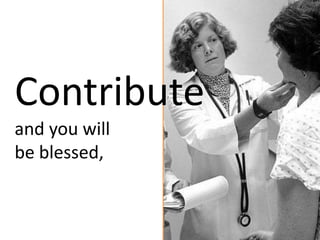
Contribute
and you will
be blessed,
you will have
opportunities,
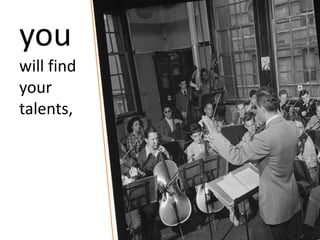
you
will find
your
talents,
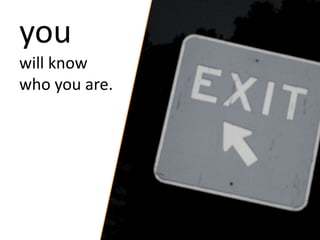
you
will know
who you are.
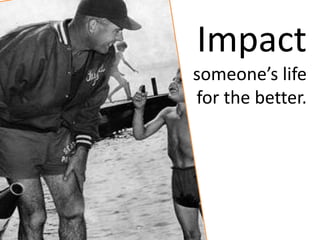
Impact
someone’s life
for the better.
So that one day when
your little one is born,
you may say, “I hope   you are
fabulous
fabulous,
full of wonder,
fabulous,
full of wonder,
  creative,
fabulous,
    full of wonder,
      creative,
everything you can be.
Everything
but average.”
Credits:
ready to go home By dan.danowski
babylove By rumpleteaser
Juliana als Vrouw en moeder/Juliana By National Archief
IMG_2345 By Must Be Art
First Day of School By calonda
1979 School Photo By LittleMissSilly
homework ritual By woodley wonder works
Graffiti showing frown on abstract green face By Horia Varlan
The face we wear By Gabi Agu
face I By Bombardier
school bus By OliBac
Trumpet Macro By Jamesongravity
Stop State By Infrogmation
Keyboard By cheetah100
IMG_0249 By Shiladsen
Exit Sign By KristinNador
I Love Sidewalks By EgoAnt
Florida State University Students.RC06637 By State Library and Archives of Florida
Driving through deep forest in Rokuroski, Katsuyama city By toshihiko2001
Mountain peaks and mt. semeru By [Share the Word]
Policeman downtown, 1981 By Seattle Municipal Archives
The Finish of the men’s 400 metres at the Olympic Games, London, 1948 By Nationals Media Museum
Ping Pong at Bridgeport JCC Youth Conference, Feb. 26, 1947 By Center for Jewish History, NYC
footprints By CAITLIN
Thelma Rounds and John Hutchinson at Mt. Rainer National Park circa 1923 By Seattle Municipal Archives
070717_A_7187T_051 By expertinfantry
Doctors with patient, 1999 By Seattle Municipal Archives
auditorium By KristinNador
woman using microscope, St. Luke’s Hospital, U.S. Industrial Alcohol Company By SMU Central University Libraries
[Portrait of Julius Grossman, ca. July 1947] By The Library of Congress
Tom Sedgwick with Jackie and Gary Donaldson, 1950 By Seattle Municipal Archives
DSC08514 By Jose Jara Ramirez

"Average?" by Hart

Editor's Notes

  • #3 Okay, audience, I want you to think of three adjectives that describe yourself? Did any of you use the word average? Think about your role in the educational environment in light of the Common Core Standards and the Race to the Top initiative. We can be dynamic experts in our field, however, if we continue to pass along students who have an average outlook on themselves, who appear stagnant and un-ambitious, then we are missing out on an opportunity to make great gains in our learning outcomes. Student motivation is a pivotal component if we are to see gains in academic achievement. Therefore we must inspire and encourage students to be more than average. Consider this….
  • #4 On the day you were born…
  • #5 your mother held you affectionately in her arms, gazed down at your precious baby face, and whispered,…
  • #6 “Oh, Little One, I hope you have an average life…
  • #7 with average abilities,
  • #8 and average opportunities.”
  • #9 No, of course not. I bet no parent in the history of mankind has every uttered those words. Parents have very high expectations for their new son or daughter, one that exceeds what they were able to achieve, a life that is full of good people, good opportunities, and good accomplishments, the best of everything that life has to offer.
  • #10 What mother wants any less than this? Right?
  • #11 But somewhere along the way, something changes. Life happens. The Little One begins to interact with his or her world; he or she makes his or her own decisions and may become comfortable with average, maybe because less effort is involved, maybe because he or she is indecisive or timid. But yet all the while, comfortable and complacent. Unfortunately, many students nowadays feel that average is acceptable. So back to our scenario…
  • #12 Little One goes off to school, to learn, to grow, to figure life out, right?
  • #13 Little One encounters teachers and classmates among others and begins right away to compare himself or herself to others.
  • #14 A teacher would not intentionally tell Little One to be average, not to excel or to achieve.
  • #15 Yet somehow, Little One gets the message that showing some moderate ability will get him or her a passable grade, that a little effort is enough to get by.
  • #16 No, this is not the message we intend for them to receive or believe.
  • #17 As teachers, we yearn for those students who make the best of every situation, who follow the Golden Rule, who function within the simple rules of the classroom: do your best, be nice, be here, and be on time. Little One needs to learn that working hard brings good results; it brings success, recognition, and personal satisfaction, and Little One will strengthen his or her abilities and knowledge base as he or she interacts in the learning environment.
  • #18 Where and when does he learn this idea (that he or she is merely average) for himself or herself, even when average is not a choice, it is not an option or a identifier?
  • #19 What changed Little One from someone who could reach his potential and change the world?
  • #20 Who changed Little One into someone who would become apathetic, disconnected, and near sighted?
  • #21 Little One. So with the changes to the Common Core Standards, we all have a vested interest in helping Little One and all the others who begin school each year to live up to their potential, to reach benchmarks, to demonstrate their knowledge by showing evidences of their learning, as well as critical thought and problem solving skills. Students need to be aware at a young age, and I am suggesting kindergarten, of their role in their self development. Yes, in kindergarten, they need to start being accountable for their learning.
  • #22 We need to encourage students to be more self aware, to learn life skills early because these will benefit them. We need to help them realize where they are now and where they are headed. They need to constantly evaluate where they want to be and be aware of what it will take to get them there. Their internal drive must be be charged.
  • #23 Students need self awareness in order to push themselves to excel. Inspire them to contemplate about what makes them “them”. So many choices lie ahead, yet some will not take the initiative. They need to be taught to be their own advocate, to rise to any occasion, and be self-challenged.
  • #24 Then they can account for their successes in hopes that they will want to attain more success. And with success they will be empowered to continue experiencing life and hopefully look forward to the journey through which they will navigate themselves.
  • #25 Ask them the “what if” questions. Potential is a self-fulfilling word that can be stuffed to overflowing. It is an intangible word that must be brought to life by the student, and nurtured daily, not put off until he or she “figures out” what he or she can become. Let them ask themselves, “What if I don’t live up to my potential because….”
  • #26 Let students fill in the blanks. These are just ideas, from the previous generation. Is it because social media was a bigger draw for their attention?
  • #27 Was it fear that shadowed their potential, inhibiting them from taking risks?
  • #28 Was peer pressure the culprit that lead them down the wrong path?
  • #29 Did anxiety snuff out their potential?
  • #30 Did laziness drain their ambitions?
  • #31 Sometimes they themselves are their biggest enemy. They lack an internal drive that pushes them on toward good choices.
  • #32 Can we demand more from them than to ask that they stuff their own lives full of potential?
  • #33 Will they figure out that talent is developed by trial and error, through a variety of opportunities?
  • #34 Seek. It is an action word that requires effort. It is a forward motion.
  • #35 Students are determining the paths.
  • #36 They are deciding the line of vision.
  • #37 They are determining how high to go.
  • #38 Here is that word again, potential. Based on what students have allowed themselves to experience, whether or not they have pushed themselves to excel, may determine how full their lives will be.
  • #39 Will they discover that their lives have a purpose beyond their own satisfaction?
  • #40 Will they want to make a difference, to look outside themselves?
  • #41 Will they discover that living requires a significant effort and that lack of effort will stop them in their tracks?
  • #42 If we connect these ideas back to our learning environments, students can contribute because they have experienced life vicariously by reading about real-world issues. They have found their voice as they contemplate opinions and relevance about social issues.
  • #43 They can appreciate, empathize, and conceptualize.
  • #44 They can gather information, look for answers, conduct research, and synthesize information…
  • #45 that has a profound influence on their world.
  • #46 They can evaluate and develop logical arguments based on textual evidence and hands-on experiences, and they can effectively communicate, collaborate, and solve problems.
  • #47 at an increased level of complexity.
  • #48 They will meet or exceed performance standards as they master the coursework, because they have developed not only their intellect, but also their identity, their passions in life.
  • #49 They will discover who they are.
  • #50 They will interact with their world and have something of value to offer. They will have had various opportunities and experiences to interact with others and with information that empowers them to discover and mold that potential within.
  • #51 So that one day when…
  • #52 when their little one is born,
  • #53 you may be able to say, “I hope YOU are…
  • #54 fabulous
  • #55 full of wonder
  • #56 creative
  • #57 And everything you CAN be.
  • #58 Everything, of course, but average. So how do we get each student to look so deeply into himself and want so passionately to intentionally develop into a potentially awesome human being?...Someone who has an expanded mental capacity, is socially-aware, and is a positively-contributing citizen in our rapidly-changing world? We must continually ask students for their best effort, their best answers, their best everything. And in doing so I feel we will reap the benefits in higher student attendance, higher performance standards, a more satisfying learning environment, and a better world. This is what will happen when we have higher than average expectations.