Automation
Project Manager
Automation Operating Model
(AOM)
3
1. Session 1 – The Automation
Implementation Methodology
2. Session 2 – Roles and
Responsibilities
3. Session 3 – The Automation
Operating Model – August 19th
4. Session 4 – Moving the Automation
Operating Model to a “steady-state
and preparing to scale” – August 26th
Agenda Slide
4
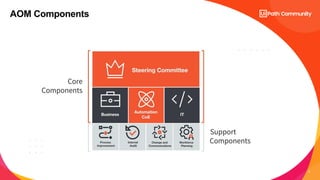
AOM Components
5
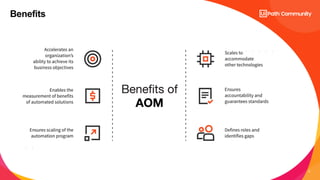
Benefits
6
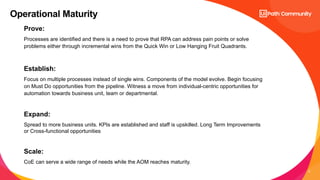
Prove:
Processes are identified and there is a need to prove that RPA can address pain points or solve
problems either through incremental wins from the Quick Win or Low Hanging Fruit Quadrants.
Establish:
Focus on multiple processes instead of single wins. Components of the model evolve. Begin focusing
on Must Do opportunities from the pipeline. Witness a move from individual-centric opportunities for
automation towards business unit, team or departmental.
Expand:
Spread to more business units. KPIs are established and staff is upskilled. Long Term Improvements
or Cross-functional opportunities
Scale:
CoE can serve a wide range of needs while the AOM reaches maturity.
Operational Maturity
7
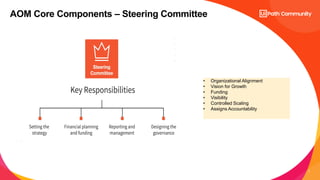
AOM Core Components – Steering Committee
• Organizational Alignment
• Vision for Growth
• Funding
• Visibility
• Controlled Scaling
• Assigns Accountability
8
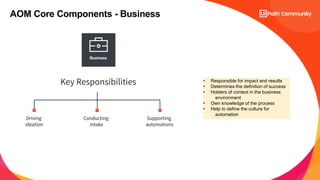
AOM Core Components - Business
• Responsible for impact and results
• Determines the definition of success
• Holders of context in the business
environment
• Own knowledge of the process
• Help to define the culture for
automation
9
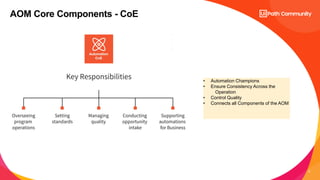
AOM Core Components - CoE
• Automation Champions
• Ensure Consistency Across the
Operation
• Control Quality
• Connects all Components of the AOM
10
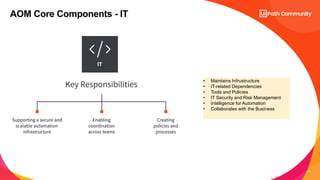
AOM Core Components - IT
• Maintains Infrustructure
• IT-related Dependencies
• Tools and Policies
• IT Security and Risk Management
• Intelligence for Automation
• Collaborates with the Business
11
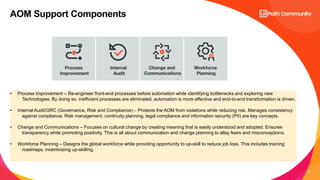
AOM Support Components
• Process Improvement – Re-engineer front-end processes before automation while identifying bottlenecks and exploring new
Technologies. By doing so, inefficient processes are eliminated, automation is more effective and end-to-end transformation is driven.
• Internal Audit/GRC (Governance, Risk and Compliance) – Protects the AOM from violations while reducing risk. Manages consistency
against compliance. Risk management, continuity planning, legal compliance and information security (PII) are key concepts.
• Change and Communications – Focuses on cultural change by creating meaning that is easily understood and adopted. Ensures
transparency while promoting positivity. This is all about communication and change planning to allay fears and misconceptions.
• Workforce Planning – Designs the global workforce while providing opportunity to up-skill to reduce job loss. This includes training
roadmaps, incentivizing up-skilling.
12
AOM Interaction Model
• Interaction Model conceptually designs who speaks to whom, when and
how. This is important on retaining a focus on AOM goals and business
objectives outlined in the Charter specifically around the roadmap.
• Defines Stakeholder and Participant roles which removes ambiguity,
reduces duplicative effort, siloing and outlines responsibilities attuned
to skill levels.
• Key Interactions within the interaction model address how the AOM
moves from PoC through scaling; evolution of responsibilities and how
to handle repeated (weekly meetings) vs. risk-based interactions or
escalations.
13
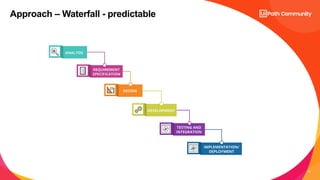
Approach – Waterfall - predictable
14
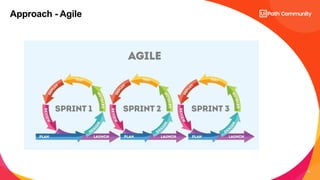
Approach - Agile
15
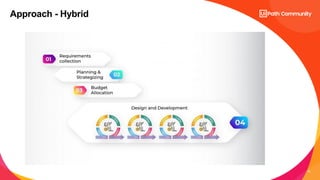
Approach - Hybrid

Automation Project Management and Operating Model 3: The Automation Operating Model

  • 1.
  • 2.
  • 3.
    3 1. Session 1– The Automation Implementation Methodology 2. Session 2 – Roles and Responsibilities 3. Session 3 – The Automation Operating Model – August 19th 4. Session 4 – Moving the Automation Operating Model to a “steady-state and preparing to scale” – August 26th Agenda Slide
  • 4.
  • 5.
  • 6.
    6 Prove: Processes are identifiedand there is a need to prove that RPA can address pain points or solve problems either through incremental wins from the Quick Win or Low Hanging Fruit Quadrants. Establish: Focus on multiple processes instead of single wins. Components of the model evolve. Begin focusing on Must Do opportunities from the pipeline. Witness a move from individual-centric opportunities for automation towards business unit, team or departmental. Expand: Spread to more business units. KPIs are established and staff is upskilled. Long Term Improvements or Cross-functional opportunities Scale: CoE can serve a wide range of needs while the AOM reaches maturity. Operational Maturity
  • 7.
    7 AOM Core Components– Steering Committee • Organizational Alignment • Vision for Growth • Funding • Visibility • Controlled Scaling • Assigns Accountability
  • 8.
    8 AOM Core Components- Business • Responsible for impact and results • Determines the definition of success • Holders of context in the business environment • Own knowledge of the process • Help to define the culture for automation
  • 9.
    9 AOM Core Components- CoE • Automation Champions • Ensure Consistency Across the Operation • Control Quality • Connects all Components of the AOM
  • 10.
    10 AOM Core Components- IT • Maintains Infrustructure • IT-related Dependencies • Tools and Policies • IT Security and Risk Management • Intelligence for Automation • Collaborates with the Business
  • 11.
    11 AOM Support Components •Process Improvement – Re-engineer front-end processes before automation while identifying bottlenecks and exploring new Technologies. By doing so, inefficient processes are eliminated, automation is more effective and end-to-end transformation is driven. • Internal Audit/GRC (Governance, Risk and Compliance) – Protects the AOM from violations while reducing risk. Manages consistency against compliance. Risk management, continuity planning, legal compliance and information security (PII) are key concepts. • Change and Communications – Focuses on cultural change by creating meaning that is easily understood and adopted. Ensures transparency while promoting positivity. This is all about communication and change planning to allay fears and misconceptions. • Workforce Planning – Designs the global workforce while providing opportunity to up-skill to reduce job loss. This includes training roadmaps, incentivizing up-skilling.
  • 12.
    12 AOM Interaction Model •Interaction Model conceptually designs who speaks to whom, when and how. This is important on retaining a focus on AOM goals and business objectives outlined in the Charter specifically around the roadmap. • Defines Stakeholder and Participant roles which removes ambiguity, reduces duplicative effort, siloing and outlines responsibilities attuned to skill levels. • Key Interactions within the interaction model address how the AOM moves from PoC through scaling; evolution of responsibilities and how to handle repeated (weekly meetings) vs. risk-based interactions or escalations.
  • 13.
  • 14.
  • 15.