PLANT TAXONOMY
Welcome to
Principles and Rules ( ICN): Author Citation, Rejection of
Names & Names of Hybrids
By
N. Sannigrahi, Associate Professor,
Deptt. Of Botany, Nistarini College,
Purulia
West Bengal, India
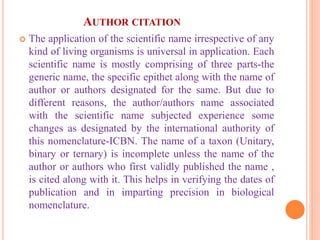
AUTHOR CITATION
 The application of the scientific name irrespective of any
kind of living organisms is universal in application. Each
scientific name is mostly comprising of three parts-the
generic name, the specific epithet along with the name of
author or authors designated for the same. But due to
different reasons, the author/authors name associated
with the scientific name subjected experience some
changes as designated by the international authority of
this nomenclature-ICBN. The name of a taxon (Unitary,
binary or ternary) is incomplete unless the name of the
author or authors who first validly published the name ,
is cited along with it. This helps in verifying the dates of
publication and in imparting precision in biological
nomenclature.
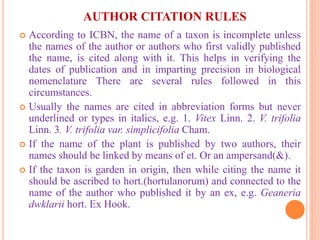
AUTHOR CITATION RULES
 According to ICBN, the name of a taxon is incomplete unless
the names of the author or authors who first validly published
the name, is cited along with it. This helps in verifying the
dates of publication and in imparting precision in biological
nomenclature There are several rules followed in this
circumstances.
 Usually the names are cited in abbreviation forms but never
underlined or types in italics, e.g. 1. Vitex Linn. 2. V. trifolia
Linn. 3. V. trifolia var. simplicifolia Cham.
 If the name of the plant is published by two authors, their
names should be linked by means of et. Or an ampersand(&).
 If the taxon is garden in origin, then while citing the name it
should be ascribed to hort.(hortulanorum) and connected to the
name of the author who published it by an ex, e.g. Geaneria
dwklarii hort. Ex Hook.
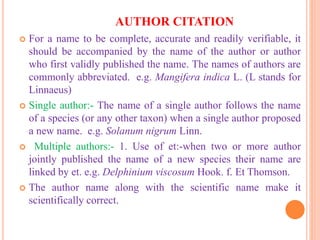
AUTHOR CITATION
 For a name to be complete, accurate and readily verifiable, it
should be accompanied by the name of the author or author
who first validly published the name. The names of authors are
commonly abbreviated. e.g. Mangifera indica L. (L stands for
Linnaeus)
 Single author:- The name of a single author follows the name
of a species (or any other taxon) when a single author proposed
a new name. e.g. Solanum nigrum Linn.
 Multiple authors:- 1. Use of et:-when two or more author
jointly published the name of a new species their name are
linked by et. e.g. Delphinium viscosum Hook. f. Et Thomson.
 The author name along with the scientific name make it
scientifically correct.
AUTHOR CITATION
 Use of parenthesis:- when the name of a taxon is based basionym,
the name of the author of basionym is placed within parenthesis and
the author who made the name, is placed outside the parenthesis. e.g.
Cynodon dactylon (Linn) Pers
 Use of ex:- when a author had proposed a name but was validly
published by another author, the word ex should be used as
connecting link between the name of authors. e.g. Cerasus cornuta
wall. Ex Royle
 Use of in:- The names of author are linked using in when a author
published a name in a publication of another author. e.g. Carex
kashmirensis Clarke in Hook. F.
 Use of emend:- The names of two authors are linked using emend
when the second author makes some change in the diagnosis or in
circumscription of taxon without altering the type. e.g. Phyllanthus
Linn. Emend Mull . Use of square brackets:-Square brackets are used
to indicate prestarting point author. e.g. Lupinus [Tourne.] Linn
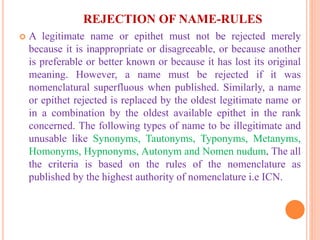
REJECTION OF NAME-RULES
 A legitimate name or epithet must not be rejected merely
because it is inappropriate or disagreeable, or because another
is preferable or better known or because it has lost its original
meaning. However, a name must be rejected if it was
nomenclatural superfluous when published. Similarly, a name
or epithet rejected is replaced by the oldest legitimate name or
in a combination by the oldest available epithet in the rank
concerned. The following types of name to be illegitimate and
unusable like Synonyms, Tautonyms, Typonyms, Metanyms,
Homonyms, Hypnonyms, Autonym and Nomen nudum. The all
the criteria is based on the rules of the nomenclature as
published by the highest authority of nomenclature i.e ICN.
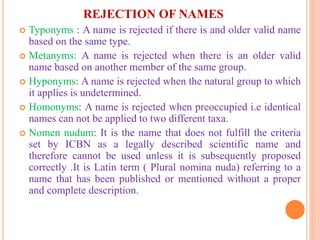
REJECTION OF NAMES
 Typonyms : A name is rejected if there is and older valid name
based on the same type.
 Metanyms: A name is rejected when there is an older valid
name based on another member of the same group.
 Hyponyms: A name is rejected when the natural group to which
it applies is undetermined.
 Homonyms: A name is rejected when preoccupied i.e identical
names can not be applied to two different taxa.
 Nomen nudum: It is the name that does not fulfill the criteria
set by ICBN as a legally described scientific name and
therefore cannot be used unless it is subsequently proposed
correctly .It is Latin term ( Plural nomina nuda) referring to a
name that has been published or mentioned without a proper
and complete description.
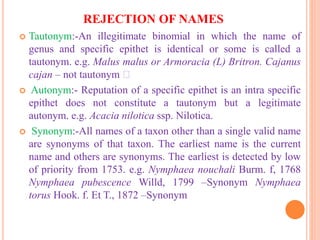
REJECTION OF NAMES
 Tautonym:-An illegitimate binomial in which the name of
genus and specific epithet is identical or some is called a
tautonym. e.g. Malus malus or Armoracia (L) Britron. Cajanus
cajan – not tautonym
 Autonym:- Reputation of a specific epithet is an intra specific
epithet does not constitute a tautonym but a legitimate
autonym. e.g. Acacia nilotica ssp. Nilotica.
 Synonym:-All names of a taxon other than a single valid name
are synonyms of that taxon. The earliest name is the current
name and others are synonyms. The earliest is detected by low
of priority from 1753. e.g. Nymphaea nouchali Burm. f, 1768
Nymphaea pubescence Willd, 1799 –Synonym Nymphaea
torus Hook. f. Et T., 1872 –Synonym
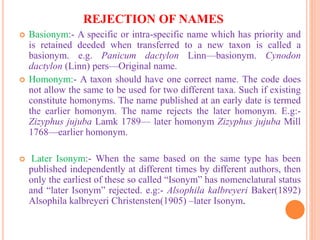
REJECTION OF NAMES
 Basionym:- A specific or intra-specific name which has priority and
is retained deeded when transferred to a new taxon is called a
basionym. e.g. Panicum dactylon Linn—basionym. Cynodon
dactylon (Linn) pers—Original name.
 Homonym:- A taxon should have one correct name. The code does
not allow the same to be used for two different taxa. Such if existing
constitute homonyms. The name published at an early date is termed
the earlier homonym. The name rejects the later homonym. E.g:-
Zizyphus jujuba Lamk 1789— later homonym Zizyphus jujuba Mill
1768—earlier homonym.
 Later Isonym:- When the same based on the same type has been
published independently at different times by different authors, then
only the earliest of these so called “Isonym” has nomenclatural status
and “later Isonym” rejected. e.g:- Alsophila kalbreyeri Baker(1892)
Alsophila kalbreyeri Christensten(1905) –later Isonym.
NAMES OF HYBRIDS
 A hybrid plant is the result of cross pollinating two different of
two different genera(Inter generic), different species(Intra
generic or Inter specific) plant varieties and growing the seed
the mix produces. The plant that grows from that seed
combination is called a hybrid. Commercial cross planting is
done to get some type of valued attribute of each initial variety
into the offspring. Hybrids might be developed for disease
resistance, size of plant, flower, or fruit, increased flowering,
color, taste or any reason a plant might be considered special.
Today, many modern plants sold are hybrids.
 Hybrid Names Fern. Validly published hybrid names are
signified by the symbol “x” and are not italicized. Hybrids at
the generic level are written with an “x” immediately prior to
the genus name, such as in the following example: xElyleymus
colvillensis (Lepage) Barkworth For a hybrid at the species
level an “x” is placed immediately prior to the specific epithet,
as in this example: Quercus xdeamii Trel. (Quercus xdeamii
was found to be a product of the cross Quercus macrocarpa
Michx. x Quercus muehlenbergii Engelm.
ACKNOWLEDGEMENT
 Google for images
 Advanced Plant Taxonomy by A.K. Mondal
 Plant Taxonomy- O. P. Sharma
 A textbook of Botany- Hait, Bhattacharyya &
Ghosh
 Some web pages
 Disclaimer: This presentation has been made in
order to enrich the online domain without any
financial interest. Only interest is the viewers
visit to go through the content.
 THANKS FOR YOUR VISIT

ICN- Author Citation, Rejection of Names and Hybrid Nomenclature of Plants

  • 1.
    PLANT TAXONOMY Welcome to Principlesand Rules ( ICN): Author Citation, Rejection of Names & Names of Hybrids By N. Sannigrahi, Associate Professor, Deptt. Of Botany, Nistarini College, Purulia West Bengal, India
  • 2.
    AUTHOR CITATION  Theapplication of the scientific name irrespective of any kind of living organisms is universal in application. Each scientific name is mostly comprising of three parts-the generic name, the specific epithet along with the name of author or authors designated for the same. But due to different reasons, the author/authors name associated with the scientific name subjected experience some changes as designated by the international authority of this nomenclature-ICBN. The name of a taxon (Unitary, binary or ternary) is incomplete unless the name of the author or authors who first validly published the name , is cited along with it. This helps in verifying the dates of publication and in imparting precision in biological nomenclature.
  • 3.
    AUTHOR CITATION RULES According to ICBN, the name of a taxon is incomplete unless the names of the author or authors who first validly published the name, is cited along with it. This helps in verifying the dates of publication and in imparting precision in biological nomenclature There are several rules followed in this circumstances.  Usually the names are cited in abbreviation forms but never underlined or types in italics, e.g. 1. Vitex Linn. 2. V. trifolia Linn. 3. V. trifolia var. simplicifolia Cham.  If the name of the plant is published by two authors, their names should be linked by means of et. Or an ampersand(&).  If the taxon is garden in origin, then while citing the name it should be ascribed to hort.(hortulanorum) and connected to the name of the author who published it by an ex, e.g. Geaneria dwklarii hort. Ex Hook.
  • 4.
    AUTHOR CITATION  Fora name to be complete, accurate and readily verifiable, it should be accompanied by the name of the author or author who first validly published the name. The names of authors are commonly abbreviated. e.g. Mangifera indica L. (L stands for Linnaeus)  Single author:- The name of a single author follows the name of a species (or any other taxon) when a single author proposed a new name. e.g. Solanum nigrum Linn.  Multiple authors:- 1. Use of et:-when two or more author jointly published the name of a new species their name are linked by et. e.g. Delphinium viscosum Hook. f. Et Thomson.  The author name along with the scientific name make it scientifically correct.
  • 5.
    AUTHOR CITATION  Useof parenthesis:- when the name of a taxon is based basionym, the name of the author of basionym is placed within parenthesis and the author who made the name, is placed outside the parenthesis. e.g. Cynodon dactylon (Linn) Pers  Use of ex:- when a author had proposed a name but was validly published by another author, the word ex should be used as connecting link between the name of authors. e.g. Cerasus cornuta wall. Ex Royle  Use of in:- The names of author are linked using in when a author published a name in a publication of another author. e.g. Carex kashmirensis Clarke in Hook. F.  Use of emend:- The names of two authors are linked using emend when the second author makes some change in the diagnosis or in circumscription of taxon without altering the type. e.g. Phyllanthus Linn. Emend Mull . Use of square brackets:-Square brackets are used to indicate prestarting point author. e.g. Lupinus [Tourne.] Linn
  • 6.
    REJECTION OF NAME-RULES A legitimate name or epithet must not be rejected merely because it is inappropriate or disagreeable, or because another is preferable or better known or because it has lost its original meaning. However, a name must be rejected if it was nomenclatural superfluous when published. Similarly, a name or epithet rejected is replaced by the oldest legitimate name or in a combination by the oldest available epithet in the rank concerned. The following types of name to be illegitimate and unusable like Synonyms, Tautonyms, Typonyms, Metanyms, Homonyms, Hypnonyms, Autonym and Nomen nudum. The all the criteria is based on the rules of the nomenclature as published by the highest authority of nomenclature i.e ICN.
  • 7.
    REJECTION OF NAMES Typonyms : A name is rejected if there is and older valid name based on the same type.  Metanyms: A name is rejected when there is an older valid name based on another member of the same group.  Hyponyms: A name is rejected when the natural group to which it applies is undetermined.  Homonyms: A name is rejected when preoccupied i.e identical names can not be applied to two different taxa.  Nomen nudum: It is the name that does not fulfill the criteria set by ICBN as a legally described scientific name and therefore cannot be used unless it is subsequently proposed correctly .It is Latin term ( Plural nomina nuda) referring to a name that has been published or mentioned without a proper and complete description.
  • 8.
    REJECTION OF NAMES Tautonym:-An illegitimate binomial in which the name of genus and specific epithet is identical or some is called a tautonym. e.g. Malus malus or Armoracia (L) Britron. Cajanus cajan – not tautonym  Autonym:- Reputation of a specific epithet is an intra specific epithet does not constitute a tautonym but a legitimate autonym. e.g. Acacia nilotica ssp. Nilotica.  Synonym:-All names of a taxon other than a single valid name are synonyms of that taxon. The earliest name is the current name and others are synonyms. The earliest is detected by low of priority from 1753. e.g. Nymphaea nouchali Burm. f, 1768 Nymphaea pubescence Willd, 1799 –Synonym Nymphaea torus Hook. f. Et T., 1872 –Synonym
  • 9.
    REJECTION OF NAMES Basionym:- A specific or intra-specific name which has priority and is retained deeded when transferred to a new taxon is called a basionym. e.g. Panicum dactylon Linn—basionym. Cynodon dactylon (Linn) pers—Original name.  Homonym:- A taxon should have one correct name. The code does not allow the same to be used for two different taxa. Such if existing constitute homonyms. The name published at an early date is termed the earlier homonym. The name rejects the later homonym. E.g:- Zizyphus jujuba Lamk 1789— later homonym Zizyphus jujuba Mill 1768—earlier homonym.  Later Isonym:- When the same based on the same type has been published independently at different times by different authors, then only the earliest of these so called “Isonym” has nomenclatural status and “later Isonym” rejected. e.g:- Alsophila kalbreyeri Baker(1892) Alsophila kalbreyeri Christensten(1905) –later Isonym.
  • 10.
    NAMES OF HYBRIDS A hybrid plant is the result of cross pollinating two different of two different genera(Inter generic), different species(Intra generic or Inter specific) plant varieties and growing the seed the mix produces. The plant that grows from that seed combination is called a hybrid. Commercial cross planting is done to get some type of valued attribute of each initial variety into the offspring. Hybrids might be developed for disease resistance, size of plant, flower, or fruit, increased flowering, color, taste or any reason a plant might be considered special. Today, many modern plants sold are hybrids.  Hybrid Names Fern. Validly published hybrid names are signified by the symbol “x” and are not italicized. Hybrids at the generic level are written with an “x” immediately prior to the genus name, such as in the following example: xElyleymus colvillensis (Lepage) Barkworth For a hybrid at the species level an “x” is placed immediately prior to the specific epithet, as in this example: Quercus xdeamii Trel. (Quercus xdeamii was found to be a product of the cross Quercus macrocarpa Michx. x Quercus muehlenbergii Engelm.
  • 11.
    ACKNOWLEDGEMENT  Google forimages  Advanced Plant Taxonomy by A.K. Mondal  Plant Taxonomy- O. P. Sharma  A textbook of Botany- Hait, Bhattacharyya & Ghosh  Some web pages  Disclaimer: This presentation has been made in order to enrich the online domain without any financial interest. Only interest is the viewers visit to go through the content.  THANKS FOR YOUR VISIT