Download the full version and explore a variety of test banks
or solution manuals at https://testbankbell.com
Auditing Cases An Interactive Learning Approach
Beasley 5th Edition Solutions Manual
_____ Tap the link below to start your download _____
http://testbankbell.com/product/auditing-cases-an-
interactive-learning-approach-beasley-5th-edition-solutions-
manual/
Find test banks or solution manuals at testbankbell.com today!
Here are some recommended products for you. Click the link to
download, or explore more at testbankbell.com
Auditing Cases An Interactive Learning Approach 6th
Edition Beasley Solutions Manual
http://testbankbell.com/product/auditing-cases-an-interactive-
learning-approach-6th-edition-beasley-solutions-manual/
Solution Manual for Thermodynamics: An Interactive
Approach Subrata Bhattacharjee
http://testbankbell.com/product/solution-manual-for-thermodynamics-an-
interactive-approach-subrata-bhattacharjee/
Auditing And Assurance Services An Integrated Approach
15th Edition Arens Solutions Manual
http://testbankbell.com/product/auditing-and-assurance-services-an-
integrated-approach-15th-edition-arens-solutions-manual/
Test Bank for Cybersecurity The Essential Body Of
Knowledge 1st Edition Dan Shoemaker Download
http://testbankbell.com/product/test-bank-for-cybersecurity-the-
essential-body-of-knowledge-1st-edition-dan-shoemaker-download/
Test Bank for Public Speaking: Finding Your Voice, 10/E,
Michael Osborn, Suzanne Osborn, Randall Osborn Kathleen J.
Turner
http://testbankbell.com/product/test-bank-for-public-speaking-finding-
your-voice-10-e-michael-osborn-suzanne-osborn-randall-osborn-kathleen-
j-turner/
Children and Their Development Kail 7th Edition Test Bank
http://testbankbell.com/product/children-and-their-development-
kail-7th-edition-test-bank/
Test Bank for Persuasion Social Influence and Compliance
Gaining 5th Edition Robert H Gass Download
http://testbankbell.com/product/test-bank-for-persuasion-social-
influence-and-compliance-gaining-5th-edition-robert-h-gass-download/
Test Bank for Macroeconomics for Life: Smart Choices for
All?2nd Edition Avi J. Cohen
http://testbankbell.com/product/test-bank-for-macroeconomics-for-life-
smart-choices-for-all2nd-edition-avi-j-cohen/
Solution Manual for Nutrition: From Science to You, 4th
Edition, Joan Salge Blake, Kathy D. Munoz Stella Volpe
http://testbankbell.com/product/solution-manual-for-nutrition-from-
science-to-you-4th-edition-joan-salge-blake-kathy-d-munoz-stella-
volpe/
Test Bank for Human Anatomy and Physiology Laboratory
Manual, Cat version, 13th Edition, Elaine N. Marieb Lori
A. Smith
http://testbankbell.com/product/test-bank-for-human-anatomy-and-
physiology-laboratory-manual-cat-version-13th-edition-elaine-n-marieb-
lori-a-smith/
Auditing Cases An Interactive Learning Approach
Beasley 5th
Full chapter download at: https://testbankbell.com/product/auditing-cases-an-interactive-learning-approach-
beasley-5th-edition-solutions-manual/
Case 1.1
ocean Manufacturing, Inc.
The new client acceptance Decision
Mark S. Beasley · Frank A. Buckless · Steven M. Glover · Douglas F. Prawitt
instruCtional objeCtives
[1] To help students understand the process of
considering a new prospective audit client and
the factors that auditors commonly consider in
making the acceptance decision.
[2] To give students experience in computing and
interpreting preliminary analytical procedures
commonly used in obtaining an understanding
of a prospective client during the client
acceptance decision process.
[3] To raise issues relating to auditor independence
in the context of client acceptance, both in terms
of financial interests and the provision of
non-audit services.
[4] To illustrate the subjective and sometimes
difficult nature of the judgments involved in the
client acceptance decision, and to give students
the opportunity to justify a recommendation on
client acceptance in the presence of both
significant positive and negative factors.
[5] To help students understand how information
gathered in the client acceptance process can
help the auditor in planning the audit if the
client is accepted.
KEY FACTS
 The student takes on the role of a newly promoted audit manager recently given the task
of consideringfactors and making a recommendation with respect to the acceptance of a new
prospective client. The request to consider the engagement was received two weeks past the
client’s fiscal year-end.
 The accounting firm, Barnes and Fischer, LLP, is a mediumsized national firm withover 6,000
professionals on the payroll. The firm mainly provides auditing and tax services, but has been
trying with some success to build the information systems consulting side of the business over
the past few years. Most of the clients in the local office that is considering the acceptance of
Ocean Manufacturing, Inc. are in the healthcare services industry.
 The prospective client, Ocean Manufacturing, is a medium-sized manufacturer of small home
appliances, and is planning an initial public offering (IPO) in the next two years. The company
has recently decided to terminate its relationship with its current auditor. The partner is intrigued
with the idea of having a client in the home appliance industry. She believes the engagement
may present an excellent opportunityfor Barnes and Fischer to enter a new market.
 The case givesbrief background information on the home appliances industry and Ocean’s
business environment, management team, selected financial statement accounts, and internal
controls. Summary information is also provided on the predecessor auditor, independence
issues, and client background checks. Ocean’s financial statements are also included, together
with some industry ratios.
 Ocean’s management reluctantly gives Barnes and Fischer permission to contact the predecessor
The case was prepared by Mark S. Beasley, Ph.D. and Frank A. Buckless, Ph.D. of North Carolina State University and Steven M. Glover,
Ph.D.and Douglas F. Prawitt, Ph.D.of Brigham Young University, asa basis for class discussion. Ocean Manufacturing isa fictitious company.
All characters and names represented are fictitious; any similarity to existing companies or persons is purely coincidental.
copyright © 2012 by pearson education, Inc., upper saddle river, nJ 07458 3
section 1: client acceptance case 1.1: ocean Manufacturing, Inc.
InsTrucTor resource Manual — Do noT copy or reDIsTrIbuTe
4 InsTrucTor resource Manual — Do noT copy or reDIsTrIbuTe 4
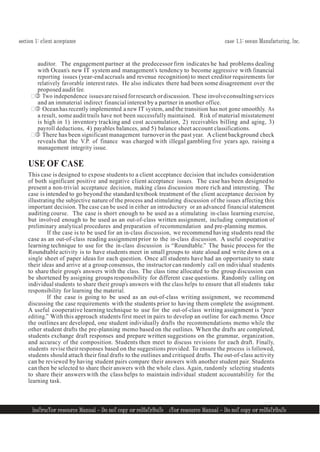
auditor. The engagement partner at the predecessor firm indicates he had problems dealing
with Ocean’s new IT system and management’s tendency to become aggressive with financial
reporting issues (year-end accruals and revenue recognition) to meet creditor requirements for
relatively favorable interest rates. He also indicates there had been some disagreement over the
proposed audit fee.
 Two independence issuesare raised forresearch ordiscussion. These involveconsultingservices
and an immaterial indirect financial interest by a partner in another office.
 Oceanhas recently implemented a new IT system, and the transition has not gone smoothly. As
a result, someaudit trails have not been successfully maintained. Risk of material misstatement
is high in 1) inventory tracking and cost accumulation, 2) receivables billing and aging, 3)
payroll deductions, 4) payables balances, and 5) balance sheet account classifications.
 There has been significant management turnover in the past year. A client background check
reveals that the V.P. of finance was charged with illegal gambling five years ago, raising a
management integrity issue.
USE OF CASE
This case is designed to expose students to a client acceptance decision that includes consideration
of both significant positive and negative client acceptance issues. The case has been designed to
present a non-trivial acceptance decision, making class discussion more rich and interesting. The
case is intended to go beyond the standard textbook treatment of the client acceptance decision by
illustrating the subjective nature of the process and stimulating discussion of the issues affecting this
important decision. The case can be used in either an introductory or an advanced financial statement
auditing course. The case is short enough to be used as a stimulating in-class learning exercise,
but involved enough to be used as an out-of-class written assignment, including computation of
preliminary analytical procedures and preparation of recommendation and pre-planning memos.
If the case is to be used for an in-class discussion, we recommend having students read the
case as an out-of-class reading assignment prior to the in-class discussion. A useful cooperative
learning technique to use for the in-class discussion is “Roundtable.” The basic process for the
Roundtable activity is to have students meet in small groups to state aloud and write down on a
single sheet of paper ideas for each question. Once all students have had an opportunity to state
their ideas and arrive at a group consensus, the instructor can randomly call on individual students
to share their group’s answers with the class. The class time allocated to the group discussion can
be shortened by assigning groups responsibility for different case questions. Randomly calling on
individual students to share their group’s answers with the class helps to ensure that all students take
responsibility for learning the material.
If the case is going to be used as an out-of-class writing assignment, we recommend
discussing the case requirements with the students prior to having them complete the assignment.
A useful cooperative learning technique to use for the out-of-class writing assignment is “peer
editing.” With this approach students first meet in pairs to develop an outline for each memo. Once
the outlines are developed, one student individually drafts the recommendations memo while the
other student drafts the pre-planning memo based on the outlines. When the drafts are completed,
students exchange draft responses and prepare written suggestions on the grammar, organization,
and accuracy of the composition. Students then meet to discuss revisions for each draft. Finally,
students revise their responses based on the suggestions provided. To ensure the process is followed,
students should attach their final drafts to the outlines and critiqued drafts. The out-of-class activity
can be reviewed by having student pairs compare their answers with another student pair. Students
can then be selected to share their answers with the whole class. Again, randomly selecting students
to share their answers with the class helps to maintain individual student accountability for the
learning task.
section 1: client acceptance case 1.1: ocean Manufacturing, Inc.
InsTrucTor resource Manual — Do noT copy or reDIsTrIbuTe
5 InsTrucTor resource Manual — Do noT copy or reDIsTrIbuTe 5
PROFESSIONAL STANDARDS
References to AU sections have been updated to reflect the new codification of ASB clarity standards.
PCAOB standards are referenced by standard number. Relevant professional standards for this
assignment are:
AICPA ASB Standards: AU 210, “Terms of Engagement,” AU 300, “Planning an Audit,” AU 510,
“Opening Balances --Initial Audit Engagements, Including Reaudit Engagements,” ET Section 101
“Independence,” ET Section 301, “Confidential Client Information,” and QC Section 10, “A Firm's
System of Quality Control.”
PCAOB Standards: AS9, "Audit Planning.”
Questions and suGGested solutions
NOTE: The underlying attendance, facts, numbers, and suggested solutions have changed in the
5th edition to address the availability of solutions of prior editions for sale on the internet.
[1] The client acceptance process can be quite complex. Identify five procedures an auditor should
perform in determining whether to accept a client. Which of these five are required by auditing
standards?
There are many activities that are reasonable for an auditor to perform in making the client
acceptance decision. Thus, students’ answers will vary greatly. Relevant standards (see
prior listing) require that the audit firm establish quality control procedures to determine
whether a client should be accepted. The audit firm also must determine its independence
with respect to the prospective client, evaluate its ability to adequately service the
prospective client, evaluate the integrity of management, and attempt to communicate with
the predecessorauditor after obtaining permission from the prospective client to discuss
confidential matters. Once these steps are taken the client and auditor must come to an
agreement on various issues such as the nature and limitations of the specific services to
be rendered, the expected cooperation of client personnel, the anticipated audit start and
end dates, and an estimated audit fee. Below are some of the more common and important
activities (those activities that are specifically required by relevant standards begin with an
asterisk):
a)
b)
c)
d)
e)
f)
g)
h)
section 1: client acceptance case 1.1: ocean Manufacturing, Inc.
InsTrucTor resource Manual — Do noT copy or reDIsTrIbuTe
6 InsTrucTor resource Manual — Do noT copy or reDIsTrIbuTe 6
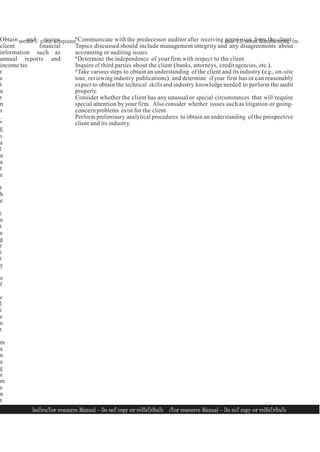
Obtain and review
client financial
information such as
annual reports and
income tax
r
e
t
u
r
n
s
.
*
E
v
a
l
u
a
t
e
t
h
e
i
n
t
e
g
r
i
t
y
o
f
c
l
i
e
n
t
m
a
n
a
g
e
m
e
n
t
.
*Communicate with the predecessor auditor after receiving permission from the client.
Topics discussed should include management integrity and any disagreements about
accounting or auditing issues.
*Determine the independence of your firm with respect to the client.
Inquire of third parties about the client (banks, attorneys, credit agencies, etc.).
*Take various steps to obtain an understanding of the client and its industry (e.g., on-site
tour, reviewing industry publications), and determine if your firm has or can reasonably
expect to obtain the technical skills and industry knowledge needed to perform the audit
properly.
Consider whether the client has any unusual or special circumstances that will require
special attention by your firm. Also consider whether issues such as litigation or going-
concernproblems exist for the client.
Perform preliminary analytical procedures to obtain an understanding of the prospective
client and its industry.
section 1: client acceptance case 1.1: ocean Manufacturing, Inc.
InsTrucTor resource Manual — Do noT copy or reDIsTrIbuTe
7 InsTrucTor resource Manual — Do noT copy or reDIsTrIbuTe 7
i)
j)
k)
l)
Evaluate the opportunities and business risks posed by the client to your auditing firm.
Obtain an agreement from management that it acknowledges and understands its
responsibility for selecting the appropriate financial reporting framework, establishing
and maintaining internal control, and providing access and information to the auditor.
Determinewhether the client is using an acceptable accounting framework.
Determine if management is going to impose a limitation on the scope of the auditor’s
work.
[2] Using Ocean’s financial information, calculate relevant preliminary analytical procedures to
obtain a better understanding of the prospective client and to determine how Ocean is doing
financially. Compare Ocean’s ratios to the industry ratios provided. Identify any major
differences and briefly list any concerns that arise from this analysis.
The following are various ratios computed from Ocean’s financial statements. This question
is intentionally vague so that students will have to refer to their auditing textbook for
guidance on the types of analytical procedures useful for gaining an understanding of the
client. The instructor can make the assignment more specific by requiring specific ratios
to be computed. The instructor could also require preparation of horizontal and vertical
analyses on the financial statements.
Several interesting trends should be noted in the ratios. Return ratios are improving,
as is inventory turnover (which is poor relative to the industry), but accounts receivable
turnover, while relatively good, is deteriorating.
2011 2010 2009
ROE 8.94% 7.11% 6.28%
ROA 4.54% 3.77% 3.39%
Asset to equity 1.97 1.88 1.85
Accounts Receivable Turnover 11.69 13.11 14.02
Average Collection Period 31.23 27.85 26.03
Inventory Turnover 6.08 4.51 3.48
Days in Inventory 59.98 80.89 104.99
Debt Ratio 0.49 0.47 0.46
Debt to Equity 0.97 0.88 0.85
Times interest earned 4.70 4.24 6.23
Current ratio 1.85 1.92 1.69
Profit Margin (on operating income) 5.5% 6.0% 4.7%
Industry Ratios for Comparison:
2011 2010
ROE 20.33% 26.22%
ROA 6.62% 8.10%
Asset to equity 3.30 2.82
Accounts Receivable Turnover 7.49 6.96
Average Collection Period 41.25 44.35
Inventory Turnover 8.09 6.90
Days in Inventory 38.16 43.86
Debt to Equity 2.38 1.90
Times interest earned 1.62 2.37
Current ratio 1.29 1.44
section 1: client acceptance case 1.1: ocean Manufacturing, Inc.
InsTrucTor resource Manual — Do noT copy or reDIsTrIbuTe
8 InsTrucTor resource Manual — Do noT copy or reDIsTrIbuTe 8
Profit Margin (on operating income) 10.58% 10.82%
section 1: client acceptance case 1.1: ocean Manufacturing, Inc.
InsTrucTor resource Manual — Do noT copy or reDIsTrIbuTe
9 InsTrucTor resource Manual — Do noT copy or reDIsTrIbuTe 9
Major Differences to be noted:
a)
b)
c)
d)
e)
Ocean has a low return on equity relative to the industry.
Ocean has a low return on assets relative to the industry.
Ocean’s accounts receivable turnover is high relative to the industry.
Ocean’s inventory turnover is low relative to the industry.
Ocean’s profit margin is low relative to the industry.
[3] What nonfinancial matters should be considered before accepting Ocean as a client? How
important are these issues to the client acceptance decision? Why?
Relevant non-financial matters include the following:
a)
b)
c)
d)
e)
f)
g)
h)
i)
section 1: client acceptance case 1.1: ocean Manufacturing, Inc.
InsTrucTor resource Manual — Do noT copy or reDIsTrIbuTe
1
0
InsTrucTor resource Manual — Do noT copy or reDIsTrIbuTe 1
0
Recent management
turnover. This matter
may or may not pose a
potential problemto the
audit, but may be a sign
of other problems that
should be investigated.
The controller is very
new and has little
relevant experience,
which may make audit
work slower and more
difficult.
High auditor turnover
rate. This should be a
red flag to the auditors.
The auditors should
look into why Ocean
has employed so many
different auditors in so
few years. Complicated
new computer system.
The complicated system
poses a couple of
problems for the
auditors. First, the
auditors may have
difficulty getting the
information they need
from the system, and a
question arises
regarding auditability.
Second, inadequate
controls over the new
system may increase the
amount of substantive
testing required. Client
hesitant to allow new
auditor to speak with
previous auditor.
Anytime a client is
hesitantor unwilling to
allow new auditors to
communicate with the
previous auditor, a
red flag should be raised
in the mind of the
successor auditor, and a
careful examination of
the issue, including
consideration of
management integrity,
should ensue.
Illegal gambling
incident. This is a
matter of concern
because it raises the
management integrity
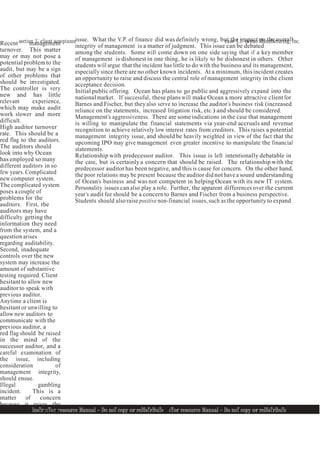
issue. What the V.P. of finance did was definitely wrong, but the impact on the overall
integrity of management is a matter of judgment. This issue can be debated
among the students. Some will come down on one side saying that if a key member
of management is dishonest in one thing, he is likely to be dishonest in others. Other
students will argue that the incident has little to do with the business and its management,
especially since there are no other known incidents. At a minimum, this incident creates
an opportunity to raise and discuss the central role of management integrity in the client
acceptance decision.
Initial public offering. Ocean has plans to go public and aggressively expand into the
national market. If successful, these plans will make Ocean a more attractive client for
Barnes and Fischer, but they also serve to increase the auditor’s business risk (increased
reliance on the statements, increased litigation risk, etc.) and should be considered.
Management’s aggressiveness. There are some indications in the case that management
is willing to manipulate the financial statements via year-end accruals and revenue
recognition to achieve relatively low interest rates from creditors. This raises a potential
management integrity issue, and should be heavily weighted in view of the fact that the
upcoming IPO may give management even greater incentive to manipulate the financial
statements.
Relationship with predecessor auditor. This issue is left intentionally debatable in
the case, but is certainlya concern that should be raised. The relationship with the
predecessor auditor has been negative, and this is cause for concern. On the other hand,
the poor relations may be present because the auditor did not have a sound understanding
of Ocean’s business and was not competent in helping Ocean with its new IT system.
Personality issues can also play a role. Further, the apparent differences over the current
year’s audit fee should be a concernto Barnes and Fischer from a business perspective.
Students should also raise positive non-financial issues, such as the opportunity to expand
section 1: client acceptance case 1.1: ocean Manufacturing, Inc.
InsTrucTor resource Manual — Do noT copy or reDIsTrIbuTe
1
1
InsTrucTor resource Manual — Do noT copy or reDIsTrIbuTe 1
1
[4] [a]
into a new industry and the opportunity to provide significant consulting services
relating to Ocean’s new IT system as well as to Ocean’s internal controls. The company
has a relatively longand stable history in the small appliances industry. Further, Ocean
is well positioned in the small appliances market. With its plans for going public and
expanding nationally, the company may become an even larger and more attractive
client. Some students will think the case represents a clear non-acceptance situation
due to the negative factors listed above. The instructor can provide some perspective
by pointing out that no prospective client comes without some concerns and problems.
Ocean certainly presents some issues and concerns, but would likely be accepted by most
auditing firms. (Two different partners from major firms commented in presenting this
case to graduate auditing courses that the level of risk presented by Ocean Mfg. was fairly
typical of many of the firm’s clients. In our experience, most students indicate that they
would not accept Ocean Mfg. as a client. This case provides an opportunity for students
to better understand the subjective issues and risks that auditors face in practice.).
Ocean wants Barnes and Fischer to aid in developing and improving its IT system. What
are the advantages and disadvantages of having the same CPA firm provide both auditing and
consulting services? Given current auditor independence rules, will Barnes and Fischer be able
to help Ocean with its IT system and still provide a financial statement audit? Support your
conclusion with appropriate citations to authoritative standards if your instructor indicates
that you should do so.
The issue of providing both systems consulting and auditing services to the same client has
been a topic of considerable debate in the profession. Some parties argue that providing
both consulting and auditing services to the same client may impair auditor objectivity. On
the other hand, manyin the profession argue that a great deal of efficiency is gained by the
same firm providing both kinds of services because the firm can leverage the auditor’s deep
understanding of the client and its information system in providing additional services. For
public companies, which are subject to the Sarbanes-Oxley Act of 2002, the auditor is not
permitted to provide certain types of consulting services for clients. Financial information
systems design and implementation is not an approved consulting service under Sarbanes-
Oxley. Until it executes its planned initial public offering, Ocean is a privately-held company
and is thus subject to AICPA independence requirements. The AICPA Code of Professional
Conduct indicates that systems implementation is an acceptable nonattest service to
provide to audit clients under certain conditions. For example, while a CPA firm may
assist an audit client in implementing a computer software package, it may not “design” the
financial information system by creating or changing the computer source code underlying
the system. Students typically have strong views on this issue. Some argue that objectivity
would likely be impaired, and others argue that the objectivity issue can be dealt with and
that the efficiencies gained outweigh the potentialcosts.
[b] Asindicated in the case, one of the partners in another office has invested in a venture capital
fund that owns shares of Ocean common stock. Would this situation constitute a violation of
independence according to the AICPA Code of Professional Conduct? Why or why not?
According to Rule 101 of the AICPA Code of Professional Conduct, materiality is not to be
considered in the case of a direct financial interest—no direct financial interests on the part of
the auditor are tolerated. However, ifthe financial interest is indirect, as in the case of a mutual
fund or venture capital fund investment, materiality is considered. It is fairly clear from the
case that the partner’s indirect financial interest is immaterial and thus does not constitute a
violation of Rule 101. The instructor may wish to point out that no individual who is on the
section 1: client acceptance case 1.1: ocean Manufacturing, Inc.
InsTrucTor resource Manual — Do noT copy or reDIsTrIbuTe
1
2
InsTrucTor resource Manual — Do noT copy or reDIsTrIbuTe 1
2
engagement team, who is a partner or manager not on the attest engagement team but who
provides nonattest services to that client, who is a partner who works in the same office as the
section 1: client acceptance case 1.1: ocean Manufacturing, Inc.
InsTrucTor resource Manual — Do noT copy or reDIsTrIbuTe
1
3
InsTrucTor resource Manual — Do noT copy or reDIsTrIbuTe 1
3
attest engagement’s lead partner, or who is a position to influence the engagement, can hold a
direct financial interest in the client. However, even the partner in charge of the Ocean audit
would be permitted to hold an immaterial indirect financial interestin Ocean.
[5] [a] Prepare a memo to the partner making a recommendation as to whether Barnes and Fischer
should or should not accept Ocean Manufacturing, Inc. as an audit client. Carefully justify
your position in light of the information in the case. Include consideration of reasons both for
and against acceptance and be sure to address both financial and nonfinancial issues to justify
your recommendation.
The memo should be professional in appearance and in substance, and should be well written.
The memo should include the points brought out in the preceding questions, which are
designed to help prepare the students to make reasoned and informed recommendations.
The memo should also include a clear recommendation as to whether the client should be
accepted. There is no right or wrong recommendation as long as a student demonstrates s/
he weighed the issues and made a reasonable decision based on the information provided.
However, in our experience, students tend to be much more negative about the prospect
of accepting Ocean as an audit client than are auditing professionals. Most of our students
tend to reject Ocean as a client; audit partners visiting our classrooms, especially those
partners from non-big 4 firms, often indicate that Ocean is similar to many of their own
clients. Students tend to want an ideal client; audit professionals have to make a living in
the real world, which includes dealing with clients that have some issues and that present
some risks. Emphasize that the client acceptance decision is a verysubjective one that is
ultimately determined by professional judgment.
[b] Prepare a separate memo to the partner briefly listing and discussing the five or six most
important factors or risk areas that will likely affect how the audit is conducted if the Ocean
engagement is accepted. Be sure to indicate specific ways in which the audit firm should tailor
its approach based onthe factors you identify.
This pre-planning memo should include many of the same issues considered in the acceptance
decision. However, this memo should then consider the implications of these issues for how
the audit will be conducted assuming the client is accepted. The case discusses many issues
that would have potentially important implications for conducting the audit. Some of the
more important implications are listed below.
a)
b)
c)
d)
e)
section 1: client acceptance case 1.1: ocean Manufacturing, Inc.
InsTrucTor resource Manual — Do noT copy or reDIsTrIbuTe
1
1
InsTrucTor resource Manual — Do noT copy or reDIsTrIbuTe 1
1
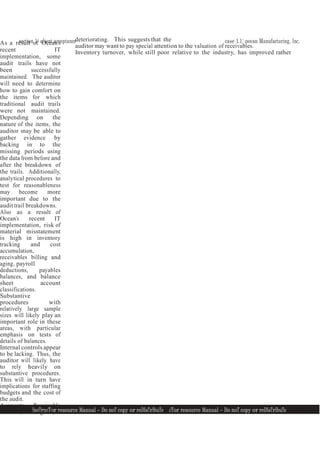
As a result of Ocean’s
recent IT
implementation, some
audit trails have not
been successfully
maintained. The auditor
will need to determine
how to gain comfort on
the items for which
traditional audit trails
were not maintained.
Depending on the
nature of the items, the
auditor may be able to
gather evidence by
backing in to the
missing periods using
the data from before and
after the breakdown of
the trails. Additionally,
analytical procedures to
test for reasonableness
may become more
important due to the
audit trail breakdowns.
Also as a result of
Ocean’s recent IT
implementation, risk of
material misstatement
is high in inventory
tracking and cost
accumulation,
receivables billing and
aging, payroll
deductions, payables
balances, and balance
sheet account
classifications.
Substantive
procedures with
relatively large sample
sizes will likely play an
important role in these
areas, with particular
emphasis on tests of
details of balances.
Internal controls appear
to be lacking. Thus, the
auditor will likely have
to rely heavily on
substantive procedures.
This will in turn have
implications for staffing
budgets and the cost of
the audit.
Accounts Receivable
turnover, while good, is
deteriorating. This suggests that the
auditor may want to pay special attention to the valuation of receivables.
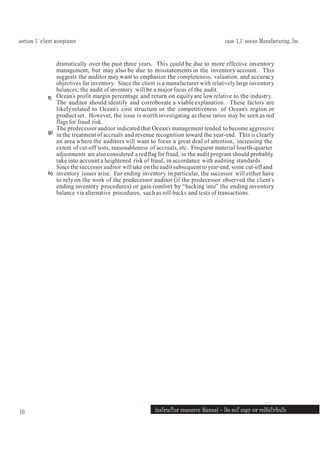
Inventory turnover, while still poor relative to the industry, has improved rather
section 1: client acceptance case 1.1: ocean Manufacturing, Inc.
InsTrucTor resource Manual — Do noT copy or reDIsTrIbuTe
10
f)
g)
h)
dramatically over the past three years. This could be due to more effective inventory
management, but may also be due to misstatements in the inventory account. This
suggests the auditor may want to emphasize the completeness, valuation, and accuracy
objectives for inventory. Since the client is a manufacturer with relatively large inventory
balances, the audit of inventory will be a majorfocus of the audit.
Ocean’s profit margin percentage and return on equity are low relative to the industry.
The auditor should identify and corroborate a viable explanation. These factors are
likely related to Ocean’s cost structure or the competitiveness of Ocean’s region or
product set. However, the issue is worth investigating as these ratios may be seen as red
flags for fraud risk.
The predecessor auditor indicated that Ocean’s management tended to become aggressive
in the treatment of accruals and revenue recognition toward the year-end. This is clearly
an area where the auditors will want to focus a great deal of attention, increasing the
extent of cut-off tests, reasonableness of accruals, etc. Frequent material fourth-quarter
adjustments are also considered a red flag for fraud, so the audit program should probably
take into accounta heightened risk of fraud, in accordance with auditing standards.
Since the successor auditor will take onthe audit subsequent to year-end, some cut-off and
inventory issues arise. For ending inventory in particular, the successor will either have
to relyon the work of the predecessor auditor (if the predecessor observed the client’s
ending inventory procedures) or gain comfort by “backing into” the ending inventory
balance via alternative procedures, such as roll-backs and tests of transactions.
Exploring the Variety of Random
Documents with Different Content
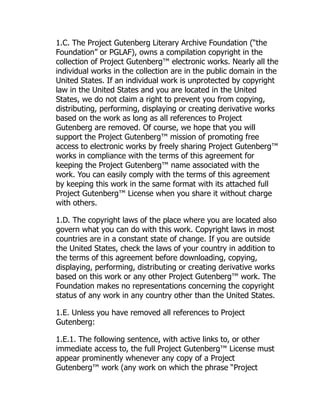
1.C. The Project Gutenberg Literary Archive Foundation (“the
Foundation” or PGLAF), owns a compilation copyright in the
collection of Project Gutenberg™ electronic works. Nearly all the
individual works in the collection are in the public domain in the
United States. If an individual work is unprotected by copyright
law in the United States and you are located in the United
States, we do not claim a right to prevent you from copying,
distributing, performing, displaying or creating derivative works
based on the work as long as all references to Project
Gutenberg are removed. Of course, we hope that you will
support the Project Gutenberg™ mission of promoting free
access to electronic works by freely sharing Project Gutenberg™
works in compliance with the terms of this agreement for
keeping the Project Gutenberg™ name associated with the
work. You can easily comply with the terms of this agreement
by keeping this work in the same format with its attached full
Project Gutenberg™ License when you share it without charge
with others.
1.D. The copyright laws of the place where you are located also
govern what you can do with this work. Copyright laws in most
countries are in a constant state of change. If you are outside
the United States, check the laws of your country in addition to
the terms of this agreement before downloading, copying,
displaying, performing, distributing or creating derivative works
based on this work or any other Project Gutenberg™ work. The
Foundation makes no representations concerning the copyright
status of any work in any country other than the United States.
1.E. Unless you have removed all references to Project
Gutenberg:
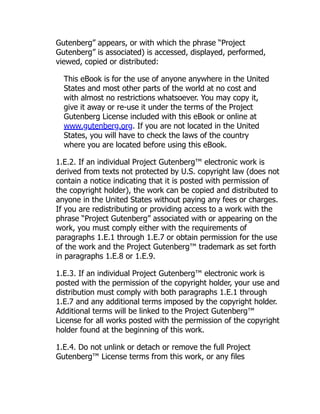
1.E.1. The following sentence, with active links to, or other
immediate access to, the full Project Gutenberg™ License must
appear prominently whenever any copy of a Project
Gutenberg™ work (any work on which the phrase “Project
Gutenberg” appears, or with which the phrase “Project
Gutenberg” is associated) is accessed, displayed, performed,
viewed, copied or distributed:
This eBook is for the use of anyone anywhere in the United
States and most other parts of the world at no cost and
with almost no restrictions whatsoever. You may copy it,
give it away or re-use it under the terms of the Project
Gutenberg License included with this eBook or online at
www.gutenberg.org. If you are not located in the United
States, you will have to check the laws of the country
where you are located before using this eBook.
1.E.2. If an individual Project Gutenberg™ electronic work is
derived from texts not protected by U.S. copyright law (does not
contain a notice indicating that it is posted with permission of
the copyright holder), the work can be copied and distributed to
anyone in the United States without paying any fees or charges.
If you are redistributing or providing access to a work with the
phrase “Project Gutenberg” associated with or appearing on the
work, you must comply either with the requirements of
paragraphs 1.E.1 through 1.E.7 or obtain permission for the use
of the work and the Project Gutenberg™ trademark as set forth
in paragraphs 1.E.8 or 1.E.9.
1.E.3. If an individual Project Gutenberg™ electronic work is
posted with the permission of the copyright holder, your use and
distribution must comply with both paragraphs 1.E.1 through
1.E.7 and any additional terms imposed by the copyright holder.
Additional terms will be linked to the Project Gutenberg™
License for all works posted with the permission of the copyright
holder found at the beginning of this work.
1.E.4. Do not unlink or detach or remove the full Project
Gutenberg™ License terms from this work, or any files
containing a part of this work or any other work associated with
Project Gutenberg™.
1.E.5. Do not copy, display, perform, distribute or redistribute
this electronic work, or any part of this electronic work, without
prominently displaying the sentence set forth in paragraph 1.E.1
with active links or immediate access to the full terms of the
Project Gutenberg™ License.
1.E.6. You may convert to and distribute this work in any binary,
compressed, marked up, nonproprietary or proprietary form,
including any word processing or hypertext form. However, if
you provide access to or distribute copies of a Project
Gutenberg™ work in a format other than “Plain Vanilla ASCII” or
other format used in the official version posted on the official
Project Gutenberg™ website (www.gutenberg.org), you must,
at no additional cost, fee or expense to the user, provide a copy,
a means of exporting a copy, or a means of obtaining a copy
upon request, of the work in its original “Plain Vanilla ASCII” or
other form. Any alternate format must include the full Project
Gutenberg™ License as specified in paragraph 1.E.1.
1.E.7. Do not charge a fee for access to, viewing, displaying,
performing, copying or distributing any Project Gutenberg™
works unless you comply with paragraph 1.E.8 or 1.E.9.
1.E.8. You may charge a reasonable fee for copies of or
providing access to or distributing Project Gutenberg™
electronic works provided that:
• You pay a royalty fee of 20% of the gross profits you derive
from the use of Project Gutenberg™ works calculated using the
method you already use to calculate your applicable taxes. The
fee is owed to the owner of the Project Gutenberg™ trademark,
but he has agreed to donate royalties under this paragraph to
the Project Gutenberg Literary Archive Foundation. Royalty
payments must be paid within 60 days following each date on
which you prepare (or are legally required to prepare) your
periodic tax returns. Royalty payments should be clearly marked
as such and sent to the Project Gutenberg Literary Archive
Foundation at the address specified in Section 4, “Information
about donations to the Project Gutenberg Literary Archive
Foundation.”
• You provide a full refund of any money paid by a user who
notifies you in writing (or by e-mail) within 30 days of receipt
that s/he does not agree to the terms of the full Project
Gutenberg™ License. You must require such a user to return or
destroy all copies of the works possessed in a physical medium
and discontinue all use of and all access to other copies of
Project Gutenberg™ works.
• You provide, in accordance with paragraph 1.F.3, a full refund of
any money paid for a work or a replacement copy, if a defect in
the electronic work is discovered and reported to you within 90
days of receipt of the work.
• You comply with all other terms of this agreement for free
distribution of Project Gutenberg™ works.
1.E.9. If you wish to charge a fee or distribute a Project
Gutenberg™ electronic work or group of works on different
terms than are set forth in this agreement, you must obtain
permission in writing from the Project Gutenberg Literary
Archive Foundation, the manager of the Project Gutenberg™
trademark. Contact the Foundation as set forth in Section 3
below.
1.F.
1.F.1. Project Gutenberg volunteers and employees expend
considerable effort to identify, do copyright research on,
transcribe and proofread works not protected by U.S. copyright
law in creating the Project Gutenberg™ collection. Despite these
efforts, Project Gutenberg™ electronic works, and the medium
on which they may be stored, may contain “Defects,” such as,
but not limited to, incomplete, inaccurate or corrupt data,
transcription errors, a copyright or other intellectual property
infringement, a defective or damaged disk or other medium, a
computer virus, or computer codes that damage or cannot be
read by your equipment.
1.F.2. LIMITED WARRANTY, DISCLAIMER OF DAMAGES - Except
for the “Right of Replacement or Refund” described in
paragraph 1.F.3, the Project Gutenberg Literary Archive
Foundation, the owner of the Project Gutenberg™ trademark,
and any other party distributing a Project Gutenberg™ electronic
work under this agreement, disclaim all liability to you for
damages, costs and expenses, including legal fees. YOU AGREE
THAT YOU HAVE NO REMEDIES FOR NEGLIGENCE, STRICT
LIABILITY, BREACH OF WARRANTY OR BREACH OF CONTRACT
EXCEPT THOSE PROVIDED IN PARAGRAPH 1.F.3. YOU AGREE
THAT THE FOUNDATION, THE TRADEMARK OWNER, AND ANY
DISTRIBUTOR UNDER THIS AGREEMENT WILL NOT BE LIABLE
TO YOU FOR ACTUAL, DIRECT, INDIRECT, CONSEQUENTIAL,
PUNITIVE OR INCIDENTAL DAMAGES EVEN IF YOU GIVE
NOTICE OF THE POSSIBILITY OF SUCH DAMAGE.
1.F.3. LIMITED RIGHT OF REPLACEMENT OR REFUND - If you
discover a defect in this electronic work within 90 days of
receiving it, you can receive a refund of the money (if any) you
paid for it by sending a written explanation to the person you
received the work from. If you received the work on a physical
medium, you must return the medium with your written
explanation. The person or entity that provided you with the
defective work may elect to provide a replacement copy in lieu
of a refund. If you received the work electronically, the person
or entity providing it to you may choose to give you a second
opportunity to receive the work electronically in lieu of a refund.
If the second copy is also defective, you may demand a refund
in writing without further opportunities to fix the problem.
1.F.4. Except for the limited right of replacement or refund set
forth in paragraph 1.F.3, this work is provided to you ‘AS-IS’,
WITH NO OTHER WARRANTIES OF ANY KIND, EXPRESS OR
IMPLIED, INCLUDING BUT NOT LIMITED TO WARRANTIES OF
MERCHANTABILITY OR FITNESS FOR ANY PURPOSE.
1.F.5. Some states do not allow disclaimers of certain implied
warranties or the exclusion or limitation of certain types of
damages. If any disclaimer or limitation set forth in this
agreement violates the law of the state applicable to this
agreement, the agreement shall be interpreted to make the
maximum disclaimer or limitation permitted by the applicable
state law. The invalidity or unenforceability of any provision of
this agreement shall not void the remaining provisions.
1.F.6. INDEMNITY - You agree to indemnify and hold the
Foundation, the trademark owner, any agent or employee of the
Foundation, anyone providing copies of Project Gutenberg™
electronic works in accordance with this agreement, and any
volunteers associated with the production, promotion and
distribution of Project Gutenberg™ electronic works, harmless
from all liability, costs and expenses, including legal fees, that
arise directly or indirectly from any of the following which you
do or cause to occur: (a) distribution of this or any Project
Gutenberg™ work, (b) alteration, modification, or additions or
deletions to any Project Gutenberg™ work, and (c) any Defect
you cause.
Section 2. Information about the Mission
of Project Gutenberg™
Project Gutenberg™ is synonymous with the free distribution of
electronic works in formats readable by the widest variety of
computers including obsolete, old, middle-aged and new
computers. It exists because of the efforts of hundreds of
volunteers and donations from people in all walks of life.
Volunteers and financial support to provide volunteers with the
assistance they need are critical to reaching Project
Gutenberg™’s goals and ensuring that the Project Gutenberg™
collection will remain freely available for generations to come. In
2001, the Project Gutenberg Literary Archive Foundation was
created to provide a secure and permanent future for Project
Gutenberg™ and future generations. To learn more about the
Project Gutenberg Literary Archive Foundation and how your
efforts and donations can help, see Sections 3 and 4 and the
Foundation information page at www.gutenberg.org.
Section 3. Information about the Project
Gutenberg Literary Archive Foundation
The Project Gutenberg Literary Archive Foundation is a non-
profit 501(c)(3) educational corporation organized under the
laws of the state of Mississippi and granted tax exempt status
by the Internal Revenue Service. The Foundation’s EIN or
federal tax identification number is 64-6221541. Contributions
to the Project Gutenberg Literary Archive Foundation are tax
deductible to the full extent permitted by U.S. federal laws and
your state’s laws.
The Foundation’s business office is located at 809 North 1500
West, Salt Lake City, UT 84116, (801) 596-1887. Email contact
links and up to date contact information can be found at the
Foundation’s website and official page at
www.gutenberg.org/contact
Section 4. Information about Donations to
the Project Gutenberg Literary Archive
Foundation
Project Gutenberg™ depends upon and cannot survive without
widespread public support and donations to carry out its mission
of increasing the number of public domain and licensed works
that can be freely distributed in machine-readable form
accessible by the widest array of equipment including outdated
equipment. Many small donations ($1 to $5,000) are particularly
important to maintaining tax exempt status with the IRS.
The Foundation is committed to complying with the laws
regulating charities and charitable donations in all 50 states of
the United States. Compliance requirements are not uniform
and it takes a considerable effort, much paperwork and many
fees to meet and keep up with these requirements. We do not
solicit donations in locations where we have not received written
confirmation of compliance. To SEND DONATIONS or determine
the status of compliance for any particular state visit
www.gutenberg.org/donate.
While we cannot and do not solicit contributions from states
where we have not met the solicitation requirements, we know
of no prohibition against accepting unsolicited donations from
donors in such states who approach us with offers to donate.
International donations are gratefully accepted, but we cannot
make any statements concerning tax treatment of donations
received from outside the United States. U.S. laws alone swamp
our small staff.
Please check the Project Gutenberg web pages for current
donation methods and addresses. Donations are accepted in a
number of other ways including checks, online payments and
credit card donations. To donate, please visit:
www.gutenberg.org/donate.
Section 5. General Information About
Project Gutenberg™ electronic works
Professor Michael S. Hart was the originator of the Project
Gutenberg™ concept of a library of electronic works that could
be freely shared with anyone. For forty years, he produced and
distributed Project Gutenberg™ eBooks with only a loose
network of volunteer support.
Project Gutenberg™ eBooks are often created from several
printed editions, all of which are confirmed as not protected by
copyright in the U.S. unless a copyright notice is included. Thus,
we do not necessarily keep eBooks in compliance with any
particular paper edition.
Most people start at our website which has the main PG search
facility: www.gutenberg.org.
This website includes information about Project Gutenberg™,
including how to make donations to the Project Gutenberg
Literary Archive Foundation, how to help produce our new
eBooks, and how to subscribe to our email newsletter to hear
about new eBooks.
Welcome to our website – the perfect destination for book lovers and
knowledge seekers. We believe that every book holds a new world,
offering opportunities for learning, discovery, and personal growth.
That’s why we are dedicated to bringing you a diverse collection of
books, ranging from classic literature and specialized publications to
self-development guides and children's books.
More than just a book-buying platform, we strive to be a bridge
connecting you with timeless cultural and intellectual values. With an
elegant, user-friendly interface and a smart search system, you can
quickly find the books that best suit your interests. Additionally,
our special promotions and home delivery services help you save time
and fully enjoy the joy of reading.
Join us on a journey of knowledge exploration, passion nurturing, and
personal growth every day!
testbankbell.com

Auditing Cases An Interactive Learning Approach Beasley 5th Edition Solutions Manual
  • 1.
    Download the fullversion and explore a variety of test banks or solution manuals at https://testbankbell.com Auditing Cases An Interactive Learning Approach Beasley 5th Edition Solutions Manual _____ Tap the link below to start your download _____ http://testbankbell.com/product/auditing-cases-an- interactive-learning-approach-beasley-5th-edition-solutions- manual/ Find test banks or solution manuals at testbankbell.com today!
  • 2.
    Here are somerecommended products for you. Click the link to download, or explore more at testbankbell.com Auditing Cases An Interactive Learning Approach 6th Edition Beasley Solutions Manual http://testbankbell.com/product/auditing-cases-an-interactive- learning-approach-6th-edition-beasley-solutions-manual/ Solution Manual for Thermodynamics: An Interactive Approach Subrata Bhattacharjee http://testbankbell.com/product/solution-manual-for-thermodynamics-an- interactive-approach-subrata-bhattacharjee/ Auditing And Assurance Services An Integrated Approach 15th Edition Arens Solutions Manual http://testbankbell.com/product/auditing-and-assurance-services-an- integrated-approach-15th-edition-arens-solutions-manual/ Test Bank for Cybersecurity The Essential Body Of Knowledge 1st Edition Dan Shoemaker Download http://testbankbell.com/product/test-bank-for-cybersecurity-the- essential-body-of-knowledge-1st-edition-dan-shoemaker-download/
  • 3.
    Test Bank forPublic Speaking: Finding Your Voice, 10/E, Michael Osborn, Suzanne Osborn, Randall Osborn Kathleen J. Turner http://testbankbell.com/product/test-bank-for-public-speaking-finding- your-voice-10-e-michael-osborn-suzanne-osborn-randall-osborn-kathleen- j-turner/ Children and Their Development Kail 7th Edition Test Bank http://testbankbell.com/product/children-and-their-development- kail-7th-edition-test-bank/ Test Bank for Persuasion Social Influence and Compliance Gaining 5th Edition Robert H Gass Download http://testbankbell.com/product/test-bank-for-persuasion-social- influence-and-compliance-gaining-5th-edition-robert-h-gass-download/ Test Bank for Macroeconomics for Life: Smart Choices for All?2nd Edition Avi J. Cohen http://testbankbell.com/product/test-bank-for-macroeconomics-for-life- smart-choices-for-all2nd-edition-avi-j-cohen/ Solution Manual for Nutrition: From Science to You, 4th Edition, Joan Salge Blake, Kathy D. Munoz Stella Volpe http://testbankbell.com/product/solution-manual-for-nutrition-from- science-to-you-4th-edition-joan-salge-blake-kathy-d-munoz-stella- volpe/
  • 4.
    Test Bank forHuman Anatomy and Physiology Laboratory Manual, Cat version, 13th Edition, Elaine N. Marieb Lori A. Smith http://testbankbell.com/product/test-bank-for-human-anatomy-and- physiology-laboratory-manual-cat-version-13th-edition-elaine-n-marieb- lori-a-smith/
  • 5.
    Auditing Cases AnInteractive Learning Approach Beasley 5th Full chapter download at: https://testbankbell.com/product/auditing-cases-an-interactive-learning-approach- beasley-5th-edition-solutions-manual/ Case 1.1 ocean Manufacturing, Inc. The new client acceptance Decision Mark S. Beasley · Frank A. Buckless · Steven M. Glover · Douglas F. Prawitt instruCtional objeCtives [1] To help students understand the process of considering a new prospective audit client and the factors that auditors commonly consider in making the acceptance decision. [2] To give students experience in computing and interpreting preliminary analytical procedures commonly used in obtaining an understanding of a prospective client during the client acceptance decision process. [3] To raise issues relating to auditor independence in the context of client acceptance, both in terms of financial interests and the provision of non-audit services. [4] To illustrate the subjective and sometimes difficult nature of the judgments involved in the client acceptance decision, and to give students the opportunity to justify a recommendation on client acceptance in the presence of both significant positive and negative factors. [5] To help students understand how information gathered in the client acceptance process can help the auditor in planning the audit if the client is accepted. KEY FACTS  The student takes on the role of a newly promoted audit manager recently given the task of consideringfactors and making a recommendation with respect to the acceptance of a new prospective client. The request to consider the engagement was received two weeks past the client’s fiscal year-end.  The accounting firm, Barnes and Fischer, LLP, is a mediumsized national firm withover 6,000 professionals on the payroll. The firm mainly provides auditing and tax services, but has been trying with some success to build the information systems consulting side of the business over the past few years. Most of the clients in the local office that is considering the acceptance of Ocean Manufacturing, Inc. are in the healthcare services industry.  The prospective client, Ocean Manufacturing, is a medium-sized manufacturer of small home appliances, and is planning an initial public offering (IPO) in the next two years. The company has recently decided to terminate its relationship with its current auditor. The partner is intrigued with the idea of having a client in the home appliance industry. She believes the engagement may present an excellent opportunityfor Barnes and Fischer to enter a new market.  The case givesbrief background information on the home appliances industry and Ocean’s business environment, management team, selected financial statement accounts, and internal controls. Summary information is also provided on the predecessor auditor, independence issues, and client background checks. Ocean’s financial statements are also included, together with some industry ratios.  Ocean’s management reluctantly gives Barnes and Fischer permission to contact the predecessor
  • 6.
    The case wasprepared by Mark S. Beasley, Ph.D. and Frank A. Buckless, Ph.D. of North Carolina State University and Steven M. Glover, Ph.D.and Douglas F. Prawitt, Ph.D.of Brigham Young University, asa basis for class discussion. Ocean Manufacturing isa fictitious company. All characters and names represented are fictitious; any similarity to existing companies or persons is purely coincidental. copyright © 2012 by pearson education, Inc., upper saddle river, nJ 07458 3
  • 7.
    section 1: clientacceptance case 1.1: ocean Manufacturing, Inc. InsTrucTor resource Manual — Do noT copy or reDIsTrIbuTe 4 InsTrucTor resource Manual — Do noT copy or reDIsTrIbuTe 4 auditor. The engagement partner at the predecessor firm indicates he had problems dealing with Ocean’s new IT system and management’s tendency to become aggressive with financial reporting issues (year-end accruals and revenue recognition) to meet creditor requirements for relatively favorable interest rates. He also indicates there had been some disagreement over the proposed audit fee.  Two independence issuesare raised forresearch ordiscussion. These involveconsultingservices and an immaterial indirect financial interest by a partner in another office.  Oceanhas recently implemented a new IT system, and the transition has not gone smoothly. As a result, someaudit trails have not been successfully maintained. Risk of material misstatement is high in 1) inventory tracking and cost accumulation, 2) receivables billing and aging, 3) payroll deductions, 4) payables balances, and 5) balance sheet account classifications.  There has been significant management turnover in the past year. A client background check reveals that the V.P. of finance was charged with illegal gambling five years ago, raising a management integrity issue. USE OF CASE This case is designed to expose students to a client acceptance decision that includes consideration of both significant positive and negative client acceptance issues. The case has been designed to present a non-trivial acceptance decision, making class discussion more rich and interesting. The case is intended to go beyond the standard textbook treatment of the client acceptance decision by illustrating the subjective nature of the process and stimulating discussion of the issues affecting this important decision. The case can be used in either an introductory or an advanced financial statement auditing course. The case is short enough to be used as a stimulating in-class learning exercise, but involved enough to be used as an out-of-class written assignment, including computation of preliminary analytical procedures and preparation of recommendation and pre-planning memos. If the case is to be used for an in-class discussion, we recommend having students read the case as an out-of-class reading assignment prior to the in-class discussion. A useful cooperative learning technique to use for the in-class discussion is “Roundtable.” The basic process for the Roundtable activity is to have students meet in small groups to state aloud and write down on a single sheet of paper ideas for each question. Once all students have had an opportunity to state their ideas and arrive at a group consensus, the instructor can randomly call on individual students to share their group’s answers with the class. The class time allocated to the group discussion can be shortened by assigning groups responsibility for different case questions. Randomly calling on individual students to share their group’s answers with the class helps to ensure that all students take responsibility for learning the material. If the case is going to be used as an out-of-class writing assignment, we recommend discussing the case requirements with the students prior to having them complete the assignment. A useful cooperative learning technique to use for the out-of-class writing assignment is “peer editing.” With this approach students first meet in pairs to develop an outline for each memo. Once the outlines are developed, one student individually drafts the recommendations memo while the other student drafts the pre-planning memo based on the outlines. When the drafts are completed, students exchange draft responses and prepare written suggestions on the grammar, organization, and accuracy of the composition. Students then meet to discuss revisions for each draft. Finally, students revise their responses based on the suggestions provided. To ensure the process is followed, students should attach their final drafts to the outlines and critiqued drafts. The out-of-class activity can be reviewed by having student pairs compare their answers with another student pair. Students can then be selected to share their answers with the whole class. Again, randomly selecting students to share their answers with the class helps to maintain individual student accountability for the learning task.
  • 8.
    section 1: clientacceptance case 1.1: ocean Manufacturing, Inc. InsTrucTor resource Manual — Do noT copy or reDIsTrIbuTe 5 InsTrucTor resource Manual — Do noT copy or reDIsTrIbuTe 5 PROFESSIONAL STANDARDS References to AU sections have been updated to reflect the new codification of ASB clarity standards. PCAOB standards are referenced by standard number. Relevant professional standards for this assignment are: AICPA ASB Standards: AU 210, “Terms of Engagement,” AU 300, “Planning an Audit,” AU 510, “Opening Balances --Initial Audit Engagements, Including Reaudit Engagements,” ET Section 101 “Independence,” ET Section 301, “Confidential Client Information,” and QC Section 10, “A Firm's System of Quality Control.” PCAOB Standards: AS9, "Audit Planning.” Questions and suGGested solutions NOTE: The underlying attendance, facts, numbers, and suggested solutions have changed in the 5th edition to address the availability of solutions of prior editions for sale on the internet. [1] The client acceptance process can be quite complex. Identify five procedures an auditor should perform in determining whether to accept a client. Which of these five are required by auditing standards? There are many activities that are reasonable for an auditor to perform in making the client acceptance decision. Thus, students’ answers will vary greatly. Relevant standards (see prior listing) require that the audit firm establish quality control procedures to determine whether a client should be accepted. The audit firm also must determine its independence with respect to the prospective client, evaluate its ability to adequately service the prospective client, evaluate the integrity of management, and attempt to communicate with the predecessorauditor after obtaining permission from the prospective client to discuss confidential matters. Once these steps are taken the client and auditor must come to an agreement on various issues such as the nature and limitations of the specific services to be rendered, the expected cooperation of client personnel, the anticipated audit start and end dates, and an estimated audit fee. Below are some of the more common and important activities (those activities that are specifically required by relevant standards begin with an asterisk): a) b) c) d) e) f) g) h)
  • 9.
    section 1: clientacceptance case 1.1: ocean Manufacturing, Inc. InsTrucTor resource Manual — Do noT copy or reDIsTrIbuTe 6 InsTrucTor resource Manual — Do noT copy or reDIsTrIbuTe 6 Obtain and review client financial information such as annual reports and income tax r e t u r n s . * E v a l u a t e t h e i n t e g r i t y o f c l i e n t m a n a g e m e n t . *Communicate with the predecessor auditor after receiving permission from the client. Topics discussed should include management integrity and any disagreements about accounting or auditing issues. *Determine the independence of your firm with respect to the client. Inquire of third parties about the client (banks, attorneys, credit agencies, etc.). *Take various steps to obtain an understanding of the client and its industry (e.g., on-site tour, reviewing industry publications), and determine if your firm has or can reasonably expect to obtain the technical skills and industry knowledge needed to perform the audit properly. Consider whether the client has any unusual or special circumstances that will require special attention by your firm. Also consider whether issues such as litigation or going- concernproblems exist for the client. Perform preliminary analytical procedures to obtain an understanding of the prospective client and its industry.
  • 10.
    section 1: clientacceptance case 1.1: ocean Manufacturing, Inc. InsTrucTor resource Manual — Do noT copy or reDIsTrIbuTe 7 InsTrucTor resource Manual — Do noT copy or reDIsTrIbuTe 7 i) j) k) l) Evaluate the opportunities and business risks posed by the client to your auditing firm. Obtain an agreement from management that it acknowledges and understands its responsibility for selecting the appropriate financial reporting framework, establishing and maintaining internal control, and providing access and information to the auditor. Determinewhether the client is using an acceptable accounting framework. Determine if management is going to impose a limitation on the scope of the auditor’s work. [2] Using Ocean’s financial information, calculate relevant preliminary analytical procedures to obtain a better understanding of the prospective client and to determine how Ocean is doing financially. Compare Ocean’s ratios to the industry ratios provided. Identify any major differences and briefly list any concerns that arise from this analysis. The following are various ratios computed from Ocean’s financial statements. This question is intentionally vague so that students will have to refer to their auditing textbook for guidance on the types of analytical procedures useful for gaining an understanding of the client. The instructor can make the assignment more specific by requiring specific ratios to be computed. The instructor could also require preparation of horizontal and vertical analyses on the financial statements. Several interesting trends should be noted in the ratios. Return ratios are improving, as is inventory turnover (which is poor relative to the industry), but accounts receivable turnover, while relatively good, is deteriorating. 2011 2010 2009 ROE 8.94% 7.11% 6.28% ROA 4.54% 3.77% 3.39% Asset to equity 1.97 1.88 1.85 Accounts Receivable Turnover 11.69 13.11 14.02 Average Collection Period 31.23 27.85 26.03 Inventory Turnover 6.08 4.51 3.48 Days in Inventory 59.98 80.89 104.99 Debt Ratio 0.49 0.47 0.46 Debt to Equity 0.97 0.88 0.85 Times interest earned 4.70 4.24 6.23 Current ratio 1.85 1.92 1.69 Profit Margin (on operating income) 5.5% 6.0% 4.7% Industry Ratios for Comparison: 2011 2010 ROE 20.33% 26.22% ROA 6.62% 8.10% Asset to equity 3.30 2.82 Accounts Receivable Turnover 7.49 6.96 Average Collection Period 41.25 44.35 Inventory Turnover 8.09 6.90 Days in Inventory 38.16 43.86 Debt to Equity 2.38 1.90 Times interest earned 1.62 2.37 Current ratio 1.29 1.44
  • 11.
    section 1: clientacceptance case 1.1: ocean Manufacturing, Inc. InsTrucTor resource Manual — Do noT copy or reDIsTrIbuTe 8 InsTrucTor resource Manual — Do noT copy or reDIsTrIbuTe 8 Profit Margin (on operating income) 10.58% 10.82%
  • 12.
    section 1: clientacceptance case 1.1: ocean Manufacturing, Inc. InsTrucTor resource Manual — Do noT copy or reDIsTrIbuTe 9 InsTrucTor resource Manual — Do noT copy or reDIsTrIbuTe 9 Major Differences to be noted: a) b) c) d) e) Ocean has a low return on equity relative to the industry. Ocean has a low return on assets relative to the industry. Ocean’s accounts receivable turnover is high relative to the industry. Ocean’s inventory turnover is low relative to the industry. Ocean’s profit margin is low relative to the industry. [3] What nonfinancial matters should be considered before accepting Ocean as a client? How important are these issues to the client acceptance decision? Why? Relevant non-financial matters include the following: a) b) c) d) e) f) g) h) i)
  • 13.
    section 1: clientacceptance case 1.1: ocean Manufacturing, Inc. InsTrucTor resource Manual — Do noT copy or reDIsTrIbuTe 1 0 InsTrucTor resource Manual — Do noT copy or reDIsTrIbuTe 1 0 Recent management turnover. This matter may or may not pose a potential problemto the audit, but may be a sign of other problems that should be investigated. The controller is very new and has little relevant experience, which may make audit work slower and more difficult. High auditor turnover rate. This should be a red flag to the auditors. The auditors should look into why Ocean has employed so many different auditors in so few years. Complicated new computer system. The complicated system poses a couple of problems for the auditors. First, the auditors may have difficulty getting the information they need from the system, and a question arises regarding auditability. Second, inadequate controls over the new system may increase the amount of substantive testing required. Client hesitant to allow new auditor to speak with previous auditor. Anytime a client is hesitantor unwilling to allow new auditors to communicate with the previous auditor, a red flag should be raised in the mind of the successor auditor, and a careful examination of the issue, including consideration of management integrity, should ensue. Illegal gambling incident. This is a matter of concern because it raises the management integrity issue. What the V.P. of finance did was definitely wrong, but the impact on the overall integrity of management is a matter of judgment. This issue can be debated among the students. Some will come down on one side saying that if a key member of management is dishonest in one thing, he is likely to be dishonest in others. Other students will argue that the incident has little to do with the business and its management, especially since there are no other known incidents. At a minimum, this incident creates an opportunity to raise and discuss the central role of management integrity in the client acceptance decision. Initial public offering. Ocean has plans to go public and aggressively expand into the national market. If successful, these plans will make Ocean a more attractive client for Barnes and Fischer, but they also serve to increase the auditor’s business risk (increased reliance on the statements, increased litigation risk, etc.) and should be considered. Management’s aggressiveness. There are some indications in the case that management is willing to manipulate the financial statements via year-end accruals and revenue recognition to achieve relatively low interest rates from creditors. This raises a potential management integrity issue, and should be heavily weighted in view of the fact that the upcoming IPO may give management even greater incentive to manipulate the financial statements. Relationship with predecessor auditor. This issue is left intentionally debatable in the case, but is certainlya concern that should be raised. The relationship with the predecessor auditor has been negative, and this is cause for concern. On the other hand, the poor relations may be present because the auditor did not have a sound understanding of Ocean’s business and was not competent in helping Ocean with its new IT system. Personality issues can also play a role. Further, the apparent differences over the current year’s audit fee should be a concernto Barnes and Fischer from a business perspective. Students should also raise positive non-financial issues, such as the opportunity to expand
  • 14.
    section 1: clientacceptance case 1.1: ocean Manufacturing, Inc. InsTrucTor resource Manual — Do noT copy or reDIsTrIbuTe 1 1 InsTrucTor resource Manual — Do noT copy or reDIsTrIbuTe 1 1 [4] [a] into a new industry and the opportunity to provide significant consulting services relating to Ocean’s new IT system as well as to Ocean’s internal controls. The company has a relatively longand stable history in the small appliances industry. Further, Ocean is well positioned in the small appliances market. With its plans for going public and expanding nationally, the company may become an even larger and more attractive client. Some students will think the case represents a clear non-acceptance situation due to the negative factors listed above. The instructor can provide some perspective by pointing out that no prospective client comes without some concerns and problems. Ocean certainly presents some issues and concerns, but would likely be accepted by most auditing firms. (Two different partners from major firms commented in presenting this case to graduate auditing courses that the level of risk presented by Ocean Mfg. was fairly typical of many of the firm’s clients. In our experience, most students indicate that they would not accept Ocean Mfg. as a client. This case provides an opportunity for students to better understand the subjective issues and risks that auditors face in practice.). Ocean wants Barnes and Fischer to aid in developing and improving its IT system. What are the advantages and disadvantages of having the same CPA firm provide both auditing and consulting services? Given current auditor independence rules, will Barnes and Fischer be able to help Ocean with its IT system and still provide a financial statement audit? Support your conclusion with appropriate citations to authoritative standards if your instructor indicates that you should do so. The issue of providing both systems consulting and auditing services to the same client has been a topic of considerable debate in the profession. Some parties argue that providing both consulting and auditing services to the same client may impair auditor objectivity. On the other hand, manyin the profession argue that a great deal of efficiency is gained by the same firm providing both kinds of services because the firm can leverage the auditor’s deep understanding of the client and its information system in providing additional services. For public companies, which are subject to the Sarbanes-Oxley Act of 2002, the auditor is not permitted to provide certain types of consulting services for clients. Financial information systems design and implementation is not an approved consulting service under Sarbanes- Oxley. Until it executes its planned initial public offering, Ocean is a privately-held company and is thus subject to AICPA independence requirements. The AICPA Code of Professional Conduct indicates that systems implementation is an acceptable nonattest service to provide to audit clients under certain conditions. For example, while a CPA firm may assist an audit client in implementing a computer software package, it may not “design” the financial information system by creating or changing the computer source code underlying the system. Students typically have strong views on this issue. Some argue that objectivity would likely be impaired, and others argue that the objectivity issue can be dealt with and that the efficiencies gained outweigh the potentialcosts. [b] Asindicated in the case, one of the partners in another office has invested in a venture capital fund that owns shares of Ocean common stock. Would this situation constitute a violation of independence according to the AICPA Code of Professional Conduct? Why or why not? According to Rule 101 of the AICPA Code of Professional Conduct, materiality is not to be considered in the case of a direct financial interest—no direct financial interests on the part of the auditor are tolerated. However, ifthe financial interest is indirect, as in the case of a mutual fund or venture capital fund investment, materiality is considered. It is fairly clear from the case that the partner’s indirect financial interest is immaterial and thus does not constitute a violation of Rule 101. The instructor may wish to point out that no individual who is on the
  • 15.
    section 1: clientacceptance case 1.1: ocean Manufacturing, Inc. InsTrucTor resource Manual — Do noT copy or reDIsTrIbuTe 1 2 InsTrucTor resource Manual — Do noT copy or reDIsTrIbuTe 1 2 engagement team, who is a partner or manager not on the attest engagement team but who provides nonattest services to that client, who is a partner who works in the same office as the
  • 16.
    section 1: clientacceptance case 1.1: ocean Manufacturing, Inc. InsTrucTor resource Manual — Do noT copy or reDIsTrIbuTe 1 3 InsTrucTor resource Manual — Do noT copy or reDIsTrIbuTe 1 3 attest engagement’s lead partner, or who is a position to influence the engagement, can hold a direct financial interest in the client. However, even the partner in charge of the Ocean audit would be permitted to hold an immaterial indirect financial interestin Ocean. [5] [a] Prepare a memo to the partner making a recommendation as to whether Barnes and Fischer should or should not accept Ocean Manufacturing, Inc. as an audit client. Carefully justify your position in light of the information in the case. Include consideration of reasons both for and against acceptance and be sure to address both financial and nonfinancial issues to justify your recommendation. The memo should be professional in appearance and in substance, and should be well written. The memo should include the points brought out in the preceding questions, which are designed to help prepare the students to make reasoned and informed recommendations. The memo should also include a clear recommendation as to whether the client should be accepted. There is no right or wrong recommendation as long as a student demonstrates s/ he weighed the issues and made a reasonable decision based on the information provided. However, in our experience, students tend to be much more negative about the prospect of accepting Ocean as an audit client than are auditing professionals. Most of our students tend to reject Ocean as a client; audit partners visiting our classrooms, especially those partners from non-big 4 firms, often indicate that Ocean is similar to many of their own clients. Students tend to want an ideal client; audit professionals have to make a living in the real world, which includes dealing with clients that have some issues and that present some risks. Emphasize that the client acceptance decision is a verysubjective one that is ultimately determined by professional judgment. [b] Prepare a separate memo to the partner briefly listing and discussing the five or six most important factors or risk areas that will likely affect how the audit is conducted if the Ocean engagement is accepted. Be sure to indicate specific ways in which the audit firm should tailor its approach based onthe factors you identify. This pre-planning memo should include many of the same issues considered in the acceptance decision. However, this memo should then consider the implications of these issues for how the audit will be conducted assuming the client is accepted. The case discusses many issues that would have potentially important implications for conducting the audit. Some of the more important implications are listed below. a) b) c) d) e)
  • 17.
    section 1: clientacceptance case 1.1: ocean Manufacturing, Inc. InsTrucTor resource Manual — Do noT copy or reDIsTrIbuTe 1 1 InsTrucTor resource Manual — Do noT copy or reDIsTrIbuTe 1 1 As a result of Ocean’s recent IT implementation, some audit trails have not been successfully maintained. The auditor will need to determine how to gain comfort on the items for which traditional audit trails were not maintained. Depending on the nature of the items, the auditor may be able to gather evidence by backing in to the missing periods using the data from before and after the breakdown of the trails. Additionally, analytical procedures to test for reasonableness may become more important due to the audit trail breakdowns. Also as a result of Ocean’s recent IT implementation, risk of material misstatement is high in inventory tracking and cost accumulation, receivables billing and aging, payroll deductions, payables balances, and balance sheet account classifications. Substantive procedures with relatively large sample sizes will likely play an important role in these areas, with particular emphasis on tests of details of balances. Internal controls appear to be lacking. Thus, the auditor will likely have to rely heavily on substantive procedures. This will in turn have implications for staffing budgets and the cost of the audit. Accounts Receivable turnover, while good, is deteriorating. This suggests that the auditor may want to pay special attention to the valuation of receivables. Inventory turnover, while still poor relative to the industry, has improved rather
  • 18.
    section 1: clientacceptance case 1.1: ocean Manufacturing, Inc. InsTrucTor resource Manual — Do noT copy or reDIsTrIbuTe 10 f) g) h) dramatically over the past three years. This could be due to more effective inventory management, but may also be due to misstatements in the inventory account. This suggests the auditor may want to emphasize the completeness, valuation, and accuracy objectives for inventory. Since the client is a manufacturer with relatively large inventory balances, the audit of inventory will be a majorfocus of the audit. Ocean’s profit margin percentage and return on equity are low relative to the industry. The auditor should identify and corroborate a viable explanation. These factors are likely related to Ocean’s cost structure or the competitiveness of Ocean’s region or product set. However, the issue is worth investigating as these ratios may be seen as red flags for fraud risk. The predecessor auditor indicated that Ocean’s management tended to become aggressive in the treatment of accruals and revenue recognition toward the year-end. This is clearly an area where the auditors will want to focus a great deal of attention, increasing the extent of cut-off tests, reasonableness of accruals, etc. Frequent material fourth-quarter adjustments are also considered a red flag for fraud, so the audit program should probably take into accounta heightened risk of fraud, in accordance with auditing standards. Since the successor auditor will take onthe audit subsequent to year-end, some cut-off and inventory issues arise. For ending inventory in particular, the successor will either have to relyon the work of the predecessor auditor (if the predecessor observed the client’s ending inventory procedures) or gain comfort by “backing into” the ending inventory balance via alternative procedures, such as roll-backs and tests of transactions.
  • 19.
    Exploring the Varietyof Random Documents with Different Content
  • 20.
    1.C. The ProjectGutenberg Literary Archive Foundation (“the Foundation” or PGLAF), owns a compilation copyright in the collection of Project Gutenberg™ electronic works. Nearly all the individual works in the collection are in the public domain in the United States. If an individual work is unprotected by copyright law in the United States and you are located in the United States, we do not claim a right to prevent you from copying, distributing, performing, displaying or creating derivative works based on the work as long as all references to Project Gutenberg are removed. Of course, we hope that you will support the Project Gutenberg™ mission of promoting free access to electronic works by freely sharing Project Gutenberg™ works in compliance with the terms of this agreement for keeping the Project Gutenberg™ name associated with the work. You can easily comply with the terms of this agreement by keeping this work in the same format with its attached full Project Gutenberg™ License when you share it without charge with others. 1.D. The copyright laws of the place where you are located also govern what you can do with this work. Copyright laws in most countries are in a constant state of change. If you are outside the United States, check the laws of your country in addition to the terms of this agreement before downloading, copying, displaying, performing, distributing or creating derivative works based on this work or any other Project Gutenberg™ work. The Foundation makes no representations concerning the copyright status of any work in any country other than the United States. 1.E. Unless you have removed all references to Project Gutenberg: 1.E.1. The following sentence, with active links to, or other immediate access to, the full Project Gutenberg™ License must appear prominently whenever any copy of a Project Gutenberg™ work (any work on which the phrase “Project
  • 21.
    Gutenberg” appears, orwith which the phrase “Project Gutenberg” is associated) is accessed, displayed, performed, viewed, copied or distributed: This eBook is for the use of anyone anywhere in the United States and most other parts of the world at no cost and with almost no restrictions whatsoever. You may copy it, give it away or re-use it under the terms of the Project Gutenberg License included with this eBook or online at www.gutenberg.org. If you are not located in the United States, you will have to check the laws of the country where you are located before using this eBook. 1.E.2. If an individual Project Gutenberg™ electronic work is derived from texts not protected by U.S. copyright law (does not contain a notice indicating that it is posted with permission of the copyright holder), the work can be copied and distributed to anyone in the United States without paying any fees or charges. If you are redistributing or providing access to a work with the phrase “Project Gutenberg” associated with or appearing on the work, you must comply either with the requirements of paragraphs 1.E.1 through 1.E.7 or obtain permission for the use of the work and the Project Gutenberg™ trademark as set forth in paragraphs 1.E.8 or 1.E.9. 1.E.3. If an individual Project Gutenberg™ electronic work is posted with the permission of the copyright holder, your use and distribution must comply with both paragraphs 1.E.1 through 1.E.7 and any additional terms imposed by the copyright holder. Additional terms will be linked to the Project Gutenberg™ License for all works posted with the permission of the copyright holder found at the beginning of this work. 1.E.4. Do not unlink or detach or remove the full Project Gutenberg™ License terms from this work, or any files
  • 22.
    containing a partof this work or any other work associated with Project Gutenberg™. 1.E.5. Do not copy, display, perform, distribute or redistribute this electronic work, or any part of this electronic work, without prominently displaying the sentence set forth in paragraph 1.E.1 with active links or immediate access to the full terms of the Project Gutenberg™ License. 1.E.6. You may convert to and distribute this work in any binary, compressed, marked up, nonproprietary or proprietary form, including any word processing or hypertext form. However, if you provide access to or distribute copies of a Project Gutenberg™ work in a format other than “Plain Vanilla ASCII” or other format used in the official version posted on the official Project Gutenberg™ website (www.gutenberg.org), you must, at no additional cost, fee or expense to the user, provide a copy, a means of exporting a copy, or a means of obtaining a copy upon request, of the work in its original “Plain Vanilla ASCII” or other form. Any alternate format must include the full Project Gutenberg™ License as specified in paragraph 1.E.1. 1.E.7. Do not charge a fee for access to, viewing, displaying, performing, copying or distributing any Project Gutenberg™ works unless you comply with paragraph 1.E.8 or 1.E.9. 1.E.8. You may charge a reasonable fee for copies of or providing access to or distributing Project Gutenberg™ electronic works provided that: • You pay a royalty fee of 20% of the gross profits you derive from the use of Project Gutenberg™ works calculated using the method you already use to calculate your applicable taxes. The fee is owed to the owner of the Project Gutenberg™ trademark, but he has agreed to donate royalties under this paragraph to the Project Gutenberg Literary Archive Foundation. Royalty
  • 23.
    payments must bepaid within 60 days following each date on which you prepare (or are legally required to prepare) your periodic tax returns. Royalty payments should be clearly marked as such and sent to the Project Gutenberg Literary Archive Foundation at the address specified in Section 4, “Information about donations to the Project Gutenberg Literary Archive Foundation.” • You provide a full refund of any money paid by a user who notifies you in writing (or by e-mail) within 30 days of receipt that s/he does not agree to the terms of the full Project Gutenberg™ License. You must require such a user to return or destroy all copies of the works possessed in a physical medium and discontinue all use of and all access to other copies of Project Gutenberg™ works. • You provide, in accordance with paragraph 1.F.3, a full refund of any money paid for a work or a replacement copy, if a defect in the electronic work is discovered and reported to you within 90 days of receipt of the work. • You comply with all other terms of this agreement for free distribution of Project Gutenberg™ works. 1.E.9. If you wish to charge a fee or distribute a Project Gutenberg™ electronic work or group of works on different terms than are set forth in this agreement, you must obtain permission in writing from the Project Gutenberg Literary Archive Foundation, the manager of the Project Gutenberg™ trademark. Contact the Foundation as set forth in Section 3 below. 1.F. 1.F.1. Project Gutenberg volunteers and employees expend considerable effort to identify, do copyright research on, transcribe and proofread works not protected by U.S. copyright
  • 24.
    law in creatingthe Project Gutenberg™ collection. Despite these efforts, Project Gutenberg™ electronic works, and the medium on which they may be stored, may contain “Defects,” such as, but not limited to, incomplete, inaccurate or corrupt data, transcription errors, a copyright or other intellectual property infringement, a defective or damaged disk or other medium, a computer virus, or computer codes that damage or cannot be read by your equipment. 1.F.2. LIMITED WARRANTY, DISCLAIMER OF DAMAGES - Except for the “Right of Replacement or Refund” described in paragraph 1.F.3, the Project Gutenberg Literary Archive Foundation, the owner of the Project Gutenberg™ trademark, and any other party distributing a Project Gutenberg™ electronic work under this agreement, disclaim all liability to you for damages, costs and expenses, including legal fees. YOU AGREE THAT YOU HAVE NO REMEDIES FOR NEGLIGENCE, STRICT LIABILITY, BREACH OF WARRANTY OR BREACH OF CONTRACT EXCEPT THOSE PROVIDED IN PARAGRAPH 1.F.3. YOU AGREE THAT THE FOUNDATION, THE TRADEMARK OWNER, AND ANY DISTRIBUTOR UNDER THIS AGREEMENT WILL NOT BE LIABLE TO YOU FOR ACTUAL, DIRECT, INDIRECT, CONSEQUENTIAL, PUNITIVE OR INCIDENTAL DAMAGES EVEN IF YOU GIVE NOTICE OF THE POSSIBILITY OF SUCH DAMAGE. 1.F.3. LIMITED RIGHT OF REPLACEMENT OR REFUND - If you discover a defect in this electronic work within 90 days of receiving it, you can receive a refund of the money (if any) you paid for it by sending a written explanation to the person you received the work from. If you received the work on a physical medium, you must return the medium with your written explanation. The person or entity that provided you with the defective work may elect to provide a replacement copy in lieu of a refund. If you received the work electronically, the person or entity providing it to you may choose to give you a second opportunity to receive the work electronically in lieu of a refund.
  • 25.
    If the secondcopy is also defective, you may demand a refund in writing without further opportunities to fix the problem. 1.F.4. Except for the limited right of replacement or refund set forth in paragraph 1.F.3, this work is provided to you ‘AS-IS’, WITH NO OTHER WARRANTIES OF ANY KIND, EXPRESS OR IMPLIED, INCLUDING BUT NOT LIMITED TO WARRANTIES OF MERCHANTABILITY OR FITNESS FOR ANY PURPOSE. 1.F.5. Some states do not allow disclaimers of certain implied warranties or the exclusion or limitation of certain types of damages. If any disclaimer or limitation set forth in this agreement violates the law of the state applicable to this agreement, the agreement shall be interpreted to make the maximum disclaimer or limitation permitted by the applicable state law. The invalidity or unenforceability of any provision of this agreement shall not void the remaining provisions. 1.F.6. INDEMNITY - You agree to indemnify and hold the Foundation, the trademark owner, any agent or employee of the Foundation, anyone providing copies of Project Gutenberg™ electronic works in accordance with this agreement, and any volunteers associated with the production, promotion and distribution of Project Gutenberg™ electronic works, harmless from all liability, costs and expenses, including legal fees, that arise directly or indirectly from any of the following which you do or cause to occur: (a) distribution of this or any Project Gutenberg™ work, (b) alteration, modification, or additions or deletions to any Project Gutenberg™ work, and (c) any Defect you cause. Section 2. Information about the Mission of Project Gutenberg™
  • 26.
    Project Gutenberg™ issynonymous with the free distribution of electronic works in formats readable by the widest variety of computers including obsolete, old, middle-aged and new computers. It exists because of the efforts of hundreds of volunteers and donations from people in all walks of life. Volunteers and financial support to provide volunteers with the assistance they need are critical to reaching Project Gutenberg™’s goals and ensuring that the Project Gutenberg™ collection will remain freely available for generations to come. In 2001, the Project Gutenberg Literary Archive Foundation was created to provide a secure and permanent future for Project Gutenberg™ and future generations. To learn more about the Project Gutenberg Literary Archive Foundation and how your efforts and donations can help, see Sections 3 and 4 and the Foundation information page at www.gutenberg.org. Section 3. Information about the Project Gutenberg Literary Archive Foundation The Project Gutenberg Literary Archive Foundation is a non- profit 501(c)(3) educational corporation organized under the laws of the state of Mississippi and granted tax exempt status by the Internal Revenue Service. The Foundation’s EIN or federal tax identification number is 64-6221541. Contributions to the Project Gutenberg Literary Archive Foundation are tax deductible to the full extent permitted by U.S. federal laws and your state’s laws. The Foundation’s business office is located at 809 North 1500 West, Salt Lake City, UT 84116, (801) 596-1887. Email contact links and up to date contact information can be found at the Foundation’s website and official page at www.gutenberg.org/contact
  • 27.
    Section 4. Informationabout Donations to the Project Gutenberg Literary Archive Foundation Project Gutenberg™ depends upon and cannot survive without widespread public support and donations to carry out its mission of increasing the number of public domain and licensed works that can be freely distributed in machine-readable form accessible by the widest array of equipment including outdated equipment. Many small donations ($1 to $5,000) are particularly important to maintaining tax exempt status with the IRS. The Foundation is committed to complying with the laws regulating charities and charitable donations in all 50 states of the United States. Compliance requirements are not uniform and it takes a considerable effort, much paperwork and many fees to meet and keep up with these requirements. We do not solicit donations in locations where we have not received written confirmation of compliance. To SEND DONATIONS or determine the status of compliance for any particular state visit www.gutenberg.org/donate. While we cannot and do not solicit contributions from states where we have not met the solicitation requirements, we know of no prohibition against accepting unsolicited donations from donors in such states who approach us with offers to donate. International donations are gratefully accepted, but we cannot make any statements concerning tax treatment of donations received from outside the United States. U.S. laws alone swamp our small staff. Please check the Project Gutenberg web pages for current donation methods and addresses. Donations are accepted in a number of other ways including checks, online payments and
  • 28.
    credit card donations.To donate, please visit: www.gutenberg.org/donate. Section 5. General Information About Project Gutenberg™ electronic works Professor Michael S. Hart was the originator of the Project Gutenberg™ concept of a library of electronic works that could be freely shared with anyone. For forty years, he produced and distributed Project Gutenberg™ eBooks with only a loose network of volunteer support. Project Gutenberg™ eBooks are often created from several printed editions, all of which are confirmed as not protected by copyright in the U.S. unless a copyright notice is included. Thus, we do not necessarily keep eBooks in compliance with any particular paper edition. Most people start at our website which has the main PG search facility: www.gutenberg.org. This website includes information about Project Gutenberg™, including how to make donations to the Project Gutenberg Literary Archive Foundation, how to help produce our new eBooks, and how to subscribe to our email newsletter to hear about new eBooks.
  • 29.
    Welcome to ourwebsite – the perfect destination for book lovers and knowledge seekers. We believe that every book holds a new world, offering opportunities for learning, discovery, and personal growth. That’s why we are dedicated to bringing you a diverse collection of books, ranging from classic literature and specialized publications to self-development guides and children's books. More than just a book-buying platform, we strive to be a bridge connecting you with timeless cultural and intellectual values. With an elegant, user-friendly interface and a smart search system, you can quickly find the books that best suit your interests. Additionally, our special promotions and home delivery services help you save time and fully enjoy the joy of reading. Join us on a journey of knowledge exploration, passion nurturing, and personal growth every day! testbankbell.com