AUDITING
Presented by
Sinchana S.D
I M.Com
Guided by,
Sundar B.N,
Asst. Prof of course co-ordinate,
Post graduation studies in
commerce,
G.F.G.C.W Holenarsipura.
Contents
 Auditing meaning
 Different types of audit
 Importance of Auditing
Auditing meaning
 The term “audit” comes from the Latin word
“audire,” which means “to hear.”
 The purpose of auditing is to confirm the
financial status as stated in the financial
statements.
 It reviews financial statements to see if they
present an accurate and fair picture of its
financial position and profit or loss.
Internal audit
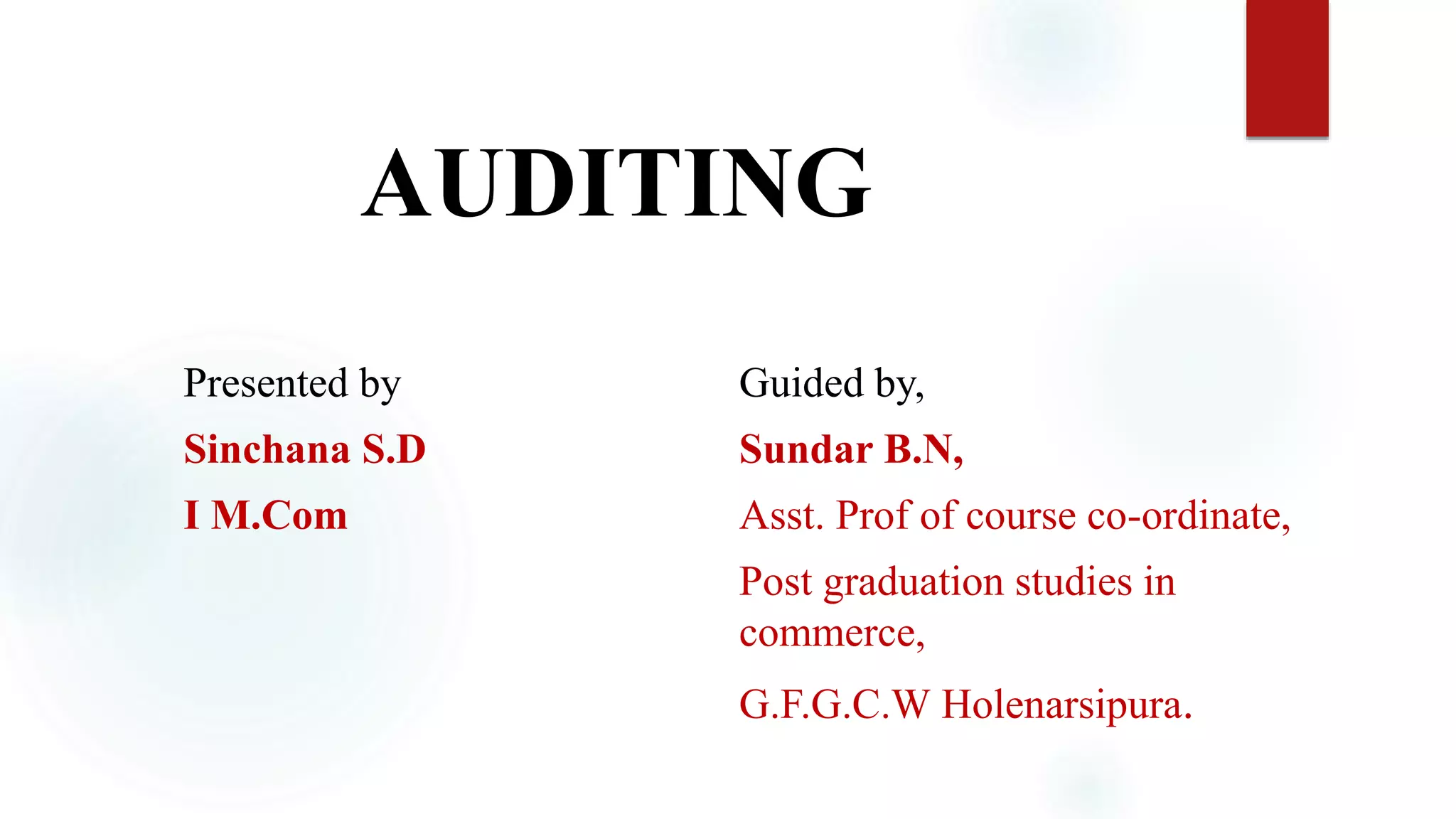
Internal audit refers to an independent service
to evaluate an organisation’s internal controls,
its corporate practices, processes, and
methods.
An internal audit helps in securing
compliance with the various laws applicable
to an organisation.
External Audit
 An external audit is an examination that is
conducted by an independent accountant.
 This type of audit is most commonly
intended to result in a certification of the
financial statements of an entity.
 This certification is required by certain
investors and lenders, and for all publicly-
held businesses.
IRS tax
In the United States of America, an
income tax audit is the examination
of a business or individual tax return
by the Internal Revenue Service
(IRS) or state tax authority.
Financial Audit
 A financial audit is an objective
examination and evaluation of the
financial statements of an
organization to make sure that the
financial records are a fair and
accurate representation of the
transactions they claim to
represent.
Operational Audit
 An operational audit is an
examination of the manner in
which an organization conducts
business,
 with the objective of pointing out
improvements that will increase its
efficiency and effectiveness.
Compliance Audit
 A compliance audit is an
independent evaluation to
ensure that an organization is
following external laws,
rules, and regulations or
internal guidelines, such as
corporate bylaws, controls,
and policies and procedures
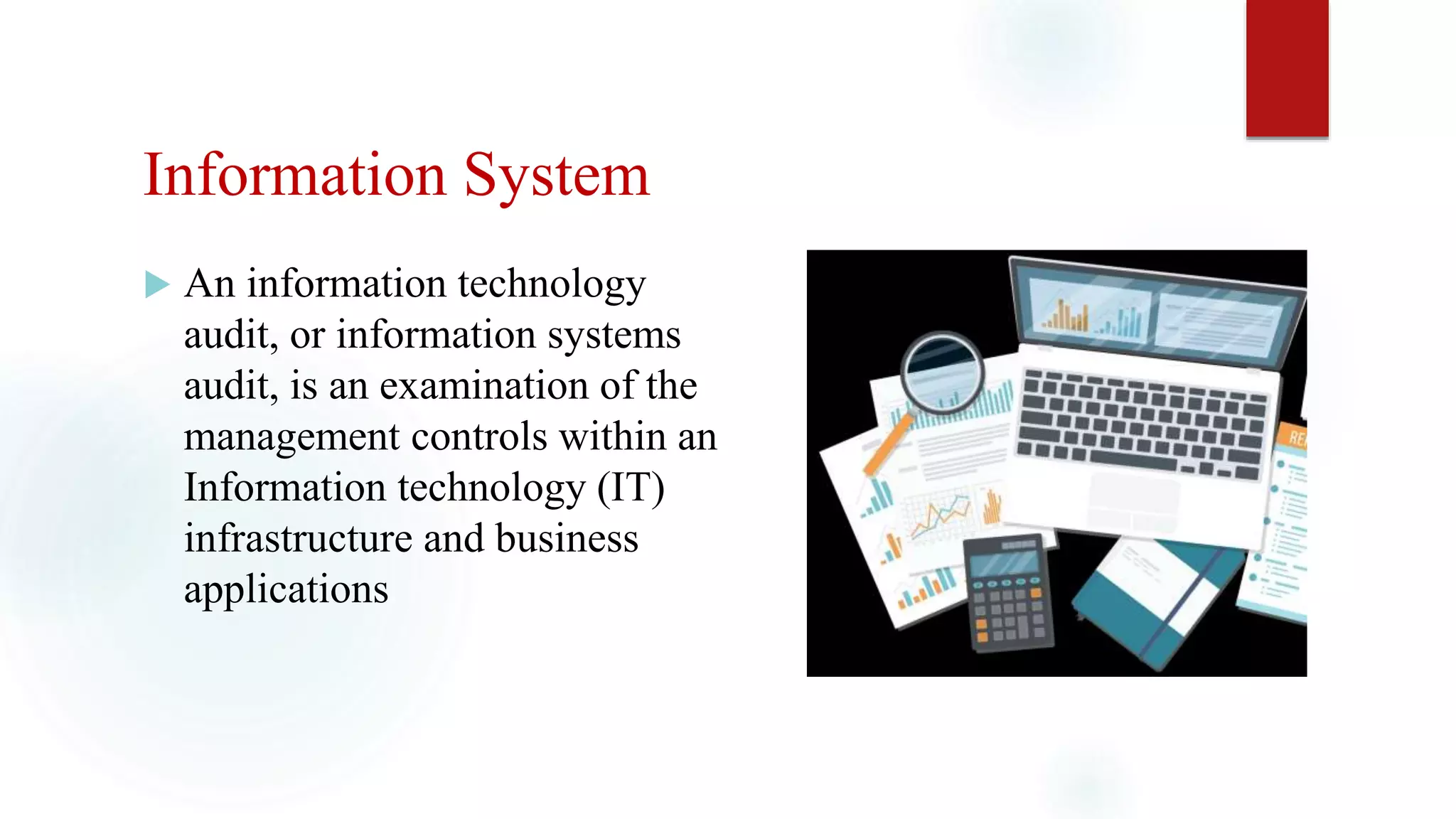
Information System
 An information technology
audit, or information systems
audit, is an examination of the
management controls within an
Information technology (IT)
infrastructure and business
applications.
Payroll
 A payroll audit, also known as a
compliance audit, is an analysis of an
organisation’s payroll-related processes.
 It identifies compliance problems
concerning employment laws, verifies tax
withholdings, spots human errors, and
prevents payroll fraud, to name a few.
 Thus, it is vital to frequently do a payroll
audit.
Importance of Auditing
 The audit helps in the detection and
prevention of errors and frauds.
 The audit helps in maintaining the
records and verification of books of
the books of accounts.
 The independent opinion of the
auditor is extracted through auditing
which is extremely essential for the
management of the company.
Auditing MCQ Questions
1. _______ is the systematic study of books and records or a
business.
A. Auditing
B. Vouching
C. Verification
D. Checking
2. When the auditor is an employee of the organisation being audited the
audit is clasified as_______
A. Internal
B. External
C. Compliance
D. Both A and B
3. Auditing is derived from The Latin word_____
A. Audire
B. Auditor
C. order
D. none of these
4. How much differents types of Auditing _____
A.9 B.8
C. 7 D.6
IRS full form ________
A.Internal revenue service
B. Investment revenue service
C.Interium revenu service
D. Including revenue service
Auditing

Auditing

  • 1.
    AUDITING Presented by Sinchana S.D IM.Com Guided by, Sundar B.N, Asst. Prof of course co-ordinate, Post graduation studies in commerce, G.F.G.C.W Holenarsipura.
  • 2.
    Contents  Auditing meaning Different types of audit  Importance of Auditing
  • 3.
    Auditing meaning  Theterm “audit” comes from the Latin word “audire,” which means “to hear.”  The purpose of auditing is to confirm the financial status as stated in the financial statements.  It reviews financial statements to see if they present an accurate and fair picture of its financial position and profit or loss.
  • 5.
    Internal audit Internal auditrefers to an independent service to evaluate an organisation’s internal controls, its corporate practices, processes, and methods. An internal audit helps in securing compliance with the various laws applicable to an organisation.
  • 6.
    External Audit  Anexternal audit is an examination that is conducted by an independent accountant.  This type of audit is most commonly intended to result in a certification of the financial statements of an entity.  This certification is required by certain investors and lenders, and for all publicly- held businesses.
  • 7.
    IRS tax In theUnited States of America, an income tax audit is the examination of a business or individual tax return by the Internal Revenue Service (IRS) or state tax authority.
  • 8.
    Financial Audit  Afinancial audit is an objective examination and evaluation of the financial statements of an organization to make sure that the financial records are a fair and accurate representation of the transactions they claim to represent.
  • 9.
    Operational Audit  Anoperational audit is an examination of the manner in which an organization conducts business,  with the objective of pointing out improvements that will increase its efficiency and effectiveness.
  • 10.
    Compliance Audit  Acompliance audit is an independent evaluation to ensure that an organization is following external laws, rules, and regulations or internal guidelines, such as corporate bylaws, controls, and policies and procedures
  • 11.
    Information System  Aninformation technology audit, or information systems audit, is an examination of the management controls within an Information technology (IT) infrastructure and business applications.
  • 12.
    Payroll  A payrollaudit, also known as a compliance audit, is an analysis of an organisation’s payroll-related processes.  It identifies compliance problems concerning employment laws, verifies tax withholdings, spots human errors, and prevents payroll fraud, to name a few.  Thus, it is vital to frequently do a payroll audit.
  • 13.
    Importance of Auditing The audit helps in the detection and prevention of errors and frauds.  The audit helps in maintaining the records and verification of books of the books of accounts.  The independent opinion of the auditor is extracted through auditing which is extremely essential for the management of the company.
  • 14.
    Auditing MCQ Questions 1._______ is the systematic study of books and records or a business. A. Auditing B. Vouching C. Verification D. Checking 2. When the auditor is an employee of the organisation being audited the audit is clasified as_______ A. Internal B. External C. Compliance D. Both A and B
  • 15.
    3. Auditing isderived from The Latin word_____ A. Audire B. Auditor C. order D. none of these 4. How much differents types of Auditing _____ A.9 B.8 C. 7 D.6
  • 16.
    IRS full form________ A.Internal revenue service B. Investment revenue service C.Interium revenu service D. Including revenue service