Audit & compliance
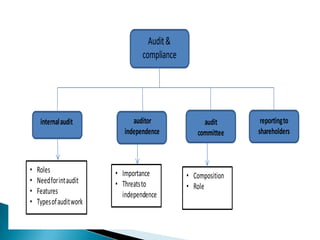
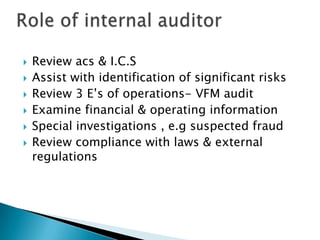
Role of internal auditorReview acs & I.C.SAssist with identification of significant risksReview 3 E’s of operations- VFM auditExamine financial & operating informationSpecial investigations , e.g suspected fraudReview compliance with laws & external regulations
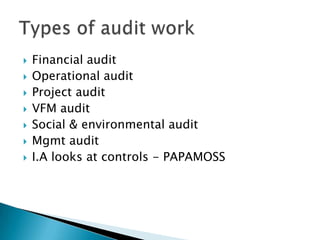
Financial auditOperational auditProject auditVFM auditSocial & environmental auditMgmt auditI.A looks at controls - PAPAMOSSTypes of audit work
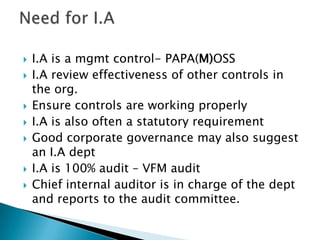
Need for I.AI.A is a mgmt control- PAPA(M)OSSI.A review effectiveness of other controls in the org.Ensure controls are working properlyI.A is also often a statutory requirementGood corporate governance may also suggest an I.A deptI.A is 100% audit – VFM auditChief internal auditor is in charge of the dept and reports to the audit committee.
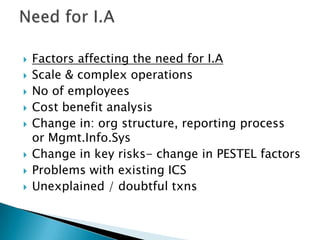
Need for I.AFactors affecting the need for I.AScale & complex operationsNo of employeesCost benefit analysisChange in: org structure, reporting process or Mgmt.Info.SysChange in key risks- change in PESTEL factorsProblems with existing ICSUnexplained / doubtful txns
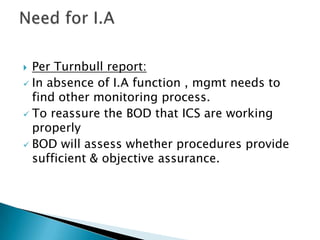
Need for I.APer Turnbull report:In absence of I.A function , mgmt needs to find other monitoring process.
To reassure the BOD that ICS are working properly
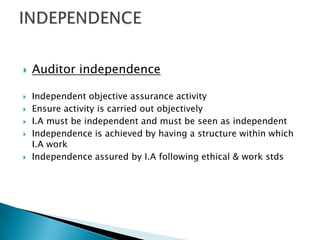
BOD will assess whether procedures provide sufficient & objective assurance.INDEPENDENCEAuditor independenceIndependent objective assurance activityEnsure activity is carried out objectivelyI.A must be independent and must be seen as independent Independence is achieved by having a structure within which I.A workIndependence assured by I.A following ethical & work stds
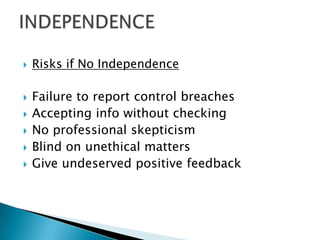
INDEPENDENCERisks if No IndependenceFailure to report control breachesAccepting info without checkingNo professional skepticismBlind on unethical mattersGive undeserved positive feedback
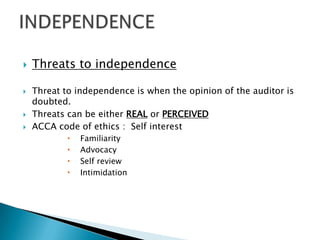
INDEPENDENCEThreats to independenceThreat to independence is when the opinion of the auditor is doubted.Threats can be either REAL or PERCEIVEDACCA code of ethics :  Self interest   Familiarity Advocacy  Self review  Intimidation
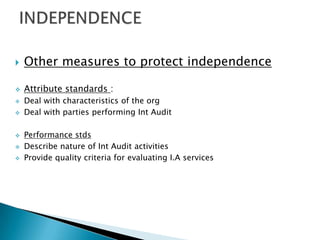
INDEPENDENCEOther measures to protect independenceAttribute standards :
Deal with characteristics of the org
Deal with parties performing Int Audit
Performance stds
Describe nature of Int Audit activities
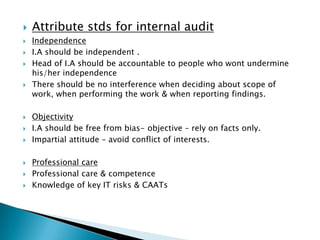
Provide quality criteria for evaluating I.A servicesAttribute stds for internal auditIndependenceI.A should be independent .Head of I.A should be accountable to people who wont undermine his/her independenceThere should be no interference when deciding about scope of work, when performing the work & when reporting findings.ObjectivityI.A should be free from bias- objective – rely on facts only.Impartial attitude – avoid conflict of interests.Professional careProfessional care & competenceKnowledge of key IT risks & CAATs
Performance standards for internal auditManaging internal auditHead I.A manages IA activity to add value to the org
Head IA : establish risk based plans, decide on work priorities, is consistent with org’s objectives.
Review IA plan annually
Head I.A submit plans to senior mgmt & BOD for approval
No interference of senior mgmt in the work of I.ARisk managementI.A identify & evaluate significant risk exposure
I.A contribute to improvement of risk mgmt & ICS
Evaluate risk exposure relating to : governance , ops , information sys.

Audit & compliance

  • 1.
  • 3.
    Role of internalauditorReview acs & I.C.SAssist with identification of significant risksReview 3 E’s of operations- VFM auditExamine financial & operating informationSpecial investigations , e.g suspected fraudReview compliance with laws & external regulations
  • 4.
    Financial auditOperational auditProjectauditVFM auditSocial & environmental auditMgmt auditI.A looks at controls - PAPAMOSSTypes of audit work
  • 5.
    Need for I.AI.Ais a mgmt control- PAPA(M)OSSI.A review effectiveness of other controls in the org.Ensure controls are working properlyI.A is also often a statutory requirementGood corporate governance may also suggest an I.A deptI.A is 100% audit – VFM auditChief internal auditor is in charge of the dept and reports to the audit committee.
  • 6.
    Need for I.AFactorsaffecting the need for I.AScale & complex operationsNo of employeesCost benefit analysisChange in: org structure, reporting process or Mgmt.Info.SysChange in key risks- change in PESTEL factorsProblems with existing ICSUnexplained / doubtful txns
  • 7.
    Need for I.APerTurnbull report:In absence of I.A function , mgmt needs to find other monitoring process.
  • 8.
    To reassure theBOD that ICS are working properly
  • 9.
    BOD will assesswhether procedures provide sufficient & objective assurance.INDEPENDENCEAuditor independenceIndependent objective assurance activityEnsure activity is carried out objectivelyI.A must be independent and must be seen as independent Independence is achieved by having a structure within which I.A workIndependence assured by I.A following ethical & work stds
  • 10.
    INDEPENDENCERisks if NoIndependenceFailure to report control breachesAccepting info without checkingNo professional skepticismBlind on unethical mattersGive undeserved positive feedback
  • 11.
    INDEPENDENCEThreats to independenceThreatto independence is when the opinion of the auditor is doubted.Threats can be either REAL or PERCEIVEDACCA code of ethics : Self interest Familiarity Advocacy Self review Intimidation
  • 12.
    INDEPENDENCEOther measures toprotect independenceAttribute standards :
  • 13.
  • 14.
    Deal with partiesperforming Int Audit
  • 15.
  • 16.
    Describe nature ofInt Audit activities
  • 17.
    Provide quality criteriafor evaluating I.A servicesAttribute stds for internal auditIndependenceI.A should be independent .Head of I.A should be accountable to people who wont undermine his/her independenceThere should be no interference when deciding about scope of work, when performing the work & when reporting findings.ObjectivityI.A should be free from bias- objective – rely on facts only.Impartial attitude – avoid conflict of interests.Professional careProfessional care & competenceKnowledge of key IT risks & CAATs
  • 18.
    Performance standards forinternal auditManaging internal auditHead I.A manages IA activity to add value to the org
  • 19.
    Head IA :establish risk based plans, decide on work priorities, is consistent with org’s objectives.
  • 20.
  • 21.
    Head I.A submitplans to senior mgmt & BOD for approval
  • 22.
    No interference ofsenior mgmt in the work of I.ARisk managementI.A identify & evaluate significant risk exposure
  • 23.
    I.A contribute toimprovement of risk mgmt & ICS
  • 24.
    Evaluate risk exposurerelating to : governance , ops , information sys.