Audio Compression
Prepared By: Miled OTHMEN
Miled.othman@gmail.com
Agenda
1 Introduction
2 Audio compression
3 Types of compression
4 Standards Codecs for audio compression
5 International organizations dealing with
audio compression standardization
6 Conclusion
2
Introduction
What is audio
• Audio is the sound system that comes with or can be added to
a computer.
• An audio file is a record of captured sound that can be played
back.
• An audio card contains a special built-in processor and
memory for processing audio files and sending them
to speakers in the computer.
3
Introduction
What is audio
• Sound is a sequence of naturally analog signals that are
converted to digital signals by the audio card, using a
microchip called an analog-to-digital converter (ADC).
• When sound is played, the digital signals are sent to the
speakers where they are converted back to analog signals that
generate varied sound.
4
Introduction
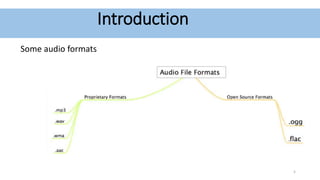
Some audio formats
5
Introduction
What do compression mean ?
• Compression is the reduction in size of data in order to save
space or transmission time.
• Compression can be used to:
 Reduce File Size
 Save disk space
 Reduce transmission time
• Compression is performed by a program that uses an
algorithm to determine how to compress or decompress data.
6
Introduction
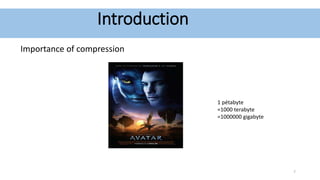
Importance of compression
1 pétabyte
=1000 terabyte
=1000000 gigabyte
7
Audio compression
Definition
• Audio compression is a form of data compression designed to
reduce the size of audio files.
• There is a conditions on this definition :
 the audio file must still be playable after compression,
without decompressing it to original size when you want
to play it (for example with WinRAR).
 If the file is compressed 'too much' there will be loss of
quality.
 The compression is done with a thing called a codec.
This is an aggregation of the words: compressor and
decompressor.
 This codec is a special algorithm to reduce the size.
8
Audio compression
Application for audio compression
• xACT (X Audio Compression Toolkit)
• XLD (X Lossless Decoder): is able to decode/convert/play
various 'lossless' audio files.
9
Audio compression
Application for audio compression
• Monkey’s audio: is a fast and easy way to compress digital
music.
• Free Audio Editor
10
Audio compression
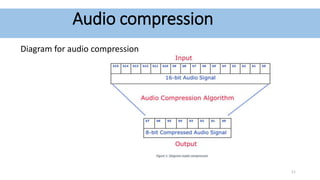
Diagram for audio compression
11
Audio compression
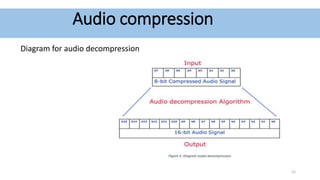
Diagram for audio decompression
12
Types of compression
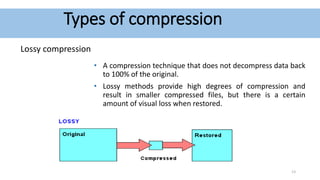
Lossy compression
• A compression technique that does not decompress data back
to 100% of the original.
• Lossy methods provide high degrees of compression and
result in smaller compressed files, but there is a certain
amount of visual loss when restored.
13
Types of compression
Lossy compression
• Audio can tolerate loss, and in many cases, it may not be
noticeable to the human ear.
• In other cases, it may be noticeable, but not that critical to
the application.
• The more tolerance for loss, the smaller the file can be
compressed, and the faster the file can be transmitted over a
network.
14
Types of compression
Lossy compression
Example of lossy file format:
MP3
• The MP3 format’s history is legendary when it comes to digital
music and the Internet.
• It has single handedly revolutionized the way we listen to and share
music.
• Even its name has become part of our everyday language, MP3
music and MP3 players are terms that are used to describe all kinds
of formats and players.
15
Types of compression
Lossy compression
Example of lossy file format:
MP3
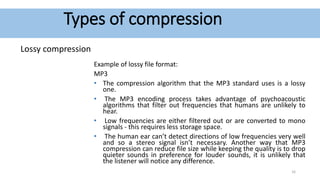
• The compression algorithm that the MP3 standard uses is a lossy
one.
• The MP3 encoding process takes advantage of psychoacoustic
algorithms that filter out frequencies that humans are unlikely to
hear.
• Low frequencies are either filtered out or are converted to mono
signals - this requires less storage space.
• The human ear can’t detect directions of low frequencies very well
and so a stereo signal isn’t necessary. Another way that MP3
compression can reduce file size while keeping the quality is to drop
quieter sounds in preference for louder sounds, it is unlikely that
the listener will notice any difference.
16
Types of compression
Lossless compression
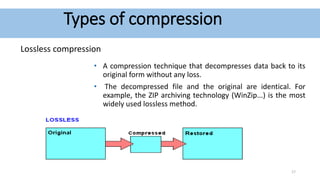
• A compression technique that decompresses data back to its
original form without any loss.
• The decompressed file and the original are identical. For
example, the ZIP archiving technology (WinZip...) is the most
widely used lossless method.
17
Types of compression
Lossless compression
• Lossless audio files typically require more storage space than
lossy encoded ones.
• However this type of format is often favored by users wanting
to backup original audio CDs.
• a perfect copy can be restored in the event of loss or damage
to the CD.
• FLAC, Apple Lossless (ALAC) and WMA Lossless are examples
of lossless compression formats.
18
Types of compression
The most popular type of audio compression currently used is lossy due to encoded
files being smaller than lossless ones while still retaining acceptable sound quality.
19
Standard Codecs for audio compression
For lossless compression
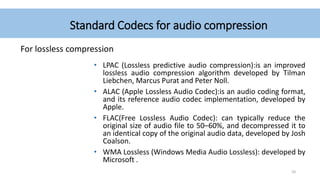
• LPAC (Lossless predictive audio compression):is an improved
lossless audio compression algorithm developed by Tilman
Liebchen, Marcus Purat and Peter Noll.
• ALAC (Apple Lossless Audio Codec):is an audio coding format,
and its reference audio codec implementation, developed by
Apple.
• FLAC(Free Lossless Audio Codec): can typically reduce the
original size of audio file to 50–60%, and decompressed it to
an identical copy of the original audio data, developed by Josh
Coalson.
• WMA Lossless (Windows Media Audio Lossless): developed by
Microsoft .
20
Standard Codecs for audio compression
For lossy compression
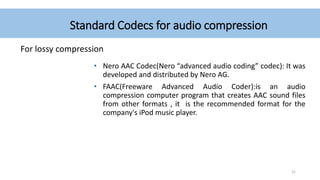
• Nero AAC Codec(Nero “advanced audio coding” codec): It was
developed and distributed by Nero AG.
• FAAC(Freeware Advanced Audio Coder):is an audio
compression computer program that creates AAC sound files
from other formats , it is the recommended format for the
company's iPod music player.
21
International organizations dealing with audio
compression standardization
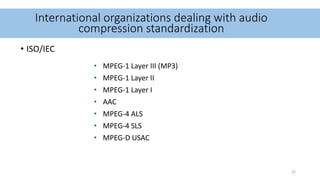
• MPEG-1 Layer III (MP3)
• MPEG-1 Layer II
• MPEG-1 Layer I
• AAC
• MPEG-4 ALS
• MPEG-4 SLS
• MPEG-D USAC
• ISO/IEC
22
International organizations dealing with audio
compression standardization
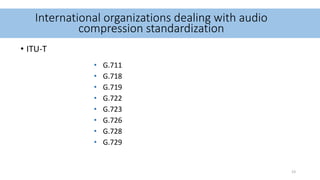
• G.711
• G.718
• G.719
• G.722
• G.723
• G.726
• G.728
• G.729
• ITU-T
23
Conclusion
The most popular type of audio compression currently used is lossy due to encoded
files being smaller than lossless ones while still retaining acceptable sound quality.
• audio compression is a key technology
• many algorithms  many applications
• Better algorithms  better quality, more compression
24
25

Audio compression

  • 1.
    Audio Compression Prepared By:Miled OTHMEN Miled.othman@gmail.com
  • 2.
    Agenda 1 Introduction 2 Audiocompression 3 Types of compression 4 Standards Codecs for audio compression 5 International organizations dealing with audio compression standardization 6 Conclusion 2
  • 3.
    Introduction What is audio •Audio is the sound system that comes with or can be added to a computer. • An audio file is a record of captured sound that can be played back. • An audio card contains a special built-in processor and memory for processing audio files and sending them to speakers in the computer. 3
  • 4.
    Introduction What is audio •Sound is a sequence of naturally analog signals that are converted to digital signals by the audio card, using a microchip called an analog-to-digital converter (ADC). • When sound is played, the digital signals are sent to the speakers where they are converted back to analog signals that generate varied sound. 4
  • 5.
  • 6.
    Introduction What do compressionmean ? • Compression is the reduction in size of data in order to save space or transmission time. • Compression can be used to:  Reduce File Size  Save disk space  Reduce transmission time • Compression is performed by a program that uses an algorithm to determine how to compress or decompress data. 6
  • 7.
    Introduction Importance of compression 1pétabyte =1000 terabyte =1000000 gigabyte 7
  • 8.
    Audio compression Definition • Audiocompression is a form of data compression designed to reduce the size of audio files. • There is a conditions on this definition :  the audio file must still be playable after compression, without decompressing it to original size when you want to play it (for example with WinRAR).  If the file is compressed 'too much' there will be loss of quality.  The compression is done with a thing called a codec. This is an aggregation of the words: compressor and decompressor.  This codec is a special algorithm to reduce the size. 8
  • 9.
    Audio compression Application foraudio compression • xACT (X Audio Compression Toolkit) • XLD (X Lossless Decoder): is able to decode/convert/play various 'lossless' audio files. 9
  • 10.
    Audio compression Application foraudio compression • Monkey’s audio: is a fast and easy way to compress digital music. • Free Audio Editor 10
  • 11.
    Audio compression Diagram foraudio compression 11
  • 12.
    Audio compression Diagram foraudio decompression 12
  • 13.
    Types of compression Lossycompression • A compression technique that does not decompress data back to 100% of the original. • Lossy methods provide high degrees of compression and result in smaller compressed files, but there is a certain amount of visual loss when restored. 13
  • 14.
    Types of compression Lossycompression • Audio can tolerate loss, and in many cases, it may not be noticeable to the human ear. • In other cases, it may be noticeable, but not that critical to the application. • The more tolerance for loss, the smaller the file can be compressed, and the faster the file can be transmitted over a network. 14
  • 15.
    Types of compression Lossycompression Example of lossy file format: MP3 • The MP3 format’s history is legendary when it comes to digital music and the Internet. • It has single handedly revolutionized the way we listen to and share music. • Even its name has become part of our everyday language, MP3 music and MP3 players are terms that are used to describe all kinds of formats and players. 15
  • 16.
    Types of compression Lossycompression Example of lossy file format: MP3 • The compression algorithm that the MP3 standard uses is a lossy one. • The MP3 encoding process takes advantage of psychoacoustic algorithms that filter out frequencies that humans are unlikely to hear. • Low frequencies are either filtered out or are converted to mono signals - this requires less storage space. • The human ear can’t detect directions of low frequencies very well and so a stereo signal isn’t necessary. Another way that MP3 compression can reduce file size while keeping the quality is to drop quieter sounds in preference for louder sounds, it is unlikely that the listener will notice any difference. 16
  • 17.
    Types of compression Losslesscompression • A compression technique that decompresses data back to its original form without any loss. • The decompressed file and the original are identical. For example, the ZIP archiving technology (WinZip...) is the most widely used lossless method. 17
  • 18.
    Types of compression Losslesscompression • Lossless audio files typically require more storage space than lossy encoded ones. • However this type of format is often favored by users wanting to backup original audio CDs. • a perfect copy can be restored in the event of loss or damage to the CD. • FLAC, Apple Lossless (ALAC) and WMA Lossless are examples of lossless compression formats. 18
  • 19.
    Types of compression Themost popular type of audio compression currently used is lossy due to encoded files being smaller than lossless ones while still retaining acceptable sound quality. 19
  • 20.
    Standard Codecs foraudio compression For lossless compression • LPAC (Lossless predictive audio compression):is an improved lossless audio compression algorithm developed by Tilman Liebchen, Marcus Purat and Peter Noll. • ALAC (Apple Lossless Audio Codec):is an audio coding format, and its reference audio codec implementation, developed by Apple. • FLAC(Free Lossless Audio Codec): can typically reduce the original size of audio file to 50–60%, and decompressed it to an identical copy of the original audio data, developed by Josh Coalson. • WMA Lossless (Windows Media Audio Lossless): developed by Microsoft . 20
  • 21.
    Standard Codecs foraudio compression For lossy compression • Nero AAC Codec(Nero “advanced audio coding” codec): It was developed and distributed by Nero AG. • FAAC(Freeware Advanced Audio Coder):is an audio compression computer program that creates AAC sound files from other formats , it is the recommended format for the company's iPod music player. 21
  • 22.
    International organizations dealingwith audio compression standardization • MPEG-1 Layer III (MP3) • MPEG-1 Layer II • MPEG-1 Layer I • AAC • MPEG-4 ALS • MPEG-4 SLS • MPEG-D USAC • ISO/IEC 22
  • 23.
    International organizations dealingwith audio compression standardization • G.711 • G.718 • G.719 • G.722 • G.723 • G.726 • G.728 • G.729 • ITU-T 23
  • 24.
    Conclusion The most populartype of audio compression currently used is lossy due to encoded files being smaller than lossless ones while still retaining acceptable sound quality. • audio compression is a key technology • many algorithms  many applications • Better algorithms  better quality, more compression 24
  • 25.

Editor's Notes

  • #6 Usually maintained by a standards organization, and it can be used and implemented by anyone . for example you can clone the source code of the soft and if u want u can develop your own version. MP3: is an audio-specific format that was designed by MPEG as part of its MPEG-1 standard and later extended in the MPEG-2 standard. MPEG: Moving Picture Expert Group Wav: WAVEform audio file (Microsoft & IBM) Wma: Windows Media Audio Aac: Advanced Audio Coding /this format has been standardized by ISO and IEC, as part of the MPEG-2 and MPEG-4 specifications.  is the default or standard audio format for YouTube, iPhone, iPod, iPad Flac: Free Lossless Audio Codec Ogg: Ogg is a free, open container format used on
  • #8 For that i take an example, the avatar movie. the original size of the avatar movie is . So without compression we can not ,download it or save it in local space .
  • #14 The size of the restored file becomes smaller because of : the elimination of redundancy bits filter out frequencies that humans are unlikely to hear.
  • #23 ISO/IEC: International Organization for Standardization (ISO) and the International Electrotechnical Commission (IEC)
  • #24  ITU Telecommunication Standardization Sector International Telecommunication Union