rutvij.trivedi@siliconsignals.io +91-94087 30545
About Me
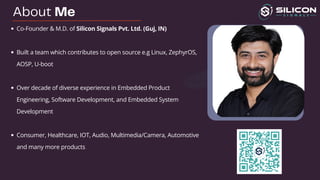
Co-Founder & M.D. of Silicon Signals Pvt. Ltd.โ€‹(Guj, IN)
Built a team which contributes to open source e.g Linux, ZephyrOS,
AOSP, U-boot โ€‹
Over decade of diverse experience in Embedded Product
Engineering, Software Development, and Embedded System
Developmentโ€‹
Consumer, Healthcare, IOT, Audio, Multimedia/Camera, Automotive
and many more products โ€‹
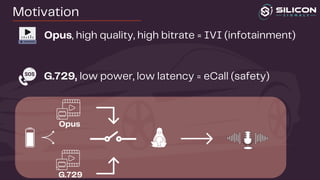
Opus, high quality, high bitrate = IVI (infotainment)
G.729, low power, low latency = eCall (safety)
Motivation
Opus
G.729
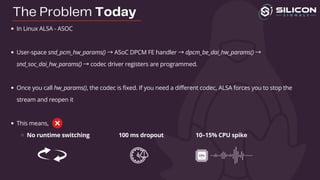
In Linux ALSA - ASOC
User-space snd_pcm_hw_params() โ†’ASoC DPCM FE handler โ†’dpcm_be_dai_hw_params() โ†’
snd_soc_dai_hw_params() โ†’codec driver registers are programmed.
Once you call hw_params(), the codec is fixed. If you need a different codec, ALSA forces you to stop the
stream and reopen it
This means,
No runtime switching 100 ms dropout 10โ€“15% CPU spike
The Problem Today
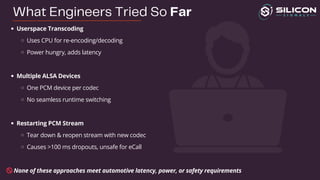
Userspace Transcoding
Uses CPU for re-encoding/decoding
Power hungry, adds latency
Multiple ALSA Devices
One PCM device per codec
No seamless runtime switching
Restarting PCM Stream
Tear down & reopen stream with new codec
Causes >100 ms dropouts, unsafe for eCall
๐ŸšซNone of these approaches meet automotive latency, power, or safety requirements
What Engineers Tried So Far
/* Enum control to select codec */
static const char * const codec_texts[] = { "Opus", "G729" };
static SOC_ENUM_SINGLE_EXT(codec_enum, codec_texts);
static int codec_set(struct snd_kcontrol *kcontrol,
struct snd_ctl_elem_value *ucontrol)
{
int new_codec = ucontrol->value.enumerated.item[0];
schedule_codec_switch(new_codec);
return 0;
}
ALSA control
interface
Triple buffering
in SoC driver
Device Tree
profiles
Power-aware
codec scheduler
Proposed Architecture
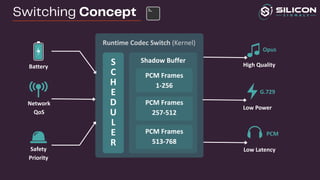
Switching Concept
Runtime Codec Switch (Kernel)
S
C
H
E
D
U
L
E
R
Shadow Buffer
PCM Frames
1-256
PCM Frames
257-512
PCM Frames
513-768
Battery
Network
QoS
Safety
Priority
High Quality
Opus
G.729
Low Power
PCM
Low Latency
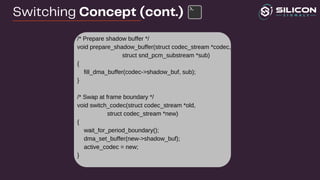
/* Prepare shadow buffer */
void prepare_shadow_buffer(struct codec_stream *codec,
struct snd_pcm_substream *sub)
{
fill_dma_buffer(codec->shadow_buf, sub);
}
/* Swap at frame boundary */
void switch_codec(struct codec_stream *old,
struct codec_stream *new)
{
wait_for_period_boundary();
dma_set_buffer(new->shadow_buf);
active_codec = new;
}
Switching Concept (cont.)
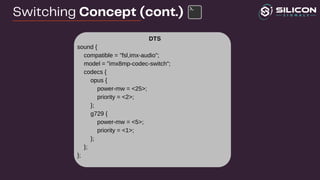
DTS
sound {
compatible = "fsl,imx-audio";
model = "imx8mp-codec-switch";
codecs {
opus {
power-mw = <25>;
priority = <2>;
};
g729 {
power-mw = <5>;
priority = <1>;
};
};
};
Switching Concept (cont.)
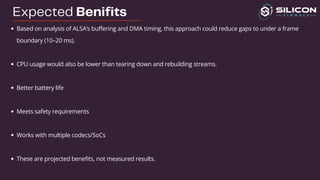
Expected Benifits
Based on analysis of ALSAโ€™s buffering and DMA timing, this approach could reduce gaps to under a frame
boundary (10โ€“20 ms).
CPU usage would also be lower than tearing down and rebuilding streams.
Better battery life
Meets safety requirements
Works with multiple codecs/SoCs
These are projected benefits, not measured results.
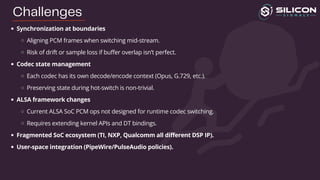
Synchronization at boundaries
Aligning PCM frames when switching mid-stream.
Risk of drift or sample loss if buffer overlap isnโ€™t perfect.
Codec state management
Each codec has its own decode/encode context (Opus, G.729, etc.).
Preserving state during hot-switch is non-trivial.
ALSA framework changes
Current ALSA SoC PCM ops not designed for runtime codec switching.
Requires extending kernel APIs and DT bindings.
Fragmented SoC ecosystem (TI, NXP, Qualcomm all different DSP IP).
User-space integration (PipeWire/PulseAudio policies).
Challenges
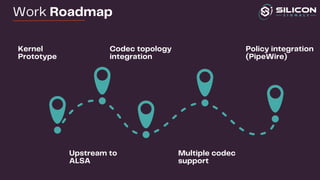
Work Roadmap
Upstream to
ALSA
Codec topology
integration
Multiple codec
support
Policy integration
(PipeWire)
Kernel
Prototype
+91-94087 30545
rutvij.trivedi@siliconsignals.io
www.siliconsignals.io

Audio Codec Switching in the Linux Kernel for Automotive Edge Devices.

  • 1.
  • 2.
    About Me Co-Founder &M.D. of Silicon Signals Pvt. Ltd.โ€‹(Guj, IN) Built a team which contributes to open source e.g Linux, ZephyrOS, AOSP, U-boot โ€‹ Over decade of diverse experience in Embedded Product Engineering, Software Development, and Embedded System Developmentโ€‹ Consumer, Healthcare, IOT, Audio, Multimedia/Camera, Automotive and many more products โ€‹
  • 3.
    Opus, high quality,high bitrate = IVI (infotainment) G.729, low power, low latency = eCall (safety) Motivation Opus G.729
  • 4.
    In Linux ALSA- ASOC User-space snd_pcm_hw_params() โ†’ASoC DPCM FE handler โ†’dpcm_be_dai_hw_params() โ†’ snd_soc_dai_hw_params() โ†’codec driver registers are programmed. Once you call hw_params(), the codec is fixed. If you need a different codec, ALSA forces you to stop the stream and reopen it This means, No runtime switching 100 ms dropout 10โ€“15% CPU spike The Problem Today
  • 5.
    Userspace Transcoding Uses CPUfor re-encoding/decoding Power hungry, adds latency Multiple ALSA Devices One PCM device per codec No seamless runtime switching Restarting PCM Stream Tear down & reopen stream with new codec Causes >100 ms dropouts, unsafe for eCall ๐ŸšซNone of these approaches meet automotive latency, power, or safety requirements What Engineers Tried So Far
  • 6.
    /* Enum controlto select codec */ static const char * const codec_texts[] = { "Opus", "G729" }; static SOC_ENUM_SINGLE_EXT(codec_enum, codec_texts); static int codec_set(struct snd_kcontrol *kcontrol, struct snd_ctl_elem_value *ucontrol) { int new_codec = ucontrol->value.enumerated.item[0]; schedule_codec_switch(new_codec); return 0; } ALSA control interface Triple buffering in SoC driver Device Tree profiles Power-aware codec scheduler Proposed Architecture
  • 7.
    Switching Concept Runtime CodecSwitch (Kernel) S C H E D U L E R Shadow Buffer PCM Frames 1-256 PCM Frames 257-512 PCM Frames 513-768 Battery Network QoS Safety Priority High Quality Opus G.729 Low Power PCM Low Latency
  • 8.
    /* Prepare shadowbuffer */ void prepare_shadow_buffer(struct codec_stream *codec, struct snd_pcm_substream *sub) { fill_dma_buffer(codec->shadow_buf, sub); } /* Swap at frame boundary */ void switch_codec(struct codec_stream *old, struct codec_stream *new) { wait_for_period_boundary(); dma_set_buffer(new->shadow_buf); active_codec = new; } Switching Concept (cont.)
  • 9.
    DTS sound { compatible ="fsl,imx-audio"; model = "imx8mp-codec-switch"; codecs { opus { power-mw = <25>; priority = <2>; }; g729 { power-mw = <5>; priority = <1>; }; }; }; Switching Concept (cont.)
  • 10.
    Expected Benifits Based onanalysis of ALSAโ€™s buffering and DMA timing, this approach could reduce gaps to under a frame boundary (10โ€“20 ms). CPU usage would also be lower than tearing down and rebuilding streams. Better battery life Meets safety requirements Works with multiple codecs/SoCs These are projected benefits, not measured results.
  • 11.
    Synchronization at boundaries AligningPCM frames when switching mid-stream. Risk of drift or sample loss if buffer overlap isnโ€™t perfect. Codec state management Each codec has its own decode/encode context (Opus, G.729, etc.). Preserving state during hot-switch is non-trivial. ALSA framework changes Current ALSA SoC PCM ops not designed for runtime codec switching. Requires extending kernel APIs and DT bindings. Fragmented SoC ecosystem (TI, NXP, Qualcomm all different DSP IP). User-space integration (PipeWire/PulseAudio policies). Challenges
  • 12.
    Work Roadmap Upstream to ALSA Codectopology integration Multiple codec support Policy integration (PipeWire) Kernel Prototype
  • 13.