ATM
ATM
HACKING
HACKING
@whereislohith
ATM full form is Automated Teller
Machine which is a self-service banking
outlet. You can withdraw money, check
your balance, or even transfer funds.
Different banks provide their ATM
services by installing cash machines in
different parts of the country.
What is ATM ???
@whereislohith
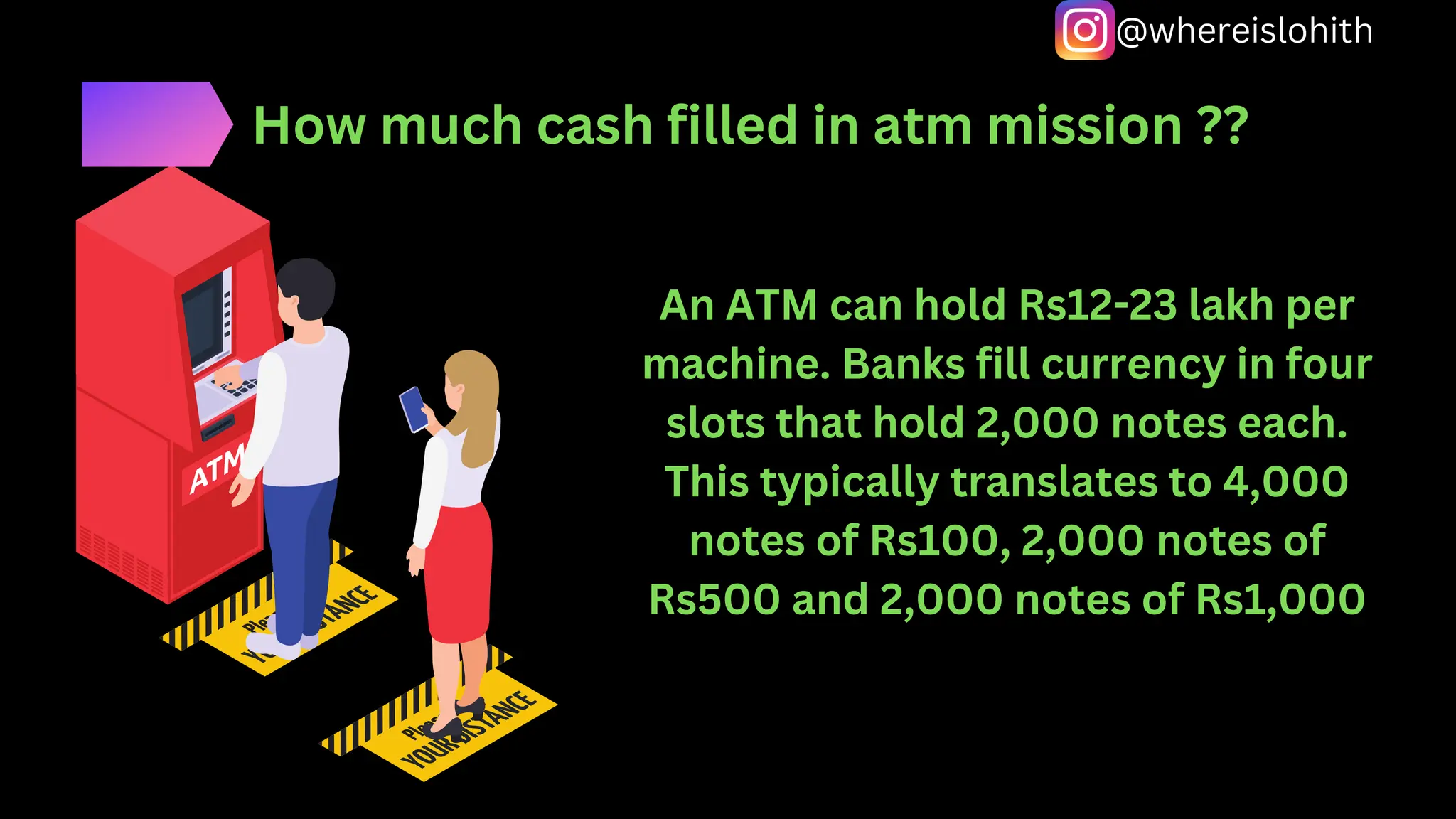
An ATM can hold Rs12-23 lakh per
machine. Banks fill currency in four
slots that hold 2,000 notes each.
This typically translates to 4,000
notes of Rs100, 2,000 notes of
Rs500 and 2,000 notes of Rs1,000
How much cash filled in atm mission ??
@whereislohith
ATM cassete
Cassette: The part
that holds all of the
cash in the ATM
@whereislohith
1.Skimming
2.Malware attacks
3.Physical Attacks
4.Network Attacks
major ATM hacking vulnerabilities
@whereislohith
Skimming is a type of fraud where criminals
use a small device, called a skimmer, to steal
credit or debit card information from
unsuspecting users. The skimmer is usually
placed on or near a legitimate card reader,
such as an ATM or a gas pump, and is
designed to look like a part of the machine.
Skimming
@whereislohith
When a user inserts their card into
the skimmer, it reads the magnetic
stripe on the card and stores the
information, including the card
number and expiration date. The
criminal can then use this
information to create a counterfeit
card or make unauthorized
purchases.
@whereislohith
ATM Jackpotting
ATM jackpotting is a type of attack where criminals take
over an ATM and force it to dispense cash using
malware or other methods
Criminals often require physical access to the ATM in
order to put malware or other software on the device in
order to carry out an ATM jackpotting the attack. Once
the virus or programme is set up, it can grant the
attacker complete access over the ATM, enabling them
to go bypass security and withdraw cash..
@whereislohith
@whereislohith
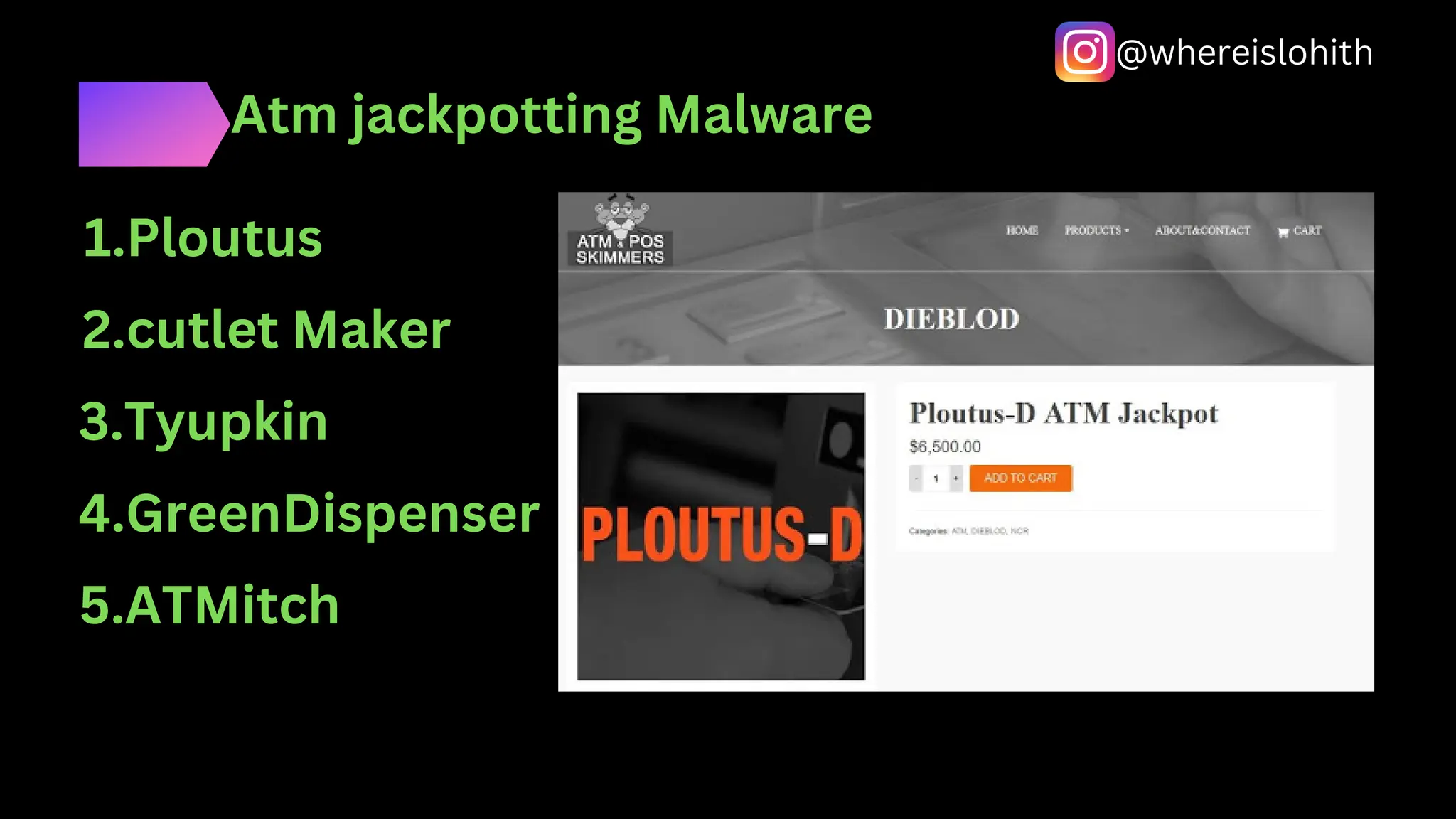
Atm jackpotting Malware
1.Ploutus
2.cutlet Maker
3.Tyupkin
4.GreenDispenser
5.ATMitch
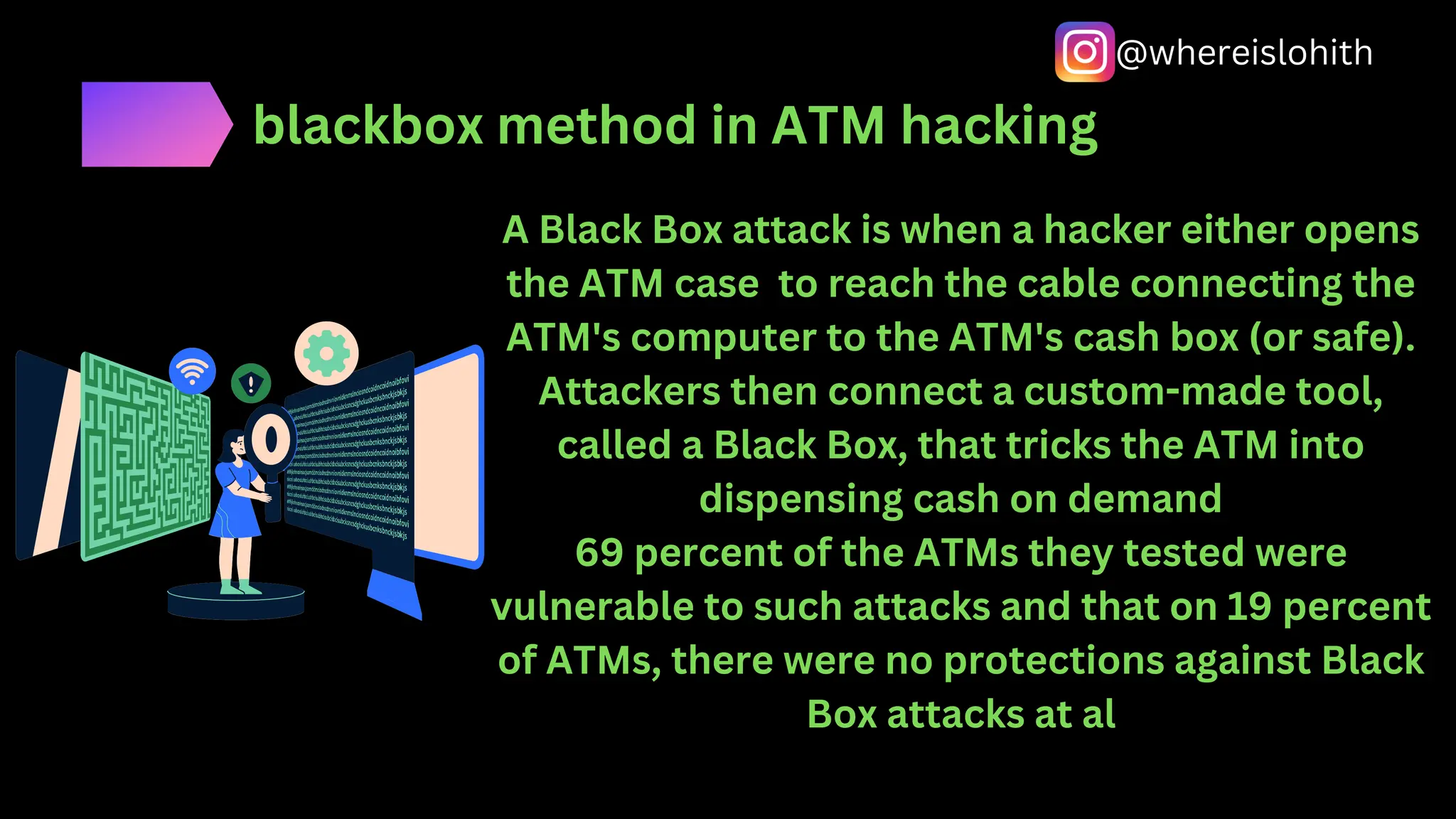
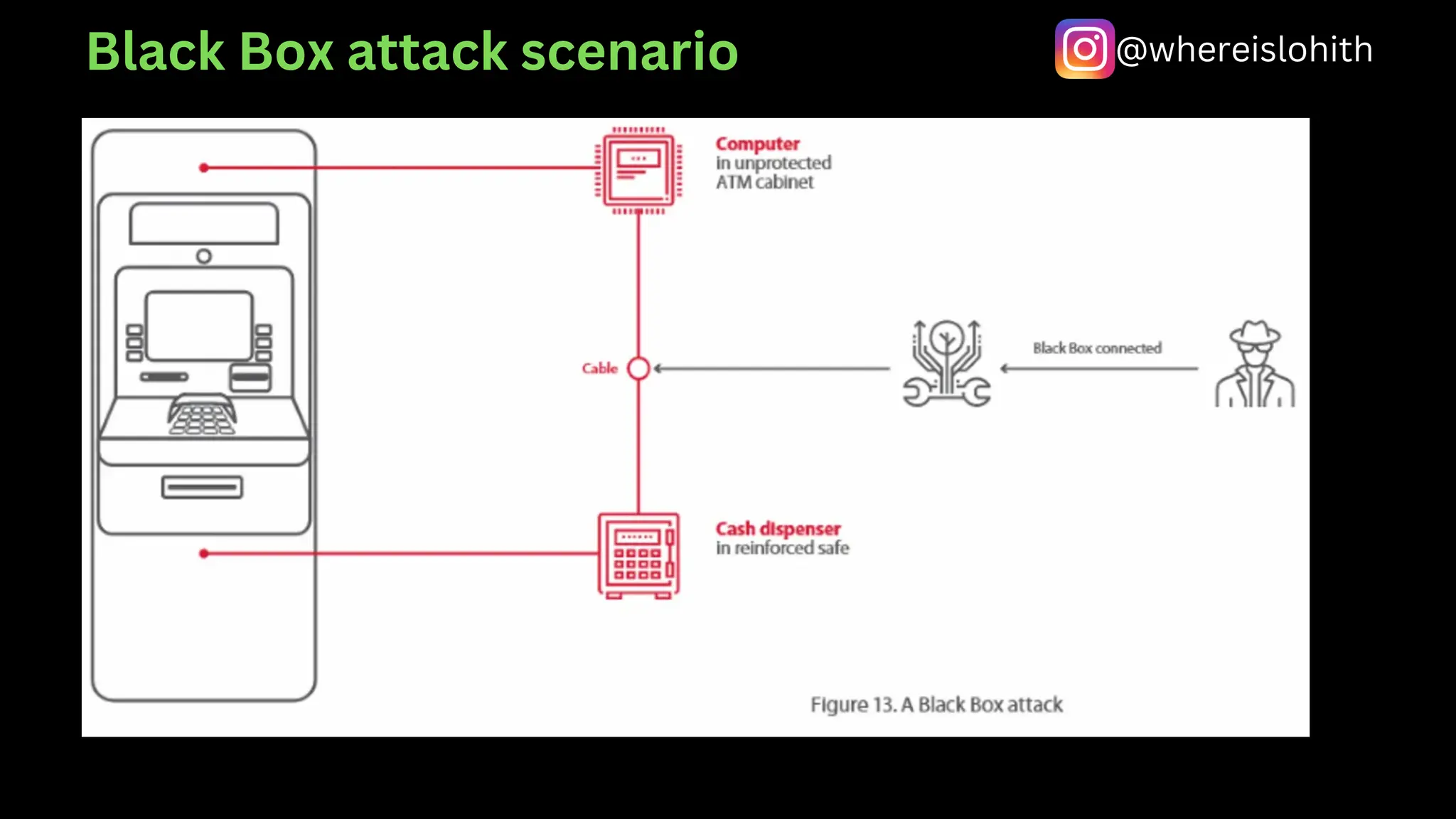
A Black Box attack is when a hacker either opens
the ATM case to reach the cable connecting the
ATM's computer to the ATM's cash box (or safe).
Attackers then connect a custom-made tool,
called a Black Box, that tricks the ATM into
dispensing cash on demand
69 percent of the ATMs they tested were
vulnerable to such attacks and that on 19 percent
of ATMs, there were no protections against Black
Box attacks at al
blackbox method in ATM hacking
@whereislohith
Black Box attack scenario @whereislohith
EXISTING Kiosk mode
In an ATM, a software configuration known as kiosk
mode limits users' access to the operating system and
other programs, allowing only a predetermined set of
features to be accessed by users.
In kiosk mode, the ATM is configured to display only
the necessary information and functionality required
to complete transactions, such as cash withdrawals or
balance inquiries.
@whereislohith
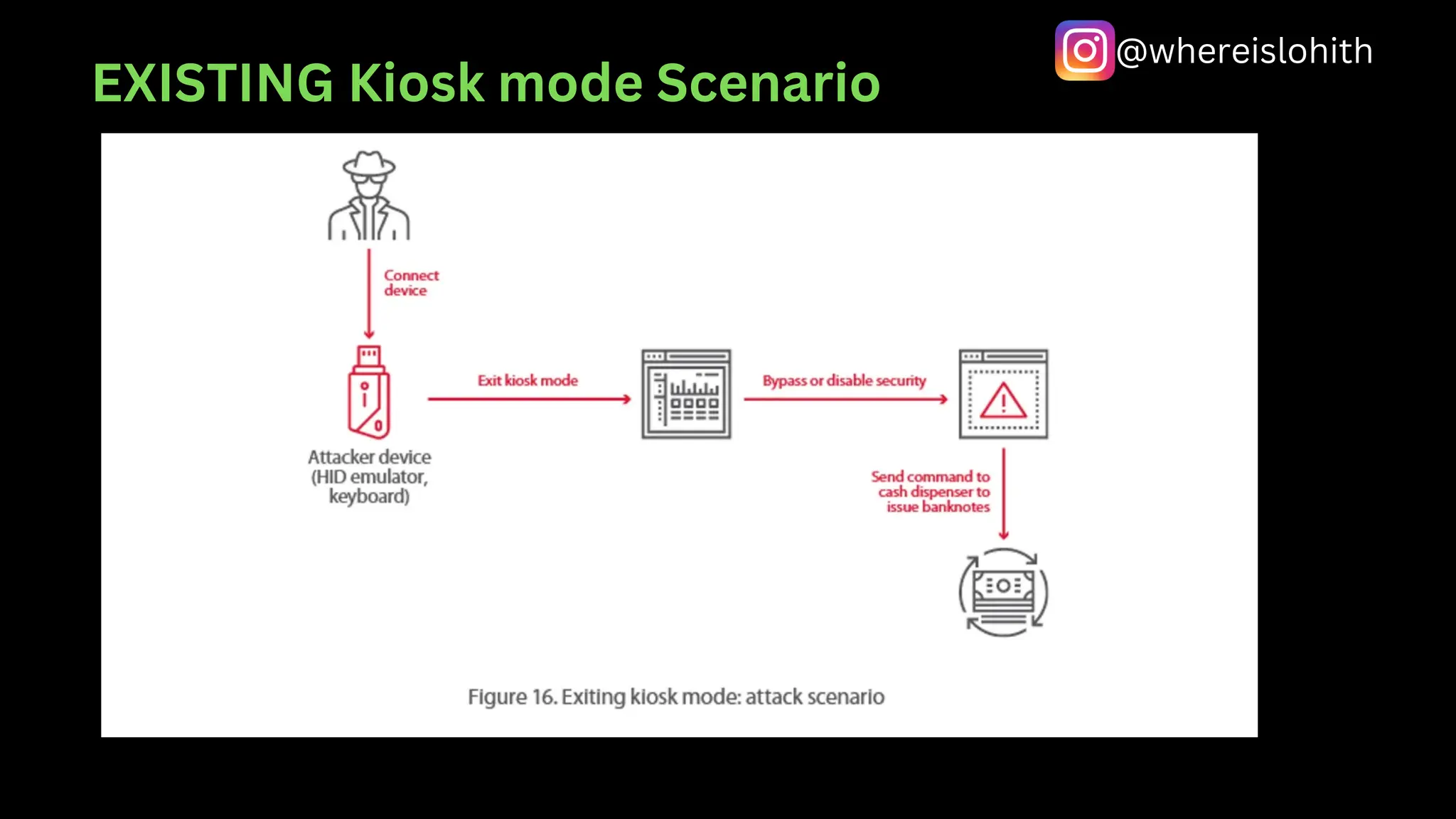
Researchers found that by
plugging a device into one of
the ATM's USB or PS/2
interfaces, they could pluck
the ATM from kiosk mode and
run commands on the
underlying OS to cash out
money from the ATM safe.
@whereislohith
EXISTING Kiosk mode Scenario
@whereislohith
Atm Network Attacks
Researchers said that 27 percent of the tested ATMs were
vulnerable to having their processing center
communications spoofed, while 58 percent of tested ATMs
had vulnerabilities in their network components or services
that could be exploited to control the ATM remotely.
Furthermore, 23 percent of the tested ATMs could be
attacked and exploited by targeting other network devices
connected to the ATM, such as, for example, GSM modems
or routers.
@whereislohith
Atm network Attack scenario @whereislohith
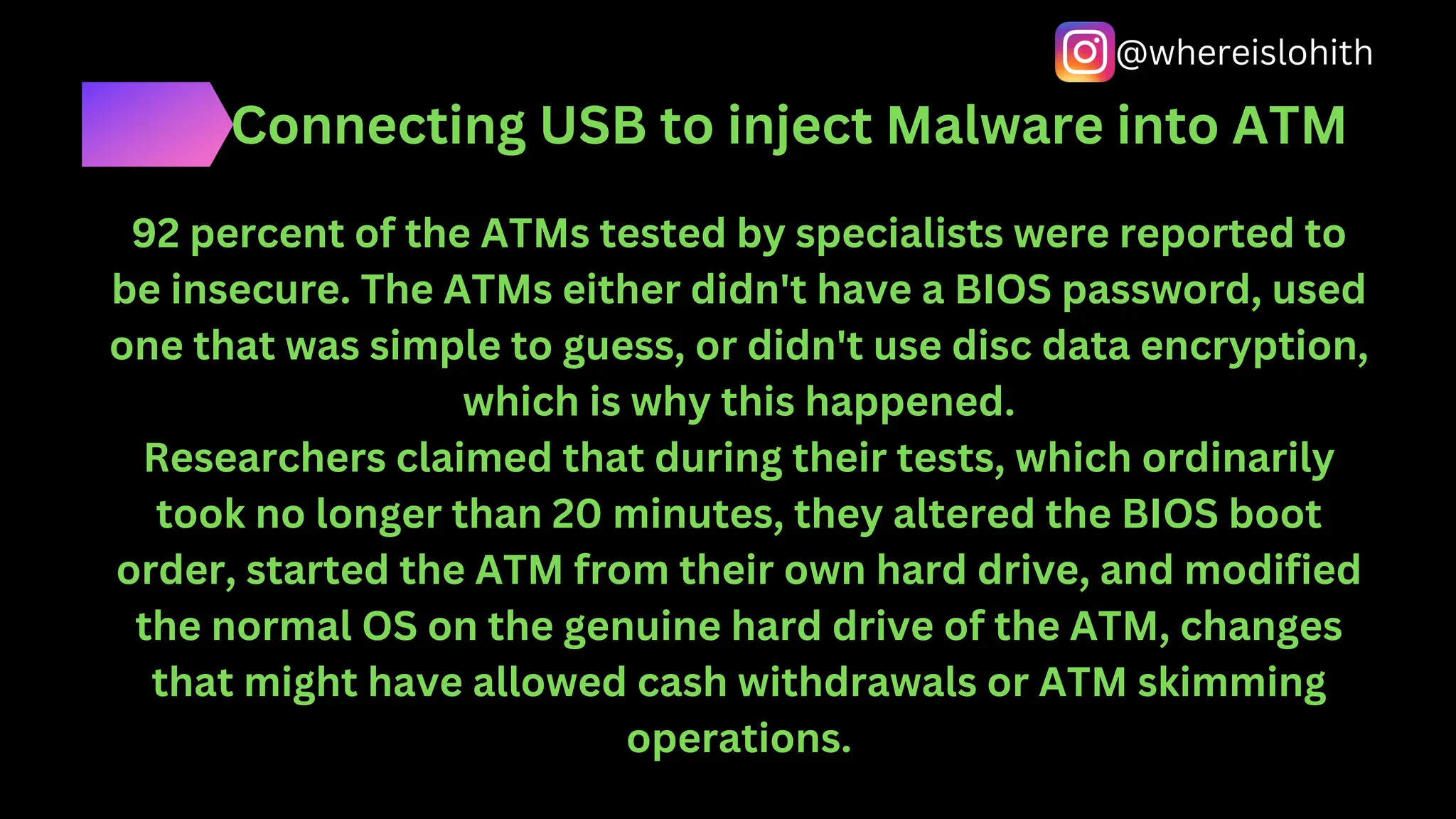
Connecting USB to inject Malware into ATM
92 percent of the ATMs tested by specialists were reported to
be insecure. The ATMs either didn't have a BIOS password, used
one that was simple to guess, or didn't use disc data encryption,
which is why this happened.
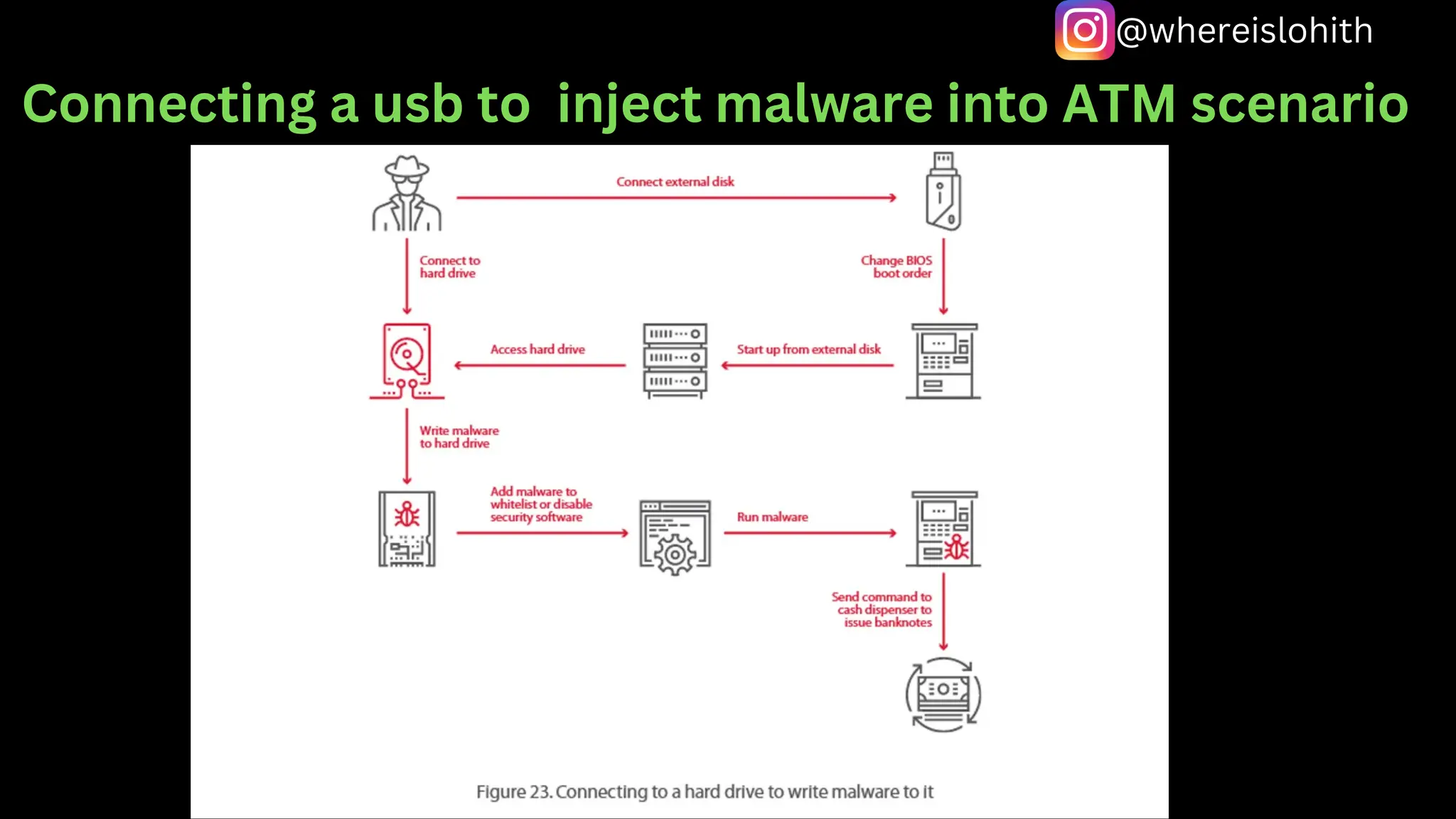
Researchers claimed that during their tests, which ordinarily
took no longer than 20 minutes, they altered the BIOS boot
order, started the ATM from their own hard drive, and modified
the normal OS on the genuine hard drive of the ATM, changes
that might have allowed cash withdrawals or ATM skimming
operations.
@whereislohith
Connecting a usb to inject malware into ATM scenario
@whereislohith
Changing boot mode as a part of cashout
Researchers discovered that an ATM attacker
could restart the machine and compel it to
boot into a safe/debug mode if they had
physical access to the ATM.
As a result, the attackers would have access to
various debugging tools or COM ports, giving
them the ability to infect the ATM with
malware.
42 percent of the ATMs tested by researchers
were vulnerable, and the attack took less than
15 minutes to complete.
@whereislohith
Changing boot mode as a part of cashout Scenario
@whereislohith
Thank
Thank
Thank
you!
you!
you!

atm hacking and cyber security atm security.pdf

  • 1.
  • 2.
    ATM full formis Automated Teller Machine which is a self-service banking outlet. You can withdraw money, check your balance, or even transfer funds. Different banks provide their ATM services by installing cash machines in different parts of the country. What is ATM ??? @whereislohith
  • 3.
    An ATM canhold Rs12-23 lakh per machine. Banks fill currency in four slots that hold 2,000 notes each. This typically translates to 4,000 notes of Rs100, 2,000 notes of Rs500 and 2,000 notes of Rs1,000 How much cash filled in atm mission ?? @whereislohith
  • 4.
    ATM cassete Cassette: Thepart that holds all of the cash in the ATM @whereislohith
  • 5.
    1.Skimming 2.Malware attacks 3.Physical Attacks 4.NetworkAttacks major ATM hacking vulnerabilities @whereislohith
  • 6.
    Skimming is atype of fraud where criminals use a small device, called a skimmer, to steal credit or debit card information from unsuspecting users. The skimmer is usually placed on or near a legitimate card reader, such as an ATM or a gas pump, and is designed to look like a part of the machine. Skimming @whereislohith
  • 7.
    When a userinserts their card into the skimmer, it reads the magnetic stripe on the card and stores the information, including the card number and expiration date. The criminal can then use this information to create a counterfeit card or make unauthorized purchases. @whereislohith
  • 8.
    ATM Jackpotting ATM jackpottingis a type of attack where criminals take over an ATM and force it to dispense cash using malware or other methods Criminals often require physical access to the ATM in order to put malware or other software on the device in order to carry out an ATM jackpotting the attack. Once the virus or programme is set up, it can grant the attacker complete access over the ATM, enabling them to go bypass security and withdraw cash.. @whereislohith
  • 9.
    @whereislohith Atm jackpotting Malware 1.Ploutus 2.cutletMaker 3.Tyupkin 4.GreenDispenser 5.ATMitch
  • 10.
    A Black Boxattack is when a hacker either opens the ATM case to reach the cable connecting the ATM's computer to the ATM's cash box (or safe). Attackers then connect a custom-made tool, called a Black Box, that tricks the ATM into dispensing cash on demand 69 percent of the ATMs they tested were vulnerable to such attacks and that on 19 percent of ATMs, there were no protections against Black Box attacks at al blackbox method in ATM hacking @whereislohith
  • 11.
    Black Box attackscenario @whereislohith
  • 12.
    EXISTING Kiosk mode Inan ATM, a software configuration known as kiosk mode limits users' access to the operating system and other programs, allowing only a predetermined set of features to be accessed by users. In kiosk mode, the ATM is configured to display only the necessary information and functionality required to complete transactions, such as cash withdrawals or balance inquiries. @whereislohith
  • 13.
    Researchers found thatby plugging a device into one of the ATM's USB or PS/2 interfaces, they could pluck the ATM from kiosk mode and run commands on the underlying OS to cash out money from the ATM safe. @whereislohith
  • 14.
    EXISTING Kiosk modeScenario @whereislohith
  • 15.
    Atm Network Attacks Researcherssaid that 27 percent of the tested ATMs were vulnerable to having their processing center communications spoofed, while 58 percent of tested ATMs had vulnerabilities in their network components or services that could be exploited to control the ATM remotely. Furthermore, 23 percent of the tested ATMs could be attacked and exploited by targeting other network devices connected to the ATM, such as, for example, GSM modems or routers. @whereislohith
  • 16.
    Atm network Attackscenario @whereislohith
  • 17.
    Connecting USB toinject Malware into ATM 92 percent of the ATMs tested by specialists were reported to be insecure. The ATMs either didn't have a BIOS password, used one that was simple to guess, or didn't use disc data encryption, which is why this happened. Researchers claimed that during their tests, which ordinarily took no longer than 20 minutes, they altered the BIOS boot order, started the ATM from their own hard drive, and modified the normal OS on the genuine hard drive of the ATM, changes that might have allowed cash withdrawals or ATM skimming operations. @whereislohith
  • 18.
    Connecting a usbto inject malware into ATM scenario @whereislohith
  • 19.
    Changing boot modeas a part of cashout Researchers discovered that an ATM attacker could restart the machine and compel it to boot into a safe/debug mode if they had physical access to the ATM. As a result, the attackers would have access to various debugging tools or COM ports, giving them the ability to infect the ATM with malware. 42 percent of the ATMs tested by researchers were vulnerable, and the attack took less than 15 minutes to complete. @whereislohith
  • 20.
    Changing boot modeas a part of cashout Scenario @whereislohith
  • 21.