i


Imprinting
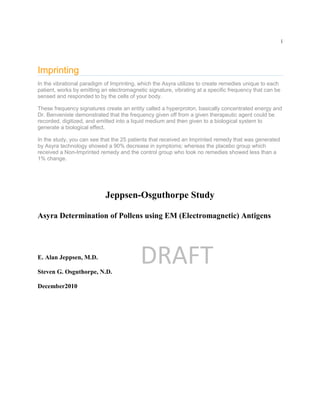
In the vibrational paradigm of Imprinting, which the Asyra utilizes to create remedies unique to each
patient, works by emitting an electromagnetic signature, vibrating at a specific frequency that can be
sensed and responded to by the cells of your body.

These frequency signatures create an entity called a hyperproton, basically concentrated energy and
Dr. Benveniste demonstrated that the frequency given off from a given therapeutic agent could be
recorded, digitized, and emitted into a liquid medium and then given to a biological system to
generate a biological effect.

In the study, you can see that the 25 patients that received an Imprinted remedy that was generated
by Asyra technology showed a 90% decrease in symptoms; whereas the placebo group which
received a Non-Imprinted remedy and the control group who took no remedies showed less than a
1% change.


                            Jeppsen-Osguthorpe Study

Asyra Determination of Pollens using EM (Electromagnetic) Antigens


E. Alan Jeppsen, M.D.

Steven G. Osguthorpe, N.D.
                                           DRAFT
December2010
ii


          Asyra Determination of Pollens using EM (Electromagnetic)

Antigens

Introduction

The concept for the ElectroDermal screening devices, EDS, was the creation of Dr. Reinhardt

Voll[11]., who discovered that the electrical resistance of the human body is not homogenous and

that meridians exist over the body which have been demonstrated as electrical fields[22]. Voll

found the body had 1000 points on the skin which followed the 12 lines of the classical Chinese

meridians. Working with Fritz Werner, Voll created an instrument to measure the skin

resistance at each of the acupuncture points, patterned after Galvanic Skin Resistance (GSR)


                                                     DRAFT
technique. During the 1950s, many investigators[3]3 studied the electrical conductance of the

skin. Elasticity, resistance, permeability, and chemistry of the skin was evaluated and found that

there was a much lower skin resistance at specific points on the skin. Normally, the skin has a

resistance of 2-4 million Ohms but over the specific conductance points, the resistance of only


1
Voll R. New Electroacupuncture (EAV) measurement points for various eye structures. Amer. Journal of Acupuncture. March
1979.

2
Voll R. Acupuncture points for the ear. Amer. J Acupuncture

3
Omura Y. Connections found between each meridian and organ representation of corresponding internal organs in each side
of the cerebral cortex. Acupunct. Electro. Ther. Res.,Vol. 14, No.2, 1989; 155-186.
Asyra Determination of Pollens using EM (Electromagnetic) Antigens
                                                                                                   2


100,000 Ohms is found in normal healthy persons. These points corresponded to classical

acupuncture points.

These acupuncture points were investigated and the assumption was made that the health status

of an organ will affect the concentrations of the ions at the measurement points along the

meridian. It was considered that inflammation of an organ may cause increase ion concentration

and the increase of ions enhances the flow of electrons causing resistance to decrease while the

conductance may increase. Conversely, a degeneration of an organ may cause a decrease in ion

concentration that hinders the flow of electrons, so as the resistance increases conductance

decreases.

During the procedure of ElectroDermal screening the body becomes an integral part of a closed

circuit. The conductance circuit touches the palm of the left and right hand. For the point of

contact, the ground electrode is held in the palm of the left hand and the test probe is held in the


                                                                     DRAFT
palm of the right hand. After completing this closed circuit, a known amount of electric current

is emitted from the instrument through the probe. The instrument then measures the

conductance from baseline to peak and return to baseline through the conductance point that is

being tested by the probe. This represents a dynamic conductance value.


Study Design


The study of ElectroDermal (EDS) screening was designed as blinded to the EDS operator in

which 35, (25 active, 5 placebo, and 5 control), patients were evaluated by the EDS technique
Asyra Determination of Pollens using EM (Electromagnetic) Antigens
                                                                                                  3


without the aid of a medical history or a physical examination or diagnosis known to the

operator before the testing. The same patient was then evaluated by a separate rater, a Physician

who did a complete history and physical examination with allergy laboratory serum testing by

an independent laboratory. Following the data pooling an additional statistician evaluated and

correlated the results. The construction of the study was to measure the capability of the EDS

system for the purpose of detecting IgE inhalant allergies in men and women as compared to

serum results for Region 8, (Arizona, Colorado, New Mexico, Nevada, and Utah). All

participants had 2 serum analyses and 4 EDS analyses over a four month period of time.


Method of Study

Each of the patients was randomly assigned to the study, from a clinic pool of 500 patients, after

appropriate approval was granted. A complete medical and surgical history and examination


                                                                     DRAFT
was obtained at the time of the study and all of the necessary supporting laboratory data was

provided to support the medical diagnosis. Each patient was evaluated, without any interview,

by the EDS operator and then by a Physician. A diagnosis was made on the basis of the detailed

biochemical laboratory data. The laboratory for each patient was compared to the medical

diagnosis and the EDS graphic recording. Control patients without allergies were also tested by

the same EDS operator.


Equipment and Use
Asyra Determination of Pollens using EM (Electromagnetic) Antigens
                                                                                                      4


ElectroDermal Screening (using the Asyra EDS) consists of obtaining conductance

measurements at an acupressure location on the skin, storing these baseline measurements and

displaying these readings on a monitor. The normal flow of electrical energy is briefly inhibited

by a micro current and the conductance was again measured. While the subject is the ground for

a closed system, the instrument functions as a micro-Ohm meter. The technique is non-invasive

and has no-risk to the subject. The instrument is calibrated to read the resistance on a scale of 0

(lowest conductance) to 100 (highest conductance). The higher conductance has been associated

with inflammation while the lower conductance is associated with degeneration. Each of these

acupressure points become part of one or more channels or meridians and generally follow the

Chinese Meridian lines. Ordinarily, the normal individual will register about 50 plus or minus 5-

10 on this scale for each point. In general, it is thought that the point of higher conductance

represents an imbalance with higher energy while a lower conductance represents an imbalance

with lower energy corresponding to pathological changes in an organ that is named as a specific

point or meridian.
                                                                     DRAFT
Analysis of Data

The patient population ranged in age from 22 to 78 with a mean age of 41.3. There were 23

females in the study as compared to 12 males. The diagnostic categories were:


Symptomatic

Each of these symptomatic patients were associated with some or all of the 10 symptoms:
Asyra Determination of Pollens using EM (Electromagnetic) Antigens
                                                                                               5


            Sneezing

            Coughing

            Itching eyes

            Allergic shiners

            Watering eyes

            Conjunctivitis

            Fuzzy thinking

            Headaches

            Sleep disturbances

            Shortness of breath


2. Asymptomatic

Each of these patients were without symptoms.


3. Tests

All of the participants were tested for the following:
                                                                     DRAFT
            Alternaria, Ash Tree, Cat Antigen, Cocklebur, Cottonwood Tree, Cypress Tree, D.

            Farinae, Dog Epithelium, Elm Tree, Grass (Bermuda, Johnson, June, Meadow), House

            Dust, Kochia, Marshelder, Mesquite Tree, Oak Tree, Pigweed, Ragweed, Russian

            Thistle, Sagebrush, Scale, and Careless Weed.


Age-matched control subjects - 5 patients.
Asyra Determination of Pollens using EM (Electromagnetic) Antigens
                                                                                                     6


Each of the patients/means of the data was statistically analyzed for rise/fall and peak in each

testing point. Furthermore, each patient was screened for history of medical illness and clinical

features of disease.


Statistical Analysis

Deviations of more than 1 standard deviation from the mean for each testing point were

calculated and the statistical mean was plotted for each patient and group. Statistical difference

of the means was then developed and calculated using the ANOVA method.


Results

The data at the end of the study showed 7 participants with an EDS reading lower than that of


                                                                     DRAFT
the serum results, while 28 had identical results with the EDS and serum.


Conclusion

The correlation between the EDS measured abnormalities, using standard deviation (SDI)

criteria and patients with symptoms was statistically significant at 99.5% with a P< 0.005.

While the results are promising, the study sample was small and a larger study needs to follow.

Έρευνα Asyra Αλλεργίες

  • 1.
    i Imprinting In the vibrationalparadigm of Imprinting, which the Asyra utilizes to create remedies unique to each patient, works by emitting an electromagnetic signature, vibrating at a specific frequency that can be sensed and responded to by the cells of your body. These frequency signatures create an entity called a hyperproton, basically concentrated energy and Dr. Benveniste demonstrated that the frequency given off from a given therapeutic agent could be recorded, digitized, and emitted into a liquid medium and then given to a biological system to generate a biological effect. In the study, you can see that the 25 patients that received an Imprinted remedy that was generated by Asyra technology showed a 90% decrease in symptoms; whereas the placebo group which received a Non-Imprinted remedy and the control group who took no remedies showed less than a 1% change. Jeppsen-Osguthorpe Study Asyra Determination of Pollens using EM (Electromagnetic) Antigens E. Alan Jeppsen, M.D. Steven G. Osguthorpe, N.D. DRAFT December2010
  • 2.
    ii Asyra Determination of Pollens using EM (Electromagnetic) Antigens Introduction The concept for the ElectroDermal screening devices, EDS, was the creation of Dr. Reinhardt Voll[11]., who discovered that the electrical resistance of the human body is not homogenous and that meridians exist over the body which have been demonstrated as electrical fields[22]. Voll found the body had 1000 points on the skin which followed the 12 lines of the classical Chinese meridians. Working with Fritz Werner, Voll created an instrument to measure the skin resistance at each of the acupuncture points, patterned after Galvanic Skin Resistance (GSR) DRAFT technique. During the 1950s, many investigators[3]3 studied the electrical conductance of the skin. Elasticity, resistance, permeability, and chemistry of the skin was evaluated and found that there was a much lower skin resistance at specific points on the skin. Normally, the skin has a resistance of 2-4 million Ohms but over the specific conductance points, the resistance of only 1 Voll R. New Electroacupuncture (EAV) measurement points for various eye structures. Amer. Journal of Acupuncture. March 1979. 2 Voll R. Acupuncture points for the ear. Amer. J Acupuncture 3 Omura Y. Connections found between each meridian and organ representation of corresponding internal organs in each side of the cerebral cortex. Acupunct. Electro. Ther. Res.,Vol. 14, No.2, 1989; 155-186.
  • 3.
    Asyra Determination ofPollens using EM (Electromagnetic) Antigens 2 100,000 Ohms is found in normal healthy persons. These points corresponded to classical acupuncture points. These acupuncture points were investigated and the assumption was made that the health status of an organ will affect the concentrations of the ions at the measurement points along the meridian. It was considered that inflammation of an organ may cause increase ion concentration and the increase of ions enhances the flow of electrons causing resistance to decrease while the conductance may increase. Conversely, a degeneration of an organ may cause a decrease in ion concentration that hinders the flow of electrons, so as the resistance increases conductance decreases. During the procedure of ElectroDermal screening the body becomes an integral part of a closed circuit. The conductance circuit touches the palm of the left and right hand. For the point of contact, the ground electrode is held in the palm of the left hand and the test probe is held in the DRAFT palm of the right hand. After completing this closed circuit, a known amount of electric current is emitted from the instrument through the probe. The instrument then measures the conductance from baseline to peak and return to baseline through the conductance point that is being tested by the probe. This represents a dynamic conductance value. Study Design The study of ElectroDermal (EDS) screening was designed as blinded to the EDS operator in which 35, (25 active, 5 placebo, and 5 control), patients were evaluated by the EDS technique
  • 4.
    Asyra Determination ofPollens using EM (Electromagnetic) Antigens 3 without the aid of a medical history or a physical examination or diagnosis known to the operator before the testing. The same patient was then evaluated by a separate rater, a Physician who did a complete history and physical examination with allergy laboratory serum testing by an independent laboratory. Following the data pooling an additional statistician evaluated and correlated the results. The construction of the study was to measure the capability of the EDS system for the purpose of detecting IgE inhalant allergies in men and women as compared to serum results for Region 8, (Arizona, Colorado, New Mexico, Nevada, and Utah). All participants had 2 serum analyses and 4 EDS analyses over a four month period of time. Method of Study Each of the patients was randomly assigned to the study, from a clinic pool of 500 patients, after appropriate approval was granted. A complete medical and surgical history and examination DRAFT was obtained at the time of the study and all of the necessary supporting laboratory data was provided to support the medical diagnosis. Each patient was evaluated, without any interview, by the EDS operator and then by a Physician. A diagnosis was made on the basis of the detailed biochemical laboratory data. The laboratory for each patient was compared to the medical diagnosis and the EDS graphic recording. Control patients without allergies were also tested by the same EDS operator. Equipment and Use
  • 5.
    Asyra Determination ofPollens using EM (Electromagnetic) Antigens 4 ElectroDermal Screening (using the Asyra EDS) consists of obtaining conductance measurements at an acupressure location on the skin, storing these baseline measurements and displaying these readings on a monitor. The normal flow of electrical energy is briefly inhibited by a micro current and the conductance was again measured. While the subject is the ground for a closed system, the instrument functions as a micro-Ohm meter. The technique is non-invasive and has no-risk to the subject. The instrument is calibrated to read the resistance on a scale of 0 (lowest conductance) to 100 (highest conductance). The higher conductance has been associated with inflammation while the lower conductance is associated with degeneration. Each of these acupressure points become part of one or more channels or meridians and generally follow the Chinese Meridian lines. Ordinarily, the normal individual will register about 50 plus or minus 5- 10 on this scale for each point. In general, it is thought that the point of higher conductance represents an imbalance with higher energy while a lower conductance represents an imbalance with lower energy corresponding to pathological changes in an organ that is named as a specific point or meridian. DRAFT Analysis of Data The patient population ranged in age from 22 to 78 with a mean age of 41.3. There were 23 females in the study as compared to 12 males. The diagnostic categories were: Symptomatic Each of these symptomatic patients were associated with some or all of the 10 symptoms:
  • 6.
    Asyra Determination ofPollens using EM (Electromagnetic) Antigens 5 Sneezing Coughing Itching eyes Allergic shiners Watering eyes Conjunctivitis Fuzzy thinking Headaches Sleep disturbances Shortness of breath 2. Asymptomatic Each of these patients were without symptoms. 3. Tests All of the participants were tested for the following: DRAFT Alternaria, Ash Tree, Cat Antigen, Cocklebur, Cottonwood Tree, Cypress Tree, D. Farinae, Dog Epithelium, Elm Tree, Grass (Bermuda, Johnson, June, Meadow), House Dust, Kochia, Marshelder, Mesquite Tree, Oak Tree, Pigweed, Ragweed, Russian Thistle, Sagebrush, Scale, and Careless Weed. Age-matched control subjects - 5 patients.
  • 7.
    Asyra Determination ofPollens using EM (Electromagnetic) Antigens 6 Each of the patients/means of the data was statistically analyzed for rise/fall and peak in each testing point. Furthermore, each patient was screened for history of medical illness and clinical features of disease. Statistical Analysis Deviations of more than 1 standard deviation from the mean for each testing point were calculated and the statistical mean was plotted for each patient and group. Statistical difference of the means was then developed and calculated using the ANOVA method. Results The data at the end of the study showed 7 participants with an EDS reading lower than that of DRAFT the serum results, while 28 had identical results with the EDS and serum. Conclusion The correlation between the EDS measured abnormalities, using standard deviation (SDI) criteria and patients with symptoms was statistically significant at 99.5% with a P< 0.005. While the results are promising, the study sample was small and a larger study needs to follow.