ICS I
I NSTITUTE FOR C LINICAL
S Y S T E M S I M P ROV E M E N T
                                    Health Care Guideline:
                                    Diagnosis and Management of Asthma


    Ninth Edition
     June 2010

                 The information contained in this ICSI Health Care Guideline is intended primarily for health profes-
                 sionals and the following expert audiences:
                       •	     physicians, nurses, and other health care professional and provider organizations;
                       •	     health plans, health systems, health care organizations, hospitals and integrated health care
                              delivery systems;
                       •	     health care teaching institutions;
                       •	     health care information technology departments;
                       •	     medical specialty and professional societies;
                       •	     researchers;
                       •	     federal, state and local government health care policy makers and specialists; and
                       •	     employee benefit managers.
                 This ICSI Health Care Guideline should not be construed as medical advice or medical opinion related to
                 any specific facts or circumstances. If you are not one of the expert audiences listed above you are urged
                 to consult a health care professional regarding your own situation and any specific medical questions
                 you may have. In addition, you should seek assistance from a health care professional in interpreting
                 this ICSI Health Care Guideline and applying it in your individual case.
                 This ICSI Health Care Guideline is designed to assist clinicians by providing an analytical framework
                 for the evaluation and treatment of patients, and is not intended either to replace a clinician's judgment
                 or to establish a protocol for all patients with a particular condition. An ICSI Health Care Guideline
                 rarely will establish the only approach to a problem.
                 Copies of this ICSI Health Care Guideline may be distributed by any organization to the organization's
                 employees but, except as provided below, may not be distributed outside of the organization without
                 the prior written consent of the Institute for Clinical Systems Improvement, Inc. If the organization is
                 a legally constituted medical group, the ICSI Health Care Guideline may be used by the medical group
                 in any of the following ways:
                       •	     copies may be provided to anyone involved in the medical group's process for developing and
                              implementing clinical guidelines;
                       •	     the ICSI Health Care Guideline may be adopted or adapted for use within the medical group
                              only, provided that ICSI receives appropriate attribution on all written or electronic documents;
                              and
                       •	     copies may be provided to patients and the clinicians who manage their care, if the ICSI Health
                              Care Guideline is incorporated into the medical group's clinical guideline program.
                 All other copyright rights in this ICSI Health Care Guideline are reserved by the Institute for Clinical
                 Systems Improvement. The Institute for Clinical Systems Improvement assumes no liability for any
                 adaptations or revisions or modifications made to this ICSI Health Care Guideline.
ICS I
                                    Health Care Guideline:
                                    Diagnosis and Management of Asthma
I NSTITUTE FOR C LINICAL
S Y S T E M S I M P ROV E M E N T                        1
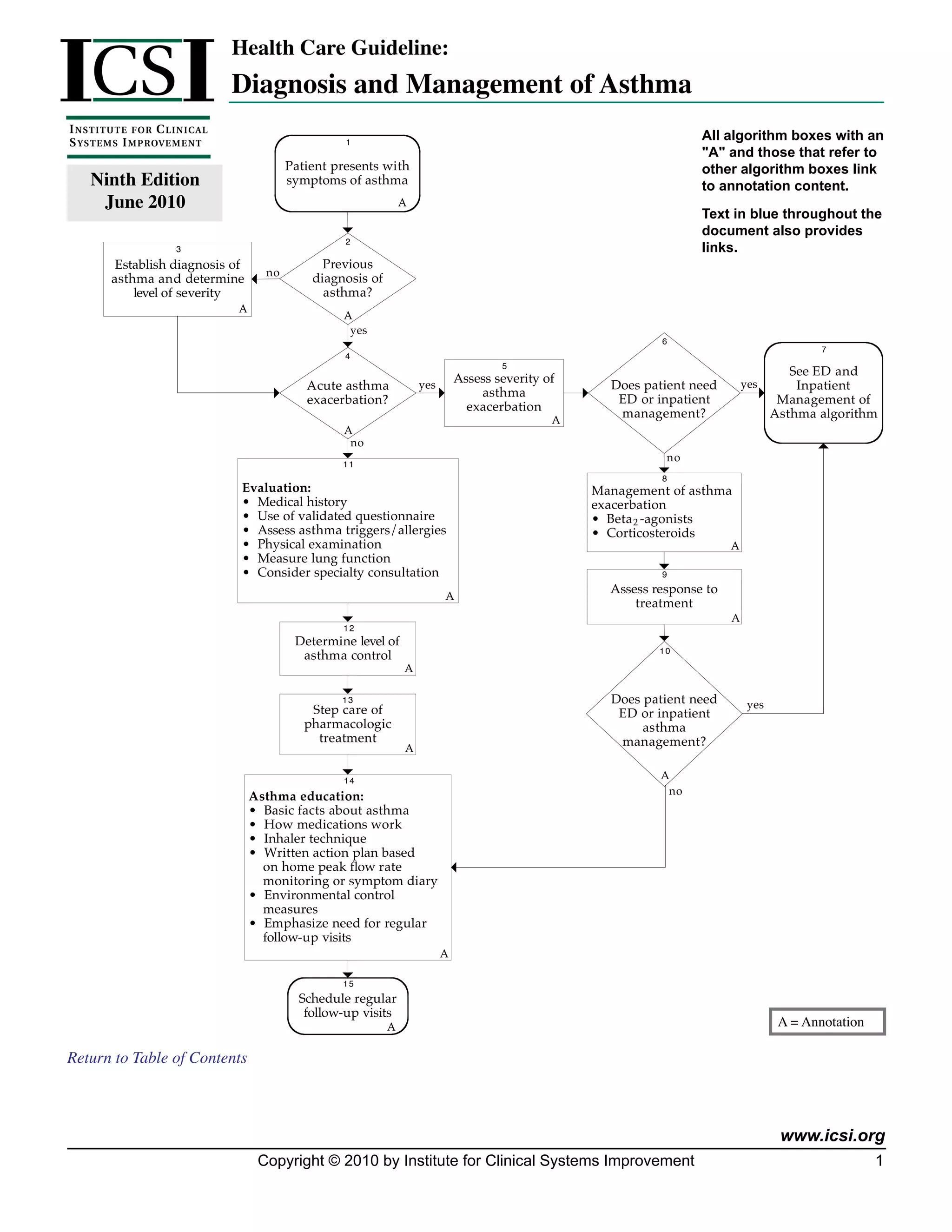
                                                                                                                          All algorithm boxes with an
                                                                                                                          "A" and those that refer to
                                               Patient presents with                                                      other algorithm boxes link
     Ninth Edition                             symptoms of asthma                                                         to annotation content.
      June 2010                                                       A
                                                                                                                          Text in blue throughout the
                                                                                                                          document also provides
                                                                                                                          links.
                                                         2
                         3
           Establish diagnosis of                    Previous
                                          no
          asthma and determine                     diagnosis of
              level of severity                      asthma?
                                    A
                                                        A
                                                         yes
                                                                                                                   6
                                                                                                                                                   7
                                                         4
                                                                                            5
                                                                                                                                              See ED and
                                                                                    Assess severity of                              yes
                                                  Acute asthma            yes                              Does patient need                   Inpatient
                                                                                        asthma
                                                  exacerbation?                                             ED or inpatient                 Management of
                                                                                      exacerbation
                                                                                                     A
                                                                                                            management?                    Asthma algorithm
                                                        A
                                                         no
                                                                                                                    no
                                                        11
                                                                                                                   8
                                     Evaluation:                                                         Management of asthma
                                     • Medical history                                                   exacerbation
                                     • Use of validated questionnaire                                    • Beta 2 -agonists
                                     • Assess asthma triggers/allergies                                  • Corticosteroids
                                     • Physical examination                                                                     A
                                     • Measure lung function
                                     • Consider specialty consultation                                             9

                                                                                A
                                                                                                           Assess response to
                                                                                                               treatment
                                                                                                                                A
                                                        12
                                                Determine level of
                                                                                                                   10
                                                 asthma control
                                                                      A

                                                        13                                                 Does patient need         yes
                                                   Step care of                                             ED or inpatient
                                                  pharmacologic                                                 asthma
                                                    treatment                                               management?
                                                                      A

                                                        14
                                                                                                                   A
                                        Asthma education:                                                           no
                                        • Basic facts about asthma
                                        • How medications work
                                        • Inhaler technique
                                        • Written action plan based
                                          on home peak flow rate
                                          monitoring or symptom diary
                                        • Environmental control
                                          measures
                                        • Emphasize need for regular
                                          follow-up visits
                                                                                A

                                                        15
                                                 Schedule regular
                                                  follow-up visits
                                                                  A                                                                         A = Annotation

Return to Table of Contents


                                                                                                                                            www.icsi.org
                                         Copyright © 2010 by Institute for Clinical Systems Improvement                                                      1
Diagnosis and Management of Asthma
                                                                                                                                      Ninth Edition/June 2010

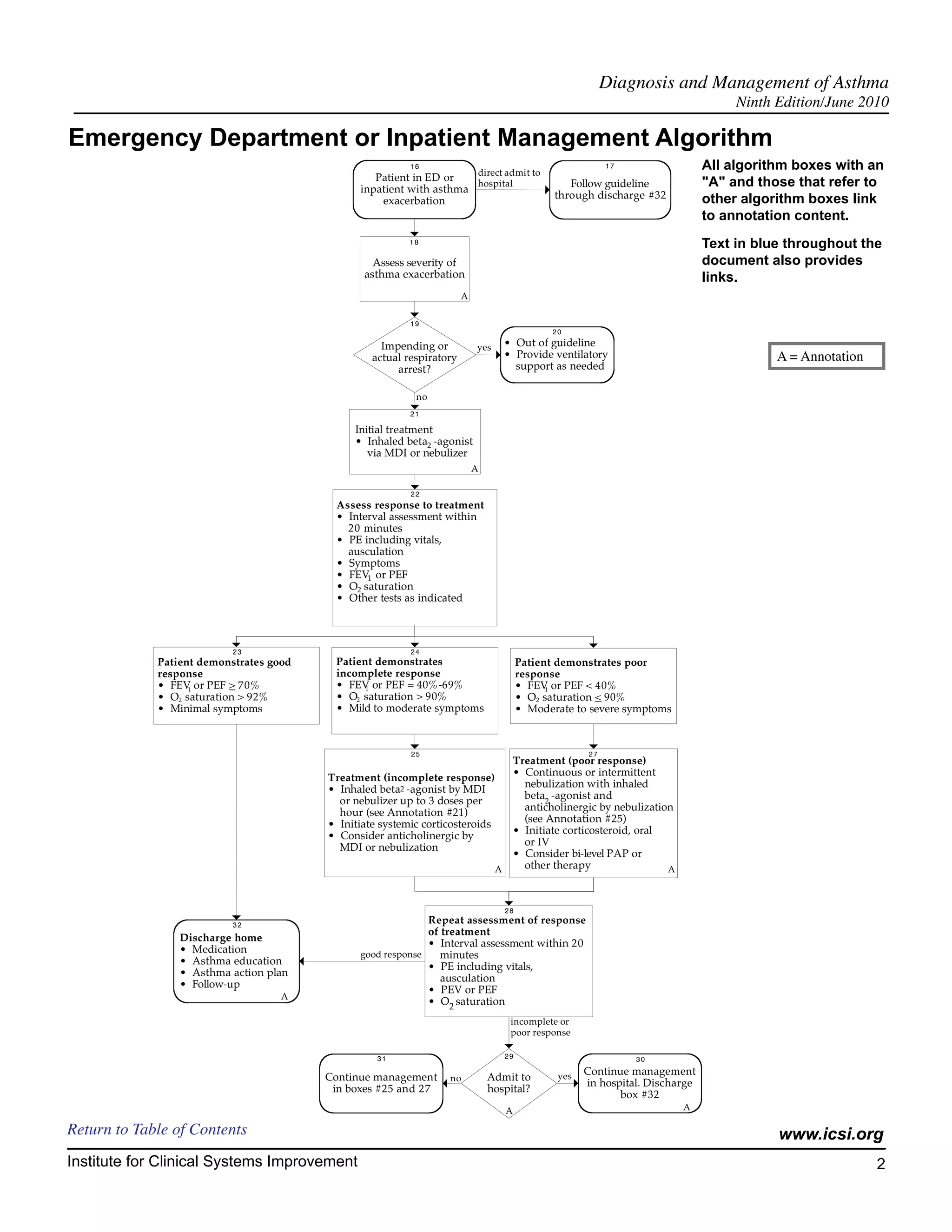
Emergency Department or Inpatient Management Algorithm
                                                          16
                                                                           direct admit to
                                                                                                             17                  All algorithm boxes with an
                                                  Patient in ED or
                                               inpatient with asthma
                                                                     hospital                       Follow guideline             "A" and those that refer to
                                                   exacerbation
                                                                                                 through discharge #32           other algorithm boxes link
                                                                                                                                 to annotation content.
                                                          18                                                                     Text in blue throughout the
                                                  Assess severity of                                                             document also provides
                                                asthma exacerbation                                                              links.
                                                                       A

                                                          19
                                                                                                 20

                                                    Impending or                     • Out of guideline
                                                                                                                                            A = Annotation
                                                                           yes
                                                  actual respiratory                 • Provide ventilatory
                                                       arrest?                         support as needed

                                                           no
                                                          21

                                              Initial treatment
                                              • Inhaled beta2 -agonist
                                                 via MDI or nebulizer
                                                                           A

                                                          22
                                           Assess response to treatment
                                           • Interval assessment within
                                             20 minutes
                                           • PE including vitals,
                                             ausculation
                                           • Symptoms
                                           • FEV1 or PEF
                                           • O2 saturation
                                           • Other tests as indicated


                           23                             24                                            26
             Patient demonstrates good    Patient demonstrates                            Patient demonstrates poor
             response                     incomplete response                             response
             • FEV or PEF > 70%
                   1
                                          • FEV or PEF = 40%-69%
                                                1                                         • FEV or PEF < 40%
                                                                                                1
             • O2 saturation > 92%        • O2 saturation > 90%                           • O2 saturation < 90%
             • Minimal symptoms           • Mild to moderate symptoms                     • Moderate to severe symptoms


                                                          25                                            27
                                                                                         Treatment (poor response)
                                                                                         • Continuous or intermittent
                                         Treatment (incomplete response)
                                                                                           nebulization with inhaled
                                         • Inhaled beta2 -agonist by MDI
                                                                                           beta2 -agonist and
                                           or nebulizer up to 3 doses per
                                                                                           anticholinergic by nebulization
                                           hour (see Annotation #21)
                                                                                           (see Annotation #25)
                                         • Initiate systemic corticosteroids
                                                                                         • Initiate corticosteroid, oral
                                         • Consider anticholinergic by
                                                                                           or IV
                                           MDI or nebulization
                                                                                         • Consider bi-level PAP or
                                                                                 A         other therapy                 A


                                                                                     28

                           32
                                                             Repeat assessment of response
                                                             of treatment
                 Discharge home
                                                             • Interval assessment within 20
                 • Medication                  good response    minutes
                 • Asthma education
                                                             • PE including vitals,
                 • Asthma action plan
                                                                ausculation
                 • Follow-up
                                                             • PEV or PEF
                                    A
                                                             • O2 saturation
                                                                                      incomplete or
                                                                                      poor response

                                                   31                                29                           30

                                                                                                  yes   Continue management
                                         Continue management      no           Admit to
                                                                                                        in hospital. Discharge
                                          in boxes #25 and 27                  hospital?
                                                                                                               box #32
                                                                                     A                                       A

Return to Table of Contents                                                                                                                 www.icsi.org
Institute for Clinical Systems Improvement                                                                                                                   2
Diagnosis and Management of Asthma
                                                                                                                                            Ninth Edition/June 2010

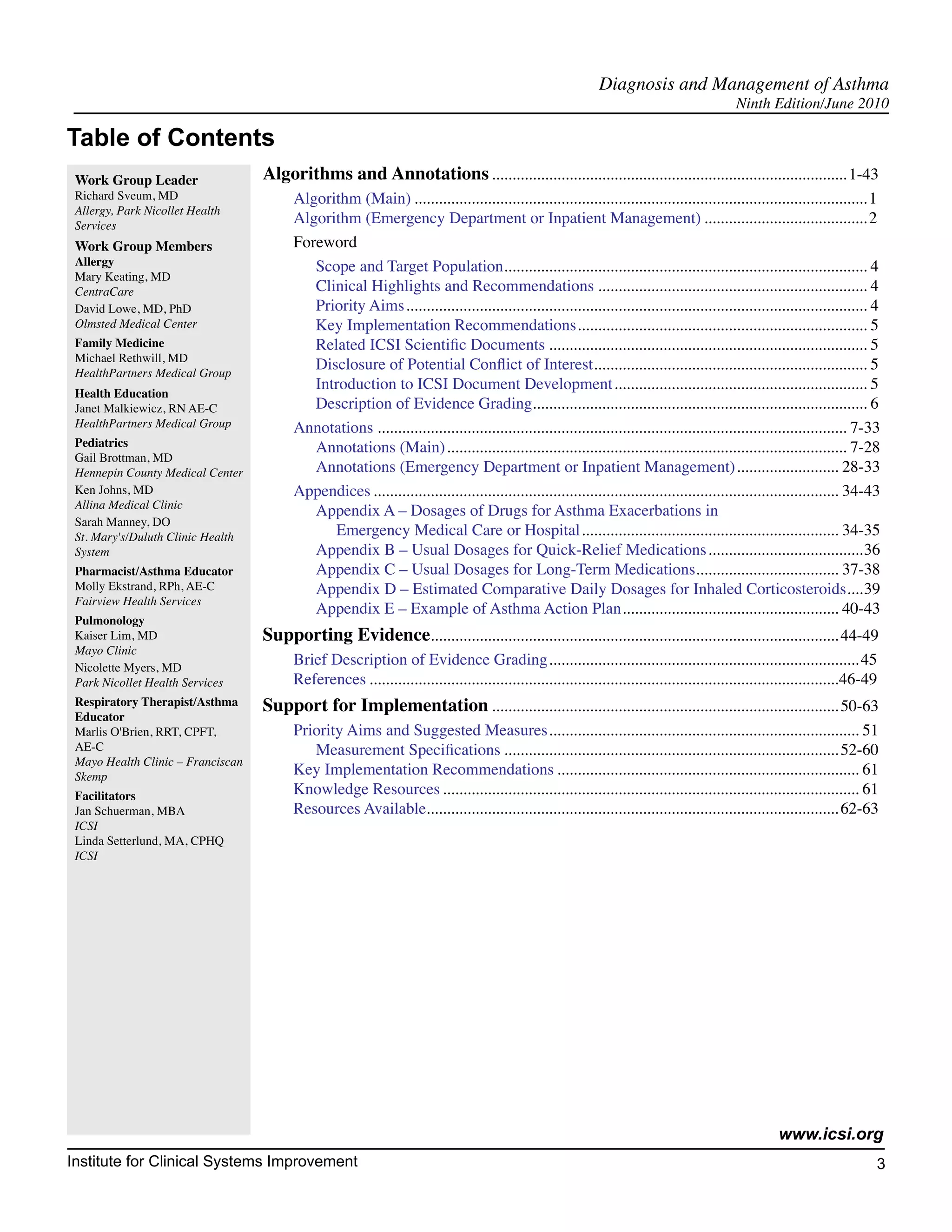
Table of Contents
 Work Group Leader                 Algorithms and Annotations........................................................................................ 1-43
 Richard Sveum, MD                       Algorithm (Main)................................................................................................................ 1
 Allergy, Park Nicollet Health
 Services
                                         Algorithm (Emergency Department or Inpatient Management)......................................... 2
 Work Group Members                      Foreword
 Allergy                                    Scope and Target Population......................................................................................... 4
                                                                                    .
 Mary Keating, MD
 CentraCare                                 Clinical Highlights and Recommendations................................................................... 4
 David Lowe, MD, PhD                        Priority Aims.................................................................................................................. 4
 Olmsted Medical Center                     Key Implementation Recommendations........................................................................ 5
 Family Medicine                            Related ICSI Scientific Documents............................................................................... 5
 Michael Rethwill, MD
 HealthPartners Medical Group
                                            Disclosure of Potential Conflict of Interest................................................................... 5
                                                                                                          .
                                            Introduction to ICSI Document Development............................................................... 5
 Health Education
 Janet Malkiewicz, RN AE-C                  Description of Evidence Grading.................................................................................. 6
 HealthPartners Medical Group            Annotations.................................................................................................................... 7-33
 Pediatrics                                 Annotations (Main)................................................................................................... 7-28
 Gail Brottman, MD
 Hennepin County Medical Center             Annotations (Emergency Department or Inpatient Management).......................... 28-33
 Ken Johns, MD                           Appendices................................................................................................................... 34-43
 Allina Medical Clinic
                                            Appendix A – Dosages of Drugs for Asthma Exacerbations in
 Sarah Manney, DO
 St. Mary's/Duluth Clinic Health               Emergency Medical Care or Hospital................................................................ 34-35
 System                                     Appendix B – Usual Dosages for Quick-Relief Medications.......................................36
 Pharmacist/Asthma Educator                 Appendix C – Usual Dosages for Long-Term Medications................................... 37-38
                                                                                                                                   .
 Molly Ekstrand, RPh, AE-C                  Appendix D – Estimated Comparative Daily Dosages for Inhaled Corticosteroids....39                                          .
 Fairview Health Services
                                            Appendix E – Example of Asthma Action Plan. .................................................... 40-43
                                                                                                                 .
 Pulmonology
 Kaiser Lim, MD                    Supporting Evidence.................................................................................................... 44-49
 Mayo Clinic
 Nicolette Myers, MD
                                         Brief Description of Evidence Grading............................................................................. 45
 Park Nicollet Health Services           References....................................................................................................................46-49
 Respiratory Therapist/Asthma      Support for Implementation...................................................................................... 50-63
 Educator
 Marlis O'Brien, RRT, CPFT,              Priority Aims and Suggested Measures............................................................................. 51
 AE-C                                       Measurement Specifications................................................................................... 52-60
 Mayo Health Clinic – Franciscan
 Skemp                                   Key Implementation Recommendations........................................................................... 61
 Facilitators                            Knowledge Resources....................................................................................................... 61
 Jan Schuerman, MBA                      Resources Available..................................................................................................... 62-63
 ICSI
 Linda Setterlund, MA, CPHQ
 ICSI


                                                                                                                                                      www.icsi.org
Institute for Clinical Systems Improvement                                                                                                                                  3
Diagnosis and Management of Asthma
                                                                                                       Ninth Edition/June 2010

Foreword
      Scope and Target Population
           This guideline addresses the diagnosis, emergent, inpatient and outpatient management of acute and chronic
           asthma in all patients over five years of age who present with asthma-like symptoms or have been diagnosed
           with asthma.
           Return to Table of Contents

      Clinical Highlights and Recommendations
          •	   Conduct interval evaluations of asthma including medical history and physical examination, assessment
               of asthma triggers and allergens, measurement of pulmonary function, and consideration of consultation
               and/or allergy testing. (Annotation #11)
          •	   Assess control using objective measures and a validated asthma control tool. (Annotation #12)
          •	   Match therapy with asthma control. (Annotation #13)
          •	   Provide asthma education to patients and parents of pediatric patients. Education should include basic
               facts about asthma, how medications work, inhaler technique, a written action plan including home peak
               flow rate monitoring or a symptom diary, environmental control measures, and emphasis on the need
               for regular follow-up visits. (Annotation #14)
          •	   Patients should receive appropriate follow-up as per Diagnosis and Management of Asthma guideline.
               (Annotation #15)
           Return to Table of Contents

      Priority Aims
          1.	 Promote the accurate assessment of asthma severity and control through the use of objective measures
              of lung function and symptoms. (Annotations #3, 4, 5)
          2.	 Promote long-term control of persistent asthma through the use of inhaled corticosteroid drug therapy.
              (Annotation #13)
          3.	 Promote the partnership of patients with asthma and/or their parents with health care professionals
              through education and the use of written action plans. (Annotation #14)
          4.	 Improve the timely and accurate assessment of patients presenting with an asthma exacerbation. (Anno-
              tations #5, 9, 30)
          5.	 Improve the treatment and management of ER and inpatient asthma. (Annotations #5, 21, 25, 27)
          6.	 Schedule follow-up visits to ensure asthma control is maintained and appropriate therapy is administered.
              (Annotations #15, 32)
           Return to Table of Contents


                                                                                                             www.icsi.org
Institute for Clinical Systems Improvement                                                                                  4
Diagnosis and Management of Asthma	
Foreword                                                                                               Ninth Edition/June 2010

      Key Implementation Recommendations
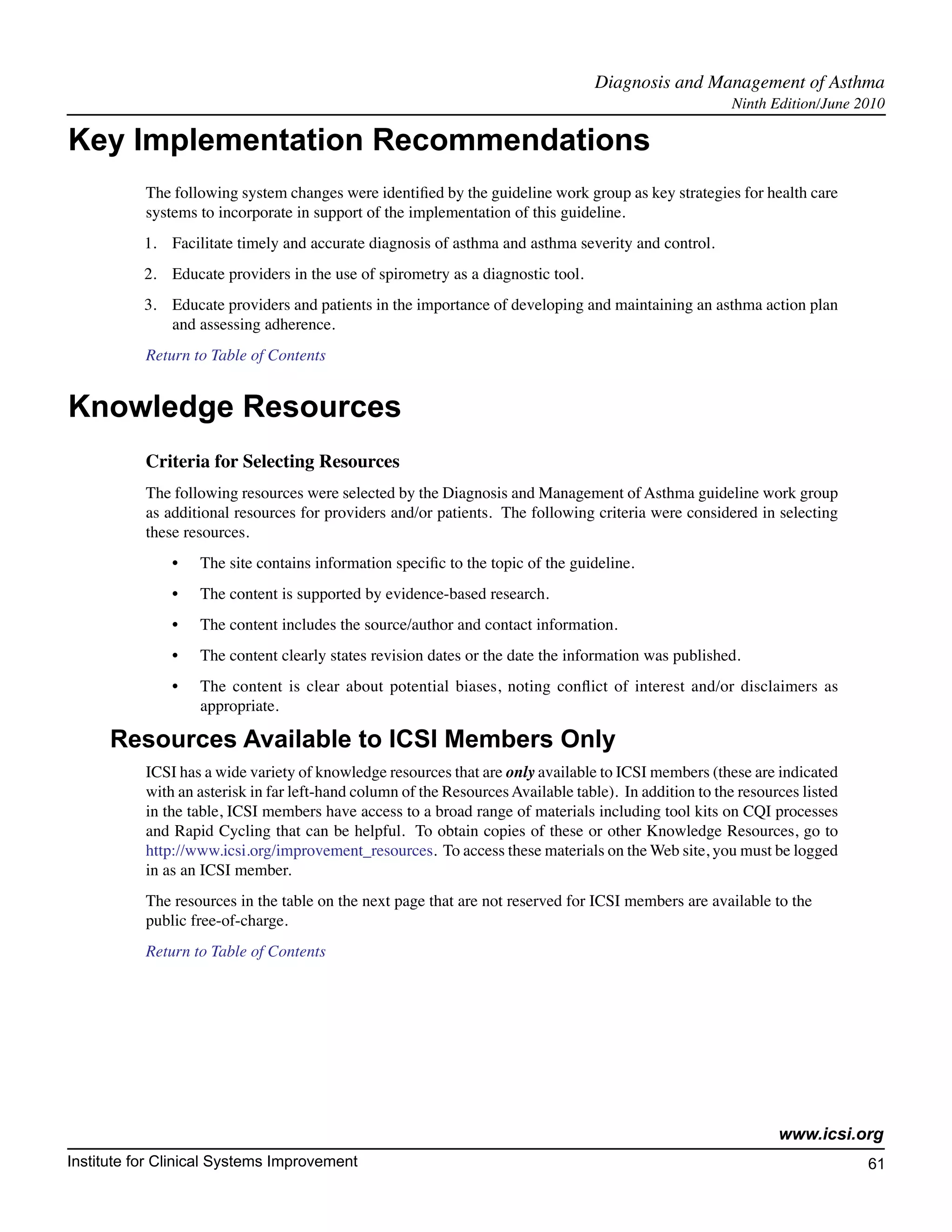
           The following system changes were identified by the guideline work group as key strategies for health care
           systems to incorporate in support of the implementation of this guideline.
           1.	 Facilitate timely and accurate diagnosis of asthma and asthma severity and control.
           2.	 Educate providers in the use of spirometry as a diagnostic tool.
           3.	 Educate providers and patients in the importance of developing and maintaining an asthma action plan
               and assessing adherence.
           Return to Table of Contents

      Related ICSI Scientific Documents
           Guidelines
               •	   Chronic Obstructive Pulmonary Disease
               •	   Diagnosis and Treatment of Respiratory Illness in Children and Adults
           Order Sets
               •	   Admission for Asthma
           Return to Table of Contents

      Disclosure of Potential Conflict of Interest
           ICSI has adopted a policy of transparency, disclosing potential conflict and competing interests of all indi-
           viduals who participate in the development, revision and approval of ICSI documents (guidelines, order
           sets and protocols). This applies to all work groups (guidelines, order sets and protocols) and committees.
           Participants must disclose any potential conflict and competing interests they or their dependents (spouse,
           dependent children, or others claimed as dependents) may have with any organization with commercial,
           proprietary, or political interests relevant to the topics covered by ICSI documents. Such disclosures will
           be shared with all individuals who prepare, review and approve ICSI documents.
           Gail Brottman has received grant funding for AHRQ.
           Kaiser Lim has mentored Dr. Amitha Harish for her Aerocrine research fellowship grant.
           Molly Ekstrand has received honoraria and some travel expenses from the American Lung Association of
           Minnesota, the American Pharmacists Association and the Minnesota Pharmacists Association.
           No other work group members have potential conflicts of interest to disclose.
           Return to Table of Contents

      Introduction to ICSI Document Development
           This document was developed and/or revised by a multidisciplinary work group utilizing a defined process
           for literature search and review, document development and revision as well as obtaining and responding
           to ICSI members.
           For a description of ICSI's development and revision process, please see the Development and Revision
           Process for Guidelines, Order Sets and Protocols at http://www.icsi.org.
           Return to Table of Contents
                                                                                                              www.icsi.org
Institute for Clinical Systems Improvement                                                                                  5
Diagnosis and Management of Asthma	
Foreword                                                                                                 Ninth Edition/June 2010

     Evidence Grading System
               A. 	 Primary Reports of New Data Collection:
                   Class A:	      Randomized, controlled trial
                   Class B:	      Cohort study
                   Class C:	      Non-randomized trial with concurrent or historical controls
                       			        Case-control study
                       			        Study of sensitivity and specificity of a diagnostic test
                       			        Population-based descriptive study
                   Class D:	      Cross-sectional study
                       			        Case series
                       			        Case report
               B.	 Reports that Synthesize or Reflect upon Collections of Primary Reports:
               	   Class M:	      Meta-analysis
                   		             Systematic review
                   		             Decision analysis
                   		             Cost-effectiveness analysis
                   Class R:	      Consensus statement
                       			        Consensus report
                       			        Narrative review
                   Class X:	      Medical opinion
           Citations are listed in the guideline utilizing the format of (Author, YYYY [report class]). A full explanation
           of ICSI's Evidence Grading System can be found at http://www.icsi.org.
           Return to Table of Contents


                                                                                                                www.icsi.org
Institute for Clinical Systems Improvement                                                                                    6
Diagnosis and Management of Asthma
                                                                                                         Ninth Edition/June 2010

Algorithm Annotations
      1.	 Patient Presents with Symptoms of Asthma
           Definition of Asthma
           Asthma is a chronic inflammatory disorder of the airways. It is characterized by:
               •	   Airway inflammatory cells, including eosinophils, macrophages, mast cells, epithelial cells and
                    activated lymphocytes that release various cytokines, adhesion molecules and other mediators.
               •	   Inflammation resulting in an acute, subacute or chronic process that alters airway tone, modulates
                    vascular permeability, activates neurons, increases secretion of mucus, and alters airway structure
                    reversibly or permanently.
               •	   Airway hyperresponsiveness in response to allergens, environmental irritants, viral infections and
                    exercise.
               •	   Airflow obstruction caused by acute bronchial constriction, edema, mucus plugs and frequently,
                    permanent remodeling.
           Symptoms
               •	   Wheezing
               •	   Breathlessness
               •	   Cough, productive or dry
               •	   Chest discomfort
           Pattern of symptoms
               •	   Perennial/seasonal
               •	   Episodic/continual
               •	   Diurnal
           Severity of symptom classification
               •	   Number of symptom episodes per week
               •	   Number of nocturnal symptoms per month
               •	   Objective measures of lung function (forced expiratory volume in one second [FEV1], peak expira-
                    tory flow rate [PEFR], PEF variability)

           Symptoms of Asthma
           Symptoms suggestive of asthma include episodic wheezing and cough with nocturnal, seasonal or exertional
           characteristics. Infants and children with frequent episodes of "bronchitis" are likely to have asthma. Atopic
           and positive family histories for asthma, particularly when associated with previously mentioned symptoms,
           should encourage one to consider a diagnosis of asthma.
           Eliciting symptoms should emphasize characterizing the current classification scheme that describes frequency
           per week, changes in physical activity, diurnal variation, and seasonal variation. It is important to recognize
           that patients with asthma are heterogeneous, falling into every age group, from infancy to older age, and

                                                                                                                www.icsi.org
Institute for Clinical Systems Improvement                                                                                    7
Diagnosis and Management of Asthma
Algorithm Annotations                                                                                      Ninth Edition/June 2010

           presenting a spectrum of signs and symptoms that vary in degree and severity from patient to patient, as
           well as within an individual patient over time (National Heart, Lung, Blood Institute EPR-3, 2007 [R]).
           Return to Algorithm		            Return to Table of Contents

      2.	 Previous Diagnosis of Asthma?
           At each evaluation, it is important to consider whether or not a previous diagnosis was correct.
               •	   History and physical consistent with diagnosis.
               •	   Response to therapy consistent with symptoms.
           Return to Algorithm		            Return to Table of Contents

      3.	 Establish Diagnosis of Asthma and Determine Level of Severity
           Key Points:
               •	 The diagnosis of asthma is based on the patient's medical history, physical examination,
                  pulmonary function tests and laboratory test results.
               •	 Spirometry is recommended for the diagnosis of asthma.
               •	 The level of asthma severity is determined by both impairment and risk.
           Asthma triggers
               •	   Viral respiratory infections
               •	   Environmental allergens
               •	   Exercise, temperature, humidity
               •	   Occupational and recreational allergens or irritants
               •	   Environmental irritants (perfume, tobacco smoke, wood-burning stoves)
               •	   Drugs (aspirin, non-steroidal anti-inflammatory drugs [NSAIDs], beta-blocker) and food (sulfites)
           Other historical components
               •	   Emergency department visits and hospitalization
               •	   Medication use (especially oral steroids)
               •	   Lung function, PEFR variability
               •	   Associated comorbidities, e.g., rhinitis, sinusitis, gastroesophageal reflux (GERD)
           Clinical testing
               •	   Accurate spirometry is recommended in every patient five years of age or older at the time of diag-
                    nosis.
               •	   Additional studies done, tailored to the specific patient.
                    -	   Allergy testing (e.g., skin testing, blood testing, in vitro-specific IgE antibody testing)
                    -	   Chest radiography, to exclude alternative diagnosis
                    -	   Bronchial provocation testing if spirometry is normal or near normal
                    -	   Sinus x-rays or CT scan
           Return to Algorithm		            Return to Table of Contents                                           www.icsi.org
Institute for Clinical Systems Improvement                                                                                      8
Diagnosis and Management of Asthma
Algorithm Annotations                                                                                     Ninth Edition/June 2010

                    -	   GERD evaluation
                    -	   CBC with eosinophils, total IgE, sputum exam
           Spirometry is the cornerstone of the laboratory evaluation that enables the clinician to demonstrate airflow
           obstruction and establish a diagnosis of asthma with certainty. Spirometry is essential for assessing the
           severity of asthma in order to make appropriate therapeutic recommendations. The use of objective measures
           of lung function is recommended because patient-reported symptoms often do not correlate with the vari-
           ability and severity of airflow obstruction. Testing should be performed in compliance with the American
           Thoracic Society standards. Obstructive and restrictive ventilatory defects can generally be determined
           using forced expiratory volume in one second (FEV1)/forced vital capacity (FVC) ratio (American Thoracic
           Society, 1991 [R]).
           Spirometry is generally valuable in children five years of age or older; however, some children cannot conduct
           the maneuver, depending on developmental ability. Spirometry measurements (FEV1, FVC, FEV1/FVC)
           before and after the patient inhales a short-acting bronchodilator should be undertaken for patients in whom
           the diagnosis of asthma is being considered. Airflow obstruction is indicated by reduced FEV1 and FEV1/
           FVC values relative to reference or predicted values. Significant reversibility is indicated by an increase of
           12 percent or greater and 200 mL in FEV1, after inhaling a short-acting bronchodilator.
           Investigation into the role of allergy, at least with a complete history, should be done in every patient, given
           high prevalence of positive skin tests among individuals with asthma and the benefits of limiting exposure
           to known allergens. History may help to distinguish seasonal allergies but may be inadequate for periennial
           allergies. Eosinophil count and IgE may be elevated in asthma; however, neither test has sufficient specificity
           or sensitivity to be used alone in a diagnosis. The chest x-ray and electrocardiogram are usually normal in
           asthma but may be useful to exclude other pulmonary or cardiac conditions. Sputum examination may be
           helpful if sputum eosinophilia or infection are suspected.
           There are several clinical scenarios in children that have a frequent association with asthma and should
           strongly suggest asthma as a possible diagnosis. These include recurrent pulmonary infiltrates (especially
           right middle lobe infiltrates) with volume loss that clear radiologically within two to three days, and the
           diagnosis of pneumonia without fever. Asthma may cause some radiologic uncertainty since mucus plug-
           ging and atelectasis may be interpreted as infiltrates.
           Diagnostic spirometry and a methacholine challenge test, if necessary, are important to clinching the diag-
           nosis. The patient's history and response to therapy should guide other diagnostic tests when considering
           alternative diagnoses. Follow-up spirometry every one to two years in mild asthmatics will reconfirm the
           diagnosis and objectify serial change and level of control. More frequent monitoring should be considered
           for the moderate and severe persistent categories.
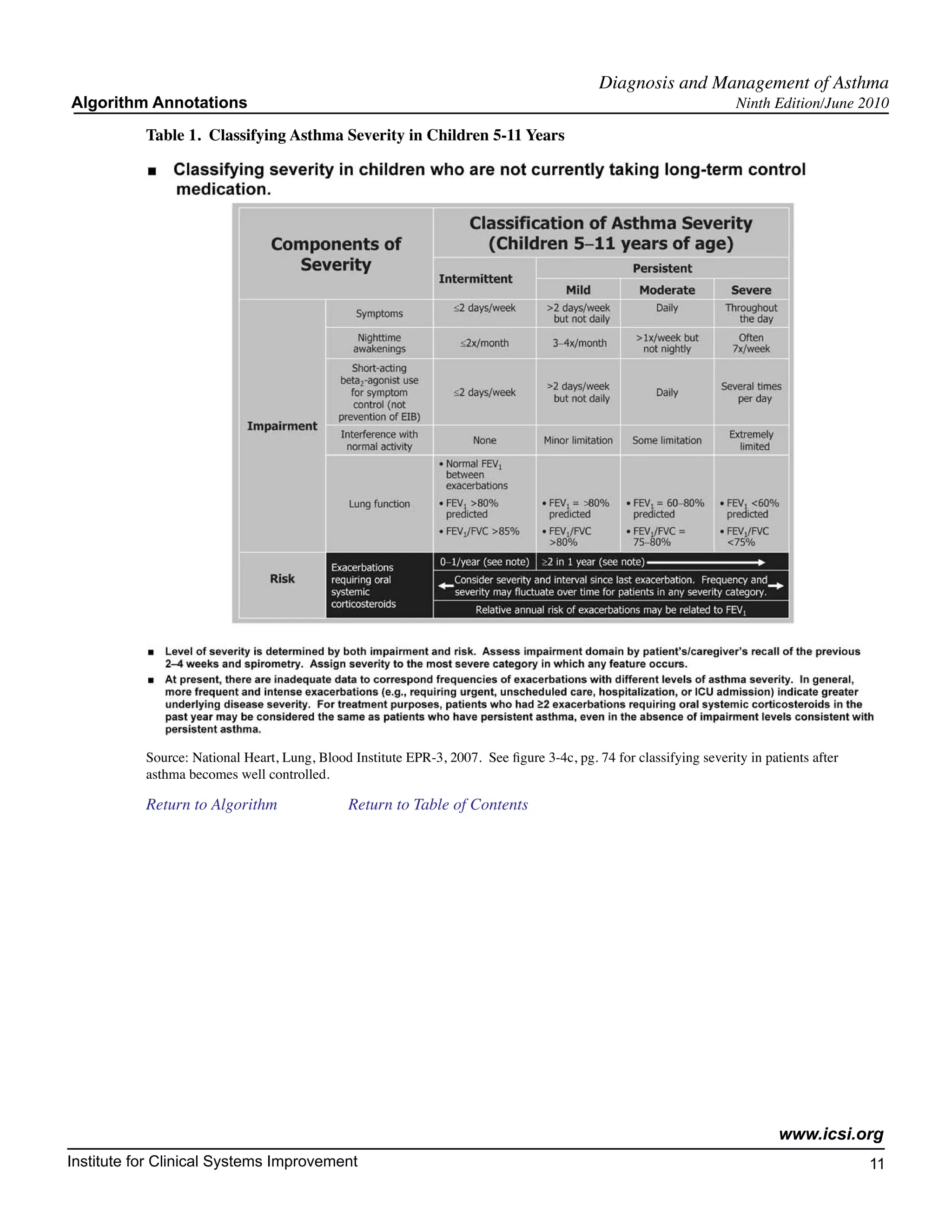
           See Table 1, "Classifying Asthma Severity in Children 5-11 Years."
           See Table 2, "Classifying Asthma Severity in Youths and Adults."
           Differential Diagnostic Possibilities for Asthma
           Upper airway disease
               •	   Allergic rhinitis and sinusitis (Corren, 1992 [A]; Rachelefsky, 1984 [D])
           Obstruction involving large airways
               •	   Foreign body in trachea or bronchus
               •	   Vocal cord dysfunction
               •	   Vascular rings or laryngeal webs
           Return to Algorithm		           Return to Table of Contents
                                                                                                                 www.icsi.org
Institute for Clinical Systems Improvement                                                                                     9
Diagnosis and Management of Asthma
Algorithm Annotations                                                                            Ninth Edition/June 2010

              •	   Laryngotracheomalacia, tracheal stenosis or bronchostenosis
              •	   Enlarged lymph nodes or tumor (benign or malignant)
              •	   Bronchiectasis of various causes, including cystic fibrosis
           Obstruction of small airways
              •	   Viral bronchiolitis or obliterative bronchiolitis
              •	   Cystic fibrosis
              •	   Bronchopulmonary dysplasia
              •	   Pulmonary infiltrates with eosinophilia
              •	   Chronic obstructive pulmonary disease (chronic bronchitis or emphysema)
           Other causes
              •	   Pulmonary embolism
              •	   Congestive heart failure
              •	   Cough secondary to drugs (angio-tension-converting enzyme [ACE] inhibitors)
              •	   Aspiration from swallowing mechanism dysfunction or gastroesophageal reflux
              •	   Recurrent cough not due to asthma
           Return to Algorithm		          Return to Table of Contents


                                                                                                       www.icsi.org
Institute for Clinical Systems Improvement                                                                          10
Diagnosis and Management of Asthma
Algorithm Annotations                                                                                                Ninth Edition/June 2010

           Table 1. Classifying Asthma Severity in Children 5-11 Years


           Source: National Heart, Lung, Blood Institute EPR-3, 2007. See figure 3-4c, pg. 74 for classifying severity in patients after
           asthma becomes well controlled.

           Return to Algorithm		               Return to Table of Contents


                                                                                                                             www.icsi.org
Institute for Clinical Systems Improvement                                                                                                 11
Diagnosis and Management of Asthma
Algorithm Annotations                                                                                                                               Ninth Edition/June 2010

           Table 2. Classifying Asthma Severity in Youths and Adults


                                                                         Classification of Asthma Severity
                                 Components of                         (Youths 12 years of age and adults)
                                   Severity                                                                     Persistent
                                                                     Intermittent             Mild             Moderate               Severe
                                                                        2 days/week      >2 days/week              Daily              Throughout
                                                   Symptoms                               but not daily                                 the day

                                                    Nighttime            2x/month          3 4x/month          >1x/week but          Often 7x/week
                                                   awakenings                                                    not nightly

                                                    Short-acting        2 days/week        2 days/week             Daily              Several times
                                                 beta2-agonist use                            but not                                   per day
                              Impairment       for symptom control                           >1x/day
                                                  (not prevention
                                                      of EIB)
                            Normal FEV1/FVC:
                             8 19 yr 85%        Interference with         None           Minor limitation     Some limitation     Extremely limited
                            20 39 yr 80%         normal activity
                            40 59 yr 75%
                            60 80 yr 70%                             • Normal FEV1
                                                                       between
                                                                       exacerbations

                                                  Lung function      • FEV1 >80%        • FEV1 80%           • FEV1 >60% but      • FEV1 <60%
                                                                       predicted          predicted            <80% predicted       predicted

                                                                     • FEV1/FVC         • FEV1/FVC           • FEV1/FVC           • FEV1/FVC
                                                                       normal             normal               reduced 5%            reduced >5%
                                                                         0 1/year
                                                                                         2/year (see note)
                                                                        (see note)
                                                 Exacerbations
                                                 requiring oral           Consider severity and interval since last exacerbation. Frequency and
                                  Risk              systemic              severity may fluctuate over time for patients in any severity category.
                                                 corticosteroids
                                                                               Relative annual risk of exacerbations may be related to FEV1


           Source: National Heart, Lung, Blood Institute EPR-3, 2007. See figure 3-4c, pg. 74 for classifying severity in patients after
           asthma becomes well controlled.

           Return to Algorithm		                 Return to Table of Contents

      4.	 Acute Asthma Exacerbation?
           Symptoms of an acute asthma episode include progressive breathlessness, cough, wheezing or chest tightness.
           An acute asthma episode is characterized by a decrease in expiratory airflow that can be documented and
           quantified by measurement of lung function (spirometry or peak expiratory flow rate [PEFR]). Indications
           for emergency care include:
               •	   Peak flow less than 40% predicted normal
               •	   Failure to respond to a beta2-agonist
               •	   Severe wheezing or coughing
               •	   Extreme anxiety due to breathlessness
               •	   Gasping for air, sweaty, or cyanotic
               •	   Rapid deterioration over a few hours
               •	   Severe retractions and nasal flaring
               •	   Hunched forward
             Return to Algorithm		      Return to Table of Contents                                                                                       www.icsi.org
Institute for Clinical Systems Improvement                                                                                                                             12
Diagnosis and Management of Asthma
Algorithm Annotations                                                                                  Ninth Edition/June 2010

      5.	 Assess Severity of Asthma Exacerbation
           Key Points:
                •	 Severity should be promptly assessed using objective measures of lung function.
                •	 Patients experiencing an acute asthma exacerbation need a focused history and physical
                   examination and measurement of airflow.
           Patients presenting with an acute exacerbation of their asthma should receive prompt evaluation to assess
           the severity of their symptoms. Treatment should begin as rapidly as possible even while still assessing
           severity.
           Assessment of asthma severity should include history, physical examination, an objective measure of lung
           function, either FEV1 or PEFR, oxygen saturation and other tests as indicated.
           History
           •	   Symptoms consistent with asthma
           •	   Severity of symptoms, limitations and sleep disturbance
           •	   Duration of symptoms
           •	   Current medical treatment plan
           •	   Adherence to medical treatment plan
           •	   Rescue medication use:
                -	   Recent use of short-acting beta2-agonists
                -	   Number of bursts of oral steroids in past year
           •	   Review Asthma Action Plan and daily charting of peak flows
           •	   Previous emergency department (ED) visits or hospitalization
           •	   Record triggers:
                -	   Upper respiratory infection (URI)
                -	   Bronchitis, pneumonia, sinusitis
                -	   Exposure to allergens or irritants
                -	   Assessment of tobacco use and/or second-hand exposure
                -	   Exercise
                -	   GERD
           Clinicians treating asthma exacerbations should be familiar with the characteristics of patients at risk for
           life-threatening deterioration.
           See Table 3, "Risk Factors for Death from Asthma."
           Return to Algorithm		            Return to Table of Contents


                                                                                                             www.icsi.org
Institute for Clinical Systems Improvement                                                                                13
Diagnosis and Management of Asthma
Algorithm Annotations                                                                                       Ninth Edition/June 2010

              Table 3. Risk Factors for Death from Asthma
               Past history of sudden severe exacerbations
               Prior intubation for asthma
               Prior admission for asthma to an intensive care unit
               Three or more emergency care visits for asthma in the past year
               Hospitalization or an emergency care visit for asthma within the past month
               Use of more than two canisters per month of inhaled short-acting beta2-agonist
               Current use of systemic corticosteroids or recent withdrawal from systemic corticosteroids
               Difficulty perceiving airflow obstruction or its severity
               Serious psychiatric disease or psychosocial problems
               Low socioeconomic status and urban residence
               Illicit drug use
               Sensitivity to alternaria

           (National Heart, Lung, Blood Institute EPR-3, 2007 [R])

           Lung Function
          •	     Spirometry (FEV1) – preferred, FEV1/FVC
          	      or
          •	     Peak expiratory flow rate (PEFR)
          •	     Pulse oximetry

           Physical Exam
          •	     Vital signs: Temperature, blood pressure, pulse rate, respiratory rate, pulsus paradoxus
          •	     Alertness
          •	     Ability to talk
          •	     Use of accessory muscles
          •	     Auscultation of chest
          •	     Color

           Laboratory Studies
           Treatment with bronchodilators should not be delayed for laboratory studies. Tests which may be useful
           include:
                 •	   Arterial blood gases (ABG's)
                 •	   Chest x-ray (CXR)
                 •	   Complete blood count (CBC)
                 •	   Electrocardiogram (EKG)
                 •	   Electrolytes
                 •	   Theophylline level (if appropriate)
           Return to Algorithm		            Return to Table of Contents


                                                                                                                  www.icsi.org
Institute for Clinical Systems Improvement                                                                                     14
Diagnosis and Management of Asthma
Algorithm Annotations                                                                                              Ninth Edition/June 2010

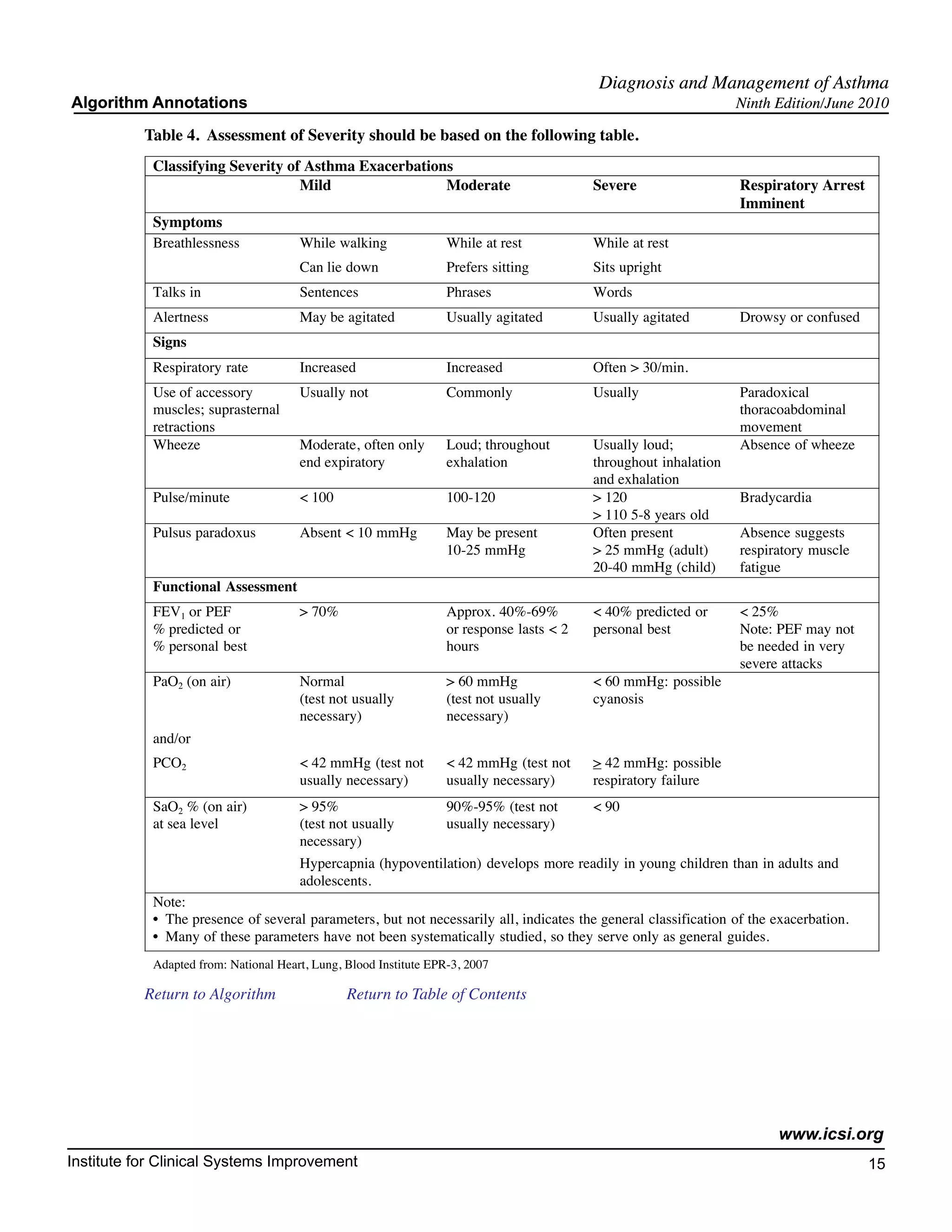
           Table 4. Assessment of Severity should be based on the following table.
            Classifying Severity of Asthma Exacerbations
                                   Mild                Moderate                            Severe                  Respiratory Arrest
                                                                                                                   Imminent
            Symptoms
            Breathlessness             While walking               While at rest           While at rest
                                       Can lie down                Prefers sitting         Sits upright
            Talks in                   Sentences                   Phrases                 Words
            Alertness                  May be agitated             Usually agitated        Usually agitated        Drowsy or confused
            Signs
            Respiratory rate           Increased                   Increased               Often > 30/min.
            Use of accessory           Usually not                 Commonly                Usually                 Paradoxical
            muscles; suprasternal                                                                                  thoracoabdominal
            retractions                                                                                            movement
            Wheeze                     Moderate, often only        Loud; throughout        Usually loud;           Absence of wheeze
                                       end expiratory              exhalation              throughout inhalation
                                                                                           and exhalation
            Pulse/minute               < 100                       100-120                 > 120                   Bradycardia
                                                                                           > 110 5-8 years old
            Pulsus paradoxus           Absent < 10 mmHg            May be present          Often present           Absence suggests
                                                                   10-25 mmHg              > 25 mmHg (adult)       respiratory muscle
                                                                                           20-40 mmHg (child)      fatigue
            Functional Assessment
            FEV1 or PEF                > 70%                       Approx. 40%-69%         < 40% predicted or      < 25%
            % predicted or                                         or response lasts < 2   personal best           Note: PEF may not
            % personal best                                        hours                                           be needed in very
                                                                                                                   severe attacks
            PaO2 (on air)              Normal                      > 60 mmHg               < 60 mmHg: possible
                                       (test not usually           (test not usually       cyanosis
                                       necessary)                  necessary)
            and/or
            PCO2                       < 42 mmHg (test not         < 42 mmHg (test not     > 42 mmHg: possible
                                       usually necessary)          usually necessary)      respiratory failure
            SaO2 % (on air)            > 95%                       90%-95% (test not       < 90
            at sea level               (test not usually           usually necessary)
                                       necessary)
                                       Hypercapnia (hypoventilation) develops more readily in young children than in adults and
                                       adolescents.
            Note:
            • The presence of several parameters, but not necessarily all, indicates the general classification of the exacerbation.
            • Many of these parameters have not been systematically studied, so they serve only as general guides.
            Adapted from: National Heart, Lung, Blood Institute EPR-3, 2007

           Return to Algorithm		                Return to Table of Contents


                                                                                                                         www.icsi.org
Institute for Clinical Systems Improvement                                                                                              15
Diagnosis and Management of Asthma
Algorithm Annotations                                                                                   Ninth Edition/June 2010

     8.	 Management of Asthma Exacerbation
           Key Points:
               •	 Treatment is begun with inhaled short-acting beta2-agonists administered by meter dose
                  inhaler (MDI)/spacer or nebulizer.
               •	 Further intensification of therapy is based on severity, response and prior history, but
                  typically includes a short course of oral corticosteroids.
           (McFadden, 2003 [R])

           Treatment
           Usual initial treatment is with short-acting beta2-agonist (albuterol) administered by nebulizer or MDI/
           spacer.
           Alternatives:
               Epinephrine: (1:1,000)
                   Adult:  0.3-0.5 mg subcutaneous or IM every 20 minutes up to three doses
                   Pediatrics:   0.01 mg/kg up to 0.3-0.5 mg subcutaneous or IM every 20 minutes up to three doses
               Ipratropium added to nebulized beta2-agonist (albuterol)
                   •	   Nebulized dose for adults and those over 12 years of age is 0.5 mg every 4 hours.  Not FDA
                        approved for any indication in those under 12 years of age.
                   •	   Ipratropium is not currently FDA approved for use in asthma.
               Levalbuterol
                   •	   Dose for adolescents 12 years of age and over and adults is 0.63 mg (via nebulizer) three times
                        daily (every six to eight hours); may increase to 1.25 mg via neb three times daily (every six
                        to eight hours) if patient does not exhibit adequate response.
                   •	   Dose for children 6-11 years of age is 0.31 mg (via nebulizer) three times daily.  Routine dosing
                        should not exceed 0.63 mg three times daily.
               Corticosteroids
                   •	   Strongly consider systemic corticosteroids in patients with acute asthma exacerbation.  Corti-
                        costeroids aid symptom resolution and prevent asthma relapse (Chapman, 1991 [A]; Fanta,
                        1983 [A]; Harris, 1987 [A]; Scarfone, 1993 [A]).
           Note:   Do not use LABA monotherapy in acute asthma exacerbations. See http://www.fda.gov/Drugs/
           DrugSafety/ucm187806.htm.   
                   •	   Initiate inhaled corticosteroids to prevent future exacerbations.
           Antibiotics are not recommended for the treatment of acute asthma except for those patients with signs of
           acute bacterial infection, fever and purulent sputum.
           Return to Algorithm		           Return to Table of Contents


                                                                                                               www.icsi.org
Institute for Clinical Systems Improvement                                                                                  16
Diagnosis and Management of Asthma
Algorithm Annotations                                                                                 Ninth Edition/June 2010

     9.	 Assess Response to Treatment
           Good response:
               •	   PEFR or FEV1 greater than or equal to 70% predicted normal
               •	   No wheezing on auscultation
           Incomplete response:
               •	   PEFR or FEV1 40%-69% predicted normal
               •	   Mild wheezing
               •	   Consider hospitalization, particularly for high-risk patients
           Poor response:
               •	   PEFR or FEV1 less than 40% predicted
               •	   No improvement in respiratory distress
               •	   Strongly consider hospitalization
           Return to Algorithm		           Return to Table of Contents

     10.  Does Patient Need ED or Inpatient Asthma Management?
           Studies suggest that most children who require hospitalization can be identified by a repeat assessment
           one hour after initial treatment (Kelly, 2004 [D]; Wilson, 2003 [D]).  After one hour, those children who
           continue to meet the criteria for a severe exacerbation have greater than 86% chance of requiring hospital-
           ization; those who meet the criteria for moderate exacerbation at one hour have an 84% chance of requiring
           hospitalization; and those whose assessment has remained the same or dropped to the mild level have only
           an 18% chance of requiring hospitalization.  These severity assessment studies highlight the importance
           of regular, multifaceted assessments and close observation of children and adolescents who present to the
           office or ED with acute asthma exacerbations (National Heart, Lung, Blood Institute EPR-3, 2007 [R]).
           Return to Algorithm		           Return to Table of Contents

     11.	Evaluation
           Key Points:
               Evaluation of asthma should include the following:
                    •	 Medical history
                    •	 Use of a validated asthma questionnaire
                    •	 Assess asthma triggers/allergens
                    •	 Physical examination
                    •	 Measure lung function
                    •	 Consider specialty consultation
           Medical History
               •	   Disruption of usual activities (work, school, home)
               •	   Sleep disturbance
           Return to Algorithm		           Return to Table of Contents                                       www.icsi.org
Institute for Clinical Systems Improvement                                                                               17
Diagnosis and Management of Asthma
Algorithm Annotations                                                                                         Ninth Edition/June 2010

                   •	   Level of usage of short-acting beta2-agonist
                   •	   Adherence to medical treatment plan
                   •	   Interval exacerbation of symptoms (either treated by self or a health care provider)
                   •	   Symptoms suggesting comorbid conditions or alternative diagnosis
                   •	   Side effects of medications
           Reassessment of medical history can elicit factors that effect overall asthma control and sense of well-being
           (Juniper, 1993 [D]).  The key symptoms that should alert the clinician include disruptive daytime symptoms
           and disturbances of sleep, and symptoms early in the morning that do not improve fifteen minutes after using
           short-acting beta2-agonist.  The quantity of short-acting beta2-agonist that is being used should be discussed
           since overuse can be a marker of the potentially fatality-prone asthmatic (Spitzer, 1992 [C]).  The use of a
           quality-of-life tool or questionnaire can assist to elicit history (Juniper, 1992 [D]).
           Use of a Validated Questionnaire
           The self-assessment questionnaires that can be completed at office visits are intended to capture the patient's
           and family's impression of asthma control, self-management skills and overall satisfaction with care.  Several
           multidimensional instruments have been developed for assessment and monitoring of asthma.  (http://www.
           nhlbi.nih.gov/guidelines/asthma/asthgdln.htm)
           (Skinner, 2004 [D]; Yawn, 2008 [C])
           Assess Asthma Triggers/Allergens
                   •	   Inquire about exposure to triggers and allergens (e.g., occupational, pets, smoke).
                   •	   Allergy testing is recommended for patients with persistent asthma who are exposed to perennial
                        indoor allergens.
                                               Comparison of Skin Tests with In Vitro Tests
                              Advantages of Skin Tests                                Advantages of In Vitro Tests
               • Less expensive than in vitro tests                       •   Do not require knowledge of skin testing
               • Results are available within one hour                        technique
               • Equally sensitive as in vitro tests                      •   Do not require availability of allergen extracts
               • Results are visible to the patient. This may             •   Can be performed on patients who are taking
                 encourage compliance with environmental control              medications that suppress the immediate skin test
                 measures                                                     (antihistamines, antidepressants)
                                                                          •   No risk of systemic reactions
                                                                          •   Can be done for patients who have extensive
                                                                              eczema
               Source: National Heart, Lung, Blood Institute EPR-3, 2007
           Studies of emergency department visits and near death show allergens as a factor in asthma exacerbation.  
           Asthma triggers in the workplace also need to be considered.  About 15% of asthma in adults is work related
           (Blanc, 1987 [C]; Malo, 1992 [C]; O'Hollaren, 1991 [D]; Pollart, 1988 [C]).
           Physical Examination
          •	       Assess signs associated with asthma, concurrent illness or medication side effects
          •	       Height in children
          •	       Head, eyes, ears, nose, throat, lungs, heart, skin
           Return to Algorithm		               Return to Table of Contents
                                                                                                                    www.icsi.org
Institute for Clinical Systems Improvement                                                                                        18
Diagnosis and Management of Asthma
Algorithm Annotations                                                                                        Ninth Edition/June 2010

           It is important to discuss any potential medication side effects as this often has a direct relationship to compli-
           ance. Common side effects from inhaled steroids include oral candidiasis and dysphonia. Beta2-agonists
           may cause tachycardia, tremor or nervousness. Individuals on long-term oral corticosteroids or frequent
           bursts of steroids need to be monitored for complications of corticosteroids use such as osteoporosis, hyper-
           tension, diabetes and Cushing's syndrome.
           The height of individuals on corticosteroids should be monitored over time. The potential effect on linear
           growth in children is important because these drugs tend to be used over long periods of time. Cumulative
           data in children suggest that low-to-medium doses of inhaled corticosteroids may have the potential of
           decreasing growth velocity, but this effect is not sustained in subsequent years of treatment, is not progres-
           sive and may be reversible (Childhood Asthma Management Program Research Group, The, 2000 [A];
           National Heart, Lung, Blood Institute EPR-3, 2007 [R]).
           Inhaled glucocorticoids used to treat asthma have been shown to have deleterious effects on bone mineral
           density and markers of bone mineral metabolism. The risk of fracture attributable to inhaled or nasal gluco-
           corticoids is uncertain (Lung Health Study Research Group, The, 2000 [A]).
           The remainder of the physical exam either supports or refutes conditions and comorbidities discussed above
           (see history).

           Measure Lung Function
           It is important to measure lung function at each visit. The two main methods are spirometry and peak
           expiratory flow rate (PEFR). Spirometry is more precise and yields more information than PEFR. It is
           helpful to verify the accuracy of the peak flow meter. It is useful when certain physical limitations affect
           accuracy of PEFR (example: very young or elderly, neuromuscular or orthopedic problems) (Enright, 1994
           [R]; Miles, 1995 [R]).
           Spirometry is recommended:
               •	   for initial diagnosis or to reassess or confirm diagnosis;
               •	   after treatment is initiated or changed, and once symptoms and PEFR have stabilized, to document
                    attainment of "near normal pulmonary function"; and
               •	   at least every one to two years to assess maintenance of airway function – more often as severity
                    indicates.
           Regular monitoring of pulmonary function is particularly important for asthma patients who do not perceive
           their symptoms until obstruction is severe (Connolly, 1992 [C]; Kikuchi, 1994 [C]).
               PEFR
                    •	   Used for follow-up, not for diagnosis
               PEFR provides a simple, quantitative and reproductive measure of severity of airflow obstruction. The
               results are more reliable if the same type of meter, and preferably the patient's own, is used.
           During interval assessment, the clinician should question the patient and review records to evaluate the
           frequency, severity and causes of exacerbation. Triggers that may contribute should be reviewed. All
           patients on chronic maintenance medication should be questioned about exposure to inhalant allergens.
           Return to Algorithm		            Return to Table of Contents


                                                                                                                    www.icsi.org
Institute for Clinical Systems Improvement                                                                                       19
Diagnosis and Management of Asthma
Algorithm Annotations                                                                                     Ninth Edition/June 2010

           Consider Specialty Consultation
           Referral is recommended for consultation or care to a specialist in asthma care (allergist or pulmonologist,
           or other physicians who have expertise in asthma management, developed through additional training and
           experience) (Zieger, 1991 [C]) when:
               •	   Patient has had a life-threatening asthma exacerbation.
               •	   Patient is not meeting the goals of asthma therapy after three to six months of treatment. An earlier
                    referral or consultation is appropriate if the physician concludes that the patient is unresponsive to
                    therapy.
               •	   Signs and symptoms are atypical, or there are problems in differential diagnosis.
               •	   Other conditions complicate asthma or its diagnosis (e.g., sinusitis, nasal polyps, aspergillosis,
                    severe rhinitis, VCD, GERD, chronic obstructive pulmonary disease [COPD]).
               •	   Additional diagnostic testing is indicated (e.g., allergy skin testing, rhinoscopy, complete pulmonary
                    function studies, provocative challenge, bronchoscopy).
               •	   Patient requires additional education and guidance on complications of therapy, problems with
                    adherence, or allergen avoidance.
               •	   Patient is being considered for immunotherapy.
               •	   Patient requires step 4 care or higher. Consider referral if patient requires step 3 care.
               •	   Patient has required more than two bursts of oral corticosteroids in one year or has an exacerbation
                    requiring hospitalization.
               •	   Patient requires confirmation of a history that suggests that an occupational or environmental inhalant
                    or ingested substance is provoking or contributing to asthma. Depending on the complexities of
                    diagnosis, treatment or the intervention required in the work environment, it may be appropriate in
                    some cases for the specialist to manage the patient over a period of time or to co-manage with the
                    PCP.
           Return to Algorithm		           Return to Table of Contents

     12.	Determine Level of Asthma Control
           Key Points:
               •	 The level of control is based on the most severe impairment or risk category.
               •	 The level of asthma control (well controlled, not well controlled, or poorly controlled)
                  is the degree to which both dimensions of the manifestations of asthma – impairment
                  and risk – are minimized by therapeutic intervention.
               •	 The level of control at the time of follow-up assessment will determine clinical actions
                  – that is, whether to maintain or adjust therapy.
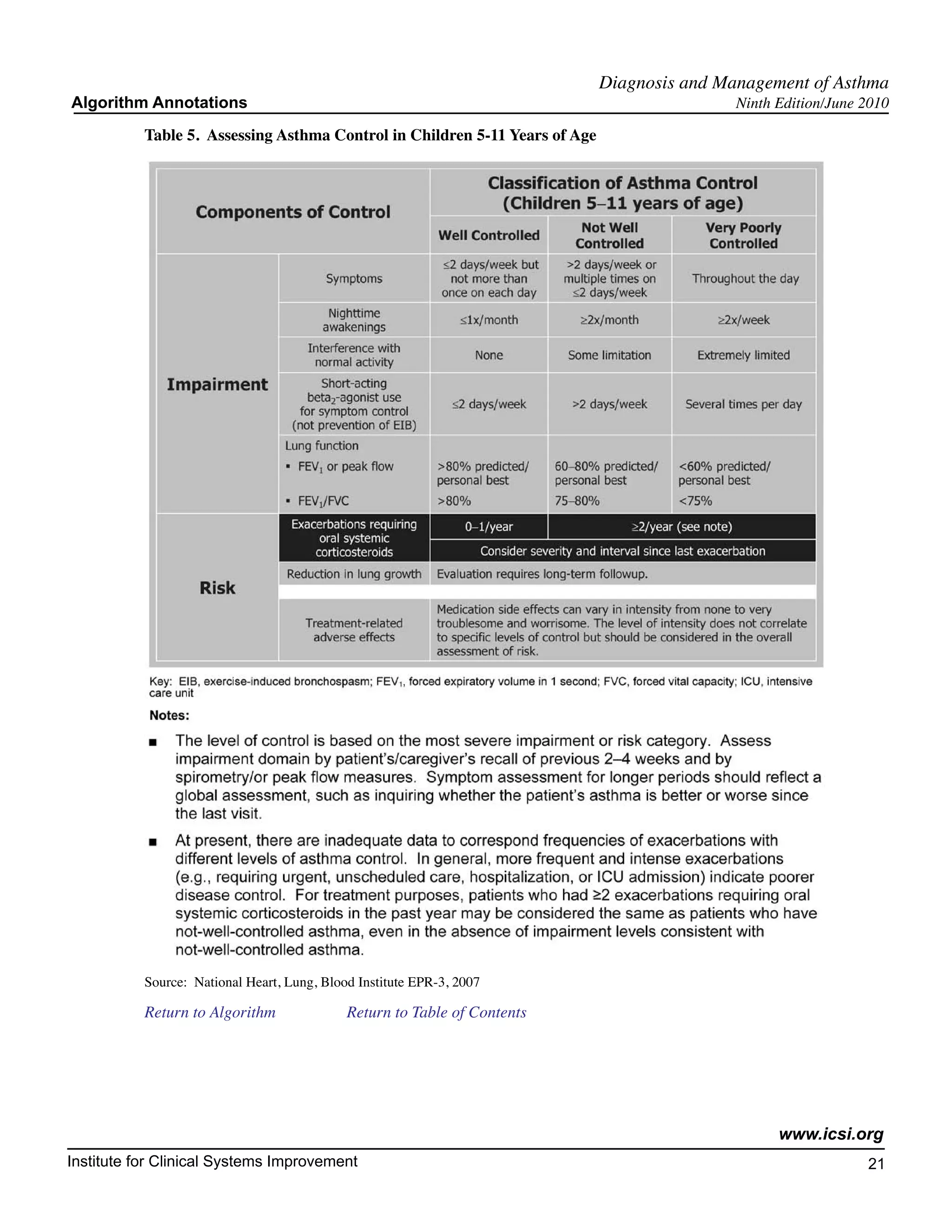
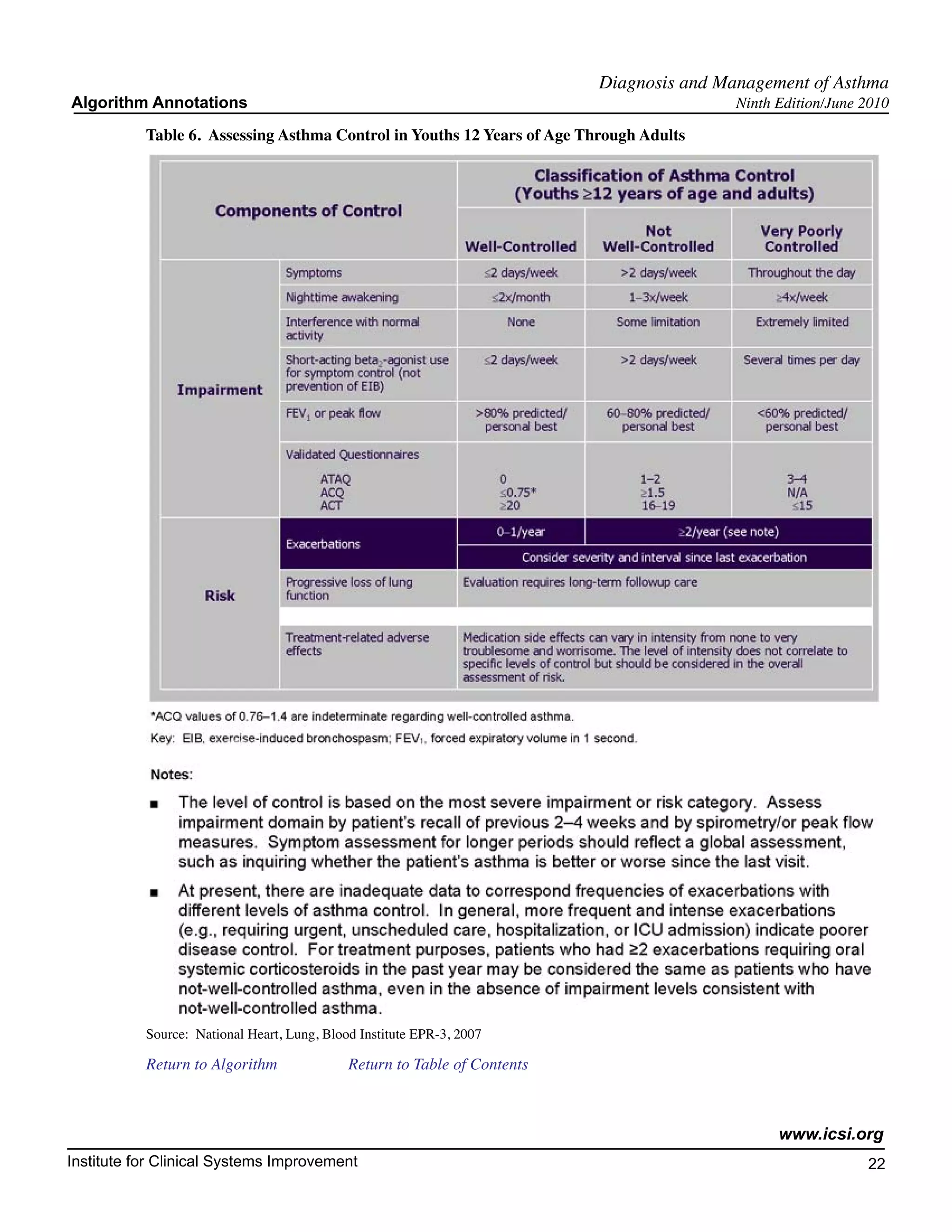
           See Table 5, "Assessing Asthma Control in Children 5-11 Years of Age," and Table 6, "Assessing Asthma
           Control in Youths 12 Years of Age through Adults."
           Return to Algorithm		           Return to Table of Contents


                                                                                                                 www.icsi.org
Institute for Clinical Systems Improvement                                                                                    20
Diagnosis and Management of Asthma
Algorithm Annotations                                                                        Ninth Edition/June 2010

           Table 5. Assessing Asthma Control in Children 5-11 Years of Age


           Source: National Heart, Lung, Blood Institute EPR-3, 2007

           Return to Algorithm		             Return to Table of Contents


                                                                                                   www.icsi.org
Institute for Clinical Systems Improvement                                                                      21
Diagnosis and Management of Asthma
Algorithm Annotations                                                                      Ninth Edition/June 2010

           Table 6. Assessing Asthma Control in Youths 12 Years of Age Through Adults


           Source: National Heart, Lung, Blood Institute EPR-3, 2007

           Return to Algorithm		             Return to Table of Contents


                                                                                                 www.icsi.org
Institute for Clinical Systems Improvement                                                                    22
Diagnosis and Management of Asthma
Algorithm Annotations                                                                                 Ninth Edition/June 2010

     13.	Step Care of Pharmacologic Treatment
           The aim of asthma therapy is to maintain control of asthma with the least amount of medication and hence
           minimize the risk for adverse effects. The stepwise approach to therapy – in which the dose and number of
           medications and frequency of administration are increased as necessary and decreased when possible – is
           used to achieve this control. Since asthma is a chronic inflammatory disorder of the airways with recurrent
           exacerbations, therapy for persistent asthma emphasizes efforts to suppress inflammation over the long-term
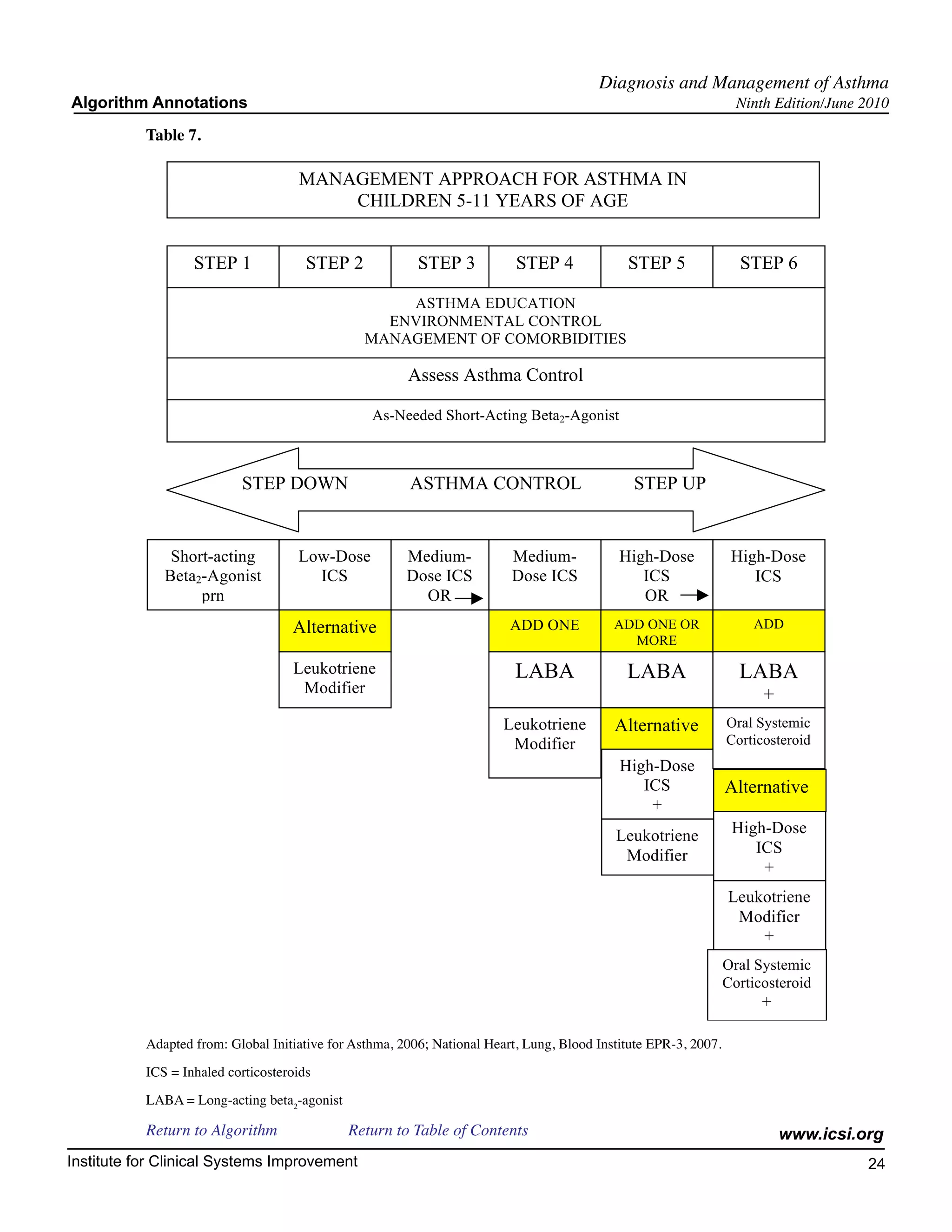
           and prevent exacerbations. See the following tables for Management Approach for Asthma.
           Based on data comparing leukotriene receptor antagonists (LTRAs) to inhaled corticosteroids, inhaled
           corticosteroids are the preferred treatment option for mild persistent asthma in adults and children. LTRAs
           are an alternative, although not preferred, treatment.
           (Bleecker, 2000 [A]; Ducharme, 2002 [M]; National Heart, Lung, Blood Institute EPR-3, 2007 [R]; Szefler,
           2005 [A])
           Vaccinations
           NOTE: Annual influenza vaccinations are recommended for patients with persistent asthma (National Heart,
           Lung, Blood Institute, 1997 [R]). Asthma is an independent risk factor for invasive pneumococcal disease.
           (Talbot, 2005 [B]). The Advisory Committee on Immunization Practices (ACIP) recommends that persons
           aged 19 through 64 years who have asthma should receive a single dose of PPSV23. (http://www.cdc.gov/
           vaccines/recs/provisional/downloads/pneumo-oct-2008-508.pdf)
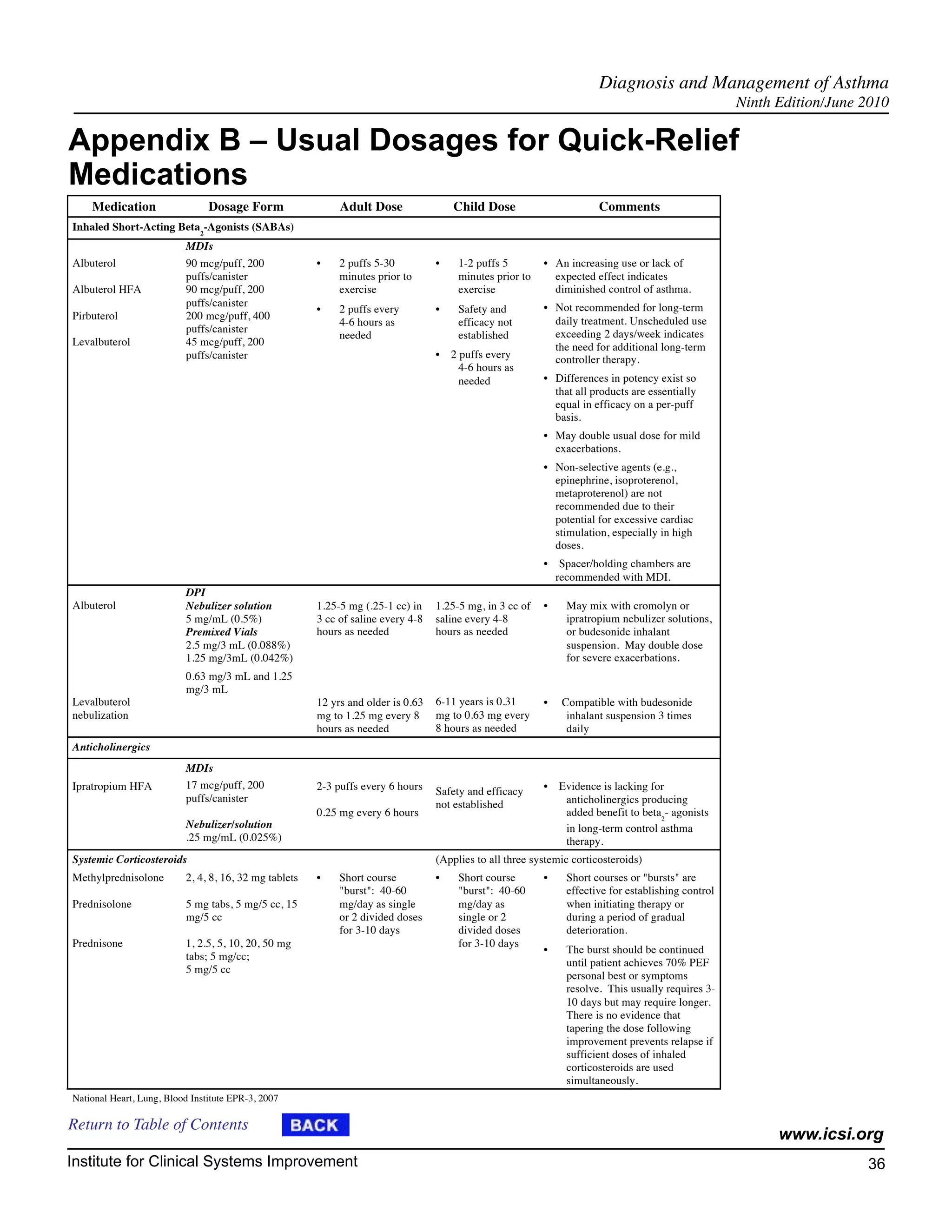
           See Appendix B, "Usual Dosages for Quick-Relief Medications."
           See Table 7, "Management Approach for Asthma in Children 5-11 Years of Age" and Table 8, "Management
           Approach for Asthma 12 Years of Age and Older."
           Return to Algorithm		          Return to Table of Contents


                                                                                                             www.icsi.org
Institute for Clinical Systems Improvement                                                                               23
Diagnosis and Management of Asthma
Algorithm Annotations                                                                                               Ninth Edition/June 2010

           Table 7.

                                     MANAGEMENT APPROACH FOR ASTHMA IN
                                         CHILDREN 5-11 YEARS OF AGE


                   STEP 1              STEP 2             STEP 3           STEP 4             STEP 5                STEP 6

                                                     ASTHMA EDUCATION
                                                   ENVIRONMENTAL CONTROL
                                                 MANAGEMENT OF COMORBIDITIES

                                                        Assess Asthma Control

                                                  As-Needed Short-Acting Beta2-Agonist


                           STEP DOWN                    ASTHMA CONTROL                         STEP UP


               Short-acting          Low-Dose           Medium-           Medium-            High-Dose             High-Dose
              Beta2-Agonist            ICS              Dose ICS          Dose ICS              ICS                   ICS
                   prn                                    OR                                    OR
                                    Alternative                           ADD ONE           ADD ONE OR                ADD
                                                                                              MORE

                                    Leukotriene                            LABA               LABA                  LABA
                                     Modifier                                                                           +
                                                                         Leukotriene        Alternative           Oral Systemic
                                                                          Modifier                                Corticosteroid
                                                                                             High-Dose
                                                                                                ICS               Alternative
                                                                                                 +
                                                                                            Leukotriene            High-Dose
                                                                                             Modifier                 ICS
                                                                                                                       +
                                                                                                                  Leukotriene
                                                                                                                   Modifier
                                                                                                                      +
                                                                                                                  Oral Systemic
                                                                                                                  Corticosteroid
                                                                                                                        +

           Adapted from: Global Initiative for Asthma, 2006; National Heart, Lung, Blood Institute EPR-3, 2007.

           ICS = Inhaled corticosteroids

           LABA = Long-acting beta2-agonist

           Return to Algorithm		              Return to Table of Contents                                                   www.icsi.org
Institute for Clinical Systems Improvement                                                                                             24
Diagnosis and Management of Asthma
Algorithm Annotations                                                                                               Ninth Edition/June 2010

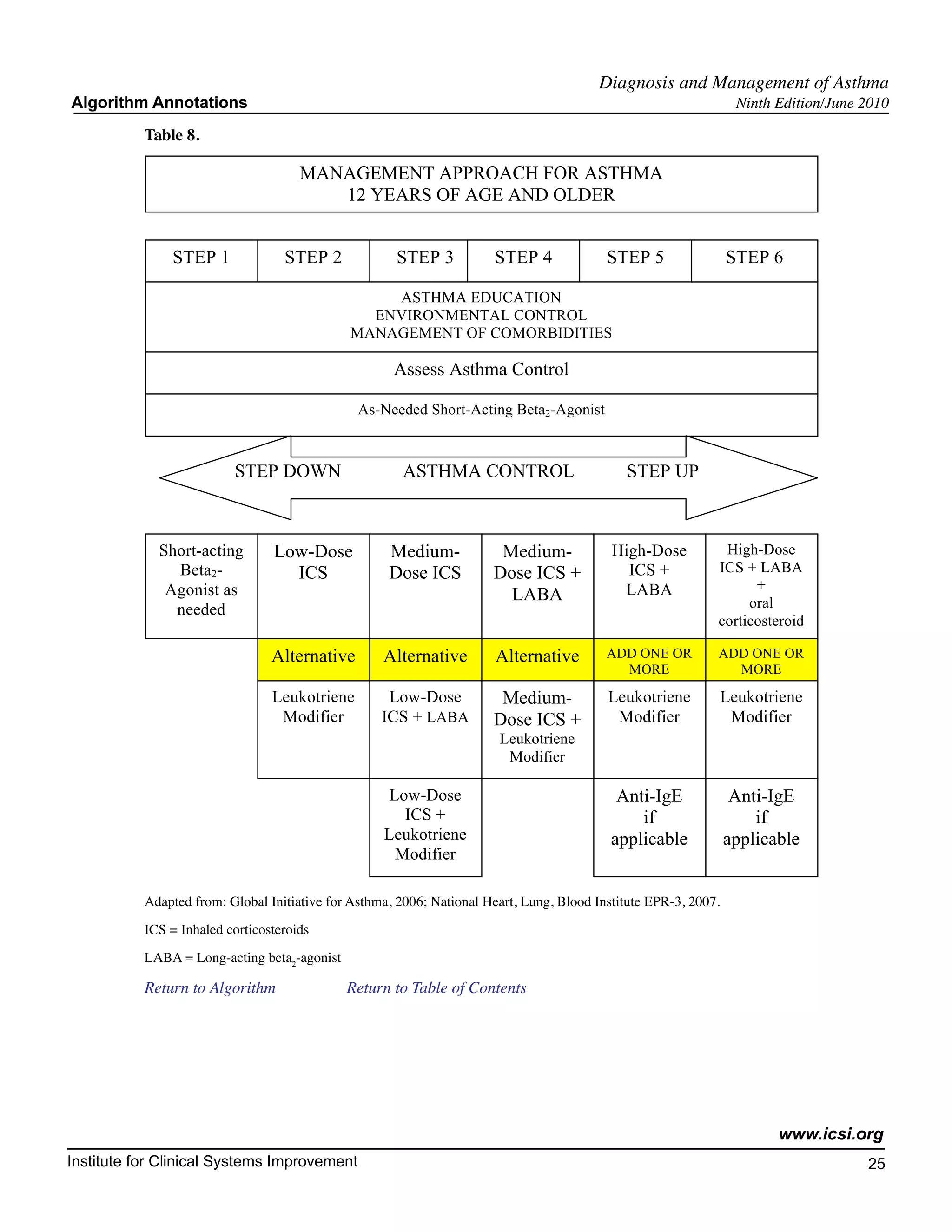
           Table 8.

                                      MANAGEMENT APPROACH FOR ASTHMA
                                         12 YEARS OF AGE AND OLDER


               STEP 1              STEP 2             STEP 3           STEP 4              STEP 5                 STEP 6

                                                  ASTHMA EDUCATION
                                                ENVIRONMENTAL CONTROL
                                              MANAGEMENT OF COMORBIDITIES

                                                      Assess Asthma Control

                                                As-Needed Short-Acting Beta2-Agonist


                          STEP DOWN                    ASTHMA CONTROL                         STEP UP


             Short-acting        Low-Dose            Medium-            Medium-             High-Dose          High-Dose
               Beta2-              ICS               Dose ICS          Dose ICS +             ICS +           ICS + LABA
              Agonist as                                                                     LABA                   +
                                                                         LABA                                      oral
               needed
                                                                                                              corticosteroid
                                                                                                                     s
                                 Alternative        Alternative        Alternative         ADD ONE OR         ADD ONE OR
                                                                                             MORE               MORE

                                 Leukotriene         Low-Dose           Medium-            Leukotriene            Leukotriene
                                  Modifier          ICS + LABA         Dose ICS +           Modifier               Modifier
                                                                        Leukotriene
                                                                         Modifier

                                                    Low-Dose                                 Anti-IgE              Anti-IgE
                                                      ICS +                                     if                    if
                                                    Leukotriene                             applicable            applicable
                                                     Modifier

           Adapted from: Global Initiative for Asthma, 2006; National Heart, Lung, Blood Institute EPR-3, 2007.

           ICS = Inhaled corticosteroids

           LABA = Long-acting beta2-agonist

           Return to Algorithm		              Return to Table of Contents


                                                                                                                          www.icsi.org
Institute for Clinical Systems Improvement                                                                                             25
Diagnosis and Management of Asthma
Algorithm Annotations                                                                                     Ninth Edition/June 2010

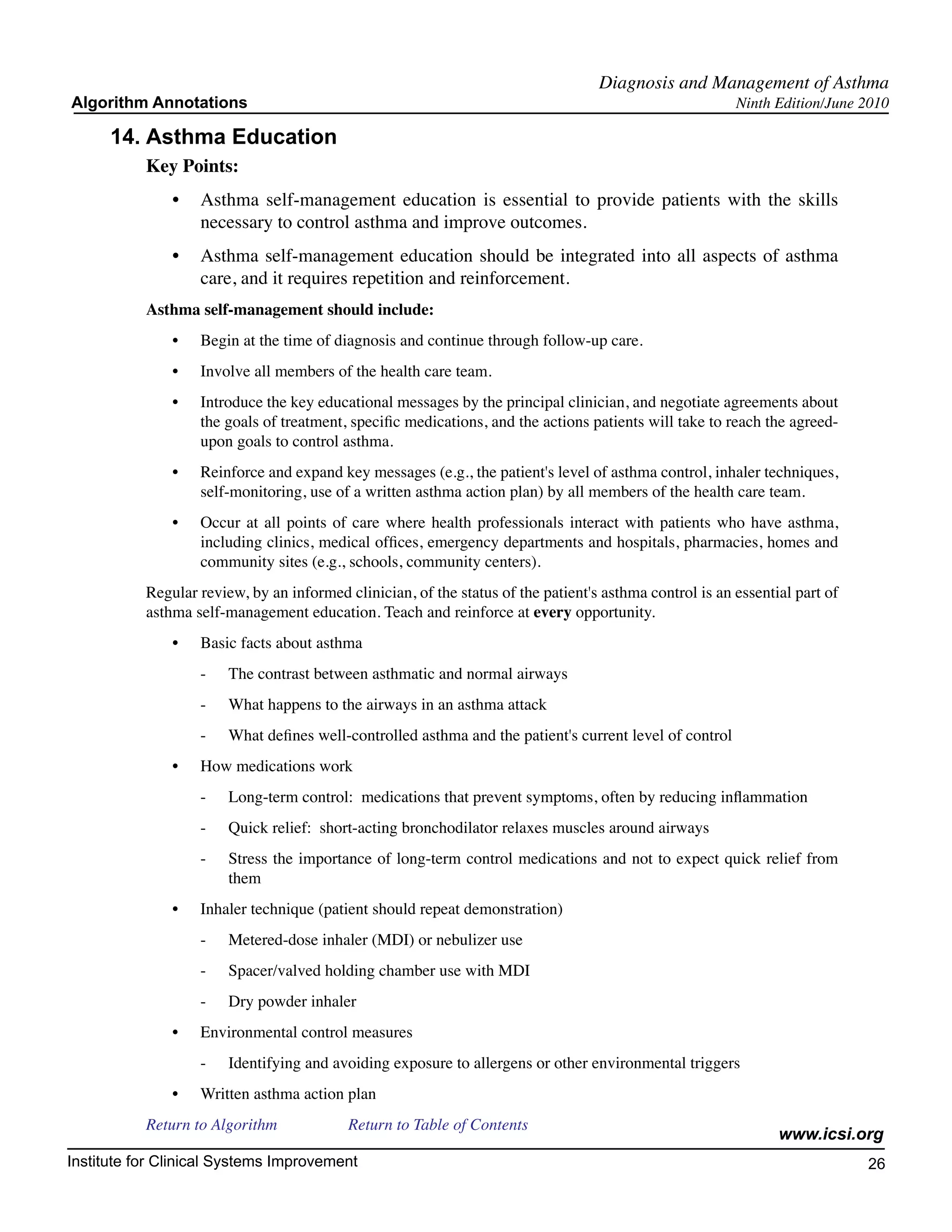
      14.	Asthma Education
           Key Points:
               •	 Asthma self-management education is essential to provide patients with the skills
                  necessary to control asthma and improve outcomes.
               •	 Asthma self-management education should be integrated into all aspects of asthma
                  care, and it requires repetition and reinforcement.
           Asthma self-management should include:
               •	   Begin at the time of diagnosis and continue through follow-up care.
               •	   Involve all members of the health care team.
               •	   Introduce the key educational messages by the principal clinician, and negotiate agreements about
                    the goals of treatment, specific medications, and the actions patients will take to reach the agreed-
                    upon goals to control asthma.
               •	   Reinforce and expand key messages (e.g., the patient's level of asthma control, inhaler techniques,
                    self-monitoring, use of a written asthma action plan) by all members of the health care team.
               •	   Occur at all points of care where health professionals interact with patients who have asthma,
                    including clinics, medical offices, emergency departments and hospitals, pharmacies, homes and
                    community sites (e.g., schools, community centers).
           Regular review, by an informed clinician, of the status of the patient's asthma control is an essential part of
           asthma self-management education. Teach and reinforce at every opportunity.
               •	   Basic facts about asthma
                    -	   The contrast between asthmatic and normal airways
                    -	   What happens to the airways in an asthma attack
                    -	   What defines well-controlled asthma and the patient's current level of control
               •	   How medications work
                    -	   Long-term control: medications that prevent symptoms, often by reducing inflammation
                    -	   Quick relief: short-acting bronchodilator relaxes muscles around airways
                    -	   Stress the importance of long-term control medications and not to expect quick relief from
                         them
               •	   Inhaler technique (patient should repeat demonstration)
                    -	   Metered-dose inhaler (MDI) or nebulizer use
                    -	   Spacer/valved holding chamber use with MDI
                    -	   Dry powder inhaler
               •	   Environmental control measures
                    -	   Identifying and avoiding exposure to allergens or other environmental triggers
               •	   Written asthma action plan
           Return to Algorithm		           Return to Table of Contents
                                                                                                                www.icsi.org
Institute for Clinical Systems Improvement                                                                                   26
Diagnosis and Management of Asthma
Algorithm Annotations                                                                                   Ninth Edition/June 2010

           This guideline recommends the use of written action plans as part of an overall effort to educate patients
           in self-management and is especially beneficial for patients with moderate or severe persistent asthma and
           patients with a history of severe exacerbations.
           All asthma patients should be given a written asthma action plan that includes two aspects: daily manage-
           ment, and how to recognize and handle worsening asthma. Written action plans are particularly recom-
           mended for patients who have moderate or severe persistent asthma, a history of severe exacerbations, or
           poorly controlled asthma. Review and refine the plan at follow-up visits.
               •	   When and how to take actions
                    -	   Symptom self-monitoring and recognizing early signs of deterioration
                    -	   When and how to handle signs and symptoms of worsening asthma
                    -	   When and where to seek care
                    -	   Discuss plan for children at school, including management of exercise-induced broncho-
                         spasm.
               •	   Emphasize need for regular follow-up visits and asthma treatment adherence
           Supervised self-management (using patient education and adjustments of anti-inflammatory medication
           based on PEFR or symptoms coupled with regular medical review, utilization and adherence to medication)
           reduces asthma morbidity. This reduction includes lost workdays, unscheduled office visits, and ED and
           hospital admissions (Gibson, 2000 [M]; Ignatio-Garcia, 1995 [A]; Lahdensuo, 1996 [A]).
           Encourage adherence by:
               •	   choosing a treatment regimen that achieves outcomes and addresses preferences that are important
                    to the patient/caregiver, and
               •	   reviewing the success of the treatment plan with the patient/caregiver at each visit and making
                    adjustments as needed.
           Tailor the asthma self-management teaching approach to the needs of each patient.
               •	   Maintain sensitivity to cultural beliefs and ethnocultural practices.
               •	   Consider language and health literacy.
           Develop an active partnership with the patient and family by:
               •	   establishing open communications,
               •	   identifying and addressing patient and family concerns about asthma and asthma treatment,
               •	   identifying patient/parent/child treatment preferences regarding treatment and barriers to its imple-
                    mentation,
               •	   developing treatment goals together with patient and family, and
               •	   encouraging active self-assessment and self-management of asthma.
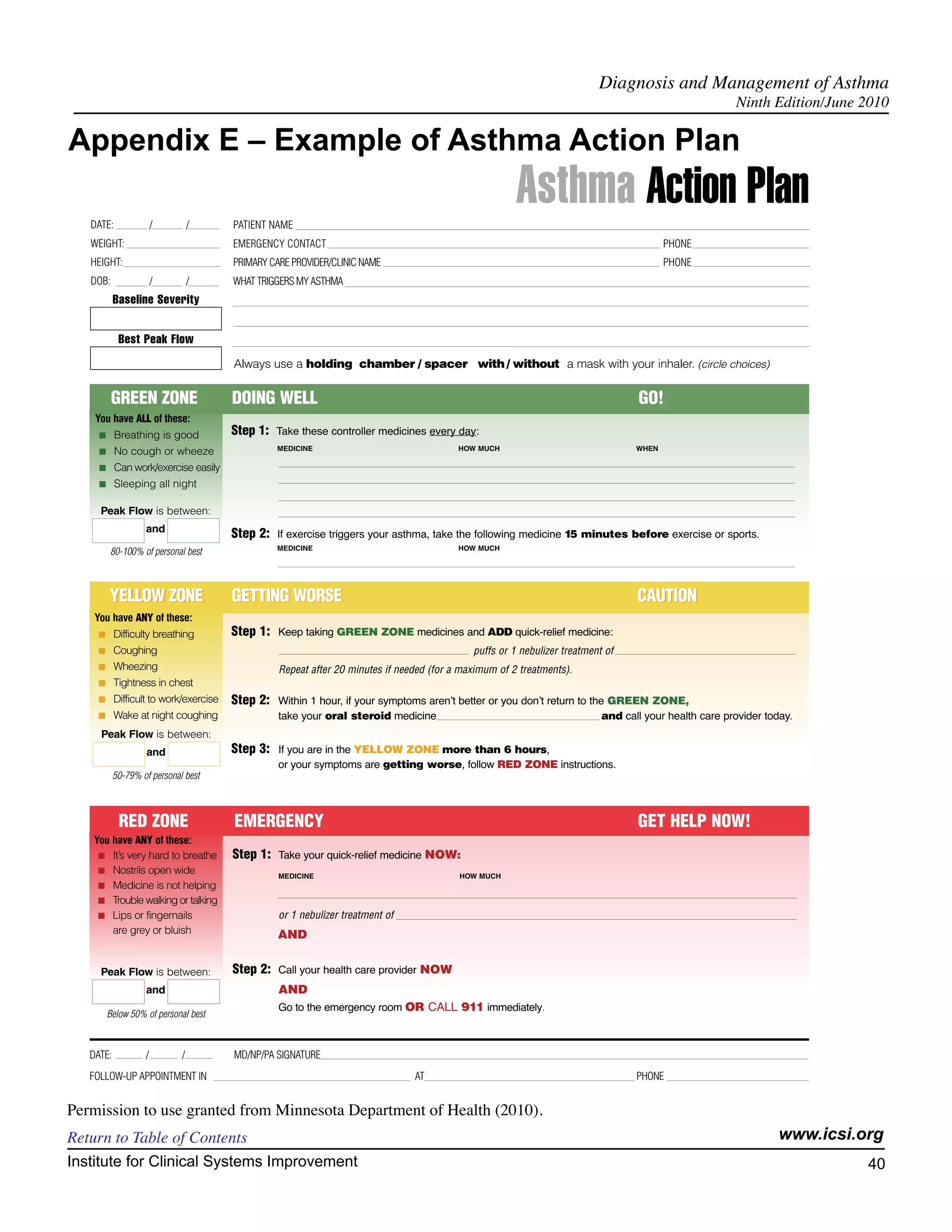
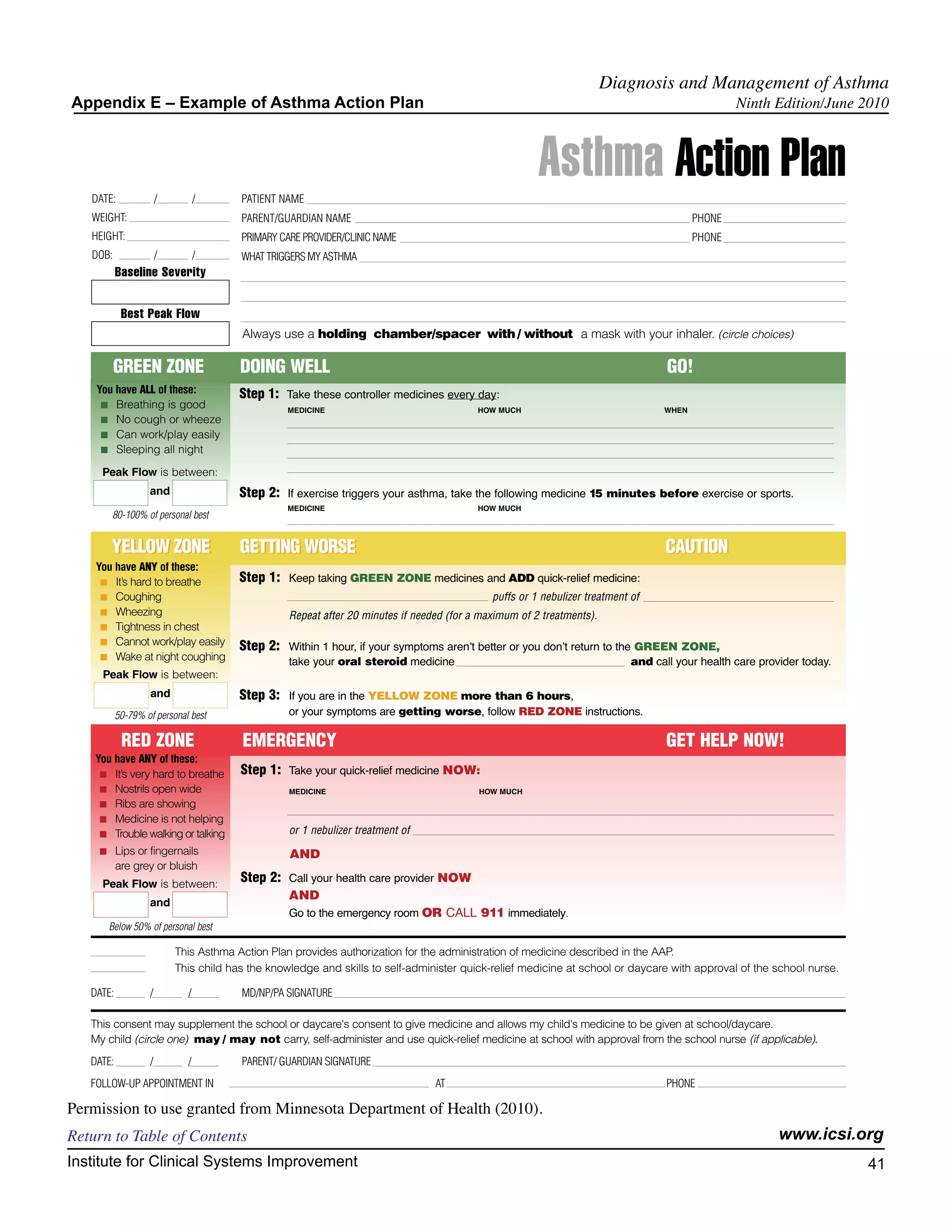
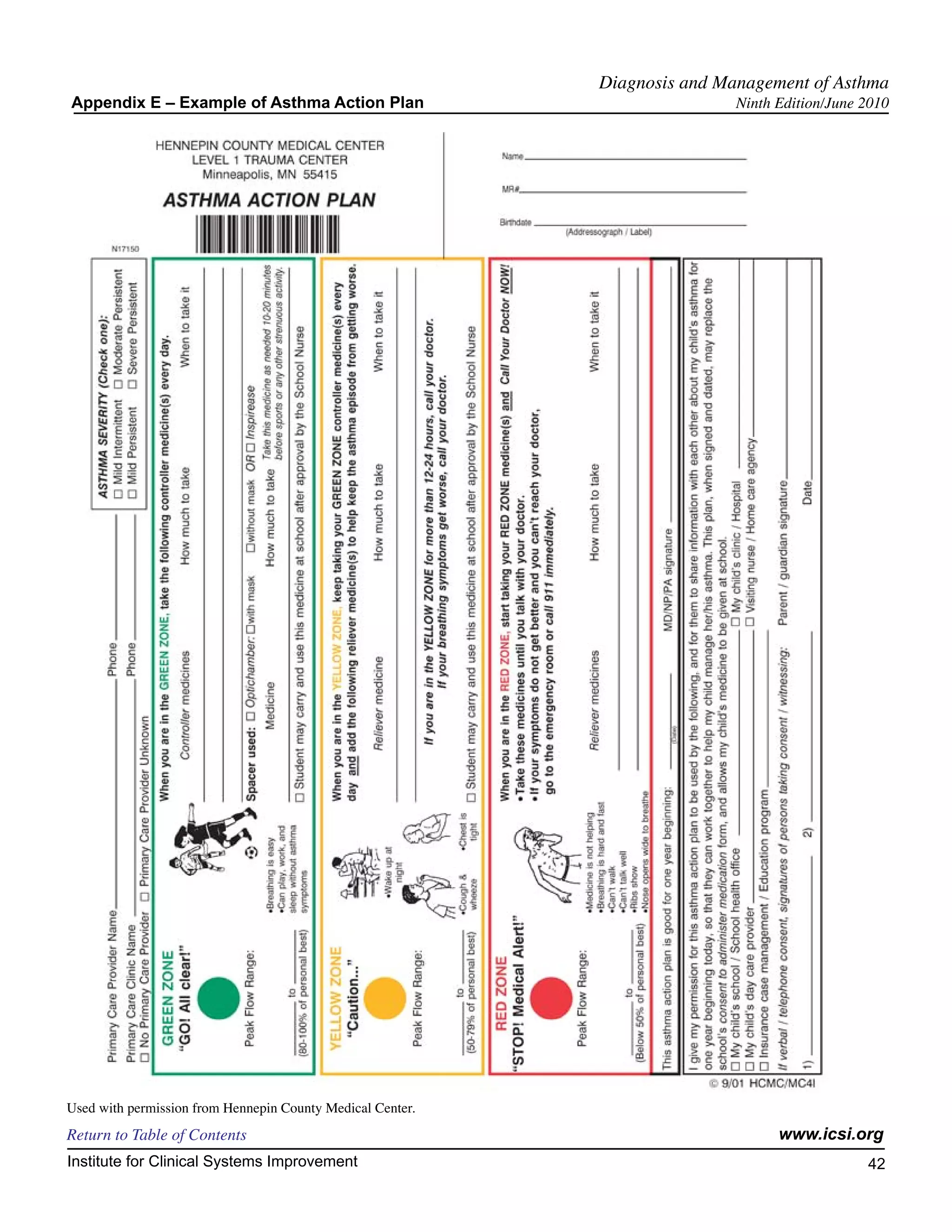
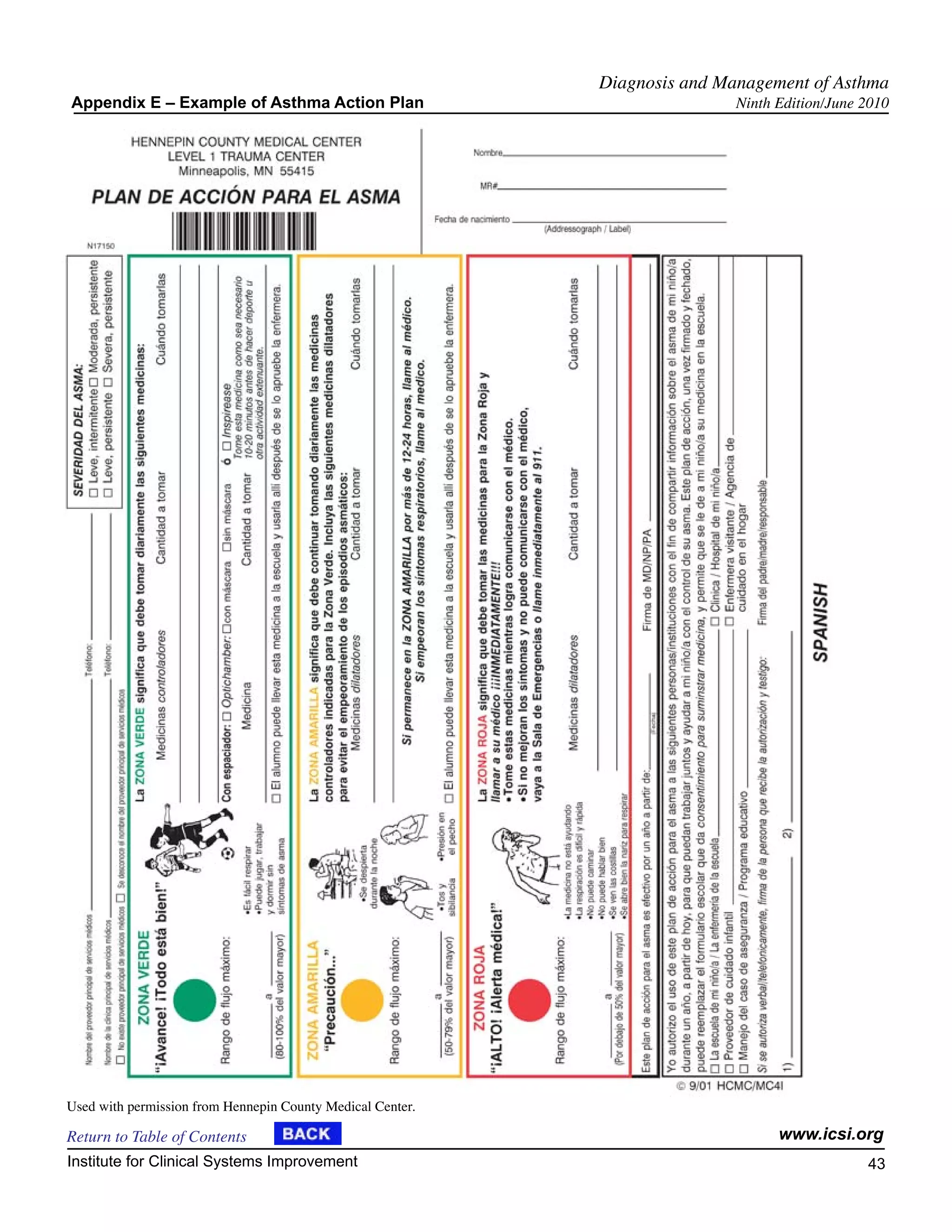
           Sample Asthma Action Plans are attached in Appendix E, "Example of Asthma Action Plan."
           See Minnesota Department of Health Action Plan at http://www.mnasthma.org/AAP/
           Return to Algorithm		           Return to Table of Contents


                                                                                                               www.icsi.org
Institute for Clinical Systems Improvement                                                                                  27
Diagnosis and Management of Asthma
Algorithm Annotations                                                                                   Ninth Edition/June 2010

     15.	Schedule Regular Follow-Up Visits
           Asthma is a chronic inflammatory lung disease, and all chronic diseases need regular follow-up visits.
           Practitioners need to assess whether or not control of asthma has been maintained and if a step down in
           therapy is appropriate. Further, practitioners need to monitor and review the daily self-management and
           action plans, the medications, and the patient's inhaler and peak flow monitoring techniques.
           Regularly scheduled follow-up visits are essential to ensure that control is maintained and the appropriate
           step down in therapy is considered. The exact frequency of visits is a matter of clinical judgment. If asthma
           is uncontrolled or a change in medication or clinical status has occurred, the patient should be followed in
           two to six weeks for an evaluation. A stable asthma patient should be followed at regular intervals of one
           to six months.
           Return to Algorithm		          Return to Table of Contents

     Emergency Department or Inpatient Management Algorithm
     Annotations
     18.	Assess Severity of Asthma Exacerbation
           See Annotation #5.
           Return to Algorithm		          Return to Table of Contents

     21.	Initial Treatment
           Also see Annotation #8, "Management of Asthma Exacerbation."
           Usual treatment is with short-acting beta2-agonist by metered-dose inhaler or nebulizer:
               Albuterol HFA (90 micrograms per puff) 4-8 puffs
               Albuterol solution 2.5 to 5 mg by nebulizer
               Levalbuterol 1.25-2.5 mg by nebulizer
           Return to Algorithm		          Return to Table of Contents

     25.	Treatment (Incomplete Response)
           Key Points:
               •	 Systemic corticosteroids should be used for all patients who do not favorably respond
                  to the initial beta2-agonist therapy.
               •	 Anticholinergic therapy may increase lung function and may decrease hospital admis-
                  sion rate.
           Corticosteroids
           Parenteral and enteral administration of corticosteroids requires about 6-24 hours to be effective. Intravenous
           (IV) and oral routes of corticosteroid administration appear to be equivalent (Barnett, 1997 [A]; Becker,
           1999 [A]; Cunnington, 2005 [A]; Engel, 1990 [A]; Harrison, 1986 [A]; Jonsson, 1988 [A]; Ratto, 1988
           [A]). Medium to high doses of corticosteroids appear to be better than low doses; however, there is still a
           large range, roughly 160 mg methylprednisolone per day or 2 mg/kg/day in children. There is no evidence
           to support very high doses of steroids (Bowler, 1992 [A]; Rodrigo, 1999 [M]). The National Asthma Educa-
           tion and Prevention Program guidelines recommend that patients admitted to the hospital should receive IV
           or oral steroids (National Heart, Lung, Blood Institute EPR-3, 2007 [R]).
           Return to Algorithm		           Return to Table of Contents                                            www.icsi.org
Institute for Clinical Systems Improvement                                                                                 28
Diagnosis and Management of Asthma
Algorithm Annotations                                                                                   Ninth Edition/June 2010

           There may be a role for inhaled high-dose corticosteroids in the emergency department in addition to the
           IV or oral route; however, the data do not support this as standard of care at this time (Edmonds, 2002 [M];
           Edmonds, 2003 [M]; Rodrigo, 2005 [A]).
           In adult asthmatic cases where intolerance or non-compliance with oral steroid therapy is a concern, consider
           the use of intramuscular (IM) methylpredisone (Lahn, 2004 [A]).

           Anticholinergics
           Inhaled ipratropium bromide: adding multiple high doses of ipratropium bromide (0.5 mg nebulizer solution
           or 8 puffs by MDI in adults; 0.25-0.5 mg nebulizer solution or 4-8 puffs by MDI in children) to a selec-
           tive short-acting beta2-agonist produces additional bronchodilation, resulting in fewer hospital admissions,
           particularly in patients who have severe airflow obstruction (Plotnick, 2000 [M]; Rodrigo, 2005 [A]).
           Return to Algorithm		          Return to Table of Contents

     27.	Treatment (Poor Response)
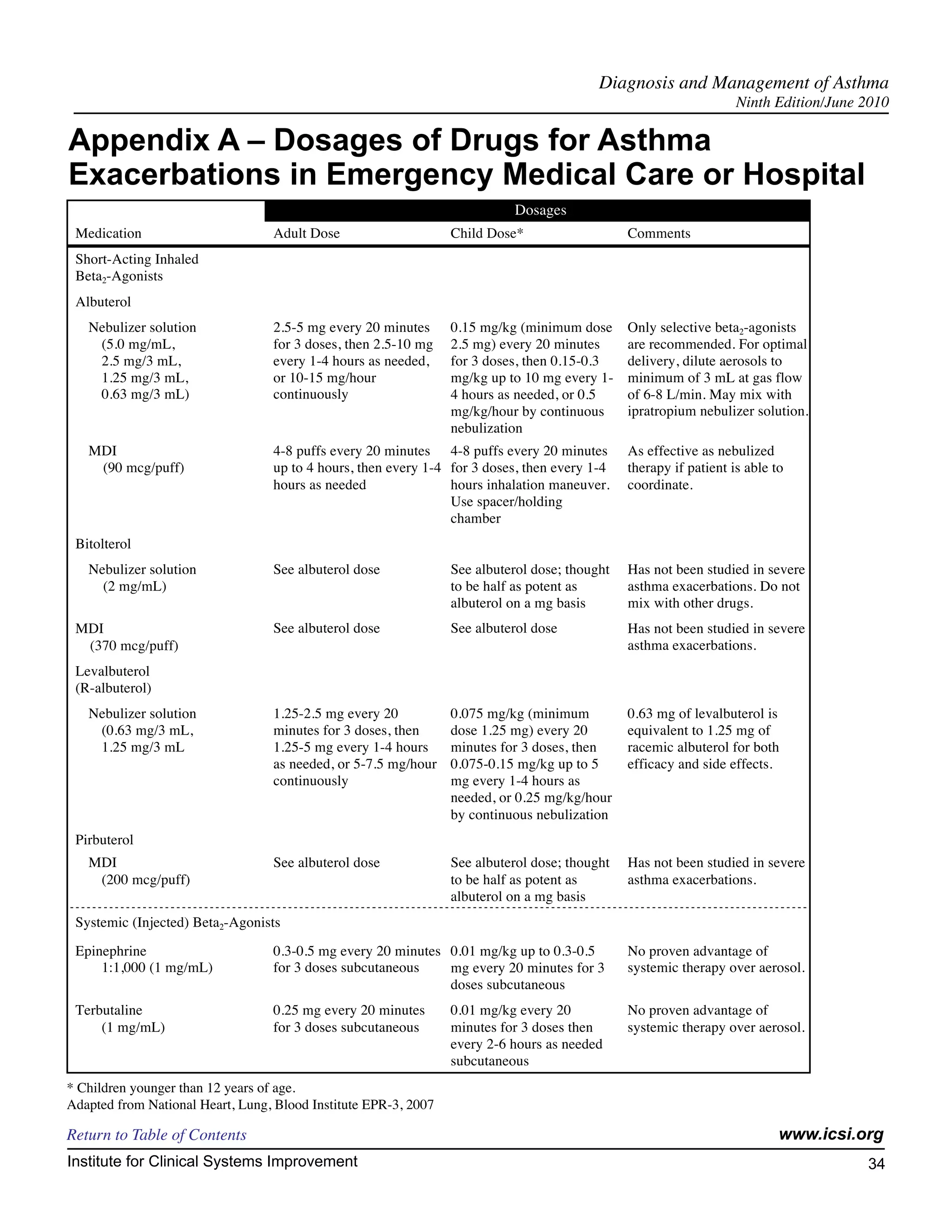
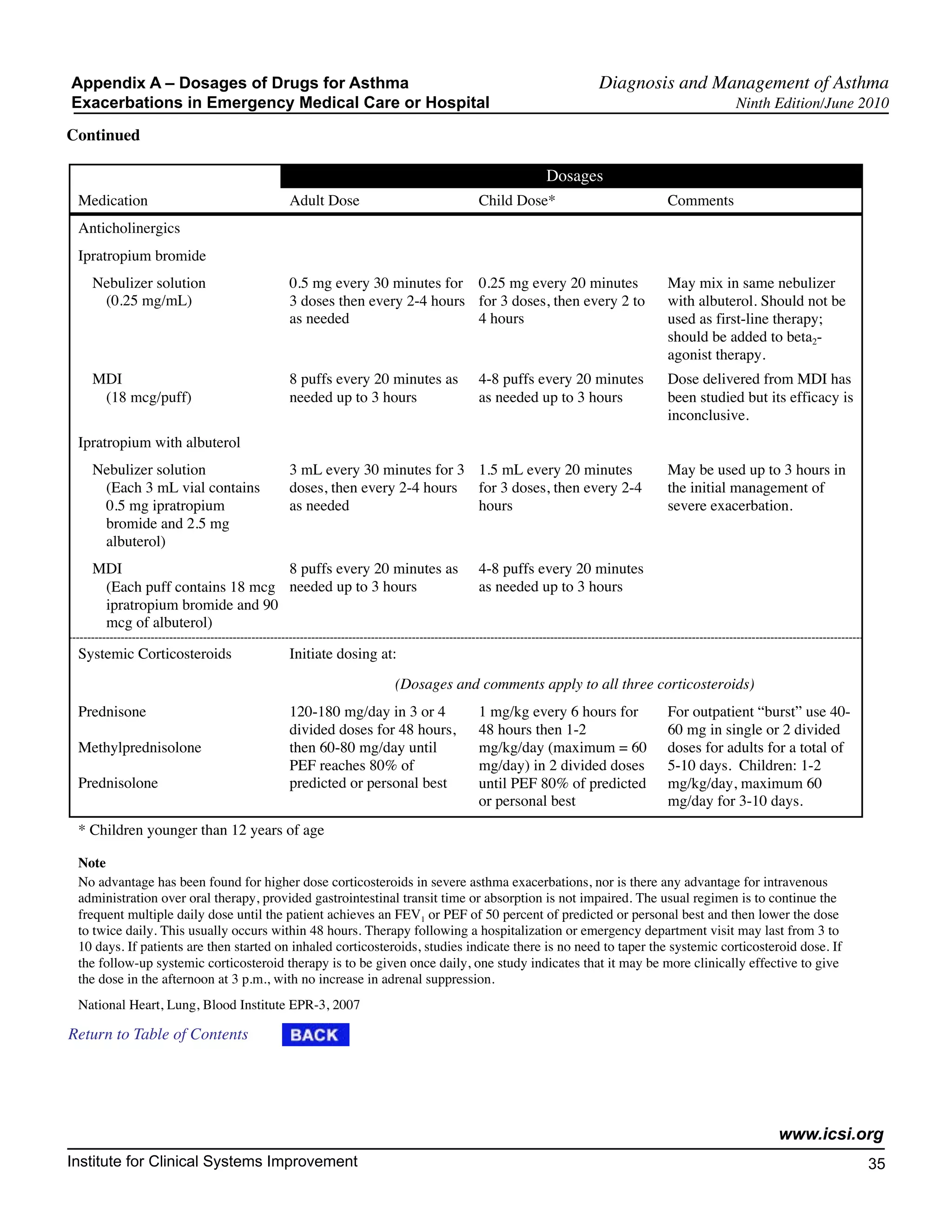
           See Appendix A, "Dosages of Drugs for Asthma Exacerbations in the Emergency Medical Care or
           Hospital."

           Key Points:
               •	 Early intervention with Bi-level positive airway pressure may prevent mechanical
                  intubations.
               •	 Heliox may be a secondary therapy in asthma patients who do not respond to first-line
                  therapies.
               •	 Ketamine should be considered for use only in severe asthma exacerbations.
               •	 Magnesium sulfate may be beneficial in the treatment of acute asthma.
               •	 Reassess patients shortly after inpatient admission.
           Intermittent Nebulization Versus Continuous Nebulization
           Intermittent nebulization versus continuous nebulization in the treatment of acute asthma has been evaluated
           quite extensively. The data would suggest that these treatments are equally efficacious; however, there may
           be a trend toward improvement in patients with severe asthma using continuous nebulization. In a subgroup
           analysis of patients whose initial FEV1 was less than 50% predicted, there was a statistically significant
           improvement in FEV1 in patients treated with continuous nebulization versus intermittent nebulization (Lin,
           1993 [A]). Similarly, in another subgroup analysis of patients whose initial PEFR was less than 200, there
           was a statistically significant improvement in PEFR and a decrease in hospital admissions in patients treated
           with continuous versus intermittent nebulization (Rudnitsky, 1993 [A]). However, in another subgroup of
           patients whose FEV1 was less than 50% predicted, there was no difference in improvement in FEV1 or hospital
           admissions in patients treated with continuous versus intermittent nebulization (Besbes-Quanes, 2000 [A]).
           A meta-analysis suggests equivalence of continuous versus intermittent albuterol in treating asthma. This
           is determined by spirometry measurement and rates of admission to the hospital (Rodrigo, 2002 [M]).
           There does not seem to be any advantage of higher doses of albuterol for continuous nebulization. There
           was no difference in lung function in patients treated with 7.5 mg or 15 mg of albuterol (Stein, 2003 [A]).
           Utilizing albuterol and ipatroprium bromide continuously versus albuterol alone demonstrated a trend
           toward improvement in reducing the length of stay in the emergency department and in hospital admission
           rates (Weber, 1999 [A]).
           Return to Algorithm		          Return to Table of Contents                                         www.icsi.org
Institute for Clinical Systems Improvement                                                                                 29
Diagnosis and Management of Asthma
Algorithm Annotations                                                                                  Ninth Edition/June 2010

           Bi-level Positive Airway Pressure (Bi-Level PAP)
           Bi-level PAP therapy should be considered for patients presenting with an acute asthma exacerbation. Accu-
           mulating studies have shown a benefit in using Bi-level PAP for patients presenting with non-cardiogenic
           respiratory failure. These studies included, but were not limited to, patients with asthma exacerbations.
           A study (Soroksky, 2003 [A]) compared Bi-level PAP ventilation plus conventional therapy versus conven-
           tional therapy in patients presenting with an acute asthma exacerbation. Patients in the Bi-level PAP group
           showed a statistically significant improvement in lung function (measured by FEV1), improved faster, and
           were less likely to require admission to the hospital and mechanical intubations.

           Heliox
           Heliox, a blend of helium and oxygen, is a low-density gas that has been shown in some studies to improve
           deposition of albuterol into distal airways when compared with nebulized albuterol with oxygen alone. To
           date, only small-sized randomized controlled trials have been performed. At best, these studies showed
           mild improvement in spirometry measures and perceived dyspnea scores in patients receiving heliox-driven
           albuterol nebulization versus patients receiving albuterol nebulization with oxygen alone. These improved
           measures were more prominent in patients with moderate to severe asthma exacerbations.
           There is not enough evidence from large, prospective, randomized controlled trials to recommend heliox
           as first-line therapy in patients with asthma exacerbations. However, it is recommended that heliox be
           considered (Ho, 2003 [M]; Rodrigo, 2003 [M]) as a secondary therapy in patients with a severe asthma
           exacerbation who are not responding to first-line therapies.

           Ketamine
           Ketamine and propofol are anesthetic agents with neuro-regulatory properties resulting in bronchodilation.
           The use of ketamine has shown benefit in improving airway parameters (Petrello, 2001 [D]), but increased
           side effects have resulted in longer hospitalizations (Lau, 2001 [M]). Increased side effects of increased
           secretions, dysphorea and hallucinations are noted. Clinical data suggests that in the non-intubated patient
           that the side effects may cancel benefit. Some reported case reports suggest benefit in intubated patients
           (Lau, 2001 [M]). Well-controlled studies are required to make a clear strong recommendation for use. Use
           of ketamine has been pursued only in severe asthmatic exacerbations.

           Magnesium Sulfate
           In vitro, magnesium acts as a smooth muscle dilator and may have some anti-inflammatory effects by
           decreasing super-oxide production in neutrophils. Its efficacy has not been consistently demonstrated in
           randomized control trials. It has not been demonstrated to cause any harmful effects. In a recent multi-
           center trial, IV magnesium sulfate improved pulmonary function only in patients with severe asthma, (FEV1
           less than 25%). It did not shorten length of hospital stay (Silverman, 2002 [A]). In a systematic review,
           magnesium sulfate did not demonstrate improvement in PEFR, or in hospital length of stay. However, in a
           subset of patients with severe asthma exacerbations, PEFR, FEV1 and length of stay were improved (Rowe,
           2000 [M]). There is insufficient evidence to support the routine use of IV magnesium in the emergency
           department setting (Cheuk, 2005 [M]; Kaye, 2002 [R]). However since it is safe and inexpensive, it should
           be considered for use in patients with severe asthma exacerbations.

           Leukotriene Modifiers
           The evaluation of leukotrienes for acute asthma care is in its infancy. Pulmonary function has been shown
           to improve more rapidly when a leukotriene administered orally is added to the standard therapy of asthma
           care (beta2-agonists/corticosteroids) in emergency department settings (Emerman, 2001 [R]; Silverman,
           1999 [A]). More studies are needed to confirm these reports.
           Return to Algorithm		          Return to Table of Contents
                                                                                                             www.icsi.org
Institute for Clinical Systems Improvement                                                                                30
Diagnosis and Management of Asthma
Algorithm Annotations                                                                                     Ninth Edition/June 2010

           Montelukast in acute asthma management has been shown to improve pulmonary function in randomized
           controlled trials (Camargo, 2003 [A]; Cylly, 2003 [A]). However, statistical significance could not always
           be maintained.
           The evidence is too preliminary to recommend leukotriene modifiers in acute asthma exacerbations.
           Return to Algorithm		           Return to Table of Contents

     29.	Admit to Hospital?
           Also see Annotation #10, "Does Patient Need ED or Inpatient Asthma Management?"
           The decision when to discharge from the emergency department (ED) or admit to the hospital must be
           individualized and depends on response to treatment, pulmonary function and socioeconomic factors. It is
           important to consider risk factors for asthma-related death (National Heart, Lung, Blood Institute EPR-3,
           2007 [R]). Actual length of stay in the ED will vary; some departments have the ability for more extended
           treatment and observation, provided there is sufficient monitoring and nursing care.
           Response to initial treatment in the ED can be based on a repeat assessment approximately 60-90 minutes
           after initiating bronchodilator therapy, which is a better predictor of the need for hospitalization than is the
           severity of an exacerbation on presentation (Rodrigo, 1993 [C]). Evaluation includes the patient's subjective
           response, physical findings, O2 saturation and measurement of airflow. Other aspects to consider include
           duration and severity of symptoms, course and severity of prior exacerbations, medications used at the time
           of the exacerbation, access to medical care and medications, adequacy of support and home conditions, and
           presence of psychiatric illness. Pretreatment O2 saturation less than or equal to 70%, persisting respiratory
           acidosis, or severe obstruction that does not improve with the administration of sympathomimetics indicates
           the need for hospitalization (Higgins, 2003 [R]).
           Discharge is appropriate if FEV1 or PEFR has returned to greater than or equal to 70% personal best or
           predicted, and symptoms are minimal or absent. Patients with an incomplete response (FEV1 or PEFR
           40%-69%), and with mild symptoms should be assessed individually and may be appropriate for discharge
           with consideration of the above factors. It is recommended that patients with a rapid good response be
           observed for 30-60 minutes after the most recent dose of bronchodilator to ensure stability of response
           before being discharged home.
           Return to Algorithm		           Return to Table of Contents

     30.	Continue Management in Hospital
           Patients being admitted from the ED with an acute asthma exacerbation should be reassessed shortly after
           admission, with special emphasis on whether the patient is showing any clinical signs of improvement or
           deterioration (see Annotation #5, "Assess Severity of Asthma Exacerbation"). Objective data should include
           repeating of the patient's FEV1 or PEFR. A complete physical exam should include emphasis on the patient's
           respiratory rate, air entry on lung exam, and the presence/absence of signs of increased work of breathing,
           such as supraclavicular or intercostal retractions.
           Consider other illnesses and comorbidities. These may also cause dyspnea, chest tightness and wheezing.
               •	   Viral pneumonitis
               •	   Pneumothorax
               •	   Pulmonary embolism
               •	   Vocal cord dysfunction syndrome
               •	   COPD
           Return to Algorithm		           Return to Table of Contents
                                                                                                                 www.icsi.org
Institute for Clinical Systems Improvement                                                                                    31
Diagnosis and Management of Asthma
Algorithm Annotations                                                                                    Ninth Edition/June 2010

                •	   Pulmonary edema
                •	   Endobronchial obstruction (tumor or foreign body)
                •	   Acute hypersensitivity pneumonitis
                •	   Epiglottitis
           (ten Brinke, 2005 [D])
           Return to Algorithm		            Return to Table of Contents

      32.	Discharge Home
           Key Points:
                •	 At discharge, provide patients with necessary medications and education in how to use
                   them, instruction in self-assessment, an action plan for managing recurrence of airflow
                   obstruction, and a follow-up appointment.
           It is recommended that follow-up with an asthma care provider occur within one week of discharge.
           Medications
           See Table 9, "Hospital Discharge Checklist for Patients with Asthma Exacerbations."
           •	   Inhaled beta2-agonist every two to six hours.
           •	   Systemic corticosteroids are almost always the treatment of choice in patients with acute asthma exac-
                erbation. Corticosteroids aid symptom resolution and prevent asthma relapse.
           •	   Initiate or increase anti-inflammatory medication:
                -	   Inhaled corticosteroids
                     •	   The role of inhaled corticosteriods after an emergency department visit is controversial
                          (Edmonds, 2003 [M]; Rowe, 1999 [A]). However, it is the consensus of this group that inhaled
                          corticosteriods should be encouraged at the time of discharge.
                -	   Consider leukotriene modifiers as an additive therapy.
           •	   Antibiotics are not routinely used but may be warranted if patient has signs of acute bacterial infection,
                fever and purulent sputum.
           •	   Long-acting beta2-agonists as monotherapy are NOT recommended.
           See Annotation #14 for asthma education and action plan.
           See Annotation #15 for follow-up care.
           Return to Algorithm		            Return to Table of Contents


                                                                                                                www.icsi.org
Institute for Clinical Systems Improvement                                                                                   32
Diagnosis and Management of Asthma
Algorithm Annotations                                                                                  Ninth Edition/June 2010

            Table 9. Hospital Discharge Checklist for Patients with Asthma Exacerbations
            Intervention                         Dose/Timing                              Education/Advice
            Inhaled medications                  Select agent, dose and frequency         Teach purpose.
            (MDI + spacer/holding chamber)       (e.g., albuterol)                        Teach technique.
            Beta2-agonist                        2-6 puffs every 3-4 hours as needed      Emphasize need for spacer/holding
                                                                                          chamber.
            Corticosteroids                      Medium dose                              Check patient technique.
            Oral medications                     Select agent, dose and frequency         Teach purpose.
                                                 (e.g., prednisone 20 mg twice daily      Teach side effects.
                                                 for 3-10 days)
            Peak flow meter                      Measure a.m. and p.m. PEF and            Teach purpose.
                                                 record best of three tries each time     Teach technique.
                                                                                          Distribute peak flow diary.
            Follow-up visit                      Make appointment for follow-up           Advise patient (or caregiver) of
                                                 care with primary clinician or asthma    date, time and location of
                                                 specialist                               appointment within 7 days of
                                                                                          hospital discharge.
            Action plan                          Before or at discharge                   Instruct patient (or caregiver) on
                                                                                          simple plan for actions to be taken
                                                                                          when symptoms, signs and PEF
                                                                                          values suggest recurrent airflow
                                                                                          obstruction.

           Source: National Heart, Lung, Blood Institute EPR-2, 1997

           Special Populations
           Asthma in pregnancy
           The treatment plan of asthma management in pregnancy should include reducing medication toxicity, tera-
           togenicity and preserving uteroplacenta circulation. Changes in the mother's asthma status are expected in
           almost half of patients, with half of these expecting a worsening of asthma status, particularly if previous
           pregnancies had similar outcomes. Typical changes of pregnancy – those of increased heart rate, respiratory
           rate and decreases in baseline CO2 levels – can lead to underdiagnosing asthma severity if not recognized
           (Sakornbut, 2003 [R]).
           The treatment of acute asthma in pregnancy follows the guidelines for acute asthma care, keeping in mind
           the goals of the management and changes in physiology.
           Albuterol is the preferred short-acting beta2-agonist and has not been linked to adverse fetal outcomes in
           follow-up studies. Inhaled corticosteroids (ICS) are the preferred treatment for long-term control medica-
           tion. Budesonide is the preferred ICS because more data are available on using budesonide in pregnant
           women than are available on other ICSs, and the data are reassuring (NAEPP, 2005 [R]; National Heart,
           Lung, Blood Institute EPR-3,2007 [R]). Systemic steroids, if used in the first trimester, may, though rarely,
           increase the frequency of cleft palate and possibly be associated with development of preeclampsia and
           prematurity. However, the risk to both mother and fetus of an unmanaged severe asthmatic attack over-
           shadows the medication observed risks (Schatz, 2009 [R]).
           Return to Algorithm		          Return to Table of Contents


                                                                                                                www.icsi.org
Institute for Clinical Systems Improvement                                                                                   33
Diagnosis and Management of Asthma
                                                                                                                   Ninth Edition/June 2010

Appendix A – Dosages of Drugs for Asthma
Exacerbations in Emergency Medical Care or Hospital
                                                                           Dosages
 Medication                       Adult Dose                     Child Dose*                   Comments
 Short-Acting Inhaled
 Beta2-Agonists
 Albuterol
   Nebulizer solution             2.5-5 mg every 20 minutes      0.15 mg/kg (minimum dose      Only selective beta2-agonists
    (5.0 mg/mL,                   for 3 doses, then 2.5-10 mg    2.5 mg) every 20 minutes      are recommended. For optimal
    2.5 mg/3 mL,                  every 1-4 hours as needed,     for 3 doses, then 0.15-0.3    delivery, dilute aerosols to
    1.25 mg/3 mL,                 or 10-15 mg/hour               mg/kg up to 10 mg every 1-    minimum of 3 mL at gas flow
    0.63 mg/3 mL)                 continuously                   4 hours as needed, or 0.5     of 6-8 L/min. May mix with
                                                                 mg/kg/hour by continuous      ipratropium nebulizer solution.
                                                                 nebulization
   MDI                            4-8 puffs every 20 minutes 4-8 puffs every 20 minutes        As effective as nebulized
    (90 mcg/puff)                 up to 4 hours, then every 1-4 for 3 doses, then every 1-4    therapy if patient is able to
                                  hours as needed               hours inhalation maneuver.     coordinate.
                                                                Use spacer/holding
                                                                chamber
 Bitolterol
   Nebulizer solution             See albuterol dose             See albuterol dose; thought   Has not been studied in severe
     (2 mg/mL)                                                   to be half as potent as       asthma exacerbations. Do not
                                                                 albuterol on a mg basis       mix with other drugs.
 MDI                              See albuterol dose             See albuterol dose            Has not been studied in severe
  (370 mcg/puff)                                                                               asthma exacerbations.
 Levalbuterol
 (R-albuterol)
   Nebulizer solution             1.25-2.5 mg every 20           0.075 mg/kg (minimum          0.63 mg of levalbuterol is
    (0.63 mg/3 mL,                minutes for 3 doses, then      dose 1.25 mg) every 20        equivalent to 1.25 mg of
    1.25 mg/3 mL                  1.25-5 mg every 1-4 hours      minutes for 3 doses, then     racemic albuterol for both
                                  as needed, or 5-7.5 mg/hour    0.075-0.15 mg/kg up to 5      efficacy and side effects.
                                  continuously                   mg every 1-4 hours as
                                                                 needed, or 0.25 mg/kg/hour
                                                                 by continuous nebulization
 Pirbuterol
   MDI                            See albuterol dose             See albuterol dose; thought   Has not been studied in severe
    (200 mcg/puff)                                               to be half as potent as       asthma exacerbations.
                                                                 albuterol on a mg basis
 Systemic (Injected) Beta2-Agonists

 Epinephrine                      0.3-0.5 mg every 20 minutes 0.01 mg/kg up to 0.3-0.5         No proven advantage of
     1:1,000 (1 mg/mL)            for 3 doses subcutaneous    mg every 20 minutes for 3        systemic therapy over aerosol.
                                                              doses subcutaneous
 Terbutaline                      0.25 mg every 20 minutes       0.01 mg/kg every 20           No proven advantage of
     (1 mg/mL)                    for 3 doses subcutaneous       minutes for 3 doses then      systemic therapy over aerosol.
                                                                 every 2-6 hours as needed
                                                                 subcutaneous
* Children younger than 12 years of age.
Adapted from National Heart, Lung, Blood Institute EPR-3, 2007

Return to Table of Contents                                                                                                www.icsi.org
Institute for Clinical Systems Improvement                                                                                            34
Appendix A – Dosages of Drugs for Asthma                                                           Diagnosis and Management of Asthma
Exacerbations in Emergency Medical Care or Hospital                                                                          Ninth Edition/June 2010

Continued

                                                                                         Dosages
 Medication                              Adult Dose                          Child Dose*                        Comments
 Anticholinergics
 Ipratropium bromide
   Nebulizer solution                    0.5 mg every 30 minutes for 0.25 mg every 20 minutes                   May mix in same nebulizer
    (0.25 mg/mL)                         3 doses then every 2-4 hours for 3 doses, then every 2 to              with albuterol. Should not be
                                         as needed                    4 hours                                   used as first-line therapy;
                                                                                                                should be added to beta2-
                                                                                                                agonist therapy.
   MDI                                   8 puffs every 20 minutes as         4-8 puffs every 20 minutes         Dose delivered from MDI has
    (18 mcg/puff)                        needed up to 3 hours                as needed up to 3 hours            been studied but its efficacy is
                                                                                                                inconclusive.
 Ipratropium with albuterol
   Nebulizer solution                    3 mL every 30 minutes for 3 1.5 mL every 20 minutes                    May be used up to 3 hours in
    (Each 3 mL vial contains             doses, then every 2-4 hours for 3 doses, then every 2-4                the initial management of
    0.5 mg ipratropium                   as needed                   hours                                      severe exacerbation.
    bromide and 2.5 mg
    albuterol)
   MDI                         8 puffs every 20 minutes as                   4-8 puffs every 20 minutes
    (Each puff contains 18 mcg needed up to 3 hours                          as needed up to 3 hours
    ipratropium bromide and 90
    mcg of albuterol)

 Systemic Corticosteroids                Initiate dosing at:
                                                             (Dosages and comments apply to all three corticosteroids)
 Prednisone                              120-180 mg/day in 3 or 4            1 mg/kg every 6 hours for          For outpatient “burst” use 40-
                                         divided doses for 48 hours,         48 hours then 1-2                  60 mg in single or 2 divided
 Methylprednisolone                      then 60-80 mg/day until             mg/kg/day (maximum = 60            doses for adults for a total of
                                         PEF reaches 80% of                  mg/day) in 2 divided doses         5-10 days. Children: 1-2
 Prednisolone                            predicted or personal best          until PEF 80% of predicted         mg/kg/day, maximum 60
                                                                             or personal best                   mg/day for 3-10 days.
 * Children younger than 12 years of age

 Note
 No advantage has been found for higher dose corticosteroids in severe asthma exacerbations, nor is there any advantage for intravenous
 administration over oral therapy, provided gastrointestinal transit time or absorption is not impaired. The usual regimen is to continue the
 frequent multiple daily dose until the patient achieves an FEV1 or PEF of 50 percent of predicted or personal best and then lower the dose
 to twice daily. This usually occurs within 48 hours. Therapy following a hospitalization or emergency department visit may last from 3 to
 10 days. If patients are then started on inhaled corticosteroids, studies indicate there is no need to taper the systemic corticosteroid dose. If
 the follow-up systemic corticosteroid therapy is to be given once daily, one study indicates that it may be more clinically effective to give
 the dose in the afternoon at 3 p.m., with no increase in adrenal suppression.
 National Heart, Lung, Blood Institute EPR-3, 2007

Return to Table of Contents


                                                                                                                                     www.icsi.org
Institute for Clinical Systems Improvement                                                                                                           35
Diagnosis and Management of Asthma
                                                                                                                                                      Ninth Edition/June 2010

Appendix B – Usual Dosages for Quick-Relief
Medications
    Medication                  Dosage Form                  Adult Dose                Child Dose                       Comments
Inhaled Short-Acting Beta2-Agonists (SABAs)
                           MDIs
Albuterol                  90 mcg/puff, 200             •    2 puffs 5-30          •    1-2 puffs 5        • An increasing use or lack of
                           puffs/canister                    minutes prior to           minutes prior to     expected effect indicates
Albuterol HFA              90 mcg/puff, 200                  exercise                   exercise             diminished control of asthma.
                           puffs/canister                                                                  • Not recommended for long-term
                                                        •    2 puffs every         •    Safety and
Pirbuterol                 200 mcg/puff, 400                                                                 daily treatment. Unscheduled use
                                                             4-6 hours as               efficacy not
                           puffs/canister                                                                    exceeding 2 days/week indicates
                                                             needed                     established
Levalbuterol               45 mcg/puff, 200                                                                  the need for additional long-term
                           puffs/canister                                          •   2 puffs every         controller therapy.
                                                                                         4-6 hours as
                                                                                         needed            • Differences in potency exist so
                                                                                                             that all products are essentially
                                                                                                             equal in efficacy on a per-puff
                                                                                                             basis.
                                                                                                           • May double usual dose for mild
                                                                                                             exacerbations.
                                                                                                           • Non-selective agents (e.g.,
                                                                                                             epinephrine, isoproterenol,
                                                                                                             metaproterenol) are not
                                                                                                             recommended due to their
                                                                                                             potential for excessive cardiac
                                                                                                             stimulation, especially in high
                                                                                                             doses.
                                                                                                           •    Spacer/holding chambers are
                                                                                                               recommended with MDI.
                           DPI
Albuterol                  Nebulizer solution           1.25-5 mg (.25-1 cc) in    1.25-5 mg, in 3 cc of   •     May mix with cromolyn or
                           5 mg/mL (0.5%)               3 cc of saline every 4-8   saline every 4-8              ipratropium nebulizer solutions,
                           Premixed Vials               hours as needed            hours as needed               or budesonide inhalant
                           2.5 mg/3 mL (0.088%)                                                                  suspension. May double dose
                           1.25 mg/3mL (0.042%)                                                                  for severe exacerbations.
                           0.63 mg/3 mL and 1.25
                           mg/3 mL
Levalbuterol                                            12 yrs and older is 0.63   6-11 years is 0.31      •    Compatible with budesonide
nebulization                                            mg to 1.25 mg every 8      mg to 0.63 mg every           inhalant suspension 3 times
                                                        hours as needed            8 hours as needed             daily
Anticholinergics
                           MDIs
Ipratropium HFA            17 mcg/puff, 200             2-3 puffs every 6 hours                            •   Evidence is lacking for
                                                                                   Safety and efficacy
                           puffs/canister                                                                       anticholinergics producing
                                                                                   not established
                                                        0.25 mg every 6 hours                                   added benefit to beta2- agonists
                           Nebulizer/solution                                                                   in long-term control asthma
                           .25 mg/mL (0.025%)                                                                   therapy.
Systemic Corticosteroids                                                           (Applies to all three systemic corticosteroids)
Methylprednisolone         2, 4, 8, 16, 32 mg tablets   •    Short course          •    Short course       •     Short courses or "bursts" are
                                                             "burst": 40-60             "burst": 40-60           effective for establishing control
Prednisolone               5 mg tabs, 5 mg/5 cc, 15          mg/day as single           mg/day as                when initiating therapy or
                           mg/5 cc                           or 2 divided doses         single or 2              during a period of gradual
                                                             for 3-10 days              divided doses            deterioration.
Prednisone                 1, 2.5, 5, 10, 20, 50 mg                                     for 3-10 days
                                                                                                           •     The burst should be continued
                           tabs; 5 mg/cc;
                                                                                                                 until patient achieves 70% PEF
                           5 mg/5 cc
                                                                                                                 personal best or symptoms
                                                                                                                 resolve. This usually requires 3-
                                                                                                                 10 days but may require longer.
                                                                                                                 There is no evidence that
                                                                                                                 tapering the dose following
                                                                                                                 improvement prevents relapse if
                                                                                                                 sufficient doses of inhaled
                                                                                                                 corticosteroids are used
                                                                                                                 simultaneously.
National Heart, Lung, Blood Institute EPR-3, 2007

Return to Table of Contents
                                                                                                                                                            www.icsi.org
Institute for Clinical Systems Improvement                                                                                                                               36
Diagnosis and Management of Asthma
                                                                                                             Ninth Edition/June 2010

Appendix C – Usual Dosages for Long-Term
Medications
Medication                 Dosage Form          Adult Dose               Child Dose*              Comments
Inhaled Corticosteroids (See Estimated Comparative Daily Dosages for Inhaled Corticosteroids.)
Systemic Corticosteroids
                                                                                               (Applies to all three corticosteroids)
Methylprednisolone         2, 4, 8, 16, 32      7.5-60 mg daily in a     0.25-2 mg/kg daily       • For long-term treatment of
                           mg tablets           single dose in a.m. or   in single dose in          severe persistent asthma,
                                                every other day as       a.m. or every other        administer single dose in a.m.
                                                needed for control       day as needed for          either daily or on alternate
                                                                         control                    days (alternate-day therapy
Prednisolone               5 mg tablets,        Short-course “burst”     Short-course               may produce less adrenal
                           5 mg/5 cc,           to achieve control       “burst”:                   suppression).
                           15 mg/5 cc           40-60 mg per day as      1-2 mg/kg/day,           • Short courses or “bursts” are
                                                single or 2 divided      maximum                    effective for establishing
                                                doses for 3-10 days      60 mg/day for 3-10         control when initiating
                                                                         days                       therapy or during a period of
                           1, 2.5, 5, 10, 20,                                                       gradual deterioration.
Prednisone
                           50 mg tablets;                                                         • The burst should be continued
                           5 mg/cc,                                                                 until patient achieves 70%
                           5 mg/5 cc                                                                PEF personal best or
                                                                                                    symptoms resolve. This
                                                                                                    usually requires 3-10 days but
                                                                                                    may require longer. There is
                                                                                                    no evidence that tapering the
                                                                                                    dose following improvement
                                                                                                    prevents relapse.
Inhaled Long-Acting Beta2-Agonists                                                                • Should not be used for
(LABA)                                                                                              symptom relief or
                                                                                                    exacerbations. Use with
                                                                                                    corticosteroids.
Salmeterol                 DPI 50               1 blister every 12       1 blister every 12
                           mcg/blister          hours                    hours
Formoterol                 DPI 12               1 capsule every 12       1 capsule every 12       • Each capsule is for single use
                           mcg/single-use       hours                    hours                      only; additional doses should
                           capsule                                                                  not be administered for at
                                                                                                    least 12 hours.
                                                                                                  • Capsules should be used only
                                                                                                    with the AerolizorTM inhaler.
                                                                                                    Avoid swallowing the
                                                                                                    capsule.

Return to Table of Contents


                                                                                                                    www.icsi.org
Institute for Clinical Systems Improvement                                                                                          37
Appendix C –                                                                                         Diagnosis and Management of Asthma
Usual Dosages for Long-Term Medications                                                                                         Ninth Edition/June 2010

Continued

 Medication                     Dosage Form                Adult Dose                   Child Dose*               Comments
 Combined Medication
 Fluticasone/                 DPI 100 mcg/50 mcg,          1 inhalation twice daily;    1 inhalation twice        • Low dose combination
 Salmeterol                   250 mcg/50 mcg or            dose depends on severity     daily; dose depends on      therapy for patient not
                              500 mcg/50 mcg               of asthma                    severity of asthma          controlled on low- to
                                                                                                                    medium-dose inhaled
                              HFA MDI                      2 puffs twice daily;         NA                          corticosteroids.
                              45 mcg/21 mcg                dose depends on severity                                 Medium dose combination
                              115 mcg/21 mcg               of asthma                                                therapy for patients not
                              230 mcg/21 mcg                                                                        controlled on medium-to-
                                                                                                                    high dose inhaled
                                                                                                                    corticosteroids.
 Budesonide/                  HFA MDI 80 mcg/4.5           2 puffs twice daily          2 puffs twice daily;      • 80/4.5 for patients who have
 Formoterol                   mcg                                                       currently approved for      asthma not controlled on
                              160 mcg/4.5 mcg                                           use in youths > 12          low- to medium-dose ICS
                                                                                        years of age
                                                                                                                  • 160/4.5 for patients who have
                                                                                                                    asthma not controlled on
                                                                                                                    medium- to high-dose ICS
 Cromolyn                     MDI 0.8 mg/puff              2 puffs 3 times a day        1-2 puffs 3-4 times a     • One dose prior to exercise or
                              Nebulizer 20/mg ampule       1 ampule 3 times a day       day                         allergen exposure provides
                                                                                        1 ampule 3 times a day      effective prophylaxis for 1-2
                                                                                                                    hours.
 Nedocromil                   MDI 1.75 mg/puff             2 puffs 3 times a day        1 puff 3 times a day      • Once control is achieved, the
                                                                                                                    frequency of dosing may be
                                                                                                                    reduced.
 Leukotriene Receptor Antagonists (LTRAs)
 Montelukast                  4 mg or 5 mg chewable        10 mg per day                • 5 mg per day (6-14      • Montelukast exhibits a flat
                              tablet                                                      years of age)             dose-response curve.
                              10 mg tablet                                                10 mg per day (more
                                                                                          than 14 years of age)
 Zafirlukast                  10 or 20 mg tablet           40 mg daily                  • 20 mg daily             • Monitor for signs and
                                                           (20 mg tablet twice daily)     (7-11 years of age)       symptoms of hepatic
                                                                                                                    dysfunction.
                                                                                                                  • For zafirlukast,
                                                                                                                    administration with meals
                                                                                                                    decreases bioavailability;
                                                                                                                    take at least 1 hour before or
                                                                                                                    2 hours after meals.
 Zileuton                     600 mg tablet                2,400 mg daily (give         NA
                                                           tablets 4 times a day)
 Methylxanthines

 Theophylline                 Liquids, sustained-release   Starting dose 10             Starting dose 10          • Adjust dosage to achieve
                              tablets, and capsules        mg/kg/day up to 300 mg       mg/kg/day; usual max:       serum concentration of 5-15
                                                           max; usual max 800           16 mg/kg/day                mcg/mL at steady-state (at
                                                           mg/day                                                   least 48 hours on same
                                                                                                                    dosage).
                                                                                                                  • Due to wide interpatient
                                                                                                                    variability in theophylline
                                                                                                                    metabolic clearance, routine
                                                                                                                    serum theophylline level
                                                                                                                    monitoring is important.
 Immunomodulators             Subcutaneous injection,      150-375 mg 2-4 weeks,                                  • Do not administer more than
                              150 mg/1.2 mL following      depending on body                                        150 mg per injection site.
 Omalizumab
                              reconstitution with 1.4      weight and pretreatment                                • Monitor for anaphylaxis for 2
                              mL sterile water for         serum IgE level                                          hours following at least the
                              injection                                                                             first 3 injections.
 National Heart, Lung, Blood Institute EPR-3, 2007

Return to Table of Contents                                                                                                             www.icsi.org
Institute for Clinical Systems Improvement                                                                                                           38
Diagnosis and Management of Asthma
                                                                                                              Ninth Edition/June 2010

Appendix D – Estimated Comparative Daily Dosages
for Inhaled Corticosteroids
                                         Low Daily Dose                 Medium Daily Dose                    High Daily Dose
 Drug                            Adult              Child*         Adult              Child*            Adult             Child*
 Beclomethasone HFA              80-240 mcg         80-160 mcg     240-480 mcg       160-320 mcg       > 480 mcg          > 320 mcg
 40 or 80 mcg/puff               (1-6 puffs)        (1-4 puffs)    (3-12 puffs)      (2-8 puffs)       (> 6-12 puffs)     (> 4-8 puffs)
 Budesonide DPI                  180-600 mcg        200-400 mcg    600-1,200 mcg     400-800 mcg       > 1,200 mcg        > 800 mcg
 90, 180 mcg/                    (1-3               (1-2           (3-6              (2-4              (> 6               (> 4 puffs)
 inhalation                      inhalations)       inhalations)   inhalations)      inhalations)      inhalations)
 Inhalation suspension for             NA           0.5 mg               NA          1.0 mg                 NA            2.0 mg
   nebulization (child dose)
 Ciclesonide**                       160 mcg             NA           320 mcg              NA             640 mcg              NA
 MDI: 80, 160 mcg/puff               (2 puffs)                        (2 puffs)                           (4 puffs)
 inhalation
 Fluticasone HFA                 88-264 mcg         88-176 mcg     264-440 mcg       176-352 mcg       > 440 mcg          > 352 mcg
 MDI: 44, 110 or 220             (2-6 puffs)        (2-4 puffs)    (2-6 puffs)       (2-10 puffs)      (> 3-6 puffs)      (2-4 puffs)
 mcg/puff
 DPI: 50, 100 or 250             100-300 mcg        100-200 mcg    300-500 mcg       200-400 mcg       > 500 mcg          > 400 mcg
 mcg/inhalation
 Mometasone DPI                      220 mcg           110 mcg         440 mcg           110 mcg          880 mcg          110 mcg
 110, 220 mcg/inhalation                  (2 inhalations)                  (2-4 inhalations)                   (4 inhalations)
 * Children 5-11 years of age
 NOTES:
 •    The most important determinant of appropriate dosing is the clinician's judgment of the patient's response to therapy. The
      clinician must monitor the patient's response on several clinical parameters and adjust the dose accordingly. The stepwise
      approach to therapy emphasizes that once control of asthma is achieved, the dose of medication should be carefully titrated to
      the minimum dose required to maintain control, thus reducing the potential for adverse effect.
 •    Some dosages may be outside package labeling.

National Heart, Lung, Blood Institute EPR-3, 2007

Return to Table of Contents


                                                                                                                        www.icsi.org
Institute for Clinical Systems Improvement                                                                                              39
Diagnosis and Management of Asthma
                                                                                                                                                       Ninth Edition/June 2010

Appendix E – Example of Asthma Action Plan

   DATE:               /         /      PATIENT NAME
                                                                                                       Asthma Action Plan
   WEIGHT:                              EMERGENCY CONTACT                                                                                PHONE
   HEIGHT:                              PRIMARY CARE PROVIDER/CLINIC NAME                                                                PHONE
   DOB:                /         /      WHAT TRIGGERS MY ASTHMA
           Baseline Severity


            Best Peak Flow
                                        Always use a holding chamber / spacer with / without a mask with your inhaler. (circle choices)


          GREEN ZONE                    DOING WELL                                                                                GO!
    You have ALL of these:
     I     Breathing is good            Step 1: Take these controller medicines every day:
                                                 MEDICINE                                 HOW MUCH                                WHEN
     I     No cough or wheeze
     I     Can work/exercise easily
     I     Sleeping all night

     Peak Flow is between:
                   and
                                        Step 2: If exercise triggers your asthma, take the following medicine 15 minutes before exercise or sports.
                                                 MEDICINE                                 HOW MUCH
         80-100% of personal best


         YELLOW ZONE                    GETTING WORSE                                                                             CAUTION
    You have ANY of these:
     I     Difficulty breathing         Step 1: Keep taking GREEN ZONE medicines and ADD quick-relief medicine:
     I     Coughing                                                                          puffs or 1 nebulizer treatment of
     I     Wheezing                               Repeat after 20 minutes if needed (for a maximum of 2 treatments).
     I     Tightness in chest
     I     Difficult to work/exercise   Step 2: Within 1 hour, if your symptoms arenʼt better or you donʼt return to the GREEN ZONE,
     I     Wake at night coughing                 take your oral steroid medicine                                          and call your health care provider today.
     Peak Flow is between:
                   and                  Step 3: If you are in the YELLOW ZONE more than 6 hours,
                                                  or your symptoms are getting worse, follow RED ZONE instructions.
           50-79% of personal best


            RED ZONE                    EMERGENCY                                                                                 GET HELP NOW!
   You have ANY of these:
    I It’s very hard to breathe         Step 1: Take your quick-relief medicine NOW:
    I Nostrils open wide
                                                  MEDICINE                                HOW MUCH
    I Medicine is not helping
    I Trouble walking or talking
    I Lips or fingernails                         or 1 nebulizer treatment of
       are grey or bluish                         AND


     Peak Flow is between:              Step 2: Call your health care provider NOW
                   and                            AND
                                                  Go to the emergency room OR CALL 911 immediately.
         Below 50% of personal best


   DATE:           /         /          MD/NP/PA SIGNATURE
   FOLLOW-UP APPOINTMENT IN                                                     AT                                                PHONE


Permission to use granted from Minnesota Department of Health (2010).
Return to Table of Contents                                                                                                                                      www.icsi.org
Institute for Clinical Systems Improvement                                                                                                                                 40
Diagnosis and Management of Asthma
Appendix E – Example of Asthma Action Plan                                                                                                       Ninth Edition/June 2010


   DATE:               /         /      PATIENT NAME
                                                                                                       Asthma Action Plan
   WEIGHT:                              PARENT/GUARDIAN NAME                                                                             PHONE
   HEIGHT:                              PRIMARY CARE PROVIDER/CLINIC NAME                                                                PHONE
   DOB:                /         /      WHAT TRIGGERS MY ASTHMA
           Baseline Severity


            Best Peak Flow
                                        Always use a holding chamber/spacer with / without a mask with your inhaler. (circle choices)

          GREEN ZONE                    DOING WELL                                                                                 GO!
    You have ALL of these:              Step 1: Take these controller medicines every day:
     I Breathing is good
                                                  MEDICINE                                HOW MUCH                                WHEN
     I No cough or wheeze
     I Can work/play easily
     I Sleeping all night

     Peak Flow is between:
                   and                  Step 2: If exercise triggers your asthma, take the following medicine 15 minutes before exercise or sports.
                                                  MEDICINE                                HOW MUCH
        80-100% of personal best


        YELLOW ZONE                     GETTING WORSE                                                                              CAUTION
    You have ANY of these:
     I It’s hard to breathe             Step 1: Keep taking GREEN ZONE medicines and ADD quick-relief medicine:
     I Coughing                                                                              puffs or 1 nebulizer treatment of
     I Wheezing                                   Repeat after 20 minutes if needed (for a maximum of 2 treatments).
     I Tightness in chest
     I Cannot work/play easily
                                        Step 2: Within 1 hour, if your symptoms arenʼt better or you donʼt return to the GREEN ZONE,
     I Wake at night coughing
                                                  take your oral steroid medicine                                           and call your health care provider today.
     Peak Flow is between:
                   and                  Step 3: If you are in the YELLOW ZONE more than 6 hours,
           50-79% of personal best                or your symptoms are getting worse, follow RED ZONE instructions.

            RED ZONE                    EMERGENCY                                                                                  GET HELP NOW!
    You have ANY of these:
     I It’s very hard to breathe        Step 1: Take your quick-relief medicine NOW:
     I Nostrils open wide                         MEDICINE                                HOW MUCH
     I Ribs are showing
     I Medicine is not helping
     I Trouble walking or talking                 or 1 nebulizer treatment of
    I      Lips or fingernails                    AND
           are grey or bluish
     Peak Flow is between:
                                        Step 2: Call your health care provider NOW
                                                  AND
                   and
                                                  Go to the emergency room OR CALL 911 immediately.
        Below 50% of personal best

                           This Asthma Action Plan provides authorization for the administration of medicine described in the AAP.
                           This child has the knowledge and skills to self-administer quick-relief medicine at school or daycare with approval of the school nurse.

   DATE:           /         /          MD/NP/PA SIGNATURE

   This consent may supplement the school or daycare's consent to give medicine and allows my child's medicine to be given at school/daycare.
   My child (circle one) may / may not carry, self-administer and use quick-relief medicine at school with approval from the school nurse (if applicable).
   DATE:           /         /          PARENT/ GUARDIAN SIGNATURE
   FOLLOW-UP APPOINTMENT IN                                                      AT                                                PHONE

Permission to use granted from Minnesota Department of Health (2010).
Return to Table of Contents                                                                                                                               www.icsi.org
Institute for Clinical Systems Improvement                                                                                                                              41
Diagnosis and Management of Asthma
Appendix E – Example of Asthma Action Plan                                  Ninth Edition/June 2010


Used with permission from Hennepin County Medical Center.
Return to Table of Contents                                                       www.icsi.org
Institute for Clinical Systems Improvement                                                     42
Diagnosis and Management of Asthma
Appendix E – Example of Asthma Action Plan                                  Ninth Edition/June 2010


Used with permission from Hennepin County Medical Center.

Return to Table of Contents                                                       www.icsi.org
Institute for Clinical Systems Improvement                                                     43
ICS I
                                    Supporting Evidence:
                                    Diagnosis and Management of Asthma
I NSTITUTE FOR C LINICAL
S Y S T E M S I M P ROV E M E N T


    Document Drafted
  Adults: Mar – Jun 1994
  Peds: May – Aug 1993
          First Edition
            Jun 1998
        Second Edition
           Jul 1999
         Third Edition
           Jul 2000
        Fourth Edition
           Jul 2001
         Fifth Edition
           Jul 2002
         Sixth Edition
           Jun 2003
       Seventh Edition
          Apr 2005
        Eighth Edition
           Feb 2008
        Ninth Edition                  Released in June 2010 for Ninth Edition.
       Begins Jul 2010
                                        The next scheduled revision will occur within 24 months.

                                              Original Work Group Members
                 Brian Bach, RPh, AE-C              Mary Keating, MD                Marlis O'Brien, RRT, CPFT,
                 Pharmacist/Asthma Educator         Allergy                         AE-C
                 Mayo Clinic – Franciscan           CentraCare                      Respiratory Therapist/Asthma
                 Skemp                              Kaiser Lim, MD                  Educator
                 Gail Brottman, MD                  Pulmonology                     Mayo Clinic – Franciscan
                 Pediatrics                         Mayo Clinic                     Skemp
                 Hennepin County Medical            David Lowe, MD, PhD             Barbara Reed, MD
                 Center                             Allergy, Internal Medicine,     Emergency department
                 Michael Bronson, MD                Pediatrics                      Mercy Hospital
                 Pediatrics                         Olmsted Medical Center          Michael Rethwill, MD
                 St. Mary's/Duluth Clinic           Janet Malkiewicz, RN AE-C       Family Medicine
                 Health System                      Health Education                HealthPartners Medical
                 Teresa Hunteman, RRT, CPHQ         HealthPartners Medical          Group
                 Measurement/Implementation         Group                           Linda Setterlund, MA, CPHQ
                 Advisor                            Nicolette Myers, MD             Facilitator
                 ICSI                               Pulmonology                     ICSI
                 Ken Johns, MD                      Park Nicollet Health Services   Richard Sveum, MD
                 Pediatrics                                                         Allergy, Work Group Leader
                 Allina Medical Clinic                                              Park Nicollet Health Services
                                                            Contact ICSI at:
                    8009 34th Avenue South, Suite 1200; Bloomington, MN 55425; (952) 814-7060; (952) 858-9675 (fax)
                                                       Online at http://www.ICSI.org
                                      Copyright © 2010 by Institute for Clinical Systems Improvement                  44
Diagnosis and Management of Asthma	
                                                                                                      Ninth Edition/June 2010

Brief Description of Evidence Grading
           Individual research reports are assigned a letter indicating the class of report based on design type: A, B,
           C, D, M, R, X.
           A full explanation of these designators is found in the Foreword of the guideline.
           Return to Table of Contents


                                                                                                             www.icsi.org
Institute for Clinical Systems Improvement                                                                                45
Diagnosis and Management of Asthma	
                                                                                                   Ninth Edition/June 2010

References                               Links are provided for those new references added to
                                         this edition (author name is highlighted in blue).

           American Thoracic Society. Lung function testing: selection of reference values and interpretive strate-
           gies. Am Rev Respir Dis 1991;144:1202-18. (Class R)
           Barnett PLJ, Caputo GL, Baskin M, Kuppermann N. Intravenous versus oral corticosteroids in the
           management of acute asthma in children. Ann Emerg Med 1997;29:212-17. (Class A)
           Becker JM, Arora A, Scarfone RJ, et al. Oral versus intravenous corticosteroids in children hospitalized
           with asthma. J Allergy Clin Immunol 1999;103:586-90. (Class A)
           Besbes-Quanes L, Nouira S, Elatrous S, et al. Continuous versus intermittent nebulization of salbutamol
           in acute severe asthma: a randomized, controlled trial. Ann Emerg Med 2000;36:198-203. (Class A)
           Blanc P. Occupational asthma in a national disability survey. Chest 1987;92:613-17. (Class C)
           Bleecker ED, Welch MJ, Weinstein SF, et al. Low-dose inhaled fluticasone propionate versus oral
           zafirlukast in the treatment of persistent asthma. J Allergy Clin Immunol 2000;105:1123-29. (Class A)
           Bowler SD, Mitchell CA, Armstrong JG. Corticosteroids in acute severe asthma: effectiveness of low
           doses. Thorax 1992;47:582-83. (Class A)
           Camargo Jr CA, Smithline HA, Malice M-P, et al. A randomized controlled trial of intravenous monte-
           lukast in acute asthma. Am J Respir Crit Care Med 2003;167:528-33. (Class A)
           Chapman KR, Verbeek PR, White JG, et al. Effect of a short course of prednisone in the prevention of
           early relapse after the emergency department treatment of acute asthma. N Eng J Med 1991;324:788-
           94. (Class A)
           Cheuk DKL, Chau TCH, Lee SL. A meta-analysis on intravenous magnesium sulphate for treating
           acute asthma. Arch Dis Child 2005;90:74-77. (Class M)
           Childhood Asthma Management Program Research Group, The. Long-term effects of budesonide or
           nedocromil in children with asthma. N Engl J Med 2000;343:1054-63. (Class A)
           Connolly MJ, Crowley JJ, Charan NB, et al. Reduced subjective awareness of bronchoconstriction
           provoked by methacholine in elderly asthmatic and normal subjects as measured on a simple aware-
           ness scale. Thorax 1992;47:410-13. (Class C)
           Corren J, Adinoff AD, Irvin CG. Changes in bronchial responsiveness following nasal provocation with
           allergen. J Allergy Clin Immunol 1992;89:611-18. (Class A)
           Cunnington D, Smith N, Steed K, et al. Oral versus intravenous corticosteroids in adults hospitalised
           with acute asthma. Pulm Pharmacol Ther 2005;18:207-12. (Class A)
           Cylly A, Kara A, Özdemir T, Ögüs C, Gülkesen KH. Effect of oral montelukast on airway function in
           acute asthma. Respir Med 2003;97:533-36. (Class A)
           Ducharme FM, Hicks GC. Anti-leukotriene agents compared to inhaled corticosteroids in the manage-
           ment of recurrent and/or chronic asthma in adults and children. Cochrane Database Syst Rev. 2002.
           (Class M)
           Edmonds ML, Camargo Jr CA, Brenner BE, Rowe BH. Replacement of oral corticosteroids with inhaled
           corticosteroids in the treatment of acute asthma following emergency department discharge: a meta-
           analysis. Chest 2002;121:1798-1805. (Class M)
           Edmonds ML, Camargo Jr CA, Pollack Jr CV, Rowe BH. Early use of inhaled corticosteroids in the
           emergency department treatment of acute asthma. Cochrane Database Syst Rev. 2003;(3):CD002308.
           (Class M)
           Return to Table of Contents
                                                                                                          www.icsi.org
Institute for Clinical Systems Improvement                                                                             46
Diagnosis and Management of Asthma	
References                                                                                         Ninth Edition/June 2010

           Emerman CL. Managing asthma in the emergency department: cost-effective strategies. Drug Benefit
           Trends 2001;13:35-46. (Class R)
           Engel T, Dirksen A, Frolund L, et al. Methylprednisolone pulse therapy in acute severe asthma: a
           randomized, double-blind study. Allergy 1990; 45:224-30. (Class A)
           Enright PL, Lebowitz MD, Cockroft DW. Physiologic measures: pulmonary function tests. Am J Respir
           Crit Care Med 1994;149:S9-S18. (Class R)
           Fanta CH, Rossing TH, McFadden ED. Glucocorticoids in acute asthma: a critical controlled trial. Am
           J Med 1983;74:845-51. (Class A)
           Gibson PG, Coughlan J, Wilson AJ, et al. Self-management education and regular practitioner review
           for adults with asthma. The Cochrane Library, 2:2000. (Class M)
           Global Initiative for Asthma (GINA). Pocket guide for asthma management and prevention. Revised
           2006. (Class R)
           Greenberger P. Asthma during pregnancy. J Asthma 1990;27:341-47. (Class R)
           Harris JB, Weinberger MM, Nassif E, et al. Early intervention with short course prednisone to prevent
           progression of asthma in ambulatory patients incompletely responsive to bronchodilators. J Pediatr
           1987;110:627-33. (Class A)
           Harrison BDW, Hart GJ, Ali NJ, et al. Need for intravenous hydrocortisone in addition to oral prednisone
           in patients admitted to hospital with severe asthma without ventilatory failure. Lancet 1986;1:181-84.
           (Class A)
           Higgins JC. The 'crashing asthmatic.' Am Fam Phys 2003;67:997-1004. (Class R)
           Ho AM, Lee A, Karmakar MK, et al. Heliox vs air-oxygen mixtures for the treatment of patients with
           acute asthma: a systematic overview. Chest 2003;123:882-90. (Class M)
           Ignacio-Garcia J, Gonzalez-Santos P. Asthma self-management education program by home monitoring
           of peak flow expiratory flow. Am J Respir Care Med 1995;151:353-59. (Class A)
           Jónsson S, Kjartansson G, Gislason D, Helgason H. Comparison of the oral and intravenous routes
           for treating asthma with methylprednisolone and theophylline. Chest 1988; 94:723-26. (Class A)
           Juniper EF, Guyatt GH, Epstein RS, et al. Evaluation of impairment of health related quality of life in
           asthma: development of a questionnaire for use in clinical trials. Thorax 1992;47:76-83. (Class D)
           Juniper EF, Guyatt GH, Ferrie PJ, Griffith LE. Measuring quality of life in asthma. Am Rev Respir Dis
           1993;147:832-38. (Class D)
           Kaye P, O'Sullivan I. The role of magnesium in the emergency department. Emerg Med J 2002;19:288-
           91. (Class R)
           Kelly AM, Kerr D, Powell C. Is severity assessment after one hour of treatment better for predicting the
           need for admission in acute asthma? Respir Med 2004;98:777-81. (Class D)
           Kikuchi Y, Okabe S, Tamura G, et al. Chemosensitivity and perception of dyspnea in patients with a
           history of near-fatal asthma. N Engl J Med 1994;330:1329-34. (Class C)
           Lahdensuo A, Haahtela T, Herrala J, et al. Randomised comparison of guided self-management and
           traditional treatment of asthma over one year. BMJ 1996;312:748-52. (Class A)
           Lahn M, Bijur P, Gallagher EJ. Randomized clinical trial of intramuscular vs oral methylprednisolone
           in the treatment of asthma exacerbations following discharge from an emergency department. Chest
           2004;126:362-68. (Class A)
           Return to Table of Contents
                                                                                                          www.icsi.org
Institute for Clinical Systems Improvement                                                                             47
Diagnosis and Management of Asthma	
References                                                                                         Ninth Edition/June 2010

           Lau T, Zed P. Does ketamine have a role in managing severe exacerbation of asthma in adults? Phar-
           macotherapy 2001;21:1100-06. (Class M)
           Lin RY, Sauter D, Newman T, et al. Continuous versus intermittent albuterol nebulization in the treat-
           ment of acute asthma. Ann Emerg Med 1993;22:1847-53. (Class A)
           Lung Health Study Research Group, The. Effect of inhaled triamcinolone on the decline in pulmonary
           function in chronic obstructive pulmonary disease. N Engl J Med 2000;343:1902-09. (Class A)
           Malo JL, Ghezzo H, D'Aquino C, et al. Natural history of occupational asthma: relevance of type of
           agent and other factors in the rate of development of symptoms in affected subjects. J Allergy Clin
           Immunol 1992;90:937-44. (Class C)
           McFadden Jr ER. Acute severe asthma. Am J Respir Crit Care Med 2003;168:740-59. (Class R)
           Miles JF, Bright P, Ayres JG, et al. The performance of mini Wright peak flow meters after prolonged
           use. Resp Med 1995;89:603-05. (Class C)
           NAEPP Export Panel Report. Managing asthma during pregnancy: recommendations for pharmacologic
           treatment – 2004 update. J Allergy Clin Immunol 2005;115:34-46. (Class R)
           National Heart, Lung, Blood Institute EPR-2. Guidelines for the Diagnosis and Outpatient Management
           of Asthma. Publication # 97-4051. National Institutes of Health. April 1997. (Class R)
           National Heart, Lung, and Blood Institute. Expert panel report 3: guidelines for the diagnosis and
           management of asthma. 2007. (Class R)
           O'Hollaren MT, Yunginger JW, Offord KP, et al. Exposure to an aeroallergen as a possible precipitating
           factor in respiratory arrest in young patients with asthma. N Engl J Med 1991;324:359-63. (Class D)
           Petrillo TM, Fortenberry JD, Linzer JF, Simon HK. Emergency department use of ketamine in pediatric
           status asthmaticus. J Asthma 2001;38:657-64. (Class D)
           Plotnick LH, Ducharme FM. Combined inhaled anticholinergics and beta2-agonists for initial treatment
           of acute asthma in children. Cochrane Database of Systematic Reviews 2000, Issue 3. (Class M)
           Pollart SM, Reid MJ, Fling JA, et al. Epidemiology of emergency department asthma in northern
           California: association with IgE antibody to ryegrass pollen. J Allergy Clin Immunol 1988;82:224-30.
           (Class C)
           Rachelefsky GS, Katz RM, Siegel SC. Chronic sinus disease with associated reactive airway disease
           in children. Pediatrics 1984;73:526-29. (Class D)
           Ratto D, Alfaro C, Sipsey J, et al. Are intravenous corticosteroids required in status asthmaticus? JAMA
           1988;260:527-29. (Class A)
           Rodrigo GJ. Comparison of inhaled fluticasone with intravenous hydrocortisone in the treatment of
           adult acute asthma. Am J Respir Crit Care Med 2005;171:1231-36. (Class A)
           Rodrigo G, Pollack C, Rodrigo C, Rowe BH. Heliox for nonintubated acute asthma patients. Cochrane
           Database Syst Rev. 2003;4:CD002884. (Class M)
           Rodrigo G, Rodrigo C. Assessment of the patient with acute asthma in the emergency department: a
           factor analytic study. Chest 1993;104:1325-28. (Class C)
           Rodrigo G, Rodrigo C. Corticosteroids in the emergency department therapy of acute adult asthma:
           an evidence-based evaluation. Chest 1999;116:285-95. (Class M)
           Rodrigo GJ, Rodrigo C. Continuous vs intermittent beta2-agonists in the treatment of acute adult
           asthma: a systematic review with meta-analysis. Chest 2002;122:160-65. (Class M)
           Return to Table of Contents
                                                                                                          www.icsi.org
Institute for Clinical Systems Improvement                                                                             48
Diagnosis and Management of Asthma	
References                                                                                          Ninth Edition/June 2010

           Rowe BH, Bota GW, Fabris L, et al. Inhaled budesonide in addition to oral corticosteroids to prevent
           asthma relapse following discharge from the emergency department: a randomized controlled trial.
           JAMA 1999;22:2119-126. (Class A)
           Rowe BH, Bretzlaff JA, Bourdon C, et al. Magnesium sulfate for treating exacerbations of acute asthma
           in the emergency department. Cochrane Database Syst Rev. 2000;(2):CD001490. (Class M)
           Rudnitsky GS, Eberlein RS, Schoffstall JM, et al. Comparison of intermittent and continuously nebulized
           albuterol for treatment of asthma in an urban emergency department. Ann Emerg Med 1993;22:1842-
           46. (Class A)
           Sakornbut E. Asthma in pregnancy: how to treat pregnant patients with asthma. Contemporary OB/
           GYN 2003;48:26-43. (Class R)
           Scarfone RJ, Fuchs SM, Nager AL, et al. Controlled trial of oral prednisone in the emergency depart-
           ment treatment of children with acute asthma. Pediatrics 1993;2:513-18. (Class A)
           Schatz M, Dombrowski MP. Asthma in pregnancy. N Engl J Med 2009;360:1862-69. (Class R)
           Silverman RA, Chen Y, Bonuccelli CM, Simonson SG. Zafirlukast improves emergency department
           outcomes after an acute asthma episode. Ann Emerg Med 1999;34:S1. (Class A)
           Silverman RA, Osborn H, Runge J, et al. IV magnesium sulfate in the treatment of acute severe asthma:
           a multicenter randomized controlled trial. Chest 2002;122:489-97. (Class A)
           Skinner EA, Diette GB, Algatt-Bergstrom PJ, et al. The asthma therapy assessment questionnaire
           (ATAQ) for children and adolescents. Disease Management 2004;7:305-13. (Class D)
           Soroksky A, Stav D, Shpirer I. A pilot prospective, randomized, placebo-controlled trial of bilevel posi-
           tive airway pressure in acute asthmatic attack. Chest 2003;123:1018-25. (Class A)
           Spitzer WO, Suissa S, Ernst P, et al. The use of beta2-agonists and the risk of death and near death
           from asthma. N Engl J Med 1992;326:501-06. (Class C)
           Stein J, Levitt MA. A randomized, controlled double-blind trial of usual-dose versus high-dose albuterol
           via continuous nebulization in patients with acute bronchospasm. Acad Emerg Med 2003;10:31-36.
           (Class A)
           Szefler SJ, Phillips BR, Martinez FD, et al. Characterization of within-subject responses to fluticasone
           and montelukast in childhood asthma. J Allergy Clin Immunol 2005;115:233-42. (Class A)
           Talbot TR, Hartert TV, Mitchel E, et al. Asthma as a risk factor for invasive pneumococcal disease. N
           Engl J Med 2005;352:2082-90. (Class B)
           ten Brinke A, Sterk PJ, Masclee AAM, et al. Risk factors of frequent exacerbations in difficult-to-treat
           asthma. Eur Respir J 2005;26:812-18. (Class D)
           Weber EJ, Levitt MA, Covington JK, Gambrioli E. Effect of continuously nebulized ipratropium bromide
           plus albuterol on emergency department length of stay and hospital admission rates in patients with
           acute bronchospasm: a randomized, controlled trial. Chest 1999;115:937-44. (Class A)
           Wilson MM, Irwin RS, Connolly AE, et al. A prospective evaluation of the 1-hour decision point for
           admission versus discharge in acute asthma. J Intensive Care Med 2003;18:275-85. (Class D)
           Yawn BP, Bertram S, Wollan P. Introduction of asthma APGAR tools improve asthma management in
           primary care practices. J Asthma Allergy 2008;1:1-10. (Class C)
           Zieger RS, Heller S, Mellon MH, et al. Facilitated referral to asthma specialist reduces relapses in
           asthma emergency department visits. J Allergy Clin Immunol 1991;87:1160-68. (Class C)
           Return to Table of Contents
                                                                                                           www.icsi.org
Institute for Clinical Systems Improvement                                                                              49
ICS I
                                      Support for Implementation:
                                      Diagnosis and Management of Asthma
I NSTIT U T E F O R C L I N I C A L
S YSTE M S I M P ROV E M E N T


                       This section provides resources, strategies and measurement specifications
                       for use in closing the gap between current clinical practice and the
                       recommendations set forth in the guideline.
                       The subdivisions of this section are:
                                      •	 Priority Aims and Suggested Measures
                                         -	 Measurement Specifications
                                      •	 Key Implementation Recommendations
                                      •	 Knowledge Resources
                                      •	 Resources Available


                                        Copyright © 2010 by Institute for Clinical Systems Improvement   50
Diagnosis and Management of Asthma	
                                                                                                      Ninth Edition/June 2010

Priority Aims and Suggested Measures
          1.	 Improve the accurate assessment of asthma severity and control for patients five and older through the
              use of objective measures of lung function and symptoms.   (Annotations #11, 12)
              Possible measures for accomplishing this aim:
              a.	 Percentage of patients with spirometry or peak flow at the last visit asthma was addressed.
              b.	 Percentage of patients with assessment of asthma control using a validated questionnaire at the last
                  visit asthma was addressed.
          2.	 Improve long-term control of asthma through the use of inhaled corticosteroid drug therapy.  (Annota-
              tion #13)
              Possible measure for accomplishing this aim:
              a.	 Percentage of patients with uncontrolled persistent asthma who are on an inhaled corticosteroid
                  medication.
          3.	 Improve the partnership of asthma patients and/or their parents (when applicable) with health care
              professionals through the use of written action plans and timely and accurate assessment of patients
              with asthma exacerbation.  (Annotation #14)
              Possible measure for accomplishing this aim:
              a.	 Percentage of 1) patients whose asthma is well controlled, 2) patient who are not at increased risk
                  of exacerbations,  and 3) patients who have a current written asthma action/management plan.  (MN
                  Community Measurement optimal asthma care composite measure)
          4.    Improve the treatment and management of asthma in inpatient care settings.  (Annotation #27)
              Possible measures for accomplishing this aim:
              a.	 Percentage of hospitalized patients with asthma who are discharged on an inhaled anti-inflammatory
                  medication.
              b.	 Percentage of discharged patients with asthma who are readmitted to hospital within 30 days.
              c. 	 Percentage of patients with asthma who return to the emergency department for treatment of asthma
                   within 30 days of last visit to the emergency department.
              d.  Percentage of patients aged 5 through 50 years with an emergency department visit or inpatient
                   admission for an asthma exacerbation who are discharged from the emergency department OR
                   inpatient setting with an asthma discharge plan.  (National Committee for Quality Assurance/Physi-
                   cian Consortium for Performance Improvement Measure-2009)
          5.   Schedule follow-up visits to ensure asthma control is maintained and appropriate therapy is administered
                following any visit for asthma or medication adjustment.  (Annotations #5, 21, 25, 27, 30)  
              Possible measures for accomplishing this aim:  
              a.	 Percentage of patients who are uncontrolled or have a change in medication or clinical status, who
                  are seen by a health care provider within two to six weeks.  
              b.  Percentage of controlled asthma patients who are seen by a health care provider every one to six
                   months.
           Return to Table of Contents
                                                                                                             www.icsi.org
Institute for Clinical Systems Improvement                                                                                51
Diagnosis and Management of Asthma	
Priority Aims and Suggested Measures                                                                   Ninth Edition/June 2010

     Measurement Specifications

     Possible Success Measurement #1a
           Percentage of patients with spirometry or peak flow at the last visit asthma was addressed.

     Population Definition
           Patients age five and older diagnosed with asthma.

           Data of Interest
                                    # of patients with spirometry or peak flow measurement
                        # of asthma patients age five and older with a visit where asthma was addressed

     Numerator/Denominator Definitions
     Numerator:	         Number of asthma patients age five and older who had spirometry or peak flow
        		               measurement at the last visit asthma was addressed.
     Denominator: 	      Number of asthma patients age five and older with a visit where asthma was addressed. A
         		              visit can include any visit with a provider and documentation of one of these ICD-9 		
         		              diagnosis codes: 493.00, 493.01, 493.10, 493.11, 493.90, 493.91.

     Method/Source of Data Collection
           Data may be collected electronically using the claims/encounter database or the enrollment database. Medical
           groups should identify patients with an asthma ICD-9 diagnosis who are seen at the clinic. Each medical
           group can then generate a list of all eligible patients with asthma seen during the target month/quarter. A
           random sample of 20 charts can be chosen from this list. The eligible patients are those who are age five
           and older who had a visit where asthma was addressed. If a patient had multiple visits during the target
           month/quarter, select the last visit where asthma was addressed. The patient medical records are reviewed
           for documentation that spirometry or peak flow meter reading was done.


           Time Frame Pertaining to Data Collection
           It is recommended that the data collection be done monthly for groups that want to track process changes
           in a shorter period. Otherwise, data collection can also be done quarterly.


           Notes
           It is important to periodically assess pulmonary function. The main methods are spirometry or PEFR.
           Spirometry is more precise and yields more information than PEFR. It is helpful to verify the accuracy of
           the peak flow meter. It is useful when certain physical limitations affect accuracy of PEFR (e.g., very young
           or elderly, neuromuscular or orthopedic problems). PEFR provides a simple, quantitative and reproductive
           measure of severity of airflow obstruction. The results are more reliable if the same type of meter, and
           preferably the patient's own, is used.
           This is a process measure, and improvement is associated with a higher score.
     Return to Table of Contents


                                                                                                              www.icsi.org
Institute for Clinical Systems Improvement                                                                                 52
Diagnosis and Management of Asthma	
Priority Aims and Suggested Measures                                                                   Ninth Edition/June 2010

      Possible Success Measurement #2a
           Percentage of patients with uncontrolled persistent asthma who are on inhaled corticosteroid medication.

      Population Definition
           Patients age five and older with uncontrolled persistent asthma.


           Data of Interest
                        # of patients with at least one prescription for inhaled corticosteroids medications
                               # of patients age five and older with uncontrolled persistent asthma

      Numerator/Denominator Definitions
      Numerator:	        Number of asthma patients age five and older with at least one prescription for inhaled
         		              corticosteroid medication.
      Denominator: 	     Number of asthma patients age five and older with 	uncontrolled persistent asthma. For
          		             definition of uncontrolled persistent asthma, refer to the Asthma guideline. Asthma
          		             diagnosis ICD-9 diagnosis codes: 493.00, 493.01, 493.10, 493.11, 493.90, 493.91.


      Method/Source of Data Collection
           Data for this measure can be collected through a pharmacy database or electronically. If collected elec-
           tronically, query all patients with asthma diagnosis codes: 493.00, 493.01,493.10,493.11,493.90, 493.91.
           Select a sample of at least 20 patients and review their medical records for documentation for at least one
           prescription for inhaled corticosteroid medication.

      Time Frame Pertaining to Data Collection
           It is suggested that data are collected quarterly.

      Notes
           Since asthma is a chronic inflammatory disorder of the airways with recurrent exacerbations, therapy for
           uncontrolled asthma emphasizes efforts to suppress inflammation over the long term and prevent exacerba-
           tions.
           This is a process measure, and improvement is associated with a higher score.
      Return to Table of Contents


                                                                                                               www.icsi.org
Institute for Clinical Systems Improvement                                                                                 53
Diagnosis and Management of Asthma	
Priority Aims and Suggested Measures                                                              Ninth Edition/June 2010

      Possible Success Measurement #3a
           Percentage of patients whose asthma is 1) well controlled, 2) patients who are not at increased risk of
           exacerbations and 3) patients who have a current written asthma action/management plan (MN Community
           Measurement optimal asthma care composite measure)

      Notes
           This is an outcome composite measure on optimal asthma care by MN Community Measurement. Full
           specifications for this measure can be obtained through MN Community Measurement. (http://www.mncm.
           org/site/)
      Return to Table of Contents


                                                                                                         www.icsi.org
Institute for Clinical Systems Improvement                                                                            54
Diagnosis and Management of Asthma	
Priority Aims and Suggested Measures                                                                   Ninth Edition/June 2010

     Possible Success Measurement #4a
           Percentage of hospitalized patients with asthma who are discharged on an inhaled anti-inflammatory medi-
           cation.

     Population Definition
           Patients age five and older with hospitalization related to asthma.

     Data of Interest
                              # of patients discharged on an inhaled anti-inflammatory medication
                                   # of patients age five and older with asthma hospitalization

     Numerator/Denominator Definitions
     Numerator:	         Number of asthma patients age five and older who are discharged on an inhaled anti-inflammatory
        		               medication
     Denominator: 	      Number of asthma patients age five and older with asthma hospitalization. Asthma includes
         		              ICD-9 diagnosis codes 493.00, 493.01,493.10,493.11,493.90, 493.91.

     Method/Source of Data Collection
           Data for this measure can be collected electronically. If collected electronically, query all patients with
           asthma diagnosis codes 493.00, 493.01,493.10,493.11,493.90, 493.91. Select a sample of at least 20
           patients and review their medical records for documentation that patients were discharged on an inhaled
           anti-inflammatory medication.

     Time Frame Pertaining to Data Collection
           It is suggested that data are collected monthly for those that want to be able to track process changes over
           a shorter period. Otherwise, data can also be collected quarterly.

     Notes
           This is a process measure, and improvement is associated with a higher score.
           This measure is primarily for inpatient care settings.
     Return to Table of Contents


                                                                                                              www.icsi.org
Institute for Clinical Systems Improvement                                                                                 55
Diagnosis and Management of Asthma	
Priority Aims and Suggested Measures                                                                       Ninth Edition/June 2010

     Possible Success Measurement #4b
           Percentage of discharged patients with asthma who are readmitted to hospital within 30 days of discharge.

     Population Definition
           Patients age five and older with hospitalization related to asthma.

     Data of Interest
                                # of patients readmitted to the hospital within 30 days of discharge
              # of asthma patients age five and older who were discharged from an asthma-related hospitalization

     Numerator/Denominator Definitions
     Numerator:	         Number of asthma patients age five and older who are readmitted to the hospital within 30 days
        		               of discharge that is asthma-related.
      Denominator: 	     Number of asthma patients age five and older who were discharged from an asthma-related
          		             hospitalization. Asthma includes ICD-9 diagnosis codes 493.00, 493.01,493.10,493.11,493.90,
          		             493.91.

     Method/Source of Data Collection
           Data for this measure can be collected electronically. If collected electronically, query all patients with asthma
           diagnosis codes 493.00, 493.01,493.10,493.11,493.90, 493.91 who were discharged. Select a sample of at least
           20 patients and review their medical records for documentation of re-admission within 30 days of discharge.

     Time Frame Pertaining to Data Collection
           It is suggested that data are collected monthly for those that want to be able to track process changes over
           a shorter period. Otherwise, data can also be collected quarterly.

     Notes
           This is a process measure, and improvement is associated with a lower score.
           This measure is primarily for inpatient care settings.
     Return to Table of Contents


                                                                                                                   www.icsi.org
Institute for Clinical Systems Improvement                                                                                      56
Diagnosis and Management of Asthma	
Priority Aims and Suggested Measures                                                                       Ninth Edition/June 2010

     Possible Success Measurement #4c
           Percentage of patients with asthma who return to the emergency department (ED) for treatment of asthma
           within 30 days of last visit to the emergency department.

     Population Definition
           Patients age five and older with ED visit related to asthma.

     Data of Interest
                           # of patients who return to the ED within 30 days of the last visit to the ED
                        # of asthma patients age five and older who were seen in ED for asthma treatment

     Numerator/Denominator Definitions
     Numerator:	         Number of asthma patients age 5 and older who return to the ED for treatment of asthma within
        		               30 days of the last visit to the ED.
     Denominator: 	      Number of asthma patients age 5 and older who were seen in ED for asthma treatment. Asthma
         		              includes ICD-9 diagnosis codes 493.00, 493.01,493.10,493.11,493.90, 493.91.

     Method/Source of Data Collection
           Data for this measure can be collected electronically. If collected electronically, query all patients with Asthma
           diagnosis codes 493.00, 493.01,493.10,493.11,493.90, 493.91 who were seen in ED for asthma treatment.
           Select a sample of at least 20 patients and review their medical records for documentation of return to the
           ED within 30 days of the last visit for asthma treatment.

     Time Frame Pertaining to Data Collection
           It is suggested that data are collected monthly for those that want to be able to track process changes over
           a shorter period. Otherwise, data can also be collected quarterly.

     Notes
           This is a process measure, and improvement is associated with a lower score. Specifically, this measure
           looks at overuse of ED for treatment of asthma.
           This measure is primarily for inpatient care settings with ED.
     Return to Table of Contents


                                                                                                                   www.icsi.org
Institute for Clinical Systems Improvement                                                                                      57
Diagnosis and Management of Asthma	
Priority Aims and Suggested Measures                                                                Ninth Edition/June 2010

     Possible Success Measurement #4d
           Percentage of patients aged 5 through 50 years with an ED visit or inpatient admission for an asthma exac-
           erbation who are discharged from the ED OR inpatient setting with an asthma discharge plan. (National
           Committee for Quality Assurance/Physician Consortium for Performance Improvement Measure-2009)

     Notes
           This is a process measure by National Committee for Quality Assurance/Physician Consortium for Perfor-
           mance Improvement (NCQA/PCPI).
           Full specifications for this measure can be obtained from NCQA at http://www.ncqa.org.
     Return to Table of Contents


                                                                                                           www.icsi.org
Institute for Clinical Systems Improvement                                                                              58
Diagnosis and Management of Asthma	
Priority Aims and Suggested Measures                                                                       Ninth Edition/June 2010

     Possible Success Measurement #5a
           Percentage of patients who are uncontrolled or have a change in medication or clinical status, who are seen
           by a health care provider within two to six weeks.

     Population Definition
           Patients age five and older with asthma diagnosis.

     Data of Interest
           # of patients who are seen by a provider within two to six weeks of change in medication or clinical status
            # of asthma patients age five and older who are uncontrolled or have a change in medication or clinical
                                                             status

     Numerator/Denominator Definitions
     Numerator:	         Number of asthma patients age five and older who are seen by a provider within two to six weeks
        		               of change in medication or clinical status.
     Denominator: 	      Number of asthma patients age five and older who are uncontrolled or have a change in
         		              medication or clinical status. For definition of uncontrolled asthma, see the guideline. Asthma
         		              includes ICD-9 diagnosis codes 493.00, 493.01,493.10,493.11,493.90, 493.91.

     Method/Source of Data Collection
           Data for this measure can be collected electronically. If collected electronically, query all patients with asthma
           diagnosis codes 493.00, 493.01,493.10,493.11,493.90, 493.91 who were seen in the clinic and at the time of
           visit, their asthma was uncontrolled or there was a change in medication or clinical status. Select a sample
           of at least 20 patients and review their medical records for documentation that a provider saw them within
           two to six weeks of change in medication or clinical status.

     Time Frame Pertaining to Data Collection
           It is suggested that data are collected monthly for those that want to be able to track process changes over
           a shorter period. Otherwise, data can also be collected quarterly.

     Notes
           This is a process measure, and improvement is associated with a higher score.
     Return to Table of Contents


                                                                                                                   www.icsi.org
Institute for Clinical Systems Improvement                                                                                      59
Diagnosis and Management of Asthma	
Priority Aims and Suggested Measures                                                                  Ninth Edition/June 2010

     Possible Success Measurement #5b
           Percentage of controlled asthma patients who are seen by a health care provider every one to six months.

     Population Definition
           Patients age five and older with asthma diagnosis.

     Data of Interest
                                # of patients who are seen by a provider every one to six months
                                   # of asthma patients age five and older who are controlled

     Numerator/Denominator Definitions
     Numerator:	         Number of asthma patients age five and older who are seen by a provider every one to six
        		               months.
     Denominator: 	      Number of asthma patients age five and older who are controlled. For definition of controlled
         		              asthma, see the guideline. Asthma includes ICD-9 diagnosis codes 493.00,493.01,493.10,
         		              493.11,493.90, 493.91.

     Method/Source of Data Collection
           Data for this measure can be collected electronically. If collected electronically, query all patients with
           Asthma diagnosis codes 493.00, 493.01,493.10,493.11,493.90, 493.91 who are controlled. Select a sample
           of at least 20 patients and review their medical records for documentation that a provider saw them within
           1 to 6 months of the last visit.

     Time Frame Pertaining to Data Collection
           It is suggested that data are collected monthly for those that want to be able to track process changes over
           a shorter period. Otherwise, data can also be collected quarterly.

     Notes
           This is a process measure, and improvement is associated with a higher score.
     Return to Table of Contents


                                                                                                             www.icsi.org
Institute for Clinical Systems Improvement                                                                                60
Diagnosis and Management of Asthma	
                                                                                                        Ninth Edition/June 2010

Key Implementation Recommendations
           The following system changes were identified by the guideline work group as key strategies for health care
           systems to incorporate in support of the implementation of this guideline.
           1.	 Facilitate timely and accurate diagnosis of asthma and asthma severity and control.
           2.	 Educate providers in the use of spirometry as a diagnostic tool.
           3.	 Educate providers and patients in the importance of developing and maintaining an asthma action plan
               and assessing adherence.
           Return to Table of Contents


Knowledge Resources
           Criteria for Selecting Resources
           The following resources were selected by the Diagnosis and Management of Asthma guideline work group
           as additional resources for providers and/or patients. The following criteria were considered in selecting
           these resources.
               •	   The site contains information specific to the topic of the guideline.
               •	   The content is supported by evidence-based research.
               •	   The content includes the source/author and contact information.
               •	   The content clearly states revision dates or the date the information was published.
               •	   The content is clear about potential biases, noting conflict of interest and/or disclaimers as
                    appropriate.

      Resources Available to ICSI Members Only
           ICSI has a wide variety of knowledge resources that are only available to ICSI members (these are indicated
           with an asterisk in far left-hand column of the Resources Available table). In addition to the resources listed
           in the table, ICSI members have access to a broad range of materials including tool kits on CQI processes
           and Rapid Cycling that can be helpful. To obtain copies of these or other Knowledge Resources, go to
           http://www.icsi.org/improvement_resources. To access these materials on the Web site, you must be logged
           in as an ICSI member.
           The resources in the table on the next page that are not reserved for ICSI members are available to the
           public free-of-charge.
           Return to Table of Contents


                                                                                                                www.icsi.org
Institute for Clinical Systems Improvement                                                                                   61
Diagnosis and Management of Asthma	
                                                                                                   Ninth Edition/June 2010

Resources Available
 * Author/Organization                  Title/Description                  Audience     Web Sites/Order Information
    Allergy and Asthma        A national non-profit network of fami-    Patients and    http://www.aanma.org
    Network/Mothers of        lies whose desire is to overcome aller-   Families;       1-800-878-4403
    Asthmatics                gies and asthma through knowledge.        Health Care
                              This Web site produces accurate,          Providers
                              timely, practical and livable alterna-
                              tives to suffering.
    American Academy of       The largest professional medical          Patients and    http://www.aaaai.org
    Allergy, Asthma and       organization in the United States         Families;       1-414-272-6071
    Immunology                devoted to the allergy/immunology         Health Care
                              specialty. The AAAAI is devoted to        Providers
                              the advancement of the knowledge
                              and practice of allergy, asthma and
                              immunology for optimal patient care.
    American College of       Provides both patient- and                Patients and    http://www.acaai.org
    Allergy, Asthma and       professional-oriented information on      Families;
    Immunology                asthma diagnosis and management.          Health Care
    (AACAAI)                                                            Providers
    American Lung             Offers comprehensive information for Patients and     http://www.lungusa.org/
    Association (ALA)         patients and practitioners on asthma Families; Health 1-800-548-4872
                              care and reduction of exacerbations  Care Providers
                              and asthma triggers.
    Association of Asthma     Promotes asthma education as an inte- Health Care         http://www.asthmaeducators.org/
    Educators                 gral comprehensive asthma program, Providers              1-888-988-7747
    (AAE)                     to raise the competence of health care
                              professionals who educate individuals
                              and families affected by asthma,
                              and to raise the standard of care and
                              quality of asthma education delivered.
    Asthma and                Focus is on improving the quality         Patients and    http://www.aafa.org
    Allergy Foundation of     of life for people with asthma and        Families;       1-800-727-8462
    America                   allergies and their caregivers, through   Health Care
    (AAFA)                    education, advocacy and research.         Providers
                              Provides practical information,
                              community-based services, support
                              and referrals through a national
                              network of chapters and educational
                              groups.
    Centers for Disease       CDC.gov is CDC's primary online           Patients and    http://www.cdc.gov
    Control and Prevention    communication channel. It provides        Families;       1-800-232-4636
                              users with credible, reliable health      Health Care
                              information on topics ranging from        Providers
                              data and dtatistics to fiseases and
                              conditions and more.
* Available to ICSI members only.
Return to Table of Contents                                                                               www.icsi.org
Institute for Clinical Systems Improvement                                                                             62
Diagnosis and Management of Asthma	
Resources Available                                                                                 Ninth Edition/June 2010

 *   Author/Organization                 Title/Description                Audience      Web Sites/Order Information
 *   Institute for Clinical     Emergency and Inpatient                 Health Care    http://www.icsi.org/
     Systems Improvement        Management of Asthma Focus              Providers
                                Group Video
 *   Institute for Clinical     Improvement Case Report on              Health Care    http://www.icsi.org/
     Systems Improvement        Asthma: Family Health Services          Providers
                                Minnesota PA, Process Improve-
                                ment Report #19
     Minnesota Department       Offers information for health care      Patients and   http://www.health.state.mn.us
     of Health                  professionals, schools and patients     Families;      (651) 201-5000
                                about asthma. An asthma action          Health Care    1-888-345-0823
                                plan is also included in English and    Providers
                                Spanish.
     National Heart, Lung,      Provides asthma health education        Patients and   http://www.nhlbi.nih.gov
     and Blood Institute        resources for patients, school/day      Families;      1-800-490-9198
     (NHLBI)                    care providers and health profes-       Health Care
                                sionals. Materials written in           Providers
                                Spanish are available.
     National Jewish Medical At the forefront of research and           Patients and   http://www.njc.org
     and Research Center     medicine for more than 110 years.          Families;      1-800-222-5864
     (Lung Line)             Integrates the latest scientific discov-   Health Care
                             eries with coordinated care for pulmo-     Providers
                             nary, cardiac, immune and related
                             conditions.
     U.S. Environmental         Offers asthma education that            Patients and   http://www.epa.gov/iaq
     Protection Agency          incorporates an awareness of indoor     Families;      1-800-490-9198
     (EPA)                      environmental asthma triggers (e.g.,    Health Care
                                secondhand smoke, dust mites,           Providers
                                mold, pet dander and cockroaches)
                                and actions that can be taken to
                                reduce children's exposure to them
                                in homes, schools and child care
                                settings.
     Wisconsin Asthma           WAC mission is to develop and           Patients and   http://dhs.wi.gov/eh/Asthma/WAC.
     Coalition (WAC)            implement a sustainable statewide       Families;      htm
                                action plan to expand and improve       Health Care
                                the quality of asthma education,        Providers
                                management and services in the
                                state. Materials and resources avail-
                                able include clinical care educa-
                                tion public policy, disparities and
                                surveillance.
* Available to ICSI members only.
Return to Table of Contents


                                                                                                              www.icsi.org
Institute for Clinical Systems Improvement                                                                              63

Asthma interactive0610

  • 1.
    ICS I I NSTITUTEFOR C LINICAL S Y S T E M S I M P ROV E M E N T Health Care Guideline: Diagnosis and Management of Asthma Ninth Edition June 2010 The information contained in this ICSI Health Care Guideline is intended primarily for health profes- sionals and the following expert audiences: • physicians, nurses, and other health care professional and provider organizations; • health plans, health systems, health care organizations, hospitals and integrated health care delivery systems; • health care teaching institutions; • health care information technology departments; • medical specialty and professional societies; • researchers; • federal, state and local government health care policy makers and specialists; and • employee benefit managers. This ICSI Health Care Guideline should not be construed as medical advice or medical opinion related to any specific facts or circumstances. If you are not one of the expert audiences listed above you are urged to consult a health care professional regarding your own situation and any specific medical questions you may have. In addition, you should seek assistance from a health care professional in interpreting this ICSI Health Care Guideline and applying it in your individual case. This ICSI Health Care Guideline is designed to assist clinicians by providing an analytical framework for the evaluation and treatment of patients, and is not intended either to replace a clinician's judgment or to establish a protocol for all patients with a particular condition. An ICSI Health Care Guideline rarely will establish the only approach to a problem. Copies of this ICSI Health Care Guideline may be distributed by any organization to the organization's employees but, except as provided below, may not be distributed outside of the organization without the prior written consent of the Institute for Clinical Systems Improvement, Inc. If the organization is a legally constituted medical group, the ICSI Health Care Guideline may be used by the medical group in any of the following ways: • copies may be provided to anyone involved in the medical group's process for developing and implementing clinical guidelines; • the ICSI Health Care Guideline may be adopted or adapted for use within the medical group only, provided that ICSI receives appropriate attribution on all written or electronic documents; and • copies may be provided to patients and the clinicians who manage their care, if the ICSI Health Care Guideline is incorporated into the medical group's clinical guideline program. All other copyright rights in this ICSI Health Care Guideline are reserved by the Institute for Clinical Systems Improvement. The Institute for Clinical Systems Improvement assumes no liability for any adaptations or revisions or modifications made to this ICSI Health Care Guideline.
  • 2.
    ICS I Health Care Guideline: Diagnosis and Management of Asthma I NSTITUTE FOR C LINICAL S Y S T E M S I M P ROV E M E N T 1 All algorithm boxes with an "A" and those that refer to Patient presents with other algorithm boxes link Ninth Edition symptoms of asthma to annotation content. June 2010 A Text in blue throughout the document also provides links. 2 3 Establish diagnosis of Previous no asthma and determine diagnosis of level of severity asthma? A A yes 6 7 4 5 See ED and Assess severity of yes Acute asthma yes Does patient need Inpatient asthma exacerbation? ED or inpatient Management of exacerbation A management? Asthma algorithm A no no 11 8 Evaluation: Management of asthma • Medical history exacerbation • Use of validated questionnaire • Beta 2 -agonists • Assess asthma triggers/allergies • Corticosteroids • Physical examination A • Measure lung function • Consider specialty consultation 9 A Assess response to treatment A 12 Determine level of 10 asthma control A 13 Does patient need yes Step care of ED or inpatient pharmacologic asthma treatment management? A 14 A Asthma education: no • Basic facts about asthma • How medications work • Inhaler technique • Written action plan based on home peak flow rate monitoring or symptom diary • Environmental control measures • Emphasize need for regular follow-up visits A 15 Schedule regular follow-up visits A A = Annotation Return to Table of Contents www.icsi.org Copyright © 2010 by Institute for Clinical Systems Improvement 1
  • 3.
    Diagnosis and Managementof Asthma Ninth Edition/June 2010 Emergency Department or Inpatient Management Algorithm 16 direct admit to 17 All algorithm boxes with an Patient in ED or inpatient with asthma hospital Follow guideline "A" and those that refer to exacerbation through discharge #32 other algorithm boxes link to annotation content. 18 Text in blue throughout the Assess severity of document also provides asthma exacerbation links. A 19 20 Impending or • Out of guideline A = Annotation yes actual respiratory • Provide ventilatory arrest? support as needed no 21 Initial treatment • Inhaled beta2 -agonist via MDI or nebulizer A 22 Assess response to treatment • Interval assessment within 20 minutes • PE including vitals, ausculation • Symptoms • FEV1 or PEF • O2 saturation • Other tests as indicated 23 24 26 Patient demonstrates good Patient demonstrates Patient demonstrates poor response incomplete response response • FEV or PEF > 70% 1 • FEV or PEF = 40%-69% 1 • FEV or PEF < 40% 1 • O2 saturation > 92% • O2 saturation > 90% • O2 saturation < 90% • Minimal symptoms • Mild to moderate symptoms • Moderate to severe symptoms 25 27 Treatment (poor response) • Continuous or intermittent Treatment (incomplete response) nebulization with inhaled • Inhaled beta2 -agonist by MDI beta2 -agonist and or nebulizer up to 3 doses per anticholinergic by nebulization hour (see Annotation #21) (see Annotation #25) • Initiate systemic corticosteroids • Initiate corticosteroid, oral • Consider anticholinergic by or IV MDI or nebulization • Consider bi-level PAP or A other therapy A 28 32 Repeat assessment of response of treatment Discharge home • Interval assessment within 20 • Medication good response minutes • Asthma education • PE including vitals, • Asthma action plan ausculation • Follow-up • PEV or PEF A • O2 saturation incomplete or poor response 31 29 30 yes Continue management Continue management no Admit to in hospital. Discharge in boxes #25 and 27 hospital? box #32 A A Return to Table of Contents www.icsi.org Institute for Clinical Systems Improvement 2
  • 4.
    Diagnosis and Managementof Asthma Ninth Edition/June 2010 Table of Contents Work Group Leader Algorithms and Annotations........................................................................................ 1-43 Richard Sveum, MD Algorithm (Main)................................................................................................................ 1 Allergy, Park Nicollet Health Services Algorithm (Emergency Department or Inpatient Management)......................................... 2 Work Group Members Foreword Allergy Scope and Target Population......................................................................................... 4 . Mary Keating, MD CentraCare Clinical Highlights and Recommendations................................................................... 4 David Lowe, MD, PhD Priority Aims.................................................................................................................. 4 Olmsted Medical Center Key Implementation Recommendations........................................................................ 5 Family Medicine Related ICSI Scientific Documents............................................................................... 5 Michael Rethwill, MD HealthPartners Medical Group Disclosure of Potential Conflict of Interest................................................................... 5 . Introduction to ICSI Document Development............................................................... 5 Health Education Janet Malkiewicz, RN AE-C Description of Evidence Grading.................................................................................. 6 HealthPartners Medical Group Annotations.................................................................................................................... 7-33 Pediatrics Annotations (Main)................................................................................................... 7-28 Gail Brottman, MD Hennepin County Medical Center Annotations (Emergency Department or Inpatient Management).......................... 28-33 Ken Johns, MD Appendices................................................................................................................... 34-43 Allina Medical Clinic Appendix A – Dosages of Drugs for Asthma Exacerbations in Sarah Manney, DO St. Mary's/Duluth Clinic Health Emergency Medical Care or Hospital................................................................ 34-35 System Appendix B – Usual Dosages for Quick-Relief Medications.......................................36 Pharmacist/Asthma Educator Appendix C – Usual Dosages for Long-Term Medications................................... 37-38 . Molly Ekstrand, RPh, AE-C Appendix D – Estimated Comparative Daily Dosages for Inhaled Corticosteroids....39 . Fairview Health Services Appendix E – Example of Asthma Action Plan. .................................................... 40-43 . Pulmonology Kaiser Lim, MD Supporting Evidence.................................................................................................... 44-49 Mayo Clinic Nicolette Myers, MD Brief Description of Evidence Grading............................................................................. 45 Park Nicollet Health Services References....................................................................................................................46-49 Respiratory Therapist/Asthma Support for Implementation...................................................................................... 50-63 Educator Marlis O'Brien, RRT, CPFT, Priority Aims and Suggested Measures............................................................................. 51 AE-C Measurement Specifications................................................................................... 52-60 Mayo Health Clinic – Franciscan Skemp Key Implementation Recommendations........................................................................... 61 Facilitators Knowledge Resources....................................................................................................... 61 Jan Schuerman, MBA Resources Available..................................................................................................... 62-63 ICSI Linda Setterlund, MA, CPHQ ICSI www.icsi.org Institute for Clinical Systems Improvement 3
  • 5.
    Diagnosis and Managementof Asthma Ninth Edition/June 2010 Foreword Scope and Target Population This guideline addresses the diagnosis, emergent, inpatient and outpatient management of acute and chronic asthma in all patients over five years of age who present with asthma-like symptoms or have been diagnosed with asthma. Return to Table of Contents Clinical Highlights and Recommendations • Conduct interval evaluations of asthma including medical history and physical examination, assessment of asthma triggers and allergens, measurement of pulmonary function, and consideration of consultation and/or allergy testing. (Annotation #11) • Assess control using objective measures and a validated asthma control tool. (Annotation #12) • Match therapy with asthma control. (Annotation #13) • Provide asthma education to patients and parents of pediatric patients. Education should include basic facts about asthma, how medications work, inhaler technique, a written action plan including home peak flow rate monitoring or a symptom diary, environmental control measures, and emphasis on the need for regular follow-up visits. (Annotation #14) • Patients should receive appropriate follow-up as per Diagnosis and Management of Asthma guideline. (Annotation #15) Return to Table of Contents Priority Aims 1. Promote the accurate assessment of asthma severity and control through the use of objective measures of lung function and symptoms. (Annotations #3, 4, 5) 2. Promote long-term control of persistent asthma through the use of inhaled corticosteroid drug therapy. (Annotation #13) 3. Promote the partnership of patients with asthma and/or their parents with health care professionals through education and the use of written action plans. (Annotation #14) 4. Improve the timely and accurate assessment of patients presenting with an asthma exacerbation. (Anno- tations #5, 9, 30) 5. Improve the treatment and management of ER and inpatient asthma. (Annotations #5, 21, 25, 27) 6. Schedule follow-up visits to ensure asthma control is maintained and appropriate therapy is administered. (Annotations #15, 32) Return to Table of Contents www.icsi.org Institute for Clinical Systems Improvement 4
  • 6.
    Diagnosis and Managementof Asthma Foreword Ninth Edition/June 2010 Key Implementation Recommendations The following system changes were identified by the guideline work group as key strategies for health care systems to incorporate in support of the implementation of this guideline. 1. Facilitate timely and accurate diagnosis of asthma and asthma severity and control. 2. Educate providers in the use of spirometry as a diagnostic tool. 3. Educate providers and patients in the importance of developing and maintaining an asthma action plan and assessing adherence. Return to Table of Contents Related ICSI Scientific Documents Guidelines • Chronic Obstructive Pulmonary Disease • Diagnosis and Treatment of Respiratory Illness in Children and Adults Order Sets • Admission for Asthma Return to Table of Contents Disclosure of Potential Conflict of Interest ICSI has adopted a policy of transparency, disclosing potential conflict and competing interests of all indi- viduals who participate in the development, revision and approval of ICSI documents (guidelines, order sets and protocols). This applies to all work groups (guidelines, order sets and protocols) and committees. Participants must disclose any potential conflict and competing interests they or their dependents (spouse, dependent children, or others claimed as dependents) may have with any organization with commercial, proprietary, or political interests relevant to the topics covered by ICSI documents. Such disclosures will be shared with all individuals who prepare, review and approve ICSI documents. Gail Brottman has received grant funding for AHRQ. Kaiser Lim has mentored Dr. Amitha Harish for her Aerocrine research fellowship grant. Molly Ekstrand has received honoraria and some travel expenses from the American Lung Association of Minnesota, the American Pharmacists Association and the Minnesota Pharmacists Association. No other work group members have potential conflicts of interest to disclose. Return to Table of Contents Introduction to ICSI Document Development This document was developed and/or revised by a multidisciplinary work group utilizing a defined process for literature search and review, document development and revision as well as obtaining and responding to ICSI members. For a description of ICSI's development and revision process, please see the Development and Revision Process for Guidelines, Order Sets and Protocols at http://www.icsi.org. Return to Table of Contents www.icsi.org Institute for Clinical Systems Improvement 5
  • 7.
    Diagnosis and Managementof Asthma Foreword Ninth Edition/June 2010 Evidence Grading System A. Primary Reports of New Data Collection: Class A: Randomized, controlled trial Class B: Cohort study Class C: Non-randomized trial with concurrent or historical controls Case-control study Study of sensitivity and specificity of a diagnostic test Population-based descriptive study Class D: Cross-sectional study Case series Case report B. Reports that Synthesize or Reflect upon Collections of Primary Reports: Class M: Meta-analysis Systematic review Decision analysis Cost-effectiveness analysis Class R: Consensus statement Consensus report Narrative review Class X: Medical opinion Citations are listed in the guideline utilizing the format of (Author, YYYY [report class]). A full explanation of ICSI's Evidence Grading System can be found at http://www.icsi.org. Return to Table of Contents www.icsi.org Institute for Clinical Systems Improvement 6
  • 8.
    Diagnosis and Managementof Asthma Ninth Edition/June 2010 Algorithm Annotations 1. Patient Presents with Symptoms of Asthma Definition of Asthma Asthma is a chronic inflammatory disorder of the airways. It is characterized by: • Airway inflammatory cells, including eosinophils, macrophages, mast cells, epithelial cells and activated lymphocytes that release various cytokines, adhesion molecules and other mediators. • Inflammation resulting in an acute, subacute or chronic process that alters airway tone, modulates vascular permeability, activates neurons, increases secretion of mucus, and alters airway structure reversibly or permanently. • Airway hyperresponsiveness in response to allergens, environmental irritants, viral infections and exercise. • Airflow obstruction caused by acute bronchial constriction, edema, mucus plugs and frequently, permanent remodeling. Symptoms • Wheezing • Breathlessness • Cough, productive or dry • Chest discomfort Pattern of symptoms • Perennial/seasonal • Episodic/continual • Diurnal Severity of symptom classification • Number of symptom episodes per week • Number of nocturnal symptoms per month • Objective measures of lung function (forced expiratory volume in one second [FEV1], peak expira- tory flow rate [PEFR], PEF variability) Symptoms of Asthma Symptoms suggestive of asthma include episodic wheezing and cough with nocturnal, seasonal or exertional characteristics. Infants and children with frequent episodes of "bronchitis" are likely to have asthma. Atopic and positive family histories for asthma, particularly when associated with previously mentioned symptoms, should encourage one to consider a diagnosis of asthma. Eliciting symptoms should emphasize characterizing the current classification scheme that describes frequency per week, changes in physical activity, diurnal variation, and seasonal variation. It is important to recognize that patients with asthma are heterogeneous, falling into every age group, from infancy to older age, and www.icsi.org Institute for Clinical Systems Improvement 7
  • 9.
    Diagnosis and Managementof Asthma Algorithm Annotations Ninth Edition/June 2010 presenting a spectrum of signs and symptoms that vary in degree and severity from patient to patient, as well as within an individual patient over time (National Heart, Lung, Blood Institute EPR-3, 2007 [R]). Return to Algorithm Return to Table of Contents 2. Previous Diagnosis of Asthma? At each evaluation, it is important to consider whether or not a previous diagnosis was correct. • History and physical consistent with diagnosis. • Response to therapy consistent with symptoms. Return to Algorithm Return to Table of Contents 3. Establish Diagnosis of Asthma and Determine Level of Severity Key Points: • The diagnosis of asthma is based on the patient's medical history, physical examination, pulmonary function tests and laboratory test results. • Spirometry is recommended for the diagnosis of asthma. • The level of asthma severity is determined by both impairment and risk. Asthma triggers • Viral respiratory infections • Environmental allergens • Exercise, temperature, humidity • Occupational and recreational allergens or irritants • Environmental irritants (perfume, tobacco smoke, wood-burning stoves) • Drugs (aspirin, non-steroidal anti-inflammatory drugs [NSAIDs], beta-blocker) and food (sulfites) Other historical components • Emergency department visits and hospitalization • Medication use (especially oral steroids) • Lung function, PEFR variability • Associated comorbidities, e.g., rhinitis, sinusitis, gastroesophageal reflux (GERD) Clinical testing • Accurate spirometry is recommended in every patient five years of age or older at the time of diag- nosis. • Additional studies done, tailored to the specific patient. - Allergy testing (e.g., skin testing, blood testing, in vitro-specific IgE antibody testing) - Chest radiography, to exclude alternative diagnosis - Bronchial provocation testing if spirometry is normal or near normal - Sinus x-rays or CT scan Return to Algorithm Return to Table of Contents www.icsi.org Institute for Clinical Systems Improvement 8
  • 10.
    Diagnosis and Managementof Asthma Algorithm Annotations Ninth Edition/June 2010 - GERD evaluation - CBC with eosinophils, total IgE, sputum exam Spirometry is the cornerstone of the laboratory evaluation that enables the clinician to demonstrate airflow obstruction and establish a diagnosis of asthma with certainty. Spirometry is essential for assessing the severity of asthma in order to make appropriate therapeutic recommendations. The use of objective measures of lung function is recommended because patient-reported symptoms often do not correlate with the vari- ability and severity of airflow obstruction. Testing should be performed in compliance with the American Thoracic Society standards. Obstructive and restrictive ventilatory defects can generally be determined using forced expiratory volume in one second (FEV1)/forced vital capacity (FVC) ratio (American Thoracic Society, 1991 [R]). Spirometry is generally valuable in children five years of age or older; however, some children cannot conduct the maneuver, depending on developmental ability. Spirometry measurements (FEV1, FVC, FEV1/FVC) before and after the patient inhales a short-acting bronchodilator should be undertaken for patients in whom the diagnosis of asthma is being considered. Airflow obstruction is indicated by reduced FEV1 and FEV1/ FVC values relative to reference or predicted values. Significant reversibility is indicated by an increase of 12 percent or greater and 200 mL in FEV1, after inhaling a short-acting bronchodilator. Investigation into the role of allergy, at least with a complete history, should be done in every patient, given high prevalence of positive skin tests among individuals with asthma and the benefits of limiting exposure to known allergens. History may help to distinguish seasonal allergies but may be inadequate for periennial allergies. Eosinophil count and IgE may be elevated in asthma; however, neither test has sufficient specificity or sensitivity to be used alone in a diagnosis. The chest x-ray and electrocardiogram are usually normal in asthma but may be useful to exclude other pulmonary or cardiac conditions. Sputum examination may be helpful if sputum eosinophilia or infection are suspected. There are several clinical scenarios in children that have a frequent association with asthma and should strongly suggest asthma as a possible diagnosis. These include recurrent pulmonary infiltrates (especially right middle lobe infiltrates) with volume loss that clear radiologically within two to three days, and the diagnosis of pneumonia without fever. Asthma may cause some radiologic uncertainty since mucus plug- ging and atelectasis may be interpreted as infiltrates. Diagnostic spirometry and a methacholine challenge test, if necessary, are important to clinching the diag- nosis. The patient's history and response to therapy should guide other diagnostic tests when considering alternative diagnoses. Follow-up spirometry every one to two years in mild asthmatics will reconfirm the diagnosis and objectify serial change and level of control. More frequent monitoring should be considered for the moderate and severe persistent categories. See Table 1, "Classifying Asthma Severity in Children 5-11 Years." See Table 2, "Classifying Asthma Severity in Youths and Adults." Differential Diagnostic Possibilities for Asthma Upper airway disease • Allergic rhinitis and sinusitis (Corren, 1992 [A]; Rachelefsky, 1984 [D]) Obstruction involving large airways • Foreign body in trachea or bronchus • Vocal cord dysfunction • Vascular rings or laryngeal webs Return to Algorithm Return to Table of Contents www.icsi.org Institute for Clinical Systems Improvement 9
  • 11.
    Diagnosis and Managementof Asthma Algorithm Annotations Ninth Edition/June 2010 • Laryngotracheomalacia, tracheal stenosis or bronchostenosis • Enlarged lymph nodes or tumor (benign or malignant) • Bronchiectasis of various causes, including cystic fibrosis Obstruction of small airways • Viral bronchiolitis or obliterative bronchiolitis • Cystic fibrosis • Bronchopulmonary dysplasia • Pulmonary infiltrates with eosinophilia • Chronic obstructive pulmonary disease (chronic bronchitis or emphysema) Other causes • Pulmonary embolism • Congestive heart failure • Cough secondary to drugs (angio-tension-converting enzyme [ACE] inhibitors) • Aspiration from swallowing mechanism dysfunction or gastroesophageal reflux • Recurrent cough not due to asthma Return to Algorithm Return to Table of Contents www.icsi.org Institute for Clinical Systems Improvement 10
  • 12.
    Diagnosis and Managementof Asthma Algorithm Annotations Ninth Edition/June 2010 Table 1. Classifying Asthma Severity in Children 5-11 Years Source: National Heart, Lung, Blood Institute EPR-3, 2007. See figure 3-4c, pg. 74 for classifying severity in patients after asthma becomes well controlled. Return to Algorithm Return to Table of Contents www.icsi.org Institute for Clinical Systems Improvement 11
  • 13.
    Diagnosis and Managementof Asthma Algorithm Annotations Ninth Edition/June 2010 Table 2. Classifying Asthma Severity in Youths and Adults Classification of Asthma Severity Components of (Youths 12 years of age and adults) Severity Persistent Intermittent Mild Moderate Severe 2 days/week >2 days/week Daily Throughout Symptoms but not daily the day Nighttime 2x/month 3 4x/month >1x/week but Often 7x/week awakenings not nightly Short-acting 2 days/week 2 days/week Daily Several times beta2-agonist use but not per day Impairment for symptom control >1x/day (not prevention of EIB) Normal FEV1/FVC: 8 19 yr 85% Interference with None Minor limitation Some limitation Extremely limited 20 39 yr 80% normal activity 40 59 yr 75% 60 80 yr 70% • Normal FEV1 between exacerbations Lung function • FEV1 >80% • FEV1 80% • FEV1 >60% but • FEV1 <60% predicted predicted <80% predicted predicted • FEV1/FVC • FEV1/FVC • FEV1/FVC • FEV1/FVC normal normal reduced 5% reduced >5% 0 1/year 2/year (see note) (see note) Exacerbations requiring oral Consider severity and interval since last exacerbation. Frequency and Risk systemic severity may fluctuate over time for patients in any severity category. corticosteroids Relative annual risk of exacerbations may be related to FEV1 Source: National Heart, Lung, Blood Institute EPR-3, 2007. See figure 3-4c, pg. 74 for classifying severity in patients after asthma becomes well controlled. Return to Algorithm Return to Table of Contents 4. Acute Asthma Exacerbation? Symptoms of an acute asthma episode include progressive breathlessness, cough, wheezing or chest tightness. An acute asthma episode is characterized by a decrease in expiratory airflow that can be documented and quantified by measurement of lung function (spirometry or peak expiratory flow rate [PEFR]). Indications for emergency care include: • Peak flow less than 40% predicted normal • Failure to respond to a beta2-agonist • Severe wheezing or coughing • Extreme anxiety due to breathlessness • Gasping for air, sweaty, or cyanotic • Rapid deterioration over a few hours • Severe retractions and nasal flaring • Hunched forward Return to Algorithm Return to Table of Contents www.icsi.org Institute for Clinical Systems Improvement 12
  • 14.
    Diagnosis and Managementof Asthma Algorithm Annotations Ninth Edition/June 2010 5. Assess Severity of Asthma Exacerbation Key Points: • Severity should be promptly assessed using objective measures of lung function. • Patients experiencing an acute asthma exacerbation need a focused history and physical examination and measurement of airflow. Patients presenting with an acute exacerbation of their asthma should receive prompt evaluation to assess the severity of their symptoms. Treatment should begin as rapidly as possible even while still assessing severity. Assessment of asthma severity should include history, physical examination, an objective measure of lung function, either FEV1 or PEFR, oxygen saturation and other tests as indicated. History • Symptoms consistent with asthma • Severity of symptoms, limitations and sleep disturbance • Duration of symptoms • Current medical treatment plan • Adherence to medical treatment plan • Rescue medication use: - Recent use of short-acting beta2-agonists - Number of bursts of oral steroids in past year • Review Asthma Action Plan and daily charting of peak flows • Previous emergency department (ED) visits or hospitalization • Record triggers: - Upper respiratory infection (URI) - Bronchitis, pneumonia, sinusitis - Exposure to allergens or irritants - Assessment of tobacco use and/or second-hand exposure - Exercise - GERD Clinicians treating asthma exacerbations should be familiar with the characteristics of patients at risk for life-threatening deterioration. See Table 3, "Risk Factors for Death from Asthma." Return to Algorithm Return to Table of Contents www.icsi.org Institute for Clinical Systems Improvement 13
  • 15.
    Diagnosis and Managementof Asthma Algorithm Annotations Ninth Edition/June 2010 Table 3. Risk Factors for Death from Asthma Past history of sudden severe exacerbations Prior intubation for asthma Prior admission for asthma to an intensive care unit Three or more emergency care visits for asthma in the past year Hospitalization or an emergency care visit for asthma within the past month Use of more than two canisters per month of inhaled short-acting beta2-agonist Current use of systemic corticosteroids or recent withdrawal from systemic corticosteroids Difficulty perceiving airflow obstruction or its severity Serious psychiatric disease or psychosocial problems Low socioeconomic status and urban residence Illicit drug use Sensitivity to alternaria (National Heart, Lung, Blood Institute EPR-3, 2007 [R]) Lung Function • Spirometry (FEV1) – preferred, FEV1/FVC or • Peak expiratory flow rate (PEFR) • Pulse oximetry Physical Exam • Vital signs: Temperature, blood pressure, pulse rate, respiratory rate, pulsus paradoxus • Alertness • Ability to talk • Use of accessory muscles • Auscultation of chest • Color Laboratory Studies Treatment with bronchodilators should not be delayed for laboratory studies. Tests which may be useful include: • Arterial blood gases (ABG's) • Chest x-ray (CXR) • Complete blood count (CBC) • Electrocardiogram (EKG) • Electrolytes • Theophylline level (if appropriate) Return to Algorithm Return to Table of Contents www.icsi.org Institute for Clinical Systems Improvement 14
  • 16.
    Diagnosis and Managementof Asthma Algorithm Annotations Ninth Edition/June 2010 Table 4. Assessment of Severity should be based on the following table. Classifying Severity of Asthma Exacerbations Mild Moderate Severe Respiratory Arrest Imminent Symptoms Breathlessness While walking While at rest While at rest Can lie down Prefers sitting Sits upright Talks in Sentences Phrases Words Alertness May be agitated Usually agitated Usually agitated Drowsy or confused Signs Respiratory rate Increased Increased Often > 30/min. Use of accessory Usually not Commonly Usually Paradoxical muscles; suprasternal thoracoabdominal retractions movement Wheeze Moderate, often only Loud; throughout Usually loud; Absence of wheeze end expiratory exhalation throughout inhalation and exhalation Pulse/minute < 100 100-120 > 120 Bradycardia > 110 5-8 years old Pulsus paradoxus Absent < 10 mmHg May be present Often present Absence suggests 10-25 mmHg > 25 mmHg (adult) respiratory muscle 20-40 mmHg (child) fatigue Functional Assessment FEV1 or PEF > 70% Approx. 40%-69% < 40% predicted or < 25% % predicted or or response lasts < 2 personal best Note: PEF may not % personal best hours be needed in very severe attacks PaO2 (on air) Normal > 60 mmHg < 60 mmHg: possible (test not usually (test not usually cyanosis necessary) necessary) and/or PCO2 < 42 mmHg (test not < 42 mmHg (test not > 42 mmHg: possible usually necessary) usually necessary) respiratory failure SaO2 % (on air) > 95% 90%-95% (test not < 90 at sea level (test not usually usually necessary) necessary) Hypercapnia (hypoventilation) develops more readily in young children than in adults and adolescents. Note: • The presence of several parameters, but not necessarily all, indicates the general classification of the exacerbation. • Many of these parameters have not been systematically studied, so they serve only as general guides. Adapted from: National Heart, Lung, Blood Institute EPR-3, 2007 Return to Algorithm Return to Table of Contents www.icsi.org Institute for Clinical Systems Improvement 15
  • 17.
    Diagnosis and Managementof Asthma Algorithm Annotations Ninth Edition/June 2010 8. Management of Asthma Exacerbation Key Points: • Treatment is begun with inhaled short-acting beta2-agonists administered by meter dose inhaler (MDI)/spacer or nebulizer. • Further intensification of therapy is based on severity, response and prior history, but typically includes a short course of oral corticosteroids. (McFadden, 2003 [R]) Treatment Usual initial treatment is with short-acting beta2-agonist (albuterol) administered by nebulizer or MDI/ spacer. Alternatives: Epinephrine: (1:1,000) Adult: 0.3-0.5 mg subcutaneous or IM every 20 minutes up to three doses Pediatrics: 0.01 mg/kg up to 0.3-0.5 mg subcutaneous or IM every 20 minutes up to three doses Ipratropium added to nebulized beta2-agonist (albuterol) • Nebulized dose for adults and those over 12 years of age is 0.5 mg every 4 hours. Not FDA approved for any indication in those under 12 years of age. • Ipratropium is not currently FDA approved for use in asthma. Levalbuterol • Dose for adolescents 12 years of age and over and adults is 0.63 mg (via nebulizer) three times daily (every six to eight hours); may increase to 1.25 mg via neb three times daily (every six to eight hours) if patient does not exhibit adequate response. • Dose for children 6-11 years of age is 0.31 mg (via nebulizer) three times daily. Routine dosing should not exceed 0.63 mg three times daily. Corticosteroids • Strongly consider systemic corticosteroids in patients with acute asthma exacerbation. Corti- costeroids aid symptom resolution and prevent asthma relapse (Chapman, 1991 [A]; Fanta, 1983 [A]; Harris, 1987 [A]; Scarfone, 1993 [A]). Note: Do not use LABA monotherapy in acute asthma exacerbations. See http://www.fda.gov/Drugs/ DrugSafety/ucm187806.htm. • Initiate inhaled corticosteroids to prevent future exacerbations. Antibiotics are not recommended for the treatment of acute asthma except for those patients with signs of acute bacterial infection, fever and purulent sputum. Return to Algorithm Return to Table of Contents www.icsi.org Institute for Clinical Systems Improvement 16
  • 18.
    Diagnosis and Managementof Asthma Algorithm Annotations Ninth Edition/June 2010 9. Assess Response to Treatment Good response: • PEFR or FEV1 greater than or equal to 70% predicted normal • No wheezing on auscultation Incomplete response: • PEFR or FEV1 40%-69% predicted normal • Mild wheezing • Consider hospitalization, particularly for high-risk patients Poor response: • PEFR or FEV1 less than 40% predicted • No improvement in respiratory distress • Strongly consider hospitalization Return to Algorithm Return to Table of Contents 10. Does Patient Need ED or Inpatient Asthma Management? Studies suggest that most children who require hospitalization can be identified by a repeat assessment one hour after initial treatment (Kelly, 2004 [D]; Wilson, 2003 [D]). After one hour, those children who continue to meet the criteria for a severe exacerbation have greater than 86% chance of requiring hospital- ization; those who meet the criteria for moderate exacerbation at one hour have an 84% chance of requiring hospitalization; and those whose assessment has remained the same or dropped to the mild level have only an 18% chance of requiring hospitalization. These severity assessment studies highlight the importance of regular, multifaceted assessments and close observation of children and adolescents who present to the office or ED with acute asthma exacerbations (National Heart, Lung, Blood Institute EPR-3, 2007 [R]). Return to Algorithm Return to Table of Contents 11. Evaluation Key Points: Evaluation of asthma should include the following: • Medical history • Use of a validated asthma questionnaire • Assess asthma triggers/allergens • Physical examination • Measure lung function • Consider specialty consultation Medical History • Disruption of usual activities (work, school, home) • Sleep disturbance Return to Algorithm Return to Table of Contents www.icsi.org Institute for Clinical Systems Improvement 17
  • 19.
    Diagnosis and Managementof Asthma Algorithm Annotations Ninth Edition/June 2010 • Level of usage of short-acting beta2-agonist • Adherence to medical treatment plan • Interval exacerbation of symptoms (either treated by self or a health care provider) • Symptoms suggesting comorbid conditions or alternative diagnosis • Side effects of medications Reassessment of medical history can elicit factors that effect overall asthma control and sense of well-being (Juniper, 1993 [D]). The key symptoms that should alert the clinician include disruptive daytime symptoms and disturbances of sleep, and symptoms early in the morning that do not improve fifteen minutes after using short-acting beta2-agonist. The quantity of short-acting beta2-agonist that is being used should be discussed since overuse can be a marker of the potentially fatality-prone asthmatic (Spitzer, 1992 [C]). The use of a quality-of-life tool or questionnaire can assist to elicit history (Juniper, 1992 [D]). Use of a Validated Questionnaire The self-assessment questionnaires that can be completed at office visits are intended to capture the patient's and family's impression of asthma control, self-management skills and overall satisfaction with care. Several multidimensional instruments have been developed for assessment and monitoring of asthma. (http://www. nhlbi.nih.gov/guidelines/asthma/asthgdln.htm) (Skinner, 2004 [D]; Yawn, 2008 [C]) Assess Asthma Triggers/Allergens • Inquire about exposure to triggers and allergens (e.g., occupational, pets, smoke). • Allergy testing is recommended for patients with persistent asthma who are exposed to perennial indoor allergens. Comparison of Skin Tests with In Vitro Tests Advantages of Skin Tests Advantages of In Vitro Tests • Less expensive than in vitro tests • Do not require knowledge of skin testing • Results are available within one hour technique • Equally sensitive as in vitro tests • Do not require availability of allergen extracts • Results are visible to the patient. This may • Can be performed on patients who are taking encourage compliance with environmental control medications that suppress the immediate skin test measures (antihistamines, antidepressants) • No risk of systemic reactions • Can be done for patients who have extensive eczema Source: National Heart, Lung, Blood Institute EPR-3, 2007 Studies of emergency department visits and near death show allergens as a factor in asthma exacerbation. Asthma triggers in the workplace also need to be considered. About 15% of asthma in adults is work related (Blanc, 1987 [C]; Malo, 1992 [C]; O'Hollaren, 1991 [D]; Pollart, 1988 [C]). Physical Examination • Assess signs associated with asthma, concurrent illness or medication side effects • Height in children • Head, eyes, ears, nose, throat, lungs, heart, skin Return to Algorithm Return to Table of Contents www.icsi.org Institute for Clinical Systems Improvement 18
  • 20.
    Diagnosis and Managementof Asthma Algorithm Annotations Ninth Edition/June 2010 It is important to discuss any potential medication side effects as this often has a direct relationship to compli- ance. Common side effects from inhaled steroids include oral candidiasis and dysphonia. Beta2-agonists may cause tachycardia, tremor or nervousness. Individuals on long-term oral corticosteroids or frequent bursts of steroids need to be monitored for complications of corticosteroids use such as osteoporosis, hyper- tension, diabetes and Cushing's syndrome. The height of individuals on corticosteroids should be monitored over time. The potential effect on linear growth in children is important because these drugs tend to be used over long periods of time. Cumulative data in children suggest that low-to-medium doses of inhaled corticosteroids may have the potential of decreasing growth velocity, but this effect is not sustained in subsequent years of treatment, is not progres- sive and may be reversible (Childhood Asthma Management Program Research Group, The, 2000 [A]; National Heart, Lung, Blood Institute EPR-3, 2007 [R]). Inhaled glucocorticoids used to treat asthma have been shown to have deleterious effects on bone mineral density and markers of bone mineral metabolism. The risk of fracture attributable to inhaled or nasal gluco- corticoids is uncertain (Lung Health Study Research Group, The, 2000 [A]). The remainder of the physical exam either supports or refutes conditions and comorbidities discussed above (see history). Measure Lung Function It is important to measure lung function at each visit. The two main methods are spirometry and peak expiratory flow rate (PEFR). Spirometry is more precise and yields more information than PEFR. It is helpful to verify the accuracy of the peak flow meter. It is useful when certain physical limitations affect accuracy of PEFR (example: very young or elderly, neuromuscular or orthopedic problems) (Enright, 1994 [R]; Miles, 1995 [R]). Spirometry is recommended: • for initial diagnosis or to reassess or confirm diagnosis; • after treatment is initiated or changed, and once symptoms and PEFR have stabilized, to document attainment of "near normal pulmonary function"; and • at least every one to two years to assess maintenance of airway function – more often as severity indicates. Regular monitoring of pulmonary function is particularly important for asthma patients who do not perceive their symptoms until obstruction is severe (Connolly, 1992 [C]; Kikuchi, 1994 [C]). PEFR • Used for follow-up, not for diagnosis PEFR provides a simple, quantitative and reproductive measure of severity of airflow obstruction. The results are more reliable if the same type of meter, and preferably the patient's own, is used. During interval assessment, the clinician should question the patient and review records to evaluate the frequency, severity and causes of exacerbation. Triggers that may contribute should be reviewed. All patients on chronic maintenance medication should be questioned about exposure to inhalant allergens. Return to Algorithm Return to Table of Contents www.icsi.org Institute for Clinical Systems Improvement 19
  • 21.
    Diagnosis and Managementof Asthma Algorithm Annotations Ninth Edition/June 2010 Consider Specialty Consultation Referral is recommended for consultation or care to a specialist in asthma care (allergist or pulmonologist, or other physicians who have expertise in asthma management, developed through additional training and experience) (Zieger, 1991 [C]) when: • Patient has had a life-threatening asthma exacerbation. • Patient is not meeting the goals of asthma therapy after three to six months of treatment. An earlier referral or consultation is appropriate if the physician concludes that the patient is unresponsive to therapy. • Signs and symptoms are atypical, or there are problems in differential diagnosis. • Other conditions complicate asthma or its diagnosis (e.g., sinusitis, nasal polyps, aspergillosis, severe rhinitis, VCD, GERD, chronic obstructive pulmonary disease [COPD]). • Additional diagnostic testing is indicated (e.g., allergy skin testing, rhinoscopy, complete pulmonary function studies, provocative challenge, bronchoscopy). • Patient requires additional education and guidance on complications of therapy, problems with adherence, or allergen avoidance. • Patient is being considered for immunotherapy. • Patient requires step 4 care or higher. Consider referral if patient requires step 3 care. • Patient has required more than two bursts of oral corticosteroids in one year or has an exacerbation requiring hospitalization. • Patient requires confirmation of a history that suggests that an occupational or environmental inhalant or ingested substance is provoking or contributing to asthma. Depending on the complexities of diagnosis, treatment or the intervention required in the work environment, it may be appropriate in some cases for the specialist to manage the patient over a period of time or to co-manage with the PCP. Return to Algorithm Return to Table of Contents 12. Determine Level of Asthma Control Key Points: • The level of control is based on the most severe impairment or risk category. • The level of asthma control (well controlled, not well controlled, or poorly controlled) is the degree to which both dimensions of the manifestations of asthma – impairment and risk – are minimized by therapeutic intervention. • The level of control at the time of follow-up assessment will determine clinical actions – that is, whether to maintain or adjust therapy. See Table 5, "Assessing Asthma Control in Children 5-11 Years of Age," and Table 6, "Assessing Asthma Control in Youths 12 Years of Age through Adults." Return to Algorithm Return to Table of Contents www.icsi.org Institute for Clinical Systems Improvement 20
  • 22.
    Diagnosis and Managementof Asthma Algorithm Annotations Ninth Edition/June 2010 Table 5. Assessing Asthma Control in Children 5-11 Years of Age Source: National Heart, Lung, Blood Institute EPR-3, 2007 Return to Algorithm Return to Table of Contents www.icsi.org Institute for Clinical Systems Improvement 21
  • 23.
    Diagnosis and Managementof Asthma Algorithm Annotations Ninth Edition/June 2010 Table 6. Assessing Asthma Control in Youths 12 Years of Age Through Adults Source: National Heart, Lung, Blood Institute EPR-3, 2007 Return to Algorithm Return to Table of Contents www.icsi.org Institute for Clinical Systems Improvement 22
  • 24.
    Diagnosis and Managementof Asthma Algorithm Annotations Ninth Edition/June 2010 13. Step Care of Pharmacologic Treatment The aim of asthma therapy is to maintain control of asthma with the least amount of medication and hence minimize the risk for adverse effects. The stepwise approach to therapy – in which the dose and number of medications and frequency of administration are increased as necessary and decreased when possible – is used to achieve this control. Since asthma is a chronic inflammatory disorder of the airways with recurrent exacerbations, therapy for persistent asthma emphasizes efforts to suppress inflammation over the long-term and prevent exacerbations. See the following tables for Management Approach for Asthma. Based on data comparing leukotriene receptor antagonists (LTRAs) to inhaled corticosteroids, inhaled corticosteroids are the preferred treatment option for mild persistent asthma in adults and children. LTRAs are an alternative, although not preferred, treatment. (Bleecker, 2000 [A]; Ducharme, 2002 [M]; National Heart, Lung, Blood Institute EPR-3, 2007 [R]; Szefler, 2005 [A]) Vaccinations NOTE: Annual influenza vaccinations are recommended for patients with persistent asthma (National Heart, Lung, Blood Institute, 1997 [R]). Asthma is an independent risk factor for invasive pneumococcal disease. (Talbot, 2005 [B]). The Advisory Committee on Immunization Practices (ACIP) recommends that persons aged 19 through 64 years who have asthma should receive a single dose of PPSV23. (http://www.cdc.gov/ vaccines/recs/provisional/downloads/pneumo-oct-2008-508.pdf) See Appendix B, "Usual Dosages for Quick-Relief Medications." See Table 7, "Management Approach for Asthma in Children 5-11 Years of Age" and Table 8, "Management Approach for Asthma 12 Years of Age and Older." Return to Algorithm Return to Table of Contents www.icsi.org Institute for Clinical Systems Improvement 23
  • 25.
    Diagnosis and Managementof Asthma Algorithm Annotations Ninth Edition/June 2010 Table 7. MANAGEMENT APPROACH FOR ASTHMA IN CHILDREN 5-11 YEARS OF AGE STEP 1 STEP 2 STEP 3 STEP 4 STEP 5 STEP 6 ASTHMA EDUCATION ENVIRONMENTAL CONTROL MANAGEMENT OF COMORBIDITIES Assess Asthma Control As-Needed Short-Acting Beta2-Agonist STEP DOWN ASTHMA CONTROL STEP UP Short-acting Low-Dose Medium- Medium- High-Dose High-Dose Beta2-Agonist ICS Dose ICS Dose ICS ICS ICS prn OR OR Alternative ADD ONE ADD ONE OR ADD MORE Leukotriene LABA LABA LABA Modifier + Leukotriene Alternative Oral Systemic Modifier Corticosteroid High-Dose ICS Alternative + Leukotriene High-Dose Modifier ICS + Leukotriene Modifier + Oral Systemic Corticosteroid + Adapted from: Global Initiative for Asthma, 2006; National Heart, Lung, Blood Institute EPR-3, 2007. ICS = Inhaled corticosteroids LABA = Long-acting beta2-agonist Return to Algorithm Return to Table of Contents www.icsi.org Institute for Clinical Systems Improvement 24
  • 26.
    Diagnosis and Managementof Asthma Algorithm Annotations Ninth Edition/June 2010 Table 8. MANAGEMENT APPROACH FOR ASTHMA 12 YEARS OF AGE AND OLDER STEP 1 STEP 2 STEP 3 STEP 4 STEP 5 STEP 6 ASTHMA EDUCATION ENVIRONMENTAL CONTROL MANAGEMENT OF COMORBIDITIES Assess Asthma Control As-Needed Short-Acting Beta2-Agonist STEP DOWN ASTHMA CONTROL STEP UP Short-acting Low-Dose Medium- Medium- High-Dose High-Dose Beta2- ICS Dose ICS Dose ICS + ICS + ICS + LABA Agonist as LABA + LABA oral needed corticosteroid s Alternative Alternative Alternative ADD ONE OR ADD ONE OR MORE MORE Leukotriene Low-Dose Medium- Leukotriene Leukotriene Modifier ICS + LABA Dose ICS + Modifier Modifier Leukotriene Modifier Low-Dose Anti-IgE Anti-IgE ICS + if if Leukotriene applicable applicable Modifier Adapted from: Global Initiative for Asthma, 2006; National Heart, Lung, Blood Institute EPR-3, 2007. ICS = Inhaled corticosteroids LABA = Long-acting beta2-agonist Return to Algorithm Return to Table of Contents www.icsi.org Institute for Clinical Systems Improvement 25
  • 27.
    Diagnosis and Managementof Asthma Algorithm Annotations Ninth Edition/June 2010 14. Asthma Education Key Points: • Asthma self-management education is essential to provide patients with the skills necessary to control asthma and improve outcomes. • Asthma self-management education should be integrated into all aspects of asthma care, and it requires repetition and reinforcement. Asthma self-management should include: • Begin at the time of diagnosis and continue through follow-up care. • Involve all members of the health care team. • Introduce the key educational messages by the principal clinician, and negotiate agreements about the goals of treatment, specific medications, and the actions patients will take to reach the agreed- upon goals to control asthma. • Reinforce and expand key messages (e.g., the patient's level of asthma control, inhaler techniques, self-monitoring, use of a written asthma action plan) by all members of the health care team. • Occur at all points of care where health professionals interact with patients who have asthma, including clinics, medical offices, emergency departments and hospitals, pharmacies, homes and community sites (e.g., schools, community centers). Regular review, by an informed clinician, of the status of the patient's asthma control is an essential part of asthma self-management education. Teach and reinforce at every opportunity. • Basic facts about asthma - The contrast between asthmatic and normal airways - What happens to the airways in an asthma attack - What defines well-controlled asthma and the patient's current level of control • How medications work - Long-term control: medications that prevent symptoms, often by reducing inflammation - Quick relief: short-acting bronchodilator relaxes muscles around airways - Stress the importance of long-term control medications and not to expect quick relief from them • Inhaler technique (patient should repeat demonstration) - Metered-dose inhaler (MDI) or nebulizer use - Spacer/valved holding chamber use with MDI - Dry powder inhaler • Environmental control measures - Identifying and avoiding exposure to allergens or other environmental triggers • Written asthma action plan Return to Algorithm Return to Table of Contents www.icsi.org Institute for Clinical Systems Improvement 26
  • 28.
    Diagnosis and Managementof Asthma Algorithm Annotations Ninth Edition/June 2010 This guideline recommends the use of written action plans as part of an overall effort to educate patients in self-management and is especially beneficial for patients with moderate or severe persistent asthma and patients with a history of severe exacerbations. All asthma patients should be given a written asthma action plan that includes two aspects: daily manage- ment, and how to recognize and handle worsening asthma. Written action plans are particularly recom- mended for patients who have moderate or severe persistent asthma, a history of severe exacerbations, or poorly controlled asthma. Review and refine the plan at follow-up visits. • When and how to take actions - Symptom self-monitoring and recognizing early signs of deterioration - When and how to handle signs and symptoms of worsening asthma - When and where to seek care - Discuss plan for children at school, including management of exercise-induced broncho- spasm. • Emphasize need for regular follow-up visits and asthma treatment adherence Supervised self-management (using patient education and adjustments of anti-inflammatory medication based on PEFR or symptoms coupled with regular medical review, utilization and adherence to medication) reduces asthma morbidity. This reduction includes lost workdays, unscheduled office visits, and ED and hospital admissions (Gibson, 2000 [M]; Ignatio-Garcia, 1995 [A]; Lahdensuo, 1996 [A]). Encourage adherence by: • choosing a treatment regimen that achieves outcomes and addresses preferences that are important to the patient/caregiver, and • reviewing the success of the treatment plan with the patient/caregiver at each visit and making adjustments as needed. Tailor the asthma self-management teaching approach to the needs of each patient. • Maintain sensitivity to cultural beliefs and ethnocultural practices. • Consider language and health literacy. Develop an active partnership with the patient and family by: • establishing open communications, • identifying and addressing patient and family concerns about asthma and asthma treatment, • identifying patient/parent/child treatment preferences regarding treatment and barriers to its imple- mentation, • developing treatment goals together with patient and family, and • encouraging active self-assessment and self-management of asthma. Sample Asthma Action Plans are attached in Appendix E, "Example of Asthma Action Plan." See Minnesota Department of Health Action Plan at http://www.mnasthma.org/AAP/ Return to Algorithm Return to Table of Contents www.icsi.org Institute for Clinical Systems Improvement 27
  • 29.
    Diagnosis and Managementof Asthma Algorithm Annotations Ninth Edition/June 2010 15. Schedule Regular Follow-Up Visits Asthma is a chronic inflammatory lung disease, and all chronic diseases need regular follow-up visits. Practitioners need to assess whether or not control of asthma has been maintained and if a step down in therapy is appropriate. Further, practitioners need to monitor and review the daily self-management and action plans, the medications, and the patient's inhaler and peak flow monitoring techniques. Regularly scheduled follow-up visits are essential to ensure that control is maintained and the appropriate step down in therapy is considered. The exact frequency of visits is a matter of clinical judgment. If asthma is uncontrolled or a change in medication or clinical status has occurred, the patient should be followed in two to six weeks for an evaluation. A stable asthma patient should be followed at regular intervals of one to six months. Return to Algorithm Return to Table of Contents Emergency Department or Inpatient Management Algorithm Annotations 18. Assess Severity of Asthma Exacerbation See Annotation #5. Return to Algorithm Return to Table of Contents 21. Initial Treatment Also see Annotation #8, "Management of Asthma Exacerbation." Usual treatment is with short-acting beta2-agonist by metered-dose inhaler or nebulizer: Albuterol HFA (90 micrograms per puff) 4-8 puffs Albuterol solution 2.5 to 5 mg by nebulizer Levalbuterol 1.25-2.5 mg by nebulizer Return to Algorithm Return to Table of Contents 25. Treatment (Incomplete Response) Key Points: • Systemic corticosteroids should be used for all patients who do not favorably respond to the initial beta2-agonist therapy. • Anticholinergic therapy may increase lung function and may decrease hospital admis- sion rate. Corticosteroids Parenteral and enteral administration of corticosteroids requires about 6-24 hours to be effective. Intravenous (IV) and oral routes of corticosteroid administration appear to be equivalent (Barnett, 1997 [A]; Becker, 1999 [A]; Cunnington, 2005 [A]; Engel, 1990 [A]; Harrison, 1986 [A]; Jonsson, 1988 [A]; Ratto, 1988 [A]). Medium to high doses of corticosteroids appear to be better than low doses; however, there is still a large range, roughly 160 mg methylprednisolone per day or 2 mg/kg/day in children. There is no evidence to support very high doses of steroids (Bowler, 1992 [A]; Rodrigo, 1999 [M]). The National Asthma Educa- tion and Prevention Program guidelines recommend that patients admitted to the hospital should receive IV or oral steroids (National Heart, Lung, Blood Institute EPR-3, 2007 [R]). Return to Algorithm Return to Table of Contents www.icsi.org Institute for Clinical Systems Improvement 28
  • 30.
    Diagnosis and Managementof Asthma Algorithm Annotations Ninth Edition/June 2010 There may be a role for inhaled high-dose corticosteroids in the emergency department in addition to the IV or oral route; however, the data do not support this as standard of care at this time (Edmonds, 2002 [M]; Edmonds, 2003 [M]; Rodrigo, 2005 [A]). In adult asthmatic cases where intolerance or non-compliance with oral steroid therapy is a concern, consider the use of intramuscular (IM) methylpredisone (Lahn, 2004 [A]). Anticholinergics Inhaled ipratropium bromide: adding multiple high doses of ipratropium bromide (0.5 mg nebulizer solution or 8 puffs by MDI in adults; 0.25-0.5 mg nebulizer solution or 4-8 puffs by MDI in children) to a selec- tive short-acting beta2-agonist produces additional bronchodilation, resulting in fewer hospital admissions, particularly in patients who have severe airflow obstruction (Plotnick, 2000 [M]; Rodrigo, 2005 [A]). Return to Algorithm Return to Table of Contents 27. Treatment (Poor Response) See Appendix A, "Dosages of Drugs for Asthma Exacerbations in the Emergency Medical Care or Hospital." Key Points: • Early intervention with Bi-level positive airway pressure may prevent mechanical intubations. • Heliox may be a secondary therapy in asthma patients who do not respond to first-line therapies. • Ketamine should be considered for use only in severe asthma exacerbations. • Magnesium sulfate may be beneficial in the treatment of acute asthma. • Reassess patients shortly after inpatient admission. Intermittent Nebulization Versus Continuous Nebulization Intermittent nebulization versus continuous nebulization in the treatment of acute asthma has been evaluated quite extensively. The data would suggest that these treatments are equally efficacious; however, there may be a trend toward improvement in patients with severe asthma using continuous nebulization. In a subgroup analysis of patients whose initial FEV1 was less than 50% predicted, there was a statistically significant improvement in FEV1 in patients treated with continuous nebulization versus intermittent nebulization (Lin, 1993 [A]). Similarly, in another subgroup analysis of patients whose initial PEFR was less than 200, there was a statistically significant improvement in PEFR and a decrease in hospital admissions in patients treated with continuous versus intermittent nebulization (Rudnitsky, 1993 [A]). However, in another subgroup of patients whose FEV1 was less than 50% predicted, there was no difference in improvement in FEV1 or hospital admissions in patients treated with continuous versus intermittent nebulization (Besbes-Quanes, 2000 [A]). A meta-analysis suggests equivalence of continuous versus intermittent albuterol in treating asthma. This is determined by spirometry measurement and rates of admission to the hospital (Rodrigo, 2002 [M]). There does not seem to be any advantage of higher doses of albuterol for continuous nebulization. There was no difference in lung function in patients treated with 7.5 mg or 15 mg of albuterol (Stein, 2003 [A]). Utilizing albuterol and ipatroprium bromide continuously versus albuterol alone demonstrated a trend toward improvement in reducing the length of stay in the emergency department and in hospital admission rates (Weber, 1999 [A]). Return to Algorithm Return to Table of Contents www.icsi.org Institute for Clinical Systems Improvement 29
  • 31.
    Diagnosis and Managementof Asthma Algorithm Annotations Ninth Edition/June 2010 Bi-level Positive Airway Pressure (Bi-Level PAP) Bi-level PAP therapy should be considered for patients presenting with an acute asthma exacerbation. Accu- mulating studies have shown a benefit in using Bi-level PAP for patients presenting with non-cardiogenic respiratory failure. These studies included, but were not limited to, patients with asthma exacerbations. A study (Soroksky, 2003 [A]) compared Bi-level PAP ventilation plus conventional therapy versus conven- tional therapy in patients presenting with an acute asthma exacerbation. Patients in the Bi-level PAP group showed a statistically significant improvement in lung function (measured by FEV1), improved faster, and were less likely to require admission to the hospital and mechanical intubations. Heliox Heliox, a blend of helium and oxygen, is a low-density gas that has been shown in some studies to improve deposition of albuterol into distal airways when compared with nebulized albuterol with oxygen alone. To date, only small-sized randomized controlled trials have been performed. At best, these studies showed mild improvement in spirometry measures and perceived dyspnea scores in patients receiving heliox-driven albuterol nebulization versus patients receiving albuterol nebulization with oxygen alone. These improved measures were more prominent in patients with moderate to severe asthma exacerbations. There is not enough evidence from large, prospective, randomized controlled trials to recommend heliox as first-line therapy in patients with asthma exacerbations. However, it is recommended that heliox be considered (Ho, 2003 [M]; Rodrigo, 2003 [M]) as a secondary therapy in patients with a severe asthma exacerbation who are not responding to first-line therapies. Ketamine Ketamine and propofol are anesthetic agents with neuro-regulatory properties resulting in bronchodilation. The use of ketamine has shown benefit in improving airway parameters (Petrello, 2001 [D]), but increased side effects have resulted in longer hospitalizations (Lau, 2001 [M]). Increased side effects of increased secretions, dysphorea and hallucinations are noted. Clinical data suggests that in the non-intubated patient that the side effects may cancel benefit. Some reported case reports suggest benefit in intubated patients (Lau, 2001 [M]). Well-controlled studies are required to make a clear strong recommendation for use. Use of ketamine has been pursued only in severe asthmatic exacerbations. Magnesium Sulfate In vitro, magnesium acts as a smooth muscle dilator and may have some anti-inflammatory effects by decreasing super-oxide production in neutrophils. Its efficacy has not been consistently demonstrated in randomized control trials. It has not been demonstrated to cause any harmful effects. In a recent multi- center trial, IV magnesium sulfate improved pulmonary function only in patients with severe asthma, (FEV1 less than 25%). It did not shorten length of hospital stay (Silverman, 2002 [A]). In a systematic review, magnesium sulfate did not demonstrate improvement in PEFR, or in hospital length of stay. However, in a subset of patients with severe asthma exacerbations, PEFR, FEV1 and length of stay were improved (Rowe, 2000 [M]). There is insufficient evidence to support the routine use of IV magnesium in the emergency department setting (Cheuk, 2005 [M]; Kaye, 2002 [R]). However since it is safe and inexpensive, it should be considered for use in patients with severe asthma exacerbations. Leukotriene Modifiers The evaluation of leukotrienes for acute asthma care is in its infancy. Pulmonary function has been shown to improve more rapidly when a leukotriene administered orally is added to the standard therapy of asthma care (beta2-agonists/corticosteroids) in emergency department settings (Emerman, 2001 [R]; Silverman, 1999 [A]). More studies are needed to confirm these reports. Return to Algorithm Return to Table of Contents www.icsi.org Institute for Clinical Systems Improvement 30
  • 32.
    Diagnosis and Managementof Asthma Algorithm Annotations Ninth Edition/June 2010 Montelukast in acute asthma management has been shown to improve pulmonary function in randomized controlled trials (Camargo, 2003 [A]; Cylly, 2003 [A]). However, statistical significance could not always be maintained. The evidence is too preliminary to recommend leukotriene modifiers in acute asthma exacerbations. Return to Algorithm Return to Table of Contents 29. Admit to Hospital? Also see Annotation #10, "Does Patient Need ED or Inpatient Asthma Management?" The decision when to discharge from the emergency department (ED) or admit to the hospital must be individualized and depends on response to treatment, pulmonary function and socioeconomic factors. It is important to consider risk factors for asthma-related death (National Heart, Lung, Blood Institute EPR-3, 2007 [R]). Actual length of stay in the ED will vary; some departments have the ability for more extended treatment and observation, provided there is sufficient monitoring and nursing care. Response to initial treatment in the ED can be based on a repeat assessment approximately 60-90 minutes after initiating bronchodilator therapy, which is a better predictor of the need for hospitalization than is the severity of an exacerbation on presentation (Rodrigo, 1993 [C]). Evaluation includes the patient's subjective response, physical findings, O2 saturation and measurement of airflow. Other aspects to consider include duration and severity of symptoms, course and severity of prior exacerbations, medications used at the time of the exacerbation, access to medical care and medications, adequacy of support and home conditions, and presence of psychiatric illness. Pretreatment O2 saturation less than or equal to 70%, persisting respiratory acidosis, or severe obstruction that does not improve with the administration of sympathomimetics indicates the need for hospitalization (Higgins, 2003 [R]). Discharge is appropriate if FEV1 or PEFR has returned to greater than or equal to 70% personal best or predicted, and symptoms are minimal or absent. Patients with an incomplete response (FEV1 or PEFR 40%-69%), and with mild symptoms should be assessed individually and may be appropriate for discharge with consideration of the above factors. It is recommended that patients with a rapid good response be observed for 30-60 minutes after the most recent dose of bronchodilator to ensure stability of response before being discharged home. Return to Algorithm Return to Table of Contents 30. Continue Management in Hospital Patients being admitted from the ED with an acute asthma exacerbation should be reassessed shortly after admission, with special emphasis on whether the patient is showing any clinical signs of improvement or deterioration (see Annotation #5, "Assess Severity of Asthma Exacerbation"). Objective data should include repeating of the patient's FEV1 or PEFR. A complete physical exam should include emphasis on the patient's respiratory rate, air entry on lung exam, and the presence/absence of signs of increased work of breathing, such as supraclavicular or intercostal retractions. Consider other illnesses and comorbidities. These may also cause dyspnea, chest tightness and wheezing. • Viral pneumonitis • Pneumothorax • Pulmonary embolism • Vocal cord dysfunction syndrome • COPD Return to Algorithm Return to Table of Contents www.icsi.org Institute for Clinical Systems Improvement 31
  • 33.
    Diagnosis and Managementof Asthma Algorithm Annotations Ninth Edition/June 2010 • Pulmonary edema • Endobronchial obstruction (tumor or foreign body) • Acute hypersensitivity pneumonitis • Epiglottitis (ten Brinke, 2005 [D]) Return to Algorithm Return to Table of Contents 32. Discharge Home Key Points: • At discharge, provide patients with necessary medications and education in how to use them, instruction in self-assessment, an action plan for managing recurrence of airflow obstruction, and a follow-up appointment. It is recommended that follow-up with an asthma care provider occur within one week of discharge. Medications See Table 9, "Hospital Discharge Checklist for Patients with Asthma Exacerbations." • Inhaled beta2-agonist every two to six hours. • Systemic corticosteroids are almost always the treatment of choice in patients with acute asthma exac- erbation. Corticosteroids aid symptom resolution and prevent asthma relapse. • Initiate or increase anti-inflammatory medication: - Inhaled corticosteroids • The role of inhaled corticosteriods after an emergency department visit is controversial (Edmonds, 2003 [M]; Rowe, 1999 [A]). However, it is the consensus of this group that inhaled corticosteriods should be encouraged at the time of discharge. - Consider leukotriene modifiers as an additive therapy. • Antibiotics are not routinely used but may be warranted if patient has signs of acute bacterial infection, fever and purulent sputum. • Long-acting beta2-agonists as monotherapy are NOT recommended. See Annotation #14 for asthma education and action plan. See Annotation #15 for follow-up care. Return to Algorithm Return to Table of Contents www.icsi.org Institute for Clinical Systems Improvement 32
  • 34.
    Diagnosis and Managementof Asthma Algorithm Annotations Ninth Edition/June 2010 Table 9. Hospital Discharge Checklist for Patients with Asthma Exacerbations Intervention Dose/Timing Education/Advice Inhaled medications Select agent, dose and frequency Teach purpose. (MDI + spacer/holding chamber) (e.g., albuterol) Teach technique. Beta2-agonist 2-6 puffs every 3-4 hours as needed Emphasize need for spacer/holding chamber. Corticosteroids Medium dose Check patient technique. Oral medications Select agent, dose and frequency Teach purpose. (e.g., prednisone 20 mg twice daily Teach side effects. for 3-10 days) Peak flow meter Measure a.m. and p.m. PEF and Teach purpose. record best of three tries each time Teach technique. Distribute peak flow diary. Follow-up visit Make appointment for follow-up Advise patient (or caregiver) of care with primary clinician or asthma date, time and location of specialist appointment within 7 days of hospital discharge. Action plan Before or at discharge Instruct patient (or caregiver) on simple plan for actions to be taken when symptoms, signs and PEF values suggest recurrent airflow obstruction. Source: National Heart, Lung, Blood Institute EPR-2, 1997 Special Populations Asthma in pregnancy The treatment plan of asthma management in pregnancy should include reducing medication toxicity, tera- togenicity and preserving uteroplacenta circulation. Changes in the mother's asthma status are expected in almost half of patients, with half of these expecting a worsening of asthma status, particularly if previous pregnancies had similar outcomes. Typical changes of pregnancy – those of increased heart rate, respiratory rate and decreases in baseline CO2 levels – can lead to underdiagnosing asthma severity if not recognized (Sakornbut, 2003 [R]). The treatment of acute asthma in pregnancy follows the guidelines for acute asthma care, keeping in mind the goals of the management and changes in physiology. Albuterol is the preferred short-acting beta2-agonist and has not been linked to adverse fetal outcomes in follow-up studies. Inhaled corticosteroids (ICS) are the preferred treatment for long-term control medica- tion. Budesonide is the preferred ICS because more data are available on using budesonide in pregnant women than are available on other ICSs, and the data are reassuring (NAEPP, 2005 [R]; National Heart, Lung, Blood Institute EPR-3,2007 [R]). Systemic steroids, if used in the first trimester, may, though rarely, increase the frequency of cleft palate and possibly be associated with development of preeclampsia and prematurity. However, the risk to both mother and fetus of an unmanaged severe asthmatic attack over- shadows the medication observed risks (Schatz, 2009 [R]). Return to Algorithm Return to Table of Contents www.icsi.org Institute for Clinical Systems Improvement 33
  • 35.
    Diagnosis and Managementof Asthma Ninth Edition/June 2010 Appendix A – Dosages of Drugs for Asthma Exacerbations in Emergency Medical Care or Hospital Dosages Medication Adult Dose Child Dose* Comments Short-Acting Inhaled Beta2-Agonists Albuterol Nebulizer solution 2.5-5 mg every 20 minutes 0.15 mg/kg (minimum dose Only selective beta2-agonists (5.0 mg/mL, for 3 doses, then 2.5-10 mg 2.5 mg) every 20 minutes are recommended. For optimal 2.5 mg/3 mL, every 1-4 hours as needed, for 3 doses, then 0.15-0.3 delivery, dilute aerosols to 1.25 mg/3 mL, or 10-15 mg/hour mg/kg up to 10 mg every 1- minimum of 3 mL at gas flow 0.63 mg/3 mL) continuously 4 hours as needed, or 0.5 of 6-8 L/min. May mix with mg/kg/hour by continuous ipratropium nebulizer solution. nebulization MDI 4-8 puffs every 20 minutes 4-8 puffs every 20 minutes As effective as nebulized (90 mcg/puff) up to 4 hours, then every 1-4 for 3 doses, then every 1-4 therapy if patient is able to hours as needed hours inhalation maneuver. coordinate. Use spacer/holding chamber Bitolterol Nebulizer solution See albuterol dose See albuterol dose; thought Has not been studied in severe (2 mg/mL) to be half as potent as asthma exacerbations. Do not albuterol on a mg basis mix with other drugs. MDI See albuterol dose See albuterol dose Has not been studied in severe (370 mcg/puff) asthma exacerbations. Levalbuterol (R-albuterol) Nebulizer solution 1.25-2.5 mg every 20 0.075 mg/kg (minimum 0.63 mg of levalbuterol is (0.63 mg/3 mL, minutes for 3 doses, then dose 1.25 mg) every 20 equivalent to 1.25 mg of 1.25 mg/3 mL 1.25-5 mg every 1-4 hours minutes for 3 doses, then racemic albuterol for both as needed, or 5-7.5 mg/hour 0.075-0.15 mg/kg up to 5 efficacy and side effects. continuously mg every 1-4 hours as needed, or 0.25 mg/kg/hour by continuous nebulization Pirbuterol MDI See albuterol dose See albuterol dose; thought Has not been studied in severe (200 mcg/puff) to be half as potent as asthma exacerbations. albuterol on a mg basis Systemic (Injected) Beta2-Agonists Epinephrine 0.3-0.5 mg every 20 minutes 0.01 mg/kg up to 0.3-0.5 No proven advantage of 1:1,000 (1 mg/mL) for 3 doses subcutaneous mg every 20 minutes for 3 systemic therapy over aerosol. doses subcutaneous Terbutaline 0.25 mg every 20 minutes 0.01 mg/kg every 20 No proven advantage of (1 mg/mL) for 3 doses subcutaneous minutes for 3 doses then systemic therapy over aerosol. every 2-6 hours as needed subcutaneous * Children younger than 12 years of age. Adapted from National Heart, Lung, Blood Institute EPR-3, 2007 Return to Table of Contents www.icsi.org Institute for Clinical Systems Improvement 34
  • 36.
    Appendix A –Dosages of Drugs for Asthma Diagnosis and Management of Asthma Exacerbations in Emergency Medical Care or Hospital Ninth Edition/June 2010 Continued Dosages Medication Adult Dose Child Dose* Comments Anticholinergics Ipratropium bromide Nebulizer solution 0.5 mg every 30 minutes for 0.25 mg every 20 minutes May mix in same nebulizer (0.25 mg/mL) 3 doses then every 2-4 hours for 3 doses, then every 2 to with albuterol. Should not be as needed 4 hours used as first-line therapy; should be added to beta2- agonist therapy. MDI 8 puffs every 20 minutes as 4-8 puffs every 20 minutes Dose delivered from MDI has (18 mcg/puff) needed up to 3 hours as needed up to 3 hours been studied but its efficacy is inconclusive. Ipratropium with albuterol Nebulizer solution 3 mL every 30 minutes for 3 1.5 mL every 20 minutes May be used up to 3 hours in (Each 3 mL vial contains doses, then every 2-4 hours for 3 doses, then every 2-4 the initial management of 0.5 mg ipratropium as needed hours severe exacerbation. bromide and 2.5 mg albuterol) MDI 8 puffs every 20 minutes as 4-8 puffs every 20 minutes (Each puff contains 18 mcg needed up to 3 hours as needed up to 3 hours ipratropium bromide and 90 mcg of albuterol) Systemic Corticosteroids Initiate dosing at: (Dosages and comments apply to all three corticosteroids) Prednisone 120-180 mg/day in 3 or 4 1 mg/kg every 6 hours for For outpatient “burst” use 40- divided doses for 48 hours, 48 hours then 1-2 60 mg in single or 2 divided Methylprednisolone then 60-80 mg/day until mg/kg/day (maximum = 60 doses for adults for a total of PEF reaches 80% of mg/day) in 2 divided doses 5-10 days. Children: 1-2 Prednisolone predicted or personal best until PEF 80% of predicted mg/kg/day, maximum 60 or personal best mg/day for 3-10 days. * Children younger than 12 years of age Note No advantage has been found for higher dose corticosteroids in severe asthma exacerbations, nor is there any advantage for intravenous administration over oral therapy, provided gastrointestinal transit time or absorption is not impaired. The usual regimen is to continue the frequent multiple daily dose until the patient achieves an FEV1 or PEF of 50 percent of predicted or personal best and then lower the dose to twice daily. This usually occurs within 48 hours. Therapy following a hospitalization or emergency department visit may last from 3 to 10 days. If patients are then started on inhaled corticosteroids, studies indicate there is no need to taper the systemic corticosteroid dose. If the follow-up systemic corticosteroid therapy is to be given once daily, one study indicates that it may be more clinically effective to give the dose in the afternoon at 3 p.m., with no increase in adrenal suppression. National Heart, Lung, Blood Institute EPR-3, 2007 Return to Table of Contents www.icsi.org Institute for Clinical Systems Improvement 35
  • 37.
    Diagnosis and Managementof Asthma Ninth Edition/June 2010 Appendix B – Usual Dosages for Quick-Relief Medications Medication Dosage Form Adult Dose Child Dose Comments Inhaled Short-Acting Beta2-Agonists (SABAs) MDIs Albuterol 90 mcg/puff, 200 • 2 puffs 5-30 • 1-2 puffs 5 • An increasing use or lack of puffs/canister minutes prior to minutes prior to expected effect indicates Albuterol HFA 90 mcg/puff, 200 exercise exercise diminished control of asthma. puffs/canister • Not recommended for long-term • 2 puffs every • Safety and Pirbuterol 200 mcg/puff, 400 daily treatment. Unscheduled use 4-6 hours as efficacy not puffs/canister exceeding 2 days/week indicates needed established Levalbuterol 45 mcg/puff, 200 the need for additional long-term puffs/canister • 2 puffs every controller therapy. 4-6 hours as needed • Differences in potency exist so that all products are essentially equal in efficacy on a per-puff basis. • May double usual dose for mild exacerbations. • Non-selective agents (e.g., epinephrine, isoproterenol, metaproterenol) are not recommended due to their potential for excessive cardiac stimulation, especially in high doses. • Spacer/holding chambers are recommended with MDI. DPI Albuterol Nebulizer solution 1.25-5 mg (.25-1 cc) in 1.25-5 mg, in 3 cc of • May mix with cromolyn or 5 mg/mL (0.5%) 3 cc of saline every 4-8 saline every 4-8 ipratropium nebulizer solutions, Premixed Vials hours as needed hours as needed or budesonide inhalant 2.5 mg/3 mL (0.088%) suspension. May double dose 1.25 mg/3mL (0.042%) for severe exacerbations. 0.63 mg/3 mL and 1.25 mg/3 mL Levalbuterol 12 yrs and older is 0.63 6-11 years is 0.31 • Compatible with budesonide nebulization mg to 1.25 mg every 8 mg to 0.63 mg every inhalant suspension 3 times hours as needed 8 hours as needed daily Anticholinergics MDIs Ipratropium HFA 17 mcg/puff, 200 2-3 puffs every 6 hours • Evidence is lacking for Safety and efficacy puffs/canister anticholinergics producing not established 0.25 mg every 6 hours added benefit to beta2- agonists Nebulizer/solution in long-term control asthma .25 mg/mL (0.025%) therapy. Systemic Corticosteroids (Applies to all three systemic corticosteroids) Methylprednisolone 2, 4, 8, 16, 32 mg tablets • Short course • Short course • Short courses or "bursts" are "burst": 40-60 "burst": 40-60 effective for establishing control Prednisolone 5 mg tabs, 5 mg/5 cc, 15 mg/day as single mg/day as when initiating therapy or mg/5 cc or 2 divided doses single or 2 during a period of gradual for 3-10 days divided doses deterioration. Prednisone 1, 2.5, 5, 10, 20, 50 mg for 3-10 days • The burst should be continued tabs; 5 mg/cc; until patient achieves 70% PEF 5 mg/5 cc personal best or symptoms resolve. This usually requires 3- 10 days but may require longer. There is no evidence that tapering the dose following improvement prevents relapse if sufficient doses of inhaled corticosteroids are used simultaneously. National Heart, Lung, Blood Institute EPR-3, 2007 Return to Table of Contents www.icsi.org Institute for Clinical Systems Improvement 36
  • 38.
    Diagnosis and Managementof Asthma Ninth Edition/June 2010 Appendix C – Usual Dosages for Long-Term Medications Medication Dosage Form Adult Dose Child Dose* Comments Inhaled Corticosteroids (See Estimated Comparative Daily Dosages for Inhaled Corticosteroids.) Systemic Corticosteroids (Applies to all three corticosteroids) Methylprednisolone 2, 4, 8, 16, 32 7.5-60 mg daily in a 0.25-2 mg/kg daily • For long-term treatment of mg tablets single dose in a.m. or in single dose in severe persistent asthma, every other day as a.m. or every other administer single dose in a.m. needed for control day as needed for either daily or on alternate control days (alternate-day therapy Prednisolone 5 mg tablets, Short-course “burst” Short-course may produce less adrenal 5 mg/5 cc, to achieve control “burst”: suppression). 15 mg/5 cc 40-60 mg per day as 1-2 mg/kg/day, • Short courses or “bursts” are single or 2 divided maximum effective for establishing doses for 3-10 days 60 mg/day for 3-10 control when initiating days therapy or during a period of 1, 2.5, 5, 10, 20, gradual deterioration. Prednisone 50 mg tablets; • The burst should be continued 5 mg/cc, until patient achieves 70% 5 mg/5 cc PEF personal best or symptoms resolve. This usually requires 3-10 days but may require longer. There is no evidence that tapering the dose following improvement prevents relapse. Inhaled Long-Acting Beta2-Agonists • Should not be used for (LABA) symptom relief or exacerbations. Use with corticosteroids. Salmeterol DPI 50 1 blister every 12 1 blister every 12 mcg/blister hours hours Formoterol DPI 12 1 capsule every 12 1 capsule every 12 • Each capsule is for single use mcg/single-use hours hours only; additional doses should capsule not be administered for at least 12 hours. • Capsules should be used only with the AerolizorTM inhaler. Avoid swallowing the capsule. Return to Table of Contents www.icsi.org Institute for Clinical Systems Improvement 37
  • 39.
    Appendix C – Diagnosis and Management of Asthma Usual Dosages for Long-Term Medications Ninth Edition/June 2010 Continued Medication Dosage Form Adult Dose Child Dose* Comments Combined Medication Fluticasone/ DPI 100 mcg/50 mcg, 1 inhalation twice daily; 1 inhalation twice • Low dose combination Salmeterol 250 mcg/50 mcg or dose depends on severity daily; dose depends on therapy for patient not 500 mcg/50 mcg of asthma severity of asthma controlled on low- to medium-dose inhaled HFA MDI 2 puffs twice daily; NA corticosteroids. 45 mcg/21 mcg dose depends on severity Medium dose combination 115 mcg/21 mcg of asthma therapy for patients not 230 mcg/21 mcg controlled on medium-to- high dose inhaled corticosteroids. Budesonide/ HFA MDI 80 mcg/4.5 2 puffs twice daily 2 puffs twice daily; • 80/4.5 for patients who have Formoterol mcg currently approved for asthma not controlled on 160 mcg/4.5 mcg use in youths > 12 low- to medium-dose ICS years of age • 160/4.5 for patients who have asthma not controlled on medium- to high-dose ICS Cromolyn MDI 0.8 mg/puff 2 puffs 3 times a day 1-2 puffs 3-4 times a • One dose prior to exercise or Nebulizer 20/mg ampule 1 ampule 3 times a day day allergen exposure provides 1 ampule 3 times a day effective prophylaxis for 1-2 hours. Nedocromil MDI 1.75 mg/puff 2 puffs 3 times a day 1 puff 3 times a day • Once control is achieved, the frequency of dosing may be reduced. Leukotriene Receptor Antagonists (LTRAs) Montelukast 4 mg or 5 mg chewable 10 mg per day • 5 mg per day (6-14 • Montelukast exhibits a flat tablet years of age) dose-response curve. 10 mg tablet 10 mg per day (more than 14 years of age) Zafirlukast 10 or 20 mg tablet 40 mg daily • 20 mg daily • Monitor for signs and (20 mg tablet twice daily) (7-11 years of age) symptoms of hepatic dysfunction. • For zafirlukast, administration with meals decreases bioavailability; take at least 1 hour before or 2 hours after meals. Zileuton 600 mg tablet 2,400 mg daily (give NA tablets 4 times a day) Methylxanthines Theophylline Liquids, sustained-release Starting dose 10 Starting dose 10 • Adjust dosage to achieve tablets, and capsules mg/kg/day up to 300 mg mg/kg/day; usual max: serum concentration of 5-15 max; usual max 800 16 mg/kg/day mcg/mL at steady-state (at mg/day least 48 hours on same dosage). • Due to wide interpatient variability in theophylline metabolic clearance, routine serum theophylline level monitoring is important. Immunomodulators Subcutaneous injection, 150-375 mg 2-4 weeks, • Do not administer more than 150 mg/1.2 mL following depending on body 150 mg per injection site. Omalizumab reconstitution with 1.4 weight and pretreatment • Monitor for anaphylaxis for 2 mL sterile water for serum IgE level hours following at least the injection first 3 injections. National Heart, Lung, Blood Institute EPR-3, 2007 Return to Table of Contents www.icsi.org Institute for Clinical Systems Improvement 38
  • 40.
    Diagnosis and Managementof Asthma Ninth Edition/June 2010 Appendix D – Estimated Comparative Daily Dosages for Inhaled Corticosteroids Low Daily Dose Medium Daily Dose High Daily Dose Drug Adult Child* Adult Child* Adult Child* Beclomethasone HFA 80-240 mcg 80-160 mcg 240-480 mcg 160-320 mcg > 480 mcg > 320 mcg 40 or 80 mcg/puff (1-6 puffs) (1-4 puffs) (3-12 puffs) (2-8 puffs) (> 6-12 puffs) (> 4-8 puffs) Budesonide DPI 180-600 mcg 200-400 mcg 600-1,200 mcg 400-800 mcg > 1,200 mcg > 800 mcg 90, 180 mcg/ (1-3 (1-2 (3-6 (2-4 (> 6 (> 4 puffs) inhalation inhalations) inhalations) inhalations) inhalations) inhalations) Inhalation suspension for NA 0.5 mg NA 1.0 mg NA 2.0 mg nebulization (child dose) Ciclesonide** 160 mcg NA 320 mcg NA 640 mcg NA MDI: 80, 160 mcg/puff (2 puffs) (2 puffs) (4 puffs) inhalation Fluticasone HFA 88-264 mcg 88-176 mcg 264-440 mcg 176-352 mcg > 440 mcg > 352 mcg MDI: 44, 110 or 220 (2-6 puffs) (2-4 puffs) (2-6 puffs) (2-10 puffs) (> 3-6 puffs) (2-4 puffs) mcg/puff DPI: 50, 100 or 250 100-300 mcg 100-200 mcg 300-500 mcg 200-400 mcg > 500 mcg > 400 mcg mcg/inhalation Mometasone DPI 220 mcg 110 mcg 440 mcg 110 mcg 880 mcg 110 mcg 110, 220 mcg/inhalation (2 inhalations) (2-4 inhalations) (4 inhalations) * Children 5-11 years of age NOTES: • The most important determinant of appropriate dosing is the clinician's judgment of the patient's response to therapy. The clinician must monitor the patient's response on several clinical parameters and adjust the dose accordingly. The stepwise approach to therapy emphasizes that once control of asthma is achieved, the dose of medication should be carefully titrated to the minimum dose required to maintain control, thus reducing the potential for adverse effect. • Some dosages may be outside package labeling. National Heart, Lung, Blood Institute EPR-3, 2007 Return to Table of Contents www.icsi.org Institute for Clinical Systems Improvement 39
  • 41.
    Diagnosis and Managementof Asthma Ninth Edition/June 2010 Appendix E – Example of Asthma Action Plan DATE: / / PATIENT NAME Asthma Action Plan WEIGHT: EMERGENCY CONTACT PHONE HEIGHT: PRIMARY CARE PROVIDER/CLINIC NAME PHONE DOB: / / WHAT TRIGGERS MY ASTHMA Baseline Severity Best Peak Flow Always use a holding chamber / spacer with / without a mask with your inhaler. (circle choices) GREEN ZONE DOING WELL GO! You have ALL of these: I Breathing is good Step 1: Take these controller medicines every day: MEDICINE HOW MUCH WHEN I No cough or wheeze I Can work/exercise easily I Sleeping all night Peak Flow is between: and Step 2: If exercise triggers your asthma, take the following medicine 15 minutes before exercise or sports. MEDICINE HOW MUCH 80-100% of personal best YELLOW ZONE GETTING WORSE CAUTION You have ANY of these: I Difficulty breathing Step 1: Keep taking GREEN ZONE medicines and ADD quick-relief medicine: I Coughing puffs or 1 nebulizer treatment of I Wheezing Repeat after 20 minutes if needed (for a maximum of 2 treatments). I Tightness in chest I Difficult to work/exercise Step 2: Within 1 hour, if your symptoms arenʼt better or you donʼt return to the GREEN ZONE, I Wake at night coughing take your oral steroid medicine and call your health care provider today. Peak Flow is between: and Step 3: If you are in the YELLOW ZONE more than 6 hours, or your symptoms are getting worse, follow RED ZONE instructions. 50-79% of personal best RED ZONE EMERGENCY GET HELP NOW! You have ANY of these: I It’s very hard to breathe Step 1: Take your quick-relief medicine NOW: I Nostrils open wide MEDICINE HOW MUCH I Medicine is not helping I Trouble walking or talking I Lips or fingernails or 1 nebulizer treatment of are grey or bluish AND Peak Flow is between: Step 2: Call your health care provider NOW and AND Go to the emergency room OR CALL 911 immediately. Below 50% of personal best DATE: / / MD/NP/PA SIGNATURE FOLLOW-UP APPOINTMENT IN AT PHONE Permission to use granted from Minnesota Department of Health (2010). Return to Table of Contents www.icsi.org Institute for Clinical Systems Improvement 40
  • 42.
    Diagnosis and Managementof Asthma Appendix E – Example of Asthma Action Plan Ninth Edition/June 2010 DATE: / / PATIENT NAME Asthma Action Plan WEIGHT: PARENT/GUARDIAN NAME PHONE HEIGHT: PRIMARY CARE PROVIDER/CLINIC NAME PHONE DOB: / / WHAT TRIGGERS MY ASTHMA Baseline Severity Best Peak Flow Always use a holding chamber/spacer with / without a mask with your inhaler. (circle choices) GREEN ZONE DOING WELL GO! You have ALL of these: Step 1: Take these controller medicines every day: I Breathing is good MEDICINE HOW MUCH WHEN I No cough or wheeze I Can work/play easily I Sleeping all night Peak Flow is between: and Step 2: If exercise triggers your asthma, take the following medicine 15 minutes before exercise or sports. MEDICINE HOW MUCH 80-100% of personal best YELLOW ZONE GETTING WORSE CAUTION You have ANY of these: I It’s hard to breathe Step 1: Keep taking GREEN ZONE medicines and ADD quick-relief medicine: I Coughing puffs or 1 nebulizer treatment of I Wheezing Repeat after 20 minutes if needed (for a maximum of 2 treatments). I Tightness in chest I Cannot work/play easily Step 2: Within 1 hour, if your symptoms arenʼt better or you donʼt return to the GREEN ZONE, I Wake at night coughing take your oral steroid medicine and call your health care provider today. Peak Flow is between: and Step 3: If you are in the YELLOW ZONE more than 6 hours, 50-79% of personal best or your symptoms are getting worse, follow RED ZONE instructions. RED ZONE EMERGENCY GET HELP NOW! You have ANY of these: I It’s very hard to breathe Step 1: Take your quick-relief medicine NOW: I Nostrils open wide MEDICINE HOW MUCH I Ribs are showing I Medicine is not helping I Trouble walking or talking or 1 nebulizer treatment of I Lips or fingernails AND are grey or bluish Peak Flow is between: Step 2: Call your health care provider NOW AND and Go to the emergency room OR CALL 911 immediately. Below 50% of personal best This Asthma Action Plan provides authorization for the administration of medicine described in the AAP. This child has the knowledge and skills to self-administer quick-relief medicine at school or daycare with approval of the school nurse. DATE: / / MD/NP/PA SIGNATURE This consent may supplement the school or daycare's consent to give medicine and allows my child's medicine to be given at school/daycare. My child (circle one) may / may not carry, self-administer and use quick-relief medicine at school with approval from the school nurse (if applicable). DATE: / / PARENT/ GUARDIAN SIGNATURE FOLLOW-UP APPOINTMENT IN AT PHONE Permission to use granted from Minnesota Department of Health (2010). Return to Table of Contents www.icsi.org Institute for Clinical Systems Improvement 41
  • 43.
    Diagnosis and Managementof Asthma Appendix E – Example of Asthma Action Plan Ninth Edition/June 2010 Used with permission from Hennepin County Medical Center. Return to Table of Contents www.icsi.org Institute for Clinical Systems Improvement 42
  • 44.
    Diagnosis and Managementof Asthma Appendix E – Example of Asthma Action Plan Ninth Edition/June 2010 Used with permission from Hennepin County Medical Center. Return to Table of Contents www.icsi.org Institute for Clinical Systems Improvement 43
  • 45.
    ICS I Supporting Evidence: Diagnosis and Management of Asthma I NSTITUTE FOR C LINICAL S Y S T E M S I M P ROV E M E N T Document Drafted Adults: Mar – Jun 1994 Peds: May – Aug 1993 First Edition Jun 1998 Second Edition Jul 1999 Third Edition Jul 2000 Fourth Edition Jul 2001 Fifth Edition Jul 2002 Sixth Edition Jun 2003 Seventh Edition Apr 2005 Eighth Edition Feb 2008 Ninth Edition  Released in June 2010 for Ninth Edition. Begins Jul 2010 The next scheduled revision will occur within 24 months. Original Work Group Members Brian Bach, RPh, AE-C Mary Keating, MD Marlis O'Brien, RRT, CPFT, Pharmacist/Asthma Educator Allergy AE-C Mayo Clinic – Franciscan CentraCare Respiratory Therapist/Asthma Skemp Kaiser Lim, MD Educator Gail Brottman, MD Pulmonology Mayo Clinic – Franciscan Pediatrics Mayo Clinic Skemp Hennepin County Medical David Lowe, MD, PhD Barbara Reed, MD Center Allergy, Internal Medicine, Emergency department Michael Bronson, MD Pediatrics Mercy Hospital Pediatrics Olmsted Medical Center Michael Rethwill, MD St. Mary's/Duluth Clinic Janet Malkiewicz, RN AE-C Family Medicine Health System Health Education HealthPartners Medical Teresa Hunteman, RRT, CPHQ HealthPartners Medical Group Measurement/Implementation Group Linda Setterlund, MA, CPHQ Advisor Nicolette Myers, MD Facilitator ICSI Pulmonology ICSI Ken Johns, MD Park Nicollet Health Services Richard Sveum, MD Pediatrics Allergy, Work Group Leader Allina Medical Clinic Park Nicollet Health Services Contact ICSI at: 8009 34th Avenue South, Suite 1200; Bloomington, MN 55425; (952) 814-7060; (952) 858-9675 (fax) Online at http://www.ICSI.org Copyright © 2010 by Institute for Clinical Systems Improvement 44
  • 46.
    Diagnosis and Managementof Asthma Ninth Edition/June 2010 Brief Description of Evidence Grading Individual research reports are assigned a letter indicating the class of report based on design type: A, B, C, D, M, R, X. A full explanation of these designators is found in the Foreword of the guideline. Return to Table of Contents www.icsi.org Institute for Clinical Systems Improvement 45
  • 47.
    Diagnosis and Managementof Asthma Ninth Edition/June 2010 References Links are provided for those new references added to this edition (author name is highlighted in blue). American Thoracic Society. Lung function testing: selection of reference values and interpretive strate- gies. Am Rev Respir Dis 1991;144:1202-18. (Class R) Barnett PLJ, Caputo GL, Baskin M, Kuppermann N. Intravenous versus oral corticosteroids in the management of acute asthma in children. Ann Emerg Med 1997;29:212-17. (Class A) Becker JM, Arora A, Scarfone RJ, et al. Oral versus intravenous corticosteroids in children hospitalized with asthma. J Allergy Clin Immunol 1999;103:586-90. (Class A) Besbes-Quanes L, Nouira S, Elatrous S, et al. Continuous versus intermittent nebulization of salbutamol in acute severe asthma: a randomized, controlled trial. Ann Emerg Med 2000;36:198-203. (Class A) Blanc P. Occupational asthma in a national disability survey. Chest 1987;92:613-17. (Class C) Bleecker ED, Welch MJ, Weinstein SF, et al. Low-dose inhaled fluticasone propionate versus oral zafirlukast in the treatment of persistent asthma. J Allergy Clin Immunol 2000;105:1123-29. (Class A) Bowler SD, Mitchell CA, Armstrong JG. Corticosteroids in acute severe asthma: effectiveness of low doses. Thorax 1992;47:582-83. (Class A) Camargo Jr CA, Smithline HA, Malice M-P, et al. A randomized controlled trial of intravenous monte- lukast in acute asthma. Am J Respir Crit Care Med 2003;167:528-33. (Class A) Chapman KR, Verbeek PR, White JG, et al. Effect of a short course of prednisone in the prevention of early relapse after the emergency department treatment of acute asthma. N Eng J Med 1991;324:788- 94. (Class A) Cheuk DKL, Chau TCH, Lee SL. A meta-analysis on intravenous magnesium sulphate for treating acute asthma. Arch Dis Child 2005;90:74-77. (Class M) Childhood Asthma Management Program Research Group, The. Long-term effects of budesonide or nedocromil in children with asthma. N Engl J Med 2000;343:1054-63. (Class A) Connolly MJ, Crowley JJ, Charan NB, et al. Reduced subjective awareness of bronchoconstriction provoked by methacholine in elderly asthmatic and normal subjects as measured on a simple aware- ness scale. Thorax 1992;47:410-13. (Class C) Corren J, Adinoff AD, Irvin CG. Changes in bronchial responsiveness following nasal provocation with allergen. J Allergy Clin Immunol 1992;89:611-18. (Class A) Cunnington D, Smith N, Steed K, et al. Oral versus intravenous corticosteroids in adults hospitalised with acute asthma. Pulm Pharmacol Ther 2005;18:207-12. (Class A) Cylly A, Kara A, Özdemir T, Ögüs C, Gülkesen KH. Effect of oral montelukast on airway function in acute asthma. Respir Med 2003;97:533-36. (Class A) Ducharme FM, Hicks GC. Anti-leukotriene agents compared to inhaled corticosteroids in the manage- ment of recurrent and/or chronic asthma in adults and children. Cochrane Database Syst Rev. 2002. (Class M) Edmonds ML, Camargo Jr CA, Brenner BE, Rowe BH. Replacement of oral corticosteroids with inhaled corticosteroids in the treatment of acute asthma following emergency department discharge: a meta- analysis. Chest 2002;121:1798-1805. (Class M) Edmonds ML, Camargo Jr CA, Pollack Jr CV, Rowe BH. Early use of inhaled corticosteroids in the emergency department treatment of acute asthma. Cochrane Database Syst Rev. 2003;(3):CD002308. (Class M) Return to Table of Contents www.icsi.org Institute for Clinical Systems Improvement 46
  • 48.
    Diagnosis and Managementof Asthma References Ninth Edition/June 2010 Emerman CL. Managing asthma in the emergency department: cost-effective strategies. Drug Benefit Trends 2001;13:35-46. (Class R) Engel T, Dirksen A, Frolund L, et al. Methylprednisolone pulse therapy in acute severe asthma: a randomized, double-blind study. Allergy 1990; 45:224-30. (Class A) Enright PL, Lebowitz MD, Cockroft DW. Physiologic measures: pulmonary function tests. Am J Respir Crit Care Med 1994;149:S9-S18. (Class R) Fanta CH, Rossing TH, McFadden ED. Glucocorticoids in acute asthma: a critical controlled trial. Am J Med 1983;74:845-51. (Class A) Gibson PG, Coughlan J, Wilson AJ, et al. Self-management education and regular practitioner review for adults with asthma. The Cochrane Library, 2:2000. (Class M) Global Initiative for Asthma (GINA). Pocket guide for asthma management and prevention. Revised 2006. (Class R) Greenberger P. Asthma during pregnancy. J Asthma 1990;27:341-47. (Class R) Harris JB, Weinberger MM, Nassif E, et al. Early intervention with short course prednisone to prevent progression of asthma in ambulatory patients incompletely responsive to bronchodilators. J Pediatr 1987;110:627-33. (Class A) Harrison BDW, Hart GJ, Ali NJ, et al. Need for intravenous hydrocortisone in addition to oral prednisone in patients admitted to hospital with severe asthma without ventilatory failure. Lancet 1986;1:181-84. (Class A) Higgins JC. The 'crashing asthmatic.' Am Fam Phys 2003;67:997-1004. (Class R) Ho AM, Lee A, Karmakar MK, et al. Heliox vs air-oxygen mixtures for the treatment of patients with acute asthma: a systematic overview. Chest 2003;123:882-90. (Class M) Ignacio-Garcia J, Gonzalez-Santos P. Asthma self-management education program by home monitoring of peak flow expiratory flow. Am J Respir Care Med 1995;151:353-59. (Class A) Jónsson S, Kjartansson G, Gislason D, Helgason H. Comparison of the oral and intravenous routes for treating asthma with methylprednisolone and theophylline. Chest 1988; 94:723-26. (Class A) Juniper EF, Guyatt GH, Epstein RS, et al. Evaluation of impairment of health related quality of life in asthma: development of a questionnaire for use in clinical trials. Thorax 1992;47:76-83. (Class D) Juniper EF, Guyatt GH, Ferrie PJ, Griffith LE. Measuring quality of life in asthma. Am Rev Respir Dis 1993;147:832-38. (Class D) Kaye P, O'Sullivan I. The role of magnesium in the emergency department. Emerg Med J 2002;19:288- 91. (Class R) Kelly AM, Kerr D, Powell C. Is severity assessment after one hour of treatment better for predicting the need for admission in acute asthma? Respir Med 2004;98:777-81. (Class D) Kikuchi Y, Okabe S, Tamura G, et al. Chemosensitivity and perception of dyspnea in patients with a history of near-fatal asthma. N Engl J Med 1994;330:1329-34. (Class C) Lahdensuo A, Haahtela T, Herrala J, et al. Randomised comparison of guided self-management and traditional treatment of asthma over one year. BMJ 1996;312:748-52. (Class A) Lahn M, Bijur P, Gallagher EJ. Randomized clinical trial of intramuscular vs oral methylprednisolone in the treatment of asthma exacerbations following discharge from an emergency department. Chest 2004;126:362-68. (Class A) Return to Table of Contents www.icsi.org Institute for Clinical Systems Improvement 47
  • 49.
    Diagnosis and Managementof Asthma References Ninth Edition/June 2010 Lau T, Zed P. Does ketamine have a role in managing severe exacerbation of asthma in adults? Phar- macotherapy 2001;21:1100-06. (Class M) Lin RY, Sauter D, Newman T, et al. Continuous versus intermittent albuterol nebulization in the treat- ment of acute asthma. Ann Emerg Med 1993;22:1847-53. (Class A) Lung Health Study Research Group, The. Effect of inhaled triamcinolone on the decline in pulmonary function in chronic obstructive pulmonary disease. N Engl J Med 2000;343:1902-09. (Class A) Malo JL, Ghezzo H, D'Aquino C, et al. Natural history of occupational asthma: relevance of type of agent and other factors in the rate of development of symptoms in affected subjects. J Allergy Clin Immunol 1992;90:937-44. (Class C) McFadden Jr ER. Acute severe asthma. Am J Respir Crit Care Med 2003;168:740-59. (Class R) Miles JF, Bright P, Ayres JG, et al. The performance of mini Wright peak flow meters after prolonged use. Resp Med 1995;89:603-05. (Class C) NAEPP Export Panel Report. Managing asthma during pregnancy: recommendations for pharmacologic treatment – 2004 update. J Allergy Clin Immunol 2005;115:34-46. (Class R) National Heart, Lung, Blood Institute EPR-2. Guidelines for the Diagnosis and Outpatient Management of Asthma. Publication # 97-4051. National Institutes of Health. April 1997. (Class R) National Heart, Lung, and Blood Institute. Expert panel report 3: guidelines for the diagnosis and management of asthma. 2007. (Class R) O'Hollaren MT, Yunginger JW, Offord KP, et al. Exposure to an aeroallergen as a possible precipitating factor in respiratory arrest in young patients with asthma. N Engl J Med 1991;324:359-63. (Class D) Petrillo TM, Fortenberry JD, Linzer JF, Simon HK. Emergency department use of ketamine in pediatric status asthmaticus. J Asthma 2001;38:657-64. (Class D) Plotnick LH, Ducharme FM. Combined inhaled anticholinergics and beta2-agonists for initial treatment of acute asthma in children. Cochrane Database of Systematic Reviews 2000, Issue 3. (Class M) Pollart SM, Reid MJ, Fling JA, et al. Epidemiology of emergency department asthma in northern California: association with IgE antibody to ryegrass pollen. J Allergy Clin Immunol 1988;82:224-30. (Class C) Rachelefsky GS, Katz RM, Siegel SC. Chronic sinus disease with associated reactive airway disease in children. Pediatrics 1984;73:526-29. (Class D) Ratto D, Alfaro C, Sipsey J, et al. Are intravenous corticosteroids required in status asthmaticus? JAMA 1988;260:527-29. (Class A) Rodrigo GJ. Comparison of inhaled fluticasone with intravenous hydrocortisone in the treatment of adult acute asthma. Am J Respir Crit Care Med 2005;171:1231-36. (Class A) Rodrigo G, Pollack C, Rodrigo C, Rowe BH. Heliox for nonintubated acute asthma patients. Cochrane Database Syst Rev. 2003;4:CD002884. (Class M) Rodrigo G, Rodrigo C. Assessment of the patient with acute asthma in the emergency department: a factor analytic study. Chest 1993;104:1325-28. (Class C) Rodrigo G, Rodrigo C. Corticosteroids in the emergency department therapy of acute adult asthma: an evidence-based evaluation. Chest 1999;116:285-95. (Class M) Rodrigo GJ, Rodrigo C. Continuous vs intermittent beta2-agonists in the treatment of acute adult asthma: a systematic review with meta-analysis. Chest 2002;122:160-65. (Class M) Return to Table of Contents www.icsi.org Institute for Clinical Systems Improvement 48
  • 50.
    Diagnosis and Managementof Asthma References Ninth Edition/June 2010 Rowe BH, Bota GW, Fabris L, et al. Inhaled budesonide in addition to oral corticosteroids to prevent asthma relapse following discharge from the emergency department: a randomized controlled trial. JAMA 1999;22:2119-126. (Class A) Rowe BH, Bretzlaff JA, Bourdon C, et al. Magnesium sulfate for treating exacerbations of acute asthma in the emergency department. Cochrane Database Syst Rev. 2000;(2):CD001490. (Class M) Rudnitsky GS, Eberlein RS, Schoffstall JM, et al. Comparison of intermittent and continuously nebulized albuterol for treatment of asthma in an urban emergency department. Ann Emerg Med 1993;22:1842- 46. (Class A) Sakornbut E. Asthma in pregnancy: how to treat pregnant patients with asthma. Contemporary OB/ GYN 2003;48:26-43. (Class R) Scarfone RJ, Fuchs SM, Nager AL, et al. Controlled trial of oral prednisone in the emergency depart- ment treatment of children with acute asthma. Pediatrics 1993;2:513-18. (Class A) Schatz M, Dombrowski MP. Asthma in pregnancy. N Engl J Med 2009;360:1862-69. (Class R) Silverman RA, Chen Y, Bonuccelli CM, Simonson SG. Zafirlukast improves emergency department outcomes after an acute asthma episode. Ann Emerg Med 1999;34:S1. (Class A) Silverman RA, Osborn H, Runge J, et al. IV magnesium sulfate in the treatment of acute severe asthma: a multicenter randomized controlled trial. Chest 2002;122:489-97. (Class A) Skinner EA, Diette GB, Algatt-Bergstrom PJ, et al. The asthma therapy assessment questionnaire (ATAQ) for children and adolescents. Disease Management 2004;7:305-13. (Class D) Soroksky A, Stav D, Shpirer I. A pilot prospective, randomized, placebo-controlled trial of bilevel posi- tive airway pressure in acute asthmatic attack. Chest 2003;123:1018-25. (Class A) Spitzer WO, Suissa S, Ernst P, et al. The use of beta2-agonists and the risk of death and near death from asthma. N Engl J Med 1992;326:501-06. (Class C) Stein J, Levitt MA. A randomized, controlled double-blind trial of usual-dose versus high-dose albuterol via continuous nebulization in patients with acute bronchospasm. Acad Emerg Med 2003;10:31-36. (Class A) Szefler SJ, Phillips BR, Martinez FD, et al. Characterization of within-subject responses to fluticasone and montelukast in childhood asthma. J Allergy Clin Immunol 2005;115:233-42. (Class A) Talbot TR, Hartert TV, Mitchel E, et al. Asthma as a risk factor for invasive pneumococcal disease. N Engl J Med 2005;352:2082-90. (Class B) ten Brinke A, Sterk PJ, Masclee AAM, et al. Risk factors of frequent exacerbations in difficult-to-treat asthma. Eur Respir J 2005;26:812-18. (Class D) Weber EJ, Levitt MA, Covington JK, Gambrioli E. Effect of continuously nebulized ipratropium bromide plus albuterol on emergency department length of stay and hospital admission rates in patients with acute bronchospasm: a randomized, controlled trial. Chest 1999;115:937-44. (Class A) Wilson MM, Irwin RS, Connolly AE, et al. A prospective evaluation of the 1-hour decision point for admission versus discharge in acute asthma. J Intensive Care Med 2003;18:275-85. (Class D) Yawn BP, Bertram S, Wollan P. Introduction of asthma APGAR tools improve asthma management in primary care practices. J Asthma Allergy 2008;1:1-10. (Class C) Zieger RS, Heller S, Mellon MH, et al. Facilitated referral to asthma specialist reduces relapses in asthma emergency department visits. J Allergy Clin Immunol 1991;87:1160-68. (Class C) Return to Table of Contents www.icsi.org Institute for Clinical Systems Improvement 49
  • 51.
    ICS I Support for Implementation: Diagnosis and Management of Asthma I NSTIT U T E F O R C L I N I C A L S YSTE M S I M P ROV E M E N T This section provides resources, strategies and measurement specifications for use in closing the gap between current clinical practice and the recommendations set forth in the guideline. The subdivisions of this section are: • Priority Aims and Suggested Measures - Measurement Specifications • Key Implementation Recommendations • Knowledge Resources • Resources Available Copyright © 2010 by Institute for Clinical Systems Improvement 50
  • 52.
    Diagnosis and Managementof Asthma Ninth Edition/June 2010 Priority Aims and Suggested Measures 1. Improve the accurate assessment of asthma severity and control for patients five and older through the use of objective measures of lung function and symptoms. (Annotations #11, 12) Possible measures for accomplishing this aim: a. Percentage of patients with spirometry or peak flow at the last visit asthma was addressed. b. Percentage of patients with assessment of asthma control using a validated questionnaire at the last visit asthma was addressed. 2. Improve long-term control of asthma through the use of inhaled corticosteroid drug therapy. (Annota- tion #13) Possible measure for accomplishing this aim: a. Percentage of patients with uncontrolled persistent asthma who are on an inhaled corticosteroid medication. 3. Improve the partnership of asthma patients and/or their parents (when applicable) with health care professionals through the use of written action plans and timely and accurate assessment of patients with asthma exacerbation. (Annotation #14) Possible measure for accomplishing this aim: a. Percentage of 1) patients whose asthma is well controlled, 2) patient who are not at increased risk of exacerbations, and 3) patients who have a current written asthma action/management plan. (MN Community Measurement optimal asthma care composite measure) 4. Improve the treatment and management of asthma in inpatient care settings. (Annotation #27) Possible measures for accomplishing this aim: a. Percentage of hospitalized patients with asthma who are discharged on an inhaled anti-inflammatory medication. b. Percentage of discharged patients with asthma who are readmitted to hospital within 30 days. c. Percentage of patients with asthma who return to the emergency department for treatment of asthma within 30 days of last visit to the emergency department. d. Percentage of patients aged 5 through 50 years with an emergency department visit or inpatient admission for an asthma exacerbation who are discharged from the emergency department OR inpatient setting with an asthma discharge plan. (National Committee for Quality Assurance/Physi- cian Consortium for Performance Improvement Measure-2009) 5. Schedule follow-up visits to ensure asthma control is maintained and appropriate therapy is administered following any visit for asthma or medication adjustment. (Annotations #5, 21, 25, 27, 30) Possible measures for accomplishing this aim: a. Percentage of patients who are uncontrolled or have a change in medication or clinical status, who are seen by a health care provider within two to six weeks. b. Percentage of controlled asthma patients who are seen by a health care provider every one to six months. Return to Table of Contents www.icsi.org Institute for Clinical Systems Improvement 51
  • 53.
    Diagnosis and Managementof Asthma Priority Aims and Suggested Measures Ninth Edition/June 2010 Measurement Specifications Possible Success Measurement #1a Percentage of patients with spirometry or peak flow at the last visit asthma was addressed. Population Definition Patients age five and older diagnosed with asthma. Data of Interest # of patients with spirometry or peak flow measurement # of asthma patients age five and older with a visit where asthma was addressed Numerator/Denominator Definitions Numerator: Number of asthma patients age five and older who had spirometry or peak flow measurement at the last visit asthma was addressed. Denominator: Number of asthma patients age five and older with a visit where asthma was addressed. A visit can include any visit with a provider and documentation of one of these ICD-9 diagnosis codes: 493.00, 493.01, 493.10, 493.11, 493.90, 493.91. Method/Source of Data Collection Data may be collected electronically using the claims/encounter database or the enrollment database. Medical groups should identify patients with an asthma ICD-9 diagnosis who are seen at the clinic. Each medical group can then generate a list of all eligible patients with asthma seen during the target month/quarter. A random sample of 20 charts can be chosen from this list. The eligible patients are those who are age five and older who had a visit where asthma was addressed. If a patient had multiple visits during the target month/quarter, select the last visit where asthma was addressed. The patient medical records are reviewed for documentation that spirometry or peak flow meter reading was done. Time Frame Pertaining to Data Collection It is recommended that the data collection be done monthly for groups that want to track process changes in a shorter period. Otherwise, data collection can also be done quarterly. Notes It is important to periodically assess pulmonary function. The main methods are spirometry or PEFR. Spirometry is more precise and yields more information than PEFR. It is helpful to verify the accuracy of the peak flow meter. It is useful when certain physical limitations affect accuracy of PEFR (e.g., very young or elderly, neuromuscular or orthopedic problems). PEFR provides a simple, quantitative and reproductive measure of severity of airflow obstruction. The results are more reliable if the same type of meter, and preferably the patient's own, is used. This is a process measure, and improvement is associated with a higher score. Return to Table of Contents www.icsi.org Institute for Clinical Systems Improvement 52
  • 54.
    Diagnosis and Managementof Asthma Priority Aims and Suggested Measures Ninth Edition/June 2010 Possible Success Measurement #2a Percentage of patients with uncontrolled persistent asthma who are on inhaled corticosteroid medication. Population Definition Patients age five and older with uncontrolled persistent asthma. Data of Interest # of patients with at least one prescription for inhaled corticosteroids medications # of patients age five and older with uncontrolled persistent asthma Numerator/Denominator Definitions Numerator: Number of asthma patients age five and older with at least one prescription for inhaled corticosteroid medication. Denominator: Number of asthma patients age five and older with uncontrolled persistent asthma. For definition of uncontrolled persistent asthma, refer to the Asthma guideline. Asthma diagnosis ICD-9 diagnosis codes: 493.00, 493.01, 493.10, 493.11, 493.90, 493.91. Method/Source of Data Collection Data for this measure can be collected through a pharmacy database or electronically. If collected elec- tronically, query all patients with asthma diagnosis codes: 493.00, 493.01,493.10,493.11,493.90, 493.91. Select a sample of at least 20 patients and review their medical records for documentation for at least one prescription for inhaled corticosteroid medication. Time Frame Pertaining to Data Collection It is suggested that data are collected quarterly. Notes Since asthma is a chronic inflammatory disorder of the airways with recurrent exacerbations, therapy for uncontrolled asthma emphasizes efforts to suppress inflammation over the long term and prevent exacerba- tions. This is a process measure, and improvement is associated with a higher score. Return to Table of Contents www.icsi.org Institute for Clinical Systems Improvement 53
  • 55.
    Diagnosis and Managementof Asthma Priority Aims and Suggested Measures Ninth Edition/June 2010 Possible Success Measurement #3a Percentage of patients whose asthma is 1) well controlled, 2) patients who are not at increased risk of exacerbations and 3) patients who have a current written asthma action/management plan (MN Community Measurement optimal asthma care composite measure) Notes This is an outcome composite measure on optimal asthma care by MN Community Measurement. Full specifications for this measure can be obtained through MN Community Measurement. (http://www.mncm. org/site/) Return to Table of Contents www.icsi.org Institute for Clinical Systems Improvement 54
  • 56.
    Diagnosis and Managementof Asthma Priority Aims and Suggested Measures Ninth Edition/June 2010 Possible Success Measurement #4a Percentage of hospitalized patients with asthma who are discharged on an inhaled anti-inflammatory medi- cation. Population Definition Patients age five and older with hospitalization related to asthma. Data of Interest # of patients discharged on an inhaled anti-inflammatory medication # of patients age five and older with asthma hospitalization Numerator/Denominator Definitions Numerator: Number of asthma patients age five and older who are discharged on an inhaled anti-inflammatory medication Denominator: Number of asthma patients age five and older with asthma hospitalization. Asthma includes ICD-9 diagnosis codes 493.00, 493.01,493.10,493.11,493.90, 493.91. Method/Source of Data Collection Data for this measure can be collected electronically. If collected electronically, query all patients with asthma diagnosis codes 493.00, 493.01,493.10,493.11,493.90, 493.91. Select a sample of at least 20 patients and review their medical records for documentation that patients were discharged on an inhaled anti-inflammatory medication. Time Frame Pertaining to Data Collection It is suggested that data are collected monthly for those that want to be able to track process changes over a shorter period. Otherwise, data can also be collected quarterly. Notes This is a process measure, and improvement is associated with a higher score. This measure is primarily for inpatient care settings. Return to Table of Contents www.icsi.org Institute for Clinical Systems Improvement 55
  • 57.
    Diagnosis and Managementof Asthma Priority Aims and Suggested Measures Ninth Edition/June 2010 Possible Success Measurement #4b Percentage of discharged patients with asthma who are readmitted to hospital within 30 days of discharge. Population Definition Patients age five and older with hospitalization related to asthma. Data of Interest # of patients readmitted to the hospital within 30 days of discharge # of asthma patients age five and older who were discharged from an asthma-related hospitalization Numerator/Denominator Definitions Numerator: Number of asthma patients age five and older who are readmitted to the hospital within 30 days of discharge that is asthma-related. Denominator: Number of asthma patients age five and older who were discharged from an asthma-related hospitalization. Asthma includes ICD-9 diagnosis codes 493.00, 493.01,493.10,493.11,493.90, 493.91. Method/Source of Data Collection Data for this measure can be collected electronically. If collected electronically, query all patients with asthma diagnosis codes 493.00, 493.01,493.10,493.11,493.90, 493.91 who were discharged. Select a sample of at least 20 patients and review their medical records for documentation of re-admission within 30 days of discharge. Time Frame Pertaining to Data Collection It is suggested that data are collected monthly for those that want to be able to track process changes over a shorter period. Otherwise, data can also be collected quarterly. Notes This is a process measure, and improvement is associated with a lower score. This measure is primarily for inpatient care settings. Return to Table of Contents www.icsi.org Institute for Clinical Systems Improvement 56
  • 58.
    Diagnosis and Managementof Asthma Priority Aims and Suggested Measures Ninth Edition/June 2010 Possible Success Measurement #4c Percentage of patients with asthma who return to the emergency department (ED) for treatment of asthma within 30 days of last visit to the emergency department. Population Definition Patients age five and older with ED visit related to asthma. Data of Interest # of patients who return to the ED within 30 days of the last visit to the ED # of asthma patients age five and older who were seen in ED for asthma treatment Numerator/Denominator Definitions Numerator: Number of asthma patients age 5 and older who return to the ED for treatment of asthma within 30 days of the last visit to the ED. Denominator: Number of asthma patients age 5 and older who were seen in ED for asthma treatment. Asthma includes ICD-9 diagnosis codes 493.00, 493.01,493.10,493.11,493.90, 493.91. Method/Source of Data Collection Data for this measure can be collected electronically. If collected electronically, query all patients with Asthma diagnosis codes 493.00, 493.01,493.10,493.11,493.90, 493.91 who were seen in ED for asthma treatment. Select a sample of at least 20 patients and review their medical records for documentation of return to the ED within 30 days of the last visit for asthma treatment. Time Frame Pertaining to Data Collection It is suggested that data are collected monthly for those that want to be able to track process changes over a shorter period. Otherwise, data can also be collected quarterly. Notes This is a process measure, and improvement is associated with a lower score. Specifically, this measure looks at overuse of ED for treatment of asthma. This measure is primarily for inpatient care settings with ED. Return to Table of Contents www.icsi.org Institute for Clinical Systems Improvement 57
  • 59.
    Diagnosis and Managementof Asthma Priority Aims and Suggested Measures Ninth Edition/June 2010 Possible Success Measurement #4d Percentage of patients aged 5 through 50 years with an ED visit or inpatient admission for an asthma exac- erbation who are discharged from the ED OR inpatient setting with an asthma discharge plan. (National Committee for Quality Assurance/Physician Consortium for Performance Improvement Measure-2009) Notes This is a process measure by National Committee for Quality Assurance/Physician Consortium for Perfor- mance Improvement (NCQA/PCPI). Full specifications for this measure can be obtained from NCQA at http://www.ncqa.org. Return to Table of Contents www.icsi.org Institute for Clinical Systems Improvement 58
  • 60.
    Diagnosis and Managementof Asthma Priority Aims and Suggested Measures Ninth Edition/June 2010 Possible Success Measurement #5a Percentage of patients who are uncontrolled or have a change in medication or clinical status, who are seen by a health care provider within two to six weeks. Population Definition Patients age five and older with asthma diagnosis. Data of Interest # of patients who are seen by a provider within two to six weeks of change in medication or clinical status # of asthma patients age five and older who are uncontrolled or have a change in medication or clinical status Numerator/Denominator Definitions Numerator: Number of asthma patients age five and older who are seen by a provider within two to six weeks of change in medication or clinical status. Denominator: Number of asthma patients age five and older who are uncontrolled or have a change in medication or clinical status. For definition of uncontrolled asthma, see the guideline. Asthma includes ICD-9 diagnosis codes 493.00, 493.01,493.10,493.11,493.90, 493.91. Method/Source of Data Collection Data for this measure can be collected electronically. If collected electronically, query all patients with asthma diagnosis codes 493.00, 493.01,493.10,493.11,493.90, 493.91 who were seen in the clinic and at the time of visit, their asthma was uncontrolled or there was a change in medication or clinical status. Select a sample of at least 20 patients and review their medical records for documentation that a provider saw them within two to six weeks of change in medication or clinical status. Time Frame Pertaining to Data Collection It is suggested that data are collected monthly for those that want to be able to track process changes over a shorter period. Otherwise, data can also be collected quarterly. Notes This is a process measure, and improvement is associated with a higher score. Return to Table of Contents www.icsi.org Institute for Clinical Systems Improvement 59
  • 61.
    Diagnosis and Managementof Asthma Priority Aims and Suggested Measures Ninth Edition/June 2010 Possible Success Measurement #5b Percentage of controlled asthma patients who are seen by a health care provider every one to six months. Population Definition Patients age five and older with asthma diagnosis. Data of Interest # of patients who are seen by a provider every one to six months # of asthma patients age five and older who are controlled Numerator/Denominator Definitions Numerator: Number of asthma patients age five and older who are seen by a provider every one to six months. Denominator: Number of asthma patients age five and older who are controlled. For definition of controlled asthma, see the guideline. Asthma includes ICD-9 diagnosis codes 493.00,493.01,493.10, 493.11,493.90, 493.91. Method/Source of Data Collection Data for this measure can be collected electronically. If collected electronically, query all patients with Asthma diagnosis codes 493.00, 493.01,493.10,493.11,493.90, 493.91 who are controlled. Select a sample of at least 20 patients and review their medical records for documentation that a provider saw them within 1 to 6 months of the last visit. Time Frame Pertaining to Data Collection It is suggested that data are collected monthly for those that want to be able to track process changes over a shorter period. Otherwise, data can also be collected quarterly. Notes This is a process measure, and improvement is associated with a higher score. Return to Table of Contents www.icsi.org Institute for Clinical Systems Improvement 60
  • 62.
    Diagnosis and Managementof Asthma Ninth Edition/June 2010 Key Implementation Recommendations The following system changes were identified by the guideline work group as key strategies for health care systems to incorporate in support of the implementation of this guideline. 1. Facilitate timely and accurate diagnosis of asthma and asthma severity and control. 2. Educate providers in the use of spirometry as a diagnostic tool. 3. Educate providers and patients in the importance of developing and maintaining an asthma action plan and assessing adherence. Return to Table of Contents Knowledge Resources Criteria for Selecting Resources The following resources were selected by the Diagnosis and Management of Asthma guideline work group as additional resources for providers and/or patients. The following criteria were considered in selecting these resources. • The site contains information specific to the topic of the guideline. • The content is supported by evidence-based research. • The content includes the source/author and contact information. • The content clearly states revision dates or the date the information was published. • The content is clear about potential biases, noting conflict of interest and/or disclaimers as appropriate. Resources Available to ICSI Members Only ICSI has a wide variety of knowledge resources that are only available to ICSI members (these are indicated with an asterisk in far left-hand column of the Resources Available table). In addition to the resources listed in the table, ICSI members have access to a broad range of materials including tool kits on CQI processes and Rapid Cycling that can be helpful. To obtain copies of these or other Knowledge Resources, go to http://www.icsi.org/improvement_resources. To access these materials on the Web site, you must be logged in as an ICSI member. The resources in the table on the next page that are not reserved for ICSI members are available to the public free-of-charge. Return to Table of Contents www.icsi.org Institute for Clinical Systems Improvement 61
  • 63.
    Diagnosis and Managementof Asthma Ninth Edition/June 2010 Resources Available * Author/Organization Title/Description Audience Web Sites/Order Information Allergy and Asthma A national non-profit network of fami- Patients and http://www.aanma.org Network/Mothers of lies whose desire is to overcome aller- Families; 1-800-878-4403 Asthmatics gies and asthma through knowledge. Health Care This Web site produces accurate, Providers timely, practical and livable alterna- tives to suffering. American Academy of The largest professional medical Patients and http://www.aaaai.org Allergy, Asthma and organization in the United States Families; 1-414-272-6071 Immunology devoted to the allergy/immunology Health Care specialty. The AAAAI is devoted to Providers the advancement of the knowledge and practice of allergy, asthma and immunology for optimal patient care. American College of Provides both patient- and Patients and http://www.acaai.org Allergy, Asthma and professional-oriented information on Families; Immunology asthma diagnosis and management. Health Care (AACAAI) Providers American Lung Offers comprehensive information for Patients and http://www.lungusa.org/ Association (ALA) patients and practitioners on asthma Families; Health 1-800-548-4872 care and reduction of exacerbations Care Providers and asthma triggers. Association of Asthma Promotes asthma education as an inte- Health Care http://www.asthmaeducators.org/ Educators gral comprehensive asthma program, Providers 1-888-988-7747 (AAE) to raise the competence of health care professionals who educate individuals and families affected by asthma, and to raise the standard of care and quality of asthma education delivered. Asthma and Focus is on improving the quality Patients and http://www.aafa.org Allergy Foundation of of life for people with asthma and Families; 1-800-727-8462 America allergies and their caregivers, through Health Care (AAFA) education, advocacy and research. Providers Provides practical information, community-based services, support and referrals through a national network of chapters and educational groups. Centers for Disease CDC.gov is CDC's primary online Patients and http://www.cdc.gov Control and Prevention communication channel. It provides Families; 1-800-232-4636 users with credible, reliable health Health Care information on topics ranging from Providers data and dtatistics to fiseases and conditions and more. * Available to ICSI members only. Return to Table of Contents www.icsi.org Institute for Clinical Systems Improvement 62
  • 64.
    Diagnosis and Managementof Asthma Resources Available Ninth Edition/June 2010 * Author/Organization Title/Description Audience Web Sites/Order Information * Institute for Clinical Emergency and Inpatient Health Care http://www.icsi.org/ Systems Improvement Management of Asthma Focus Providers Group Video * Institute for Clinical Improvement Case Report on Health Care http://www.icsi.org/ Systems Improvement Asthma: Family Health Services Providers Minnesota PA, Process Improve- ment Report #19 Minnesota Department Offers information for health care Patients and http://www.health.state.mn.us of Health professionals, schools and patients Families; (651) 201-5000 about asthma. An asthma action Health Care 1-888-345-0823 plan is also included in English and Providers Spanish. National Heart, Lung, Provides asthma health education Patients and http://www.nhlbi.nih.gov and Blood Institute resources for patients, school/day Families; 1-800-490-9198 (NHLBI) care providers and health profes- Health Care sionals. Materials written in Providers Spanish are available. National Jewish Medical At the forefront of research and Patients and http://www.njc.org and Research Center medicine for more than 110 years. Families; 1-800-222-5864 (Lung Line) Integrates the latest scientific discov- Health Care eries with coordinated care for pulmo- Providers nary, cardiac, immune and related conditions. U.S. Environmental Offers asthma education that Patients and http://www.epa.gov/iaq Protection Agency incorporates an awareness of indoor Families; 1-800-490-9198 (EPA) environmental asthma triggers (e.g., Health Care secondhand smoke, dust mites, Providers mold, pet dander and cockroaches) and actions that can be taken to reduce children's exposure to them in homes, schools and child care settings. Wisconsin Asthma WAC mission is to develop and Patients and http://dhs.wi.gov/eh/Asthma/WAC. Coalition (WAC) implement a sustainable statewide Families; htm action plan to expand and improve Health Care the quality of asthma education, Providers management and services in the state. Materials and resources avail- able include clinical care educa- tion public policy, disparities and surveillance. * Available to ICSI members only. Return to Table of Contents www.icsi.org Institute for Clinical Systems Improvement 63