Planning
Management introduction
Chapter 3
Andy Darman Raehan Bayu Hikmah Amalia
Presentation by:
NIM 5551230113 NIM 5553230095 NIM 5551230128
Definition
It is the selection of a set of
activities and the subsequent
decision of what to do, when, how,
and by whom
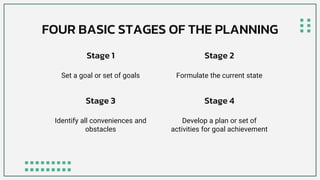
Set a goal or set of goals Formulate the current state
Identify all conveniences and
obstacles
Develop a plan or set of
activities for goal achievement
FOUR BASIC STAGES OF THE PLANNING
Stage 1
Stage 3
Stage 2
Stage 4
Benefits of
Planning
1. Helps management to adjust to changes in
the environment
2. Allows managers to understand the overall
operating picture more clearly
3. Helps assign responsibilities more quickly
4. Provides a way of giving orders for
operations
5. Facilitates coordination among various parts
of the organization.
6. Makes objectives more specific, detailed
and easier to understand
7. Minimizes uncertain work
8. Saves time, effort and money
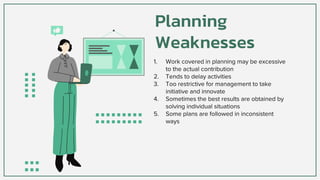
Planning
Weaknesses
1. Work covered in planning may be excessive
to the actual contribution
2. Tends to delay activities
3. Too restrictive for management to take
initiative and innovate
4. Sometimes the best results are obtained by
solving individual situations
5. Some plans are followed in inconsistent
ways
Some Types of Planning
1. Mission : Describes the role or purpose of an organization in a
particular society.
2. Purpose : Is the end point to which the organization's activities
are directed.
3. strategy : Is a general/principal plan for achieving organizational goals.
4. Policy : It is a general statement or understanding that helps
guide decision-making (especially the way of thinking).
5. Procedures : Is a set of activities or actions, which directs action (rather
than thinking).
6. Rules : is a plan that is chosen from several alternatives, to do or not to
do.
7. Program : is a complex network of objectives, policies, procedures, rules,
assignments, steps to be taken, resource allocation, and other
elements, based on the chosen alternative course of action.
8. Budget : is a plan expressed in numbers.
Planning Process
 Planning Process
 Strategic Planning
From the organization's mission, strategic objectives are
derived. Strategic plans are aimed at achieving strategic goals.
Usually strategic plans are set by top management.
 Tactical Planning
Tactical plans are derived from missions and strategic plans.
Tactical plans are aimed at achieving tactical goals that are a
specific part of the strategic plan. Focuses on human relations
and action, and is usually determined by middle management.
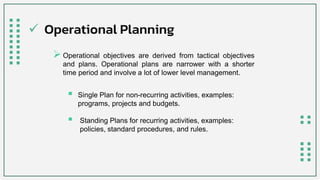
 Operational Planning
Operational objectives are derived from tactical objectives
and plans. Operational plans are narrower with a shorter
time period and involve a lot of lower level management.
 Single Plan for non-recurring activities, examples:
programs, projects and budgets.
 Standing Plans for recurring activities, examples:
policies, standard procedures, and rules.
 Situational Planning
is planning that includes alternative planning if situational events arise.
 Planning and Management Levels
Top management will be more involved in strategic planning, middle management in
tactical planning, and lower level management in operational planning.
Obstacles and Problem Solving of
Obstacles in Planning
 Barriers to Effective Planning
 Inappropriate goals, not understanding the environment and
organization, and not being confident.
Overcoming Barriers
 Training or assistance to managers in setting goals and
understanding the organization and environment.
 Is a participatory goal setting method popularized by Peter Drucker.
MBO departs from the assumption of human characteristics Y.
Participation and communication are the keys to MBO.
 Effectiveness of MBO
 Top management commitment, goal setting from top management,
goal setting and clear individual responsibilities, participation,
communication, autonomy and performance review (evaluation).
MBO
(Management By Objectives)
Weaknesses of MBO
 Inherent in MBO, it absorbs a lot of energy and time, a lot of
administrative work, a complicated process that requires a willingness to
learn.
 Beyond MBO which can theoretically be eliminated, examples are lack
of top management commitment, authoritarian management style,
lacking human relations skills.
 Steps to Solve the Weaknesses of MBO
 Top Management Commitment strengthened
 Encourage participation
 Provide communication training to managers who have less human
relations skills
 Effective feedback
 Set clear goals
 Provide training in the use of MBO
Model Proses MBO
-Company Strategic
- Objectives
Departmental
- Objectives
Individual Goals
Implementation
Planning
Take remedial steps
Review the progress
achieved
Setting Goals
Develop an
implementation plan
Review the
progress achieved
Menilai Kinerja
Rewards for overall
performance
• A plan is born not by chance but because there is a cause
in the form of initiatives or initiatives from within and
outside the organization or company. As the origin of a
plan includes various sources, including:
• -Policy top management: It is the top management who
issue policies on planning because they are indeed the
policy holders.
• -Supervision results: Based on the results of supervision,
a number of data and facts were collected which were
made in a new plan that repaired or overhauled what
had been implemented.
• BACKGROUND TO THE BIRTH
OF PLANNING
This means that planning is a process of determining what is to be achieved in the
future and determining the stages needed to achieve it. Thus, the planning process
is carried out by examining various directions of achievement and assessing the
various uncertainties that exist, measuring our ability (capacity) to achieve it and
then choosing the best directions and steps to achieve it. Plans can be informal
plans or formal plans.
• Initiative from within: Planning can also be born as a
result of suggestions from outsiders who may directly or
indirectly have an interest in the organization.
• -Future needs: A plan is made as a preparation for the
future or to deal with obstacles and obstacles that can
occur at any time.
 The conditions for good planning must be reasonable, realistic and
systematic. The objectivity of a plan is seen through its benefits and
efficiency.
 General factors planning is
1. Resources (nature, people, capital and technology
2. Ideology
3. Targets of development goals
4. Policy and regulation
5. Data and method
6. Enviromental, social, political and cultural condition
PLANNING TERMS
PRINCIPLES AND ELEMENTS OF
PLANNING
Planning principles
1. Planning must really help achieve the goal, so it is possible
that the actions we take will not make mistakes so that they will
not cause greater sacrifices. That can only happen if we think in
advance about the actions we will take.
2. Planning must be the first activity of the entire management
process (primary activity). As we know, planning is an absolute
requirement to be able to carry out good management. Because
planning here provides guidelines, guidance and direction,
which is always the first activity to be carried out.
3. Planning must cover all activities. We all know that planning is the main
function of management. This means that planning must cover all activities,
namely organizing, directing, coordinating, and controlling.
4. In a plan there must be alternatives, both regarding materials, time, labor,
costs, and so on.
5. Planning must have a value of efficiency and savings.
6. Planning must only look at urgent factors so that it must be clear, clear and
not wordy.
7. Planning must be easily perfected, corrected, or adapted to situations and
conditions that change at any time.
8. Must have a strategy to be accepted by all parties, so that it can be
implemented properly.
Planning elements
A complete and perfect plan must contain six elements, which include six
questions
● 5 W + 1 H, that is:
● 1. What - What action must be taken? In this case, the required activities
must be explained and detailed, the factors needed to carry out these
activities so that the objectives can be achieved.
● 2. Why - What is the reason for the action being done? Here it is necessary
to explain and clarify why the activity must be carried out and why the goal
must be achieved.
3. Where - Where will the action be implemented? The planning must contain
where the location of the work will be completed. It is necessary to provide the
means and facilities to do the job.
4. When - When was the action carried out? It is necessary to have a time
schedule and when the work starts until the work ends.
5. Who - Who will do it? The plan must contain the workers who do the work. In
addition, it is also necessary to clarify the authority and responsibility of officers.
6. How - How to carry out the work? The planning must explain the techniques,
methods and systems of doing the work in question.
Bintoro Tjokroaminoto in Husaini Usman (2008) states that planning is the
process of systematically preparing activities that will be carried out to achieve
certain goals. Prajudi Atmosudirjo in Husaini Usman (2008) also argues that
planning is the calculation and determination of something that will be carried
out in order to achieve certain goals, who does it, when, where, and how to do
it.
Meanwhile, Widjojo in the State Administration Institute (1985: 31), explained
that planning basically revolves around two things:
1. The conscious choice of concrete goals to be achieved within a certain
period of time based on the values of the community concerned.
Theory of Planning
2. The choice between alternative ways that are efficient and rational to
achieve these goals, both for determining goals that cover a certain period of
time and for selecting these methods, certain measures or criteria are needed
which must first be selected as well.
Planning is a rational way to prepare for the future Becker (2000) in Rustiadi
(2008: 339). Meanwhile, according to Alder (1999) in Rustiadi (2008: 339) states
that: Planning is a process of determining what is to be achieved in the future
and determining the stages needed to achieve it. Some people argue that
planning is an activity that is not planned.
According to George R. Terry, planning is the selecting and relating of fact and
the making and using of assumption regarding the future in the visualization and
formulating of proposed activities believed necessary to achieve desired result.
So we are able to coordinate all our activities that are being carried out and those that will be
carried out in the future, we can make sure that planning is very necessary.
Planning is a activities that we cannot avoid even without realizing it, cause planning describe
more what, why, whom, when, where and how we’re gonna do to make sure we coordinate all
activities that will be carried out, both in the present and in the future.
Conclusion
CREDITS: This presentation template was created by Slidesgo,
including icons by Flaticon, and infographics & images by Freepik
Do you have any questions?
Thanks

assignment_of_management (planning) (2).pptx

  • 1.
  • 2.
    Andy Darman RaehanBayu Hikmah Amalia Presentation by: NIM 5551230113 NIM 5553230095 NIM 5551230128
  • 3.
    Definition It is theselection of a set of activities and the subsequent decision of what to do, when, how, and by whom
  • 4.
    Set a goalor set of goals Formulate the current state Identify all conveniences and obstacles Develop a plan or set of activities for goal achievement FOUR BASIC STAGES OF THE PLANNING Stage 1 Stage 3 Stage 2 Stage 4
  • 5.
    Benefits of Planning 1. Helpsmanagement to adjust to changes in the environment 2. Allows managers to understand the overall operating picture more clearly 3. Helps assign responsibilities more quickly 4. Provides a way of giving orders for operations 5. Facilitates coordination among various parts of the organization. 6. Makes objectives more specific, detailed and easier to understand 7. Minimizes uncertain work 8. Saves time, effort and money
  • 6.
    Planning Weaknesses 1. Work coveredin planning may be excessive to the actual contribution 2. Tends to delay activities 3. Too restrictive for management to take initiative and innovate 4. Sometimes the best results are obtained by solving individual situations 5. Some plans are followed in inconsistent ways
  • 7.
    Some Types ofPlanning 1. Mission : Describes the role or purpose of an organization in a particular society. 2. Purpose : Is the end point to which the organization's activities are directed. 3. strategy : Is a general/principal plan for achieving organizational goals. 4. Policy : It is a general statement or understanding that helps guide decision-making (especially the way of thinking). 5. Procedures : Is a set of activities or actions, which directs action (rather than thinking). 6. Rules : is a plan that is chosen from several alternatives, to do or not to do. 7. Program : is a complex network of objectives, policies, procedures, rules, assignments, steps to be taken, resource allocation, and other elements, based on the chosen alternative course of action. 8. Budget : is a plan expressed in numbers.
  • 8.
    Planning Process  PlanningProcess  Strategic Planning From the organization's mission, strategic objectives are derived. Strategic plans are aimed at achieving strategic goals. Usually strategic plans are set by top management.  Tactical Planning Tactical plans are derived from missions and strategic plans. Tactical plans are aimed at achieving tactical goals that are a specific part of the strategic plan. Focuses on human relations and action, and is usually determined by middle management.
  • 9.
     Operational Planning Operationalobjectives are derived from tactical objectives and plans. Operational plans are narrower with a shorter time period and involve a lot of lower level management.  Single Plan for non-recurring activities, examples: programs, projects and budgets.  Standing Plans for recurring activities, examples: policies, standard procedures, and rules.
  • 10.
     Situational Planning isplanning that includes alternative planning if situational events arise.  Planning and Management Levels Top management will be more involved in strategic planning, middle management in tactical planning, and lower level management in operational planning.
  • 11.
    Obstacles and ProblemSolving of Obstacles in Planning  Barriers to Effective Planning  Inappropriate goals, not understanding the environment and organization, and not being confident. Overcoming Barriers  Training or assistance to managers in setting goals and understanding the organization and environment.
  • 12.
     Is aparticipatory goal setting method popularized by Peter Drucker. MBO departs from the assumption of human characteristics Y. Participation and communication are the keys to MBO.  Effectiveness of MBO  Top management commitment, goal setting from top management, goal setting and clear individual responsibilities, participation, communication, autonomy and performance review (evaluation). MBO (Management By Objectives)
  • 13.
    Weaknesses of MBO Inherent in MBO, it absorbs a lot of energy and time, a lot of administrative work, a complicated process that requires a willingness to learn.  Beyond MBO which can theoretically be eliminated, examples are lack of top management commitment, authoritarian management style, lacking human relations skills.  Steps to Solve the Weaknesses of MBO  Top Management Commitment strengthened  Encourage participation  Provide communication training to managers who have less human relations skills  Effective feedback  Set clear goals  Provide training in the use of MBO
  • 14.
    Model Proses MBO -CompanyStrategic - Objectives Departmental - Objectives Individual Goals Implementation Planning Take remedial steps Review the progress achieved Setting Goals Develop an implementation plan Review the progress achieved Menilai Kinerja Rewards for overall performance
  • 15.
    • A planis born not by chance but because there is a cause in the form of initiatives or initiatives from within and outside the organization or company. As the origin of a plan includes various sources, including: • -Policy top management: It is the top management who issue policies on planning because they are indeed the policy holders. • -Supervision results: Based on the results of supervision, a number of data and facts were collected which were made in a new plan that repaired or overhauled what had been implemented. • BACKGROUND TO THE BIRTH OF PLANNING
  • 16.
    This means thatplanning is a process of determining what is to be achieved in the future and determining the stages needed to achieve it. Thus, the planning process is carried out by examining various directions of achievement and assessing the various uncertainties that exist, measuring our ability (capacity) to achieve it and then choosing the best directions and steps to achieve it. Plans can be informal plans or formal plans. • Initiative from within: Planning can also be born as a result of suggestions from outsiders who may directly or indirectly have an interest in the organization. • -Future needs: A plan is made as a preparation for the future or to deal with obstacles and obstacles that can occur at any time.
  • 17.
     The conditionsfor good planning must be reasonable, realistic and systematic. The objectivity of a plan is seen through its benefits and efficiency.  General factors planning is 1. Resources (nature, people, capital and technology 2. Ideology 3. Targets of development goals 4. Policy and regulation 5. Data and method 6. Enviromental, social, political and cultural condition PLANNING TERMS
  • 18.
    PRINCIPLES AND ELEMENTSOF PLANNING Planning principles 1. Planning must really help achieve the goal, so it is possible that the actions we take will not make mistakes so that they will not cause greater sacrifices. That can only happen if we think in advance about the actions we will take. 2. Planning must be the first activity of the entire management process (primary activity). As we know, planning is an absolute requirement to be able to carry out good management. Because planning here provides guidelines, guidance and direction, which is always the first activity to be carried out.
  • 19.
    3. Planning mustcover all activities. We all know that planning is the main function of management. This means that planning must cover all activities, namely organizing, directing, coordinating, and controlling. 4. In a plan there must be alternatives, both regarding materials, time, labor, costs, and so on. 5. Planning must have a value of efficiency and savings. 6. Planning must only look at urgent factors so that it must be clear, clear and not wordy. 7. Planning must be easily perfected, corrected, or adapted to situations and conditions that change at any time. 8. Must have a strategy to be accepted by all parties, so that it can be implemented properly.
  • 20.
    Planning elements A completeand perfect plan must contain six elements, which include six questions ● 5 W + 1 H, that is: ● 1. What - What action must be taken? In this case, the required activities must be explained and detailed, the factors needed to carry out these activities so that the objectives can be achieved. ● 2. Why - What is the reason for the action being done? Here it is necessary to explain and clarify why the activity must be carried out and why the goal must be achieved.
  • 21.
    3. Where -Where will the action be implemented? The planning must contain where the location of the work will be completed. It is necessary to provide the means and facilities to do the job. 4. When - When was the action carried out? It is necessary to have a time schedule and when the work starts until the work ends. 5. Who - Who will do it? The plan must contain the workers who do the work. In addition, it is also necessary to clarify the authority and responsibility of officers. 6. How - How to carry out the work? The planning must explain the techniques, methods and systems of doing the work in question.
  • 22.
    Bintoro Tjokroaminoto inHusaini Usman (2008) states that planning is the process of systematically preparing activities that will be carried out to achieve certain goals. Prajudi Atmosudirjo in Husaini Usman (2008) also argues that planning is the calculation and determination of something that will be carried out in order to achieve certain goals, who does it, when, where, and how to do it. Meanwhile, Widjojo in the State Administration Institute (1985: 31), explained that planning basically revolves around two things: 1. The conscious choice of concrete goals to be achieved within a certain period of time based on the values of the community concerned. Theory of Planning
  • 23.
    2. The choicebetween alternative ways that are efficient and rational to achieve these goals, both for determining goals that cover a certain period of time and for selecting these methods, certain measures or criteria are needed which must first be selected as well. Planning is a rational way to prepare for the future Becker (2000) in Rustiadi (2008: 339). Meanwhile, according to Alder (1999) in Rustiadi (2008: 339) states that: Planning is a process of determining what is to be achieved in the future and determining the stages needed to achieve it. Some people argue that planning is an activity that is not planned. According to George R. Terry, planning is the selecting and relating of fact and the making and using of assumption regarding the future in the visualization and formulating of proposed activities believed necessary to achieve desired result.
  • 24.
    So we areable to coordinate all our activities that are being carried out and those that will be carried out in the future, we can make sure that planning is very necessary. Planning is a activities that we cannot avoid even without realizing it, cause planning describe more what, why, whom, when, where and how we’re gonna do to make sure we coordinate all activities that will be carried out, both in the present and in the future. Conclusion
  • 25.
    CREDITS: This presentationtemplate was created by Slidesgo, including icons by Flaticon, and infographics & images by Freepik Do you have any questions? Thanks