Assignment on Numerical Methods Assignment topic: C code using numerical methods Course Code: CSE 234 Fall-2014 
Submitted To: Md. Jashim Uddin Assistant Professor Dept. of Natural Sciences Dept. of Computer Science & Engineering Faculty of Science & Information Technology 
Submitted by: 
Name: Syed Ahmed Zaki 
Name: Fatema Khatun 
Name: Sumi Basak 
Name: Priangka Kirtania 
Name: Afruza Zinnurain 
ID:131-15-2169 
ID:131-15-2372 
ID:131-15-2364 
ID:131-15-2385 
ID:131-15-2345 
Sec: B Dept. of CSE,FSIT 
Date of submission: 12 , December 2014
Contents: 
Root Finding Method Page Bisection Method 2 Newton-Raphson Method 4 Interpolation Newton Forward Interpolation 5 Newton Backward Interpolation 7 Lagrange Method 8 
Numerical Integration 
Trapezoidal Rule 10 Simpson’s 1/3 Rule 12 Simpson’s 3/8 Rule 13 Weddle’s Rule 14 
Ordinary Differential Equations 
Euler Method 17 Runge-Kutta 4th order method 18 
Linear System Gauss Seidel Method 20 
1
Bisection Method: The Bisection Method is a numerical method for estimating the roots of a polynomial f(x). It is one of the simplest and most reliable but it is not the fastest method. 
Problem: Here we have to find root for the polynomial x^3+x^2-1 
Algorithm: 
1. Start 
2. Read a1, b1, TOL *Here a1 and b1 are initial guesses TOL is the absolute error or tolerance i.e. the desired degree of accuracy* 
3. Compute: f1 = f(a1) and f3 = f(b1) 
4. If (f1*f3) > 0, then display initial guesses are wrong and goto step 11 Otherwise continue. 
5. root = (a1 + b1)/2 
6. If [ (a1 – b1)/root ] < TOL , then display root and goto step 11 * Here [ ] refers to the modulus sign. * or f(root)=0 then display root 
7. Else, f2 = f(root) 
8. If (f1*f2) < 0, then b1=root 
9. Else if (f2*f3)<0 then a1=root 
10. else goto step 5 *Now the loop continues with new values.* 
11. Stop 
Code: 
1 
2 
3 
4 
5 
6 
7 
8 
9 
10 
11 
12 
13 
14 
15 
16 
17 
18 
19 
#include<stdio.h> 
#include<math.h> 
#define f(y) (pow(x,3)+x*x-1); 
int main() 
{ 
double a,b,m=-1,x,y; 
int n=0,k,i; 
printf("Enter the value of a: "); 
scanf("%lf",&a); 
printf("Enter the value of b: "); 
scanf("%lf",&b); 
printf("How many itteration you want: "); 
scanf("%d",&k); 
printf("n n a b xn=a+b/2 sign of(xn)n"); 
printf("-------------------------------------------------------------n"); 
for(i=1;i<=k;i++) 
{ 
x=(a+b)/2; 
y=f(x); 
2
20 
21 
22 
23 
24 
25 
26 
27 
28 
29 
30 
31 
32 
33 
34 
35 
36 
37 
38 
39 
if(m==x) 
{ 
break; 
} 
i f(y>=0) 
{ 
printf(" %d %.5lf %.5lf %.5lf +n",i,a,b,x); 
b=x; 
} 
else if(y<0) 
{ 
printf(" %d %.5lf %.5lf %.5lf -n",i,a,b,x); 
a=x; 
} 
m=x; 
} 
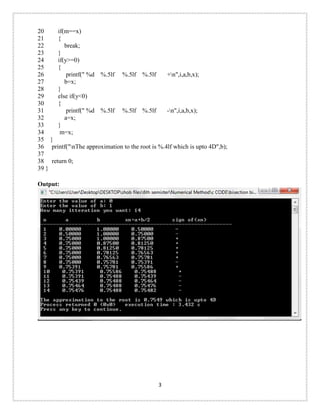
printf("nThe approximation to the root is %.4lf which is upto 4D",b); 
return 0; 
} 
Output: 
3
Newton – Raphson Method: 
Problem: Here we have to find root for the polynomial x^3-8*x-4 upto 6D(decimal places) 
Solution in C: 
1 
2 
3 
4 
5 
6 
7 
8 
9 
10 
11 
12 
13 
14 
15 
16 
17 
18 
19 
20 
21 
22 
23 
24 
25 
26 
27 
#include<stdio.h> 
#include<math.h> 
#define f(x) pow(a,3)-8*a-4; 
#define fd(x) 3*pow(a,2)-8; 
int main() 
{ 
double a,b,c,d,h,k,x,y; 
int i,j,m,n; 
printf("Enter the value of xn: "); 
scanf("%lf",&a); 
printf("Enter itteration number: "); 
scanf("%d",&n); 
printf(" xn f(x) f'(x) hn=-f(x)/f'(xn) xn+1=xn+hn"); 
printf("-----------------------------------------------------------------------------------------n"); 
for(i=1;i<=n;i++) 
{ 
x=f(a); 
y=fd(x); 
h=-(x/y); 
k=h+a; 
printf(" %.7lf %.7lf %.7lf %.7lf %.7lfn",a,x,y,h,k); 
a=k; 
} 
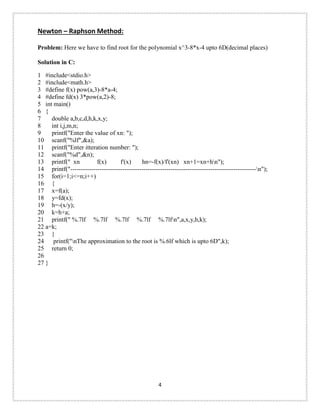
printf("nThe approximation to the root is %.6lf which is upto 6D",k); 
return 0; 
} 
4
Output: 
Newton Forward Interpolation: Problem: The population of a town is given below as thousands Year : 1891 1901 1911 1921 1931 Population : 46 66 81 93 101 
Find the population of 1895 ? 
Code: 
1 
2 
3 
4 
5 
6 
7 
8 
9 
10 
11 
12 
13 
14 
15 
16 
17 
#include<stdio.h> 
#include<math.h> 
#include<stdlib.h> 
main() 
{ 
float x[20],y[20],f,s,h,d,p; 
int j,i,n; 
printf("enter the value of n :"); 
scanf("%d",&n); 
printf("enter the elements of x:"); 
for(i=1;i<=n;i++) 
{ 
scanf("n%f",&x[i]); 
} 
printf("enter the elements of y:"); 
for(i=1;i<=n;i++) 
{ 
5
18 
19 
20 
21 
22 
23 
24 
25 
26 
27 
28 
29 
30 
31 
32 
33 
34 
35 
36 
37 
38 
scanf("n%f",&y[i]); 
} 
h=x[2]-x[1]; 
printf("Enter the value of f(to findout value):"); 
scanf("%f",&f); 
s=(f-x[1])/h; 
p=1; 
d=y[1]; 
for(i=1;i<=(n-1);i++) 
{ 
for(j=1;j<=(n-i);j++) 
{ 
y[j]=y[j+1]-y[j]; 
} 
p=p*(s-i+1)/i; 
d=d+p*y[1]; 
} 
printf("For the value of x=%6.5f THe value is %6.5f",f,d); 
getch(); 
} 
Output: 
6
Newton Backward Interpolation: Problem: The population of a town is given below as thousands Year : 1891 1901 1911 1921 1931 Population : 46 66 81 93 101 
Find the population of 1895 ? 
Code: 
1 
2 
3 
4 
5 
6 
7 
8 
9 
10 
11 
12 
13 
14 
15 
16 
17 
18 
19 
20 
21 
22 
23 
24 
25 
26 
27 
28 
29 
30 
31 
32 
33 
34 
35 
36 
37 
#include<stdio.h> 
#include<math.h> 
#include<stdlib.h> 
main() 
{ 
float x[20],y[20],f,s,d,h,p; 
int j,i,k,n; 
printf("enter the value of the elements :"); 
scanf("%d",&n); 
printf("enter the value of x:n"); 
for(i=1;i<=n;i++) 
{ 
scanf("%f",&x[i]); 
} 
printf("enter the value of y:n"); 
for(i=1;i<=n;i++) 
{ 
scanf("%f",&y[i]); 
} 
h=x[2]-x[1]; 
printf("enter the searching point f:"); 
scanf("%f",&f); 
s=(f-x[n])/h; 
d=y[n]; 
p=1; 
for(i=n,k=1;i>=1,k<n;i--,k++) 
{ 
for(j=n;j>=1;j--) 
{ 
y[j]=y[j]-y[j-1]; 
} 
p=p*(s+k-1)/k; 
d=d+p*y[n]; 
} 
printf("for f=%f ,ans is=%f",f,d); 
getch(); 
} 
7
Output: 
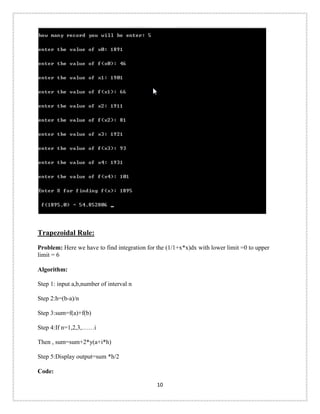
Lagrange Method: Problem: The population of a town is given below as thousands Year : 1891 1901 1911 1921 1931 Population : 46 66 81 93 101 
Find the population of 1895 ? 
Code: 
1 
2 
3 
4 
5 
6 
7 
8 
9 
10 
11 
12 
13 
14 
15 
16 
17 
18 
19 
20 
21 
22 
#include<stdio.h> 
#include<math.h> 
int main() 
{ 
float x[10],y[10],temp=1,f[10],sum,p; 
int i,n,j,k=0,c; 
printf("nhow many record you will be enter: "); 
scanf("%d",&n); 
for(i=0; i<n; i++) 
{ 
printf("nnenter the value of x%d: ",i); 
scanf("%f",&x[i]); 
printf("nnenter the value of f(x%d): ",i); 
scanf("%f",&y[i]); 
} 
printf("nnEnter X for finding f(x): "); 
scanf("%f",&p); 
for(i=0;i<n;i++) 
{ 
temp = 1; 
8
23 
24 
25 
26 
27 
28 
29 
30 
31 
32 
33 
34 
35 
36 
37 
38 
39 
40 
41 
42 
43 
44 
k = i; 
for(j=0;j<n;j++) 
{ 
if(k==j) 
{ 
continue; 
} 
else 
{ 
temp = temp * ((p-x[j])/(x[k]-x[j])); 
} 
} 
f[i]=y[i]*temp; 
} 
for(i=0;i<n;i++) 
{ 
sum = sum + f[i]; 
} 
printf("nn f(%.1f) = %f ",p,sum); 
getch(); 
} 
9
Output: 
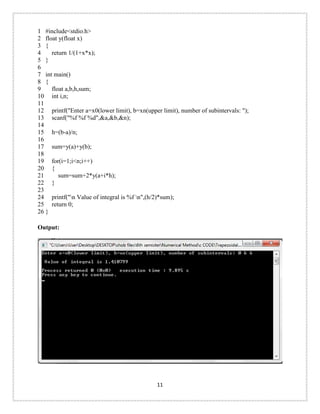
Trapezoidal Rule: Problem: Here we have to find integration for the (1/1+x*x)dx with lower limit =0 to upper limit = 6 
Algorithm: 
Step 1: input a,b,number of interval n 
Step 2:h=(b-a)/n 
Step 3:sum=f(a)+f(b) 
Step 4:If n=1,2,3,……i 
Then , sum=sum+2*y(a+i*h) 
Step 5:Display output=sum *h/2 
Code: 
10
1 
2 
3 
4 
5 
6 
7 
8 
9 
10 
11 
12 
13 
14 
15 
16 
17 
18 
19 
20 
21 
22 
23 
24 
25 
26 
#include<stdio.h> 
float y(float x) 
{ 
return 1/(1+x*x); 
} 
int main() 
{ 
float a,b,h,sum; 
int i,n; 
printf("Enter a=x0(lower limit), b=xn(upper limit), number of subintervals: "); 
scanf("%f %f %d",&a,&b,&n); 
h=(b-a)/n; 
sum=y(a)+y(b); 
for(i=1;i<n;i++) 
{ 
sum=sum+2*y(a+i*h); 
} 
printf("n Value of integral is %f n",(h/2)*sum); 
return 0; 
} 
Output: 
11
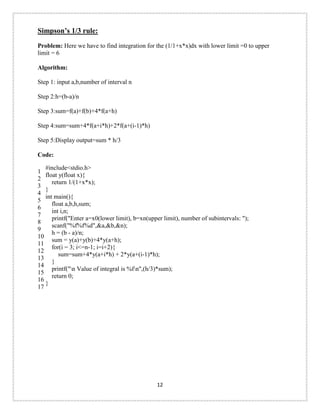
Simpson’s 1/3 rule: 
Problem: Here we have to find integration for the (1/1+x*x)dx with lower limit =0 to upper limit = 6 
Algorithm: 
Step 1: input a,b,number of interval n 
Step 2:h=(b-a)/n 
Step 3:sum=f(a)+f(b)+4*f(a+h) 
Step 4:sum=sum+4*f(a+i*h)+2*f(a+(i-1)*h) 
Step 5:Display output=sum * h/3 
Code: 
1 
2 
3 
4 
5 
6 
7 
8 
9 
10 
11 
12 
13 
14 
15 
16 
17 
#include<stdio.h> 
float y(float x){ 
return 1/(1+x*x); 
} 
int main(){ 
float a,b,h,sum; 
int i,n; 
printf("Enter a=x0(lower limit), b=xn(upper limit), number of subintervals: "); 
scanf("%f%f%d",&a,&b,&n); 
h = (b - a)/n; 
sum = y(a)+y(b)+4*y(a+h); 
for(i = 3; i<=n-1; i=i+2){ 
sum=sum+4*y(a+i*h) + 2*y(a+(i-1)*h); 
} 
printf("n Value of integral is %fn",(h/3)*sum); 
return 0; 
} 
12
Output: 
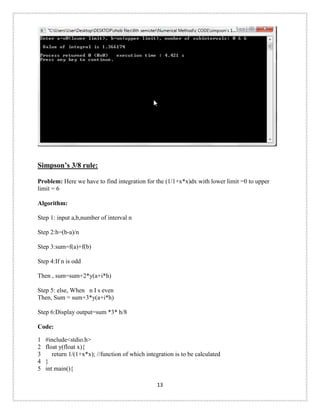
Simpson’s 3/8 rule: Problem: Here we have to find integration for the (1/1+x*x)dx with lower limit =0 to upper limit = 6 
Algorithm: 
Step 1: input a,b,number of interval n 
Step 2:h=(b-a)/n 
Step 3:sum=f(a)+f(b) 
Step 4:If n is odd 
Then , sum=sum+2*y(a+i*h) 
Step 5: else, When n I s even Then, Sum = sum+3*y(a+i*h) 
Step 6:Display output=sum *3* h/8 
Code: 
1 
2 
3 
4 
5 
#include<stdio.h> 
float y(float x){ 
return 1/(1+x*x); //function of which integration is to be calculated 
} 
int main(){ 
13
6 
7 
8 
9 
10 
11 
12 
13 
14 
15 
16 
17 
18 
19 
20 
21 
22 
23 
float a,b,h,sum; 
int i,n,j; 
sum=0; 
printf("Enter a=x0(lower limit), b=xn(upper limit), number of subintervals: "); 
scanf("%f%f%d",&a,&b,&n); 
h = (b-a)/n; 
sum = y(a)+y(b); 
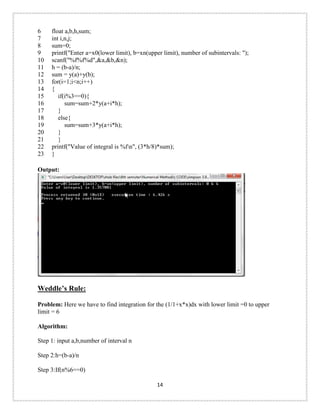
for(i=1;i<n;i++) 
{ 
if(i%3==0){ 
sum=sum+2*y(a+i*h); 
} 
else{ 
sum=sum+3*y(a+i*h); 
} 
} 
printf("Value of integral is %fn", (3*h/8)*sum); 
} 
Output: 
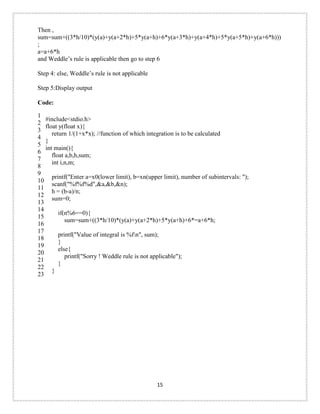
Weddle’s Rule: Problem: Here we have to find integration for the (1/1+x*x)dx with lower limit =0 to upper limit = 6 
Algorithm: 
Step 1: input a,b,number of interval n 
Step 2:h=(b-a)/n 
Step 3:If(n%6==0) 
14
Then , sum=sum+((3*h/10)*(y(a)+y(a+2*h)+5*y(a+h)+6*y(a+3*h)+y(a+4*h)+5*y(a+5*h)+y(a+6*h))) ; a=a+6*h and Weddle’s rule is applicable then go to step 6 
Step 4: else, Weddle’s rule is not applicable 
Step 5:Display output 
Code: 
1 
2 
3 
4 
5 
6 
7 
8 
9 
10 
11 
12 
13 
14 
15 
16 
17 
18 
19 
20 
21 
22 
23 
#include<stdio.h> 
float y(float x){ 
return 1/(1+x*x); //function of which integration is to be calculated 
} 
int main(){ 
float a,b,h,sum; 
int i,n,m; 
printf("Enter a=x0(lower limit), b=xn(upper limit), number of subintervals: "); 
scanf("%f%f%d",&a,&b,&n); 
h = (b-a)/n; 
sum=0; 
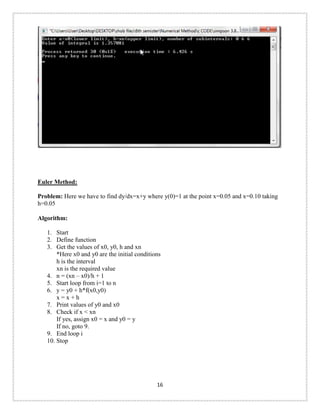
if(n%6==0){ 
sum=sum+((3*h/10)*(y(a)+y(a+2*h)+5*y(a+h)+6*=a+6*h; 
printf("Value of integral is %fn", sum); 
} 
else{ 
printf("Sorry ! Weddle rule is not applicable"); 
} 
} 
15
Output: 
Euler Method: Problem: Here we have to find dy/dx=x+y where y(0)=1 at the point x=0.05 and x=0.10 taking h=0.05 
Algorithm: 
1. Start 
2. Define function 
3. Get the values of x0, y0, h and xn *Here x0 and y0 are the initial conditions h is the interval xn is the required value 
4. n = (xn – x0)/h + 1 
5. Start loop from i=1 to n 
6. y = y0 + h*f(x0,y0) x = x + h 
7. Print values of y0 and x0 
8. Check if x < xn If yes, assign x0 = x and y0 = y If no, goto 9. 
9. End loop i 
10. Stop 
16
Code: 
1 
2 
3 
4 
5 
6 
7 
8 
9 
10 
11 
12 
13 
14 
15 
16 
17 
18 
19 
20 
21 
22 
23 
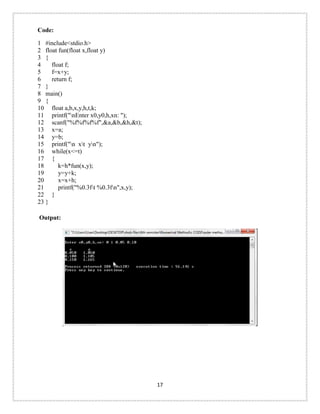
#include<stdio.h> 
float fun(float x,float y) 
{ 
float f; 
f=x+y; 
return f; 
} 
main() 
{ 
float a,b,x,y,h,t,k; 
printf("nEnter x0,y0,h,xn: "); 
scanf("%f%f%f%f",&a,&b,&h,&t); 
x=a; 
y=b; 
printf("n xt yn"); 
while(x<=t) 
{ 
k=h*fun(x,y); 
y=y+k; 
x=x+h; 
printf("%0.3ft %0.3fn",x,y); 
} 
} 
Output: 
17
Runge-Kutta 4th order method: 
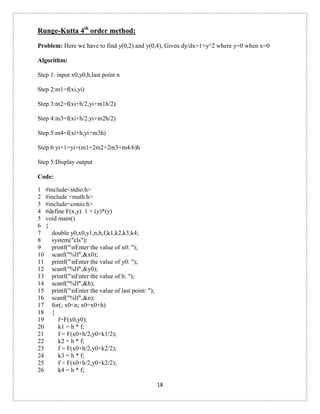
Problem: Here we have to find y(0,2) and y(0,4), Given dy/dx=1+y^2 where y=0 when x=0 
Algorithm: 
Step 1: input x0,y0,h,last point n 
Step 2:m1=f(xi,yi) 
Step 3:m2=f(xi+h/2,yi+m1h/2) 
Step 4:m3=f(xi+h/2,yi+m2h/2) 
Step 5:m4=f(xi+h,yi+m3h) 
Step 6:yi+1=yi+(m1+2m2+2m3+m4/6)h 
Step 5:Display output 
Code: 
1 
2 
3 
4 
5 
6 
7 
8 
9 
10 
11 
12 
13 
14 
15 
16 
17 
18 
19 
20 
21 
22 
23 
24 
25 
26 
#include<stdio.h> 
#include <math.h> 
#include<conio.h> 
#define F(x,y) 1 + (y)*(y) 
void main() 
{ 
double y0,x0,y1,n,h,f,k1,k2,k3,k4; 
system("cls"); 
printf("nEnter the value of x0: "); 
scanf("%lf",&x0); 
printf("nEnter the value of y0: "); 
scanf("%lf",&y0); 
printf("nEnter the value of h: "); 
scanf("%lf",&h); 
printf("nEnter the value of last point: "); 
scanf("%lf",&n); 
for(; x0<n; x0=x0+h) 
{ 
f=F(x0,y0); 
k1 = h * f; 
f = F(x0+h/2,y0+k1/2); 
k2 = h * f; 
f = F(x0+h/2,y0+k2/2); 
k3 = h * f; 
f = F(x0+h/2,y0+k2/2); 
k4 = h * f; 
18
27 
28 
29 
30 
31 
32 
33 
34 
35 
36 
y1 = y0 + ( k1 + 2*k2 + 2*k3 + k4)/6; 
printf("nn k1 = %.4lf ",k1); 
printf("nn k2 = %.4lf ",k2); 
printf("nn k3 = %.4lf ",k3); 
printf("nn k4 = %.4lf ",k4); 
printf("nn y(%.4lf) = %.3lf ",x0+h,y1); 
y0=y1; 
} 
getch(); 
} 
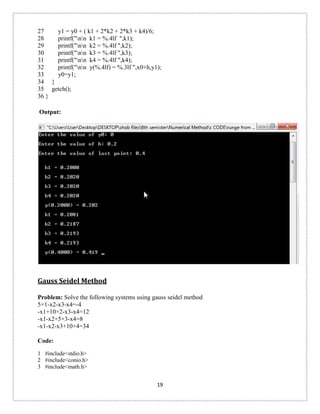
Output: 
Gauss Seidel Method 
Problem: Solve the following systems using gauss seidel method 5×1-x2-x3-x4=-4 -x1+10×2-x3-x4=12 -x1-x2+5×3-x4=8 -x1-x2-x3+10×4=34 
Code: 
1 
2 
3 
#include<stdio.h> 
#include<conio.h> 
#include<math.h> 
19
4 
5 
6 
7 
8 
9 
10 
11 
12 
13 
14 
15 
16 
17 
18 
19 
20 
21 
22 
23 
24 
25 
26 
27 
28 
29 
30 
31 
32 
33 
34 
35 
36 
37 
38 
39 
40 
41 
42 
43 
44 
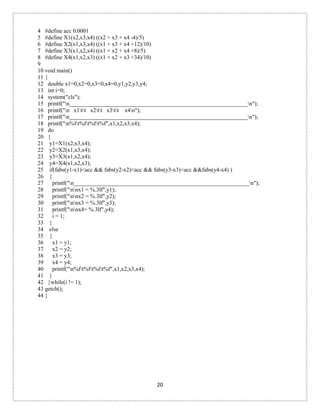
#define acc 0.0001 
#define X1(x2,x3,x4) ((x2 + x3 + x4 -4)/5) 
#define X2(x1,x3,x4) ((x1 + x3 + x4 +12)/10) 
#define X3(x1,x2,x4) ((x1 + x2 + x4 +8)/5) 
#define X4(x1,x2,x3) ((x1 + x2 + x3 +34)/10) 
void main() 
{ 
double x1=0,x2=0,x3=0,x4=0,y1,y2,y3,y4; 
int i=0; 
system("cls"); 
printf("n______________________________________________________________n"); 
printf("n x1tt x2tt x3tt x4n"); 
printf("n______________________________________________________________n"); 
printf("n%ft%ft%ft%f",x1,x2,x3,x4); 
do 
{ 
y1=X1(x2,x3,x4); 
y2=X2(x1,x3,x4); 
y3=X3(x1,x2,x4); 
y4=X4(x1,x2,x3); 
if(fabs(y1-x1)<acc && fabs(y2-x2)<acc && fabs(y3-x3)<acc &&fabs(y4-x4) ) 
{ 
printf("n_____________________________________________________________n"); 
printf("nnx1 = %.3lf",y1); 
printf("nnx2 = %.3lf",y2); 
printf("nnx3 = %.3lf",y3); 
printf("nnx4= %.3lf",y4); 
i = 1; 
} 
e lse 
{ 
x1 = y1; 
x2 = y2; 
x3 = y3; 
x4 = y4; 
printf("n%ft%ft%ft%f",x1,x2,x3,x4); 
} 
}while(i != 1); 
getch(); 
} 
20
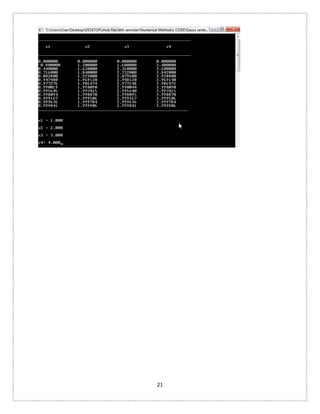
Output: 21

Assignment on Numerical Method C Code

  • 1.
    Assignment on NumericalMethods Assignment topic: C code using numerical methods Course Code: CSE 234 Fall-2014 Submitted To: Md. Jashim Uddin Assistant Professor Dept. of Natural Sciences Dept. of Computer Science & Engineering Faculty of Science & Information Technology Submitted by: Name: Syed Ahmed Zaki Name: Fatema Khatun Name: Sumi Basak Name: Priangka Kirtania Name: Afruza Zinnurain ID:131-15-2169 ID:131-15-2372 ID:131-15-2364 ID:131-15-2385 ID:131-15-2345 Sec: B Dept. of CSE,FSIT Date of submission: 12 , December 2014
  • 2.
    Contents: Root FindingMethod Page Bisection Method 2 Newton-Raphson Method 4 Interpolation Newton Forward Interpolation 5 Newton Backward Interpolation 7 Lagrange Method 8 Numerical Integration Trapezoidal Rule 10 Simpson’s 1/3 Rule 12 Simpson’s 3/8 Rule 13 Weddle’s Rule 14 Ordinary Differential Equations Euler Method 17 Runge-Kutta 4th order method 18 Linear System Gauss Seidel Method 20 1
  • 3.
    Bisection Method: TheBisection Method is a numerical method for estimating the roots of a polynomial f(x). It is one of the simplest and most reliable but it is not the fastest method. Problem: Here we have to find root for the polynomial x^3+x^2-1 Algorithm: 1. Start 2. Read a1, b1, TOL *Here a1 and b1 are initial guesses TOL is the absolute error or tolerance i.e. the desired degree of accuracy* 3. Compute: f1 = f(a1) and f3 = f(b1) 4. If (f1*f3) > 0, then display initial guesses are wrong and goto step 11 Otherwise continue. 5. root = (a1 + b1)/2 6. If [ (a1 – b1)/root ] < TOL , then display root and goto step 11 * Here [ ] refers to the modulus sign. * or f(root)=0 then display root 7. Else, f2 = f(root) 8. If (f1*f2) < 0, then b1=root 9. Else if (f2*f3)<0 then a1=root 10. else goto step 5 *Now the loop continues with new values.* 11. Stop Code: 1 2 3 4 5 6 7 8 9 10 11 12 13 14 15 16 17 18 19 #include<stdio.h> #include<math.h> #define f(y) (pow(x,3)+x*x-1); int main() { double a,b,m=-1,x,y; int n=0,k,i; printf("Enter the value of a: "); scanf("%lf",&a); printf("Enter the value of b: "); scanf("%lf",&b); printf("How many itteration you want: "); scanf("%d",&k); printf("n n a b xn=a+b/2 sign of(xn)n"); printf("-------------------------------------------------------------n"); for(i=1;i<=k;i++) { x=(a+b)/2; y=f(x); 2
  • 4.
    20 21 22 23 24 25 26 27 28 29 30 31 32 33 34 35 36 37 38 39 if(m==x) { break; } i f(y>=0) { printf(" %d %.5lf %.5lf %.5lf +n",i,a,b,x); b=x; } else if(y<0) { printf(" %d %.5lf %.5lf %.5lf -n",i,a,b,x); a=x; } m=x; } printf("nThe approximation to the root is %.4lf which is upto 4D",b); return 0; } Output: 3
  • 5.
    Newton – RaphsonMethod: Problem: Here we have to find root for the polynomial x^3-8*x-4 upto 6D(decimal places) Solution in C: 1 2 3 4 5 6 7 8 9 10 11 12 13 14 15 16 17 18 19 20 21 22 23 24 25 26 27 #include<stdio.h> #include<math.h> #define f(x) pow(a,3)-8*a-4; #define fd(x) 3*pow(a,2)-8; int main() { double a,b,c,d,h,k,x,y; int i,j,m,n; printf("Enter the value of xn: "); scanf("%lf",&a); printf("Enter itteration number: "); scanf("%d",&n); printf(" xn f(x) f'(x) hn=-f(x)/f'(xn) xn+1=xn+hn"); printf("-----------------------------------------------------------------------------------------n"); for(i=1;i<=n;i++) { x=f(a); y=fd(x); h=-(x/y); k=h+a; printf(" %.7lf %.7lf %.7lf %.7lf %.7lfn",a,x,y,h,k); a=k; } printf("nThe approximation to the root is %.6lf which is upto 6D",k); return 0; } 4
  • 6.
    Output: Newton ForwardInterpolation: Problem: The population of a town is given below as thousands Year : 1891 1901 1911 1921 1931 Population : 46 66 81 93 101 Find the population of 1895 ? Code: 1 2 3 4 5 6 7 8 9 10 11 12 13 14 15 16 17 #include<stdio.h> #include<math.h> #include<stdlib.h> main() { float x[20],y[20],f,s,h,d,p; int j,i,n; printf("enter the value of n :"); scanf("%d",&n); printf("enter the elements of x:"); for(i=1;i<=n;i++) { scanf("n%f",&x[i]); } printf("enter the elements of y:"); for(i=1;i<=n;i++) { 5
  • 7.
    18 19 20 21 22 23 24 25 26 27 28 29 30 31 32 33 34 35 36 37 38 scanf("n%f",&y[i]); } h=x[2]-x[1]; printf("Enter the value of f(to findout value):"); scanf("%f",&f); s=(f-x[1])/h; p=1; d=y[1]; for(i=1;i<=(n-1);i++) { for(j=1;j<=(n-i);j++) { y[j]=y[j+1]-y[j]; } p=p*(s-i+1)/i; d=d+p*y[1]; } printf("For the value of x=%6.5f THe value is %6.5f",f,d); getch(); } Output: 6
  • 8.
    Newton Backward Interpolation:Problem: The population of a town is given below as thousands Year : 1891 1901 1911 1921 1931 Population : 46 66 81 93 101 Find the population of 1895 ? Code: 1 2 3 4 5 6 7 8 9 10 11 12 13 14 15 16 17 18 19 20 21 22 23 24 25 26 27 28 29 30 31 32 33 34 35 36 37 #include<stdio.h> #include<math.h> #include<stdlib.h> main() { float x[20],y[20],f,s,d,h,p; int j,i,k,n; printf("enter the value of the elements :"); scanf("%d",&n); printf("enter the value of x:n"); for(i=1;i<=n;i++) { scanf("%f",&x[i]); } printf("enter the value of y:n"); for(i=1;i<=n;i++) { scanf("%f",&y[i]); } h=x[2]-x[1]; printf("enter the searching point f:"); scanf("%f",&f); s=(f-x[n])/h; d=y[n]; p=1; for(i=n,k=1;i>=1,k<n;i--,k++) { for(j=n;j>=1;j--) { y[j]=y[j]-y[j-1]; } p=p*(s+k-1)/k; d=d+p*y[n]; } printf("for f=%f ,ans is=%f",f,d); getch(); } 7
  • 9.
    Output: Lagrange Method:Problem: The population of a town is given below as thousands Year : 1891 1901 1911 1921 1931 Population : 46 66 81 93 101 Find the population of 1895 ? Code: 1 2 3 4 5 6 7 8 9 10 11 12 13 14 15 16 17 18 19 20 21 22 #include<stdio.h> #include<math.h> int main() { float x[10],y[10],temp=1,f[10],sum,p; int i,n,j,k=0,c; printf("nhow many record you will be enter: "); scanf("%d",&n); for(i=0; i<n; i++) { printf("nnenter the value of x%d: ",i); scanf("%f",&x[i]); printf("nnenter the value of f(x%d): ",i); scanf("%f",&y[i]); } printf("nnEnter X for finding f(x): "); scanf("%f",&p); for(i=0;i<n;i++) { temp = 1; 8
  • 10.
    23 24 25 26 27 28 29 30 31 32 33 34 35 36 37 38 39 40 41 42 43 44 k = i; for(j=0;j<n;j++) { if(k==j) { continue; } else { temp = temp * ((p-x[j])/(x[k]-x[j])); } } f[i]=y[i]*temp; } for(i=0;i<n;i++) { sum = sum + f[i]; } printf("nn f(%.1f) = %f ",p,sum); getch(); } 9
  • 11.
    Output: Trapezoidal Rule:Problem: Here we have to find integration for the (1/1+x*x)dx with lower limit =0 to upper limit = 6 Algorithm: Step 1: input a,b,number of interval n Step 2:h=(b-a)/n Step 3:sum=f(a)+f(b) Step 4:If n=1,2,3,……i Then , sum=sum+2*y(a+i*h) Step 5:Display output=sum *h/2 Code: 10
  • 12.
    1 2 3 4 5 6 7 8 9 10 11 12 13 14 15 16 17 18 19 20 21 22 23 24 25 26 #include<stdio.h> float y(float x) { return 1/(1+x*x); } int main() { float a,b,h,sum; int i,n; printf("Enter a=x0(lower limit), b=xn(upper limit), number of subintervals: "); scanf("%f %f %d",&a,&b,&n); h=(b-a)/n; sum=y(a)+y(b); for(i=1;i<n;i++) { sum=sum+2*y(a+i*h); } printf("n Value of integral is %f n",(h/2)*sum); return 0; } Output: 11
  • 13.
    Simpson’s 1/3 rule: Problem: Here we have to find integration for the (1/1+x*x)dx with lower limit =0 to upper limit = 6 Algorithm: Step 1: input a,b,number of interval n Step 2:h=(b-a)/n Step 3:sum=f(a)+f(b)+4*f(a+h) Step 4:sum=sum+4*f(a+i*h)+2*f(a+(i-1)*h) Step 5:Display output=sum * h/3 Code: 1 2 3 4 5 6 7 8 9 10 11 12 13 14 15 16 17 #include<stdio.h> float y(float x){ return 1/(1+x*x); } int main(){ float a,b,h,sum; int i,n; printf("Enter a=x0(lower limit), b=xn(upper limit), number of subintervals: "); scanf("%f%f%d",&a,&b,&n); h = (b - a)/n; sum = y(a)+y(b)+4*y(a+h); for(i = 3; i<=n-1; i=i+2){ sum=sum+4*y(a+i*h) + 2*y(a+(i-1)*h); } printf("n Value of integral is %fn",(h/3)*sum); return 0; } 12
  • 14.
    Output: Simpson’s 3/8rule: Problem: Here we have to find integration for the (1/1+x*x)dx with lower limit =0 to upper limit = 6 Algorithm: Step 1: input a,b,number of interval n Step 2:h=(b-a)/n Step 3:sum=f(a)+f(b) Step 4:If n is odd Then , sum=sum+2*y(a+i*h) Step 5: else, When n I s even Then, Sum = sum+3*y(a+i*h) Step 6:Display output=sum *3* h/8 Code: 1 2 3 4 5 #include<stdio.h> float y(float x){ return 1/(1+x*x); //function of which integration is to be calculated } int main(){ 13
  • 15.
    6 7 8 9 10 11 12 13 14 15 16 17 18 19 20 21 22 23 float a,b,h,sum; int i,n,j; sum=0; printf("Enter a=x0(lower limit), b=xn(upper limit), number of subintervals: "); scanf("%f%f%d",&a,&b,&n); h = (b-a)/n; sum = y(a)+y(b); for(i=1;i<n;i++) { if(i%3==0){ sum=sum+2*y(a+i*h); } else{ sum=sum+3*y(a+i*h); } } printf("Value of integral is %fn", (3*h/8)*sum); } Output: Weddle’s Rule: Problem: Here we have to find integration for the (1/1+x*x)dx with lower limit =0 to upper limit = 6 Algorithm: Step 1: input a,b,number of interval n Step 2:h=(b-a)/n Step 3:If(n%6==0) 14
  • 16.
    Then , sum=sum+((3*h/10)*(y(a)+y(a+2*h)+5*y(a+h)+6*y(a+3*h)+y(a+4*h)+5*y(a+5*h)+y(a+6*h))); a=a+6*h and Weddle’s rule is applicable then go to step 6 Step 4: else, Weddle’s rule is not applicable Step 5:Display output Code: 1 2 3 4 5 6 7 8 9 10 11 12 13 14 15 16 17 18 19 20 21 22 23 #include<stdio.h> float y(float x){ return 1/(1+x*x); //function of which integration is to be calculated } int main(){ float a,b,h,sum; int i,n,m; printf("Enter a=x0(lower limit), b=xn(upper limit), number of subintervals: "); scanf("%f%f%d",&a,&b,&n); h = (b-a)/n; sum=0; if(n%6==0){ sum=sum+((3*h/10)*(y(a)+y(a+2*h)+5*y(a+h)+6*=a+6*h; printf("Value of integral is %fn", sum); } else{ printf("Sorry ! Weddle rule is not applicable"); } } 15
  • 17.
    Output: Euler Method:Problem: Here we have to find dy/dx=x+y where y(0)=1 at the point x=0.05 and x=0.10 taking h=0.05 Algorithm: 1. Start 2. Define function 3. Get the values of x0, y0, h and xn *Here x0 and y0 are the initial conditions h is the interval xn is the required value 4. n = (xn – x0)/h + 1 5. Start loop from i=1 to n 6. y = y0 + h*f(x0,y0) x = x + h 7. Print values of y0 and x0 8. Check if x < xn If yes, assign x0 = x and y0 = y If no, goto 9. 9. End loop i 10. Stop 16
  • 18.
    Code: 1 2 3 4 5 6 7 8 9 10 11 12 13 14 15 16 17 18 19 20 21 22 23 #include<stdio.h> float fun(float x,float y) { float f; f=x+y; return f; } main() { float a,b,x,y,h,t,k; printf("nEnter x0,y0,h,xn: "); scanf("%f%f%f%f",&a,&b,&h,&t); x=a; y=b; printf("n xt yn"); while(x<=t) { k=h*fun(x,y); y=y+k; x=x+h; printf("%0.3ft %0.3fn",x,y); } } Output: 17
  • 19.
    Runge-Kutta 4th ordermethod: Problem: Here we have to find y(0,2) and y(0,4), Given dy/dx=1+y^2 where y=0 when x=0 Algorithm: Step 1: input x0,y0,h,last point n Step 2:m1=f(xi,yi) Step 3:m2=f(xi+h/2,yi+m1h/2) Step 4:m3=f(xi+h/2,yi+m2h/2) Step 5:m4=f(xi+h,yi+m3h) Step 6:yi+1=yi+(m1+2m2+2m3+m4/6)h Step 5:Display output Code: 1 2 3 4 5 6 7 8 9 10 11 12 13 14 15 16 17 18 19 20 21 22 23 24 25 26 #include<stdio.h> #include <math.h> #include<conio.h> #define F(x,y) 1 + (y)*(y) void main() { double y0,x0,y1,n,h,f,k1,k2,k3,k4; system("cls"); printf("nEnter the value of x0: "); scanf("%lf",&x0); printf("nEnter the value of y0: "); scanf("%lf",&y0); printf("nEnter the value of h: "); scanf("%lf",&h); printf("nEnter the value of last point: "); scanf("%lf",&n); for(; x0<n; x0=x0+h) { f=F(x0,y0); k1 = h * f; f = F(x0+h/2,y0+k1/2); k2 = h * f; f = F(x0+h/2,y0+k2/2); k3 = h * f; f = F(x0+h/2,y0+k2/2); k4 = h * f; 18
  • 20.
    27 28 29 30 31 32 33 34 35 36 y1 = y0 + ( k1 + 2*k2 + 2*k3 + k4)/6; printf("nn k1 = %.4lf ",k1); printf("nn k2 = %.4lf ",k2); printf("nn k3 = %.4lf ",k3); printf("nn k4 = %.4lf ",k4); printf("nn y(%.4lf) = %.3lf ",x0+h,y1); y0=y1; } getch(); } Output: Gauss Seidel Method Problem: Solve the following systems using gauss seidel method 5×1-x2-x3-x4=-4 -x1+10×2-x3-x4=12 -x1-x2+5×3-x4=8 -x1-x2-x3+10×4=34 Code: 1 2 3 #include<stdio.h> #include<conio.h> #include<math.h> 19
  • 21.
    4 5 6 7 8 9 10 11 12 13 14 15 16 17 18 19 20 21 22 23 24 25 26 27 28 29 30 31 32 33 34 35 36 37 38 39 40 41 42 43 44 #define acc 0.0001 #define X1(x2,x3,x4) ((x2 + x3 + x4 -4)/5) #define X2(x1,x3,x4) ((x1 + x3 + x4 +12)/10) #define X3(x1,x2,x4) ((x1 + x2 + x4 +8)/5) #define X4(x1,x2,x3) ((x1 + x2 + x3 +34)/10) void main() { double x1=0,x2=0,x3=0,x4=0,y1,y2,y3,y4; int i=0; system("cls"); printf("n______________________________________________________________n"); printf("n x1tt x2tt x3tt x4n"); printf("n______________________________________________________________n"); printf("n%ft%ft%ft%f",x1,x2,x3,x4); do { y1=X1(x2,x3,x4); y2=X2(x1,x3,x4); y3=X3(x1,x2,x4); y4=X4(x1,x2,x3); if(fabs(y1-x1)<acc && fabs(y2-x2)<acc && fabs(y3-x3)<acc &&fabs(y4-x4) ) { printf("n_____________________________________________________________n"); printf("nnx1 = %.3lf",y1); printf("nnx2 = %.3lf",y2); printf("nnx3 = %.3lf",y3); printf("nnx4= %.3lf",y4); i = 1; } e lse { x1 = y1; x2 = y2; x3 = y3; x4 = y4; printf("n%ft%ft%ft%f",x1,x2,x3,x4); } }while(i != 1); getch(); } 20
  • 22.