This watermark does not appear in the registered version - http://www.clicktoconvert.com 
UNIT - I 
LESSON - 1 
The Solution of Numerical Algebraic and Transcendental Equations 
Contents: 
1.0 Aims and Objectives 
1.1 Introduction 
1.2 Bisection Method 
1.2.1 Definition 
1.2.2 Computation of real root 
1.2.3 Illustrations 
1.3 Newton – Raphson Method 
1.3.1 Definition 
1.3.2 Computation of Real root by Newton-Raphson Method 
1.3.3 Illustration 
1.4 The Method of False Position 
1.4.1 Definition 
1.4.2 Computation of Real root by method of false position 
1.4.3 Illustrations 
1.4.4 Check your progress 
1.5 Lesson End Activities 
1.6 Let us Sum Up 
1.7 References 
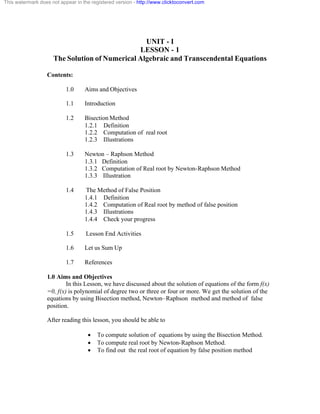
1.0 Aims and Objectives 
In this Lesson, we have discussed about the solution of equations of the form f(x) 
=0, f(x) is polynomial of degree two or three or four or more. We get the solution of the 
equations by using Bisection method, Newton–Raphson method and method of false 
position. 
After reading this lesson, you should be able to 
· To compute solution of equations by using the Bisection Method. 
· To compute real root by Newton-Raphson Method. 
· To find out the real root of equation by false position method
This watermark does not appear in the registered version - http://www.clicktoconvert.com 
1.1 Introduction 
The solution of the equation of the form f(x) = 0 occurs in the field of science, 
engineering and other applications. If f(x) is a polynomial of degree two or more , 
we have formulae to find solution. But, if f(x) is a transcendental function, we do 
not have formulae to obtain solutions. When such type of equations are there, we 
have some methods like Bisection method, Newton-Raphson Method and The 
method of false position. Those methods are solved by using a theorem in theory 
of equations, i.e., If f(x) is continuous in the interval (a,b) and if f(a) and f(b) are 
of opposite signs, then the equation f(x) = 0 will have atleast one real root 
between a and b. 
1.2 Bisection Method 
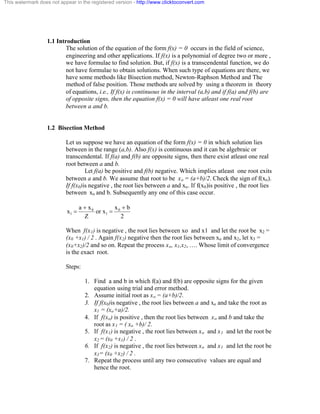
Let us suppose we have an equation of the form f(x) = 0 in which solution lies 
between in the range (a,b). Also f(x) is continuous and it can be algebraic or 
transcendental. If f(a) and f(b) are opposite signs, then there exist atleast one real 
root between a and b. 
Let f(a) be positive and f(b) negative. Which implies atleast one root exits 
between a and b. We assume that root to be xo = (a+b)/2. Check the sign of f(xo). 
If f(x0)is negative , the root lies between a and xo. If f(x0)is positive , the root lies 
between xo and b. Subsequently any one of this case occur. 
x a x 0 
or x x b 
2 
Z 
1 
0 
1 
+ 
= 
+ 
= 
When f(x1) is negative , the root lies between xo and x1 and let the root be x2 = 
(x0 +x1) / 2 . Again f(x2) negative then the root lies between xo and x2, let x3 = 
(x0+x2)/2 and so on. Repeat the process xo, x1,x2, …. Whose limit of convergence 
is the exact root. 
Steps: 
1. Find a and b in which f(a) and f(b) are opposite signs for the given 
equation using trial and error method. 
2. Assume initial root as xo = (a+b)/2. 
3. If f(x0)is negative , the root lies between a and xo and take the root as 
x1 = (xo+a)/2. 
4. If f(xo) is positive , then the root lies between xo and b and take the 
root as x1 = ( xo +b)/ 2. 
5. If f(x1) is negative , the root lies between xo and x1 and let the root be 
x2 = (x0 +x1) / 2 . 
6. If f(x2) is negative , the root lies between xo and x1 and let the root be 
x3= (x0 +x2) / 2 . 
7. Repeat the process until any two consecutive values are equal and 
hence the root.
This watermark does not appear in the registered version - http://www.clicktoconvert.com 
Illustrations: 
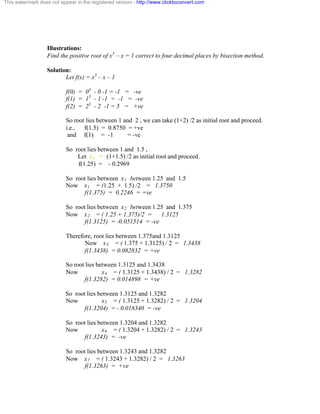
Find the positive root of x3 – x = 1 correct to four decimal places by bisection method. 
Solution: 
Let f(x) = x3 – x – 1 
f(0) = 03 - 0 -1 = -1 = -ve 
f(1) = 13 - 1 -1 = -1 = -ve 
f(2) = 23 - 2 -1 = 5 = +ve 
So root lies between 1 and 2 , we can take (1+2) /2 as initial root and proceed. 
i.e., f(1.5) = 0.8750 = +ve 
and f(1) = -1 = -ve 
So root lies between 1 and 1.5 , 
Let xo = (1+1.5) /2 as initial root and proceed. 
f(1.25) = - 0.2969 
So root lies between x1 between 1.25 and 1.5 
Now x1 = (1.25 + 1.5) /2 = 1.3750 
f(1.375) = 0.2246 = +ve 
So root lies between x2 between 1.25 and 1.375 
Now x2 = ( 1.25 + 1.375)/2 = 1.3125 
f(1.3125) = -0.051514 = -ve 
Therefore, root lies between 1.375and 1.3125 
Now x3 = ( 1.375 + 1.3125) / 2 = 1.3438 
f(1.3438) = 0.082832 = +ve 
So root lies between 1.3125 and 1.3438 
Now x4 = ( 1.3125 + 1.3438) / 2 = 1.3282 
f(1.3282) = 0.014898 = +ve 
So root lies between 1.3125 and 1.3282 
Now x5 = ( 1.3125 + 1.3282) / 2 = 1.3204 
f(1.3204) = - 0.018340 = -ve 
So root lies between 1.3204 and 1.3282 
Now x6 = ( 1.3204 + 1.3282) / 2 = 1.3243 
f(1.3243) = -ve 
So root lies between 1.3243 and 1.3282 
Now x7 = ( 1.3243 + 1.3282) / 2 = 1.3263 
f(1.3263) = +ve
This watermark does not appear in the registered version - http://www.clicktoconvert.com 
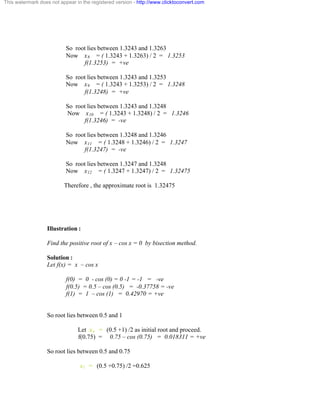
So root lies between 1.3243 and 1.3263 
Now x8 = ( 1.3243 + 1.3263) / 2 = 1.3253 
f(1.3253) = +ve 
So root lies between 1.3243 and 1.3253 
Now x9 = ( 1.3243 + 1.3253) / 2 = 1.3248 
f(1.3248) = +ve 
So root lies between 1.3243 and 1.3248 
Now x10 = ( 1.3243 + 1.3248) / 2 = 1.3246 
f(1.3246) = -ve 
So root lies between 1.3248 and 1.3246 
Now x11 = ( 1.3248 + 1.3246) / 2 = 1.3247 
f(1.3247) = -ve 
So root lies between 1.3247 and 1.3248 
Now x12 = ( 1.3247 + 1.3247) / 2 = 1.32475 
Therefore , the approximate root is 1.32475 
Illustration : 
Find the positive root of x – cos x = 0 by bisection method. 
Solution : 
Let f(x) = x – cos x 
f(0) = 0 - cos (0) = 0 -1 = -1 = -ve 
f(0.5) = 0.5 – cos (0.5) = -0.37758 = -ve 
f(1) = 1 – cos (1) = 0.42970 = +ve 
So root lies between 0.5 and 1 
Let xo = (0.5 +1) /2 as initial root and proceed. 
f(0.75) = 0.75 – cos (0.75) = 0.018311 = +ve 
So root lies between 0.5 and 0.75 
x1 = (0.5 +0.75) /2 =0.625
This watermark does not appear in the registered version - http://www.clicktoconvert.com 
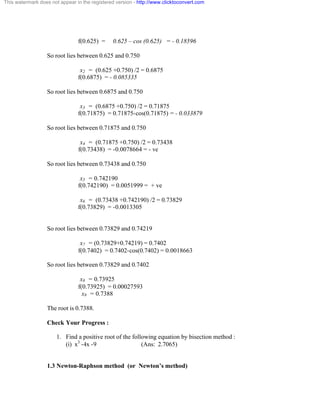
f(0.625) = 0.625 – cos (0.625) = - 0.18596 
So root lies between 0.625 and 0.750 
x2 = (0.625 +0.750) /2 = 0.6875 
f(0.6875) = - 0.085335 
So root lies between 0.6875 and 0.750 
x3 = (0.6875 +0.750) /2 = 0.71875 
f(0.71875) = 0.71875-cos(0.71875) = - 0.033879 
So root lies between 0.71875 and 0.750 
x4 = (0.71875 +0.750) /2 = 0.73438 
f(0.73438) = -0.0078664 = - ve 
So root lies between 0.73438 and 0.750 
x5 = 0.742190 
f(0.742190) = 0.0051999 = + ve 
x6 = (0.73438 +0.742190) /2 = 0.73829 
f(0.73829) = -0.0013305 
So root lies between 0.73829 and 0.74219 
x7 = (0.73829+0.74219) = 0.7402 
f(0.7402) = 0.7402-cos(0.7402) = 0.0018663 
So root lies between 0.73829 and 0.7402 
x8 = 0.73925 
f(0.73925) = 0.00027593 
x9 = 0.7388 
The root is 0.7388. 
Check Your Progress : 
1. Find a positive root of the following equation by bisection method : 
(i) x3 -4x -9 (Ans: 2.7065) 
1.3 Newton-Raphson method (or Newton’s method)
This watermark does not appear in the registered version - http://www.clicktoconvert.com 
Let us suppose we have an equation of the form f(x) = 0 in which solution is lies 
between in the range (a,b). Also f(x) is continuous and it can be algebraic or 
transcendental. If f(a) and f(b) are opposite signs, then there exist atleast one real 
root between a and b. 
Let f(a) be positive and f(b) negative. Which implies atleast one root exits 
between a and b. We assume that root to be either a or b, in which the value of 
f(a) or f(b) is very close to zero. That number is assumed to be initial root.. 
Then we iterate the process by using the following formula until the value is 
converges. 
f(Xn) 
Xn+1 = Xn | | | | | | | | 
f’(Xn) 
Steps: 
1. Find a and b in which f(a) and f(b) are opposite signs for the given 
equation using trial and error method. 
2. Assume initial root as Xo = a i.e., if f(a)is very close to zero or Xo = b 
if f(a)is very close to zero 
3. Find X1 by using the formula 
f(Xo) 
X1 = Xo | | | | | | | | 
f’(Xo) 
4. Find X2 by using the following formula 
f(X1) 
X2 = X1 | | | | | | | | 
f’(X1) 
5. Find X3,X4, …Xn until any two successive values are equal 
Illustration 1: 
Find the positive root of f(x) = 2x3 - 3x-6 =0 by Newton – Raphson method correct to 
five decimal places. 
Solution: 
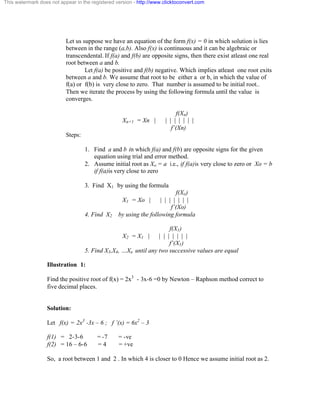
Let f(x) = 2x3 -3x – 6 ; f ’(x) = 6x2 – 3 
f(1) = 2-3-6 = -7 = -ve 
f(2) = 16 – 6-6 = 4 = +ve 
So, a root between 1 and 2 . In which 4 is closer to 0 Hence we assume initial root as 2.
This watermark does not appear in the registered version - http://www.clicktoconvert.com 
Consider x0 =2 
So X1 = X0 – f(X0)/f’(X0) 
= X0 - ((2X0 
3 
- 3X0 - 6) / 6á0 -3) = (4X0 
3 +6)/(6X0 
2-3) 
Xi+1 = (4Xi 
3 + 6)/(6Xi 
2-3) 
X1 = (4(2)2+6)/(6(2)2- 3) = 38/21 = 1.809524 
X2 = (4(1.809524)3+6)/(6(1.809524)2- 3) = 29.700256/16.646263 = 1.784200 
X3 = (4(1.784200)3+6)/(6(1.784200)2- 3) = 28.719072/16.100218 = 1.783769 
X4 = (4(1.783769)3+6)/(6(1.783769)2- 3) = 28.702612/16.090991 = 1.783769 
Since X3 and X4 are equal, hence root is 1.783769 
Illustrations 2: 
Using Newton’s method, find the root between 0 and 1 of x3 = 6x – 4 correct to 5 
decimal places. 
Solution : 
Let f(x) = x3 -6x+4; f(0) = 4 = +ve; f(1) = -1 = -ve 
So a root lies between 0 and 1 
f(1) is nearer to 0. Therefore we take initial root as X0 = 1 
f’(x) = 3x2- 6 
= x – f(x) 
f’(x) 
= x - (3x3 -6x+4)/(3x2-6) 
= (2x3 -4)/(3x2 -6) 
X1 = (2X0 
3 – 4 )/(3X0 
2-6) = (2-4)/(3-6) = 2/3 = 0.66666
This watermark does not appear in the registered version - http://www.clicktoconvert.com 
X2 = (2(2/3) 
3 – 4 )/(3(2/3) 
2-6) = 0.73016 
X3 = (2(0.73015873) 
3 – 4 )/(3(0.73015873) 
2-6) 
= (3.22145837/ 4.40060469) 
= 0.73205 
X4 = (2(0.73204903) 
3 – 4 )/(3(0.73204903) 
2-6) 
= (3.21539602/ 4.439231265) 
= 0.73205 
The root is 0.73205 correct to 5 decimal places. 
Check Your Progress : 
Solve the following by using Newton – Raphson Method : 
x3 -x -1 (Ans :1.3247 ) 
1.4 Method of False Position ( or Regula Falsi Method ) 
Consider the equation f(x) = 0 and f(a) and f(b) are of opposite signs. Also let a< b. 
The graph y = f(x) will Meet the x-axis at some point between A(a, f(a)) and 
B (b,f(b)). The equation of the chord joining the two points A(a, f(a)) and 
B (b,f(b)) is 
y – f(a) f(a) - f(b) 
||||| = | | | | | | | 
x - a a - b 
The x- Coordinate of the point of intersection of this chord with the x-axis gives an 
approximate value for the of f(x) = 0. Taking y = 0 in the chord equation, we get 
– f(a) f(a) - f(b) 
||||| = | | | | | | | 
x - a a - b 
x[f(a) - f(b)] - a f(a) + a f(b) = -a f(a) + b f(b) 
x[f(a) - f(b)] = b f(a) - a f(b) 
This x1 gives an approximate value of the root f(x) = 0. (a < x1 < b) 
Now f(x1) and f(a)are of opposite signs or f(x1) and f(b) are opposite signs. 
If f(x1 ), f(a) <0 . then x2 lies between x1 and a.
This watermark does not appear in the registered version - http://www.clicktoconvert.com 
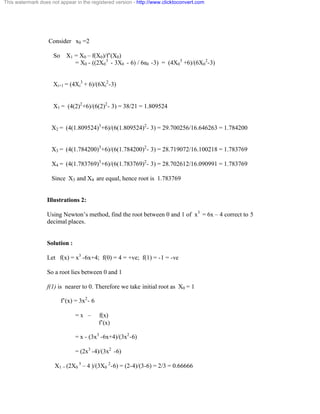
a f(x1) – x1 f(b) 
Therefore x2 = | | | | | | | | 
f(x1) - f(a) 
This process of calculation of ( x3, x4, x5, ….) is continued till any two successive 
values are equal and subsequently we get the solution of the given equation. 
Steps: 
1. Find a and b in which f(a) and f(b) are opposite signs for the given equation 
using trial and error method. 
2. Therefore root lies between a and b if f(a)is very close to zero select and 
compute x1 by using the following formula: 
a f(b) - b f(a) 
x1 = | | | | | | | | 
f(b) - f(a) 
3. If f(x1 ), f(a) <0 . then root lies between x1 and a. Compute x2 by using the 
following formula: 
a f(x1) – x1 f(b) 
x2 = | | | | | | | | 
f(x1) - f(a) 
4. Calculate the values of ( x3, x4, x5, ….) by using the above formula until any 
two successive values are equal and subsequently we get the solution of the given 
equation. 
Illustrations 1: 
Solve for a positive root of x3 -4x+1=0 by and Regula Falsi method 
Solution : 
Let f(x) = x3-4x+1 = 0 
f(0) = 03-4 (0)+1 = 1 = +ve 
f(1) = 13-4(1)+1 = -2 = -ve 
So a root lies between 0 and 1 
We shall find the root that lies between 0 and 1. 
Here a=0, b=1 
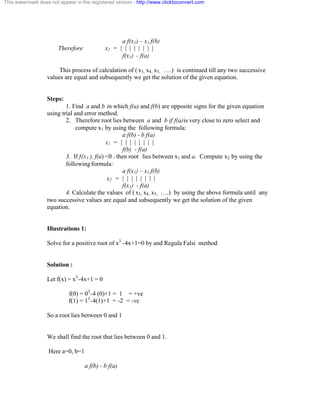
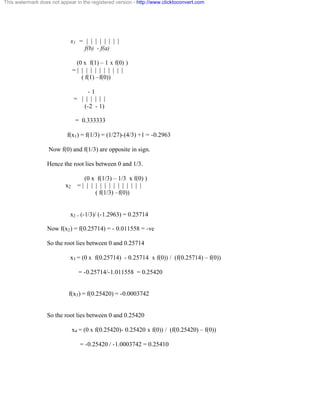
a f(b) - b f(a)
This watermark does not appear in the registered version - http://www.clicktoconvert.com 
x1 = | | | | | | | | 
f(b) - f(a) 
(0 x f(1) – 1 x f(0) ) 
= | | | | | | | | | | | 
( f(1) –f(0)) 
- 1 
= | | | | | | 
(-2 - 1) 
= 0.333333 
f(x1) = f(1/3) = (1/27)-(4/3) +1 = -0.2963 
Now f(0) and f(1/3) are opposite in sign. 
Hence the root lies between 0 and 1/3. 
(0 x f(1/3) – 1/3 x f(0) ) 
x2 = | | | | | | | | | | | | | | 
( f(1/3) –f(0)) 
x2 = (-1/3)/ (-1.2963) = 0.25714 
Now f(x2) = f(0.25714) = - 0.011558 = -ve 
So the root lies between 0 and 0.25714 
x3 = (0 x f(0.25714) - 0.25714 x f(0)) / (f(0.25714) – f(0)) 
= -0.25714/-1.011558 = 0.25420 
f(x3) = f(0.25420) = -0.0003742 
So the root lies between 0 and 0.25420 
x4 = (0 x f(0.25420)- 0.25420 x f(0)) / (f(0.25420) – f(0)) 
= -0.25420 / -1.0003742 = 0.25410
This watermark does not appear in the registered version - http://www.clicktoconvert.com 
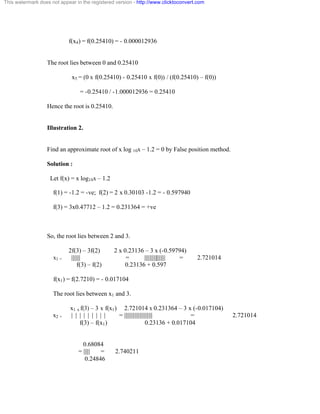
f(x4) = f(0.25410) = - 0.000012936 
The root lies between 0 and 0.25410 
x5 = (0 x f(0.25410) - 0.25410 x f(0)) / (f(0.25410) – f(0)) 
= -0.25410 / -1.000012936 = 0.25410 
Hence the root is 0.25410. 
Illustration 2. 
Find an approximate root of x log 10x – 1.2 = 0 by False position method. 
Solution : 
Let f(x) = x log10x – 1.2 
f(1) = -1.2 = -ve; f(2) = 2 x 0.30103 -1.2 = - 0.597940 
f(3) = 3x0.47712 – 1.2 = 0.231364 = +ve 
So, the root lies between 2 and 3. 
2f(3) – 3f(2) 2 x 0.23136 – 3 x (-0.59794) 
x1 = ||||||| = ||||||||||||||||| = 2.721014 
f(3) – f(2) 0.23136 + 0.597 
f(x1) = f(2.7210) = - 0.017104 
The root lies between x1 and 3. 
x1 x f(3) – 3 x f(x1) 2.721014 x 0.231364 – 3 x (-0.017104) 
x2 = | | | | | | | | | = |||||||||||||||||||||| = 2.721014 
f(3) – f(x1) 0.23136 + 0.017104 
0.68084 
= ||||| = 2.740211 
0.24846
This watermark does not appear in the registered version - http://www.clicktoconvert.com 
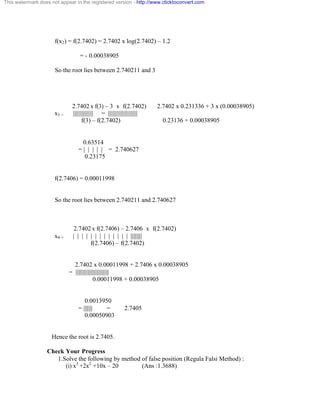
f(x2) = f(2.7402) = 2.7402 x log(2.7402) – 1.2 
= - 0.00038905 
So the root lies between 2.740211 and 3 
2.7402 x f(3) – 3 x f(2.7402) 2.7402 x 0.231336 + 3 x (0.00038905) 
x3 = ||||||||||||||| = |||||||||||||||||||||| 
f(3) – f(2.7402) 0.23136 + 0.00038905 
0.63514 
= | | | | | = 2.740627 
0.23175 
f(2.7406) = 0.00011998 
So the root lies between 2.740211 and 2.740627 
2.7402 x f(2.7406) – 2.7406 x f(2.7402) 
x4 = | | | | | | | | | | | | | ||||||||| 
f(2.7406) – f(2.7402) 
2.7402 x 0.00011998 + 2.7406 x 0.00038905 
= |||||||||||||||||||||||||| 
0.00011998 + 0.00038905 
0.0013950 
= ||||||| = 2.7405 
0.00050903 
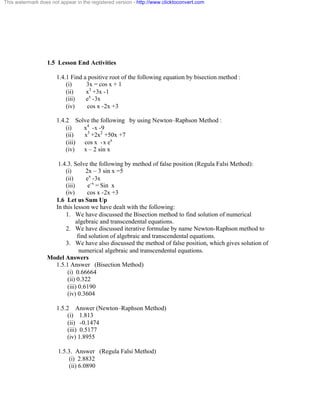
Hence the root is 2.7405. 
Check Your Progress 
1.Solve the following by method of false position (Regula Falsi Method) : 
(i) x3 +2x2 +10x – 20 (Ans :1.3688)
This watermark does not appear in the registered version - http://www.clicktoconvert.com 
1.5 Lesson End Activities 
1.4.1 Find a positive root of the following equation by bisection method : 
(i) 3x = cos x + 1 
(ii) x3 +3x -1 
(iii) ex -3x 
(iv) cos x -2x +3 
1.4.2 Solve the following by using Newton–Raphson Method : 
(i) x4 -x -9 
(ii) x3 +2x2 +50x +7 
(iii) cos x -x ex 
(iv) x – 2 sin x 
1.4.3. Solve the following by method of false position (Regula Falsi Method): 
(i) 2x – 3 sin x =5 
(ii) ex -3x 
(iii) e-x = Sin x 
(iv) cos x -2x +3 
1.6 Let us Sum Up 
In this lesson we have dealt with the following: 
1. We have discussed the Bisection method to find solution of numerical 
algebraic and transcendental equations. 
2. We have discussed iterative formulae by name Newton-Raphson method to 
find solution of algebraic and transcendental equations. 
3. We have also discussed the method of false position, which gives solution of 
numerical algebraic and transcendental equations. 
Model Answers 
1.5.1 Answer (Bisection Method) 
(i) 0.66664 
(ii) 0.322 
(iii) 0.6190 
(iv) 0.3604 
1.5.2 Answer (Newton–Raphson Method) 
(i) 1.813 
(ii) -0.1474 
(iii) 0.5177 
(iv) 1.8955 
1.5.3. Answer (Regula Falsi Method) 
(i) 2.8832 
(ii) 6.0890
This watermark does not appear in the registered version - http://www.clicktoconvert.com 
(iii) 0.5885 
(iv) 1.5236 
1.7 Reference: 
Numerical Methods – P.Kandasamy, K.Thilagavathi, K.Gunavathi., S.Chand &Company 
Ltd., Revised Edition 2005 . 
Numerical Methods – A. Singaravelu, Meenakshi Publication, Arupakkam – Po, 609 111. 
Numerical Methods – E. Balagurusamy, Tamil Nadu, Tata McGraw Hill.
This watermark does not appear in the registered version - http://www.clicktoconvert.com 
LESSON - 2 
The Solution of Simultaneous Linear Algebraic Equation - Direct Methods 
Contents: 
2.0 Aims and Objectives 
2.1 Introduction 
2.2 Gauss Elimination Method 
2.2.1 Introduction 
2.2.2 Gauss Elimination Method for System of equation 
2.2.3 Illustrations 
2.3 Gauss-Jordon Method 
2.3.1 Introduction 
2.3.2 Gauss-Jordon Method for System of equation 
2.3.3 Illustrations 
2.4 Lesson End Activities 
2.5 Let us Sum Up 
2.6 References 
2.0 Aims and Objectives 
In this Lesson, we have discussed about the solving of simultaneous linear 
algebraic equations , which occurs in the field of science and engineering . Early studies 
of solving the equations are tedious. With help computer we solve by using numerical 
methods. These numerical methods are of two types namely Gauss Elimination and 
Gauss-Jordon method 
After reading this lesson, you should be able 
· To Solve the system of equations by using the Gauss Elimination 
method 
· To Solve the system of equations by using the Gauss-Jordon method 
2.1 Introduction 
Simultaneous linear algebraic equations occur in various fields of science and 
engineering. We solve such type of equation by Cramer’s rule. These methods are 
time consuming and tedious. To solve such equations, we go to numerical 
methods. The numerical methods are of two types name (i) direct (ii) iterative. 
Now, we will study these methods and detailed below : 
2.2 Gauss Elimination Method 
This is direct method based on number of unknowns, by eliminating the same by 
combining the equations to a triangular form. To illustrate the method consider 
the following system equations 
Consider the n linear equations in n unknowns,
This watermark does not appear in the registered version - http://www.clicktoconvert.com 
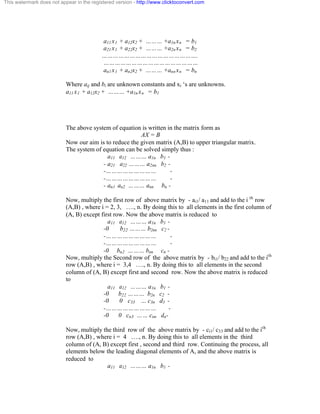
a11 x1 + a12x2 + ……… +a1n xn = b1 
a21 x1 + a22x2 + ……… +a2n xn = b2 
……………………………………………. 
…………………………………………… 
an1 x1 + an2x2 + ……… +ann xn = bn 
Where aij and bi are unknown constants and xi ‘s are unknowns. 
a11 x1 + a12x2 + ……… +a1n xn = b1 
The above system of equation is written in the matrix form as 
AX = B 
Now our aim is to reduce the given matrix (A,B) to upper triangular matrix. 
The system of equation can be solved simply thus : 
a11 a12 ……… a1n b1 - 
- a21 a22 ……… a2nn b2 - 
-……………………… - 
-……………………… - 
- an1 an2 ……… ann bn - 
Now, multiply the first row of above matrix by - ai1/ a11 and add to the i th row 
(A,B) , where i = 2, 3, …., n. By doing this to all elements in the first column of 
(A, B) except first row. Now the above matrix is reduced to 
a11 a12 ……… a1n b1 - 
-0 b22 ……… b2nn c2 - 
-……………………… - 
-……………………… - 
-0 bn2 ……… bnn cn - 
Now, multiply the Second row of the above matrix by - bi1/ b22 and add to the ith 
row (A,B) , where i = 3,4 …., n. By doing this to all elements in the second 
column of (A, B) except first and second row. Now the above matrix is reduced 
to 
a11 a12 ……… a1n b1 - 
-0 b22 ……… b2n c2 - 
-0 0 c33 … c3n d3 - 
-……………………… - 
-0 0 cn3 …… cnn dn- 
Now, multiply the third row of the above matrix by - ci1/ c33 and add to the ith 
row (A,B) , where i = 4 …., n. By doing this to all elements in the third 
column of (A, B) except first , second and third row. Continuing the process, all 
elements below the leading diagonal elements of A, and the above matrix is 
reduced to 
a11 a12 ……… a1n b1 -
This watermark does not appear in the registered version - http://www.clicktoconvert.com 
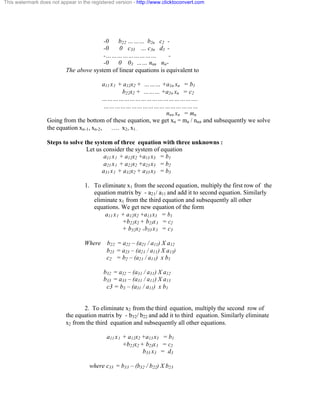
-0 b22 ……… b2n c2 - 
-0 0 c33 … c3n d3 - 
-……………………… - 
-0 0 03 …… nnn nn- 
The above system of linear equations is equivalent to 
a11 x1 + a12x2 + ……… +a1n xn = b1 
b22x2 + ……… +a2n xn = c2 
……………………………………………. 
…………………………………………… 
nnn xn = mn 
Going from the bottom of these equation, we get xn = mn / nnn and subsequently we solve 
the equation xn-1, xn-2, …. x2, x1. 
Steps to solve the system of three equation with three unknowns : 
Let us consider the system of equation 
a11 x1 + a12x2 +a13 x3 = b1 
a21 x1 + a22x2 +a23 x3 = b2 
a31 x1 + a32x2 + a33 x3 = b3 
1. To eliminate x1 from the second equation, multiply the first row of the 
equation matrix by - a21/ a11 and add it to second equation. Similarly 
eliminate x1 from the third equation and subsequently all other 
equations. We get new equation of the form 
a11 x1 + a12x2 +a13 x3 = b1 
+b22x2 + b23x3 = c2 
+ b32x2 +b33 x3 = c3 
Where b22 = a22 – (a21 / a11) X a12 
b23 = a23 – (a21 / a11) X a13) 
c2 = b2 – (a21 / a11) x b1 
b32 = a32 – (a31 / a31) X a12 
b33 = a33 – (a31 / a11) X a13 
c3 = b3 – (a31 / a11) x b1 
2. To eliminate x2 from the third equation, multiply the second row of 
the equation matrix by - b32/ b22 and add it to third equation. Similarly eliminate 
x2 from the third equation and subsequently all other equations. 
a11 x1 + a12x2 +a13 x3 = b1 
+b22x2 + b23x3 = c2 
b33 x3 = d3 
where c33 = b33 – (b32 / b22) X b23
This watermark does not appear in the registered version - http://www.clicktoconvert.com 
d3 =c3 – (b32 / b22) x c2 
3. From the above reduced system of equation substitute the values x3 , x2 
and x1 by backward substitution we get the solution of the given equations. 
Illustration 1 : 
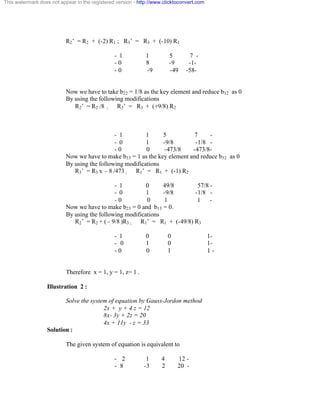
Solve the system of equation by Gauss elimination method 
x+ 2y + z = 3 
2x+ 3y + 3z = 10 
3x - y + 2z = 13 
Solution : 
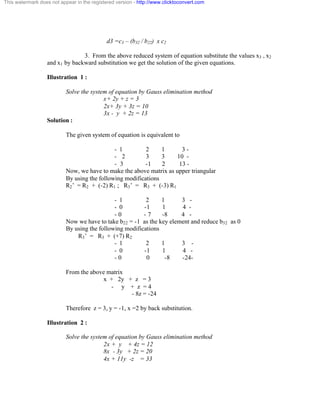
The given system of equation is equivalent to 
- 1 2 1 3 - 
- 2 3 3 10 - 
- 3 -1 2 13 - 
Now, we have to make the above matrix as upper triangular 
By using the following modifications 
R2’ = R2 + (-2) R1 ; R3’ = R3 + (-3) R1 
- 1 2 1 3 - 
- 0 -1 1 4 - 
- 0 - 7 -8 4 - 
Now we have to take b22 = -1 as the key element and reduce b32 as 0 
By using the following modifications 
R3’ = R3 + (+7) R2 
- 1 2 1 3 - 
- 0 -1 1 4 - 
- 0 0 -8 -24- 
From the above matrix 
x + 2y + z = 3 
- y + z = 4 
- 8z = -24 
Therefore z = 3, y = -1, x =2 by back substitution. 
Illustration 2 : 
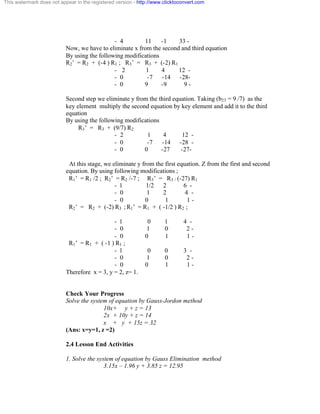
Solve the system of equation by Gauss elimination method 
2x + y + 4z = 12 
8x - 3y + 2z = 20 
4x + 11y -z = 33
This watermark does not appear in the registered version - http://www.clicktoconvert.com 
Solution : 
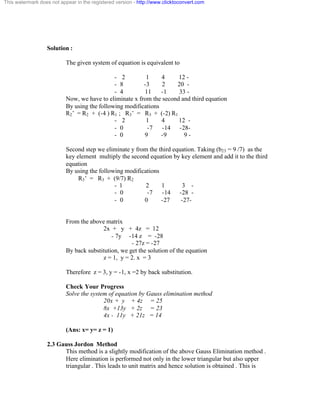
The given system of equation is equivalent to 
- 2 1 4 12 - 
- 8 -3 2 20 - 
- 4 11 -1 33 - 
Now, we have to eliminate x from the second and third equation 
By using the following modifications 
R2’ = R2 + (-4 ) R1 ; R3’ = R3 + (-2) R1 
- 2 1 4 12 - 
- 0 -7 -14 -28- 
- 0 9 -9 9 - 
Second step we eliminate y from the third equation. Taking (b23 = 9 /7) as the 
key element multiply the second equation by key element and add it to the third 
equation 
By using the following modifications 
R3’ = R3 + (9/7) R2 
- 1 2 1 3 - 
- 0 -7 -14 -28 - 
- 0 0 -27 -27 - 
From the above matrix 
2x + y + 4z = 12 
- 7y -14 z = -28 
- 27z = -27 
By back substitution, we get the solution of the equation 
z = 1, y = 2. x = 3 
Therefore z = 3, y = -1, x =2 by back substitution. 
Check Your Progress 
Solve the system of equation by Gauss elimination method 
20x + y + 4z = 25 
8x +13y + 2z = 23 
4x - 11y + 21z = 14 
(Ans: x= y= z = 1) 
2.3 Gauss Jordon Method 
This method is a slightly modification of the above Gauss Elimination method . 
Here elimination is performed not only in the lower triangular but also upper 
triangular . This leads to unit matrix and hence solution is obtained . This is
This watermark does not appear in the registered version - http://www.clicktoconvert.com 
Jordon’s modification of the Gauss elimination and hence the name is Gauss- 
Jordon Method. 
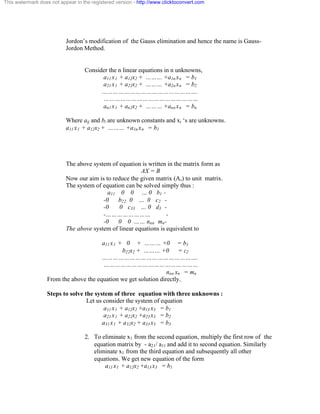
Consider the n linear equations in n unknowns, 
a11 x1 + a12x2 + ……… +a1n xn = b1 
a21 x1 + a22x2 + ……… +a2n xn = b2 
……………………………………………. 
…………………………………………… 
an1 x1 + an2x2 + ……… +ann xn = bn 
Where aij and bi are unknown constants and xi ‘s are unknowns. 
a11 x1 + a12x2 + ……… +a1n xn = b1 
The above system of equation is written in the matrix form as 
AX = B 
Now our aim is to reduce the given matrix (A,) to unit matrix. 
The system of equation can be solved simply thus : 
a11 0 0 … 0 b1 - 
-0 b22 0 … 0 c2 - 
-0 0 c33 … 0 d3 - 
-…………………… - 
-0 0 0 …… nnn mn- 
The above system of linear equations is equivalent to 
a11 x1 + 0 + ……… +0 = b1 
b22x2 + ……… +0 = c2 
……………………………………………. 
…………………………………………… 
nnn xn = mn 
From the above the equation we get solution directly.. 
Steps to solve the system of three equation with three unknowns : 
Let us consider the system of equation 
a11 x1 + a12x2 +a13 x3 = b1 
a21 x1 + a22x2 +a23 x3 = b2 
a31 x1 + a32x2 + a33 x3 = b3 
2. To eliminate x1 from the second equation, multiply the first row of the 
equation matrix by - a21/ a11 and add it to second equation. Similarly 
eliminate x1 from the third equation and subsequently all other 
equations. We get new equation of the form 
a11 x1 + a12x2 +a13 x3 = b1
This watermark does not appear in the registered version - http://www.clicktoconvert.com 
+b22x2 + b23x3 = c2 
+ b32x2 +b33 x3 = c3 
Where b22 = a22 – (a21 / a11) X a12 
b23 = a23 – (a21 / a11) X a13) 
c2 = b2 – (a21 / a11) x b1 
b32 = a32 – (a31 / a31) X a12 
b33 = a33 – (a31 / a11) X a13 
c3 = b3 – (a31 / a11) x b1 
2. In this method, we eliminate x2 from the first and third equation, 
Multiply the second row of the equation matrix by - b32/ b22 and add it to third 
equation. Similarly eliminate x2 from the first equation. 
a11 x1 + 0 +a13 x3 = b1 
+b22x2 + b23x3 = c2 
b33 x3 = d3 
where c33 = b33 – (b32 / b22) X b23 
d3 =c3 – (b32 / b22) x c2 
b13 = a13 – a12 / b22 x b23 
 b’1 = b1 – a12 / b22 x c2 
Similarly eliminate x3 from first and second equation 
3. From the above reduced system of equation the values x1 , x2 and x3 are 
obtained. 
Illustration 1 : 
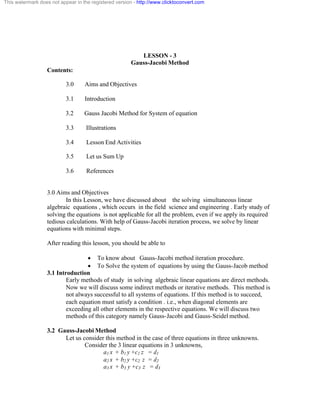
Solve the system of equation by Gauss-Jordon method 
10x+ y + z = 12 
2x + 10y + z = 10 
x + y + 5z = 13 
Solution : 
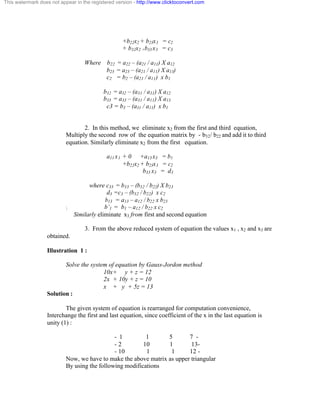
The given system of equation is rearranged for computation convenience, 
Interchange the first and last equation, since coefficient of the x in the last equation is 
unity (1) : 
- 1 1 5 7 - 
- 2 10 1 13- 
- 10 1 1 12 - 
Now, we have to make the above matrix as upper triangular 
By using the following modifications
This watermark does not appear in the registered version - http://www.clicktoconvert.com 
R2’ = R2 + (-2) R1 ; R3’ = R3 + (-10) R1 
- 1 1 5 7 - 
- 0 8 -9 -1 - 
- 0 -9 -49 -58 - 
Now we have to take b22 = 1/8 as the key element and reduce b32 as 0 
By using the following modifications 
R2’ = R2 /8 ; R3’ = R3 + (+9/8) R2 
- 1 1 5 7 - 
- 0 1 -9/8 -1/8 - 
- 0 0 -473/8 -473/8- 
Now we have to make b33 = 1 as the key element and reduce b32 as 0 
By using the following modifications 
R3’ = R3 x - 8 /473 ; R1’ = R1 + (-1) R2 
- 1 0 49/8 57/8 - 
- 0 1 -9/8 -1/8 - 
- 0 0 1 1 - 
Now we have to make b23 = 0 and b13 = 0. 
By using the following modifications 
R2’ = R2 + ( - 9/8 )R3 ; R1’ = R1 + (-49/8) R3 
- 1 0 0 1- 
- 0 1 0 1- 
- 0 0 1 1 - 
Therefore x = 1, y = 1, z= 1 . 
Illustration 2 : 
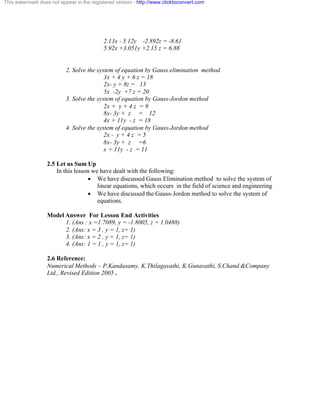
Solve the system of equation by Gauss-Jordon method 
2x + y + 4 z = 12 
8x- 3y + 2z = 20 
4x + 11y - z = 33 
Solution : 
The given system of equation is equivalent to 
- 2 1 4 12 - 
- 8 -3 2 20 -
This watermark does not appear in the registered version - http://www.clicktoconvert.com 
- 4 11 -1 33 - 
Now, we have to eliminate x from the second and third equation 
By using the following modifications 
R2’ = R2 + (-4 ) R1 ; R3’ = R3 + (-2) R1 
- 2 1 4 12 - 
- 0 -7 -14 -28- 
- 0 9 -9 9 - 
Second step we eliminate y from the third equation. Taking (b23 = 9 /7) as the 
key element multiply the second equation by key element and add it to the third 
equation 
By using the following modifications 
R3’ = R3 + (9/7) R2 
- 2 1 4 12 - 
- 0 -7 -14 -28 - 
- 0 0 -27 -27 - 
At this stage, we eliminate y from the first equation. Z from the first and second 
equation. By using following modifications ; 
R1’ = R1 /2 ; R2’ = R2 /-7 ; R3’ = R3 / (-27) R1 
- 1 1/2 2 6 - 
- 0 1 2 4 - 
- 0 0 1 1 - 
R2’ = R2 + (-2) R3 ; R1’ = R1 + ( -1/2 ) R2 ; 
- 1 0 1 4 - 
- 0 1 0 2 - 
- 0 0 1 1 - 
R1’ = R1 + ( -1 ) R1 ; 
- 1 0 0 3 - 
- 0 1 0 2 - 
- 0 0 1 1 - 
Therefore x = 3, y = 2, z= 1. 
Check Your Progress 
Solve the system of equation by Gauss-Jordon method 
10x+ y + z = 13 
2x + 10y + z = 14 
x + y + 15z = 32 
(Ans: x=y=1, z =2) 
2.4 Lesson End Activities 
1. Solve the system of equation by Gauss Elimination method 
3.15x – 1.96 y + 3.85 z = 12.95
This watermark does not appear in the registered version - http://www.clicktoconvert.com 
2.13x - 5.12y -2.892z = -8.61 
5.92x +3.051y +2.15 z = 6.88 
2. Solve the system of equation by Gauss elimination method 
3x + 4 y + 6 z = 18 
2x- y + 8z = 13 
5x -2y +7 z = 20 
3. Solve the system of equation by Gauss-Jordon method 
2x + y + 4 z = 9 
8x- 3y + z = 12 
4x + 11y - z = 18 
4. Solve the system of equation by Gauss-Jordon method 
2x - y + 4 z = 5 
8x- 3y + z =6 
x + 11y - z = 11 
2.5 Let us Sum Up 
In this lesson we have dealt with the following: 
· We have discussed Gauss Elimination method to solve the system of 
linear equations, which occurs in the field of science and engineering 
· We have discussed the Gauss-Jordon method to solve the system of 
equations. 
Model Answer For Lesson End Activities 
1. (Ans : x =1.7089, y = -1.8005, z = 1.0488) 
2. (Ans: x = 3 , y = 1, z= 1) 
3. (Ans: x = 2 , y = 1, z= 1) 
4. (Ans: 1 = 1 , y = 1, z= 1) 
2.6 Reference: 
Numerical Methods – P.Kandasamy, K.Thilagavathi, K.Gunavathi, S.Chand &Company 
Ltd., Revised Edition 2005 .
This watermark does not appear in the registered version - http://www.clicktoconvert.com 
LESSON - 3 
Gauss-Jacobi Method 
Contents: 
3.0 Aims and Objectives 
3.1 Introduction 
3.2 Gauss Jacobi Method for System of equation 
3.3 Illustrations 
3.4 Lesson End Activities 
3.5 Let us Sum Up 
3.6 References 
3.0 Aims and Objectives 
In this Lesson, we have discussed about the solving simultaneous linear 
algebraic equations , which occurs in the field science and engineering . Early study of 
solving the equations is not applicable for all the problem, even if we apply its required 
tedious calculations. With help of Gauss-Jacobi iteration process, we solve by linear 
equations with minimal steps. 
After reading this lesson, you should be able to 
· To know about Gauss-Jacobi method iteration procedure. 
· To Solve the system of equations by using the Gauss-Jacob method 
3.1 Introduction 
Early methods of study in solving algebraic linear equations are direct methods. 
Now we will discuss some indirect methods or iterative methods. This method is 
not always successful to all systems of equations. If this method is to succeed, 
each equation must satisfy a condition . i.e., when diagonal elements are 
exceeding all other elements in the respective equations. We will discuss two 
methods of this category namely Gauss-Jacobi and Gauss-Seidel method. 
3.2 Gauss-Jacobi Method 
Let us consider this method in the case of three equations in three unknowns. 
Consider the 3 linear equations in 3 unknowns, 
a1 x + b1 y +c1 z = d1 
a2 x + b2 y +c2 z = d2 
a3 x + b3 y +c3 z = d3
This watermark does not appear in the registered version - http://www.clicktoconvert.com 
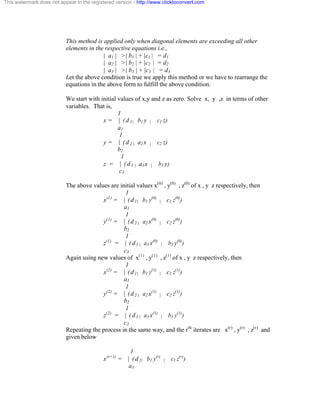
This method is applied only when diagonal elements are exceeding all other 
elements in the respective equations i.e., 
| a1 | >| b1 | + |c1 | = d1 
| a2 | >| b2 | + |c2 | = d2 
| a3 | >| b3 | + |c3 | = d3 
Let the above condition is true we apply this method or we have to rearrange the 
equations in the above form to fulfill the above condition. 
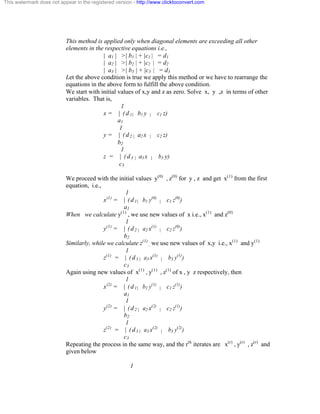
We start with initial values of x,y and z as zero. Solve x, y ,z in terms of other 
variables. That is, 
1 
x = | ( d 1 | b1 y | c1 z) 
a1 
1 
y = | ( d 2 | a2 x | c2 z) 
b2 
1 
z = | ( d 3 | a3 x | b3 y) 
c3 
The above values are initial values x(0) , y(0) , z(0) of x , y z respectively, then 
1 
x(1) = | ( d 1 | b1 y(0) | c1 z(0)) 
a1 
1 
y(1) = | ( d 2 | a2 x(0) | c2 z(0)) 
b2 
1 
z(1) = | ( d 3 | a3 x(0) | b3 y(0)) 
c3 
Again using new values of x(1) , y(1) , z(1) of x , y z respectively, then 
1 
x(2) = | ( d 1 | b1 y(1) | c1 z(1)) 
a1 
1 
y(2) = | ( d 2 | a2 x(1) | c2 z(1)) 
b2 
1 
z(2) = | ( d 3 | a3 x(1) | b3 y(1)) 
c3 
Repeating the process in the same way, and the rth iterates are x(r) , y(r) , z(r) and 
given below 
1 
x(r+1) = | ( d 1 | b1 y(r) | c1 z(r)) 
a1
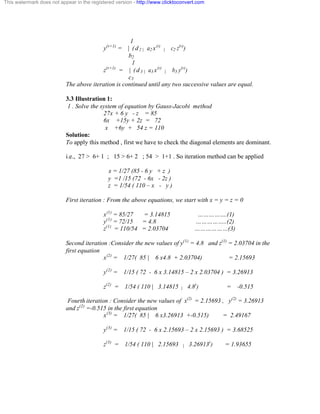
This watermark does not appear in the registered version - http://www.clicktoconvert.com 
1 
y(r+1) = | ( d 2 | a2 x(r) | c2 z(r)) 
b2 
1 
z(r+1) = | ( d 3 | a3 x(r) | b3 y(r)) 
c3 
The above iteration is continued until any two successive values are equal. 
3.3 Illustration 1: 
1 . Solve the system of equation by Gauss-Jacobi method 
27x + 6 y - z = 85 
6x +15y + 2z = 72 
x +6y + 54 z = 110 
Solution: 
To apply this method , first we have to check the diagonal elements are dominant. 
i.e., 27 > 6+ 1 ; 15 > 6+ 2 ; 54 > 1+1 . So iteration method can be applied 
x = 1/27 (85 - 6 y + z ) 
y =1 /15 (72 - 6x - 2z ) 
z = 1/54 ( 110 – x - y ) 
First iteration : From the above equations, we start with x = y = z = 0 
x(1) = 85/27 = 3.14815 …………….(1) 
y(1) = 72/15 = 4.8 ……………..(2) 
z(1) = 110/54 = 2.03704 ………………(3) 
Second iteration :Consider the new values of y(1) = 4.8 and z(1) = 2.03704 in the 
first equation 
x(2) = 1/27( 85 | 6 x4.8 + 2.03704) = 2.15693 
y(2) = 1/15 ( 72 - 6 x 3.14815 – 2 x 2.03704 ) = 3.26913 
z(2) = 1/54 ( 110 | 3.14815 | 4.8)) = -0.515 
Fourth iteration : Consider the new values of x(2) = 2.15693 , y(2) = 3.26913 
and z(2) =-0.515 in the first equation 
x(3) = 1/27( 85 | 6 x3.26913 +-0.515) = 2.49167 
y(3) = 1/15 ( 72 - 6 x 2.15693 – 2 x 2.15693 ) = 3.68525 
z(3) = 1/54 ( 110 | 2.15693 | 3.26913)) = 1.93655
This watermark does not appear in the registered version - http://www.clicktoconvert.com 
Thus, we continue the iteration and result is noted below 
Iteration No. x y z 
4 2.40093 3.54513 1.92265 
5 2.43155 3.58327 1.92692 
6 2.42323 3.57046 1.92565 
7 2.42603 3.57395 1.92604 
8 2.42527 3.57278 1.92593 
9 2.42552 3.57310 1.92596 
10 2.42546 3.57300 1.92595 
From the above table 9 th and 10 th iterations are equal by considering the four 
decimal places. Hence the solution of the equation is 
x = 2.4255 y = 3.5730 z =1.9260. 
Illustration 2 . Solve the system of equation by Gauss-Jacobi method 
10x - 5 y - 2 z = 3 
4x - 10y + 3z = -3 
x +6y + 10 z = 3 
Solution: 
To apply this method , first we have to check the diagonal elements are dominant. 
i.e., 10 > 5+ 2 ; 10 > 4+ 3 ; 10 > 1+6 . So iteration method can be applied 
x = 1/10 (3 + 5 y + 2z ) 
y =1 /10 (3 + 4x + 3z ) 
z = 1/10 ( -3 – x - 6y ) 
First iteration : From the above equations, we start with x = y = z = 0 
x(1) = 3/10 = 0 .3 …………….(1) 
y(1) = 3/10 = 0 .3 ……………..(2) 
z(1) = -3/10 = -0.3 ………………(3) 
Second iteration :Consider the new values of y(1) =0 .3 and z(1) = -0.3 in the first 
equation 
x(2) = 1/10( 3 + 5 x.3 +( -0.3)) = 0.39 
y(2) = 1/10 ( 3 + 4 x0 .3 + 3 x( -0.3) ) = 0.33 
z(2) = 1/10 [ -3 | (0.3) | 6(0 .3) ] = -0.51 
Third iteration : Consider the new values of x(2) = 0.39 , y(2) = 0.33 and z(2) 
=-0.51 in the first equation
This watermark does not appear in the registered version - http://www.clicktoconvert.com 
x(3) = 1/10 [ 3 | 5 x0.33 +(-0.51)] = 0.363 
y(3) = 1/10 ( 3 + 4 x 0.39 + 3 x (-0.51) ) = 0.303 
z(3) = 1/10[ -3 | 0.39 | 6 x (0.33) ] = -0.537 
Thus, we continue the iteration and result is noted below 
Iteration No. X y z 
4 0.3441 0.2841 -0.5181 
5 0.33843 0.2822 -0.50487 
6 0.340126 0.283911 0.503163 
7 0.3413229 0.2851015 -0.5043592 
8 0.34167891 0.2852214 -0.50519319 
9 0.341572062 0.285113607 -0.505300731 
From the above table 8 th and 9 th iterations are equal by considering the 3 
decimal places. Hence the solution of the equation is 
x =0.342 , y = 0.285, z = - 0.505. 
Check Your Progress 
1. Solve the system of equation by Gauss-Jacobi method 
3.15x – 1.96 y + 3.85 z = 12.95 
2.13x - 5.12y -2.892z = -8.61 
5.92x +3.051y +2.15 z = 6.88 
(Ans : x =1.7089, y = -1.8005, z = 1.0488) 
3.4 Lesson End Activities 
Solve the following system of equations by using Gauss-Jacobi Method 
1. 8x -3y + 2z=20 ; 4x +11y – z = 33; 6x +3y +12 z = 35 
2. 28x+4y -z= 32 ; x +3y +10 z = 24; 2x +3y +10 z = 24 
3. 5x -2y +z = -4 ; x + 6y -2z = -1; 3x+y+5z = 13 
4. 8x +y+z = 8 ; 2x+4y + z = 4 ; x +3y + 3z = 5 
3.5 Let us Sum Up 
In this lesson we have dealt with the following: 
· We have discussed Gauss Jacobi method to solve the system of 
linear equations, which occurs in the field of science and 
engineering. This method is an iterative method and it is widely 
applied. 
Model Answer For Lesson End Activities 
1. (Ans: 3.017, 1.986, 0.912) 
2. (Ans: 0.994, 1.507, 1.849) 
3. (Ans:-1.0, .999, 3 )
This watermark does not appear in the registered version - http://www.clicktoconvert.com 
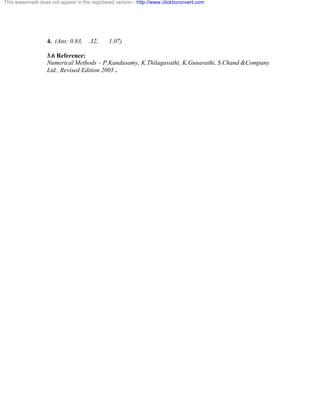
4. (Ans: 0.83, .32, 1.07) 
3.6 Reference: 
Numerical Methods – P.Kandasamy, K.Thilagavathi, K.Gunavathi, S.Chand &Company 
Ltd., Revised Edition 2005 .
This watermark does not appear in the registered version - http://www.clicktoconvert.com 
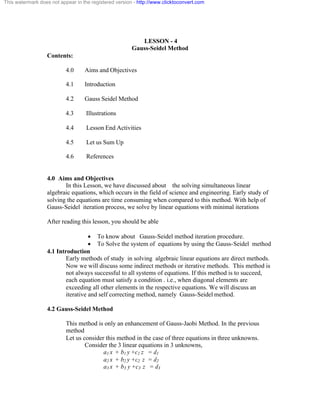
LESSON - 4 
Gauss-Seidel Method 
Contents: 
4.0 Aims and Objectives 
4.1 Introduction 
4.2 Gauss Seidel Method 
4.3 Illustrations 
4.4 Lesson End Activities 
4.5 Let us Sum Up 
4.6 References 
4.0 Aims and Objectives 
In this Lesson, we have discussed about the solving simultaneous linear 
algebraic equations, which occurs in the field of science and engineering. Early study of 
solving the equations are time consuming when compared to this method. With help of 
Gauss-Seidel iteration process, we solve by linear equations with minimal iterations 
After reading this lesson, you should be able 
· To know about Gauss-Seidel method iteration procedure. 
· To Solve the system of equations by using the Gauss-Seidel method 
4.1 Introduction 
Early methods of study in solving algebraic linear equations are direct methods. 
Now we will discuss some indirect methods or iterative methods. This method is 
not always successful to all systems of equations. If this method is to succeed, 
each equation must satisfy a condition . i.e., when diagonal elements are 
exceeding all other elements in the respective equations. We will discuss an 
iterative and self correcting method, namely Gauss-Seidel method. 
4.2 Gauss-Seidel Method 
This method is only an enhancement of Gauss-Jaobi Method. In the previous 
method 
Let us consider this method in the case of three equations in three unknowns. 
Consider the 3 linear equations in 3 unknowns, 
a1 x + b1 y +c1 z = d1 
a2 x + b2 y +c2 z = d2 
a3 x + b3 y +c3 z = d3
This watermark does not appear in the registered version - http://www.clicktoconvert.com 
This method is applied only when diagonal elements are exceeding all other 
elements in the respective equations i.e., 
| a1 | >| b1 | + |c1 | = d1 
| a2 | >| b2 | + |c2 | = d2 
| a3 | >| b3 | + |c3 | = d3 
Let the above condition is true we apply this method or we have to rearrange the 
equations in the above form to fulfill the above condition. 
We start with initial values of x,y and z as zero. Solve x, y ,z in terms of other 
variables. That is, 
1 
x = | ( d 1 | b1 y | c1 z) 
a1 
1 
y = | ( d 2 | a2 x | c2 z) 
b2 
1 
z = | ( d 3 | a3 x | b3 y) 
c3 
We proceed with the initial values y(0) , z(0) for y , z and get x(1) from the first 
equation, i.e., 
1 
x(1) = | ( d 1 | b1 y(0) | c1 z(0)) 
a1 
When we calculate y(1) , we use new values of x i.e., x(1) and z(0) 
1 
y(1) = | ( d 2 | a2 x(1) | c2 z(0)) 
b2 
Similarly, while we calculate z(1) 
, we use new values of x,y i.e., x(1) and y(1) 
1 
z(1) = | ( d 3 | a3 x(1) | b3 y(1)) 
c3 
Again using new values of x(1) , y(1) , z(1) of x , y z respectively, then 
1 
x(2) = | ( d 1 | b1 y(1) | c1 z(1)) 
a1 
1 
y(2) = | ( d 2 | a2 x(2) | c2 z(1)) 
b2 
1 
z(2) = | ( d 3 | a3 x(2) | b3 y(2)) 
c3 
Repeating the process in the same way, and the rth iterates are x(r) , y(r) , z(r) and 
given below 
1
This watermark does not appear in the registered version - http://www.clicktoconvert.com 
x(r+1) = | ( d 1 | b1 y(r) | c1 z(r)) 
a1 
1 
y(r+1) = | ( d 2 | a2 x(r+1) | c2 z(r)) 
b2 
1 
z(r+1) = | ( d 3 | a3 x(r+1) | b3 y(r+1)) 
c3 
The above iteration is continued until any two successive values are equal. 
Note : 1. For all systems of equation, this method will not work 
2.Iteration method is self correcting method. Any error made in computation is corrected 
automatically in subsequent iterations 
3. Iteration is stopped when any two successive iteration values are equal 
4.3 Illustration : 1 . Solve the system of equation by Gauss-Seidel method 
10x - 5 y - 2 z = 3 
4x - 10y + 3z = -3 
x +6y + 10 z = 3 
Solution: 
To apply this method , first we have to check the diagonal elements are dominant. 
ie., 10 > 5+ 2 ; 10 > 4+ 3 ; 10 > 1+6 . So iteration method can be applied 
x = 1/10 (3 + 5 y + 2z ) 
y =1 /10 (3 + 4x + 3z ) 
z = 1/10 ( -3 – x - 6y ) 
First iteration : 
From the above equations, we start with x = y = z = 0 
x(1) = 3/10 = 0 .3 …………….(1) 
New value of x is used for further calculation ie., x = 0.3 
y(1) = 1/10 (3 + 4x 0.3+ 3(0)] = 0 .42 ……………..(2) 
New values of x and y is used for further calculation ie., x = 0.3 and y = 0.42 
z(1) = 1/10 (-3 - 0.3 -6(0.42) = -0.582 ………………(3) 
Second iteration : 
Consider the new values of y(1) =0 .42 and z(1) = -0.582 in the first equation 
x(2) = 1/10( 3 + 5 x 0.42 +( -0.582)) = 0.3936 
y(2) = 1/10 ( 3 + 4 x0 .3936 + 3 x( -0.582) ) = 0.28284 
z(2) = 1/10 [ -3 | (0.3936) | 6(0 .28284) ] = -0.509064
This watermark does not appear in the registered version - http://www.clicktoconvert.com 
Third iteration : Consider the new values of x(2) = 0.3936 , y(2) = 0.28284 and 
z(2) =-0.509064 in the first equation 
x(3) = 1/10 [ 3 | 5 x0.28284 +(-0.509064)] = 0.3396072 
y(3) = 1/10 ( 3 + 4 x 0.3396072 + 3 x (-0.509064 ) = 0.28312368 
z(3) = 1/10[ -3 | 0.3396072 | 6 x (0.283123678) ] = -0.503834928 
Thus, we continue the iteration and result is noted below 
Iteration No. X Y Z 
4 0.34079485 0.28516746 -0.50517996 
5 0.3415547 0.28506792 -0.505196229 
6 0.3414947 0.2850390 -0.5051728 
7 0.3414849 0.28504212 -0.5051737 
The values correct to 3 decimal places are 
x = 0.342, y = 0.285, z = -0.505 
Note : Check the above equations by substituting values of x,y and z 
Illustration 2 : 1 . Solve the system of equation by Gauss-Seidel method 
28x + 4 y - z = 32 
4x +3y + 10 z = 24 
2x +17y + 4z = 35 
Solution: 
To apply this method , first we have to rewrite the equation in such way that to 
fulfill diagonal elements are dominant. 
28x + 4 y - z = 32 
2x +17y + 4z = 35 
4x +3y + 10 z = 24 
ie., 28 > 4+ 1 ; 17 > 2+ 4 ; 10 > 4+3 . So iteration method can be applied 
x = 1/28 (32 - 4 y + z ) 
y =1 /17 (35 -2x -4z ) 
z = 1/10 ( 24 – x - 3y ) 
First iteration : 
From the above equations, we start with y = z = 0, we get 
x(1) = 32/28 = 1.1429 
New value of x is used for further calculation ie., x = 1.1429 
y(1) = 1/17 (35 + 1.1429+ 3(0)] = 1.9244 
New values of x and y is used for further calculation ie., x = 1.1429
This watermark does not appear in the registered version - http://www.clicktoconvert.com 
and y = 1.9244 
z(1) = 1/10 [24 -1.1429 -3(1.9244 ) ] = 1.8084) 
Second iteration : 
Consider the new values of y(1) = 1.9244 and z(1) = 1.8084 
x(2) = 1/28[ 32 – 4 (1.9244) +( 1.8084)] = 0.9325 
y(2) = 1/17 [ 35 - 2 (0 .9325) - 4 ( 1.8084) ] = 1.5236 
z(2) = 1/10 [ 24 | (0.9325) | 3(1.5236) ] = 1.8497 
Third iteration : 
Consider the new values of x(2 ) = 0.9325, y(2) = 1.5236 and z(2) = 1.8497 
x(3) = 1/28[ 32 – 4 (1.5236) +( 1.8497)] = 0.9913 
y(3) = 1/17 [ 35 - 2 (0 .9913) - 4 ( 1.8497) ) = 1.5070 
z(3) = 1/10 [ 24 | (0.9913) | 3(1.5070) ] = 1.8488 
Thus, we continue the iteration and result is noted below 
Iteration No. X y Z 
4 0.9936 1.5069 1.8486 
5 0.9936 1.5069 1.8486 
Therefore x = 0.9936, y = 1.5069, z = 1.8486 
Check Your Progress 
1. Solve the system of equation by Gauss Seidel method 
3.15x – 1.96 y + 3.85 z = 12.95 
2.13x - 5.12y -2.892z = -8.61 
5.92x +3.051y +2.15 z = 6.88 
(Ans : x =1.7089, y = -1.8005, z = 1.0488) 
4.4 Lesson End Activities 
1. 8x -6y +z =13.67; 3x +y -2z =17.59; 2x -6y +9z =29.29 
2. 30x – 2y +3z =75; 2x+ 2y +18z = 30 ; x + 17y -2z =48 
3. y –x + 10z=35.61; x + z + 10y =20.08; y- z +10x =11.19 
4. 10x -2y +z = 12 ; x + 9y -z =10; 2x – y + 11z = 20 
5. 8x – y +z =18; 2x +5y -2z = 3; x+y – 3z = -16 
6. 2x + y + z =4; x + 2y –z = 4; x + y + 2z = 4
This watermark does not appear in the registered version - http://www.clicktoconvert.com 
4.5 Let us Sum Up 
In this lesson we have dealt with the following: 
· We have discussed Gauss-Seidel method to solve the system of 
linear equations, which occurs in the field of science and 
engineering. This method is an iterative method and it is widely 
applied. 
Model Answer For Lesson End Activities 
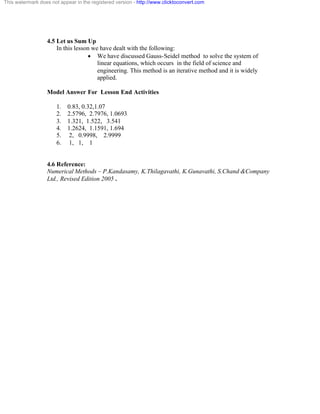
1. 0.83, 0.32,1.07 
2. 2.5796, 2.7976, 1.0693 
3. 1.321, 1.522, 3.541 
4. 1.2624, 1.1591, 1.694 
5. 2, 0.9998, 2.9999 
6. 1, 1, 1 
4.6 Reference: 
Numerical Methods – P.Kandasamy, K.Thilagavathi, K.Gunavathi, S.Chand &Company 
Ltd., Revised Edition 2005 .
This watermark does not appear in the registered version - http://www.clicktoconvert.com 
UNIT-II 
LESSON - 5 
Numerical Differentiation 
Contents : 
5.0 Aims and Objectives 
5.1 Introduction 
5.2 Newton’s forward difference formula 
5.3 Illustrations 
5.4 Lesson end activities 
5.5 Let us Sum Up 
5.6 References 
5.0 Aims and Objectives 
In this Lesson, we have discussed about Newton’s forward difference formula 
for finding derivatives. If the derivative occurs closer to the beginning of the table, we 
use this method. 
After reading this lesson, you should be able 
· To know about construction of the difference table. 
· To find derivatives using Newton’s forward difference formula. 
5.1 Introduction 
Let y=f(x) be a function taking the values y0, y1, y2, yn corresponding to the 
values x0, x1, x2, ……….. xn of the independent variable x. Now we are trying to find the 
derivative value of y = yk for the given x = xk .. If the derivative is required at a point 
nearer to starting value in the table., i.e., If the value occur between xo to x1 or beginning 
of the table, we use Newton’s forward interpolation formula. 
5.2 Newton’s forward difference formula : 
Suppose the following table represents a set of values of x and y. 
x: x0 x1 x2 x3 ……….. xn 
y: y0 y1 y2 y3 ……….. yn
This watermark does not appear in the registered version - http://www.clicktoconvert.com 
From the above values, we want to find the derivative of y = f(x) passing through (n+1) 
points, at a point closer to the starting value x = x0 
Newton’s forward difference interpolation formula is given below 
y(x0 + uh) = yu = y0 + u Äy0 + u (u-1) Ä2y0 + u (u-1)(u-2) Ä3y0 +…….. …….(1) 
2! 3! 
Where y(x) is a polynomial of degree n in x. 
x- x0 
where u = | | | | and 
h 
Äy0 , Ä2y0 , Ä3y0 are obtained from difference table 
Differentiating with respect to x, finally it reduced to the following way 
dy / dx = Dy0 = (1/ h) { Äy0 - (1/2) Ä2y0 + (1/3) Ä3y0 + ….. } 
d2y / dx2 = D2y0 = (1/ h2) { Ä2y0 - Ä3y0 +(11/12) Ä4y0 ….. } 
5.3 Illustration 1. 
Find the first two derivatives of (x)(1/3) at x = 50 given table below : 
x : 50 51 52 53 54 55 56 
y : 3.6840 3.7084 3.7325 3.7563 3.7798 3.8030 3.8259 
Solution : 
Step 1. Write down the formula : 
dy / dx = Dy0 = (1/ h) { Äy0 - (1/2) Ä2y0 + (1/3) Ä3y0 + ….. } 
d2y / dx2 = D2y0 = (1/ h2) { Ä2y0 - Ä3y0 +(11/12) Ä4y0 ….. } 
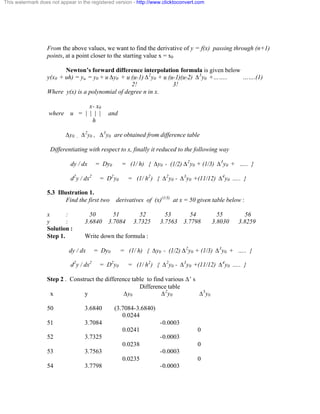
Step 2 . Construct the difference table to find various Ä’ s 
Difference table 
x y Äy0 Ä2y0 Ä3y0 
50 3.6840 (3.7084-3.6840) 
0.0244 
51 3.7084 -0.0003 
0.0241 0 
52 3.7325 -0.0003 
0.0238 0 
53 3.7563 -0.0003 
0.0235 0 
54 3.7798 -0.0003
This watermark does not appear in the registered version - http://www.clicktoconvert.com 
0.0232 0 
55 3.8030 -0.0003 
0.0229 
56 3.8259 
By applying Newton’s forward formula : 
[ dy / dx]x=xo =[ dy / dx]u=o 
= (1/ h) { Äy0 - (1/2) Ä2y0 + (1/3) Ä3y0 + ….. } 
= (1/ 1) [ 0.0244 - (1/2) (-0.0003) + (1/3) 0 ] 
= 0.02455 
[d2y / dx2 ]x=50 = D2y0 = (1/ h2) [ Ä2y0 - Ä3y0 +… ] 
= 1 [ -0.0003] 
= -0.0003 
Illustration 2. The population of a certain town is given below. Find the rate of growth 
of the population in 1931 and 1941 
Year x : 1931 1941 1951 1961 1971 
Population y : 40.62 60.80 79.95 103.56 132.65 
Solution. Construct the difference table 
x y Äy0 Ä2y0 Ä3y0 Ä4y0 
1931 40.62 
20.18 
1941 60.80 -1.03 
19.15 5.49 
1951 79.95 4.46 -4.47 
23.61 1.02 
1961 103.56 5.48 
29.09 
1971 132.65 
By applying Newton’s forward formula : 
To find (i) f’(1931) 
x- x0 1931 - 1931 
where u = | | | | = |||||||| = 0
This watermark does not appear in the registered version - http://www.clicktoconvert.com 
h 10 
[ dy / dx]x=1931 =[ dy / dx]u=o 
= (1/ h) [ Äy0 - (1/2) Ä2y0 + (1/3) Ä3y0 - (1/4) Ä4y0 ] 
= (1/ 10) [ 20.18 - (1/2) (-1.03) + (1/3) (5.49) –(-4.47) ] 
= (1/ 10) [ 20.18 +0515+1.83+1.1175 ] 
= 2.36425 
To find (i) f’(1941) 
x- x0 1941 - 1931 
where u = | | | | = |||||||| = 1 
h 10 
[ dy / dx]x=1941 =[ dy / dx]u=1 
= (1/ h) { Äy0 + [(2u-1)/2] Ä2y0 + [(3u2-6u+2)/6] Ä3y0 +[(4u3 -18u2 +22u- 
6)/24 ] Ä4y0 } 
= (1/ 10) [ 20.18 + (1/2) (-1.03) –(1/6) (5.49) +(1/12)(-4.47) ] 
= (1/ 10) [ 20.18 | 0.515 |0.915|0.3725 ] 
= 1.83775 
Check Your Progress 
4.Find the first two derivatives of t5he function x = 1.5 from the table below 
x 1.5 2.0 2.5 3.0 3.5 4.0 
y 3.375 7.0 13.625 24.0 38.875 59.0 
(Ans : 4.75, 9.0) 
5.4 Lesson End Activities 
1. Find the first and second derivative of the function tabulated below at x = 3 
x : 3.0 3.2 3.4 3.6 3.8 4.0 
f(x) : -14 -10.32 -5.296 -0.256 6.672 14 
2. Find second derivative of y at x = 0.96 from the data 
x : 0.96 0.98 1.00 1.02 1.04 
y : 0.7825 0.7739 0.7651 0.7563 0.7473 
3. Find the value of cos(1.74) from the following table.
This watermark does not appear in the registered version - http://www.clicktoconvert.com 
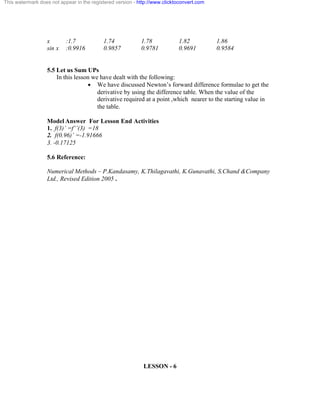
x :1.7 1.74 1.78 1.82 1.86 
sin x :0.9916 0.9857 0.9781 0.9691 0.9584 
5.5 Let us Sum UPs 
In this lesson we have dealt with the following: 
· We have discussed Newton’s forward difference formulae to get the 
derivative by using the difference table. When the value of the 
derivative required at a point ,which nearer to the starting value in 
the table. 
Model Answer For Lesson End Activities 
1. f(3)’ =f’’(3) =18 
2. f(0.96)’ =-1.91666 
3. -0.17125 
5.6 Reference: 
Numerical Methods – P.Kandasamy, K.Thilagavathi, K.Gunavathi, S.Chand &Company 
Ltd., Revised Edition 2005 . 
LESSON - 6
This watermark does not appear in the registered version - http://www.clicktoconvert.com 
Newton’s Backward Difference formula 
Contents 
6.0 Aims and Objectives 
6.1 Introduction 
6.2 Newton’s backward difference formula 
6.3 Illustrations 
6.4 Lesson end activities 
6.5 Let us Sum Up 
6.6 References 
6.0 Aims and Objectives 
In this Lesson, we have discussed about Newton’s backward difference formula 
for finding derivatives. If the derivative occur closer to the end of the table, we use this 
method. 
After reading this lesson, you should be able to 
· To find derivatives using Newton’s backward difference formula. 
· Computation of derivatives. 
6.1 Introduction 
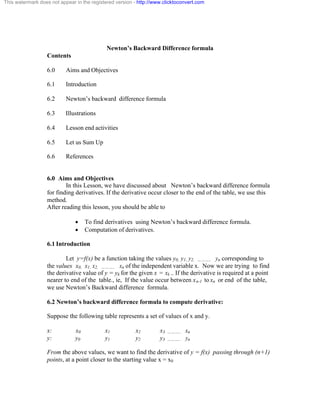
Let y=f(x) be a function taking the values y0, y1, y2, ……….. yn corresponding to 
the values x0, x1, x2, ……….. xn of the independent variable x. Now we are trying to find 
the derivative value of y = yk for the given x = xk .. If the derivative is required at a point 
nearer to end of the table., ie, If the value occur between xn-1 to xn or end of the table, 
we use Newton’s Backward difference formula. 
6.2 Newton’s backward difference formula to compute derivative: 
Suppose the following table represents a set of values of x and y. 
x: x0 x1 x2 x3 ……….. xn 
y: y0 y1 y2 y3 ……….. yn 
From the above values, we want to find the derivative of y = f(x) passing through (n+1) 
points, at a point closer to the starting value x = x0
This watermark does not appear in the registered version - http://www.clicktoconvert.com 
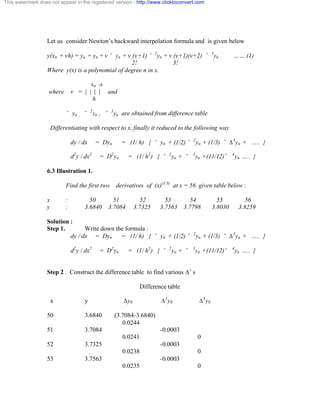
Let us consider Newton’s backward interpolation formula and is given below 
y(xn + vh) = yu = yn + v ˘ yn + v (v+1) ˘ 2yn + v (v+1)(v+2) ˘ 3yn …….(1) 
2! 3! 
Where y(x) is a polynomial of degree n in x. 
xn -x 
where v = | | | | and 
h 
˘ yn , ˘ 2yn , ˘ 3yn are obtained from difference table 
Differentiating with respect to x, finally it reduced to the following way 
dy / dx = Dyn = (1/ h) { ˘ yn + (1/2) ˘ 2yn + (1/3) ˘ Ä3yn + ….. } 
d2y / dx2 = D2yn = (1/ h2) { ˘ 2yn + ˘ 3yn +(11/12) ˘ 4yn ….. } 
6.3 Illustration 1. 
Find the first two derivatives of (x)(1/3) at x = 56 given table below : 
x : 50 51 52 53 54 55 56 
y : 3.6840 3.7084 3.7325 3.7563 3.7798 3.8030 3.8259 
Solution : 
Step 1. Write down the formula : 
dy / dx = Dyn = (1/ h) { ˘ yn + (1/2) ˘ 2yn + (1/3) ˘ Ä3yn + ….. } 
d2y / dx2 = D2yn = (1/ h2) { ˘ 2yn + ˘ 3yn +(11/12) ˘ 4yn ….. } 
Step 2 . Construct the difference table to find various Ä’ s 
Difference table 
x y Äy0 Ä2y0 Ä3y0 
50 3.6840 (3.7084-3.6840) 
0.0244 
51 3.7084 -0.0003 
0.0241 0 
52 3.7325 -0.0003 
0.0238 0 
53 3.7563 -0.0003 
0.0235 0
This watermark does not appear in the registered version - http://www.clicktoconvert.com 
54 3.7798 -0.0003 
0.0232 0 
55 3.8030 -0.0003 
0.0229 
56 3.8259 
By applying Newton’s backward difference formula : 
[ dy / dx]x=xn =[ dy / dx]v=o 
= (1/ h) { ˘ yn + (1/2) ˘ 2yn + (1/3) ˘ Ä3yn + ….. } 
= (1/ 1) [ 0.0299 + (1/2) (-0.0003) + (1/3) 0 ] 
= 0.02275 
[d2y / dx2 ]x=56 = D2y0 = (1/ h2) [ ˘ 2yn + ˘ 3yn +… ] 
= 1 [ -0.0003] 
= -0.0003 
Illustration 2. The population of a certain town is given below. Find the rate of growth 
of the population in 1961 and 1971 
Year x : 1931 1941 1951 1961 1971 
Population y : 40.62 60.80 79.95 103.56 132.65 
Solution. Construct the difference table 
x y Äy0 Ä2y0 Ä3y0 Ä4y0 
1931 40.62 
20.18 
1941 60.80 -1.03 
19.15 5.49 
1951 79.95 4.46 -4.47 
23.61 1.02 
1961 103.56 5.48 
29.09 
1971 132.65 
By applying Newton’s forward formula : 
To find (i) f’(1961)
This watermark does not appear in the registered version - http://www.clicktoconvert.com 
xn- x 1961 - 1971 
where v = | | | | = |||||||| = -1 
h 10 
[ dy / dx]x=1961 =[ dy / dx]v=-1 
= (1/ h) { ˘ yn + ((2v+1) / 2) ˘ 2yn + ((3v2+6v+2)/6) ˘ Ä3yn +….. } 
= (1/ 10) [29.09 – (1/2) (5.48) – (1/6) (1.02) – (1/12) (-4.47) ] 
= (1/ 10) [29.09 – 2.74 -0.17 + 0.3725] 
= 2.65525 
To find (i) f’(1971) 
xn- x 1971 - 1971 
where v = | | | | = | | | | | | | | = 0 
h 10 
[ dy / dx]x=1971 =[ dy / dx]v=0 
= (1/ h) { ˘ yn + (1 / 2) ˘ 2yn + (1/3) ˘ Ä3yn +(1/4) ˘ Ä4yn ….. } 
= (1/ 10) [29.09 + (1/2) (5.48) + (1/3) (1.02) + (1/4) (-4.47) ] 
= (1/ 10) [29.09 + 2.74 +0.34 - 1.1175] 
= 2.65525 
6.4 Lesson End Activities 
1. find the first and second derivative of the function tabulated below at x = 4.0 
x : 3.0 3.2 3.4 3.6 3.8 4.0 
f(x) : -14 -10.32 -5.296 -0.256 6.672 14 
2. find second derivative of y at x = 1.04 from the data 
x : 0.96 0.98 1.00 1.02 1.04 
y : 0.7825 0.7739 0.7651 0.7563 0.7473 
3. From the table below find y’ and y’’ at x = 1.25 
x : 1.00 1.05 1.10 1.15 1.20 1.25 1.30 
y : 1.00000 1.02470 1.04881 1.07238 1.09544 1.11803 1.14017
This watermark does not appear in the registered version - http://www.clicktoconvert.com 
__ 
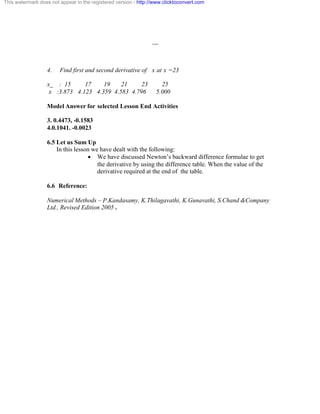
4. Find first and second derivative of x at x =23 
x_ : 15 17 19 21 23 25 
x :3.873 4.123 4.359 4.583 4.796 5.000 
Model Answer for selected Lesson End Activities 
3. 0.4473, -0.1583 
4.0.1041. -0.0023 
6.5 Let us Sum Up 
In this lesson we have dealt with the following: 
· We have discussed Newton’s backward difference formulae to get 
the derivative by using the difference table. When the value of the 
derivative required at the end of the table. 
6.6 Reference: 
Numerical Methods – P.Kandasamy, K.Thilagavathi, K.Gunavathi, S.Chand &Company 
Ltd., Revised Edition 2005 .
This watermark does not appear in the registered version - http://www.clicktoconvert.com 
LESSON – 7 
Numerical Integration 
Contents 
7.0 Aims and Objectives 
7.1 Introduction 
7.2 Trapezoidal rule 
7.3 Illustrations 
7.4 Let us Sum Up 
7.5 Lesson end Activities 
7.6 References 
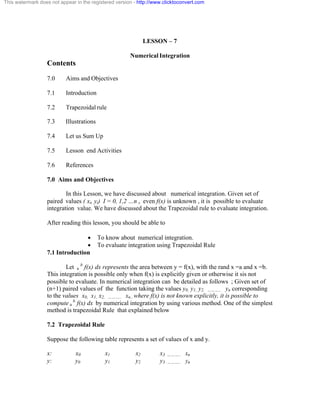
7.0 Aims and Objectives 
In this Lesson, we have discussed about numerical integration. Given set of 
paired values ( xi, yi) I = 0, 1,2 …n , even f(x) is unknown , it is possible to evaluate 
integration value. We have discussed about the Trapezoidal rule to evaluate integration. 
After reading this lesson, you should be able to 
· To know about numerical integration. 
· To evaluate integration using Trapezoidal Rule 
7.1 Introduction 
Let a b f(x) dx represents the area between y = f(x), with the rand x =a and x =b. 
This integration is possible only when f(x) is explicitly given or otherwise it sis not 
possible to evaluate. In numerical integration can be detailed as follows ; Given set of 
(n+1) paired values of the function taking the values y0, y1, y2, ……….. yn corresponding 
to the values x0, x1, x2, ……….. xn.. where f(x) is not known explicitly, it is possible to 
compute a b f(x) dx by numerical integration by using various method. One of the simplest 
method is trapezoidal Rule that explained below 
7.2 Trapezoidal Rule 
Suppose the following table represents a set of values of x and y. 
x: x0 x1 x2 x3 ……….. xn 
y: y0 y1 y2 y3 ……….. yn
This watermark does not appear in the registered version - http://www.clicktoconvert.com 
From the above values, we want to find the integration of y = f(x) with the range x0 and 
x0 +mh 
xo x0+mh f(x) dx = (h/2) [ (y0 + yn) + 2 (y1 + y2+ y3+ …. + yn-1) ] 
= (h/2) [ (sum of the first and last ordinates ) + 
(Sum of the remaining ordinates) ] 
7.3 Illustrations 1. Evaluate -3 3 x4 dx by using Trapezoidal rule. Verify result by 
actual integration. 
Step 1. We are given that f(x) = x4. Interval length (b –a ) = (3 – (-3) ) = 6. So we 
divide 6 equal intervals with h= 6/6 = 1.0 And tabulate the values as below 
x : -3 -2 -1 0 1 2 3 
y : 81 16 1 0 1 16 81 
Step2. Write down the trapezoidal rule and put the respective values in that rule 
-3 3 f(x) dx = (h/2) [ (y0 + yn) + 2 (y1 + y2+ y3+ …. + yn-1) ] 
= (h/2) [ (sum of the first and last ordinates ) + 
(Sum of the remaining ordinates) ] 
= (1/2) [ (81+81) + 2 (16+1+0+1+16) ] 
= 115 
By actual integration -3 3 f(x) dx = -3 3 x4 dx 
= [ (35/5) -(-35/5) ] 
=[ (243/5) + (243/5)] 
= 97.5 
Illustration 2 :Evaluate 0 1 1/(1+x2) dx by using Trapezoidal rule with h = 0.2 
Solution: 
Step 1. We are given that f(x) = 1/(1+x2). Interval length (b –a ) = (1 – 0 ) = 1. So we 
divide 6 equal intervals with h= 0.2 And tabulate the values as below 
x : 0 0.2 0.4 0.6 0.8 1.0 
y1/(1+x2): 1 0.96154 0.86207 0.73529 0.60976 0.5000 
Step2. Write down the trapezoidal rule and put the respective values of y in that rule
This watermark does not appear in the registered version - http://www.clicktoconvert.com 
-3 3 f(x) dx = (h/2) [ (y0 + yn) + 2 (y1 + y2+ y3+ …. + yn-1) ] 
= (h/2) [ (sum of the first and last ordinates ) + 
(Sum of the remaining ordinates) ] 
= (0.2/2) [ (1+0.5) + 2 (0.96154+0.86207+0.73529+0.60976) ] 
= (0.1) [ (1.05) + 6.33732 ] 
= 0.783732 
Illustration 3. Evaluate 0 6 1/ (1+x) dx by using Trapezoidal rule . 
Solution: 
Step 1. We are given that f(x) = 1/(1+x). Interval length (b –a ) = (6 – 0 ) = 6. So we 
divide 6 equal intervals with h= 1. And tabulate the values as below 
x : 0 1 2 3 4 5 6 
y1/(1+x2): 1 0.5 1/3 1/4 1/5 1/6 1/7 
Step2. Write down the trapezoidal rule and put the respective values of y in that rule 
-3 3 f(x) dx = (h/2) [ (y0 + yn) + 2 (y1 + y2+ y3+ …. + yn-1) ] 
= (h/2) [ (sum of the first and last ordinates ) + 
(Sum of the remaining ordinates) ] 
= (1/2) [ (1+1/7) + 2 (0.5+1/3 + 1/4 + 1/5 +1/6 ) ] 
= (0.5) [ (1.05) + 6.33732 ] 
Illustration 4. Evaluate 4 5.2 loge x dx by using Trapezoidal rule . 
Solution: 
Step 1. We are given that f(x) = loge x Interval length (b –a ) = (5.2 – 4 ) = 1.2. So we 
divide 6 equal intervals with h= 0.2. And tabulate the values as below 
x : 4 4.2 4.4 4.6 4.8 5.0 5.2 
y : 1.39 1.44 1.48 1.53 1.57 1.61 1.65
This watermark does not appear in the registered version - http://www.clicktoconvert.com 
Step2. Write down the trapezoidal rule and put the respective values of y in that rule 
-3 3 f(x) dx = (h/2) [ (y0 + yn) + 2 (y1 + y2+ y3+ …. + yn-1) ] 
= (h/2) [ (sum of the first and last ordinates ) + 
(Sum of the remaining ordinates) ] 
= (0.2/2) [ (1.39+1.65) + 2 (1.44 +1.48 + 1.53+ 1.57 +1.61) ] 
= (0.1) [ 3.04 + 2(7.63) ] 
= 1.83 
Illustration 5. Evaluate 0 ð sin x dx by using Trapezoidal rule, by dividing the range 
into ten equal parts . 
Solution : 
Step 1. We are given that f(x) = sin x Interval length (b –a ) = (ð – 0 ) =ð. 
So we divide 10 equal intervals with h= ð/10 (specified in the question itself), 
and tabulate the values as below 
x: 0 ð/10 2ð/10 3ð/10 4ð/10 
Y: 0.0 0.3090 0.5878 0.8090 0.9511 
x: 5ð/10 6ð/10 7ð/10 8ð/10 9ð/10 ð 
Y: 1.0 0.9511 0.8090 0.5878 0.3090 0 
Step2. Write down the trapezoidal rule and put the respective values of y in that rule 
-3 3 f(x) dx = (h/2) [ (y0 + yn) + 2 (y1 + y2+ y3+ …. + yn-1) ] 
= (h/2) [ (sum of the first and last ordinates ) + 
(Sum of the remaining ordinates) ] 
=(ð/20)[(0+0)+2(0.3090+0.5878+0.8090+0.9511+1.0+ 
0.9511+0.8090+0.5878+0.309)] 
= 1.9843
This watermark does not appear in the registered version - http://www.clicktoconvert.com 
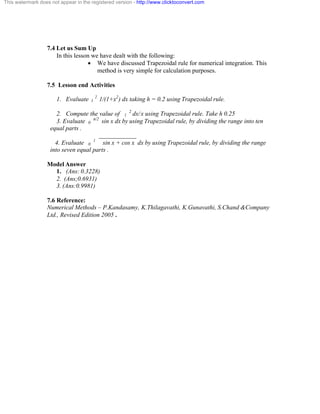
7.4 Let us Sum Up 
In this lesson we have dealt with the following: 
· We have discussed Trapezoidal rule for numerical integration. This 
method is very simple for calculation purposes. 
7.5 Lesson end Activities 
1. Evaluate 1 2 1/(1+x2) dx taking h = 0.2 using Trapezoidal rule. 
2. Compute the value of 1 2 dx/ x using Trapezoidal rule. Take h 0.25 
3. Evaluate 0 ð/2 sin x dx by using Trapezoidal rule, by dividing the range into ten 
equal parts . 
____________ 
4. Evaluate 0 1 sin x + cos x dx by using Trapezoidal rule, by dividing the range 
into seven equal parts . 
Model Answer 
1. (Ans: 0.3228) 
2. (Ans;0.6931) 
3. (Ans:0.9981) 
7.6 Reference: 
Numerical Methods – P.Kandasamy, K.Thilagavathi, K.Gunavathi, S.Chand &Company 
Ltd., Revised Edition 2005 .
This watermark does not appear in the registered version - http://www.clicktoconvert.com 
LESSON - 8 
Simpson’s one-third rule 
Contents 
8.0 Aims and Objectives 
8.1 Introduction 
8.2 Simpson’s one third rule 
8.3 Illustrations 
8.4 Lesson End Activities 
8.5 Let us Sum Up 
8.6 References 
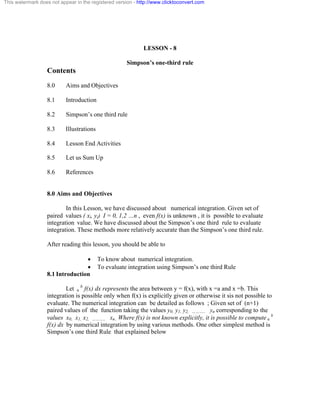
8.0 Aims and Objectives 
In this Lesson, we have discussed about numerical integration. Given set of 
paired values ( xi, yi) I = 0, 1,2 …n , even f(x) is unknown , it is possible to evaluate 
integration value. We have discussed about the Simpson’s one third rule to evaluate 
integration. These methods more relatively accurate than the Simpson’s one third rule. 
After reading this lesson, you should be able to 
· To know about numerical integration. 
· To evaluate integration using Simpson’s one third Rule 
8.1 Introduction 
Let a b f(x) dx represents the area between y = f(x), with x =a and x =b. This 
integration is possible only when f(x) is explicitly given or otherwise it sis not possible to 
evaluate. The numerical integration can be detailed as follows ; Given set of (n+1) 
paired values of the function taking the values y0, y1, y2, ……….. yn corresponding to the 
values x0, x1, x2, ……….. xn.. Where f(x) is not known explicitly, it is possible to compute a b 
f(x) dx by numerical integration by using various methods. One other simplest method is 
Simpson’s one third Rule that explained below
This watermark does not appear in the registered version - http://www.clicktoconvert.com 
7.3 Simpson’s one third Rule 
Suppose the following table represents a set of values of x and y. 
x: x0 x1 x2 x3 ……….. xn 
y: y0 y1 y2 y3 ……….. yn 
From the above values, we want to find the integration of y = f(x) with the range x0 and 
x0 + nh 
xo xn f(x) dx = (h/3) [ (y0 + yn) + 2 (y2 + y4 + ) + 4 (y1+ y3+ …. ) ] 
= (h/3) [ (sum of the first and last ordinates ) + 
+ 2 (Sum of remaining even ordinates) 
+4 ( sum of remaining odd ordinates)] 
The above equation is called Simpson’s one third rule and it is applicable only when 
number of ordinates must be odd ( no. of pairs ). 
8.3 Illustrations 1. Evaluate -3 3 x4 dx by using Simpson’s one third rule. Verify result 
by actual integration. 
Step 1. We are given that f(x) = x4. Interval length (b –a ) = (3 – (-3) ) = 6. So we 
divide 6 equal intervals with h= 6/6 = 1.0 And tabulate the values as below 
x : -3 -2 -1 0 1 2 3 
y : 81 16 1 0 1 16 81 
Step2. Write down the Simpson’s one third rule and put the respective values in that rule 
-3 3 f(x) dx ) = (h/3) [ (y0 + y6) + 2 (y2 + y4 ) + 4 (y1+ y3+y5 ) ] 
= (h/3) [ (sum of the first and last ordinates ) + 
+ 2 (Sum of remaining even ordinates) 
+4 ( sum of remaining odd ordinates) ] 
= (1/3) [ (81+81) + 2 (1+1) +4(16+1+16) ] 
= 98 
By actual integration -3 3 f(x) dx = -3 3 x4 dx 
= [ (35/5) -(-35/5) ] 
=[ (243/5) + (243/5)] 
= 97.5
This watermark does not appear in the registered version - http://www.clicktoconvert.com 
2. Evaluate 0 1.2 1/(1+x2) dx by using Simpson’s one third rule with h = 0.2 
Solution: 
Step 1. We are given that f(x) = 1/(1+x2). Interval length (b –a ) = (1.2 – 0 ) = 1.2 . So 
we divide 6 equal intervals with h= 0.2 And tabulate the values as below 
x : 0 0.2 0.4 0.6 0.8 1.0 1.2 
y1/(1+x2): 1 0.9615 0.8621 0.7353 0.6098 0.5000 0.4098 
Step2. Write down the Simpson’s one third rule and put the respective values of y in that 
rule 
-3 3 f(x) dx = (h/3) [ (y0 + y6) + 2 (y2 + y4 ) + 4 (y1+ y3+y5 ) ] 
= (h/3) [ (sum of the first and last ordinates ) + 
+ 2 (Sum of remaining even ordinates) 
+4 ( sum of remaining odd ordinates) ] 
= (0.2 /3) [ (1+0.4098) + 2 (0.8621 +0.6098) + 4 (0.9615+0.7353+0.5 ) ] 
= (0.0667) [ (1.4098) +2(1.4719) + 4 (2.1503) ] 
= (0.0667) [ 1.4098 + 2.9438 + 8.6012] 
=0.8641 
3. Evaluate 0 6 1/ (1+x) dx by using Simpson’s one third rule . 
Solution: 
Step 1. We are given that f(x) = 1/(1+x). Interval length (b –a ) = (6 – 0 ) = 6. So we 
divide 6 equal intervals with h= 1. And tabulate the values as below 
x : 0 1 2 3 4 5 6 
y1/(1+x2): 1 0.5 1/3 1/4 1/5 1/6 1/7 
Step2. Write down the Simpson’s one third rule and put the respective values of y in that 
rule
This watermark does not appear in the registered version - http://www.clicktoconvert.com 
-3 3 f(x) dx = (h/3) [ (y0 + y6) + 2 (y2 + y4 ) + 4 (y1+ y3+y5 ) ] 
= (h/3) [ (sum of the first and last ordinates ) + 
+ 2 (Sum of remaining even ordinates) 
+4 ( sum of remaining odd ordinates) ] 
= (1/3) [ (1+1/7) + 2 (1/3 + 1/5) + 4( 0.5 +1/4 +1/6 ) ] 
= 1.9587 
4. Evaluate 4 5.2 loge x dx by using Simpson’s one third rule . 
Solution: 
Step 1. We are given that f(x) = loge x Interval length (b –a ) = (5.2 – 4 ) = 1.2. So we 
divide 6 equal intervals with h= 0.2. And tabulate the values as below 
x : 4 4.2 4.4 4.6 4.8 5.0 5.2 
y : 1.39 1.44 1.48 1.53 1.57 1.61 1.65 
Step2. Write down the Simpson’s one third rule and put the respective values of y in that 
rule 
-3 3 f(x) dx = (h/3) [ (y0 + y6) + 2 (y2 + y4 ) + 4 (y1+ y3+y5 ) ] 
= (h/3) [ (sum of the first and last ordinates ) + 
+ 2 (Sum of remaining even ordinates) 
+4 ( sum of remaining odd ordinates) ] 
= (0.2/3) [ (1.39+1.65) + 2 (1.48+ 1.57) + 4 (1.44+ 1.53++1.61) ] 
= (0.0667) [ 3.04 + 2(3.05)+ 4 (4.58) ] 
= 1.83 
5. Evaluate 0 ð sin x dx by using Simpson’s one third rule, by dividing the range into 
ten equal parts . 
Solution :
This watermark does not appear in the registered version - http://www.clicktoconvert.com 
Step 1. We are given that f(x) = sin x Interval length (b –a ) = (ð – 0 ) =ð. 
So we divide 10 equal intervals with h= ð/10 (specified in the question itself), 
and tabulate the values as below 
x: 0 ð/10 2ð/10 3ð/10 4ð/10 
Y: 0.0 0.3090 0.5878 0.8090 0.9511 
x: 5ð/10 6ð/10 7ð/10 8ð/10 9ð/10 ð 
Y: 1.0 0.9511 0.8090 0.5878 0.3090 0 
Step2. Write down the Simpson’s one third rule and put the respective values of y in that 
rule 
-3 3 f(x) dx =(h/3) [ (y0 + y10) + 2 (y2 + y4 + y6 + y8 ) + 4 (y1+ y3+y5+ y7 + y9 ) ] 
= (h/3) [ (sum of the first and last ordinates ) + 
+ 2 (Sum of remaining even ordinates) 
+4 ( sum of remaining odd ordinates 
=(ð/20)[(0+0)+2(0.5878+ 0.9511+0.9511+0.5878) + 
4(0.3090+0.8090+ 1+ 0.8090+0.3090)] 
= 2.0009 
8.4 Lesson End Activities 
2. Evaluate 1 2 1/(1+x2) dx taking h = 0.2 using Simpson’s one third rule. 
2. Compute the value of 1 2 dx/ x using Simpson’s one third rule. Take h 0.25 
3. Evaluate 0 ð/2 sin x dx by using Simpson’s one third rule, by dividing the range 
into ten equal parts .) 
____________ 
4. Evaluate 0 1 sin x + cos x dx by using Simpson’s one third rule, by dividing the 
range into seven equal parts . 
8.5 Let us Sum Up 
In this lesson we have dealt with the following: 
We have discussed about the Simpson’s one third rule to evaluate 
integration. This method more easier than any other method.
This watermark does not appear in the registered version - http://www.clicktoconvert.com 
Model Answer for selected lesson end activities 
1. 0.3228 
2. 0.6971 
3. 1.0006 
8.6 Reference: 
Numerical Methods – P.Kandasamy, K.Thilagavathi, K.Gunavathi, S.Chand &Company 
Ltd., Revised Edition 2005 .
This watermark does not appear in the registered version - http://www.clicktoconvert.com 
LESSON - 9 
Simpson’s three-eighths rule 
Contents 
9.0 Aims and Objectives 
9.1 Introduction 
9.2 Simpson’s three-eighth rule 
9.3 Illustrations 
9.4 Lesson End Activities 
9.5 Let us Sum Up 
9.6 References 
9.0 Aims and Objectives 
In this Lesson, we have discussed about numerical integration. Given set of 
paired values ( xi, yi) I = 0, 1,2 …n , even f(x) is unknown , it is possible to evaluate 
integration value. We have discussed about the Simpson’s three-eighths rule to 
evaluate integration. This method is relatively accurate than earlier methods of numerical 
integration. 
After reading this lesson, you should be able to 
· To know about the numerical integration. 
· To evaluate integration using Simpson’s three-eighth Rule 
9.1 Introduction 
Let a b f(x) dx represents the area between y = f(x), with the rand x =a and x =b. 
This integration is possible only when f(x) is explicitly given or otherwise it sis not 
possible to evaluate. In numerical integration can be detailed as follows ; Given set of 
(n+1) paired values of the function taking the values y0, y1, y2, ……….. yn corresponding 
to the values x0, x1, x2, ……….. xn, . where f(x) is not known explicitly, it is possible to 
compute a b f(x) dx by numerical integration by using various method. One of the 
simplest method is Simpson’s three-eighth rule, that is explained in detail and also this 
method is method is more accurate than the earlier methods of study.
This watermark does not appear in the registered version - http://www.clicktoconvert.com 
9.2 Simpson’s three-eighth Rule 
Suppose the following table represents a set of values of x and y. 
x: x0 x1 x2 x3 ……….. xn 
y: y0 y1 y2 y3 ……….. yn 
From the above values, we want to find the integration of y = f(x) with the range x0 and 
x0 +h 
xo xn f(x) dx = (3h/8 ) [ (y0 + yn) + 2 (y3 + y6+ y9 +… ) + 3 (y1 + y2 + y4 + y5 + …….+yn-1 )] 
= (3h/8) [ (sum of the first and last ordinates ) + 
+ 2 (Sum of multiples of three ordinates) 
+3 ( sum of remaining ordinates)] 
The above equation is called Simpson’s three-eighths rule which is applicable only when 
n is multiple of 3 . 
9.3 Illustrations 1. Evaluate -3 3 x4 dx by using Simpson’s three-eighth rule. Verify 
result by actual integration. 
Step 1. We are given that f(x) = x4. Interval length (b –a ) = (3 – (-3) ) = 6. So we 
divide 6 equal intervals with h= 6/6 = 1.0 And tabulate the values as below 
x : -3 -2 -1 0 1 2 3 
y : 81 16 1 0 1 16 81 
Step2. Write down the Simpson’s three-eighth rule and put the respective values in that 
rule 
-3 3 f(x) dx ) = (3h/8) [ (y0 + y6) + 2 (y3 ) + 3 (y1 + y2+ y4+ y5 ) ] 
= (3h/8) [ (sum of the first and last ordinates ) + 
+ 2 (Sum of multiples of three, other than last ordinates ) 
+3 ( sum of remaining ordinates)] 
= (3/8) [ (81+81) + 2 (0)) + 3(16+1+1+16) ] 
= 99 
By actual integration -3 3 f(x) dx = -3 3 x4 dx 
= [ (35/5) -(-35/5) ]
This watermark does not appear in the registered version - http://www.clicktoconvert.com 
=[ (243/5) + (243/5)] 
= 97.5 
6. Evaluate 0 1.2 1/(1+x2) dx by using Simpson’s three-eighth rule with h = 0.2 
Solution: 
Step 1. We are given that f(x) = 1/(1+x2). Interval length (b –a ) = (1 – 0 ) = 1. So we 
divide 6 equal intervals with h= 0.2 and tabulate the values as below 
x : 0 0.2 0.4 0.6 0.8 1.0 1.2 
y1/(1+x2): 1 0.9615 0.8621 0.7353 0.6098 0.5000 0.4098 
Step2. Write down the Simpson’s three-eighth rule and put the respective values of y in 
that rule 
-3 3 f(x) dx = (3h/8) [ (y0 + y6) + 2 (y3 ) + 3 (y1 + y2+ y4+ y5 ) ] 
= (3h/8) [ (sum of the first and last ordinates ) + 
+ 2 (Sum of multiples of three, other than last ordinates ) 
+3 ( sum of remaining ordinates) ] 
= (3 x 0.2 /3) [ (1+0.4098) + 2 (0.7353 ) 
+ 3 (0.9615+0.8621+0.6098 + 0.5 ) ] 
= (0.075) [1.4098 + 1.4706 + 3 ( 2.9334) ] 
= (0.075) [ 1.4098 + 1.4706 + 8.8002] 
=0.8760 
7. Evaluate 0 6 1/ (1+x) dx by using Simpson’s three-eighth rule . 
Solution: 
Step 1. We are given that f(x) = 1/(1+x). Interval length (b –a ) = (6 – 0 ) = 6. So we 
divide 6 equal intervals with h= 1. And tabulate the values as below 
X : 0 1 2 3 4 5 6 
y = 1/(1+x2)x : 1 0.5 1/3 1/4 1/5 1/6 1/7 
Step2. Write down the Simpson’s three-eighth rule and put the respective values of y in 
that rule
This watermark does not appear in the registered version - http://www.clicktoconvert.com 
-3 3 f(x) dx = (3h/8) [ (y0 + y6) + 2 (y3 ) + 3 (y1 + y2+ y4+ y5 ) ] 
= (3h/8) [ (sum of the first and last ordinates ) + 
+ 2 (Sum of multiples of three, other than last ordinates ) 
+3 ( sum of remaining ordinates )] 
= (3/8) [ (1+1/7) + 2 (1/4) + 3 ( 0.5 + 1/3 + 1/5 +1/6 ) ] 
= 1.9661 
8. Evaluate 4 5.2 loge x dx by using Simpson’s three-eighth rule . 
Solution: 
Step 1. We are given that f(x) = loge x Interval length (b –a ) = (5.2 – 4 ) = 1.2. So we 
divide 6 equal intervals with h= 0.2. And tabulate the values as below 
x : 4 4.2 4.4 4.6 4.8 5.0 5.2 
y : 1.39 1.44 1.48 1.53 1.57 1.61 1.65 
Step2. Write down the Simpson’s three-eighth rule and put the respective values of y in 
that rule 
-3 3 f(x) dx = (3h/8) [ (y0 + y6) + 2 (y3 ) + 3 (y1 + y2+ y4+ y5 ) ] 
= (3h/8) [ (sum of the first and last ordinates ) + 
+ 2 (Sum of multiples of three, other than last ordinates ) 
+3 ( sum of remaining ordinates ) ] 
= (3x 0.2 /8 ) [ (1.39+1.65) + 2 (1.53) + 3 (1.44+ 1.48 +1.57++1.61) ] 
= (0.075 ) [ 3.04 + 3.06 + 3 (6.1) ] 
= 1.83 
9. Evaluate 0 9 x2 dx by using Simpson’s three-eighth rule, by dividing the range into 
nine equal parts and verify your answer with actual integration. 
Solution : 
Step 1. We are given that f(x) = x2 Interval length (b –a ) = (9 – 0 ) =9.
This watermark does not appear in the registered version - http://www.clicktoconvert.com 
So, we divide 9 equal intervals with h=9 /9 = 1 (specified in the question itself), 
and tabulate the values as below 
X : 0 1 2 3 4 
Y = x2:0 1 4 9 16 
x: 5 6 7 8 9 
Y: 25 36 49 64 81 
Step2. Write down the Simpson’s three-eighth rule and put the respective values of y in 
that rule 
-3 3 f(x) dx = (3h/8) [ (y0 + y9) + 2 (y3 + y6 ) + 3 (y1 + y2+ y4+ y5+ y7+ y8 ) ] 
= (3h/8) [ (sum of the first and last ordinates ) + 
+ 2 (Sum of multiples of three, other than last ordinates ) 
+3 ( sum of remaining ordinates ) ] 
= (3/8) [ (0 +81) + 2 ( 9 + 36) + 3 ( 1+ 4 + 16 + 25 + 49 + 64 ) ] 
= (.375) [ 81 + 90 + 477 ] 
= 243 
By actual integration 0 9 f(x) dx = 0 9 x2 dx 
= [ (93/3) -( 03/3) ] 
=[ (729 / 3) + 0] 
= 243 
9.4 Lesson End Activities 
1. Evaluate 1 2.2 1/(1+x2) dx taking h = 0.2 using Simpson’s three eighth rule. 
2. Compute the value of 0 1.2 dx/ x using Simpson’s three eighth rule. Take h = 0.2 
3. Evaluate 0 ð/2 sin x dx by using Simpson’s three eighth rule, by dividing the range 
into nine equal parts . 
4. Evaluate 0 6 sin x + cos x dx by using Simpson’s three eighth rule, by dividing 
the range into six equal parts .
This watermark does not appear in the registered version - http://www.clicktoconvert.com 
9.5 Let us Sum Up 
In this lesson we have dealt with the following: 
We have discussed about the Simpson’s three eighth rule to evaluate 
integration. This method more relatively accurate than the Simpson’s one third 
rule 
Model Answer for selected lesson end activities 
1 0.3228 
2. 0.6971 
3. 1.0006 
9.6 Reference: 
Numerical Methods – P.Kandasamy, K.Thilagavathi, K.Gunavathi, S.Chand &Company 
Ltd., Revised Edition 2005 .
This watermark does not appear in the registered version - http://www.clicktoconvert.com 
UNIT - III 
LESSON – 10 
Interpolation 
Contents 
10.0 Aims and Objectives 
10.1 Introduction 
10.2 Newton’s forward interpolation formula 
10.3 Illustrations 
10.4 Lesson end activities 
10.5 Let us Sum Up 
10.6 References 
10.0 Aims and Objectives 
In this Lesson, we have discussed about Interpolation, which means process of 
computing intermediate value of a function. We have also discussed about Newton’s 
forward interpolation formula for finding intermediate value of a function. 
After reading this lesson, you should be able to 
· To know about Interpolation. 
· To find intermediate values using Newton’s forward difference 
formula. 
10.1 Introduction 
Interpolation means the process of computing intermediate values of a function a 
given set of tabular values of a function. Suppose the following table represents a set of 
values of x and y. 
x: x0 x1 x2 x3 ……….. xn 
y: y0 y1 y2 y3 ……….. yn 
We may require the value of y = yi for the given x = xi, where x lies between x0 to xn
This watermark does not appear in the registered version - http://www.clicktoconvert.com 
Let y = f(x) be a function taking the values y0, y1, y2, … yn corresponding to the values 
x0, x1, x2, ……….. xn . Now we are trying to find y = yi for the given x = xi under 
assumption that the function f(x) is not known. In such cases , we replace f(x) by simple 
fan arbitrary function and let Ö(x) denotes an arbitrary function which satisfies the set of 
values given in the table above . The function Ö(x) is called interpolating function or 
smoothing function or interpolation formula. 
10.2 Newton’s forward interpolation formula (or) Gregory-Newton forward 
interpolation formula ( for equal intervals) 
Let y = f(x) denote a function which takes the values y0, y1, y2 ………., yn corresponding 
to the values x0, x1, x2 ………., xn. 
Let suppose that the values of x i.e., x0, x1, x2 ………., xn. are equidistant . 
x1 = x0 + h ; x2 = x1 + h ; and so on xn = xn-1 + h ; 
Therefore xi = x0 + i h, where i = 1,2, … , n 
Let Pn(x) be a polynomial of the n th degree in which x is such that 
yI = f(xi) = Pn(xi), I = 0,1,2, …. n 
Let us assume Pn(x) in the form given below 
Pn(x) = a0 + a1 (x – x0)(1) + a 2(x – x0)(2) + ……….+ ar (x – x0)(r) +…….+ 
+…… + an (x – x0)(n) ……(1) 
This polynomial contains the n + 1 constants a0, a1, a2, ………an can be found as 
follows : 
Pn(x0) = y0 = a0 (setting x = x0, in (1) ) 
Similarly y1 = a0 + a1 (x1 – x0) 
y2 = a0 + a1 (x2 – x0) + a2 (x2 – x0) 
From these, we get the values of a0, a1, a2 , …… an 
i.e., 
Therefore, a0 = y0 
Äy0 = y1 - y0 = a1 (x1 – x0) 
= a1h 
=> a1 = Äy0 /h 
lly => a2 = (Äy1 - Äy0) /2h2 = Ä2y0 / 2! h2 
lly => a3 = Ä3y0 / 3! h3 
Putting these values in (1), we get 
Pn(x) = = y0 + (x – x0)(1)Äy0 /h + (x – x0)(2) Ä2y0 /( 2! h2) + ……+ (x – x0)(r) Äry0 /(r! hr) 
+…… + (x – x0)(n) Äry0 /(n! hn)
This watermark does not appear in the registered version - http://www.clicktoconvert.com 
x- x0 
By substituting | | | | = u , the above equation becomes 
h 
y(x0 + uh) = yu = y0 + u Äy0 + u (u-1) Ä2y0 + u (u-1)(u-2) Ä3y0 +…….. … 
2! 3! 
By substituting u = u(1), 
u (u-1) = u(2), 
u(u-1)(u-2) = u(3), … in the above equation, we get 
Pn (x)= Pny(x0 + uh) = y0 + u(1)Äy0 + u(2) Ä2y0 + u(3)Ä3y0 +……+ u(r)Äry0 +.... + u(n)Äny0 
2! 3! r! n! 
The above equation is known as Gregory-Newton forward formula or Newton's 
forward interpolation formula. 
Note : 1. This formula is applicable only when the interval of difference is uniform. 
2. This formula apply forward differences of y0, hence this is used to interpolate 
the values of y nearer to beginning value of the table ( i.e., x lies between x0 to x1 or x1 to 
x2 ) 
10.3 Illustrations 1.Find the values of y at x = 21 from the following data. 
x: 20 23 26 29 
y 0.3420 0.3907 0.4384 0.4848 
Solution. 
Step 1.Since x = 21 is nearer to beginning of the table. Hence we apply Newton’s 
forward formula. 
Step 2. Construct the difference table 
x y Äy0 Ä2y0 Ä3y0 
20 0.3420 (0.3420-0.3907) 
0.0487 (0.0477-0.0487) 
23 0.3907 -0.001 
0.0477 -0.0003 
26 0.4384 -0.0013 
0.0464 
29 0.4848 
Step 3. Write down the formula and put the various values : 
Pn (x)= Pny(x0 + uh) = y0 + u(1)Äy0 + u(2) Ä2y0 + u(3)Ä3y0 +……+ u(r)Äry0 +.... + u(n)Äny0 
2! 3! r! n!
This watermark does not appear in the registered version - http://www.clicktoconvert.com 
Where u(1) = (x – x0) / h = (21 – 20) / 3 = 0.3333 
u(2) = u(u-1) = (0.3333)(0.6666) 
Pn (x=21)= y(21) = 0.3420 + (0.3333)( 0.0487)+ (0.3333) (-0.6666) ( -0.001) 
+ (0.3333) (-0.6666)(-1.6666) ( -0.0003) 
= 0.3583 
Illustrations 2 . From the following table of half yearly premium for policies maturing at 
different ages, estimate the premium for policies maturing at age 46. 
Age x: 45 50 55 60 65 
Premium y: 114.84 96.16 83.32 74.48 68.48 
Solution. 
Step 1.Since x = 46 is nearer to beginning of the table and the values of x is equidistant 
i.e., h = 5.. Hence we apply Newton’s forward formula. 
Step 2. Construct the difference table 
x y Äy0 Ä2y0 Ä3y0 Ä4y0 
45 114.84 
-18.68 
50 96.16 5.84 
-12.84 -1.84 
55 83.12 4.00 0.68 
-8.84 -1.16 
60 74.48 2.84 
-6.00 
65 68.48 
Step 3. Write down the formula and put the various values : 
Pn (x)= Pny(x0 + uh) = y0 + u(1)Äy0 + u(2) Ä2y0 + u(3)Ä3y0 +……+ u(r)Äry0 +.... + u(n)Äny0 
2! 3! r! n! 
Where u = (x – x0) / h = (46 – 45) / 5 = 01/5 = 0.2 
Pn (x=46)= y(46) = 114.84 + [0.2 (-18.68)] +[0.2 (-0.8) (5.84)/ 3] 
+ [0.2 (-0.8) (-1.8)(-1.84)/6 ] 
+ [0.2 (-0.8) (-1.8)(-2.8)(0.68)]
This watermark does not appear in the registered version - http://www.clicktoconvert.com 
= 114.84 – 3.7360 – 0.4672 – 0.08832 – 0.228 
= 110.5257 
Illustrations 3 . From the following table , find the value of tan 450 15’ 
x0 : 45 46 47 48 49 50 
tan x0: 1.0 1.03553 1.07237 1.11061 1.15037 1.19175 
Solution. 
Step 1.Since x = 45o 15’ is nearer to beginning of the table and the values of x is 
equidistant i.e., h =1. Hence we apply Newton’s forward formula. 
Step 2. Construct the difference table to find various Ä’s 
x y Äy0 Ä2y0 Ä3y0 Ä4y0 Ä5y0 
450 1.0000 
0.03553 
460 1.03553 0.00131 
0.03684 0.00009 
470 1.07237 0.00140 0.00003 
0.03824 0.00012 -0.00005 
480 1.11061 0.00152 -0.00002 
0.03976 0.00010 
490 1.15037 0.00162 
0.04138 
500 1.19175 
Step 3. Write down the formula and substitute the various values : 
Pn (x)= Pny(x0 + uh) = y0 + u(1)Äy0 + u(2) Ä2y0 + u(3)Ä3y0 +……+ u(r)Äry0 +.... + u(n)Äny0 
2! 3! r! n! 
Where u = (45o 15’ – 450) / 10 
= 15’ / 10 
= 0.25 ……………(since 10 = 60 ‘) 
y (x=45o 15’ )= P5 (45o 15’) =1.00 + (0.25)( 0.03553) + (0.25)(- 0.75)(0.00131)/2 
+(0.25)(- 0.75)(-1.75)(0.00009)/6 
+(0.25)(- 0.75) (-1.75) (-2.75) (0.0003)/24 
+(0.25)(- 0.75) (-1.75) (-2.75) (-3.75) (-0.00005)/120 
= 1.000 + 0.0088825 – 0.0001228 +0.0000049
This watermark does not appear in the registered version - http://www.clicktoconvert.com 
= 1.00876 
4. The Population of a town is as follows. 
Year x: 1941 1951 1961 1971 1981 1991 
Population 20 24 29 36 46 51 
in lakhs y : 
Estimate the population increase during the period 1946. 
Step 1. Since x = 46 is nearer to beginning of the table and the values of x is equidistant 
i.e., h =5 . Hence we apply Newton’s forward formula. 
Step 2. Construct the difference table to find various Ä’s 
x y Äy0 Ä2y0 Ä3y0 Ä4y0 Ä5y0 
1941 20 
4 
1951 24 1 
5 1 
1961 29 2 0 
7 1 -9 
1971 36 3 -9 
10 -8 
1981 46 -5 
5 
1991 51 
Step 3. Write down the formula and substitute the various values : 
Pn (x)= P5 y(x0 + uh) = y0 + u(1)Äy0 + u(2) Ä2y0 + u(3)Ä3y0 + u(4)Ä4y0 + u(5)Ä5y0 
2! 3! 4! 5!! 
Where u = (1946 –19 41) / 10 
= 5/ 10 
= 0.5 
Y(1946) = 20 + (0.5) (4) + (0.5)(-0.5) (1/2) + (0.5)(-0.5)(-1.5)(1/6) + 
+(0.5)(-0.5) (-1.5)(-2.5) (0/24) 
+(0.5)(-0.5) (-1.5) (-2.5) (-3.5) ( -9 /120) 
= 20 + 2 -0.125 + 0.0625 + 0 -0.24609 
= 21.69
This watermark does not appear in the registered version - http://www.clicktoconvert.com 
10.4 Lesson end activities 
1.From the following data find è at x = 43 . Also express è in terms of x. 
x : 40 50 60 70 80 90 
y : 184 204 226 250 276 304 
2. From the data given below, find the number of students whose weight is between 60 
and 70. 
Weight in lbs. : 0-40 40-60 60-80 80-100 100-120 
No. of students: 250 120 100 70 50 
3. Find a polynomial of degree two which takes the values 
x : 0 1 2 3 4 5 6 7 
y : 1 2 4 7 11 16 22 29 
4.The following data are taken from the steam table. 
Temp. 0C :140 150 160 170 180 
Pressure : 3.685 4.854 6.302 8.076 10.225 
Find the pressure at temperature t = 1420. (Ans : 3.898) 
10.5 Let us Sum Up: 
In this lesson we have dealt with following 
* We have discussed about the Newton’s forward difference formula to 
find intermediate values. This method more useful when the function type is not exactly 
known. 
Model Answer 
1. 189.79, 0.01x2 + 1.1 x + 124 
2. 424 
3. 0.5 (x2 + x + 2) 
4. 3.898 
10.6 Reference: 
Numerical Methods – P.Kandasamy, K.Thilagavathi, K.Gunavathi, S.Chand &Company 
Ltd., Revised Edition 2005 .
This watermark does not appear in the registered version - http://www.clicktoconvert.com 
LESSON - 11 
Newton Backward Interpolation Formula 
Contents 
11.0 Aims and Objectives 
11.1 Introduction 
11.2 Newton’s backward interpolation formula 
11.3 Illustrations 
11.4 Lesson end activities 
11.5 Let us Sum Up 
11.6 References 
11.0 Aims and Objectives 
In this Lesson, we have discussed about Newton’s backward interpolation 
formula for finding intermediate value of a function. 
After reading this lesson, you should be able to 
* To find intermediate values which occur end of the series using 
Newton’s backward interpolation formula. 
11.1 Introduction 
Interpolation means the process of computing intermediate values of a function a 
given set of tabular values of a function. Suppose the following table represents a set of 
values of x and y. 
x: x0 x1 x2 x3 ……….. xn 
y: y0 y1 y2 y3 ……….. yn 
We may require the value of y = yi for the given x = xi, where x lies between xn-1 to xn 
Let y = f(x) be a function taking the values y0, y1, y2, … yn corresponding to the values 
x0, x1, x2, ……….. xn . Now we are trying to find y = yi for the given x = xi under 
assumption that the function f(x) is not known. In such cases , we replace f(x) by simple 
an arbitrary function and let Ö(x) denote an arbitrary function which satisfies the set of 
values given in the table above . The function Ö(x) is called interpolating function or 
smoothing function or interpolation formula.
This watermark does not appear in the registered version - http://www.clicktoconvert.com 
11.2 Newton’s backward interpolation formula (or) Gregory-Newton backward 
interpolation formula ( for equal intervals) 
Let y = f(x) denote a function which takes the values y0, y1, y2 ………., yn corresponding 
to the values x0, x1, x2 ………., xn. 
Let suppose that the values of x i.e., x0, x1, x2 ………., xn. are equidistant . 
x1 = x0 + h ; x2 = x1 + h ; and so on xn = xn-1 + h ; 
Therefore xi = x0 + i h, where i = 1,2, … , n 
Let Pn(x) be a polynomial of the n th degree in which x is such that 
yI = f(xi) = Pn(xi), I = 0,1,2, …. n 
Pn(x) = a0 + a1 (x – xn)(1) + a 2(x – xn) (x – xn-1)) + ……… 
+ an (x – xn) (x – xn-1) …(x – x1) ……(1) 
Let us assume Pn(x) in the form given below 
Pn(x) = a0 + a1 (x – xn)(1) + a 2(x – xn)(2) + ……….+ ar (x – xn)(r) +…… 
+…… + an (x – xn)(n) ……(1.1) 
This polynomial contains the n + 1 constants a0, a1, a2, ………an can be found as 
follows : 
Pn(xn) = yn = a0 (setting x = xn, in (1) ) 
Similarly yn-1 = a0 + a1 (xn-1 – xn) 
yn-2 = a0 + a1 (xn-2 – xn) + a2 (xn-2 – xn) 
From these, we get the values of a0, a1, a2 , …… an 
Therefore, a0 = yn 
˘ yn = yn - yn-1 = a1 (xn-1 – xn) 
= a1h 
=> a1 = yn /h 
lly => a2 = (˘ y1 -˘ yn) /2h2 = ˘ 2yn/ 2! h2 
lly => a3 = ˘ 3/ 3! h3 
Putting these values in (1), we get 
Pn(x) = = yn + (x – xn)(n) ˘ yn /h + (x – xn)(2) ˘ 2yn /( 2! h2) + (x – xn)(r) ˘ ryn /(r! hr) 
+…… + (x – xn)(n) ˘ ryn /(n! hn) 
x- xn 
By substituting | | | | = v , the above equation becomes 
h 
y(xn + vh) = yn + v ˘ yn + v (v+1) ˘ 2yn+ v (v+1)(v+2) ˘ 3yn +…….. …
This watermark does not appear in the registered version - http://www.clicktoconvert.com 
2! 3! 
By substituting v = v(1), 
v (v+1) = v(2), 
v(v+1)(v+2) = v(3), … in the above equation, we get 
Pn (x)= Pny(xn + vh) = yn + v(1)˘ yn + v(2) ˘ 2yn + v(3) ˘ 3yn +…+ v(r) ˘ ryn +.... +v(n)Änyn 
2! 3! r! n! 
The above equation is known as Gregory-Newton backward formula or Newton’s 
backward interpolation formula. 
Note : 1. This formula is applicable only when the interval of difference is uniform. 
2. This formula apply backward differences of yn, hence this is used to interpolate 
the values of y nearer to the end of a set tabular values. ( i.e., x lies between xn to xn- 1 and 
xn-1 to xn-2 ) 
11.3 Illustrations 1.Find the values of y at x = 28 from the following data. 
x: 20 23 26 29 
y 0.3420 0.3907 0.4384 0.4848 
Solution. 
Step 1.Since x = 28 is nearer to beginning of the table. Hence we apply Newton’s 
backward formula. 
Step 2. Construct the difference table 
x y ˘ yn ˘ 
2yn ˘ 3yn 
20 0.3420 (0.3420-0.3907) 
0.0487 (0.0477-0.0487) 
23 0.3907 -0.001 
0.0477 -0.0003 
26 0.4384 -0.0013 
0.0464 
29 0.4848 
Step 3. Write down the formula and put the various values : 
P3 (x)= P3 y(xn + vh) = yn + v(1)˘ yn + v(2) ˘ 2yn + v(3) ˘ 3yn 
2! 3! 
Where v(1) = (x – xn) / h = (28 – 29) / 3 = -0.3333 
v(2)= v(v+1) =( -0.333)(0.6666) 
v(3)= v(v+1) (v+2) =( -0.333)(0.6666)(1.6666) 
Pn (x=28)= y(28) = 0.4848 + (-0.3333)( 0.0464)+ (-0.3333) (0.6666) ( -0.0013)/2
This watermark does not appear in the registered version - http://www.clicktoconvert.com 
+(-0.3333) (0.6666)(1.6666) ( -0.0003)/6 
= 0.4848 – 0.015465 +0.0001444 + 0.0000185 
= 0.4695 
Illustrations 2 . From the following table of half yearly premium for policies maturing at 
different ages, estimate the premium for policies maturing at age 63. 
Age x: 45 50 55 60 65 
Premium y: 114.84 96.16 83.32 74.48 68.48 
Solution. 
Step 1.Since x = 63 is nearer to beginning of the table and the values of x is equidistant 
i.e., h = 5.. Hence we apply Newton’s backward formula. 
Step 2. Construct the difference table 
x y ˘ y0 ˘ 2y0 ˘ 3y0 ˘ 4y0 
45 114.84 
-18.68 
50 96.16 5.84 
-12.84 -1.84 
55 83.12 4.00 0.68 
-8.84 -1.16 
60 74.48 2.84 
-6.00 
65 68.48 
Step 3. Write down the formula and put the various values : 
P3 (x)= P3 y(xn + vh) = yn + v(1)˘ yn + v(2) ˘ 2yn + v(3) ˘ 3yn + v(4) ˘ 4yn 
2! 3! 4! 
Where v(1) = (x – xn) / h = (63 – 65) / 5 = -2/5 = - 0.4 
v(2) = v(v+1) = ( -0.4)(1.6) 
v(3) = v(v+1) (v+2) = ( -0.4)(1.6) (2.6) 
v(4) = v(v+1) (v+2) ) (v+3) = ( -0.4)(1.6) (2.6)(3.6) 
P4 (x=63)= y(63) = 68.48 + [(-0.4) (-6.0)] +[(-0.4) (1.6) (2.84)/ 2] 
+ [(-0.4) (1.6) (2.6)(-1.16)/6 ] 
+ [(-0.4) (1.6) (2.6)(3.6) (0.68)/24 ] 
= 68.48 +2.40 - 0.3408 +0.07424 – 0.028288 
= 70.5852
This watermark does not appear in the registered version - http://www.clicktoconvert.com 
Illustrations 3 . From the following table , find the value of tan 490 15’ 
x0 : 45 46 47 48 49 50 
tan x0: 1.0 1.03553 1.07237 1.11061 1.15037 1.19175 
Solution. 
Step 1.Since x = 49o 45’ is nearer to beginning of the table and the values of x is 
equidistant i.e., h =1. Hence we apply Newton’s backward formula. 
Step 2. Construct the difference table to find various Ä’s 
x y ˘ y0 ˘ 2y0 ˘ 3y0 ˘ 4y0 ˘ 5y0 
450 1.0000 
0.03553 
460 1.03553 0.00131 
0.03684 0.00009 
470 1.07237 0.00140 0.00003 
0.03824 0.00012 -0.00005 
480 1.11061 0.00152 -0.00002 
0.03976 0.00010 
490 1.15037 0.00162 
0.04138 
500 1.19175 
Step 3. Write down the formula and substitute the various values : 
P5 (x)= P5 y(xn + vh) = yn + v(1)˘ yn + v(2) ˘ 2yn + v(3) ˘ 3yn + v(4) ˘ 4yn + v(5) ˘ 5yn 
2! 3! 4! 5! 
Where v = (49o 45’ – 500) / 10 
= - 15’ / 10 
= - 0.25 ……………(since 10 = 60 ‘) 
v(2) = v(v+1) = ( -0.25) )( 0.75) 
v(3) = v(v+1) (v+2) = ( -0.25) (0.75)(1.75) 
v(4) = v(v+1) (v+2) ) (v+3) = (-0.25)( 0.75) (1.75) (2.75) 
y (x=49o 15’ )= P5 (49o 15’) =1.19175 + (-0.25)( 0.04138) + (-0.25)( 0.75) (0.00162)/2 
+(-0.25) (0.75)(1.75) (0.0001)/6
This watermark does not appear in the registered version - http://www.clicktoconvert.com 
+(-0.25)( 0.75) (1.75) (2.75) (-0.0002)/24 
+(-0.25)( 0.75) (1.75) (2.75) (3.75) (-0.00005)/120 
= 1.19175 - 0.010345 – 0.000151875 +0 .000005+ …. 
= 1.18126 
4. The Population of a town is as follows. 
Year x: 1941 1951 1961 1971 1981 1991 
Population 20 24 29 36 46 51 
in lakhs y : 
Estimate the population in the year of 1976. 
Step 1. Since x = 76 is nearer to beginning of the table and the values of x is equidistant 
i.e., h =5 . Hence we apply Newton’s backward formula. 
Step 2. Construct the difference table to find various Ä’s 
x y ˘ y0 ˘ 2y0 ˘ 3y0 ˘ 4y0 ˘ 5y0 
1941 20 
4 
1951 24 1 
5 1 
1961 29 2 0 
7 1 -9 
1971 36 3 -9 
10 -8 
1981 46 -5 
5 
1991 51 
Step 3. Write down the formula and substitute the various values : 
P5 (x)= P5 y(xn + vh) = yn + v(1)˘ yn + v(2) ˘ 2yn + v(3) ˘ 3yn + v(4) ˘ 4yn + v(5) ˘ 5yn 
2! 3! 4! 5! 
Where v (1)= (1976 –1991) / 10 
= -15/ 10 
= -1.5 
v(2 ) = v(v+1) = (-1.5)(0.5) and so on., 
Y(1976) = 51 + (-1.5) (5) + (-1.5)(0.5) (-5/2) + (-1.5)(0.5) (1.5) (-8/6) + 
+ (-1.5)(0.5) (1.5) (2.5) (-9/24)
This watermark does not appear in the registered version - http://www.clicktoconvert.com 
+ (-1.5)(0.5) (1.5) (2.5) (-3.5) ( -9 /120) 
= 51 – 7.5 -1.875 – 0.5 - 0.2109 + 0.1055 
= 40.8086 
11.4 Lesson End Activities 
1.From the following data find è at x = 84 . Also express è in terms of x. 
x : 40 50 60 70 80 90 
y : 184 204 226 250 276 304 
2. From the data given below, find the number of students whose weight is between 100 
and 110 
Weight in lbs. : 0-40 40-60 60-80 80-100 100-120 
No. of students: 250 120 100 70 50 
3. Find a polynomial of degree two which takes the following . Also find x= 6.5 
x : 0 1 2 3 4 5 6 7 
y : 1 2 4 7 11 16 22 29 
4.The following data are taken from the steam table. 
Temp. 0C :140 150 160 170 180 
Pressure : 3.685 4.854 6.302 8.076 10.225 
Find the pressure at temperature t = 1750. 
11.5 Let us Sum Up 
In this lesson we have dealt with the following : 
Newton’s backward interpolation formula to find intermediate values 
which occur at end of the series. 
Model Answer for selected lesson end activities 
1. 286.96, 0.01x2+1.1x+124 
3. 0.5 (x2+x+2) 
4. 9.100 
11.6 Reference: 
Numerical Methods – P.Kandasamy, K.Thilagavathi, K.Gunavathi, S.Chand &Company 
Ltd., Revised Edition 2005 .
This watermark does not appear in the registered version - http://www.clicktoconvert.com 
LESSON – 12 
Lagrange’s Interpolation Formula 
Contents 
12.0 Aims and Objectives 
12.1 Introduction 
12.2 Lagrange’s Interpolation Formula 
12.3 Illustrations 
12.4 Lesson end activities 
12.5 Let us Sum Up 
12.6 References 
12.0 Aims and Objectives 
In this Lesson, we have discussed about Lagrange’s interpolation formula for 
finding intermediate value of a function in which the values of independent variable are 
not equally spaced. 
After reading this lesson, you should be able to 
· To find intermediate values which occur anywhere else of the series 
using Lagrange’s interpolation formula. 
12.1 Introduction 
Interpolation means the process of computing intermediate values of a function a 
given set of tabular values of a function. Suppose the following table represents a set of 
values of x and y. 
x: x0 x1 x2 x3 ……….. xn 
y: y0 y1 y2 y3 ……….. yn 
We may require the value of y = yi for the given x = xi, where x lies between x0 to xn 
Let y = f(x) be a function taking the values y0, y1, y2, … yn corresponding to the values 
x0, x1, x2, ……….. xn . Now we are trying to find y = yi for the given x = xi under 
assumption that the function f(x) is not known. In such cases, xi ‘s are not equally spaced 
we use Lagrange’s interpolation formula.
This watermark does not appear in the registered version - http://www.clicktoconvert.com 
12.2 Lagrange’s interpolation formula ( for unequal intervals) 
Let y = f(x) denote a function which takes the values y0, y1, y2 ………., yn corresponding 
to the values x0, x1, x2 ………., xn. 
Let suppose that the values of x i.e., x0, x1, x2 ………., xn. are not equidistant . 
yI = f(xi) I = 0,1,2, …. N 
Now, there are (n+1) paired values (xi,yi,), I = 0,1,2, … n and hence f(x) can be 
represented by a polynomial function of degree n in x. 
Let us consider f(x) as follows 
f(x) = a0 (x – x1) (x – x2) (x – x3)… (x – xn) 
+ a1 (x – x0)(x – x2) (x – x3) … (x – xn) 
+ a2 (x – x0)(x – x3) (x – x4) … (x – xn) 
……………………………………… 
+an (x – x0)(x – x2) (x – x3) … (x – xn-1) ……….(1) 
Substituting x= x0, y=y0 , in the above equation 
y0 = a0 (x – x1) (x – x2) (x – x3)… (x – xn) 
which implies a0 = y0 / (x0 – x1) (x0– x2) (x0 – x3)… (x0 – xn) 
Similarly a1 = y1 / (x1 – x0) (x1 – x2) (x1 – x3)… (x1 – xn) 
a2 = y2 / (x2 – x0) (x2 – x1) (x2 – x3)… (x2 – xn) 
……………………………………………… 
an = yn (xn – x0)( xn – x2) (xn – x3) … (xn – xn-1) 
Putting these values in (1), we get 
(x – x1) (x – x2) (x – x3)… (x – xn) 
y = f(x) = ||||||||||||||||||| y0 
(x0 – x1) (x0– x2) (x0 – x3)… (x0 – xn) 
(x – x0)(x – x2) (x – x3) … (x – xn) 
+ |||||||||||||||||||| y1 
(x1 – x0) (x1 – x2) (x1 – x3)… (x1 – xn) 
(x – x0)(x – x1) (x – x3) … (x – xn) 
+ ||||||||||||||||||||| y2 
(x2 – x0) (x2 – x2) (x1 – x3)… (x1 – xn) 
+ ……………………………………. 
(x – x0)(x – x2) (x – x3) … (x – xn-1) 
+ ||||||||||||||||||||| yn 
(xn – x0)( xn – x2) (xn – x3) … (xn – xn-1)
This watermark does not appear in the registered version - http://www.clicktoconvert.com 
The above equation is called Lagrange’s interpolation formula for unequal intervals. 
Note : 1. This formula is will be more useful when the interval of difference is not 
uniform. 
12.3 Illustrations 1. Using Lagrange’s interpolation formula, find y(10) from the 
following table 
x : 5 6 9 11 
y : 3 13 14 16 
Solution: 
Step 1. Write down the Lagrange’s formula : 
(x – x1) (x – x2) (x – x3)… (x – xn) 
y = f(x) = ||||||||||||||||||| y0 
(x0 – x1) (x0– x2) (x0 – x3)… (x0 – xn) 
(x – x0)(x – x2) (x – x3) 
+ |||||||||||||| y1 
(x1 – x0) (x1 – x2) (x1 – x3) 
(x – x0)(x – x1) (x – x3) 
+ |||||||||||||| y2 
(x2 – x0) (x2 – x2) (x1 – x3)) 
(x – x0)(x – x2) (x – x2) 
+ ||||||||||||||| y3 
(x3 – x0)( x3 – x2) (x3 – x3) 
(x – 6) (x – 9) (x – 11) 
= |||||||||||||||| ( 12) 
(5 – 6) (5– 9) (5 – 11) 
(x – 5) (x – 9) (x – 11) 
+ |||||||||||||| (13) 
(6 – 5) (6– 9) (6 – 11) 
(x – 5) (x –6) (x – 11) 
+ |||||||||||||| (14) 
(9 – 5) (9– 6) (9 – 11)
This watermark does not appear in the registered version - http://www.clicktoconvert.com 
(x – 5) (x –6) (x – 19) 
+ |||||||||||||| (16) 
(11 – 5) (11– 6) (11 – 9) 
Putting x = 10 in the above equation 
(4)(1) (-1) (5)(1) (-1) 
Y(10) = f(10) = |||||| (12) + |||||| (13) 
(-1)(-4)(-6) (1)(-3)(-5) 
(5)(4)(1)) (5)(4) (1) 
|||||| (14) + |||||| (16) 
(4)(3)(-2) (6)(5)(2) 
= 14.6666 
Illustrations 2. Using Lagrange’s interpolation formula, find y(10) from the following 
table 
x : 7 8 9 10 
y : 3 1 1 9 
Step 1. Write down the Lagrange’s formula : 
(x – x1) (x – x2) (x – x3)… (x – xn) 
y = f(x) = ||||||||||||||||||| y0 
(x0 – x1) (x0– x2) (x0 – x3)… (x0 – xn) 
(x – x0)(x – x2) (x – x3) 
+ |||||||||||||| y1 
(x1 – x0) (x1 – x2) (x1 – x3) 
(x – x0)(x – x1) (x – x3) 
+ |||||||||||||| y2 
(x2 – x0) (x2 – x2) (x1 – x3)) 
(x – x0)(x – x2) (x – x2) 
+ ||||||||||||||| y3 
(x3 – x0)( x3 – x2) (x3 – x3) 
Substitute the various values of xi and yi 
(x – 8) (x – 9) (x – 10) 
= |||||||||||||||| ( 3) 
(7 – 8) (7– 9) (7 – 10)
This watermark does not appear in the registered version - http://www.clicktoconvert.com 
(x – 7) (x – 9) (x – 10) 
+ |||||||||||||| (1) 
(8 – 7) (8– 9) (8 – 10) 
(x – 7) (x –8) (x – 10) 
+ |||||||||||||| (1) 
(9 – 7) (9– 8) (9 – 10) 
(x – 7) (x –8) (x – 19) 
+ |||||||||||||| (9) 
(10 – 7) (10– 8) (10 – 9) 
Putting x = 9.5 in the above equation 
(1.5)(0.5) (-0.5) (2.5)(0.5) (-0.5) 
Y(9.5) = f(9.5) = |||||||| (3) + ||||||||| (1) 
(-1)(-2)(-3) (1)(-1)(-2) 
(2.5)(1.5) (-0.5) (2.5)(0.5) (0.5) 
|||||||| (1) + |||||||||| ( 9) 
(2)(1)(-1)) (3) (2) (1) 
= 3.625 
Illustrations 3. Using Lagrange’s interpolation formula, find the value f(x) at x=27 , 
from the following table 
x : 14 17 31 35 
y : 68.7 64.0 44 39.1 
(or)Find y(27) given y(14)=68.7, y(17)=64, y(31)=44, y(35)=39.1, 
Step 1. Write down the Lagrange’s formula : 
(x – x1) (x – x2) (x – x3)… (x – xn) 
y = f(x) = ||||||||||||||||||| y0 
(x0 – x1) (x0– x2) (x0 – x3)… (x0 – xn) 
(x – x0)(x – x2) (x – x3) 
+ |||||||||||||| y1 
(x1 – x0) (x1 – x2) (x1 – x3) 
(x – x0)(x – x1) (x – x3) 
+ |||||||||||||| y2 
(x2 – x0) (x2 – x2) (x1 – x3)) 
(x – x0)(x – x2) (x – x2)
This watermark does not appear in the registered version - http://www.clicktoconvert.com 
+ ||||||||||||||| y3 
(x3 – x0)( x3 – x2) (x3 – x3) 
Substitute the various values of xi and yi 
(x – 17) (x – 31) (x – 35) 
= |||||||||||||||| (68.7) 
(14 – 17) (14– 31) (14 – 35) 
(x – 14) (x – 31) (x – 35) 
+ |||||||||||||||| (64.0) 
(17 – 14) (17– 31) (17 – 35) 
(x – 14) (x –17) (x – 35) 
+ | | | | | ||||||||||| (44) 
(31 – 14) (31– 17) (31 – 35) 
(x – 14) (x –17) (x – 31) 
+ |||||||||||||||| (39.1) 
(35 – 14) (35– 17) (35 – 31) 
Putting x =27 in the above equation 
(10)(-4) (-8) (13)(-4) (-8) 
Y(27) = f(27) = |||||||| (68.7) + ||||||||| (64) 
(-3)(-17)(-21) (3)(-14)(-18) 
(13)(10) (-8) (13)(-4) (-4) 
+ |||||||| (44) + |||||||||| ( 39.1) 
(17)(14)(-4)) (21) (18) (4)) 
= -20.52 + 35.22 +48.07-13.45 
= 49.3 
12.4 Lesson end activities 
1. Use Lagrange’s formula to fit a polynomial to the data and hence find y(1) 
X : -1 0 2 3 
Y : -8 3 1 12 
(Hint: Keep x in the formula as it is ) 
2. Using Lagrange’s interpolation formula, find the value f(x) at x=20 , from the 
following table 
x : 14 17 31 35
This watermark does not appear in the registered version - http://www.clicktoconvert.com 
y : 68.7 64.0 44 39.1 
3. Using Lagrange’s interpolation formula, find the value y at x=5, from the following 
table 
x : 1 2 3 4 7 
y : 2 4 8 16 128 
4. Find y(10 ) given y(5) = 12,y(6) = 13, y(9) = 14and y(11) =16. 
12.5 Let us Sum Up 
In this lesson we have dealt with the following : 
Lagrange’s interpolation formula for unequal intervals to find intermediate 
values which occur anywhere in the series 
Model Answer for selected questions 
1. 2x3+3x-6x2+3, 2 
3. 32.9 
4. 14.7 
12.6 References 
Numerical Methods – P.Kandasamy, K.Thilagavathi, K.Gunavathi, S.Chand &Company 
Ltd., Revised Edition 2005 .
This watermark does not appear in the registered version - http://www.clicktoconvert.com 
LESSON - 13 
Numerical Solution of Ordinary Differential Equations 
Contents 
13.0 Aims and Objectives 
13.1 Introduction 
13.2 Taylor Method 
13.3 Illustrations 
13.4 Lesson end activities 
13.5 Let us Sum Up 
13.6 References 
13.0 Aims and Objectives 
In this Lesson, we have discussed about row to evaluate the solution of the 
differential equation. In the field of Engineering and Science, some are represented by 
mathematical models, which are happened to be differential equations. we present Taylor 
Method of numerical solutions of the ordinary differential equations. These are not exact 
solutions, but an approximate solutions. In many cases, approximate solutions to the 
required accuracy are quite sufficient. 
After reading this lesson, you should be able to 
· To know about numerical solution of ordinary differential equation. 
· To evaluate the solution by Taylor Method. 
13.1 Introduction 
Suppose we require to solve dy/dx = f(x,y) with the initial condition y(x0) =y0. By 
numerical solution of the differential equation, let y(x0) = y0 , y(x1), y(x2),….. be the 
solutions of y at x= x0, x1, x2, ……….. xn . Let y = y(x) be the exact solution.. If we plot and 
draw the graph of y = y(x) , and also draw the approximate curve by plotting (x0, y0), (x1, 
y1), (x2, y2),… we get two curves.. For each xi approximate values of the dependent 
variable y(x) are calculated using a suitable recursive formula. These values are y0, y1,
This watermark does not appear in the registered version - http://www.clicktoconvert.com 
y2, y3,….. yn. Computation of these approximate values is known as numerical solution of 
the differential equation. Many techniques are available for the approximate solution of 
ordinary differential equations by numerical methods. In this lesson we consider the most 
frequently used Taylor Method 
13.2 Taylor Method 
Suppose we want to find the numerical solution of the equation 
dy: 
| = f(x,y) 
dx 
Given the initial condition y(x0) = y0 
y(x) can be expanded about the point x = x0 in a Taylor’s series as 
Suppose the following table represents a set of values of x and y. 
x: x0 x1 x2 x3 ……….. xn 
y: y0 y1 y2 y3 ……….. yn 
From the above values, we want to find the derivative of y = f(x), passing through (n+1) 
points, at a point closer to the starting value x = x0 
y(x) = y(x0) + (x – x0)1 [ y’(x)]xo /1! + (x – x0)2 [y’’(x) ] xo / 2! + ... 
y(x) = y0 + (x – x0)1 y’0 /1! + (x – x0)2 y0’’ / 2! + ... 
Putting x = x1 = x0+h, we get 
y1 = y0 + h y’0 /1! + h2 y0’’ / 2! + h3 y0’’’ / 3! + ... 
Now y(x) can be expanded about the point x = x1 in a Taylor’s series as 
y2 = y1+ h y’1 /1! + h2 y1’’ / 2! + h3 y1’’’ / 3! + ... 
Proceeding in the same way, we get 
yn+1 = yn+ h y’n /1! + h2 yn’’ / 2! + h3 yn’’’ / 3! + ... 
In the above equation yr 
n = [ dry/dxr](xn,yn) and also an infinite series and hence we have 
to truncate at some term to have the numerical value calculated. 
For calculation purpose, the terms unto and including hn and neglect terms involving 
hn+1, the Taylor algorithm used is said to be of nth order. By increasing the number of 
terms in the series, the error can be reduced further . 
13.3 Illustrations 1. Solve dy/dx = x +y , given y(1) = 0, and get y(1.1) , y(1.2) by 
Taylor series method. Compare the result with the actual solution.
This watermark does not appear in the registered version - http://www.clicktoconvert.com 
Solution : 
We are given that y(1) = 0 => x0 = 1, y0 = 0, h = 0.1 
Also y’ = x+y y0 ‘ = x0+y0 = 1+ 0 = 1 
=> y’’ = 1 + y’ y0 ‘’ = y0’ +1 = 2 
=> y’’’ = y’’ y0 ‘’’ = y0 ‘’+ 2 = 2 
=> yiv = y’’’ y0 
iv = 2. 
By Taylor series, we have 
y1 = y0 + h y’0 /1! + h2 y0’’ / 2! + h3 y0’’’ / 3! + ... 
0.1 (0.1)2 ( 0.1)3 (0.1)4 (0.1)5 
= y(1.1) = 0 + ||| (1) + |||| (2) + ||| (2) + ||| (2) + | | | 
1 2 6 24 120 
= 0.1 + 0.01 + 0.00033 + 0.00000833 +0.000000166 
= 0.11033847 
Consider that x0 = 1.1, h = 0.1, and evaluate y2 
y2 = y1+ h y’1 /1! + h2 y1’’ / 2! + h3 y1’’’ / 3! + ... 
Calculate y1’, y1’’, y1’’’, y1 
iv, … ; x1= 1.1, y1 =0.11033847 
y1’ = x1+y1 = 1.1 + 0.11033847 = 1.21033847 
y1’’ = 1 + y1’ = 2.21033847 
Using the above values : 
y2 = y(1.2) = 0.11033847+ 0.1(1.21033847) + (0.1)2 (2.21033847) /2 
+ (0.1)3 (2.21033847) /6+ (0.1)4 (2.21033847) /24 
= 0.11033847 + 0.121033847 + 2.21033847 (0.005) + …. 
= 0.2461077 
The actual solution of dy/dx = x +y , is 
y = -x -1 + 2ex-1 
y(1.1) = -1.1 - 1 + 2e0.1 = 0.11034 
y(1.2) = -1.2 - 1 + 2e0.2 = 0.2428 
y(1.1) = 0.11033847 
y(1.2) = 0.2461077 
Actual values : y(1.1) = 0.110341836 
y(1.2) = 0.242805552.
This watermark does not appear in the registered version - http://www.clicktoconvert.com 
Illustration 2. Apply Taylor series method , find correct to four decimal places, the value 
of y(0.1), given dy/dx = x2+y2 and y(0) = 1. 
Solution : 
We are given that y(0) = 1 => x0 = 0, y0 =1, h = 0.1 
x1 = 0.1, To find y1 =y(0.1) by using 
following series : 
Also y’ = x2+y2 y0 ‘ = x0 
2+y0 
2 = 0+1 = 1 
=> y’’ = 2x +2y y’ y0’’ = 2x0 +2y0 y0’ = 2 
=> y’’’ =2+2y y’’+2 (y’)2 y0’’’ =2+2y0 y0’’+2 (y0’)2 
=> yiv = 2y y’’’+2y’y’’+4y’y’’ = 2+ 2 (1)(2) +2 (1)2 = 8 
=2yy’’’ + 6y’y’’ y0 
iv = 2(1)(8)+6(1)(2) = 28 
By Taylor series, we have 
y1 = y0 + h y’0 /1! + h2 y0’’ / 2! + h3 y0’’’ / 3! + ... 
0.1 (0.1)2 ( 0.1)3 (0.1)4 
= y(0.1) = 1 + ||| (1) + |||| (2) + ||| (8) + ||| (28) +…. 
1 2 6 24 
= 1 +0.1 + 0.00133 +0.00011 
= 1.11144999 
= 1.11145 
13.4 Lesson end activities 
1. Apply Taylor series method , find correct to four decimal places, the value of and 
given dy/dx =1 – 2x2 and y(0) = 0. 
2. Apply Taylor series method , find correct to four decimal places, the value of y(1.1) , 
y(1.2) and given dy/dx =xy1/3 and y(1) = 1. 
3. Using Taylor series method, find y at x = 0.1(0.1)0.4 given dy/dx =x2 - y, y(0) =1. 
Correct to 4 decimal places. 
(Hint: calculate the values of y(0.1) , y(0.2) y(0.3) and y(0.4) ) 
4. By means of Taylor series expansion, find y at x = 0.1, 0.2 correct to three significant 
digits given dy/dx -2y =3ex, y(0) = 0.
This watermark does not appear in the registered version - http://www.clicktoconvert.com 
13.5 Let us Sum Up 
In this lesson we have dealt with the following : 
· We have discussed about numerical solution of ordinary differential 
equation. 
· We have discussed equation.about the Taylor Method to obtain 
solution of ordinary differential equation. 
Model answer 
1. 0.1948,0.3599 
2. 1.1068, 1.2277 
3. 0.9051, 0.8212, 0.7492, 0.6897 
13.6 References 
Numerical Methods – P.Kandasamy, K.Thilagavathi, K.Gunavathi, S.Chand &Company 
Ltd., Revised Edition 2005 .
This watermark does not appear in the registered version - http://www.clicktoconvert.com 
LESSON - 14 
Euler’s method 
Contents 
14.0 Aims and Objectives 
14.1 Introduction 
14.2 Euler’s Method 
14.3 Runge-Kutta Method 
14.4 Lesson end activities 
14.5 Let us Sum up 
14.6 References 
14.0 Aims and Objectives 
In this Lesson, we have discussed about to evaluate the solution of the 
differential equation by using Euler’s method and Runge-Kutta. In the field of 
Engineering and Science, some are represented by mathematical models, which are 
happened to be differential equations. Euler’s Method and Runge-Kutta methods are step 
by step methods because the values of y are calculated by short steps. After reading this 
lesson, you should be able to 
· To evaluate the solution of ordinary differential equation by Euler’s 
Method. 
· To evaluate the solution of ordinary differential equation by Runge-Kutta 
Method. 
14.1 Introduction 
In solving a first order differential equation by numerical method, there are two 
types of solution: 
(i) A series solution of y in terms of x, from which the values of y can be 
obtained by substitution. 
(ii) Values of y at specified values of x. 
Earlier method of study .i.e. Taylor method belong to the first category. Whereas Euler 
Method and Runge-Kutta methods are coming under second category. In which ,the
This watermark does not appear in the registered version - http://www.clicktoconvert.com 
values of y are calculated by short steps with equal interval h of the independent 
variable x. 
14.2 Euler’ Method 
Suppose we want to find the numerical solution of the equation 
dy 
| = f(x,y) 
dx 
Given the initial condition y(x0) = y0. ……………….(1) 
y(x) can be expanded about the point x = x0 in a Taylor’s series as 
Suppose the following table represents a set of values of x : 
x: x0 x1 x2 x3 ……….. xn 
In which xi-xi+1 = h, i.e., xi = x0 + ih, i =0,1,2,…… 
Let the actual solution of differential equation be denoted by continuous line 
graph lies on the curve. We have to find value of y of the curve at x = xi 
y: y0 y1 y2 y3 ……….. yn 
From the above values, we want to find the derivative of y = f(x), passing through (n+1) 
points, at a point closer to the starting value x = x0 
The equation of tangent at (x0, y0) to curve is 
y - y0 = y’(x0,y0) (x – x0) 
= f(x0,y0). (x –x0) 
Therefore y = y0 + f(x0,y0). (x –x0) 
This is the value of the y coordinate of a point on the tangent. The curve is approximated 
by the tangent, in the interval (x0, x1). Hence, the value of y on the curve is approximately 
equal to the value of y on the tangent at (x0,y0), corresponding to x = x1. 
Therefore y1 = y0 + + f(x0,y0) (x1 –x0) 
y1 = y0 + +h y0’ 
Similarly, we approximate the curve by the line through (x1, y1) whose slope is f(x0,y0) we 
get y2 = y1 + h f(x1,y1) = y1 + h y1’ 
Thus yn+1 = yn + h f(xn,yn) = yn + h yn’ ; n = 0,1,2, ….. 
This formula is called Euler’s algorithm.
This watermark does not appear in the registered version - http://www.clicktoconvert.com 
Improved Euler method 
Slight change may be included in the above mentioned algorithm ., i.e., we approximate 
the curve by the tangent and we get improved Euler formula ; 
yn+1 = yn +(1/2) h[ f(xn,yn)+ f(xn+h, yn+h f(xn,yn) ) 
This equation is called improved Euler’s method. 
Modified Euler method 
Slight change may be included in the above mentioned improved Euler’s method., i.e., 
we averaged the slopes, whereas in modified Euler method, we will average the points. 
We get the formula for Modified Euler method , given by 
yn+1 = yn + h[ f(xn+h/2, yn+(h/2) f(xn,yn) ] 
or y(x+h) = y(x) + h[ f(x+h/2, y+(h/2) f(x,y) ] 
This equation is called Modified Euler’s method. 
Note : 1. Use the formula correctly, after understanding the problem. 
14.4 Illustration 1: Solve y’ = - y ,and y(0) = 1, determine the values of y at x = 
(0.01)(0.01)(0.04) by Euler’s method. 
Solution. 
Step 1. 
Calculate various values of xi 
‘ s and respective yi’s 
We are given that y’ = -y and y(0) = 1 ; f(x,y) = -y; 
x = (0.01)(0.01)(0.04) = > x0 = 0, y0 = 1 
x1 = 0.01, x1 = 0.01, x2 = 0.02, x3 = 0.03, x4 = 0.04 
Step 2. To find y1, y2, y3, y4. Take h = 0.01 (Specified in the problem itself) 
Write down the Euler formula , 
yn+1 = yn + h f(xn,yn) = yn + h yn’ ; n = 0,1,2, ….. 
y1 = y0 + h f(x0,y0) = 1 + (0.01) (-1) = 1 – 0.01 = 0.99 
y2 = y1 + h f(x1,y1) = 0.99 + (0.01) (- y1) = 0.99 + (0.01) (- 0.99) = 0.9801 
y3 = y2 + h f(x2,y2) = 0.9801 + (0.01) (- 0.9801) = 0.9703 
y4 = y3 + h f(x3,y3) = 0.9703 + (0.01) (- 0.9703) =x 0.9606
This watermark does not appear in the registered version - http://www.clicktoconvert.com 
Step 3. Flash the values in tabular form 
X 0 0.01 0.02 0.03 0.04 
Y 1 0.9900 0.9801 0.9703 0.9606 
Exact y 1 0.9900 0.9802 0.9704 0.9608 
Since, y = e-x is the exact solution. 
Illustration 2: Solve y’ = x + y and y(0) = 1, determine the values of y at x = 
0.0(0.2)(1.0) by Euler’s method. Compare answer with actual answer. 
Solution. 
We are given that h = 0.2 , f (x ,y) = x + y 
y(0) = 1 => x0 = 0 , y0 = 1 
x = (0.0)(0.2)(1.0) = > x1 = 0.0 , x1 = 0.2, x2 = 0.4, x3 = 0.4, x4 = 0.8 , x5 = 1 
yn+1 = yn + h f(xn,yn) = yn + h yn’ ; n = 0,1,2, ….. 
y1 = y0 + h f(x0,y0) = 1 + (0.2) (0+1) = 1 + 0.2 = 1.2 
y2 = y1 + h f(x1,y1) = 1.2 + (0.2) () = 1.2 + (0.2) (0.2 + 1.2) = 1.48 
y3 = y2 + h f(x2,y2) = 1.48 + (0.2) (0.4 + 1.48) = 1.856 
y4 = y3 + h f(x3,y3) = 1.856 + (0.2) (0.6 + 1.856) =2.3472 
y5 = y4 + h f(x4,y4) = 2.3472 + (0.2) (0.8 + 2.3472) =2.94664 
Exact solution is y = 2ex – x – 1. Flash the values in tabular form 
X 0 0.2 0.4 0.6 0.8 1.0 
Euler y 1 1.2 1.48 1.856 2.3472 2.94664 
Exact y 1 1.2428 1.5836 2.0442 2.6511 3.4366 
The value of y deviates from the exact values as x increases. Hence we require to use 
either Modified Euler or Improved Euler method for the above problem. 
Illustration 3 : Solve numerically y’ = y + ex , y(0) = 1,for x= 0.2, 0.4by Improved 
Euler’s method. 
Solution : 
Step 1. 
We are given that y’ = y + ex , y(0) = 0 ; f (x ,y) = y + ex. 
y(0) = 0 => x0 = 0 , y0 = 0 
x =0.2, 0.4 = > x1 = 0.0 , x1 = 0.2, x2 = 0.4
This watermark does not appear in the registered version - http://www.clicktoconvert.com 
Step 2. Write down the formula for Improved Euler method 
yn+1 = yn +(1/2) h[ f(xn,yn)+ f(xn+h, yn+h f(xn,yn) ] 
y1 = y0 + (1/2) h[ f(x0,y0)+ f(x0+h, y0+h f(x0,y0) ) ) ] 
= 0 + (0.5) (0.2) [ y0 + exo + y0 + h(y0 + exo) + exo+h ] 
= 0.1 [0+1+0+0.2(0+1)+e0.2] 
= 0.1 (1 +0.2 +1.2214) 
ð y(0.2) = 0.24214 
y2 = y1 + (1/2) h[ f(x1,y1)+ f( x1+h, y1+h f(x1,y1) ) ) ] 
where f(x1,y1) = y1 + ex1 =0.24214 + e 0.2 = 1.46354 
y1+h f(x1,y1) = 0.24214 + (0.2)(1.46354) = 0.53485 
f( x1+h, y1+h f(x1,y1) = f(0.4, 0.53485) = 0.53485 + e0.4 = 2.02667 
Substituting the above values, we get 
y(0.4) = 0.24212+(0.5)(0.2)[1.46354+2.02667] 
= 0.59116 
Tabulate the values and it given below: 
x 0 .0.2 0.4 
y 0 0.24214 0.59116 
Illustration 4. Compute y at x = 0.25 by Modified Euler method given y’ = 2xy, 
y(0) = 1. 
Solution : 
Step 1. 
We are given that f(x,y) = 2xy ; 
y(0) = > x0 = 0, y0 = 1 
h = 0.25 => x1 = 0+ 0.25 = 0.25 
Step 2. Write down the Modified Euler formula 
yn+1 = yn + h[ f(xn+h/2, yn+(h/2) f(xn,yn)] 
=> y1 = y0 + h[ f(x0+h/2, y0+(h/2) f(x0,y0) ] 
= 1 + (0.25)[f(0.125,1] 
= 1 + (0.25)[2 x (0.125) x 1] 
= 1.0625.
This watermark does not appear in the registered version - http://www.clicktoconvert.com 
Note : By solving the equation y(0.25) = 1.0645 and error is only 0.002 To 
improve the result take h= 0.125 iterate twice, which incurs lot of mathematical 
calculation. 
14.3 Runge-Kutta Method 
Suppose we want to find the numerical solution of the equation 
dy 
| = f(x,y) 
dx 
Given the initial condition y(x0) = y0. ……………….(1) 
Calculate 
k1 = h f(x0 , yo) 
k2 = h f(x0 +(1/2)h, yo+(1/2)k1) 
and Äy == k2, where h = Äx 
The above mentioned algorithm is Second order Runge-Kutta Algorithm 
Calculate 
k1 = h f(x0 , yo) 
k2 = h f(x0 +(1/2)h, yo+(1/2)k1) 
k3 = h f(x0 +(1/2)h, yo+(1/2)k2) 
and Äy = (1/6)[k1+ 4k2+ k3) 
The above mentioned algorithm is Third order Runge-Kutta Algorithm 
Calculate 
k1 = h f(x0 , yo) 
k2 = h f(x0 +(1/2)h, yo+(1/2)k1) 
k3 = h f(x0 +(1/2)h, yo+(1/2)k2) 
k4 = h f(x0+h , yo +k3) 
and Äy = (1/6)[k1+ 2k2+2 k3+ k4] 
y(x+h) = y(x) +Äy 
The above mentioned algorithm is Fourth order Runge-Kutta Algorithm 
Where Äx = h. 
Calculate 
y1 = y0 + Äy 
Now starting from (x1,y1) and repeating the above process, we get (x2,y2) etc. 
Note 1: In second order Runge–Kutta method 
Äy0 = k2 = h f(x0 +(1/2)h, yo+(1/2)k1) 
Äy0 = k2 = h f(x0 +(1/2)h, yo+(1/2)h f(x0,y0)) ) 
Therefore 
y1 = y0 + h[ f(x0+h/2, y0+(h/2) f(x0,y0) ] 
This is equivalent to modified Euler Method. 
Hence, the Runge-Kutta method of second order is nothing but the Modified Euler 
Method.
This watermark does not appear in the registered version - http://www.clicktoconvert.com 
Note 2: if f(x,y) = f(x), i.e., f(x,y) is only depending on a function x alone, then the fourth 
order Runge-Kutta method reduces to Simpson’s one third rule 
Note 3. In all the three methods the values of k1,k2,k3 are same. Therefore, no need to 
calculate the constants while doing by all the three method. 
Illustration 1. Apply the fourth order Runge-Kutta method to find t(0.2) given that y’ = 
x+y, y(0) = 1. 
Solution: 
Step 1. We are given that y’ = x+y, y(0) = 1 => f(x,y) = x + y, x0 = 0 , y0 = 1 
Since h is not specified in the question, we take h = 0.1; x1 = 0.1, x2 = 0.2 
Step 2. We have to find various constants in fourth order Runge-Kutta method 
k1 = h f(x0 , yo) = (0.1)( x0 + y0) = (0.1)(0+1) = 0.1 
k2 = h f(x0 +(1/2)h, yo+(1/2)k1) = (0.1)f(0.05,1.05) 
= 0.1(0.05+1.05) = 0.11 
k3 = h f(x0 +(1/2)h, yo+(1/2)k2) = (0.1)f(0.05,1.055) 
= 0.1(0.05+1.055) = 0.1105 
k4 = h f(x0+h , yo +k3) = = 0.1f(0.1, 1.1105) = 0.12105 
and Äy = (1/6)[k1+ 2k2+2 k3+ k4] 
= (0.16666)(0.1+0.22+0.2210+0.12105) 
= 0.110342. 
y1 = y0 + Äy 
y(0.1) = y1 = y0 + Äy = 1.110342 
Step 3. Now starting from (x1,y1) and repeating the above process, we get (x2,y2). 
Again apply Runge-Kutta method replacing (x0,y0) by(x1,y1). 
k1 = h f(x1 , y1) = (0.1)( x1 + y1) = (0.1)(0.1 +1.110342) = 0.1 
k2 = h f(x1 +(1/2)h, y1+(1/2)k1) = (0.1)f(0.15,1.170859) 
= 0.1(0.15+1.170859) = 0.1320859 
k3 = h f(x1 +(1/2)h, y1+(1/2)k2) = (0.1)f(0.15, 1.1763848) 
= 0.1(0.15+1.1763848) = 0.13263848 
k4 = h f(x1+h , y1 +k3) = 0.1f(0.2, 1.24298048) = 0.144298048 
and Äy = (1/6)[k1+ 2k2+2 k3+ k4] 
= (0.16666)(0.1+0.2641718+0.26527696+0.144298048) 
y(0.2) = y1 = y0 + Äy = 1.110342 + (0.166666)(0.7947810008) 
y(0.2) = 1.2428055 => 1.2428 (Correct to four decimal places).
This watermark does not appear in the registered version - http://www.clicktoconvert.com 
Illustration 2. Obtain the values of y at x= 0.1, 0.2 using R.K. method of (i) second order 
(ii) third order and (iii) fourth order for the differential equation y’ = -y, given y(0) = 1. 
Solution: 
Step 1. We are given that y’ = -y, y(0) = 1 => f(x,y) = - y, x0 = 0 , y0 = 1 
Since h is clearly specified in the question, we take h = 0.1; x1 = 0.1, x2 = 0.2 
Step 2. (i) We have to find various constants in Second order Runge-Kutta method 
k1 = h f(x0 , yo) = (0.1)( - y0) = (0.1)(-1) = - 0.1 
k2 = h f(x0 +(1/2)h, yo+(1/2)k1) = (0.1)f(0.05, .95) 
= 0.1(-0.95) =-0.095 = Äy 
y1 = y0 + Äy 
y(0.1) = y1 = y0 + Äy = 1 – 0.095 = 0.905 
Now starting from (x1,y1) i.e., (.01, 0.905) and repeating the above process, we get 
(x2,y2). Again apply Runge-Kutta method replacing (x0,y0) by(x1,y1). 
k1 = h f(x1 , y1) = (0.1)( - y0) = (0.1)(-0.905) = - 0.0905 
k2 = h f(x1 +(1/2)h, y1+(1/2)k1) = (0.1)f(0.15, 0.85975) 
= 0.1(-0.85975) = - 0.85975 = Äy 
y1 = y1 + Äy 
y(0.2) = y1 = y1 + Äy = 0.819025 
Step 3. (i) We have to find various constants in Third order Runge-Kutta method 
k1 = h f(x0 , yo) = (0.1)( - y0) = (0.1)(-1) = - 0.1 
k2 = h f(x0 +(1/2)h, yo+(1/2)k1) = (0.1)f(0.05,0.95) 
= 0.1(-0.95) = -0.095 
k3 = h f(x0 +(1/2)h, yo+(1/2)k2) =(0.1) f(0.1, 0 .9) = (-0.09) 
Äy = (1/6)[k1+ 4k2+ k3] 
y1 = y0 + Äy 
y(0.1) = y1 = y0 + Äy = 1 – 0.09 = 0.91 
Now starting from (x1,y1) i.e., (.01, 0.905) and repeating the above process, we get 
(x2,y2). Again apply Runge-Kutta method replacing (x0,y0) by(x1,y1). 
k1 = h f(x1 , y1) = (0.1)( - y0) = (0.1)(-0.91) = - 0.091 
k2 = h f(x1 +(1/2)h, y1+(1/2)k1) = (0.1)f(0.15, 0.865) 
= 0.1(-0.865) = - 0.865 
k3 = h f(x0 +(1/2)h, yo+(1/2)k2) =(0.1) f(0.2, 0 .828) = - 0.0828 
Äy = (1/6)[k1+ 4k2+ k3]
This watermark does not appear in the registered version - http://www.clicktoconvert.com 
y2 = y1 + Äy 
y(0.2) = y2 = y1 + Äy = 0.91+ (0.16666)((– 0.091 – 0.346 -0.0828) 
= 0.823366 
Step 4. (i) We have to find various constants in fourth order Runge-Kutta method 
k1 = h f(x0 , yo) = (0.1)( - y0) = (0.1)(-1) = - 0.1 
k2 = h f(x0 +(1/2)h, yo+(1/2)k1) = (0.1)f(0.05,0.95) 
= 0.1(-0.95) = -0.095 
k3 = h f(x0 +(1/2)h, yo+(1/2)k2) =(0.1) f(0.1, 0 .9525) = -0.09525 
k4 = h f(x0+h , yo +k3) = 0.1f(0.1,0.90475) = - 0.090475 
and Äy = (1/6)[k1+ 2k2+2 k3+ k4] 
= (0.16666)( -0.095 -0.19 – 0.1905 -0.090475) 
= - 0.0951625 
y1 = y0 + Äy 
y(0.1) = y1 = y0+ Äy =1+ (0.0951625) 
= 0.9048375 
Now starting from (x1,y1) i.e., (0.1, 0.9048375) and repeating the above process, we 
get (x2,y2). Again apply Runge-Kutta method replacing (x0,y0) by(x1,y1). 
k1 = h f(x1 , y1) = (0.1)( - y1) = (0.1)(-0.91) = - 0.09048375 
k2 = h f(x1 +(1/2)h, y1+(1/2)k1) = (0.1)f(0.15, 0.8595956) 
= 0.1(-0. 0.8595956) = - 0.08595956 
k3 = h f(x1+(1/2)h, y1+(1/2)k2) =(0.1) f(0.15, 0 .8618577) = - 0.08618577 
k4 = h f(x1+h , y1 +k3) = = 0.1f(0.2, 0.8186517) = -0.0818517 
and Äy = (1/6)[k1+ 2k2+2 k3+ k4] 
= (0.16666)( - 0.09048375 + 2 (- 0.08595956) + 
2(- 0.08618577) -0.0818517 ) 
= -0.086106607 
y2 = y1 + Äy 
y(0.2) = y2 = y1 + Äy = 0.9048375+ (-0.086106607) 
= 0.81873089
This watermark does not appear in the registered version - http://www.clicktoconvert.com 
Tabular values are 
x Second order Third order Fourth order Exact Value 
0.1 0.905 0.91 0.9048375 0.904837418 
0.2 0.819025 0.823366 0.81873089 0.818730753 
Note : While evaluating values in Runge-Kutta method , unless not specified in the 
problem apply fourth order Runge-Kutta method only. 
14.4 Lesson end activities 
1. Use Euler’s method find y(0.4) given y’ = xy, y(0) = 1. 
2. Find y(0.6), y(0.8), y(1) given (dy/dx) = x+y , y(0) = 0 taking h =0.2 by 
improved Euler method. 
3. Using Improved Euler method find y(0.2), y(0.4) given dy/dx = y + x2, 
y(0) = 1. 
4. Solve y’ = 3x2 + y given y(0) = 4, if h=0.25 to obtain y(0.25), y(0.5). 
5. Using Modified Euler method , find y (0.2), y(0.4), y(0.6) given dy/dx = y - x2 , 
y(0)= 1. 
6. Apply Modified Euler method and obtain y(0.2) given dy/dx = y – x2, 
y(0) = 1. 
7. Find y (0.2) given dy/dx = y – x , y(0) = 2 taking h = 0.1. by Runge –Kutta 
method. 
8. Evaluate y(1.4) given dy/dx = x +y , y(1.2) = 2. By Runge-Kutta Method. 
14.5 Let us Sum Up 
In this lesson we have dealt with the following : 
· We have discussed equation about the Euler’s Method to obtain solution 
of ordinary differential 
· We have discussed equation about the Runge-Kutta Method to obtain 
solution of ordinary differential
This watermark does not appear in the registered version - http://www.clicktoconvert.com 
Model Answer For selected questions 
1. 1.061106 
2. 0.2158,0.4153,0.7027 
3. 1.224,1.514) 
5 1.218,1.467,1.737 
6. 1.0095 
7. 2.4214 
8. 2.7299 
14.6 References 
Numerical Methods – P.Kandasamy, K.Thilagavathi, K.Gunavathi, S.Chand &Company 
Ltd., Revised Edition 2005 .
This watermark does not appear in the registered version - http://www.clicktoconvert.com 
UNIT - IV 
LESSON – 15 
MEASURES OF CENTRAL TENDENCY 
Contents: 
15.0 Aims and Objectives 
15.1 Introduction - Mean 
15.2 Mean 
15.2.1 Characteristics 
15.2.2 Types of average 
15.3 Computation of Mean in Discrete case 
15.4 Computation of Mean in Continuous case 
15.5 Merits and Demerits 
15.6 Lesson End Activities 
15.7 Let us Sum Up 
15.8 References 
15.0 Aims and Objectives 
In this Lesson, we have discussed the measures of central tendency. In which, we 
have defined Mean and its characteristics. Computation of Mean for Discrete and 
Continuous case are explained with illustrations. Relationship among the same are 
explained. 
After reading this lesson, you should be able to 
· To compute Mean for both Discrete and Continuous case. 
· Merits and Demerits of Mean 
15.1 Introduction - Mean 
Averages are “statistical constants which enable us to comprehend in a single effort the 
significance of the whole”, this is definition is given by Professor Bowley; they give us 
useful information about the complete group. According to father of statistics R.Fisher,
This watermark does not appear in the registered version - http://www.clicktoconvert.com 
“The inherent inability of the human mind to grasp in it’s entirely a large body of 
numerical data compels us to seek relatively few constants that will adequately describe 
the data”. 
Hence a simple figure, which is used to represent the whole group, that must be a 
representative number, it is termed to be “s measure of central tendency or the average” 
15.2.1 Characteristics of a Typical Average 
According to Yule and Kendall average must satisfied the following characteristics: 
1. It should be rigidly defined 
2. It should be simple to calculate and easy to understand 
3. It should be based on all the observations 
4. It should be proficient of being used in further statistical computations 
5. It should not be affected much by extreme values 
15.2.2 Types of averages: 
1. Arithmetic Mean 
2. Median 
3. Mode 
4. Geometric Mean, and 
5. Harmonic Mean 
ARITHMETIC MEAN 
Arithmetic mean of set of values is obtained by dividing the total value by the 
number of observations and it is also called Mean. There are two types of Arithmetic 
average: 1. Simple Mean 2. Weighted Average 
Computation of Mean 
Case 1: Individual observations: 
(a) Direct Method: 
Step 1. Add all the observations of the variables X and compute X 
Step 2. Divide X by number of observation (N) 
__ __ 
X= X1+X2+…….Xn or X = X 
N N 
__ 
X = Mean
This watermark does not appear in the registered version - http://www.clicktoconvert.com 
X = the sum of observations 
N = Number of observation 
Illustration: 1 
Calculate mean from the following data : 
Roll No. 1 2 3 4 5 6 7 8 9 10 
Mark 45 50 55 60 55 90 95 65 35 80 
Solution : Calculation of Mean by using following table : 
(b) Short Cut Method 
Roll Nos. Marks 
1 45 
2 50 
3 55 
4 60 
5 55 
6 90 
7 95 
8 65 
9 35 
10 80 
Total 630 
__ X 
X= ----- 
N 
__ 
X = 630 
---- 
10 
= 63 Marks 
The arithmetic mean can also be calculated by short cut method. This method 
applied to reduce the calculation. It includes the following steps: 
Step 1. Assume any value as assumed mean, which is very close to the given values 
(Let A= Assumed Mean) 
Step 2. Find out D (D= X- A)
Step 3. Add all the deviations D 
Step 4. Using the formula: 
__ D 
X = A + ---- 
__ N 
X = Arithmetic Mean 
A = Assumed Mean 
D= Sum of the Deviations 
N = Number of observations. 
Illustration : 2 
( Solving the above problem by using short cut method) 
Roll Nos Marks D= X-60 
1 45 -15 
2 50 -10 
3 55 -5 
4 60 0 
5 55 -5 
6 90 30 
7 95 35 
9 35 -25 
10 80 20 
N= 10 Total 30 
2. Weighted Arithmetic Mean 
While we calculate the arithmetic mean ,all the items in the series 
have al importance. In certain cases it is not so. Importance of items depends on the 
weights attached to it. Weighted average can be defined as an average whose items are 
multiplied by certain values(weights) divided by the total weights. 
Weighted Mean = WX / W 
__ 30 
X = 60 + --- 
10 
__ 
X = 60 + 3 = 63 
This watermark does not appear in the registered version - http://www.clicktoconvert.com
This watermark does not appear in the registered version - http://www.clicktoconvert.com 
Illustrations: 3 
Calculate weighted average of the following data: 
Course : BA BSc MA MCA MBA 
%of Pass 70 65 75 90 99 
No of Students 20 30 30 50 40 
Solution: 
Weighted Average = 13300 / 170 
= 76.47 
15.3 
% of Pass X 
No of Student W XW 
70 2 0 1 4 0 0 
65 30 1950 
75 30 2250 
90 50 4500 
80 40 3200 
X= 380 W = 170 WX=13300 
Computation of mean for DISCRETE SERIES 
Direct Method : Computation of mean by using the following steps 
Steps 
1. Multiply each item (X) by frequency (f) i.e., (f x X) 
2. Sum up all the fX , f X 
3. Divide fX by the total frequency (N) 
__ f X 
Formula is X = -------- 
N 
Illustrations: 
Calculate the mean of the following data: 
Course : BA BSc MA MCA MBA 
Mark 40 60 80 90 100 
No of Students 6 9 15 7 3
This watermark does not appear in the registered version - http://www.clicktoconvert.com 
Solution: 
Mean = 2910 / 40 
= 72.75 
(c) Short Cut Method 
The arithmetic mean can also be calculated by short cut method. This method 
applied to reduce the calculation. It includes the following steps: 
Step 1. Assume any value as assumed mean, which is very close to the given values 
(Let A= Assumed Mean) 
Step 2. Find out D (D= X- A) 
Step 3. Sum up all the products f D 
Step 4. Using the formula: __ f D 
X = A + ---- 
__ N 
X = Arithmetic Mean 
A = Assumed Mean 
f D = Sum of total Deviations 
f = N = Total frequency. 
Illustrations 
Calculate Mean of the following data: 
X 10 20 30 40 50 
F 5 10 25 7 3 
Solution: 
Construction of the table to find mean: 
X F D=X-(A=30) fD 
10 5 -20 -100 
20 10 -10 -100 
30 25 0 0 
40 7 10 70 
50 3 20 60 
Total f =N=50 Total -70 
: __ f D 
X = A + ---- 
__ N 
X = 30 + ( -70 / 50) 
= 30 – 1.4 
= 28.6
This watermark does not appear in the registered version - http://www.clicktoconvert.com 
15.4 Computation of mean for continuous case 
In continuous frequency distribution, the mean can be computed by using the 
following methods after identifying mid point of each class: 
1. Direct Method 
2. Short cut Method 
Direct Method : The following steps are used to compute mean in continuous series 
Steps: 
1. Find out mid point of each class (m) i.e.( ( Upper limit + lower limit) / 2 ) 
4. Multiply the mid point of each class (m) by frequency (f) i.e. (f x m) 
5. Sum up all the fm , f m 
6. Divide fm by the total frequency (N) 
__ f m 
Formula is X = -------- 
N 
Illustrations: 
Calculate Mean of the following data: 
X 10--20 20--30 30--40 40--50 50--60 
F 5 10 25 7 3 
:Solution: 
Construction of the table to find mean: 
X Mid value m f fm 
10-20 15 5 75 
20-30 25 10 250 
30-40 35 25 875 
40-50 45 7 315 
50-60 55 3 165 
Total f=N=50 1680 
__ f m 
X = ---- 
__ N 
X = (1680 / 50) 
= 33.6
This watermark does not appear in the registered version - http://www.clicktoconvert.com 
3. Short cut Method: 
Step 1. Find out mid point of each class (m) i.e.( ( Upper limit + lower limit) / 2 ). 
2. Assume any mid value as assumed mean (A). 
3. Find out deviations of the mid point of each from the assumed mean (d = m – 
A). 
4. Multiply the deviations of each class by its frequency ( fd) 
5. Sum up all the fd , f d 
6. Divide fd by the total frequency (N) 
__ f d 
Formula is X = -------- 
N 
Illustrations: 
Calculate Mean of the following data: 
Marks 10--20 20--30 30--40 40--50 50--60 
f 5 10 25 7 3 
Solution: 
Construction of the table to find mean by short cut method: 
X Mid value m d= m- A f fm 
10-20 15 -20 5 -100 
20-30 25 -10 10 -100 
30-40 35 0 25 0 
40-50 45 10 7 70 
50-60 55 20 3 60 
Total f=N=50 -70 
__ f m 
X = A + ---- 
__ N 
X = 35 + ( -70 / 50) 
= 35 – 1.4 
= 33.6
This watermark does not appear in the registered version - http://www.clicktoconvert.com 
15.5 Merits of Mean 
Arithmetic mean is the simplest measurement of central tendency of a group. It is 
extensively used because : 
1. It is easy to calculate and easy to understand. 
2. It is based on all the observations. 
3. It is rigidly defined. 
4. It provides good basis of comparison. 
5. It can be used for further analysis and algebraic treatment. 
Demerits of Mean 
1. It is affected by the extreme values. 
2. It may lead to a wrong conclusion.. 
3. It is unrealistic. 
4. Arithmetic mean cannot be obtained even if single observation is missing 
5. It cannot be identified observation or graphic method 
15.6 Lesson end activities 
1. Calculate mean from the following data : 
Roll No. 1 2 3 4 5 6 7 8 9 10 
Mark 40 50 55 78 58 60 73 35 43 48 
2. Calculate Mean of the following data: 
Value 0-4 5-9 10-19 20-29 30-39 40-49 50-59 60-69 
Frequency 328 350 720 664 598 524 378 244 
3. Calculate Mean of the following data: 
Marks 0-10 10-20 20-30 .30-40 .40-50 .50-60 .60-70 .70-80 
Frequency 15 .20 .25 .24 .12 .31 .71 52
This watermark does not appear in the registered version - http://www.clicktoconvert.com 
15.7 Let us Sum Up 
In this lesson we have dealt with the following: 
¨ We have discussed about Mean, types of mean and their 
characteristics. 
¨ We have discussed about the computation of mean for both discrete 
and continuous case 
Model Answer for selected lesson end activities 
4. 54 
5. 28.91 
6. 50.4 
15.8 References 
Statistics –R.S.N Pillai, V.Bgavathi,, S.Chand &Company Ltd., Revised Edition and 
Reprint 2005 . 
Fundamentals of Mathematical Statistics. S.C. Gupta, V.K. Kapoor. Sultan Chand and 
Sons.
This watermark does not appear in the registered version - http://www.clicktoconvert.com 
LESSON – 16 
MEDIAN 
Contents: 
16.0 Aims and Objectives 
16.1 Introduction - Median 
16.2 Computation of Median – Individual observations 
16.3 Computation of Median in Discrete case 
16.4 Computation of Median in Continuous case 
16.5 Merits and Demerits 
16.6 Lesson End Activities 
16.7 Let us Sum Up 
16.8 References 
16.0 Aims and Objectives 
In this Lesson, we have discussed the measures of central tendency. In which, we 
have defined Median and its characteristics. Computation of Median for Discrete and 
Continuous case are explained with illustrations. Relationship among the same are 
explained. 
After reading this lesson, you should be able to 
· To compute Median for both Discrete and Continuous case. 
· Merits and Demerits of Median 
16.1 Introduction 
Median is the value which divides the series into two equal parts. One half containing 
values greater than it and the other half containing values less than it. Hence series has to 
be arranged in ascending or descending order to find median. 
According to Croxton and Cowden “The median is that value which divides a series so 
that one half or more of the items are equal to or less than it and one half or more of the 
items are equal to or greater than it “
This watermark does not appear in the registered version - http://www.clicktoconvert.com 
16.2 Computation of Median – Individual Series 
Steps: 1. Arrange the data in increasing or decreasing order. 
Apply the formula 
Median = Size of (N+1) / 2 th item 
Illustration : Calculate Median for the following data: 
Roll Nos. Marks 
1 45 
2 50 
3 55 
4 60 
5 55 
6 90 
7 95 
8 65 
9 35 
Solution: 
Computation of Median requires arrangement of the given data (increasing order) 
Roll Nos. Marks 
9 35 
1 45 
2 50 
3 55 
5 55 
4 60 
8 65 
6 90 
7 95
This watermark does not appear in the registered version - http://www.clicktoconvert.com 
Median = Size of (N+1) / 2 th item 
= Size of (9+ 1) /2 th item 
= Size of 5 th item 
= 55 
16.3 Computation of Median – Discrete case 
Steps: 1. Arrange the data in increasing or decreasing order. 
2. Find the cumulative frequency 
3. Apply the formula 
Median = Size of (N+1) / 2 th item 
Illustrations: 
Identify median from the following data: 
Size of shirts | 32 | 34 | 36 | 38 | 40 | 42 
Nos. 10 20 25 10 7 3 
Solution: 
Construction of the new table to find median : 
Size f c.f 
32 10 10 
34 20 10+20=30 
36 25 30+25=55 
38 10 55+10=65 
40 7 65+7 =72 
42 3 72+3 =75 
Median = Size of (75+1) / 2 item 
= Size of 38 th item 
= Size of 38 th item = 36 
Median size of shoe is 36
This watermark does not appear in the registered version - http://www.clicktoconvert.com 
16.4 Computation of Median – Continuous case : 
Steps: 1. Construct the table which consists of c.f 
. 2. Find the cumulative frequency 
3 Find out Median class by using N / 2 
Apply the formula 
{(N/2) - cf } 
Median = L + ---------------- X i 
f 
L = Lower limit of the median class 
f = Frequency of the Median class 
cf = Cumulative frequency of the class preceding median class 
i = Class interval of median class 
Illustrations: 
Calculate Median of the following data: 
Marks 10--20 20--30 30--40 40--50 50--60 
f 5 20 25 15 5 
Solution : 
Construction of the table to find Median: 
Marks f cf 
10-20 5 5 
20-30 20 5+20=25 
30-40 25 25+25=50 
40-50 15 50+15=65 
50-60 5 65+5=70 
Median = N/2 i.e. 70 /2 = 35 
Median occurs in the Class 30-40 Marks 
{(N/2) - cf } 
Median = L + ---------------- X i 
f 
L = Lower limit of the median class = 30 
f = Frequency of the Median class = 25 
cf = Cumulative frequency of the class preceding median class = 25 
i = Class interval of median class = 10
This watermark does not appear in the registered version - http://www.clicktoconvert.com 
{(70/2) - 25 } 
Median = 30 + ---------------- X 10 
25 
{ 35 -25 } 
= 30 + -------------- X 10 
25 
= 30 + (10 x10 ) / 25 
= 30 + 4 
= 34 Marks 
16.5 Merits of Median: 
v It is easy to calculate and easy to understand. 
v It is based on all the observations. 
v It is rigidly defined. 
v It eliminates the impact of extreme values. 
v It can be used for further analysis and algebraic treatment. 
v Median can be found out just by inspection in some cases. 
Demerits of Median 
v It simply ignores the extreme values. 
v It may lead to a wrong conclusion. When distribution of observations is irregular. 
v The median is estimated in continuous case. 
16.6 Lesson End Activities 
1. Calculate Median of the following data: 
Marks 0-10 10-20 20-30 .30-40 .40-50 .50-60 .60-70 .70-80 
Nos. of 
students 
(‘000’) 
2 3 4 3 2 1 0.5 0.1 
2. Calculate the median of the following data : 
Marks 10-25 25-40 .40-55 .55-70 .70-85 .85-100 
Frequency 6 20 44 26 3 1 
3. Calculate the median of the following data 
Marks 10-19 20-29 30-39 .40-49 .50-59 .60-69 .70-79 .80-89 90-99 
Frequency 7 15 18 25 30 20 16 7 2
This watermark does not appear in the registered version - http://www.clicktoconvert.com 
4. Calculate the median of the following data 
Mid values 115 125 135 145 155 165 175 185 195 
Frequency 6 25 48 72 116 60 38 22 3 
5. The following table gives the marks obtained by65 students in c language in a certain 
examination. Calculate the median. 
Marks No of students 
More than 70% 7 
More than 60% 18 
More than 50% 40 
More than 40% 45 
More than 30% 50 
More than 20% 63 
More than 10% 65 
16.7 Let us Sum Up 
In this lesson we have dealt with the following: 
¨ We have discussed about the computation of median for both discrete 
and continuous case. 
¨ We have discussed about merit and demerits of median. 
Model Answer for selected lesson end activities 
1. 27 
2. 48.18 
4. 153.79 
5 53.4 
16.8 References 
Statistics –R.S.N Pillai, V.Bgavathi,, S.Chand &Company Ltd., Revised Edition and 
Reprint 2005 .
This watermark does not appear in the registered version - http://www.clicktoconvert.com 
LESSON – 17 
MODE 
Contents: 
17.0 Aims and Objectives 
17.1 Introduction - Mode 
17.2 Computation of Mode in Discrete case 
17.3 Computation of Mode in Continuous case 
17.4 Merits and Demerits 
17.5 Lesson End Activities 
17.6 Let us Sum Up 
17.7 References 
17.0 Aims and Objectives 
In this Lesson, we have discussed the measures of central tendency. In which, we 
have defined Mode and its characteristics. Computation of Mode for Discrete and 
Continuous case are explained with illustrations. Relationship among the same are 
explained. 
After reading this lesson, you should be able to 
· To compute Mode for both Discrete and Continuous case. 
· Merits and Demerits of Mode 
· Relationship among mean, median and mode 
17.1 Introduction 
Mode is the value which is the highest number of frequency in a group. Mode is 
most attractive value in distribution, because it is repeated many number of times. 
According to Croxton and Cowden. “ The mode of a distribution the value at the point 
around which the item tend to be most heavily concentrated” . 
17.2 Calculation of Mode – Individual observations 
Mode can be found out by mere inspection in case of individual observations. The 
data have to be arranged and look for the highest frequency that value is known as Mode.
This watermark does not appear in the registered version - http://www.clicktoconvert.com 
Example: Percentage of Top 10 Students is as follows 
95, 98, 95, 80, 88, 95, 89, 91,94, 93 
Percentage 95 repeats three times, therefore the mode percentage is 95 . 
17.3 Computation of Mode - Continuous Case 
Steps : 1. Construct the table 
. 2. Find the Modal class 
3. Find out Mode class by using N / 2 
4. Apply the formula 
(f1 - f2) 
Mode = L + ---------------- X i 
2f1 - f0 -f2 
L = Lower limit of the Modal class 
f1 = Frequency of the Modal class 
f0 = Frequency of the class preceding the Modal class 
f2 = Frequency of the class succeeding Modal class 
i = Class interval of modal class 
Illustrations: 
Calculate mode of the following data: 
Marks 10--20 20--30 30--40 40--50 50--60 
f 5 20 25 15 5 
Solution : 
Construction of the table to find Mode: 
Marks F 
10-20 5 
20-30 20 
30-40 25 
40-50 15 
50-60 5 
Modal Class is 30 - 40 Since highest frequency occurs here 
i.e., frequency of that class is = 25
This watermark does not appear in the registered version - http://www.clicktoconvert.com 
(f1 - f0) 
Mode = L + ---------------- X i 
2f1 - f0 -f2 
L = Lower limit of the Modal class = 30 
f1 = Frequency of the Modal class = 25 
f0 = Frequency of the class preceding the Modal class = 20 
f2 = Frequency of the class succeeding Modal class = 15 
i = Class interval of modal class = 10 
{25 - 20 } 
Mode = 30 + ---------------- X 10 
2x25 – 20 -15 
= 30 + ( 5 x 10) / 15 
= 33.33 
17.4 Merits of Mode: 
1. It is easy to calculate and easy to understand. 
2. It eliminates the impact of extreme values. 
3. It can be identified by using graphical method. 
Demerits of Mode 
1. It is not suitable for further mathematical treatments. 
2. It may lead to a wrong conclusion. When bimodal distribution. 
3. It is difficult to compute in some cases. 
4. Mode is influenced by length of the class interval. 
Relationship between Mean , Median and Mode. 
Symmetrical distribution : Mean = Median =Mode 
Moderately Asymmetrical Distribution : Mean – Mode = 3( Mean – Median) 
Asymmetrical positively skewed : (Mean > Median > Mode) 
Asymmetrical negatively skewed : (Mode > Median > Mean) 
17.5 Lesson End Activities 
1. Calculate the mode of the following data 
Marks 20-25 25-30 30-35 35-40 .40-45 .45-50 .50-55 .55-60 
Frequency 50 70 80 180 150 120 70 50
This watermark does not appear in the registered version - http://www.clicktoconvert.com 
2. Calculate the median of the following data 
Marks 0-9 10- 
19 
20- 
29 
30- 
39 
.40- 
49 
.50- 
59 
.60- 
69 
.70- 
79 
.80- 
89 
90- 
99 
Frequency 6 29 87 181 247 263 133 43 9 2 
3. Calculate Mode of the following data: 
Class 10-20 20-30 .30-40 .40-50 .50-60 .60-70 .70-80 
Frequency 24 42 56 66 108 130 154 
4. Calculate Mode of the following data: 
Size 0-10 10-20 20-30 30-40 40-50 50-60 60-70 
Frequency 5 7 12 18 16 10 5 
5. Calculate Mode of the following data: 
Size 0-10 10-20 20-30 30-40 40-50 50-60 60-70 70-80 
Frequency 4 10 16 22 20 18 8 2 
17.6 Let us Sum Up 
In this lesson we have dealt with the following: 
¨ Computation of mode for both discrete and continuous case. 
¨ Merit and demerits of median. 
¨ Relationship between Mean, Median and Mode. 
Model Answer for lesson end activities 
1. 42 
2. 54.09 
3. 71.34 
4. 37.5 
5. 36 
17.7 References 
Statistics –R.S.N Pillai, V.Bgavathi,, S.Chand &Company Ltd., Revised Edition and 
Reprint 2005 .
This watermark does not appear in the registered version - http://www.clicktoconvert.com 
LESSON - 18 
DISPERSION 
Contents: 
18.0 Aims and Objectives 
18.1 Introduction 
18.2 Range 
18.2.1 Definition 
18.2.2 Computation of Range 
18.2.3 Merits and demerits 
18.3 Mean Deviation 
18.3.1 Definition 
18.3.2 Computation of Mean deviation - Discrete case 
18.3.3 Computation of Mean deviation -Continuous case 
18.4 Standard Deviation 
18.4.1 Definition 
18.4.2 Computation of Standard Deviation -Discrete case 
18.4.3 Computation of Standard Deviation -Continuous case 
18.5 Lesson end Activities 
18.6 Let us Sum Up 
18.7 References 
18.0 Aims and Objectives 
In this Lesson, we have discussed the measures of Dispersion. In which, we have 
defined Range, Mean Deviation and Standard Deviation and also their characteristics. 
Computations of Range, Mean Deviation and Standard Deviation for Discrete and 
Continuous case are explained with illustrations. Merits and demerits are discussed. 
Comparisons between Mean Deviation and Standard Deviation are explained. 
After reading this lesson, you should be able to 
· To compute Range, Mean Deviation and Standard Deviation. 
· Merits and Demerits of Range, Mean Deviation and Standard deviation. 
· Comparisons between Mean deviation and Standard Deviation. 
18.1 Introduction 
Averages give us information of concentration of the observations about the central 
part of the distribution. But they fail to give anything further about the data. 
According to George Simpson and Fritz Kafka, “An average does not tell the full 
story. It is hardly fully representative of a mass, unless we know the manner in which 
the individual items scatter around it. A further description of the series is necessary 
if we to gauge how representative the average is. “
This watermark does not appear in the registered version - http://www.clicktoconvert.com 
Definitions: 
“Dispersion is the measure of the variations of the items.“ - A.L Bowley 
“Dispersion is the measure of extend to which individual items vary.” – L.R. Connor 
“The degree to which numerical data tend to spread about an average value is called 
variation or dispersion of the data.” - Spiegel 
18.2 RANGE 
The range is the difference between two extreme values of the given observations 
Range = Largest value – Smallest value 
Largest value – Smallest value 
Co- efficient of Range = ---------------------------------------- 
Largest value – Smallest value 
Illustration : 1 
Find the range of Marks of 10 students from the following 
65,35,48,99,56,88,78,20,66,53 
Solution: 
Range = L – S 
= 99 -20 
= 79 
99-20 
Co- efficient of Range = ------- 
99+20 
79 
= ----- 
109 
= 0.72 
Merits: 
1. It is easy to compute and understand. 
2. It gives an idea about the distribution immediately. 
Demerits: 
1. Calculation range depends only on the basis of extreme items, hence it is not 
reliable. 
2. It is not applied to open end cases 
3. Not suitable for mathematical treatments.
This watermark does not appear in the registered version - http://www.clicktoconvert.com 
18.3 MEAN DEVIATION 
Mean deviation is the arithmetic mean of the difference of a series computed from 
any measure of central tendency i.e., Deviations from Mean or Mode or Median. All the 
deviation’s absolute values are considered. According to Clark and Schekade, “Average 
deviations the average amount of scatter of the items in a distribution from either the 
mean or the median, ignoring the signs of the deviations. The average that is taken of 
scatter is an arithmetic mean, which accounts for the fact that this measure is often called 
“mean deviation”. 
Mean deviation is computed from the following formula: 
- x - Mean - 
M.D. (from Mean) = | | | | | | | | | | 
N 
- x - Median - 
M.D. (from Median) = | | | | | | | | | | 
N 
- x - Mode - 
M.D. (from Mode) = | | | | | | | | | | 
N 
Coefficient of Mean Deviation 
Mean Deviation X 100 
| | | | | | | | | | | | | 
Mean or Median or Mode 
Mean Deviation – Individual series 
Steps 1. Calculate Mean of given series. 
2. Compute the deviations of the observations from Mean. Ignoring signs and 
denotes this by - D - . 
3. Compute the sum of these deviations i.e., - D - . 
4. Divide this sum by number of observations. 
Formula is given by 
-D - 
M.D. = | | | | | | 
N 
Where M.D. = Mean Deviations 
-D- = Sum of the deviations. 
N = Number of observations
This watermark does not appear in the registered version - http://www.clicktoconvert.com 
Illustrations: 
Calculate mean deviation from the following data: 
100 200 300 470 500 600 700 
Solution : 
X -D-= X – 410 
100 310 
200 210 
300 110 
400 0 
500 110 
600 210 
700 310 
Total 1320 
Mean = 2870 
7 
= 410 
1320 
M.D. = | | | | | | 
7 
= 188.57 
Coefficient of M.D. 
= M.D. 
X 
= 188.57 
410 
= 0.46 
Mean Deviation – Discrete series 
Steps. 1. Calculate Mean or Median or Mode of given series . 
2. Compute the deviations of the observations from Mean. Ignoring signs and 
denotes this by - D - . 
3. Multiply the deviation of each size-D- by its frequency and Compute the 
sum of these deviations i.e., f - D - . 
4. Divide this total by sum of the frequency 
Formula is given by 
f-D - 
M.D. = | | | | | | 
N
This watermark does not appear in the registered version - http://www.clicktoconvert.com 
Where M.D. = Mean Deviations. 
f-D- = Sum of the products of frequency and respective 
deviations. 
N = Total of the frequency. 
Illustrations: 
Calculate mean deviation from the following data: 
X 2 4 6 8 10 
f 1 3 6 3 1 
Solution: 
Construct the following table to compute the mean deviation (from Mean): 
X f fX - X-Mean- f - D - 
2 1 2 |2-6| = 4 4 
4 3 12 2 6 
6 7 42 0 0 
8 3 24 2 6 
10 1 10 4 4 
Total 15 90 12 20 
_ 90 
X = || = 6 
15 
f - D - 
M.D. = | | | | | | 
N 
20 
= | | | | | 
15 
= 1.25 
Illustration: 
Calculate the mean deviation from mean for the following data: 
Class interval : 2| 4 4|6 6|8 8|10 
Frequency 6 8 4 2
This watermark does not appear in the registered version - http://www.clicktoconvert.com 
Solution : 
Construction of the table to find mean deviation 
Class Mid Value Frequency Fm X-Mean f|D| 
2| 4 3 6 18 2.2 13.2 
4| 6 5 8 40 0.2 1.6 
6| 8 7 4 28 1.8 7.2 
8| 1 0 9 2 18 3.8 7.6 
Total 20 104 29.6 
_ 104 
X = || = 5.2 
20 
f - D - 
M.D. = | | | | | | 
N 
29.6 
= | | | | | 
20 
= 1.48 
Merits of Mean Deviation: 
1. It is simple to understand and easy to calculate 
2. The computation process is based on all items of the series 
3. It is less affected by the extreme items. 
4. This measure is flexible, Since it can be calculated from mean, meadian, or 
mode. 
5. This measure is rigidly defined. 
Demerits of Mean Deviation: 
1. This measure is not a very accurate measure of dispersion. 
2. Not suitable for further mathematical calculation. 
3. It is rarely used. 
4. Absolute values are considered, mathematically unsound and illogical. 
18.4 STANDARD DEVIATION 
The famous statistician Karl Pearson introduced the concept of Standard Deviation in 
1893. 
This is the most accepted measure of dispersion and also widely used in many statistical 
applications. Standard deviation is also referred as Root-Mean Square Deviation or Mean 
Square error. It gives accurate results. The standard deviation is also denoted by the 
Greek letter (ó).
This watermark does not appear in the registered version - http://www.clicktoconvert.com 
18.4.1 Calculation of standard Deviation – Individual observation 
There are two method of calculating standard deviation in an individual 
observation: 
(i) Direct Method – Deviation taken from actual mean 
(ii) Short –cut Method – Deviation taken from assumed mean 
(i) Direct Method 
The following are the steps : 
1. Find out the actual mean of the given observations. 
2. Compute deviation of each observation from the mean (X-Mean). 
3. Square the deviations and find out the sum i.e., ( X -X)2 . 
4. Divide this total by the number of observations and take square root of the 
quotient, the value is standard deviation. 
__________ 
( X -X)2 
ó = ------ 
N 
Illustration : 
Calculate the standard deviation from the following data : 
15, 12, 17, 10, 21, 18, 11, 16 
Solution : 
Calculation of S.D from Mean 
Values (X) 
_ 
(X-X) 
_ 
(X-X)2 
15 15-15 = 0 0 
12 12-15 = -3 9 
17 2 4 
10 -5 25 
21 6 36 
18 3 9 
11 -4 16 
16 1 1 
X = 120 ( X -X)2 = 100 
__ 120 
X = 8 
= 15 
__________ 
( X -X)2 100 
ó = ------ = --- 
N 8 
= 3.53
This watermark does not appear in the registered version - http://www.clicktoconvert.com 
Method 2 : 
Standard Deviation can be found out by using variables directly 
Values (X) 
X2 
15 225 
12 144 
17 289 
10 100 
21 441 
18 324 
11 121 
16 256 
X = 120 X 2 = 1900 
____________ 
X 2 - - X ¬ 2 
ó = ---- ¦ --¦ 
N L N - 
____________ 
1900 -120 ¬ 2 
ó = ||| | - ||- 
8 L 8 - 
____________ 
ó = 237.5 - 225 = 3.53 
(b) Deviation taken from assumed mean 
This method is used when arithmetic mean is fractional value. A deviation from 
fractional value leads to tedious task. To save calculation time, we apply this method. 
The formula is 
_________________ 
d 2 [ d ] 2 
ó = --- - ¦ -- ¦ 
N [ N ] 
Where d = Deviations from assumed mean = (X –A) 
N = Number of observations
This watermark does not appear in the registered version - http://www.clicktoconvert.com 
The following are the steps: 
1. Assume any value which is very close to the given observations just by 
inspection (A). 
2. Find out the deviations from the assumed Mean . i.e., (X-A) denoted by d 
3. Find out the sum of the deviations i.e., d 
4. find out Square of the deviations; i.e., d 2 
5. Apply all the values to the above mentioned formula. 
Illustrations : 
Compute the standard deviation of the following data: 
Roll No. : 1 2 3 4 5 6 7 8 9 10 
Marks : 45 50 56 63 68 78 74 66 72 33 
Solution : (Construct the table to find out SD) 
Roll No Marks (X) d = -A 
d = X-50 
d 2 
1 45 45-50= -5 25 
2 50 50-50= 0 0 
3 56 6 36 
4 63 13 169 
5 68 18 324 
6 78 28 784 
7 74 24 576 
8 66 16 256 
9 72 22 484 
10 33 -17 289 
N=10 
Total 110 2943 
_________________ 
d 2 [ d ] 2 
ó = --- - ¦ -- ¦ 
N [ N ] 
_________________ 
2943 [ 110 ] 2 
ó = --- - ¦ -- ¦ 
10 [ 10 ] 
______________ 
= 294.3 - ( 11)2
This watermark does not appear in the registered version - http://www.clicktoconvert.com 
______________ 
= 294.3 - 121 
_______ 
= 173.3 
= 13.165 
18.4.2 Computation of Standard Deviation : Discrete Case 
Following are the methods used to compute standard deviation: 
(i) Actual Mean method 
(ii) Assumed Mean method 
(iii) Step deviation Method 
Actual Mean method 
Steps: 1. Compute mean of the observations. _ 
2. Compute deviation from the mean (d= X-X). 
3. Square the deviations (d2) and multiply these values with respective 
frequencies (f) i.e., fd2 
4. Sum the products fd2 and apply the formula 
____________ 
f d 2 
ó = ---- 
f 
Illustrations: 
Compute standard deviation from the following data : 
Marks 10 20 30 40 50 
Frequency 2 8 10 8 2 
Solution : 
Construct the table to compute the standard deviation 
Marks 
X 
f fX d = X-X 
X-30 
d2 fd2 
10 2 20 -20 400 800 
20 8 160 -10 100 800 
30 10 300 0 0 0 
40 8 320 10 100 800 
50 2 100 20 400 800 
f = 30 f X=900 fd2=3200
This watermark does not appear in the registered version - http://www.clicktoconvert.com 
__ 
X = (900 / 30) = 30 
____________ 
f d 2 
ó = ---- 
f 
____________ 
3200 
ó = ---- 
30 
______ 
= 106.66 
= 10.325 
Assumed Mean Method 
Steps: 1. Assume any one of the given value as assumed mean A 
2. Compute deviation from the assumed mean (d= X-A). 
3. Multiply these deviations by its frequencies fd. 
4. Square the deviations (d2) and multiply these values with respective 
frequencies (f) i.e., fd2 
5. Sum the products fd2 and apply the formula. 
_________________ 
f d 2 ( f d )2 
ó = |||| | || 
f ( f)2 
Illustrations: 
Compute standard deviation from the following data : 
Marks 
10 20 30 40 50 
Frequency 2 8 10 8 2 
Solution:. 
Construct the table to compute the standard deviation 
___ 
Marks 
X 
F d = X-A 
X-20 
fd fd2 
10 2 -10 -20 200 
20 8 0 0 0 
30 10 10 100 1000 
40 8 20 160 3200 
50 2 30 60 1800 
f = 30 300 fd2=6200
This watermark does not appear in the registered version - http://www.clicktoconvert.com 
__________________ 
f d 2 ( f d )2 
ó = ---- | || 
f ( f)2 
__________________ 
6200 3002 
ó = ---- | || 
30 30 2 
_____________ 
= 206.66 - 100 
______ 
= 106.66 
= 10.325 
Step Deviation Method : 
Take a common factor and divide that item by all deviations 
Steps: 1. Assume any one of the given value as assumed mean A 
2. Compute deviation from the assumed mean (d = ( X-A)/i). 
3. Multiply these deviations by its frequencies fd. 
4. Square the deviations (d2) and multiply these values with respective 
frequencies (f) i.e., fd2 
5. Sum the products fd2 and apply the formula. 
_________________ 
f d 2 ( f d )2 
ó = ---- | || X i 
f ( f)2 
Illustrations: 
Solving the above problem. 
Construct the table to compute the standard deviation 
Marks 
X 
F d = (X-A)/ 
i 
(X-20)/10 
fd fd2 
10 2 -1 -2 2 
20 8 0 0 0 
30 10 1 10 10 
40 8 2 16 32 
50 2 3 6 18 
f = 30 30 fd2=62
This watermark does not appear in the registered version - http://www.clicktoconvert.com 
__________________ 
f d 2 ( f d )2 
ó = ---- | || x i 
f ( f)2 
__________________ 
62 302 
ó = ---- | || X 10 
30 30 2 
_____________ 
= 2.0666 - 1 X 10 
______ 
= 1.0666 X 10 
= 1.0325 
18.4.3 Calculation of Standard Deviation – Continuous Case 
In continuous case, mid-values of the class intervals are to be found out and that values 
are used for calculations 
Step : 1. Compute mid value of each class and also assume any one of the mid values 
as assumed mead A 
2. Compute deviation of each class from the assumed mean and divide that value 
by class interval , it is denoted by (d = ( m-A)/i). 
3. Multiply these deviations by its frequencies fd. 
4. Square the deviations (d2) and multiply these values with respective 
frequencies (f) i.e., fd2 
5. Sum the products fd2 and apply the formula. 
_________________ 
f d 2 ( f d )2 
ó = ---- | || X i 
f ( f)2 
m – A 
d = |||| where i is class interval. 
i
This watermark does not appear in the registered version - http://www.clicktoconvert.com 
Illustrations: 
Compute the standard deviation from the following data. 
Marks 0-10 10-20 20-30 30-40 40-50 50-60 60-70 
Frequency 7 13 14 20 16 7 3 
. 
Solution: 
Construct the table to compute the standard deviation 
___ 
__________________ 
f d 2 ( f d )2 
ó = ---- | || x i 
f ( f)2 
__________________ 
200 (-22)2 
ó = ---- | || X 10 
80 80 2 
_____________ 
= / 2.5 – 0.0756 X 10 
______ 
= / 2.4244 X 10 
= 1.5555 X 10 
= 15.555 
Marks 
X 
Frequency Mid 
value m 
d = (X-A)/i 
(m-35)/10 
fd fd2 
0-10 7 5 -3 -21 63 
10-20 13 15 -2 -26 52 
20-30 14 25 -1 -14 14 
30-40 20 35 0 0 0 
40-50 16 45 1 16 16 
50-60 7 55 2 14 28 
60-70 3 65 3 9 27 
80 -22 200
This watermark does not appear in the registered version - http://www.clicktoconvert.com 
Illustration : 
The daily temperature recorded in a place in Ooty in a year is given below : 
Temperature oC No. of days 
-40 to -30 20 
-30 to -20 38 
-20 to -10 40 
-10 to 0 52 
0 to 10 65 
10 to 20 140 
20 to 30 10 
Compute Mean and Standard deviation. 
Solution: 
Construct the table to compute mean and standard deviation. 
Temperature oC Mid X 
(m) 
No. of 
days ( f) 
d= m-0 
10 
fd fd2 
-40 to -30 -35 20 -3.5 -70 245 
-30 to -20 -25 38 -2.5 -95 232.5 
-20 to -10 -15 40 -1.5 -60 90 
-10 to 0 -5 52 -.5 -26 13 
0 to 10 5 65 .5 32.5 16.25 
10 to 20 15 140 1.5 210 315 
20 to 30 25 10 2.5 25 62.5 
365 16.5 974.25 
__ 16.5 x 10 
X = 0 + = 0.45 
365 
__________________ 
f d 2 ( f d )2 
ó = ---- | || x i 
f ( f)2 __________________ 
974.25 ( 16.5 )2 
ó = ---- | || x 10 
365 (365)2 
________________ 
ó = 2.66 - 0.20 X 10 
______ 
ó = 2.46 X 10 
= 1.57 oC
This watermark does not appear in the registered version - http://www.clicktoconvert.com 
18.5 Lesson end activities: 
1. Calculate Standard Deviation for the following data: 
Class 
Intervals 
5-10 10-15 15-20 20-25 25-30 30-35 35-40 40-45 
Frequency 
6 5 15 10 5 4 3 2 
2. Calculate Standard Deviation for the following data: 
Age 20-25 25-30 30-35 35-40 40-45 45-50 50-55 
F 170 110 80 45 40 30 25 
3. Calculate Standard Deviation for the following data giving 300 telephone calls 
according to their duration in seconds : 
Duration 
(in sec.) 
0-30 30-60 60-90 90-120 120-150 150-180 180-210 
No of 
calls 
9 17 43 82 81 44 24 
4. Calculate the S.D of the following 
Size of the item 6 7 8 9 10 11 12 
Frequency 3 6 9 13 8 5 4 
5. Calculate Mean Deviation of the following : 
X 10 11 12 13 14 
f 3 12 18 12 3 
6. Calculate Mean Deviation and Standard Deviation for the following data: 
Age 20-25 25-30 30-35 35-40 40-45 45-50 
F 170 110 80 45 40 35 
18.6 Let us Sum Up 
In this lesson we have dealt with the following: 
¨ Computation of Range. 
¨ Computation of Mean Deviation for both discrete and continuous case. 
¨ Computation of Standard Deviation using various methods for both 
discrete and continuous case.
This watermark does not appear in the registered version - http://www.clicktoconvert.com 
Model Answer for lesson end activities 
1. 9.1 
2. 9.05 
3. 42.42 
4. 1.6 
5. 0.75 
6. 6.36 
7. 94 
18.7 Reference 
Statistics –R.S.N Pillai, V.Bgavathi,, S.Chand &Company Ltd., Revised Edition and 
Reprint 2005 .
This watermark does not appear in the registered version - http://www.clicktoconvert.com 
UNIT – V 
LESSON - 19 
CORRELATION 
Contents: 
19.0 Aims and Objectives 
19.1 Introduction 
19.2 Types of Correlation 
19.3 Coefficient of Correlation 
19.4 Karl Pearson’s Coefficient of Correlation 
19.5 Computation of Coefficient of Correlation 
19.6 Lesson end activities 
19.7 Let us Sum Up 
19.8 References 
19.1 Aims and Objectives 
In this Lesson, we have discussed about the correlation. In which, we have 
defined the measure of relationship between two variables... Computations of Correlation 
and its types, Karl Pearson’s coefficient of Rank correlation is explained with 
illustrations. 
After reading this lesson, you should be able to 
To compute 
· To Compute Karl Pearson’s Coefficient of correlation between 
variables. 
· Types of correlation 
· Mathematical properties of correlation. 
19.2 Introduction 
Definition of Correlation: 
According to Croxton and Cowden, “The relationship of quantitative nature, the 
appropriate statistical tool for discovering and measuring the relationship and expressing 
it in brief formula is known as correlation”
This watermark does not appear in the registered version - http://www.clicktoconvert.com 
The relationship of any two variables is known as correlation. The correlation expresses 
the association or interdependence of two variables. Correlation is the numerical 
measure, which shows degree of correlation between two variables. 
19.3 Types of correlation. 
Correlation is classified by the following types and they are: 
1. Positive and Negative 
2. Simple and Multiple 
3. Partial and total. 
4. Linear and non linear. 
1. Positive and Negative 
Positive and negative correlation depends on the direction of change of the 
variables. If move variables move in the same direction i.e., when there is an increase in 
the value one variable influenced by an increase in the value of other variable is called 
positive correlation. If two variables tend to move in opposite directions so that an 
increase in the values of one variable is influenced by decrease in the value of the other 
variable, then the correlation is said to be negative correlation. 
2. Simple and Multiple 
When we study about only two variables then the correlation is said to be simple 
where as we study about more than two variables is called multiple correlation. 
3. Partial and total 
In multiple variable environments, some variables excluded due to some reason 
then it is termed as partial correlation. In total correlation, all the facts are taken into 
consideration. 
4. Linear and non linear 
If the ratios of change between two variables are uniform, then there exists 
uniform correlation. In non linear correlation, the quantum of change is one variable not 
in constant ratio. 
19.3 Coefficient of Correlation 
Correlation is statistical technique used for analysing the behaviour of two 
variables. This analysis refers with the relationship between two or more variables. 
Statistical measures of correlation are co-variation between series, not of functional 
relationship. It is not possible to obtain another variable, if the value of a one variable 
known in one series.
This watermark does not appear in the registered version - http://www.clicktoconvert.com 
19.4 Karl Pearson’s Coefficient of Correlation 
The famous statistician Karl Pearson suggested a mathematical method to 
compute the magnitude of linear relationship between two variables. This method is 
widely used and it is called Karl Pearson’s coefficient of correlation. It is denoted by the 
symbol ‘r’. The formula is given by 
Covariance of xy xy xy 
r = |||||||||| = ||||||||| = ||||||||| 
óx X óy N óx X óy x 2 y 2 
__ _ 
Where x = (x- X) y = (y-Y) 
óx = Standard deviation of series x 
óy = Standard deviation of series y 
Steps: 
__ _ 
1. Find out the mean of the two series X and Y. __ _ 
2. Take deviations of the two series from the respective means X and Y and 
denote x and y. 
3. Square the deviations and find the sum of square and denote x 2 and y 2 
4. Multiply deviations of x and y i.e., x y 
5. Substitute the values of xy, x 2 and y 2in the formula. 
19.5 Computation of Coefficient of Correlation 
Illustration: 
Calculate coefficient of correlation from the following data 
X 3 5 7 3 2 
Y 2 4 6 2 1 
Solution: 
Construct the table to compute correlation coefficient: 
__ 
_ 
X 
Y 
x= X - X 
y = Y- Y 
xy 
x2 
y2 
3 2 -1 -1 1 1 1 
5 4 1 1 1 1 1 
7 6 3 3 9 9 9 
3 2 -1 -1 1 1 1 
2 1 -2 -2 4 4 4 
Total 16 16 16
This watermark does not appear in the registered version - http://www.clicktoconvert.com 
xy 
r = ||||||||| 
x 2 y 2 
16 
r = ||||||||| 
16 16 
= 1 
Computation of correlation coefficient by another formula: 
When the both series observations are small in numbers, Correlation can also be 
computed without taking deviation from actual mean. The formula is given by this 
method is: 
N( XY)( X x Y) 
r = | | | | | | | | | | | | | | | | | 
N X2-( X ) 2 N Y2-( Y ) 2 
Illustration: 
Compute the correlation coefficient to the following data : 
X 8 7 6 4 3 2 
Y 9 1 6 3 4 5 
Solution: 
Construct the table to compute the correlation coefficient 
X Y X2 Y2 XY 
8 9 64 91 72 
7 1 49 1 7 
6 6 36 36 36 
4 3 16 9 12 
3 4 9 16 12 
2 5 4 25 10 
X= 30 Y= 28 X2 =178 Y 2= 178 XY= 149 
N( XY)( X x Y) 
r = | | | | | | | | | | | | | | | | | 
N X2-( X ) 2 N Y2-( Y ) 2
This watermark does not appear in the registered version - http://www.clicktoconvert.com 
6 (149) - (30)(28) 
________________________________ 
= ____________ ___________ 
6(178) – (30)2 6(178) – (28)2 
6 (149) - (30)(28) 
________________________________ 
= ____________ ___________ 
6(178) – (900) 6(178) – (784) 
894 - 840 
________________________________ 
= ____________ ___________ 
1068 – (900) 1068 – (784) 
54 
______________ 
= _____ ____ 
168 284 
54 
______________ 
= ______ 
47712 
Alternate Method : Computation of correlation by Assumed Mean 
When actual mean is a fraction , the calculation of direct method will involve a lot 
of arithmetic calculations. To avoid tedious calculation, we use assumed mean method 
the formula is given by : 
N dx dy - dx x d y 
r = | | | | | | | | | | | | | | | | | 
N dx2-( d x )2 N dy2-( d y )2 
dx = (X-A) Where A = assumed mean of series X. 
dy = (Y-B) Where B is assumed mean of series Y. 
N = No. of observations in a series. 
dxdy = the total product of the deviations of x and y form their 
assumed mean .
This watermark does not appear in the registered version - http://www.clicktoconvert.com 
d x 2 = the total of the squares of the deviations of the series X from an 
assumed mean. 
d y 2 = the total of the squares of the deviations of the series Y from an 
assumed mean. 
Steps: 
1. Take the deviations of the series X from assumed mean i.e., dx = X-A and get 
the total i.e., d x 
2. Take the deviations of the series X from assumed mean i.e. dy = Y-B and get 
the total. dy 
3. Multiply dx and dy and find the total i.e., dxdy . 
4. Square dx and obtain the total d x 2 and square dy and obtain the total d y 2 
5. Substitute the above values to the following formula : 
N dx dy - dx x d y 
r = | | | | | | | | | | | | | | | | | 
_____________ ____________ 
N dx2-( d x )2 N dy2-( d y )2 
Illustrations: 
Find out coefficient of correlation in the following data: 
Mark in Maths : 65 66 67 67 68 69 71 73 
Mark in Statistics: 67 68 64 68 72 70 69 70 
Solution: 
Construct the table to compute the correlation coefficient : 
Mark in 
Deviations 
Square of 
Mark in 
Deviations 
Square of 
Maths 
X-67 
Deviations 
Statistics 
Y-68 
Deviations 
Products 
X Dx dx2 Y dy dy2 dxdy 
65 -2 4 67 -1 1 2 
66 -1 1 68 0 0 0 
67 0 0 64 -4 16 0 
67 0 0 68 0 0 0 
68 1 1 72 4 16 4 
69 2 4 70 2 4 4 
71 4 16 69 1 1 4 
73 6 36 70 2 4 12 
X =546 
dx = 10 d x 2 = 62 Y = 548 dy = 4 d y 2 = 42 dxdy=26 
N dx dy - dx x d y dx 
r = | | | | | | | | | | | | | | | | | 
____________ ____________ 
N dx2-( d x )2 N dy2-( d y )2
This watermark does not appear in the registered version - http://www.clicktoconvert.com 
8 (26) – (10)(4) 
r = | | | | | | | | | | | | | | | | | 
___________ __________ 
8 (62) - (10)2 8(42)2-(4)2 
208 – 40 
r = | | | | | | | | | | | | | 
_________ _______ 
496 - 100 336-16 
168 
r = | | | | 
355.98 
r = 0.472 
Correlation of grouped bi-variate data 
When the numbers of observations are very high, the data is classified into two 
way frequency table. The class intervals for y are in column headings and for x in the 
stubs. The formula for calculating the correlation coefficient is given below : 
N fdx dy - fdx x f d y dx 
r = | | | | | | | | | | | | | | | | | | | | | 
_____________ _____________ 
N fdx2-( f d x )2 N fdy2-( f d y )2 
Steps : 
1. Find the mid-points of the various classes of x and y. 
2. Take step deviations of the two series from the respective means X and Y and 
denote dx and dy. 
3. Multiply dx,dy with respective frequencies and note the figure in the left hand 
corner of each cell. 
4. Sum up all the values as calculated in step 4 and get the total fdx dy . 
5. Multiply dx by its frequencies and get fdx . 
6. Multiply dx2 by its frequencies and get f d x 2. 
7. Multiply dy by its frequencies and get f dy . 
8. Multiply dy2 by its frequencies and get f dy2. 
Illustrations: 
Calculate coefficient of correlation between the marks obtained by a batch of 100 
students in accountancy and statistics as given below:
This watermark does not appear in the registered version - http://www.clicktoconvert.com 
Marks in Marks in Accountancy 
Statistics 20-30 30-40 40-50 50-60 60-70 Total 
15-25 5 9 3 17 
25-35 10 25 2 37 
35-45 1 12 2 15 
45-55 4 16 5 25 
55-65 4 2 6 
Total 5 20 44 24 7 100 
Solution : 
Let the marks in Accountancy be denoted by X and the Marks in Statistic by Y. 
N fdx dy - fdx x f d y dx 
r = | | | | | | | | | | | | | | | | | | | | | 
_____________ _____________ 
N fdx2-( f d x )2 N fdy2-( f d y )2 
Construction of the table to compute the correlation: 
M 
20- 
30 
25 
30- 
40 
35 
40- 
50 
45 
50- 
60 
55 
60- 
70 
65 
X 
Y -2 -1 0 1 2 f fdy fdy2 dxdy 
15- 
20 -2 5 
9 
3 
17 -34 68 
20 
20 
18 
0 
38 
25- 
35 
30 -1 10 
10 
25 
0 
2 
-2 
37 -37 37 
8 
35- 
45 
40 0 1 12 2 15 0 0 
0 
45- 
55 
50 1 4 
0 
16 
16 
5 
10 
25 25 25 
26 
55- 
65 
60 2 4 
8 
2 
8 
6 12 24 
16 
f 5 20 44 24 7 100 -34 -154 88 
fdx -10 -20 0 24 14 8 
fdx2 20 20 0 24 28 92 
dxdy 20 28 0 22 18 88 
100 (88)-(8)(-34) 
r = | | | | | | | | | | | | | | | | | | | | | 
_____________ _____________ 
100(92)-82 100(154) – (-34)2
This watermark does not appear in the registered version - http://www.clicktoconvert.com 
8800 + 272 
r = | | | | | | | | | | | | | | | | | | | | | 
_____________ _____________ 
9200-64 15400 – 1156 
9072 
r = | | | | | | | | | | | | | | | | | | | | | 
______ _______ 
9136 14244 
r = 0.7953 
Mathematical Properties of the correlation coefficient 
1. Correlation always lies between -1 and +1 i.e., -1 r +1 . 
2. Correlation is independent of change of origin and scale. 
19.6 Lesson end Activities 
Problems: 
1.Find Karl Pearson’s coefficient of correlation from the following data : 
Wages: 100 101 102 102 100 99 97 98 96 95 
Cost of living 98 99 99 97 95 92 95 94 90 91 
2.Find Karl Pearson’s coefficient of correlation from the following case : 
Height of father 65 66 67 67 68 69 71 73 
Height of son 67 68 64 68 72 70 69 70 
3.Find the co-efficient of correlation between sales and expenses of the following ten 
firms. 
Firm No: 1 2 3 4 5 6 7 8 9 10 
Sales 50 50 55 60 65 65 65 60 60 50 
Expenses 11 13 14 16 16 15 15 14 13 13 
19.7 Let us Sum Up 
In this lesson we have dealt with the following: 
· Computation coefficient of correlation by using Karl Pearson’s 
Coefficient of correlation method. 
· Types of correlation 
· Mathematical properties of correlation.
This watermark does not appear in the registered version - http://www.clicktoconvert.com 
Model Answer for lesson end activities 
7. 0.847 
8. 0.472 
3. 0.79 
19.8 Reference 
Statistics –R.S.N Pillai, V.Bgavathi,, S.Chand &Company Ltd., Revised Edition and 
Reprint 2005 .
This watermark does not appear in the registered version - http://www.clicktoconvert.com 
LESSON - 20 
RANK CORRELATION 
Contents: 
20.0 Aims and Objectives 
20.1 Introduction 
20.2 Computation of Rank Correlation 
20.3 Computation of Rank correlation with repeated observation 
20.4 Lesson end activities 
20.5 Let us Sum Up 
20.6 References 
20.0 Aims and Objectives 
In this Lesson, we have discussed about the Rank correlation. In which, we have 
defined the measure of relationship between two variables by using a simple method. A 
computation of Rank correlation is explained with illustrations. 
After reading this lesson, you should be able to 
To compute 
· To Compute Rank correlation between variables. 
· To Compute Rank correlation with repeated observations. 
20.1 Introduction 
Definition of Correlation: 
According to Croxton and Cowden, “The relationship of quantitative nature, the 
appropriate statistical tool for discovering and measuring the relationship and expressing 
it in brief formula is known as correlation” 
The relationship of any two variables is known as correlation. The correlation expresses 
the association or interdependence of two variables. Correlation is the numerical 
measure, which shows degree of correlation between two variables.
This watermark does not appear in the registered version - http://www.clicktoconvert.com 
20.2 Rank Correlation Coefficient 
The formula for spearman’s rank correlation is given below : 
6 D 2 
R = 1 | |||||| 
N(N2 - 1) 
Where D2 = Sum of the squares of the differences of two ranks. (R1 - R2). 
N = No. of paired observations. 
Steps: 
1. Fix the ranks of the two series R1 and R2. 
2. Find the difference between two ranks D = (R1 - R2). 
3. Square D and find sum of D2 . 
4. Substitute the above values in the formula. 
Illustration: 
Following are the rank obtained by 10 students in two subjects Statistics and 
mathematics .To what extent the knowledge of the students in the two subjects is related? 
Statistics: 1 2 3 4 5 6 7 8 9 10 
Maths: 2 4 1 5 3 9 7 10 6 8 
Solution: Calculation Of rank correlation coefficient 
Rank of 
Statistics R1 
Rank of 
Maths R2 
D = R1 | R2 D2 
1 2 -1 1 
2 4 -2 4 
3 1 2 4 
4 5 -1 1 
5 3 2 4 
6 9 -3 9 
7 7 0 0 
8 10 -2 4 
9 6 3 9 
10 8 2 4 
D 2 =40 
6 D 2 
R = 1 | |||||| 
N(N2 - 1) 
6 X 40
This watermark does not appear in the registered version - http://www.clicktoconvert.com 
R = 1 | |||||| 
10(102 - 1) 
240 
= 1 | |||||| 
10(100 - 1) 
240 
= 1 | |||||| 
990 
= 1 – 0.24 
= 0.76 
Illustration : 
A random sample of 5 college students is selected and their percentage in 
Economics and Business Mathematics are found to be : 
Economics : 75 85 68 48 92 
Mathematics : 91 73 63 55 78 
Compute rank correlation coefficient. 
Solution: 
Mark in 
Economics 
X 
Rank of 
R1 
Mark in 
Mathematics 
Y 
Rank of 
Maths 
R2 
D = R1 | R2 D2 
75 3 91 1 2 4 
85 2 73 3 -1 1 
68 4 63 4 0 0 
48 5 55 5 0 0 
92 1 78 2 -1 1 
D 2 6 
6 D 2 
R = 1 | |||||| 
N(N2 - 1) 
6 X 6 
R = 1 | |||||| 
5(52 - 1)
36 
= 1 | |||||| 
5(25 - 1) 
36 
= 1 | || | | | | 
120 
= 1 – 0.3 
= 0.70 
20.3 Computation of correlation for Repeated Ranks 
For the given observations, two or more observations have equal Ranks. Slightly 
different formula is used and it is given below : 
6{ D 2 + 1 (m3-m)+1 (m3-m) ….} 
12 12 
R = 1 | ||||||||||||||||||||| 
N(N2 - 1) 
Where m = the number of items whose ranks are common. 
Compute rank correlation to the following data: 
X 47 32 39 8 15 15 64 23 15 56 
Y 12 12 23 5 14 3 19 8 5 18 
Solution : 
Construct the table to compute rank correlation coefficient 
X Rx Y Ry D= Rx - Ry D2 
47 8 12 5.5 2.5 6.25 
32 6 12 5.5 0.5 0.25 
39 7 23 10 -3 9.00 
8 1 5 2.5 -1.5 2.25 
15 3 14 7 -4 16.00 
15 3 3 1 2 4.00 
64 10 19 9 1 1.00 
23 5 8 4 1 1.00 
15 3 5 2.5 .5 0.25 
56 9 18 8 1 1.00 
D 2 41 
This watermark does not appear in the registered version - http://www.clicktoconvert.com
This watermark does not appear in the registered version - http://www.clicktoconvert.com 
6{ D 2 + 1 (m3-m)+1 (m3-m) ….} 
12 12 
R = 1 | ||||||||||||||||||||| 
N(N2 - 1) 
6{ 41 + 1 (33-3)+1 (33-3)+ 1(23-2)+ 1 (23-2)} 
12 12 12 12 
R = 1 | |||||||||||||||||||||||||| 
10(102 - 1) 
6{41+2+0.5+0.5} 
= 1 | |||||||||||| 
990 
990 - 264 
= | | | | | | | | | | | | 
990 
= 0.733 
Merits of Rank correlation Coefficient 
1. It is easy to calculate and simple to understand. 
2. It is much useful when the data in the case of qualitative nature. 
3. When the data is given in the form of ranks, no other method is applied. 
except this method. 
20.4 Lesson end activities 
1.Calculate Pearson’s Coefficient of correlation between advertisement and sales as per 
data given below : 
Advt.(‘000) 80 64 54 49 48 35 32 29 20 18 
15 10 
Sales(lakhs) : 36 38 39 41 27 43 45 52 51 42 
40 52 
2. Ten competitors in voice contest are ranked by three judges in the following orders : 
Judge I 1 6 5 10 3 2 4 9 7 8 
Judge II 3 5 8 4 7 10 2 1 6 9 
Judge III 6 4 9 8 1 2 3 10 5 7 
Use the rank correlation to gauge which pair of judges have the nearest approach to 
common likings in voice.
This watermark does not appear in the registered version - http://www.clicktoconvert.com 
20.5 Let us Sum Up 
In this lesson we have dealt with the following: 
· Computation of rank correlation 
· Computation of rank correlation with repeated observations 
Model Answer for lesson end activities 
1. -0.685 
2. I & II = -0.212 ; II & III = -0.297 I & III = +0.636 
20.6 Reference: 
Statistics –R.S.N Pillai, V.Bgavathi,, S.Chand &Company Ltd., Revised Edition and 
Reprint 2005 .
This watermark does not appear in the registered version - http://www.clicktoconvert.com 
LESSON - 21 
REGRESSION 
Contents: 
21.0 Aims and Objectives 
21.1 Introduction 
21.2 Regression equation by method of least square 
21.3 Regression equation by Deviation from mean 
21.4 Regression equation by Deviation from assumed mean 
21.5 Difference between regression and correlation. 
21.6 Lesson end activities 
21.7 Let us Sum Up 
21.8 References 
21.0 Aims and Objectives 
In this Lesson, we have discussed about the Regression lines. In which, we can 
estimate the value of one variable, provided the value of the other variable is given. 
Regression equations are explained with illustrations. 
After reading this lesson, you should be able to 
To compute 
· To find out Regression equation X on Y. 
· To find out Regression equation Y on X. 
· Difference between correlation and regression 
21.1 Introduction 
Regression is an estimate or predict the value of one variable from the given value 
of another variable when there exit some relationship among the two variables. 
“Regression is the measure of the average relationship between two or more 
variable in terms of the original units of the data” - Blair
This watermark does not appear in the registered version - http://www.clicktoconvert.com 
“It is often more important to find out what the relation actually is , in order to 
estimate or predict one variable and statistical technique appropriate in such a case is 
called Regression Analysis” - Wallis and Robert 
Regression Equations: 
21.2 Regression Equations by Method of least squares: 
Regression equation of X on Y is defined by 
Xe = a + b y 
Where a and b is computed by using method of least squares, the formula 
to determine ‘a’ and ‘b’ is : 
X = N a + b Y 
XY = a Y + b Y2 
Regression equation of Y on X is defined by 
Ye = a + b X 
Where a and b is computed by using method of least squares, the formula 
to determine ‘a’ and ‘b’ is : 
Y = N a + b X 
XY = a X + b X2 
The above equations are called normal equations. 
Illustration: 
Determine the equation n of a straight line which best fits the data : 
X 10 12 13 16 17 20 25 
Y 10 22 24 27 29 33 37 
Solution : 
Straight line Y = a + bx 
The two normal equations are : 
Y = N a + b X 
XY = a X + b X2 
X X2 Y XY 
10 100 10 100 
12 144 22 264 
13 169 24 312 
16 256 27 432 
17 289 29 493 
20 400 33 660 
25 625 37 925 
X=113 X2=1983 y = 182 XY=3186
This watermark does not appear in the registered version - http://www.clicktoconvert.com 
Substituting the values, 
Y = N a + b X 
182 =7 a +b 113 ………..(1) 
XY = a X + b X2 
3186 = a 113 + b 1983 …………(2) 
Multiplying (1) by 113 we get 
12769 b +791 a = 20566 ………….(3) 
Multiplying (2) by.7 we get 
13887 b +791 a = 22302 ………….(4) 
Subtracting equation (4) from (3) we get 
-1112b = -1736 
b = -1736 / -1112 = 1.56 
When b = 1.56 = > 7a = (182)- (1.56)(113) 
a = 5.72 / 1.56 
a = 0.82 
The equation of straight line is 
Y = 0.82 + 1.56 X 
This is called regression of y on x. 
21.3 Deviation taken from arithmetic mean of X and Y 
Regression Equation X on Y is defined by 
_ óx _ 
(X-X) = r | ( Y – Y) 
óy 
The regression coefficient X on Y or bxy is defined by 
óx 
r | 
óy 
Regression Equation Y on X is defined by 
_ óy _ 
(Y-Y) = r | ( X – X) 
óx
This watermark does not appear in the registered version - http://www.clicktoconvert.com 
The regression coefficient Y on X or byx is defined by 
óy 
r | 
óx 
Where 
r = Correlation between X and Y. 
_ 
X = mean of X . 
_ 
Y = Mean of Y. 
óx = Standard Deviation of X. 
óy = Standard Deviation of Y. 
Illustration : 
Calculate the two regression equations of X on Y and Yon X from the 
data given below 
X 9 11 12 11 15 14 
Y 39 37 42 44 36 42 
Estimate the Y when X is 30 
Solution: 
Construction of the table to compute regression : 
X x=(X– 12 
) 
x2 Y y=(Y-40) y2 xy 
9 -3 9 39 -1 1 3 
11 -1 1 37 -3 9 3 
12 0 0 42 2 4 0 
11 -1 1 44 4 16 -4 
15 3 9 36 -4 16 -12 
14 2 4 42 2 4 4 
X = 72 x = 0 x2=24 Y = 240 y = 0 y2= 50 xy=-6 
Regression equation of X on Y 
_ óx _ 
(X-X) = r | ( Y – Y) 
óy 
__ 
X = 72/6 = 12
This watermark does not appear in the registered version - http://www.clicktoconvert.com 
__ 
Y = 240/6 = 40 
óx x y -6 
r | = ------- = -- = 0.12- 
óy y 50 
X -12 = - 0.12( Y -40) 
X = -0.12Y + 16.8 
Regression equation of Y on X 
_ óy _ 
(Y-Y) = r | ( X – X) 
Óx 
__ 
X = 72/6 = 12 
__ 
Y = 240/6 = 40 
óY xy -6 
r | = ------- = -- = - 0.25 
óx y 24 
Y - 40 = - 0.25( X -12) 
Y = -0.25X + 43 
When X = 30, Y will be 
Y = -0.25X + 43 
Y = -0.25(30) +43 
= 50.5 
When X = 30 , the likely value of Y is 50.5 
21.4 Deviation taken from assumed mean of X and Y 
When the actual mean is a fractional value, this method will be applied to reduce 
the calculations at larger extend.
This watermark does not appear in the registered version - http://www.clicktoconvert.com 
Regression Equation X on Y is defined by 
_ óx _ 
(X-X) = r | ( Y – Y) 
óy 
Regression Equation Y on X is defined by 
_ óy _ 
(Y-Y) = r | ( X – X) 
óx 
Where óx dxdy | ( dx X dy) /N 
r | = bxy = | | | | | | | | | | | | | | | | | | 
óy d y 2 | ( dy)2 
/ N 
dx = X – A 
dy = Y – B 
where A and B are assumed mean of the respective 
series. 
_ 
X = mean of X . 
_ 
Y = Mean of Y. 
óx = Standard Deviation of X. 
óy = Standard Deviation of Y. 
Illustrations : 
Price indices of rice and wheat are given below for the 12 months of a year. Obtain the 
equations of the lines of regression between the indices. 
Price index 
of rice (X) 77 76 84 87 86 81 80 76 72 82 
Price index 
of wheat (Y) 70 75 85 87 83 81 79 82 84 87
This watermark does not appear in the registered version - http://www.clicktoconvert.com 
Solution : 
Price 
index of 
rice (X) 
dx= X - 
80 
dx2 Price index 
of wheat(Y) 
dy= Y - 
80 
dy2 dxdy 
77 -3 9 70 -10 100 30 
76 -4 16 75 -5 25 20 
84 4 16 85 5 25 20 
87 7 49 87 7 49 79 
86 6 36 83 3 9 18 
81 1 1 81 1 1 1 
80 0 0 79 -1 1 0 
76 -4 16 82 2 4 -8 
72 -8 64 84 4 16 -32 
82 2 4 87 7 49 14 
801 dx=1 dx2=211 813 13 dy2=279 dxdy=142 
Regression Equation X on Y is defined by 
_ _ 
(X-X) = bxy ( Y – Y) 
Where dxdy | ( dx X dy) /N 
bxy = | | | | | | | | | | | | | | | | | | 
d y 2 | ( dy)2 
/ N 
142 | (1 X 13)/ 10 
bxy = | | | | | | | | | | | | | | | | | | 
279 | (13)2 
/ 10 
142 | 1.3 
bxy = | | | | | | | | | | | | | | | | | | 
279 | (169 / 10) 
140.7 
bxy = | | | | | | | | | | | | | | | | | | 
279 | (16.9) 
= 0.536 
X- 80.1 = 0.536( Y – 81.3) 
X = 0.536 Y - 43.5768 + 80.1 
X = 0.536 Y + 36.5232
This watermark does not appear in the registered version - http://www.clicktoconvert.com 
Regression Equation Y on X is defined by 
_ _ 
(Y-Y) = byx ( X – X) 
Where dxdy | ( dx X dy) /N 
byx = | | | | | | | | | | | | | | | | | | 
d x 2 | ( dx)2 
/ N 
142 | (1 X 13)/ 10 
byx = | | | | | | | | | | | | | | | | | | 
211 | (1)2 
/ 10 
142 | 1.3 
byx = | | | | | | | | | | | | | | | | | | 
211 | (1 / 10) 
140.7 
btx = | | | | | | | | | | | | | | | | | | 
211 | (0.1) 
= 0.667 
Y- 81.3 = 0.667( X – 80.1) 
Y = 0.667 X - 53.4267 + 81.3 
Y = 0.667 X + 27.8733.
This watermark does not appear in the registered version - http://www.clicktoconvert.com 
21.5 Correlation And Regression 
Correlation Regression 
Correlation is the relationship between two or 
more variable. 
Both the variables X and Y are random variables 
It finds out the degree of relationship between 
two variables and not the cause and effect of the 
variable. 
It is used for testing and verifying the relation 
between two variables and gives limited 
information 
The coefficient of correlation is relative measure. 
The range lies between -1 and +1 
There may be nonsense correlation between two 
variables 
It has limited mathematical application, because 
it is confined only to linear relationship between 
the variables. 
It is not very useful for further mathematical 
treatment 
If the coefficient of correlation is positive, then 
the two variables are positively correlated. 
It is immaterial whether X depends upon Y or Y 
depends on X 
Regression is a mathematical measure 
showing the relationship between two 
variables. 
X is a random variable and y is a fixed 
variable. 
It indicates the cause and effect 
relationship between variables. 
It is used for prediction of one variable, 
in the relationship to the other variable 
Regression coefficient is an absolute 
figure 
In regression there is no such nonsense 
regression. 
It has wider application, as it studies 
linear and non-linear relationship 
between the variables. 
It is widely used for further 
mathematical treatment. 
The regression coefficient explains that 
the decrease in one variable is 
associated with the increase in the other 
variable. 
There is a functional relationship 
between the two variables so that we 
may identify between the independent 
and dependent variables
This watermark does not appear in the registered version - http://www.clicktoconvert.com 
21.6 Lesson end activities: 
1.Calculate the co-efficient of correlation and obtain the lines of regression for the 
following: 
X 1 2 3 4 5 6 7 8 9 
Y 9 8 10 12 11 13 14 16 15 
Obtain an estimate of Y which should correspond to the average X=6.2 
2.A panel of two judges P and Q graded dramatic performance by independently 
awarding marks as follows: 
Performance 1 2 3 4 5 6 7 
Marks by P 46 42 44 40 43 41 45 
Marks by Q 40 38 36 35 39 37 41 
The eighth performance which judge Q could not attend, was awarded 37 marks 
by judge P. If the judge Q had also been present, how many marks could be expected to 
have by him to eighth performance. 
3.The quantity of a raw material purchased by a Company at the specified prices during 
the 12 months of 1992 is given: 
Month Price Per kg(Rs) Quantity kg. 
Jan 96 250 
Feb 110 200 
Mar 100 250 
Apr 90 280 
May 86 300 
June 92 300 
July 112 220 
Aug 112 220 
Sep 108 200 
Oct 116 210 
Nov 86 300 
Dec 92 250 
a. Find the regression equations based on the above data. 
b. Can you estimate the approximate quantity likely to be purchased if the 
price shoots up to Rs.124 per Kg.? 
c. Hence or otherwise obtain the co-efficient of correlation between the price 
prevailing and the quantity demanded.
This watermark does not appear in the registered version - http://www.clicktoconvert.com 
4.Given: 
N=50 
Mean of Y=44 
Variance of X is 9/16 of the variance of Y 
Regression Equation of X on Y =3Y-5Y = -180 
Find : 1) the mean of X 
2) Co-efficient of correlation between X and Y. 
5.From the following regression equations find the mean values of X and Y series : 
8X-10Y = -66 
40X -18Y = 214 
Find: 
1) Average values of X and Y 
2) Correlation Coefficient between the two variables 
3) Standard Deviation of Y 
6.In a correlation analysis, between production and price of a commodity, the following 
consonants were obtained: 
Production 
Index 
Price Index 
Arithmetic Mean 110 98 
Standard Deviation 12 5 
r between production and 
0.4 
price 
Write down the regression equation of price on production and calculate 
the price index when the production index is 116. 
7. You are given the following results for the heights(X) and weights (Y) of 1,000 
workers of a factory. 
X = 68” óx = 2.5” ã = 0.6 
Y = 150 lbs óy = 20 lbs 
Estimate from the above data: 
i) The weight of a particular factory worker who is 5’ tall. 
ii) The height of a particular factory worker whose weight is 200 lbs.
This watermark does not appear in the registered version - http://www.clicktoconvert.com 
8. The following results were worked out from the scores in Statistics and Mathematics in 
a certain examination: 
Scores in Statistics Scores in Maths 
(X) (Y) 
Mean 39.5 47.5 
Standard Deviations 10.8 17.8 
Karl Pearson’s correlation coefficient between X and Y = -0.42. Find both the 
regression lines. Use these regression equation and estimate the value of Y for X = 50 
and also estimate the value of X for Y =30. 
9. Given the following data, estimate the marks in Mathematics obtained by a student 
who has scored 60 marks in English. 
Mean of Marks in Mathematics 80 
Mean of Marks in English 50 
SD of Marks in Mathematics 15 
SD of Marks in English 10 
Coefficient of correlation 0.4. 
10. Calculate the coefficient of correlation and obtain the lines of regression for the 
following data: 
X 1 2 3 4 5 6 7 
Y 9 8 10 12 11 13 14 
Obtain an estimate of y which should correspond to the average X=6.2. 
11. From the following data of the rainfall and production of rice, find the most likely 
production corresponding to the rainfall of 40”. 
Rainfall(inches) Production(Quintals) 
Mean 35 50 
S.D. 5 8 
Co-efficient of correlation = +0.8 
(Ans : Y = 56.4)
This watermark does not appear in the registered version - http://www.clicktoconvert.com 
12. From 10 observations on price (X) and supply(Y) of a commodity, the following 
summary figures were obtained (in a appropriate units). 
Y = 130, y = 220, X^2= 2288, XY = 3467 
Compute the line of regression of Y on X and interpret the result. Estimate the 
supply when a price is 16 units. 
(Ans : 25.06) 
13. The following table gives the various values of two variables. 
X 42 44 58 55 89 98 66 
Y 56 49 53 58 65 76 58 
Determine the regression equations which may be associated with these values 
and calculate Karl Pearson’s coefficient of correlation. 
(Ans: r= 0.9) 
Points for Discussions 
In this lesson we have dealt with the following: 
· Regression equations 
· Estimation of a variable by using Regression equations. 
· Difference between regression and correlation. 
Model Answer for lesson end activities 
a. Y = 13.14 
b. Q = 33.5 
3. X= -.26Y +164.57 Y = -3.244X + 572.73 Y= 170.474 r= 0.92 
4. r = 0.8 Mean of X = 62.4 
5. 1. 13,17 2. r =0.6 3. SD of Y 4 
6. 97 
7. Y = 111.6 X = 71.15 
8. X = 35.0387 Y = 54.766 
9. X = 86 
10. Y = 13.044 X = .929 Y – 6.219
This watermark does not appear in the registered version - http://www.clicktoconvert.com 
21.7 Let us Sum Up 
It is needless to say that we have learnt regression equitation, by following 
method of least square, deviation from mean and deviation from assumed mean and also 
learnt the difference between regression and correlation. 
21.8 Reference: 
Statistics –R.S.N Pillai, V.Bgavathi,, S.Chand &Company Ltd., Revised Edition and 
Reprint 2005 .

Bca numer

  • 1.
    This watermark doesnot appear in the registered version - http://www.clicktoconvert.com UNIT - I LESSON - 1 The Solution of Numerical Algebraic and Transcendental Equations Contents: 1.0 Aims and Objectives 1.1 Introduction 1.2 Bisection Method 1.2.1 Definition 1.2.2 Computation of real root 1.2.3 Illustrations 1.3 Newton – Raphson Method 1.3.1 Definition 1.3.2 Computation of Real root by Newton-Raphson Method 1.3.3 Illustration 1.4 The Method of False Position 1.4.1 Definition 1.4.2 Computation of Real root by method of false position 1.4.3 Illustrations 1.4.4 Check your progress 1.5 Lesson End Activities 1.6 Let us Sum Up 1.7 References 1.0 Aims and Objectives In this Lesson, we have discussed about the solution of equations of the form f(x) =0, f(x) is polynomial of degree two or three or four or more. We get the solution of the equations by using Bisection method, Newton–Raphson method and method of false position. After reading this lesson, you should be able to · To compute solution of equations by using the Bisection Method. · To compute real root by Newton-Raphson Method. · To find out the real root of equation by false position method
  • 2.
    This watermark doesnot appear in the registered version - http://www.clicktoconvert.com 1.1 Introduction The solution of the equation of the form f(x) = 0 occurs in the field of science, engineering and other applications. If f(x) is a polynomial of degree two or more , we have formulae to find solution. But, if f(x) is a transcendental function, we do not have formulae to obtain solutions. When such type of equations are there, we have some methods like Bisection method, Newton-Raphson Method and The method of false position. Those methods are solved by using a theorem in theory of equations, i.e., If f(x) is continuous in the interval (a,b) and if f(a) and f(b) are of opposite signs, then the equation f(x) = 0 will have atleast one real root between a and b. 1.2 Bisection Method Let us suppose we have an equation of the form f(x) = 0 in which solution lies between in the range (a,b). Also f(x) is continuous and it can be algebraic or transcendental. If f(a) and f(b) are opposite signs, then there exist atleast one real root between a and b. Let f(a) be positive and f(b) negative. Which implies atleast one root exits between a and b. We assume that root to be xo = (a+b)/2. Check the sign of f(xo). If f(x0)is negative , the root lies between a and xo. If f(x0)is positive , the root lies between xo and b. Subsequently any one of this case occur. x a x 0 or x x b 2 Z 1 0 1 + = + = When f(x1) is negative , the root lies between xo and x1 and let the root be x2 = (x0 +x1) / 2 . Again f(x2) negative then the root lies between xo and x2, let x3 = (x0+x2)/2 and so on. Repeat the process xo, x1,x2, …. Whose limit of convergence is the exact root. Steps: 1. Find a and b in which f(a) and f(b) are opposite signs for the given equation using trial and error method. 2. Assume initial root as xo = (a+b)/2. 3. If f(x0)is negative , the root lies between a and xo and take the root as x1 = (xo+a)/2. 4. If f(xo) is positive , then the root lies between xo and b and take the root as x1 = ( xo +b)/ 2. 5. If f(x1) is negative , the root lies between xo and x1 and let the root be x2 = (x0 +x1) / 2 . 6. If f(x2) is negative , the root lies between xo and x1 and let the root be x3= (x0 +x2) / 2 . 7. Repeat the process until any two consecutive values are equal and hence the root.
  • 3.
    This watermark doesnot appear in the registered version - http://www.clicktoconvert.com Illustrations: Find the positive root of x3 – x = 1 correct to four decimal places by bisection method. Solution: Let f(x) = x3 – x – 1 f(0) = 03 - 0 -1 = -1 = -ve f(1) = 13 - 1 -1 = -1 = -ve f(2) = 23 - 2 -1 = 5 = +ve So root lies between 1 and 2 , we can take (1+2) /2 as initial root and proceed. i.e., f(1.5) = 0.8750 = +ve and f(1) = -1 = -ve So root lies between 1 and 1.5 , Let xo = (1+1.5) /2 as initial root and proceed. f(1.25) = - 0.2969 So root lies between x1 between 1.25 and 1.5 Now x1 = (1.25 + 1.5) /2 = 1.3750 f(1.375) = 0.2246 = +ve So root lies between x2 between 1.25 and 1.375 Now x2 = ( 1.25 + 1.375)/2 = 1.3125 f(1.3125) = -0.051514 = -ve Therefore, root lies between 1.375and 1.3125 Now x3 = ( 1.375 + 1.3125) / 2 = 1.3438 f(1.3438) = 0.082832 = +ve So root lies between 1.3125 and 1.3438 Now x4 = ( 1.3125 + 1.3438) / 2 = 1.3282 f(1.3282) = 0.014898 = +ve So root lies between 1.3125 and 1.3282 Now x5 = ( 1.3125 + 1.3282) / 2 = 1.3204 f(1.3204) = - 0.018340 = -ve So root lies between 1.3204 and 1.3282 Now x6 = ( 1.3204 + 1.3282) / 2 = 1.3243 f(1.3243) = -ve So root lies between 1.3243 and 1.3282 Now x7 = ( 1.3243 + 1.3282) / 2 = 1.3263 f(1.3263) = +ve
  • 4.
    This watermark doesnot appear in the registered version - http://www.clicktoconvert.com So root lies between 1.3243 and 1.3263 Now x8 = ( 1.3243 + 1.3263) / 2 = 1.3253 f(1.3253) = +ve So root lies between 1.3243 and 1.3253 Now x9 = ( 1.3243 + 1.3253) / 2 = 1.3248 f(1.3248) = +ve So root lies between 1.3243 and 1.3248 Now x10 = ( 1.3243 + 1.3248) / 2 = 1.3246 f(1.3246) = -ve So root lies between 1.3248 and 1.3246 Now x11 = ( 1.3248 + 1.3246) / 2 = 1.3247 f(1.3247) = -ve So root lies between 1.3247 and 1.3248 Now x12 = ( 1.3247 + 1.3247) / 2 = 1.32475 Therefore , the approximate root is 1.32475 Illustration : Find the positive root of x – cos x = 0 by bisection method. Solution : Let f(x) = x – cos x f(0) = 0 - cos (0) = 0 -1 = -1 = -ve f(0.5) = 0.5 – cos (0.5) = -0.37758 = -ve f(1) = 1 – cos (1) = 0.42970 = +ve So root lies between 0.5 and 1 Let xo = (0.5 +1) /2 as initial root and proceed. f(0.75) = 0.75 – cos (0.75) = 0.018311 = +ve So root lies between 0.5 and 0.75 x1 = (0.5 +0.75) /2 =0.625
  • 5.
    This watermark doesnot appear in the registered version - http://www.clicktoconvert.com f(0.625) = 0.625 – cos (0.625) = - 0.18596 So root lies between 0.625 and 0.750 x2 = (0.625 +0.750) /2 = 0.6875 f(0.6875) = - 0.085335 So root lies between 0.6875 and 0.750 x3 = (0.6875 +0.750) /2 = 0.71875 f(0.71875) = 0.71875-cos(0.71875) = - 0.033879 So root lies between 0.71875 and 0.750 x4 = (0.71875 +0.750) /2 = 0.73438 f(0.73438) = -0.0078664 = - ve So root lies between 0.73438 and 0.750 x5 = 0.742190 f(0.742190) = 0.0051999 = + ve x6 = (0.73438 +0.742190) /2 = 0.73829 f(0.73829) = -0.0013305 So root lies between 0.73829 and 0.74219 x7 = (0.73829+0.74219) = 0.7402 f(0.7402) = 0.7402-cos(0.7402) = 0.0018663 So root lies between 0.73829 and 0.7402 x8 = 0.73925 f(0.73925) = 0.00027593 x9 = 0.7388 The root is 0.7388. Check Your Progress : 1. Find a positive root of the following equation by bisection method : (i) x3 -4x -9 (Ans: 2.7065) 1.3 Newton-Raphson method (or Newton’s method)
  • 6.
    This watermark doesnot appear in the registered version - http://www.clicktoconvert.com Let us suppose we have an equation of the form f(x) = 0 in which solution is lies between in the range (a,b). Also f(x) is continuous and it can be algebraic or transcendental. If f(a) and f(b) are opposite signs, then there exist atleast one real root between a and b. Let f(a) be positive and f(b) negative. Which implies atleast one root exits between a and b. We assume that root to be either a or b, in which the value of f(a) or f(b) is very close to zero. That number is assumed to be initial root.. Then we iterate the process by using the following formula until the value is converges. f(Xn) Xn+1 = Xn | | | | | | | | f’(Xn) Steps: 1. Find a and b in which f(a) and f(b) are opposite signs for the given equation using trial and error method. 2. Assume initial root as Xo = a i.e., if f(a)is very close to zero or Xo = b if f(a)is very close to zero 3. Find X1 by using the formula f(Xo) X1 = Xo | | | | | | | | f’(Xo) 4. Find X2 by using the following formula f(X1) X2 = X1 | | | | | | | | f’(X1) 5. Find X3,X4, …Xn until any two successive values are equal Illustration 1: Find the positive root of f(x) = 2x3 - 3x-6 =0 by Newton – Raphson method correct to five decimal places. Solution: Let f(x) = 2x3 -3x – 6 ; f ’(x) = 6x2 – 3 f(1) = 2-3-6 = -7 = -ve f(2) = 16 – 6-6 = 4 = +ve So, a root between 1 and 2 . In which 4 is closer to 0 Hence we assume initial root as 2.
  • 7.
    This watermark doesnot appear in the registered version - http://www.clicktoconvert.com Consider x0 =2 So X1 = X0 – f(X0)/f’(X0) = X0 - ((2X0 3 - 3X0 - 6) / 6á0 -3) = (4X0 3 +6)/(6X0 2-3) Xi+1 = (4Xi 3 + 6)/(6Xi 2-3) X1 = (4(2)2+6)/(6(2)2- 3) = 38/21 = 1.809524 X2 = (4(1.809524)3+6)/(6(1.809524)2- 3) = 29.700256/16.646263 = 1.784200 X3 = (4(1.784200)3+6)/(6(1.784200)2- 3) = 28.719072/16.100218 = 1.783769 X4 = (4(1.783769)3+6)/(6(1.783769)2- 3) = 28.702612/16.090991 = 1.783769 Since X3 and X4 are equal, hence root is 1.783769 Illustrations 2: Using Newton’s method, find the root between 0 and 1 of x3 = 6x – 4 correct to 5 decimal places. Solution : Let f(x) = x3 -6x+4; f(0) = 4 = +ve; f(1) = -1 = -ve So a root lies between 0 and 1 f(1) is nearer to 0. Therefore we take initial root as X0 = 1 f’(x) = 3x2- 6 = x – f(x) f’(x) = x - (3x3 -6x+4)/(3x2-6) = (2x3 -4)/(3x2 -6) X1 = (2X0 3 – 4 )/(3X0 2-6) = (2-4)/(3-6) = 2/3 = 0.66666
  • 8.
    This watermark doesnot appear in the registered version - http://www.clicktoconvert.com X2 = (2(2/3) 3 – 4 )/(3(2/3) 2-6) = 0.73016 X3 = (2(0.73015873) 3 – 4 )/(3(0.73015873) 2-6) = (3.22145837/ 4.40060469) = 0.73205 X4 = (2(0.73204903) 3 – 4 )/(3(0.73204903) 2-6) = (3.21539602/ 4.439231265) = 0.73205 The root is 0.73205 correct to 5 decimal places. Check Your Progress : Solve the following by using Newton – Raphson Method : x3 -x -1 (Ans :1.3247 ) 1.4 Method of False Position ( or Regula Falsi Method ) Consider the equation f(x) = 0 and f(a) and f(b) are of opposite signs. Also let a< b. The graph y = f(x) will Meet the x-axis at some point between A(a, f(a)) and B (b,f(b)). The equation of the chord joining the two points A(a, f(a)) and B (b,f(b)) is y – f(a) f(a) - f(b) ||||| = | | | | | | | x - a a - b The x- Coordinate of the point of intersection of this chord with the x-axis gives an approximate value for the of f(x) = 0. Taking y = 0 in the chord equation, we get – f(a) f(a) - f(b) ||||| = | | | | | | | x - a a - b x[f(a) - f(b)] - a f(a) + a f(b) = -a f(a) + b f(b) x[f(a) - f(b)] = b f(a) - a f(b) This x1 gives an approximate value of the root f(x) = 0. (a < x1 < b) Now f(x1) and f(a)are of opposite signs or f(x1) and f(b) are opposite signs. If f(x1 ), f(a) <0 . then x2 lies between x1 and a.
  • 9.
    This watermark doesnot appear in the registered version - http://www.clicktoconvert.com a f(x1) – x1 f(b) Therefore x2 = | | | | | | | | f(x1) - f(a) This process of calculation of ( x3, x4, x5, ….) is continued till any two successive values are equal and subsequently we get the solution of the given equation. Steps: 1. Find a and b in which f(a) and f(b) are opposite signs for the given equation using trial and error method. 2. Therefore root lies between a and b if f(a)is very close to zero select and compute x1 by using the following formula: a f(b) - b f(a) x1 = | | | | | | | | f(b) - f(a) 3. If f(x1 ), f(a) <0 . then root lies between x1 and a. Compute x2 by using the following formula: a f(x1) – x1 f(b) x2 = | | | | | | | | f(x1) - f(a) 4. Calculate the values of ( x3, x4, x5, ….) by using the above formula until any two successive values are equal and subsequently we get the solution of the given equation. Illustrations 1: Solve for a positive root of x3 -4x+1=0 by and Regula Falsi method Solution : Let f(x) = x3-4x+1 = 0 f(0) = 03-4 (0)+1 = 1 = +ve f(1) = 13-4(1)+1 = -2 = -ve So a root lies between 0 and 1 We shall find the root that lies between 0 and 1. Here a=0, b=1 a f(b) - b f(a)
  • 10.
    This watermark doesnot appear in the registered version - http://www.clicktoconvert.com x1 = | | | | | | | | f(b) - f(a) (0 x f(1) – 1 x f(0) ) = | | | | | | | | | | | ( f(1) –f(0)) - 1 = | | | | | | (-2 - 1) = 0.333333 f(x1) = f(1/3) = (1/27)-(4/3) +1 = -0.2963 Now f(0) and f(1/3) are opposite in sign. Hence the root lies between 0 and 1/3. (0 x f(1/3) – 1/3 x f(0) ) x2 = | | | | | | | | | | | | | | ( f(1/3) –f(0)) x2 = (-1/3)/ (-1.2963) = 0.25714 Now f(x2) = f(0.25714) = - 0.011558 = -ve So the root lies between 0 and 0.25714 x3 = (0 x f(0.25714) - 0.25714 x f(0)) / (f(0.25714) – f(0)) = -0.25714/-1.011558 = 0.25420 f(x3) = f(0.25420) = -0.0003742 So the root lies between 0 and 0.25420 x4 = (0 x f(0.25420)- 0.25420 x f(0)) / (f(0.25420) – f(0)) = -0.25420 / -1.0003742 = 0.25410
  • 11.
    This watermark doesnot appear in the registered version - http://www.clicktoconvert.com f(x4) = f(0.25410) = - 0.000012936 The root lies between 0 and 0.25410 x5 = (0 x f(0.25410) - 0.25410 x f(0)) / (f(0.25410) – f(0)) = -0.25410 / -1.000012936 = 0.25410 Hence the root is 0.25410. Illustration 2. Find an approximate root of x log 10x – 1.2 = 0 by False position method. Solution : Let f(x) = x log10x – 1.2 f(1) = -1.2 = -ve; f(2) = 2 x 0.30103 -1.2 = - 0.597940 f(3) = 3x0.47712 – 1.2 = 0.231364 = +ve So, the root lies between 2 and 3. 2f(3) – 3f(2) 2 x 0.23136 – 3 x (-0.59794) x1 = ||||||| = ||||||||||||||||| = 2.721014 f(3) – f(2) 0.23136 + 0.597 f(x1) = f(2.7210) = - 0.017104 The root lies between x1 and 3. x1 x f(3) – 3 x f(x1) 2.721014 x 0.231364 – 3 x (-0.017104) x2 = | | | | | | | | | = |||||||||||||||||||||| = 2.721014 f(3) – f(x1) 0.23136 + 0.017104 0.68084 = ||||| = 2.740211 0.24846
  • 12.
    This watermark doesnot appear in the registered version - http://www.clicktoconvert.com f(x2) = f(2.7402) = 2.7402 x log(2.7402) – 1.2 = - 0.00038905 So the root lies between 2.740211 and 3 2.7402 x f(3) – 3 x f(2.7402) 2.7402 x 0.231336 + 3 x (0.00038905) x3 = ||||||||||||||| = |||||||||||||||||||||| f(3) – f(2.7402) 0.23136 + 0.00038905 0.63514 = | | | | | = 2.740627 0.23175 f(2.7406) = 0.00011998 So the root lies between 2.740211 and 2.740627 2.7402 x f(2.7406) – 2.7406 x f(2.7402) x4 = | | | | | | | | | | | | | ||||||||| f(2.7406) – f(2.7402) 2.7402 x 0.00011998 + 2.7406 x 0.00038905 = |||||||||||||||||||||||||| 0.00011998 + 0.00038905 0.0013950 = ||||||| = 2.7405 0.00050903 Hence the root is 2.7405. Check Your Progress 1.Solve the following by method of false position (Regula Falsi Method) : (i) x3 +2x2 +10x – 20 (Ans :1.3688)
  • 13.
    This watermark doesnot appear in the registered version - http://www.clicktoconvert.com 1.5 Lesson End Activities 1.4.1 Find a positive root of the following equation by bisection method : (i) 3x = cos x + 1 (ii) x3 +3x -1 (iii) ex -3x (iv) cos x -2x +3 1.4.2 Solve the following by using Newton–Raphson Method : (i) x4 -x -9 (ii) x3 +2x2 +50x +7 (iii) cos x -x ex (iv) x – 2 sin x 1.4.3. Solve the following by method of false position (Regula Falsi Method): (i) 2x – 3 sin x =5 (ii) ex -3x (iii) e-x = Sin x (iv) cos x -2x +3 1.6 Let us Sum Up In this lesson we have dealt with the following: 1. We have discussed the Bisection method to find solution of numerical algebraic and transcendental equations. 2. We have discussed iterative formulae by name Newton-Raphson method to find solution of algebraic and transcendental equations. 3. We have also discussed the method of false position, which gives solution of numerical algebraic and transcendental equations. Model Answers 1.5.1 Answer (Bisection Method) (i) 0.66664 (ii) 0.322 (iii) 0.6190 (iv) 0.3604 1.5.2 Answer (Newton–Raphson Method) (i) 1.813 (ii) -0.1474 (iii) 0.5177 (iv) 1.8955 1.5.3. Answer (Regula Falsi Method) (i) 2.8832 (ii) 6.0890
  • 14.
    This watermark doesnot appear in the registered version - http://www.clicktoconvert.com (iii) 0.5885 (iv) 1.5236 1.7 Reference: Numerical Methods – P.Kandasamy, K.Thilagavathi, K.Gunavathi., S.Chand &Company Ltd., Revised Edition 2005 . Numerical Methods – A. Singaravelu, Meenakshi Publication, Arupakkam – Po, 609 111. Numerical Methods – E. Balagurusamy, Tamil Nadu, Tata McGraw Hill.
  • 15.
    This watermark doesnot appear in the registered version - http://www.clicktoconvert.com LESSON - 2 The Solution of Simultaneous Linear Algebraic Equation - Direct Methods Contents: 2.0 Aims and Objectives 2.1 Introduction 2.2 Gauss Elimination Method 2.2.1 Introduction 2.2.2 Gauss Elimination Method for System of equation 2.2.3 Illustrations 2.3 Gauss-Jordon Method 2.3.1 Introduction 2.3.2 Gauss-Jordon Method for System of equation 2.3.3 Illustrations 2.4 Lesson End Activities 2.5 Let us Sum Up 2.6 References 2.0 Aims and Objectives In this Lesson, we have discussed about the solving of simultaneous linear algebraic equations , which occurs in the field of science and engineering . Early studies of solving the equations are tedious. With help computer we solve by using numerical methods. These numerical methods are of two types namely Gauss Elimination and Gauss-Jordon method After reading this lesson, you should be able · To Solve the system of equations by using the Gauss Elimination method · To Solve the system of equations by using the Gauss-Jordon method 2.1 Introduction Simultaneous linear algebraic equations occur in various fields of science and engineering. We solve such type of equation by Cramer’s rule. These methods are time consuming and tedious. To solve such equations, we go to numerical methods. The numerical methods are of two types name (i) direct (ii) iterative. Now, we will study these methods and detailed below : 2.2 Gauss Elimination Method This is direct method based on number of unknowns, by eliminating the same by combining the equations to a triangular form. To illustrate the method consider the following system equations Consider the n linear equations in n unknowns,
  • 16.
    This watermark doesnot appear in the registered version - http://www.clicktoconvert.com a11 x1 + a12x2 + ……… +a1n xn = b1 a21 x1 + a22x2 + ……… +a2n xn = b2 ……………………………………………. …………………………………………… an1 x1 + an2x2 + ……… +ann xn = bn Where aij and bi are unknown constants and xi ‘s are unknowns. a11 x1 + a12x2 + ……… +a1n xn = b1 The above system of equation is written in the matrix form as AX = B Now our aim is to reduce the given matrix (A,B) to upper triangular matrix. The system of equation can be solved simply thus : a11 a12 ……… a1n b1 - - a21 a22 ……… a2nn b2 - -……………………… - -……………………… - - an1 an2 ……… ann bn - Now, multiply the first row of above matrix by - ai1/ a11 and add to the i th row (A,B) , where i = 2, 3, …., n. By doing this to all elements in the first column of (A, B) except first row. Now the above matrix is reduced to a11 a12 ……… a1n b1 - -0 b22 ……… b2nn c2 - -……………………… - -……………………… - -0 bn2 ……… bnn cn - Now, multiply the Second row of the above matrix by - bi1/ b22 and add to the ith row (A,B) , where i = 3,4 …., n. By doing this to all elements in the second column of (A, B) except first and second row. Now the above matrix is reduced to a11 a12 ……… a1n b1 - -0 b22 ……… b2n c2 - -0 0 c33 … c3n d3 - -……………………… - -0 0 cn3 …… cnn dn- Now, multiply the third row of the above matrix by - ci1/ c33 and add to the ith row (A,B) , where i = 4 …., n. By doing this to all elements in the third column of (A, B) except first , second and third row. Continuing the process, all elements below the leading diagonal elements of A, and the above matrix is reduced to a11 a12 ……… a1n b1 -
  • 17.
    This watermark doesnot appear in the registered version - http://www.clicktoconvert.com -0 b22 ……… b2n c2 - -0 0 c33 … c3n d3 - -……………………… - -0 0 03 …… nnn nn- The above system of linear equations is equivalent to a11 x1 + a12x2 + ……… +a1n xn = b1 b22x2 + ……… +a2n xn = c2 ……………………………………………. …………………………………………… nnn xn = mn Going from the bottom of these equation, we get xn = mn / nnn and subsequently we solve the equation xn-1, xn-2, …. x2, x1. Steps to solve the system of three equation with three unknowns : Let us consider the system of equation a11 x1 + a12x2 +a13 x3 = b1 a21 x1 + a22x2 +a23 x3 = b2 a31 x1 + a32x2 + a33 x3 = b3 1. To eliminate x1 from the second equation, multiply the first row of the equation matrix by - a21/ a11 and add it to second equation. Similarly eliminate x1 from the third equation and subsequently all other equations. We get new equation of the form a11 x1 + a12x2 +a13 x3 = b1 +b22x2 + b23x3 = c2 + b32x2 +b33 x3 = c3 Where b22 = a22 – (a21 / a11) X a12 b23 = a23 – (a21 / a11) X a13) c2 = b2 – (a21 / a11) x b1 b32 = a32 – (a31 / a31) X a12 b33 = a33 – (a31 / a11) X a13 c3 = b3 – (a31 / a11) x b1 2. To eliminate x2 from the third equation, multiply the second row of the equation matrix by - b32/ b22 and add it to third equation. Similarly eliminate x2 from the third equation and subsequently all other equations. a11 x1 + a12x2 +a13 x3 = b1 +b22x2 + b23x3 = c2 b33 x3 = d3 where c33 = b33 – (b32 / b22) X b23
  • 18.
    This watermark doesnot appear in the registered version - http://www.clicktoconvert.com d3 =c3 – (b32 / b22) x c2 3. From the above reduced system of equation substitute the values x3 , x2 and x1 by backward substitution we get the solution of the given equations. Illustration 1 : Solve the system of equation by Gauss elimination method x+ 2y + z = 3 2x+ 3y + 3z = 10 3x - y + 2z = 13 Solution : The given system of equation is equivalent to - 1 2 1 3 - - 2 3 3 10 - - 3 -1 2 13 - Now, we have to make the above matrix as upper triangular By using the following modifications R2’ = R2 + (-2) R1 ; R3’ = R3 + (-3) R1 - 1 2 1 3 - - 0 -1 1 4 - - 0 - 7 -8 4 - Now we have to take b22 = -1 as the key element and reduce b32 as 0 By using the following modifications R3’ = R3 + (+7) R2 - 1 2 1 3 - - 0 -1 1 4 - - 0 0 -8 -24- From the above matrix x + 2y + z = 3 - y + z = 4 - 8z = -24 Therefore z = 3, y = -1, x =2 by back substitution. Illustration 2 : Solve the system of equation by Gauss elimination method 2x + y + 4z = 12 8x - 3y + 2z = 20 4x + 11y -z = 33
  • 19.
    This watermark doesnot appear in the registered version - http://www.clicktoconvert.com Solution : The given system of equation is equivalent to - 2 1 4 12 - - 8 -3 2 20 - - 4 11 -1 33 - Now, we have to eliminate x from the second and third equation By using the following modifications R2’ = R2 + (-4 ) R1 ; R3’ = R3 + (-2) R1 - 2 1 4 12 - - 0 -7 -14 -28- - 0 9 -9 9 - Second step we eliminate y from the third equation. Taking (b23 = 9 /7) as the key element multiply the second equation by key element and add it to the third equation By using the following modifications R3’ = R3 + (9/7) R2 - 1 2 1 3 - - 0 -7 -14 -28 - - 0 0 -27 -27 - From the above matrix 2x + y + 4z = 12 - 7y -14 z = -28 - 27z = -27 By back substitution, we get the solution of the equation z = 1, y = 2. x = 3 Therefore z = 3, y = -1, x =2 by back substitution. Check Your Progress Solve the system of equation by Gauss elimination method 20x + y + 4z = 25 8x +13y + 2z = 23 4x - 11y + 21z = 14 (Ans: x= y= z = 1) 2.3 Gauss Jordon Method This method is a slightly modification of the above Gauss Elimination method . Here elimination is performed not only in the lower triangular but also upper triangular . This leads to unit matrix and hence solution is obtained . This is
  • 20.
    This watermark doesnot appear in the registered version - http://www.clicktoconvert.com Jordon’s modification of the Gauss elimination and hence the name is Gauss- Jordon Method. Consider the n linear equations in n unknowns, a11 x1 + a12x2 + ……… +a1n xn = b1 a21 x1 + a22x2 + ……… +a2n xn = b2 ……………………………………………. …………………………………………… an1 x1 + an2x2 + ……… +ann xn = bn Where aij and bi are unknown constants and xi ‘s are unknowns. a11 x1 + a12x2 + ……… +a1n xn = b1 The above system of equation is written in the matrix form as AX = B Now our aim is to reduce the given matrix (A,) to unit matrix. The system of equation can be solved simply thus : a11 0 0 … 0 b1 - -0 b22 0 … 0 c2 - -0 0 c33 … 0 d3 - -…………………… - -0 0 0 …… nnn mn- The above system of linear equations is equivalent to a11 x1 + 0 + ……… +0 = b1 b22x2 + ……… +0 = c2 ……………………………………………. …………………………………………… nnn xn = mn From the above the equation we get solution directly.. Steps to solve the system of three equation with three unknowns : Let us consider the system of equation a11 x1 + a12x2 +a13 x3 = b1 a21 x1 + a22x2 +a23 x3 = b2 a31 x1 + a32x2 + a33 x3 = b3 2. To eliminate x1 from the second equation, multiply the first row of the equation matrix by - a21/ a11 and add it to second equation. Similarly eliminate x1 from the third equation and subsequently all other equations. We get new equation of the form a11 x1 + a12x2 +a13 x3 = b1
  • 21.
    This watermark doesnot appear in the registered version - http://www.clicktoconvert.com +b22x2 + b23x3 = c2 + b32x2 +b33 x3 = c3 Where b22 = a22 – (a21 / a11) X a12 b23 = a23 – (a21 / a11) X a13) c2 = b2 – (a21 / a11) x b1 b32 = a32 – (a31 / a31) X a12 b33 = a33 – (a31 / a11) X a13 c3 = b3 – (a31 / a11) x b1 2. In this method, we eliminate x2 from the first and third equation, Multiply the second row of the equation matrix by - b32/ b22 and add it to third equation. Similarly eliminate x2 from the first equation. a11 x1 + 0 +a13 x3 = b1 +b22x2 + b23x3 = c2 b33 x3 = d3 where c33 = b33 – (b32 / b22) X b23 d3 =c3 – (b32 / b22) x c2 b13 = a13 – a12 / b22 x b23 b’1 = b1 – a12 / b22 x c2 Similarly eliminate x3 from first and second equation 3. From the above reduced system of equation the values x1 , x2 and x3 are obtained. Illustration 1 : Solve the system of equation by Gauss-Jordon method 10x+ y + z = 12 2x + 10y + z = 10 x + y + 5z = 13 Solution : The given system of equation is rearranged for computation convenience, Interchange the first and last equation, since coefficient of the x in the last equation is unity (1) : - 1 1 5 7 - - 2 10 1 13- - 10 1 1 12 - Now, we have to make the above matrix as upper triangular By using the following modifications
  • 22.
    This watermark doesnot appear in the registered version - http://www.clicktoconvert.com R2’ = R2 + (-2) R1 ; R3’ = R3 + (-10) R1 - 1 1 5 7 - - 0 8 -9 -1 - - 0 -9 -49 -58 - Now we have to take b22 = 1/8 as the key element and reduce b32 as 0 By using the following modifications R2’ = R2 /8 ; R3’ = R3 + (+9/8) R2 - 1 1 5 7 - - 0 1 -9/8 -1/8 - - 0 0 -473/8 -473/8- Now we have to make b33 = 1 as the key element and reduce b32 as 0 By using the following modifications R3’ = R3 x - 8 /473 ; R1’ = R1 + (-1) R2 - 1 0 49/8 57/8 - - 0 1 -9/8 -1/8 - - 0 0 1 1 - Now we have to make b23 = 0 and b13 = 0. By using the following modifications R2’ = R2 + ( - 9/8 )R3 ; R1’ = R1 + (-49/8) R3 - 1 0 0 1- - 0 1 0 1- - 0 0 1 1 - Therefore x = 1, y = 1, z= 1 . Illustration 2 : Solve the system of equation by Gauss-Jordon method 2x + y + 4 z = 12 8x- 3y + 2z = 20 4x + 11y - z = 33 Solution : The given system of equation is equivalent to - 2 1 4 12 - - 8 -3 2 20 -
  • 23.
    This watermark doesnot appear in the registered version - http://www.clicktoconvert.com - 4 11 -1 33 - Now, we have to eliminate x from the second and third equation By using the following modifications R2’ = R2 + (-4 ) R1 ; R3’ = R3 + (-2) R1 - 2 1 4 12 - - 0 -7 -14 -28- - 0 9 -9 9 - Second step we eliminate y from the third equation. Taking (b23 = 9 /7) as the key element multiply the second equation by key element and add it to the third equation By using the following modifications R3’ = R3 + (9/7) R2 - 2 1 4 12 - - 0 -7 -14 -28 - - 0 0 -27 -27 - At this stage, we eliminate y from the first equation. Z from the first and second equation. By using following modifications ; R1’ = R1 /2 ; R2’ = R2 /-7 ; R3’ = R3 / (-27) R1 - 1 1/2 2 6 - - 0 1 2 4 - - 0 0 1 1 - R2’ = R2 + (-2) R3 ; R1’ = R1 + ( -1/2 ) R2 ; - 1 0 1 4 - - 0 1 0 2 - - 0 0 1 1 - R1’ = R1 + ( -1 ) R1 ; - 1 0 0 3 - - 0 1 0 2 - - 0 0 1 1 - Therefore x = 3, y = 2, z= 1. Check Your Progress Solve the system of equation by Gauss-Jordon method 10x+ y + z = 13 2x + 10y + z = 14 x + y + 15z = 32 (Ans: x=y=1, z =2) 2.4 Lesson End Activities 1. Solve the system of equation by Gauss Elimination method 3.15x – 1.96 y + 3.85 z = 12.95
  • 24.
    This watermark doesnot appear in the registered version - http://www.clicktoconvert.com 2.13x - 5.12y -2.892z = -8.61 5.92x +3.051y +2.15 z = 6.88 2. Solve the system of equation by Gauss elimination method 3x + 4 y + 6 z = 18 2x- y + 8z = 13 5x -2y +7 z = 20 3. Solve the system of equation by Gauss-Jordon method 2x + y + 4 z = 9 8x- 3y + z = 12 4x + 11y - z = 18 4. Solve the system of equation by Gauss-Jordon method 2x - y + 4 z = 5 8x- 3y + z =6 x + 11y - z = 11 2.5 Let us Sum Up In this lesson we have dealt with the following: · We have discussed Gauss Elimination method to solve the system of linear equations, which occurs in the field of science and engineering · We have discussed the Gauss-Jordon method to solve the system of equations. Model Answer For Lesson End Activities 1. (Ans : x =1.7089, y = -1.8005, z = 1.0488) 2. (Ans: x = 3 , y = 1, z= 1) 3. (Ans: x = 2 , y = 1, z= 1) 4. (Ans: 1 = 1 , y = 1, z= 1) 2.6 Reference: Numerical Methods – P.Kandasamy, K.Thilagavathi, K.Gunavathi, S.Chand &Company Ltd., Revised Edition 2005 .
  • 25.
    This watermark doesnot appear in the registered version - http://www.clicktoconvert.com LESSON - 3 Gauss-Jacobi Method Contents: 3.0 Aims and Objectives 3.1 Introduction 3.2 Gauss Jacobi Method for System of equation 3.3 Illustrations 3.4 Lesson End Activities 3.5 Let us Sum Up 3.6 References 3.0 Aims and Objectives In this Lesson, we have discussed about the solving simultaneous linear algebraic equations , which occurs in the field science and engineering . Early study of solving the equations is not applicable for all the problem, even if we apply its required tedious calculations. With help of Gauss-Jacobi iteration process, we solve by linear equations with minimal steps. After reading this lesson, you should be able to · To know about Gauss-Jacobi method iteration procedure. · To Solve the system of equations by using the Gauss-Jacob method 3.1 Introduction Early methods of study in solving algebraic linear equations are direct methods. Now we will discuss some indirect methods or iterative methods. This method is not always successful to all systems of equations. If this method is to succeed, each equation must satisfy a condition . i.e., when diagonal elements are exceeding all other elements in the respective equations. We will discuss two methods of this category namely Gauss-Jacobi and Gauss-Seidel method. 3.2 Gauss-Jacobi Method Let us consider this method in the case of three equations in three unknowns. Consider the 3 linear equations in 3 unknowns, a1 x + b1 y +c1 z = d1 a2 x + b2 y +c2 z = d2 a3 x + b3 y +c3 z = d3
  • 26.
    This watermark doesnot appear in the registered version - http://www.clicktoconvert.com This method is applied only when diagonal elements are exceeding all other elements in the respective equations i.e., | a1 | >| b1 | + |c1 | = d1 | a2 | >| b2 | + |c2 | = d2 | a3 | >| b3 | + |c3 | = d3 Let the above condition is true we apply this method or we have to rearrange the equations in the above form to fulfill the above condition. We start with initial values of x,y and z as zero. Solve x, y ,z in terms of other variables. That is, 1 x = | ( d 1 | b1 y | c1 z) a1 1 y = | ( d 2 | a2 x | c2 z) b2 1 z = | ( d 3 | a3 x | b3 y) c3 The above values are initial values x(0) , y(0) , z(0) of x , y z respectively, then 1 x(1) = | ( d 1 | b1 y(0) | c1 z(0)) a1 1 y(1) = | ( d 2 | a2 x(0) | c2 z(0)) b2 1 z(1) = | ( d 3 | a3 x(0) | b3 y(0)) c3 Again using new values of x(1) , y(1) , z(1) of x , y z respectively, then 1 x(2) = | ( d 1 | b1 y(1) | c1 z(1)) a1 1 y(2) = | ( d 2 | a2 x(1) | c2 z(1)) b2 1 z(2) = | ( d 3 | a3 x(1) | b3 y(1)) c3 Repeating the process in the same way, and the rth iterates are x(r) , y(r) , z(r) and given below 1 x(r+1) = | ( d 1 | b1 y(r) | c1 z(r)) a1
  • 27.
    This watermark doesnot appear in the registered version - http://www.clicktoconvert.com 1 y(r+1) = | ( d 2 | a2 x(r) | c2 z(r)) b2 1 z(r+1) = | ( d 3 | a3 x(r) | b3 y(r)) c3 The above iteration is continued until any two successive values are equal. 3.3 Illustration 1: 1 . Solve the system of equation by Gauss-Jacobi method 27x + 6 y - z = 85 6x +15y + 2z = 72 x +6y + 54 z = 110 Solution: To apply this method , first we have to check the diagonal elements are dominant. i.e., 27 > 6+ 1 ; 15 > 6+ 2 ; 54 > 1+1 . So iteration method can be applied x = 1/27 (85 - 6 y + z ) y =1 /15 (72 - 6x - 2z ) z = 1/54 ( 110 – x - y ) First iteration : From the above equations, we start with x = y = z = 0 x(1) = 85/27 = 3.14815 …………….(1) y(1) = 72/15 = 4.8 ……………..(2) z(1) = 110/54 = 2.03704 ………………(3) Second iteration :Consider the new values of y(1) = 4.8 and z(1) = 2.03704 in the first equation x(2) = 1/27( 85 | 6 x4.8 + 2.03704) = 2.15693 y(2) = 1/15 ( 72 - 6 x 3.14815 – 2 x 2.03704 ) = 3.26913 z(2) = 1/54 ( 110 | 3.14815 | 4.8)) = -0.515 Fourth iteration : Consider the new values of x(2) = 2.15693 , y(2) = 3.26913 and z(2) =-0.515 in the first equation x(3) = 1/27( 85 | 6 x3.26913 +-0.515) = 2.49167 y(3) = 1/15 ( 72 - 6 x 2.15693 – 2 x 2.15693 ) = 3.68525 z(3) = 1/54 ( 110 | 2.15693 | 3.26913)) = 1.93655
  • 28.
    This watermark doesnot appear in the registered version - http://www.clicktoconvert.com Thus, we continue the iteration and result is noted below Iteration No. x y z 4 2.40093 3.54513 1.92265 5 2.43155 3.58327 1.92692 6 2.42323 3.57046 1.92565 7 2.42603 3.57395 1.92604 8 2.42527 3.57278 1.92593 9 2.42552 3.57310 1.92596 10 2.42546 3.57300 1.92595 From the above table 9 th and 10 th iterations are equal by considering the four decimal places. Hence the solution of the equation is x = 2.4255 y = 3.5730 z =1.9260. Illustration 2 . Solve the system of equation by Gauss-Jacobi method 10x - 5 y - 2 z = 3 4x - 10y + 3z = -3 x +6y + 10 z = 3 Solution: To apply this method , first we have to check the diagonal elements are dominant. i.e., 10 > 5+ 2 ; 10 > 4+ 3 ; 10 > 1+6 . So iteration method can be applied x = 1/10 (3 + 5 y + 2z ) y =1 /10 (3 + 4x + 3z ) z = 1/10 ( -3 – x - 6y ) First iteration : From the above equations, we start with x = y = z = 0 x(1) = 3/10 = 0 .3 …………….(1) y(1) = 3/10 = 0 .3 ……………..(2) z(1) = -3/10 = -0.3 ………………(3) Second iteration :Consider the new values of y(1) =0 .3 and z(1) = -0.3 in the first equation x(2) = 1/10( 3 + 5 x.3 +( -0.3)) = 0.39 y(2) = 1/10 ( 3 + 4 x0 .3 + 3 x( -0.3) ) = 0.33 z(2) = 1/10 [ -3 | (0.3) | 6(0 .3) ] = -0.51 Third iteration : Consider the new values of x(2) = 0.39 , y(2) = 0.33 and z(2) =-0.51 in the first equation
  • 29.
    This watermark doesnot appear in the registered version - http://www.clicktoconvert.com x(3) = 1/10 [ 3 | 5 x0.33 +(-0.51)] = 0.363 y(3) = 1/10 ( 3 + 4 x 0.39 + 3 x (-0.51) ) = 0.303 z(3) = 1/10[ -3 | 0.39 | 6 x (0.33) ] = -0.537 Thus, we continue the iteration and result is noted below Iteration No. X y z 4 0.3441 0.2841 -0.5181 5 0.33843 0.2822 -0.50487 6 0.340126 0.283911 0.503163 7 0.3413229 0.2851015 -0.5043592 8 0.34167891 0.2852214 -0.50519319 9 0.341572062 0.285113607 -0.505300731 From the above table 8 th and 9 th iterations are equal by considering the 3 decimal places. Hence the solution of the equation is x =0.342 , y = 0.285, z = - 0.505. Check Your Progress 1. Solve the system of equation by Gauss-Jacobi method 3.15x – 1.96 y + 3.85 z = 12.95 2.13x - 5.12y -2.892z = -8.61 5.92x +3.051y +2.15 z = 6.88 (Ans : x =1.7089, y = -1.8005, z = 1.0488) 3.4 Lesson End Activities Solve the following system of equations by using Gauss-Jacobi Method 1. 8x -3y + 2z=20 ; 4x +11y – z = 33; 6x +3y +12 z = 35 2. 28x+4y -z= 32 ; x +3y +10 z = 24; 2x +3y +10 z = 24 3. 5x -2y +z = -4 ; x + 6y -2z = -1; 3x+y+5z = 13 4. 8x +y+z = 8 ; 2x+4y + z = 4 ; x +3y + 3z = 5 3.5 Let us Sum Up In this lesson we have dealt with the following: · We have discussed Gauss Jacobi method to solve the system of linear equations, which occurs in the field of science and engineering. This method is an iterative method and it is widely applied. Model Answer For Lesson End Activities 1. (Ans: 3.017, 1.986, 0.912) 2. (Ans: 0.994, 1.507, 1.849) 3. (Ans:-1.0, .999, 3 )
  • 30.
    This watermark doesnot appear in the registered version - http://www.clicktoconvert.com 4. (Ans: 0.83, .32, 1.07) 3.6 Reference: Numerical Methods – P.Kandasamy, K.Thilagavathi, K.Gunavathi, S.Chand &Company Ltd., Revised Edition 2005 .
  • 31.
    This watermark doesnot appear in the registered version - http://www.clicktoconvert.com LESSON - 4 Gauss-Seidel Method Contents: 4.0 Aims and Objectives 4.1 Introduction 4.2 Gauss Seidel Method 4.3 Illustrations 4.4 Lesson End Activities 4.5 Let us Sum Up 4.6 References 4.0 Aims and Objectives In this Lesson, we have discussed about the solving simultaneous linear algebraic equations, which occurs in the field of science and engineering. Early study of solving the equations are time consuming when compared to this method. With help of Gauss-Seidel iteration process, we solve by linear equations with minimal iterations After reading this lesson, you should be able · To know about Gauss-Seidel method iteration procedure. · To Solve the system of equations by using the Gauss-Seidel method 4.1 Introduction Early methods of study in solving algebraic linear equations are direct methods. Now we will discuss some indirect methods or iterative methods. This method is not always successful to all systems of equations. If this method is to succeed, each equation must satisfy a condition . i.e., when diagonal elements are exceeding all other elements in the respective equations. We will discuss an iterative and self correcting method, namely Gauss-Seidel method. 4.2 Gauss-Seidel Method This method is only an enhancement of Gauss-Jaobi Method. In the previous method Let us consider this method in the case of three equations in three unknowns. Consider the 3 linear equations in 3 unknowns, a1 x + b1 y +c1 z = d1 a2 x + b2 y +c2 z = d2 a3 x + b3 y +c3 z = d3
  • 32.
    This watermark doesnot appear in the registered version - http://www.clicktoconvert.com This method is applied only when diagonal elements are exceeding all other elements in the respective equations i.e., | a1 | >| b1 | + |c1 | = d1 | a2 | >| b2 | + |c2 | = d2 | a3 | >| b3 | + |c3 | = d3 Let the above condition is true we apply this method or we have to rearrange the equations in the above form to fulfill the above condition. We start with initial values of x,y and z as zero. Solve x, y ,z in terms of other variables. That is, 1 x = | ( d 1 | b1 y | c1 z) a1 1 y = | ( d 2 | a2 x | c2 z) b2 1 z = | ( d 3 | a3 x | b3 y) c3 We proceed with the initial values y(0) , z(0) for y , z and get x(1) from the first equation, i.e., 1 x(1) = | ( d 1 | b1 y(0) | c1 z(0)) a1 When we calculate y(1) , we use new values of x i.e., x(1) and z(0) 1 y(1) = | ( d 2 | a2 x(1) | c2 z(0)) b2 Similarly, while we calculate z(1) , we use new values of x,y i.e., x(1) and y(1) 1 z(1) = | ( d 3 | a3 x(1) | b3 y(1)) c3 Again using new values of x(1) , y(1) , z(1) of x , y z respectively, then 1 x(2) = | ( d 1 | b1 y(1) | c1 z(1)) a1 1 y(2) = | ( d 2 | a2 x(2) | c2 z(1)) b2 1 z(2) = | ( d 3 | a3 x(2) | b3 y(2)) c3 Repeating the process in the same way, and the rth iterates are x(r) , y(r) , z(r) and given below 1
  • 33.
    This watermark doesnot appear in the registered version - http://www.clicktoconvert.com x(r+1) = | ( d 1 | b1 y(r) | c1 z(r)) a1 1 y(r+1) = | ( d 2 | a2 x(r+1) | c2 z(r)) b2 1 z(r+1) = | ( d 3 | a3 x(r+1) | b3 y(r+1)) c3 The above iteration is continued until any two successive values are equal. Note : 1. For all systems of equation, this method will not work 2.Iteration method is self correcting method. Any error made in computation is corrected automatically in subsequent iterations 3. Iteration is stopped when any two successive iteration values are equal 4.3 Illustration : 1 . Solve the system of equation by Gauss-Seidel method 10x - 5 y - 2 z = 3 4x - 10y + 3z = -3 x +6y + 10 z = 3 Solution: To apply this method , first we have to check the diagonal elements are dominant. ie., 10 > 5+ 2 ; 10 > 4+ 3 ; 10 > 1+6 . So iteration method can be applied x = 1/10 (3 + 5 y + 2z ) y =1 /10 (3 + 4x + 3z ) z = 1/10 ( -3 – x - 6y ) First iteration : From the above equations, we start with x = y = z = 0 x(1) = 3/10 = 0 .3 …………….(1) New value of x is used for further calculation ie., x = 0.3 y(1) = 1/10 (3 + 4x 0.3+ 3(0)] = 0 .42 ……………..(2) New values of x and y is used for further calculation ie., x = 0.3 and y = 0.42 z(1) = 1/10 (-3 - 0.3 -6(0.42) = -0.582 ………………(3) Second iteration : Consider the new values of y(1) =0 .42 and z(1) = -0.582 in the first equation x(2) = 1/10( 3 + 5 x 0.42 +( -0.582)) = 0.3936 y(2) = 1/10 ( 3 + 4 x0 .3936 + 3 x( -0.582) ) = 0.28284 z(2) = 1/10 [ -3 | (0.3936) | 6(0 .28284) ] = -0.509064
  • 34.
    This watermark doesnot appear in the registered version - http://www.clicktoconvert.com Third iteration : Consider the new values of x(2) = 0.3936 , y(2) = 0.28284 and z(2) =-0.509064 in the first equation x(3) = 1/10 [ 3 | 5 x0.28284 +(-0.509064)] = 0.3396072 y(3) = 1/10 ( 3 + 4 x 0.3396072 + 3 x (-0.509064 ) = 0.28312368 z(3) = 1/10[ -3 | 0.3396072 | 6 x (0.283123678) ] = -0.503834928 Thus, we continue the iteration and result is noted below Iteration No. X Y Z 4 0.34079485 0.28516746 -0.50517996 5 0.3415547 0.28506792 -0.505196229 6 0.3414947 0.2850390 -0.5051728 7 0.3414849 0.28504212 -0.5051737 The values correct to 3 decimal places are x = 0.342, y = 0.285, z = -0.505 Note : Check the above equations by substituting values of x,y and z Illustration 2 : 1 . Solve the system of equation by Gauss-Seidel method 28x + 4 y - z = 32 4x +3y + 10 z = 24 2x +17y + 4z = 35 Solution: To apply this method , first we have to rewrite the equation in such way that to fulfill diagonal elements are dominant. 28x + 4 y - z = 32 2x +17y + 4z = 35 4x +3y + 10 z = 24 ie., 28 > 4+ 1 ; 17 > 2+ 4 ; 10 > 4+3 . So iteration method can be applied x = 1/28 (32 - 4 y + z ) y =1 /17 (35 -2x -4z ) z = 1/10 ( 24 – x - 3y ) First iteration : From the above equations, we start with y = z = 0, we get x(1) = 32/28 = 1.1429 New value of x is used for further calculation ie., x = 1.1429 y(1) = 1/17 (35 + 1.1429+ 3(0)] = 1.9244 New values of x and y is used for further calculation ie., x = 1.1429
  • 35.
    This watermark doesnot appear in the registered version - http://www.clicktoconvert.com and y = 1.9244 z(1) = 1/10 [24 -1.1429 -3(1.9244 ) ] = 1.8084) Second iteration : Consider the new values of y(1) = 1.9244 and z(1) = 1.8084 x(2) = 1/28[ 32 – 4 (1.9244) +( 1.8084)] = 0.9325 y(2) = 1/17 [ 35 - 2 (0 .9325) - 4 ( 1.8084) ] = 1.5236 z(2) = 1/10 [ 24 | (0.9325) | 3(1.5236) ] = 1.8497 Third iteration : Consider the new values of x(2 ) = 0.9325, y(2) = 1.5236 and z(2) = 1.8497 x(3) = 1/28[ 32 – 4 (1.5236) +( 1.8497)] = 0.9913 y(3) = 1/17 [ 35 - 2 (0 .9913) - 4 ( 1.8497) ) = 1.5070 z(3) = 1/10 [ 24 | (0.9913) | 3(1.5070) ] = 1.8488 Thus, we continue the iteration and result is noted below Iteration No. X y Z 4 0.9936 1.5069 1.8486 5 0.9936 1.5069 1.8486 Therefore x = 0.9936, y = 1.5069, z = 1.8486 Check Your Progress 1. Solve the system of equation by Gauss Seidel method 3.15x – 1.96 y + 3.85 z = 12.95 2.13x - 5.12y -2.892z = -8.61 5.92x +3.051y +2.15 z = 6.88 (Ans : x =1.7089, y = -1.8005, z = 1.0488) 4.4 Lesson End Activities 1. 8x -6y +z =13.67; 3x +y -2z =17.59; 2x -6y +9z =29.29 2. 30x – 2y +3z =75; 2x+ 2y +18z = 30 ; x + 17y -2z =48 3. y –x + 10z=35.61; x + z + 10y =20.08; y- z +10x =11.19 4. 10x -2y +z = 12 ; x + 9y -z =10; 2x – y + 11z = 20 5. 8x – y +z =18; 2x +5y -2z = 3; x+y – 3z = -16 6. 2x + y + z =4; x + 2y –z = 4; x + y + 2z = 4
  • 36.
    This watermark doesnot appear in the registered version - http://www.clicktoconvert.com 4.5 Let us Sum Up In this lesson we have dealt with the following: · We have discussed Gauss-Seidel method to solve the system of linear equations, which occurs in the field of science and engineering. This method is an iterative method and it is widely applied. Model Answer For Lesson End Activities 1. 0.83, 0.32,1.07 2. 2.5796, 2.7976, 1.0693 3. 1.321, 1.522, 3.541 4. 1.2624, 1.1591, 1.694 5. 2, 0.9998, 2.9999 6. 1, 1, 1 4.6 Reference: Numerical Methods – P.Kandasamy, K.Thilagavathi, K.Gunavathi, S.Chand &Company Ltd., Revised Edition 2005 .
  • 37.
    This watermark doesnot appear in the registered version - http://www.clicktoconvert.com UNIT-II LESSON - 5 Numerical Differentiation Contents : 5.0 Aims and Objectives 5.1 Introduction 5.2 Newton’s forward difference formula 5.3 Illustrations 5.4 Lesson end activities 5.5 Let us Sum Up 5.6 References 5.0 Aims and Objectives In this Lesson, we have discussed about Newton’s forward difference formula for finding derivatives. If the derivative occurs closer to the beginning of the table, we use this method. After reading this lesson, you should be able · To know about construction of the difference table. · To find derivatives using Newton’s forward difference formula. 5.1 Introduction Let y=f(x) be a function taking the values y0, y1, y2, yn corresponding to the values x0, x1, x2, ……….. xn of the independent variable x. Now we are trying to find the derivative value of y = yk for the given x = xk .. If the derivative is required at a point nearer to starting value in the table., i.e., If the value occur between xo to x1 or beginning of the table, we use Newton’s forward interpolation formula. 5.2 Newton’s forward difference formula : Suppose the following table represents a set of values of x and y. x: x0 x1 x2 x3 ……….. xn y: y0 y1 y2 y3 ……….. yn
  • 38.
    This watermark doesnot appear in the registered version - http://www.clicktoconvert.com From the above values, we want to find the derivative of y = f(x) passing through (n+1) points, at a point closer to the starting value x = x0 Newton’s forward difference interpolation formula is given below y(x0 + uh) = yu = y0 + u Äy0 + u (u-1) Ä2y0 + u (u-1)(u-2) Ä3y0 +…….. …….(1) 2! 3! Where y(x) is a polynomial of degree n in x. x- x0 where u = | | | | and h Äy0 , Ä2y0 , Ä3y0 are obtained from difference table Differentiating with respect to x, finally it reduced to the following way dy / dx = Dy0 = (1/ h) { Äy0 - (1/2) Ä2y0 + (1/3) Ä3y0 + ….. } d2y / dx2 = D2y0 = (1/ h2) { Ä2y0 - Ä3y0 +(11/12) Ä4y0 ….. } 5.3 Illustration 1. Find the first two derivatives of (x)(1/3) at x = 50 given table below : x : 50 51 52 53 54 55 56 y : 3.6840 3.7084 3.7325 3.7563 3.7798 3.8030 3.8259 Solution : Step 1. Write down the formula : dy / dx = Dy0 = (1/ h) { Äy0 - (1/2) Ä2y0 + (1/3) Ä3y0 + ….. } d2y / dx2 = D2y0 = (1/ h2) { Ä2y0 - Ä3y0 +(11/12) Ä4y0 ….. } Step 2 . Construct the difference table to find various Ä’ s Difference table x y Äy0 Ä2y0 Ä3y0 50 3.6840 (3.7084-3.6840) 0.0244 51 3.7084 -0.0003 0.0241 0 52 3.7325 -0.0003 0.0238 0 53 3.7563 -0.0003 0.0235 0 54 3.7798 -0.0003
  • 39.
    This watermark doesnot appear in the registered version - http://www.clicktoconvert.com 0.0232 0 55 3.8030 -0.0003 0.0229 56 3.8259 By applying Newton’s forward formula : [ dy / dx]x=xo =[ dy / dx]u=o = (1/ h) { Äy0 - (1/2) Ä2y0 + (1/3) Ä3y0 + ….. } = (1/ 1) [ 0.0244 - (1/2) (-0.0003) + (1/3) 0 ] = 0.02455 [d2y / dx2 ]x=50 = D2y0 = (1/ h2) [ Ä2y0 - Ä3y0 +… ] = 1 [ -0.0003] = -0.0003 Illustration 2. The population of a certain town is given below. Find the rate of growth of the population in 1931 and 1941 Year x : 1931 1941 1951 1961 1971 Population y : 40.62 60.80 79.95 103.56 132.65 Solution. Construct the difference table x y Äy0 Ä2y0 Ä3y0 Ä4y0 1931 40.62 20.18 1941 60.80 -1.03 19.15 5.49 1951 79.95 4.46 -4.47 23.61 1.02 1961 103.56 5.48 29.09 1971 132.65 By applying Newton’s forward formula : To find (i) f’(1931) x- x0 1931 - 1931 where u = | | | | = |||||||| = 0
  • 40.
    This watermark doesnot appear in the registered version - http://www.clicktoconvert.com h 10 [ dy / dx]x=1931 =[ dy / dx]u=o = (1/ h) [ Äy0 - (1/2) Ä2y0 + (1/3) Ä3y0 - (1/4) Ä4y0 ] = (1/ 10) [ 20.18 - (1/2) (-1.03) + (1/3) (5.49) –(-4.47) ] = (1/ 10) [ 20.18 +0515+1.83+1.1175 ] = 2.36425 To find (i) f’(1941) x- x0 1941 - 1931 where u = | | | | = |||||||| = 1 h 10 [ dy / dx]x=1941 =[ dy / dx]u=1 = (1/ h) { Äy0 + [(2u-1)/2] Ä2y0 + [(3u2-6u+2)/6] Ä3y0 +[(4u3 -18u2 +22u- 6)/24 ] Ä4y0 } = (1/ 10) [ 20.18 + (1/2) (-1.03) –(1/6) (5.49) +(1/12)(-4.47) ] = (1/ 10) [ 20.18 | 0.515 |0.915|0.3725 ] = 1.83775 Check Your Progress 4.Find the first two derivatives of t5he function x = 1.5 from the table below x 1.5 2.0 2.5 3.0 3.5 4.0 y 3.375 7.0 13.625 24.0 38.875 59.0 (Ans : 4.75, 9.0) 5.4 Lesson End Activities 1. Find the first and second derivative of the function tabulated below at x = 3 x : 3.0 3.2 3.4 3.6 3.8 4.0 f(x) : -14 -10.32 -5.296 -0.256 6.672 14 2. Find second derivative of y at x = 0.96 from the data x : 0.96 0.98 1.00 1.02 1.04 y : 0.7825 0.7739 0.7651 0.7563 0.7473 3. Find the value of cos(1.74) from the following table.
  • 41.
    This watermark doesnot appear in the registered version - http://www.clicktoconvert.com x :1.7 1.74 1.78 1.82 1.86 sin x :0.9916 0.9857 0.9781 0.9691 0.9584 5.5 Let us Sum UPs In this lesson we have dealt with the following: · We have discussed Newton’s forward difference formulae to get the derivative by using the difference table. When the value of the derivative required at a point ,which nearer to the starting value in the table. Model Answer For Lesson End Activities 1. f(3)’ =f’’(3) =18 2. f(0.96)’ =-1.91666 3. -0.17125 5.6 Reference: Numerical Methods – P.Kandasamy, K.Thilagavathi, K.Gunavathi, S.Chand &Company Ltd., Revised Edition 2005 . LESSON - 6
  • 42.
    This watermark doesnot appear in the registered version - http://www.clicktoconvert.com Newton’s Backward Difference formula Contents 6.0 Aims and Objectives 6.1 Introduction 6.2 Newton’s backward difference formula 6.3 Illustrations 6.4 Lesson end activities 6.5 Let us Sum Up 6.6 References 6.0 Aims and Objectives In this Lesson, we have discussed about Newton’s backward difference formula for finding derivatives. If the derivative occur closer to the end of the table, we use this method. After reading this lesson, you should be able to · To find derivatives using Newton’s backward difference formula. · Computation of derivatives. 6.1 Introduction Let y=f(x) be a function taking the values y0, y1, y2, ……….. yn corresponding to the values x0, x1, x2, ……….. xn of the independent variable x. Now we are trying to find the derivative value of y = yk for the given x = xk .. If the derivative is required at a point nearer to end of the table., ie, If the value occur between xn-1 to xn or end of the table, we use Newton’s Backward difference formula. 6.2 Newton’s backward difference formula to compute derivative: Suppose the following table represents a set of values of x and y. x: x0 x1 x2 x3 ……….. xn y: y0 y1 y2 y3 ……….. yn From the above values, we want to find the derivative of y = f(x) passing through (n+1) points, at a point closer to the starting value x = x0
  • 43.
    This watermark doesnot appear in the registered version - http://www.clicktoconvert.com Let us consider Newton’s backward interpolation formula and is given below y(xn + vh) = yu = yn + v ˘ yn + v (v+1) ˘ 2yn + v (v+1)(v+2) ˘ 3yn …….(1) 2! 3! Where y(x) is a polynomial of degree n in x. xn -x where v = | | | | and h ˘ yn , ˘ 2yn , ˘ 3yn are obtained from difference table Differentiating with respect to x, finally it reduced to the following way dy / dx = Dyn = (1/ h) { ˘ yn + (1/2) ˘ 2yn + (1/3) ˘ Ä3yn + ….. } d2y / dx2 = D2yn = (1/ h2) { ˘ 2yn + ˘ 3yn +(11/12) ˘ 4yn ….. } 6.3 Illustration 1. Find the first two derivatives of (x)(1/3) at x = 56 given table below : x : 50 51 52 53 54 55 56 y : 3.6840 3.7084 3.7325 3.7563 3.7798 3.8030 3.8259 Solution : Step 1. Write down the formula : dy / dx = Dyn = (1/ h) { ˘ yn + (1/2) ˘ 2yn + (1/3) ˘ Ä3yn + ….. } d2y / dx2 = D2yn = (1/ h2) { ˘ 2yn + ˘ 3yn +(11/12) ˘ 4yn ….. } Step 2 . Construct the difference table to find various Ä’ s Difference table x y Äy0 Ä2y0 Ä3y0 50 3.6840 (3.7084-3.6840) 0.0244 51 3.7084 -0.0003 0.0241 0 52 3.7325 -0.0003 0.0238 0 53 3.7563 -0.0003 0.0235 0
  • 44.
    This watermark doesnot appear in the registered version - http://www.clicktoconvert.com 54 3.7798 -0.0003 0.0232 0 55 3.8030 -0.0003 0.0229 56 3.8259 By applying Newton’s backward difference formula : [ dy / dx]x=xn =[ dy / dx]v=o = (1/ h) { ˘ yn + (1/2) ˘ 2yn + (1/3) ˘ Ä3yn + ….. } = (1/ 1) [ 0.0299 + (1/2) (-0.0003) + (1/3) 0 ] = 0.02275 [d2y / dx2 ]x=56 = D2y0 = (1/ h2) [ ˘ 2yn + ˘ 3yn +… ] = 1 [ -0.0003] = -0.0003 Illustration 2. The population of a certain town is given below. Find the rate of growth of the population in 1961 and 1971 Year x : 1931 1941 1951 1961 1971 Population y : 40.62 60.80 79.95 103.56 132.65 Solution. Construct the difference table x y Äy0 Ä2y0 Ä3y0 Ä4y0 1931 40.62 20.18 1941 60.80 -1.03 19.15 5.49 1951 79.95 4.46 -4.47 23.61 1.02 1961 103.56 5.48 29.09 1971 132.65 By applying Newton’s forward formula : To find (i) f’(1961)
  • 45.
    This watermark doesnot appear in the registered version - http://www.clicktoconvert.com xn- x 1961 - 1971 where v = | | | | = |||||||| = -1 h 10 [ dy / dx]x=1961 =[ dy / dx]v=-1 = (1/ h) { ˘ yn + ((2v+1) / 2) ˘ 2yn + ((3v2+6v+2)/6) ˘ Ä3yn +….. } = (1/ 10) [29.09 – (1/2) (5.48) – (1/6) (1.02) – (1/12) (-4.47) ] = (1/ 10) [29.09 – 2.74 -0.17 + 0.3725] = 2.65525 To find (i) f’(1971) xn- x 1971 - 1971 where v = | | | | = | | | | | | | | = 0 h 10 [ dy / dx]x=1971 =[ dy / dx]v=0 = (1/ h) { ˘ yn + (1 / 2) ˘ 2yn + (1/3) ˘ Ä3yn +(1/4) ˘ Ä4yn ….. } = (1/ 10) [29.09 + (1/2) (5.48) + (1/3) (1.02) + (1/4) (-4.47) ] = (1/ 10) [29.09 + 2.74 +0.34 - 1.1175] = 2.65525 6.4 Lesson End Activities 1. find the first and second derivative of the function tabulated below at x = 4.0 x : 3.0 3.2 3.4 3.6 3.8 4.0 f(x) : -14 -10.32 -5.296 -0.256 6.672 14 2. find second derivative of y at x = 1.04 from the data x : 0.96 0.98 1.00 1.02 1.04 y : 0.7825 0.7739 0.7651 0.7563 0.7473 3. From the table below find y’ and y’’ at x = 1.25 x : 1.00 1.05 1.10 1.15 1.20 1.25 1.30 y : 1.00000 1.02470 1.04881 1.07238 1.09544 1.11803 1.14017
  • 46.
    This watermark doesnot appear in the registered version - http://www.clicktoconvert.com __ 4. Find first and second derivative of x at x =23 x_ : 15 17 19 21 23 25 x :3.873 4.123 4.359 4.583 4.796 5.000 Model Answer for selected Lesson End Activities 3. 0.4473, -0.1583 4.0.1041. -0.0023 6.5 Let us Sum Up In this lesson we have dealt with the following: · We have discussed Newton’s backward difference formulae to get the derivative by using the difference table. When the value of the derivative required at the end of the table. 6.6 Reference: Numerical Methods – P.Kandasamy, K.Thilagavathi, K.Gunavathi, S.Chand &Company Ltd., Revised Edition 2005 .
  • 47.
    This watermark doesnot appear in the registered version - http://www.clicktoconvert.com LESSON – 7 Numerical Integration Contents 7.0 Aims and Objectives 7.1 Introduction 7.2 Trapezoidal rule 7.3 Illustrations 7.4 Let us Sum Up 7.5 Lesson end Activities 7.6 References 7.0 Aims and Objectives In this Lesson, we have discussed about numerical integration. Given set of paired values ( xi, yi) I = 0, 1,2 …n , even f(x) is unknown , it is possible to evaluate integration value. We have discussed about the Trapezoidal rule to evaluate integration. After reading this lesson, you should be able to · To know about numerical integration. · To evaluate integration using Trapezoidal Rule 7.1 Introduction Let a b f(x) dx represents the area between y = f(x), with the rand x =a and x =b. This integration is possible only when f(x) is explicitly given or otherwise it sis not possible to evaluate. In numerical integration can be detailed as follows ; Given set of (n+1) paired values of the function taking the values y0, y1, y2, ……….. yn corresponding to the values x0, x1, x2, ……….. xn.. where f(x) is not known explicitly, it is possible to compute a b f(x) dx by numerical integration by using various method. One of the simplest method is trapezoidal Rule that explained below 7.2 Trapezoidal Rule Suppose the following table represents a set of values of x and y. x: x0 x1 x2 x3 ……….. xn y: y0 y1 y2 y3 ……….. yn
  • 48.
    This watermark doesnot appear in the registered version - http://www.clicktoconvert.com From the above values, we want to find the integration of y = f(x) with the range x0 and x0 +mh xo x0+mh f(x) dx = (h/2) [ (y0 + yn) + 2 (y1 + y2+ y3+ …. + yn-1) ] = (h/2) [ (sum of the first and last ordinates ) + (Sum of the remaining ordinates) ] 7.3 Illustrations 1. Evaluate -3 3 x4 dx by using Trapezoidal rule. Verify result by actual integration. Step 1. We are given that f(x) = x4. Interval length (b –a ) = (3 – (-3) ) = 6. So we divide 6 equal intervals with h= 6/6 = 1.0 And tabulate the values as below x : -3 -2 -1 0 1 2 3 y : 81 16 1 0 1 16 81 Step2. Write down the trapezoidal rule and put the respective values in that rule -3 3 f(x) dx = (h/2) [ (y0 + yn) + 2 (y1 + y2+ y3+ …. + yn-1) ] = (h/2) [ (sum of the first and last ordinates ) + (Sum of the remaining ordinates) ] = (1/2) [ (81+81) + 2 (16+1+0+1+16) ] = 115 By actual integration -3 3 f(x) dx = -3 3 x4 dx = [ (35/5) -(-35/5) ] =[ (243/5) + (243/5)] = 97.5 Illustration 2 :Evaluate 0 1 1/(1+x2) dx by using Trapezoidal rule with h = 0.2 Solution: Step 1. We are given that f(x) = 1/(1+x2). Interval length (b –a ) = (1 – 0 ) = 1. So we divide 6 equal intervals with h= 0.2 And tabulate the values as below x : 0 0.2 0.4 0.6 0.8 1.0 y1/(1+x2): 1 0.96154 0.86207 0.73529 0.60976 0.5000 Step2. Write down the trapezoidal rule and put the respective values of y in that rule
  • 49.
    This watermark doesnot appear in the registered version - http://www.clicktoconvert.com -3 3 f(x) dx = (h/2) [ (y0 + yn) + 2 (y1 + y2+ y3+ …. + yn-1) ] = (h/2) [ (sum of the first and last ordinates ) + (Sum of the remaining ordinates) ] = (0.2/2) [ (1+0.5) + 2 (0.96154+0.86207+0.73529+0.60976) ] = (0.1) [ (1.05) + 6.33732 ] = 0.783732 Illustration 3. Evaluate 0 6 1/ (1+x) dx by using Trapezoidal rule . Solution: Step 1. We are given that f(x) = 1/(1+x). Interval length (b –a ) = (6 – 0 ) = 6. So we divide 6 equal intervals with h= 1. And tabulate the values as below x : 0 1 2 3 4 5 6 y1/(1+x2): 1 0.5 1/3 1/4 1/5 1/6 1/7 Step2. Write down the trapezoidal rule and put the respective values of y in that rule -3 3 f(x) dx = (h/2) [ (y0 + yn) + 2 (y1 + y2+ y3+ …. + yn-1) ] = (h/2) [ (sum of the first and last ordinates ) + (Sum of the remaining ordinates) ] = (1/2) [ (1+1/7) + 2 (0.5+1/3 + 1/4 + 1/5 +1/6 ) ] = (0.5) [ (1.05) + 6.33732 ] Illustration 4. Evaluate 4 5.2 loge x dx by using Trapezoidal rule . Solution: Step 1. We are given that f(x) = loge x Interval length (b –a ) = (5.2 – 4 ) = 1.2. So we divide 6 equal intervals with h= 0.2. And tabulate the values as below x : 4 4.2 4.4 4.6 4.8 5.0 5.2 y : 1.39 1.44 1.48 1.53 1.57 1.61 1.65
  • 50.
    This watermark doesnot appear in the registered version - http://www.clicktoconvert.com Step2. Write down the trapezoidal rule and put the respective values of y in that rule -3 3 f(x) dx = (h/2) [ (y0 + yn) + 2 (y1 + y2+ y3+ …. + yn-1) ] = (h/2) [ (sum of the first and last ordinates ) + (Sum of the remaining ordinates) ] = (0.2/2) [ (1.39+1.65) + 2 (1.44 +1.48 + 1.53+ 1.57 +1.61) ] = (0.1) [ 3.04 + 2(7.63) ] = 1.83 Illustration 5. Evaluate 0 ð sin x dx by using Trapezoidal rule, by dividing the range into ten equal parts . Solution : Step 1. We are given that f(x) = sin x Interval length (b –a ) = (ð – 0 ) =ð. So we divide 10 equal intervals with h= ð/10 (specified in the question itself), and tabulate the values as below x: 0 ð/10 2ð/10 3ð/10 4ð/10 Y: 0.0 0.3090 0.5878 0.8090 0.9511 x: 5ð/10 6ð/10 7ð/10 8ð/10 9ð/10 ð Y: 1.0 0.9511 0.8090 0.5878 0.3090 0 Step2. Write down the trapezoidal rule and put the respective values of y in that rule -3 3 f(x) dx = (h/2) [ (y0 + yn) + 2 (y1 + y2+ y3+ …. + yn-1) ] = (h/2) [ (sum of the first and last ordinates ) + (Sum of the remaining ordinates) ] =(ð/20)[(0+0)+2(0.3090+0.5878+0.8090+0.9511+1.0+ 0.9511+0.8090+0.5878+0.309)] = 1.9843
  • 51.
    This watermark doesnot appear in the registered version - http://www.clicktoconvert.com 7.4 Let us Sum Up In this lesson we have dealt with the following: · We have discussed Trapezoidal rule for numerical integration. This method is very simple for calculation purposes. 7.5 Lesson end Activities 1. Evaluate 1 2 1/(1+x2) dx taking h = 0.2 using Trapezoidal rule. 2. Compute the value of 1 2 dx/ x using Trapezoidal rule. Take h 0.25 3. Evaluate 0 ð/2 sin x dx by using Trapezoidal rule, by dividing the range into ten equal parts . ____________ 4. Evaluate 0 1 sin x + cos x dx by using Trapezoidal rule, by dividing the range into seven equal parts . Model Answer 1. (Ans: 0.3228) 2. (Ans;0.6931) 3. (Ans:0.9981) 7.6 Reference: Numerical Methods – P.Kandasamy, K.Thilagavathi, K.Gunavathi, S.Chand &Company Ltd., Revised Edition 2005 .
  • 52.
    This watermark doesnot appear in the registered version - http://www.clicktoconvert.com LESSON - 8 Simpson’s one-third rule Contents 8.0 Aims and Objectives 8.1 Introduction 8.2 Simpson’s one third rule 8.3 Illustrations 8.4 Lesson End Activities 8.5 Let us Sum Up 8.6 References 8.0 Aims and Objectives In this Lesson, we have discussed about numerical integration. Given set of paired values ( xi, yi) I = 0, 1,2 …n , even f(x) is unknown , it is possible to evaluate integration value. We have discussed about the Simpson’s one third rule to evaluate integration. These methods more relatively accurate than the Simpson’s one third rule. After reading this lesson, you should be able to · To know about numerical integration. · To evaluate integration using Simpson’s one third Rule 8.1 Introduction Let a b f(x) dx represents the area between y = f(x), with x =a and x =b. This integration is possible only when f(x) is explicitly given or otherwise it sis not possible to evaluate. The numerical integration can be detailed as follows ; Given set of (n+1) paired values of the function taking the values y0, y1, y2, ……….. yn corresponding to the values x0, x1, x2, ……….. xn.. Where f(x) is not known explicitly, it is possible to compute a b f(x) dx by numerical integration by using various methods. One other simplest method is Simpson’s one third Rule that explained below
  • 53.
    This watermark doesnot appear in the registered version - http://www.clicktoconvert.com 7.3 Simpson’s one third Rule Suppose the following table represents a set of values of x and y. x: x0 x1 x2 x3 ……….. xn y: y0 y1 y2 y3 ……….. yn From the above values, we want to find the integration of y = f(x) with the range x0 and x0 + nh xo xn f(x) dx = (h/3) [ (y0 + yn) + 2 (y2 + y4 + ) + 4 (y1+ y3+ …. ) ] = (h/3) [ (sum of the first and last ordinates ) + + 2 (Sum of remaining even ordinates) +4 ( sum of remaining odd ordinates)] The above equation is called Simpson’s one third rule and it is applicable only when number of ordinates must be odd ( no. of pairs ). 8.3 Illustrations 1. Evaluate -3 3 x4 dx by using Simpson’s one third rule. Verify result by actual integration. Step 1. We are given that f(x) = x4. Interval length (b –a ) = (3 – (-3) ) = 6. So we divide 6 equal intervals with h= 6/6 = 1.0 And tabulate the values as below x : -3 -2 -1 0 1 2 3 y : 81 16 1 0 1 16 81 Step2. Write down the Simpson’s one third rule and put the respective values in that rule -3 3 f(x) dx ) = (h/3) [ (y0 + y6) + 2 (y2 + y4 ) + 4 (y1+ y3+y5 ) ] = (h/3) [ (sum of the first and last ordinates ) + + 2 (Sum of remaining even ordinates) +4 ( sum of remaining odd ordinates) ] = (1/3) [ (81+81) + 2 (1+1) +4(16+1+16) ] = 98 By actual integration -3 3 f(x) dx = -3 3 x4 dx = [ (35/5) -(-35/5) ] =[ (243/5) + (243/5)] = 97.5
  • 54.
    This watermark doesnot appear in the registered version - http://www.clicktoconvert.com 2. Evaluate 0 1.2 1/(1+x2) dx by using Simpson’s one third rule with h = 0.2 Solution: Step 1. We are given that f(x) = 1/(1+x2). Interval length (b –a ) = (1.2 – 0 ) = 1.2 . So we divide 6 equal intervals with h= 0.2 And tabulate the values as below x : 0 0.2 0.4 0.6 0.8 1.0 1.2 y1/(1+x2): 1 0.9615 0.8621 0.7353 0.6098 0.5000 0.4098 Step2. Write down the Simpson’s one third rule and put the respective values of y in that rule -3 3 f(x) dx = (h/3) [ (y0 + y6) + 2 (y2 + y4 ) + 4 (y1+ y3+y5 ) ] = (h/3) [ (sum of the first and last ordinates ) + + 2 (Sum of remaining even ordinates) +4 ( sum of remaining odd ordinates) ] = (0.2 /3) [ (1+0.4098) + 2 (0.8621 +0.6098) + 4 (0.9615+0.7353+0.5 ) ] = (0.0667) [ (1.4098) +2(1.4719) + 4 (2.1503) ] = (0.0667) [ 1.4098 + 2.9438 + 8.6012] =0.8641 3. Evaluate 0 6 1/ (1+x) dx by using Simpson’s one third rule . Solution: Step 1. We are given that f(x) = 1/(1+x). Interval length (b –a ) = (6 – 0 ) = 6. So we divide 6 equal intervals with h= 1. And tabulate the values as below x : 0 1 2 3 4 5 6 y1/(1+x2): 1 0.5 1/3 1/4 1/5 1/6 1/7 Step2. Write down the Simpson’s one third rule and put the respective values of y in that rule
  • 55.
    This watermark doesnot appear in the registered version - http://www.clicktoconvert.com -3 3 f(x) dx = (h/3) [ (y0 + y6) + 2 (y2 + y4 ) + 4 (y1+ y3+y5 ) ] = (h/3) [ (sum of the first and last ordinates ) + + 2 (Sum of remaining even ordinates) +4 ( sum of remaining odd ordinates) ] = (1/3) [ (1+1/7) + 2 (1/3 + 1/5) + 4( 0.5 +1/4 +1/6 ) ] = 1.9587 4. Evaluate 4 5.2 loge x dx by using Simpson’s one third rule . Solution: Step 1. We are given that f(x) = loge x Interval length (b –a ) = (5.2 – 4 ) = 1.2. So we divide 6 equal intervals with h= 0.2. And tabulate the values as below x : 4 4.2 4.4 4.6 4.8 5.0 5.2 y : 1.39 1.44 1.48 1.53 1.57 1.61 1.65 Step2. Write down the Simpson’s one third rule and put the respective values of y in that rule -3 3 f(x) dx = (h/3) [ (y0 + y6) + 2 (y2 + y4 ) + 4 (y1+ y3+y5 ) ] = (h/3) [ (sum of the first and last ordinates ) + + 2 (Sum of remaining even ordinates) +4 ( sum of remaining odd ordinates) ] = (0.2/3) [ (1.39+1.65) + 2 (1.48+ 1.57) + 4 (1.44+ 1.53++1.61) ] = (0.0667) [ 3.04 + 2(3.05)+ 4 (4.58) ] = 1.83 5. Evaluate 0 ð sin x dx by using Simpson’s one third rule, by dividing the range into ten equal parts . Solution :
  • 56.
    This watermark doesnot appear in the registered version - http://www.clicktoconvert.com Step 1. We are given that f(x) = sin x Interval length (b –a ) = (ð – 0 ) =ð. So we divide 10 equal intervals with h= ð/10 (specified in the question itself), and tabulate the values as below x: 0 ð/10 2ð/10 3ð/10 4ð/10 Y: 0.0 0.3090 0.5878 0.8090 0.9511 x: 5ð/10 6ð/10 7ð/10 8ð/10 9ð/10 ð Y: 1.0 0.9511 0.8090 0.5878 0.3090 0 Step2. Write down the Simpson’s one third rule and put the respective values of y in that rule -3 3 f(x) dx =(h/3) [ (y0 + y10) + 2 (y2 + y4 + y6 + y8 ) + 4 (y1+ y3+y5+ y7 + y9 ) ] = (h/3) [ (sum of the first and last ordinates ) + + 2 (Sum of remaining even ordinates) +4 ( sum of remaining odd ordinates =(ð/20)[(0+0)+2(0.5878+ 0.9511+0.9511+0.5878) + 4(0.3090+0.8090+ 1+ 0.8090+0.3090)] = 2.0009 8.4 Lesson End Activities 2. Evaluate 1 2 1/(1+x2) dx taking h = 0.2 using Simpson’s one third rule. 2. Compute the value of 1 2 dx/ x using Simpson’s one third rule. Take h 0.25 3. Evaluate 0 ð/2 sin x dx by using Simpson’s one third rule, by dividing the range into ten equal parts .) ____________ 4. Evaluate 0 1 sin x + cos x dx by using Simpson’s one third rule, by dividing the range into seven equal parts . 8.5 Let us Sum Up In this lesson we have dealt with the following: We have discussed about the Simpson’s one third rule to evaluate integration. This method more easier than any other method.
  • 57.
    This watermark doesnot appear in the registered version - http://www.clicktoconvert.com Model Answer for selected lesson end activities 1. 0.3228 2. 0.6971 3. 1.0006 8.6 Reference: Numerical Methods – P.Kandasamy, K.Thilagavathi, K.Gunavathi, S.Chand &Company Ltd., Revised Edition 2005 .
  • 58.
    This watermark doesnot appear in the registered version - http://www.clicktoconvert.com LESSON - 9 Simpson’s three-eighths rule Contents 9.0 Aims and Objectives 9.1 Introduction 9.2 Simpson’s three-eighth rule 9.3 Illustrations 9.4 Lesson End Activities 9.5 Let us Sum Up 9.6 References 9.0 Aims and Objectives In this Lesson, we have discussed about numerical integration. Given set of paired values ( xi, yi) I = 0, 1,2 …n , even f(x) is unknown , it is possible to evaluate integration value. We have discussed about the Simpson’s three-eighths rule to evaluate integration. This method is relatively accurate than earlier methods of numerical integration. After reading this lesson, you should be able to · To know about the numerical integration. · To evaluate integration using Simpson’s three-eighth Rule 9.1 Introduction Let a b f(x) dx represents the area between y = f(x), with the rand x =a and x =b. This integration is possible only when f(x) is explicitly given or otherwise it sis not possible to evaluate. In numerical integration can be detailed as follows ; Given set of (n+1) paired values of the function taking the values y0, y1, y2, ……….. yn corresponding to the values x0, x1, x2, ……….. xn, . where f(x) is not known explicitly, it is possible to compute a b f(x) dx by numerical integration by using various method. One of the simplest method is Simpson’s three-eighth rule, that is explained in detail and also this method is method is more accurate than the earlier methods of study.
  • 59.
    This watermark doesnot appear in the registered version - http://www.clicktoconvert.com 9.2 Simpson’s three-eighth Rule Suppose the following table represents a set of values of x and y. x: x0 x1 x2 x3 ……….. xn y: y0 y1 y2 y3 ……….. yn From the above values, we want to find the integration of y = f(x) with the range x0 and x0 +h xo xn f(x) dx = (3h/8 ) [ (y0 + yn) + 2 (y3 + y6+ y9 +… ) + 3 (y1 + y2 + y4 + y5 + …….+yn-1 )] = (3h/8) [ (sum of the first and last ordinates ) + + 2 (Sum of multiples of three ordinates) +3 ( sum of remaining ordinates)] The above equation is called Simpson’s three-eighths rule which is applicable only when n is multiple of 3 . 9.3 Illustrations 1. Evaluate -3 3 x4 dx by using Simpson’s three-eighth rule. Verify result by actual integration. Step 1. We are given that f(x) = x4. Interval length (b –a ) = (3 – (-3) ) = 6. So we divide 6 equal intervals with h= 6/6 = 1.0 And tabulate the values as below x : -3 -2 -1 0 1 2 3 y : 81 16 1 0 1 16 81 Step2. Write down the Simpson’s three-eighth rule and put the respective values in that rule -3 3 f(x) dx ) = (3h/8) [ (y0 + y6) + 2 (y3 ) + 3 (y1 + y2+ y4+ y5 ) ] = (3h/8) [ (sum of the first and last ordinates ) + + 2 (Sum of multiples of three, other than last ordinates ) +3 ( sum of remaining ordinates)] = (3/8) [ (81+81) + 2 (0)) + 3(16+1+1+16) ] = 99 By actual integration -3 3 f(x) dx = -3 3 x4 dx = [ (35/5) -(-35/5) ]
  • 60.
    This watermark doesnot appear in the registered version - http://www.clicktoconvert.com =[ (243/5) + (243/5)] = 97.5 6. Evaluate 0 1.2 1/(1+x2) dx by using Simpson’s three-eighth rule with h = 0.2 Solution: Step 1. We are given that f(x) = 1/(1+x2). Interval length (b –a ) = (1 – 0 ) = 1. So we divide 6 equal intervals with h= 0.2 and tabulate the values as below x : 0 0.2 0.4 0.6 0.8 1.0 1.2 y1/(1+x2): 1 0.9615 0.8621 0.7353 0.6098 0.5000 0.4098 Step2. Write down the Simpson’s three-eighth rule and put the respective values of y in that rule -3 3 f(x) dx = (3h/8) [ (y0 + y6) + 2 (y3 ) + 3 (y1 + y2+ y4+ y5 ) ] = (3h/8) [ (sum of the first and last ordinates ) + + 2 (Sum of multiples of three, other than last ordinates ) +3 ( sum of remaining ordinates) ] = (3 x 0.2 /3) [ (1+0.4098) + 2 (0.7353 ) + 3 (0.9615+0.8621+0.6098 + 0.5 ) ] = (0.075) [1.4098 + 1.4706 + 3 ( 2.9334) ] = (0.075) [ 1.4098 + 1.4706 + 8.8002] =0.8760 7. Evaluate 0 6 1/ (1+x) dx by using Simpson’s three-eighth rule . Solution: Step 1. We are given that f(x) = 1/(1+x). Interval length (b –a ) = (6 – 0 ) = 6. So we divide 6 equal intervals with h= 1. And tabulate the values as below X : 0 1 2 3 4 5 6 y = 1/(1+x2)x : 1 0.5 1/3 1/4 1/5 1/6 1/7 Step2. Write down the Simpson’s three-eighth rule and put the respective values of y in that rule
  • 61.
    This watermark doesnot appear in the registered version - http://www.clicktoconvert.com -3 3 f(x) dx = (3h/8) [ (y0 + y6) + 2 (y3 ) + 3 (y1 + y2+ y4+ y5 ) ] = (3h/8) [ (sum of the first and last ordinates ) + + 2 (Sum of multiples of three, other than last ordinates ) +3 ( sum of remaining ordinates )] = (3/8) [ (1+1/7) + 2 (1/4) + 3 ( 0.5 + 1/3 + 1/5 +1/6 ) ] = 1.9661 8. Evaluate 4 5.2 loge x dx by using Simpson’s three-eighth rule . Solution: Step 1. We are given that f(x) = loge x Interval length (b –a ) = (5.2 – 4 ) = 1.2. So we divide 6 equal intervals with h= 0.2. And tabulate the values as below x : 4 4.2 4.4 4.6 4.8 5.0 5.2 y : 1.39 1.44 1.48 1.53 1.57 1.61 1.65 Step2. Write down the Simpson’s three-eighth rule and put the respective values of y in that rule -3 3 f(x) dx = (3h/8) [ (y0 + y6) + 2 (y3 ) + 3 (y1 + y2+ y4+ y5 ) ] = (3h/8) [ (sum of the first and last ordinates ) + + 2 (Sum of multiples of three, other than last ordinates ) +3 ( sum of remaining ordinates ) ] = (3x 0.2 /8 ) [ (1.39+1.65) + 2 (1.53) + 3 (1.44+ 1.48 +1.57++1.61) ] = (0.075 ) [ 3.04 + 3.06 + 3 (6.1) ] = 1.83 9. Evaluate 0 9 x2 dx by using Simpson’s three-eighth rule, by dividing the range into nine equal parts and verify your answer with actual integration. Solution : Step 1. We are given that f(x) = x2 Interval length (b –a ) = (9 – 0 ) =9.
  • 62.
    This watermark doesnot appear in the registered version - http://www.clicktoconvert.com So, we divide 9 equal intervals with h=9 /9 = 1 (specified in the question itself), and tabulate the values as below X : 0 1 2 3 4 Y = x2:0 1 4 9 16 x: 5 6 7 8 9 Y: 25 36 49 64 81 Step2. Write down the Simpson’s three-eighth rule and put the respective values of y in that rule -3 3 f(x) dx = (3h/8) [ (y0 + y9) + 2 (y3 + y6 ) + 3 (y1 + y2+ y4+ y5+ y7+ y8 ) ] = (3h/8) [ (sum of the first and last ordinates ) + + 2 (Sum of multiples of three, other than last ordinates ) +3 ( sum of remaining ordinates ) ] = (3/8) [ (0 +81) + 2 ( 9 + 36) + 3 ( 1+ 4 + 16 + 25 + 49 + 64 ) ] = (.375) [ 81 + 90 + 477 ] = 243 By actual integration 0 9 f(x) dx = 0 9 x2 dx = [ (93/3) -( 03/3) ] =[ (729 / 3) + 0] = 243 9.4 Lesson End Activities 1. Evaluate 1 2.2 1/(1+x2) dx taking h = 0.2 using Simpson’s three eighth rule. 2. Compute the value of 0 1.2 dx/ x using Simpson’s three eighth rule. Take h = 0.2 3. Evaluate 0 ð/2 sin x dx by using Simpson’s three eighth rule, by dividing the range into nine equal parts . 4. Evaluate 0 6 sin x + cos x dx by using Simpson’s three eighth rule, by dividing the range into six equal parts .
  • 63.
    This watermark doesnot appear in the registered version - http://www.clicktoconvert.com 9.5 Let us Sum Up In this lesson we have dealt with the following: We have discussed about the Simpson’s three eighth rule to evaluate integration. This method more relatively accurate than the Simpson’s one third rule Model Answer for selected lesson end activities 1 0.3228 2. 0.6971 3. 1.0006 9.6 Reference: Numerical Methods – P.Kandasamy, K.Thilagavathi, K.Gunavathi, S.Chand &Company Ltd., Revised Edition 2005 .
  • 64.
    This watermark doesnot appear in the registered version - http://www.clicktoconvert.com UNIT - III LESSON – 10 Interpolation Contents 10.0 Aims and Objectives 10.1 Introduction 10.2 Newton’s forward interpolation formula 10.3 Illustrations 10.4 Lesson end activities 10.5 Let us Sum Up 10.6 References 10.0 Aims and Objectives In this Lesson, we have discussed about Interpolation, which means process of computing intermediate value of a function. We have also discussed about Newton’s forward interpolation formula for finding intermediate value of a function. After reading this lesson, you should be able to · To know about Interpolation. · To find intermediate values using Newton’s forward difference formula. 10.1 Introduction Interpolation means the process of computing intermediate values of a function a given set of tabular values of a function. Suppose the following table represents a set of values of x and y. x: x0 x1 x2 x3 ……….. xn y: y0 y1 y2 y3 ……….. yn We may require the value of y = yi for the given x = xi, where x lies between x0 to xn
  • 65.
    This watermark doesnot appear in the registered version - http://www.clicktoconvert.com Let y = f(x) be a function taking the values y0, y1, y2, … yn corresponding to the values x0, x1, x2, ……….. xn . Now we are trying to find y = yi for the given x = xi under assumption that the function f(x) is not known. In such cases , we replace f(x) by simple fan arbitrary function and let Ö(x) denotes an arbitrary function which satisfies the set of values given in the table above . The function Ö(x) is called interpolating function or smoothing function or interpolation formula. 10.2 Newton’s forward interpolation formula (or) Gregory-Newton forward interpolation formula ( for equal intervals) Let y = f(x) denote a function which takes the values y0, y1, y2 ………., yn corresponding to the values x0, x1, x2 ………., xn. Let suppose that the values of x i.e., x0, x1, x2 ………., xn. are equidistant . x1 = x0 + h ; x2 = x1 + h ; and so on xn = xn-1 + h ; Therefore xi = x0 + i h, where i = 1,2, … , n Let Pn(x) be a polynomial of the n th degree in which x is such that yI = f(xi) = Pn(xi), I = 0,1,2, …. n Let us assume Pn(x) in the form given below Pn(x) = a0 + a1 (x – x0)(1) + a 2(x – x0)(2) + ……….+ ar (x – x0)(r) +…….+ +…… + an (x – x0)(n) ……(1) This polynomial contains the n + 1 constants a0, a1, a2, ………an can be found as follows : Pn(x0) = y0 = a0 (setting x = x0, in (1) ) Similarly y1 = a0 + a1 (x1 – x0) y2 = a0 + a1 (x2 – x0) + a2 (x2 – x0) From these, we get the values of a0, a1, a2 , …… an i.e., Therefore, a0 = y0 Äy0 = y1 - y0 = a1 (x1 – x0) = a1h => a1 = Äy0 /h lly => a2 = (Äy1 - Äy0) /2h2 = Ä2y0 / 2! h2 lly => a3 = Ä3y0 / 3! h3 Putting these values in (1), we get Pn(x) = = y0 + (x – x0)(1)Äy0 /h + (x – x0)(2) Ä2y0 /( 2! h2) + ……+ (x – x0)(r) Äry0 /(r! hr) +…… + (x – x0)(n) Äry0 /(n! hn)
  • 66.
    This watermark doesnot appear in the registered version - http://www.clicktoconvert.com x- x0 By substituting | | | | = u , the above equation becomes h y(x0 + uh) = yu = y0 + u Äy0 + u (u-1) Ä2y0 + u (u-1)(u-2) Ä3y0 +…….. … 2! 3! By substituting u = u(1), u (u-1) = u(2), u(u-1)(u-2) = u(3), … in the above equation, we get Pn (x)= Pny(x0 + uh) = y0 + u(1)Äy0 + u(2) Ä2y0 + u(3)Ä3y0 +……+ u(r)Äry0 +.... + u(n)Äny0 2! 3! r! n! The above equation is known as Gregory-Newton forward formula or Newton's forward interpolation formula. Note : 1. This formula is applicable only when the interval of difference is uniform. 2. This formula apply forward differences of y0, hence this is used to interpolate the values of y nearer to beginning value of the table ( i.e., x lies between x0 to x1 or x1 to x2 ) 10.3 Illustrations 1.Find the values of y at x = 21 from the following data. x: 20 23 26 29 y 0.3420 0.3907 0.4384 0.4848 Solution. Step 1.Since x = 21 is nearer to beginning of the table. Hence we apply Newton’s forward formula. Step 2. Construct the difference table x y Äy0 Ä2y0 Ä3y0 20 0.3420 (0.3420-0.3907) 0.0487 (0.0477-0.0487) 23 0.3907 -0.001 0.0477 -0.0003 26 0.4384 -0.0013 0.0464 29 0.4848 Step 3. Write down the formula and put the various values : Pn (x)= Pny(x0 + uh) = y0 + u(1)Äy0 + u(2) Ä2y0 + u(3)Ä3y0 +……+ u(r)Äry0 +.... + u(n)Äny0 2! 3! r! n!
  • 67.
    This watermark doesnot appear in the registered version - http://www.clicktoconvert.com Where u(1) = (x – x0) / h = (21 – 20) / 3 = 0.3333 u(2) = u(u-1) = (0.3333)(0.6666) Pn (x=21)= y(21) = 0.3420 + (0.3333)( 0.0487)+ (0.3333) (-0.6666) ( -0.001) + (0.3333) (-0.6666)(-1.6666) ( -0.0003) = 0.3583 Illustrations 2 . From the following table of half yearly premium for policies maturing at different ages, estimate the premium for policies maturing at age 46. Age x: 45 50 55 60 65 Premium y: 114.84 96.16 83.32 74.48 68.48 Solution. Step 1.Since x = 46 is nearer to beginning of the table and the values of x is equidistant i.e., h = 5.. Hence we apply Newton’s forward formula. Step 2. Construct the difference table x y Äy0 Ä2y0 Ä3y0 Ä4y0 45 114.84 -18.68 50 96.16 5.84 -12.84 -1.84 55 83.12 4.00 0.68 -8.84 -1.16 60 74.48 2.84 -6.00 65 68.48 Step 3. Write down the formula and put the various values : Pn (x)= Pny(x0 + uh) = y0 + u(1)Äy0 + u(2) Ä2y0 + u(3)Ä3y0 +……+ u(r)Äry0 +.... + u(n)Äny0 2! 3! r! n! Where u = (x – x0) / h = (46 – 45) / 5 = 01/5 = 0.2 Pn (x=46)= y(46) = 114.84 + [0.2 (-18.68)] +[0.2 (-0.8) (5.84)/ 3] + [0.2 (-0.8) (-1.8)(-1.84)/6 ] + [0.2 (-0.8) (-1.8)(-2.8)(0.68)]
  • 68.
    This watermark doesnot appear in the registered version - http://www.clicktoconvert.com = 114.84 – 3.7360 – 0.4672 – 0.08832 – 0.228 = 110.5257 Illustrations 3 . From the following table , find the value of tan 450 15’ x0 : 45 46 47 48 49 50 tan x0: 1.0 1.03553 1.07237 1.11061 1.15037 1.19175 Solution. Step 1.Since x = 45o 15’ is nearer to beginning of the table and the values of x is equidistant i.e., h =1. Hence we apply Newton’s forward formula. Step 2. Construct the difference table to find various Ä’s x y Äy0 Ä2y0 Ä3y0 Ä4y0 Ä5y0 450 1.0000 0.03553 460 1.03553 0.00131 0.03684 0.00009 470 1.07237 0.00140 0.00003 0.03824 0.00012 -0.00005 480 1.11061 0.00152 -0.00002 0.03976 0.00010 490 1.15037 0.00162 0.04138 500 1.19175 Step 3. Write down the formula and substitute the various values : Pn (x)= Pny(x0 + uh) = y0 + u(1)Äy0 + u(2) Ä2y0 + u(3)Ä3y0 +……+ u(r)Äry0 +.... + u(n)Äny0 2! 3! r! n! Where u = (45o 15’ – 450) / 10 = 15’ / 10 = 0.25 ……………(since 10 = 60 ‘) y (x=45o 15’ )= P5 (45o 15’) =1.00 + (0.25)( 0.03553) + (0.25)(- 0.75)(0.00131)/2 +(0.25)(- 0.75)(-1.75)(0.00009)/6 +(0.25)(- 0.75) (-1.75) (-2.75) (0.0003)/24 +(0.25)(- 0.75) (-1.75) (-2.75) (-3.75) (-0.00005)/120 = 1.000 + 0.0088825 – 0.0001228 +0.0000049
  • 69.
    This watermark doesnot appear in the registered version - http://www.clicktoconvert.com = 1.00876 4. The Population of a town is as follows. Year x: 1941 1951 1961 1971 1981 1991 Population 20 24 29 36 46 51 in lakhs y : Estimate the population increase during the period 1946. Step 1. Since x = 46 is nearer to beginning of the table and the values of x is equidistant i.e., h =5 . Hence we apply Newton’s forward formula. Step 2. Construct the difference table to find various Ä’s x y Äy0 Ä2y0 Ä3y0 Ä4y0 Ä5y0 1941 20 4 1951 24 1 5 1 1961 29 2 0 7 1 -9 1971 36 3 -9 10 -8 1981 46 -5 5 1991 51 Step 3. Write down the formula and substitute the various values : Pn (x)= P5 y(x0 + uh) = y0 + u(1)Äy0 + u(2) Ä2y0 + u(3)Ä3y0 + u(4)Ä4y0 + u(5)Ä5y0 2! 3! 4! 5!! Where u = (1946 –19 41) / 10 = 5/ 10 = 0.5 Y(1946) = 20 + (0.5) (4) + (0.5)(-0.5) (1/2) + (0.5)(-0.5)(-1.5)(1/6) + +(0.5)(-0.5) (-1.5)(-2.5) (0/24) +(0.5)(-0.5) (-1.5) (-2.5) (-3.5) ( -9 /120) = 20 + 2 -0.125 + 0.0625 + 0 -0.24609 = 21.69
  • 70.
    This watermark doesnot appear in the registered version - http://www.clicktoconvert.com 10.4 Lesson end activities 1.From the following data find è at x = 43 . Also express è in terms of x. x : 40 50 60 70 80 90 y : 184 204 226 250 276 304 2. From the data given below, find the number of students whose weight is between 60 and 70. Weight in lbs. : 0-40 40-60 60-80 80-100 100-120 No. of students: 250 120 100 70 50 3. Find a polynomial of degree two which takes the values x : 0 1 2 3 4 5 6 7 y : 1 2 4 7 11 16 22 29 4.The following data are taken from the steam table. Temp. 0C :140 150 160 170 180 Pressure : 3.685 4.854 6.302 8.076 10.225 Find the pressure at temperature t = 1420. (Ans : 3.898) 10.5 Let us Sum Up: In this lesson we have dealt with following * We have discussed about the Newton’s forward difference formula to find intermediate values. This method more useful when the function type is not exactly known. Model Answer 1. 189.79, 0.01x2 + 1.1 x + 124 2. 424 3. 0.5 (x2 + x + 2) 4. 3.898 10.6 Reference: Numerical Methods – P.Kandasamy, K.Thilagavathi, K.Gunavathi, S.Chand &Company Ltd., Revised Edition 2005 .
  • 71.
    This watermark doesnot appear in the registered version - http://www.clicktoconvert.com LESSON - 11 Newton Backward Interpolation Formula Contents 11.0 Aims and Objectives 11.1 Introduction 11.2 Newton’s backward interpolation formula 11.3 Illustrations 11.4 Lesson end activities 11.5 Let us Sum Up 11.6 References 11.0 Aims and Objectives In this Lesson, we have discussed about Newton’s backward interpolation formula for finding intermediate value of a function. After reading this lesson, you should be able to * To find intermediate values which occur end of the series using Newton’s backward interpolation formula. 11.1 Introduction Interpolation means the process of computing intermediate values of a function a given set of tabular values of a function. Suppose the following table represents a set of values of x and y. x: x0 x1 x2 x3 ……….. xn y: y0 y1 y2 y3 ……….. yn We may require the value of y = yi for the given x = xi, where x lies between xn-1 to xn Let y = f(x) be a function taking the values y0, y1, y2, … yn corresponding to the values x0, x1, x2, ……….. xn . Now we are trying to find y = yi for the given x = xi under assumption that the function f(x) is not known. In such cases , we replace f(x) by simple an arbitrary function and let Ö(x) denote an arbitrary function which satisfies the set of values given in the table above . The function Ö(x) is called interpolating function or smoothing function or interpolation formula.
  • 72.
    This watermark doesnot appear in the registered version - http://www.clicktoconvert.com 11.2 Newton’s backward interpolation formula (or) Gregory-Newton backward interpolation formula ( for equal intervals) Let y = f(x) denote a function which takes the values y0, y1, y2 ………., yn corresponding to the values x0, x1, x2 ………., xn. Let suppose that the values of x i.e., x0, x1, x2 ………., xn. are equidistant . x1 = x0 + h ; x2 = x1 + h ; and so on xn = xn-1 + h ; Therefore xi = x0 + i h, where i = 1,2, … , n Let Pn(x) be a polynomial of the n th degree in which x is such that yI = f(xi) = Pn(xi), I = 0,1,2, …. n Pn(x) = a0 + a1 (x – xn)(1) + a 2(x – xn) (x – xn-1)) + ……… + an (x – xn) (x – xn-1) …(x – x1) ……(1) Let us assume Pn(x) in the form given below Pn(x) = a0 + a1 (x – xn)(1) + a 2(x – xn)(2) + ……….+ ar (x – xn)(r) +…… +…… + an (x – xn)(n) ……(1.1) This polynomial contains the n + 1 constants a0, a1, a2, ………an can be found as follows : Pn(xn) = yn = a0 (setting x = xn, in (1) ) Similarly yn-1 = a0 + a1 (xn-1 – xn) yn-2 = a0 + a1 (xn-2 – xn) + a2 (xn-2 – xn) From these, we get the values of a0, a1, a2 , …… an Therefore, a0 = yn ˘ yn = yn - yn-1 = a1 (xn-1 – xn) = a1h => a1 = yn /h lly => a2 = (˘ y1 -˘ yn) /2h2 = ˘ 2yn/ 2! h2 lly => a3 = ˘ 3/ 3! h3 Putting these values in (1), we get Pn(x) = = yn + (x – xn)(n) ˘ yn /h + (x – xn)(2) ˘ 2yn /( 2! h2) + (x – xn)(r) ˘ ryn /(r! hr) +…… + (x – xn)(n) ˘ ryn /(n! hn) x- xn By substituting | | | | = v , the above equation becomes h y(xn + vh) = yn + v ˘ yn + v (v+1) ˘ 2yn+ v (v+1)(v+2) ˘ 3yn +…….. …
  • 73.
    This watermark doesnot appear in the registered version - http://www.clicktoconvert.com 2! 3! By substituting v = v(1), v (v+1) = v(2), v(v+1)(v+2) = v(3), … in the above equation, we get Pn (x)= Pny(xn + vh) = yn + v(1)˘ yn + v(2) ˘ 2yn + v(3) ˘ 3yn +…+ v(r) ˘ ryn +.... +v(n)Änyn 2! 3! r! n! The above equation is known as Gregory-Newton backward formula or Newton’s backward interpolation formula. Note : 1. This formula is applicable only when the interval of difference is uniform. 2. This formula apply backward differences of yn, hence this is used to interpolate the values of y nearer to the end of a set tabular values. ( i.e., x lies between xn to xn- 1 and xn-1 to xn-2 ) 11.3 Illustrations 1.Find the values of y at x = 28 from the following data. x: 20 23 26 29 y 0.3420 0.3907 0.4384 0.4848 Solution. Step 1.Since x = 28 is nearer to beginning of the table. Hence we apply Newton’s backward formula. Step 2. Construct the difference table x y ˘ yn ˘ 2yn ˘ 3yn 20 0.3420 (0.3420-0.3907) 0.0487 (0.0477-0.0487) 23 0.3907 -0.001 0.0477 -0.0003 26 0.4384 -0.0013 0.0464 29 0.4848 Step 3. Write down the formula and put the various values : P3 (x)= P3 y(xn + vh) = yn + v(1)˘ yn + v(2) ˘ 2yn + v(3) ˘ 3yn 2! 3! Where v(1) = (x – xn) / h = (28 – 29) / 3 = -0.3333 v(2)= v(v+1) =( -0.333)(0.6666) v(3)= v(v+1) (v+2) =( -0.333)(0.6666)(1.6666) Pn (x=28)= y(28) = 0.4848 + (-0.3333)( 0.0464)+ (-0.3333) (0.6666) ( -0.0013)/2
  • 74.
    This watermark doesnot appear in the registered version - http://www.clicktoconvert.com +(-0.3333) (0.6666)(1.6666) ( -0.0003)/6 = 0.4848 – 0.015465 +0.0001444 + 0.0000185 = 0.4695 Illustrations 2 . From the following table of half yearly premium for policies maturing at different ages, estimate the premium for policies maturing at age 63. Age x: 45 50 55 60 65 Premium y: 114.84 96.16 83.32 74.48 68.48 Solution. Step 1.Since x = 63 is nearer to beginning of the table and the values of x is equidistant i.e., h = 5.. Hence we apply Newton’s backward formula. Step 2. Construct the difference table x y ˘ y0 ˘ 2y0 ˘ 3y0 ˘ 4y0 45 114.84 -18.68 50 96.16 5.84 -12.84 -1.84 55 83.12 4.00 0.68 -8.84 -1.16 60 74.48 2.84 -6.00 65 68.48 Step 3. Write down the formula and put the various values : P3 (x)= P3 y(xn + vh) = yn + v(1)˘ yn + v(2) ˘ 2yn + v(3) ˘ 3yn + v(4) ˘ 4yn 2! 3! 4! Where v(1) = (x – xn) / h = (63 – 65) / 5 = -2/5 = - 0.4 v(2) = v(v+1) = ( -0.4)(1.6) v(3) = v(v+1) (v+2) = ( -0.4)(1.6) (2.6) v(4) = v(v+1) (v+2) ) (v+3) = ( -0.4)(1.6) (2.6)(3.6) P4 (x=63)= y(63) = 68.48 + [(-0.4) (-6.0)] +[(-0.4) (1.6) (2.84)/ 2] + [(-0.4) (1.6) (2.6)(-1.16)/6 ] + [(-0.4) (1.6) (2.6)(3.6) (0.68)/24 ] = 68.48 +2.40 - 0.3408 +0.07424 – 0.028288 = 70.5852
  • 75.
    This watermark doesnot appear in the registered version - http://www.clicktoconvert.com Illustrations 3 . From the following table , find the value of tan 490 15’ x0 : 45 46 47 48 49 50 tan x0: 1.0 1.03553 1.07237 1.11061 1.15037 1.19175 Solution. Step 1.Since x = 49o 45’ is nearer to beginning of the table and the values of x is equidistant i.e., h =1. Hence we apply Newton’s backward formula. Step 2. Construct the difference table to find various Ä’s x y ˘ y0 ˘ 2y0 ˘ 3y0 ˘ 4y0 ˘ 5y0 450 1.0000 0.03553 460 1.03553 0.00131 0.03684 0.00009 470 1.07237 0.00140 0.00003 0.03824 0.00012 -0.00005 480 1.11061 0.00152 -0.00002 0.03976 0.00010 490 1.15037 0.00162 0.04138 500 1.19175 Step 3. Write down the formula and substitute the various values : P5 (x)= P5 y(xn + vh) = yn + v(1)˘ yn + v(2) ˘ 2yn + v(3) ˘ 3yn + v(4) ˘ 4yn + v(5) ˘ 5yn 2! 3! 4! 5! Where v = (49o 45’ – 500) / 10 = - 15’ / 10 = - 0.25 ……………(since 10 = 60 ‘) v(2) = v(v+1) = ( -0.25) )( 0.75) v(3) = v(v+1) (v+2) = ( -0.25) (0.75)(1.75) v(4) = v(v+1) (v+2) ) (v+3) = (-0.25)( 0.75) (1.75) (2.75) y (x=49o 15’ )= P5 (49o 15’) =1.19175 + (-0.25)( 0.04138) + (-0.25)( 0.75) (0.00162)/2 +(-0.25) (0.75)(1.75) (0.0001)/6
  • 76.
    This watermark doesnot appear in the registered version - http://www.clicktoconvert.com +(-0.25)( 0.75) (1.75) (2.75) (-0.0002)/24 +(-0.25)( 0.75) (1.75) (2.75) (3.75) (-0.00005)/120 = 1.19175 - 0.010345 – 0.000151875 +0 .000005+ …. = 1.18126 4. The Population of a town is as follows. Year x: 1941 1951 1961 1971 1981 1991 Population 20 24 29 36 46 51 in lakhs y : Estimate the population in the year of 1976. Step 1. Since x = 76 is nearer to beginning of the table and the values of x is equidistant i.e., h =5 . Hence we apply Newton’s backward formula. Step 2. Construct the difference table to find various Ä’s x y ˘ y0 ˘ 2y0 ˘ 3y0 ˘ 4y0 ˘ 5y0 1941 20 4 1951 24 1 5 1 1961 29 2 0 7 1 -9 1971 36 3 -9 10 -8 1981 46 -5 5 1991 51 Step 3. Write down the formula and substitute the various values : P5 (x)= P5 y(xn + vh) = yn + v(1)˘ yn + v(2) ˘ 2yn + v(3) ˘ 3yn + v(4) ˘ 4yn + v(5) ˘ 5yn 2! 3! 4! 5! Where v (1)= (1976 –1991) / 10 = -15/ 10 = -1.5 v(2 ) = v(v+1) = (-1.5)(0.5) and so on., Y(1976) = 51 + (-1.5) (5) + (-1.5)(0.5) (-5/2) + (-1.5)(0.5) (1.5) (-8/6) + + (-1.5)(0.5) (1.5) (2.5) (-9/24)
  • 77.
    This watermark doesnot appear in the registered version - http://www.clicktoconvert.com + (-1.5)(0.5) (1.5) (2.5) (-3.5) ( -9 /120) = 51 – 7.5 -1.875 – 0.5 - 0.2109 + 0.1055 = 40.8086 11.4 Lesson End Activities 1.From the following data find è at x = 84 . Also express è in terms of x. x : 40 50 60 70 80 90 y : 184 204 226 250 276 304 2. From the data given below, find the number of students whose weight is between 100 and 110 Weight in lbs. : 0-40 40-60 60-80 80-100 100-120 No. of students: 250 120 100 70 50 3. Find a polynomial of degree two which takes the following . Also find x= 6.5 x : 0 1 2 3 4 5 6 7 y : 1 2 4 7 11 16 22 29 4.The following data are taken from the steam table. Temp. 0C :140 150 160 170 180 Pressure : 3.685 4.854 6.302 8.076 10.225 Find the pressure at temperature t = 1750. 11.5 Let us Sum Up In this lesson we have dealt with the following : Newton’s backward interpolation formula to find intermediate values which occur at end of the series. Model Answer for selected lesson end activities 1. 286.96, 0.01x2+1.1x+124 3. 0.5 (x2+x+2) 4. 9.100 11.6 Reference: Numerical Methods – P.Kandasamy, K.Thilagavathi, K.Gunavathi, S.Chand &Company Ltd., Revised Edition 2005 .
  • 78.
    This watermark doesnot appear in the registered version - http://www.clicktoconvert.com LESSON – 12 Lagrange’s Interpolation Formula Contents 12.0 Aims and Objectives 12.1 Introduction 12.2 Lagrange’s Interpolation Formula 12.3 Illustrations 12.4 Lesson end activities 12.5 Let us Sum Up 12.6 References 12.0 Aims and Objectives In this Lesson, we have discussed about Lagrange’s interpolation formula for finding intermediate value of a function in which the values of independent variable are not equally spaced. After reading this lesson, you should be able to · To find intermediate values which occur anywhere else of the series using Lagrange’s interpolation formula. 12.1 Introduction Interpolation means the process of computing intermediate values of a function a given set of tabular values of a function. Suppose the following table represents a set of values of x and y. x: x0 x1 x2 x3 ……….. xn y: y0 y1 y2 y3 ……….. yn We may require the value of y = yi for the given x = xi, where x lies between x0 to xn Let y = f(x) be a function taking the values y0, y1, y2, … yn corresponding to the values x0, x1, x2, ……….. xn . Now we are trying to find y = yi for the given x = xi under assumption that the function f(x) is not known. In such cases, xi ‘s are not equally spaced we use Lagrange’s interpolation formula.
  • 79.
    This watermark doesnot appear in the registered version - http://www.clicktoconvert.com 12.2 Lagrange’s interpolation formula ( for unequal intervals) Let y = f(x) denote a function which takes the values y0, y1, y2 ………., yn corresponding to the values x0, x1, x2 ………., xn. Let suppose that the values of x i.e., x0, x1, x2 ………., xn. are not equidistant . yI = f(xi) I = 0,1,2, …. N Now, there are (n+1) paired values (xi,yi,), I = 0,1,2, … n and hence f(x) can be represented by a polynomial function of degree n in x. Let us consider f(x) as follows f(x) = a0 (x – x1) (x – x2) (x – x3)… (x – xn) + a1 (x – x0)(x – x2) (x – x3) … (x – xn) + a2 (x – x0)(x – x3) (x – x4) … (x – xn) ……………………………………… +an (x – x0)(x – x2) (x – x3) … (x – xn-1) ……….(1) Substituting x= x0, y=y0 , in the above equation y0 = a0 (x – x1) (x – x2) (x – x3)… (x – xn) which implies a0 = y0 / (x0 – x1) (x0– x2) (x0 – x3)… (x0 – xn) Similarly a1 = y1 / (x1 – x0) (x1 – x2) (x1 – x3)… (x1 – xn) a2 = y2 / (x2 – x0) (x2 – x1) (x2 – x3)… (x2 – xn) ……………………………………………… an = yn (xn – x0)( xn – x2) (xn – x3) … (xn – xn-1) Putting these values in (1), we get (x – x1) (x – x2) (x – x3)… (x – xn) y = f(x) = ||||||||||||||||||| y0 (x0 – x1) (x0– x2) (x0 – x3)… (x0 – xn) (x – x0)(x – x2) (x – x3) … (x – xn) + |||||||||||||||||||| y1 (x1 – x0) (x1 – x2) (x1 – x3)… (x1 – xn) (x – x0)(x – x1) (x – x3) … (x – xn) + ||||||||||||||||||||| y2 (x2 – x0) (x2 – x2) (x1 – x3)… (x1 – xn) + ……………………………………. (x – x0)(x – x2) (x – x3) … (x – xn-1) + ||||||||||||||||||||| yn (xn – x0)( xn – x2) (xn – x3) … (xn – xn-1)
  • 80.
    This watermark doesnot appear in the registered version - http://www.clicktoconvert.com The above equation is called Lagrange’s interpolation formula for unequal intervals. Note : 1. This formula is will be more useful when the interval of difference is not uniform. 12.3 Illustrations 1. Using Lagrange’s interpolation formula, find y(10) from the following table x : 5 6 9 11 y : 3 13 14 16 Solution: Step 1. Write down the Lagrange’s formula : (x – x1) (x – x2) (x – x3)… (x – xn) y = f(x) = ||||||||||||||||||| y0 (x0 – x1) (x0– x2) (x0 – x3)… (x0 – xn) (x – x0)(x – x2) (x – x3) + |||||||||||||| y1 (x1 – x0) (x1 – x2) (x1 – x3) (x – x0)(x – x1) (x – x3) + |||||||||||||| y2 (x2 – x0) (x2 – x2) (x1 – x3)) (x – x0)(x – x2) (x – x2) + ||||||||||||||| y3 (x3 – x0)( x3 – x2) (x3 – x3) (x – 6) (x – 9) (x – 11) = |||||||||||||||| ( 12) (5 – 6) (5– 9) (5 – 11) (x – 5) (x – 9) (x – 11) + |||||||||||||| (13) (6 – 5) (6– 9) (6 – 11) (x – 5) (x –6) (x – 11) + |||||||||||||| (14) (9 – 5) (9– 6) (9 – 11)
  • 81.
    This watermark doesnot appear in the registered version - http://www.clicktoconvert.com (x – 5) (x –6) (x – 19) + |||||||||||||| (16) (11 – 5) (11– 6) (11 – 9) Putting x = 10 in the above equation (4)(1) (-1) (5)(1) (-1) Y(10) = f(10) = |||||| (12) + |||||| (13) (-1)(-4)(-6) (1)(-3)(-5) (5)(4)(1)) (5)(4) (1) |||||| (14) + |||||| (16) (4)(3)(-2) (6)(5)(2) = 14.6666 Illustrations 2. Using Lagrange’s interpolation formula, find y(10) from the following table x : 7 8 9 10 y : 3 1 1 9 Step 1. Write down the Lagrange’s formula : (x – x1) (x – x2) (x – x3)… (x – xn) y = f(x) = ||||||||||||||||||| y0 (x0 – x1) (x0– x2) (x0 – x3)… (x0 – xn) (x – x0)(x – x2) (x – x3) + |||||||||||||| y1 (x1 – x0) (x1 – x2) (x1 – x3) (x – x0)(x – x1) (x – x3) + |||||||||||||| y2 (x2 – x0) (x2 – x2) (x1 – x3)) (x – x0)(x – x2) (x – x2) + ||||||||||||||| y3 (x3 – x0)( x3 – x2) (x3 – x3) Substitute the various values of xi and yi (x – 8) (x – 9) (x – 10) = |||||||||||||||| ( 3) (7 – 8) (7– 9) (7 – 10)
  • 82.
    This watermark doesnot appear in the registered version - http://www.clicktoconvert.com (x – 7) (x – 9) (x – 10) + |||||||||||||| (1) (8 – 7) (8– 9) (8 – 10) (x – 7) (x –8) (x – 10) + |||||||||||||| (1) (9 – 7) (9– 8) (9 – 10) (x – 7) (x –8) (x – 19) + |||||||||||||| (9) (10 – 7) (10– 8) (10 – 9) Putting x = 9.5 in the above equation (1.5)(0.5) (-0.5) (2.5)(0.5) (-0.5) Y(9.5) = f(9.5) = |||||||| (3) + ||||||||| (1) (-1)(-2)(-3) (1)(-1)(-2) (2.5)(1.5) (-0.5) (2.5)(0.5) (0.5) |||||||| (1) + |||||||||| ( 9) (2)(1)(-1)) (3) (2) (1) = 3.625 Illustrations 3. Using Lagrange’s interpolation formula, find the value f(x) at x=27 , from the following table x : 14 17 31 35 y : 68.7 64.0 44 39.1 (or)Find y(27) given y(14)=68.7, y(17)=64, y(31)=44, y(35)=39.1, Step 1. Write down the Lagrange’s formula : (x – x1) (x – x2) (x – x3)… (x – xn) y = f(x) = ||||||||||||||||||| y0 (x0 – x1) (x0– x2) (x0 – x3)… (x0 – xn) (x – x0)(x – x2) (x – x3) + |||||||||||||| y1 (x1 – x0) (x1 – x2) (x1 – x3) (x – x0)(x – x1) (x – x3) + |||||||||||||| y2 (x2 – x0) (x2 – x2) (x1 – x3)) (x – x0)(x – x2) (x – x2)
  • 83.
    This watermark doesnot appear in the registered version - http://www.clicktoconvert.com + ||||||||||||||| y3 (x3 – x0)( x3 – x2) (x3 – x3) Substitute the various values of xi and yi (x – 17) (x – 31) (x – 35) = |||||||||||||||| (68.7) (14 – 17) (14– 31) (14 – 35) (x – 14) (x – 31) (x – 35) + |||||||||||||||| (64.0) (17 – 14) (17– 31) (17 – 35) (x – 14) (x –17) (x – 35) + | | | | | ||||||||||| (44) (31 – 14) (31– 17) (31 – 35) (x – 14) (x –17) (x – 31) + |||||||||||||||| (39.1) (35 – 14) (35– 17) (35 – 31) Putting x =27 in the above equation (10)(-4) (-8) (13)(-4) (-8) Y(27) = f(27) = |||||||| (68.7) + ||||||||| (64) (-3)(-17)(-21) (3)(-14)(-18) (13)(10) (-8) (13)(-4) (-4) + |||||||| (44) + |||||||||| ( 39.1) (17)(14)(-4)) (21) (18) (4)) = -20.52 + 35.22 +48.07-13.45 = 49.3 12.4 Lesson end activities 1. Use Lagrange’s formula to fit a polynomial to the data and hence find y(1) X : -1 0 2 3 Y : -8 3 1 12 (Hint: Keep x in the formula as it is ) 2. Using Lagrange’s interpolation formula, find the value f(x) at x=20 , from the following table x : 14 17 31 35
  • 84.
    This watermark doesnot appear in the registered version - http://www.clicktoconvert.com y : 68.7 64.0 44 39.1 3. Using Lagrange’s interpolation formula, find the value y at x=5, from the following table x : 1 2 3 4 7 y : 2 4 8 16 128 4. Find y(10 ) given y(5) = 12,y(6) = 13, y(9) = 14and y(11) =16. 12.5 Let us Sum Up In this lesson we have dealt with the following : Lagrange’s interpolation formula for unequal intervals to find intermediate values which occur anywhere in the series Model Answer for selected questions 1. 2x3+3x-6x2+3, 2 3. 32.9 4. 14.7 12.6 References Numerical Methods – P.Kandasamy, K.Thilagavathi, K.Gunavathi, S.Chand &Company Ltd., Revised Edition 2005 .
  • 85.
    This watermark doesnot appear in the registered version - http://www.clicktoconvert.com LESSON - 13 Numerical Solution of Ordinary Differential Equations Contents 13.0 Aims and Objectives 13.1 Introduction 13.2 Taylor Method 13.3 Illustrations 13.4 Lesson end activities 13.5 Let us Sum Up 13.6 References 13.0 Aims and Objectives In this Lesson, we have discussed about row to evaluate the solution of the differential equation. In the field of Engineering and Science, some are represented by mathematical models, which are happened to be differential equations. we present Taylor Method of numerical solutions of the ordinary differential equations. These are not exact solutions, but an approximate solutions. In many cases, approximate solutions to the required accuracy are quite sufficient. After reading this lesson, you should be able to · To know about numerical solution of ordinary differential equation. · To evaluate the solution by Taylor Method. 13.1 Introduction Suppose we require to solve dy/dx = f(x,y) with the initial condition y(x0) =y0. By numerical solution of the differential equation, let y(x0) = y0 , y(x1), y(x2),….. be the solutions of y at x= x0, x1, x2, ……….. xn . Let y = y(x) be the exact solution.. If we plot and draw the graph of y = y(x) , and also draw the approximate curve by plotting (x0, y0), (x1, y1), (x2, y2),… we get two curves.. For each xi approximate values of the dependent variable y(x) are calculated using a suitable recursive formula. These values are y0, y1,
  • 86.
    This watermark doesnot appear in the registered version - http://www.clicktoconvert.com y2, y3,….. yn. Computation of these approximate values is known as numerical solution of the differential equation. Many techniques are available for the approximate solution of ordinary differential equations by numerical methods. In this lesson we consider the most frequently used Taylor Method 13.2 Taylor Method Suppose we want to find the numerical solution of the equation dy: | = f(x,y) dx Given the initial condition y(x0) = y0 y(x) can be expanded about the point x = x0 in a Taylor’s series as Suppose the following table represents a set of values of x and y. x: x0 x1 x2 x3 ……….. xn y: y0 y1 y2 y3 ……….. yn From the above values, we want to find the derivative of y = f(x), passing through (n+1) points, at a point closer to the starting value x = x0 y(x) = y(x0) + (x – x0)1 [ y’(x)]xo /1! + (x – x0)2 [y’’(x) ] xo / 2! + ... y(x) = y0 + (x – x0)1 y’0 /1! + (x – x0)2 y0’’ / 2! + ... Putting x = x1 = x0+h, we get y1 = y0 + h y’0 /1! + h2 y0’’ / 2! + h3 y0’’’ / 3! + ... Now y(x) can be expanded about the point x = x1 in a Taylor’s series as y2 = y1+ h y’1 /1! + h2 y1’’ / 2! + h3 y1’’’ / 3! + ... Proceeding in the same way, we get yn+1 = yn+ h y’n /1! + h2 yn’’ / 2! + h3 yn’’’ / 3! + ... In the above equation yr n = [ dry/dxr](xn,yn) and also an infinite series and hence we have to truncate at some term to have the numerical value calculated. For calculation purpose, the terms unto and including hn and neglect terms involving hn+1, the Taylor algorithm used is said to be of nth order. By increasing the number of terms in the series, the error can be reduced further . 13.3 Illustrations 1. Solve dy/dx = x +y , given y(1) = 0, and get y(1.1) , y(1.2) by Taylor series method. Compare the result with the actual solution.
  • 87.
    This watermark doesnot appear in the registered version - http://www.clicktoconvert.com Solution : We are given that y(1) = 0 => x0 = 1, y0 = 0, h = 0.1 Also y’ = x+y y0 ‘ = x0+y0 = 1+ 0 = 1 => y’’ = 1 + y’ y0 ‘’ = y0’ +1 = 2 => y’’’ = y’’ y0 ‘’’ = y0 ‘’+ 2 = 2 => yiv = y’’’ y0 iv = 2. By Taylor series, we have y1 = y0 + h y’0 /1! + h2 y0’’ / 2! + h3 y0’’’ / 3! + ... 0.1 (0.1)2 ( 0.1)3 (0.1)4 (0.1)5 = y(1.1) = 0 + ||| (1) + |||| (2) + ||| (2) + ||| (2) + | | | 1 2 6 24 120 = 0.1 + 0.01 + 0.00033 + 0.00000833 +0.000000166 = 0.11033847 Consider that x0 = 1.1, h = 0.1, and evaluate y2 y2 = y1+ h y’1 /1! + h2 y1’’ / 2! + h3 y1’’’ / 3! + ... Calculate y1’, y1’’, y1’’’, y1 iv, … ; x1= 1.1, y1 =0.11033847 y1’ = x1+y1 = 1.1 + 0.11033847 = 1.21033847 y1’’ = 1 + y1’ = 2.21033847 Using the above values : y2 = y(1.2) = 0.11033847+ 0.1(1.21033847) + (0.1)2 (2.21033847) /2 + (0.1)3 (2.21033847) /6+ (0.1)4 (2.21033847) /24 = 0.11033847 + 0.121033847 + 2.21033847 (0.005) + …. = 0.2461077 The actual solution of dy/dx = x +y , is y = -x -1 + 2ex-1 y(1.1) = -1.1 - 1 + 2e0.1 = 0.11034 y(1.2) = -1.2 - 1 + 2e0.2 = 0.2428 y(1.1) = 0.11033847 y(1.2) = 0.2461077 Actual values : y(1.1) = 0.110341836 y(1.2) = 0.242805552.
  • 88.
    This watermark doesnot appear in the registered version - http://www.clicktoconvert.com Illustration 2. Apply Taylor series method , find correct to four decimal places, the value of y(0.1), given dy/dx = x2+y2 and y(0) = 1. Solution : We are given that y(0) = 1 => x0 = 0, y0 =1, h = 0.1 x1 = 0.1, To find y1 =y(0.1) by using following series : Also y’ = x2+y2 y0 ‘ = x0 2+y0 2 = 0+1 = 1 => y’’ = 2x +2y y’ y0’’ = 2x0 +2y0 y0’ = 2 => y’’’ =2+2y y’’+2 (y’)2 y0’’’ =2+2y0 y0’’+2 (y0’)2 => yiv = 2y y’’’+2y’y’’+4y’y’’ = 2+ 2 (1)(2) +2 (1)2 = 8 =2yy’’’ + 6y’y’’ y0 iv = 2(1)(8)+6(1)(2) = 28 By Taylor series, we have y1 = y0 + h y’0 /1! + h2 y0’’ / 2! + h3 y0’’’ / 3! + ... 0.1 (0.1)2 ( 0.1)3 (0.1)4 = y(0.1) = 1 + ||| (1) + |||| (2) + ||| (8) + ||| (28) +…. 1 2 6 24 = 1 +0.1 + 0.00133 +0.00011 = 1.11144999 = 1.11145 13.4 Lesson end activities 1. Apply Taylor series method , find correct to four decimal places, the value of and given dy/dx =1 – 2x2 and y(0) = 0. 2. Apply Taylor series method , find correct to four decimal places, the value of y(1.1) , y(1.2) and given dy/dx =xy1/3 and y(1) = 1. 3. Using Taylor series method, find y at x = 0.1(0.1)0.4 given dy/dx =x2 - y, y(0) =1. Correct to 4 decimal places. (Hint: calculate the values of y(0.1) , y(0.2) y(0.3) and y(0.4) ) 4. By means of Taylor series expansion, find y at x = 0.1, 0.2 correct to three significant digits given dy/dx -2y =3ex, y(0) = 0.
  • 89.
    This watermark doesnot appear in the registered version - http://www.clicktoconvert.com 13.5 Let us Sum Up In this lesson we have dealt with the following : · We have discussed about numerical solution of ordinary differential equation. · We have discussed equation.about the Taylor Method to obtain solution of ordinary differential equation. Model answer 1. 0.1948,0.3599 2. 1.1068, 1.2277 3. 0.9051, 0.8212, 0.7492, 0.6897 13.6 References Numerical Methods – P.Kandasamy, K.Thilagavathi, K.Gunavathi, S.Chand &Company Ltd., Revised Edition 2005 .
  • 90.
    This watermark doesnot appear in the registered version - http://www.clicktoconvert.com LESSON - 14 Euler’s method Contents 14.0 Aims and Objectives 14.1 Introduction 14.2 Euler’s Method 14.3 Runge-Kutta Method 14.4 Lesson end activities 14.5 Let us Sum up 14.6 References 14.0 Aims and Objectives In this Lesson, we have discussed about to evaluate the solution of the differential equation by using Euler’s method and Runge-Kutta. In the field of Engineering and Science, some are represented by mathematical models, which are happened to be differential equations. Euler’s Method and Runge-Kutta methods are step by step methods because the values of y are calculated by short steps. After reading this lesson, you should be able to · To evaluate the solution of ordinary differential equation by Euler’s Method. · To evaluate the solution of ordinary differential equation by Runge-Kutta Method. 14.1 Introduction In solving a first order differential equation by numerical method, there are two types of solution: (i) A series solution of y in terms of x, from which the values of y can be obtained by substitution. (ii) Values of y at specified values of x. Earlier method of study .i.e. Taylor method belong to the first category. Whereas Euler Method and Runge-Kutta methods are coming under second category. In which ,the
  • 91.
    This watermark doesnot appear in the registered version - http://www.clicktoconvert.com values of y are calculated by short steps with equal interval h of the independent variable x. 14.2 Euler’ Method Suppose we want to find the numerical solution of the equation dy | = f(x,y) dx Given the initial condition y(x0) = y0. ……………….(1) y(x) can be expanded about the point x = x0 in a Taylor’s series as Suppose the following table represents a set of values of x : x: x0 x1 x2 x3 ……….. xn In which xi-xi+1 = h, i.e., xi = x0 + ih, i =0,1,2,…… Let the actual solution of differential equation be denoted by continuous line graph lies on the curve. We have to find value of y of the curve at x = xi y: y0 y1 y2 y3 ……….. yn From the above values, we want to find the derivative of y = f(x), passing through (n+1) points, at a point closer to the starting value x = x0 The equation of tangent at (x0, y0) to curve is y - y0 = y’(x0,y0) (x – x0) = f(x0,y0). (x –x0) Therefore y = y0 + f(x0,y0). (x –x0) This is the value of the y coordinate of a point on the tangent. The curve is approximated by the tangent, in the interval (x0, x1). Hence, the value of y on the curve is approximately equal to the value of y on the tangent at (x0,y0), corresponding to x = x1. Therefore y1 = y0 + + f(x0,y0) (x1 –x0) y1 = y0 + +h y0’ Similarly, we approximate the curve by the line through (x1, y1) whose slope is f(x0,y0) we get y2 = y1 + h f(x1,y1) = y1 + h y1’ Thus yn+1 = yn + h f(xn,yn) = yn + h yn’ ; n = 0,1,2, ….. This formula is called Euler’s algorithm.
  • 92.
    This watermark doesnot appear in the registered version - http://www.clicktoconvert.com Improved Euler method Slight change may be included in the above mentioned algorithm ., i.e., we approximate the curve by the tangent and we get improved Euler formula ; yn+1 = yn +(1/2) h[ f(xn,yn)+ f(xn+h, yn+h f(xn,yn) ) This equation is called improved Euler’s method. Modified Euler method Slight change may be included in the above mentioned improved Euler’s method., i.e., we averaged the slopes, whereas in modified Euler method, we will average the points. We get the formula for Modified Euler method , given by yn+1 = yn + h[ f(xn+h/2, yn+(h/2) f(xn,yn) ] or y(x+h) = y(x) + h[ f(x+h/2, y+(h/2) f(x,y) ] This equation is called Modified Euler’s method. Note : 1. Use the formula correctly, after understanding the problem. 14.4 Illustration 1: Solve y’ = - y ,and y(0) = 1, determine the values of y at x = (0.01)(0.01)(0.04) by Euler’s method. Solution. Step 1. Calculate various values of xi ‘ s and respective yi’s We are given that y’ = -y and y(0) = 1 ; f(x,y) = -y; x = (0.01)(0.01)(0.04) = > x0 = 0, y0 = 1 x1 = 0.01, x1 = 0.01, x2 = 0.02, x3 = 0.03, x4 = 0.04 Step 2. To find y1, y2, y3, y4. Take h = 0.01 (Specified in the problem itself) Write down the Euler formula , yn+1 = yn + h f(xn,yn) = yn + h yn’ ; n = 0,1,2, ….. y1 = y0 + h f(x0,y0) = 1 + (0.01) (-1) = 1 – 0.01 = 0.99 y2 = y1 + h f(x1,y1) = 0.99 + (0.01) (- y1) = 0.99 + (0.01) (- 0.99) = 0.9801 y3 = y2 + h f(x2,y2) = 0.9801 + (0.01) (- 0.9801) = 0.9703 y4 = y3 + h f(x3,y3) = 0.9703 + (0.01) (- 0.9703) =x 0.9606
  • 93.
    This watermark doesnot appear in the registered version - http://www.clicktoconvert.com Step 3. Flash the values in tabular form X 0 0.01 0.02 0.03 0.04 Y 1 0.9900 0.9801 0.9703 0.9606 Exact y 1 0.9900 0.9802 0.9704 0.9608 Since, y = e-x is the exact solution. Illustration 2: Solve y’ = x + y and y(0) = 1, determine the values of y at x = 0.0(0.2)(1.0) by Euler’s method. Compare answer with actual answer. Solution. We are given that h = 0.2 , f (x ,y) = x + y y(0) = 1 => x0 = 0 , y0 = 1 x = (0.0)(0.2)(1.0) = > x1 = 0.0 , x1 = 0.2, x2 = 0.4, x3 = 0.4, x4 = 0.8 , x5 = 1 yn+1 = yn + h f(xn,yn) = yn + h yn’ ; n = 0,1,2, ….. y1 = y0 + h f(x0,y0) = 1 + (0.2) (0+1) = 1 + 0.2 = 1.2 y2 = y1 + h f(x1,y1) = 1.2 + (0.2) () = 1.2 + (0.2) (0.2 + 1.2) = 1.48 y3 = y2 + h f(x2,y2) = 1.48 + (0.2) (0.4 + 1.48) = 1.856 y4 = y3 + h f(x3,y3) = 1.856 + (0.2) (0.6 + 1.856) =2.3472 y5 = y4 + h f(x4,y4) = 2.3472 + (0.2) (0.8 + 2.3472) =2.94664 Exact solution is y = 2ex – x – 1. Flash the values in tabular form X 0 0.2 0.4 0.6 0.8 1.0 Euler y 1 1.2 1.48 1.856 2.3472 2.94664 Exact y 1 1.2428 1.5836 2.0442 2.6511 3.4366 The value of y deviates from the exact values as x increases. Hence we require to use either Modified Euler or Improved Euler method for the above problem. Illustration 3 : Solve numerically y’ = y + ex , y(0) = 1,for x= 0.2, 0.4by Improved Euler’s method. Solution : Step 1. We are given that y’ = y + ex , y(0) = 0 ; f (x ,y) = y + ex. y(0) = 0 => x0 = 0 , y0 = 0 x =0.2, 0.4 = > x1 = 0.0 , x1 = 0.2, x2 = 0.4
  • 94.
    This watermark doesnot appear in the registered version - http://www.clicktoconvert.com Step 2. Write down the formula for Improved Euler method yn+1 = yn +(1/2) h[ f(xn,yn)+ f(xn+h, yn+h f(xn,yn) ] y1 = y0 + (1/2) h[ f(x0,y0)+ f(x0+h, y0+h f(x0,y0) ) ) ] = 0 + (0.5) (0.2) [ y0 + exo + y0 + h(y0 + exo) + exo+h ] = 0.1 [0+1+0+0.2(0+1)+e0.2] = 0.1 (1 +0.2 +1.2214) ð y(0.2) = 0.24214 y2 = y1 + (1/2) h[ f(x1,y1)+ f( x1+h, y1+h f(x1,y1) ) ) ] where f(x1,y1) = y1 + ex1 =0.24214 + e 0.2 = 1.46354 y1+h f(x1,y1) = 0.24214 + (0.2)(1.46354) = 0.53485 f( x1+h, y1+h f(x1,y1) = f(0.4, 0.53485) = 0.53485 + e0.4 = 2.02667 Substituting the above values, we get y(0.4) = 0.24212+(0.5)(0.2)[1.46354+2.02667] = 0.59116 Tabulate the values and it given below: x 0 .0.2 0.4 y 0 0.24214 0.59116 Illustration 4. Compute y at x = 0.25 by Modified Euler method given y’ = 2xy, y(0) = 1. Solution : Step 1. We are given that f(x,y) = 2xy ; y(0) = > x0 = 0, y0 = 1 h = 0.25 => x1 = 0+ 0.25 = 0.25 Step 2. Write down the Modified Euler formula yn+1 = yn + h[ f(xn+h/2, yn+(h/2) f(xn,yn)] => y1 = y0 + h[ f(x0+h/2, y0+(h/2) f(x0,y0) ] = 1 + (0.25)[f(0.125,1] = 1 + (0.25)[2 x (0.125) x 1] = 1.0625.
  • 95.
    This watermark doesnot appear in the registered version - http://www.clicktoconvert.com Note : By solving the equation y(0.25) = 1.0645 and error is only 0.002 To improve the result take h= 0.125 iterate twice, which incurs lot of mathematical calculation. 14.3 Runge-Kutta Method Suppose we want to find the numerical solution of the equation dy | = f(x,y) dx Given the initial condition y(x0) = y0. ……………….(1) Calculate k1 = h f(x0 , yo) k2 = h f(x0 +(1/2)h, yo+(1/2)k1) and Äy == k2, where h = Äx The above mentioned algorithm is Second order Runge-Kutta Algorithm Calculate k1 = h f(x0 , yo) k2 = h f(x0 +(1/2)h, yo+(1/2)k1) k3 = h f(x0 +(1/2)h, yo+(1/2)k2) and Äy = (1/6)[k1+ 4k2+ k3) The above mentioned algorithm is Third order Runge-Kutta Algorithm Calculate k1 = h f(x0 , yo) k2 = h f(x0 +(1/2)h, yo+(1/2)k1) k3 = h f(x0 +(1/2)h, yo+(1/2)k2) k4 = h f(x0+h , yo +k3) and Äy = (1/6)[k1+ 2k2+2 k3+ k4] y(x+h) = y(x) +Äy The above mentioned algorithm is Fourth order Runge-Kutta Algorithm Where Äx = h. Calculate y1 = y0 + Äy Now starting from (x1,y1) and repeating the above process, we get (x2,y2) etc. Note 1: In second order Runge–Kutta method Äy0 = k2 = h f(x0 +(1/2)h, yo+(1/2)k1) Äy0 = k2 = h f(x0 +(1/2)h, yo+(1/2)h f(x0,y0)) ) Therefore y1 = y0 + h[ f(x0+h/2, y0+(h/2) f(x0,y0) ] This is equivalent to modified Euler Method. Hence, the Runge-Kutta method of second order is nothing but the Modified Euler Method.
  • 96.
    This watermark doesnot appear in the registered version - http://www.clicktoconvert.com Note 2: if f(x,y) = f(x), i.e., f(x,y) is only depending on a function x alone, then the fourth order Runge-Kutta method reduces to Simpson’s one third rule Note 3. In all the three methods the values of k1,k2,k3 are same. Therefore, no need to calculate the constants while doing by all the three method. Illustration 1. Apply the fourth order Runge-Kutta method to find t(0.2) given that y’ = x+y, y(0) = 1. Solution: Step 1. We are given that y’ = x+y, y(0) = 1 => f(x,y) = x + y, x0 = 0 , y0 = 1 Since h is not specified in the question, we take h = 0.1; x1 = 0.1, x2 = 0.2 Step 2. We have to find various constants in fourth order Runge-Kutta method k1 = h f(x0 , yo) = (0.1)( x0 + y0) = (0.1)(0+1) = 0.1 k2 = h f(x0 +(1/2)h, yo+(1/2)k1) = (0.1)f(0.05,1.05) = 0.1(0.05+1.05) = 0.11 k3 = h f(x0 +(1/2)h, yo+(1/2)k2) = (0.1)f(0.05,1.055) = 0.1(0.05+1.055) = 0.1105 k4 = h f(x0+h , yo +k3) = = 0.1f(0.1, 1.1105) = 0.12105 and Äy = (1/6)[k1+ 2k2+2 k3+ k4] = (0.16666)(0.1+0.22+0.2210+0.12105) = 0.110342. y1 = y0 + Äy y(0.1) = y1 = y0 + Äy = 1.110342 Step 3. Now starting from (x1,y1) and repeating the above process, we get (x2,y2). Again apply Runge-Kutta method replacing (x0,y0) by(x1,y1). k1 = h f(x1 , y1) = (0.1)( x1 + y1) = (0.1)(0.1 +1.110342) = 0.1 k2 = h f(x1 +(1/2)h, y1+(1/2)k1) = (0.1)f(0.15,1.170859) = 0.1(0.15+1.170859) = 0.1320859 k3 = h f(x1 +(1/2)h, y1+(1/2)k2) = (0.1)f(0.15, 1.1763848) = 0.1(0.15+1.1763848) = 0.13263848 k4 = h f(x1+h , y1 +k3) = 0.1f(0.2, 1.24298048) = 0.144298048 and Äy = (1/6)[k1+ 2k2+2 k3+ k4] = (0.16666)(0.1+0.2641718+0.26527696+0.144298048) y(0.2) = y1 = y0 + Äy = 1.110342 + (0.166666)(0.7947810008) y(0.2) = 1.2428055 => 1.2428 (Correct to four decimal places).
  • 97.
    This watermark doesnot appear in the registered version - http://www.clicktoconvert.com Illustration 2. Obtain the values of y at x= 0.1, 0.2 using R.K. method of (i) second order (ii) third order and (iii) fourth order for the differential equation y’ = -y, given y(0) = 1. Solution: Step 1. We are given that y’ = -y, y(0) = 1 => f(x,y) = - y, x0 = 0 , y0 = 1 Since h is clearly specified in the question, we take h = 0.1; x1 = 0.1, x2 = 0.2 Step 2. (i) We have to find various constants in Second order Runge-Kutta method k1 = h f(x0 , yo) = (0.1)( - y0) = (0.1)(-1) = - 0.1 k2 = h f(x0 +(1/2)h, yo+(1/2)k1) = (0.1)f(0.05, .95) = 0.1(-0.95) =-0.095 = Äy y1 = y0 + Äy y(0.1) = y1 = y0 + Äy = 1 – 0.095 = 0.905 Now starting from (x1,y1) i.e., (.01, 0.905) and repeating the above process, we get (x2,y2). Again apply Runge-Kutta method replacing (x0,y0) by(x1,y1). k1 = h f(x1 , y1) = (0.1)( - y0) = (0.1)(-0.905) = - 0.0905 k2 = h f(x1 +(1/2)h, y1+(1/2)k1) = (0.1)f(0.15, 0.85975) = 0.1(-0.85975) = - 0.85975 = Äy y1 = y1 + Äy y(0.2) = y1 = y1 + Äy = 0.819025 Step 3. (i) We have to find various constants in Third order Runge-Kutta method k1 = h f(x0 , yo) = (0.1)( - y0) = (0.1)(-1) = - 0.1 k2 = h f(x0 +(1/2)h, yo+(1/2)k1) = (0.1)f(0.05,0.95) = 0.1(-0.95) = -0.095 k3 = h f(x0 +(1/2)h, yo+(1/2)k2) =(0.1) f(0.1, 0 .9) = (-0.09) Äy = (1/6)[k1+ 4k2+ k3] y1 = y0 + Äy y(0.1) = y1 = y0 + Äy = 1 – 0.09 = 0.91 Now starting from (x1,y1) i.e., (.01, 0.905) and repeating the above process, we get (x2,y2). Again apply Runge-Kutta method replacing (x0,y0) by(x1,y1). k1 = h f(x1 , y1) = (0.1)( - y0) = (0.1)(-0.91) = - 0.091 k2 = h f(x1 +(1/2)h, y1+(1/2)k1) = (0.1)f(0.15, 0.865) = 0.1(-0.865) = - 0.865 k3 = h f(x0 +(1/2)h, yo+(1/2)k2) =(0.1) f(0.2, 0 .828) = - 0.0828 Äy = (1/6)[k1+ 4k2+ k3]
  • 98.
    This watermark doesnot appear in the registered version - http://www.clicktoconvert.com y2 = y1 + Äy y(0.2) = y2 = y1 + Äy = 0.91+ (0.16666)((– 0.091 – 0.346 -0.0828) = 0.823366 Step 4. (i) We have to find various constants in fourth order Runge-Kutta method k1 = h f(x0 , yo) = (0.1)( - y0) = (0.1)(-1) = - 0.1 k2 = h f(x0 +(1/2)h, yo+(1/2)k1) = (0.1)f(0.05,0.95) = 0.1(-0.95) = -0.095 k3 = h f(x0 +(1/2)h, yo+(1/2)k2) =(0.1) f(0.1, 0 .9525) = -0.09525 k4 = h f(x0+h , yo +k3) = 0.1f(0.1,0.90475) = - 0.090475 and Äy = (1/6)[k1+ 2k2+2 k3+ k4] = (0.16666)( -0.095 -0.19 – 0.1905 -0.090475) = - 0.0951625 y1 = y0 + Äy y(0.1) = y1 = y0+ Äy =1+ (0.0951625) = 0.9048375 Now starting from (x1,y1) i.e., (0.1, 0.9048375) and repeating the above process, we get (x2,y2). Again apply Runge-Kutta method replacing (x0,y0) by(x1,y1). k1 = h f(x1 , y1) = (0.1)( - y1) = (0.1)(-0.91) = - 0.09048375 k2 = h f(x1 +(1/2)h, y1+(1/2)k1) = (0.1)f(0.15, 0.8595956) = 0.1(-0. 0.8595956) = - 0.08595956 k3 = h f(x1+(1/2)h, y1+(1/2)k2) =(0.1) f(0.15, 0 .8618577) = - 0.08618577 k4 = h f(x1+h , y1 +k3) = = 0.1f(0.2, 0.8186517) = -0.0818517 and Äy = (1/6)[k1+ 2k2+2 k3+ k4] = (0.16666)( - 0.09048375 + 2 (- 0.08595956) + 2(- 0.08618577) -0.0818517 ) = -0.086106607 y2 = y1 + Äy y(0.2) = y2 = y1 + Äy = 0.9048375+ (-0.086106607) = 0.81873089
  • 99.
    This watermark doesnot appear in the registered version - http://www.clicktoconvert.com Tabular values are x Second order Third order Fourth order Exact Value 0.1 0.905 0.91 0.9048375 0.904837418 0.2 0.819025 0.823366 0.81873089 0.818730753 Note : While evaluating values in Runge-Kutta method , unless not specified in the problem apply fourth order Runge-Kutta method only. 14.4 Lesson end activities 1. Use Euler’s method find y(0.4) given y’ = xy, y(0) = 1. 2. Find y(0.6), y(0.8), y(1) given (dy/dx) = x+y , y(0) = 0 taking h =0.2 by improved Euler method. 3. Using Improved Euler method find y(0.2), y(0.4) given dy/dx = y + x2, y(0) = 1. 4. Solve y’ = 3x2 + y given y(0) = 4, if h=0.25 to obtain y(0.25), y(0.5). 5. Using Modified Euler method , find y (0.2), y(0.4), y(0.6) given dy/dx = y - x2 , y(0)= 1. 6. Apply Modified Euler method and obtain y(0.2) given dy/dx = y – x2, y(0) = 1. 7. Find y (0.2) given dy/dx = y – x , y(0) = 2 taking h = 0.1. by Runge –Kutta method. 8. Evaluate y(1.4) given dy/dx = x +y , y(1.2) = 2. By Runge-Kutta Method. 14.5 Let us Sum Up In this lesson we have dealt with the following : · We have discussed equation about the Euler’s Method to obtain solution of ordinary differential · We have discussed equation about the Runge-Kutta Method to obtain solution of ordinary differential
  • 100.
    This watermark doesnot appear in the registered version - http://www.clicktoconvert.com Model Answer For selected questions 1. 1.061106 2. 0.2158,0.4153,0.7027 3. 1.224,1.514) 5 1.218,1.467,1.737 6. 1.0095 7. 2.4214 8. 2.7299 14.6 References Numerical Methods – P.Kandasamy, K.Thilagavathi, K.Gunavathi, S.Chand &Company Ltd., Revised Edition 2005 .
  • 101.
    This watermark doesnot appear in the registered version - http://www.clicktoconvert.com UNIT - IV LESSON – 15 MEASURES OF CENTRAL TENDENCY Contents: 15.0 Aims and Objectives 15.1 Introduction - Mean 15.2 Mean 15.2.1 Characteristics 15.2.2 Types of average 15.3 Computation of Mean in Discrete case 15.4 Computation of Mean in Continuous case 15.5 Merits and Demerits 15.6 Lesson End Activities 15.7 Let us Sum Up 15.8 References 15.0 Aims and Objectives In this Lesson, we have discussed the measures of central tendency. In which, we have defined Mean and its characteristics. Computation of Mean for Discrete and Continuous case are explained with illustrations. Relationship among the same are explained. After reading this lesson, you should be able to · To compute Mean for both Discrete and Continuous case. · Merits and Demerits of Mean 15.1 Introduction - Mean Averages are “statistical constants which enable us to comprehend in a single effort the significance of the whole”, this is definition is given by Professor Bowley; they give us useful information about the complete group. According to father of statistics R.Fisher,
  • 102.
    This watermark doesnot appear in the registered version - http://www.clicktoconvert.com “The inherent inability of the human mind to grasp in it’s entirely a large body of numerical data compels us to seek relatively few constants that will adequately describe the data”. Hence a simple figure, which is used to represent the whole group, that must be a representative number, it is termed to be “s measure of central tendency or the average” 15.2.1 Characteristics of a Typical Average According to Yule and Kendall average must satisfied the following characteristics: 1. It should be rigidly defined 2. It should be simple to calculate and easy to understand 3. It should be based on all the observations 4. It should be proficient of being used in further statistical computations 5. It should not be affected much by extreme values 15.2.2 Types of averages: 1. Arithmetic Mean 2. Median 3. Mode 4. Geometric Mean, and 5. Harmonic Mean ARITHMETIC MEAN Arithmetic mean of set of values is obtained by dividing the total value by the number of observations and it is also called Mean. There are two types of Arithmetic average: 1. Simple Mean 2. Weighted Average Computation of Mean Case 1: Individual observations: (a) Direct Method: Step 1. Add all the observations of the variables X and compute X Step 2. Divide X by number of observation (N) __ __ X= X1+X2+…….Xn or X = X N N __ X = Mean
  • 103.
    This watermark doesnot appear in the registered version - http://www.clicktoconvert.com X = the sum of observations N = Number of observation Illustration: 1 Calculate mean from the following data : Roll No. 1 2 3 4 5 6 7 8 9 10 Mark 45 50 55 60 55 90 95 65 35 80 Solution : Calculation of Mean by using following table : (b) Short Cut Method Roll Nos. Marks 1 45 2 50 3 55 4 60 5 55 6 90 7 95 8 65 9 35 10 80 Total 630 __ X X= ----- N __ X = 630 ---- 10 = 63 Marks The arithmetic mean can also be calculated by short cut method. This method applied to reduce the calculation. It includes the following steps: Step 1. Assume any value as assumed mean, which is very close to the given values (Let A= Assumed Mean) Step 2. Find out D (D= X- A)
  • 104.
    Step 3. Addall the deviations D Step 4. Using the formula: __ D X = A + ---- __ N X = Arithmetic Mean A = Assumed Mean D= Sum of the Deviations N = Number of observations. Illustration : 2 ( Solving the above problem by using short cut method) Roll Nos Marks D= X-60 1 45 -15 2 50 -10 3 55 -5 4 60 0 5 55 -5 6 90 30 7 95 35 9 35 -25 10 80 20 N= 10 Total 30 2. Weighted Arithmetic Mean While we calculate the arithmetic mean ,all the items in the series have al importance. In certain cases it is not so. Importance of items depends on the weights attached to it. Weighted average can be defined as an average whose items are multiplied by certain values(weights) divided by the total weights. Weighted Mean = WX / W __ 30 X = 60 + --- 10 __ X = 60 + 3 = 63 This watermark does not appear in the registered version - http://www.clicktoconvert.com
  • 105.
    This watermark doesnot appear in the registered version - http://www.clicktoconvert.com Illustrations: 3 Calculate weighted average of the following data: Course : BA BSc MA MCA MBA %of Pass 70 65 75 90 99 No of Students 20 30 30 50 40 Solution: Weighted Average = 13300 / 170 = 76.47 15.3 % of Pass X No of Student W XW 70 2 0 1 4 0 0 65 30 1950 75 30 2250 90 50 4500 80 40 3200 X= 380 W = 170 WX=13300 Computation of mean for DISCRETE SERIES Direct Method : Computation of mean by using the following steps Steps 1. Multiply each item (X) by frequency (f) i.e., (f x X) 2. Sum up all the fX , f X 3. Divide fX by the total frequency (N) __ f X Formula is X = -------- N Illustrations: Calculate the mean of the following data: Course : BA BSc MA MCA MBA Mark 40 60 80 90 100 No of Students 6 9 15 7 3
  • 106.
    This watermark doesnot appear in the registered version - http://www.clicktoconvert.com Solution: Mean = 2910 / 40 = 72.75 (c) Short Cut Method The arithmetic mean can also be calculated by short cut method. This method applied to reduce the calculation. It includes the following steps: Step 1. Assume any value as assumed mean, which is very close to the given values (Let A= Assumed Mean) Step 2. Find out D (D= X- A) Step 3. Sum up all the products f D Step 4. Using the formula: __ f D X = A + ---- __ N X = Arithmetic Mean A = Assumed Mean f D = Sum of total Deviations f = N = Total frequency. Illustrations Calculate Mean of the following data: X 10 20 30 40 50 F 5 10 25 7 3 Solution: Construction of the table to find mean: X F D=X-(A=30) fD 10 5 -20 -100 20 10 -10 -100 30 25 0 0 40 7 10 70 50 3 20 60 Total f =N=50 Total -70 : __ f D X = A + ---- __ N X = 30 + ( -70 / 50) = 30 – 1.4 = 28.6
  • 107.
    This watermark doesnot appear in the registered version - http://www.clicktoconvert.com 15.4 Computation of mean for continuous case In continuous frequency distribution, the mean can be computed by using the following methods after identifying mid point of each class: 1. Direct Method 2. Short cut Method Direct Method : The following steps are used to compute mean in continuous series Steps: 1. Find out mid point of each class (m) i.e.( ( Upper limit + lower limit) / 2 ) 4. Multiply the mid point of each class (m) by frequency (f) i.e. (f x m) 5. Sum up all the fm , f m 6. Divide fm by the total frequency (N) __ f m Formula is X = -------- N Illustrations: Calculate Mean of the following data: X 10--20 20--30 30--40 40--50 50--60 F 5 10 25 7 3 :Solution: Construction of the table to find mean: X Mid value m f fm 10-20 15 5 75 20-30 25 10 250 30-40 35 25 875 40-50 45 7 315 50-60 55 3 165 Total f=N=50 1680 __ f m X = ---- __ N X = (1680 / 50) = 33.6
  • 108.
    This watermark doesnot appear in the registered version - http://www.clicktoconvert.com 3. Short cut Method: Step 1. Find out mid point of each class (m) i.e.( ( Upper limit + lower limit) / 2 ). 2. Assume any mid value as assumed mean (A). 3. Find out deviations of the mid point of each from the assumed mean (d = m – A). 4. Multiply the deviations of each class by its frequency ( fd) 5. Sum up all the fd , f d 6. Divide fd by the total frequency (N) __ f d Formula is X = -------- N Illustrations: Calculate Mean of the following data: Marks 10--20 20--30 30--40 40--50 50--60 f 5 10 25 7 3 Solution: Construction of the table to find mean by short cut method: X Mid value m d= m- A f fm 10-20 15 -20 5 -100 20-30 25 -10 10 -100 30-40 35 0 25 0 40-50 45 10 7 70 50-60 55 20 3 60 Total f=N=50 -70 __ f m X = A + ---- __ N X = 35 + ( -70 / 50) = 35 – 1.4 = 33.6
  • 109.
    This watermark doesnot appear in the registered version - http://www.clicktoconvert.com 15.5 Merits of Mean Arithmetic mean is the simplest measurement of central tendency of a group. It is extensively used because : 1. It is easy to calculate and easy to understand. 2. It is based on all the observations. 3. It is rigidly defined. 4. It provides good basis of comparison. 5. It can be used for further analysis and algebraic treatment. Demerits of Mean 1. It is affected by the extreme values. 2. It may lead to a wrong conclusion.. 3. It is unrealistic. 4. Arithmetic mean cannot be obtained even if single observation is missing 5. It cannot be identified observation or graphic method 15.6 Lesson end activities 1. Calculate mean from the following data : Roll No. 1 2 3 4 5 6 7 8 9 10 Mark 40 50 55 78 58 60 73 35 43 48 2. Calculate Mean of the following data: Value 0-4 5-9 10-19 20-29 30-39 40-49 50-59 60-69 Frequency 328 350 720 664 598 524 378 244 3. Calculate Mean of the following data: Marks 0-10 10-20 20-30 .30-40 .40-50 .50-60 .60-70 .70-80 Frequency 15 .20 .25 .24 .12 .31 .71 52
  • 110.
    This watermark doesnot appear in the registered version - http://www.clicktoconvert.com 15.7 Let us Sum Up In this lesson we have dealt with the following: ¨ We have discussed about Mean, types of mean and their characteristics. ¨ We have discussed about the computation of mean for both discrete and continuous case Model Answer for selected lesson end activities 4. 54 5. 28.91 6. 50.4 15.8 References Statistics –R.S.N Pillai, V.Bgavathi,, S.Chand &Company Ltd., Revised Edition and Reprint 2005 . Fundamentals of Mathematical Statistics. S.C. Gupta, V.K. Kapoor. Sultan Chand and Sons.
  • 111.
    This watermark doesnot appear in the registered version - http://www.clicktoconvert.com LESSON – 16 MEDIAN Contents: 16.0 Aims and Objectives 16.1 Introduction - Median 16.2 Computation of Median – Individual observations 16.3 Computation of Median in Discrete case 16.4 Computation of Median in Continuous case 16.5 Merits and Demerits 16.6 Lesson End Activities 16.7 Let us Sum Up 16.8 References 16.0 Aims and Objectives In this Lesson, we have discussed the measures of central tendency. In which, we have defined Median and its characteristics. Computation of Median for Discrete and Continuous case are explained with illustrations. Relationship among the same are explained. After reading this lesson, you should be able to · To compute Median for both Discrete and Continuous case. · Merits and Demerits of Median 16.1 Introduction Median is the value which divides the series into two equal parts. One half containing values greater than it and the other half containing values less than it. Hence series has to be arranged in ascending or descending order to find median. According to Croxton and Cowden “The median is that value which divides a series so that one half or more of the items are equal to or less than it and one half or more of the items are equal to or greater than it “
  • 112.
    This watermark doesnot appear in the registered version - http://www.clicktoconvert.com 16.2 Computation of Median – Individual Series Steps: 1. Arrange the data in increasing or decreasing order. Apply the formula Median = Size of (N+1) / 2 th item Illustration : Calculate Median for the following data: Roll Nos. Marks 1 45 2 50 3 55 4 60 5 55 6 90 7 95 8 65 9 35 Solution: Computation of Median requires arrangement of the given data (increasing order) Roll Nos. Marks 9 35 1 45 2 50 3 55 5 55 4 60 8 65 6 90 7 95
  • 113.
    This watermark doesnot appear in the registered version - http://www.clicktoconvert.com Median = Size of (N+1) / 2 th item = Size of (9+ 1) /2 th item = Size of 5 th item = 55 16.3 Computation of Median – Discrete case Steps: 1. Arrange the data in increasing or decreasing order. 2. Find the cumulative frequency 3. Apply the formula Median = Size of (N+1) / 2 th item Illustrations: Identify median from the following data: Size of shirts | 32 | 34 | 36 | 38 | 40 | 42 Nos. 10 20 25 10 7 3 Solution: Construction of the new table to find median : Size f c.f 32 10 10 34 20 10+20=30 36 25 30+25=55 38 10 55+10=65 40 7 65+7 =72 42 3 72+3 =75 Median = Size of (75+1) / 2 item = Size of 38 th item = Size of 38 th item = 36 Median size of shoe is 36
  • 114.
    This watermark doesnot appear in the registered version - http://www.clicktoconvert.com 16.4 Computation of Median – Continuous case : Steps: 1. Construct the table which consists of c.f . 2. Find the cumulative frequency 3 Find out Median class by using N / 2 Apply the formula {(N/2) - cf } Median = L + ---------------- X i f L = Lower limit of the median class f = Frequency of the Median class cf = Cumulative frequency of the class preceding median class i = Class interval of median class Illustrations: Calculate Median of the following data: Marks 10--20 20--30 30--40 40--50 50--60 f 5 20 25 15 5 Solution : Construction of the table to find Median: Marks f cf 10-20 5 5 20-30 20 5+20=25 30-40 25 25+25=50 40-50 15 50+15=65 50-60 5 65+5=70 Median = N/2 i.e. 70 /2 = 35 Median occurs in the Class 30-40 Marks {(N/2) - cf } Median = L + ---------------- X i f L = Lower limit of the median class = 30 f = Frequency of the Median class = 25 cf = Cumulative frequency of the class preceding median class = 25 i = Class interval of median class = 10
  • 115.
    This watermark doesnot appear in the registered version - http://www.clicktoconvert.com {(70/2) - 25 } Median = 30 + ---------------- X 10 25 { 35 -25 } = 30 + -------------- X 10 25 = 30 + (10 x10 ) / 25 = 30 + 4 = 34 Marks 16.5 Merits of Median: v It is easy to calculate and easy to understand. v It is based on all the observations. v It is rigidly defined. v It eliminates the impact of extreme values. v It can be used for further analysis and algebraic treatment. v Median can be found out just by inspection in some cases. Demerits of Median v It simply ignores the extreme values. v It may lead to a wrong conclusion. When distribution of observations is irregular. v The median is estimated in continuous case. 16.6 Lesson End Activities 1. Calculate Median of the following data: Marks 0-10 10-20 20-30 .30-40 .40-50 .50-60 .60-70 .70-80 Nos. of students (‘000’) 2 3 4 3 2 1 0.5 0.1 2. Calculate the median of the following data : Marks 10-25 25-40 .40-55 .55-70 .70-85 .85-100 Frequency 6 20 44 26 3 1 3. Calculate the median of the following data Marks 10-19 20-29 30-39 .40-49 .50-59 .60-69 .70-79 .80-89 90-99 Frequency 7 15 18 25 30 20 16 7 2
  • 116.
    This watermark doesnot appear in the registered version - http://www.clicktoconvert.com 4. Calculate the median of the following data Mid values 115 125 135 145 155 165 175 185 195 Frequency 6 25 48 72 116 60 38 22 3 5. The following table gives the marks obtained by65 students in c language in a certain examination. Calculate the median. Marks No of students More than 70% 7 More than 60% 18 More than 50% 40 More than 40% 45 More than 30% 50 More than 20% 63 More than 10% 65 16.7 Let us Sum Up In this lesson we have dealt with the following: ¨ We have discussed about the computation of median for both discrete and continuous case. ¨ We have discussed about merit and demerits of median. Model Answer for selected lesson end activities 1. 27 2. 48.18 4. 153.79 5 53.4 16.8 References Statistics –R.S.N Pillai, V.Bgavathi,, S.Chand &Company Ltd., Revised Edition and Reprint 2005 .
  • 117.
    This watermark doesnot appear in the registered version - http://www.clicktoconvert.com LESSON – 17 MODE Contents: 17.0 Aims and Objectives 17.1 Introduction - Mode 17.2 Computation of Mode in Discrete case 17.3 Computation of Mode in Continuous case 17.4 Merits and Demerits 17.5 Lesson End Activities 17.6 Let us Sum Up 17.7 References 17.0 Aims and Objectives In this Lesson, we have discussed the measures of central tendency. In which, we have defined Mode and its characteristics. Computation of Mode for Discrete and Continuous case are explained with illustrations. Relationship among the same are explained. After reading this lesson, you should be able to · To compute Mode for both Discrete and Continuous case. · Merits and Demerits of Mode · Relationship among mean, median and mode 17.1 Introduction Mode is the value which is the highest number of frequency in a group. Mode is most attractive value in distribution, because it is repeated many number of times. According to Croxton and Cowden. “ The mode of a distribution the value at the point around which the item tend to be most heavily concentrated” . 17.2 Calculation of Mode – Individual observations Mode can be found out by mere inspection in case of individual observations. The data have to be arranged and look for the highest frequency that value is known as Mode.
  • 118.
    This watermark doesnot appear in the registered version - http://www.clicktoconvert.com Example: Percentage of Top 10 Students is as follows 95, 98, 95, 80, 88, 95, 89, 91,94, 93 Percentage 95 repeats three times, therefore the mode percentage is 95 . 17.3 Computation of Mode - Continuous Case Steps : 1. Construct the table . 2. Find the Modal class 3. Find out Mode class by using N / 2 4. Apply the formula (f1 - f2) Mode = L + ---------------- X i 2f1 - f0 -f2 L = Lower limit of the Modal class f1 = Frequency of the Modal class f0 = Frequency of the class preceding the Modal class f2 = Frequency of the class succeeding Modal class i = Class interval of modal class Illustrations: Calculate mode of the following data: Marks 10--20 20--30 30--40 40--50 50--60 f 5 20 25 15 5 Solution : Construction of the table to find Mode: Marks F 10-20 5 20-30 20 30-40 25 40-50 15 50-60 5 Modal Class is 30 - 40 Since highest frequency occurs here i.e., frequency of that class is = 25
  • 119.
    This watermark doesnot appear in the registered version - http://www.clicktoconvert.com (f1 - f0) Mode = L + ---------------- X i 2f1 - f0 -f2 L = Lower limit of the Modal class = 30 f1 = Frequency of the Modal class = 25 f0 = Frequency of the class preceding the Modal class = 20 f2 = Frequency of the class succeeding Modal class = 15 i = Class interval of modal class = 10 {25 - 20 } Mode = 30 + ---------------- X 10 2x25 – 20 -15 = 30 + ( 5 x 10) / 15 = 33.33 17.4 Merits of Mode: 1. It is easy to calculate and easy to understand. 2. It eliminates the impact of extreme values. 3. It can be identified by using graphical method. Demerits of Mode 1. It is not suitable for further mathematical treatments. 2. It may lead to a wrong conclusion. When bimodal distribution. 3. It is difficult to compute in some cases. 4. Mode is influenced by length of the class interval. Relationship between Mean , Median and Mode. Symmetrical distribution : Mean = Median =Mode Moderately Asymmetrical Distribution : Mean – Mode = 3( Mean – Median) Asymmetrical positively skewed : (Mean > Median > Mode) Asymmetrical negatively skewed : (Mode > Median > Mean) 17.5 Lesson End Activities 1. Calculate the mode of the following data Marks 20-25 25-30 30-35 35-40 .40-45 .45-50 .50-55 .55-60 Frequency 50 70 80 180 150 120 70 50
  • 120.
    This watermark doesnot appear in the registered version - http://www.clicktoconvert.com 2. Calculate the median of the following data Marks 0-9 10- 19 20- 29 30- 39 .40- 49 .50- 59 .60- 69 .70- 79 .80- 89 90- 99 Frequency 6 29 87 181 247 263 133 43 9 2 3. Calculate Mode of the following data: Class 10-20 20-30 .30-40 .40-50 .50-60 .60-70 .70-80 Frequency 24 42 56 66 108 130 154 4. Calculate Mode of the following data: Size 0-10 10-20 20-30 30-40 40-50 50-60 60-70 Frequency 5 7 12 18 16 10 5 5. Calculate Mode of the following data: Size 0-10 10-20 20-30 30-40 40-50 50-60 60-70 70-80 Frequency 4 10 16 22 20 18 8 2 17.6 Let us Sum Up In this lesson we have dealt with the following: ¨ Computation of mode for both discrete and continuous case. ¨ Merit and demerits of median. ¨ Relationship between Mean, Median and Mode. Model Answer for lesson end activities 1. 42 2. 54.09 3. 71.34 4. 37.5 5. 36 17.7 References Statistics –R.S.N Pillai, V.Bgavathi,, S.Chand &Company Ltd., Revised Edition and Reprint 2005 .
  • 121.
    This watermark doesnot appear in the registered version - http://www.clicktoconvert.com LESSON - 18 DISPERSION Contents: 18.0 Aims and Objectives 18.1 Introduction 18.2 Range 18.2.1 Definition 18.2.2 Computation of Range 18.2.3 Merits and demerits 18.3 Mean Deviation 18.3.1 Definition 18.3.2 Computation of Mean deviation - Discrete case 18.3.3 Computation of Mean deviation -Continuous case 18.4 Standard Deviation 18.4.1 Definition 18.4.2 Computation of Standard Deviation -Discrete case 18.4.3 Computation of Standard Deviation -Continuous case 18.5 Lesson end Activities 18.6 Let us Sum Up 18.7 References 18.0 Aims and Objectives In this Lesson, we have discussed the measures of Dispersion. In which, we have defined Range, Mean Deviation and Standard Deviation and also their characteristics. Computations of Range, Mean Deviation and Standard Deviation for Discrete and Continuous case are explained with illustrations. Merits and demerits are discussed. Comparisons between Mean Deviation and Standard Deviation are explained. After reading this lesson, you should be able to · To compute Range, Mean Deviation and Standard Deviation. · Merits and Demerits of Range, Mean Deviation and Standard deviation. · Comparisons between Mean deviation and Standard Deviation. 18.1 Introduction Averages give us information of concentration of the observations about the central part of the distribution. But they fail to give anything further about the data. According to George Simpson and Fritz Kafka, “An average does not tell the full story. It is hardly fully representative of a mass, unless we know the manner in which the individual items scatter around it. A further description of the series is necessary if we to gauge how representative the average is. “
  • 122.
    This watermark doesnot appear in the registered version - http://www.clicktoconvert.com Definitions: “Dispersion is the measure of the variations of the items.“ - A.L Bowley “Dispersion is the measure of extend to which individual items vary.” – L.R. Connor “The degree to which numerical data tend to spread about an average value is called variation or dispersion of the data.” - Spiegel 18.2 RANGE The range is the difference between two extreme values of the given observations Range = Largest value – Smallest value Largest value – Smallest value Co- efficient of Range = ---------------------------------------- Largest value – Smallest value Illustration : 1 Find the range of Marks of 10 students from the following 65,35,48,99,56,88,78,20,66,53 Solution: Range = L – S = 99 -20 = 79 99-20 Co- efficient of Range = ------- 99+20 79 = ----- 109 = 0.72 Merits: 1. It is easy to compute and understand. 2. It gives an idea about the distribution immediately. Demerits: 1. Calculation range depends only on the basis of extreme items, hence it is not reliable. 2. It is not applied to open end cases 3. Not suitable for mathematical treatments.
  • 123.
    This watermark doesnot appear in the registered version - http://www.clicktoconvert.com 18.3 MEAN DEVIATION Mean deviation is the arithmetic mean of the difference of a series computed from any measure of central tendency i.e., Deviations from Mean or Mode or Median. All the deviation’s absolute values are considered. According to Clark and Schekade, “Average deviations the average amount of scatter of the items in a distribution from either the mean or the median, ignoring the signs of the deviations. The average that is taken of scatter is an arithmetic mean, which accounts for the fact that this measure is often called “mean deviation”. Mean deviation is computed from the following formula: - x - Mean - M.D. (from Mean) = | | | | | | | | | | N - x - Median - M.D. (from Median) = | | | | | | | | | | N - x - Mode - M.D. (from Mode) = | | | | | | | | | | N Coefficient of Mean Deviation Mean Deviation X 100 | | | | | | | | | | | | | Mean or Median or Mode Mean Deviation – Individual series Steps 1. Calculate Mean of given series. 2. Compute the deviations of the observations from Mean. Ignoring signs and denotes this by - D - . 3. Compute the sum of these deviations i.e., - D - . 4. Divide this sum by number of observations. Formula is given by -D - M.D. = | | | | | | N Where M.D. = Mean Deviations -D- = Sum of the deviations. N = Number of observations
  • 124.
    This watermark doesnot appear in the registered version - http://www.clicktoconvert.com Illustrations: Calculate mean deviation from the following data: 100 200 300 470 500 600 700 Solution : X -D-= X – 410 100 310 200 210 300 110 400 0 500 110 600 210 700 310 Total 1320 Mean = 2870 7 = 410 1320 M.D. = | | | | | | 7 = 188.57 Coefficient of M.D. = M.D. X = 188.57 410 = 0.46 Mean Deviation – Discrete series Steps. 1. Calculate Mean or Median or Mode of given series . 2. Compute the deviations of the observations from Mean. Ignoring signs and denotes this by - D - . 3. Multiply the deviation of each size-D- by its frequency and Compute the sum of these deviations i.e., f - D - . 4. Divide this total by sum of the frequency Formula is given by f-D - M.D. = | | | | | | N
  • 125.
    This watermark doesnot appear in the registered version - http://www.clicktoconvert.com Where M.D. = Mean Deviations. f-D- = Sum of the products of frequency and respective deviations. N = Total of the frequency. Illustrations: Calculate mean deviation from the following data: X 2 4 6 8 10 f 1 3 6 3 1 Solution: Construct the following table to compute the mean deviation (from Mean): X f fX - X-Mean- f - D - 2 1 2 |2-6| = 4 4 4 3 12 2 6 6 7 42 0 0 8 3 24 2 6 10 1 10 4 4 Total 15 90 12 20 _ 90 X = || = 6 15 f - D - M.D. = | | | | | | N 20 = | | | | | 15 = 1.25 Illustration: Calculate the mean deviation from mean for the following data: Class interval : 2| 4 4|6 6|8 8|10 Frequency 6 8 4 2
  • 126.
    This watermark doesnot appear in the registered version - http://www.clicktoconvert.com Solution : Construction of the table to find mean deviation Class Mid Value Frequency Fm X-Mean f|D| 2| 4 3 6 18 2.2 13.2 4| 6 5 8 40 0.2 1.6 6| 8 7 4 28 1.8 7.2 8| 1 0 9 2 18 3.8 7.6 Total 20 104 29.6 _ 104 X = || = 5.2 20 f - D - M.D. = | | | | | | N 29.6 = | | | | | 20 = 1.48 Merits of Mean Deviation: 1. It is simple to understand and easy to calculate 2. The computation process is based on all items of the series 3. It is less affected by the extreme items. 4. This measure is flexible, Since it can be calculated from mean, meadian, or mode. 5. This measure is rigidly defined. Demerits of Mean Deviation: 1. This measure is not a very accurate measure of dispersion. 2. Not suitable for further mathematical calculation. 3. It is rarely used. 4. Absolute values are considered, mathematically unsound and illogical. 18.4 STANDARD DEVIATION The famous statistician Karl Pearson introduced the concept of Standard Deviation in 1893. This is the most accepted measure of dispersion and also widely used in many statistical applications. Standard deviation is also referred as Root-Mean Square Deviation or Mean Square error. It gives accurate results. The standard deviation is also denoted by the Greek letter (ó).
  • 127.
    This watermark doesnot appear in the registered version - http://www.clicktoconvert.com 18.4.1 Calculation of standard Deviation – Individual observation There are two method of calculating standard deviation in an individual observation: (i) Direct Method – Deviation taken from actual mean (ii) Short –cut Method – Deviation taken from assumed mean (i) Direct Method The following are the steps : 1. Find out the actual mean of the given observations. 2. Compute deviation of each observation from the mean (X-Mean). 3. Square the deviations and find out the sum i.e., ( X -X)2 . 4. Divide this total by the number of observations and take square root of the quotient, the value is standard deviation. __________ ( X -X)2 ó = ------ N Illustration : Calculate the standard deviation from the following data : 15, 12, 17, 10, 21, 18, 11, 16 Solution : Calculation of S.D from Mean Values (X) _ (X-X) _ (X-X)2 15 15-15 = 0 0 12 12-15 = -3 9 17 2 4 10 -5 25 21 6 36 18 3 9 11 -4 16 16 1 1 X = 120 ( X -X)2 = 100 __ 120 X = 8 = 15 __________ ( X -X)2 100 ó = ------ = --- N 8 = 3.53
  • 128.
    This watermark doesnot appear in the registered version - http://www.clicktoconvert.com Method 2 : Standard Deviation can be found out by using variables directly Values (X) X2 15 225 12 144 17 289 10 100 21 441 18 324 11 121 16 256 X = 120 X 2 = 1900 ____________ X 2 - - X ¬ 2 ó = ---- ¦ --¦ N L N - ____________ 1900 -120 ¬ 2 ó = ||| | - ||- 8 L 8 - ____________ ó = 237.5 - 225 = 3.53 (b) Deviation taken from assumed mean This method is used when arithmetic mean is fractional value. A deviation from fractional value leads to tedious task. To save calculation time, we apply this method. The formula is _________________ d 2 [ d ] 2 ó = --- - ¦ -- ¦ N [ N ] Where d = Deviations from assumed mean = (X –A) N = Number of observations
  • 129.
    This watermark doesnot appear in the registered version - http://www.clicktoconvert.com The following are the steps: 1. Assume any value which is very close to the given observations just by inspection (A). 2. Find out the deviations from the assumed Mean . i.e., (X-A) denoted by d 3. Find out the sum of the deviations i.e., d 4. find out Square of the deviations; i.e., d 2 5. Apply all the values to the above mentioned formula. Illustrations : Compute the standard deviation of the following data: Roll No. : 1 2 3 4 5 6 7 8 9 10 Marks : 45 50 56 63 68 78 74 66 72 33 Solution : (Construct the table to find out SD) Roll No Marks (X) d = -A d = X-50 d 2 1 45 45-50= -5 25 2 50 50-50= 0 0 3 56 6 36 4 63 13 169 5 68 18 324 6 78 28 784 7 74 24 576 8 66 16 256 9 72 22 484 10 33 -17 289 N=10 Total 110 2943 _________________ d 2 [ d ] 2 ó = --- - ¦ -- ¦ N [ N ] _________________ 2943 [ 110 ] 2 ó = --- - ¦ -- ¦ 10 [ 10 ] ______________ = 294.3 - ( 11)2
  • 130.
    This watermark doesnot appear in the registered version - http://www.clicktoconvert.com ______________ = 294.3 - 121 _______ = 173.3 = 13.165 18.4.2 Computation of Standard Deviation : Discrete Case Following are the methods used to compute standard deviation: (i) Actual Mean method (ii) Assumed Mean method (iii) Step deviation Method Actual Mean method Steps: 1. Compute mean of the observations. _ 2. Compute deviation from the mean (d= X-X). 3. Square the deviations (d2) and multiply these values with respective frequencies (f) i.e., fd2 4. Sum the products fd2 and apply the formula ____________ f d 2 ó = ---- f Illustrations: Compute standard deviation from the following data : Marks 10 20 30 40 50 Frequency 2 8 10 8 2 Solution : Construct the table to compute the standard deviation Marks X f fX d = X-X X-30 d2 fd2 10 2 20 -20 400 800 20 8 160 -10 100 800 30 10 300 0 0 0 40 8 320 10 100 800 50 2 100 20 400 800 f = 30 f X=900 fd2=3200
  • 131.
    This watermark doesnot appear in the registered version - http://www.clicktoconvert.com __ X = (900 / 30) = 30 ____________ f d 2 ó = ---- f ____________ 3200 ó = ---- 30 ______ = 106.66 = 10.325 Assumed Mean Method Steps: 1. Assume any one of the given value as assumed mean A 2. Compute deviation from the assumed mean (d= X-A). 3. Multiply these deviations by its frequencies fd. 4. Square the deviations (d2) and multiply these values with respective frequencies (f) i.e., fd2 5. Sum the products fd2 and apply the formula. _________________ f d 2 ( f d )2 ó = |||| | || f ( f)2 Illustrations: Compute standard deviation from the following data : Marks 10 20 30 40 50 Frequency 2 8 10 8 2 Solution:. Construct the table to compute the standard deviation ___ Marks X F d = X-A X-20 fd fd2 10 2 -10 -20 200 20 8 0 0 0 30 10 10 100 1000 40 8 20 160 3200 50 2 30 60 1800 f = 30 300 fd2=6200
  • 132.
    This watermark doesnot appear in the registered version - http://www.clicktoconvert.com __________________ f d 2 ( f d )2 ó = ---- | || f ( f)2 __________________ 6200 3002 ó = ---- | || 30 30 2 _____________ = 206.66 - 100 ______ = 106.66 = 10.325 Step Deviation Method : Take a common factor and divide that item by all deviations Steps: 1. Assume any one of the given value as assumed mean A 2. Compute deviation from the assumed mean (d = ( X-A)/i). 3. Multiply these deviations by its frequencies fd. 4. Square the deviations (d2) and multiply these values with respective frequencies (f) i.e., fd2 5. Sum the products fd2 and apply the formula. _________________ f d 2 ( f d )2 ó = ---- | || X i f ( f)2 Illustrations: Solving the above problem. Construct the table to compute the standard deviation Marks X F d = (X-A)/ i (X-20)/10 fd fd2 10 2 -1 -2 2 20 8 0 0 0 30 10 1 10 10 40 8 2 16 32 50 2 3 6 18 f = 30 30 fd2=62
  • 133.
    This watermark doesnot appear in the registered version - http://www.clicktoconvert.com __________________ f d 2 ( f d )2 ó = ---- | || x i f ( f)2 __________________ 62 302 ó = ---- | || X 10 30 30 2 _____________ = 2.0666 - 1 X 10 ______ = 1.0666 X 10 = 1.0325 18.4.3 Calculation of Standard Deviation – Continuous Case In continuous case, mid-values of the class intervals are to be found out and that values are used for calculations Step : 1. Compute mid value of each class and also assume any one of the mid values as assumed mead A 2. Compute deviation of each class from the assumed mean and divide that value by class interval , it is denoted by (d = ( m-A)/i). 3. Multiply these deviations by its frequencies fd. 4. Square the deviations (d2) and multiply these values with respective frequencies (f) i.e., fd2 5. Sum the products fd2 and apply the formula. _________________ f d 2 ( f d )2 ó = ---- | || X i f ( f)2 m – A d = |||| where i is class interval. i
  • 134.
    This watermark doesnot appear in the registered version - http://www.clicktoconvert.com Illustrations: Compute the standard deviation from the following data. Marks 0-10 10-20 20-30 30-40 40-50 50-60 60-70 Frequency 7 13 14 20 16 7 3 . Solution: Construct the table to compute the standard deviation ___ __________________ f d 2 ( f d )2 ó = ---- | || x i f ( f)2 __________________ 200 (-22)2 ó = ---- | || X 10 80 80 2 _____________ = / 2.5 – 0.0756 X 10 ______ = / 2.4244 X 10 = 1.5555 X 10 = 15.555 Marks X Frequency Mid value m d = (X-A)/i (m-35)/10 fd fd2 0-10 7 5 -3 -21 63 10-20 13 15 -2 -26 52 20-30 14 25 -1 -14 14 30-40 20 35 0 0 0 40-50 16 45 1 16 16 50-60 7 55 2 14 28 60-70 3 65 3 9 27 80 -22 200
  • 135.
    This watermark doesnot appear in the registered version - http://www.clicktoconvert.com Illustration : The daily temperature recorded in a place in Ooty in a year is given below : Temperature oC No. of days -40 to -30 20 -30 to -20 38 -20 to -10 40 -10 to 0 52 0 to 10 65 10 to 20 140 20 to 30 10 Compute Mean and Standard deviation. Solution: Construct the table to compute mean and standard deviation. Temperature oC Mid X (m) No. of days ( f) d= m-0 10 fd fd2 -40 to -30 -35 20 -3.5 -70 245 -30 to -20 -25 38 -2.5 -95 232.5 -20 to -10 -15 40 -1.5 -60 90 -10 to 0 -5 52 -.5 -26 13 0 to 10 5 65 .5 32.5 16.25 10 to 20 15 140 1.5 210 315 20 to 30 25 10 2.5 25 62.5 365 16.5 974.25 __ 16.5 x 10 X = 0 + = 0.45 365 __________________ f d 2 ( f d )2 ó = ---- | || x i f ( f)2 __________________ 974.25 ( 16.5 )2 ó = ---- | || x 10 365 (365)2 ________________ ó = 2.66 - 0.20 X 10 ______ ó = 2.46 X 10 = 1.57 oC
  • 136.
    This watermark doesnot appear in the registered version - http://www.clicktoconvert.com 18.5 Lesson end activities: 1. Calculate Standard Deviation for the following data: Class Intervals 5-10 10-15 15-20 20-25 25-30 30-35 35-40 40-45 Frequency 6 5 15 10 5 4 3 2 2. Calculate Standard Deviation for the following data: Age 20-25 25-30 30-35 35-40 40-45 45-50 50-55 F 170 110 80 45 40 30 25 3. Calculate Standard Deviation for the following data giving 300 telephone calls according to their duration in seconds : Duration (in sec.) 0-30 30-60 60-90 90-120 120-150 150-180 180-210 No of calls 9 17 43 82 81 44 24 4. Calculate the S.D of the following Size of the item 6 7 8 9 10 11 12 Frequency 3 6 9 13 8 5 4 5. Calculate Mean Deviation of the following : X 10 11 12 13 14 f 3 12 18 12 3 6. Calculate Mean Deviation and Standard Deviation for the following data: Age 20-25 25-30 30-35 35-40 40-45 45-50 F 170 110 80 45 40 35 18.6 Let us Sum Up In this lesson we have dealt with the following: ¨ Computation of Range. ¨ Computation of Mean Deviation for both discrete and continuous case. ¨ Computation of Standard Deviation using various methods for both discrete and continuous case.
  • 137.
    This watermark doesnot appear in the registered version - http://www.clicktoconvert.com Model Answer for lesson end activities 1. 9.1 2. 9.05 3. 42.42 4. 1.6 5. 0.75 6. 6.36 7. 94 18.7 Reference Statistics –R.S.N Pillai, V.Bgavathi,, S.Chand &Company Ltd., Revised Edition and Reprint 2005 .
  • 138.
    This watermark doesnot appear in the registered version - http://www.clicktoconvert.com UNIT – V LESSON - 19 CORRELATION Contents: 19.0 Aims and Objectives 19.1 Introduction 19.2 Types of Correlation 19.3 Coefficient of Correlation 19.4 Karl Pearson’s Coefficient of Correlation 19.5 Computation of Coefficient of Correlation 19.6 Lesson end activities 19.7 Let us Sum Up 19.8 References 19.1 Aims and Objectives In this Lesson, we have discussed about the correlation. In which, we have defined the measure of relationship between two variables... Computations of Correlation and its types, Karl Pearson’s coefficient of Rank correlation is explained with illustrations. After reading this lesson, you should be able to To compute · To Compute Karl Pearson’s Coefficient of correlation between variables. · Types of correlation · Mathematical properties of correlation. 19.2 Introduction Definition of Correlation: According to Croxton and Cowden, “The relationship of quantitative nature, the appropriate statistical tool for discovering and measuring the relationship and expressing it in brief formula is known as correlation”
  • 139.
    This watermark doesnot appear in the registered version - http://www.clicktoconvert.com The relationship of any two variables is known as correlation. The correlation expresses the association or interdependence of two variables. Correlation is the numerical measure, which shows degree of correlation between two variables. 19.3 Types of correlation. Correlation is classified by the following types and they are: 1. Positive and Negative 2. Simple and Multiple 3. Partial and total. 4. Linear and non linear. 1. Positive and Negative Positive and negative correlation depends on the direction of change of the variables. If move variables move in the same direction i.e., when there is an increase in the value one variable influenced by an increase in the value of other variable is called positive correlation. If two variables tend to move in opposite directions so that an increase in the values of one variable is influenced by decrease in the value of the other variable, then the correlation is said to be negative correlation. 2. Simple and Multiple When we study about only two variables then the correlation is said to be simple where as we study about more than two variables is called multiple correlation. 3. Partial and total In multiple variable environments, some variables excluded due to some reason then it is termed as partial correlation. In total correlation, all the facts are taken into consideration. 4. Linear and non linear If the ratios of change between two variables are uniform, then there exists uniform correlation. In non linear correlation, the quantum of change is one variable not in constant ratio. 19.3 Coefficient of Correlation Correlation is statistical technique used for analysing the behaviour of two variables. This analysis refers with the relationship between two or more variables. Statistical measures of correlation are co-variation between series, not of functional relationship. It is not possible to obtain another variable, if the value of a one variable known in one series.
  • 140.
    This watermark doesnot appear in the registered version - http://www.clicktoconvert.com 19.4 Karl Pearson’s Coefficient of Correlation The famous statistician Karl Pearson suggested a mathematical method to compute the magnitude of linear relationship between two variables. This method is widely used and it is called Karl Pearson’s coefficient of correlation. It is denoted by the symbol ‘r’. The formula is given by Covariance of xy xy xy r = |||||||||| = ||||||||| = ||||||||| óx X óy N óx X óy x 2 y 2 __ _ Where x = (x- X) y = (y-Y) óx = Standard deviation of series x óy = Standard deviation of series y Steps: __ _ 1. Find out the mean of the two series X and Y. __ _ 2. Take deviations of the two series from the respective means X and Y and denote x and y. 3. Square the deviations and find the sum of square and denote x 2 and y 2 4. Multiply deviations of x and y i.e., x y 5. Substitute the values of xy, x 2 and y 2in the formula. 19.5 Computation of Coefficient of Correlation Illustration: Calculate coefficient of correlation from the following data X 3 5 7 3 2 Y 2 4 6 2 1 Solution: Construct the table to compute correlation coefficient: __ _ X Y x= X - X y = Y- Y xy x2 y2 3 2 -1 -1 1 1 1 5 4 1 1 1 1 1 7 6 3 3 9 9 9 3 2 -1 -1 1 1 1 2 1 -2 -2 4 4 4 Total 16 16 16
  • 141.
    This watermark doesnot appear in the registered version - http://www.clicktoconvert.com xy r = ||||||||| x 2 y 2 16 r = ||||||||| 16 16 = 1 Computation of correlation coefficient by another formula: When the both series observations are small in numbers, Correlation can also be computed without taking deviation from actual mean. The formula is given by this method is: N( XY)( X x Y) r = | | | | | | | | | | | | | | | | | N X2-( X ) 2 N Y2-( Y ) 2 Illustration: Compute the correlation coefficient to the following data : X 8 7 6 4 3 2 Y 9 1 6 3 4 5 Solution: Construct the table to compute the correlation coefficient X Y X2 Y2 XY 8 9 64 91 72 7 1 49 1 7 6 6 36 36 36 4 3 16 9 12 3 4 9 16 12 2 5 4 25 10 X= 30 Y= 28 X2 =178 Y 2= 178 XY= 149 N( XY)( X x Y) r = | | | | | | | | | | | | | | | | | N X2-( X ) 2 N Y2-( Y ) 2
  • 142.
    This watermark doesnot appear in the registered version - http://www.clicktoconvert.com 6 (149) - (30)(28) ________________________________ = ____________ ___________ 6(178) – (30)2 6(178) – (28)2 6 (149) - (30)(28) ________________________________ = ____________ ___________ 6(178) – (900) 6(178) – (784) 894 - 840 ________________________________ = ____________ ___________ 1068 – (900) 1068 – (784) 54 ______________ = _____ ____ 168 284 54 ______________ = ______ 47712 Alternate Method : Computation of correlation by Assumed Mean When actual mean is a fraction , the calculation of direct method will involve a lot of arithmetic calculations. To avoid tedious calculation, we use assumed mean method the formula is given by : N dx dy - dx x d y r = | | | | | | | | | | | | | | | | | N dx2-( d x )2 N dy2-( d y )2 dx = (X-A) Where A = assumed mean of series X. dy = (Y-B) Where B is assumed mean of series Y. N = No. of observations in a series. dxdy = the total product of the deviations of x and y form their assumed mean .
  • 143.
    This watermark doesnot appear in the registered version - http://www.clicktoconvert.com d x 2 = the total of the squares of the deviations of the series X from an assumed mean. d y 2 = the total of the squares of the deviations of the series Y from an assumed mean. Steps: 1. Take the deviations of the series X from assumed mean i.e., dx = X-A and get the total i.e., d x 2. Take the deviations of the series X from assumed mean i.e. dy = Y-B and get the total. dy 3. Multiply dx and dy and find the total i.e., dxdy . 4. Square dx and obtain the total d x 2 and square dy and obtain the total d y 2 5. Substitute the above values to the following formula : N dx dy - dx x d y r = | | | | | | | | | | | | | | | | | _____________ ____________ N dx2-( d x )2 N dy2-( d y )2 Illustrations: Find out coefficient of correlation in the following data: Mark in Maths : 65 66 67 67 68 69 71 73 Mark in Statistics: 67 68 64 68 72 70 69 70 Solution: Construct the table to compute the correlation coefficient : Mark in Deviations Square of Mark in Deviations Square of Maths X-67 Deviations Statistics Y-68 Deviations Products X Dx dx2 Y dy dy2 dxdy 65 -2 4 67 -1 1 2 66 -1 1 68 0 0 0 67 0 0 64 -4 16 0 67 0 0 68 0 0 0 68 1 1 72 4 16 4 69 2 4 70 2 4 4 71 4 16 69 1 1 4 73 6 36 70 2 4 12 X =546 dx = 10 d x 2 = 62 Y = 548 dy = 4 d y 2 = 42 dxdy=26 N dx dy - dx x d y dx r = | | | | | | | | | | | | | | | | | ____________ ____________ N dx2-( d x )2 N dy2-( d y )2
  • 144.
    This watermark doesnot appear in the registered version - http://www.clicktoconvert.com 8 (26) – (10)(4) r = | | | | | | | | | | | | | | | | | ___________ __________ 8 (62) - (10)2 8(42)2-(4)2 208 – 40 r = | | | | | | | | | | | | | _________ _______ 496 - 100 336-16 168 r = | | | | 355.98 r = 0.472 Correlation of grouped bi-variate data When the numbers of observations are very high, the data is classified into two way frequency table. The class intervals for y are in column headings and for x in the stubs. The formula for calculating the correlation coefficient is given below : N fdx dy - fdx x f d y dx r = | | | | | | | | | | | | | | | | | | | | | _____________ _____________ N fdx2-( f d x )2 N fdy2-( f d y )2 Steps : 1. Find the mid-points of the various classes of x and y. 2. Take step deviations of the two series from the respective means X and Y and denote dx and dy. 3. Multiply dx,dy with respective frequencies and note the figure in the left hand corner of each cell. 4. Sum up all the values as calculated in step 4 and get the total fdx dy . 5. Multiply dx by its frequencies and get fdx . 6. Multiply dx2 by its frequencies and get f d x 2. 7. Multiply dy by its frequencies and get f dy . 8. Multiply dy2 by its frequencies and get f dy2. Illustrations: Calculate coefficient of correlation between the marks obtained by a batch of 100 students in accountancy and statistics as given below:
  • 145.
    This watermark doesnot appear in the registered version - http://www.clicktoconvert.com Marks in Marks in Accountancy Statistics 20-30 30-40 40-50 50-60 60-70 Total 15-25 5 9 3 17 25-35 10 25 2 37 35-45 1 12 2 15 45-55 4 16 5 25 55-65 4 2 6 Total 5 20 44 24 7 100 Solution : Let the marks in Accountancy be denoted by X and the Marks in Statistic by Y. N fdx dy - fdx x f d y dx r = | | | | | | | | | | | | | | | | | | | | | _____________ _____________ N fdx2-( f d x )2 N fdy2-( f d y )2 Construction of the table to compute the correlation: M 20- 30 25 30- 40 35 40- 50 45 50- 60 55 60- 70 65 X Y -2 -1 0 1 2 f fdy fdy2 dxdy 15- 20 -2 5 9 3 17 -34 68 20 20 18 0 38 25- 35 30 -1 10 10 25 0 2 -2 37 -37 37 8 35- 45 40 0 1 12 2 15 0 0 0 45- 55 50 1 4 0 16 16 5 10 25 25 25 26 55- 65 60 2 4 8 2 8 6 12 24 16 f 5 20 44 24 7 100 -34 -154 88 fdx -10 -20 0 24 14 8 fdx2 20 20 0 24 28 92 dxdy 20 28 0 22 18 88 100 (88)-(8)(-34) r = | | | | | | | | | | | | | | | | | | | | | _____________ _____________ 100(92)-82 100(154) – (-34)2
  • 146.
    This watermark doesnot appear in the registered version - http://www.clicktoconvert.com 8800 + 272 r = | | | | | | | | | | | | | | | | | | | | | _____________ _____________ 9200-64 15400 – 1156 9072 r = | | | | | | | | | | | | | | | | | | | | | ______ _______ 9136 14244 r = 0.7953 Mathematical Properties of the correlation coefficient 1. Correlation always lies between -1 and +1 i.e., -1 r +1 . 2. Correlation is independent of change of origin and scale. 19.6 Lesson end Activities Problems: 1.Find Karl Pearson’s coefficient of correlation from the following data : Wages: 100 101 102 102 100 99 97 98 96 95 Cost of living 98 99 99 97 95 92 95 94 90 91 2.Find Karl Pearson’s coefficient of correlation from the following case : Height of father 65 66 67 67 68 69 71 73 Height of son 67 68 64 68 72 70 69 70 3.Find the co-efficient of correlation between sales and expenses of the following ten firms. Firm No: 1 2 3 4 5 6 7 8 9 10 Sales 50 50 55 60 65 65 65 60 60 50 Expenses 11 13 14 16 16 15 15 14 13 13 19.7 Let us Sum Up In this lesson we have dealt with the following: · Computation coefficient of correlation by using Karl Pearson’s Coefficient of correlation method. · Types of correlation · Mathematical properties of correlation.
  • 147.
    This watermark doesnot appear in the registered version - http://www.clicktoconvert.com Model Answer for lesson end activities 7. 0.847 8. 0.472 3. 0.79 19.8 Reference Statistics –R.S.N Pillai, V.Bgavathi,, S.Chand &Company Ltd., Revised Edition and Reprint 2005 .
  • 148.
    This watermark doesnot appear in the registered version - http://www.clicktoconvert.com LESSON - 20 RANK CORRELATION Contents: 20.0 Aims and Objectives 20.1 Introduction 20.2 Computation of Rank Correlation 20.3 Computation of Rank correlation with repeated observation 20.4 Lesson end activities 20.5 Let us Sum Up 20.6 References 20.0 Aims and Objectives In this Lesson, we have discussed about the Rank correlation. In which, we have defined the measure of relationship between two variables by using a simple method. A computation of Rank correlation is explained with illustrations. After reading this lesson, you should be able to To compute · To Compute Rank correlation between variables. · To Compute Rank correlation with repeated observations. 20.1 Introduction Definition of Correlation: According to Croxton and Cowden, “The relationship of quantitative nature, the appropriate statistical tool for discovering and measuring the relationship and expressing it in brief formula is known as correlation” The relationship of any two variables is known as correlation. The correlation expresses the association or interdependence of two variables. Correlation is the numerical measure, which shows degree of correlation between two variables.
  • 149.
    This watermark doesnot appear in the registered version - http://www.clicktoconvert.com 20.2 Rank Correlation Coefficient The formula for spearman’s rank correlation is given below : 6 D 2 R = 1 | |||||| N(N2 - 1) Where D2 = Sum of the squares of the differences of two ranks. (R1 - R2). N = No. of paired observations. Steps: 1. Fix the ranks of the two series R1 and R2. 2. Find the difference between two ranks D = (R1 - R2). 3. Square D and find sum of D2 . 4. Substitute the above values in the formula. Illustration: Following are the rank obtained by 10 students in two subjects Statistics and mathematics .To what extent the knowledge of the students in the two subjects is related? Statistics: 1 2 3 4 5 6 7 8 9 10 Maths: 2 4 1 5 3 9 7 10 6 8 Solution: Calculation Of rank correlation coefficient Rank of Statistics R1 Rank of Maths R2 D = R1 | R2 D2 1 2 -1 1 2 4 -2 4 3 1 2 4 4 5 -1 1 5 3 2 4 6 9 -3 9 7 7 0 0 8 10 -2 4 9 6 3 9 10 8 2 4 D 2 =40 6 D 2 R = 1 | |||||| N(N2 - 1) 6 X 40
  • 150.
    This watermark doesnot appear in the registered version - http://www.clicktoconvert.com R = 1 | |||||| 10(102 - 1) 240 = 1 | |||||| 10(100 - 1) 240 = 1 | |||||| 990 = 1 – 0.24 = 0.76 Illustration : A random sample of 5 college students is selected and their percentage in Economics and Business Mathematics are found to be : Economics : 75 85 68 48 92 Mathematics : 91 73 63 55 78 Compute rank correlation coefficient. Solution: Mark in Economics X Rank of R1 Mark in Mathematics Y Rank of Maths R2 D = R1 | R2 D2 75 3 91 1 2 4 85 2 73 3 -1 1 68 4 63 4 0 0 48 5 55 5 0 0 92 1 78 2 -1 1 D 2 6 6 D 2 R = 1 | |||||| N(N2 - 1) 6 X 6 R = 1 | |||||| 5(52 - 1)
  • 151.
    36 = 1| |||||| 5(25 - 1) 36 = 1 | || | | | | 120 = 1 – 0.3 = 0.70 20.3 Computation of correlation for Repeated Ranks For the given observations, two or more observations have equal Ranks. Slightly different formula is used and it is given below : 6{ D 2 + 1 (m3-m)+1 (m3-m) ….} 12 12 R = 1 | ||||||||||||||||||||| N(N2 - 1) Where m = the number of items whose ranks are common. Compute rank correlation to the following data: X 47 32 39 8 15 15 64 23 15 56 Y 12 12 23 5 14 3 19 8 5 18 Solution : Construct the table to compute rank correlation coefficient X Rx Y Ry D= Rx - Ry D2 47 8 12 5.5 2.5 6.25 32 6 12 5.5 0.5 0.25 39 7 23 10 -3 9.00 8 1 5 2.5 -1.5 2.25 15 3 14 7 -4 16.00 15 3 3 1 2 4.00 64 10 19 9 1 1.00 23 5 8 4 1 1.00 15 3 5 2.5 .5 0.25 56 9 18 8 1 1.00 D 2 41 This watermark does not appear in the registered version - http://www.clicktoconvert.com
  • 152.
    This watermark doesnot appear in the registered version - http://www.clicktoconvert.com 6{ D 2 + 1 (m3-m)+1 (m3-m) ….} 12 12 R = 1 | ||||||||||||||||||||| N(N2 - 1) 6{ 41 + 1 (33-3)+1 (33-3)+ 1(23-2)+ 1 (23-2)} 12 12 12 12 R = 1 | |||||||||||||||||||||||||| 10(102 - 1) 6{41+2+0.5+0.5} = 1 | |||||||||||| 990 990 - 264 = | | | | | | | | | | | | 990 = 0.733 Merits of Rank correlation Coefficient 1. It is easy to calculate and simple to understand. 2. It is much useful when the data in the case of qualitative nature. 3. When the data is given in the form of ranks, no other method is applied. except this method. 20.4 Lesson end activities 1.Calculate Pearson’s Coefficient of correlation between advertisement and sales as per data given below : Advt.(‘000) 80 64 54 49 48 35 32 29 20 18 15 10 Sales(lakhs) : 36 38 39 41 27 43 45 52 51 42 40 52 2. Ten competitors in voice contest are ranked by three judges in the following orders : Judge I 1 6 5 10 3 2 4 9 7 8 Judge II 3 5 8 4 7 10 2 1 6 9 Judge III 6 4 9 8 1 2 3 10 5 7 Use the rank correlation to gauge which pair of judges have the nearest approach to common likings in voice.
  • 153.
    This watermark doesnot appear in the registered version - http://www.clicktoconvert.com 20.5 Let us Sum Up In this lesson we have dealt with the following: · Computation of rank correlation · Computation of rank correlation with repeated observations Model Answer for lesson end activities 1. -0.685 2. I & II = -0.212 ; II & III = -0.297 I & III = +0.636 20.6 Reference: Statistics –R.S.N Pillai, V.Bgavathi,, S.Chand &Company Ltd., Revised Edition and Reprint 2005 .
  • 154.
    This watermark doesnot appear in the registered version - http://www.clicktoconvert.com LESSON - 21 REGRESSION Contents: 21.0 Aims and Objectives 21.1 Introduction 21.2 Regression equation by method of least square 21.3 Regression equation by Deviation from mean 21.4 Regression equation by Deviation from assumed mean 21.5 Difference between regression and correlation. 21.6 Lesson end activities 21.7 Let us Sum Up 21.8 References 21.0 Aims and Objectives In this Lesson, we have discussed about the Regression lines. In which, we can estimate the value of one variable, provided the value of the other variable is given. Regression equations are explained with illustrations. After reading this lesson, you should be able to To compute · To find out Regression equation X on Y. · To find out Regression equation Y on X. · Difference between correlation and regression 21.1 Introduction Regression is an estimate or predict the value of one variable from the given value of another variable when there exit some relationship among the two variables. “Regression is the measure of the average relationship between two or more variable in terms of the original units of the data” - Blair
  • 155.
    This watermark doesnot appear in the registered version - http://www.clicktoconvert.com “It is often more important to find out what the relation actually is , in order to estimate or predict one variable and statistical technique appropriate in such a case is called Regression Analysis” - Wallis and Robert Regression Equations: 21.2 Regression Equations by Method of least squares: Regression equation of X on Y is defined by Xe = a + b y Where a and b is computed by using method of least squares, the formula to determine ‘a’ and ‘b’ is : X = N a + b Y XY = a Y + b Y2 Regression equation of Y on X is defined by Ye = a + b X Where a and b is computed by using method of least squares, the formula to determine ‘a’ and ‘b’ is : Y = N a + b X XY = a X + b X2 The above equations are called normal equations. Illustration: Determine the equation n of a straight line which best fits the data : X 10 12 13 16 17 20 25 Y 10 22 24 27 29 33 37 Solution : Straight line Y = a + bx The two normal equations are : Y = N a + b X XY = a X + b X2 X X2 Y XY 10 100 10 100 12 144 22 264 13 169 24 312 16 256 27 432 17 289 29 493 20 400 33 660 25 625 37 925 X=113 X2=1983 y = 182 XY=3186
  • 156.
    This watermark doesnot appear in the registered version - http://www.clicktoconvert.com Substituting the values, Y = N a + b X 182 =7 a +b 113 ………..(1) XY = a X + b X2 3186 = a 113 + b 1983 …………(2) Multiplying (1) by 113 we get 12769 b +791 a = 20566 ………….(3) Multiplying (2) by.7 we get 13887 b +791 a = 22302 ………….(4) Subtracting equation (4) from (3) we get -1112b = -1736 b = -1736 / -1112 = 1.56 When b = 1.56 = > 7a = (182)- (1.56)(113) a = 5.72 / 1.56 a = 0.82 The equation of straight line is Y = 0.82 + 1.56 X This is called regression of y on x. 21.3 Deviation taken from arithmetic mean of X and Y Regression Equation X on Y is defined by _ óx _ (X-X) = r | ( Y – Y) óy The regression coefficient X on Y or bxy is defined by óx r | óy Regression Equation Y on X is defined by _ óy _ (Y-Y) = r | ( X – X) óx
  • 157.
    This watermark doesnot appear in the registered version - http://www.clicktoconvert.com The regression coefficient Y on X or byx is defined by óy r | óx Where r = Correlation between X and Y. _ X = mean of X . _ Y = Mean of Y. óx = Standard Deviation of X. óy = Standard Deviation of Y. Illustration : Calculate the two regression equations of X on Y and Yon X from the data given below X 9 11 12 11 15 14 Y 39 37 42 44 36 42 Estimate the Y when X is 30 Solution: Construction of the table to compute regression : X x=(X– 12 ) x2 Y y=(Y-40) y2 xy 9 -3 9 39 -1 1 3 11 -1 1 37 -3 9 3 12 0 0 42 2 4 0 11 -1 1 44 4 16 -4 15 3 9 36 -4 16 -12 14 2 4 42 2 4 4 X = 72 x = 0 x2=24 Y = 240 y = 0 y2= 50 xy=-6 Regression equation of X on Y _ óx _ (X-X) = r | ( Y – Y) óy __ X = 72/6 = 12
  • 158.
    This watermark doesnot appear in the registered version - http://www.clicktoconvert.com __ Y = 240/6 = 40 óx x y -6 r | = ------- = -- = 0.12- óy y 50 X -12 = - 0.12( Y -40) X = -0.12Y + 16.8 Regression equation of Y on X _ óy _ (Y-Y) = r | ( X – X) Óx __ X = 72/6 = 12 __ Y = 240/6 = 40 óY xy -6 r | = ------- = -- = - 0.25 óx y 24 Y - 40 = - 0.25( X -12) Y = -0.25X + 43 When X = 30, Y will be Y = -0.25X + 43 Y = -0.25(30) +43 = 50.5 When X = 30 , the likely value of Y is 50.5 21.4 Deviation taken from assumed mean of X and Y When the actual mean is a fractional value, this method will be applied to reduce the calculations at larger extend.
  • 159.
    This watermark doesnot appear in the registered version - http://www.clicktoconvert.com Regression Equation X on Y is defined by _ óx _ (X-X) = r | ( Y – Y) óy Regression Equation Y on X is defined by _ óy _ (Y-Y) = r | ( X – X) óx Where óx dxdy | ( dx X dy) /N r | = bxy = | | | | | | | | | | | | | | | | | | óy d y 2 | ( dy)2 / N dx = X – A dy = Y – B where A and B are assumed mean of the respective series. _ X = mean of X . _ Y = Mean of Y. óx = Standard Deviation of X. óy = Standard Deviation of Y. Illustrations : Price indices of rice and wheat are given below for the 12 months of a year. Obtain the equations of the lines of regression between the indices. Price index of rice (X) 77 76 84 87 86 81 80 76 72 82 Price index of wheat (Y) 70 75 85 87 83 81 79 82 84 87
  • 160.
    This watermark doesnot appear in the registered version - http://www.clicktoconvert.com Solution : Price index of rice (X) dx= X - 80 dx2 Price index of wheat(Y) dy= Y - 80 dy2 dxdy 77 -3 9 70 -10 100 30 76 -4 16 75 -5 25 20 84 4 16 85 5 25 20 87 7 49 87 7 49 79 86 6 36 83 3 9 18 81 1 1 81 1 1 1 80 0 0 79 -1 1 0 76 -4 16 82 2 4 -8 72 -8 64 84 4 16 -32 82 2 4 87 7 49 14 801 dx=1 dx2=211 813 13 dy2=279 dxdy=142 Regression Equation X on Y is defined by _ _ (X-X) = bxy ( Y – Y) Where dxdy | ( dx X dy) /N bxy = | | | | | | | | | | | | | | | | | | d y 2 | ( dy)2 / N 142 | (1 X 13)/ 10 bxy = | | | | | | | | | | | | | | | | | | 279 | (13)2 / 10 142 | 1.3 bxy = | | | | | | | | | | | | | | | | | | 279 | (169 / 10) 140.7 bxy = | | | | | | | | | | | | | | | | | | 279 | (16.9) = 0.536 X- 80.1 = 0.536( Y – 81.3) X = 0.536 Y - 43.5768 + 80.1 X = 0.536 Y + 36.5232
  • 161.
    This watermark doesnot appear in the registered version - http://www.clicktoconvert.com Regression Equation Y on X is defined by _ _ (Y-Y) = byx ( X – X) Where dxdy | ( dx X dy) /N byx = | | | | | | | | | | | | | | | | | | d x 2 | ( dx)2 / N 142 | (1 X 13)/ 10 byx = | | | | | | | | | | | | | | | | | | 211 | (1)2 / 10 142 | 1.3 byx = | | | | | | | | | | | | | | | | | | 211 | (1 / 10) 140.7 btx = | | | | | | | | | | | | | | | | | | 211 | (0.1) = 0.667 Y- 81.3 = 0.667( X – 80.1) Y = 0.667 X - 53.4267 + 81.3 Y = 0.667 X + 27.8733.
  • 162.
    This watermark doesnot appear in the registered version - http://www.clicktoconvert.com 21.5 Correlation And Regression Correlation Regression Correlation is the relationship between two or more variable. Both the variables X and Y are random variables It finds out the degree of relationship between two variables and not the cause and effect of the variable. It is used for testing and verifying the relation between two variables and gives limited information The coefficient of correlation is relative measure. The range lies between -1 and +1 There may be nonsense correlation between two variables It has limited mathematical application, because it is confined only to linear relationship between the variables. It is not very useful for further mathematical treatment If the coefficient of correlation is positive, then the two variables are positively correlated. It is immaterial whether X depends upon Y or Y depends on X Regression is a mathematical measure showing the relationship between two variables. X is a random variable and y is a fixed variable. It indicates the cause and effect relationship between variables. It is used for prediction of one variable, in the relationship to the other variable Regression coefficient is an absolute figure In regression there is no such nonsense regression. It has wider application, as it studies linear and non-linear relationship between the variables. It is widely used for further mathematical treatment. The regression coefficient explains that the decrease in one variable is associated with the increase in the other variable. There is a functional relationship between the two variables so that we may identify between the independent and dependent variables
  • 163.
    This watermark doesnot appear in the registered version - http://www.clicktoconvert.com 21.6 Lesson end activities: 1.Calculate the co-efficient of correlation and obtain the lines of regression for the following: X 1 2 3 4 5 6 7 8 9 Y 9 8 10 12 11 13 14 16 15 Obtain an estimate of Y which should correspond to the average X=6.2 2.A panel of two judges P and Q graded dramatic performance by independently awarding marks as follows: Performance 1 2 3 4 5 6 7 Marks by P 46 42 44 40 43 41 45 Marks by Q 40 38 36 35 39 37 41 The eighth performance which judge Q could not attend, was awarded 37 marks by judge P. If the judge Q had also been present, how many marks could be expected to have by him to eighth performance. 3.The quantity of a raw material purchased by a Company at the specified prices during the 12 months of 1992 is given: Month Price Per kg(Rs) Quantity kg. Jan 96 250 Feb 110 200 Mar 100 250 Apr 90 280 May 86 300 June 92 300 July 112 220 Aug 112 220 Sep 108 200 Oct 116 210 Nov 86 300 Dec 92 250 a. Find the regression equations based on the above data. b. Can you estimate the approximate quantity likely to be purchased if the price shoots up to Rs.124 per Kg.? c. Hence or otherwise obtain the co-efficient of correlation between the price prevailing and the quantity demanded.
  • 164.
    This watermark doesnot appear in the registered version - http://www.clicktoconvert.com 4.Given: N=50 Mean of Y=44 Variance of X is 9/16 of the variance of Y Regression Equation of X on Y =3Y-5Y = -180 Find : 1) the mean of X 2) Co-efficient of correlation between X and Y. 5.From the following regression equations find the mean values of X and Y series : 8X-10Y = -66 40X -18Y = 214 Find: 1) Average values of X and Y 2) Correlation Coefficient between the two variables 3) Standard Deviation of Y 6.In a correlation analysis, between production and price of a commodity, the following consonants were obtained: Production Index Price Index Arithmetic Mean 110 98 Standard Deviation 12 5 r between production and 0.4 price Write down the regression equation of price on production and calculate the price index when the production index is 116. 7. You are given the following results for the heights(X) and weights (Y) of 1,000 workers of a factory. X = 68” óx = 2.5” ã = 0.6 Y = 150 lbs óy = 20 lbs Estimate from the above data: i) The weight of a particular factory worker who is 5’ tall. ii) The height of a particular factory worker whose weight is 200 lbs.
  • 165.
    This watermark doesnot appear in the registered version - http://www.clicktoconvert.com 8. The following results were worked out from the scores in Statistics and Mathematics in a certain examination: Scores in Statistics Scores in Maths (X) (Y) Mean 39.5 47.5 Standard Deviations 10.8 17.8 Karl Pearson’s correlation coefficient between X and Y = -0.42. Find both the regression lines. Use these regression equation and estimate the value of Y for X = 50 and also estimate the value of X for Y =30. 9. Given the following data, estimate the marks in Mathematics obtained by a student who has scored 60 marks in English. Mean of Marks in Mathematics 80 Mean of Marks in English 50 SD of Marks in Mathematics 15 SD of Marks in English 10 Coefficient of correlation 0.4. 10. Calculate the coefficient of correlation and obtain the lines of regression for the following data: X 1 2 3 4 5 6 7 Y 9 8 10 12 11 13 14 Obtain an estimate of y which should correspond to the average X=6.2. 11. From the following data of the rainfall and production of rice, find the most likely production corresponding to the rainfall of 40”. Rainfall(inches) Production(Quintals) Mean 35 50 S.D. 5 8 Co-efficient of correlation = +0.8 (Ans : Y = 56.4)
  • 166.
    This watermark doesnot appear in the registered version - http://www.clicktoconvert.com 12. From 10 observations on price (X) and supply(Y) of a commodity, the following summary figures were obtained (in a appropriate units). Y = 130, y = 220, X^2= 2288, XY = 3467 Compute the line of regression of Y on X and interpret the result. Estimate the supply when a price is 16 units. (Ans : 25.06) 13. The following table gives the various values of two variables. X 42 44 58 55 89 98 66 Y 56 49 53 58 65 76 58 Determine the regression equations which may be associated with these values and calculate Karl Pearson’s coefficient of correlation. (Ans: r= 0.9) Points for Discussions In this lesson we have dealt with the following: · Regression equations · Estimation of a variable by using Regression equations. · Difference between regression and correlation. Model Answer for lesson end activities a. Y = 13.14 b. Q = 33.5 3. X= -.26Y +164.57 Y = -3.244X + 572.73 Y= 170.474 r= 0.92 4. r = 0.8 Mean of X = 62.4 5. 1. 13,17 2. r =0.6 3. SD of Y 4 6. 97 7. Y = 111.6 X = 71.15 8. X = 35.0387 Y = 54.766 9. X = 86 10. Y = 13.044 X = .929 Y – 6.219
  • 167.
    This watermark doesnot appear in the registered version - http://www.clicktoconvert.com 21.7 Let us Sum Up It is needless to say that we have learnt regression equitation, by following method of least square, deviation from mean and deviation from assumed mean and also learnt the difference between regression and correlation. 21.8 Reference: Statistics –R.S.N Pillai, V.Bgavathi,, S.Chand &Company Ltd., Revised Edition and Reprint 2005 .