Assgnment of International Business
Title: Exporting importing countertrade
EAST AFRICA COLLEGE
Master Of Busıness Admınstratıon
Mohammed Abdukadir
PGR/OO205/15
International Business
Exporting, Importing, and
Countertrade
McGraw-Hill/Irwin
Global Business Today, 5e © 2008 The McGraw-Hill Companies, Inc., All Rights Reserved.
Exporting, Importing, and Countertrade
INTRODUCTION
• Both large and small firms stand to benefit from exporting
• The volume of export activity in the world economy is increasing as exporting has become easier
• The decline in trade barriers under the WTO along with regional economic agreements such as the
European Union and the North American Free Trade Agreement have increased export opportunities
• Firms wishing to export must identify export opportunities, avoid a host of unanticipated problems
that are often associated with doing business in a foreign market, become familiar with the mechanics
of export and import financing , learn where to get financing and export credit insurance, and learn how
to deal with foreign exchange risk
THE PROMISE AND PITFALLS OF EXPORTING
• The potential benefits from exporting can be great--the rest of the world is a much larger market than
the domestic market
• Larger firms may be proactive in seeking out new export opportunities, but many smaller firms are
reactive and only pursue international opportunities when the customer calls or knocks on the door
• Many novice exporters have run into significant problems when first trying to do business abroad,
souring them on following up on subsequent opportunities
Exporting, Importing, and Countertrade
Common pitfalls include:
• poor market analysis
• poor understanding of competitive conditions
• lack of customization for local markets, poor distribution arrangements, bad
promotional campaigns
• a general underestimation of the differences and expertise required for foreign
market penetration
The tremendous paperwork and formalities that must be dealt with can be also be
overwhelming for exporters.
Exporting, Importing, and Countertrade
IMPROVING EXPORT PERFORMANCE
An International Comparison
• One big impediment to exporting is the simple lack of knowledge of the
opportunities available
• The way to overcome ignorance is to collect information
• Both Germany and Japan have developed extensive institutional structures or
promoting exports
• Japanese exporters can also take advantage of the knowledge and contacts of
sogo shosha, the country’s great trading houses
Exporting, Importing, and Countertrade
Information Sources
• The most comprehensive source of information for U.S. firms to increase their
awareness of export opportunities is the U.S. Department of Commerce
Exporting, Importing, and Countertrade
Utilizing Export Management Companies
Export management companies are export specialists that act as the export marketing department or international department for client firms.
EMCs normally accept two types of export assignments:
• they start exporting operations for a firm with the understanding that the firm will take over operations after they are well established
• they start services with the understanding that the EMC will have continuing responsibility for selling the firm’s products
• The advantage of EMCs is that they are experienced specialists who can help the neophyte exporter identify opportunities and avoid common
pitfalls
• However, there is a large variation in the quality of EMCs, so a careful review of a number of companies should be conducted
Exporting, Importing, and Countertrade
Export Strategy
Firms can reduce the risks associated with exporting if they are careful about their choice of exporting
strategy.
• It helps to hire an EMC, or at least an experienced export consultant, to help with the identification of
opportunities and navigate through the tangled web of paperwork and regulations so often involved in
exporting
• It often makes sense to initially focus on one, or a few, markets
• It may make sense to enter a foreign market on a fairly small scale in order to reduce the costs of any
subsequent failures
Exporting, Importing, and Countertrade
• The exporter needs to recognize the time and managerial commitment involved in
building export sales, and should hire additional personnel to oversee this activity
• In many countries it is important to devote a lot of attention to building strong and
enduring relationships with local distributors and customers
• It is important to hire local personnel to help the firm establish itself in a foreign
market
• It is important for the exporter to keep the option of local production in mind
Exporting, Importing, and Countertrade
EXPORT AND IMPORT FINANCING
Mechanisms for financing exports and imports have evolved over the
centuries in response to a problem that can be particularly acute in
international trade: the lack of trust that exists when one must put
faith in a stranger.
Exporting, Importing, and Countertrade
Lack of Trust
• Firms engaged in international trade have to trust someone who may be very difficult
to track down if they default on an obligation
• Due to the lack of trust, each party to an international transaction has a different set
of preferences regarding the configuration of the transaction
• The problems arising from a lack of trust between exporters and importers can be
solved by using a third party who is trusted by both - normally a reputable bank
Exporting, Importing, and Countertrade
Letter of Credit
• A letter of credit is issued by a bank at the request of an importer and
states the bank will pay a specified sum of money to a beneficiary,
normally the exporter, on presentation of particular, specified documents
Exporting, Importing, and Countertrade
Draft
• A draft, also called a bill of exchange, is the instrument
normally used in international commerce for payment
• A draft is simply an order written by an exporter
instructing an importer, or an importer's agent, to pay a
specified amount of money at a specified time
• A sight draft is payable on presentation to the drawee
while a time draft allows for a delay in payment - normally
30, 60, 90, or 120 days
Exporting, Importing, and Countertrade
Bill of Lading
The bill of lading is issued to the exporter by the common carrier
transporting the merchandise.
It serves three purposes:
• it is a receipt
• it is a contract
• it is a document of title
Exporting, Importing, and Countertrade
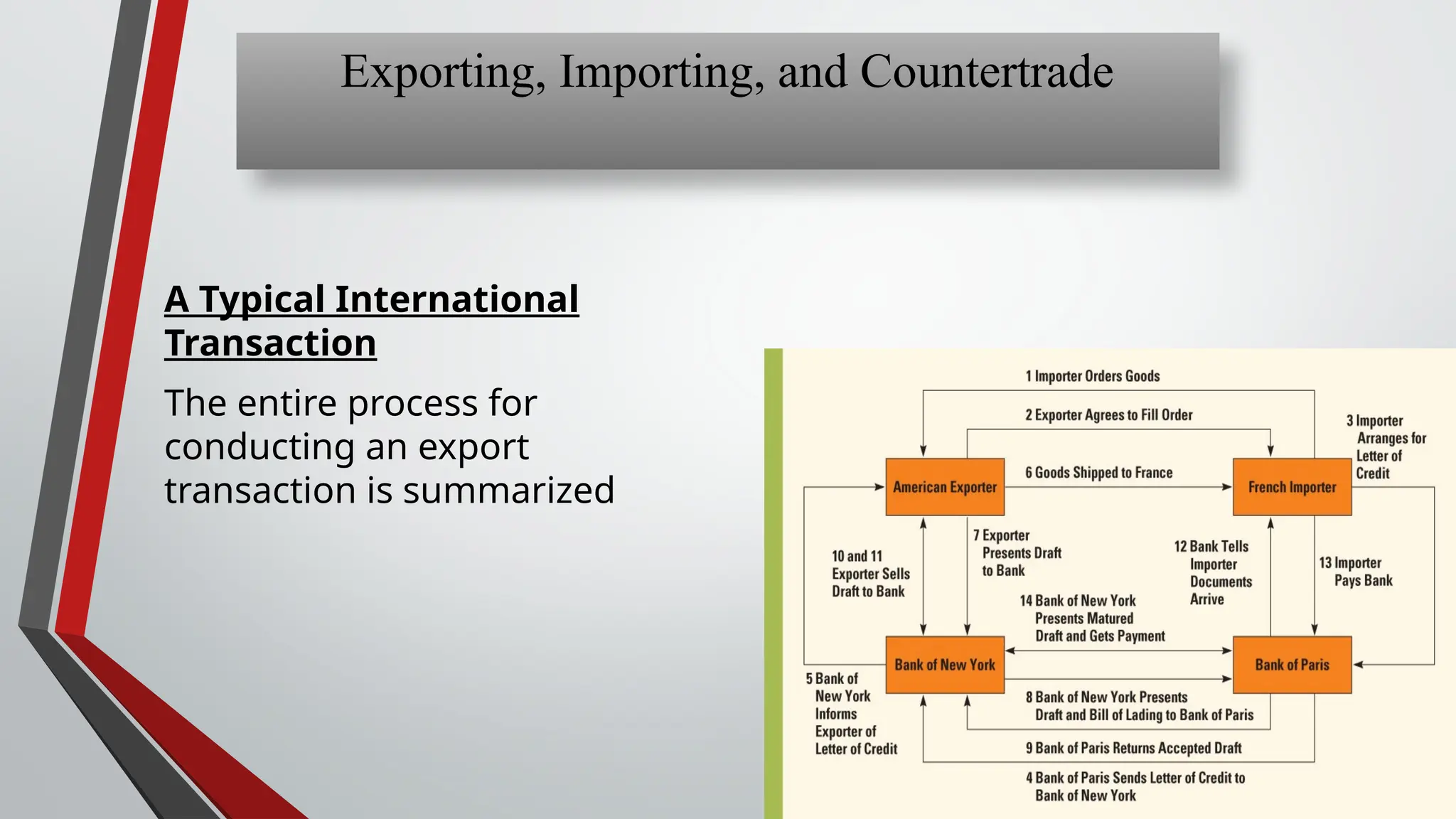
A Typical International
Transaction
The entire process for
conducting an export
transaction is summarized
Exporting, Importing, and Countertrade
EXPORT ASSISTANCE
Prospective U.S. exporters can draw on two forms of
government-backed assistance to help their export programs:
•they can get financing aid from the Export-Import Bank
•they can get export credit insurance from the Foreign Credit
Insurance Association
Exporting, Importing, and Countertrade
Chapter 13: Exporting,
Importing, and Countertrade
Export-Import Bank
• The Export-Import Bank (Exim bank) is an independent agency of the U.S.
government
• Its mission is to provide financing aid that will facilitate exports, imports, and the
exchange of commodities between the U.S. and other countries
Export Credit Insurance
• In the U.S., export credit insurance is provided by the Foreign Credit Insurance
Association (FICA)
• FICA provides coverage against commercial risks and political risks
Exporting, Importing, and Countertrade
Chapter 13: Exporting,
Importing, and Countertrade
COUNTERTRADE
• Countertrade is an alternative means of structuring an
international sale when conventional means of payment
are difficult, costly, or nonexistent
• Countertrade refers to a range of barterlike agreements
that facilitate the trade of goods and services for other
goods and services when they cannot be traded for money
Exporting, Importing, and Countertrade
The Incidence of Countertrade
• Countertrade arose in the 1960s as a way for the Soviet Union and the
Communist states of Eastern Europe, whose currencies were generally
nonconvertible, to purchase imports
• During the 1980s, the technique grew in popularity among many
developing nations that lacked the foreign exchange reserves required to
purchase necessary imports
• There was a notable increase in the volume of countertrade after the
Asian financial crisis of 1997
Exporting, Importing, and Countertrade
Types of Countertrade
Countertrade can be categorized into five distinct types of trading
arrangements:
• barter
• counter purchase
• offset
• switch trading
• compensation or buyback
Exporting, Importing, and Countertrade
Barter is a direct exchange of goods and/or services
between two parties without a cash transaction
• Barter is the most restrictive countertrade arrangement
• It is used primarily for one-time-only deals in transactions
with trading partners who are not creditworthy or
trustworthy
• Counter purchase is a reciprocal buying agreement
• It occurs when a firm agrees to purchase a certain
amount of materials back from a country to which a sale is
made
Exporting, Importing, and Countertrade
• Offset is similar to counterpurchase insofar as one
party agrees to purchase goods and services with a
specified percentage of the proceeds from the original
sale
• The difference is that this party can fulfill the
obligation with any firm in the country to which the sale
is being made
Exporting, Importing, and Countertrade
Switch Trading
• Switch trading refers to the use of a specialized third-party trading
house in a countertrade arrangement
• When a firm enters a counter purchase or offset agreement with a
country, it often ends up with what are called counter purchase
credits, which can be used to purchase goods from that country
• Switch trading occurs when a third-party trading house buys the
firm’s counter purchase credits and sells them to another firm that
can better use them
Exporting, Importing, and Countertrade
Compensation or Buybacks
• A buyback occurs when a firm builds a plant in a country—or supplies
technology, equipment, training, or other services to the country—and
agrees to take a certain percentage of the plant’s output as a partial
payment for the contract
Exporting, Importing, and Countertrade
The Pros and Cons of Countertrade
• Countertrade’s main advantage is that it can give a firm
a way to finance an export deal when other means are not
available
• If a firm is unwilling to enter a countertrade agreement,
it may lose an export opportunity to a competitor that is
willing to make a countertrade agreement
• A countertrade arrangement may be required by the
government of a country to which a firm is exporting
goods or services
Exporting, Importing, and Countertrade
The drawbacks of countertrade are substantial:
• countertrade contracts may involve the exchange of unusable or
poor-quality goods that the firm cannot dispose of profitably
• countertrade is most attractive to large, diverse multinational
enterprises that can use their worldwide network of contacts to
dispose of goods acquired in countertrading
Exporting, Importing, and Countertrade

assignment of International Business in Exporting Importing and Counter trade

  • 1.
    Assgnment of InternationalBusiness Title: Exporting importing countertrade EAST AFRICA COLLEGE Master Of Busıness Admınstratıon Mohammed Abdukadir PGR/OO205/15
  • 3.
    International Business Exporting, Importing,and Countertrade McGraw-Hill/Irwin Global Business Today, 5e © 2008 The McGraw-Hill Companies, Inc., All Rights Reserved.
  • 4.
    Exporting, Importing, andCountertrade INTRODUCTION • Both large and small firms stand to benefit from exporting • The volume of export activity in the world economy is increasing as exporting has become easier • The decline in trade barriers under the WTO along with regional economic agreements such as the European Union and the North American Free Trade Agreement have increased export opportunities • Firms wishing to export must identify export opportunities, avoid a host of unanticipated problems that are often associated with doing business in a foreign market, become familiar with the mechanics of export and import financing , learn where to get financing and export credit insurance, and learn how to deal with foreign exchange risk
  • 5.
    THE PROMISE ANDPITFALLS OF EXPORTING • The potential benefits from exporting can be great--the rest of the world is a much larger market than the domestic market • Larger firms may be proactive in seeking out new export opportunities, but many smaller firms are reactive and only pursue international opportunities when the customer calls or knocks on the door • Many novice exporters have run into significant problems when first trying to do business abroad, souring them on following up on subsequent opportunities Exporting, Importing, and Countertrade
  • 6.
    Common pitfalls include: •poor market analysis • poor understanding of competitive conditions • lack of customization for local markets, poor distribution arrangements, bad promotional campaigns • a general underestimation of the differences and expertise required for foreign market penetration The tremendous paperwork and formalities that must be dealt with can be also be overwhelming for exporters. Exporting, Importing, and Countertrade
  • 7.
    IMPROVING EXPORT PERFORMANCE AnInternational Comparison • One big impediment to exporting is the simple lack of knowledge of the opportunities available • The way to overcome ignorance is to collect information • Both Germany and Japan have developed extensive institutional structures or promoting exports • Japanese exporters can also take advantage of the knowledge and contacts of sogo shosha, the country’s great trading houses Exporting, Importing, and Countertrade
  • 8.
    Information Sources • Themost comprehensive source of information for U.S. firms to increase their awareness of export opportunities is the U.S. Department of Commerce Exporting, Importing, and Countertrade
  • 9.
    Utilizing Export ManagementCompanies Export management companies are export specialists that act as the export marketing department or international department for client firms. EMCs normally accept two types of export assignments: • they start exporting operations for a firm with the understanding that the firm will take over operations after they are well established • they start services with the understanding that the EMC will have continuing responsibility for selling the firm’s products • The advantage of EMCs is that they are experienced specialists who can help the neophyte exporter identify opportunities and avoid common pitfalls • However, there is a large variation in the quality of EMCs, so a careful review of a number of companies should be conducted Exporting, Importing, and Countertrade
  • 10.
    Export Strategy Firms canreduce the risks associated with exporting if they are careful about their choice of exporting strategy. • It helps to hire an EMC, or at least an experienced export consultant, to help with the identification of opportunities and navigate through the tangled web of paperwork and regulations so often involved in exporting • It often makes sense to initially focus on one, or a few, markets • It may make sense to enter a foreign market on a fairly small scale in order to reduce the costs of any subsequent failures Exporting, Importing, and Countertrade
  • 11.
    • The exporterneeds to recognize the time and managerial commitment involved in building export sales, and should hire additional personnel to oversee this activity • In many countries it is important to devote a lot of attention to building strong and enduring relationships with local distributors and customers • It is important to hire local personnel to help the firm establish itself in a foreign market • It is important for the exporter to keep the option of local production in mind Exporting, Importing, and Countertrade
  • 12.
    EXPORT AND IMPORTFINANCING Mechanisms for financing exports and imports have evolved over the centuries in response to a problem that can be particularly acute in international trade: the lack of trust that exists when one must put faith in a stranger. Exporting, Importing, and Countertrade
  • 13.
    Lack of Trust •Firms engaged in international trade have to trust someone who may be very difficult to track down if they default on an obligation • Due to the lack of trust, each party to an international transaction has a different set of preferences regarding the configuration of the transaction • The problems arising from a lack of trust between exporters and importers can be solved by using a third party who is trusted by both - normally a reputable bank Exporting, Importing, and Countertrade
  • 14.
    Letter of Credit •A letter of credit is issued by a bank at the request of an importer and states the bank will pay a specified sum of money to a beneficiary, normally the exporter, on presentation of particular, specified documents Exporting, Importing, and Countertrade
  • 15.
    Draft • A draft,also called a bill of exchange, is the instrument normally used in international commerce for payment • A draft is simply an order written by an exporter instructing an importer, or an importer's agent, to pay a specified amount of money at a specified time • A sight draft is payable on presentation to the drawee while a time draft allows for a delay in payment - normally 30, 60, 90, or 120 days Exporting, Importing, and Countertrade
  • 16.
    Bill of Lading Thebill of lading is issued to the exporter by the common carrier transporting the merchandise. It serves three purposes: • it is a receipt • it is a contract • it is a document of title Exporting, Importing, and Countertrade
  • 17.
    A Typical International Transaction Theentire process for conducting an export transaction is summarized Exporting, Importing, and Countertrade
  • 18.
    EXPORT ASSISTANCE Prospective U.S.exporters can draw on two forms of government-backed assistance to help their export programs: •they can get financing aid from the Export-Import Bank •they can get export credit insurance from the Foreign Credit Insurance Association Exporting, Importing, and Countertrade
  • 19.
    Chapter 13: Exporting, Importing,and Countertrade Export-Import Bank • The Export-Import Bank (Exim bank) is an independent agency of the U.S. government • Its mission is to provide financing aid that will facilitate exports, imports, and the exchange of commodities between the U.S. and other countries Export Credit Insurance • In the U.S., export credit insurance is provided by the Foreign Credit Insurance Association (FICA) • FICA provides coverage against commercial risks and political risks Exporting, Importing, and Countertrade
  • 20.
    Chapter 13: Exporting, Importing,and Countertrade COUNTERTRADE • Countertrade is an alternative means of structuring an international sale when conventional means of payment are difficult, costly, or nonexistent • Countertrade refers to a range of barterlike agreements that facilitate the trade of goods and services for other goods and services when they cannot be traded for money Exporting, Importing, and Countertrade
  • 21.
    The Incidence ofCountertrade • Countertrade arose in the 1960s as a way for the Soviet Union and the Communist states of Eastern Europe, whose currencies were generally nonconvertible, to purchase imports • During the 1980s, the technique grew in popularity among many developing nations that lacked the foreign exchange reserves required to purchase necessary imports • There was a notable increase in the volume of countertrade after the Asian financial crisis of 1997 Exporting, Importing, and Countertrade
  • 22.
    Types of Countertrade Countertradecan be categorized into five distinct types of trading arrangements: • barter • counter purchase • offset • switch trading • compensation or buyback Exporting, Importing, and Countertrade
  • 23.
    Barter is adirect exchange of goods and/or services between two parties without a cash transaction • Barter is the most restrictive countertrade arrangement • It is used primarily for one-time-only deals in transactions with trading partners who are not creditworthy or trustworthy • Counter purchase is a reciprocal buying agreement • It occurs when a firm agrees to purchase a certain amount of materials back from a country to which a sale is made Exporting, Importing, and Countertrade
  • 24.
    • Offset issimilar to counterpurchase insofar as one party agrees to purchase goods and services with a specified percentage of the proceeds from the original sale • The difference is that this party can fulfill the obligation with any firm in the country to which the sale is being made Exporting, Importing, and Countertrade
  • 25.
    Switch Trading • Switchtrading refers to the use of a specialized third-party trading house in a countertrade arrangement • When a firm enters a counter purchase or offset agreement with a country, it often ends up with what are called counter purchase credits, which can be used to purchase goods from that country • Switch trading occurs when a third-party trading house buys the firm’s counter purchase credits and sells them to another firm that can better use them Exporting, Importing, and Countertrade
  • 26.
    Compensation or Buybacks •A buyback occurs when a firm builds a plant in a country—or supplies technology, equipment, training, or other services to the country—and agrees to take a certain percentage of the plant’s output as a partial payment for the contract Exporting, Importing, and Countertrade
  • 27.
    The Pros andCons of Countertrade • Countertrade’s main advantage is that it can give a firm a way to finance an export deal when other means are not available • If a firm is unwilling to enter a countertrade agreement, it may lose an export opportunity to a competitor that is willing to make a countertrade agreement • A countertrade arrangement may be required by the government of a country to which a firm is exporting goods or services Exporting, Importing, and Countertrade
  • 28.
    The drawbacks ofcountertrade are substantial: • countertrade contracts may involve the exchange of unusable or poor-quality goods that the firm cannot dispose of profitably • countertrade is most attractive to large, diverse multinational enterprises that can use their worldwide network of contacts to dispose of goods acquired in countertrading Exporting, Importing, and Countertrade

Editor's Notes

  • #4 Internet Extra: Exporting is often the first step in a company’s international expansion. Some companies may feel that while opportunities for exporting exist, they are not ready to begin the process themselves. Export. Gov {http://www.export.gov/exportbasics/exp_001602.asp} offers a site where companies can explore their export readiness. Go to the site and click on Are You Export Ready. This will bring you to an online quiz where you can see some of the questions a firm should answer prior to beginning the export process. Take the quiz using either an imaginary company as your basis, or a company that you are familiar with. What do your results tell you? How might you help your company be a successful exporter?
  • #9 Management Focus: Exporting with a Little Government Help Summary This feature describes the challenges faced by small firms as they seek to expand their sales through exports. The case notes that there are a number of agencies, institutions, and export management companies that provide assistance to small exporters. The following questions can be helpful in directing the discussion. Suggested Discussion Questions 1. Foreign market expansion can be a daunting prospect, especially for a small company with no international experience. Discuss how Novi, Inc became such a success story in such a short time. What lessons can other companies learn from Novi’s experiences? 2. As a small business owner facing saturated domestic markets, how would you approach foreign markets? Develop a strategic plan outlining how you would research markets, get your product to potential customers, handle the financing side of the business, and grow your sales. Include information on what resources are available to help with this process.
  • #10 Management Focus: Exporting Strategy at 3M Summary This feature explores the Minnesota Mining and Manufacturing Company’s (3M) export strategy. 3M generates more than half its revenues from outside the U.S. The company often uses exports to establish an initial presence in a foreign market, only building foreign production facilities once sales volume rises to a level where local production is justified. Discussion of the feature can begin with the following questions. Suggested Discussion Questions 1. Discuss why 3M initially enters on a small scale. How does the firm’s strategy fit with the philosophy that exporting is not an end in itself, but merely a step on the road toward establishment of foreign production? 2. Explain the three principles that make 3M so successful. Why was it important for 3M to hire local personnel?
  • #11 Management Focus: Red Spot Paint Varnish Summary This feature focuses on Red Spot paint Varnish, a company that produces paints for plastic components used in automobiles. The company relies on foreign markets for some 15-25% of its annual revenue. Generating its foreign sales has not been an easy task according to one employee. The company has found it difficult to hire managers with appropriate international experience and has also struggled with pressures to achieve quick results. The following questions provide a starting point for discussion of this feature. Suggested Discussion Questions 1. How has the Internet made it easier for companies to not only get export assistance but also to find the experienced talent necessary to build an international staff? How has Red Spot Paint been able to capitalize on foreign market opportunities while similar competitors have not? 2. In an era of “time is money,” how can the trusting relationships that are so often critical to the success of a foreign venture be achieved? How important was the establishment of trust between Red Spot Paint and its local distributors and customers to the success of the company?