ME 234 Thermodynamics II 
Assignment No. 1 Due Date : December 08, 2014 
Question No. 1. Consider a simple ideal Brayton cycle with air as the working fluid. The 
pressure ratio of the cycle is 6, and the minimum and maximum temperatures are 300 and 1300 
K, respectively. Now the pressure ratio is doubled without changing the minimum and maximum 
temperatures in the cycle. Determine the change in (a) the net-work output per unit mass and (b) 
the thermal efficiency of the cycle as a result of this modification. Assume constant specific heats 
for air. 
Question No. 2. An ideal Otto cycle has a compression ratio of 9.2 and uses air as the 
working fluid. At the beginning of the compression process, air is at 98 kPa and 27°C. The 
pressure is doubled during the constant-volume heat-addition process. Accounting for the 
variation of specific heats with temperature, determine (a) the amount of heat transferred to the 
air, (b) the net work output, (c) the thermal efficiency, and (d) the mean effective pressure for the 
cycle. 
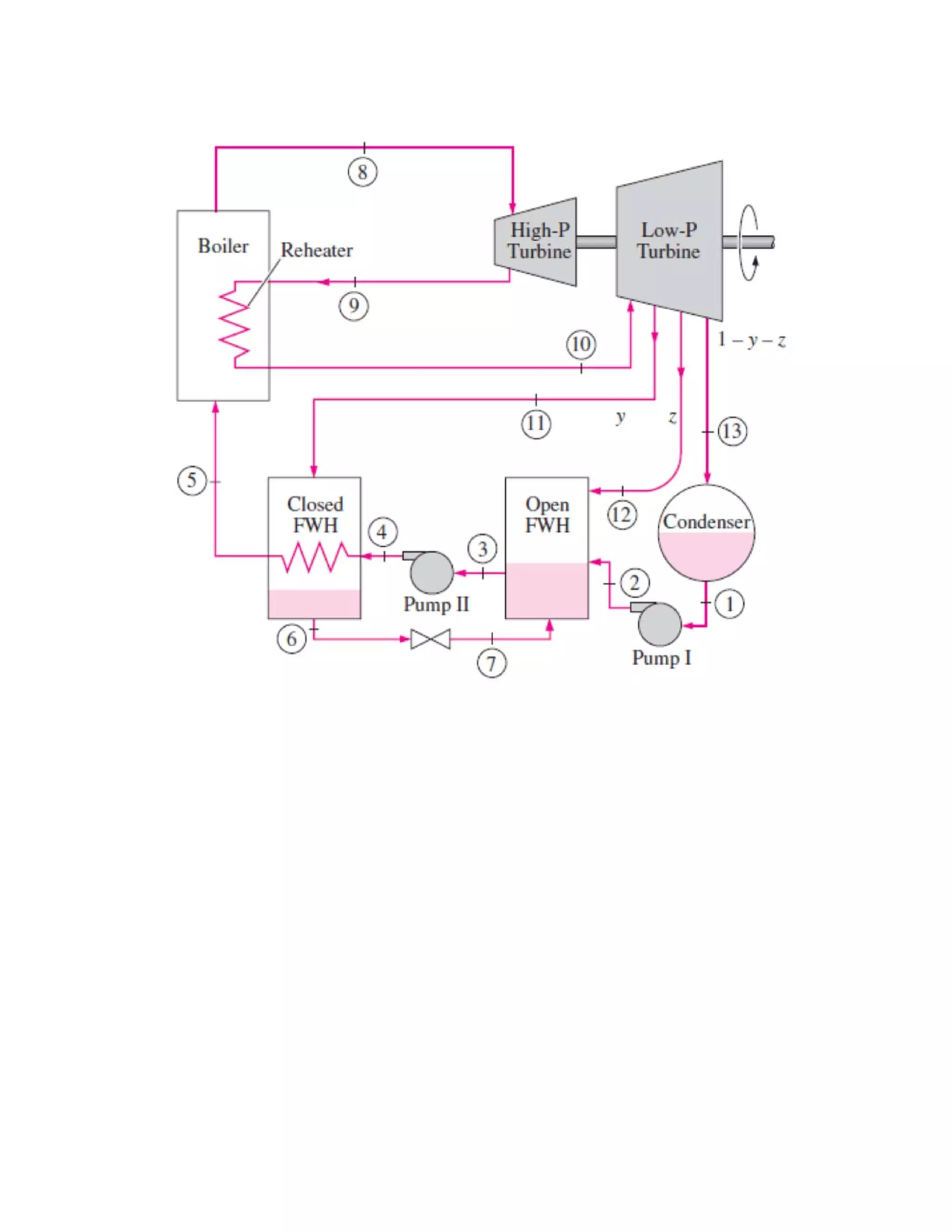
Question No. 3. A steam power plant operates on an ideal reheat–regenerative Rankine 
cycle with one reheater and two feedwater heaters, one open and one closed. Steam enters the 
high-pressure turbine at 15 MPa and 600°C and the low pressure turbine at 1 MPa and 500°C. 
The condenser pressure is 5 kPa. Steam is extracted from the turbine at 0.6 MPa for the closed 
feedwater heater and at 0.2 MPa for the open feedwater heater. In the closed feedwater heater, 
the feedwater is heated to the condensation temperature of the extracted steam. The extracted 
steam leaves the closed feedwater heater as a saturated liquid, which is subsequently throttled 
to the open feedwater heater. Show the cycle on a T-s diagram with respect to saturation lines. 
Determine (a) the fraction of steam extracted from the turbine for the open feedwater heater, (b) 
the thermal efficiency of the cycle, and (c) the net power output for a mass flow rate of 42 kg/s 
through the boiler.
Assignment 1

Assignment 1

  • 1.
    ME 234 ThermodynamicsII Assignment No. 1 Due Date : December 08, 2014 Question No. 1. Consider a simple ideal Brayton cycle with air as the working fluid. The pressure ratio of the cycle is 6, and the minimum and maximum temperatures are 300 and 1300 K, respectively. Now the pressure ratio is doubled without changing the minimum and maximum temperatures in the cycle. Determine the change in (a) the net-work output per unit mass and (b) the thermal efficiency of the cycle as a result of this modification. Assume constant specific heats for air. Question No. 2. An ideal Otto cycle has a compression ratio of 9.2 and uses air as the working fluid. At the beginning of the compression process, air is at 98 kPa and 27°C. The pressure is doubled during the constant-volume heat-addition process. Accounting for the variation of specific heats with temperature, determine (a) the amount of heat transferred to the air, (b) the net work output, (c) the thermal efficiency, and (d) the mean effective pressure for the cycle. Question No. 3. A steam power plant operates on an ideal reheat–regenerative Rankine cycle with one reheater and two feedwater heaters, one open and one closed. Steam enters the high-pressure turbine at 15 MPa and 600°C and the low pressure turbine at 1 MPa and 500°C. The condenser pressure is 5 kPa. Steam is extracted from the turbine at 0.6 MPa for the closed feedwater heater and at 0.2 MPa for the open feedwater heater. In the closed feedwater heater, the feedwater is heated to the condensation temperature of the extracted steam. The extracted steam leaves the closed feedwater heater as a saturated liquid, which is subsequently throttled to the open feedwater heater. Show the cycle on a T-s diagram with respect to saturation lines. Determine (a) the fraction of steam extracted from the turbine for the open feedwater heater, (b) the thermal efficiency of the cycle, and (c) the net power output for a mass flow rate of 42 kg/s through the boiler.