REPUBLIC COLLEGES OF GUINOBATAN, INC.
College of Education
G. Alban St., Iraya, Guinobatan, Albay
I. DETAILED COURSE OUTLINE
ASSESSMENT of LEARNING 1
_________________________
__________________________
COURSE CODE : Prof.Educ.6 PROGRAM :
CLASS SCHEDULE : Saturday(8:00am-11:00am) CREDITS : 3
INSTRUCTOR : Yvonne P.Arnesto PRE-REQUISITE : None
INSTITUTION MVG:
Mission
The school is committed to pursue its mission of integrating its effort in maintaining and supporting an adequate and integrated system of
education relevant to the needs of the community and of the country in general, guided effectively by the theory and sound practice of essential
competencies, skills and values for life-long learning employment .The school should accelerate research for discovery and acquisition of new
knowledge to compete globally based on sound curriculum that is at par with international standards.
Vision
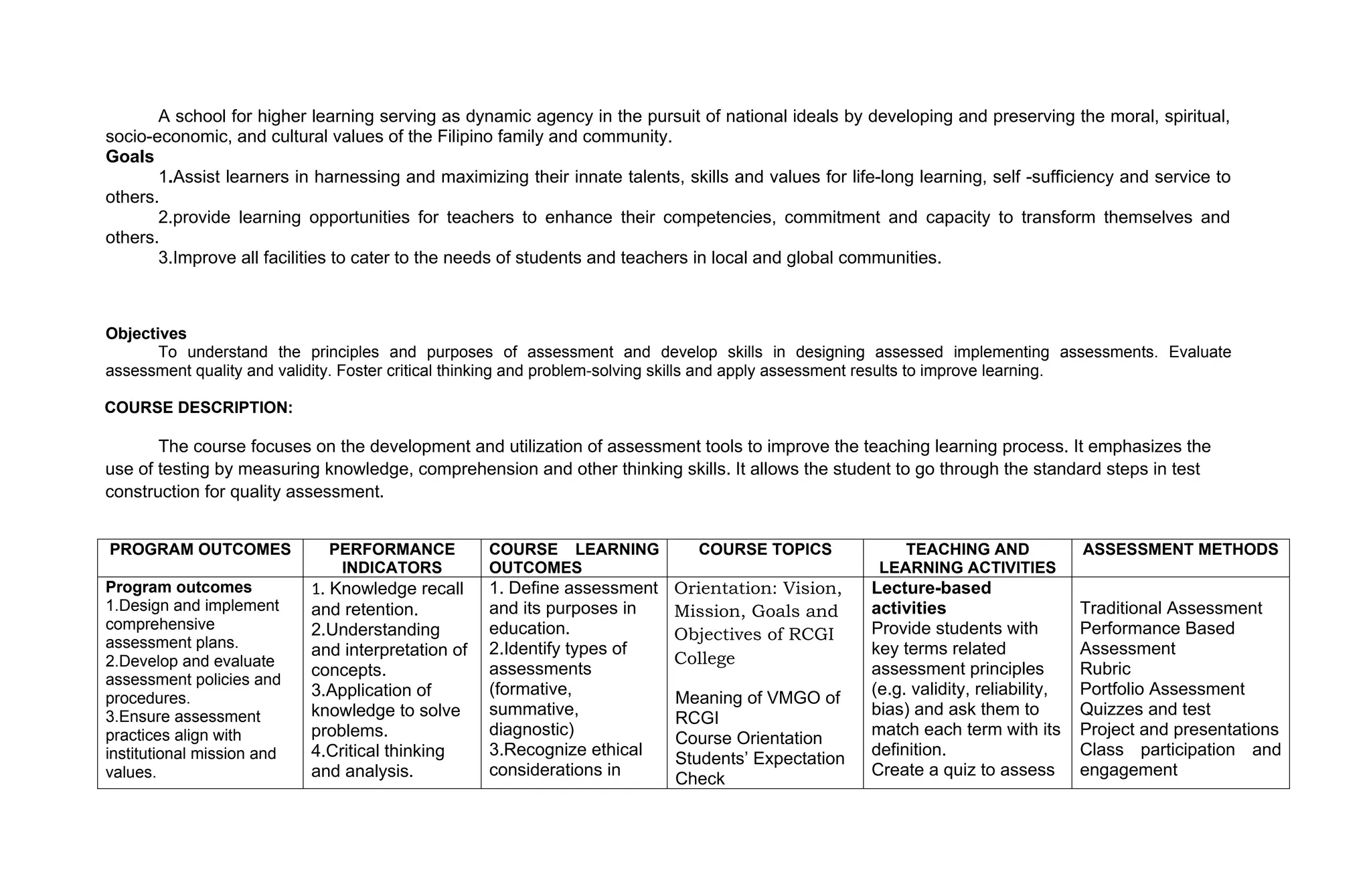
A school for higher learning serving as dynamic agency in the pursuit of national ideals by developing and preserving the moral, spiritual,
socio-economic, and cultural values of the Filipino family and community.
Goals
1.Assist learners in harnessing and maximizing their innate talents, skills and values for life-long learning, self -sufficiency and service to
others.
2.provide learning opportunities for teachers to enhance their competencies, commitment and capacity to transform themselves and
others.
3.Improve all facilities to cater to the needs of students and teachers in local and global communities.
Objectives
To understand the principles and purposes of assessment and develop skills in designing assessed implementing assessments. Evaluate
assessment quality and validity. Foster critical thinking and problem-solving skills and apply assessment results to improve learning.
COURSE DESCRIPTION:
The course focuses on the development and utilization of assessment tools to improve the teaching learning process. It emphasizes the
use of testing by measuring knowledge, comprehension and other thinking skills. It allows the student to go through the standard steps in test
construction for quality assessment.
PROGRAM OUTCOMES PERFORMANCE
INDICATORS
COURSE LEARNING
OUTCOMES
COURSE TOPICS TEACHING AND
LEARNING ACTIVITIES
ASSESSMENT METHODS
Program outcomes
1.Design and implement
comprehensive
assessment plans.
2.Develop and evaluate
assessment policies and
procedures.
3.Ensure assessment
practices align with
institutional mission and
values.
1. Knowledge recall
and retention.
2.Understanding
and interpretation of
concepts.
3.Application of
knowledge to solve
problems.
4.Critical thinking
and analysis.
1. Define assessment
and its purposes in
education.
2.Identify types of
assessments
(formative,
summative,
diagnostic)
3.Recognize ethical
considerations in
Orientation: Vision,
Mission, Goals and
Objectives of RCGI
College
Meaning of VMGO of
RCGI
Course Orientation
Students’ Expectation
Check
Lecture-based
activities
Provide students with
key terms related
assessment principles
(e.g. validity, reliability,
bias) and ask them to
match each term with its
definition.
Create a quiz to assess
Traditional Assessment
Performance Based
Assessment
Rubric
Portfolio Assessment
Quizzes and test
Project and presentations
Class participation and
engagement
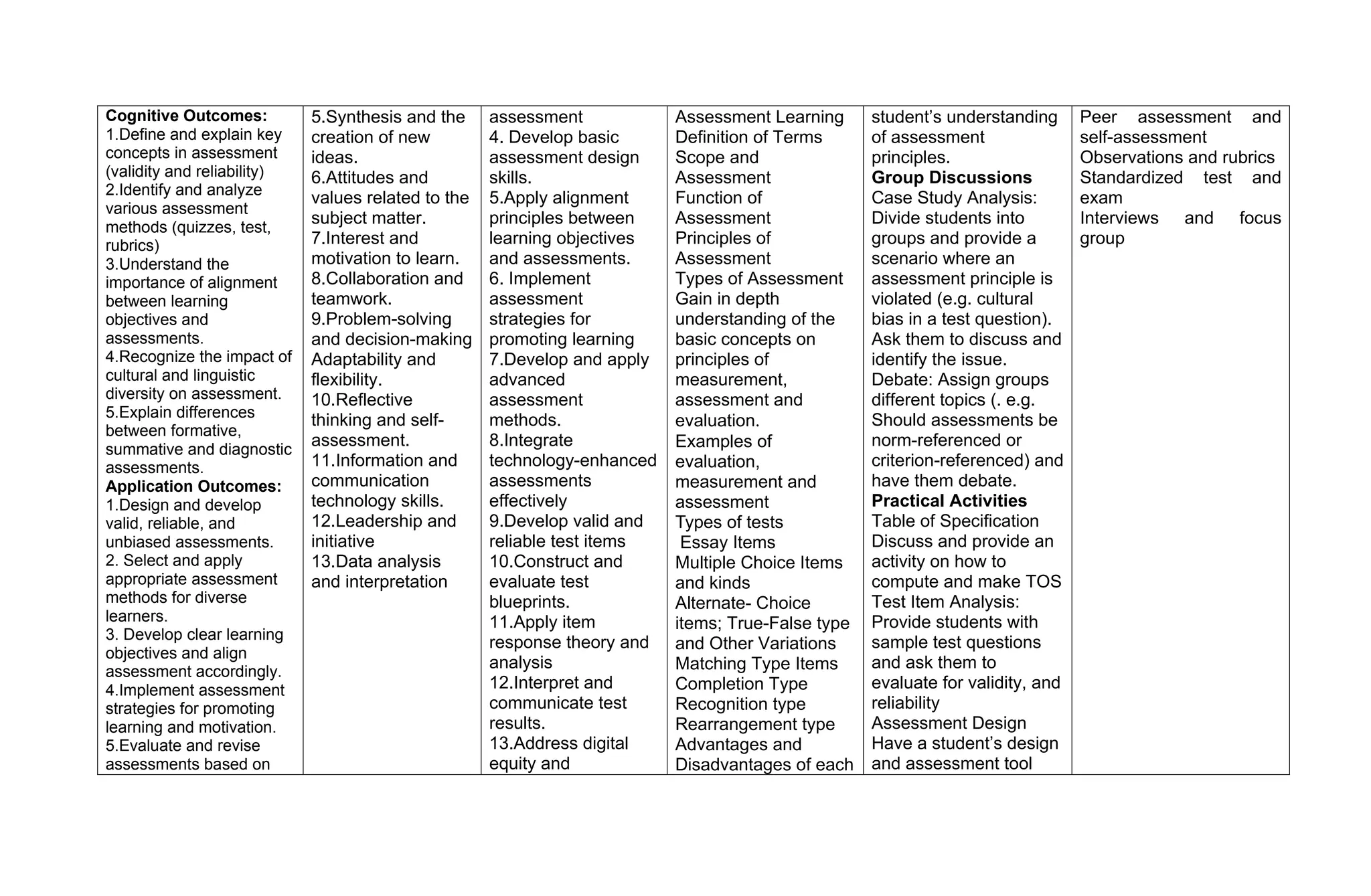
Cognitive Outcomes:
1.Define and explain key
concepts in assessment
(validity and reliability)
2.Identify and analyze
various assessment
methods (quizzes, test,
rubrics)
3.Understand the
importance of alignment
between learning
objectives and
assessments.
4.Recognize the impact of
cultural and linguistic
diversity on assessment.
5.Explain differences
between formative,
summative and diagnostic
assessments.
Application Outcomes:
1.Design and develop
valid, reliable, and
unbiased assessments.
2. Select and apply
appropriate assessment
methods for diverse
learners.
3. Develop clear learning
objectives and align
assessment accordingly.
4.Implement assessment
strategies for promoting
learning and motivation.
5.Evaluate and revise
assessments based on
5.Synthesis and the
creation of new
ideas.
6.Attitudes and
values related to the
subject matter.
7.Interest and
motivation to learn.
8.Collaboration and
teamwork.
9.Problem-solving
and decision-making
Adaptability and
flexibility.
10.Reflective
thinking and self-
assessment.
11.Information and
communication
technology skills.
12.Leadership and
initiative
13.Data analysis
and interpretation
assessment
4. Develop basic
assessment design
skills.
5.Apply alignment
principles between
learning objectives
and assessments.
6. Implement
assessment
strategies for
promoting learning
7.Develop and apply
advanced
assessment
methods.
8.Integrate
technology-enhanced
assessments
effectively
9.Develop valid and
reliable test items
10.Construct and
evaluate test
blueprints.
11.Apply item
response theory and
analysis
12.Interpret and
communicate test
results.
13.Address digital
equity and
Assessment Learning
Definition of Terms
Scope and
Assessment
Function of
Assessment
Principles of
Assessment
Types of Assessment
Gain in depth
understanding of the
basic concepts on
principles of
measurement,
assessment and
evaluation.
Examples of
evaluation,
measurement and
assessment
Types of tests
Essay Items
Multiple Choice Items
and kinds
Alternate- Choice
items; True-False type
and Other Variations
Matching Type Items
Completion Type
Recognition type
Rearrangement type
Advantages and
Disadvantages of each
student’s understanding
of assessment
principles.
Group Discussions
Case Study Analysis:
Divide students into
groups and provide a
scenario where an
assessment principle is
violated (e.g. cultural
bias in a test question).
Ask them to discuss and
identify the issue.
Debate: Assign groups
different topics (. e.g.
Should assessments be
norm-referenced or
criterion-referenced) and
have them debate.
Practical Activities
Table of Specification
Discuss and provide an
activity on how to
compute and make TOS
Test Item Analysis:
Provide students with
sample test questions
and ask them to
evaluate for validity, and
reliability
Assessment Design
Have a student’s design
and assessment tool
Peer assessment and
self-assessment
Observations and rubrics
Standardized test and
exam
Interviews and focus
group
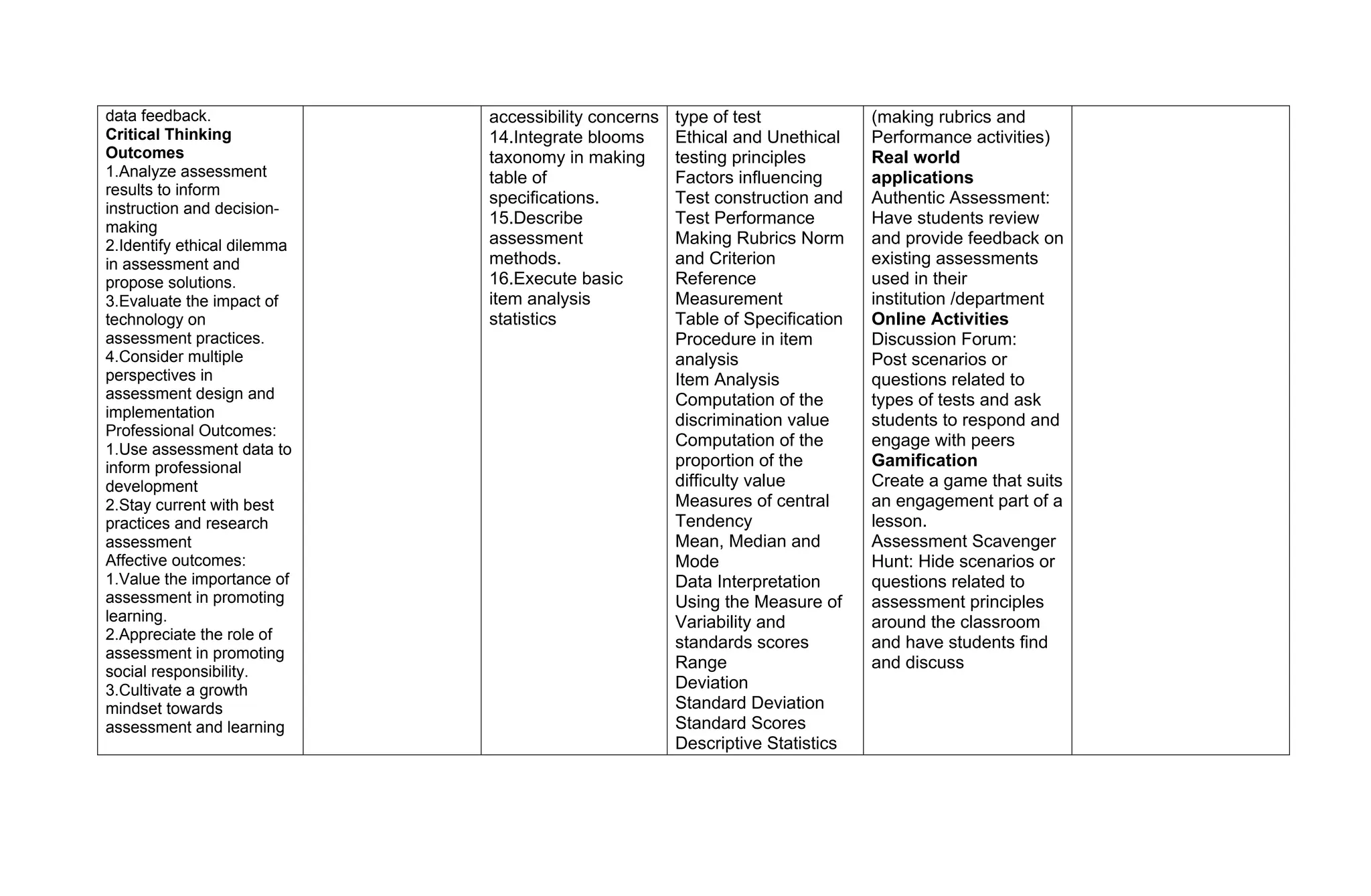
data feedback.
Critical Thinking
Outcomes
1.Analyze assessment
results to inform
instruction and decision-
making
2.Identify ethical dilemma
in assessment and
propose solutions.
3.Evaluate the impact of
technology on
assessment practices.
4.Consider multiple
perspectives in
assessment design and
implementation
Professional Outcomes:
1.Use assessment data to
inform professional
development
2.Stay current with best
practices and research
assessment
Affective outcomes:
1.Value the importance of
assessment in promoting
learning.
2.Appreciate the role of
assessment in promoting
social responsibility.
3.Cultivate a growth
mindset towards
assessment and learning
accessibility concerns
14.Integrate blooms
taxonomy in making
table of
specifications.
15.Describe
assessment
methods.
16.Execute basic
item analysis
statistics
type of test
Ethical and Unethical
testing principles
Factors influencing
Test construction and
Test Performance
Making Rubrics Norm
and Criterion
Reference
Measurement
Table of Specification
Procedure in item
analysis
Item Analysis
Computation of the
discrimination value
Computation of the
proportion of the
difficulty value
Measures of central
Tendency
Mean, Median and
Mode
Data Interpretation
Using the Measure of
Variability and
standards scores
Range
Deviation
Standard Deviation
Standard Scores
Descriptive Statistics
(making rubrics and
Performance activities)
Real world
applications
Authentic Assessment:
Have students review
and provide feedback on
existing assessments
used in their
institution /department
Online Activities
Discussion Forum:
Post scenarios or
questions related to
types of tests and ask
students to respond and
engage with peers
Gamification
Create a game that suits
an engagement part of a
lesson.
Assessment Scavenger
Hunt: Hide scenarios or
questions related to
assessment principles
around the classroom
and have students find
and discuss
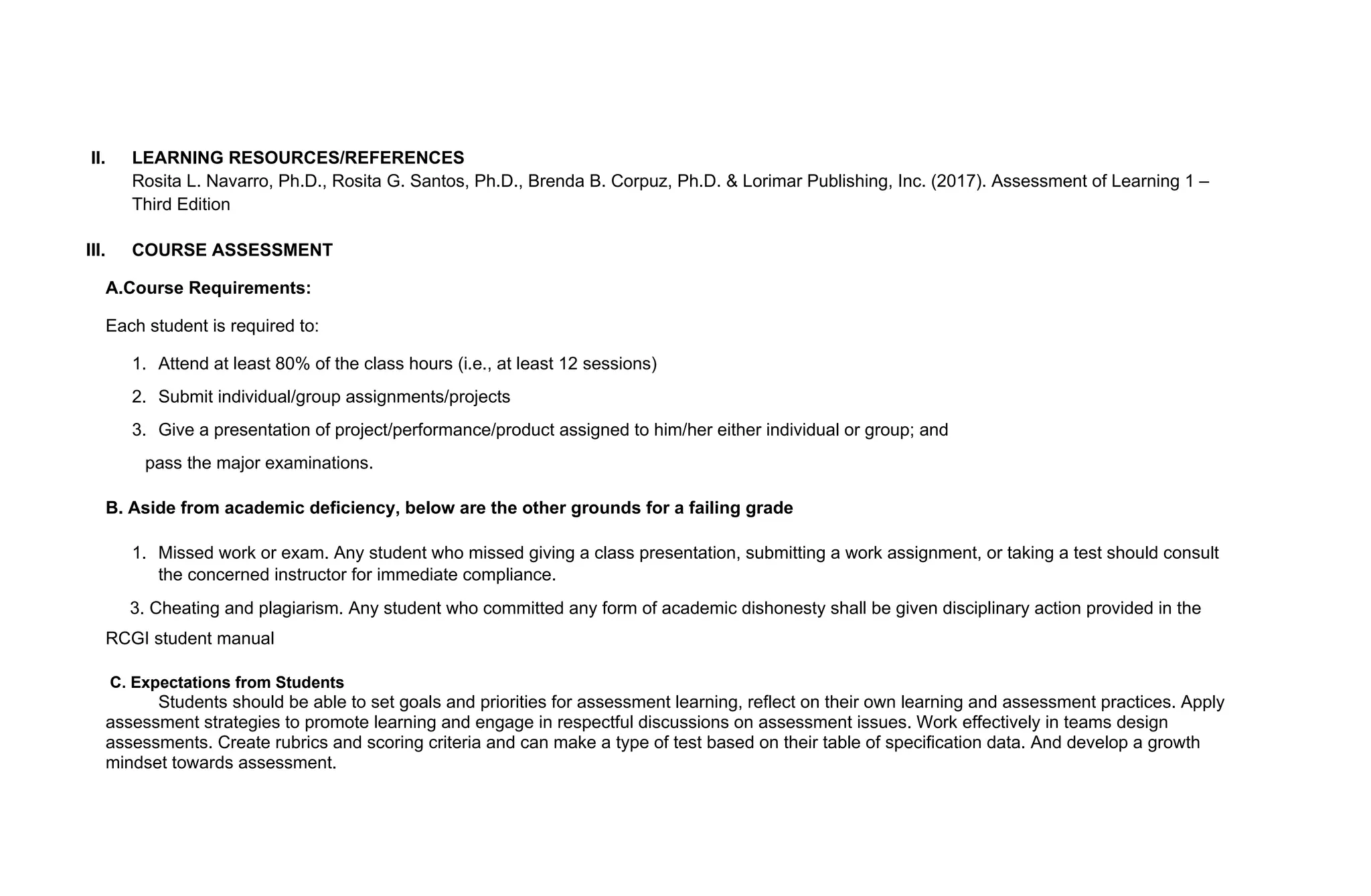
II. LEARNING RESOURCES/REFERENCES
Rosita L. Navarro, Ph.D., Rosita G. Santos, Ph.D., Brenda B. Corpuz, Ph.D. & Lorimar Publishing, Inc. (2017). Assessment of Learning 1 –
Third Edition
III. COURSE ASSESSMENT
A.Course Requirements:
Each student is required to:
1. Attend at least 80% of the class hours (i.e., at least 12 sessions)
2. Submit individual/group assignments/projects
3. Give a presentation of project/performance/product assigned to him/her either individual or group; and
pass the major examinations.
B. Aside from academic deficiency, below are the other grounds for a failing grade
1. Missed work or exam. Any student who missed giving a class presentation, submitting a work assignment, or taking a test should consult
the concerned instructor for immediate compliance.
3. Cheating and plagiarism. Any student who committed any form of academic dishonesty shall be given disciplinary action provided in the
RCGI student manual
C. Expectations from Students
Students should be able to set goals and priorities for assessment learning, reflect on their own learning and assessment practices. Apply
assessment strategies to promote learning and engage in respectful discussions on assessment issues. Work effectively in teams design
assessments. Create rubrics and scoring criteria and can make a type of test based on their table of specification data. And develop a growth
mindset towards assessment.
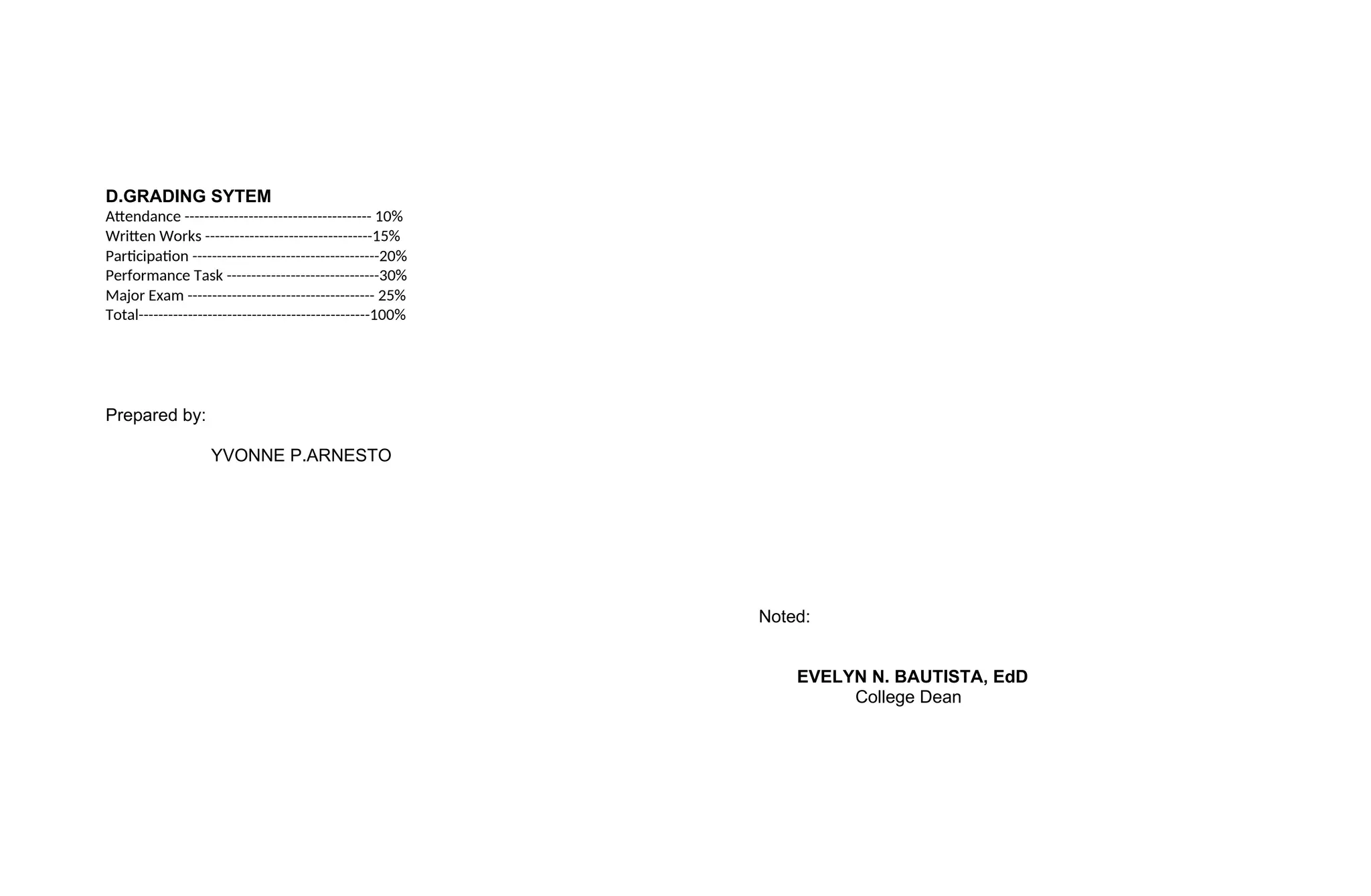
D.GRADING SYTEM
Attendance -------------------------------------- 10%
Written Works ----------------------------------15%
Participation --------------------------------------20%
Performance Task -------------------------------30%
Major Exam -------------------------------------- 25%
Total-----------------------------------------------100%
Prepared by:
YVONNE P.ARNESTO
Noted:
EVELYN N. BAUTISTA, EdD
College Dean
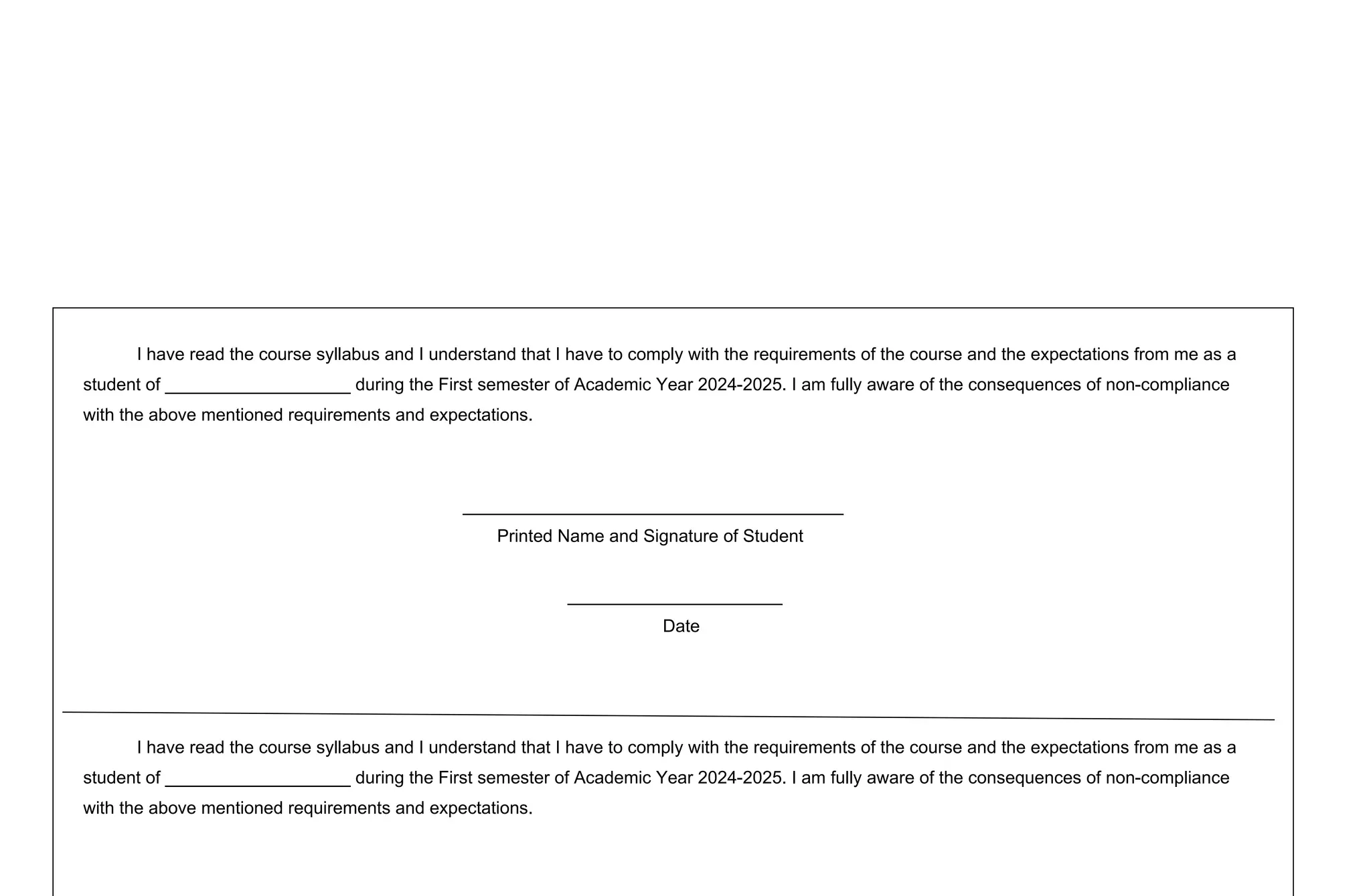
I have read the course syllabus and I understand that I have to comply with the requirements of the course and the expectations from me as a
student of ___________________ during the First semester of Academic Year 2024-2025. I am fully aware of the consequences of non-compliance
with the above mentioned requirements and expectations.
_______________________________________
Printed Name and Signature of Student
______________________
Date
I have read the course syllabus and I understand that I have to comply with the requirements of the course and the expectations from me as a
student of ___________________ during the First semester of Academic Year 2024-2025. I am fully aware of the consequences of non-compliance
with the above mentioned requirements and expectations.

Assessment-SYLLABUS document for college

  • 1.
    REPUBLIC COLLEGES OFGUINOBATAN, INC. College of Education G. Alban St., Iraya, Guinobatan, Albay I. DETAILED COURSE OUTLINE ASSESSMENT of LEARNING 1 _________________________ __________________________ COURSE CODE : Prof.Educ.6 PROGRAM : CLASS SCHEDULE : Saturday(8:00am-11:00am) CREDITS : 3 INSTRUCTOR : Yvonne P.Arnesto PRE-REQUISITE : None INSTITUTION MVG: Mission The school is committed to pursue its mission of integrating its effort in maintaining and supporting an adequate and integrated system of education relevant to the needs of the community and of the country in general, guided effectively by the theory and sound practice of essential competencies, skills and values for life-long learning employment .The school should accelerate research for discovery and acquisition of new knowledge to compete globally based on sound curriculum that is at par with international standards. Vision
  • 2.
    A school forhigher learning serving as dynamic agency in the pursuit of national ideals by developing and preserving the moral, spiritual, socio-economic, and cultural values of the Filipino family and community. Goals 1.Assist learners in harnessing and maximizing their innate talents, skills and values for life-long learning, self -sufficiency and service to others. 2.provide learning opportunities for teachers to enhance their competencies, commitment and capacity to transform themselves and others. 3.Improve all facilities to cater to the needs of students and teachers in local and global communities. Objectives To understand the principles and purposes of assessment and develop skills in designing assessed implementing assessments. Evaluate assessment quality and validity. Foster critical thinking and problem-solving skills and apply assessment results to improve learning. COURSE DESCRIPTION: The course focuses on the development and utilization of assessment tools to improve the teaching learning process. It emphasizes the use of testing by measuring knowledge, comprehension and other thinking skills. It allows the student to go through the standard steps in test construction for quality assessment. PROGRAM OUTCOMES PERFORMANCE INDICATORS COURSE LEARNING OUTCOMES COURSE TOPICS TEACHING AND LEARNING ACTIVITIES ASSESSMENT METHODS Program outcomes 1.Design and implement comprehensive assessment plans. 2.Develop and evaluate assessment policies and procedures. 3.Ensure assessment practices align with institutional mission and values. 1. Knowledge recall and retention. 2.Understanding and interpretation of concepts. 3.Application of knowledge to solve problems. 4.Critical thinking and analysis. 1. Define assessment and its purposes in education. 2.Identify types of assessments (formative, summative, diagnostic) 3.Recognize ethical considerations in Orientation: Vision, Mission, Goals and Objectives of RCGI College Meaning of VMGO of RCGI Course Orientation Students’ Expectation Check Lecture-based activities Provide students with key terms related assessment principles (e.g. validity, reliability, bias) and ask them to match each term with its definition. Create a quiz to assess Traditional Assessment Performance Based Assessment Rubric Portfolio Assessment Quizzes and test Project and presentations Class participation and engagement
  • 3.
    Cognitive Outcomes: 1.Define andexplain key concepts in assessment (validity and reliability) 2.Identify and analyze various assessment methods (quizzes, test, rubrics) 3.Understand the importance of alignment between learning objectives and assessments. 4.Recognize the impact of cultural and linguistic diversity on assessment. 5.Explain differences between formative, summative and diagnostic assessments. Application Outcomes: 1.Design and develop valid, reliable, and unbiased assessments. 2. Select and apply appropriate assessment methods for diverse learners. 3. Develop clear learning objectives and align assessment accordingly. 4.Implement assessment strategies for promoting learning and motivation. 5.Evaluate and revise assessments based on 5.Synthesis and the creation of new ideas. 6.Attitudes and values related to the subject matter. 7.Interest and motivation to learn. 8.Collaboration and teamwork. 9.Problem-solving and decision-making Adaptability and flexibility. 10.Reflective thinking and self- assessment. 11.Information and communication technology skills. 12.Leadership and initiative 13.Data analysis and interpretation assessment 4. Develop basic assessment design skills. 5.Apply alignment principles between learning objectives and assessments. 6. Implement assessment strategies for promoting learning 7.Develop and apply advanced assessment methods. 8.Integrate technology-enhanced assessments effectively 9.Develop valid and reliable test items 10.Construct and evaluate test blueprints. 11.Apply item response theory and analysis 12.Interpret and communicate test results. 13.Address digital equity and Assessment Learning Definition of Terms Scope and Assessment Function of Assessment Principles of Assessment Types of Assessment Gain in depth understanding of the basic concepts on principles of measurement, assessment and evaluation. Examples of evaluation, measurement and assessment Types of tests Essay Items Multiple Choice Items and kinds Alternate- Choice items; True-False type and Other Variations Matching Type Items Completion Type Recognition type Rearrangement type Advantages and Disadvantages of each student’s understanding of assessment principles. Group Discussions Case Study Analysis: Divide students into groups and provide a scenario where an assessment principle is violated (e.g. cultural bias in a test question). Ask them to discuss and identify the issue. Debate: Assign groups different topics (. e.g. Should assessments be norm-referenced or criterion-referenced) and have them debate. Practical Activities Table of Specification Discuss and provide an activity on how to compute and make TOS Test Item Analysis: Provide students with sample test questions and ask them to evaluate for validity, and reliability Assessment Design Have a student’s design and assessment tool Peer assessment and self-assessment Observations and rubrics Standardized test and exam Interviews and focus group
  • 4.
    data feedback. Critical Thinking Outcomes 1.Analyzeassessment results to inform instruction and decision- making 2.Identify ethical dilemma in assessment and propose solutions. 3.Evaluate the impact of technology on assessment practices. 4.Consider multiple perspectives in assessment design and implementation Professional Outcomes: 1.Use assessment data to inform professional development 2.Stay current with best practices and research assessment Affective outcomes: 1.Value the importance of assessment in promoting learning. 2.Appreciate the role of assessment in promoting social responsibility. 3.Cultivate a growth mindset towards assessment and learning accessibility concerns 14.Integrate blooms taxonomy in making table of specifications. 15.Describe assessment methods. 16.Execute basic item analysis statistics type of test Ethical and Unethical testing principles Factors influencing Test construction and Test Performance Making Rubrics Norm and Criterion Reference Measurement Table of Specification Procedure in item analysis Item Analysis Computation of the discrimination value Computation of the proportion of the difficulty value Measures of central Tendency Mean, Median and Mode Data Interpretation Using the Measure of Variability and standards scores Range Deviation Standard Deviation Standard Scores Descriptive Statistics (making rubrics and Performance activities) Real world applications Authentic Assessment: Have students review and provide feedback on existing assessments used in their institution /department Online Activities Discussion Forum: Post scenarios or questions related to types of tests and ask students to respond and engage with peers Gamification Create a game that suits an engagement part of a lesson. Assessment Scavenger Hunt: Hide scenarios or questions related to assessment principles around the classroom and have students find and discuss
  • 5.
    II. LEARNING RESOURCES/REFERENCES RositaL. Navarro, Ph.D., Rosita G. Santos, Ph.D., Brenda B. Corpuz, Ph.D. & Lorimar Publishing, Inc. (2017). Assessment of Learning 1 – Third Edition III. COURSE ASSESSMENT A.Course Requirements: Each student is required to: 1. Attend at least 80% of the class hours (i.e., at least 12 sessions) 2. Submit individual/group assignments/projects 3. Give a presentation of project/performance/product assigned to him/her either individual or group; and pass the major examinations. B. Aside from academic deficiency, below are the other grounds for a failing grade 1. Missed work or exam. Any student who missed giving a class presentation, submitting a work assignment, or taking a test should consult the concerned instructor for immediate compliance. 3. Cheating and plagiarism. Any student who committed any form of academic dishonesty shall be given disciplinary action provided in the RCGI student manual C. Expectations from Students Students should be able to set goals and priorities for assessment learning, reflect on their own learning and assessment practices. Apply assessment strategies to promote learning and engage in respectful discussions on assessment issues. Work effectively in teams design assessments. Create rubrics and scoring criteria and can make a type of test based on their table of specification data. And develop a growth mindset towards assessment.
  • 6.
    D.GRADING SYTEM Attendance --------------------------------------10% Written Works ----------------------------------15% Participation --------------------------------------20% Performance Task -------------------------------30% Major Exam -------------------------------------- 25% Total-----------------------------------------------100% Prepared by: YVONNE P.ARNESTO Noted: EVELYN N. BAUTISTA, EdD College Dean
  • 7.
    I have readthe course syllabus and I understand that I have to comply with the requirements of the course and the expectations from me as a student of ___________________ during the First semester of Academic Year 2024-2025. I am fully aware of the consequences of non-compliance with the above mentioned requirements and expectations. _______________________________________ Printed Name and Signature of Student ______________________ Date I have read the course syllabus and I understand that I have to comply with the requirements of the course and the expectations from me as a student of ___________________ during the First semester of Academic Year 2024-2025. I am fully aware of the consequences of non-compliance with the above mentioned requirements and expectations.