VINAYAKA EDUCATION SOCIETY(R)
NATIONAL COLLEGE OF EDUCATION
Harihara road, hosapete
BACHELOR OF EDUCATION [B.ED]
1st year 2nd semester
2023-2024
PAPER TITLE: PEC-4 : Learning and
Teaching process
Seminar Topic: Asessment of learning
and Assessment for learning
Guided by: M Karthik sir
Assistant professor of
National B.Ed college
Presented by: Anusha TM
2nd semester
Reg no: U16NH23E0023
INDEX
1. Introduction
2. Meaning of assessment
3. Definitions of assessment
4. Characteristics of assessment
5. Types of assessment
6. Meaning and definition of Assessment of
learning
7. Meaning and definition of Assessment for
learning
8. Difference between Assessment of
learning and Assessment for learning
9. Conclusion
Introduction
Assessment refers to the process of gathering
pieces of information about learn's skills,abilities
and knowledge.It also provides feedback on
students performance to encourage them for
further learning.
Although this term is used as the
interchangeably with the terms "evaluation
"and "testing".
Meaning of
assessment
The word ASSESS comes from the Latin word
ASSIDERE means "to sit with".
• Assessment is a continuous process and
helps in decision making which can be used
in numerous ways in educational situation.
• Assessment = measurement + Evaluation
• Assessment is the end step in the process of
evaluation.
Definitions of Assessment
• According to Bransford :- "A process for
documenting, in measurable terms, the
knowledge,skills,attitudes and beliefs of the learner
is assessment".
• According to Murry print :- "Assessment involves
the interpretation of measurement data.it makes
sense of data collected in students performance".
• According to Allen :- "Assessment involves the use
of empirical data on student learning to refine
programs and improve students learning".
Characteristics of
Assessment
• Assessment is valid and reliable.
• Value beyond the assessment itself.
• Accept students constructed response.
• Collecting of data through multiple sources.
• It provides multidimensional scores.
• It provides opportunities for close observation of
students in the process of learning.
• Classroom assessment involves students and
teachers in continuous monitoring of students
Learning.
Types of assessment
1. DIAGNOSTIC ASSESSMENT :- It
happens at the beginning of the lesson,
unit, course or academic program.
2. FORMATIVE ASSESSMENT :- In-
process assessment designed for
practice and feedback.
3. SUMMATIVE ASSESSMENT :- Aims to
assess the levels of learning at the end
of an instructional period.
Meaning and definition of
Assessment of learning
• Meaning of Assessment of learning :- It is a final
evaluation of what students have learned at the end
of a learning period, usually through a test or exam,
to measure their overall achievement against set
standards.
• Definition of Assessment of learning :- It refers to a
summative evaluation method used to measure a
student's final achievement against specific learning
outcomes at the end of a learning period, often
through a test or exam.
• Examples :- Final exams, standardized tests.
Meaning and definition of
Assessment for learning
• Meaning of Assessment for learning :- It refers to an
ongoing process of gathering information about
students understanding during the learning process to
guide instruction and improve their progress.
• Definition of Assessment for learning :- It is a formative
approach that involves ongoing feedback throughout
the learning process to guide instruction and improve
student understanding, allowing teachers to adjust
their teaching based on student.
• Examples :- Quick quizzes, classroom discussion, self-
assessment.
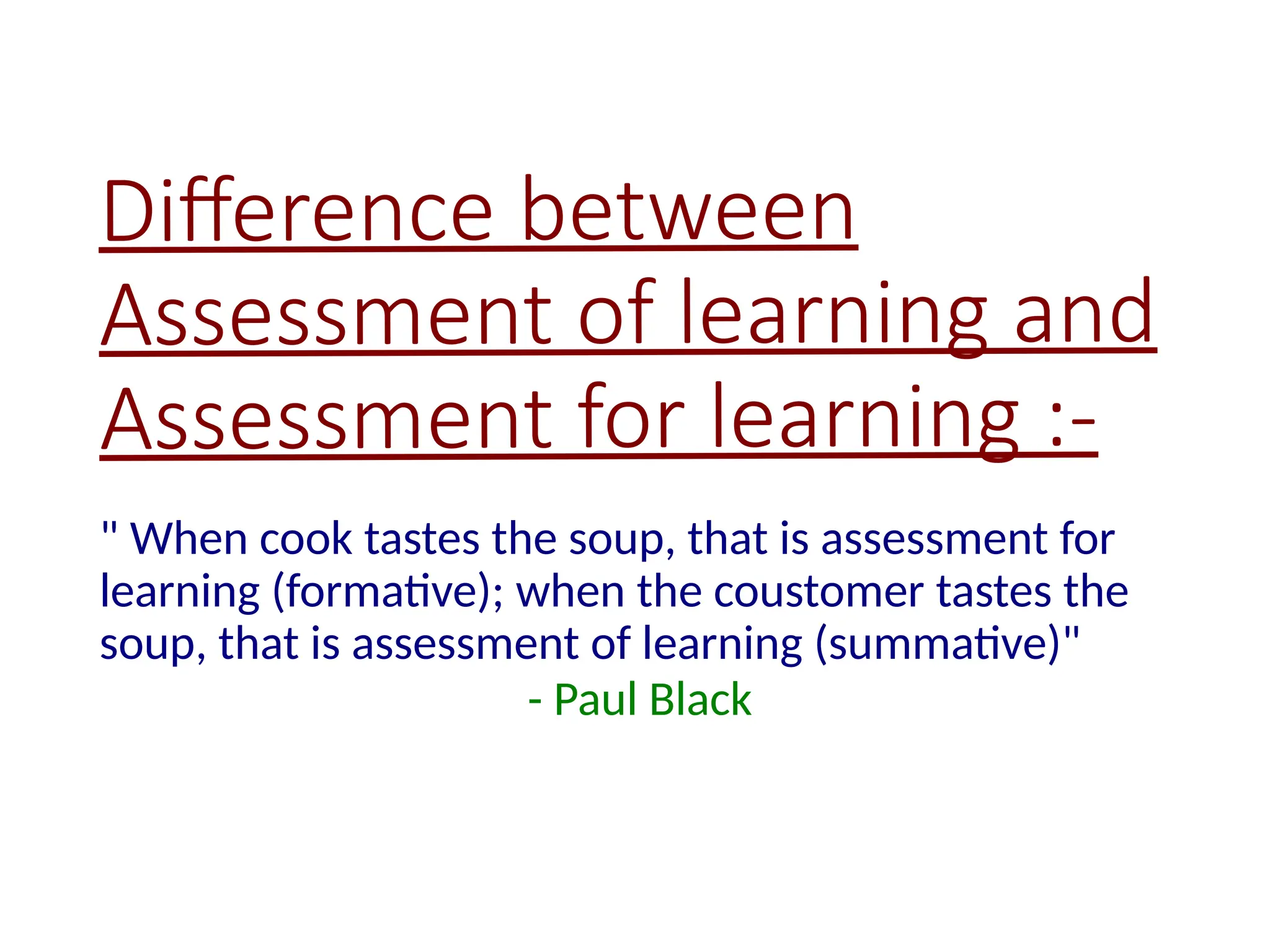
Difference between
Assessment of learning and
Assessment for learning :-
" When cook tastes the soup, that is assessment for
learning (formative); when the coustomer tastes the
soup, that is assessment of learning (summative)"
- Paul Black
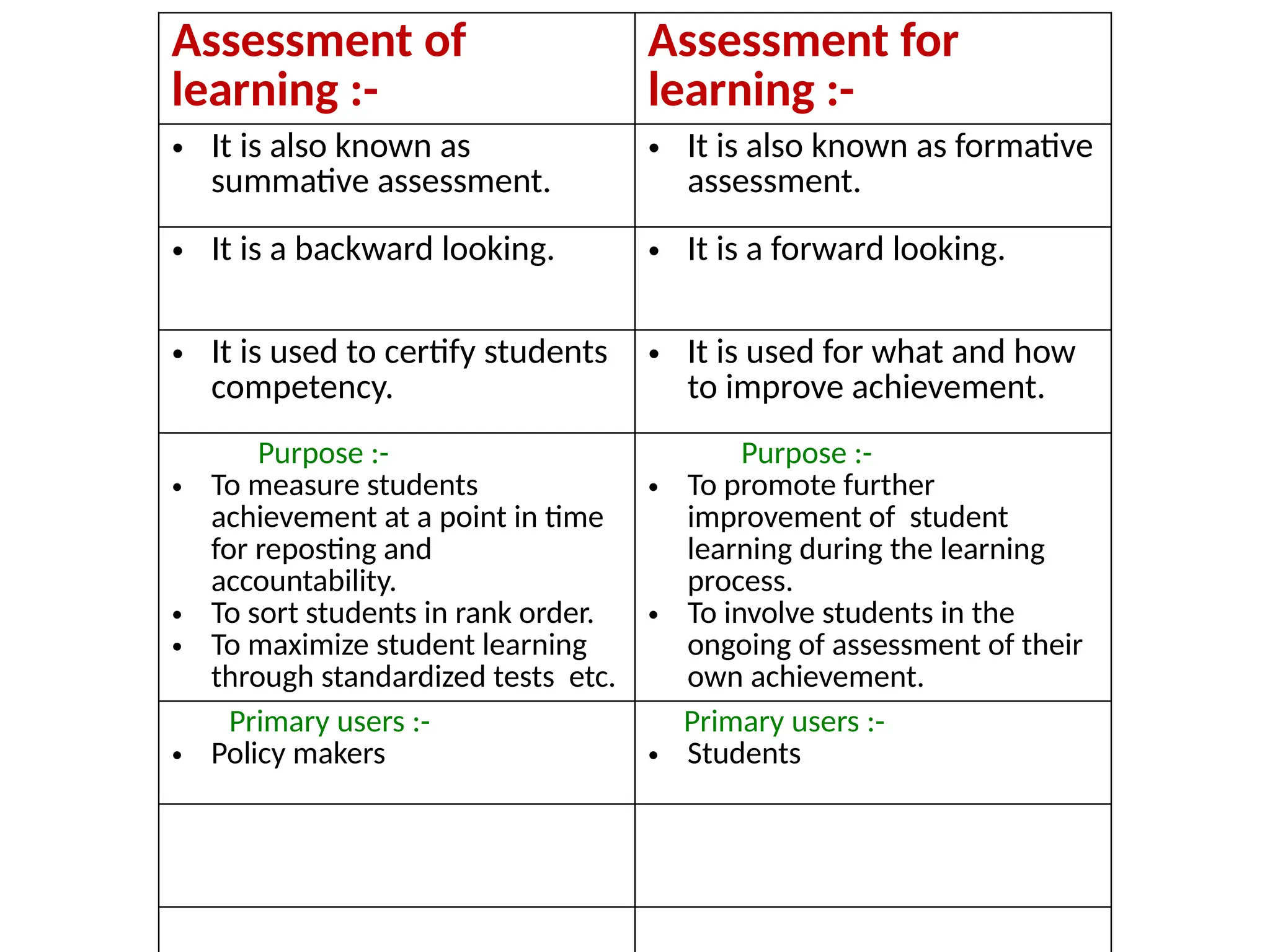
Assessment of
learning :-
Assessment for
learning :-
• It is also known as
summative assessment.
• It is also known as formative
assessment.
• It is a backward looking. • It is a forward looking.
• It is used to certify students
competency.
• It is used for what and how
to improve achievement.
Purpose :-
• To measure students
achievement at a point in time
for reposting and
accountability.
• To sort students in rank order.
• To maximize student learning
through standardized tests etc.
Purpose :-
• To promote further
improvement of student
learning during the learning
process.
• To involve students in the
ongoing of assessment of their
own achievement.
Primary users :-
• Policy makers
Primary users :-
• Students
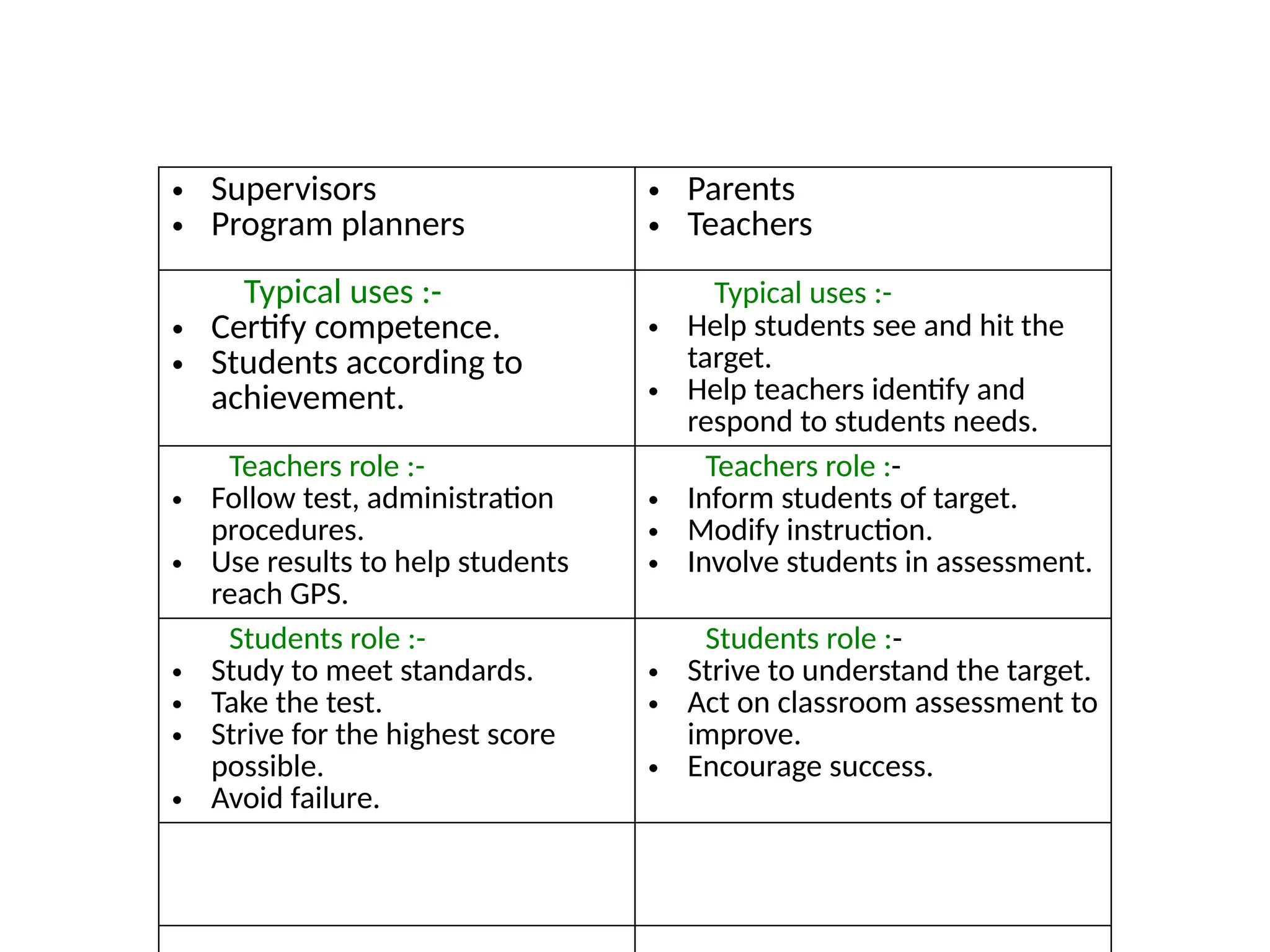
• Supervisors
• Program planners
• Parents
• Teachers
Typical uses :-
• Certify competence.
• Students according to
achievement.
Typical uses :-
• Help students see and hit the
target.
• Help teachers identify and
respond to students needs.
Teachers role :-
• Follow test, administration
procedures.
• Use results to help students
reach GPS.
Teachers role :-
• Inform students of target.
• Modify instruction.
• Involve students in assessment.
Students role :-
• Study to meet standards.
• Take the test.
• Strive for the highest score
possible.
• Avoid failure.
Students role :-
• Strive to understand the target.
• Act on classroom assessment to
improve.
• Encourage success.
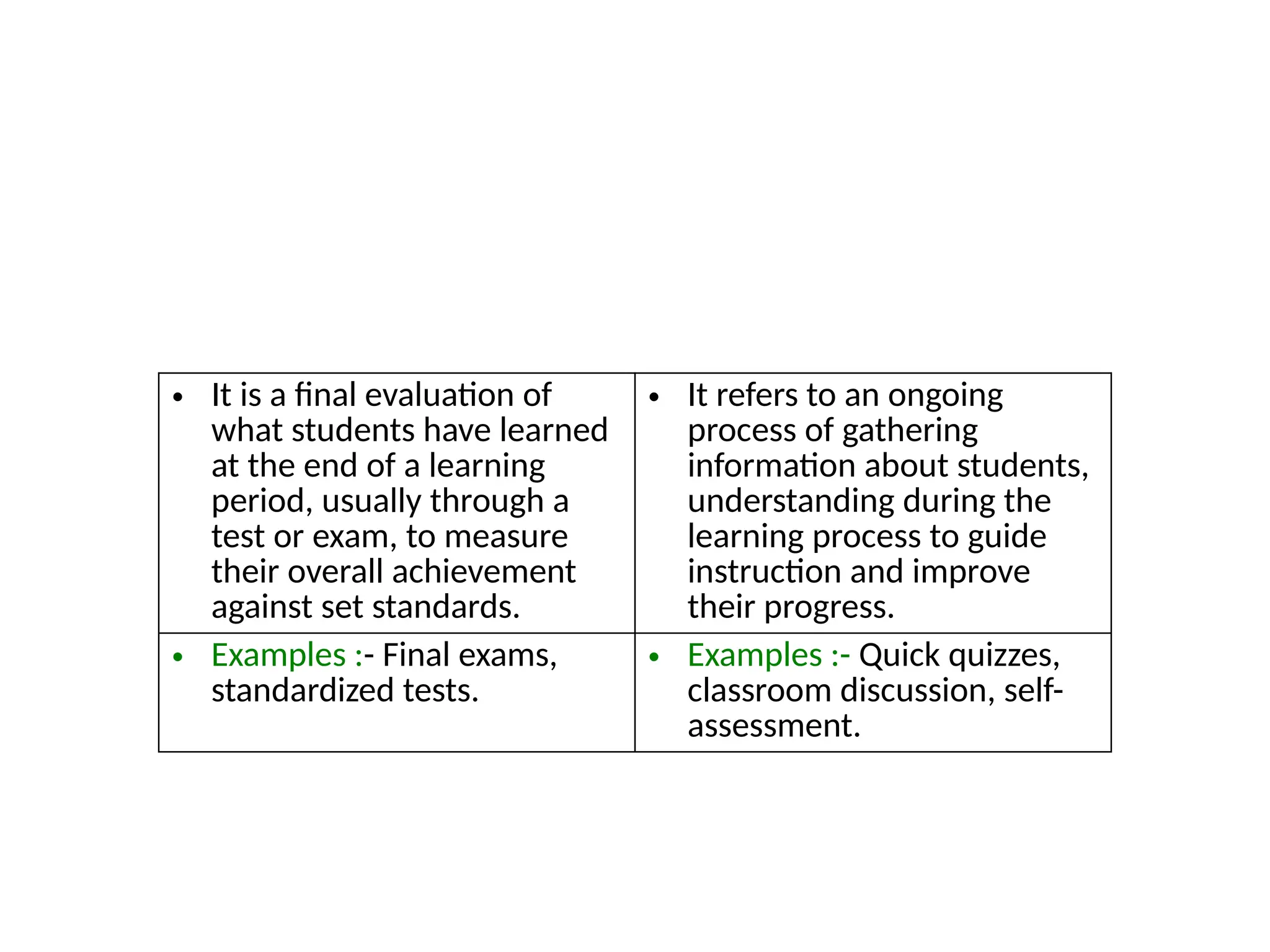
• It is a final evaluation of
what students have learned
at the end of a learning
period, usually through a
test or exam, to measure
their overall achievement
against set standards.
• It refers to an ongoing
process of gathering
information about students,
understanding during the
learning process to guide
instruction and improve
their progress.
• Examples :- Final exams,
standardized tests.
• Examples :- Quick quizzes,
classroom discussion, self-
assessment.
Conclusion
In conclusion, while " assessment of learning"
provides a snapshot of student achievement
at a specific point in time. "assessment for
learning" prioritises ongoing feedback and
adjustments to teaching practices to actively
promote student progress and growth,
making it a more dynamic and student-
centered approach to evaluation that
ultimately leads to improved learning
outcomes for all learners.

Assessment of learning and for learning ppt by Anusha TM.pptx

  • 1.
    VINAYAKA EDUCATION SOCIETY(R) NATIONALCOLLEGE OF EDUCATION Harihara road, hosapete BACHELOR OF EDUCATION [B.ED] 1st year 2nd semester 2023-2024 PAPER TITLE: PEC-4 : Learning and Teaching process Seminar Topic: Asessment of learning and Assessment for learning Guided by: M Karthik sir Assistant professor of National B.Ed college Presented by: Anusha TM 2nd semester Reg no: U16NH23E0023
  • 2.
    INDEX 1. Introduction 2. Meaningof assessment 3. Definitions of assessment 4. Characteristics of assessment 5. Types of assessment 6. Meaning and definition of Assessment of learning 7. Meaning and definition of Assessment for learning 8. Difference between Assessment of learning and Assessment for learning 9. Conclusion
  • 3.
    Introduction Assessment refers tothe process of gathering pieces of information about learn's skills,abilities and knowledge.It also provides feedback on students performance to encourage them for further learning. Although this term is used as the interchangeably with the terms "evaluation "and "testing".
  • 4.
    Meaning of assessment The wordASSESS comes from the Latin word ASSIDERE means "to sit with". • Assessment is a continuous process and helps in decision making which can be used in numerous ways in educational situation. • Assessment = measurement + Evaluation • Assessment is the end step in the process of evaluation.
  • 5.
    Definitions of Assessment •According to Bransford :- "A process for documenting, in measurable terms, the knowledge,skills,attitudes and beliefs of the learner is assessment". • According to Murry print :- "Assessment involves the interpretation of measurement data.it makes sense of data collected in students performance". • According to Allen :- "Assessment involves the use of empirical data on student learning to refine programs and improve students learning".
  • 6.
    Characteristics of Assessment • Assessmentis valid and reliable. • Value beyond the assessment itself. • Accept students constructed response. • Collecting of data through multiple sources. • It provides multidimensional scores. • It provides opportunities for close observation of students in the process of learning. • Classroom assessment involves students and teachers in continuous monitoring of students Learning.
  • 7.
    Types of assessment 1.DIAGNOSTIC ASSESSMENT :- It happens at the beginning of the lesson, unit, course or academic program. 2. FORMATIVE ASSESSMENT :- In- process assessment designed for practice and feedback. 3. SUMMATIVE ASSESSMENT :- Aims to assess the levels of learning at the end of an instructional period.
  • 8.
    Meaning and definitionof Assessment of learning • Meaning of Assessment of learning :- It is a final evaluation of what students have learned at the end of a learning period, usually through a test or exam, to measure their overall achievement against set standards. • Definition of Assessment of learning :- It refers to a summative evaluation method used to measure a student's final achievement against specific learning outcomes at the end of a learning period, often through a test or exam. • Examples :- Final exams, standardized tests.
  • 9.
    Meaning and definitionof Assessment for learning • Meaning of Assessment for learning :- It refers to an ongoing process of gathering information about students understanding during the learning process to guide instruction and improve their progress. • Definition of Assessment for learning :- It is a formative approach that involves ongoing feedback throughout the learning process to guide instruction and improve student understanding, allowing teachers to adjust their teaching based on student. • Examples :- Quick quizzes, classroom discussion, self- assessment.
  • 10.
    Difference between Assessment oflearning and Assessment for learning :- " When cook tastes the soup, that is assessment for learning (formative); when the coustomer tastes the soup, that is assessment of learning (summative)" - Paul Black
  • 11.
    Assessment of learning :- Assessmentfor learning :- • It is also known as summative assessment. • It is also known as formative assessment. • It is a backward looking. • It is a forward looking. • It is used to certify students competency. • It is used for what and how to improve achievement. Purpose :- • To measure students achievement at a point in time for reposting and accountability. • To sort students in rank order. • To maximize student learning through standardized tests etc. Purpose :- • To promote further improvement of student learning during the learning process. • To involve students in the ongoing of assessment of their own achievement. Primary users :- • Policy makers Primary users :- • Students
  • 12.
    • Supervisors • Programplanners • Parents • Teachers Typical uses :- • Certify competence. • Students according to achievement. Typical uses :- • Help students see and hit the target. • Help teachers identify and respond to students needs. Teachers role :- • Follow test, administration procedures. • Use results to help students reach GPS. Teachers role :- • Inform students of target. • Modify instruction. • Involve students in assessment. Students role :- • Study to meet standards. • Take the test. • Strive for the highest score possible. • Avoid failure. Students role :- • Strive to understand the target. • Act on classroom assessment to improve. • Encourage success.
  • 13.
    • It isa final evaluation of what students have learned at the end of a learning period, usually through a test or exam, to measure their overall achievement against set standards. • It refers to an ongoing process of gathering information about students, understanding during the learning process to guide instruction and improve their progress. • Examples :- Final exams, standardized tests. • Examples :- Quick quizzes, classroom discussion, self- assessment.
  • 14.
    Conclusion In conclusion, while" assessment of learning" provides a snapshot of student achievement at a specific point in time. "assessment for learning" prioritises ongoing feedback and adjustments to teaching practices to actively promote student progress and growth, making it a more dynamic and student- centered approach to evaluation that ultimately leads to improved learning outcomes for all learners.