<ldJ.ibN
ssaJ6oJd
6u~M04S:6U~UJD3l
Jo:}-t-uawssassv
......
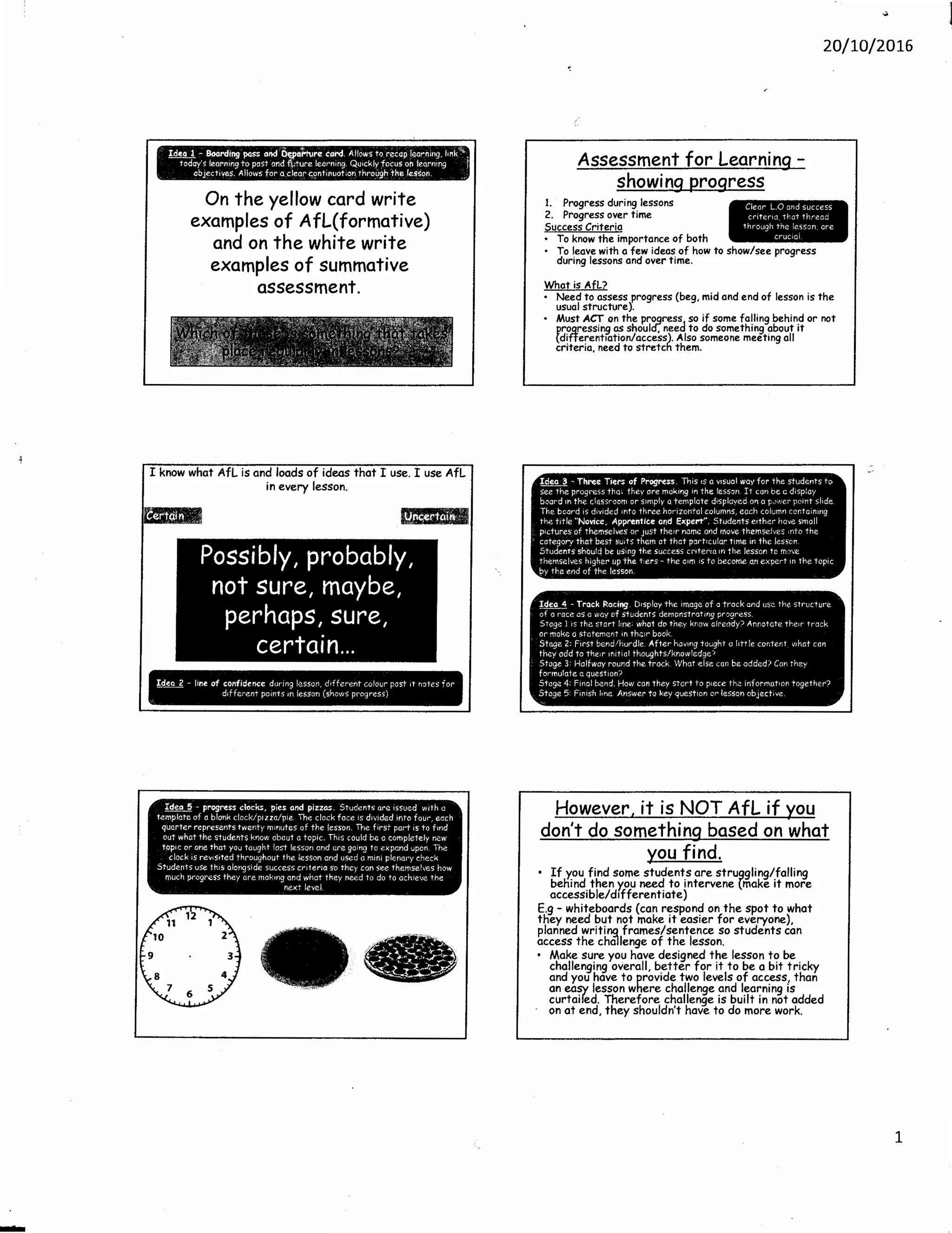
Idoa •a·: ~ingP4$S o.ld~r;paM-U~ c(lt<l All6wstor?c~!i.l~o,.nin!).l•nk~.
today's leo.rntng to past and t}Jture learning: qwckly focus on teqrnmg ·J
~~J~~t1y~~~ Allows fo~ _ct.cl,e~t59"tinuatJq~_.t~r(l}~hth_~_J~~~· ,;:
On the yellow card write
examples of AfL(formative)
and on the white write
examples of summative
assessment.
I know what AfL is and loads of ideas that I use. I use AfL
in every lesson.
&111&111
Possibly, probably,
not sure, maybe,
perhaps, sure,
certain...
1-df!a 2 - line of confiden<:e during lessor~. different colour post it n:Jtes for
different points m lesson (shows progress)
.;.
20/10/2016
Assessment for Learning-
showing progress
I. Progress during lessons
2. Progress over time
Success Criteria
To know the importance of both
Clear L0 and success
cr1ter1a that thread
through the lesson ore
cruc1al
• To leave with a few ideas of how to show/see progress
during lessons and over time.
What is AfL?
Need to assess progress (beg, mid and end of lesson is the
usual structure).
Must Acr on the progress, so if some falling behind or not
progressing as shoula; neea to do something about it
(difterent•ation/access). Also someone meeting all
criteria, need to stretcli them.
Idea 3 ~Three Tiers of PrQgre;s. This 15 a visual Way for the students to
see the progress tha• they ore making in the !ess-::m. It con be c display
b-oard lh the classroom or Stmply a template displayed on a pvwer point slide
The board is divided into three horizontal columns, e-ach column containmg
the title "Novice, Apprentice Ofld EJ~::pert"', Students etther have small
picture_s of themselves or jUst their name and move themselves ;nto the
categOry that best suits them at that particular time in the lessen
Students shOu!d be using the success cr1teria in the lesson tc move
themselves high:er up the tiers- the cHm is tobecotne_an expert in the topic
py the end of the lessor,.
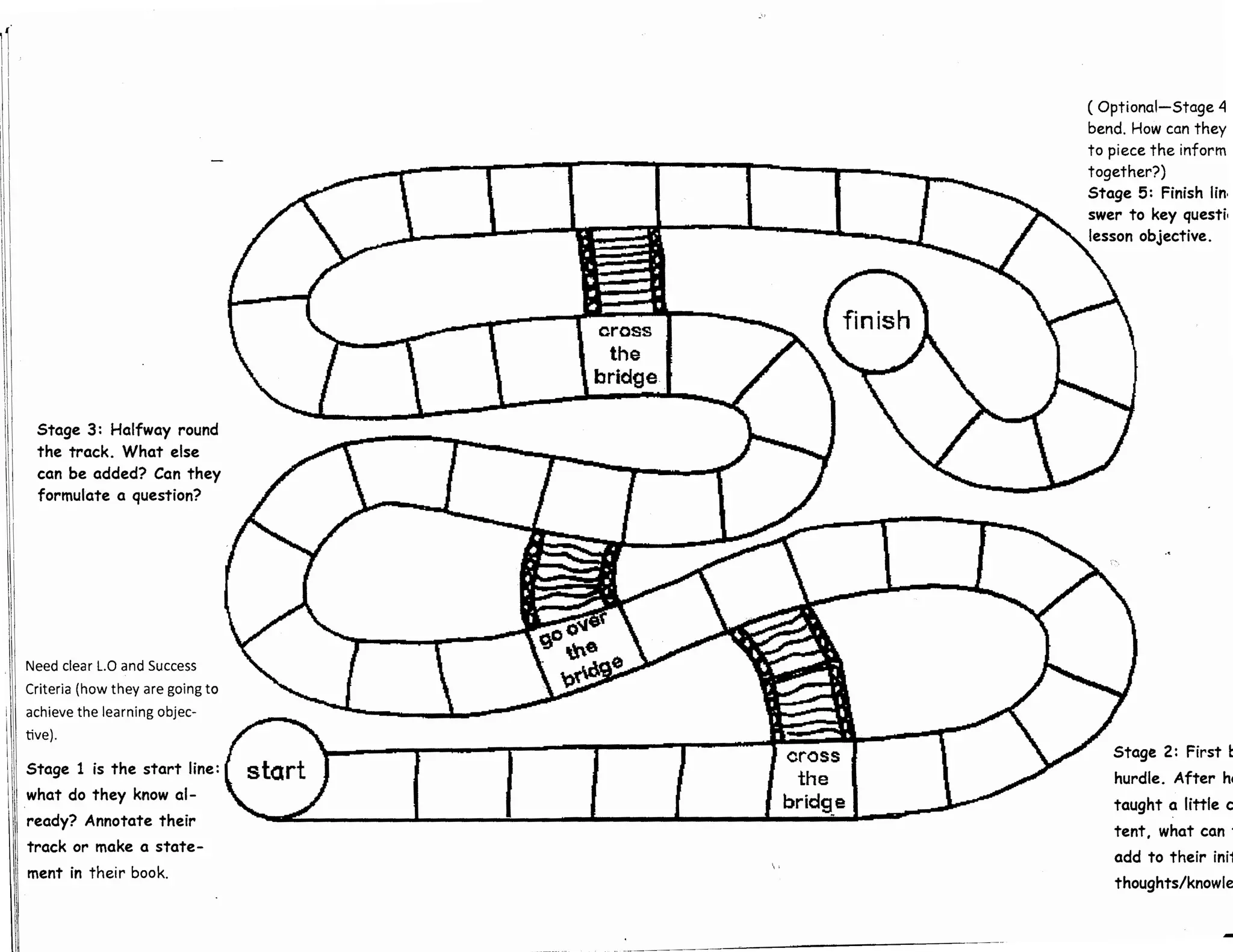
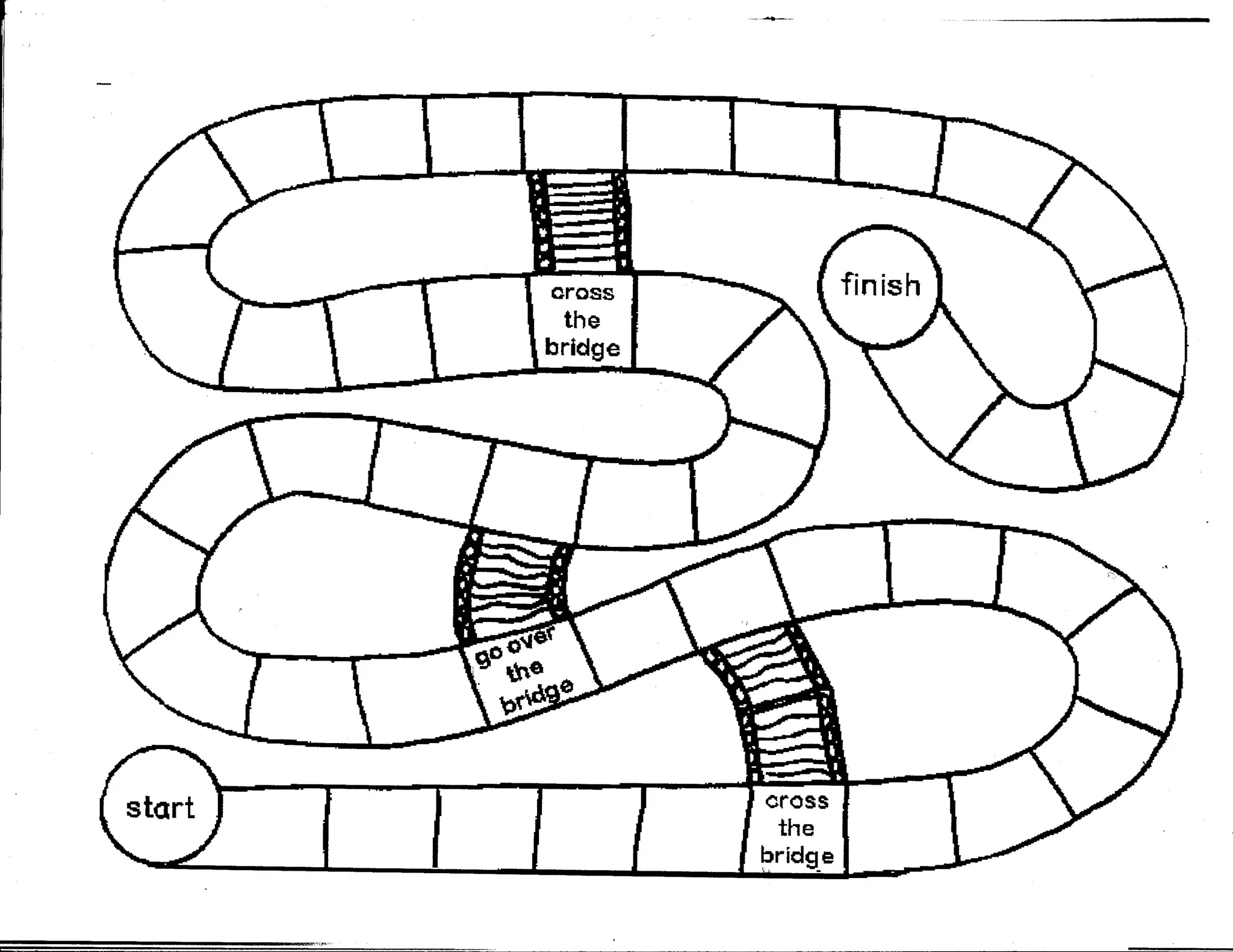
Idea 4 ~ Track Racing. Dtsp!ay the image of <1 track and use the structure.
of a race as a way of students demonstrating progress.
Stage 1 is the start line: what do they kMw already? Annotate thew track
or make o statement in thetr book.
Stage 2:first bend/hurdle. _After hav1ng tought a little content. what can
they add to the1r initial thoughts/knowledge")
Stage 3: Halfway round the track. What else con be added! Carl they
formulate a question?
Stage 4: Final bend: How can they stort to p1ece the informat1on togethe.r?
Stage 5: Finish line. Answer to key question or lesson objective_
However, it is NOT AfL if you
don't do something based on what
you find.
• If you find some students are struggling/falling
beliind then you need to intervene lmake it more
accessible/differentiate)
E.g- whiteboards (can respond on the spot to what
tliey need but not make it easier for everyone),
planned writing frames/sentence so students can
access the challenge of the lesson.
• Make sure you have designed the lesson to be
challenging overall, better for it to be a bit tricky
and you have to provide two levels of access, than
an easy lesson where challenge and learning is
curtaifed. Therefore challenge is built in not added
on at end, they shouldn't have to do more work.
1
I
j
I
i
i
I know what AfL is and loads of ideas that I use. I use AfL
in every lesson.
Possibly, probably,
not sure, maybe,
perhaps, sure,
certain...
Idea 6 - Medol Circles. See next slide
Has anyone got any ideas that
they would like to share?
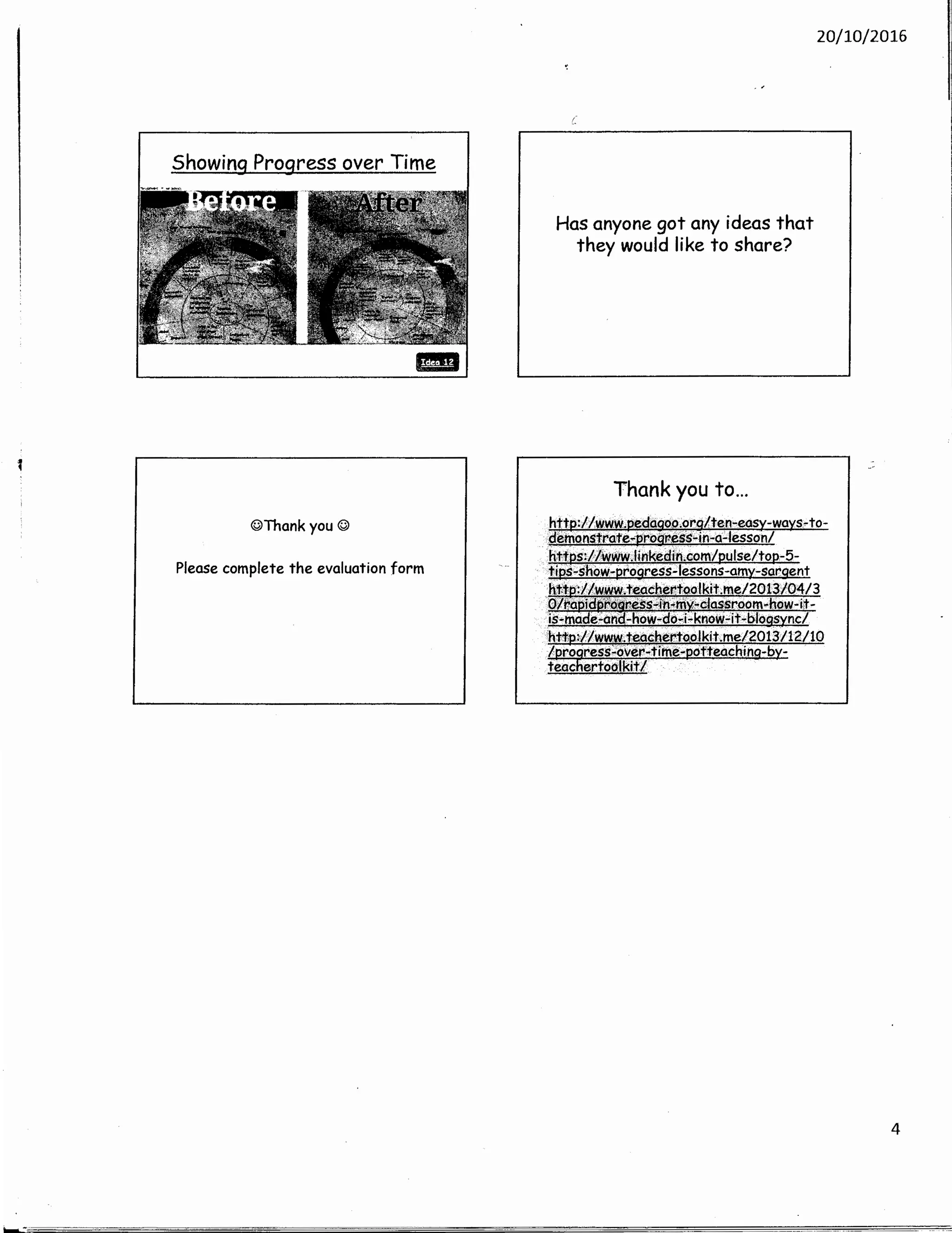
Showing Progress over Time
Marking- Using targets from marking to
ensure focussed improvement (easier to
see/show progress). In responses-
students highlighting where they have
done the improvement comment, also easy
to quickly check if you want to.
11!1
20/10/2016
Showing Progress over Time
Trackers- See examples at back (KS3/4
and KS5) of room and Teaching Backwards
(in
Ill
2
Showing Progress over Time
Acknowledgement Marking
Mark a sample of students work - 20% , range of
abilities
• Note general subject related issues as well as
literacy and presentation.
Use the Five Minute Marking Plan to record
~
Give Verbal Feedback. All students write in their
bookS. Students respond -Marked by the teacher
and shows improvement.
This may impact on future planning.
Allows for immediate feedback
1111
i Completed 5 minute marking plan
Showing Progress over Time
Glossary tracking
~
-
~...
20/10/2016
Theltlgpicture?
{n..Pt11P<J$6DFnurl:nglor-
,..uDF-t/PfDJ!ICf')
The 5Minute Marking Plan
_..priltrondscribblel'C>rH_,IOfocus...,uloiCWnrll~..,..,.nt•
SummHiv•martring:
to-.(~)ll!Mnt,__,
~

Re-t.Kh?
i/ ···~
1
____ ,'/
Common Errors?!
~
•studetttnsponseb:l
fHdbac:k required?
Acknowledgement Marking
Showing Progress over Time
Tracking boards
1111
3
Showing Progress over Time
~
©Thank you©
Please complete the evaluation form
Has anyone got any ideas that
they would like to share?
Thank you to...
20/10/2016
4
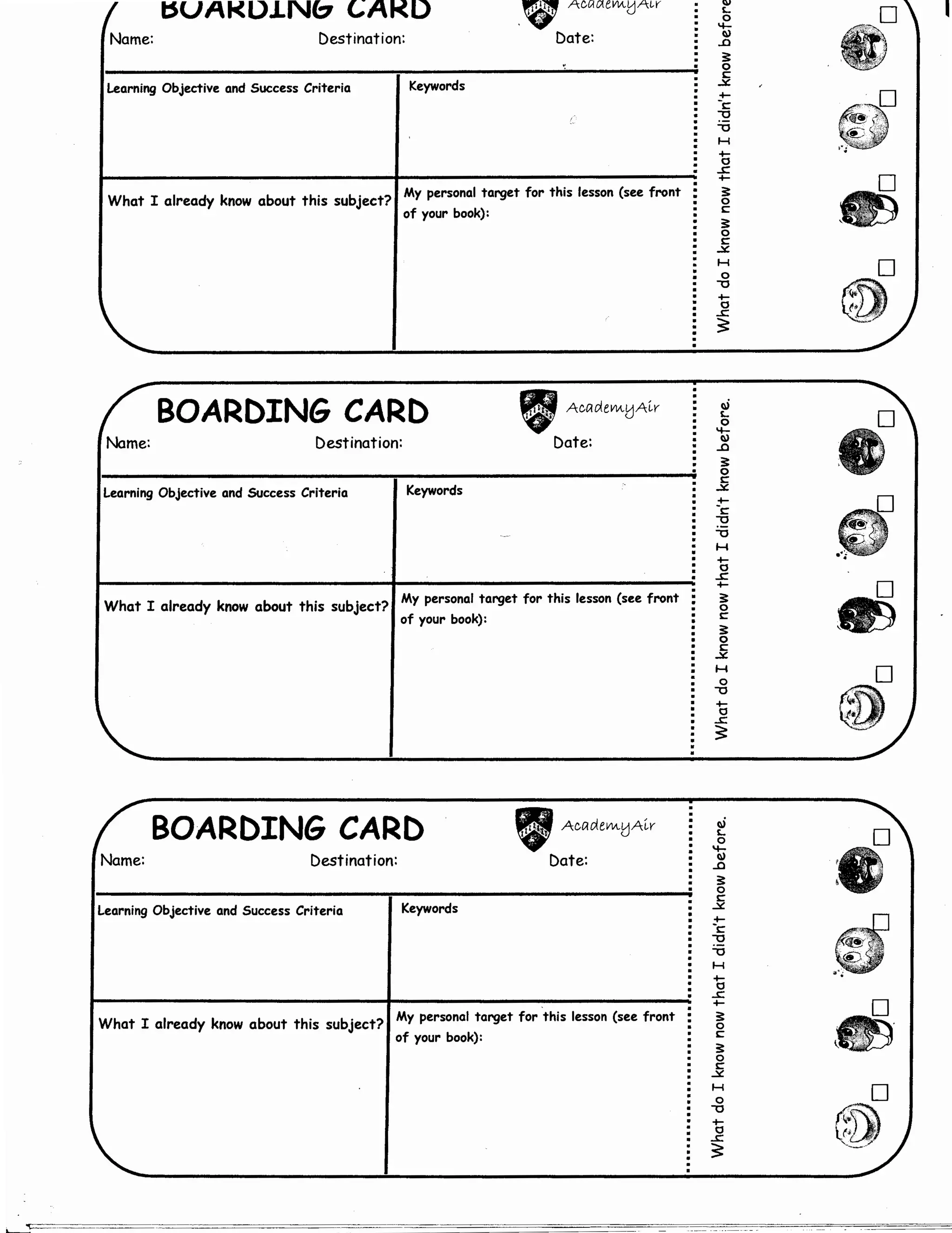
I:SUAI<DJ.NC::7 t;A~D
~ Accwlevvu.,1A~v
v u
Name: Destination: Date:
Learning Objective and Success Criteria Keywords
What I already know about this subject? 1My personal target for this lesson (see front
of your book):
BOARDING CARD
Name: Destination:
Learning Objective and SUccess Criteria Keywords
" AwdeVM.tJA~v
Date:
What I already know about this subject?1My personal target for this lesson (see front
of your book):
BOARDING CARD
Name: Destination:
Learning Objective and Success Criteria Keywords
" AcetdeVVttJA~v
Date:
What I already know about this subject? 1My personal target for this lesson (see front
of your book):
wL
0
"1-
w
..a
::0
c..;:,£
+-
-c
""0
""0
H
+-
0
..s::
+-
::0
c
::0
~
H
0
""0
+-
0
..s::
~
1iL
0
"1-
w
..a
::0
c
..;:,£
+-
-c
:-2
""0
H
+-
0
..s::
+-
::0
c
::0
c
..;:,£
H
0
""0
+-
0
..s::
~
1iL
0
't..a
::0
c..;:,£
+-
-c
""0
i:i
H
+-
0
..s::
+-
::0
c
::0
~
H
0
""0
+-
0
..s::
~
e)
D
BOARDING CARD FLIGHTHIST
DESTINATION: THE PAST
3 key things you learned LAST
lesson:
1.
2.
3.
l!la·~-
[!]. .
What I need to find out/learn to do this
lesson:
I am confident about:
-~--
LANDING CARD FOR
DESTINATION: THE PAST
3 key things you learned THIS lesson:
1.
2.
3.
What I need to find out/am still unsure
about:
I am confident about:
Departure Gate: Leeds Trinity University I Thank you for flying with us today
The past is aforeign country. They do things differently there. L. P. Hartley 1953
'i
1
II
!'[
II
I
Stage 3: Halfway round
the track. What else
can be added? Can they
formulate a question?
Need clear L.O and Success
Criteria (how they are going to
achieve the learning objec-
tive).
Stage 1 is the start line:
what do they know al-
ready? Annotate their
track or make a state-
ment in their book.
( Optional-Stage 4
bend. How can they
to piece the inform
together?)
Stage 5: Finish fin,
swer to key questi•
lesson objective.
Stage 2: First b
hurdle. After ha
taught a little co
tent, what can t
add to their initi
thoughts/knowled
~orvt: ,-~Avn rN"q- ISACK.wA .e..p..s
6.f A~D~ ~ FFl~ 1.. "'A~
(AvAH-A~LE. IN L~c)
TARGET LOGS
FEEDBACK 1 25S
6u ~t-JS
Over the last three years, we've noticed that both the quantity and quality of written
feedback to learners has increased. Ofsted's sharper focus on learners' books and evi-
dence of progress over time has led school leaders to check more regularly that books
are being marked.
1.
2.
3.
4.
5.
6.
However, we often feel that this relentless drive for the marking of books is, in some
schools, missing the point of why we devote so many hours to this important task of
assessment and feedback. Unless learners engage with and act on the written feedback
that teachers provide them with, marking is an utter waste of time. When askeg, many
teachers say that the most frustrating and thankless part of their job is writing feedback
that is consistently ignored by learners.
That said, we're also pleased to say that marking is an area where many of the teachers
we've worked with have made a transformational difference to their learners' progress.
One particular strategy that we've seen in action has enabled teachers to offer their learn-
ers impactful and timely feedback without having to work any harder. Like most great
ideas, it's deceptively simple yet highly effective. The secret is a simple piece of paper stuck
inside the cover of learners' books. We call it a'feedback target log: Its purpose is to ensure
that learners get into the habit of acting on their teacher's written feedback.
One of the problems with the kind of written feedback that teachers have traditionally
written in learner books is that it's frequently skimmed over and easily forgotten. For both
learners and teachers, it's often out of sight, out of mind. And, to state an obvious fact,
256 ! OUTSTANDING TEACHING : TEACHING BACKWARDS
learners are generally not in the habit of flicking back through their workbooks to look up
past feedback comments. It's hardly surprising that a common teacher moan is about hav-
ing to mark the same mistakes from the same learners week in, week out.
Here is a copy of a learner's book, showing their target log, from the wonderful lsleworth
Town Primary School in West London. As you can see, the target log flips up from the
inside front cover of the exercise book. It's a constant in-the-face reminder of the targets
that the learner is required to focus on.
Photo: Mark Burns.
f:
FEEDBACK ! 257
HOWTO MAKE TARGET LOGS WORK
There are four key steps to making target logs work well:
Step 1. As soon as the learners get their marked work back from the teacher, they
should read and then copy the 'target'that the teacher has given them into their target
log. This provides a record ofeach target given to a learner over time. Typically there are
no more than three targets for a learner to work on, depending on the age and com-
petence level of the individual. Too much feedback tends to be counterproductive.
Step 2. When the learners embark on their next piece of work, the teacher directs
them to flip up their target log from the inside cover of their books. The teacher asks
them to have a brief discussion with their partner about how they're going to address
this target in the next piece of work. This discussion acts as a powerful reminder about
the importance of addressing their targets and closing their gaps. Given the high visi-
bility of the log, learners have a constant reminder of the gap they should be focusing
on and closing as they work.
Step 3. After completing the piece of work, each learner has to underline or highlight
precisely where in their work they have addressed the target. If they have more than
one target, then they indicate each one using the number indicated in the 'target iden-
tified' column. This is an important step as it provides feedback to the teacher about
whether or not learners have understood the targets they've been set. If the teacher
finds that a learner is not addressing the target correctly, they will make time as soon
as possible to talk thr<>ugh the problem with that learner
Step 4. When the teacher marks each newly completed piece of work she can quickly
check whether the existing targets have been met. If this is the case, the teacher signs
offone of the boxes in the 'Completed'column. You might be wondering why there are
three boxes in this column. Hitting a target once does not prove mastery. We recom-
mend, therefore, that the learner demonstrates that they've hit the target at least three
times before it's signed off. Once atarget is signed off, an additional and more challeng-
ing target should be added.
Used effectively, the target log transforms the learner's book into a story of how they have
closed successive gaps over time using the feedback their teacher has given them.
a Several teachers we've worked with now use learners' books and target
logs at parents'evenings. When parents ask how their child is progress-
ing, these teachers ask the learners themselves to explain. The learners
use their target logs and the successive pieces of annotated work in
their books to show their parents how they're incorporating their
teacher's feedback to make progress. Impressive, eh?
SmtVM>DVS9NIHJV3.L19NIH)'V3.L9NIONV.LS.LnOBs-l
..
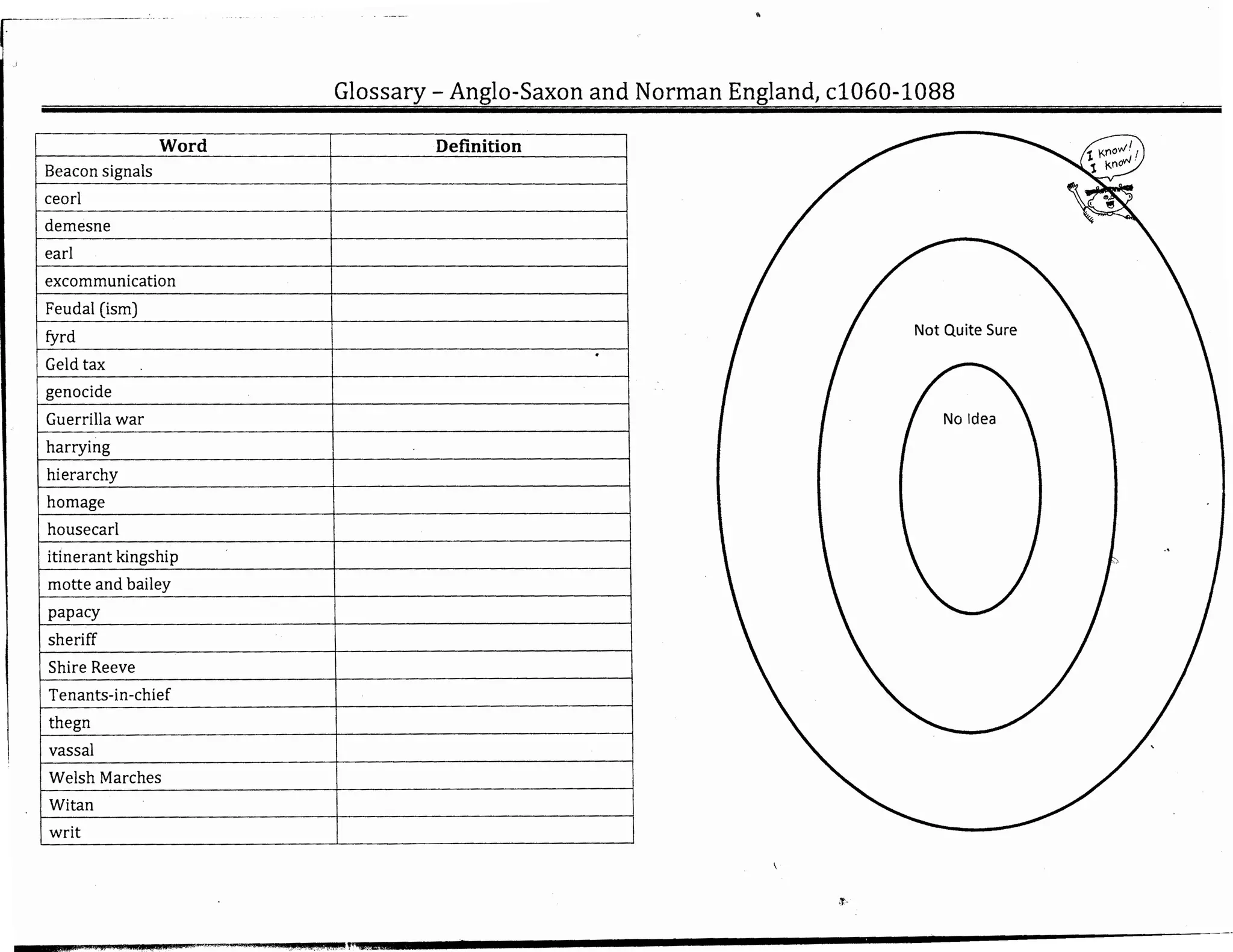
Glossary- Anglo-Saxon and Norman England, c1060-1088
Word Definition
Beacon signals
ceorl
demesne
earl
excommunication
Feudal (ism)
fyrd Not Quite Sure
. I
Geld tax i
genocide
Guerrilla war No Idea
harrying
hierarchy
homage
housecarl
itinerant kingship
motte and bailey
papacy
sheriff
Shire Reeve
Tenants-in-chief
thegn
vassal
Welsh Marches
Witan
writ - -- --- ---------
.'f
£ ;q; 41 4MIIijl1ilijffiJJ"'"Ifllll'"'"l'~;~~_,.,,w;a; ) . 4, ),ij

Assessment for learning showing progress

  • 1.
  • 2.
    ...... Idoa •a·: ~ingP4$So.ld~r;paM-U~ c(lt<l All6wstor?c~!i.l~o,.nin!).l•nk~. today's leo.rntng to past and t}Jture learning: qwckly focus on teqrnmg ·J ~~J~~t1y~~~ Allows fo~ _ct.cl,e~t59"tinuatJq~_.t~r(l}~hth_~_J~~~· ,;: On the yellow card write examples of AfL(formative) and on the white write examples of summative assessment. I know what AfL is and loads of ideas that I use. I use AfL in every lesson. &111&111 Possibly, probably, not sure, maybe, perhaps, sure, certain... 1-df!a 2 - line of confiden<:e during lessor~. different colour post it n:Jtes for different points m lesson (shows progress) .;. 20/10/2016 Assessment for Learning- showing progress I. Progress during lessons 2. Progress over time Success Criteria To know the importance of both Clear L0 and success cr1ter1a that thread through the lesson ore cruc1al • To leave with a few ideas of how to show/see progress during lessons and over time. What is AfL? Need to assess progress (beg, mid and end of lesson is the usual structure). Must Acr on the progress, so if some falling behind or not progressing as shoula; neea to do something about it (difterent•ation/access). Also someone meeting all criteria, need to stretcli them. Idea 3 ~Three Tiers of PrQgre;s. This 15 a visual Way for the students to see the progress tha• they ore making in the !ess-::m. It con be c display b-oard lh the classroom or Stmply a template displayed on a pvwer point slide The board is divided into three horizontal columns, e-ach column containmg the title "Novice, Apprentice Ofld EJ~::pert"', Students etther have small picture_s of themselves or jUst their name and move themselves ;nto the categOry that best suits them at that particular time in the lessen Students shOu!d be using the success cr1teria in the lesson tc move themselves high:er up the tiers- the cHm is tobecotne_an expert in the topic py the end of the lessor,. Idea 4 ~ Track Racing. Dtsp!ay the image of <1 track and use the structure. of a race as a way of students demonstrating progress. Stage 1 is the start line: what do they kMw already? Annotate thew track or make o statement in thetr book. Stage 2:first bend/hurdle. _After hav1ng tought a little content. what can they add to the1r initial thoughts/knowledge") Stage 3: Halfway round the track. What else con be added! Carl they formulate a question? Stage 4: Final bend: How can they stort to p1ece the informat1on togethe.r? Stage 5: Finish line. Answer to key question or lesson objective_ However, it is NOT AfL if you don't do something based on what you find. • If you find some students are struggling/falling beliind then you need to intervene lmake it more accessible/differentiate) E.g- whiteboards (can respond on the spot to what tliey need but not make it easier for everyone), planned writing frames/sentence so students can access the challenge of the lesson. • Make sure you have designed the lesson to be challenging overall, better for it to be a bit tricky and you have to provide two levels of access, than an easy lesson where challenge and learning is curtaifed. Therefore challenge is built in not added on at end, they shouldn't have to do more work. 1
  • 3.
    I j I i i I know whatAfL is and loads of ideas that I use. I use AfL in every lesson. Possibly, probably, not sure, maybe, perhaps, sure, certain... Idea 6 - Medol Circles. See next slide Has anyone got any ideas that they would like to share? Showing Progress over Time Marking- Using targets from marking to ensure focussed improvement (easier to see/show progress). In responses- students highlighting where they have done the improvement comment, also easy to quickly check if you want to. 11!1 20/10/2016 Showing Progress over Time Trackers- See examples at back (KS3/4 and KS5) of room and Teaching Backwards (in Ill 2
  • 4.
    Showing Progress overTime Acknowledgement Marking Mark a sample of students work - 20% , range of abilities • Note general subject related issues as well as literacy and presentation. Use the Five Minute Marking Plan to record ~ Give Verbal Feedback. All students write in their bookS. Students respond -Marked by the teacher and shows improvement. This may impact on future planning. Allows for immediate feedback 1111 i Completed 5 minute marking plan Showing Progress over Time Glossary tracking ~ - ~... 20/10/2016 Theltlgpicture? {n..Pt11P<J$6DFnurl:nglor- ,..uDF-t/PfDJ!ICf') The 5Minute Marking Plan _..priltrondscribblel'C>rH_,IOfocus...,uloiCWnrll~..,..,.nt• SummHiv•martring: to-.(~)ll!Mnt,__, ~ Re-t.Kh? i/ ···~ 1 ____ ,'/ Common Errors?! ~ •studetttnsponseb:l fHdbac:k required? Acknowledgement Marking Showing Progress over Time Tracking boards 1111 3
  • 5.
    Showing Progress overTime ~ ©Thank you© Please complete the evaluation form Has anyone got any ideas that they would like to share? Thank you to... 20/10/2016 4
  • 6.
    I:SUAI<DJ.NC::7 t;A~D ~ Accwlevvu.,1A~v vu Name: Destination: Date: Learning Objective and Success Criteria Keywords What I already know about this subject? 1My personal target for this lesson (see front of your book): BOARDING CARD Name: Destination: Learning Objective and SUccess Criteria Keywords " AwdeVM.tJA~v Date: What I already know about this subject?1My personal target for this lesson (see front of your book): BOARDING CARD Name: Destination: Learning Objective and Success Criteria Keywords " AcetdeVVttJA~v Date: What I already know about this subject? 1My personal target for this lesson (see front of your book): wL 0 "1- w ..a ::0 c..;:,£ +- -c ""0 ""0 H +- 0 ..s:: +- ::0 c ::0 ~ H 0 ""0 +- 0 ..s:: ~ 1iL 0 "1- w ..a ::0 c ..;:,£ +- -c :-2 ""0 H +- 0 ..s:: +- ::0 c ::0 c ..;:,£ H 0 ""0 +- 0 ..s:: ~ 1iL 0 't..a ::0 c..;:,£ +- -c ""0 i:i H +- 0 ..s:: +- ::0 c ::0 ~ H 0 ""0 +- 0 ..s:: ~ e) D
  • 7.
    BOARDING CARD FLIGHTHIST DESTINATION:THE PAST 3 key things you learned LAST lesson: 1. 2. 3. l!la·~- [!]. . What I need to find out/learn to do this lesson: I am confident about: -~-- LANDING CARD FOR DESTINATION: THE PAST 3 key things you learned THIS lesson: 1. 2. 3. What I need to find out/am still unsure about: I am confident about: Departure Gate: Leeds Trinity University I Thank you for flying with us today The past is aforeign country. They do things differently there. L. P. Hartley 1953 'i
  • 8.
    1 II !'[ II I Stage 3: Halfwayround the track. What else can be added? Can they formulate a question? Need clear L.O and Success Criteria (how they are going to achieve the learning objec- tive). Stage 1 is the start line: what do they know al- ready? Annotate their track or make a state- ment in their book. ( Optional-Stage 4 bend. How can they to piece the inform together?) Stage 5: Finish fin, swer to key questi• lesson objective. Stage 2: First b hurdle. After ha taught a little co tent, what can t add to their initi thoughts/knowled
  • 10.
    ~orvt: ,-~Avn rN"q-ISACK.wA .e..p..s 6.f A~D~ ~ FFl~ 1.. "'A~ (AvAH-A~LE. IN L~c) TARGET LOGS FEEDBACK 1 25S 6u ~t-JS Over the last three years, we've noticed that both the quantity and quality of written feedback to learners has increased. Ofsted's sharper focus on learners' books and evi- dence of progress over time has led school leaders to check more regularly that books are being marked. 1. 2. 3. 4. 5. 6. However, we often feel that this relentless drive for the marking of books is, in some schools, missing the point of why we devote so many hours to this important task of assessment and feedback. Unless learners engage with and act on the written feedback that teachers provide them with, marking is an utter waste of time. When askeg, many teachers say that the most frustrating and thankless part of their job is writing feedback that is consistently ignored by learners. That said, we're also pleased to say that marking is an area where many of the teachers we've worked with have made a transformational difference to their learners' progress. One particular strategy that we've seen in action has enabled teachers to offer their learn- ers impactful and timely feedback without having to work any harder. Like most great ideas, it's deceptively simple yet highly effective. The secret is a simple piece of paper stuck inside the cover of learners' books. We call it a'feedback target log: Its purpose is to ensure that learners get into the habit of acting on their teacher's written feedback. One of the problems with the kind of written feedback that teachers have traditionally written in learner books is that it's frequently skimmed over and easily forgotten. For both learners and teachers, it's often out of sight, out of mind. And, to state an obvious fact,
  • 11.
    256 ! OUTSTANDINGTEACHING : TEACHING BACKWARDS learners are generally not in the habit of flicking back through their workbooks to look up past feedback comments. It's hardly surprising that a common teacher moan is about hav- ing to mark the same mistakes from the same learners week in, week out. Here is a copy of a learner's book, showing their target log, from the wonderful lsleworth Town Primary School in West London. As you can see, the target log flips up from the inside front cover of the exercise book. It's a constant in-the-face reminder of the targets that the learner is required to focus on. Photo: Mark Burns. f:
  • 12.
    FEEDBACK ! 257 HOWTOMAKE TARGET LOGS WORK There are four key steps to making target logs work well: Step 1. As soon as the learners get their marked work back from the teacher, they should read and then copy the 'target'that the teacher has given them into their target log. This provides a record ofeach target given to a learner over time. Typically there are no more than three targets for a learner to work on, depending on the age and com- petence level of the individual. Too much feedback tends to be counterproductive. Step 2. When the learners embark on their next piece of work, the teacher directs them to flip up their target log from the inside cover of their books. The teacher asks them to have a brief discussion with their partner about how they're going to address this target in the next piece of work. This discussion acts as a powerful reminder about the importance of addressing their targets and closing their gaps. Given the high visi- bility of the log, learners have a constant reminder of the gap they should be focusing on and closing as they work. Step 3. After completing the piece of work, each learner has to underline or highlight precisely where in their work they have addressed the target. If they have more than one target, then they indicate each one using the number indicated in the 'target iden- tified' column. This is an important step as it provides feedback to the teacher about whether or not learners have understood the targets they've been set. If the teacher finds that a learner is not addressing the target correctly, they will make time as soon as possible to talk thr<>ugh the problem with that learner Step 4. When the teacher marks each newly completed piece of work she can quickly check whether the existing targets have been met. If this is the case, the teacher signs offone of the boxes in the 'Completed'column. You might be wondering why there are three boxes in this column. Hitting a target once does not prove mastery. We recom- mend, therefore, that the learner demonstrates that they've hit the target at least three times before it's signed off. Once atarget is signed off, an additional and more challeng- ing target should be added. Used effectively, the target log transforms the learner's book into a story of how they have closed successive gaps over time using the feedback their teacher has given them. a Several teachers we've worked with now use learners' books and target logs at parents'evenings. When parents ask how their child is progress- ing, these teachers ask the learners themselves to explain. The learners use their target logs and the successive pieces of annotated work in their books to show their parents how they're incorporating their teacher's feedback to make progress. Impressive, eh?
  • 13.
  • 14.
    .. Glossary- Anglo-Saxon andNorman England, c1060-1088 Word Definition Beacon signals ceorl demesne earl excommunication Feudal (ism) fyrd Not Quite Sure . I Geld tax i genocide Guerrilla war No Idea harrying hierarchy homage housecarl itinerant kingship motte and bailey papacy sheriff Shire Reeve Tenants-in-chief thegn vassal Welsh Marches Witan writ - -- --- --------- .'f £ ;q; 41 4MIIijl1ilijffiJJ"'"Ifllll'"'"l'~;~~_,.,,w;a; ) . 4, ),ij