Objective (5 mins):
To accurately draw an allocated cartoon character
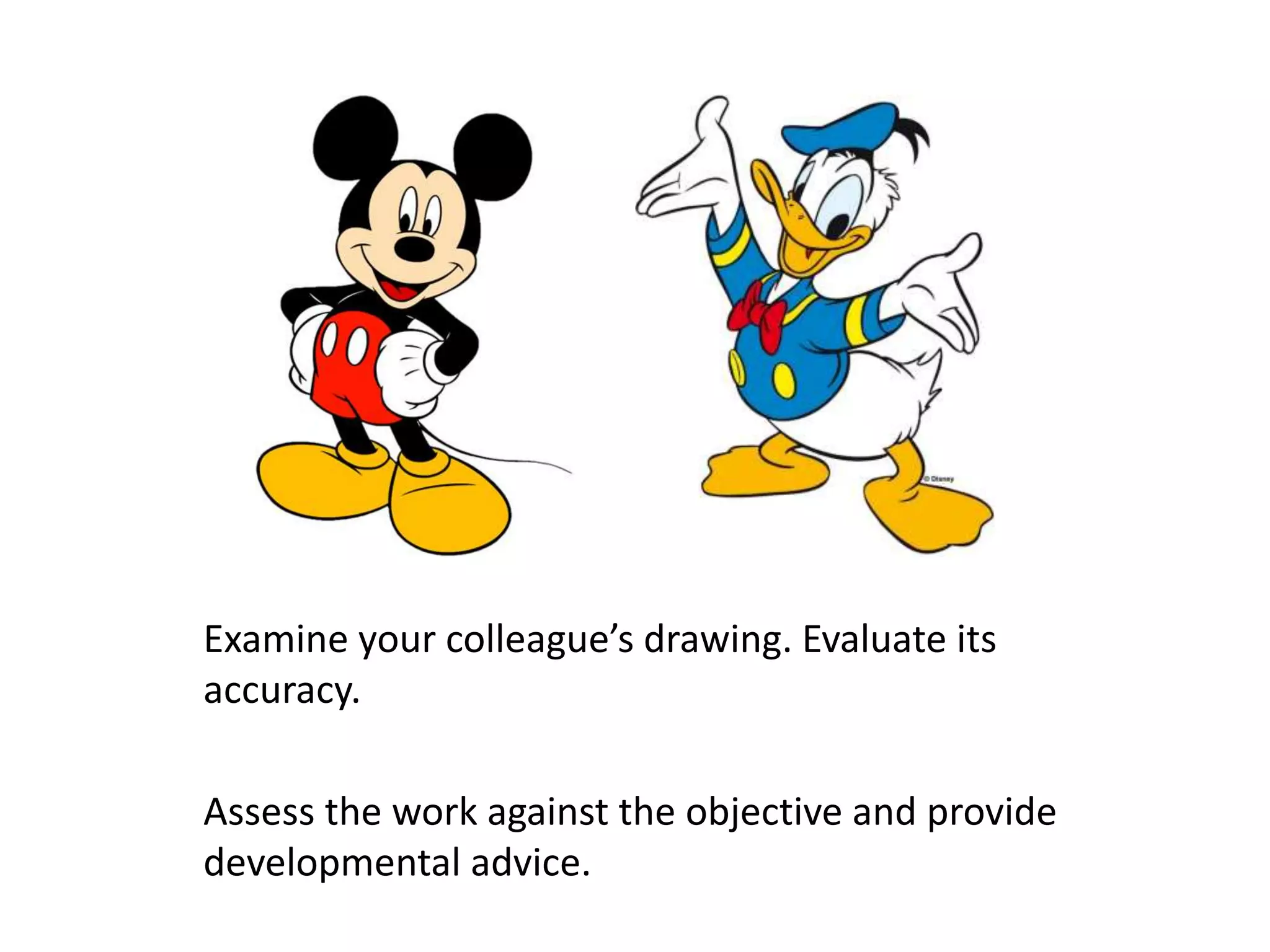
Examine your colleague’s drawing. Evaluate its
accuracy.
Assess the work against the objective and provide
developmental advice.
Effective Formative
Feedback through Marking…
…Avoiding the black hole
Assessment for Learning Cohort 7
TEACHERS’ STANDARD 6
• To consider ways to ‘give pupils regular
feedback, both orally and through marking,
and encourage pupils to respond to the
feedback’
• To reflect on our learning from the scenario
and to share insights
• To share AfL strategies which enable pupil
progress
“Teachers can spend a lot of time marking
pupils’ work, but the reality is that this can
have little effect on improving their learning.
Often, marks or comments on work tell pupils
about success or failure but not about how to
move on in their learning.”
(Council for the Curriculum, Examinations and
Assessment in Northern Ireland, 2009)
I am working really hard to
support these children – it must
be making a big difference!
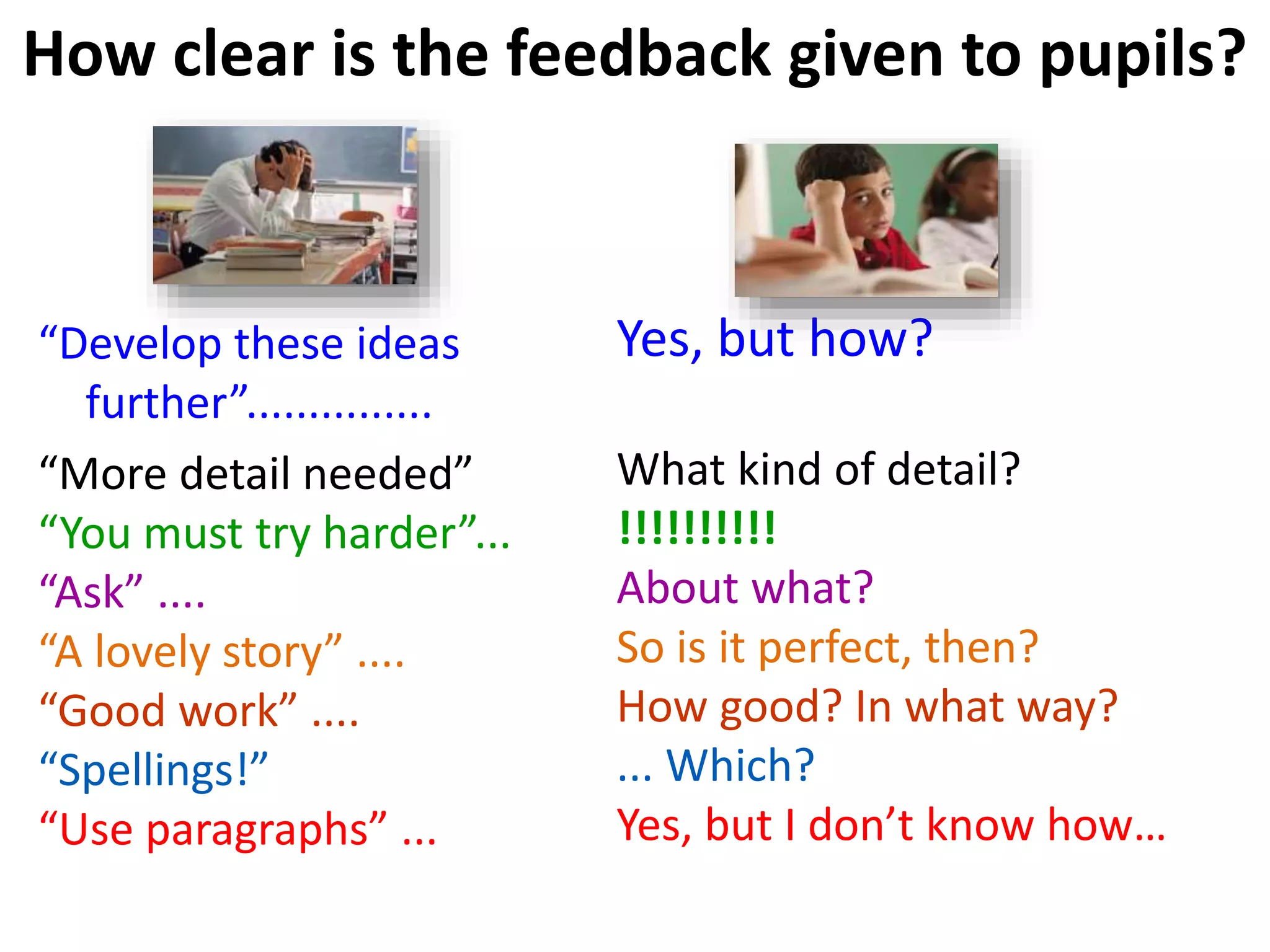
How clear is the feedback given to pupils?
“Develop these ideas
further”...............
“More detail needed”
“You must try harder”...
“Ask” ....
“A lovely story” ....
“Good work” ....
“Spellings!”
“Use paragraphs” ...
Yes, but how?
What kind of detail?
!!!!!!!!!!
About what?
So is it perfect, then?
How good? In what way?
... Which?
Yes, but I don’t know how…
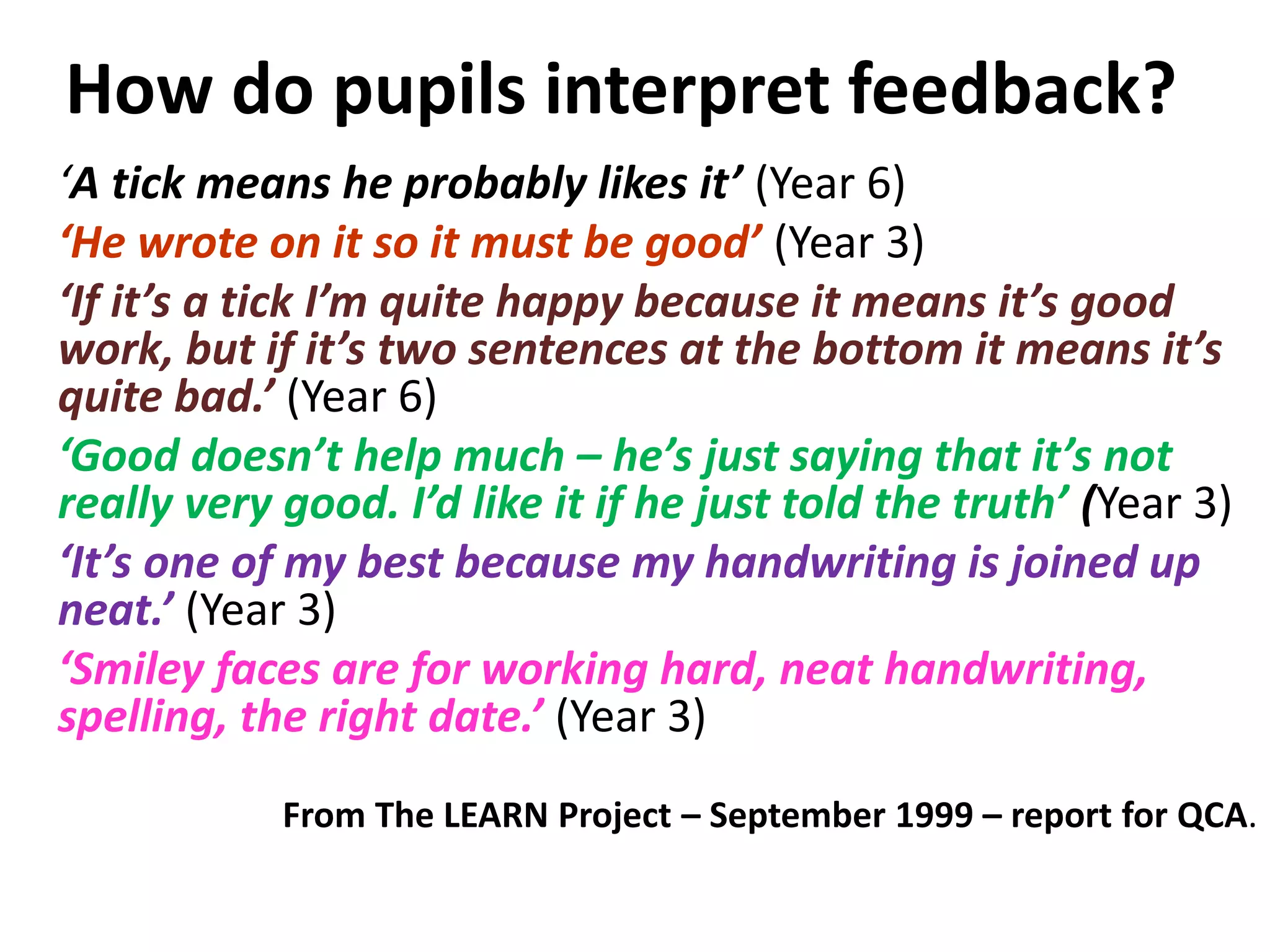
How do pupils interpret feedback?
‘A tick means he probably likes it’ (Year 6)
‘He wrote on it so it must be good’ (Year 3)
‘If it’s a tick I’m quite happy because it means it’s good
work, but if it’s two sentences at the bottom it means it’s
quite bad.’ (Year 6)
‘Good doesn’t help much – he’s just saying that it’s not
really very good. I’d like it if he just told the truth’ (Year 3)
‘It’s one of my best because my handwriting is joined up
neat.’ (Year 3)
‘Smiley faces are for working hard, neat handwriting,
spelling, the right date.’ (Year 3)
From The LEARN Project – September 1999 – report for QCA.
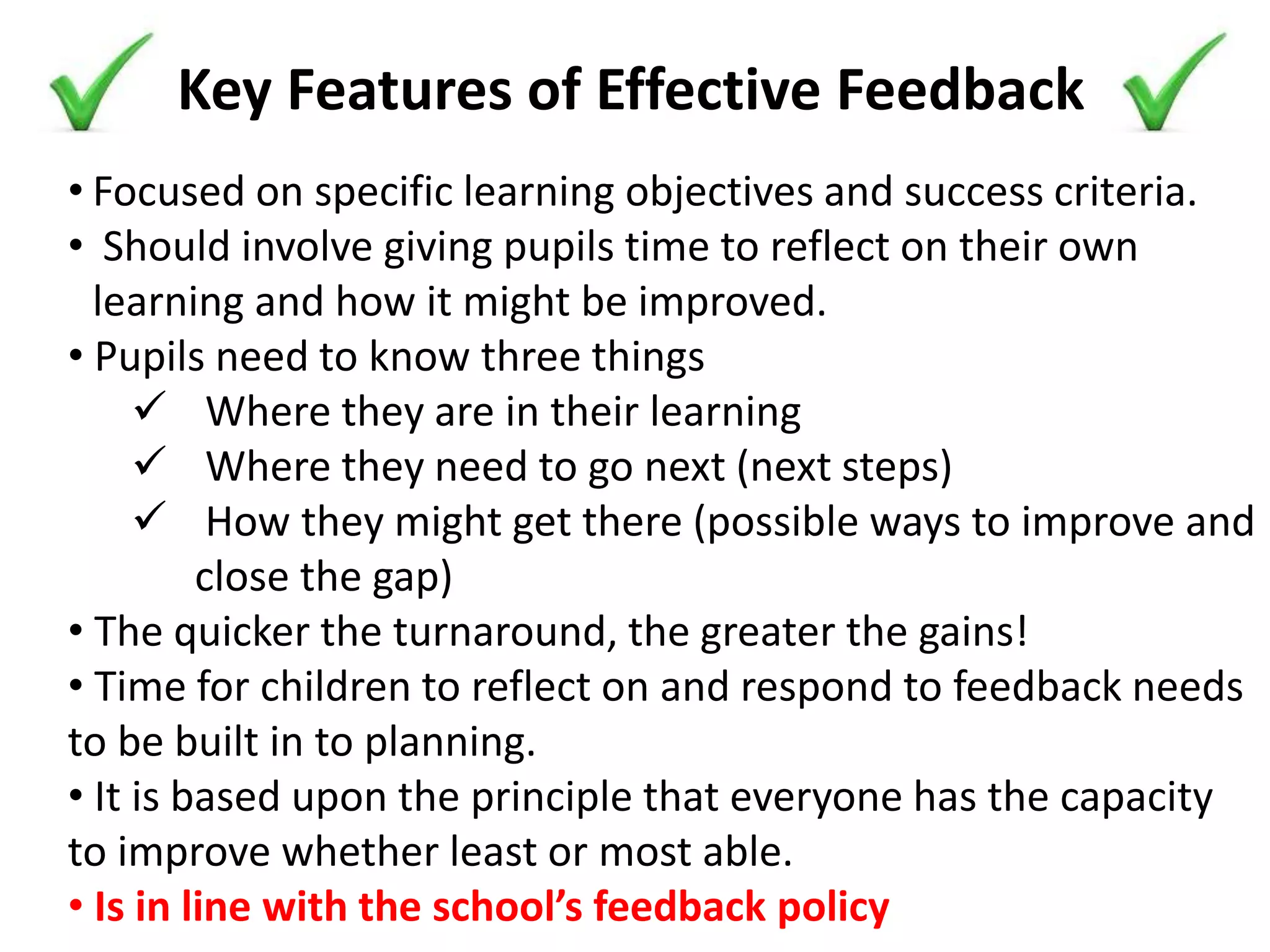
Key Features of Effective Feedback
• Focused on specific learning objectives and success criteria.
• Should involve giving pupils time to reflect on their own
learning and how it might be improved.
• Pupils need to know three things
 Where they are in their learning
 Where they need to go next (next steps)
 How they might get there (possible ways to improve and
close the gap)
• The quicker the turnaround, the greater the gains!
• Time for children to reflect on and respond to feedback needs
to be built in to planning.
• It is based upon the principle that everyone has the capacity
to improve whether least or most able.
• Is in line with the school’s feedback policy
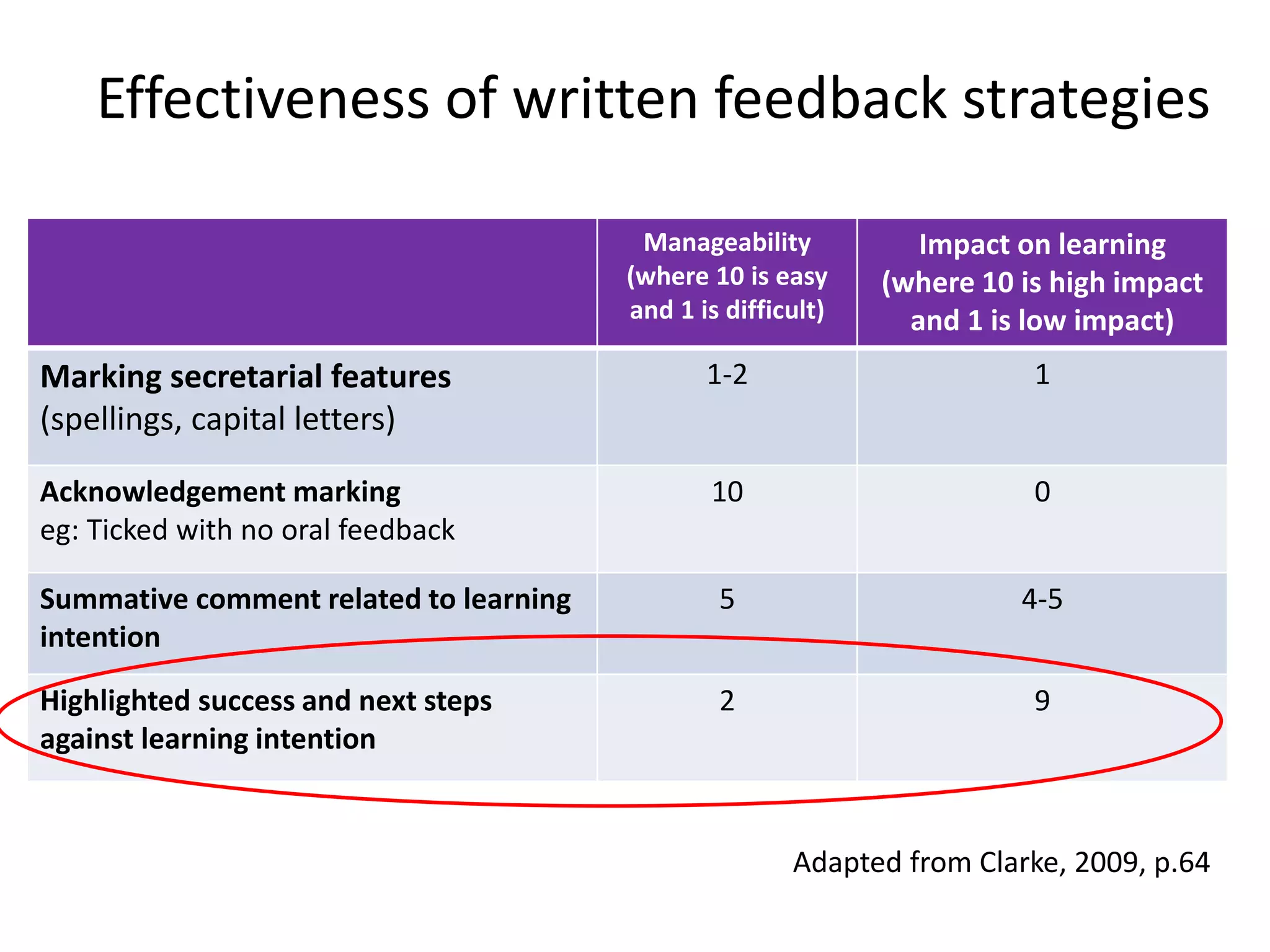
Effectiveness of written feedback strategies
Manageability
(where 10 is easy
and 1 is difficult)
Impact on learning
(where 10 is high impact
and 1 is low impact)
Marking secretarial features
(spellings, capital letters)
1-2 1
Acknowledgement marking
eg: Ticked with no oral feedback
10 0
Summative comment related to learning
intention
5 4-5
Highlighted success and next steps
against learning intention
2 9
Adapted from Clarke, 2009, p.64
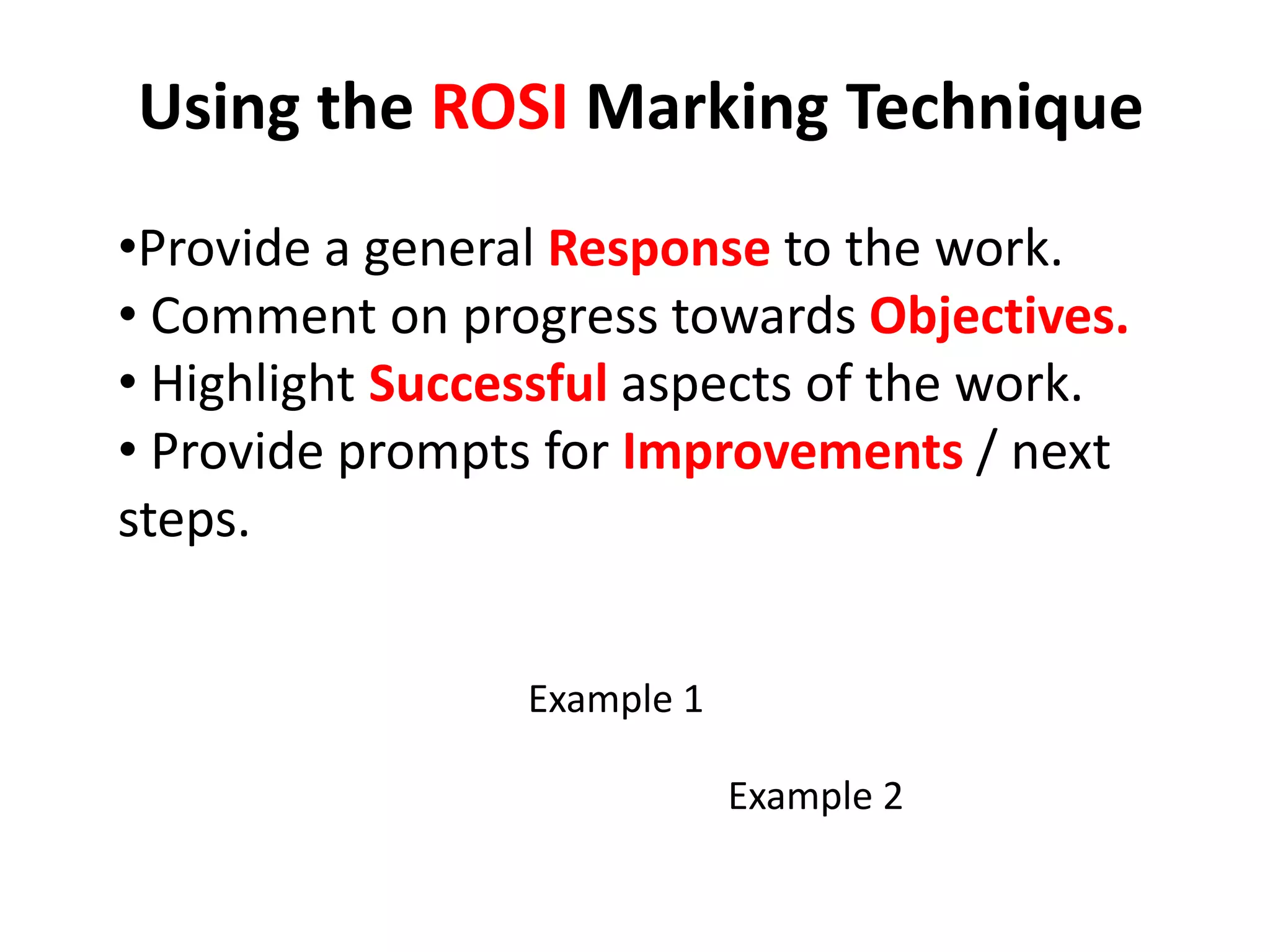
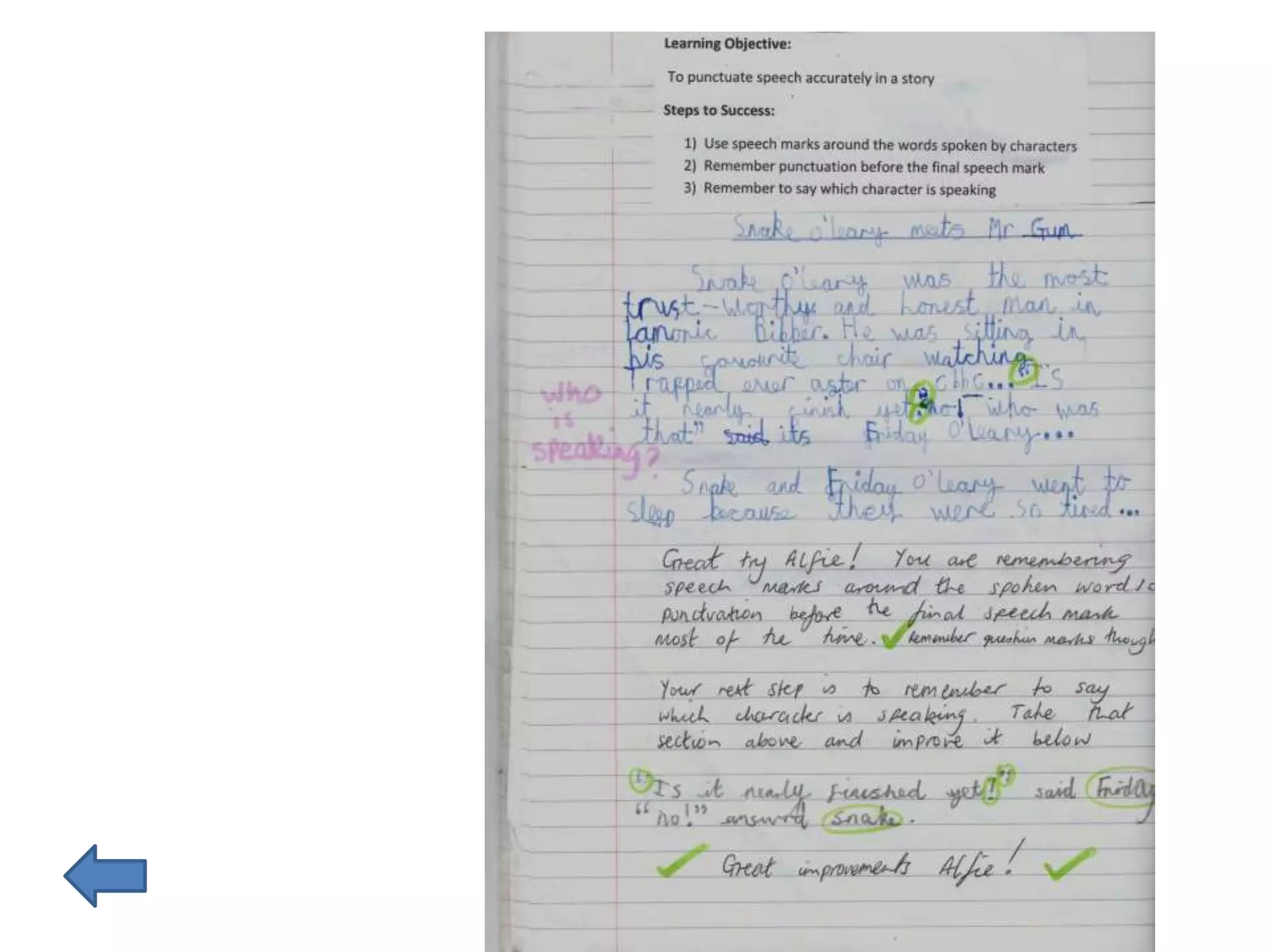
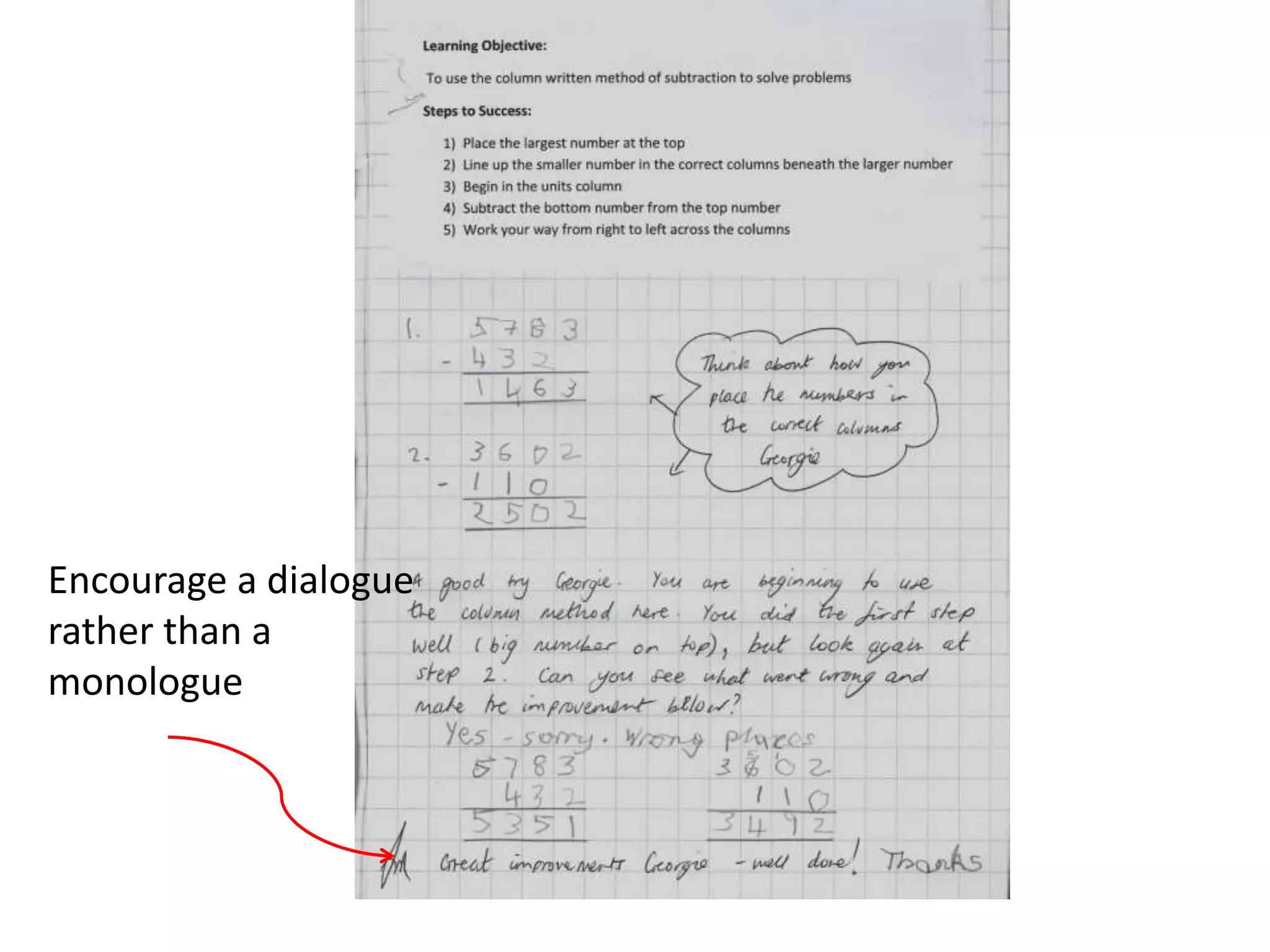
Using the ROSI Marking Technique
•Provide a general Response to the work.
• Comment on progress towards Objectives.
• Highlight Successful aspects of the work.
• Provide prompts for Improvements / next
steps.
Example 1
Example 2
Encourage a dialogue
rather than a
monologue
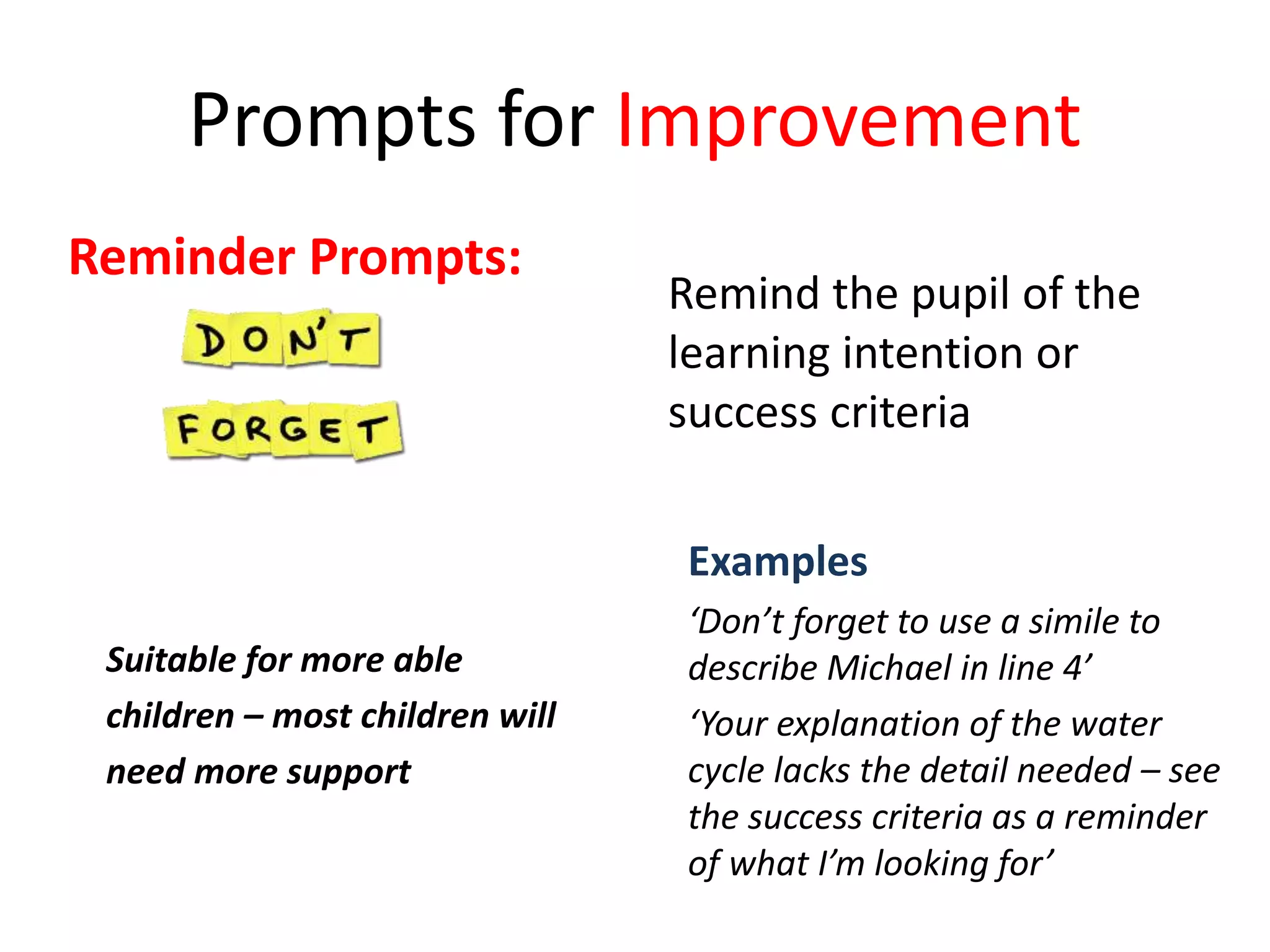
Prompts for Improvement
Suitable for more able
children – most children will
need more support
Examples
‘Don’t forget to use a simile to
describe Michael in line 4’
‘Your explanation of the water
cycle lacks the detail needed – see
the success criteria as a reminder
of what I’m looking for’
Reminder Prompts:
Remind the pupil of the
learning intention or
success criteria
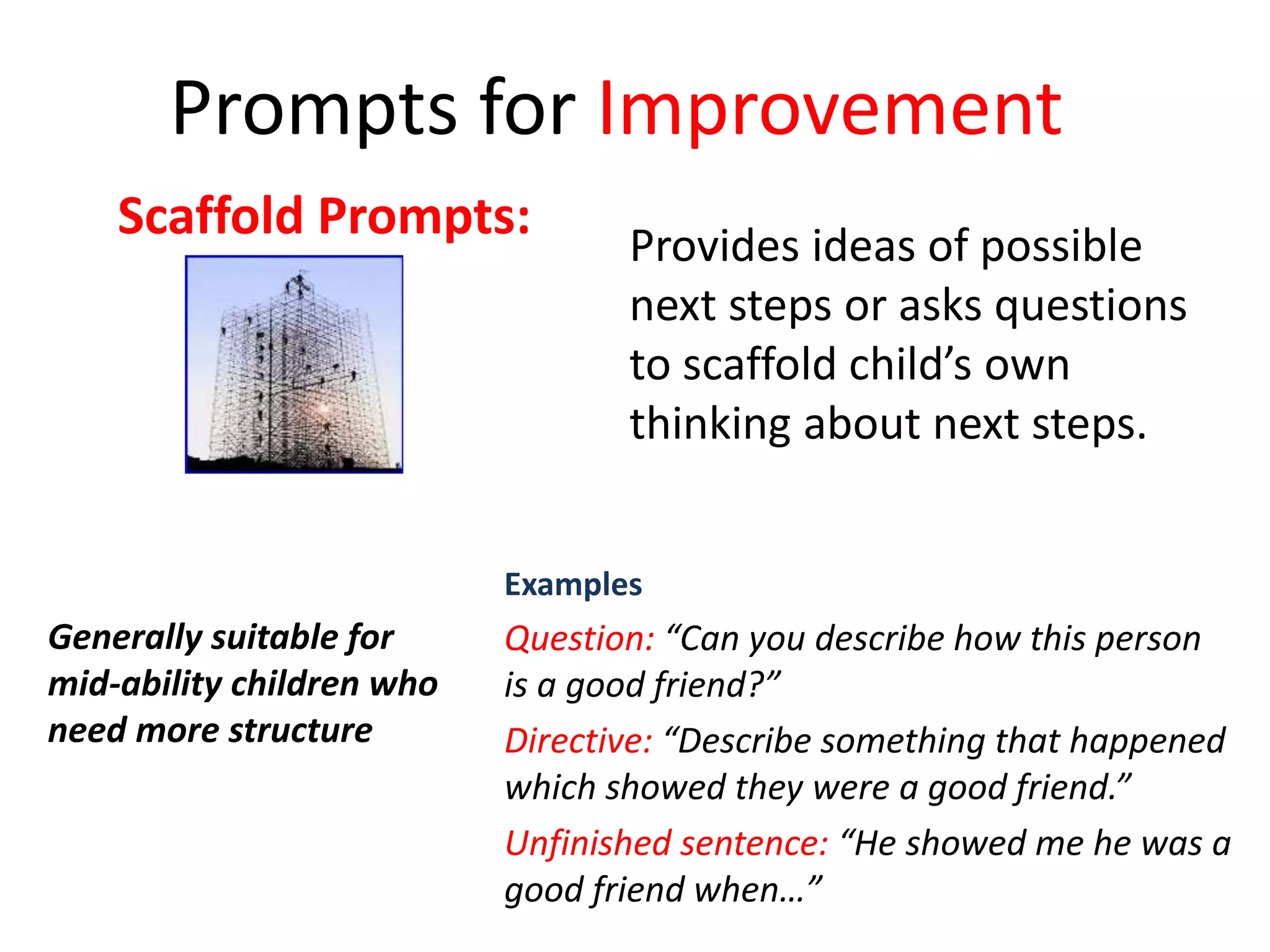
Examples
Question: “Can you describe how this person
is a good friend?”
Directive: “Describe something that happened
which showed they were a good friend.”
Unfinished sentence: “He showed me he was a
good friend when…”
Prompts for Improvement
Generally suitable for
mid-ability children who
need more structure
Scaffold Prompts: Provides ideas of possible
next steps or asks questions
to scaffold child’s own
thinking about next steps.
Examples
Add a little more description about what
Kate saw as the plane came down to land.
Choose one of these or make up your own:
 The cars looked like toys
 The houses looked like dolls’ houses
 The people looked like ants
Prompts for Improvement
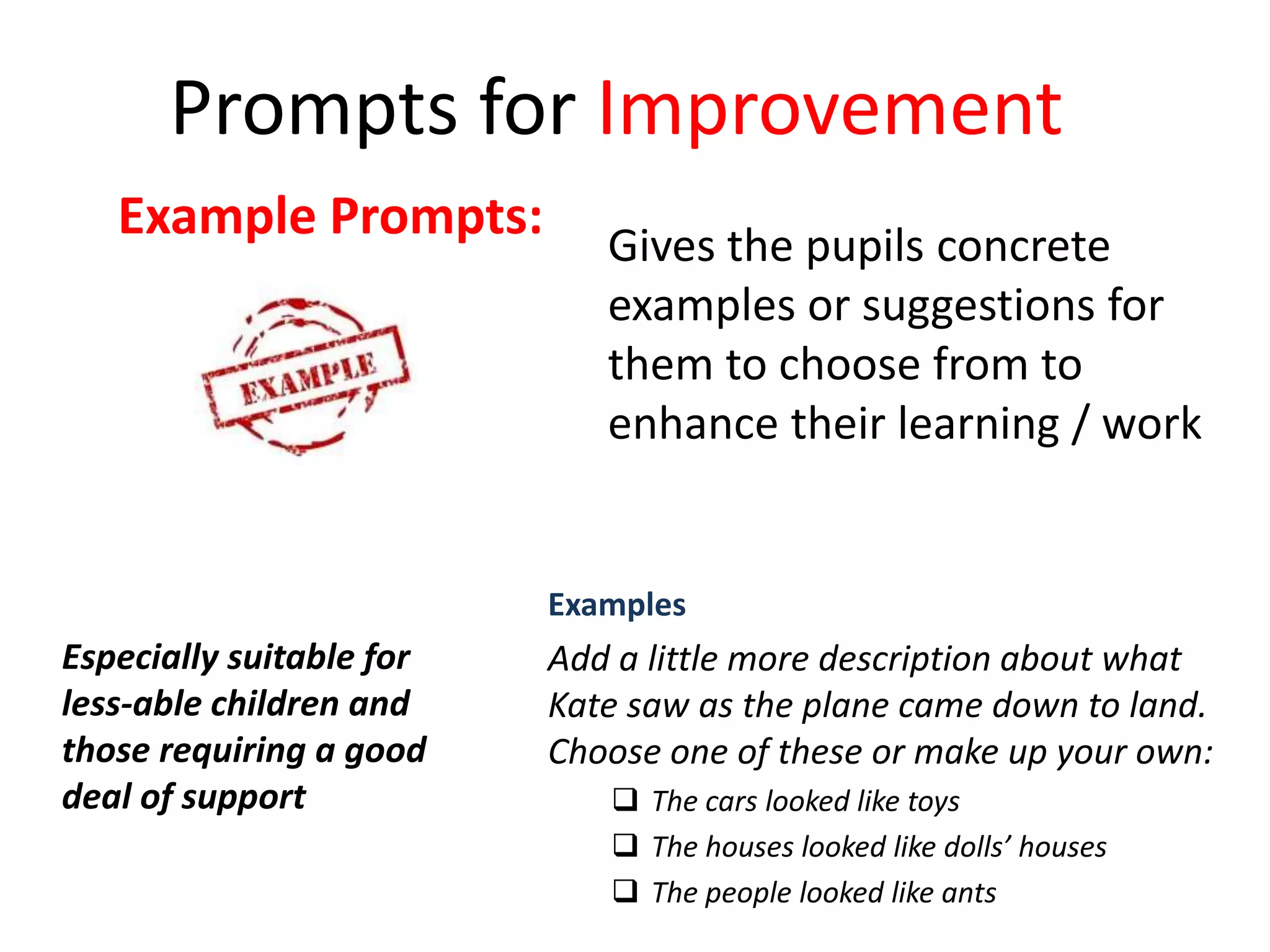
Especially suitable for
less-able children and
those requiring a good
deal of support
Example Prompts: Gives the pupils concrete
examples or suggestions for
them to choose from to
enhance their learning / work
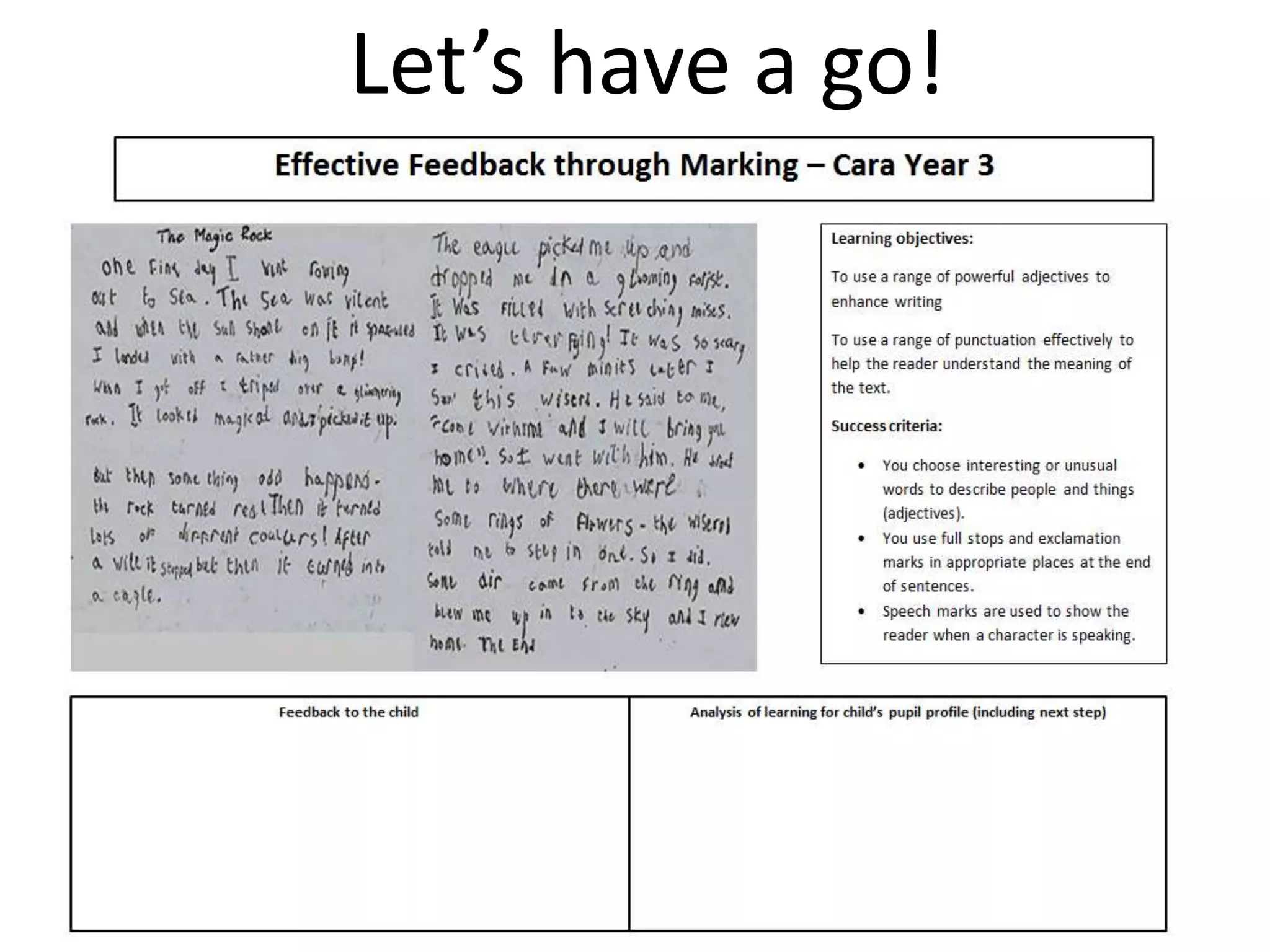
Let’s have a go!
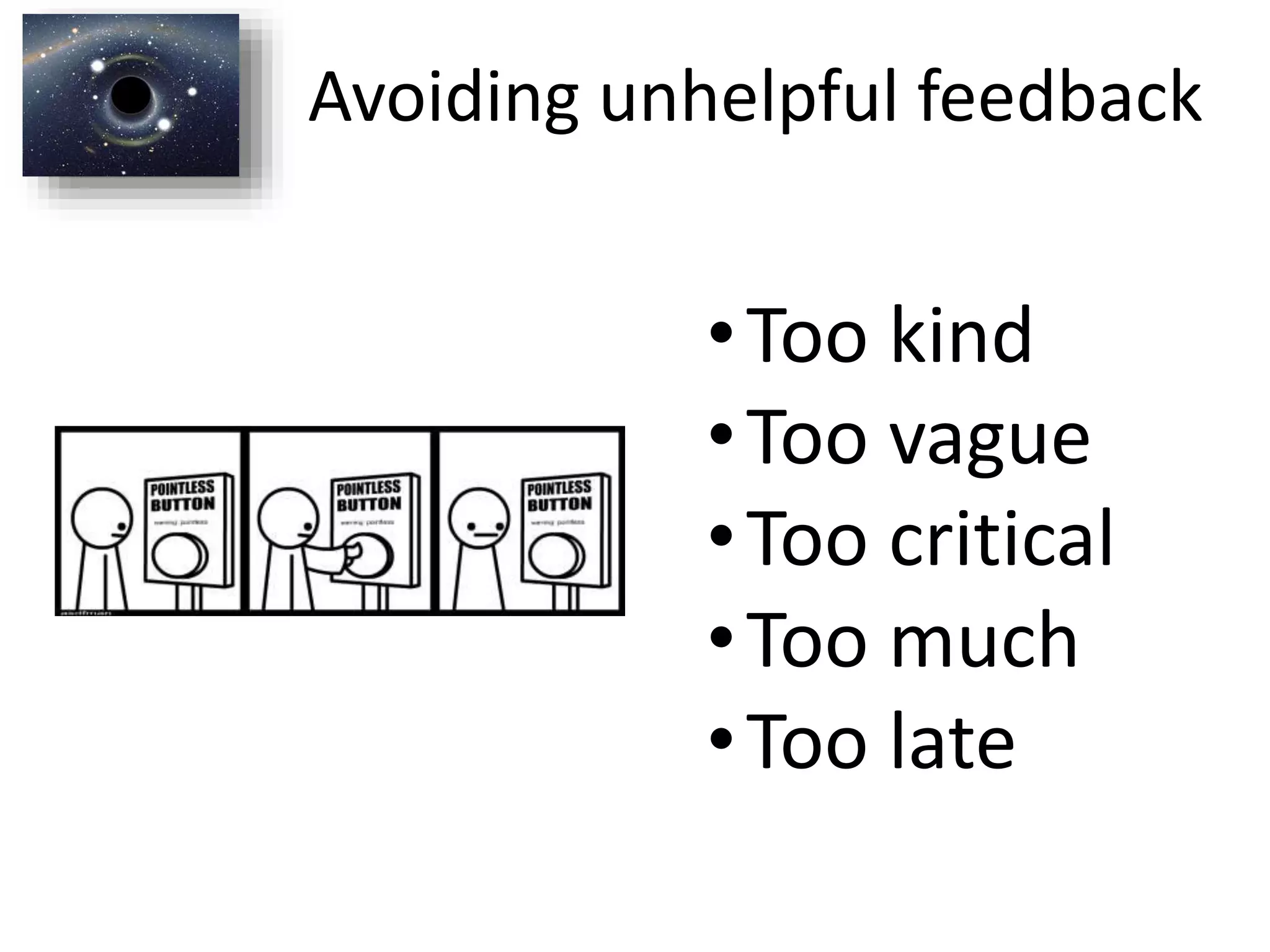
Avoiding unhelpful feedback
•Too kind
•Too vague
•Too critical
•Too much
•Too late
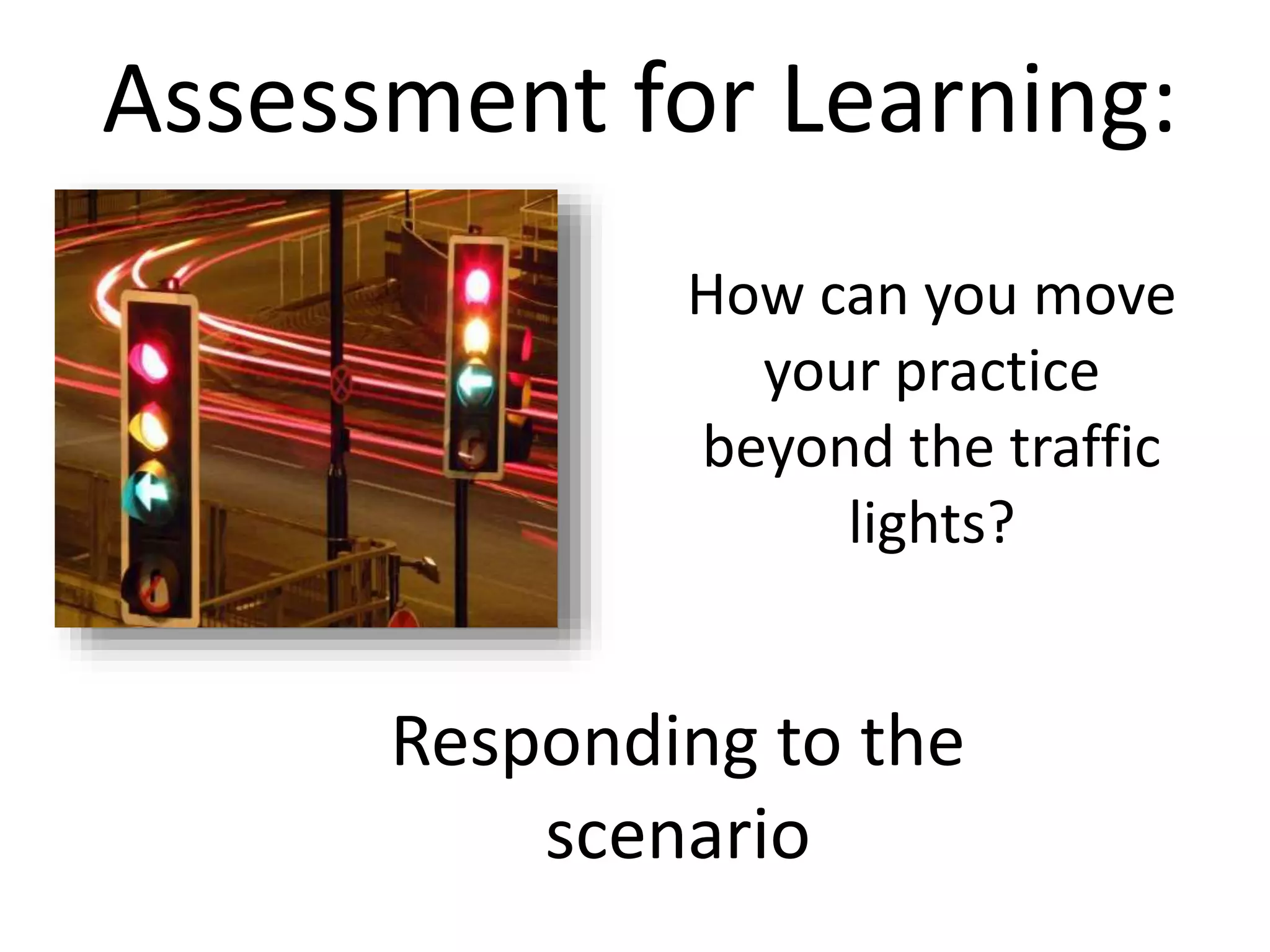
Assessment for Learning:
How can you move
your practice
beyond the traffic
lights?
Responding to the
scenario
Beware of tokenistic approaches
Some teachers seem to stick to the ‘letter’ of A4L by using a
range of the strategies but without a true appreciation of the
purpose or the ‘spirit’ of A4L. The implementation of AfL in the
classroom [is] about much more than the application of certain
procedures – questioning, feedback, sharing the criteria with
the learner and peer and self-assessment – but about the
realization of certain principles of teaching and learning.
(Marshall and Drummond, 2007)
‘In the less effective practice, teachers failed to understand
sufficiently how the approaches were meant to improve pupils’
achievement’. (OfSTED, 2008, p.6)
‘The impact…was no better than satisfactory in almost two
thirds of the schools visited’ (OfSTED, 2008, p.1)
The Task
You realise that now may be a good time to consider the ways in
which assessment for learning strategies may be used within
your classroom to ensure that children make good or outstanding
progress. However, you are also aware of some conflicting
research findings within this area. While there appears to be
widespread support for the potential impact of formative
assessment on raising standards, other research suggests that
while some teachers are adopting a range of recognised AfL
strategies, these sometimes only have a limited impact on
children’s learning and future planning.
With reference to existing literature in this area, put together a
professional development resource for teachers which provides
them with a guide to effective assessment for learning practice
and highlights some of the potential benefits and limitations of
aspects of assessment for learning practice.
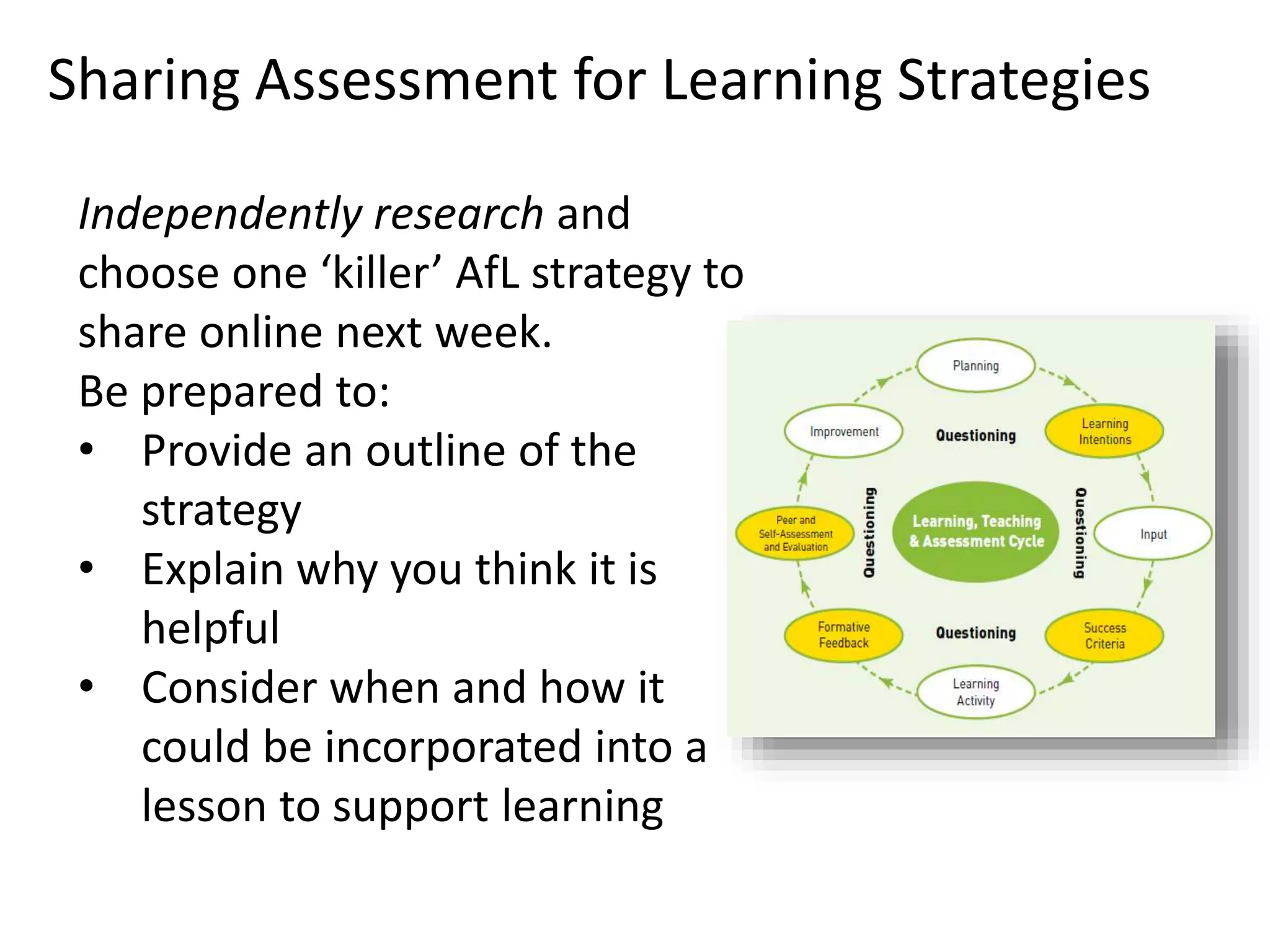
Independently research and
choose one ‘killer’ AfL strategy to
share online next week.
Be prepared to:
• Provide an outline of the
strategy
• Explain why you think it is
helpful
• Consider when and how it
could be incorporated into a
lesson to support learning
Sharing Assessment for Learning Strategies
Identify three key learning points
from today’s session
How will you use these new insights
to have a positive impact on the
progress of the children you will be
working with?
How will you know if you are having a
positive impact on learning?
The ‘so what?’ questions
Aspects to consider:
• There must be links to your appendix, you need
to select three areas.
• The appendix must have links to reading.
• It would be wise to use your placement
experience
• Remember that the appendices can be presented
in a number of ways including, for example, the
creation of a website, tables, illustrations,
diagrams etc.
• Guidance states that your appendix focus should
be on 3 areas. You can add to this if required
remember 2000 equivalent.
References
Clarke, S. (2009) Enriching Feedback in the Primary Classroom,
Oxford: Hodder Press
Wiliam, D. (2008) ‘Improving Learning in Science with Formative
Assessment’ in Coffey, J. (ed) Assessing Science Learning:
Perspectives from Research and Practice, New York: NSTA Press,
pp.3-20

Level 5 ppp assessment for learning final

  • 1.
    Objective (5 mins): Toaccurately draw an allocated cartoon character
  • 2.
    Examine your colleague’sdrawing. Evaluate its accuracy. Assess the work against the objective and provide developmental advice.
  • 3.
    Effective Formative Feedback throughMarking… …Avoiding the black hole Assessment for Learning Cohort 7
  • 4.
    TEACHERS’ STANDARD 6 •To consider ways to ‘give pupils regular feedback, both orally and through marking, and encourage pupils to respond to the feedback’ • To reflect on our learning from the scenario and to share insights • To share AfL strategies which enable pupil progress
  • 5.
    “Teachers can spenda lot of time marking pupils’ work, but the reality is that this can have little effect on improving their learning. Often, marks or comments on work tell pupils about success or failure but not about how to move on in their learning.” (Council for the Curriculum, Examinations and Assessment in Northern Ireland, 2009) I am working really hard to support these children – it must be making a big difference!
  • 6.
    How clear isthe feedback given to pupils? “Develop these ideas further”............... “More detail needed” “You must try harder”... “Ask” .... “A lovely story” .... “Good work” .... “Spellings!” “Use paragraphs” ... Yes, but how? What kind of detail? !!!!!!!!!! About what? So is it perfect, then? How good? In what way? ... Which? Yes, but I don’t know how…
  • 7.
    How do pupilsinterpret feedback? ‘A tick means he probably likes it’ (Year 6) ‘He wrote on it so it must be good’ (Year 3) ‘If it’s a tick I’m quite happy because it means it’s good work, but if it’s two sentences at the bottom it means it’s quite bad.’ (Year 6) ‘Good doesn’t help much – he’s just saying that it’s not really very good. I’d like it if he just told the truth’ (Year 3) ‘It’s one of my best because my handwriting is joined up neat.’ (Year 3) ‘Smiley faces are for working hard, neat handwriting, spelling, the right date.’ (Year 3) From The LEARN Project – September 1999 – report for QCA.
  • 8.
    Key Features ofEffective Feedback • Focused on specific learning objectives and success criteria. • Should involve giving pupils time to reflect on their own learning and how it might be improved. • Pupils need to know three things  Where they are in their learning  Where they need to go next (next steps)  How they might get there (possible ways to improve and close the gap) • The quicker the turnaround, the greater the gains! • Time for children to reflect on and respond to feedback needs to be built in to planning. • It is based upon the principle that everyone has the capacity to improve whether least or most able. • Is in line with the school’s feedback policy
  • 9.
    Effectiveness of writtenfeedback strategies Manageability (where 10 is easy and 1 is difficult) Impact on learning (where 10 is high impact and 1 is low impact) Marking secretarial features (spellings, capital letters) 1-2 1 Acknowledgement marking eg: Ticked with no oral feedback 10 0 Summative comment related to learning intention 5 4-5 Highlighted success and next steps against learning intention 2 9 Adapted from Clarke, 2009, p.64
  • 10.
    Using the ROSIMarking Technique •Provide a general Response to the work. • Comment on progress towards Objectives. • Highlight Successful aspects of the work. • Provide prompts for Improvements / next steps. Example 1 Example 2
  • 12.
  • 13.
    Prompts for Improvement Suitablefor more able children – most children will need more support Examples ‘Don’t forget to use a simile to describe Michael in line 4’ ‘Your explanation of the water cycle lacks the detail needed – see the success criteria as a reminder of what I’m looking for’ Reminder Prompts: Remind the pupil of the learning intention or success criteria
  • 14.
    Examples Question: “Can youdescribe how this person is a good friend?” Directive: “Describe something that happened which showed they were a good friend.” Unfinished sentence: “He showed me he was a good friend when…” Prompts for Improvement Generally suitable for mid-ability children who need more structure Scaffold Prompts: Provides ideas of possible next steps or asks questions to scaffold child’s own thinking about next steps.
  • 15.
    Examples Add a littlemore description about what Kate saw as the plane came down to land. Choose one of these or make up your own:  The cars looked like toys  The houses looked like dolls’ houses  The people looked like ants Prompts for Improvement Especially suitable for less-able children and those requiring a good deal of support Example Prompts: Gives the pupils concrete examples or suggestions for them to choose from to enhance their learning / work
  • 16.
  • 17.
    Avoiding unhelpful feedback •Tookind •Too vague •Too critical •Too much •Too late
  • 18.
    Assessment for Learning: Howcan you move your practice beyond the traffic lights? Responding to the scenario
  • 19.
    Beware of tokenisticapproaches Some teachers seem to stick to the ‘letter’ of A4L by using a range of the strategies but without a true appreciation of the purpose or the ‘spirit’ of A4L. The implementation of AfL in the classroom [is] about much more than the application of certain procedures – questioning, feedback, sharing the criteria with the learner and peer and self-assessment – but about the realization of certain principles of teaching and learning. (Marshall and Drummond, 2007) ‘In the less effective practice, teachers failed to understand sufficiently how the approaches were meant to improve pupils’ achievement’. (OfSTED, 2008, p.6) ‘The impact…was no better than satisfactory in almost two thirds of the schools visited’ (OfSTED, 2008, p.1)
  • 20.
    The Task You realisethat now may be a good time to consider the ways in which assessment for learning strategies may be used within your classroom to ensure that children make good or outstanding progress. However, you are also aware of some conflicting research findings within this area. While there appears to be widespread support for the potential impact of formative assessment on raising standards, other research suggests that while some teachers are adopting a range of recognised AfL strategies, these sometimes only have a limited impact on children’s learning and future planning. With reference to existing literature in this area, put together a professional development resource for teachers which provides them with a guide to effective assessment for learning practice and highlights some of the potential benefits and limitations of aspects of assessment for learning practice.
  • 22.
    Independently research and chooseone ‘killer’ AfL strategy to share online next week. Be prepared to: • Provide an outline of the strategy • Explain why you think it is helpful • Consider when and how it could be incorporated into a lesson to support learning Sharing Assessment for Learning Strategies
  • 23.
    Identify three keylearning points from today’s session How will you use these new insights to have a positive impact on the progress of the children you will be working with? How will you know if you are having a positive impact on learning? The ‘so what?’ questions
  • 24.
    Aspects to consider: •There must be links to your appendix, you need to select three areas. • The appendix must have links to reading. • It would be wise to use your placement experience • Remember that the appendices can be presented in a number of ways including, for example, the creation of a website, tables, illustrations, diagrams etc. • Guidance states that your appendix focus should be on 3 areas. You can add to this if required remember 2000 equivalent.
  • 25.
    References Clarke, S. (2009)Enriching Feedback in the Primary Classroom, Oxford: Hodder Press Wiliam, D. (2008) ‘Improving Learning in Science with Formative Assessment’ in Coffey, J. (ed) Assessing Science Learning: Perspectives from Research and Practice, New York: NSTA Press, pp.3-20