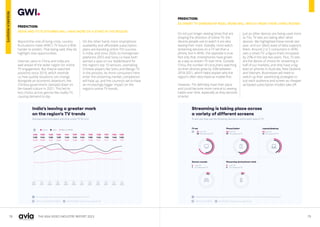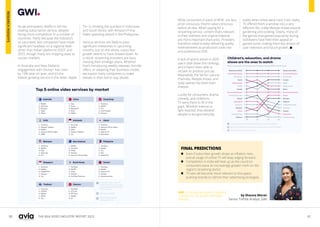


2023
2 3
THE ASIA VIDEO INDUSTRY REPORT 2023
ABOUT AVIA
Asia Video Industry Association
20/F Leighton Centre, 77 Leighton Road
Causeway Bay, Hong Kong
-
5008 Ang Mo Kio Avenue 5
#04-09 Techplace II
Singapore 569874
AVIA IS
THE VOICE OF THE
INDUSTRY WITH
GOVERNMENTS
AND REGULATORS
POLICY
DEDICATED TO
FIGHTING AND
REDUCING VIDEO
PIRACY
PIRACY
COMMITTED
TO PROVIDING
INSIGHT THROUGH
ENGAGEMENT
INSIGHT
The Asia Video Industry Association (AVIA) exists to make the industry stronger
and healthier and thus create a better business environment for its members.
The Asia Video Industry Association (AVIA) is the trade association for the video industry
and ecosystem in Asia Pacific. It serves to make the video industry stronger
and healthier through promoting the common interests of its members.
AVIA is the interlocutor for the industry with governments across the region,
leads the fight against video piracy through its Coalition Against Piracy (CAP)
and provides insight into the video industry through reports and conferences
aimed to support a vibrant video industry.
The Asia Video Industry Report 2023 is curated end edited by Charmaine Kwan,
Head of Marketing and Communications, AVIA.
Please note that data and contributions provided by third parties
have been generated independently and represents their own views.
www.avia.org
4 5
THE ASIA VIDEO INDUSTRY REPORT 2023
FOREWORD
A FUTURE OF GROWTH AND SUSTAINABILITY
The annual Asia Video Industry Report is a
treasure trove of insight and information
and if you want a holistic view of the state
of our industry at the end of 2022, it is
required reading. There is such a variety
of topics and opinions that it is a great
resource to be able to revisit and always
find something new.
The other great thing about this report
is that like everything that we do, it
represents our membership. As an
industry body, our strength always lies
in the members we represent. It is by
channelling the passion and hard work of
all of you that we, as an industry, can be
successful.
Nothing is ever straightforward or
predictable. We thought the outbreak
of a global pandemic was going to test
us and it did, but perhaps not as much
as now - the process of coming out of it,
with the world’s economy under serious
strain. Visions of a tech-led future that
saw valuations reach historic levels under
COVID have been replaced with a more
sombre assessment of priorities – the
key ones being financial profitability and
sustained growth prospects.
So while there is little doubt some of
us will have some rocky times ahead, I
am very confident of the outlook of the
Asian video industry. Profitability and
sustained growth prospects are exactly
what I see. They may not be the first to
tell you, but consumers love what they are
getting. They love the wealth and depth
of amazing shows being produced, they
love the international hits, they love the
local investments in their own stories
and culture, and they love discovering
lesser-known shows from countries they
are less familiar with.
Is there more rationalisation which
needs to be made? Will we see more
consolidations? Will there be more debate
about peak content and its relationship to
financial stability? The answer to all three
of these questions is certainly yes. But
these are growing pains in a sector that
will continue to grow and be immensely
successful. All the tweets and user
generated content in the world cannot
replace the value of well-crafted, well-told
and well-produced stories.
I also believe we have matured
enormously as an industry over the last
few years. If there was any panic over the
disruption the industry has been through,
I believe it has gone. And I see greater
certainty and confidence in the roles
each company plays. There is a more
sombre assessment by each company
of the value that they bring which others
do not. Temptations to try to be D2C and
D2B and a content producer and a tech
company have abated, and we look more
like an industry now with everyone in their
right place.
The role AVIA plays continues to evolve
and while it is not always directly visible,
I believe it remains more important now
than at any previous time. The analogy
I always use is of building and securing
the foundations on which our industry
sits. The stronger and more secure we
can make them, the taller the individual
buildings can grow. The impetus to
regulate in the digital realm is only getting
stronger. We need to continue to make
sure governments across the region
understand the differences between
us and UGC or social media content,
and understand for example, that an
issue such as online harm is not one our
industry faces. Access to appropriate
content is more easily managed in the
world of OTT, through parental controls
putting the consumer in control of their
household.
There are many more examples of issues
where we all align and now as we are able
to travel once again, our ability to take
the positive messages from our industry
to governments around the region have
increased exponentially.
Piracy continues to threaten our
foundations and we continue to combat
it. Working to understand the evolution of
the problems, measuring our success in
containing it, working with governments
to give us better tools and protections
to allow legitimate content to prosper
and building coalitions among our local
and international members to present a
common front, are all key priorities.
For the last three years we have also
been increasingly focused on how we can
support the growth of advertising as we
have witnessed what we think has been a
disproportionate migration of high-quality
produced content on TV to social media.
OTT is the technological evolution of
TV, and while the medium may be more
fragmented than TV was, this is changing
and clearly, we all see international shifts
to focus more on advertising gaining
momentum.
Finally, our role is simply to wonder and
ask the questions to understand how our
industry is evolving and how we can help
support that evolution. I hope this report
will provide answers to many of those
questions we all have. 
Louis Boswell
Chief Executive Officer
AVIA
6 7
THE ASIA VIDEO INDUSTRY REPORT 2023
CONTENTS
SETTING THE STAGE - POLICY CHALLENGES
REDUCING THEFT - PIRACY IN ASIA
RESEARCH INSIGHTS
TECHNOLOGY
ADVERTISING OVERVIEW
CONTENT PERSPECTIVES
MEASUREMENT GUIDE
9
21
53
83
101
135
153
9
SETTING
THE
STAGE
-
POLICY
CHALLENGES
10 11
THE ASIA VIDEO INDUSTRY REPORT 2023
POLICY IN ASIA
Stepping into any new role 18 months
ago, amidst the chaos being wreaked
by COVID, was always going to be
challenging. Doing so within an industry
association where the very nature of the
role requires close collaboration with
regulators and members made the task
infinitely harder. Navigating new online
experiences and meeting colleagues
and members through Zoom was
never going to be ideal but somehow,
we have managed to maintain that
team spirit both within AVIA and with
all our members. While we have never
underestimated the value of face-to-face
meetings, especially in Asia, this continued
collaboration has ensured that the Policy
team at AVIA has been well-placed to face
the onslaught of regulation that seems to
have been borne out of the pandemic. As
we start returning to physical meetings
despite the inevitable inertia that has
taken root, we are confident that we will
be able to build on these relationships
and ensure that we can effectively
address the challenges that some of
these new regulatory initiatives seek to
introduce.
COVID has certainly acted as a catalyst
for regulators to consider not only how
their economies emerge but also how to
ensure the sustainability and continued
growth of those economies. Given
the success that OTT platforms have
witnessed during lockdown, it is no small
surprise that regulators have primarily
turned their attention to these online
providers in an effort to extract a share of
some of those reaped benefits.
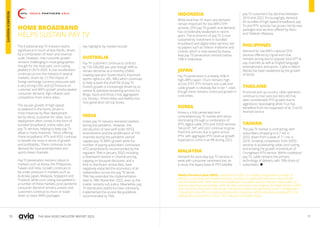
VIETNAM
Vietnam is one of those markets in which
regulators have sought to introduce tax
portals for offshore companies to pay the
tax which would ordinarily be recoverable
from the users of those services, the end
consumers. While registration has been
made compulsory, drafting discrepancies
continue to be addressed and the extent
of what constitutes compliance, remains
uncertain. Unfortunately, these compliance
challenges have also made their mark
in other regulations where the initial
empowering legislation had been met with
so much optimism. This is nowhere more
true than in the case of the Cinema Law
and its draft implementing regulations
where we hoped that only a “simple
notification” would be required, involving
only a list of the titles and rating assigned.
A few months down the line and all is
really not what it seemed. We have heard
that the current draft of the implementing
regulations may propose that the
capacity will require, amongst other
things, proof that the service provider is
paying tax in Vietnam and that the service
provider offers parental controls with
accompanying tutorials. If that is indeed
the case, it would be disappointing that the
proposed regulations overall will take us
five steps back from what initially seemed
like a practical and viable alternative to a
licensing framework.
Decree 6, on the other hand, has not
moved from its position of requiring a local
license and local office establishment and
it has also held firm on the restrictions it
imposed on foreign television channels
around editing, translation, and local
advertising insertion. As we write, Decree
71, amending and formally supplementing
Decree 6 on the Management, Provisions
and Use of Radio and Television Services,
has been formally published with an
operational date of 1 January 2023, to
coincide with the commencement date of
the Cinema Law. The industry had been
optimistic that, with the removal of the
licensing requirement in the Cinema Law,
the licensing requirements in Decree
6 might have similarly been relaxed.
Unfortunately, that is not the case. The
licensing requirement will continue to
apply to all channels and SVOD services
which provide titles beyond what the
Cinema Law has designated as “films”.
This licensing requirement will in turn
require the service provider to set up a
local establishment under the Press Law
and while a foreign entity will be allowed
to wholly own this local establishment,
approval from the Prime Minister will
need to be sought. Until such time as the
Press Law is amended, it seems that these
licensing requirements are here to stay.
INDONESIA
While regulators in Indonesia, via
Regulation 5/2020, opted for registration
(as opposed to more stringent licensing)
by all private electronic service operators
through an online submission portal,
criticism and pushback from the
industry was primarily focused on what
that registration might entail. Concern
arose given that registration required
two further obligations - (i) compliance
with content moderation provisions,
including the widely drafted prohibition of
information that disturbs the public order,
and (ii) compulsory provision of access to
the service provider’s electronic system
and data upon receipt of a request from
the relevant ministry or government
agency. While it appears that most of the
focus is currently on gambling service
providers, the breadth of the regulation
and the sanctions, which include
takedowns and service suspensions,
remain troubling to companies seeking
to offer goods and services within the
market.
The other major issue that has garnered
much attention in Indonesia of late is the
recent spate of data protection breaches.
The regulatory response - the Personal
Data Protection Bill (PDPB) - seeks to
address consumers’ concerns but leaves
service providers slightly uneasy given
the ambiguity of some of its provisions,
POLICY
12 13
THE ASIA VIDEO INDUSTRY REPORT 2023
by Celeste Campbell-Pitt
Chief Policy Officer, AVIA
not least its failure to address whether
the computation of revenue penalties is
to be made with reference to a service
provider’s domestic or global revenue.
INDIA
The debate about data protection has
probably been loudest in India where
an initial draft bill sought to regulate
non-personal data and was withdrawn
after significant pushback from industry.
Work has now begun on a replacement
bill. Commentary from the Ministry of
Electronics and IT (Meity) has drawn a
clear distinction between privacy and data
protection, stating that the PDPB will seek
to address how companies collect, store,
and process data and that the purpose
of the PDPB was not “to do anything
with privacy”. They have also indicated
that the government’s exemption from
compliance with the PDPB will remain,
on the basis that the government is
not “monetizing” the data but instead
using the data for a different purpose
i.e. governance and public service. It is
of course a fine distinction and one we
expect other regulators to adopt as they
seek to find ways to protect their citizens’
personal data.
Regulators in India have been especially
active since the end of last year,
addressing issues such as whether
healthy competition continues to
thrive within the cable industry or
whether there is a need to regulate
the sector. The ongoing debate around
TRAI’s New Tarif Order 2.0, proposed
regulations (which subsequently became
“recommendations”) on the participation
of child artists within the entertainment
industry, regulatory framework proposals
around the establishment of data centres,
content delivery networks and internet
exchanges and a consultation paper
around ease of doing business within
India. All these proposals and consultation
papers have kept the Policy team on
our toes but it has been encouraging
to see the regulators pull back from
implementing regulation where evidence
is advanced, either through industry
submission or public consultation, that
no regulatory intervention is needed and
should not be introduced without formal
regulatory impact assessments having
been conducted.
TRENDS IN CONTENT REGULATION
AROUND THE REGION
As we see in many markets around the
region, many of these initiatives tend to
arise from a stated effort by regulators,
to create a level playing field by trying
to import stringent legacy regulation
into the OTT universe but we continue
to advocate for self-regulation as much
as possible, employing our Governance
Framework as a useful tool to demonstrate
how the curated content industry takes
its social responsibilities seriously by not
showcasing illegal content, implementing
a robust consumer feedback mechanism
and putting content controls squarely in
the hands of the consumer to decide what
content they and their families are able to
access.
Some regulators, however, are yet to be
convinced that presenting consumers
with this level of choice and control is
sufficient to afford the consumer the
necessary level of protection against
content which potentially offends the
social norms and cultural nuances of
that consumer’s market. While AVIA’s
members have always appreciated and
acknowledged that each market’s cultural
norms are different, AVIA works hard to
rebut blanket pre-censorship which does
not take into account evolving market
nuances or which severely limits freedom
of expression. Some markets like Malaysia
and Singapore allow service providers to
operate relatively unencumbered in the
market provided they abide by the relevant
content codes which have been put into
place. However, we do see an increased
eagerness across the region to regulate
more closely all content which appears on
OTT platforms, regardless of whether that
content is part of the substantive offering
or simply publicity and marketing material
promoting that offering. Unfortunately, as
regulators lobby to have their regulatory
scope increased, we also witness more
stringent takedown notice requirements
being considered, with Vietnam and
Indonesia recently proposing 24 hour
notice takedown obligations. This is not
pragmatic, especially for those companies
headquartered in other jurisdictions, so
we will continue our lobbying efforts to
advocate for provisions which are both
reasonable and which offer the affected
party an opportunity to be heard.
Having finally returned to our first physical
“in view” events in a few years, including
our first Korea in View event, we are
hopeful that the opportunity to engage in
person with regulators will offer industry
a much-needed platform to explain
the challenges that could potentially
impede growth and innovation within
a market. We remain of the view that
greater understanding on both sides will
undoubtedly lead to the establishment
of regulatory frameworks that foster the
growth of the industry and are in line with
modern, international best trends. We are
also hopeful that a return to our annual
Policy Roundtable event, again back in
person, offers regulators and industry
members a time to reflect and to remind
ourselves of the fascinating and inspiring
journey the video content industry has
been on, how it has evolved, what the
current key challenges are, how we can
work together to ensure the industry’s
sustainability while minimising our impact
on this planet and ultimately, offer us the
opportunity to explore what the future
holds - the next frontier of the content
industry’s evolution. 
POLICY
14 15
THE ASIA VIDEO INDUSTRY REPORT 2023
INDIA UPDATE
REGULATION OF VIDEO IN INDIA
Over the last 2 years, there has been a
spate of new regulation in India in respect
of video content. As a result, all major
modes of content dissemination and all
forms of content including news, fiction,
non-fiction, reality TV, and advertisements
are now regulated.
THE INFORMATION TECHNOLOGY
(INTERMEDIARY GUIDELINES
AND DIGITAL MEDIA ETHICS CODE)
RULES, 2021
The Information Technology (Intermediary
Guidelines And Digital Media Ethics
Code) Rules, 2021 (IT Rules 2021)
have introduced a framework for
regulating online content in India, and
require content providers to exercise
diligence over content and establish a
3-tier grievance redressal mechanism
with an inter-departmental committee
constituted by the Ministry of Information
and Broadcasting (MIB) acting as the
final tier. The MIB may refer grievances to
the inter-departmental committee 1
and
issue guidance and advisories to content
publishers, and the committee may
recommend that publishers 2
be warned,
censured, admonished, or reprimanded.3
The involvement of the MIB and
inter-departmental committee has led
to concerns that the rights to freedom
of speech and expression, freedom of
press, and dissent on the internet will be
curtailed.
The IT Rules 2021 also prescribe a broadly
worded Code of Ethics for publishers
of content.4
However, the Bombay High
Court has, for the present, stayed the
operation of Rules 9(1) and 9(3) of the IT
Rules 2021 5
which mandate the adoption
of a Code of Ethics.
Oddly, online content is being regulated
under the Information Technology Act,
2000 (IT Act) 6
rather than a bespoke
legislation enacted pursuant to discussions
with stakeholders and parliamentary
approval.7
The IT Act provides legal
recognition for transactions conducted
by means of electronic data interchange
and electronic communication, facilitates
electronic filing of documents, and
addresses cybercrime.8
Whether the
courts will hold that the IT Rules 2021 have
exceeded the scope of their parent Act
remains to be seen.
THE CABLE TELEVISION NETWORKS
(AMENDMENT) RULES, 2021
The Cable Television Networks
(Amendment) Rules, 2021 (CTN
Rules 2021) were notified following a
recommendation from the Supreme
Court 9
that a formal complaint redressal
mechanism be established for consumer
grievances in respect of television
content. Until then, the pay TV space was
self-regulated by autonomous bodies
recognised by the MIB such as the
Broadcasting Content Complaints Council
and the News Broadcasting Standards
Authority which dealt with complaints
relating to television content. The
Broadcasting Wing of the MIB had also
formed an Inter-Ministerial Committee
and an Electronic Media Monitoring
Centre to address public grievances
regarding television content, and to
ensure compliance and issue advisories in
relation to the Programme Code and the
Advertising Code.10
The CTN Rules 2021 establish a 3-tier
complaint redressal mechanism,
identical to the IT Rules 2021, and allow
the MIB to prohibit the transmission
or re-transmission of a channel or
programme which is in violation of the
broadly worded Programme Code 11
or
the Advertising Code.12
The CTN Rules
2021 refer to guidelines prescribed by
the Advertising Standards Council of India
(ASCI), a self-regulatory authority, and lay
down the timeline (but not the procedure)
to be followed by ASCI to dispose of
complaints raised to it.
1 Rule 13(1)(c) of the IT Rules 2021.
2 Rules 13(1)(d) of the IT Rules 2021.
3 Rule 14(5)(a) of the IT Rules 2021.
4 Appendix to the IT Rules 2021.
5 Nikhil Mangesh Wagle v. Union of India, Public Interest Litigation (L) No. 14204 of 2021; Agij Promotion of
Nineteenonea Media Private Limited & Ors. v. Union of India, Writ Petition (L.). No. 14172 of 2021.
6 Section 69A of the IT Act, also see “Government notifies Information Technology (Intermediary Guidelines
and Digital Media Ethics Code) Rules 2021”, Press Information Bureau, Ministry of Electronics and Information
Technology, February 25, 2021
7 Note that content published through other modes is governed through specific legislation such as the Press Council
Act, 1978 and Press and Registration of Books Act, 1867 for print news, the Cable Television Networks (Regulation)
Act, 1995 for television broadcast, and the Cinematograph Act, 1952 for films.
8 Introduction to the IT Act.
9 Common Cause v. Union of India & Others (2018) 13 SCC 440.
10 Rule 4 of the CTN Rules 2021, newly inserted Rule 17(1).
11 Rule 2 of the CTN Rules 2021 inserted Sub-Rule (7) in Rule 6 of the CTN Rules 1994.
12 Rule 3 of the CTN Rules 2021 inserted Sub-Rule (12) in Rule 7 of the CTN Rules 1994.
POLICY
16 17
THE ASIA VIDEO INDUSTRY REPORT 2023
BHARUCHA & PARTNERS was founded on enduring principles of professional ethics and
excellence. The Firm has offices in 3 cities with 15 partners and over 100 associates who offer a
mix of rich experience, creativity, and the energy of youth. B&P is a full-service firm and advises
clients on domestic and cross-border issues across sectors and geographies.
by Kaushik Moitra
Partner, Bharucha & Partners
THE CINEMATOGRAPH
(AMENDMENT) BILL, 2021
The government has proposed the
Cinematograph (Amendment) Bill, 2021
(Cinematograph Bill) which, in its
present form, allows the government to
revoke a certificate granted to a film, and
direct the censor board to re-certify films.
The Cinematograph Bill been criticised
for enabling excessive state participation
as the government may determine which
films can be released to the public in the
interest of the sovereignty and integrity of
India, state security, relations with foreign
states, public order, decency or morality
or in relation to contempt of court,
defamation, or incitement of any offence.
WHAT NEXT?
The regulatory framework, along with
the amendments proposed by the
Cinematograph Bill, is ambiguous
and allows the government to be the
adjudicator of permissible speech in
the country. The intention of recent
regulations appears to be to treat TV
content at par with the internet, which
will likely hinder the liberties that content
for private viewing on OTT platforms
could afford and may lead to publishers
pre-emptively censoring their content to
avoid adverse action. Meanwhile, reports
indicate that, in light of the converged
content environment, the government
is considering an overarching legislation
governing content across print, electronic,
digital media, and cinema.13
Content is being regulated by numerous
state authorities on the grounds that,
under Article 19(2) of the Constitution
of India, the state may place ‘reasonable
restrictions’ upon the freedom of speech
and expression. If the freedom of speech
is to be maintained, and democracy
protected, the regulatory framework
should limit government oversight rather
than expanding it. 
13 See Centre mulls single law to supervise all media, Hindustan Times, 17 August 2021 – available at https://www.
hindustantimes.com/india-news/centre-mulls-single-law-to-supervise-all-media-101629149955442.html
POLICY
18 19
THE ASIA VIDEO INDUSTRY REPORT 2023
INVESTING IN CONTENT DELIVERY
ON THE OPEN INTERNET
Wherever they are and whenever they
want, consumers can access a trove
of movies and TV shows right at their
fingertips — opening up new worlds,
cultures and perspectives to them.
That’s the beauty of streaming, and it’s
all made possible by the internet and the
concept of Net Neutrality, which ensures
Internet Service Providers (ISPs) treat
access to all sites equally. Meaning you
are able to access the latest season of
Stranger Things just as easily as you can
purchase concert tickets to see your
favorite artist.
But unfortunately, we have come to a
crossroads where internet gatekeepers
could get to decide if the next great
Korean, Indian, Australian, Thai etc. story
can be watched, and loved, by the world.
ISPs in many parts of the world, including
the Asia Pacific, are seeking to extract
arbitrary payments from streaming
services for simply making shows and
films available to their subscribers who
are already paying for their internet
connection. Because by making both
consumers and content providers pay,
they can get paid twice.
Proposed legislation would require
internet content providers to pay network
fees to local ISPs for access to their
customers. Such a move violates ‘net
neutrality’ principles that ISPs have to
provide access to virtually all endpoints
of the internet and that all online traffic
should be treated equally.
The stated rationale for the proposed
fees is that the growth of internet traffic is
creating 'unsustainable costs' for the ISPs.
Yet this overlooks multiple points.
First, increased usage incentivizes
users to upgrade their plans, which is
an opportunity for ISPs. We see that
subscribers of streaming services are more
likely to subscribe to higher speed plans,
and many ISPs bundle plans together.
Second, investment in technology ensures
that growing demand from end users can
be handled sustainably without increasing
network costs over time, as has been
observed in the past — internet traffic
grew 50-fold in the past decade. Charging
a fee would distort this incentive for ISPs to
invest in efficiency.
Lastly, content providers, such as
Netflix, already invest to handle traffic
efficiently. We recently celebrated the
10th
anniversary of our global content
delivery network called Open Connect. We
offer this device for free to ISPs around
the world, enabling Netflix content to be
stored as close to members as possible
to reduce congestion and cost. A win-win
for all.
Consumers in APAC should be able to
continue streaming and enjoying their
favorite films and shows from everywhere.
To do that, the world needs a long-term
commitment to collaboration and a free
and open internet. 
by Nick O’Donnell
Head of Public Policy, Asia Pacific, Netflix
NETFLIX is the world's leading streaming entertainment service with 223 million paid
memberships in over 190 countries enjoying TV series, documentaries, feature films and mobile
games across a wide variety of genres and languages. Members can play, pause and resume
watching as much as they want, anytime, anywhere, and can change their plans at any time.
POLICY
21
REDUCING
THEFT
-
PIRACY
IN
ASIA
22 23
THE ASIA VIDEO INDUSTRY REPORT 2023
CAP 2022
A YEAR OF CHANGE & PROGRESS
Niccolo Machiavelli was much more than
just Machiavellian; a little over 500 years
ago he wrote Discorsi sopra la prima
deca di Tito Livio, known in English as the
Discourses on Livy. The Discourses was an
examination of the early Roman historian
Livy’s history of Rome, Ab Urbe Condita,
or From the Founding of the City. The
Discourses illustrate Machiavelli’s belief
that history shows time and again that we
must never forget the past but use it to
build our future, and in the third and final
book of the Discourses, he focuses on the
actions of the men who made Rome great
(a book sadly misunderstood by Starship
in their 1985 hit “We Built this City (on Rock
and Roll)”). It is in this book that Machiavelli
notes that ‘whosoever desires constant
success must change his conduct with
the times’. Never has a maxim been more
relevant than in recent years, including for
CAP.
In January, CAP underwent a major change
in leadership. The change provided a good
opportunity to step back, review where
CAP was, how we got there, and most
importantly, how we move forward. This
review resulted in the identification of
CAP’s goal to be “leading the protection of
AVIA member company content online in
the Asia Pacific region”. CAP’s mission was
then outlined in the ‘Strategy on a Page’
which was built around the four pillars of
Collaboration; Research & Technology;
Enforcement and Disruption, and
Engagement and Outreach. The review
also identified CAP’s work as being imbued
with our values of being Collaborative;
Transparent; Strategic; Innovative, and
Impactful. The goal and the mission were
what underpinned and drove CAP’s work
throughout 2022.
COLLABORATION
From day one, collaboration with our
key stakeholders, particularly the CAP
Steering Committee and local coalitions,
has been a defining feature of CAP’s work,
and it is through this work that we ensure
an effective strategy with the capacity
to create and sustain enforcement
momentum around the region. In
2022 CAP re-energised this pillar with a
particular focus on communication. Newly
created quarterly reports were distributed
to the Steering Committee at the end
of each quarter, and these were each
followed with quarterly meetings to review
CAP’s activities and strategies from the
quarter as well as looking ahead for those
planned for the next. CAP also enacted
regular one on one calls with members to
ensure ongoing engagement with all.
The role of local coalitions was also
galvanised in 2022 with the Video
Coaltion of Indonesia (VCI) being key to
the extension of our site blocking efforts
there. It is hoped CAP’s creation of the
Video Coalition of the Philippines (VCP)
in September 2022 will bear similar fruit
in ensuring efficient and effective site
blocking procedures are put in place in the
Philippines in the near future.
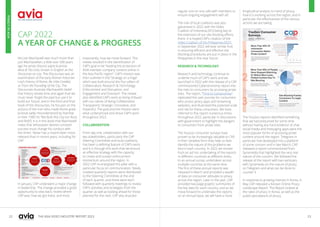
RESEARCH & TECHNOLOGY
Research and technology continue to
underlie much of CAP’s work and we
launched in 2022 with the release of a CAP
commissioned Cyberstronomy report into
the risks to consumers by accessing pirate
sites. The report, “Time to Compromise”,
replicated the user journey for consumers
who access piracy apps and streaming
websites, and illustrated the potential scale
and risk for these consumers. We have
referred to this report numerous times
throughout 2022, particular in discussions
with government to highlight the dangers
to consumers from pirate sites.
The YouGov consumer surveys have
proven to be increasingly valuable to CAP,
in their simplest form they help us best
identify the nature of the problems we
face in each country. In 2022 we moved
from an ad hoc undertaking of the reports
in different countries at different times,
to an annual survey undertaken across
multiple countries at the same time.
The first of these annual reports was
released in March and provided a wealth
of data on consumer attitudes to piracy
across the region. Later in the year, CAP
provided two-page graphic summaries of
the key data for each country, and as we
move forward to undertake the reports
on an annual basis, we will have a more
longitudinal analysis to hand of piracy,
how it is evolving across the region, and in
particular the effectiveness of the various
actions we are taking.
The YouGov reports identified something
that we had presumed for some time
without having any hard evidence of, that
social media and messaging apps were the
most popular forms of accessing pirate
content around the region. Telegram in
particular had developed into a platform
of some concern and in late March, CAP
released a report commissioned from
Synamedia that highlighted the very real
nature of the concern. We followed the
release of the report with two seminars
with Synamedia on the nature of piracy
on Telegram and what can be done to
counter it.
In response to growing interest in Korea, in
May CAP released a Korean Online Piracy
Landscape Report. The Report looked at
the rates of piracy in Korea, as well as the
public perceptions of piracy.
PIRACY
IN
ASIA
24 25
THE ASIA VIDEO INDUSTRY REPORT 2023
Along with the YouGov reports, the
MagiCAP portal has been essential to
CAP’s work in its identifying of pirate
sites of concern around the region, and
particularly in tracking piracy traffic and
superbly illustrating the impact of blocking.
2022 saw a total overhaul of the portal
and a new and improved MagiCAP 2.0 with
extra fiddly bits is expected to be launched
in Q4.
ENFORCEMENT & DISRUPTION
The YouGov reports have shown the
effectiveness of site blocking in combatting
online piracy, perhaps nowhere more
starkly than in Indonesia where CAP’s
rolling site blocking strategy has seen more
than 4,000 pirate sites blocked in the last
three years, resulting in 50% of Indonesian
consumers saying they no longer access
pirate sites at all, and another 34% saying
they rarely do. This has however seen
a growing migration of pirate sites to IP
address only locations, which cannot be
blocked by the normal method of DNS
(domain name server) blocking as there is
no domain to be blocked. To counter this,
in Q3 CAP entered into a three-month IP
address blocking trial with the Indonesian
telecommunications regulator, Kominfo.
Throughout the trial CAP worked with Vidio
to forward Kominfo 10 sites a month for IP
blocking, which were then monitored daily
with changes being immediately reported
to Kominfo. The trial proceeded smoothly
and in Q4 CAP will be working with Vidio
and Kominfo to expand the trial to a more
regular program of 50 sites being referred
every month.
CAP’s blocking program also continued
apace in Singapore when we obtained
our largest ever blocking order of 30
sites and close to 150 associated URLs
being obtained in Q1. The order was a
‘dynamic’ one and in Q3 we informed
ISPs of another 99 associated URLs that
were subsequently blocked. We are now
working on a further order that we expect
to be obtained in late 2022. In Malaysia,
CAP continued to block on a regular basis,
and we added members to the blocking
list that greatly expanded the footprint
of sites that can be blocked, with 70 sites
being referred in one round alone in Q3.
2022 also saw the successful conclusion
of a CAP led action with New Zealand
and Australian partners against a New
Zealand based ISD seller with the operator
effectively shutting down their operations.
ENGAGEMENT & OUTREACH
Following YouGov’s identification of
social media platforms as a key source of
accessing pirated content, in 2022 CAP
cranked up its engagement with the two
biggest technology companies in this
space, Google and Meta. CAP has regular
calls with each company and in 2022 we
instituted roundtables with each with
CAP Steering Committee members. The
roundtables were very well attended and
both were highly effective. For Google
we are now exploring their offer of CAP
acting as a Trusted Copyright Removal
Program (TCRP) facilitator on behalf of
CAP members who don’t hit the necessary
thresholds for that service themselves.
For Meta, CAP in 2022 began referring
sites that we have had blocked around
the APAC region, for removal from all
Meta platforms (Facebook, Messenger
and Instagram). CAP are the only
non-government organisation that receive
this service.
And speaking of government, the easing
of COVID restrictions allowed CAP to have
face to face meetings with numerous
government officials around the region. In
Q2 we organised a meeting in Singapore
with CAP members and Kominfo, the
result of which was the highly successful
IP blocking trial. As a longer term goal,
CAP are also working with Kominfo on an
MOU that would allow for the blocking
of sites based on copyright alone in
Indonesia.
In Q2 CAP also met with Astro and MDTCA
in Malaysia to discuss our site blocking
program there. In Q3 CAP picked things
up in the Philippines following the July
introduction to the House of a Revised
IP Code that included site blocking
provisions. In August CAP made an out
of cycle submission on the Bill, and we
followed this in hosting a Digital Piracy
Summit in Manila in September, made
possible with the support of Globe.
We invited Congressman Salceda, who
presented the Bill, to provide the keynote
for the Summit, and we subsequently met
separately with him and Globe later in the
month to discuss the key components
of an efficient and effective site blocking
regime.
Another key speaker at the Manila
Summit was Mr Ita Choi, the Executive
Director of Korea’s Copyright Overseas
Promotion Association (COA). COA
represent the Korean broadcasters and
our developing relationship with such a
key strategic partner has been one of our
highlights in 2022. MDTCA also spoke at
the event.
CONCLUSION
He was onto something, that Machiavelli.
In 2022 CAP reviewed its operational
history, identified its strengths and
weaknesses, and pushed forward. That
included: revising our YouGov surveys
to be undertaken annually across the
board; a top to bottom restructuring of
our online platform resulting in MagiCAP
2.0; greatly enhancing our relationships
with the tech giants Google and Meta;
pushing the boundaries of our site
blocking efforts with a move to IP blocking
in Indonesia, our biggest site blocking
order in Singapore, greatly expanding
our footprint of sites to be blocked in
Malaysia, and finally, an all court press
pushing for an efficient and effective site
blocking regime in the Philippines. As
the world continues to emerge from its
post-COVID funk, CAP are eagerly looking
forward to striving for constant success
via changing times in 2023. 
by Matthew Cheetham
General Manager, Coalition Against Piracy
PIRACY
IN
ASIA
26 27
THE ASIA VIDEO INDUSTRY REPORT 2023
MEASURES TO COMBAT ONLINE PIRACY IN ASIA PACIFIC:
RECENT DEVELOPMENTS
Notwithstanding the increased volume
of legitimate content available through
Over-The-Top (OTT) streaming services,
the prevalence of online piracy remains
a huge threat to content rights holders
globally.
Against the surge in consumption of
illegal content, countries across the Asia
Pacific region (APAC) have recognised
the importance of using their legal
and regulatory frameworks to combat
online piracy. This article provides a
brief overview of the recent regional
developments.
1.
SINGAPORE
In response to feedback regarding the
difficulty of using previous legislation
to enforce their rights against sellers of
hardware devices, software applications
and services that facilitate access to
unauthorised content, the Singapore
Copyright Act 2021 now imposes civil and
criminal liability on commercial dealers of
such devices and services.
The new provisions are technologically
neutral and broad enough to cover
other types of content such as books
and songs, and other methods such as
offering of services to install applications
on existing hardware.
The change targets people who
commercially profit off hardware, software
and services that only have a limited
commercially significant purpose or use,
other than to facilitate access to copyright
works communicated to the public without
the authority of copyright owners. They
do not impose liability on consumers and
users of the hardware devices, software
applications or services.
2.
MALAYSIA
The Malaysia Copyright (Amendment) Act
2022, effective since 18 March 2022, has
created new offences for:
a. Committing or facilitating copyright
infringement by:
• manufacturing, importing, selling,
letting for hire, distributing and/or
offering any streaming technology;
and/or
• offering or providing any service of
streaming technology;
b. Intentionally causing any evidence
in relation to the commission of an
offence to disappear, or knowingly
giving false information; and/or
c. Sharing infringing access to online
location of any works or copies of
works online.
The new Act also strengthens
enforcement powers for copyright-related
offences, now allowing search and seizure
of any infringing copy by the Assistant
Controller or police, even without any
application by the copyright owner.
The Assistant Controller can also
now direct the copyright owner (or
an authorised person) to make a test
purchase of any goods to determine
whether the new Act has been complied
with; and to direct the provision of
information or document in the course of
an investigation under the Act.
3.
INDONESIA
Although there has been no further
amendment made to the Indonesia
Copyright Act after its enactment in
2014 and the Information and Electronic
Transaction Act after its last revision in
2016, Indonesia has seen a significant
75% reduction in traffic to pirate sites as
of January 2022, since site-blocking began
in mid-2019. As of April 2022, more than
3,500 domain names have been added
to the local blacklist.However, in 2022
Special 301 Report of the United States
Trade Representative, Indonesia is still
included in the Priority Watch List, as
rights owners continue to report notable
levels of piracy through illicit streaming
devices (ISDs) and illicit Internet Protocol
Television (IPTV), as well as unauthorized
camcording and unlicensed use of
software.
4.
PHILIPPINES
The Philippine Online Infringement Bill,
first proposed in 2019, is still pending
approval. If enacted, this will enable the
Philippines Intellectual Property Office
to revoke licenses of Internet Service
Providers (ISPs) that allow pirate websites
to circulate unauthorised content.
The Philippines has also joined the
growing list of countries to implement
site-blocking measures (albeit without
oversight from the Courts in this
case). The voluntary agreement saw
the Philippines IPO, the National
Telecommunications Commission and the
country’s ISPs collaborate to block pirates
in a streamlined fashion.
These developments are significant
since the local level of piracy has recently
overtaken that of Malaysia and Indonesia.
In 2022 alone, 61% of consumers admitted
to accessing pirated content, an increase
from 49% in 2020.Amongst those who
frequent pirate sites, 47% have cancelled
their subscriptions to legitimate local and
international content services.
5.
THAILAND
The Thai Copyright Act (No. 5) B.E. 2565
2022, effective from 23 August 2022,
provides for a new takedown procedure
that allows copyright owners to use a
takedown notice (instead of a Court
order) to start the takedown process.
PIRACY
IN
ASIA
28 29
THE ASIA VIDEO INDUSTRY REPORT 2023
Certain types of “service provider[s]” –
which now covers intermediary service,
caching service, hosting service and
information location tools service – are
presumed to be exempt from liability if 2
conditions are satisfied:
a. An explicit announcement and actual
compliance of service-terminating
measures have been made; and
b. Compliance with the statutory
conditions provided for each type of
service provider.
For hosting service and information
location tools services, the amended
Copyright Act introduces a new notice and
take down procedure allowing copyright
owners to issue a copyright infringement
notice to such service providers and
counter-claims against such notice.
6.
CHINA
China’s Third Amendment of Copyright
Law ("Third Amendment"), effective
since 1 June 2021, is a major reform in
response to the increasing number of
copyright infringement lawsuits in China,
including cases of digital piracy.
Some key highlights below:
• In response to previous criticisms
relating to the assessment of damages,
new legislation has increased the
amount of statutory damages payable
within the range of CNY 500 (USD 77)
to CNY 5 million (around USD 770,000)
and introduced punitive damages
consistent with its trade marks and
patent laws. Where appropriate,
punitive damages of up to 5 times the
determined damages may be awarded.
• Copyright authorities can also impose
fines on infringers proportionate to
the illegal business turnover; conduct
investigations; and seize suspected
infringing articles.
7.
HONG KONG
The Hong Kong Copyright (Amendment)
Bill 2022 has been gazetted. If
enacted, it will introduce an exclusive
technology-neutral communication
right for copyright owners and criminal
sanctions against infringement relating to
the new communication right.It also will
introduce two additional statutory factors
for the court to consider when assessing
whether to award additional damages to
copyright owners in civil cases involving
copyright infringements that will to help
deter infringement.
The Bill also introduces “safe harbour”
provisions for online service providers
to protect their activities and incentivise
them to cooperate with copyright owners
in combatting online piracy.
by Andy Leck
Head of the Intellectual Property and
Technology Practice Group in Singapore, Baker McKenzie
We at Baker McKenzie appreciate the challenges of staying innovative and profitable in an
increasingly regulated global landscape. Working across borders, our Media and Entertainment
practice brings together intellectual property and technology specialists to advise on a wide
range of complex cross-border matters to help clients keep the show on the road. We advise on
all aspects of intellectual property in the media and entertainment space, including development
agreements, brand strategy, designs and complex copyright questions associated with moral
rights, content production, distribution and transactions.
COMMENTARY
The rapid development of copyright laws
across the region recognises the need for
better and smarter regulations to guard
against the misappropriation of content
by bad actors.
While the industry cannot solely depend
on existing laws and regulations to catch
up with rapidly evolving technology,
the increased amount of effective
site-blocking in a number of countries
and updated copyright laws across the
region show a greater awareness of these
issues among governments. For example,
YouGov surveys in Malaysia show that
consumers move away from piracy when
faced with site-blocking pages. Indonesia
too, has seen a downward trajectory of
streaming piracy since the introduction of
its site-blocking regime.
Nonetheless, as technology continues
to march forward and more content
continues to be pirated before it is even
released, an effective strategy to reduce
theft and combat piracy in APAC can
only be achieved through consistent
enforcement, disruption and consumer
education and outreach. 
PIRACY
IN
ASIA
30 31
THE ASIA VIDEO INDUSTRY REPORT 2023
LEGISLATION SHOULD KEEP PACE WITH TECHNOLOGY
TO STOP STREAMING PIRATES IN THEIR TRACKS
What’s the link between streaming piracy
and seatbelts? The answer is legislation.
In countries where seatbelt use is required
by law, the reduction in car crash fatalities
is dramatic. Likewise, we at Synamedia
believe that governmental legislation and
the enforcement of anti-piracy regulations
will result in a significant reduction in
the number of incidents and risks from
streaming piracy.
Undermining the ecosystem of the media
and entertainment industry, streaming
piracy continues its sky-rocketing
trajectory. The financial rewards on offer
and the relative ease of setting-up an
illegal operation, combined with the low
risk of arrest or meaningful punishment,
means that video streaming pirates are
continually on the look-out for more ways
to monetize their illegal distribution of
content.
Keeping one step ahead of piracy requires
collaboration across the entire video
distribution chain.
On the one hand, adopting both protective
and proactive approaches to detect,
disrupt and deter piracy is paramount.
For example, employing OTT protection,
encryption, forensic watermarking and
other technologies to ensure that only
legitimate subscribers and applications are
granted authorised access to content.
On the other hand, we need collaboration
among content owners, legislators and
law enforcement authorities to gather the
evidence required to orchestrate technical
and legal takedowns. The effectiveness of
this approach has already been proven.
For example, in the EU, the UK, Brazil and
Southeast Asia, we work with Interpol and
local law enforcement agencies to develop
training materials and evidence-gathering
guidelines to support local enforcement
activities.
LEGAL LIMITATIONS
Content owners can fight streaming
pirates by issuing takedown notices once
piracy has been detected, and by asking
courts for blocking injunctions. In addition
to progress in taking down illegal streams
on social media platforms, new techniques
such as dynamic IP blocking are beginning
to play their part.
The existing worldwide legal framework
offers only a partial solution for the
protection of digital property. Internet
service providers (ISPs) are not always
obliged to comply with takedown notices.
If they do comply, there are often varying
interpretations of what constitutes
‘expeditious’ action, and when it comes
to removing infringing content during
sporting events, current standards are
typically not ‘expeditious’ enough.
There is no legal path to complement
existing technological capabilities to tackle
the threat of piracy in real time, and stop
the distribution of stolen digital content as
it is discovered, without enlisting the help
of an external enforcement authority. For
example, protecting sports and live events
means applying to the court for a dynamic
blocking order. Such a court order allows
a content owner to notify ISPs, in advance,
that they must block access of URLs
providing access to websites that are
subject to the main court order. However,
these measures are still not widely
deployed.
RETHINKING LEGISLATION
We need to update current legislation to
address ongoing and repeated real-time
infringements by pirates. In essence, rights
holders should be able to counterstrike
against streaming pirates who illicitly
distribute unlicensed content. In street
crime, using reasonable force to fight back
is ‘self-defence’ and permissible by law. We
believe the law should support this in the
virtual space too.
The tech industry is already in a position
to do this by integrating the existing
technology solutions and capabilities that
detect the stolen content and disrupt
its distribution, without violating pirates’
assets or privacy. As technology moves
faster than legislation, the law needs to
be future-proofed to address techniques
pirates deploy, and enforcement agencies
should be empowered for compliance.
It’s time for legislators to buckle up, rev
up the self-defence legislation engine and
force the pirates off the road, into the
ditch. 
SYNAMEDIA protects approximately $70 billion in operator revenues every year with its
unrivalled intelligence-based approach, leveraging AI technologies alongside human intelligence
to monitor and map the piracy supply chain. With 30 years’ experience in video security,
Synamedia developed the longest unhacked solution on the market, while its operational security
team has brought many criminals to the attention of law enforcement officials.
by Miri Naor Elias
Intelligence and Security Senior Legal Advisor, Synamedia
PIRACY
IN
ASIA
32 33
THE ASIA VIDEO INDUSTRY REPORT 2023
SECURING THE FUTURE
OF ASIA’S MEDIA & ENTERTAINMENT INDUSTRY
Global piracy has undoubtedly grown over
the last two years of the pandemic. It is
estimated to cost TV and movie providers
almost USD$52 billion in revenue
worldwide in 2022, according to Online TV
Piracy Forecasts.
This is not surprising, given rising
demand for online content created by
pandemic-induced social restrictions, and
the reduction of purchasing power which
has resulted in some consumers seeking
illegal streaming options for content.
According to Akamai’s latest State of the
Internet / Security report, global piracy
demand* reached 3.7 billion unlicensed
streams and downloads between January
and September 2021.
There were also 82 billion visits to
television and film industry-related piracy
websites between January and September
2021, with the United States (13.5 billion),
Russia (7.2 billion), India (6.5 billion), China
(5.9 billion), and Brazil (4.5 billion) as the
top five locations for piracy website visits.
In Asia Pacific, where the online video
industry is expected to grow at an
8% CAGR to reach USD72.7 billion in
2027, and the total addressable market
continues to expand with 78% of the
population (excluding China) accessing
4G, 5G and fibre-enabled connectivity in
2022, piracy remains a pervasive issue that
cannot remain unchecked.
PIRACY EXPOSES BOTH
MEDIA COMPANIES AND
CONSUMERS TO BAD ACTORS
Beyond the legal implications and financial
losses for content providers, piracy also
exposes consumers to malicious content,
from phishing, malware, and exploits
to botnets, ransomware attacks, and
identity theft. Over 90% of illicit streaming
sites detected by our Managed Content
Protection service were found to contain
this type of content, posing a real threat to
users and streaming providers alike.
Beyond that, many motivated threat
actors leverage the illicit lure of pirated
content as a passive delivery vehicle for
targeted attacks, including credential and
PII (personal identifiable Information) theft
via spear phishing, malware, and botnet
aggregation.
This begs the question: how then can
businesses stay at the top of their game?
DEVELOPING 360-DEGREE AWARENESS
TO THWART PIRACY ATTACKS
The only way that content providers can
effectively prevent piracy from making an
impact is to identify and mitigate broadcast
layer piracy in near-real time. Solutions
like Akamai’s Managed Content Protection
(MCP) service which is delivered by Akamai
experts in the media Broadcast Operations
Command Center (BOCC) serve as a first
line of defence to monitor, automatically
detect, analyse and mitigate piracy threats
in real-time to stop them in their tracks.
Another important mitigating effort to
consider is how to convert users of piracy
sites into paying subscribers. For example,
by terminating unauthorized access with
content protection services in near-real
time can be a way to push potential
viewers of pirated content to pursue legal
means of access.
Tapping onto content protection services
is also a good way to mitigate such issues
– as it enables the collection of business
intelligence which can help organizations
understand consumption patterns and
thereafter, identify the right content
strategies to reach customers and nurture
a legitimate audience.
Additionally, the role of consumer
education cannot be overstated. Not only
does this encompass awareness around
the consequences of piracy, but also
education around how they can safely and
legally obtain access.
According to Akamai’s findings, we
also found that a top reason for
consumers turning to pirated content
is the unavailability of content in their
markets. Thus, ensuring availability, and
communicating this to consumers will be
key, to cut the problem off at the source.
NAVIGATING A PIRACY-FREE FUTURE
Piracy is, indeed, an ongoing battle, and
there is no silver bullet to address this
pervasive issue.
The only way that industry players
can stay ahead is to continually evolve
security measures and be diligent in using
solutions that block piracy and protect
their intellectual property to ensure their
continued growth. 
AKAMAI powers and protects life online. Leading companies choose Akamai to build, deliver,
and secure digital experiences. With the most distributed compute platform — cloud to edge —
customers can build modern apps while keeping experiences closer to users and threats farther
away. Learn about Akamai’s security, compute, and delivery solutions at akamai.com.
by Dean Houari
Director of Security Technology and Strategy – APJ
Akamai Technlogies
* Measured by visits to websites offering access to movies and television shows, either directly through a browser or
mobile application, as well as torrent downloads.
PIRACY
IN
ASIA
34 35
THE ASIA VIDEO INDUSTRY REPORT 2023
SECURING YOUR CONTENT
AGAINST PIRATES
Streaming piracy is on the rise and
attacks on OTT infrastructure have
become increasingly sophisticated. Pirates
never cease searching for ways to take
advantage of platform vulnerabilities.
As the leaders in cybersecurity, we have
identified the following latest trends.
USING VPNS AND PROXIES
TO CIRCUMVENT GEO-RESTRICTIONS
Pirates use VPNs and proxies to go
around the geo-restrictions which
are common in the media industry.
Geo-restrictions are in place because
content rights are traditionally acquired on
a region-by-region basis, and consumption
of this content is restricted by the
location of the viewer. Geo-blocking is the
mechanism used to manage the access
to video content based upon the user's
geographical location. Geo-blocking is
made possible thanks to IP addresses
that function as geographical identifiers.
ISPs operate in specific regions and
therefore the range of IP addresses
provide this geographical identifier. The
ISPs in turn assign an IP address to their
(consumer) customers’ devices that are
connected to the internet. The OTT service
provider will check the IP address of the
user’s device to ensure that it has the
rights to show the content requested by
the user.
By using VPNs and proxy servers, users
can “disguise” their location by directing
the internet traffic (and encrypting the
communications in the case of a VPN)
through servers hosted in various parts
of the world. This means that a consumer
could gain access to content in a location
where the provider does not have the
rights to offer the content. Because VPN
and proxy servers are constantly adapting
and new ones appear in the market, it
can be challenging for an OTT provider to
maintain a blacklist of the IP addresses of
the VPN and proxy servers. This process
drastically reduces the speed through
which you would consume content. A
proxy (or more specifically a proxy server)
on the other hand works similarly to
VPNs but without the encryption. This
still allows users to access geo-blocked
websites without negatively affecting
speed or performance but at the cost of
reduced security due to the unencrypted
communications.
Irdeto Control, Irdeto’s multi-Digital Rights
Management (DRM) offering, provides
a geo enforcement service that is easy
to use and maximizes the effects of
geo-blocking in the fight against piracy.
It leverages professional, studio-approved
geo-IP & VPN/proxy databases. These
databases are frequently updated to
cover any changes in IP-to-geo location
mappings and address new VPN/proxy
trends and classifications. In addition,
the geo-enforcement service provides
streaming services the flexibility to
enforce geo-restrictions based on content
and/or a subscriber’s country, region or
city location while ensuring tools such as
VPN/proxy don’t allow circumvention of
these geo-restrictions.
STEALING AND SHARING SUBSCRIBER
SESSION TOKENS
“Session token sharing” is trending. In
short, pirates are stealing and reusing
session tokens from legitimate customers
to offer their services. A session token
is a representation of a subscriber’s
authentication and usage rights and
is tamper proof. Tokens are signed
credentials encoded into a long string of
characters created by a server. When web
browsing, tokens are used to authenticate
and indicate the rights of the user to
access the website. When persisted,
tokens allow the user to access the service
without authentication (until the validity
period of the token expires). Issues arise if
these tokens get compromised. When this
happens, the user of the compromised
token can act as a legitimate user and
access all the privileges of the legitimate
user.
From the perspective of a streaming
service, it is critical to determine if a token
is stolen and shared by a pirate.
The users of the pirate service can access
the content pretending to be paying
customers, leading to revenue loss while
also incurring cost to serve these pirate
customers. Irdeto Control’s DRM-based
Concurrent Stream Management (CSM)
technology is an effective mechanism to
address session sharing piracy. When
combined with best practices, such
as short duration session token, the
PIRACY
IN
ASIA
36 37
THE ASIA VIDEO INDUSTRY REPORT 2023
IRDETO is the world leader in digital platform cybersecurity, empowering businesses to innovate
for a secure, connected future. Building on over 50 years of expertise in security, Irdeto’s services
and solutions protect revenue, enable growth and fight cybercrime in video entertainment, video
games, and connected industries including transport, health and infrastructure. Irdeto is the
preferred security partner to empower a secure world where people can connect with confidence.
by Mark Mulready
Vice President – Cyber Services, Irdeto
maximum number of devices which can
leverage a stolen/compromised token can
be restricted, thereby effectively knocking
out the attempts of pirates to use this
piracy technique to offer services across
their wider base.
Irdeto Control’s CSM offers a host of
benefits: (1) eliminate the risk of increased
cost to support piracy service customers,
(2) avoid the risk of overloading CDN
(Content Delivery Network) during
high profile events due to illegitimate
streaming, (3) maintain full monetization
of value-added services, and (4) reduce
potential loss of new subscriber revenue.
TARGETING SECURITY
VULNERABILITIES AND EXTRACTING
CONTENT KEYS
As many will no doubt know, not a day
goes by without mentioning how either
AI and/or ML will help consumers,
governments and companies solve
complex problems. To detect attacks
quickly, the use of tools such as AI and ML
are essential, complimented by a broad
team of analysts and investigators.
The security of content is only as good
as the tools, technologies, and teams
you use. At Irdeto, the primary goal with
this service is to detect suspicious user
activities using multiple deep learning
algorithms and review these using a team
of cybersecurity analysts and investigators.
Finally, the ability to scale up the solution
to handle data volumes during high profile
events is essential.
END-TO-END SECURITY IS KEY
These are just some of the ways pirates
steal content and hurt valuable revenue.
Protecting your content requires an
end-to-end suite of products and services
that match your specific needs and a
security partner who works with you to
target and address specific threats. 
PIRACY
IN
ASIA
38 39
THE ASIA VIDEO INDUSTRY REPORT 2023
YOU KNOW THERE’S A PIRACY PROBLEM.
HOW BIG IS IT, WHERE IS THE MAIN THREAT
AND WHAT’S THE BEST WAY TO REACT?
Piracy is omnipresent in our industry
today. A lot is written about the size of
the problem and how we, as an industry
need to deal with it. But let’s take a step
back. How do you quantify the size of the
problem, the size of the threat and how
can you pro-actively mitigate against it in
the first place?
Excellent intelligence is the key to any
anti-piracy approach. Clear, unambiguous
data not only allows anti-piracy teams
to track the threat but also reveal the
ecosystem in which it resides. At NAGRA,
our Anti-Piracy Intelligence teams
continually scan the web for threats,
building one of the largest case books
in the industry today. For our video
service customers, we routinely sweep
their networks to identify the scale of the
problem and align the results with our
case files to zoom in on the significant
threats. With threats identified, it then
comes down to inter-relationships
between the pirate organizations and
this ecosystem view allows organizations
to identify the best targets to focus on.
With threats identified and the ecosystem
understood, it’s then time to work with
our law enforcement and other coalition
partners to take direct action on behalf of
our customers. Operation 404.4 in Brazil
where NAGRA contributed intelligence-led
evidence to several successful raids as
part of an operation with Alianza, that
is equivalent to AVIA’s Coalition Against
Piracy (CAP) in Asia Pacific and is a great
example of all these pieces working
together.
However, what about the steps required
to prevent piracy in the first place? As part
of a good content and service protection
strategy, several tools and technologies
are required to all work together to
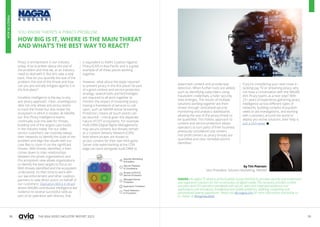
monitor the impact of streaming piracy.
Having a framework of services to call
upon, such as NAGRA Active Streaming
Protection, means all touch points can
be secured – critical given the disparate
nature of OTT ecosystems. For example,
multi-DRM (Digital Rights Management)
may secure content, but threats remain
at a Content Delivery Network (CDN)
level where pirates are known to
access content for their own illicit gains.
Server-side watermarking at the CDN
edge can work alongside multi-DRM to
NAGRA the digital TV division of the Kudelski Group (SIX:KUD.S), provides security and multiscreen
user experience solutions for the monetization of digital media. The company provides content
providers and DTV operators worldwide with secure, open and integrated platforms and
applications over broadcast, broadband and mobile platforms, enabling compelling and
personalized viewing experiences. Please visit dtv.nagra.com for more information and follow us
on Twitter at @nagrakudelski.
by Tim Pearson
Vice President, Solution Marketing, NAGRA
watermark content and provide leak
detection. When further tools are added,
such as identifying subscribers using
fraudulent credentials, a fuller security
view emerges. The results of multiple
solutions working together are then
shown through centralized security
monitoring and analytics dashboards
allowing the size of the piracy threat to
be quantified. This holistic approach to
content and service protection allows
operators to turn parts of their business
previously considered cost centers
into profit centers as piracy threats are
quantified and clear remedial actions
identified.
If you’re considering your next move in
tackling pay TV or streaming piracy, why
not have a conversation with the NAGRA
Anti-Piracy teams as a next step? With
25+ years of experience gathering piracy
intelligence across different types of
networks, building complex ecosystem
views to aid investigations, and working
with customers around the world to
deploy pro-active solutions, their help is
just a click away. 
PIRACY
IN
ASIA
40 41
THE ASIA VIDEO INDUSTRY REPORT 2023
REIGNING IN
“INFLUENCER COUNTERFEITING”
Partnerships between major brands
and social media influencers are today
de rigueur. Worryingly, however, the
rise of influencer marketing has been
accompanied by an unseemly trend
of “influencer counterfeiting”, where a
minority of unscrupulous influencers
blatantly hawk fake goods on the internet.
A recent survey, commissioned by the UK
Intellectual Property Office and conducted
by the University of Portsmouth, found
that “deviant” social media influencers
exert a significant influence on young
followers, stating a host of alarming
statistics.
While a reasonable amount of media
coverage has been devoted to the trend
of influencer counterfeiting, what is
sometimes missed is that levels of respect
for intellectual property can vary across
social media platforms.
For example, Meta appears to have a
fairly robust complaints mechanism,
with approximately 80 percent of
counterfeit-related complaint resulting
in takedowns (per its transparency
reports). Meta has also partnered with
well-known brands and initiated legal
action against counterfeiters (including,
in one instance, a lawsuit jointly filed
with Gucci in a US court). The same,
however, is arguably less true for TikTok
and its Chinese equivalent Douyin. Media
reports, and SIPI’s own enforcement
experience, suggests that the extent of
influencer counterfeiting on the platform
is widespread and responses to takedown
requests need to be improved. This also
holds true for Telegram. Compounding
the problem, Telegram offers users
significant anonymity, thus potentially
allowing rogue influencers to hide behind
false identities and also evade offline
enforcement actions.
Judicial precedents concerning influencer
counterfeiting, and the obligations of
social media platforms, remain few
and far between. Last year, Amazon
sued two influencers active on TikTok,
Facebook and Instagram in the US, for
allegedly working with a large network of
counterfeiters to advertise and facilitate
the sale of fake luxury products. The
case, however, was ultimately settled on
confidential terms. In June 2022, Amazon
and Cartier partnered to sue an influencer
selling fake jewellery on Instagram.
In contrast with the earlier case, the
identity of the influencer was unknown
and identified in court filings only by the
handle “Phym9y3v”. While the outcome of
the case is eagerly awaited, a very recent
precedent from the Delhi High Court in
India is instructive. An English-language
tutor, whose lectures and course
materials were being uploaded and sold
on Telegram without her permission,
sued Telegram for copyright infringement.
The plaintiff observed that she had sent
takedown requests to Telegram, but new
A subsidiary of Authentix Inc, the global authority in authentication with a wide range of
authentication and traceability technologies, STRATEGIC IP INFORMATION ("SIPI") provides
anti-piracy & online brand protection services to fight counterfeiting, grey market sales and other
unfair business practices.
by Bharat Kapoor
VP of Online Brand Protection, Authentix
channels with the infringing content were
popping up as soon as one was disabled.
Telegram contested the application on
the ground that it was an intermediary
and that its servers were located
overseas, beyond the jurisdiction of Indian
courts. The court rejected Telegram’s
arguments, observing that “conventional
concepts of territoriality no longer exist”
and that copyright enforcement “cannot
be diminished merely due to the growth
of technology, which has made it easier
to hide and conceal illegal activities.” The
court thus directed Telegram to disclose
the mobile numbers, IP addresses and
email addresses used to upload and
disseminate the content, along with
details of the servers and networks used.
The increase in influencer counterfeiting
requires brand owners to pursue rogue
influencers (both online and offline) and
press for myriad forms of legislative
intervention and diplomatic pressure, to
truly reign in influencer counterfeiting and
the platforms that facilitate it. 
PIRACY
IN
ASIA
42 43
THE ASIA VIDEO INDUSTRY REPORT 2023
the 80,455 links. Takedown
notifications were then sent
to Google and 773 websites
automatically by the CPLS.
Here are the screenshots
of the CPLS in action.
With the proliferation of online
piracy, it is not feasible to use
traditional or manual methods
to detect and identify large
amounts of infringing online
platforms and pirated links
any longer. Today, we need to
use technological measures
to tackle the challenges
expeditiously and effectively. 
BRINGING TECHNOLOGY
TO THE FIGHT AGAINST PIRACY
As a broadcaster of TV content, TVB
has observed the rising trend of IP
infringement by online platforms in
Asia. While site blocking and takedown
approaches are effective means to tackle
online piracy, it is highly labour intensive
and time consuming to identify the
infringing domain names and pirated links.
As such, DfoDeca Limited, a subsidiary of
TVB, has developed an AI system that can
automatically identify infringing websites
and detect pirated links.
To detect domain names of infringing
websites, it is a usual practice to search
content titles by search engines to identify
the domain names of pirated websites.
Then, the traffic going to the identified
domain names is used to signify the piracy
impact of these websites. However, in our
our perspective, the number of infringing
title links is more important than website
traffic in reflecting the piracy impact of the
website. Take for example, comparing a
website with 100,000 daily visits with only
one pirated title link to another website
with only 30,000 daily visits but with fifty
pirated title links. It is obvious that the low
traffic website with more pirated title links
has greater piracy impact than the website
with higher traffic.
Based on the above-mentioned notion,
we have developed a proprietary system,
the Copyright Landscape System (CPLS), to
automatically identify infringing websites
and gather the pirated title links from
these websites. Based on the AI algorithm,
the CPLS can identify infringing websites
automatically and gather the pirated URL
links from the detected websites. The CPLS
is designed to deliver:
a. Overall information, including infringing
websites and number of links in
different countries, pirated links of
each title, etc. for decision making and
marketing strategy;
b. detailed information of detected
websites and links, such as domain
registrant, IP address, title links on each
website, etc. for investigation purpose;
c. de-duplicated title links for takedown
purpose; and
d. report of (a), (b) and (c) daily or any
other time frame during the monitoring
period.
To demonstrate the functionality of the
CPLS, we have used 107 titles, which are
popular TVB episodes from the past 2
years. These 107 titles are used as input
to the CPLS. We have also selected 10
countries, from which the CPLS would
search for infringing websites and pirated
links. As a result, the CPLS identified a
total of 80,455 pirated links of the 107
titles from 773 infringing websites. Given
the detected 80,455 pirated links are
having many duplications, the CPLS can
further identify 10,437 unique links from
Established in 1976, TVB INTERNATIONAL (“TVBI”) is the worldwide operating arm of TVB,
supplying quality TV programmes to free-to-air broadcasters, cable and satellite services operators,
and licensed video and DVD/VCD distributors throughout North and South America, Europe and
the Asia Pacific region. TVBI has also been playing an active role in the development of emerging
digital media.
by Michael Kwan
Senior IP Enforcement Adviser, TVBI
PIRACY
IN
ASIA
44 45
THE ASIA VIDEO INDUSTRY REPORT 2023
STRATEGIES FOR
RAMPING UP ANTI-PIRACY EFFICIENCY
According to a recent survey by Streaming
Media, the average streaming video
content publisher loses 20% of potential
revenue to piracy. With the volume in
video piracy cases growing at an alarming
rate, pay TV operators need better ways to
fight against threats.
There is no silver bullet for fighting piracy;
however, a holistic anti-piracy solution with
innovative technologies can help operators
combat video piracy more efficiently.
This article will examine why tools such
as automatic detection with human
input, machine learning (ML)-based data
collection, and dynamic watermarking are
imperative.
COMBINING AUTOMATIC DETECTION
WITH HUMAN INPUT BOOSTS
ANTI-PIRACY EFFICIENCY
Illegal web streaming is one of the top
forms of video piracy today. To effectively
fight illegal web streaming, operators need
an anti-piracy solution that can manage
a huge volume of data, quickly detect
sources of piracy, and swiftly submit
requests to delist content for copyright
infringement.
While many anti-piracy solutions use
automatic detection tools to identify piracy
sources, technology alone is not enough.
Piracy detection can be enhanced with
human input. For example, it has been
shown that the human eye is superior
at detecting typos and voluntary letter
swap than an automated detection tool.
Combining the strengths of automatic
detection and human monitoring is an
excellent way to drive efficiency when
combatting illegal web streaming.
MACHINE LEARNING IS CRUCIAL FOR
DATA COLLECTION
The number of illegal IPTV networks has
boomed over the past few years and is
a significant problem for the live sports
video industry. To fight piracy on illegal
IPTV networks, operators must effectively
manage a massive volume of data. Data
collection and analysis aids operators to
quickly identify and accurately label pirate
websites selling accounts of those IPTV
services. Analysing the sites give operators
insights on the most used IPTV services in
their broadcast areas and help them focus
on the proper targets.
24/7 web crawling, real-time automated
monitoring, and ML data collection are
powerful technologies that operators
can use to act faster and improve the
identification of illegal IPTV networks. With
ML, operators can constantly improve data
labeling, manage a significant amount of
data, and ensure data is always up to date.
VIACCESS-ORCA is a leading global solutions provider of OTT and TV platforms, content
protection, and advanced data solutions. The company offers an extensive range of innovative,
end-to-end, modular solutions for content delivery, protection, discovery, and monetization. With
over 20 years of industry leadership, Viaccess-Orca helps content providers and TV operators
shape a smarter and safer TV and OTT experience. www.viaccess-orca.com.
by Anne-Sophie Cornet
Product Marketing Manager, Viaccess-Orca
DYNAMIC WATERMARKING IS A MUST
FOR LIVE EVENTS
Dynamic video watermarking technology
enables operators and content owners
to fight illegal live streaming faster than
ever. By employing a unique, top-down
approach that supports client-side,
server-side, and contribution use cases,
the technology allows operators to protect
content on broadcast, IPTV, and OTT
networks. After identifying the source of
piracy, the content owner or TV operator
can then take down the source, which
is especially critical for live sports and
events since there is a short window for
monetization.
It is important for watermarking
technology to be dynamic since piracy
techniques are increasingly sophisticated.
For example, with collusion attacks,
several pirate sources can mix their copies
together and retransmit the content as a
new blank stream. Dynamic watermarking
enables operators to react swiftly to new
types of pirate attacks.
NO ONE-SIZE-FITS-ALL APPROACH TO
PIRACY
There is no one-size-fits-all approach
to fighting piracy. Piracy technologies
are constantly changing. Video pirates
are getting smarter, and they are using
increasingly complex techniques.
Operators need to be able to counteract
any type or source of video piracy,
including piracy on the web, IPTV services,
Set-Top Boxes (STBs), and apps.
By embracing a holistic anti-piracy solution
and technology innovations such as
automatic detection with human input,
machine learning for data collection,
and dynamic watermarking, operators
can drive efficiency and ensure faster
remediation to safeguard their brand
reputation and revenue stream. 
PIRACY
IN
ASIA
46 47
THE ASIA VIDEO INDUSTRY REPORT 2023
WAGING A WAR ON PIRACY
IN INDONESIA
It is recorded that piracy in Indonesia has
slumped since our collaboration with AVIA.
These crackdowns are also immensely
helped by the government of Indonesia
in order to alleviate the piracy problems.
Numerous illegal sites have been banned
and shut down thus boosting traffic to
various legitimate sites. This is a great
leap forward since Indonesia is one the
most targeted places to be swarmed with
pirated content. However, piracy does still
exist in Indonesia and it is alive and well.
Sadly, there are numerous ways for pirated
content to continue circulating across our
digital platforms. As part of a growing OTT
(Over-The-Top) industry in Indonesia, Vidio
has never ceased in its fight against piracy.
We have persisted and created a new
branch within our legal team focused on
eradicating piracy. This is where the Legal
and Anti-Piracy Team of Vidio comes into
play.
This year, Vidio and AVIA have successfully
cooperated to shut down illegal sites. As
of August 2022, as many as 265 illegal
sites have been reported for blocking
and these numbers keep on rising. This
achievement is also made possible with
the help of the Ministry of Communication
and Information Technology of Indonesia
(Kominfo), who works tirelessly to block
these sites. In addition, the cooperation
between Vidio and AVIA has also yielded a
new experimental way to block domainless
hosted websites which are harder to
track and block than the usual websites
with domains. If this new method can
be proven effective, it will be a major
breakthrough in the cause against piracy
as these sites are harder to be tracked and
taken down with the previous ways.
Furthermore, Vidio has also taken one
step further to eliminate these illegal sites
by filing a police report on two giant illegal
sites popular in Indonesia in July 2022.
This means that these reported sites will
be checked and inspected further by
the police. Indonesia has created a law
regarding copyrights which mentions that
owners of these malicious sites can be
given the penalty of imprisonment and a
fine. Adhering with the laws in Indonesia,
Vidio has registered Vidio’s original series
with the Directorate General of Intellectual
Property (DJKI) thus enhancing its
protection of intellectual property mainly in
cinematographic works in Indonesia. This
can also help in stopping piracy of these
movies as the illegal sites can be brought
to court with the help of the certification.
In conclusion, Vidio has embarked on
various ways to fight piracy in Indonesia,
including cooperating in IP blocking and
other blocking methods. At the same time,
Vidio has also pursued legal options by
handing illegal websites to the police and
registering Vidio’s original series with DJKI
in order to set a precedent of ownership
of these cinematographic works to the
state. All that aside, there are still lots to
be done as the war on piracy will keep on
Founded in 2014, VIDIO is the leading OTT (Over the Top) startup in Indonesia, serving millions
of video-on-demand for local drama series, catch-up TV and paid-subscription of Indonesian box
office hits, including Asian, Korean Drama, Bollywood, and Hollywood, as well as the most varied
sports selection on OTT locally. Vidio is committed to providing complete and easy access for users
to enjoy entertainment without limitations or device restrictions to be accessed anytime, anywhere.
by Gina Golda Pangaila
Vice President, Legal & Anti-Piracy, Vidio
going for years to come. As technology
gets more advanced, we have to catch up
and possibly outrun them in order to stop
these illegal practices. This is why both
coalitions by AVIA and the government will
always be necessary in order to enhance
the process of eradicating piracy in
Indonesia. Through our continuous work
on combating piracy, Vidio hopes that
there will always be a sustained decrease
in the number of pirated contents. 
Vidio’s Legal & Anti-Piracy Team Gina Golda Pangaila, Luthfi Rachman and the lawyers handing a report of
illegal websites to Banten District Police.
PIRACY
IN
ASIA
48 49
THE ASIA VIDEO INDUSTRY REPORT 2023
STARVING PIRACY OF AD REVENUE REALLY WORKS
IT IS TIME FOR SOUTHEAST ASIA
TO BLOCK ADS
White Bullet’s latest research shows
that the average estimated ad revenue
per ad unit for a piracy website illegally
providing access to copyrighted content
across Southeast Asia increased by
20% in the first half of 2022. Singapore
leads, with an increase of 47%, followed
by Malaysia with an increase of 18%,
meaning pirates are making more money
month on month from each ad they can
attract to their websites. By contrast, the
average estimated ad revenue per ad unit
for a piracy website in Europe decreased
by 4%, so pirates are now making less
money from each ad across the European
continent.
HOW DOES WHITE BULLET DO THIS?
White Bullet uses its technology to detect
and risk score piracy websites and apps
and then continually tracks the advertising
funding them. White Bullet uses its
proprietary advertising valuation algorithm
to calculate the estimated advertising
revenue associated with every thousand
ad impressions (or ad views) it derives
from ads it has found on pirate websites.
This is known as an eCPM and provides
the value for each ad unit. It first identifies
the digital advertising payment model
associated with each ad found - either
CPM (display only), CPC (payment per
click) or CPA (payment per action) – then
calculates a base value for every 1000
ads of this type, and then applies various
multipliers to the base value depending
on the format, type, sector and display
country of the ad. Using this information
White Bullet works with rights holders
to send notices to the ad industry found
supporting piracy websites.
WHY HAS THE AD REVENUE PER
AD UNIT FALLEN IN EUROPE AND
INCREASED IN SOUTHEAST ASIA?
It is worth first looking at overall ad
spend across all websites to determine if
these fluctuations apply to the legitimate
advertising publisher world. They do not.
Leading ad agency, Dentsu, forecasts
ad spend in Asia and EMEA (Europe,
Middle East and Africa) to reach similar
levels of growth (5%-6%) in 2022,
with digital ad spend being 55-60%
of overall ad spend in both regions.
Although not a direct comparison, ad
spend can broadly correlate with eCPM
values. So, the decrease in Europe and
significant increase in Southeast Asia on
pirate websites is drastically different
to the legitimate publisher ad spend
expectations.
White Bullet attributes this positive decline
in Europe to the various successful
demonetisation efforts undertaken in
Europe to defund pirate websites of
advertising revenue. Several pioneering
strategies have been deployed in Europe
by a range of stakeholders, including
governmental bodies, industry groups and
piracy experts with White Bullet engaged
in tracking prior to implementation
and post, to determine impact. The
European Commission’s Memorandum
of Understanding on Online Advertising
and IPR has seen the ad industry and
rights owners come together to share
best practices to block ads from pirate
websites. Additionally, Project Brand
Integrity (PBI) run by the ad industry
regulator the Trustworthy Accountability
Group has seen outreach across Europe
to ad agencies and brands found by
White Bullet to be supporting piracy, to
raise awareness and demand action.
This has seen considerable success with
77% of brands contacted through the
PBI programme decreasing their monthly
estimated ad impressions on pirate
websites. In the UK a joint initiative aimed
at tackling gambling ads on piracy websites
between The City of London’s Police
Intellectual Property Crime Unit (PIPCU)
and the UK Gambling Commission (UKGC)
has seen a 44% reduction in gambling ads
appearing on pirate websites. In parallel,
in Europe the EU Gambling and Betting
Association has actively participated in the
Commission’s MoU and together with the
UK efforts, has resulted in the gambling
sector no longer being the dominant
sector supporting piracy websites across
Europe.
In Southeast Asia such coordinated efforts
are yet to be developed. It is worth noting
that pirate websites in Southeast Asia
attract more ad views than in Europe; the
average number of ad impressions per
website is two times higher. Worryingly,
this means ad supported piracy in
Southeast Asia is increasingly attractive for
criminals.
WHAT CAN BE DONE IN SOUTHEAST
ASIA TO BRING DOWN PIRACY AD
REVENUES?
Similar strategies to those implemented in
Europe can be adopted in Southeast Asia
to reverse the trend of increasing ad value
on pirate websites.
Firstly, a targeted sectoral approach
could be key. The Gambling sector is
one advertising sector that is ripe for
tackling. As previously in Europe, the
Gambling sector is the dominant ad
sector in Southeast Asia, with gambling
brands accounting for 92% of estimated
Country/Region
AVG eCPM change
Jan22 - Jun22
Singapore 47%
Malaysia 18%
Philippines 3%
Vietnam 2%
Indonesia -3%
Hong Kong -4%
Thailand -6%
Southeast Asia 20%
Europe -4%
White Bullet Intellectual Property Infringement Platform data
The latest data from anti-piracy technology company White Bullet shows the value of advertising
on pirate websites is increasing in Southeast Asia, whilst actually decreasing in Europe.
PIRACY
IN
ASIA
50 51
THE ASIA VIDEO INDUSTRY REPORT 2023
Founded in 2013 by a leadership team of experienced Intellectual Property lawyers from the media
and advertising industries, WHITE BULLET offers companies piracy risk data and protection,
brand safety solutions, and full transparency on their advertising placement and digital supply
chains. With offices in London, New York, and Chicago, White Bullet also advises policymakers and
government bodies on regulatory and compliance programs globally.
by Tom Chytil
Business Intelligence Director, White Bullet
branded ad impressions in the first half
of 2022. Removing gambling ads from
pirate websites alone therefore will have a
significant impact on pirate revenues.
Secondly, a broader awareness
programme could help brands. Outreach
programmes involving notices to brands
and ad agencies raise awareness generally
to the risks of piracy and can be both
national or regional. Brands demand
transparency from their ad supply chains
but seldom get the levels of transparency
data they need – of course it is not in the
interest of the supply chain to point out
to their clients when they have misplaced
ads. So getting data about misplacement
means brands not only can take action,
blocking future ads, but may be able to
demand money back for those ads already
misplaced.
Thirdly, ad tech intermediaries should be
encouraged to directly integrate anti-piracy
tools to block ads in real-time. This is
already being done across the industry in
other parts of the world. Doing so is not
unusual, as the industry already acquires
specialist data in other fields, such as
terrorism, hate speech, child safety and
other dangerous content. It is time the ad
industry in Southeast Asia looked at piracy
through the same risk lens. 
PIRACY
IN
ASIA
53
RE
S
E
ARC
H
INSIG
HTS
54 55
THE ASIA VIDEO INDUSTRY REPORT 2023
REGIONAL CHANNEL
TV VIEWERS
REGIONAL CHANNEL TV
CONSUMED MORE THAN OTHER MEDIA
52%
47%
51%
25%
28%
21%
MALAYSIA
SINGAPORE
TAIWAN
ANY REGIONAL CHANNELS (monthly)
ANY REGIONAL CHANNELS (weekly)
ANY REGIONAL CHANNELS (daily)
ANY INFLIGHT MAGAZINES
ANY REGIONAL MAGAZINES (monthly)
ANY REGIONAL MAGAZINES (weekly)
ANY REGIONAL NEWSPAPERS (daily)
ANY REGIONAL TITLES
REGIONAL CHANNEL TV
REGIONAL PRINT MEDIA
Source: Ipsos Affluent Asia Survey H1 2022
Reported markets: Thailand, Hong Kong, Indonesia, Malaysia, The Philippines, Singapore, Taiwan, India, South Korea, Australia, China
Viewed regional TV yesterday and Not viewed any regional TV in past month
Source: Ipsos Affluent Asia Survey H1 2022
Reported markets: Thailand, Hong Kong, Indonesia, Malaysia, The Philippines, Singapore, Taiwan, India, South Korea, Australia, China
73% 12%
INDIA
46% 26%
THAILAND
62% 20%
INDONESIA
35% 34%
CHINA
33% 36%
HONG KONG
43% 23%
SOUTH KOREA
69% 14%
PHILIPPINES
33% 32%
AUSTRALIA
75%
68%
47%
24%
7%
3%
6%
16%
VIEWED
YESTERDAY
NOT
VIEWED
IN PAST MONTH
AFFLUENT VIEWERS
ARE EARLY ADOPTERS...
OWNERSHIP INDEX
>
>
>
>
>
128
120
134
116
118
61
74
60
76
72
CAMERA DRONES
(FLYING CAMERAS)
ELECTRONIC BEAUTY DEVICES
(US$200+)
VIRTUAL REALITY (VR)
HEADSET
VOICE COMMAND DEVICE /
SMART SPEAKER
(E.G. AMAZON ECHO, GOOGLE HOME, ETC.)
WIRELESS BLUETOOTH
HEADPHONES / SPEAKERS
(US$200+)
Source: Ipsos Affluent Asia Survey H1 2022
Average Base Index: 100.
Reported markets: Thailand, Hong Kong, Indonesia, Malaysia, The Philippines, Singapore, Taiwan, India, South Korea, Australia, China
Viewed regional channel TV yesterday and Not viewed any regional channel TV in past month
DON’T
WATCH WATCH
REGIONAL TV
RESEARCH
INSIGHTS
56 57
THE ASIA VIDEO INDUSTRY REPORT 2023
Source: Ipsos Affluent Asia Survey H1 2022
Average Base Index: 100.
Reported markets: Thailand, Hong Kong, Indonesia, Malaysia, The Philippines, Singapore, Taiwan, India, South Korea, Australia, China
Viewed regional channel TV yesterday and Not viewed any regional channel TV in past month
KEY DECISION MAKERS...
INDEX
>
>
>
>
115
143
121
125
82
51
78
77
INTEND TO BUY A CAR
IN NEXT 12 MONTHS
TOP MANAGEMENT
OWN BONDS
OWN COLLECTIBLES
AS AN INVESTMENT
(E.G. ART, ANTIQUES, GEMS, ETC.)
>
141 51
OWN COMMODITY
FUTURES / OPTIONS
DON’T
WATCH WATCH
REGIONAL TV
LUXURY SPENDERS...
>
>
>
>
>
141
123
125
126
126
45
67
65
65
70
OWN QUALITY / DESIGNER
ACCESSORIES & FOOTWEAR
WORTH US$10,000+
OWN JEWELLERY
WORTH US$10,000+
OWN A LUXURY WATCH
WORTH US$10,000+
OWN QUALITY / DESIGNER
CLOTHES & LEATHER GOODS
WORTH US$10,000+
CONSUMED BRANDY /
COGNAC IN PAST 4 WEEKS
Source: Ipsos Affluent Asia Survey H1 2022
Average Base Index: 100.
Reported markets: Thailand, Hong Kong, Indonesia, Malaysia, The Philippines, Singapore, Taiwan, India, South Korea, Australia, China
Viewed regional channel TV yesterday and Not viewed any regional channel TV in past month
DON’T
WATCH WATCH
REGIONAL TV
INDEX
RESEARCH
INSIGHTS
58 59
THE ASIA VIDEO INDUSTRY REPORT 2023
THE AFFLUENCERS...
Source: Ipsos Affluent Asia Survey H1 2022
Average Base Index: 100.
Reported markets: Thailand, Hong Kong, Indonesia, Malaysia, The Philippines, Singapore, Taiwan, India, South Korea, Australia, China
Viewed regional channel TV yesterday and Not viewed any regional channel TV in past month
>
>
>
>
>
148
142
137
134
149
51
66
65
61
44
WORKED ON INTERNATIONAL
BUSINESS STRATEGIES
LOBBIED OR ADVISED MEMBERS
OF NATIONAL OR LOCAL
GOVERNMENT
INVOLVED WITH ENVIRONMENTAL /
CONSERVATION GROUP
RAISED CAPITAL, INVESTED FUNDS
FOR MY COMPANY
TAKEN EXECUTIVE DECISIONS
WHICH AFFECT ORGANISATION'S
OPERATIONS IN OTHER COUNTRIES
DON’T
WATCH WATCH
REGIONAL TV
INDEX
>
>
>
>
>
133
133
133
130
128
69
64
68
74
72
PEOPLE OFTEN ASK MY ADVICE
ABOUT FASHION AND WHAT
THEY SHOULD WEAR
I REGULARLY MAKE THE EFFORT
TO INVESTIGATE A COMPANY'S
ENVIRONMENTAL OR SOCIAL
RECORD
PEOPLE OFTEN ASK MY ADVICE
ABOUT FINANCIAL ISSUES
AND INVESTING
I AM ALWAYS ONE OF THE FIRST
TO HAVE TECHNOLOGICALLY
INNOVATIVE PRODUCTS
I VALUE THE ELEMENTS OF HIGH
QUALITY AND EXCLUSIVITY
AS DEMONSTRATED BY
LUXURY PRODUCTS
Source: Ipsos Affluent Asia Survey H1 2022
Average Base Index: 100.
Reported markets: Thailand, Hong Kong, Indonesia, Malaysia, The Philippines, Singapore, Taiwan, India, South Korea, Australia, China
Viewed regional channel TV yesterday and Not viewed any regional channel TV in past month
DON’T
WATCH WATCH
REGIONAL TV
INDEX
AFFLUENT VIEWERS
STRONGLY AGREE THAT...
RESEARCH
INSIGHTS
60 61
THE ASIA VIDEO INDUSTRY REPORT 2023
NETTING DEFINITION OF
REGIONAL TV CHANNELS
REGIONAL NEWS
ABC Australia
Al Jazeera English
Arirang TV
BBC World News
Bloomberg
CGTN
CNA
CNBC
CNBC TV 18
CNN
CNN Indonesia
CNN News18
CNN Philippines
Euronews
Fox News
KBS World
Lotus TV
NHK WORLD-Japan
Phoenix Chinese Channel
Phoenix InfoNews
RT Channel
Sky News
TV5Monde
REGIONAL DOCUMENTARIES
Animal Planet
BBC Earth
Discovery Channel
Discovery Science Channel
History Channel
Nat. Geo Wild
National Geographic Channel
REGIONAL LIFESTYLE
Asian Food Network
BBC Lifestyle
Food Network
HGTV
MTV
TLC
REGIONAL MOVIE & TV SERIES
AXN Asia
BBC First
HBO
STAR Chinese Movies
Star Movies
StarWorld
tvN
Warner TV
REGIONAL SPORTS
Eurosport
Star Sports 2
Ipsos Hong Kong began the Affluent Asia tracking survey over 20 years ago because we knew
from the beginning the affluent is one of the most sought-after audiences in this fast growing
Asia Pacific region. The affluent represents a group of premium consumers who drive spending,
take up new technology and experience, and influence on their peers. Media publishers, agencies
and advertisers rely on Affluent Asia to analyse their target customers, in order to capture the
share of wallet as well as share of mind of this critically important group.
Ipsos Hong Kong began the Media Atlas syndicated survey over 15 years and it has been a
barometer of cross-media consumption and people’s lifestyle of the city.
More recently Media Atlas has gone through a major overhaul with a renewed focus to serve the
print publishers, where many have been extending their presence from paper to the digital space.
MEDIA CONSUMPTION
DIGITAL LIFESTYLE
Source: Ipsos Media Atlas Q1 2021 – Q4 2021. Reported market: Hong Kong
WATCHED ANY TV
IN PAST 7 DAYS 92%
LISTENED TO ANY RADIO
IN PAST 7 DAYS 46%
USED ANY STREAMING VOD
IN PAST 7 DAYS 51%
READ ANY DAILY NEWSPAPER - PRINT (A.I.R.)
YESTERDAY
34%
READ ANY DAILY NEWSPAPER - DIGITAL
YESTERDAY
24%
HONG KONG
Source: Ipsos Media Atlas Q1 2021 – Q4 2021 Reported market: Hong Kong. Usage in the Past 7 Days. Netting of 9 major brands of social network
platforms. / Netting of 5 major brands of search engines. / Netting of 6 major brands of online forums.
96%
68%
21%
USED ANY SOCIAL
NETWORK PLATFORMS
USED ANY SEARCH ENGINES
USED ANY ONLINE FORUMS
USAGE IN PAST 7 DAYS
Source: Ipsos Media Atlas Q1 2021 – Q4 2021 Reported market: Hong Kong. Usage in the Past 30 Days. Netting of 6 major brands of mobile payment
platforms. / Netting of 3 major brands of online meeting platforms. / Netting of 2 major brands of food order & delivery apps. / Netting of 6 major brands
of car hailing apps.
61%
26%
25%
12%
USED ANY MOBILE
PAYMENT PLATFORMS
USED ANY ONLINE
MEETING PLATFORMS
USED ANY FOOD ORDERING
& DELIVERY APPS
USED ANY CAR HAILING APPS
USAGE IN PAST 30 DAYS
RESEARCH
INSIGHTS
62 63
THE ASIA VIDEO INDUSTRY REPORT 2023
ASIA PACIFIC MARKET OVERVIEW
AUSTRALIA
The Internet remains the most used media
type in Australia, with Australians averaging
22 hours a week online, an increase
from 21 hours last year. Free-To-Air (FTA)
television, which held the lead previously,
has maintained an average of 18 hours per
week since last year.
Mobile phones are remarkably the most
common device to access the internet
with. This has increased from 39% last
year to 44% of Australians who most often
access the internet through a mobile
phone device. In comparison 14% of
Australians mainly go online through their
laptop, the second most common device.
70% of Australians access the internet
several times a day and 1 in 3 access
online while watching TV daily.
Watching videos is the most popular online
activity and it is only getting more common
– over 2/3 of Australians now consume
video content online monthly. Alongside
an ever expanding selection of streaming
services comes continued growth in Paid
Streaming TV. Australians who subscribe
to a streaming service grew from 60% to
70% over the year. Netflix sees a recession
while still staying on top of the market.
Netflix dropped from 72% of Australians
who subscribe to streaming services
paying for its service to 68%. Binge has
seen the biggest growth in recent history
with a jump from 8% to 15% this year.
Source: Nielsen Australia CMV
HONG KONG
Hong Kongers’ consumption behaviour
has changed significantly since the
pandemic with reduced time outdoors.
At-home entertainment is on the rise and
does not appear to be slowing down with
71% of Hong Kongers surfing websites
(58% in 2019), 50% listening to music
(42% in 2019), 19% playing video games
(15% in 2019) and 40% reading books
(36% in 2019). There is an increase in
using Smartphones (85% vs 82% in 2019)
and Tablets (39% vs 33% in 2019) to
consume online videos too.
Hong Kong audiences spent more time
watching TV programs and streaming
videos in 2022 due to social distancing
and pandemic control measures imposed
by the government. There are 10.1
billion in-home minutes spent streaming,
representing 1/5 of all video consumption
time in-home, based on a total net reach
of 4.6 million Hong Kongers. The average
daily share of the video streaming across
total video time increased after 9pm
and it reached 52% at 3-4am. Nielsen’s
streaming platform insights also revealed
that video streaming platforms accounted
for 19.4% of audience total video time. It
also provided a view into the broadcast
share of audience total video time of
65.4% during the same period.
Sources: Nielsen Hong Kong CMV, & Streaming Insight
INDONESIA
Advertising spend for all media types in
Indonesia in H1 2022 vs same period last
year showed a modest increase of 7%,
mostly driven by an increased rate card
of 6% while volume increased by only 1%.
80% of advertising spend is still with linear
TV while digital takes up 15%. Advertisers
are cautiously confident that among
the top 5 biggest category spend, 3 of
them still increased spending in the high
double digits i.e. Online Service category
(e-commerce and tech based companies,
+69%), Haircare category (+20%) and
Political/Government (+13%). While the
two categories that decreased advertising
spend i.e. Facial Care and Seasonings/
Condiments, decreased by only single
digit of 7% and 2% respectively. It is also
interesting to note that FMCG companies
still rely heavily on TV while e-commerce
companies are much more dominant on
digital.
In this COVID recovery period, many
companies are showing confidence and
starting to launch new variants or brands
into the market, which contributed to
about 8% of total advertising spend in
H1 2022. For comparison purposes,
prior to COVID in H1 2019, new launches
contributed to 12% of advertising spend.
However, the number of new creatives
across all media types increased by
40% in H1’22 vs H1’19. This increase
is contributed by digital media with
numerous short thematic campaigns.
In terms of media penetration, similar to
trends in other countries, reach of linear
TV is declining while daily internet access
is growing significantly driven by various
activities including gaming, social media
and video streaming especially from
mobile. While the time spent on watching
TV is pretty stable (4 hours 35 minutes),
time spent doing various activities on
internet is catching up fast to amount to 4
hours and 37 minutes per day.
Sources: Nielsen Indonesia Ad Intel & CMV
JAPAN
With the removal of restrictions on going
out due to COVID, video viewing did not
grow significantly compared to last year.
However, the users of SVOD services such
as Netflix has increased compared to
before COVID, and 31% of Internet users
use them. This year, for the first time, the
number of users of SVOD exceeded the
number of users of rental DVD/Blu-ray.
In addition, the frequency has also
increased, and the number of people who
watch at least once a week has increased
by more than 20% since 2020 for SVOD
and AVOD.
In recent years, more people are watching
VOD services on TV screens. People who
watch Internet videos on TV screens
spend about 30% of their TV viewing time
streaming.
Source: Nielsen Japan Digital Panel
MALAYSIA
Overall advertising spend grew +8% for
the period Jul '21 – Jun '22 vs. Jul '20 – Jun
'21, primarily driven by increases in spend
for Digital and FTA TV. Cinema advertising
spend revived with the reopening of
theatres in the final quarter of 2021,
RESEARCH
INSIGHTS
64 65
THE ASIA VIDEO INDUSTRY REPORT 2023
offering some recovery after 5 months
of closures. Meanwhile, like for like radio
spend (i.e. excluding newly monitored
stations), grew 6%.
Digital featured the highest advertising
spend increase (+36%), aligning with
public and private sector initiatives to
drive digital connectivity by boosting
internet usage and reach (+8%)
throughout the country. Whilst increased
online activities were quickened by
the pandemic, the need for immediate
information and entertainment have
grown internet activities like digital news
consumption (+23%), online viewing
(+13%), and e-commerce (+25%).
FTA was one of the key reasons for
improved advertising spend, with
advertisers returning to many established
TV channels, as well as sharing their
ad-Ringgit with some of the newly
launched FTA players. The lifting of
movement restrictions and the move
to an endemic phase coincided with a
slight decrease in TV ratings from 16%
to 15%, with viewers spending at least
5 hours watching TV per day. However,
there was an uplift in ratings for sports
programming (+83%), with local and
international fixtures happening, after a
year of postponements.
Source: Nielsen Malaysia Ad Intel, CMV & TAM
MYANMAR
Despite numerous challenges brought
by the COVID pandemic and political
instability within the country, media
consumption is still thriving amidst
uncertainty.
TV viewing incidence has increased +2%
nationwide when compared to 2021. On
the contrary, internet usage incidence has
declined -4% nationwide when compared
to 2021.
Several advertisers have kept advertising
their brands mainly on TV. Non-Alcoholic
Beverages, Pharmaceuticals,
Communications, Personal Care/
Cosmetics and Oral Care categories
remain the highest industries by
advertising spend.
The rating of TV slightly decreased around
-1% in the key 6 cities but the viewing
hours remained flat. FTA channels take
+90% share of ratings in H1 2022. In light
of environmental challenges (e.g. power
supply), late night TV’s rating increased
about +3% in H1 2022.
Source: Nielsen Myanmar Ad Intel, CMV, & TAM
NEW ZEALAND
New Zealand advertising spend in 2021
has shown a solid rebound with a healthy
30% increase compared to 2020, and this
is reflected across a range of traditional
media (i.e. TV, newspaper, radio, outdoor,
and cinema). Digital spend stood out with
a 38% year-on-year increase in advertising
spend for 2021.
Whilst the first half of 2022 advertising
spend has slowed down (-7%) compared
to the second half of 2021, categories
such as Computers, Travel, Insurance, and
Clothing have increased over the same
time period.
The launch of WizzAd and Nielsen Ad Intel
Digital data to New Zealand’s product
portfolio in July 2021, plus the addition
to measurement of Instagram & Twitter
Video (Sept 2021) has given the market
a more comprehensive view of digital
advertising activities in the market.
The inclusion of TV & Print Creatives in
Nielsen's WizzAd from July 2022 provides
the market with an expanded view of
competitive creative information, beyond
the current offering of digital creatives.
In line with the vision of delivering a true
picture of consumers’ viewing habits on all
internet-enabled devices in a household,
500 streaming meters have been
successfully incorporated into Nielsen’s’
Television Audience Measurement (TAM)
panel across New Zealand. Data from
the newly installed 500 streaming meters
is currently being technically developed
and reviewed for representation and
robustness, in preparation for the next
steps in bringing the first phase of data to
the market.
Source: Advertising Standards Authority - Advertising Turnover Report,
and Nielsen New Zealand Ad Intel
PHILIPPINES
Reflective of how the world has opened
up, Out-Of-Home (OOH) exposure had the
most significant growth in Q2 2022. But
despite Q2 being a news-heavy period due
to the recent election, it was not observed
to have any major shifts in the other
mediums; everything remained stable.
TV viewing levels increased to 12.32%
compared to last year’s 13.29%, but
still not enough to match past year’s
performance. Radio sees the impact of
relaxed quarantine regulations as their
levels in Mega Manila declined by almost
1%.
Traditional advertising spending in
Q2 2022 grew over 8% from the year
before, and almost double from the
pandemic-onset of Q2 2020. TV showed a
16% growth in spend, and a 15% growth
in volume, reflective of a larger number
of channels that have emerged since the
shutdown of major broadcaster ABS-CBN
two years ago.
Source: Nielsen Ad Intel, CMV, & NUTAM
SINGAPORE
Advertising spend continues to rise in
Singapore with a 5% overall growth in the
first half of 2022 compared to the same
period in 2021. Coupled with the opening
up of Singapore in a 2022 post COVID era,
outdoor advertising showed the largest
growth (22%) followed by radio (9%) and
TV (8%).
Categories badly hit by the COVID
pandemic in 2020 and 2021 bounced
back with their advertising investments
in 2022; with Airlines, Events and Travel
Agencies/Tourist Commissions increasing
their spends dramatically this year (242%,
61% and 46% respectively). Where some
categories which are more akin to a
stay-at-home COVID mentality, such as
Home Décor, reduced their investments
this year by 43%.
The Fitness category also saw an
interesting shift with a 66% drop in
ad spends for Home Gym Equipment
whereas a return in investments from
RESEARCH
INSIGHTS
66 67
THE ASIA VIDEO INDUSTRY REPORT 2023
the Sports Centers and Clubs; indicating
a post COVID trend of fitness enthusiasts
returning back to physical gyms rather
than exercising at home.
However, with the continued popularity
of online shopping, the largest ad
spenders this year were largely in the
Online Shopping Portal category where
the majority of their media spends are in
digital channels.
Source: Nielsen Singapore Ad Intel
SOUTH KOREA
In the first half of 2022, as COVID has
become endemic and it got people to
enjoy increased outdoor activities, media
usage time also decreased due to a
decrease of time spent at home. The TV
commercial market declined for the first
time since COVID due to a decrease in
viewing time. Total individual's average
time viewing on TV decreased by 5.2%
compared to the same period in 2021.
One of the most popular dramas in
the first half of 2022 was Extraordinary
Attorney Woo which aired on ENA, a small
pay channel, and showed an average
minute rating of 5.9% for total individuals,
which is remarkable for a cable channel.
Average time spent on PC, a fixed device,
decreased by 13% compared to last year.
In the mobile market, Online Shopping
has kept becoming part of daily life since
COVID, and mobile apps for Sports/
Leisure/Travel that are highly related
to outdoor activities have received new
attention. While the number of users in
the mobile video market increased by
3%, the growth rate was higher mainly
for domestic OTT such as 'TVING' (+68%
YoY) and 'Coupang Play' (+161% YoY),
which has drawn more notice with its
original content and exclusive sports
broadcasting.
Source: Nielsen South Korea Mobile Panel & TAM
TAIWAN
The advertising spend in 1st
half year of
2022 in Taiwan remained flat vs 1H 2021,
due to the outbreak of COVID in Q2 2022.
With a deep dive into different media,
there saw the rebound of TV advertising
spend; both FTA and cable TV recorded
a +8.5% and +5.1% growth vs 1H 2021
respectively. OOH was hit by COVID with
15.8% decrease. Digital remained flat vs
previous year. Overall, the top growth
categories were e-Commerce and Sports
Apparel, due to competition and the
booming of sports activities.
The rating of TV decreased around 4%
due to the decrease of reach but the
viewing hours remained flat. The rating
of FTA channels are going up while the
news channels and variety channels from
cable platforms are going down. Although
the FTA channels rating is going up, cable
news channels still have the highest rating
genre.
With 10% growth in the usage of OTT/
Video platforms, 74% of respondents
were using OTT/Video platforms
yesterday. For SVOD, the usage was going
up as well, but only 20% of respondents
were using SVOD. Local OTT player,
‘Friday’, grew over 55% (3.1% to 4.8%), but
YouTube and Netflix remained ranked at
No. 1 and No. 2 respectively.
Source: Nielsen Taiwan Ad Intel, CMV & TAM
THAILAND
Thailand media spend is bouncing back
- Thai people are returning to more
outdoor activities. Across Jan - Jul 2022
total advertising spend has seen an
increase of 9% and Cinema is up +128%,
Outdoor & Transit +28%, and In-store
+29% compared to the previous year. As
advertising growth continues to return,
many sectors are also bouncing back. The
biggest spenders are Food & Beverage,
Personal Care & Cosmetic.
One consumer, multiple platforms -
Thais have switched from watching via
a traditional TV player to the digital TV
channel. TV viewing via Smart TV grew
by 45% from 2019 during the pre-COVID
outbreak, and over 45% watched TV
via mobile phones, an increase of
8%. Viewers have more options and
more ways to watch Thai TV than ever
before. The latest data surveyed in the
first quarter of 2022 found that 52%
of Thai viewers were watching content
via streaming platforms or OTT, which
increased by 80% from 2019.
The new model of measurement -
Thailand has launched Cross Platform
Measurement, the first in ASEAN to
provide a measure of viewership both
on TV screens and through digital
platforms, to be in line with the changes
in technology and consumer behavior in
the current era.
Source: Nielsen Thailand Ad Intel, CMV & Cross Platform Measurement

NIELSEN shapes the world’s media and content as a global leader in audience measurement,
data and analytics. Through our understanding of people and their behaviors across all channels
and platforms, we empower our clients with independent and actionable intelligence so they can
connect and engage with their audiences—now and into the future.
An S&P 500 company, Nielsen (NYSE: NLSN) operates around the world in more than 55 countries.
Learn more at www.nielsen.com or www.nielsen.com/investors and connect with us on social
media.
RESEARCH
INSIGHTS
68 69
THE ASIA VIDEO INDUSTRY REPORT 2023
795.0
MILLION PAY-TV SUBSCRIBERS
FAST FACTS*
POPULATION .................................... 3,574,100,000
TOTAL HOMES................................... 1,058,100,000
TELEVISION HOMES .............................. 868,900,000
PAY TV PENETRATION *	������������������������������������ 71%
PAY TV SUBSCRIBERS............................. 795,000,000
BROADBAND SUBSCRIBERS.................. 3,937,000,000
1. Percent of pay TV penetration and pay TV subscribers					
2. Free-to-Air satellite subscribers are excluded from numbers above
3. Based on 14 selected markets
		
Source: Media Partners Asia
Note: Total broadband subscribers include mobile broadband users and fixed broadband households
* Includes subscribers to multiple platforms
26%
JAPAN
13.5 Million
237.9 Million
100%
SOUTH KOREA
36.9 Million
91.7 Million
77%
TAIWAN
6.7 Million
36.2 Million
38%
PHILIPPINES
8.9 Million
98.2 Million
9%
INDONESIA
4.2 Million
300.1 Million
21%
AUSTRALIA
2.0 Million
37.2 Million
30%
NEW ZEALAND
0.6 Million
8.6 Million
46%
MALAYSIA
3.5 Million
43.3 Million
44%
SINGAPORE
0.6 Million
9.3 Million
67%
INDIA
120.1 Million
829.0 Million
78%
HONG KONG
2.1 Million
27.3 Million
90%
CHINA
578.2 Million
2,033.4 Million
19%
THAILAND
4.1 Million
84.8 Million
71%
VIETNAM
13.7 Million
99.8 Million
3.9
BILLION BROADBAND SUBSCRIBERS
IN ASIA PACIFIC
RESEARCH
INSIGHTS
70 71
THE ASIA VIDEO INDUSTRY REPORT 2023
HOME BROADBAND
HELPS SUSTAIN PAY TV
The traditional pay TV industry retains
significance in much of Asia Pacific, driven
by a combination of reach and revenue
scale. However, new customer growth
remains challenging in most geographies
though for the most part, cord cutting
peaked in 2019-2020. A cost recalibration
continues across the industry in several
markets, driven by: (1) The impact of
foreign exchange currency pressures with
a very strong USD; and (2) Pressure on
customer and ARPU growth amidst weaker
consumer demand, high inflation and
competition from online video.
The secular growth of high-speed
broadband in the home, driven in
most instances by fiber deployment
led by telcos, is positive for video. Such
deployment often comes in the form of
bundled broadband, online video and
pay TV services, helping to keep pay TV
afloat in many instances. Telcos offering
home broadband, IPTV and VOD, continue
to benefit the most in terms of growth
and profitability. There continues to be
demand for local entertainment and
sports linear channels.
Pay TV penetration remains robust in
markets such as Korea, the Philippines,
Taiwan and India. Growth continues to
be under pressure in markets such as
Australia, Japan, Malaysia, Singapore and
Thailand; while cord cutting has peaked in
a number of these markets, post pandemic
consumer demand remains uneven and
customers continue to churn or trade
down to lower ARPU packages.
Key highlights by market include:
AUSTRALIA
Pay TV customers continue to contract
by 150-200,000 per year though ARPUs
remain attractive at a monthly US$60.
Leading operator Foxtel retains important
sports rights (i.e. AFL, NRL) which continues
to help sustain the shelf life of pay TV.
Foxtel’s growth is increasingly driven by its
owned & operated streaming services (i.e.
Binge, Kayo) and those it has aggregated
(i.e. Disney+, Prime Video and Netflix) into
next generation set top boxes.
INDIA
India’s pay TV industry remained resilient
during the pandemic. However, the
introduction of new tariff order (NTO)
amendments and the proliferation of FTA
channels during the pandemic period
capped pay TV ARPU growth while the
number of paying subscribers contracted.
NTO amendments recommended by the
regulator TRAI in January 2020, including
a downward revision in channel pricing,
capping on bouquet discounts, and a
limit to distributor access fees, have
negatively impacted the economics of all
stakeholders across the pay TV sector.
TRAI has extended the implementation
date to 30th November 2022, even as the
matter remains sub judice. Meanwhile, pay
TV distribution platforms have voluntarily
implemented the access fee guidelines
recommended by TRAI.
INDONESIA
While local free TV reach and demand
remain important for low ARPU DTH
services, DTH pay TV growth and demand
has considerably weakened in recent
years. The economics of pay TV is now
sustained by investment in bundled
broadband and digital video services, led
by players such as Telkom Indihome and
Linknet, which is now owned by Axiata.
Real pay TV penetration remains below
10% in Indonesia.
JAPAN
Pay TV penetration is a steady 26% in
high-ARPU Japan. Churn remains high
across DTH, IPTV remains sub scale and
cable growth is relatively flat in tier 1 cities
though there remains continued growth in
rural areas.
KOREA
Korea is a fully penetrated and
consolidated pay TV market with telcos
dominating through a combination of
IPTV, digital cable, DTH and SVOD services.
Telcos KT, SKT and LGU continue to grow
fixed line services due to gains across
IPTV, with aggregate IPTV revenue growth
expected to come in at 4% during 2022.
MALAYSIA
Demand for pure play pay TV services is
weak with consumer sentiment low. As
a result, the legacy base of DTH satellite
pay TV customers has declined between
2019 and 2022. Encouragingly, demand
for bundles of high-speed broadband, pay
TV and IPTV services has grown, led by new
packages and services offered by Astro
and Telekom Malaysia.
PHILIPPINES
Demand for low-ARPU national DTH
services offered by Cignal and GSat
remains strong due to popular local DTT &
pay channels as well as English-language
entertainment and sports. Cable in Metro
Manila has been weakened by the growth
of SVOD.
THAILAND
Provincial and up-country cable operators
continue to lose subs but telco AIS has
seen considerable IPTV growth due to
aggressive repackaging while True has
benefited from the expansion of its True ID
Android service.
TAIWAN
The pay TV market is contracting, with
subscribers dropping to 6.7 mil. in
2022, down from a peak of 7.1 mil. in
2018. Growing competition from SVOD
services is accelerating cable cord cutting
and eroding the growth momentum of
Chunghwa’s IPTV service. Within traditional
pay TV, cable remains the primary
technology of delivery, with 70% share of
subscribers. 
Media Partners Asia (MPA), established in 2001, is a leading independent provider of
advisory, consulting and research services, focusing on media and telecoms in Asia Pacific
and the Middle East. MPA reports and databases are widely used by industry stakeholders for
business planning and strategy. MPA has been involved in due diligence for M&A activity in APAC
with numerous local and cross border transactions while also operating as an IC (Independent
Consultant) in the IPOs of media and telecoms companies. MPA hosts and operates APOS, the
leading annual summit for Asia’s TMT industry with global impact.
RESEARCH
INSIGHTS
72 73
THE ASIA VIDEO INDUSTRY REPORT 2023
ONLINE VIDEO ENTERS ITS
NEXT PHASE OF GROWTH
KEY THEMES
Large addressable market. Ex-China,
combined 4G and 5G users will reach
78% of the population across APAC in
2022 while home broadband penetration
will reach 31%. Rising CTV penetration is
helping to fuel advertising growth across
YouTube and premium AVOD platforms,
led by BVOD players, while also bolstering
monetization at SVOD platforms.
Content travelability. The production
and consumption of high-quality local
content with travelability is growing, led
by Korea, Japan, China, India, Thailand
and Taiwan. Premium sports rights are
transitioning online in key markets, often
bundled with entertainment on SVOD or
freemium platforms.
Rationality. Growth at any cost models
are fast transitioning towards more
rational models, anchored to monetizable
reach. Inflationary content costs remain a
challenge.
Policy. Regulatory issues are a significant
barrier in China with numerous rules
limiting the scope of growth, innovation
and creativity across China’s large scale
online video sector.
Piracy. Online piracy levels across sports
and entertainment are also alarmingly
high in markets such as India and across
Southeast Asia.
Affordability. While growing incomes
and a rising middle class has helped
drive affordability, monetizable demand
for online video services remains largely
confined to large urban markets with
huge untapped demand in micro ARPU
rural and second / third-tier regions.
VIEWERSHIP
Data from MPA subsidiary AMPD,
which measures online viewership and
engagement, indicates that premium
video, which includes SVOD, freemium
and premium AVOD platforms, captured
35% of total online video viewership in
Australia for the first nine months of
2022. Premium video’s share ranged
between 15-30% in markets such as
China, Japan, Korea and Taiwan for 9M
2022 and was under 10% in markets
such as Indonesia. Such dynamics are
a function of production ecosystems,
premium local content availability and
infrastructure.
Across the region, YouTube is a
prominent and powerful driver of time
spent on online video, with wide-ranging
appeal across demographics, powered by
long-tail user-generated content, but also
key professionally generated categories
like music, kids animation and some FTA.
TikTok has taken off in a significant way
particularly in Southeast Asia, eroding
YouTube’s share significantly and is a
major contributor to the growth of the
streaming category.
The market for online video in Asia Pacific is entering its second phase of growth.
The region remains the largest growth contributor to global online video users today
and is emerging as a significant contributor to revenue growth.
SVOD MONTHLY ARPU VS. SVOD HH PENETRATION, 2022
Source: Media Partners Asia
SHARE OF TOTAL ONLINE VIDEO VIEWERSHIP (JAN - SEPT. 2022)
Source: AMPD
RESEARCH
INSIGHTS
74 75
THE ASIA VIDEO INDUSTRY REPORT 2023
by Anthony Dobson, MD, AMPD Research
LOCAL LANGUAGE WINS
Market leaders with first mover advantage
and strong local content continue to
win consumption share in the premium
online video space – examples include
Netflix in Korea; Disney+ Hotstar in India;
Prime Video in Japan; Netflix and Disney
in Australia; and Vidio, Viu and Disney+
Hotstar in Indonesia and Southeast Asia.
AMPD Research clearly indicates that
local language content is central to drive
consumption share in APAC’s largest
markets.
In Australia, Japan and Korea, local
language content drives 70-75% of
streaming and local content is even
more powerful in India, with 85% share
of premium video, underscoring how
embedded local content demand and
supply has become in the streaming
landscape in APAC’s biggest, scalable
content markets where players are
investing in local content across Indian
entertainment, Japanese anime and
Korean dramas.
US CONTENT
STILL RESONATES IN SEA
In Southeast Asia, US, Korean and
Japanese content lead, with broad appeal
across markets. On average, the three
content origins capture 70% of premium
video consumption in Southeast Asia
as per AMPD. Global players like Netflix
monetize their US, Korean and Japanese
content investment well in Southeast
Asia, with English-speaking markets like
Singapore, Philippines and Thailand
consuming large amounts of US content
online, while Korean and Japanese anime
has broad appeal across the region.
Local content consumption is nascent,
but emerging rapidly in large markets like
Indonesia and Thailand, particularly as
local champions (i.e. Vidio) emerge, and
global and regional platforms invest in
high-quality OTT originals.
KEY MARKETS
China, APAC’s largest online video market,
is increasingly mature. Two long-form
platforms Tencent Video and iQIYI, and
two short-form video players ByteDance
and Kuaishou lead, capturing ~70%
market share in revenue terms in 2022.
SVOD leaders such as Tencent, iQIYI
and Youku have largely achieved urban
penetration, and are launching cheaper
tiers and ad-supported content in second
tier cities and suburbs.
Australia remains a high revenue
generating online video market. SVOD
has reached maturity with household
penetration at 85% in 2022. Japan and
Korea house high-ARPU and relatively
high-CPM audiences, with significant
growth potential as SVOD penetration of
households is not yet saturated at 49%
and 42% respectively, according to MPA
analysis.
India’s streaming OTT video market is
in a new growth phase. Competitive
intensity is set to grow between global
giants and newly capitalized local players.
Telco reach remains critical in the market
along with AVOD business models and
low-ARPU, high volume SVOD services.
Indonesia is Southeast Asia’s largest
online video market. Led by YouTube,
UGC and social video, advertising
contributed half of total online video
revenue in 2022, down significantly from
nearly 80% in 2019 as the premium video
sector (SVOD and premium ad inventory)
has emerged as a material revenue
generator. 
Launched in 2019 by MPA, AMPD uses passive measurement to provide customer behaviour
data and insights across the online landscape in 13 Asia Pacific and international markets.
AMPD clients include online video platforms, content producers and studios, telecom and pay
TV operators, and advertising agencies. AMPD software decrypts title level consumption and first
view data for online apps across categories including video, music, gaming and commerce. The
fusion of title level and first view data with AMPD metadata and supply level databases drives
category insights. MPA is the leading independent provider of research, advisory and consulting
services across the media and telecoms sectors in Asia Pacific.
RESEARCH
INSIGHTS
76 77
THE ASIA VIDEO INDUSTRY REPORT 2023
THE CHANGING MEDIA LANDSCAPE
MAPPING OUT THE EVOLUTION OF TV AND VIDEO
This time last year, the Delta variant was
pushing countries back into lockdown and
we discussed the impact this was having
on time spent online. While we were quick
to point out that lockdowns weren’t the
only driver of online TV growth, hours
spent watching it did peak in Q2 2020.
The big question was whether we’d see
these highs in a post-pandemic context.
Though the current situation is very
changeable, we’re able to revisit our last
round of predictions and draw out some
new ones.
Compared to 12 months ago, we’re in
a very different situation. The worst of
the virus has passed and some kind
of normality has returned. Yet, as the
COVID situation improved, a cost-of-living
crisis emerged, driving many consumers
to rethink purchases like in-home
entertainment. For example, 26% of
streamers in five APAC markets are
considering canceling a TV subscription.
But this just means they’re open to
breaking up with services, not the
industry.
In our last piece, we predicted that time
spent watching online TV would match
or surpass broadcast, despite the end
of lockdowns. And 2022 has seen that
happen; online streaming has overtaken
traditional TV for the very first time in our
latest wave of data. It may be by a slim
margin, but it’s a huge milestone for the
sector.
The years between 2016-19 represent
the biggest jumps in online TV usage,
and progress is unlikely to ever happen
that quickly again because the untapped
market in many countries is smaller
than it once was. Still, our data suggests
that recent joiners are sticking around
and that time spent watching streaming
services will continue to creep up.
This shift doesn’t have to come at the
expense of traditional TV. While time
spent watching it seems to be trending
downward, we expect general viewership
to remain steady, with over 4 in 5
continuing to tune in on a typical day.
PREDICTION:
ONLINE TV USAGE WILL CONTINUE TO CREEP UP DESPITE RISING INFLATION
RESEARCH
INSIGHTS
78 79
THE ASIA VIDEO INDUSTRY REPORT 2023
Beyond the cost-of-living crisis, country
fluctuations make APAC’s TV future a little
harder to predict. That being said, they do
highlight new opportunities.
Internet users in China and India are
well ahead of the wider region for online
TV engagement. But they’ve switched
positions since 2019, which reminds
us how quickly situations can change.
Alongside an economic downturn, the
Chinese government clamped down on
fan-based culture in 2021. This led to
less choice across genres like reality TV,
causing demand to dip.
On the other hand, more smartphone
availability and affordable subscription
plans are boosting online TV’s success
in India; and since 2020, its homegrown
platforms ZEE5 and Sony Liv have both
earned a spot on our leaderboard for
the region’s top 10 services, overtaking
Chinese players like Sohu and Mango TV
in the process. As more consumers here
enter the streaming market, competition
will heat up, and the country’s set to have
an increasingly bigger impact on the
region’s online TV trends.
It’s not just longer viewing times that are
shaping the direction of online TV; the
devices people use to watch it are also
leaving their mark. Globally, more watch
streaming services on a TV set than a
phone, but in APAC, the opposite is true.
Not only that, smartphones have grown
as a way to stream TV over time. Outside
China, the number of consumers watching
via their phones grew by 33% between
2018-2021, which helps explain why the
region’s often described as mobile-first.
However, TVs definitely have their place
and could become more central to viewing
habits over time, especially as they become
smarter.
Just as other devices are being used more
as TVs, TV sets are taking after other
devices. We highlighted these trends last
year, and our latest wave of data supports
them. Around 2 in 5 consumers in APAC
own a smart TV, a figure that’s increased
by 25% in the last two years. Plus, TV sets
are the device of choice for streaming in
half of our markets, and they have a big
lead on phones in Australia, New Zealand,
and Vietnam. Businesses will need to
switch up their advertising strategies to
suit each audience and screen as cheaper
ad-based subscription models take off.
PREDICTION:
INDIA AND ITS PLATFORMS WILL HAVE MORE OF A STAKE IN THE REGION
PREDICTION:
AS SMART TV OWNERSHIP RISES, MORE WILL WATCH FROM THEIR LIVING ROOMS
RESEARCH
INSIGHTS
80 81
THE ASIA VIDEO INDUSTRY REPORT 2023
While consumers in parts of APAC are very
price-conscious, they’re value-conscious
before all else. When paying for a
streaming service, content that’s relevant
to their interests and original material
are more important than price. Providers
therefore need to keep delivering quality
entertainment as production costs rise
and preferences shift.
A lack of sports action in 2020
saw it slide down the rankings,
and it hasn’t been able to
reclaim its position just yet.
Meanwhile, the fall for cultural
channels, lifestyle shows, and
soap operas has been even
sharper.
Luckily for consumers, drama,
comedy, and children’s
TV were there to fill in the
gaps. Whether intense or
light-hearted, they allowed
people to escape everyday
reality when times were hard. Even reality
TV offered them a window into a very
different life, unlike lifestyle shows around
gardening and cooking. Clearly, many of
the genres that gained popularity during
lockdowns have held their appeal or
gained some, making them key drivers of
user retention and future growth. 
 Even if subscriber growth drops as inflation rises,
overall usage of online TV will keep edging forward.
 Competition in India will heat up as the country’s
consumers leave an increasingly greater mark on the
region’s streaming sector.
 TV sets will become more relevant to this space,
pushing brands to rethink their advertising strategies.
by Shauna Moran
Senior Trends Analyst, GWI
GWI is the leading audience targeting
company for the global marketing
industry.
FINAL PREDICTIONS
As we anticipated, Netflix is still the
leading subscription service, despite
facing more competition in a number of
countries. Partly because the industry’s
so saturated, few companies have made
significant headway on a regional level
other than Indian platforms VOOT and
ZEE5, though many are chipping away at
certain markets.
In Australia and New Zealand,
engagement with Disney+ has risen
by 19% year-on-year, and it’s the
fastest-growing service in the latter. Apple
TV+ is climbing the quickest in Indonesia
and South Korea, with Amazon Prime
Video speeding ahead in the Philippines.
Various services are likely to pass
significant milestones in upcoming
months, but on the whole, subscriber
growth seems to have slowed down. As
a result, streaming providers are busy
revising their strategic plans. Whether
that’s introducing weekly releases, bundle
offers, or adapting their business model,
we expect many companies to make
tweaks in their bid to stay ahead.
RESEARCH
INSIGHTS
83
T
E
C
HN
OLOG
Y
84 85
THE ASIA VIDEO INDUSTRY REPORT 2023
MOVING MEDIA CONTENT
TO THE CLOUD VIA SATELLITE
The media and entertainment industry
has changed substantially over the past
years. The emergence of new technologies
and the ever-evolving viewer consumption
patterns have driven content providers to
look critically at their distribution networks.
This has led them to the question: how
do I best optimize my network, while
maintaining stability but not limiting my
growth opportunities?
Cloud services have become an integral
part of this business model. The use of
cloud services leads to cost savings and
increases access to better resources
such as the ability to archive content and
utilize playout. Adoption was accelerated
as a result of the pandemic; however it
is expected to continue to rapidly grow
across media companies in the next couple
of years.
As we analyze cloud adoption patterns,
we see that it has different speeds. On the
one hand, many global content providers
have already adopted cloud services as
the standard of their operations, both for
content creation and distribution. Remote
content ingestion and cloud editing are
two of the clearest examples of this early
adoption in the content creation part,
followed by cloud playout.
On the other hand, many content providers
have not yet adopted the cloud as a
part of their infrastructure due to lack of
resources. Most of the time, these content
providers could benefit the most from the
considerable cost restructuring that comes
with using cloud services.
Content providers now need to utilize
multiple technologies to address their
viewers' consumption habits which
includes both linear and OTT. Cloud
services is only part of this conversation
which is why hybrid distribution options
have become more desirable.
With all the new technology available, the
ubiquity of satellite that provides for the
distribution of content and bandwidth
remains unbeatable. That is why, as
content providers continue to adopt cloud
strategies, they must look at hybrid options
to maximize their distribution. Combining
cloud with only terrestrial networks can
be limiting and inflexible. By leveraging the
integration with satellite, cloud services
are now extended to the satellite footprint,
increasing reach, and further driving
efficiencies for content providers.
This is why Intelsat is integrating secure
access to cloud technologies into our
global media network. We are working with
the main global cloud providers to place
cloud infrastructures in close proximity to
our network Points of Presence (PoPs) and
antennas. This provides customers with last
mile positioning.
by Terry Bleakley
Regional Vice-President, Asia Pacific, Intelsat
As the foundational architects of satellite technology, INTELSAT operates the world’s most
trusted satellite telecom network. We apply our unparalleled expertise and global scale to
connect people, businesses, and communities, no matter how difficult the challenge. Intelsat
is building the future of global communications with the world’s first hybrid, multi-orbit,
software-defined 5G network designed for simple, seamless, and secure coverage precisely when
and where our customers most need it. Follow the leader in global connectivity and “Imagine
Here,” with us, at Intelsat.com.
This model offers numerous benefits.
The first and clearest is the reduction of
egress cost. This is an important part of the
service for cloud users who are pushing
content from the cloud for distribution.
By adding cloud as a secure extension of
the Intelsat network, egress cost is zero to
pull content from the cloud and uplink it
to a satellite for distribution. Secondly, our
last mile strategy reduces risks of video
transport. With customers content being
in “cable distance” of our teleports, content
is reliably uplinked to satellites for regional
and global distribution.
In early 2022, we had our first customer
utilize our cloud services model. C-SPAN, a
nonprofit, public affairs network providing
Americans with unfiltered access to federal
government proceedings uses the cloud
and Intelsat’s Cloud Connect product to
store and archive their content. C-SPAN
and Intelsat have been longstanding
partners driving innovation in the media
industry.
As content providers make the move to
cloud services, the time is now to take
a holistic look at distribution needs and
embrace multiple technologies to maximize
the potential of your content. 
TECHNOLOGY
86 87
THE ASIA VIDEO INDUSTRY REPORT 2023
TAKING ADVANTAGE OF THE CLOUD
TO DEPLOY PLAYOUT DISASTER RECOVERY
THAT FITS YOUR BUSINESS
There have been more than a few global
press headlines spotlighting the risks of
working without playout disaster recovery
(DR) protection in recent months. Despite
high levels of resiliency, it is a fact of life
that playout systems fail – and it is not if
but when.
Disasters such as fire, flood, or the
accidental cutting of power or critical
cabling can and do cause outages. The
reality is that even near-perfect 99.99%
("four nines") playout reliability means
a statistical average of about an hour
of downtime a year. Moreover, the
increasing complexity of playout plus
the growth of linked services such as
over-the-top (OTT) and international
distribution means that the impact
and financial and reputational cost of
downtime have grown exponentially.
Traditionally, a full active/active
on-premise DR set-up that has replicated
the playout infrastructure has been one
way to ensure resiliency. If you lose one
site, then all of the workload moves to
the other site. The drawback has always
been cost, especially for smaller and more
specialised broadcasters and streaming
services. For many, creating a fully
redundant playout infrastructure is out of
the question.
So, what is the solution? In the face of
concerns about DR, many broadcasters
and streaming services are looking to the
cloud, which is playing a growing role in
everyday playout. Planetcast has actively
worked to offer a ‘Lite’, cloud-based
channel back-up solution that replaces
the monolithic active/active on-premise
set-up, enabling a level of cost feasibility
that makes DR available to any media
business operating a linear service.
Today's advanced cloud playout
technologies makes it possible to offer
a broadcast-grade DR solution with
minimal recurring costs until the service
is activated. This "pay-as-you-use" cloud
DR approach means there is virtually no
running cost when the back-up system is
not in its playout mode. The full cost of
cloud playout should only kick in when
there is an outage. However, the solution
should be fired up and tested monthly
to ensure it is able to deliver services as
expected.
Nevertheless, good disaster recovery isn't
just about moving to the cloud. Having a
solution that is also facility - and location
- independent is critical to minimising
risk. If the backup is essentially in a
building in the same local region as the
primary facility, then it could be exposed
to the same geographic risks that impact
the main playout. Many of Planetcast's
major international broadcast clients
benefit from a multi-country architecture,
combining on-premise infrastructure
by Sanjay Duda
COO, Planetcast
Founded in 1996 with a vision to revolutionize the broadcast industry globally, PLANETCAST
has been an epitome of quality and trust for almost two decades. With teleports and media
centers in Singapore, Mumbai, Delhi NCR and Cochin, PLANETCAST’s ability to conceptualize,
architect and implement new and expanded capabilities allows clients to take their business to
the next level.
with backup disaster recovery in a private
cloud facility based in a different region or
country to minimise risk.
Furthermore, we are increasingly seeing
companies adopt a hybrid infrastructure
that mixes on-premise and cloud
elements. Not everyone wants to move
their whole playout load onto the cloud.
Many broadcasters maintain their core
channels and high-value content, such
as premier sporting events through
on-premise infrastructure, due to heavy
graphics, live ingest and processing
requirements.
But mixing in cloud playout for parts
of a media company's service can help
with multi-event, multi-lingual feeds. For
example, broadcasters increasingly offer
alternative streamed feeds of live sports
such as football or tennis tournament
matches when many are being played
simultaneously. Broadcasters can
integrate an on-premise infrastructure
for core channels and cloud for others to
create this type of hybrid set-up. These
hybrid configurations lend themselves to
integrating cloud-based disaster recovery
protection, enabling media companies to
easily and economically scale up DR as
they grow and add new services that also
need to be protected.
It is important to note that if the cloud
is to become a vital element of a media
company's DR protection, shifting to IP
infrastructure is fundamental. If your
infrastructure is SDI-based, you can't
virtualise or design a cost-effective
multi-facility architecture, let alone
harness the cloud-based workflows
required to achieve best-in-class disaster
recovery that is facility - or location -
agnostic.
Finally, media brands should view the
adoption of cloud-based DR as part of
a broader, ongoing journey towards the
cloud. The overall flexibility and scalability
of cloud-based playout not only helps
enable cost-effective DR and the launch
of pop-up channels and alternative
services but, as part of a broader hybrid
architecture, it improves overall business
agility. 
TECHNOLOGY
88 89
THE ASIA VIDEO INDUSTRY REPORT 2023
NAVIGATING AND ADAPTING
TO THE NEW STREAMING NORMAL
WITH SES
“My mama always said life was like a box of
chocolates. You never know what you’re going
to get.” This quote from Forrest Gump
perfectly captures the essence of the video
industry in Asia Pacific (APAC) – exactly how
dynamic and multifaceted it is. I have had
the privilege of working internationally for
most of my career, but nowhere else have
I seen more diversity and a ravenous drive
to innovate than in Asia over the past ten
years.
With audiences seeking a mix of both
linear and OTT content and their endless
search for seamless viewing experiences
across multiple screens, content owners
and broadcast operators are finding it
increasingly challenging to provide the
same services using their own resources.
Likewise at SES, we too need to think
about how we can go beyond expanding
our satellite footprints to tailoring our
services to meet our customers’ evolving
needs.
ADAPTING TO CUSTOMERS’ NEEDS
IS KEY TO STAYING COMPETITIVE
One way adaptability served us well was
with Indonesia’s largest entertainment
network, Mola. When SES first started
working with Mola in 2017, they were
looking to deliver live football coverage
via satellite television. However, with the
pandemic and people staying at home,
not only did viewers spend more time
watching live TV but internet penetration
also grew by 45 million users1
across
Indonesia, as did consumers’ appetite for
hyper-personalised OTT content. In fact,
Indonesia is now leading Southeast Asia in
OTT consumption with a 40% year-on-year
growth.2
To meet this growing demand, Mola
needed to quickly diversify and
expand their OTT offerings, all without
compromising on the quality of content.
By tapping onto SES’s 360 Unified
Media Platform for end-to-end content
management and distribution services of
OTT content, Mola was able to seamlessly
transition to meet their audience’s new
preferences. Five years on, SES is now a
direct provider of Mola’s OTT content, and
a key enabler for the network to move
into delivering a wider range of sporting
content such as golf and mixed martial
arts, alongside their own original content.
Ching Ping Lee, Chief Technology and
Operations Officer at Mola, echoes similar
sentiments on the fast-changing nature
of our industry – and the necessity of
meeting customers’ evolving demands.
He said, “Being part of the broadcasting
industry in Asia means we must always
be able to respond quickly to changes in
the media landscape. As we prepare to
shift business priorities to accommodate
evolving consumer needs, we are glad
by John Huddle
Director, Market Development, Asia, SES
SES has a bold vision to deliver amazing experiences everywhere on earth by distributing the
highest quality video content and providing seamless connectivity around the world. As the
leader in global content connectivity solutions, SES’s video network carries 8,400 channels and
has an unparalleled reach of 366 million households, and a billion people worldwide, delivering
managed media services for both linear and non-linear content. For more information visit:
www.ses.com.
to have SES as a reliable partner. With
the right solutions for our needs and the
flexibility to adapt as we grow, we know we
are in good hands.”
Going back to the chocolates Forrest
Gump alluded to – we may never know
what we will get but staying adaptable will
prepare us for all that the APAC landscape
has to offer. I am looking forward to
continuing to enable our customers to
connect to their audience with a seamless
viewing experience. After all, there is
nothing quite like hard-won success – and
succeeding in a highly complex market like
APAC offers satisfaction far greater than a
box of chocolates. 
1 Tempo, Indonesian Internet Users Jumped by 45 Million due to Pandemic: Survey
2 The Trade Desk, Indonesia OTT consumption highest in Southeast Asia as growth hits 40 percent
TECHNOLOGY
90 91
THE ASIA VIDEO INDUSTRY REPORT 2023
MEDIA MARKET WATCH
IN ASIA PACIFIC
While the world was confined within the
four walls of their homes, streaming video
content transformed into a habit. Fuelled
by the pandemic, the spike of APAC digital
video viewers in 2020 was at a record-high
of 1.93 billion.
During the lockdown boredom, digital
consumers craved entertainment — there
was plenty of room for escapism and
humour. But as we emerge from the
pandemic, and the demand for streaming
entertainment returns to more 'normal
levels', sustainable growth surfaces as a
major concern for industry executives.
BytePlus seeks to address some
challenging issues that befall upon content
providers:
• How do they keep pace with the
ever-evolving media landscape?
• Just as importantly, what are some
challenges on the horizon that
streaming services should keep an eye
out on?
• How can market players reinvent ways
to attract, retain, and entertain
subscribers with better content
recommendation and deep learning
technology?
CHALLENGE #1
SUBSCRIPTION FATIGUE
Too much of everything
The new golden age of television is, in some
ways, too much of a good thing.
With an abundance of services battling it
out in the streaming wars, consumers are
hit with an avalanche of options.
By virtue, users desire power and control
over products. But Hick’s Law suggests that
along with that power and control comes
the frustration that can soak up precious
watch time, as users start to feel like they
are merely flicking through shows without
finding anything worth watching.
In worst cases, should a typical subscriber
not find something to watch in 60 or 90
seconds, they could lose interest and move
on to something else, like a book, or even
old-fashioned TV.
Goldfish-sized attention spans
Furthermore, the average human attention
span has fallen by 66%, from 12 seconds
to 8 seconds.
That is shorter than the average attention
span of a goldfish.
One school of thought on the cause of
the reduction of attention span is the
continuous stream of entertainment. To
that end, the race to be top-of-mind is
critical.
Netflix, for instance, not only focuses on
localization and internalization, but also
‘thinks global, and acts local’. Simply put,
they build products for both local and
global markets in mind.
‘Hit and run’ subscribers
Another worrying trend is the rising
phenomenon of ‘hit and run’ subscribers:
those who watch the hits, then cancel their
subscriptions. Starkly, Deloitte Insights
found that as much as 62% of users had
signed up to watch a specific show, then
cancelled as soon as they were done.
And they did it in a snap: 43% of
subscribers cancelled the same day they
decided they no longer wanted the service.
This leaves streaming video services with
little time to respond.
Given the churn challenges, streaming
services need to be more aggressive
in how they expose users to other
content on their platform.
CHALLENGE #2
THE PERSONALIZATION CONUNDRUM
As Charlie Sung, Head of BytePlus, APAC
points out, “Recommendation should be at
the heart of every service provider’s growth
strategy, be it in churn management,
ad revenue or user engagement.” Done
well, recommendation engines like
BytePlus Recommend, offers in real-time
an objective-driven, personalized user
experience that allows consumers to find
and access relevant content based on their
habits and preferences.
Choosing not to personalize perpetuates
the delivery of fragmented experiences.
Those who forgo personalization do
so at their own peril, as poor (or no)
personalization efforts reportedly led to
41% consumers adopting alternatives.
CHALLENGE #3
VIDEOS THAT BUFFER
The recent explosion of digitization,
coupled with the growing adoption of
online services, have shone a spotlight on
latency issues and the negative impact
video start times can have on the overall
viewer experience. Because people own
multiple devices and expect them to work
well together, a great customer experience
is now the norm. For example, everyone
expects to be able to binge-watch their
favourite shows without any issues.
TECHNOLOGY
92 93
THE ASIA VIDEO INDUSTRY REPORT 2023
So how can service providers keep up while
continuing to push the boundaries and
differentiate their services?
For those hoping to binge watch their
favourite TV series, a server issue of
buffering stream makes the viewing
experience unbearable. With 26% of
mobile users leaving sites that take more
than 4 seconds to load, content providers
can ill afford persistent latency problems in
the increasingly contested streaming wars.
Following a subpar streaming experience,
subscribers are also less likely to return to
the platform, and worse still, cancel their
subscriptions altogether.
AVOID MARCHING BACKWARD INTO
THE FUTURE
APAC continues to be an attractive
region for streaming services looking
to reach greater subscriber scale.
It's not all smooth sailing; there are also
difficulties. Low-end mobile devices in
developing regions, as well as low network
bandwidth in rural areas, add another layer
of difficulty to providing the best viewing
experience across APAC.
To emerge victorious in the hodgepodge of
streaming services, delivering exceptional
customer experiences and exceeding
client expectations is key. A perceptive and
intelligent content discovery strategy is a
key differentiator in attracting and engaging
subscribers over the long-term.
We are only scratching the surface of the
possibilities in OTT. At BytePlus, we are
committed to reinventing our ways to
help service providers keep pace in the
fast-evolving market. Click here to learn
more about BytePlus. 
by Charlie Sung
Head of APAC, BytePlus
Borne from ByteDance's technology, we help our clients maximize their growth through a wide
range of intelligent technology solutions. Our dedicated team of specialists works hand-in-hand
with customers to help create better products, yield better experiences, and realize business
growth.
TECHNOLOGY
94 95
THE ASIA VIDEO INDUSTRY REPORT 2023
A SOUND COMBINATION DRIVING
CONTENT + DEVICE + SERVICE EXPERIENCES
Over the years, the content consumption
behavior of consumers has witnessed
an exponential change and has led to
a significant rise in the consumption of
content by the people, in the living room,
and on-the-go experiences. Users today
have the option to set up state-of-the-art
home-entertainment systems that offer
a cinema-like experience in their living
rooms. Moreover, the rise of affordable
smartphones and the easy availability
of the internet has only accelerated
this growth. Today, music and quality
audio-visual experiences are a huge part
of consumers’ lives. People have access to
music, games and podcasts or watch TV
and movies at home or on-the-go making
digital audio-visual technologies our closest
companions.
The demand for quality audio-visual
technologies has become essential
because of their engagement value. At
Dolby, that’s what our work comes down
to. With our audio-visual technologies,
Dolby Atmos and Dolby Vision, respectively
- we intend to draw the audience, elicit
emotional connect, deliver the smallest of
details, accentuate what we watch on the
screen, and make it impactful. Beyond the
codecs, our job is to bring fans closer to
the content that moves them, to deepen
the connection between creators and
their audiences with content and devices
enabled with Dolby technologies for an
immersive experience.
For example, in Indonesia Vision+ newest
originals, ORKES Semesta, is the first
audio-visual concert with music genre
originals from Vision+. The platform adopts
Dolby technologies, Dolby Vision and Dolby
Atmos, to provide an elevated immersive
concert.
According to Clarissa Tanoesoedibjo,
Managing Director of Vision+, “As our first
entry into the music scene, we are proud
to say that "ORKES Semesta" is one of our
greatest innovations for our Originals. With
a surreal-themed concept surrounding
"Space" and "Orbits", combined with the
intimacy through dialogue that chronicles
the manifestation of Maliq D'Essentials in
their careers and identities, this is not only
a content breakthrough but a technological
breakthrough for us as a streaming service
to become Indonesia's first OTT platform
adopting Dolby Vision and Dolby Atmos. As
the boundaries for quality in local content
and media increase, Vision+ will continue
to explore how we can incorporate this
standard across and throughout the rest of
our product and platform offerings.”
Similarly, Galaxy Play is the first OTT/
streaming platform in Vietnam to adopt
Dolby Vision and Dolby Atmos experience.
Dolby Audio experience is also widely
available on Galaxy Play's VOD catalogue
and ranges from its original series to
licensed content. The platform has already
streamed "Catch Me If You Can" and at least
three more Galaxy Original series will be
made available for consumers to stream
in Dolby Vision and Dolby Atmos this year
across TV sets, mobile phones and other
devices as Galaxy continues to court
Vietnam’s connected consumers.
Ashim Mathur, Senior Regional Director,
Japan and Emerging Markets, Dolby
Laboratories added, “We are thrilled
to be collaborating with our partners
at Vision+ and Galaxy Play to elevate
consumers’ entertainment experiences
at home and on-the-go. Dolby Vision
delivers a more vivid, lifelike image thus
bringing entertainment to life, whilst Dolby
Atmos produces sound with incredible
clarity that allows users to hear details
they've never heard before. With ORKES
Semesta, consumers will enjoy spectacular
musical performances with Dolby enabled
TVs, mobile and tablets, and similarly
with Galaxy Play, subscribers can now
experience Catch Me If You Can come alive
in ultra-vivid colors with Dolby Vision and
the immersive sound of Dolby Atmos at
home and on-the-go.”
A good sound accompanied with great
visuals brings every emotion together in a
story. At Dolby, we work with each member
in the value chain and give them the tool,
the know-how and the technology to
create content and do better storytelling
for a wholesome immersive audio-visual
experience. 
by Ashim Mathur
Senior Regional Director, Japan and Emerging Markets
Dolby Laboratories
DOLBY’s remarkable audiovisual technologies heighten and deepen your experiences, helping
you feel more. It’s the heavy downpour in a moody scene. The stunningly vivid sunset in the
show’s season finale. The song you feel deep in your chest. The footsteps lurking behind you
on the video game battlefield. The voice of a colleague on a call who lives across the globe
but sounds like they’re right next to you. We breathe life into these experiences through our
innovative audiovisual technologies. This is the Dolby Difference.
TECHNOLOGY
96 97
THE ASIA VIDEO INDUSTRY REPORT 2023
HOW APAC BUSINESSES CAN
UNLOCK OPPORTUNITIES
IN THE DIRECT-TO-CONSUMER OTT LANDSCAPE
The over-the-top (OTT) video streaming
market in Asia Pacific is flourishing. In fact,
video streaming in APAC is expected to be
a USD$76.6 billion industry by 2030. To
capture their share of the market, brands
and content owners looking to create direct
relationships with consumers need more
than just a technology vendor—they need
a strategic growth-focused transformation
partner. OTT streaming platforms are
far from set-it-and-forget-it assets; they
require a constant feedback loop and
optimization to strategically fine-tune the
user experience and unlock new revenue
streams. With the democratization of
direct-to-consumer streaming technology,
brands regardless of size can leverage
valuable resources to make OTT a core
part of their business strategy and revenue
portfolio.
MONETIZE CONTENT
ACROSS SVOD AND FAST
Identifying strategic avenues to monetize
intellectual property and licensed content
is fundamental to any OTT service today.
The goal is to match content with targeted
audiences on owned and operated
platforms as well as free ad-supported TV
(FAST) channels. In addition to capitalizing
on the adverting and subscription-based
revenue generated within SVOD, brands
can leverage FAST as a complementary
strategy to reach untapped viewers, bring
in additional advertising dollars, and create
better brand awareness and top-of-funnel
lead generation. Although FAST is in
its infancy in APAC, adoption rates are
expected to accelerate in the coming years.
DRIVE ENGAGEMENT
WITH INTERACTIVITY
Engagement is currency in the
video streaming space. To drive that
engagement, brands need tried-and-tested
toolsets to offer the localization and
interactivity that result in greater user
loyalty and retention.
Interactivity helps brands differentiate
themselves in a crowded market.
OTT platforms can layer in all kinds of
interactive features including graphic
overlays, statistics, and multi-view directly
within the viewing experience. In-stream
commerce capabilities also enable fans to
transact on merchandise without leaving
the video stream, leading to not only
additional revenue streams but added
user engagement. With the right expertise,
brands can identify the interactive feature
sets and content treatments that will result
in the greatest return for their specific
audiences.
CRAFT THE SUPERFAN’S PARADISE
When it comes to sports content, fans want
exclusive, behind-the-scenes access to
their favorite teams and players far beyond
game day. OTT experiences can serve as
the launchpad for sports organizations to
build a successful digital media business
with the fan at the epicenter. From a
business perspective, OTT platforms
provide tools for commercialization
flexibility, predictive analytics, churn
mitigation, and significant revenue
opportunities.
One example: In late 2021, SKY Perfect JSAT
(SPTV) partnered with Endeavor Streaming
to launch its new streaming service, SPTV
Bundesliga Live. The service allows viewers
in Japan to watch live and on-demand
games while interacting with real-time data
overlays to receive a more personalized
viewing experience. SPTV Bundesliga
Live also provides SPTV with additional
monetization avenues that optimize the
value of its content and drive sustained
growth for the business. By taking a similar
holistic approach to crafting tailored
OTT experiences, brands can create the
superfan’s paradise in the sports world and
beyond.
FOR SUCCESS, ENLIST A BUSINESS
TRANSFORMATION PARTNER
Endeavor Streaming, a global leader in
premium video distribution, partners with a
variety of media organizations across APAC
to help them achieve the above initiatives
and build OTT platforms positioned
for growth. We understand the unique
nuances of localized content distribution,
whether for live football in Japan with
SkyPerfecTV, on-demand movies in the
Philippines with TapGo, or for delivering
The Ashes cricket across APAC. We are
committed to empowering our customers
to propel the OTT market forward. Through
the global footprint of the Endeavor
network and our position at the forefront of
technology, Endeavor Streaming provides
future-focused solutions with unmatched
flexibility in content delivery, management,
consumption, and monetization. Our
industry-leading expertise turns niches
into networks, influencers into brands,
and national sports leagues into global
entertainment icons. 
by Yew Weng Soo
Sales Director, APAC, Endeavor Streaming
ENDEAVOR STREAMING, a subsidiary of Endeavor, is a global leader in premium video
distribution and monetization for live and on-demand content across sports, entertainment,
media and lifestyle. Through its complete end-to-end streaming platform and unique
service offerings inclusive of advisory and consultancy, growth marketing, custom front-end
development and more, Endeavor Streaming helps content creators, brands and rights holders
transform, grow and scale their direct-to-consumer businesses.
To learn more and discuss your OTT needs,
please contact yewweng.soo@endeavorstreaming.com
TECHNOLOGY
98 99
THE ASIA VIDEO INDUSTRY REPORT 2023
UX IS KEY TO ENGAGING
& RETAINING OTT CUSTOMERS
OTT operators face numerous challenges
to engage and retain their customers in
a crowded market, but the key element
to bear in mind when developing new
services or upgrading existing services
is the user experience (UX). With many
operators now serving as a ‘shop window’
for a range of streaming platforms, the
challenge is to succeed based on their
added value and relevance to their
customers' needs. Increasingly, this
comes down to the quality of the whole
subscription package, not just the content.
Operators should also ensure they are
providing a comfortable and painless user
experience to their customers. Users do
not necessarily realise that they are having
a good experience, but they certainly
know – and act accordingly – when it is a
bad one. A well-designed interface with
easy commands and simple to use search
functions will reward operators with
engaged and loyal customers.
There is a growing need for quick and
easy content aggregation across multiple
platforms because customers do not want
to be constantly closing and opening apps
and services to scan for what’s on offer.
In this situation, operators can add value
by enabling users to search across many
platforms with a single ‘click’ to find that
movie or TV show they are looking for.
Adding to this, operators that can provide
a fluid and seamless journey across
platforms, allowing viewers to pick up
shows where they left off while switching
between devices, will win loyalty.
Quality of viewing experience is crucial in
a world where viewers expect high quality
video and have little patience for latency or
instability. The entire video pipeline – from
encoders, packagers and content delivery
networks (CDNs) to the client device's
player – must be up to date, especially
when viewing content on larger displays
where the end users' tolerance for faults
and bugs is very low. As a result, operators
must select market-tested solutions for
both client software and infrastructure.
In terms of new and emerging
technologies that will add value to the user
experience, a recent survey we conducted
with set top box (STB) professionals
showed that smart assistants and watch
parties are among the next functionalities
to add to the STB UX. These services are
very desirable to customers and relatively
straightforward to integrate, particularly
on Android platforms. While we should
keep an eye on the possibilities of the
metaverse for the future, the survey found
significantly less interest in providing
VR headset compatibility or access to
metaverses at the current time.
All these UX elements and value-added
services require significant technical
integration with the video back-end,
which is where specialist integration
companies like iWedia come in. iWedia
offers a wide range of professional
advice and services, from technological
consultancy and architecture definition
to skilled execution, deployment and
maintenance. Understanding not only
each component of the system individually
but also the interactions between these
components without losing sight of the
overall architecture is the main challenge
of successfully managing an increasingly
complex end-to-end service that will
attract and retain customers. 
by Xavier Marle
Director of Sales & Business Development for APAC, iWedia
iWedia S.A., part of Zappware Entertainment Group International (ZEGI), provides world-class
software solutions for connected TV devices. We are pioneers in Android TV and support our
customers with software architecture and design expertise, field proven products and cost-effective
engineering services out of our development centres in Serbia. We are proud to be serving major
Telecom operators, Pay TV operators and tier 1 automotive OEMs with our media solutions.
TECHNOLOGY
101
ADV
E
R
T
ISIN
G
O
V
ER
VI
E
W
102 103
THE ASIA VIDEO INDUSTRY REPORT 2023
ADVERTISING
OVERVIEW
NIELSEN ASIA PACIFIC AD INTEL ANALYSIS
APAC MEDIA AD SPENDING SHARE
Jan – Jun 2022
With the improved COVID-19 situation
across the region, APAC advertising
spending for 1st
half of 2022 has recorded
a slight growth (+1.0%) compared to 1st
half of 2021.
Television remains the biggest contributor
in advertising spending among all media
and has shown 3.1% growth in 1st
half
of 2022 compared with the same period
last year, followed by Internet with +1.5%
growth.
However, other traditional media has
been seeing a decline of advertising
spending compared to 1st
half of 2021:
• Newspapers: -6.1%
• Outdoor: -7.9%
• Radio: -12.6%
Remarks:
Markets covered Australia, Indonesia, Malaysia, New Zealand,
Philippines, South Korea, Singapore, Taiwan and Thailand.Media
not available: Outdoor is not available in Indonesia, Malaysia, and
South Korea. Cinema is not available in Indonesia, Philippines,
South Korea, Singapore and Taiwan. Internet is not available in New
Zealand (due to change in methodology and the data will be ready
in later 2022), Philippines and Taiwan.
Remarks:
Markets covered Australia, Indonesia, Malaysia, New Zealand, Philippines, Korea, Singapore, Taiwan and Thailand.Media not available: Outdoor is not
available in Indonesia, Malaysia, and Korea. Cinema is not available in Indonesia, Philippines, Korea, Singapore and Taiwan. Internet is not available in
New Zealand, Philippines and Taiwan.
Among APAC markets, Indonesia (+6.7%)
and South Korea (+3.3%) have shown a
positive growth in advertising spending in
1st
half 2022 compared to the same period
last year.
The top 3 macro sectors contributing
to the increase in Indonesia
advertising spending this year are
Fast-moving Consumer Goods (FMCG),
Telecommunications and Healthcare.
APAC AD SPENDING GAIN & LOSS ANALYSIS BY MARKET
1st
half 2022 vs. 1st
half 2021
104 105
THE ASIA VIDEO INDUSTRY REPORT 2023
Nielsen Holdings plc (NYSE: NLSN) is a leading global data and analytics company that
provides a holistic and objective understanding of the media industry. With offerings spanning
audience measurement, audience outcomes and content, Nielsen offers its clients and partners
simple solutions to complex questions and optimizes the value of their investments and
growth strategies. It is the only company that can offer de-duplicated cross-media audience
measurement. Audience is EverythingTM
to Nielsen and its clients, and Nielsen is committed to
ensuring that every voice counts.
An S&P 500 company, Nielsen offers measurement and analytics service in nearly 60 countries.
Learn more at www.nielsen.com or www.nielsen.com/investors and connect with us on Twitter,
LinkedIn, Facebook and Instagram.
APAC AD CATEGORY SPENDING GAIN & LOSS ANALYSIS
1st
half 2022 vs. 1st
half 2021
Remarks:
Markets covered Australia, Indonesia, Malaysia, New Zealand, Philippines, Korea, Singapore, Taiwan and Thailand.Media not available: Outdoor is not
available in Indonesia, Malaysia, and Korea. Cinema is not available in Indonesia, Philippines, Korea, Singapore and Taiwan. Internet is not available in
New Zealand, Philippines and Taiwan.
This year, 5 out of 11 macro sectors
showed growth during the 1st
half of
2022 compared to 1st
half of 2021
with the pandemic having stabilized.
Telecommunications (+24.8%) lead the
way followed by Industry & Services
(+14.7%), and Distribution Channels
(+5.9%).
Increase in the Telecommunications
sector this year was mainly contributed
by Television and Internet, with growth of
9.9% and 56.4% respectively in advertising
spending compared to last year.
The advertising spending for Automotive
and Media have generated a decline
of 7.3% and 6.5% respectively when
compared to the 1st
half of last year. 
ADVERTISING
OVERVIEW
106 107
THE ASIA VIDEO INDUSTRY REPORT 2023
FUTUREPROOFING
YOUR MARKETING STRATEGY
WITH ADDRESSABLE ADVERTISING
TV viewing today has become highly
connected, even more engaging and
personalised. Individuals’ conversations
about and involvement with TV content are
readily mediated through various forms of
media.
With the cookie apocalypse coming
(despite Google’s latest push), the tectonic
plates of advertising are shifting to a more
responsible first party-centric approach to
using consumer and audience data. Now is
the time to play catch up so when it does
happen, you have a future proof marketing
strategy in place.
As the leading content
powerhouse in Malaysia,
Astro has the key binding
agent, our premium
content, to build our
collection of audience
data across our media
assets. Astro has a
“treasure chest” of data;
both first party and data
enriched. We are able to
profile audience segments
based on income, location,
viewing behaviour, among
others; thus, enabling
highly relevant ads to
be placed against highly
relevant audiences.
Welcome to the era of
“Smart Data”, merging
the emotive facets of TV’s persuasive
power with the cognitive facets of data.
Astro Addressable Advertising is indeed
a powerful tool with its audience-first
and data supported characteristic,
underpinned by premium content,
and with the ability to bundle multi-media
platforms together. Leveraging on Astro’s
first-party audience data to pioneer
Southeast Asia’s first addressable
targeting, this next-gen of TV advertising
provides brands a rich and holistic
measurement of audience viewing
across Linear TV, Video-On-Demand
and Astro GO.
With Astro
Addressable
Advertising,
marketers can
now enjoy the
best of both TV
and digital worlds;
the unparalleled
scale of attention
and emotional
engagement of
TV, combined with
precise targeting
capability and advanced campaign
measurement focusing on the audience,
to be delivered at scale in a premium
brand-safe environment.
Regardless of the industry and the size
of the company, the good news is that
all brands can access TV inventory.
Addressable advertising can scale (up
or down) to suit various industries and
business sizes, thus making it possible for
even SMEs to reach TV audiences.
Now we can bridge the upper and lower
consumer sales funnel KPIs that allow
TV to extend downwards, and ultimately,
deliver business outcomes such as leads
generation, purchase consideration,
traffic footfall, followers to name a few.
Eventually, we will also see marketers start
to experiment with new upper funnel
tactics.
PROMISING RESULTS
FOR EARLY ADOPTERS
Early results generated from Astro
Addressable Ad campaigns have been
very encouraging with independently
commissioned brand lift studies
demonstrating advertising efficacy.
In the campaign for a telco, among those
who have seen its ad through Astro
Addressable Advertising versus those
who have not, its brand perceptions
within ‘Fastest Network’ and ‘Most Reliable
Network’ categories increased significantly
by double digits.
For another campaign by foodpanda, we
saw a positive shift of 25 percentage points
upward in overall brand consideration,
and even more interesting findings
under gender demographic. It was a
whopping 40 percentage points shift in
brand consideration, from 30% to 70%,
an uplift of 2.3 times among male target
who would consider foodpanda after
seeing the addressable ad! And under race
demographic, there’s positive shift of 38
percentage points in brand consideration
among Chinese audience, an uplift of
2.7 times, those are amazing results for
foodpanda to expand its customer base.
ADVERTISING
OVERVIEW
108 109
THE ASIA VIDEO INDUSTRY REPORT 2023
by Kenny Ong
Director, Astro Media Solutions
ASTRO MALAYSIA HOLDINGS BERHAD (ASTRO) is Malaysia’s leading content and
entertainment company, engaging with 5.5 million homes or 70% Malaysia TV households,
7,700 enterprises, 18 million weekly radio listeners, 11 million digital monthly unique visitors
and 3.2 million shoppers across its content and consumer-based ecosystem.
ADDRESSABLE ADVERTISING
IS THE FUTURE
Together with our business partners,
we are committed to reinvent TV
advertising and to spearhead the growth
of Addressable Advertising in Malaysia.
We believe it can reshape the future of TV
advertising (and beyond), helping brands
win customers in this new era.
Join us on this exciting journey to spark
your brand’s Eureka moment and
magical ideas that deliver exponential
brand impact. Astro Addressable
Advertising is now available on Astro
GO, Video-On-Demand and Linear TV
from July 2022, reaching the high-value
audiences of Astro households. 
ADVERTISING
OVERVIEW
110 111
THE ASIA VIDEO INDUSTRY REPORT 2023
by Clement Birdsall
Senior Publisher & Platform Development
Director of APAC, Integral Ad Science
FUTURE OF VIDEO ADVERTISING:
THE RISE & PROMINENCE OF CONNECTED TV
When it comes to advertising on video,
the Asia Pacific (APAC) region offers an
unparalleled opportunity for advertisers
and marketers alike. In 2022, for the first
time, the FIFA World Cup will cross over
with the traditionally busy ‘holiday’ season.
In addition, the national elections in India,
as well as the ICC T20 Cricket World Cup
and Indian Premier League will attract
large numbers of eyeballs across the
region. These events will boost and put a
big retail focus on Q4, where Television
ad spending will reach US$192.8 billion as
per the Global Ad Spend Forecast report
released in July 2022. The same report
states that Linear TV's share of spend is
on the decline - both globally and in the
region - as Connected TV (CTV) and Video
on Demand (VOD) grow. While Linear TV
is growing by 2.0%, CTV is up by 22.3%
and Broadcaster Video on Demand
(BVOD) growing by 16.0% emphasizes the
audiences’ shift to digital platforms.
With traditional Linear TV audiences
declining in favour of SVOD and AVOD
platforms, and the rise of many platforms
offering these audiences on OTT, it has
become more difficult for advertisers to
reach specific audiences and even find a
platform where this can be done effectively
and at scale. For broadcasters, they have
similarly felt the pressure to create a
solution quickly for advertisers to transact
on to keep up with demand - even if this
means that there are impressions left on
the table.
It's no surprise reading the headlines
that the market is shifting further toward
privacy, and rightly so, and with this
broadcasters and media owners have
access to troves of data that the rest of the
market would love to be able to access.
Now CTV is gaining another platform with
Netflix launching advertising, although
these will not be without restrictions
around ads per hour among others,
showing how important User Experience
is when building your AVOD infrastructure.
The issues which have plagued CTV
around repeating ads and frequency are
now being looked at under a microscope
by business leads asking why these issues
are still happening and if there is a better
way. This balancing act to retain and grow
ad revenue without deterring viewers
from the platform is compounded by the
high demand for the channel, especially
amongst premium platforms.
For broadcasters and streaming services,
the stakes are high to build better ad
breaks – this means without competitive
clashes, reducing ad repetition and
frequency – to encourage user advocacy
whilst maximising the sale price of each
advertisement, often easier said than done
unless the right tools are in place. Another
tactic for broadcasters is dividing bid CPMs
by creative length to get a cost-per-second
metric on which to base decisions from.
Once this is in place, broadcasters can
then create an ad break with a mix of
Integral Ad Science (IAS) is a global leader in digital media quality. IAS makes every impression
count, ensuring that ads are viewable by real people, in safe and suitable environments, activating
contextual targeting, and driving supply path optimization. Our mission is to be the global
benchmark for trust and transparency in digital media quality for the world’s leading brands,
publishers, and platforms.
ad lengths, allowing more individual
advertisers and maximising the value
of the pod – a win for consumers and
broadcasters.
However not all demand is created
equal… Broadcasters who are accessing
programmatic demand alongside their
direct campaigns need to make a decision
on which demand to prioritise, which
can be tricky to balance big upfront
commitments from advertisers against
lucrative programmatic CPMs – which
is where Unified Auction solutions are
paramount to ensure that programmatic
demand is the highest yield it can
be without creative issues instead of
outdated waterfall solutions that will leave
impressions and revenue on the table.
When thinking of CTV advertising, the
anecdote ‘if you notice the music in a
movie, it is not done well’ cannot be more
relevant – if your viewers are noticing
advertising constantly, not only does it
deter them from choosing your platform,
but it also deters your advertisers from
re-investing. 
Emerging CTV opportunity
While Singapore continues to be a
mobile-first region, CTV usage is rapidly
growing significantly among older
audiences aged 35-44.
21% of OTT viewers aged 35-44 spend
the most time watching video on
Smart TV.
* Note: individuals of any age who watch video via any app or website at least once per month that provides paid subscription access to streaming video content
over the internet and bypasses traditional distribution; examples include Amazon Video, HBO Now, Hulu, Netflix, Sling TV and YouTube Red; includes overlap
between video services. Source: eMarketer, February 2022
Source:
Magnite
research
*
ADVERTISING
OVERVIEW
112 113
THE ASIA VIDEO INDUSTRY REPORT 2023
UNLOCKING ADDRESSABILITY
IN AN OMNICHANNEL WORLD
In today’s increasingly omnichannel
world, there’s an ongoing movement
to give consumers more transparency
and control over their personal data.
As a result, the digital ecosystem has
seen rapid developments to phase out
third-party cookies and mobile identifiers
over the last decade.
A privacy-centric future is inevitable and
will transform how audiences are reached
and measured across devices. Luckily,
there’s a range of addressability solutions
available to help combat the signal loss
that comes with the deprecation of
third-party cookies and device identifiers.
DETERMINING THE RIGHT APPROACH
TO ADDRESSABILITY
In light of shifting digital behaviour, some
consumers will feel that allowing their
log-in data to be used for targeting and
measurement is a fair and equitable value
exchange for the content that they enjoy
across their favourite media brands, sites,
and apps. Others will choose to remain
anonymous.
Key solutions and considerations exist for
each scenario, these include:
REACHING AUTHENTICATED
AUDIENCES
Authenticated universal IDs: with these
IDs, consumers consent for their log-in
data, email address, or phone number
to be used to create an anonymous
online identifier. Authenticated universal
IDs allow marketers to realise all of the
benefits of people-based marketing,
without dramatically changing the current
approaches to reaching audiences and
measuring performance. This includes
reaching a consumer across multiple
devices, person-level frequency capping,
and cross-device measurement. Some
authenticated IDs offer associations to
Connected TV (CTV) devices, meaning that
the potential for omnichannel frequency
capping, messaging and measurement
won’t disappear when the third-party
cookie goes away.
REACHING NON-AUTHENTICATED
AUDIENCES
Approaches for optimising for
non-authenticated audiences include:
Inferred Universal IDs
These IDs allow for targeting and
measurement without requiring
authentication. They will either use
probabilistic inferences to associate a
consumer to all the sites they visit in a
browser (device-level) or use first-party
cookies to associate consumers to a
single publisher’s sites (site-level).
Google Privacy Sandbox
To support the industry’s transition away
from cookies, Google launched Privacy
Sandbox. These solutions promise scaled
addressability across Chrome’s massive
audience and offer publishers a way to
monetise audiences when authentication
isn’t possible.
Solutions include:
· The Topics API is a proposal that
allows marketers to reach third-party
audiences in interest-based groups.
· FLEDGE and other proposals allow for
site visitor retargeting using trusted
servers.
Publisher First-party Data
Publisher first-party data is becoming
increasingly valuable in today’s
privacy-centric landscape. Whether
activating first-party data for custom
taxonomies or advanced contextual
solutions, these approaches will help
marketers reach the right audiences
across the web.
Solutions include:
· Seller-Defined Audiences from the
IAB Tech Lab and Prebid promise a
standardised taxonomy that allows
scaled cross-site targeting based on a
publisher’s first-party data.
· Advanced contextual targeting allows
marketers to reach audiences based
on relevant content signals sent within
the bid stream.
ADVERTISING
OVERVIEW
114 115
THE ASIA VIDEO INDUSTRY REPORT 2023
WHAT’S REQUIRED TO THRIVE IN
AN OMNICHANNEL ADDRESSABILITY
LANDSCAPE?
Implementing an addressability portfolio
provides options for engaging both
authenticated and non-authenticated
audiences to achieve true reach and
frequency across devices.
With identifier-based approaches -
including both authenticated and inferred
universal IDs - the general approach and
workflow used to target, retarget, and
measure audiences doesn’t change much
from existing practices as identifiers
will still be used in audience segments.
Identity graphs can offer associations
to CTVs either through CTV IDs or the
universal IDs with CTV associations. For
attribution, there is an ability to link an ID
for an impression on the publisher site to
an ID in a conversion event on the brand
site. The mechanics of retargeting will be
similar to what they are now.
Non-identifier-based approaches to
addressability will require significant
changes to how audiences are reached
and measured. Some of the most
promising solutions, such as the Topics
API and Seller-Defined Audiences, will
offer scale and high-quality audiences,
but don’t solve for all use cases, such
as activating marketers’ CRM data or
remarketing to site visitors. Without
identifiers, measurement and attribution
will likely be less precise. The industry
as a whole will need to develop other
approaches, including panel-based
measurement.
THE ADDRESSABLE OPPORTUNITY
TODAY
Preparing for the eventual demise of
third-party cookies and device identifiers
is important, but the good news is there’s
already a significant opportunity without
them, today. 34% of iOS bid requests to
Index still contain an IDFA, we can see that
a sizable number of consumers are willing
to exchange targeted and measurable
messaging in return for free content.
Ultimately, the time to act is now. 
Index Exchange is a global advertising marketplace enabling media owners to grow revenue
by helping marketers reach consumers on any screen, through any format. Headquartered in
Toronto, Index has nearly 20 years of experience accelerating the evolution of ad technology
for the world’s leading experience makers. To learn more, visit www.indexexchange.com or @
indexexchange.
by Yogesh Sehgal
Director, Platform Partnerships, APAC, Index Exchange
To learn more about how to get
started download the addressability
guide or contact the Index team.
ADVERTISING
OVERVIEW
116 117
THE ASIA VIDEO INDUSTRY REPORT 2023
REWARDED VIDEO ADS:
THE HIDDEN GEM OF MOBILE ADVERTISING
In today’s fast changing world, the
advertising ecosystem is being compelled
to innovate at break-neck speed. On
one hand, brands are struggling to keep
up with the ever-evolving consumers
and create experiences that enhance
consumer interest and engagement.
On the other hand, publishers and
app developers need to find ways to
increase engagement and retention
on their properties and grow revenue
while staying compliant with advertising
regulations. But the advertising industry
has a long history of understanding
consumers’ psyche and leveraging it to
find optimum solutions. Rewarded video
is the perfect native experience that
bridges expectations of the consumer,
the advertiser and the publisher.
People love getting things for free – even
when they are not really free. Rewarded
video ads prompt users to take voluntary
action in exchange for a reward. These
rewards are usually premium features
that otherwise users might not have
access to. While rewarded video ads are
typically used for gaming apps, they have
a wider range of applications for other
apps. They can also be used as interstitial
ads on websites which makes them
usable outside mobile devices as well.
Non-gaming apps have been leveraging
this ad format to enhance the in-app user
experience. These ads can be leveraged
to give access to premium content or
in-app currency or time-limited access to
select paid features.
In the gaming advertising universe,
rewarded video ads operate on the
value system and exchange established
between a user and a game. Users spend
time watching an ad and tangibly reap
the benefits in-game. The Everyone’s
Gaming Among Us report by InMobi
shows that over 74% of gamers in India
and Southeast Asia prefer watching a
rewarded video as a method to progress
in the game. The report also found that
video ads on gaming apps see over
30-40% higher engagement as compared
to industry benchmark.
A WINNING STRATEGY FOR BOTH
ADVERTISERS AND PUBLISHERS
Rewarded videos are considered to be
the most preferred ad format by users
and this trend is only expected to grow
upwards. In an attempt to demystify
the popularity of this ad format, let’s
look at the benefits rewarded video ad
strategy holds for key stakeholders in the
advertising ecosystem.
BENEFITS FOR ADVERTISERS
• Higher engagement
Rewarded video ads are inarguably the
most engaging ad format and users
opt-in for them. They receive up to 31%
higher completion rate and 2.6 times
higher engagement.
• Higher awareness and recall
The Everyone’s Gaming Among Us
report by InMobi shows that over 60%
of mobile gamers recall the rewarded
video ads they see in games.
• Higher return on ad spends (ROAS)
With all the benefits leading to higher
engagement, rewarded video ads help
advertisers get more out of the money
spent.
• High reusability and versatility
Multiple versions of the same rewarded
ad unit can be created by tweaking the
end card and the landing page as per
the consumer’s journey with the brand.
The utility of the rewarded video ads
also extends beyond the top of the
funnel. Their high engagement rate also
makes them an effective way to drive
action. Rewarded video ads can also
be a great way to collect feedback and
insights by creating surveys that when
answered, provide a reward to the user
in the game.
BENEFITS FOR PUBLISHERS
• Higher fill rates
Given how popular and engaging
rewarded video ads are, their
inventory sees a higher fill rate
compared to other ad formats.
Publishers working with InMobi have
reported up to 30% higher fill rates
with rewarded video ads.
• Higher advertising revenue
With higher demand and higher user
engagement, rewarded video ads lead
to higher effective cost per thousand
impressions (eCPM). A lift of over
40% in eCPM has been experienced
by publishers who monetized these
ads with InMobi. We have witnessed
an average 180% year-on-year eCPM
growth between Q4 2020 and Q4 2021
in the top APAC markets where InMobi
operates. Higher eCPMs and better
user engagement increases overall
advertising revenue for app developers
and publishers.
• Higher retention rate
Access to premium app features
through rewarded video ads positively
affects the in-app user experience
which leads to higher user retention
rates and lifetime value.
• Higher in-app purchase revenue
As users spend more quality time
within the app, they are more likely to
spend on in-app features or currency.
ADVERTISING
OVERVIEW
118 119
THE ASIA VIDEO INDUSTRY REPORT 2023
Being a format that helps brands create
memorable ad experiences right where
their consumers are and enables
publishers to monetize their properties
and inventories better, rewarded video ads
are the hidden gem of mobile advertising.
And one can only expect more creativity
and innovation in rewarded video ads
as the advertising ecosystem learns to
explore their true potential. 
InMobi is a leading provider of marketing and monetization technologies. With deep expertise
and unique reach in mobile, it is a trusted and transparent technology partner for marketers,
content creators and businesses of all kinds. InMobi’s mission is to power its customers’ growth by
helping them engage their audiences and build meaningful connections.
by Rishi Bedi
Managing Director, Asia Pacific, InMobi
This ad flow is from “Make It Large” campaign by Royal Stag brand of Pernod Ricard India, which drove brand awareness with mobile video ads on casual
gaming apps. The campaign reached 2 million unique users in 30 days and resulted in 4 million completed video views with 1.4x higher video completion
rates against the benchmarks. The images are for representation purpose only.
REWARDED VIDEO AD FLOW - ROYAL STAG’S EXAMPLE:
ADVERTISING
OVERVIEW
120 121
THE ASIA VIDEO INDUSTRY REPORT 2023
NAVIGATING NEW CONSUMER BEHAVIORS
IN THE POST-PANDEMIC ERA
After years of pandemic-fuelled growth,
the region's increase in digital media
consumption continues to drive the video
advertising ecosystem. For the region
as a whole, BidSwitch recorded a 35%
year-on-year increase in video advertising
requests and a comparable increase
in advertising spend in H1 2022. When
broken down by country, we can see that
the pace of video consumption (via video
advertising request growth) in developed
markets is almost double that of less
developed markets.
As such a large and diverse region, it is no
surprise that there are regional variations.
For example, as a recent Nielsen report
demonstrates, the developed markets of
China and Korea represent ecosystems
with seamless integration of e-commerce,
online payment systems and content,
while India and Australia clearly have
established and eclectic video markets.
By contrast, Nielsen notes that there’s an
emerging shift towards digital channels in
the developing markets of Southeast Asia
which continues post-pandemic.
OVERALL MARKET GROWTH
DRIVEN BY PC AND MOBILE
Since 2019, 54% of the APAC population
has gone online, with Southeast
Asia ranking as the second-fastest
growing region in the world. Known
as a mobile-first region, the number
of smartphone users in Southeast
Asia is expected to grow faster than
the number of overall mobile phone
users. Since the pandemic, consumers
in APAC have embraced smartphones
for a range of purposes, predominantly
mobile payments, gaming, ride-hailing,
food-delivery, and – most importantly –
videos.
PC digital consumption across APAC
has also exploded as the world
experienced a rise in remote work and
online learning as shown below in the
65% year-on-year growth of desktop
ad requests throughout H1 2022. Cisco
reported that PCs accounted for 12% of
consumer internet traffic compared to
TVs, which accounted for 9% of internet
traffic in early 2022. As a comparison, in
the US, PCs are projected to account for
23% of consumer internet traffic in 2022,
compared to 40% for TVs.
With lockdowns lifted across Asia Pacific, growing industry confidence and willingness to
spend on media are clear markers that the advertising ecosystem is bouncing back.
Even after emerging from nearly two years at home, APAC audiences are consuming
more content than ever before and they’re eager to be entertained. We can also see
that the shifts in consumer behavior seen during the pandemic are here to stay with
digital penetration rising across all Asian markets, albeit with developments varying
across each diverse region.
REGIONAL MARKET GROWTH
ADVERTISING
OVERVIEW
122 123
THE ASIA VIDEO INDUSTRY REPORT 2023
IPONWEB is an industry pioneer and world leader in the engineering and operation of highly
customized, real-time media trading systems for publishers, advertisers, agencies and innovative
technology companies. With more than 15 years’ experience driving innovation in the ad exchange
and real-time technology space, IPONWEB is the ‘behind the scenes’ technology provider that
many of the world’s leading industry players rely on to successfully power their media and data
businesses. Visit www.iponweb.com to learn more.
by Ryan Pestano
Vice President, APAC, IPONWEB
CTV IS POISED FOR HYPER-GROWTH
ACROSS APAC
In addition to the increase in mobile
and PC traffic, OTT and CTV markets are
continuing to accelerate exponentially in
APAC beyond the pandemic boom.
While CTV is still considered relatively
nascent in APAC, the region is seeing a
continuous rise in the consumption of
video and content via various streaming
channels, especially in those areas with
advancing high-speed data availability and
increased smartphone usage.
Not surprisingly, different markets across
APAC are at different stages of growth
and maturity. For example, markets in
Southeast Asia are experiencing low
penetration and low monetization.
Japan reports high penetration with
low monetization, and markets such
as Australia and China are seeing high
penetration and high monetization. China
has the highest digital video viewer share
of internet users among all countries in
Asia Pacific, with penetration reaching
93.4% in 2022 (eMarketer).
On BidSwitch, India saw the highest level
of year-on-year growth, with PWC recently
noting that India is set to become the
third largest TV market globally by 2026.
However, variances in penetration do
not immediately point to consumption or
reach issues. Instead, consumption across
audiences includes watching content
on a broader range of devices. For
example, smartphones are essential for
communication and video consumption in
countries such as India and Indonesia, but
traditional DVR devices are preferred to
smart TVs and OTT boxes in Japan.
WHAT’S NEXT?
In the coming years, the CTV market is
set to continue to grow exponentially in
APAC, especially as the region witnesses
the growth of high-speed data and
increased device usage.
Nonetheless, markets moving at different
speeds across APAC poses a unique set
of challenges for marketers. In particular,
the regional fragmentation poses a
difficulty for marketers looking to reach
CTV audiences at scale. As these markets
mature, APAC should work to develop
more expertise and scalable technology
solutions to drive media buying and
adoption as an effective advertising
channel. 
ADVERTISING
OVERVIEW
124 125
THE ASIA VIDEO INDUSTRY REPORT 2023
The impact of OTT has been truly
revolutionary, transforming and
reinventing the traditional TV space with
new digital opportunities – including
the rise of live programming. Audiences
are streaming their favourite programs
on smart devices instead of broadcast
television - and many of them are
watching these programs live, in real-time.
As the global live streaming market
continues to grow, estimated to reach
over USD$247 billion by 2027, the live
streaming boom has huge potential to
make an impact in APAC – especially with
the region’s rapid OTT streaming growth
at 90% YOY versus global’s 14%.
Within OTT, live linear programming
has become a bright spot, with APAC
audiences tuning in via streaming devices.
Highly anticipated sports events, such
as the upcoming FIFA World Cup, will
likely attract massive audiences with
appointment viewing and diversified
programming choices, from mainstream
to niche sports.
Live OTT presents a significant
opportunity for video publishers
and brands to reach highly engaged,
addressable audiences at scale. Yet,
more investment in live OTT and industry
standardisation, together with a deeper
understanding of these audiences’
consumption behaviour, is necessary to
capture the medium's potential fully and
drive the most value and demand.
LIVE LINEAR PROGRAMMING DRAWS
AD-RECEPTIVE AUDIENCES
As APAC OTT viewing has grown,
audiences are embracing live linear
programming at a rapid pace - from news,
events, reality shows to sports. This is
particularly true in Australia, New Zealand
and India.
According to Magnite’s recent study, live
streaming is broadly adopted in Australia,
New Zealand and India. In Australia alone,
82% of all OTT users watch live streaming
through at least one OTT service.
Meanwhile, 80% of all New Zealand
Connected TV (CTV)/ OTT audiences can
be classified as live streamers. Magnite’s
India OTT research also revealed 86% are
watching live content through streaming
where national news, sports and reality
shows were the content types most
commonly live streamed.
For advertisers, this brings huge
opportunities, where live linear OTT
environments present special value. In
countries like Australia, live ad-supported
programming now accounts for an
impressive 36% of total OTT viewing time.
Live sports streamers are more receptive
to ads in live linear OTT environments,
which is more akin to broadcast TV.
According to Magnite’s research, 40% of
sports streamers in Australia and New
Zealand said that TV ads are ‘an important
part’ of the watching experience. That’s
WAKING THE SLEEPING GIANT
OF LIVE LINEAR OTT IN ASIA PACIFIC
not surprising, given the quality of
advertising creative used alongside live
sports programming.
Live streaming’s popularity will only
grow, with marquee sports events now
readily available via streaming alongside
easy access to a plethora of content,
from mainstream to niche sports. This is
already seen across Australia and New
Zealand where viewers are planning to
stream rather than watch major sports
programs on traditional TV.
MAGNITE OTT IS FOR EVERYONE INDIA RESEARCH
MAGNITE LEADER IN LIVE AUSTRALIA RESEARCH
ADVERTISING
OVERVIEW
126 127
THE ASIA VIDEO INDUSTRY REPORT 2023
by Gavin Buxton
Managing Director, Asia, Magnite
UNLOCKING
LIVE LINEAR’S POTENTIAL IN APAC
With growing OTT markets, a plethora
of live streaming services has expanded
to the APAC region. To unlock the full
potential of live streaming at scale in
APAC, where the importance of data
driven, quality ad experience is more
crucial than ever, broadcasters can focus
on the following key pillars:
1.
AD REPLACEMENT ACTIVATION
One of the biggest sleeping giants of
accessibility of scale is Server-Side Ad
Insertion (SSAI) enabling media owners to
create a seamless viewing experience by
inserting ads into high-quality, long-form
content – essentially replicating the
viewing experience of TV while winning
brands more flexibility and granular
targeting. This has big potential to
maximize ad revenue by opening up
scale.
With the growing importance of
multi-screen touchpoints, SSAI’s ability
to enable smooth delivery across varying
devices (mobile, CTV, etc) is a major
advantage. However publishers need to
partner with ad servers and Supply-Side
Platforms (SSPs) that can streamline and
track audience attribution and ad delivery
across formats.
2.
TURNING ON
PROGRAMMATIC ACTIVATION
Some publishers in APAC are trialing and
activating live linear but have yet to turn
on the programmatic monetisation tools
to drive greater revenues and monetise
supply bursts.
With increased fragmentation, live video
publishers benefit from programmatic
tools that help monetise their inventory
and track performance and impressions,
to manage budgets and optimise
campaigns.
3.
UNIFIED AUCTIONS
A seamless ad experience, particularly live
broadcast, also requires the right tools
to manage ad breaks while effectively
maximizing yield across all demand.
Programmatic demand is necessary and
should be leveraged with direct demand
to maximize ad breaks with a large
diverse pool of advertisers. With unified
auctions, this unlocks greater control
and flexibility for publishers to efficiently
compete programmatic and direct
demand.
4.
ENHANCED AD EXPERIENCE
WITH AD PODS
Ad pods have been a key OTT advantage
by enabling ad frequency control, where a
mix of ads are sequenced together, much
like a linear TV commercial break. New
technology can further enhance these
ad pods, filling ad slots with contextually
relevant, brand-appropriate content
that ensures creative deduplication and
competitive ad separations. With this,
brands can drive efficient impact and
ROI across audience touch points in a
controlled way without overly repetitive
ads.
Live broadcast delivery is an area where
advanced technology such as Magnite’s
Live Stream Accelerator (LSA) can enable
publishers to monetise CTV further
programmatically. Media buyers can
reach engaged audiences at scale in live
environments while publishers can better
manage large spikes of ad requests for
live supply without overburdening their
technical infrastructure.
5.
MEASUREMENT
Adopting region-specific standards for
live linear content delivery and quality
controls are needed for live OTT to
truly take off. Marketers will want to see
stronger reporting that goes beyond
viewability and completion rates to
account for audience attribution. Solving
the challenges of ad measurement will
require a phased approach where all
industry players need to work towards a
common currency.
Ultimately, engagement with live linear
OTT channels is booming — and as more
audiences in APAC go online to stream
video content, OTT and CTV investment
is positioned to expand with ad budgets
following suit. With more budgets moving
from broadcast TV to OTT (or a mix of
both), live OTT programming provides a
natural fit for advertisers looking to build
incremental reach with linear audiences.
As the growing OTT APAC market evolves
to prioritise programmatic trading tools,
video publishers and marketers will have
a unique opportunity to drive campaign
outcomes at an unprecedented scale. 
We're Magnite (NASDAQ: MGNI), the world’s largest independent sell-side advertising platform.
Publishers use our technology to monetize their content across all screens and formats including
CTV, online video, display, and audio. The world’s leading agencies and brands trust our platform
to access brand-safe, high-quality ad inventory and execute billions of advertising transactions
each month.
ADVERTISING
OVERVIEW
128 129
THE ASIA VIDEO INDUSTRY REPORT 2023
CTV PUBLISHERS BENEFIT
FROM SEPARATED DEMAND & TECH PLATFORMS
Recently, publishers have been presented
with a host of new technology partnership
options that are shifting the dynamics
between programmatic technology and
sources of demand. In Connected TV
(CTV), vendors are forcing preferential
inventory access and proprietary
technology just for them to access
demand, a scenario that is all too familiar
to CTV publishers with programmatic
video and display inventory. CTV
publishers are also experiencing déjà vu
with issues that compare to competing
display wrappers and demand partners
moving down the funnel to be closer
to suppliers. Now more than ever,
publishers need to ensure that they don’t
back themselves into a corner with CTV.
To get the best price and highest amount
of fair competition for their inventory,
CTV publishers should select ad tech
platforms and demand partners through
separate processes. The best tech
platform for a publisher may be from
a vendor that also provides demand
or maybe from a vendor that provides
technology only. However, publishers
need a consistent, objective framework
to make choices that will benefit their
short-term revenue goals along with
long-term growth and independence. As
an industry, the pressures being put on
publishers to bundle tech and demand
partnerships signal that it is a good time
to create new transparency and fairness
standards for CTV.
BEWARE OF FIRST LOOKS
Both auction theory and years of
empirical evidence tell us that publishers
achieve the best yields when multiple
bidders compete simultaneously in a
transparent and fair unified auction
– even for Private Marketplace (PMP)
deals. One aspect of the waterfall that is
often overlooked is that they are highly
beneficial to the demand partner at
the top of the waterfall, which reduces
competition for the publisher. The
partner that has the first look at inventory
sees all the inventory but is not subject to
price competition. The same holds true
for PMP and other deals where buyers
are competing on price – if one partner
has preferred access, the publisher isn’t
getting the highest price across demand
sources.
Demand partners that have that
privileged top of the waterfall position –
or get first preferred access to deals – are
often tempted to discourage publishers
from moving to a unified auction because
they know the extra competition will
hurt their fill rates even as the publisher
benefits from that additional bid density
on every impression. One method that
self-interested demand partners can use
to thwart a move to unified auctions is to
refuse to bid into them or insist they can
only be called from tech platforms they
provide which may still give them a first
look.
Publishers encountering resistance to
demand partners running in a unified
auction should see this resistance as a
red flag that the partner is favoring their
own interests rather than working to get
the publisher maximum yield.
BEWARE OF THE TOLL GATE
Another reason that vendors may try
to tie part of the ad stack together is
to establish a toll gate (aka revenue
collection opportunity) on external
demand sources. If an ad server vendor
effectively forces publishers to source
programmatic demand through a
programmatic path they control, there is
likely to be toll gate now or in the future.
Publishers should seek out innovative
capabilities that make it easier to connect
their parts of the stack to the rest of the
ecosystem without any tolls.
With web display, there are multiple
options for how to connect demand
sources and that means publishers can
choose the path that is best for them.
We are at a critical point in the evolution
of programmatic CTV advertising where
we are collectively deciding whether the
future will be one where publishers can
freely choose the technology platforms
and demand that suit them best or
whether those choices will be tied to
together in ways that create sub-optimal
outcomes for the entire ecosystem. If
those choices exist, then vendors that
offer the best value and efficiency will be
winners. If those choices are curtailed,
then the vendors with the largest legacy
footprints will be the winners. The pie will
be much larger if value and efficiency are
rewarded.
CTV NEEDS A CODE OF CONDUCT
As header bidding took off for display ads
on the web, many ecosystem participants
were concerned about unfair auctions
and vendors controlling the wrapper
favoring their own demand. The success
of Prebid.js and the principles of Prebid.
org addressed this issue. Prebid.org
promoted fairness and transparency
through its Code of Conduct which
required all member companies to
abide by a set of rules that ensured fair
auctions.
ADVERTISING
OVERVIEW
130 131
THE ASIA VIDEO INDUSTRY REPORT 2023
PubMatic (Nasdaq: PUBM) is an independent technology company maximizing customer
value by delivering digital advertising’s supply chain of the future. PubMatic’s sell-side platform
empowers the world’s leading digital content creators across the open internet to control access to
their inventory and increase monetization by enabling marketers to drive return on investment and
reach addressable audiences across ad formats and devices.
by Vijay Kunduri
Regional Vice President, OTT/CTV, PubMatic
By setting standards that ensured fair and
transparent auctions, Prebid provided
publishers the option to choose their
tech stack separately from their demand
partners which meant publishers could
find the combination that maximized their
yield and best served their needs.
Unfortunately, CTV unified auctions are
not heading in the same direction. Too
many vendors are trying to leverage
their demand for preferential access or
trying to use control of one part of the ad
stack to restrict publisher choice in other
components. In order for programmatic
CTV to become a fair and transparent
marketplace, we need the principles that
Prebid.org championed on the web to
become industry standard for CTV, such
as having a fair wrapper and to design for
interoperability.
Demand partners should be willing to bid
into unified auctions where the operator
has agreed to fair and transparent
auctions. Vendors throughout the stack
should be willing to interoperate with
publisher's choice of components and not
restrict publishers to using their full stack.
These changes won’t happen unless
publishers insist their vendors adhere to
principles of fairness, transparency and
interoperability. 
ADVERTISING
OVERVIEW
132 133
THE ASIA VIDEO INDUSTRY REPORT 2023
IF YOU BUILD IT, WILL THEY COME?
CTV AND OTT IN ASIA
As ever with the digital ad industry, things
are changing fast, led by consumer
preferences and advances in technology.
Throughout the pandemic, consumers
across the globe turned their attention
toward more engaging formats, seeking
out video-on-demand on any screen,
consuming short-form and long-form
content on their smartphones, tablets
and Connected TVs (CTV) at increased
rates. This year, it has become clear that
post-lockdowns, these habits are here to
stay, making the digital video landscape
an increasingly compelling proposition for
advertisers looking to meet their audience
wherever they choose to be.
While consumer habits and the digitization
of daily life have become commonplace,
growth for many international markets
in the OTT and CTV advertising space
has at times been hampered by the
challenge of scaling audiences in high
quality, professionally produced content
environments.
This year, at a global level, we’re also
experiencing several macro implications
on household and living costs, such as
inflation increasing, interest rates going
up and discretionary spend reducing.
With these things at play, we could start
to see a drop in content subscriptions
per household, which may cause
premium content providers to look to
more affordable, ad supported models
to compete for new consumers while
maintaining existing subscribers, offering
even more opportunities for advertisers
across APAC to effectively leverage CTV to
reach and engage audiences.
STATE OF THE NATION: APAC
Over the last three years, I have been
focused on running teams that support
video marketplaces in the region.
Relocating from Sydney to Singapore in
2021, I’ve worked across the consolidated
advertising marketplace of Australia, to
move to the more fragmented landscape
in Southeast Asia and India, and it has
been fascinating to witness the nuances of
premium video buying in the region unfold.
In Taiwan, for example, there is a high
rate of smart TV ownership, and we are
seeing many traditional broadcasters and
hardware providers wanting to enter the
programmatic marketplace for the first
time. On the other hand, in Indonesia,
there are top regional and global players
such as Disney+ Hotstar, iQIYI and Viu,
that provide high quality content ready
for CTVs. However, the share of CTV
ownership is much lower, as the majority
of programmable inventory is consumed
on mobile devices.
India is witnessing a particularly
interesting potential inflection point,
where smartphone sales are decreasing
year-over-year, while smart TV ownership
is on the increase; Q4 2021 saw the
highest ever sales of smart TVs for the
country. Coupled together with a long
standing and vibrant advertising video
on demand (AVOD) marketplace, we
expect to see audiences grow on this
newly shipped hardware and more global
players like Samsung and Xiaomi increase
their ad supported offerings. In addition,
there has been a big shake-up from a
content perspective, with the change of
IPL digital rights from Disney+ Hotstar to a
consortium led by Viacom18 in 2023. This
is bound to change how these companies
think about how to get the best yield for
both their new and existing content roster.
MEASURING EFFECTIVENESS TO
HELP DRIVE INCREASED ADOPTION
While buyers are eager to explore the
opportunities that advertising on premium
content presents, they also want to
understand its effectiveness and what
additional benefits can be reaped. What
can they target and what results can they
expect from this medium compared to
their typical video buying on short-form,
user generated content? Is addressable
content as effective as linear TV? The key
drive to increased adoption will be the
ability of the industry to help marketers
understand where to place premium CTV
and OTT content in their marketing mix.
We’ve started to see an increase in case
studies that promote the effectiveness and
brand uplift when leveraging CTV and OTT.
We’ve also seen methods for these studies
to shift from simple questionnaires to
more quantitative research based on live
consumer reaction.
One study commissioned by the
ShowHeroes Group in Europe, highlights
the appetite of consumers for more
ad-supported models, finding that 65%
of all CTV viewers would be willing to
watch content for free in exchange
for watching ads, further supporting
the notion that we can expect to see
an increase in adoption of AVOD. It
also provides compelling evidence of
increased intention of consumers while
watching CTV; CTV achieved an attention
rate among European consumers of 82%,
compared with linear TV’s 69% and social
video's 42%.
While the adoption of OTT and CTV
advertising across Asia is slower than other
markets such as EMEA and the US, it is
exciting to witness the many opportunities
and progress of the premium video
landscape in the region. As an industry, it’s
imperative we showcase the effectiveness
of CTV and OTT content and demonstrate
the benefits for buyers. The advances
in programmatic technology will only
continue, and advertisers can create an
edge by seeking out a partner that is
equipped to help them maximise their
investments in the format across multiple
markets. 
Xandr a part of Microsoft Advertising, powers a global marketplace for premium advertising. Our
data-enabled technology platform, encompassing Xandr Invest, Xandr Monetize, and Xandr Curate,
optimizes return on investment for both buyers and sellers, while maintaining a commitment to an
open marketplace and empowering the open web globally.
by Tom Dover
Director, Video Marketplace Development APAC, Xandr
ADVERTISING
OVERVIEW
134 135
THE ASIA VIDEO INDUSTRY REPORT 2023 135
C
O
NT
E
NT
PE
RSPEC
TI
VE
S
136 137
THE ASIA VIDEO INDUSTRY REPORT 2023
could take a seat at the IP table. Our open
IP policy and clear business projections
give production companies the incentive
to take creative risks and use leverage to
structure strategic deals across the board.
Our philosophy is simple: shared risks,
shared rewards.
We believe in the creative prowess and
bravery of those that burn the midnight
oil, their tenacity and resilience. The
engine that kept productions going
even during the darkest times of the
pandemic is the engine behind the
increase in Korean content consumption,
up 53.5% for scripted series, 51.8% for
films and 51.5% for unscripted content in
comparison to pre-pandemic numbers.*
At A+E, we’re committed to doing
things differently. We are committed to
continually improving and adapting to
strengthen an ecosystem that celebrates
fresh perspectives and out of the box
ideas. We strive to be agile and versatile
in this ever-changing industry landscape.
We strive to have a shared vision with our
content partners. And, yes, we believe in
that ever-elusive Special K. 
*Courtesy of Global Hallyu Trends 2022. Seoul:
Korean Foundation for International Cultural Exchange)
CONTENT
PERSPECTIVES
CASSIE YOO
HEAD OF CONTENT, A+E NETWORKS KOREA
It goes without saying that content needs
to be compelling. Thought-provoking.
Entertaining. Different. Global. And
stories from Korea such as Squid Game
(Winner of 6 Emmys including Best Actor),
Extraordinary Attorney Woo, Parasite and
Narco-Saints are a testament to the
excellence of Korean content (K-Content).
When A+E Networks launched its Korea
operations in 2017, our mandate was
clear: create best-in-class local original
content embodying the elements that
make K-Content so special. Now 5 years
later, we have produced almost 500 hours
of unscripted (41 original programs), 80
hours of scripted shows (6 original series)
and our Digital Studio has turned out 43
originals. In the process, we have had the
privilege of working with some of the best
producers - Group 8, Climax Studios and
Taewon Entertainment, to name a few
– and major broadcast networks - MBC,
SBS, KBS - and OTT platforms such as
WAVVE, iQiYi, Viu, Unext and Viki.
Variety shows/unscripted fare are
considered the main staple of TV
consumption in Korea. Tapping into
this highly competitive market is key to
the success of our two major channel
brands – Lifetime and History Channel.
Unscripted content in Korea has always
been heavily celebrity-dependent and
capturing viewership while staying true to
the brand has never been a walk in the
park. Our strategy has been to establish
content alliances with the major FTA and
OTT players to bring the freshest content
to our viewers. With our most recent
title, Battlegram, we worked with the
homegrown OTT player WAVVE, to create
a wholly original show that encompasses
the most recent trends – beauty, health,
lifestyle, competition – and features a
non-celebrity cast. The program debuted
on WAVVE as one of the strongest
tracking titles on the platform and is one
of the highest ranking original unscripted
shows on Lifetime.
After our first foray into scripted content
production in 2017 with The Best Time
to Quit Your Job, we expanded our
premium drama production pipeline
with the quintessential rom-com
Backstreet Rookie (SBS). With the success
of Backstreet Rookie which took the
number 1 spot among all Korean dramas
after its premiere on iQiYi, we released
Dramaworld (Lifetime Korea), which is an
ode to Korean dramas itself. In 2022, Jane
the Virgin’s Korean adaptation Woori the
Virgin (SBS) and the 100% A+E investment
project If You Wish Upon Me (KBS)
premiered. In an industry where local
and global heavyweights such as WAVVE,
TVING, Netflix, Disney + and Apple TV
pack a sizeable arsenal of resources
and dollars to dominate the dynamic
K-Content space, we took an approach
that set us apart from the rest. We set up
the proverbial playing field so producers
As a joint venture between Disney and the world's largest media group Hearst, A+E Networks
is a global media and entertainment brand portfolio that finds, cultivates, illuminates, and
markets entertainment content to worldwide audiences in 41+ languages on 90+ channels
including History and Lifetime on 200+ territories. A+E Korea launched two brands, History and
Lifetime in October 2017 and the digital studio, 'Dalla Studio' in 2018.
That Special K!
138 139
THE ASIA VIDEO INDUSTRY REPORT 2023
Q&A
TO
CEOs
AVIA
PATRON
SPOTLIGHT
AGNES ROZARIO
DIRECTOR, CONTENT, ASTRO
Our decision to focus on local production
and creation of IPs has been paying
rewards as our local content engagement
has grown from strength to strength over
the years and now comprises 74% of total
content consumed on Astro.
Always identifying opportunities to engage
Malaysians, we led the wave of exponential
growth in the film industry for local films
with Polis Evo, Ola Bola, Hantu Kak Limah
and Paskal. This year Mat Kilau, the smash
hit in cinemas and our ambitious Air Force
The Movie: Selagi Bernyawa are proof that
local film makers are adept at producing
films that audiences will pay for. Abang
Long Fadil 3 featuring the #1 movie star
Zizan Razak and directed by Shafiq Yusuf
launched with a gala premiere with fans
waiting in droves and is one of the most
anticipated local films of 2022.
From films, the natural fit and our more
recent focus has been to add to our
differentiators i.e. in the local premium
scripted space - where we capitalise on
more unconventional genre bending,
daring stories that are able to drive
conversations and engagement and with
elevated production values. Our success
to date has been off the back of Malaysian
stories and collaborative partners resulting
in the likes of Projek: Anchor SPM (winning
recognition in the MARKies Awards
and Asian Academy Creative Awards),
i-Tanggang, Dukun Diva, Penunggang
Agama, with each exceeding engagement
expectations and driving connectivity
amongst audiences. Our most ambitious
project to date is One Cent Thief (premiered
in October), which continues the local
story thread and is the effort of our hugely
creative team of writers and show runners.
The creative industry has been inspiring
partners, thus allowing us to scale story
development, production and marketing
capabilities and more innovative stories
will be coming our way including Cina Buta
and the much-anticipated Project High
Council. Our first Chinese scripted original
series Lost & Found dropped in October
along with Rally For Love, our Hokkien
show with badminton strongly featuring
in its storyline. Indian scripted premium
series, Magarantham also launched in
August to strong audience engagement. In
addition to this, we continue to be inspired
by foreign formats, the latest of which is
our adaptation of the hit, Liar from the
UK. The next step is export - audiences
in Singapore, Brunei and Indonesia are
familiar with our shows and more recently
our original drama, The Maid, premiered in
the Philippines.
Astro Malaysia Holdings Berhad (Astro) is Malaysia’s leading content and entertainment
company, engaging with 5.5 million homes or 70% Malaysia TV households, 7,700 enterprises,
18 million weekly radio listeners, 11 million digital monthly unique visitors and 3.2 million
shoppers across its content and consumer-based ecosystem.
Championing Local Storytelling
We see IP and franchise creation as a key
part of our growth and pleased that Gegar
Vaganza, the #1 Malaysian entertainment
IP is in its 9th
successful year and Big Stage
is fast catching up. Our gifted comedians
are going on ground with us for a
nationwide tour with our hit IP Sepahtu
Reunion Live Tour with TV viewership
exceeding a million consistently. We
continue to also work on adaptations of hit
formats such as All Together Now Malaysia
and The Masked Singer Malaysia which allow
us to leverage on our knowledge of our
local market and help us to keep honing
our craft.
Local entertainment has never been more
exciting, and we are stalwartly optimistic
about the future of Malaysian content. Our
commitment to developing stories, shows
and the creative talent industry is as strong
as ever. 
CONTENT
PERSPECTIVES
140 141
THE ASIA VIDEO INDUSTRY REPORT 2023
activities to our partners. For several
years we have had framework deals
in place with Tencent, which have
supported co-production and content
licensing activity, particularly in BBC
Studios’ world-leading natural history
programming. More recently, the
relationship has expanded to include the
co-production of Supertato, a pre-school
animation based on the hit children’s
books, which will go out on Tencent Video,
CBeebies (the BBC’s pre-school channel),
and BBC iPlayer (the BBC’s UK streaming
platform). Further afield, among other
examples, we have had long term
partnership agreements in place with
ZDF in Germany, covering co-production,
licensing and co-development for factual
and scripted programming.
We hope to do more with our valued
partners in Asia. As the industry strives
to find new ways to fund programming,
new ways to access programming that
is compelling and distinctive, and new
combinations of content and platform
that best serve audiences, we are
confident the opportunities are there.
We will need to engage together earlier
in the development and production
process, and we will need to be creative
in bringing to bear all of the strengths of
our respective organisations. The rewards
will be great for Asian companies with an
eye on regional and global success, and
for global companies like BBC Studios that
want to find the most compelling ways to
serve audiences wherever they are in the
world. 
NICK PERCY
PRESIDENT, GLOBAL MARKETS, BBC STUDIOS
You’ll be aware of the perennial debate:
‘content is king’ versus ‘own the audience’;
owning content IP versus owning a
platform. It has always been both and
today, more than ever, it’s about getting
both content and platform working
together really effectively.
At BBC Studios, we have always sought
to work across the value chain, taking
content IP to platform partners around
the world, through content licensing
arrangements with broadcasters and
streamers, and through our own channels
and streaming businesses, like BBC Player
in Asia carried on pay TV platforms, or
direct-to-consumer in the case of BritBox,
our streaming joint venture in North
America, Australia, South Africa and
Nordics. The merger of our production
and distribution entities in 2018, and
more recently, the integration of the
BBC’s commercial news activities and the
Kids and Family production team into
BBC Studios, has added further scale and
scope. Scope that we can bring to bear
for the benefits of partners around the
world.
Our priority now is to find ways to create
bigger, long-lasting partnerships with
platforms of all types in Asia and around
the world. We have long-standing and
valuable partners in Asia, such as NHK
in Japan and KBS in South Korea. The
market is dynamic and we are exploring
new areas for commercial partnerships,
like education, where we know our brand
is valued. It’s not easy, but there are big
rewards for companies that can find the
right blend of content and platform, and
the right partner. It helps local partners
to extend their reach globally and allows
international partners to establish and
build their local presence.
There are interesting examples
emerging in many places and from many
companies, and the number will grow
as the industry evolves in response to
streaming and in order to improve the
streaming experience and economics.
Paramount and CJ ENM recently agreed
a multi-faceted deal for co-production,
licensing and distribution of series and
films across both companies’ streaming
services. This included co-developing
and co-financing of English-language and
Korean series. It’s a neat deal that helps
realise both partners’ ambitions.
We aspire to expand our existing
partnerships and create new ones
to bring benefits from our various
BBC Studios, a commercial subsidiary of the BBC Group, takes an idea seamlessly from
thought to screen and beyond. Its activities span content financing, development, production,
sales, branded services, and ancillaries across both its own productions, and programmes and
formats made by high-quality UK independents. BBC.com, BBC Studios’ global digital news
platform, has 139 million unique browser visits each month.
Why Partnership is the New King
©
BBC
Studios’
Frozen
Planet
II
CONTENT
PERSPECTIVES
142 143
THE ASIA VIDEO INDUSTRY REPORT 2023
The streaming TV landscape is highly
competitive, with globally renowned
and local platforms vying for a share
of the burgeoning Asia Pacific market.
Competition is stiff—there are hundreds
of OTT apps competing for eyeballs,
streaming audiences are large and highly
diverse, and content can be expensive.
Whilst you might not have a content
budget as large as Netflix (which spent
$17B in 2021), building a video library—
one that engages viewers over the long
term—is a costly undertaking. Whatever
the size of your library, understanding how
your customers engage with your content
is an important step to drive business
growth and maximise the return on your
content investment with new and existing
users.
Content is a key driver of engagement, so
leverage discoverable content and curated
channels to fuel further growth. Enhance
the viewer experience with personalised
recommendations based on individual
viewing preferences. Satisfying audience
demand for content catered specifically to
your viewer can increase watch time and
retention. It also exposes audiences to
new sections of your video library.
Drive effective communication through
advertising or other marketing channels
with tailored messaging by segmenting
your audience. There’s no single best
approach to attracting and acquiring new
streaming audiences, but ensuring your
content is discoverable is key. Make sure
your app and content are indexed for
search and discovery to enable viewers
to easily find your content. Social media
and digital marketing campaigns are also
great strategies to aid in OTT content
discovery, to build awareness and allow for
sophisticated targeting.
Offering and converting trial subscriptions
or offering snippets of free content are
powerful audience-building tactics for
SVOD services. Viewers can experience
the depth and quality of the content
firsthand. Follow up with personalised
communications to boost conversion
rates, send relevant offers, reminders,
and content recommendations to drive
conversion.
Once you have acquired an audience,
the focus shifts to engaging and retaining
subscribers. Delivering a standout
experience—one that is user-friendly, easy
to engage with content and ensuring a
broadcast quality video stream—is a must.
Building a loyal audience requires ongoing
nurturing through regular communications
on new releases and other content.
Add personalisation using insights
into interests, activity level, and watch
history to engage individual viewers with
custom content recommendations and
promotional offers.
Monitoring and engaging your viewers is
also critical to keep churn in check. Losing
viewers means losing revenue, so engage
viewers using compelling video highlights
or retention offers to keep them sticky.
Win-back campaigns are also profitable—
offers for a discounted subscription or
package upgrades are often seen as a
strong incentive to return.
Leveraging audience and content insights
from OTT data helps smarter decisions
across the viewer journey, understanding
what content to invest in to delight and
retain audiences, and knowing which
audiences to target to increase content
engagement and revenue.
To supercharge growth, take advantage
of streaming platforms that aggregate
and analyse data from multiple sources—
subscriptions, marketing touches,
video views, and more—to give you a
360-degree view of video performance tied
to customer engagement.
The OTT streaming market is rich with
opportunities which can be unlocked with
data driven insight and creative marketing.
Are you ready to take your share? 
Brightcove creates the world’s most reliable, scalable, and secure streaming technology
solutions to build a greater connection between companies and their audiences, no matter
where they are or on which devices they consume content. Brightcove’s intelligent video platform
enables businesses to sell to customers more effectively, media leaders to stream and monetise
content more reliably, and every organisation to communicate with team members more
powerfully. Visit www.brightcove.com
GREG ARMSHAW
SENIOR DIRECTOR OF STRATEGY, ASIA PACIFIC, BRIGHTCOVE
Reach and Grow a Loyal Audience
Leverage discoverable content and curated channels to fuel further growth. For fresh ideas, actionable tips and thought-provoking inspiration on using
video to connect with all your audiences, visit Brightcove's own corporate streaming service, PLAYTV™ by Brightcove.
CONTENT
PERSPECTIVES
144 145
THE ASIA VIDEO INDUSTRY REPORT 2023
Q&A
TO
CEOs
AVIA
PATRON
SPOTLIGHT
GEORGE CHIEN
CO-FOUNDER, PRESIDENT & CEO, KC GLOBAL MEDIA
KC Global Media continually pushes the
boundaries of entertainment by driving
creativity and innovation to new levels, and
exciting our audience with groundbreaking
content.
Leveraging on the multifaceted benefits
of various multimedia platforms, KC
Global Media has taken an enhanced
perspective of our original productions by
creating an integrated multimedia content
experience across both video and audio
entertainment. In our first year of growth,
we made bold strides to innovate and
establish our vision of creating Asia’s new
standard of entertainment by pioneering
our first original crime-thriller podcast
series Fey Hollow: The Fairy Tale Murders,
featuring Singapore’s home-grown talents
- Lim Kay Tong, Naomi Yeo and DJ Joshua
Simon. The audio-drama podcast offers a
brand-new immersive take on storytelling
with a unique dual ending where
audiences are invited to take the wheel
to choose from two different endings –
making them the creator and audience
at the same time. Within its first week, Fey
Hollow: The Fairy Tale Murders reached the
#1 spot of Apple’s podcast fiction category
and ranked #5 overall on Spotify.
This year, we've also elevated our Asian
Originals with our new docutainment
production to enrich the audience’s
multimedia experience as integrated
across linear, online and podcast
platforms. Our latest production, Secrets of
the Raknus Selu Trail, chronicles the Hakka
trail of Taiwan’s most iconic exports that
is also a cultural and industrial link to the
world. The one-hour docutainment special
premiered across AXN Asia Networks,
including the global release of an exclusive
four-part podcast series of the same title.
Amid the pandemic, we adopted creative
and innovative approaches to take our
Asian original productions to the next level
with some of the biggest local celebrities
on two groundbreaking multimedia
travel series, connecting with our fans
worldwide across AXN Asia networks.
In partnership with the Philippines
Department of Tourism, Filipino celebrities
such as celebrity couple Megan Young and
Mikael Daez, Miss Universe Philippines
2019 Gazini Ganados, Marc Pingris and
fellow basketball superstars JC Intal, Jayjay
Helterbrand and Rico Maierhofer invited
audiences from around the world on
a journey to their hometowns through
our lifestyle and travel reality series, My
Hometown is G.O.A.T. Through the show,
it helped those far and abroad to stay
connected through a heartwarming social
movement. Award-winning Indonesian
celebrities, Afgansyah Reza (Afgan) and
Isyana Sarasvati joined AXN Ultimate
Founded by former Sony Executives, Andy Kaplan and George Chien, KC Global Media Asia
(KCGM Asia) is Asia’s leading entertainment hub through the production, distribution and
programming of quality, ground-breaking content. Its portfolio of premium pay TV channels in
Asia includes English-language general entertainment network AXN, anime channel Animax,
South Korea’s ONE and Japanese entertainment channel GEM.
Challenge Indonesia, a travel reality series
in partnership with the Ministry of Tourism
and Creative Economy of Indonesia to
explore three iconic islands in Wonderful
Indonesia. With travel restrictions during
these unprecedented times, we continued
to bridge the gaps and collaborated
with Instagram communities across the
region on the first ASEAN “Insta-Meet”
by engaging fans on the ultimate virtual
travel experience through the art of
photography. In partnership with Kansai
TV, we also brought fans closer to Japan
through a GEM Original travelogue series,
Budget Trip in Japan, where Japanese
celebrities, Fallindebu Hassy, Hina Kagei,
Honoka Tsuchiya, Yuki Kamifuku, Wakako
Hashimoto, Sumire Noda, Enis Go Okafor,
and Shoko Shii took audiences on an
authentic journey to discover hidden gems
of Japan. More recently, presented by IKEA
and filmed at the biggest IKEA store in
the world, Millennium Cooking Philippines
adds a twist to the classic cooking reality
show, hosted by Filipino actor and celebrity
restaurateur Matteo Guidicelli.
Our creative and innovative approaches to
bringing multimedia content experiences
to life are evident in our Asian Original
Productions, including “live” digital content
experiences where we connected fans
closer to their favourite South Korean star
in the first virtual fan-meet with Kim Young
Dae, from ONE’s top rated award-winning
Korean drama series, Penthouse.
As Asia’s leading network, we continue to
enhance our premium content offerings
and launched a brand-new subscription
plan featuring both linear and on-demand
content from Animax and GEM in
partnership with Singapore’s national
media network, Mediacorp. Viewers in the
country can now enjoy an endless stream
of Japanese anime, drama, and variety
programmes. As we continue to grow our
mission to bring the best of entertainment
to every household and mobile device
across all territories, we recently concluded
a multi-year deal with Mongolia’s largest
communication service provider with the
expansion of AXN and Animax on both
linear and digital platforms. KC Global
Media continues to acquire the best of
premium entertainment from Hollywood,
Europe, Korea, Japan, and more. This year,
we also expanded our premium content
offering with Pay1 blockbusters movies on
AXN Asia and will continue to acquire more
titles from various studios in the region to
provide fresh content to our audiences. 
Creating a New Standard of Entertainment
CONTENT
PERSPECTIVES
146 147
THE ASIA VIDEO INDUSTRY REPORT 2023
Q&A
TO
CEOs
AVIA
PATRON
SPOTLIGHT
Due to precise targeting, relatively low
operating costs, and higher return on
investment (ROI) of content creator
marketing, many brands are planning to
increase their spend on content creator
marketing. According to Mediakix, 71% of
marketers are planning to increase their
budgets to work with content creators in
the next year.
Despite the increase in demand for
content creators, they face many
challenges. Research by Pioneer
Consulting Asia Pacific (PCA) has identified
TACKLING THE PAIN POINTS
TO REALISE GROWTH
IN THE CONTENT CREATOR MARKET
their pain points which are explained
below:
1.
CONTENT CREATION CAN BE
A LONELY JOB
The creative process often requires
independent thinking and dedicated time
to create. Additionally, due to it being
a relatively new and niche profession,
not many people can understand the
struggles faced by the content creator
and mentors with relevant experience
are hard to find. This often leaves content
creators feeling isolated.
2.
CONTENT CREATORS HAVE
TROUBLE EXPANDING TO OTHER
SOCIAL MEDIA PLATFORMS
Being a content creator goes beyond
coming up with original content ideas,
filming, and editing. It also includes
interacting with fans, handling brand
deals, and even doing something as
mundane as filing tax returns. This
demands a lot of time and effort from
a content creator, especially one who is
just starting. The lack of manpower and
financial support limits a content creator
from expanding to other social media
platforms and thereby limits their brand
reach.
3.
THERE IS LITTLE MOMENTUM
WHEN STARTING OUT
Most content creators have to figure
out the entire process when starting by
themselves. This leads to slow progress
in the beginning as they try to figure out
technical issues such as the algorithm,
finding their niche content, and even
basics such as coming up with the right
video titles and descriptions to attract
viewers.
4.
FAKE ACCOUNTS
IMPERSONATING
CONTENT CREATORS
There is a lack of support on social media
platforms such as Instagram and TikTok
to verify the identity of content creators
(i.e. a blue verification tick on their
accounts). This has led to multiple scam
cases among their viewers as scammers
impersonate their favorite content
creators.
5.
LACK OF LONG-TERM
COLLABORATION BETWEEN
CREATORS AND BRANDS
Collaborations between creators and
brands often feel transactional and
there is a lack of long-term relationship
between the two. Case studies have
also shown that merely transactional
collaborations lead to low impact and
outreach of the campaign as compared
to campaigns launched by brands
who foster a strong and long-standing
relationship with the content creators.
So, how can businesses who want to take
advantage of this growing trend step in
and help tackle these pain points?
As social media becomes a more integrated part of our lives, content creator marketing
(better known as influencer marketing) has exploded, with over 49% of consumers
depending on the creators’ recommendations to make purchase decisions (source:
Influencer Orchestration Network). Consumers are willing and active participants with
content creators. We observe a new form of exchange between brands and consumers
through original and entertaining content. And the pandemic lockdowns have reinforced
the shift in consumers’ preference in marketing and online commerce. As such, the
content creation market is expected to grow at a CAGR of 21% from 2020 to 2025,
almost doubling in size by 2025 to reach USD 42B (see below).
CONTENT
PERSPECTIVES
148 149
THE ASIA VIDEO INDUSTRY REPORT 2023
Pioneer Consulting Asia Pacific is an international management consultancy
that specializes in telecoms, media, and digital. For further information, please contact us at
info@pioneerconsultingasia.com
Q&A
TO
CEOs
AVIA
PATRON
SPOTLIGHT
Firstly, companies can provide content
creators with content creator outreaches
and networking opportunities. This will
allow creators to meet alike individuals
in the same field and share their
experiences, struggles, and tips on how
to thrive in the content creator industry.
Additionally, this allows creators to tap on
each other’s skills and talent and reach
out to a wider combined audience.
Secondly, there is a need for guidance
and mentorship programs for content
creators, especially for content creators
who are just starting. Through these
programs, content creators will not only
gain skills but also gain momentum
and even expand to other social media
platforms.
And last and most importantly, brands
should revisit their relationships with
content creators. Studies on existing
brand campaigns have shown that having
solid relationships with content creators
can continue to drive results even after
the campaign is over. When brand deals
are strictly transactional, content creators
will see it as a contractually obligated
task and the impact and outreach of the
collaboration will be minimal.
The spike in demand for content creators
across entertainment and marketing has
made it all the more important to address
these pain points so that the content
creator industry can realise its growth
potential. Therefore, companies and
brands have an important role to step
up and provide the support that content
creators need. 
CONTENT
PERSPECTIVES
150 151
THE ASIA VIDEO INDUSTRY REPORT 2023
WARD PLATT
FOUNDER, ROCK ENTERTAINMENT HOLDINGS
The media landscape has changed
dramatically over the last five years with
streaming now front and center, while
traditional pay TV has had to adjust
to the reality of being just another
viewing choice in the household, and in
most cases not the first choice. Today,
channel providers need to operate their
businesses more efficiently than ever
and the best way to achieve this is to be
disciplined and focused with each and
every aspect of their operations.
Platforms want a good channel full of
good content with a broad set of rights at
a great price from their channel partners.
Bringing full SVOD rights to the table (not
just catch-up) is increasingly essential for
the platforms. Other bells and whistles
beyond the main content offering, like
an authenticated app, are more of a
distraction than real value added for the
platforms.
Platform partners also want channels
to stick to their strengths and for all
their investment to be supporting
these strengths. If you are a Hollywood
entertainment channel, then all your
investment should go into Hollywood
content. Investing in a few hours a year
of local content might help you win a few
awards, but platforms will wonder why
you didn’t just put those dollars into more
of the best content from Hollywood.
At Rock we invest in the best TV series
franchises from Hollywood and beyond,
whether that be on the crime procedural
front (we air Law & Order SVU, NCIS and
FBI), on the non-scripted entertainment
side (we are the home of The Masked
Singer, Masterchef Junior and Come Dance
with Me), on the Blockbuster movie front
(where we will be showcasing all four
Indiana Jones films ahead of the theatrical
launch of the newest movie in the
franchise) or in the factual entertainment
space where The Wine Show and New
Kids In The Wild have been knocking
it out of the park for Global Trekker
and Love Nature 4K respectively. We
distribute 7 brands in total, and in most
cases we make available these brands
as linear services as well as on demand
(both SVOD and AVOD). We are also
flexible in how we package our offering,
in some cases being part of the basic
channel package, in other cases retailed
as a separate Rock 24/7 pack and lastly
offered as a branded AVOD, SVOD or
FAST service on other platforms.
Linear television and pay TV will be
Rock Entertainment distributes content via Linear pay TV channels, branded and unbranded
across the globe. We offer a portfolio of brands that includes Love Nature 4K, ZooMoo Networks,
Smithsonian Channel, ROCK Entertainment, ROCK Extreme, Makeful, and Global Trekker, which
covers a wide range of programming from natural history, lifestyle, entertainment, Kids, factual
and more!
Q&A
TO
CEOs
AVIA
PATRON
SPOTLIGHT
Stay Clear of Distractions When Making Content Investment Decisions
around for a long time to come, but the
value proposition has changed for the
consumer, and channel providers must
work more carefully than ever with their
platform partners to provide a product
of perceived value for which there will
be ongoing demand. This will only get
more difficult with the proliferation of
more premium as well as ad supported
streaming products. 
CONTENT
PERSPECTIVES
153
M
E
AS
U
REMENT
G
UIDE
154 155
THE ASIA VIDEO INDUSTRY REPORT 2023
MEASUREMENT
GUIDE
TELEVISION AUDIENCE MEASUREMENT 2022-2023
MARKETS
RESEARCH
COMPANY
PEOPLEMETER PANELSIZE
(HOMES/HOUSEHOLDS)
RETURN PATH DATA(RPD) PANEL PANELCOVERAGE
CABLE/
SATELLITE
MEASURED
DTT
MEASURED
INTERNET,TABLETS
& SMARTPHONES
VOD &/OR
OTT
SERVICES
MEASURED
COMMERCIAL
BREAK
RATINGS
FOR PAY-TV
CHANNELS
COMMERCIAL
SPOTLOGS
FOR PAY-TV
CHANNELS
PAY-TV
REACH &
FREQUENCY
AVAILABLE
TIME SHIFT
VIEWING
MEASURED
SOFTWARE
AUSTRALIA
Nielsen TAM
on behalf of
OzTAM
5,250 (Metropolitan)
2,120 (National
subscription TV)
No
Metro areas (5 cities) & nationally
for Subscription TV
Yes Yes No
National Video
player data
reported separately
No No Yes Yes User choice*
Nielsen TAM
on behalf
of Regional
TAM
3,198 (Regional) No
Queensland,Northern NSW,
Southern NSW,Victoria,Tasmania
& Regional Western Australia
Yes Yes No No No No Yes Yes User choice*
CAMBODIA Kantar Media 795 Homes (Diaries) Phnom Penh,Siem Riep & Battambang Yes Yes No Yes Yes Yes
Instar
Analytics
CHINA CSM 37,350
National panel:
500,000 Smart TV Device & 52
City panel:
200,000 Smart TV Device
1 national meter panel,
78 city meter panels,
12 provincial meter panels,
39 diary city panels,
13 diary provincial panels
Yes Yes Yes Yes No No Yes Yes Infosys+
HONG KONG
CSM &
Kantar Media
1,000 No HK Region
Cable-Yes
Satellite--Yes,
limited to
monitoring
list of AMS
channel"
Yes From 2019 Yes No No
Yes for
subscribers
Yes
Instar
Analytics
CSM Media
Research
2,000 homes HK Region; Now TV subscriber base
Yes (NowTV
channelsonly)
No Yes Yes No Yes Yes Yes
Instar
Analytics
INDIA BARC India 49,000
BARCIndiaisamemberof the
JointWorkingGroup(JWG)setup
byMinistryof I&BtoexploreRPD
capabilitiesinthecontextofTV
audiencemeasurement.
All India (Urban + Rural) Yes No No No Yes Yes Yes Yes
Yumi
Analytics
INDONESIA Nielsen
2,578 (Terrestrial)
640 (Pay-TV)
2,000 panel for Indohome
(UseeTV) - exclusive
11 major cities Yes Yes
Yes,in Digital Ad
Ratings (DAR) &
Total Ad Ratings (TAR)
No No Yes Yes No Arianna
JAPAN
Video
Research Ltd
10,700 household
(sample age>4)
No
32 regions including Kanto,Kansai,
Nagoya,Fukuoka,Sapporo,Sendai,
Hiroshima,Shizuoka,Nagano,
Fukushima,Nigata,Okayama&Kagawa,
Kumamoto,Kagoshima,Nagasaki,
Kanazawa,Yamagata, Iwate,
Tottori&Shimane, Ehime,Toyama,
Yamaguchi,Akita,Aomori,Oita,
Okinawa,Kochi,Yamanashi,Fukui,
Tokushima,Saga,Miyazaki
Yes No No No No No Yes No cs/NEX
Survey Notes: Japan,Video Research Ltd: Peoplemeters in Tokyo & Osaka. Non-continuous measurement, 2 week sweeps conducted every two months
(12 weeks/year). Subscription TV panel is separate from national terrestrial TV panel of 5,100 homes, 52 weeks reporting/year
*1 : Tokyo 30km area *2 : main area, 5 Pref. *3 : main area of Chukyo, 3 Pref. *4 : main area of ​​
northern Kyushu *5 : Sapporo city
156 157
THE ASIA VIDEO INDUSTRY REPORT 2023
MARKETS
RESEARCH
COMPANY
PEOPLEMETER PANELSIZE
(HOMES/HOUSEHOLDS)
RETURN PATH DATA(RPD) PANEL PANELCOVERAGE
CABLE/
SATELLITE
MEASURED
DTT
MEASURED
INTERNET,TABLETS
& SMARTPHONES
VOD &/OR
OTT SERVICES MEA-
SURED
COMMERCIAL
BREAK
RATINGS
FOR PAY-TV
CHANNELS
COMMERCIAL
SPOTLOGS
FOR PAY-TV
CHANNELS
PAY-TV
REACH&
FREQUENCY
AVAILABLE
TIME SHIFT
VIEWING
MEASURED
SOFTWARE
TELEVISION AUDIENCE MEASUREMENT 2022-2023
MALAYSIA
Nielsen
1,100 TV Households
in Peninsular Malaysia
No
Across 11 states in Peninsular Malaysia,
covering both urban and rural
Astro Pay-TV &
Njoi (Free Sat) Yes
Yes,Digital Ad Ratings
(DAR) inclusive of
Desktop & Mobile
No No No Yes No Arianna
Kantar 4,000 homes
Across all 13 states in Peninsular & East
Malaysia,covering urban & rural
Yes
(Astro Pay-TV)
No Q1 2018
Yes
(all channels)
Yes
(all channels)
Yes Yes
Instar
Analytics
MYANMAR
Nielsen Media
Myanmar
1,000+ HH,M-Diary
Panel 6,000+ Individuals
No 6 Key Cities within metro & urban Yes Yes No No Yes Yes Yes No Arianna
NEW ZEALAND Nielsen
900 households
(2,250 panel members)
No National Yes Yes
Yes,inDigitalAdRating
(DAR)andDigital
ContentRating(DCR)
No Yes Yes Yes Yes
Arianna/
eTAM
PAKISTAN
Medialogic
Pakistan
3000+
Yes (RPD + METERS )
Hybrid (Since Feb.2022)
Over 100 cities
Feb.2022 onwards
Yes N/A No No Yes Yes Yes No
Instar
Analytics
PAKISTAN
Gallup
Pakistan
National Diary Panel:
2,500 HH,3,500
Individuals (2,000 Urban
HH & 500 Rural HH)*
National (Urban+Rural) Yes N/A No No Yes No Yes No Reporter
PHILIPPINES
NATIONAL
Nielsen
National Panel: 3,500
(2,000 Urban homes
(NUTAM) & 1,500
Rural homes (RTAM))
No National (Urban+Rural) Yes Yes
Yes,in Digital Ad
Ratings (DAR) &
Total Ad Ratings (TAR)
No Yes Yes Yes No Arianna
PHILIPPINES
METRO
Nielsen
Metro Panel 1,950
(1,150 Mega Manila
homes (MEGATAM) and
800 homes for 6 other
Metros (MCTAM)
No Metro Cities Yes Yes
Yes,in Digital Ad
Ratings (DAR) &
Total Ad Ratings (TAR)
No Yes Yes Yes No Arianna
PHILIPPINES Kantar National Panel:
1,900 homes National (Urban + Rural) Yes
Yes,part of
TAM panel
Yes Yes Yes
Instar
Analytics
SINGAPORE
GFK
1,200 households and
2,000 individuals on
PC/tablets/mobile devices
No National Yes Yes Yes No No No Yes
Yes
(up to 28
days)
Evogenius
Nielsen for
StarHub
SmarTAM
-
Panel: 5,000 homes
Census: 279,000 homes
StarHub TV Subscriber base Yes No No Yes for VOD Yes Yes Yes Yes
Arianna/
eTAM
MEASUREMENT
GUIDE
158 159
THE ASIA VIDEO INDUSTRY REPORT 2023
Survey Notes: Australia, OzTAM: 5 City Metros include Sydney, Melbourne, Brisbane, Adelaide & Perth, Australia, User Choice* Gold Standard accredited software
suppliers for OzTAM & Regional TAM Data (refer to https://oztam.com.au/Software.aspx). Indonesia, Nielsen: : Terrestrial & Pay-TV: 11 cities:Jakarta, Surabaya,
Medan, Semarang, Bandung, Makassar, Yogyakarta, Palembang, Denpasar, Banjarmasin and Surakarta. Japan, Video Research Ltd: Peoplemeters in Tokyo & Osaka.
Non-continuous measurement,2 week sweeps conducted every two months (12 weeks/year). Subscription TV panel is separate from national terrestrial TV panel
of 6,600 homes, 52 weeks reporting /year. Myanmar, Nielsen MMRD: 6 Key Cities include Yangon, Mandalay, Nay Pyi Taw, Taunggyi, Magway, & Mawlamyine.
Pakistan,Medialogic: 20 cities - Karachi, Lahore, Islamabad,Rawalpinidi, Faisalabad, Multan, Hyderabad, Sukkur, Gujranwala, Bahawalpur,Peshawar, Sheikhupura,
Sailkot, Pakpattan, Jehlam, Kohat, Mardan, Larkana, Dadu and Quetta Pakistan, Gallup Pakistan: National diary panel include all 3 Metros (Karachi, Lahore, Islamabad/
Rawalpindi: 2,100 individuals) , 5 Large Cities (Faisalabad, Hyderabad, Multan, Peshawar, Quetta: 1,100 individuals), 10 Small Cities & Towns (Gujrat, Jacobabad, Kasur,
Mardan, Pashin, Rajanpur, Rohri, Sahiwal, Sargodha, Thatta: 1,500 individuals), Rural 800 individuals. South Korea, Nielsen: National and over 200 pay-TV channels are
monitored programme names or TVC spot logs.(Seoul, Incheon, Busan, Gwangju, Daejeon, Daegu, Ulsan, Gyungi Province, Kangwon Province, North Chungcheong
Province, South Chungcheong Province, North Gyeongsang Province, South Gyeongsang Province, North Jeolla Province, South Jeolla Province, Jeju Island) South
Korea, TNMS: Return Path Data panel size is 10,000 homes of KT IPTV. Vietnam, Kantar Media, People Meter, 1 National panel, 4 cities: Ha Noi, HoChiMinh City, Da
Nang, and Can Tho, 90 TV Channels monitored Programme and TVC Spot logs.
Please contact the research company for a comprehensive report on measurement.
MARKETS
RESEARCH
COMPANY
PEOPLEMETER PANELSIZE
(HOMES/HOUSEHOLDS)
RETURN PATH DATA(RPD) PANEL PANELCOVERAGE
CABLE/
SATELLITE
MEASURED
DTT
MEASURED
INTERNET,TABLETS
& SMARTPHONES
VOD &/OR
OTT SERVICES
MEASURED
COMMERCIAL
BREAK
RATINGS
FOR PAY-TV
CHANNELS
COMMERCIAL
SPOTLOGS
FOR PAY-TV
CHANNELS
PAY-TV REACH
& FREQUENCY
AVAILABLE
TIME SHIFT
VIEWING
MEASURED
SOFTWARE
SOUTH KOREA
Nielsen 4,144 No National Yes Yes Yes Yes Yes Yes Yes No Arianna
TNMS 3,200 10,000 National Yes Yes No Yes Yes Yes Yes No
Instar
Analytics
SRI LANKA Kantar
650 Homes
~ 2,350 Individuals
No National Yes Yes No No No No No No
Media
Xpress
TAIWAN Nielsen 2,000 - National Yes Yes No No Yes Yes Yes No Arianna
TAIWAN (MOD) Nielsen - 17,000 MOD subscriber base No No No No Yes Yes Yes No Arianna
THAILAND Nielsen 2,400 No National Yes Yes Yes Yes Yes Yes Yes Yes
Arianna,
eTAM (Q4,
2022)
VIETNAM Kantar Media
National TAM (PM)
2,310 homes
National
4 cities subset
Yes Yes No Yes Yes Yes
Instar
Analytics
TELEVISION AUDIENCE MEASUREMENT 2022-2023
MEASUREMENT
GUIDE
160 161
THE ASIA VIDEO INDUSTRY REPORT 2023
SYNDICATED MEDIA SURVEYS 2022-2023
MARKETS
RESEARCH
COMPANY
SURVEY SAMPLE SIZE PANEL COVERAGE METHODOLOGY DEMOGRAPHICS
CAB/SAT
MEASURED
DTT SOFTWARE
REACH &
FREQUENCY
HONG KONG Nielsen Media Index 6,000+ All area Face-to-Face/Online 12 - 64 Yes Yes Clear Decisions Yes
AUSTRALIA Nielsen Consumer & Media View 30,000 National Online 14+ Yes Yes Clear Decisions No
NEW ZEALAND Nielsen
Consumer & Media
Insights
10,000 National
Recruited: CATI/Online
All survey completed Online
15+ Fused withTAM data Fused withTAM data Clear Decisions Yes
INDONESIA11 cities Nielsen Consumer & Media View 17,000 Indonesia,11 cities
Face-to-face/Phone interview
(during COVID-19)/Online Survey
10+ Yes Yes Clear Decisions Yes
MALAYSIAPeninsular only Nielsen Consumer & Media View 10,000 Peninsular Malaysia Only
Face-to-face or
CATI (Rural)/Online (Urban)
15+ Fused withTAM data Fused withTAM data Clear Decisions Yes
MALAYSIAEast Malaysia Nielsen Consumer & Media View 2,000
East Malaysia [Kota Kinabalu
(Sabah) & Kuching (Sarawak)]
Face-to-face 15+ Yes Yes Clear Decisions Yes
MYANMAR Nielsen Media
Myanmar
Consumer & Media View 5,300+ National CAPI/ CATI 10 - 64 Yes Yes Clear Decisions No
PHILIPPINES National Urban Nielsen Consumer & Media View 10,000 National Urban CATI-CAWI/Face-to-Face CAPI 10+ Yes Yes Clear Decisions Yes
SINGAPORE Nielsen Consumer & Media View 4,200+ National Face-to-face/Online/ CATI 15+ Yes Yes Clear Decisions
Yes
(Print only)
THAILAND Nielsen Consumer & Media View 9,000+ National Face-to-Face/Online 12+ Yes Yes Clear Decisions No
TAIWAN Nielsen Media Index 10,000 National Face-to-Face/Online 12 - 65 Yes Yes Clear Decisions Yes
BANGLADESH Kantar
National Media Survey
(NMS) -TGI
16,200 National Face-to-Face 15+ Yes No ThinkMedia Yes
SRI LANKA Kantar
National Demographic
& Media Survey
(NDMS) -TGI
12,500 National Face-to-Face/CAPI 6+ Yes No QuestPlus No
VIETNAM Kantar Media
Media Habit Survey
(MHS) -TGI
6 Cities (Urban)
9,352 & National
(exc 6 cities)
7,200
6 cities & National Face-to-Face/Self completed 15 - 54 Choices 4 Yes
CHINA Sinomonitor CMMS/H3/MMMS
CMMS - 120,000+
H3 - 12,400+
MMMS - 30,000+
CMMS - National,108 cities (tier 1-5)
H3 - National,20 cities (tier 1-3)
MMMS - National,46 cities (tier 1-3)
Face-to-Face/Self
completed/Online
CMMS - 15-64
H3 - 18-50
MMMS - 15-64
Yes No
Telmar
DataTile
No
INDIA IMRB India 51,000 National Face-to-Face/Self completed 15 - 55 ABC
MEASUREMENT
GUIDE
162 163
THE ASIA VIDEO INDUSTRY REPORT 2023
SYNDICATED MEDIA SURVEYS 2022-2023
MARKETS
RESEARCH
COMPANY
SURVEY SAMPLE SIZE PANEL COVERAGE METHODOLOGY DEMOGRAPHICS
CAB/SAT
MEASURED
DTT SOFTWARE
REACH &
FREQUENCY
HONG KONG Ipsos Media Atlas 2,000 Hong Kong Online/Face-to-Face 18 - 64 No Yes Telmar Yes
11 ASIA MARKETS
Kantar TGI Global Quick View 85,000
Australia,China,Hong Kong,India,
Indonesia,Japan,Phillipines,
Singapore,South Korea
Online 16+ Yes Yes Choices 4 Online Yes
Ipsos Affluent Asia 19,480
Hong Kong,Singapore,Malaysia,
Taiwan,Thailand,Indonesia,
Philippines,Korea,India,Australia,China
Online
Affluent/BDM/
Top Management
Age 18 - 74
Yes Yes User choice Yes
12 ASIA MARKETS Ipsos
GBI (Global Business
Influencer Survey)
7,064
Australia,China,Hong Kong,India,
Indonesia,Japan,Malaysia,Philippines,
Singapore,South Korea,Taiwan,Thailand
Online
Senior business execs
in companies
with 50+ employees
Yes No User choice Yes
14 ASIA MARKETS GWI GWI Core research
353,525
(annually)
Australia,China,Hong Kong,India,
Indonesia,Japan,Malaysia,New Zealand,
Philippines,Singapore,South Korea,
Taiwan,Thailand,Vietnam
Online
16-64 year old
internet users
Yes GWI PRO Platform Yes
MEASUREMENT
GUIDE
164 165
THE ASIA VIDEO INDUSTRY REPORT 2023
MARKETS
RESEARCH
COMPANY
SIZE OF PANEL PLATFORM COVERAGE METHODOLOGY CORE REPORTING METRICS DEMOGRAPHICS
AUDIENCE
SEGMENTATION
(BEHAVIOUR)
MULTI-
PLATFORM
REPORTING
ONLINE
VIDEO
REPORTING
PLANNINGTOOLS
AUSTRALIA Nielsen
4,800 PC
3,000 smartphone
850 tablet
PC + Smartphone + Tablet
Panel only Measurement
for audiences.Engagement metrics
fused with census collection
from tags where applicable
Audience based metrics such as
Reach,page views based metrics
including pageviews per person,
session based metrics including
sessions per person and time based
metrics including time per person
Age, Gender,
Income,Education
& Region
Additional segments
can be explored on an
ad hoc,post campaign
basis subject to sufficient
campaign size and panel
availability
Yes n.a.
Measurement of
static content on
apps and websites
across multiple
platforms
JAPAN Nielsen
14,500 PC
6,300 smartphone
PC + Smartphone
(Android & iOS)
Not claim based but actual log
behaviour based tracking
Unique Audience (000)
Active Reach (%)
Total Sessions (000)
Sessions Per Person Total Minutes
(000)
Time Per Person (hh:mm:ss)
Total Page Views (000)
Page Views Per Person
Age, Gender,
Income,Marital
Status,Education,
Occupation
Additional segments
can be explored on an
ad hoc,post campaign
basis subject to sufficient
campaign size and panel
availability
Total audience
number report
is delivered as
one of element
in DCR
n.a. n.a.
NEW ZEALAND Nielsen 2,300 PC PC Only
Panel only Measurement
for audiences.Engagement metrics
fused with census collection
from tags where applicable
Audience based metrics such as
Reach,page views based metrics
including pageviews per person,
session based metrics including
sessions per person and time based
metrics including time per person
Age, Gender,
Income,
Education,
Occupation,
Household
Size and presence
of children
Additional segments
can be explored on an
ad hoc,post campaign
basis subject to sufficient
campaign size and panel
availability
n.a. n.a.
Measurement of
static content on
desktop apps and
websites
SOUTH KOREA Nielsen
12,000 PC
7,000 Smartphone
PC + Smartphone
(Android & iOS)
Panel only Measurement
for audiences
Reach,Install,Time spent,
Pageview,Session
Age, Gender,
Region,Occupation,
Marriage,Income,
Lifestyle,Education
Additional segments
can be explored on an
ad hoc,post campaign
basis subject to sufficient
campaign size and panel
availability
Yes Yes
Measurement of
static content on
apps and websites
across multiple
platforms
DIGITAL AUDIENCE MEASUREMENT 2022-2023
Note: Above all DAR, TAR & DCR info reflects the Nielsen product offering after our January 2021 Digital Transformation. Further updates will be made
to meet the demands of the changing industry and Nielsen will inform industry stakeholders through our press releases.
MEASUREMENT
GUIDE
166 167
THE ASIA VIDEO INDUSTRY REPORT 2023
TOTAL AD RATINGS 2022 -2023
MARKETS
RESEARCH
COMPANY
SIZE OF PANEL PLATFORM COVERAGE METHODOLOGY
CORE REPORTING
METRICS DEMOGRAPHICS
MULTI-
PLATFORM
REPORTING
REPORTING PLANNINGTOOLS
INDONESIA
from
September
2021
Nielsen
Nielsen TAM Panel - ~9,000 individuals Single source survey sample
feeding probabilistic de-duplication model of 4,200,increased to 16,500
in Q1 2022.Nielsen Digital Ad Ratings -Facebook universe (millions)
with calibration panel for Facebook Properties.Google universe (millions)
with calibration panel for Google Video properties & Youtube.
Open Web properties measured using Nielsen ID Probabilistic Identity Model.
TV - Nielsen TAM - 11
Major Cities TV coverage.
Digital - Nielsen
DAR - Desktop,Mobile
(Smartphone and Tablet,
Web and App)
Uses established media trading currencies
in market for Television (Nielsen TAM) and
Digital Ad Ratings (DAR).De-duplication
factors created using a scaled media
consumption survey,calibrated back to the
media currencies.
Unique Audience,
Impressions,Frequency,
GRP,On Target % TV Only
Exposure,Digital Only,
TV+Digital,Undupli-
cated Audience
Age & Gender Yes
All industry
standard
video and
display
advertising
Measurement of
digital campaign
Impressions,
Reach,Frequency,
GRP and On
Target %
PHILIPPINES
from
September
2021
Nielsen
Nielsen TAM Panel - ~14,200 individuals Single source survey sample
feeding probabilistic de-duplication model of 6,000.Nielsen Digital
Ad Ratings -Facebook universe (millions) with calibration panel for Facebook
Properties.Google universe (millions) with calibration panel for Google
Video properties & Youtube.Open Web properties measured using Nielsen
ID Probabilistic Identity Model.
TV - Nielsen TAM - National
TV coverage.Digital -
Nielsen DAR - Desktop,
Mobile (Smartphone and
Tablet,Web and App)
Uses established media trading currencies
in market for Television (Nielsen TAM) and
Digital Ad Ratings (DAR).De-duplication
factors created using a scaled media
consumption survey,calibrated back to the
media currencies.
Unique Audience,
Impressions,Frequency,
GRP,On Target % TV Only
Exposure,Digital Only,
TV+Digital,Undupli-
cated Audience
Age & Gender Yes
All industry
standard
video and
display
advertising
Measurement of
digital campaign
Impressions,
Reach,Frequency,
GRP and On
Target %
TAIWAN
from
September
2021
Nielsen
Nielsen TAM Panel - ~7,000 individuals Single source survey sample
feeding probabilistic de-duplication model of 3,145 increased to 8,300 in Q1
2022.Nielsen Digital Ad Ratings -Facebook universe (millions) with calibration
panel for Facebook Properties.Google universe (millions) with calibration panel
for Google Video properties & Youtube.Open Web properties measured using
Nielsen ID Probabilistic Identity Model.
TV - Nielsen TAM - National
TV coverage.Digital -
Nielsen DAR - Desktop,
Mobile (Smartphone and
Tablet,Web and App)
Uses established media trading currencies
in market for Television (Nielsen TAM) and
Digital Ad Ratings (DAR).De-duplication
factors created using a scaled media
consumption survey,calibrated back to the
media currencies.
Unique Audience,
Impressions,Frequency,
GRP,On Target % TV Only
Exposure,Digital Only,
TV+Digital,Undupli-
cated Audience
Age & Gender Yes
All industry
standard
video and
display
advertising
Measurement of
digital campaign
Impressions,
Reach,Frequency,
GRP and On
Target %
THAILAND
from
September
2021
Nielsen
Nielsen TAM Panel - ~8,000 individuals Single source survey sample
feeding probabilistic de-duplication model of 6,000 increased to 8,900
in Q1 2022.Nielsen Digital Ad Ratings -Facebook universe (millions)
with calibration panel for Facebook Properties.Google universe (millions)
with calibration panel for Google Video properties & Youtube.
Open Web properties measured using Nielsen ID Probabilistic Identity Model.
TV - Nielsen TAM - National
TV coverage.Digital -
Nielsen DAR - Desktop,
Mobile (Smartphone and
Tablet,Web and App)
Uses established media trading currencies
in market for Television (Nielsen TAM) and
Digital Ad Ratings (DAR).De-duplication
factors created using a scaled media
consumption survey,calibrated back to the
media currencies.
Unique Audience,
Impressions,Frequency,
GRP,On Target % TV Only
Exposure,Digital Only,
TV+Digital,Undupli-
cated Audience
Age & Gender Yes
All industry
standard
video and
display
advertising
Measurement of
digital campaign
Impressions,
Reach,Frequency,
GRP and On
Target %
MALAYSIA
from
May
2022
Nielsen
Nielsen TAM Panel - ~5,000 individuals Single source survey sample
feeding probabilistic de-duplication model of 5,000.Nielsen Digital Ad Ratings
-Facebook universe (millions) with calibration panel for Facebook Properties.
Google universe (millions) with calibration panel for Google
Video properties & Youtube.Open Web properties measured using
Nielsen ID Probabilistic Identity Model.
TV - Nielsen TAM -
Peninsula Malaysia TV
coverage.Digital - Nielsen
DAR - Desktop,Mobile
(Smartphone and Tablet,
Web and App)
Uses established media trading currencies
in market for Television (Nielsen TAM) and
Digital Ad Ratings (DAR).De-duplication
factors created using a scaled media
consumption survey,calibrated back to the
media currencies.
Unique Audience,
Impressions,Frequency,
GRP,On Target % TV Only
Exposure,Digital Only,
TV+Digital,Undupli-
cated Audience
Age & Gender Yes
All industry
standard
video and
display
advertising
Measurement of
digital campaign
Impressions,
Reach,Frequency,
GRP and On
Target %
JAPAN
from
April
2022
Nielsen
Nielsen Digital Ad Ratings -Facebook universe (millions)
with calibration panel for Facebook Properties.Google universe (millions)
with calibration panel for Google Video properties & Youtube.
Open Web properties measured using Nielsen ID Probabilistic Identity Model.
Video Research TAM Panel is a 3rd party partner of Nielsen in Japan
for Cross-Platform measurement - ~22,000 individuals
Single source survey sample feeding probabilistic
de-duplication model of ~20,000.
TV - Video Research TAM -
Kanto TV coverage.Digital
- Nielsen DAR - Desktop,
Mobile (Smartphone and
Tablet,Web and App)
Uses established media trading currencies in
market for Television (Video Research TAM)
and Digital Ad Ratings (DAR).De-duplication
factors created using a scaled media
consumption survey,calibrated back to the
media currencies.
Unique Audience,
Impressions,Frequency,
GRP,On Target % TV Only
Exposure,Digital Only,
TV+Digital,Undupli-
cated Audience
Age & Gender Yes
All industry
standard
video and
display
advertising
Measurement of
digital campaign
Impressions,
Reach,Frequency,
GRP and On
Target %
Note: Above all DAR, TAR & DCR info reflects the Nielsen product offering due to Digital Transformation in the near future.
Further updates will be made to meet the demands of the changing industry and Nielsen will inform industry stakeholders through our press releases.
MEASUREMENT
GUIDE
168 169
THE ASIA VIDEO INDUSTRY REPORT 2023
DIGITAL CONTENT RATINGS 2022-2023
MARKETS RESEARCH
COMPANY
SIZE OF PANEL PLATFORM COVERAGE METHODOLOGY
CORE REPORTING
METRICS
DEMOGRAPHICS
AUDIENCE
SEGMENTATION
(BEHAVIOUR)
MULTI-
PLATFORM
REPORTING
REPORTING PLANNINGTOOLS
AUSTRALIA
JAPAN
Nielsen
Facebook universe (millions)
with calibration panel for Facebook Properties.
Google universe (millions) with calibration
panel for Google Video properties &Youtube.
Open Web properties measured using
Nielsen ID Identity Model
Desktop,Mobile
(Smartphone and
Tablet,Web and App)
Including Youtube
In-App
Panel,Survey,Census
Collection from Tags,
Facebook Attribution,
Google ADH,Nielsen ID
identity system for Open Web,
SDK or Platform Integration
Unique Audience,
Tracked Ads,
Frequency,GRP,
On Target %
Age & Gender
Additional segments can be
explored on an ad hoc,post
campaign basis subject to
sufficient campaign size
and panel availability
Yes
All industry standard
video and display
advertising
Measurement of digital
campaign Impressions,Reach,
Frequency,GRP and OnTarget
% Custom Media Analytics tools
available to visualise DAR data
HONG KONG
INDIA
INDONESIA
MALAYSIA
NEW ZEALAND
PHILIPPINES
SINGAPORE
TAIWAN
THAILAND
Nielsen
Facebook universe (millions)
with calibration panel for Facebook Properties.
Google universe (millions) with calibration
panel for Google Video properties &Youtube.
Open Web properties measured using
Nielsen ID Identity Model
Desktop,Mobile
(Smartphone and
Tablet,Web and App)
Including Youtube
In-App
Panel,Survey,Census
Collection from Tags,
Facebook Attribution,
Google ADH,Nielsen ID
identity system for Open Web,
SDK or Platform Integration
Unique Audience,
Tracked Ads,
Frequency,GRP,
On Target %
Age & Gender
Additional segments can be
explored on an ad hoc,post
campaign basis subject to
sufficient campaign size
and panel availability
Yes
All industry standard
video and display
advertising
Measurement of digital
campaign Impressions,Reach,
Frequency,GRP and OnTarget
% Custom Media Analytics tools
available to visualise DAR data
SOUTH KOREA Nielsen
Facebook universe (millions)
with calibration panel for Facebook Properties.
Google universe (millions) with calibration
panel for Google Video properties &Youtube.
Desktop,Mobile
(Smartphone and
Tablet,Web and App)
Including Youtube
In-App
Panel,Survey,Census
Collection from Tags,
Facebook Attribution,
Google ADH,SDK or
Platform Integration
Unique Audience,
Tracked Ads,
Frequency,GRP,
On Target %
Age & Gender - Yes
All industry standard
video and display
advertising
Measurement of digital
campaign Impressions,Reach,
Frequency,GRP and OnTarget
% Custom Media Analytics tools
available to visualise DAR data
MARKETS RESEARCH
COMPANY
SIZE OF PANEL PLATFORM COVERAGE METHODOLOGY CORE REPORTING METRICS DEMOGRAPHICS
AUDIENCE
SEGMENTATION
(BEHAVIOUR)
MULTI-
PLATFORM
REPORTING
REPORTING PLANNINGTOOLS
AUSTRALIA Nielsen Nielsen machine learning algorithms
along with Nielsen Digital Panel
Desktop,Mobile
(Smartphone & Tablet,
Web & App)
Panel,Survey,Census Collection
from Tags,SDK or Platform
Integration & Machine Learning
Reach,Time Spent,Page
Views,App Launches,
Platform, Content Type,
Unique Audience,
and Categories
Age & Gender
Additional
segments can be
explored on an
ad hoc basis
Yes
Measurement of digital video and static
content Reach,Time Spent,Page Views,
App Launches,Platform,Content Type,
Unique Audience,and Categories
Measurement
of video & static
content,apps,
audio,etc.
JAPAN Nielsen Nielsen machine learning algorithms
along with Nielsen Digital Panel
Desktop,Mobile
(Smartphone & Tablet,
Web & App)
Panel,Survey,Census Collection
from SDK and Platform
Integration
Reach,Time Spent,Page
Views,App Launches,
Platform, Content Type,
Unique Audience,
and Categories
Age & Gender
Additional
segments can be
explored on an
ad hoc basis
Yes
Measurement of digital video and static
content Reach,Time Spent,Page Views,
App Launches,Platform,Content Type,
Unique Audience,and Categories
Measurement
of video & static
content across
web and apps
NEW ZEALAND Nielsen
Volumetrics only
(Separate panel based hybrid
service in market)
Desktop,Mobile
(Smartphone &Tablet,
Web & App)
Census Collection
fromTags & SDK
Time Spent,Page Views,
App Launches,Platform,
ContentType and Categories
NA
Additional
segments can be
explored on an
ad hoc basis
Yes Volumetric reporting for static
and video content across platforms
Measurement
of video and static
content,apps,
audio,etc.
THAILAND Nielsen Volumetrics only
Desktop,Mobile
(Smartphone &Tablet,
Web & App)
Census Collection
from SDK
Time Spent,Page Views,
App Launches,Platform,
ContentType and Categories
NA
Additional
segments can be
explored on an
ad hoc basis
Yes Volumetric reporting for static
and video content across platforms
Measurement
of video and static
content,apps,
audio,etc.
DIGITAL AD RATINGS 2022-2023
Note: Above all DAR, TAR & DCR info reflects the Nielsen product offering due to Digital Transformation in the near future.
Further updates will be made to meet the demands of the changing industry and Nielsen will inform industry stakeholders through our press releases.
MEASUREMENT
GUIDE
170 171
THE ASIA VIDEO INDUSTRY REPORT 2023
DIGITAL AUDIENCE MEASUREMENT 2022-2023
MARKETS
RESEARCH
COMPANY
SIZE OF PANEL PLATFORM COVERAGE METHODOLOGY CORE REPORTING METRICS DEMOGRAPHICS
AUDIENCE
SEGMENTATION
(BEHAVIOUR)
MULTI-
PLATFORM
REPORTING
REPORTING PLANNINGTOOLS
AUSTRALIA
CHINA
HONG KONG
JAPAN
SINGAPORE
TAIWAN
VIETNAM
Comscore
2 million-person global
human panel and
extensive Comscore
census network
Desktop,Mobile
(Smartphone and Tablet,Web and App)
People Panel,Enumeration Survey,
Server Tags,SDK
Unique Visitors,Minutes,
Page Views,Visits
Age,Gender,
Expanded
Demographics*
(depending on
market and
product)
Yes Yes
Unique Video Viewers,
VideoStreams,
Viewing Duration,
Total Minutes
Campaign Reach/Frequency,
Video Reach/Frequency
INDIA Comscore
Desktop, Mobile
(Smartphone and Tablet,Web and App)
People Panel,Enumeration Survey,
Server Tags,SDK
Unique Visitors,Minutes,
Page Views,Visits
Age,Gender,
Expanded
Demographics*
(depending on
market and product),
State Level Clusters
Yes Yes
Unique Video Viewers,
Video Streams,
Viewing Duration,
Total Minutes
Campaign Reach/Frequency,
Video Reach/Frequency,
Mobile and Multi-Platform
Reach/Frequency,
Plan Metrix Multi-Platform
INDONESIA
MALAYSIA
Comscore
Desktop, Mobile
(Smartphone and Tablet,Web and App)
People Panel,Enumeration Survey,
Server Tags,SDK
Unique Visitors,Minutes,
Page Views,Visits
Age,Gender,
Expanded
Demographics*
(depending on
market and product)
Yes Yes
Unique Video Viewers,
Video Streams,
Viewing Duration,
Total Minutes
Campaign Reach/Frequency,
Video Reach/Frequency,
Mobile and Multi-Platform
Reach/Frequency
NEW ZEALAND Comscore
Desktop, Mobile
(Smartphone and Tablet,Web and App)
People Panel,Enumeration Survey,
Server Tags,SDK
Unique Visitors,Minutes,
Page Views,Visits
Age,Gender Yes No
Unique Video Viewers,
Video Streams,
Viewing Duration,
Total Minutes
Campaign Reach/Frequency,
Video Reach/Frequency
Note: Above all DAR, TAR & DCR info reflects the Nielsen product offering after our January 2021 Digital Transformation. Further updates will be made to meet
the demands of the changing industry and Nielsen will inform industry stakeholders through our press releases.
MEASUREMENT
GUIDE
172 THE ASIA VIDEO INDUSTRY REPORT 2023
MARKETS
RESEARCH
COMPANY
PANELSIZE
CAMPAIGN
AD FRAUD &
INVALIDTRAFFIC
DETECTION
CAMPAIGN
VIEWABILITY
CAMPAIGN
BRAND SAFETY
GEOGRAPHIC
AD DELIVERY
AUSTRALIA Comscore
Internet
Universe
Yes Yes Yes Yes
CHINA Comscore
Internet
Universe
Yes Yes Yes Yes
HONG KONG Comscore
Internet
Universe
Yes Yes Yes Yes
INDIA Comscore
Internet
Universe
Yes Yes Yes Yes
INDONESIA Comscore
Internet
Universe
Yes Yes Yes Yes
JAPAN Comscore
Internet
Universe
Yes Yes Yes Yes
MALAYSIA Comscore
Internet
Universe
Yes Yes Yes Yes
NEW ZEALAND Comscore
Internet
Universe
Yes Yes Yes Yes
SINGAPORE Comscore
Internet
Universe
Yes Yes Yes Yes
TAIWAN Comscore
Internet
Universe
Yes Yes Yes Yes
VIETNAM Comscore
Internet
Universe
Yes Yes Yes Yes
DIGITAL ADVERTISING AND AUDIENCE VALIDATION
2022-2023
STAY CONNECTED
linkedin.com/company/AsiaVideoIA
facebook.com/AsiaVideoIA
@AsiaVideoIA
communications@avia.org
www.avia.org
HONG KONG OFFICE
theDesk
20/F Leighton Centre
77 Leighton Road
Causeway Bay, Hong Kong
SINGAPORE OFFICE
The Workshop
5008 Ang Mo Kio Avenue 5 #04-09
Techplace II, Singapore 569874
©2023.
The
Asia
Video
Industry
Association
holds
all
the
rights
to
this
report,
and
no
part
thereof
may
be
reproduced
or
replicated
without
prior
explicit
and
written
permission.
DESIGNED
BY
CALAMANSI
DESIGNS
MEASUREMENT
GUIDE
Asia-Video-Industry - Report-2023.pdf

Asia-Video-Industry - Report-2023.pdf

  • 1.
  • 2.
    2 3 THE ASIAVIDEO INDUSTRY REPORT 2023 ABOUT AVIA Asia Video Industry Association 20/F Leighton Centre, 77 Leighton Road Causeway Bay, Hong Kong - 5008 Ang Mo Kio Avenue 5 #04-09 Techplace II Singapore 569874 AVIA IS THE VOICE OF THE INDUSTRY WITH GOVERNMENTS AND REGULATORS POLICY DEDICATED TO FIGHTING AND REDUCING VIDEO PIRACY PIRACY COMMITTED TO PROVIDING INSIGHT THROUGH ENGAGEMENT INSIGHT The Asia Video Industry Association (AVIA) exists to make the industry stronger and healthier and thus create a better business environment for its members. The Asia Video Industry Association (AVIA) is the trade association for the video industry and ecosystem in Asia Pacific. It serves to make the video industry stronger and healthier through promoting the common interests of its members. AVIA is the interlocutor for the industry with governments across the region, leads the fight against video piracy through its Coalition Against Piracy (CAP) and provides insight into the video industry through reports and conferences aimed to support a vibrant video industry. The Asia Video Industry Report 2023 is curated end edited by Charmaine Kwan, Head of Marketing and Communications, AVIA. Please note that data and contributions provided by third parties have been generated independently and represents their own views. www.avia.org
  • 3.
    4 5 THE ASIAVIDEO INDUSTRY REPORT 2023 FOREWORD A FUTURE OF GROWTH AND SUSTAINABILITY The annual Asia Video Industry Report is a treasure trove of insight and information and if you want a holistic view of the state of our industry at the end of 2022, it is required reading. There is such a variety of topics and opinions that it is a great resource to be able to revisit and always find something new. The other great thing about this report is that like everything that we do, it represents our membership. As an industry body, our strength always lies in the members we represent. It is by channelling the passion and hard work of all of you that we, as an industry, can be successful. Nothing is ever straightforward or predictable. We thought the outbreak of a global pandemic was going to test us and it did, but perhaps not as much as now - the process of coming out of it, with the world’s economy under serious strain. Visions of a tech-led future that saw valuations reach historic levels under COVID have been replaced with a more sombre assessment of priorities – the key ones being financial profitability and sustained growth prospects. So while there is little doubt some of us will have some rocky times ahead, I am very confident of the outlook of the Asian video industry. Profitability and sustained growth prospects are exactly what I see. They may not be the first to tell you, but consumers love what they are getting. They love the wealth and depth of amazing shows being produced, they love the international hits, they love the local investments in their own stories and culture, and they love discovering lesser-known shows from countries they are less familiar with. Is there more rationalisation which needs to be made? Will we see more consolidations? Will there be more debate about peak content and its relationship to financial stability? The answer to all three of these questions is certainly yes. But these are growing pains in a sector that will continue to grow and be immensely successful. All the tweets and user generated content in the world cannot replace the value of well-crafted, well-told and well-produced stories. I also believe we have matured enormously as an industry over the last few years. If there was any panic over the disruption the industry has been through, I believe it has gone. And I see greater certainty and confidence in the roles each company plays. There is a more sombre assessment by each company of the value that they bring which others do not. Temptations to try to be D2C and D2B and a content producer and a tech company have abated, and we look more like an industry now with everyone in their right place. The role AVIA plays continues to evolve and while it is not always directly visible, I believe it remains more important now than at any previous time. The analogy I always use is of building and securing the foundations on which our industry sits. The stronger and more secure we can make them, the taller the individual buildings can grow. The impetus to regulate in the digital realm is only getting stronger. We need to continue to make sure governments across the region understand the differences between us and UGC or social media content, and understand for example, that an issue such as online harm is not one our industry faces. Access to appropriate content is more easily managed in the world of OTT, through parental controls putting the consumer in control of their household. There are many more examples of issues where we all align and now as we are able to travel once again, our ability to take the positive messages from our industry to governments around the region have increased exponentially. Piracy continues to threaten our foundations and we continue to combat it. Working to understand the evolution of the problems, measuring our success in containing it, working with governments to give us better tools and protections to allow legitimate content to prosper and building coalitions among our local and international members to present a common front, are all key priorities. For the last three years we have also been increasingly focused on how we can support the growth of advertising as we have witnessed what we think has been a disproportionate migration of high-quality produced content on TV to social media. OTT is the technological evolution of TV, and while the medium may be more fragmented than TV was, this is changing and clearly, we all see international shifts to focus more on advertising gaining momentum. Finally, our role is simply to wonder and ask the questions to understand how our industry is evolving and how we can help support that evolution. I hope this report will provide answers to many of those questions we all have.  Louis Boswell Chief Executive Officer AVIA
  • 4.
    6 7 THE ASIAVIDEO INDUSTRY REPORT 2023 CONTENTS SETTING THE STAGE - POLICY CHALLENGES REDUCING THEFT - PIRACY IN ASIA RESEARCH INSIGHTS TECHNOLOGY ADVERTISING OVERVIEW CONTENT PERSPECTIVES MEASUREMENT GUIDE 9 21 53 83 101 135 153
  • 5.
  • 6.
    10 11 THE ASIAVIDEO INDUSTRY REPORT 2023 POLICY IN ASIA Stepping into any new role 18 months ago, amidst the chaos being wreaked by COVID, was always going to be challenging. Doing so within an industry association where the very nature of the role requires close collaboration with regulators and members made the task infinitely harder. Navigating new online experiences and meeting colleagues and members through Zoom was never going to be ideal but somehow, we have managed to maintain that team spirit both within AVIA and with all our members. While we have never underestimated the value of face-to-face meetings, especially in Asia, this continued collaboration has ensured that the Policy team at AVIA has been well-placed to face the onslaught of regulation that seems to have been borne out of the pandemic. As we start returning to physical meetings despite the inevitable inertia that has taken root, we are confident that we will be able to build on these relationships and ensure that we can effectively address the challenges that some of these new regulatory initiatives seek to introduce. COVID has certainly acted as a catalyst for regulators to consider not only how their economies emerge but also how to ensure the sustainability and continued growth of those economies. Given the success that OTT platforms have witnessed during lockdown, it is no small surprise that regulators have primarily turned their attention to these online providers in an effort to extract a share of some of those reaped benefits. VIETNAM Vietnam is one of those markets in which regulators have sought to introduce tax portals for offshore companies to pay the tax which would ordinarily be recoverable from the users of those services, the end consumers. While registration has been made compulsory, drafting discrepancies continue to be addressed and the extent of what constitutes compliance, remains uncertain. Unfortunately, these compliance challenges have also made their mark in other regulations where the initial empowering legislation had been met with so much optimism. This is nowhere more true than in the case of the Cinema Law and its draft implementing regulations where we hoped that only a “simple notification” would be required, involving only a list of the titles and rating assigned. A few months down the line and all is really not what it seemed. We have heard that the current draft of the implementing regulations may propose that the capacity will require, amongst other things, proof that the service provider is paying tax in Vietnam and that the service provider offers parental controls with accompanying tutorials. If that is indeed the case, it would be disappointing that the proposed regulations overall will take us five steps back from what initially seemed like a practical and viable alternative to a licensing framework. Decree 6, on the other hand, has not moved from its position of requiring a local license and local office establishment and it has also held firm on the restrictions it imposed on foreign television channels around editing, translation, and local advertising insertion. As we write, Decree 71, amending and formally supplementing Decree 6 on the Management, Provisions and Use of Radio and Television Services, has been formally published with an operational date of 1 January 2023, to coincide with the commencement date of the Cinema Law. The industry had been optimistic that, with the removal of the licensing requirement in the Cinema Law, the licensing requirements in Decree 6 might have similarly been relaxed. Unfortunately, that is not the case. The licensing requirement will continue to apply to all channels and SVOD services which provide titles beyond what the Cinema Law has designated as “films”. This licensing requirement will in turn require the service provider to set up a local establishment under the Press Law and while a foreign entity will be allowed to wholly own this local establishment, approval from the Prime Minister will need to be sought. Until such time as the Press Law is amended, it seems that these licensing requirements are here to stay. INDONESIA While regulators in Indonesia, via Regulation 5/2020, opted for registration (as opposed to more stringent licensing) by all private electronic service operators through an online submission portal, criticism and pushback from the industry was primarily focused on what that registration might entail. Concern arose given that registration required two further obligations - (i) compliance with content moderation provisions, including the widely drafted prohibition of information that disturbs the public order, and (ii) compulsory provision of access to the service provider’s electronic system and data upon receipt of a request from the relevant ministry or government agency. While it appears that most of the focus is currently on gambling service providers, the breadth of the regulation and the sanctions, which include takedowns and service suspensions, remain troubling to companies seeking to offer goods and services within the market. The other major issue that has garnered much attention in Indonesia of late is the recent spate of data protection breaches. The regulatory response - the Personal Data Protection Bill (PDPB) - seeks to address consumers’ concerns but leaves service providers slightly uneasy given the ambiguity of some of its provisions, POLICY
  • 7.
    12 13 THE ASIAVIDEO INDUSTRY REPORT 2023 by Celeste Campbell-Pitt Chief Policy Officer, AVIA not least its failure to address whether the computation of revenue penalties is to be made with reference to a service provider’s domestic or global revenue. INDIA The debate about data protection has probably been loudest in India where an initial draft bill sought to regulate non-personal data and was withdrawn after significant pushback from industry. Work has now begun on a replacement bill. Commentary from the Ministry of Electronics and IT (Meity) has drawn a clear distinction between privacy and data protection, stating that the PDPB will seek to address how companies collect, store, and process data and that the purpose of the PDPB was not “to do anything with privacy”. They have also indicated that the government’s exemption from compliance with the PDPB will remain, on the basis that the government is not “monetizing” the data but instead using the data for a different purpose i.e. governance and public service. It is of course a fine distinction and one we expect other regulators to adopt as they seek to find ways to protect their citizens’ personal data. Regulators in India have been especially active since the end of last year, addressing issues such as whether healthy competition continues to thrive within the cable industry or whether there is a need to regulate the sector. The ongoing debate around TRAI’s New Tarif Order 2.0, proposed regulations (which subsequently became “recommendations”) on the participation of child artists within the entertainment industry, regulatory framework proposals around the establishment of data centres, content delivery networks and internet exchanges and a consultation paper around ease of doing business within India. All these proposals and consultation papers have kept the Policy team on our toes but it has been encouraging to see the regulators pull back from implementing regulation where evidence is advanced, either through industry submission or public consultation, that no regulatory intervention is needed and should not be introduced without formal regulatory impact assessments having been conducted. TRENDS IN CONTENT REGULATION AROUND THE REGION As we see in many markets around the region, many of these initiatives tend to arise from a stated effort by regulators, to create a level playing field by trying to import stringent legacy regulation into the OTT universe but we continue to advocate for self-regulation as much as possible, employing our Governance Framework as a useful tool to demonstrate how the curated content industry takes its social responsibilities seriously by not showcasing illegal content, implementing a robust consumer feedback mechanism and putting content controls squarely in the hands of the consumer to decide what content they and their families are able to access. Some regulators, however, are yet to be convinced that presenting consumers with this level of choice and control is sufficient to afford the consumer the necessary level of protection against content which potentially offends the social norms and cultural nuances of that consumer’s market. While AVIA’s members have always appreciated and acknowledged that each market’s cultural norms are different, AVIA works hard to rebut blanket pre-censorship which does not take into account evolving market nuances or which severely limits freedom of expression. Some markets like Malaysia and Singapore allow service providers to operate relatively unencumbered in the market provided they abide by the relevant content codes which have been put into place. However, we do see an increased eagerness across the region to regulate more closely all content which appears on OTT platforms, regardless of whether that content is part of the substantive offering or simply publicity and marketing material promoting that offering. Unfortunately, as regulators lobby to have their regulatory scope increased, we also witness more stringent takedown notice requirements being considered, with Vietnam and Indonesia recently proposing 24 hour notice takedown obligations. This is not pragmatic, especially for those companies headquartered in other jurisdictions, so we will continue our lobbying efforts to advocate for provisions which are both reasonable and which offer the affected party an opportunity to be heard. Having finally returned to our first physical “in view” events in a few years, including our first Korea in View event, we are hopeful that the opportunity to engage in person with regulators will offer industry a much-needed platform to explain the challenges that could potentially impede growth and innovation within a market. We remain of the view that greater understanding on both sides will undoubtedly lead to the establishment of regulatory frameworks that foster the growth of the industry and are in line with modern, international best trends. We are also hopeful that a return to our annual Policy Roundtable event, again back in person, offers regulators and industry members a time to reflect and to remind ourselves of the fascinating and inspiring journey the video content industry has been on, how it has evolved, what the current key challenges are, how we can work together to ensure the industry’s sustainability while minimising our impact on this planet and ultimately, offer us the opportunity to explore what the future holds - the next frontier of the content industry’s evolution.  POLICY
  • 8.
    14 15 THE ASIAVIDEO INDUSTRY REPORT 2023 INDIA UPDATE REGULATION OF VIDEO IN INDIA Over the last 2 years, there has been a spate of new regulation in India in respect of video content. As a result, all major modes of content dissemination and all forms of content including news, fiction, non-fiction, reality TV, and advertisements are now regulated. THE INFORMATION TECHNOLOGY (INTERMEDIARY GUIDELINES AND DIGITAL MEDIA ETHICS CODE) RULES, 2021 The Information Technology (Intermediary Guidelines And Digital Media Ethics Code) Rules, 2021 (IT Rules 2021) have introduced a framework for regulating online content in India, and require content providers to exercise diligence over content and establish a 3-tier grievance redressal mechanism with an inter-departmental committee constituted by the Ministry of Information and Broadcasting (MIB) acting as the final tier. The MIB may refer grievances to the inter-departmental committee 1 and issue guidance and advisories to content publishers, and the committee may recommend that publishers 2 be warned, censured, admonished, or reprimanded.3 The involvement of the MIB and inter-departmental committee has led to concerns that the rights to freedom of speech and expression, freedom of press, and dissent on the internet will be curtailed. The IT Rules 2021 also prescribe a broadly worded Code of Ethics for publishers of content.4 However, the Bombay High Court has, for the present, stayed the operation of Rules 9(1) and 9(3) of the IT Rules 2021 5 which mandate the adoption of a Code of Ethics. Oddly, online content is being regulated under the Information Technology Act, 2000 (IT Act) 6 rather than a bespoke legislation enacted pursuant to discussions with stakeholders and parliamentary approval.7 The IT Act provides legal recognition for transactions conducted by means of electronic data interchange and electronic communication, facilitates electronic filing of documents, and addresses cybercrime.8 Whether the courts will hold that the IT Rules 2021 have exceeded the scope of their parent Act remains to be seen. THE CABLE TELEVISION NETWORKS (AMENDMENT) RULES, 2021 The Cable Television Networks (Amendment) Rules, 2021 (CTN Rules 2021) were notified following a recommendation from the Supreme Court 9 that a formal complaint redressal mechanism be established for consumer grievances in respect of television content. Until then, the pay TV space was self-regulated by autonomous bodies recognised by the MIB such as the Broadcasting Content Complaints Council and the News Broadcasting Standards Authority which dealt with complaints relating to television content. The Broadcasting Wing of the MIB had also formed an Inter-Ministerial Committee and an Electronic Media Monitoring Centre to address public grievances regarding television content, and to ensure compliance and issue advisories in relation to the Programme Code and the Advertising Code.10 The CTN Rules 2021 establish a 3-tier complaint redressal mechanism, identical to the IT Rules 2021, and allow the MIB to prohibit the transmission or re-transmission of a channel or programme which is in violation of the broadly worded Programme Code 11 or the Advertising Code.12 The CTN Rules 2021 refer to guidelines prescribed by the Advertising Standards Council of India (ASCI), a self-regulatory authority, and lay down the timeline (but not the procedure) to be followed by ASCI to dispose of complaints raised to it. 1 Rule 13(1)(c) of the IT Rules 2021. 2 Rules 13(1)(d) of the IT Rules 2021. 3 Rule 14(5)(a) of the IT Rules 2021. 4 Appendix to the IT Rules 2021. 5 Nikhil Mangesh Wagle v. Union of India, Public Interest Litigation (L) No. 14204 of 2021; Agij Promotion of Nineteenonea Media Private Limited & Ors. v. Union of India, Writ Petition (L.). No. 14172 of 2021. 6 Section 69A of the IT Act, also see “Government notifies Information Technology (Intermediary Guidelines and Digital Media Ethics Code) Rules 2021”, Press Information Bureau, Ministry of Electronics and Information Technology, February 25, 2021 7 Note that content published through other modes is governed through specific legislation such as the Press Council Act, 1978 and Press and Registration of Books Act, 1867 for print news, the Cable Television Networks (Regulation) Act, 1995 for television broadcast, and the Cinematograph Act, 1952 for films. 8 Introduction to the IT Act. 9 Common Cause v. Union of India & Others (2018) 13 SCC 440. 10 Rule 4 of the CTN Rules 2021, newly inserted Rule 17(1). 11 Rule 2 of the CTN Rules 2021 inserted Sub-Rule (7) in Rule 6 of the CTN Rules 1994. 12 Rule 3 of the CTN Rules 2021 inserted Sub-Rule (12) in Rule 7 of the CTN Rules 1994. POLICY
  • 9.
    16 17 THE ASIAVIDEO INDUSTRY REPORT 2023 BHARUCHA & PARTNERS was founded on enduring principles of professional ethics and excellence. The Firm has offices in 3 cities with 15 partners and over 100 associates who offer a mix of rich experience, creativity, and the energy of youth. B&P is a full-service firm and advises clients on domestic and cross-border issues across sectors and geographies. by Kaushik Moitra Partner, Bharucha & Partners THE CINEMATOGRAPH (AMENDMENT) BILL, 2021 The government has proposed the Cinematograph (Amendment) Bill, 2021 (Cinematograph Bill) which, in its present form, allows the government to revoke a certificate granted to a film, and direct the censor board to re-certify films. The Cinematograph Bill been criticised for enabling excessive state participation as the government may determine which films can be released to the public in the interest of the sovereignty and integrity of India, state security, relations with foreign states, public order, decency or morality or in relation to contempt of court, defamation, or incitement of any offence. WHAT NEXT? The regulatory framework, along with the amendments proposed by the Cinematograph Bill, is ambiguous and allows the government to be the adjudicator of permissible speech in the country. The intention of recent regulations appears to be to treat TV content at par with the internet, which will likely hinder the liberties that content for private viewing on OTT platforms could afford and may lead to publishers pre-emptively censoring their content to avoid adverse action. Meanwhile, reports indicate that, in light of the converged content environment, the government is considering an overarching legislation governing content across print, electronic, digital media, and cinema.13 Content is being regulated by numerous state authorities on the grounds that, under Article 19(2) of the Constitution of India, the state may place ‘reasonable restrictions’ upon the freedom of speech and expression. If the freedom of speech is to be maintained, and democracy protected, the regulatory framework should limit government oversight rather than expanding it.  13 See Centre mulls single law to supervise all media, Hindustan Times, 17 August 2021 – available at https://www. hindustantimes.com/india-news/centre-mulls-single-law-to-supervise-all-media-101629149955442.html POLICY
  • 10.
    18 19 THE ASIAVIDEO INDUSTRY REPORT 2023 INVESTING IN CONTENT DELIVERY ON THE OPEN INTERNET Wherever they are and whenever they want, consumers can access a trove of movies and TV shows right at their fingertips — opening up new worlds, cultures and perspectives to them. That’s the beauty of streaming, and it’s all made possible by the internet and the concept of Net Neutrality, which ensures Internet Service Providers (ISPs) treat access to all sites equally. Meaning you are able to access the latest season of Stranger Things just as easily as you can purchase concert tickets to see your favorite artist. But unfortunately, we have come to a crossroads where internet gatekeepers could get to decide if the next great Korean, Indian, Australian, Thai etc. story can be watched, and loved, by the world. ISPs in many parts of the world, including the Asia Pacific, are seeking to extract arbitrary payments from streaming services for simply making shows and films available to their subscribers who are already paying for their internet connection. Because by making both consumers and content providers pay, they can get paid twice. Proposed legislation would require internet content providers to pay network fees to local ISPs for access to their customers. Such a move violates ‘net neutrality’ principles that ISPs have to provide access to virtually all endpoints of the internet and that all online traffic should be treated equally. The stated rationale for the proposed fees is that the growth of internet traffic is creating 'unsustainable costs' for the ISPs. Yet this overlooks multiple points. First, increased usage incentivizes users to upgrade their plans, which is an opportunity for ISPs. We see that subscribers of streaming services are more likely to subscribe to higher speed plans, and many ISPs bundle plans together. Second, investment in technology ensures that growing demand from end users can be handled sustainably without increasing network costs over time, as has been observed in the past — internet traffic grew 50-fold in the past decade. Charging a fee would distort this incentive for ISPs to invest in efficiency. Lastly, content providers, such as Netflix, already invest to handle traffic efficiently. We recently celebrated the 10th anniversary of our global content delivery network called Open Connect. We offer this device for free to ISPs around the world, enabling Netflix content to be stored as close to members as possible to reduce congestion and cost. A win-win for all. Consumers in APAC should be able to continue streaming and enjoying their favorite films and shows from everywhere. To do that, the world needs a long-term commitment to collaboration and a free and open internet.  by Nick O’Donnell Head of Public Policy, Asia Pacific, Netflix NETFLIX is the world's leading streaming entertainment service with 223 million paid memberships in over 190 countries enjoying TV series, documentaries, feature films and mobile games across a wide variety of genres and languages. Members can play, pause and resume watching as much as they want, anytime, anywhere, and can change their plans at any time. POLICY
  • 11.
  • 12.
    22 23 THE ASIAVIDEO INDUSTRY REPORT 2023 CAP 2022 A YEAR OF CHANGE & PROGRESS Niccolo Machiavelli was much more than just Machiavellian; a little over 500 years ago he wrote Discorsi sopra la prima deca di Tito Livio, known in English as the Discourses on Livy. The Discourses was an examination of the early Roman historian Livy’s history of Rome, Ab Urbe Condita, or From the Founding of the City. The Discourses illustrate Machiavelli’s belief that history shows time and again that we must never forget the past but use it to build our future, and in the third and final book of the Discourses, he focuses on the actions of the men who made Rome great (a book sadly misunderstood by Starship in their 1985 hit “We Built this City (on Rock and Roll)”). It is in this book that Machiavelli notes that ‘whosoever desires constant success must change his conduct with the times’. Never has a maxim been more relevant than in recent years, including for CAP. In January, CAP underwent a major change in leadership. The change provided a good opportunity to step back, review where CAP was, how we got there, and most importantly, how we move forward. This review resulted in the identification of CAP’s goal to be “leading the protection of AVIA member company content online in the Asia Pacific region”. CAP’s mission was then outlined in the ‘Strategy on a Page’ which was built around the four pillars of Collaboration; Research & Technology; Enforcement and Disruption, and Engagement and Outreach. The review also identified CAP’s work as being imbued with our values of being Collaborative; Transparent; Strategic; Innovative, and Impactful. The goal and the mission were what underpinned and drove CAP’s work throughout 2022. COLLABORATION From day one, collaboration with our key stakeholders, particularly the CAP Steering Committee and local coalitions, has been a defining feature of CAP’s work, and it is through this work that we ensure an effective strategy with the capacity to create and sustain enforcement momentum around the region. In 2022 CAP re-energised this pillar with a particular focus on communication. Newly created quarterly reports were distributed to the Steering Committee at the end of each quarter, and these were each followed with quarterly meetings to review CAP’s activities and strategies from the quarter as well as looking ahead for those planned for the next. CAP also enacted regular one on one calls with members to ensure ongoing engagement with all. The role of local coalitions was also galvanised in 2022 with the Video Coaltion of Indonesia (VCI) being key to the extension of our site blocking efforts there. It is hoped CAP’s creation of the Video Coalition of the Philippines (VCP) in September 2022 will bear similar fruit in ensuring efficient and effective site blocking procedures are put in place in the Philippines in the near future. RESEARCH & TECHNOLOGY Research and technology continue to underlie much of CAP’s work and we launched in 2022 with the release of a CAP commissioned Cyberstronomy report into the risks to consumers by accessing pirate sites. The report, “Time to Compromise”, replicated the user journey for consumers who access piracy apps and streaming websites, and illustrated the potential scale and risk for these consumers. We have referred to this report numerous times throughout 2022, particular in discussions with government to highlight the dangers to consumers from pirate sites. The YouGov consumer surveys have proven to be increasingly valuable to CAP, in their simplest form they help us best identify the nature of the problems we face in each country. In 2022 we moved from an ad hoc undertaking of the reports in different countries at different times, to an annual survey undertaken across multiple countries at the same time. The first of these annual reports was released in March and provided a wealth of data on consumer attitudes to piracy across the region. Later in the year, CAP provided two-page graphic summaries of the key data for each country, and as we move forward to undertake the reports on an annual basis, we will have a more longitudinal analysis to hand of piracy, how it is evolving across the region, and in particular the effectiveness of the various actions we are taking. The YouGov reports identified something that we had presumed for some time without having any hard evidence of, that social media and messaging apps were the most popular forms of accessing pirate content around the region. Telegram in particular had developed into a platform of some concern and in late March, CAP released a report commissioned from Synamedia that highlighted the very real nature of the concern. We followed the release of the report with two seminars with Synamedia on the nature of piracy on Telegram and what can be done to counter it. In response to growing interest in Korea, in May CAP released a Korean Online Piracy Landscape Report. The Report looked at the rates of piracy in Korea, as well as the public perceptions of piracy. PIRACY IN ASIA
  • 13.
    24 25 THE ASIAVIDEO INDUSTRY REPORT 2023 Along with the YouGov reports, the MagiCAP portal has been essential to CAP’s work in its identifying of pirate sites of concern around the region, and particularly in tracking piracy traffic and superbly illustrating the impact of blocking. 2022 saw a total overhaul of the portal and a new and improved MagiCAP 2.0 with extra fiddly bits is expected to be launched in Q4. ENFORCEMENT & DISRUPTION The YouGov reports have shown the effectiveness of site blocking in combatting online piracy, perhaps nowhere more starkly than in Indonesia where CAP’s rolling site blocking strategy has seen more than 4,000 pirate sites blocked in the last three years, resulting in 50% of Indonesian consumers saying they no longer access pirate sites at all, and another 34% saying they rarely do. This has however seen a growing migration of pirate sites to IP address only locations, which cannot be blocked by the normal method of DNS (domain name server) blocking as there is no domain to be blocked. To counter this, in Q3 CAP entered into a three-month IP address blocking trial with the Indonesian telecommunications regulator, Kominfo. Throughout the trial CAP worked with Vidio to forward Kominfo 10 sites a month for IP blocking, which were then monitored daily with changes being immediately reported to Kominfo. The trial proceeded smoothly and in Q4 CAP will be working with Vidio and Kominfo to expand the trial to a more regular program of 50 sites being referred every month. CAP’s blocking program also continued apace in Singapore when we obtained our largest ever blocking order of 30 sites and close to 150 associated URLs being obtained in Q1. The order was a ‘dynamic’ one and in Q3 we informed ISPs of another 99 associated URLs that were subsequently blocked. We are now working on a further order that we expect to be obtained in late 2022. In Malaysia, CAP continued to block on a regular basis, and we added members to the blocking list that greatly expanded the footprint of sites that can be blocked, with 70 sites being referred in one round alone in Q3. 2022 also saw the successful conclusion of a CAP led action with New Zealand and Australian partners against a New Zealand based ISD seller with the operator effectively shutting down their operations. ENGAGEMENT & OUTREACH Following YouGov’s identification of social media platforms as a key source of accessing pirated content, in 2022 CAP cranked up its engagement with the two biggest technology companies in this space, Google and Meta. CAP has regular calls with each company and in 2022 we instituted roundtables with each with CAP Steering Committee members. The roundtables were very well attended and both were highly effective. For Google we are now exploring their offer of CAP acting as a Trusted Copyright Removal Program (TCRP) facilitator on behalf of CAP members who don’t hit the necessary thresholds for that service themselves. For Meta, CAP in 2022 began referring sites that we have had blocked around the APAC region, for removal from all Meta platforms (Facebook, Messenger and Instagram). CAP are the only non-government organisation that receive this service. And speaking of government, the easing of COVID restrictions allowed CAP to have face to face meetings with numerous government officials around the region. In Q2 we organised a meeting in Singapore with CAP members and Kominfo, the result of which was the highly successful IP blocking trial. As a longer term goal, CAP are also working with Kominfo on an MOU that would allow for the blocking of sites based on copyright alone in Indonesia. In Q2 CAP also met with Astro and MDTCA in Malaysia to discuss our site blocking program there. In Q3 CAP picked things up in the Philippines following the July introduction to the House of a Revised IP Code that included site blocking provisions. In August CAP made an out of cycle submission on the Bill, and we followed this in hosting a Digital Piracy Summit in Manila in September, made possible with the support of Globe. We invited Congressman Salceda, who presented the Bill, to provide the keynote for the Summit, and we subsequently met separately with him and Globe later in the month to discuss the key components of an efficient and effective site blocking regime. Another key speaker at the Manila Summit was Mr Ita Choi, the Executive Director of Korea’s Copyright Overseas Promotion Association (COA). COA represent the Korean broadcasters and our developing relationship with such a key strategic partner has been one of our highlights in 2022. MDTCA also spoke at the event. CONCLUSION He was onto something, that Machiavelli. In 2022 CAP reviewed its operational history, identified its strengths and weaknesses, and pushed forward. That included: revising our YouGov surveys to be undertaken annually across the board; a top to bottom restructuring of our online platform resulting in MagiCAP 2.0; greatly enhancing our relationships with the tech giants Google and Meta; pushing the boundaries of our site blocking efforts with a move to IP blocking in Indonesia, our biggest site blocking order in Singapore, greatly expanding our footprint of sites to be blocked in Malaysia, and finally, an all court press pushing for an efficient and effective site blocking regime in the Philippines. As the world continues to emerge from its post-COVID funk, CAP are eagerly looking forward to striving for constant success via changing times in 2023.  by Matthew Cheetham General Manager, Coalition Against Piracy PIRACY IN ASIA
  • 14.
    26 27 THE ASIAVIDEO INDUSTRY REPORT 2023 MEASURES TO COMBAT ONLINE PIRACY IN ASIA PACIFIC: RECENT DEVELOPMENTS Notwithstanding the increased volume of legitimate content available through Over-The-Top (OTT) streaming services, the prevalence of online piracy remains a huge threat to content rights holders globally. Against the surge in consumption of illegal content, countries across the Asia Pacific region (APAC) have recognised the importance of using their legal and regulatory frameworks to combat online piracy. This article provides a brief overview of the recent regional developments. 1. SINGAPORE In response to feedback regarding the difficulty of using previous legislation to enforce their rights against sellers of hardware devices, software applications and services that facilitate access to unauthorised content, the Singapore Copyright Act 2021 now imposes civil and criminal liability on commercial dealers of such devices and services. The new provisions are technologically neutral and broad enough to cover other types of content such as books and songs, and other methods such as offering of services to install applications on existing hardware. The change targets people who commercially profit off hardware, software and services that only have a limited commercially significant purpose or use, other than to facilitate access to copyright works communicated to the public without the authority of copyright owners. They do not impose liability on consumers and users of the hardware devices, software applications or services. 2. MALAYSIA The Malaysia Copyright (Amendment) Act 2022, effective since 18 March 2022, has created new offences for: a. Committing or facilitating copyright infringement by: • manufacturing, importing, selling, letting for hire, distributing and/or offering any streaming technology; and/or • offering or providing any service of streaming technology; b. Intentionally causing any evidence in relation to the commission of an offence to disappear, or knowingly giving false information; and/or c. Sharing infringing access to online location of any works or copies of works online. The new Act also strengthens enforcement powers for copyright-related offences, now allowing search and seizure of any infringing copy by the Assistant Controller or police, even without any application by the copyright owner. The Assistant Controller can also now direct the copyright owner (or an authorised person) to make a test purchase of any goods to determine whether the new Act has been complied with; and to direct the provision of information or document in the course of an investigation under the Act. 3. INDONESIA Although there has been no further amendment made to the Indonesia Copyright Act after its enactment in 2014 and the Information and Electronic Transaction Act after its last revision in 2016, Indonesia has seen a significant 75% reduction in traffic to pirate sites as of January 2022, since site-blocking began in mid-2019. As of April 2022, more than 3,500 domain names have been added to the local blacklist.However, in 2022 Special 301 Report of the United States Trade Representative, Indonesia is still included in the Priority Watch List, as rights owners continue to report notable levels of piracy through illicit streaming devices (ISDs) and illicit Internet Protocol Television (IPTV), as well as unauthorized camcording and unlicensed use of software. 4. PHILIPPINES The Philippine Online Infringement Bill, first proposed in 2019, is still pending approval. If enacted, this will enable the Philippines Intellectual Property Office to revoke licenses of Internet Service Providers (ISPs) that allow pirate websites to circulate unauthorised content. The Philippines has also joined the growing list of countries to implement site-blocking measures (albeit without oversight from the Courts in this case). The voluntary agreement saw the Philippines IPO, the National Telecommunications Commission and the country’s ISPs collaborate to block pirates in a streamlined fashion. These developments are significant since the local level of piracy has recently overtaken that of Malaysia and Indonesia. In 2022 alone, 61% of consumers admitted to accessing pirated content, an increase from 49% in 2020.Amongst those who frequent pirate sites, 47% have cancelled their subscriptions to legitimate local and international content services. 5. THAILAND The Thai Copyright Act (No. 5) B.E. 2565 2022, effective from 23 August 2022, provides for a new takedown procedure that allows copyright owners to use a takedown notice (instead of a Court order) to start the takedown process. PIRACY IN ASIA
  • 15.
    28 29 THE ASIAVIDEO INDUSTRY REPORT 2023 Certain types of “service provider[s]” – which now covers intermediary service, caching service, hosting service and information location tools service – are presumed to be exempt from liability if 2 conditions are satisfied: a. An explicit announcement and actual compliance of service-terminating measures have been made; and b. Compliance with the statutory conditions provided for each type of service provider. For hosting service and information location tools services, the amended Copyright Act introduces a new notice and take down procedure allowing copyright owners to issue a copyright infringement notice to such service providers and counter-claims against such notice. 6. CHINA China’s Third Amendment of Copyright Law ("Third Amendment"), effective since 1 June 2021, is a major reform in response to the increasing number of copyright infringement lawsuits in China, including cases of digital piracy. Some key highlights below: • In response to previous criticisms relating to the assessment of damages, new legislation has increased the amount of statutory damages payable within the range of CNY 500 (USD 77) to CNY 5 million (around USD 770,000) and introduced punitive damages consistent with its trade marks and patent laws. Where appropriate, punitive damages of up to 5 times the determined damages may be awarded. • Copyright authorities can also impose fines on infringers proportionate to the illegal business turnover; conduct investigations; and seize suspected infringing articles. 7. HONG KONG The Hong Kong Copyright (Amendment) Bill 2022 has been gazetted. If enacted, it will introduce an exclusive technology-neutral communication right for copyright owners and criminal sanctions against infringement relating to the new communication right.It also will introduce two additional statutory factors for the court to consider when assessing whether to award additional damages to copyright owners in civil cases involving copyright infringements that will to help deter infringement. The Bill also introduces “safe harbour” provisions for online service providers to protect their activities and incentivise them to cooperate with copyright owners in combatting online piracy. by Andy Leck Head of the Intellectual Property and Technology Practice Group in Singapore, Baker McKenzie We at Baker McKenzie appreciate the challenges of staying innovative and profitable in an increasingly regulated global landscape. Working across borders, our Media and Entertainment practice brings together intellectual property and technology specialists to advise on a wide range of complex cross-border matters to help clients keep the show on the road. We advise on all aspects of intellectual property in the media and entertainment space, including development agreements, brand strategy, designs and complex copyright questions associated with moral rights, content production, distribution and transactions. COMMENTARY The rapid development of copyright laws across the region recognises the need for better and smarter regulations to guard against the misappropriation of content by bad actors. While the industry cannot solely depend on existing laws and regulations to catch up with rapidly evolving technology, the increased amount of effective site-blocking in a number of countries and updated copyright laws across the region show a greater awareness of these issues among governments. For example, YouGov surveys in Malaysia show that consumers move away from piracy when faced with site-blocking pages. Indonesia too, has seen a downward trajectory of streaming piracy since the introduction of its site-blocking regime. Nonetheless, as technology continues to march forward and more content continues to be pirated before it is even released, an effective strategy to reduce theft and combat piracy in APAC can only be achieved through consistent enforcement, disruption and consumer education and outreach.  PIRACY IN ASIA
  • 16.
    30 31 THE ASIAVIDEO INDUSTRY REPORT 2023 LEGISLATION SHOULD KEEP PACE WITH TECHNOLOGY TO STOP STREAMING PIRATES IN THEIR TRACKS What’s the link between streaming piracy and seatbelts? The answer is legislation. In countries where seatbelt use is required by law, the reduction in car crash fatalities is dramatic. Likewise, we at Synamedia believe that governmental legislation and the enforcement of anti-piracy regulations will result in a significant reduction in the number of incidents and risks from streaming piracy. Undermining the ecosystem of the media and entertainment industry, streaming piracy continues its sky-rocketing trajectory. The financial rewards on offer and the relative ease of setting-up an illegal operation, combined with the low risk of arrest or meaningful punishment, means that video streaming pirates are continually on the look-out for more ways to monetize their illegal distribution of content. Keeping one step ahead of piracy requires collaboration across the entire video distribution chain. On the one hand, adopting both protective and proactive approaches to detect, disrupt and deter piracy is paramount. For example, employing OTT protection, encryption, forensic watermarking and other technologies to ensure that only legitimate subscribers and applications are granted authorised access to content. On the other hand, we need collaboration among content owners, legislators and law enforcement authorities to gather the evidence required to orchestrate technical and legal takedowns. The effectiveness of this approach has already been proven. For example, in the EU, the UK, Brazil and Southeast Asia, we work with Interpol and local law enforcement agencies to develop training materials and evidence-gathering guidelines to support local enforcement activities. LEGAL LIMITATIONS Content owners can fight streaming pirates by issuing takedown notices once piracy has been detected, and by asking courts for blocking injunctions. In addition to progress in taking down illegal streams on social media platforms, new techniques such as dynamic IP blocking are beginning to play their part. The existing worldwide legal framework offers only a partial solution for the protection of digital property. Internet service providers (ISPs) are not always obliged to comply with takedown notices. If they do comply, there are often varying interpretations of what constitutes ‘expeditious’ action, and when it comes to removing infringing content during sporting events, current standards are typically not ‘expeditious’ enough. There is no legal path to complement existing technological capabilities to tackle the threat of piracy in real time, and stop the distribution of stolen digital content as it is discovered, without enlisting the help of an external enforcement authority. For example, protecting sports and live events means applying to the court for a dynamic blocking order. Such a court order allows a content owner to notify ISPs, in advance, that they must block access of URLs providing access to websites that are subject to the main court order. However, these measures are still not widely deployed. RETHINKING LEGISLATION We need to update current legislation to address ongoing and repeated real-time infringements by pirates. In essence, rights holders should be able to counterstrike against streaming pirates who illicitly distribute unlicensed content. In street crime, using reasonable force to fight back is ‘self-defence’ and permissible by law. We believe the law should support this in the virtual space too. The tech industry is already in a position to do this by integrating the existing technology solutions and capabilities that detect the stolen content and disrupt its distribution, without violating pirates’ assets or privacy. As technology moves faster than legislation, the law needs to be future-proofed to address techniques pirates deploy, and enforcement agencies should be empowered for compliance. It’s time for legislators to buckle up, rev up the self-defence legislation engine and force the pirates off the road, into the ditch.  SYNAMEDIA protects approximately $70 billion in operator revenues every year with its unrivalled intelligence-based approach, leveraging AI technologies alongside human intelligence to monitor and map the piracy supply chain. With 30 years’ experience in video security, Synamedia developed the longest unhacked solution on the market, while its operational security team has brought many criminals to the attention of law enforcement officials. by Miri Naor Elias Intelligence and Security Senior Legal Advisor, Synamedia PIRACY IN ASIA
  • 17.
    32 33 THE ASIAVIDEO INDUSTRY REPORT 2023 SECURING THE FUTURE OF ASIA’S MEDIA & ENTERTAINMENT INDUSTRY Global piracy has undoubtedly grown over the last two years of the pandemic. It is estimated to cost TV and movie providers almost USD$52 billion in revenue worldwide in 2022, according to Online TV Piracy Forecasts. This is not surprising, given rising demand for online content created by pandemic-induced social restrictions, and the reduction of purchasing power which has resulted in some consumers seeking illegal streaming options for content. According to Akamai’s latest State of the Internet / Security report, global piracy demand* reached 3.7 billion unlicensed streams and downloads between January and September 2021. There were also 82 billion visits to television and film industry-related piracy websites between January and September 2021, with the United States (13.5 billion), Russia (7.2 billion), India (6.5 billion), China (5.9 billion), and Brazil (4.5 billion) as the top five locations for piracy website visits. In Asia Pacific, where the online video industry is expected to grow at an 8% CAGR to reach USD72.7 billion in 2027, and the total addressable market continues to expand with 78% of the population (excluding China) accessing 4G, 5G and fibre-enabled connectivity in 2022, piracy remains a pervasive issue that cannot remain unchecked. PIRACY EXPOSES BOTH MEDIA COMPANIES AND CONSUMERS TO BAD ACTORS Beyond the legal implications and financial losses for content providers, piracy also exposes consumers to malicious content, from phishing, malware, and exploits to botnets, ransomware attacks, and identity theft. Over 90% of illicit streaming sites detected by our Managed Content Protection service were found to contain this type of content, posing a real threat to users and streaming providers alike. Beyond that, many motivated threat actors leverage the illicit lure of pirated content as a passive delivery vehicle for targeted attacks, including credential and PII (personal identifiable Information) theft via spear phishing, malware, and botnet aggregation. This begs the question: how then can businesses stay at the top of their game? DEVELOPING 360-DEGREE AWARENESS TO THWART PIRACY ATTACKS The only way that content providers can effectively prevent piracy from making an impact is to identify and mitigate broadcast layer piracy in near-real time. Solutions like Akamai’s Managed Content Protection (MCP) service which is delivered by Akamai experts in the media Broadcast Operations Command Center (BOCC) serve as a first line of defence to monitor, automatically detect, analyse and mitigate piracy threats in real-time to stop them in their tracks. Another important mitigating effort to consider is how to convert users of piracy sites into paying subscribers. For example, by terminating unauthorized access with content protection services in near-real time can be a way to push potential viewers of pirated content to pursue legal means of access. Tapping onto content protection services is also a good way to mitigate such issues – as it enables the collection of business intelligence which can help organizations understand consumption patterns and thereafter, identify the right content strategies to reach customers and nurture a legitimate audience. Additionally, the role of consumer education cannot be overstated. Not only does this encompass awareness around the consequences of piracy, but also education around how they can safely and legally obtain access. According to Akamai’s findings, we also found that a top reason for consumers turning to pirated content is the unavailability of content in their markets. Thus, ensuring availability, and communicating this to consumers will be key, to cut the problem off at the source. NAVIGATING A PIRACY-FREE FUTURE Piracy is, indeed, an ongoing battle, and there is no silver bullet to address this pervasive issue. The only way that industry players can stay ahead is to continually evolve security measures and be diligent in using solutions that block piracy and protect their intellectual property to ensure their continued growth.  AKAMAI powers and protects life online. Leading companies choose Akamai to build, deliver, and secure digital experiences. With the most distributed compute platform — cloud to edge — customers can build modern apps while keeping experiences closer to users and threats farther away. Learn about Akamai’s security, compute, and delivery solutions at akamai.com. by Dean Houari Director of Security Technology and Strategy – APJ Akamai Technlogies * Measured by visits to websites offering access to movies and television shows, either directly through a browser or mobile application, as well as torrent downloads. PIRACY IN ASIA
  • 18.
    34 35 THE ASIAVIDEO INDUSTRY REPORT 2023 SECURING YOUR CONTENT AGAINST PIRATES Streaming piracy is on the rise and attacks on OTT infrastructure have become increasingly sophisticated. Pirates never cease searching for ways to take advantage of platform vulnerabilities. As the leaders in cybersecurity, we have identified the following latest trends. USING VPNS AND PROXIES TO CIRCUMVENT GEO-RESTRICTIONS Pirates use VPNs and proxies to go around the geo-restrictions which are common in the media industry. Geo-restrictions are in place because content rights are traditionally acquired on a region-by-region basis, and consumption of this content is restricted by the location of the viewer. Geo-blocking is the mechanism used to manage the access to video content based upon the user's geographical location. Geo-blocking is made possible thanks to IP addresses that function as geographical identifiers. ISPs operate in specific regions and therefore the range of IP addresses provide this geographical identifier. The ISPs in turn assign an IP address to their (consumer) customers’ devices that are connected to the internet. The OTT service provider will check the IP address of the user’s device to ensure that it has the rights to show the content requested by the user. By using VPNs and proxy servers, users can “disguise” their location by directing the internet traffic (and encrypting the communications in the case of a VPN) through servers hosted in various parts of the world. This means that a consumer could gain access to content in a location where the provider does not have the rights to offer the content. Because VPN and proxy servers are constantly adapting and new ones appear in the market, it can be challenging for an OTT provider to maintain a blacklist of the IP addresses of the VPN and proxy servers. This process drastically reduces the speed through which you would consume content. A proxy (or more specifically a proxy server) on the other hand works similarly to VPNs but without the encryption. This still allows users to access geo-blocked websites without negatively affecting speed or performance but at the cost of reduced security due to the unencrypted communications. Irdeto Control, Irdeto’s multi-Digital Rights Management (DRM) offering, provides a geo enforcement service that is easy to use and maximizes the effects of geo-blocking in the fight against piracy. It leverages professional, studio-approved geo-IP & VPN/proxy databases. These databases are frequently updated to cover any changes in IP-to-geo location mappings and address new VPN/proxy trends and classifications. In addition, the geo-enforcement service provides streaming services the flexibility to enforce geo-restrictions based on content and/or a subscriber’s country, region or city location while ensuring tools such as VPN/proxy don’t allow circumvention of these geo-restrictions. STEALING AND SHARING SUBSCRIBER SESSION TOKENS “Session token sharing” is trending. In short, pirates are stealing and reusing session tokens from legitimate customers to offer their services. A session token is a representation of a subscriber’s authentication and usage rights and is tamper proof. Tokens are signed credentials encoded into a long string of characters created by a server. When web browsing, tokens are used to authenticate and indicate the rights of the user to access the website. When persisted, tokens allow the user to access the service without authentication (until the validity period of the token expires). Issues arise if these tokens get compromised. When this happens, the user of the compromised token can act as a legitimate user and access all the privileges of the legitimate user. From the perspective of a streaming service, it is critical to determine if a token is stolen and shared by a pirate. The users of the pirate service can access the content pretending to be paying customers, leading to revenue loss while also incurring cost to serve these pirate customers. Irdeto Control’s DRM-based Concurrent Stream Management (CSM) technology is an effective mechanism to address session sharing piracy. When combined with best practices, such as short duration session token, the PIRACY IN ASIA
  • 19.
    36 37 THE ASIAVIDEO INDUSTRY REPORT 2023 IRDETO is the world leader in digital platform cybersecurity, empowering businesses to innovate for a secure, connected future. Building on over 50 years of expertise in security, Irdeto’s services and solutions protect revenue, enable growth and fight cybercrime in video entertainment, video games, and connected industries including transport, health and infrastructure. Irdeto is the preferred security partner to empower a secure world where people can connect with confidence. by Mark Mulready Vice President – Cyber Services, Irdeto maximum number of devices which can leverage a stolen/compromised token can be restricted, thereby effectively knocking out the attempts of pirates to use this piracy technique to offer services across their wider base. Irdeto Control’s CSM offers a host of benefits: (1) eliminate the risk of increased cost to support piracy service customers, (2) avoid the risk of overloading CDN (Content Delivery Network) during high profile events due to illegitimate streaming, (3) maintain full monetization of value-added services, and (4) reduce potential loss of new subscriber revenue. TARGETING SECURITY VULNERABILITIES AND EXTRACTING CONTENT KEYS As many will no doubt know, not a day goes by without mentioning how either AI and/or ML will help consumers, governments and companies solve complex problems. To detect attacks quickly, the use of tools such as AI and ML are essential, complimented by a broad team of analysts and investigators. The security of content is only as good as the tools, technologies, and teams you use. At Irdeto, the primary goal with this service is to detect suspicious user activities using multiple deep learning algorithms and review these using a team of cybersecurity analysts and investigators. Finally, the ability to scale up the solution to handle data volumes during high profile events is essential. END-TO-END SECURITY IS KEY These are just some of the ways pirates steal content and hurt valuable revenue. Protecting your content requires an end-to-end suite of products and services that match your specific needs and a security partner who works with you to target and address specific threats.  PIRACY IN ASIA
  • 20.
    38 39 THE ASIAVIDEO INDUSTRY REPORT 2023 YOU KNOW THERE’S A PIRACY PROBLEM. HOW BIG IS IT, WHERE IS THE MAIN THREAT AND WHAT’S THE BEST WAY TO REACT? Piracy is omnipresent in our industry today. A lot is written about the size of the problem and how we, as an industry need to deal with it. But let’s take a step back. How do you quantify the size of the problem, the size of the threat and how can you pro-actively mitigate against it in the first place? Excellent intelligence is the key to any anti-piracy approach. Clear, unambiguous data not only allows anti-piracy teams to track the threat but also reveal the ecosystem in which it resides. At NAGRA, our Anti-Piracy Intelligence teams continually scan the web for threats, building one of the largest case books in the industry today. For our video service customers, we routinely sweep their networks to identify the scale of the problem and align the results with our case files to zoom in on the significant threats. With threats identified, it then comes down to inter-relationships between the pirate organizations and this ecosystem view allows organizations to identify the best targets to focus on. With threats identified and the ecosystem understood, it’s then time to work with our law enforcement and other coalition partners to take direct action on behalf of our customers. Operation 404.4 in Brazil where NAGRA contributed intelligence-led evidence to several successful raids as part of an operation with Alianza, that is equivalent to AVIA’s Coalition Against Piracy (CAP) in Asia Pacific and is a great example of all these pieces working together. However, what about the steps required to prevent piracy in the first place? As part of a good content and service protection strategy, several tools and technologies are required to all work together to monitor the impact of streaming piracy. Having a framework of services to call upon, such as NAGRA Active Streaming Protection, means all touch points can be secured – critical given the disparate nature of OTT ecosystems. For example, multi-DRM (Digital Rights Management) may secure content, but threats remain at a Content Delivery Network (CDN) level where pirates are known to access content for their own illicit gains. Server-side watermarking at the CDN edge can work alongside multi-DRM to NAGRA the digital TV division of the Kudelski Group (SIX:KUD.S), provides security and multiscreen user experience solutions for the monetization of digital media. The company provides content providers and DTV operators worldwide with secure, open and integrated platforms and applications over broadcast, broadband and mobile platforms, enabling compelling and personalized viewing experiences. Please visit dtv.nagra.com for more information and follow us on Twitter at @nagrakudelski. by Tim Pearson Vice President, Solution Marketing, NAGRA watermark content and provide leak detection. When further tools are added, such as identifying subscribers using fraudulent credentials, a fuller security view emerges. The results of multiple solutions working together are then shown through centralized security monitoring and analytics dashboards allowing the size of the piracy threat to be quantified. This holistic approach to content and service protection allows operators to turn parts of their business previously considered cost centers into profit centers as piracy threats are quantified and clear remedial actions identified. If you’re considering your next move in tackling pay TV or streaming piracy, why not have a conversation with the NAGRA Anti-Piracy teams as a next step? With 25+ years of experience gathering piracy intelligence across different types of networks, building complex ecosystem views to aid investigations, and working with customers around the world to deploy pro-active solutions, their help is just a click away.  PIRACY IN ASIA
  • 21.
    40 41 THE ASIAVIDEO INDUSTRY REPORT 2023 REIGNING IN “INFLUENCER COUNTERFEITING” Partnerships between major brands and social media influencers are today de rigueur. Worryingly, however, the rise of influencer marketing has been accompanied by an unseemly trend of “influencer counterfeiting”, where a minority of unscrupulous influencers blatantly hawk fake goods on the internet. A recent survey, commissioned by the UK Intellectual Property Office and conducted by the University of Portsmouth, found that “deviant” social media influencers exert a significant influence on young followers, stating a host of alarming statistics. While a reasonable amount of media coverage has been devoted to the trend of influencer counterfeiting, what is sometimes missed is that levels of respect for intellectual property can vary across social media platforms. For example, Meta appears to have a fairly robust complaints mechanism, with approximately 80 percent of counterfeit-related complaint resulting in takedowns (per its transparency reports). Meta has also partnered with well-known brands and initiated legal action against counterfeiters (including, in one instance, a lawsuit jointly filed with Gucci in a US court). The same, however, is arguably less true for TikTok and its Chinese equivalent Douyin. Media reports, and SIPI’s own enforcement experience, suggests that the extent of influencer counterfeiting on the platform is widespread and responses to takedown requests need to be improved. This also holds true for Telegram. Compounding the problem, Telegram offers users significant anonymity, thus potentially allowing rogue influencers to hide behind false identities and also evade offline enforcement actions. Judicial precedents concerning influencer counterfeiting, and the obligations of social media platforms, remain few and far between. Last year, Amazon sued two influencers active on TikTok, Facebook and Instagram in the US, for allegedly working with a large network of counterfeiters to advertise and facilitate the sale of fake luxury products. The case, however, was ultimately settled on confidential terms. In June 2022, Amazon and Cartier partnered to sue an influencer selling fake jewellery on Instagram. In contrast with the earlier case, the identity of the influencer was unknown and identified in court filings only by the handle “Phym9y3v”. While the outcome of the case is eagerly awaited, a very recent precedent from the Delhi High Court in India is instructive. An English-language tutor, whose lectures and course materials were being uploaded and sold on Telegram without her permission, sued Telegram for copyright infringement. The plaintiff observed that she had sent takedown requests to Telegram, but new A subsidiary of Authentix Inc, the global authority in authentication with a wide range of authentication and traceability technologies, STRATEGIC IP INFORMATION ("SIPI") provides anti-piracy & online brand protection services to fight counterfeiting, grey market sales and other unfair business practices. by Bharat Kapoor VP of Online Brand Protection, Authentix channels with the infringing content were popping up as soon as one was disabled. Telegram contested the application on the ground that it was an intermediary and that its servers were located overseas, beyond the jurisdiction of Indian courts. The court rejected Telegram’s arguments, observing that “conventional concepts of territoriality no longer exist” and that copyright enforcement “cannot be diminished merely due to the growth of technology, which has made it easier to hide and conceal illegal activities.” The court thus directed Telegram to disclose the mobile numbers, IP addresses and email addresses used to upload and disseminate the content, along with details of the servers and networks used. The increase in influencer counterfeiting requires brand owners to pursue rogue influencers (both online and offline) and press for myriad forms of legislative intervention and diplomatic pressure, to truly reign in influencer counterfeiting and the platforms that facilitate it.  PIRACY IN ASIA
  • 22.
    42 43 THE ASIAVIDEO INDUSTRY REPORT 2023 the 80,455 links. Takedown notifications were then sent to Google and 773 websites automatically by the CPLS. Here are the screenshots of the CPLS in action. With the proliferation of online piracy, it is not feasible to use traditional or manual methods to detect and identify large amounts of infringing online platforms and pirated links any longer. Today, we need to use technological measures to tackle the challenges expeditiously and effectively.  BRINGING TECHNOLOGY TO THE FIGHT AGAINST PIRACY As a broadcaster of TV content, TVB has observed the rising trend of IP infringement by online platforms in Asia. While site blocking and takedown approaches are effective means to tackle online piracy, it is highly labour intensive and time consuming to identify the infringing domain names and pirated links. As such, DfoDeca Limited, a subsidiary of TVB, has developed an AI system that can automatically identify infringing websites and detect pirated links. To detect domain names of infringing websites, it is a usual practice to search content titles by search engines to identify the domain names of pirated websites. Then, the traffic going to the identified domain names is used to signify the piracy impact of these websites. However, in our our perspective, the number of infringing title links is more important than website traffic in reflecting the piracy impact of the website. Take for example, comparing a website with 100,000 daily visits with only one pirated title link to another website with only 30,000 daily visits but with fifty pirated title links. It is obvious that the low traffic website with more pirated title links has greater piracy impact than the website with higher traffic. Based on the above-mentioned notion, we have developed a proprietary system, the Copyright Landscape System (CPLS), to automatically identify infringing websites and gather the pirated title links from these websites. Based on the AI algorithm, the CPLS can identify infringing websites automatically and gather the pirated URL links from the detected websites. The CPLS is designed to deliver: a. Overall information, including infringing websites and number of links in different countries, pirated links of each title, etc. for decision making and marketing strategy; b. detailed information of detected websites and links, such as domain registrant, IP address, title links on each website, etc. for investigation purpose; c. de-duplicated title links for takedown purpose; and d. report of (a), (b) and (c) daily or any other time frame during the monitoring period. To demonstrate the functionality of the CPLS, we have used 107 titles, which are popular TVB episodes from the past 2 years. These 107 titles are used as input to the CPLS. We have also selected 10 countries, from which the CPLS would search for infringing websites and pirated links. As a result, the CPLS identified a total of 80,455 pirated links of the 107 titles from 773 infringing websites. Given the detected 80,455 pirated links are having many duplications, the CPLS can further identify 10,437 unique links from Established in 1976, TVB INTERNATIONAL (“TVBI”) is the worldwide operating arm of TVB, supplying quality TV programmes to free-to-air broadcasters, cable and satellite services operators, and licensed video and DVD/VCD distributors throughout North and South America, Europe and the Asia Pacific region. TVBI has also been playing an active role in the development of emerging digital media. by Michael Kwan Senior IP Enforcement Adviser, TVBI PIRACY IN ASIA
  • 23.
    44 45 THE ASIAVIDEO INDUSTRY REPORT 2023 STRATEGIES FOR RAMPING UP ANTI-PIRACY EFFICIENCY According to a recent survey by Streaming Media, the average streaming video content publisher loses 20% of potential revenue to piracy. With the volume in video piracy cases growing at an alarming rate, pay TV operators need better ways to fight against threats. There is no silver bullet for fighting piracy; however, a holistic anti-piracy solution with innovative technologies can help operators combat video piracy more efficiently. This article will examine why tools such as automatic detection with human input, machine learning (ML)-based data collection, and dynamic watermarking are imperative. COMBINING AUTOMATIC DETECTION WITH HUMAN INPUT BOOSTS ANTI-PIRACY EFFICIENCY Illegal web streaming is one of the top forms of video piracy today. To effectively fight illegal web streaming, operators need an anti-piracy solution that can manage a huge volume of data, quickly detect sources of piracy, and swiftly submit requests to delist content for copyright infringement. While many anti-piracy solutions use automatic detection tools to identify piracy sources, technology alone is not enough. Piracy detection can be enhanced with human input. For example, it has been shown that the human eye is superior at detecting typos and voluntary letter swap than an automated detection tool. Combining the strengths of automatic detection and human monitoring is an excellent way to drive efficiency when combatting illegal web streaming. MACHINE LEARNING IS CRUCIAL FOR DATA COLLECTION The number of illegal IPTV networks has boomed over the past few years and is a significant problem for the live sports video industry. To fight piracy on illegal IPTV networks, operators must effectively manage a massive volume of data. Data collection and analysis aids operators to quickly identify and accurately label pirate websites selling accounts of those IPTV services. Analysing the sites give operators insights on the most used IPTV services in their broadcast areas and help them focus on the proper targets. 24/7 web crawling, real-time automated monitoring, and ML data collection are powerful technologies that operators can use to act faster and improve the identification of illegal IPTV networks. With ML, operators can constantly improve data labeling, manage a significant amount of data, and ensure data is always up to date. VIACCESS-ORCA is a leading global solutions provider of OTT and TV platforms, content protection, and advanced data solutions. The company offers an extensive range of innovative, end-to-end, modular solutions for content delivery, protection, discovery, and monetization. With over 20 years of industry leadership, Viaccess-Orca helps content providers and TV operators shape a smarter and safer TV and OTT experience. www.viaccess-orca.com. by Anne-Sophie Cornet Product Marketing Manager, Viaccess-Orca DYNAMIC WATERMARKING IS A MUST FOR LIVE EVENTS Dynamic video watermarking technology enables operators and content owners to fight illegal live streaming faster than ever. By employing a unique, top-down approach that supports client-side, server-side, and contribution use cases, the technology allows operators to protect content on broadcast, IPTV, and OTT networks. After identifying the source of piracy, the content owner or TV operator can then take down the source, which is especially critical for live sports and events since there is a short window for monetization. It is important for watermarking technology to be dynamic since piracy techniques are increasingly sophisticated. For example, with collusion attacks, several pirate sources can mix their copies together and retransmit the content as a new blank stream. Dynamic watermarking enables operators to react swiftly to new types of pirate attacks. NO ONE-SIZE-FITS-ALL APPROACH TO PIRACY There is no one-size-fits-all approach to fighting piracy. Piracy technologies are constantly changing. Video pirates are getting smarter, and they are using increasingly complex techniques. Operators need to be able to counteract any type or source of video piracy, including piracy on the web, IPTV services, Set-Top Boxes (STBs), and apps. By embracing a holistic anti-piracy solution and technology innovations such as automatic detection with human input, machine learning for data collection, and dynamic watermarking, operators can drive efficiency and ensure faster remediation to safeguard their brand reputation and revenue stream.  PIRACY IN ASIA
  • 24.
    46 47 THE ASIAVIDEO INDUSTRY REPORT 2023 WAGING A WAR ON PIRACY IN INDONESIA It is recorded that piracy in Indonesia has slumped since our collaboration with AVIA. These crackdowns are also immensely helped by the government of Indonesia in order to alleviate the piracy problems. Numerous illegal sites have been banned and shut down thus boosting traffic to various legitimate sites. This is a great leap forward since Indonesia is one the most targeted places to be swarmed with pirated content. However, piracy does still exist in Indonesia and it is alive and well. Sadly, there are numerous ways for pirated content to continue circulating across our digital platforms. As part of a growing OTT (Over-The-Top) industry in Indonesia, Vidio has never ceased in its fight against piracy. We have persisted and created a new branch within our legal team focused on eradicating piracy. This is where the Legal and Anti-Piracy Team of Vidio comes into play. This year, Vidio and AVIA have successfully cooperated to shut down illegal sites. As of August 2022, as many as 265 illegal sites have been reported for blocking and these numbers keep on rising. This achievement is also made possible with the help of the Ministry of Communication and Information Technology of Indonesia (Kominfo), who works tirelessly to block these sites. In addition, the cooperation between Vidio and AVIA has also yielded a new experimental way to block domainless hosted websites which are harder to track and block than the usual websites with domains. If this new method can be proven effective, it will be a major breakthrough in the cause against piracy as these sites are harder to be tracked and taken down with the previous ways. Furthermore, Vidio has also taken one step further to eliminate these illegal sites by filing a police report on two giant illegal sites popular in Indonesia in July 2022. This means that these reported sites will be checked and inspected further by the police. Indonesia has created a law regarding copyrights which mentions that owners of these malicious sites can be given the penalty of imprisonment and a fine. Adhering with the laws in Indonesia, Vidio has registered Vidio’s original series with the Directorate General of Intellectual Property (DJKI) thus enhancing its protection of intellectual property mainly in cinematographic works in Indonesia. This can also help in stopping piracy of these movies as the illegal sites can be brought to court with the help of the certification. In conclusion, Vidio has embarked on various ways to fight piracy in Indonesia, including cooperating in IP blocking and other blocking methods. At the same time, Vidio has also pursued legal options by handing illegal websites to the police and registering Vidio’s original series with DJKI in order to set a precedent of ownership of these cinematographic works to the state. All that aside, there are still lots to be done as the war on piracy will keep on Founded in 2014, VIDIO is the leading OTT (Over the Top) startup in Indonesia, serving millions of video-on-demand for local drama series, catch-up TV and paid-subscription of Indonesian box office hits, including Asian, Korean Drama, Bollywood, and Hollywood, as well as the most varied sports selection on OTT locally. Vidio is committed to providing complete and easy access for users to enjoy entertainment without limitations or device restrictions to be accessed anytime, anywhere. by Gina Golda Pangaila Vice President, Legal & Anti-Piracy, Vidio going for years to come. As technology gets more advanced, we have to catch up and possibly outrun them in order to stop these illegal practices. This is why both coalitions by AVIA and the government will always be necessary in order to enhance the process of eradicating piracy in Indonesia. Through our continuous work on combating piracy, Vidio hopes that there will always be a sustained decrease in the number of pirated contents.  Vidio’s Legal & Anti-Piracy Team Gina Golda Pangaila, Luthfi Rachman and the lawyers handing a report of illegal websites to Banten District Police. PIRACY IN ASIA
  • 25.
    48 49 THE ASIAVIDEO INDUSTRY REPORT 2023 STARVING PIRACY OF AD REVENUE REALLY WORKS IT IS TIME FOR SOUTHEAST ASIA TO BLOCK ADS White Bullet’s latest research shows that the average estimated ad revenue per ad unit for a piracy website illegally providing access to copyrighted content across Southeast Asia increased by 20% in the first half of 2022. Singapore leads, with an increase of 47%, followed by Malaysia with an increase of 18%, meaning pirates are making more money month on month from each ad they can attract to their websites. By contrast, the average estimated ad revenue per ad unit for a piracy website in Europe decreased by 4%, so pirates are now making less money from each ad across the European continent. HOW DOES WHITE BULLET DO THIS? White Bullet uses its technology to detect and risk score piracy websites and apps and then continually tracks the advertising funding them. White Bullet uses its proprietary advertising valuation algorithm to calculate the estimated advertising revenue associated with every thousand ad impressions (or ad views) it derives from ads it has found on pirate websites. This is known as an eCPM and provides the value for each ad unit. It first identifies the digital advertising payment model associated with each ad found - either CPM (display only), CPC (payment per click) or CPA (payment per action) – then calculates a base value for every 1000 ads of this type, and then applies various multipliers to the base value depending on the format, type, sector and display country of the ad. Using this information White Bullet works with rights holders to send notices to the ad industry found supporting piracy websites. WHY HAS THE AD REVENUE PER AD UNIT FALLEN IN EUROPE AND INCREASED IN SOUTHEAST ASIA? It is worth first looking at overall ad spend across all websites to determine if these fluctuations apply to the legitimate advertising publisher world. They do not. Leading ad agency, Dentsu, forecasts ad spend in Asia and EMEA (Europe, Middle East and Africa) to reach similar levels of growth (5%-6%) in 2022, with digital ad spend being 55-60% of overall ad spend in both regions. Although not a direct comparison, ad spend can broadly correlate with eCPM values. So, the decrease in Europe and significant increase in Southeast Asia on pirate websites is drastically different to the legitimate publisher ad spend expectations. White Bullet attributes this positive decline in Europe to the various successful demonetisation efforts undertaken in Europe to defund pirate websites of advertising revenue. Several pioneering strategies have been deployed in Europe by a range of stakeholders, including governmental bodies, industry groups and piracy experts with White Bullet engaged in tracking prior to implementation and post, to determine impact. The European Commission’s Memorandum of Understanding on Online Advertising and IPR has seen the ad industry and rights owners come together to share best practices to block ads from pirate websites. Additionally, Project Brand Integrity (PBI) run by the ad industry regulator the Trustworthy Accountability Group has seen outreach across Europe to ad agencies and brands found by White Bullet to be supporting piracy, to raise awareness and demand action. This has seen considerable success with 77% of brands contacted through the PBI programme decreasing their monthly estimated ad impressions on pirate websites. In the UK a joint initiative aimed at tackling gambling ads on piracy websites between The City of London’s Police Intellectual Property Crime Unit (PIPCU) and the UK Gambling Commission (UKGC) has seen a 44% reduction in gambling ads appearing on pirate websites. In parallel, in Europe the EU Gambling and Betting Association has actively participated in the Commission’s MoU and together with the UK efforts, has resulted in the gambling sector no longer being the dominant sector supporting piracy websites across Europe. In Southeast Asia such coordinated efforts are yet to be developed. It is worth noting that pirate websites in Southeast Asia attract more ad views than in Europe; the average number of ad impressions per website is two times higher. Worryingly, this means ad supported piracy in Southeast Asia is increasingly attractive for criminals. WHAT CAN BE DONE IN SOUTHEAST ASIA TO BRING DOWN PIRACY AD REVENUES? Similar strategies to those implemented in Europe can be adopted in Southeast Asia to reverse the trend of increasing ad value on pirate websites. Firstly, a targeted sectoral approach could be key. The Gambling sector is one advertising sector that is ripe for tackling. As previously in Europe, the Gambling sector is the dominant ad sector in Southeast Asia, with gambling brands accounting for 92% of estimated Country/Region AVG eCPM change Jan22 - Jun22 Singapore 47% Malaysia 18% Philippines 3% Vietnam 2% Indonesia -3% Hong Kong -4% Thailand -6% Southeast Asia 20% Europe -4% White Bullet Intellectual Property Infringement Platform data The latest data from anti-piracy technology company White Bullet shows the value of advertising on pirate websites is increasing in Southeast Asia, whilst actually decreasing in Europe. PIRACY IN ASIA
  • 26.
    50 51 THE ASIAVIDEO INDUSTRY REPORT 2023 Founded in 2013 by a leadership team of experienced Intellectual Property lawyers from the media and advertising industries, WHITE BULLET offers companies piracy risk data and protection, brand safety solutions, and full transparency on their advertising placement and digital supply chains. With offices in London, New York, and Chicago, White Bullet also advises policymakers and government bodies on regulatory and compliance programs globally. by Tom Chytil Business Intelligence Director, White Bullet branded ad impressions in the first half of 2022. Removing gambling ads from pirate websites alone therefore will have a significant impact on pirate revenues. Secondly, a broader awareness programme could help brands. Outreach programmes involving notices to brands and ad agencies raise awareness generally to the risks of piracy and can be both national or regional. Brands demand transparency from their ad supply chains but seldom get the levels of transparency data they need – of course it is not in the interest of the supply chain to point out to their clients when they have misplaced ads. So getting data about misplacement means brands not only can take action, blocking future ads, but may be able to demand money back for those ads already misplaced. Thirdly, ad tech intermediaries should be encouraged to directly integrate anti-piracy tools to block ads in real-time. This is already being done across the industry in other parts of the world. Doing so is not unusual, as the industry already acquires specialist data in other fields, such as terrorism, hate speech, child safety and other dangerous content. It is time the ad industry in Southeast Asia looked at piracy through the same risk lens.  PIRACY IN ASIA
  • 27.
  • 28.
    54 55 THE ASIAVIDEO INDUSTRY REPORT 2023 REGIONAL CHANNEL TV VIEWERS REGIONAL CHANNEL TV CONSUMED MORE THAN OTHER MEDIA 52% 47% 51% 25% 28% 21% MALAYSIA SINGAPORE TAIWAN ANY REGIONAL CHANNELS (monthly) ANY REGIONAL CHANNELS (weekly) ANY REGIONAL CHANNELS (daily) ANY INFLIGHT MAGAZINES ANY REGIONAL MAGAZINES (monthly) ANY REGIONAL MAGAZINES (weekly) ANY REGIONAL NEWSPAPERS (daily) ANY REGIONAL TITLES REGIONAL CHANNEL TV REGIONAL PRINT MEDIA Source: Ipsos Affluent Asia Survey H1 2022 Reported markets: Thailand, Hong Kong, Indonesia, Malaysia, The Philippines, Singapore, Taiwan, India, South Korea, Australia, China Viewed regional TV yesterday and Not viewed any regional TV in past month Source: Ipsos Affluent Asia Survey H1 2022 Reported markets: Thailand, Hong Kong, Indonesia, Malaysia, The Philippines, Singapore, Taiwan, India, South Korea, Australia, China 73% 12% INDIA 46% 26% THAILAND 62% 20% INDONESIA 35% 34% CHINA 33% 36% HONG KONG 43% 23% SOUTH KOREA 69% 14% PHILIPPINES 33% 32% AUSTRALIA 75% 68% 47% 24% 7% 3% 6% 16% VIEWED YESTERDAY NOT VIEWED IN PAST MONTH AFFLUENT VIEWERS ARE EARLY ADOPTERS... OWNERSHIP INDEX > > > > > 128 120 134 116 118 61 74 60 76 72 CAMERA DRONES (FLYING CAMERAS) ELECTRONIC BEAUTY DEVICES (US$200+) VIRTUAL REALITY (VR) HEADSET VOICE COMMAND DEVICE / SMART SPEAKER (E.G. AMAZON ECHO, GOOGLE HOME, ETC.) WIRELESS BLUETOOTH HEADPHONES / SPEAKERS (US$200+) Source: Ipsos Affluent Asia Survey H1 2022 Average Base Index: 100. Reported markets: Thailand, Hong Kong, Indonesia, Malaysia, The Philippines, Singapore, Taiwan, India, South Korea, Australia, China Viewed regional channel TV yesterday and Not viewed any regional channel TV in past month DON’T WATCH WATCH REGIONAL TV RESEARCH INSIGHTS
  • 29.
    56 57 THE ASIAVIDEO INDUSTRY REPORT 2023 Source: Ipsos Affluent Asia Survey H1 2022 Average Base Index: 100. Reported markets: Thailand, Hong Kong, Indonesia, Malaysia, The Philippines, Singapore, Taiwan, India, South Korea, Australia, China Viewed regional channel TV yesterday and Not viewed any regional channel TV in past month KEY DECISION MAKERS... INDEX > > > > 115 143 121 125 82 51 78 77 INTEND TO BUY A CAR IN NEXT 12 MONTHS TOP MANAGEMENT OWN BONDS OWN COLLECTIBLES AS AN INVESTMENT (E.G. ART, ANTIQUES, GEMS, ETC.) > 141 51 OWN COMMODITY FUTURES / OPTIONS DON’T WATCH WATCH REGIONAL TV LUXURY SPENDERS... > > > > > 141 123 125 126 126 45 67 65 65 70 OWN QUALITY / DESIGNER ACCESSORIES & FOOTWEAR WORTH US$10,000+ OWN JEWELLERY WORTH US$10,000+ OWN A LUXURY WATCH WORTH US$10,000+ OWN QUALITY / DESIGNER CLOTHES & LEATHER GOODS WORTH US$10,000+ CONSUMED BRANDY / COGNAC IN PAST 4 WEEKS Source: Ipsos Affluent Asia Survey H1 2022 Average Base Index: 100. Reported markets: Thailand, Hong Kong, Indonesia, Malaysia, The Philippines, Singapore, Taiwan, India, South Korea, Australia, China Viewed regional channel TV yesterday and Not viewed any regional channel TV in past month DON’T WATCH WATCH REGIONAL TV INDEX RESEARCH INSIGHTS
  • 30.
    58 59 THE ASIAVIDEO INDUSTRY REPORT 2023 THE AFFLUENCERS... Source: Ipsos Affluent Asia Survey H1 2022 Average Base Index: 100. Reported markets: Thailand, Hong Kong, Indonesia, Malaysia, The Philippines, Singapore, Taiwan, India, South Korea, Australia, China Viewed regional channel TV yesterday and Not viewed any regional channel TV in past month > > > > > 148 142 137 134 149 51 66 65 61 44 WORKED ON INTERNATIONAL BUSINESS STRATEGIES LOBBIED OR ADVISED MEMBERS OF NATIONAL OR LOCAL GOVERNMENT INVOLVED WITH ENVIRONMENTAL / CONSERVATION GROUP RAISED CAPITAL, INVESTED FUNDS FOR MY COMPANY TAKEN EXECUTIVE DECISIONS WHICH AFFECT ORGANISATION'S OPERATIONS IN OTHER COUNTRIES DON’T WATCH WATCH REGIONAL TV INDEX > > > > > 133 133 133 130 128 69 64 68 74 72 PEOPLE OFTEN ASK MY ADVICE ABOUT FASHION AND WHAT THEY SHOULD WEAR I REGULARLY MAKE THE EFFORT TO INVESTIGATE A COMPANY'S ENVIRONMENTAL OR SOCIAL RECORD PEOPLE OFTEN ASK MY ADVICE ABOUT FINANCIAL ISSUES AND INVESTING I AM ALWAYS ONE OF THE FIRST TO HAVE TECHNOLOGICALLY INNOVATIVE PRODUCTS I VALUE THE ELEMENTS OF HIGH QUALITY AND EXCLUSIVITY AS DEMONSTRATED BY LUXURY PRODUCTS Source: Ipsos Affluent Asia Survey H1 2022 Average Base Index: 100. Reported markets: Thailand, Hong Kong, Indonesia, Malaysia, The Philippines, Singapore, Taiwan, India, South Korea, Australia, China Viewed regional channel TV yesterday and Not viewed any regional channel TV in past month DON’T WATCH WATCH REGIONAL TV INDEX AFFLUENT VIEWERS STRONGLY AGREE THAT... RESEARCH INSIGHTS
  • 31.
    60 61 THE ASIAVIDEO INDUSTRY REPORT 2023 NETTING DEFINITION OF REGIONAL TV CHANNELS REGIONAL NEWS ABC Australia Al Jazeera English Arirang TV BBC World News Bloomberg CGTN CNA CNBC CNBC TV 18 CNN CNN Indonesia CNN News18 CNN Philippines Euronews Fox News KBS World Lotus TV NHK WORLD-Japan Phoenix Chinese Channel Phoenix InfoNews RT Channel Sky News TV5Monde REGIONAL DOCUMENTARIES Animal Planet BBC Earth Discovery Channel Discovery Science Channel History Channel Nat. Geo Wild National Geographic Channel REGIONAL LIFESTYLE Asian Food Network BBC Lifestyle Food Network HGTV MTV TLC REGIONAL MOVIE & TV SERIES AXN Asia BBC First HBO STAR Chinese Movies Star Movies StarWorld tvN Warner TV REGIONAL SPORTS Eurosport Star Sports 2 Ipsos Hong Kong began the Affluent Asia tracking survey over 20 years ago because we knew from the beginning the affluent is one of the most sought-after audiences in this fast growing Asia Pacific region. The affluent represents a group of premium consumers who drive spending, take up new technology and experience, and influence on their peers. Media publishers, agencies and advertisers rely on Affluent Asia to analyse their target customers, in order to capture the share of wallet as well as share of mind of this critically important group. Ipsos Hong Kong began the Media Atlas syndicated survey over 15 years and it has been a barometer of cross-media consumption and people’s lifestyle of the city. More recently Media Atlas has gone through a major overhaul with a renewed focus to serve the print publishers, where many have been extending their presence from paper to the digital space. MEDIA CONSUMPTION DIGITAL LIFESTYLE Source: Ipsos Media Atlas Q1 2021 – Q4 2021. Reported market: Hong Kong WATCHED ANY TV IN PAST 7 DAYS 92% LISTENED TO ANY RADIO IN PAST 7 DAYS 46% USED ANY STREAMING VOD IN PAST 7 DAYS 51% READ ANY DAILY NEWSPAPER - PRINT (A.I.R.) YESTERDAY 34% READ ANY DAILY NEWSPAPER - DIGITAL YESTERDAY 24% HONG KONG Source: Ipsos Media Atlas Q1 2021 – Q4 2021 Reported market: Hong Kong. Usage in the Past 7 Days. Netting of 9 major brands of social network platforms. / Netting of 5 major brands of search engines. / Netting of 6 major brands of online forums. 96% 68% 21% USED ANY SOCIAL NETWORK PLATFORMS USED ANY SEARCH ENGINES USED ANY ONLINE FORUMS USAGE IN PAST 7 DAYS Source: Ipsos Media Atlas Q1 2021 – Q4 2021 Reported market: Hong Kong. Usage in the Past 30 Days. Netting of 6 major brands of mobile payment platforms. / Netting of 3 major brands of online meeting platforms. / Netting of 2 major brands of food order & delivery apps. / Netting of 6 major brands of car hailing apps. 61% 26% 25% 12% USED ANY MOBILE PAYMENT PLATFORMS USED ANY ONLINE MEETING PLATFORMS USED ANY FOOD ORDERING & DELIVERY APPS USED ANY CAR HAILING APPS USAGE IN PAST 30 DAYS RESEARCH INSIGHTS
  • 32.
    62 63 THE ASIAVIDEO INDUSTRY REPORT 2023 ASIA PACIFIC MARKET OVERVIEW AUSTRALIA The Internet remains the most used media type in Australia, with Australians averaging 22 hours a week online, an increase from 21 hours last year. Free-To-Air (FTA) television, which held the lead previously, has maintained an average of 18 hours per week since last year. Mobile phones are remarkably the most common device to access the internet with. This has increased from 39% last year to 44% of Australians who most often access the internet through a mobile phone device. In comparison 14% of Australians mainly go online through their laptop, the second most common device. 70% of Australians access the internet several times a day and 1 in 3 access online while watching TV daily. Watching videos is the most popular online activity and it is only getting more common – over 2/3 of Australians now consume video content online monthly. Alongside an ever expanding selection of streaming services comes continued growth in Paid Streaming TV. Australians who subscribe to a streaming service grew from 60% to 70% over the year. Netflix sees a recession while still staying on top of the market. Netflix dropped from 72% of Australians who subscribe to streaming services paying for its service to 68%. Binge has seen the biggest growth in recent history with a jump from 8% to 15% this year. Source: Nielsen Australia CMV HONG KONG Hong Kongers’ consumption behaviour has changed significantly since the pandemic with reduced time outdoors. At-home entertainment is on the rise and does not appear to be slowing down with 71% of Hong Kongers surfing websites (58% in 2019), 50% listening to music (42% in 2019), 19% playing video games (15% in 2019) and 40% reading books (36% in 2019). There is an increase in using Smartphones (85% vs 82% in 2019) and Tablets (39% vs 33% in 2019) to consume online videos too. Hong Kong audiences spent more time watching TV programs and streaming videos in 2022 due to social distancing and pandemic control measures imposed by the government. There are 10.1 billion in-home minutes spent streaming, representing 1/5 of all video consumption time in-home, based on a total net reach of 4.6 million Hong Kongers. The average daily share of the video streaming across total video time increased after 9pm and it reached 52% at 3-4am. Nielsen’s streaming platform insights also revealed that video streaming platforms accounted for 19.4% of audience total video time. It also provided a view into the broadcast share of audience total video time of 65.4% during the same period. Sources: Nielsen Hong Kong CMV, & Streaming Insight INDONESIA Advertising spend for all media types in Indonesia in H1 2022 vs same period last year showed a modest increase of 7%, mostly driven by an increased rate card of 6% while volume increased by only 1%. 80% of advertising spend is still with linear TV while digital takes up 15%. Advertisers are cautiously confident that among the top 5 biggest category spend, 3 of them still increased spending in the high double digits i.e. Online Service category (e-commerce and tech based companies, +69%), Haircare category (+20%) and Political/Government (+13%). While the two categories that decreased advertising spend i.e. Facial Care and Seasonings/ Condiments, decreased by only single digit of 7% and 2% respectively. It is also interesting to note that FMCG companies still rely heavily on TV while e-commerce companies are much more dominant on digital. In this COVID recovery period, many companies are showing confidence and starting to launch new variants or brands into the market, which contributed to about 8% of total advertising spend in H1 2022. For comparison purposes, prior to COVID in H1 2019, new launches contributed to 12% of advertising spend. However, the number of new creatives across all media types increased by 40% in H1’22 vs H1’19. This increase is contributed by digital media with numerous short thematic campaigns. In terms of media penetration, similar to trends in other countries, reach of linear TV is declining while daily internet access is growing significantly driven by various activities including gaming, social media and video streaming especially from mobile. While the time spent on watching TV is pretty stable (4 hours 35 minutes), time spent doing various activities on internet is catching up fast to amount to 4 hours and 37 minutes per day. Sources: Nielsen Indonesia Ad Intel & CMV JAPAN With the removal of restrictions on going out due to COVID, video viewing did not grow significantly compared to last year. However, the users of SVOD services such as Netflix has increased compared to before COVID, and 31% of Internet users use them. This year, for the first time, the number of users of SVOD exceeded the number of users of rental DVD/Blu-ray. In addition, the frequency has also increased, and the number of people who watch at least once a week has increased by more than 20% since 2020 for SVOD and AVOD. In recent years, more people are watching VOD services on TV screens. People who watch Internet videos on TV screens spend about 30% of their TV viewing time streaming. Source: Nielsen Japan Digital Panel MALAYSIA Overall advertising spend grew +8% for the period Jul '21 – Jun '22 vs. Jul '20 – Jun '21, primarily driven by increases in spend for Digital and FTA TV. Cinema advertising spend revived with the reopening of theatres in the final quarter of 2021, RESEARCH INSIGHTS
  • 33.
    64 65 THE ASIAVIDEO INDUSTRY REPORT 2023 offering some recovery after 5 months of closures. Meanwhile, like for like radio spend (i.e. excluding newly monitored stations), grew 6%. Digital featured the highest advertising spend increase (+36%), aligning with public and private sector initiatives to drive digital connectivity by boosting internet usage and reach (+8%) throughout the country. Whilst increased online activities were quickened by the pandemic, the need for immediate information and entertainment have grown internet activities like digital news consumption (+23%), online viewing (+13%), and e-commerce (+25%). FTA was one of the key reasons for improved advertising spend, with advertisers returning to many established TV channels, as well as sharing their ad-Ringgit with some of the newly launched FTA players. The lifting of movement restrictions and the move to an endemic phase coincided with a slight decrease in TV ratings from 16% to 15%, with viewers spending at least 5 hours watching TV per day. However, there was an uplift in ratings for sports programming (+83%), with local and international fixtures happening, after a year of postponements. Source: Nielsen Malaysia Ad Intel, CMV & TAM MYANMAR Despite numerous challenges brought by the COVID pandemic and political instability within the country, media consumption is still thriving amidst uncertainty. TV viewing incidence has increased +2% nationwide when compared to 2021. On the contrary, internet usage incidence has declined -4% nationwide when compared to 2021. Several advertisers have kept advertising their brands mainly on TV. Non-Alcoholic Beverages, Pharmaceuticals, Communications, Personal Care/ Cosmetics and Oral Care categories remain the highest industries by advertising spend. The rating of TV slightly decreased around -1% in the key 6 cities but the viewing hours remained flat. FTA channels take +90% share of ratings in H1 2022. In light of environmental challenges (e.g. power supply), late night TV’s rating increased about +3% in H1 2022. Source: Nielsen Myanmar Ad Intel, CMV, & TAM NEW ZEALAND New Zealand advertising spend in 2021 has shown a solid rebound with a healthy 30% increase compared to 2020, and this is reflected across a range of traditional media (i.e. TV, newspaper, radio, outdoor, and cinema). Digital spend stood out with a 38% year-on-year increase in advertising spend for 2021. Whilst the first half of 2022 advertising spend has slowed down (-7%) compared to the second half of 2021, categories such as Computers, Travel, Insurance, and Clothing have increased over the same time period. The launch of WizzAd and Nielsen Ad Intel Digital data to New Zealand’s product portfolio in July 2021, plus the addition to measurement of Instagram & Twitter Video (Sept 2021) has given the market a more comprehensive view of digital advertising activities in the market. The inclusion of TV & Print Creatives in Nielsen's WizzAd from July 2022 provides the market with an expanded view of competitive creative information, beyond the current offering of digital creatives. In line with the vision of delivering a true picture of consumers’ viewing habits on all internet-enabled devices in a household, 500 streaming meters have been successfully incorporated into Nielsen’s’ Television Audience Measurement (TAM) panel across New Zealand. Data from the newly installed 500 streaming meters is currently being technically developed and reviewed for representation and robustness, in preparation for the next steps in bringing the first phase of data to the market. Source: Advertising Standards Authority - Advertising Turnover Report, and Nielsen New Zealand Ad Intel PHILIPPINES Reflective of how the world has opened up, Out-Of-Home (OOH) exposure had the most significant growth in Q2 2022. But despite Q2 being a news-heavy period due to the recent election, it was not observed to have any major shifts in the other mediums; everything remained stable. TV viewing levels increased to 12.32% compared to last year’s 13.29%, but still not enough to match past year’s performance. Radio sees the impact of relaxed quarantine regulations as their levels in Mega Manila declined by almost 1%. Traditional advertising spending in Q2 2022 grew over 8% from the year before, and almost double from the pandemic-onset of Q2 2020. TV showed a 16% growth in spend, and a 15% growth in volume, reflective of a larger number of channels that have emerged since the shutdown of major broadcaster ABS-CBN two years ago. Source: Nielsen Ad Intel, CMV, & NUTAM SINGAPORE Advertising spend continues to rise in Singapore with a 5% overall growth in the first half of 2022 compared to the same period in 2021. Coupled with the opening up of Singapore in a 2022 post COVID era, outdoor advertising showed the largest growth (22%) followed by radio (9%) and TV (8%). Categories badly hit by the COVID pandemic in 2020 and 2021 bounced back with their advertising investments in 2022; with Airlines, Events and Travel Agencies/Tourist Commissions increasing their spends dramatically this year (242%, 61% and 46% respectively). Where some categories which are more akin to a stay-at-home COVID mentality, such as Home Décor, reduced their investments this year by 43%. The Fitness category also saw an interesting shift with a 66% drop in ad spends for Home Gym Equipment whereas a return in investments from RESEARCH INSIGHTS
  • 34.
    66 67 THE ASIAVIDEO INDUSTRY REPORT 2023 the Sports Centers and Clubs; indicating a post COVID trend of fitness enthusiasts returning back to physical gyms rather than exercising at home. However, with the continued popularity of online shopping, the largest ad spenders this year were largely in the Online Shopping Portal category where the majority of their media spends are in digital channels. Source: Nielsen Singapore Ad Intel SOUTH KOREA In the first half of 2022, as COVID has become endemic and it got people to enjoy increased outdoor activities, media usage time also decreased due to a decrease of time spent at home. The TV commercial market declined for the first time since COVID due to a decrease in viewing time. Total individual's average time viewing on TV decreased by 5.2% compared to the same period in 2021. One of the most popular dramas in the first half of 2022 was Extraordinary Attorney Woo which aired on ENA, a small pay channel, and showed an average minute rating of 5.9% for total individuals, which is remarkable for a cable channel. Average time spent on PC, a fixed device, decreased by 13% compared to last year. In the mobile market, Online Shopping has kept becoming part of daily life since COVID, and mobile apps for Sports/ Leisure/Travel that are highly related to outdoor activities have received new attention. While the number of users in the mobile video market increased by 3%, the growth rate was higher mainly for domestic OTT such as 'TVING' (+68% YoY) and 'Coupang Play' (+161% YoY), which has drawn more notice with its original content and exclusive sports broadcasting. Source: Nielsen South Korea Mobile Panel & TAM TAIWAN The advertising spend in 1st half year of 2022 in Taiwan remained flat vs 1H 2021, due to the outbreak of COVID in Q2 2022. With a deep dive into different media, there saw the rebound of TV advertising spend; both FTA and cable TV recorded a +8.5% and +5.1% growth vs 1H 2021 respectively. OOH was hit by COVID with 15.8% decrease. Digital remained flat vs previous year. Overall, the top growth categories were e-Commerce and Sports Apparel, due to competition and the booming of sports activities. The rating of TV decreased around 4% due to the decrease of reach but the viewing hours remained flat. The rating of FTA channels are going up while the news channels and variety channels from cable platforms are going down. Although the FTA channels rating is going up, cable news channels still have the highest rating genre. With 10% growth in the usage of OTT/ Video platforms, 74% of respondents were using OTT/Video platforms yesterday. For SVOD, the usage was going up as well, but only 20% of respondents were using SVOD. Local OTT player, ‘Friday’, grew over 55% (3.1% to 4.8%), but YouTube and Netflix remained ranked at No. 1 and No. 2 respectively. Source: Nielsen Taiwan Ad Intel, CMV & TAM THAILAND Thailand media spend is bouncing back - Thai people are returning to more outdoor activities. Across Jan - Jul 2022 total advertising spend has seen an increase of 9% and Cinema is up +128%, Outdoor & Transit +28%, and In-store +29% compared to the previous year. As advertising growth continues to return, many sectors are also bouncing back. The biggest spenders are Food & Beverage, Personal Care & Cosmetic. One consumer, multiple platforms - Thais have switched from watching via a traditional TV player to the digital TV channel. TV viewing via Smart TV grew by 45% from 2019 during the pre-COVID outbreak, and over 45% watched TV via mobile phones, an increase of 8%. Viewers have more options and more ways to watch Thai TV than ever before. The latest data surveyed in the first quarter of 2022 found that 52% of Thai viewers were watching content via streaming platforms or OTT, which increased by 80% from 2019. The new model of measurement - Thailand has launched Cross Platform Measurement, the first in ASEAN to provide a measure of viewership both on TV screens and through digital platforms, to be in line with the changes in technology and consumer behavior in the current era. Source: Nielsen Thailand Ad Intel, CMV & Cross Platform Measurement  NIELSEN shapes the world’s media and content as a global leader in audience measurement, data and analytics. Through our understanding of people and their behaviors across all channels and platforms, we empower our clients with independent and actionable intelligence so they can connect and engage with their audiences—now and into the future. An S&P 500 company, Nielsen (NYSE: NLSN) operates around the world in more than 55 countries. Learn more at www.nielsen.com or www.nielsen.com/investors and connect with us on social media. RESEARCH INSIGHTS
  • 35.
    68 69 THE ASIAVIDEO INDUSTRY REPORT 2023 795.0 MILLION PAY-TV SUBSCRIBERS FAST FACTS* POPULATION .................................... 3,574,100,000 TOTAL HOMES................................... 1,058,100,000 TELEVISION HOMES .............................. 868,900,000 PAY TV PENETRATION * ������������������������������������ 71% PAY TV SUBSCRIBERS............................. 795,000,000 BROADBAND SUBSCRIBERS.................. 3,937,000,000 1. Percent of pay TV penetration and pay TV subscribers 2. Free-to-Air satellite subscribers are excluded from numbers above 3. Based on 14 selected markets Source: Media Partners Asia Note: Total broadband subscribers include mobile broadband users and fixed broadband households * Includes subscribers to multiple platforms 26% JAPAN 13.5 Million 237.9 Million 100% SOUTH KOREA 36.9 Million 91.7 Million 77% TAIWAN 6.7 Million 36.2 Million 38% PHILIPPINES 8.9 Million 98.2 Million 9% INDONESIA 4.2 Million 300.1 Million 21% AUSTRALIA 2.0 Million 37.2 Million 30% NEW ZEALAND 0.6 Million 8.6 Million 46% MALAYSIA 3.5 Million 43.3 Million 44% SINGAPORE 0.6 Million 9.3 Million 67% INDIA 120.1 Million 829.0 Million 78% HONG KONG 2.1 Million 27.3 Million 90% CHINA 578.2 Million 2,033.4 Million 19% THAILAND 4.1 Million 84.8 Million 71% VIETNAM 13.7 Million 99.8 Million 3.9 BILLION BROADBAND SUBSCRIBERS IN ASIA PACIFIC RESEARCH INSIGHTS
  • 36.
    70 71 THE ASIAVIDEO INDUSTRY REPORT 2023 HOME BROADBAND HELPS SUSTAIN PAY TV The traditional pay TV industry retains significance in much of Asia Pacific, driven by a combination of reach and revenue scale. However, new customer growth remains challenging in most geographies though for the most part, cord cutting peaked in 2019-2020. A cost recalibration continues across the industry in several markets, driven by: (1) The impact of foreign exchange currency pressures with a very strong USD; and (2) Pressure on customer and ARPU growth amidst weaker consumer demand, high inflation and competition from online video. The secular growth of high-speed broadband in the home, driven in most instances by fiber deployment led by telcos, is positive for video. Such deployment often comes in the form of bundled broadband, online video and pay TV services, helping to keep pay TV afloat in many instances. Telcos offering home broadband, IPTV and VOD, continue to benefit the most in terms of growth and profitability. There continues to be demand for local entertainment and sports linear channels. Pay TV penetration remains robust in markets such as Korea, the Philippines, Taiwan and India. Growth continues to be under pressure in markets such as Australia, Japan, Malaysia, Singapore and Thailand; while cord cutting has peaked in a number of these markets, post pandemic consumer demand remains uneven and customers continue to churn or trade down to lower ARPU packages. Key highlights by market include: AUSTRALIA Pay TV customers continue to contract by 150-200,000 per year though ARPUs remain attractive at a monthly US$60. Leading operator Foxtel retains important sports rights (i.e. AFL, NRL) which continues to help sustain the shelf life of pay TV. Foxtel’s growth is increasingly driven by its owned & operated streaming services (i.e. Binge, Kayo) and those it has aggregated (i.e. Disney+, Prime Video and Netflix) into next generation set top boxes. INDIA India’s pay TV industry remained resilient during the pandemic. However, the introduction of new tariff order (NTO) amendments and the proliferation of FTA channels during the pandemic period capped pay TV ARPU growth while the number of paying subscribers contracted. NTO amendments recommended by the regulator TRAI in January 2020, including a downward revision in channel pricing, capping on bouquet discounts, and a limit to distributor access fees, have negatively impacted the economics of all stakeholders across the pay TV sector. TRAI has extended the implementation date to 30th November 2022, even as the matter remains sub judice. Meanwhile, pay TV distribution platforms have voluntarily implemented the access fee guidelines recommended by TRAI. INDONESIA While local free TV reach and demand remain important for low ARPU DTH services, DTH pay TV growth and demand has considerably weakened in recent years. The economics of pay TV is now sustained by investment in bundled broadband and digital video services, led by players such as Telkom Indihome and Linknet, which is now owned by Axiata. Real pay TV penetration remains below 10% in Indonesia. JAPAN Pay TV penetration is a steady 26% in high-ARPU Japan. Churn remains high across DTH, IPTV remains sub scale and cable growth is relatively flat in tier 1 cities though there remains continued growth in rural areas. KOREA Korea is a fully penetrated and consolidated pay TV market with telcos dominating through a combination of IPTV, digital cable, DTH and SVOD services. Telcos KT, SKT and LGU continue to grow fixed line services due to gains across IPTV, with aggregate IPTV revenue growth expected to come in at 4% during 2022. MALAYSIA Demand for pure play pay TV services is weak with consumer sentiment low. As a result, the legacy base of DTH satellite pay TV customers has declined between 2019 and 2022. Encouragingly, demand for bundles of high-speed broadband, pay TV and IPTV services has grown, led by new packages and services offered by Astro and Telekom Malaysia. PHILIPPINES Demand for low-ARPU national DTH services offered by Cignal and GSat remains strong due to popular local DTT & pay channels as well as English-language entertainment and sports. Cable in Metro Manila has been weakened by the growth of SVOD. THAILAND Provincial and up-country cable operators continue to lose subs but telco AIS has seen considerable IPTV growth due to aggressive repackaging while True has benefited from the expansion of its True ID Android service. TAIWAN The pay TV market is contracting, with subscribers dropping to 6.7 mil. in 2022, down from a peak of 7.1 mil. in 2018. Growing competition from SVOD services is accelerating cable cord cutting and eroding the growth momentum of Chunghwa’s IPTV service. Within traditional pay TV, cable remains the primary technology of delivery, with 70% share of subscribers.  Media Partners Asia (MPA), established in 2001, is a leading independent provider of advisory, consulting and research services, focusing on media and telecoms in Asia Pacific and the Middle East. MPA reports and databases are widely used by industry stakeholders for business planning and strategy. MPA has been involved in due diligence for M&A activity in APAC with numerous local and cross border transactions while also operating as an IC (Independent Consultant) in the IPOs of media and telecoms companies. MPA hosts and operates APOS, the leading annual summit for Asia’s TMT industry with global impact. RESEARCH INSIGHTS
  • 37.
    72 73 THE ASIAVIDEO INDUSTRY REPORT 2023 ONLINE VIDEO ENTERS ITS NEXT PHASE OF GROWTH KEY THEMES Large addressable market. Ex-China, combined 4G and 5G users will reach 78% of the population across APAC in 2022 while home broadband penetration will reach 31%. Rising CTV penetration is helping to fuel advertising growth across YouTube and premium AVOD platforms, led by BVOD players, while also bolstering monetization at SVOD platforms. Content travelability. The production and consumption of high-quality local content with travelability is growing, led by Korea, Japan, China, India, Thailand and Taiwan. Premium sports rights are transitioning online in key markets, often bundled with entertainment on SVOD or freemium platforms. Rationality. Growth at any cost models are fast transitioning towards more rational models, anchored to monetizable reach. Inflationary content costs remain a challenge. Policy. Regulatory issues are a significant barrier in China with numerous rules limiting the scope of growth, innovation and creativity across China’s large scale online video sector. Piracy. Online piracy levels across sports and entertainment are also alarmingly high in markets such as India and across Southeast Asia. Affordability. While growing incomes and a rising middle class has helped drive affordability, monetizable demand for online video services remains largely confined to large urban markets with huge untapped demand in micro ARPU rural and second / third-tier regions. VIEWERSHIP Data from MPA subsidiary AMPD, which measures online viewership and engagement, indicates that premium video, which includes SVOD, freemium and premium AVOD platforms, captured 35% of total online video viewership in Australia for the first nine months of 2022. Premium video’s share ranged between 15-30% in markets such as China, Japan, Korea and Taiwan for 9M 2022 and was under 10% in markets such as Indonesia. Such dynamics are a function of production ecosystems, premium local content availability and infrastructure. Across the region, YouTube is a prominent and powerful driver of time spent on online video, with wide-ranging appeal across demographics, powered by long-tail user-generated content, but also key professionally generated categories like music, kids animation and some FTA. TikTok has taken off in a significant way particularly in Southeast Asia, eroding YouTube’s share significantly and is a major contributor to the growth of the streaming category. The market for online video in Asia Pacific is entering its second phase of growth. The region remains the largest growth contributor to global online video users today and is emerging as a significant contributor to revenue growth. SVOD MONTHLY ARPU VS. SVOD HH PENETRATION, 2022 Source: Media Partners Asia SHARE OF TOTAL ONLINE VIDEO VIEWERSHIP (JAN - SEPT. 2022) Source: AMPD RESEARCH INSIGHTS
  • 38.
    74 75 THE ASIAVIDEO INDUSTRY REPORT 2023 by Anthony Dobson, MD, AMPD Research LOCAL LANGUAGE WINS Market leaders with first mover advantage and strong local content continue to win consumption share in the premium online video space – examples include Netflix in Korea; Disney+ Hotstar in India; Prime Video in Japan; Netflix and Disney in Australia; and Vidio, Viu and Disney+ Hotstar in Indonesia and Southeast Asia. AMPD Research clearly indicates that local language content is central to drive consumption share in APAC’s largest markets. In Australia, Japan and Korea, local language content drives 70-75% of streaming and local content is even more powerful in India, with 85% share of premium video, underscoring how embedded local content demand and supply has become in the streaming landscape in APAC’s biggest, scalable content markets where players are investing in local content across Indian entertainment, Japanese anime and Korean dramas. US CONTENT STILL RESONATES IN SEA In Southeast Asia, US, Korean and Japanese content lead, with broad appeal across markets. On average, the three content origins capture 70% of premium video consumption in Southeast Asia as per AMPD. Global players like Netflix monetize their US, Korean and Japanese content investment well in Southeast Asia, with English-speaking markets like Singapore, Philippines and Thailand consuming large amounts of US content online, while Korean and Japanese anime has broad appeal across the region. Local content consumption is nascent, but emerging rapidly in large markets like Indonesia and Thailand, particularly as local champions (i.e. Vidio) emerge, and global and regional platforms invest in high-quality OTT originals. KEY MARKETS China, APAC’s largest online video market, is increasingly mature. Two long-form platforms Tencent Video and iQIYI, and two short-form video players ByteDance and Kuaishou lead, capturing ~70% market share in revenue terms in 2022. SVOD leaders such as Tencent, iQIYI and Youku have largely achieved urban penetration, and are launching cheaper tiers and ad-supported content in second tier cities and suburbs. Australia remains a high revenue generating online video market. SVOD has reached maturity with household penetration at 85% in 2022. Japan and Korea house high-ARPU and relatively high-CPM audiences, with significant growth potential as SVOD penetration of households is not yet saturated at 49% and 42% respectively, according to MPA analysis. India’s streaming OTT video market is in a new growth phase. Competitive intensity is set to grow between global giants and newly capitalized local players. Telco reach remains critical in the market along with AVOD business models and low-ARPU, high volume SVOD services. Indonesia is Southeast Asia’s largest online video market. Led by YouTube, UGC and social video, advertising contributed half of total online video revenue in 2022, down significantly from nearly 80% in 2019 as the premium video sector (SVOD and premium ad inventory) has emerged as a material revenue generator.  Launched in 2019 by MPA, AMPD uses passive measurement to provide customer behaviour data and insights across the online landscape in 13 Asia Pacific and international markets. AMPD clients include online video platforms, content producers and studios, telecom and pay TV operators, and advertising agencies. AMPD software decrypts title level consumption and first view data for online apps across categories including video, music, gaming and commerce. The fusion of title level and first view data with AMPD metadata and supply level databases drives category insights. MPA is the leading independent provider of research, advisory and consulting services across the media and telecoms sectors in Asia Pacific. RESEARCH INSIGHTS
  • 39.
    76 77 THE ASIAVIDEO INDUSTRY REPORT 2023 THE CHANGING MEDIA LANDSCAPE MAPPING OUT THE EVOLUTION OF TV AND VIDEO This time last year, the Delta variant was pushing countries back into lockdown and we discussed the impact this was having on time spent online. While we were quick to point out that lockdowns weren’t the only driver of online TV growth, hours spent watching it did peak in Q2 2020. The big question was whether we’d see these highs in a post-pandemic context. Though the current situation is very changeable, we’re able to revisit our last round of predictions and draw out some new ones. Compared to 12 months ago, we’re in a very different situation. The worst of the virus has passed and some kind of normality has returned. Yet, as the COVID situation improved, a cost-of-living crisis emerged, driving many consumers to rethink purchases like in-home entertainment. For example, 26% of streamers in five APAC markets are considering canceling a TV subscription. But this just means they’re open to breaking up with services, not the industry. In our last piece, we predicted that time spent watching online TV would match or surpass broadcast, despite the end of lockdowns. And 2022 has seen that happen; online streaming has overtaken traditional TV for the very first time in our latest wave of data. It may be by a slim margin, but it’s a huge milestone for the sector. The years between 2016-19 represent the biggest jumps in online TV usage, and progress is unlikely to ever happen that quickly again because the untapped market in many countries is smaller than it once was. Still, our data suggests that recent joiners are sticking around and that time spent watching streaming services will continue to creep up. This shift doesn’t have to come at the expense of traditional TV. While time spent watching it seems to be trending downward, we expect general viewership to remain steady, with over 4 in 5 continuing to tune in on a typical day. PREDICTION: ONLINE TV USAGE WILL CONTINUE TO CREEP UP DESPITE RISING INFLATION RESEARCH INSIGHTS
  • 40.
    78 79 THE ASIAVIDEO INDUSTRY REPORT 2023 Beyond the cost-of-living crisis, country fluctuations make APAC’s TV future a little harder to predict. That being said, they do highlight new opportunities. Internet users in China and India are well ahead of the wider region for online TV engagement. But they’ve switched positions since 2019, which reminds us how quickly situations can change. Alongside an economic downturn, the Chinese government clamped down on fan-based culture in 2021. This led to less choice across genres like reality TV, causing demand to dip. On the other hand, more smartphone availability and affordable subscription plans are boosting online TV’s success in India; and since 2020, its homegrown platforms ZEE5 and Sony Liv have both earned a spot on our leaderboard for the region’s top 10 services, overtaking Chinese players like Sohu and Mango TV in the process. As more consumers here enter the streaming market, competition will heat up, and the country’s set to have an increasingly bigger impact on the region’s online TV trends. It’s not just longer viewing times that are shaping the direction of online TV; the devices people use to watch it are also leaving their mark. Globally, more watch streaming services on a TV set than a phone, but in APAC, the opposite is true. Not only that, smartphones have grown as a way to stream TV over time. Outside China, the number of consumers watching via their phones grew by 33% between 2018-2021, which helps explain why the region’s often described as mobile-first. However, TVs definitely have their place and could become more central to viewing habits over time, especially as they become smarter. Just as other devices are being used more as TVs, TV sets are taking after other devices. We highlighted these trends last year, and our latest wave of data supports them. Around 2 in 5 consumers in APAC own a smart TV, a figure that’s increased by 25% in the last two years. Plus, TV sets are the device of choice for streaming in half of our markets, and they have a big lead on phones in Australia, New Zealand, and Vietnam. Businesses will need to switch up their advertising strategies to suit each audience and screen as cheaper ad-based subscription models take off. PREDICTION: INDIA AND ITS PLATFORMS WILL HAVE MORE OF A STAKE IN THE REGION PREDICTION: AS SMART TV OWNERSHIP RISES, MORE WILL WATCH FROM THEIR LIVING ROOMS RESEARCH INSIGHTS
  • 41.
    80 81 THE ASIAVIDEO INDUSTRY REPORT 2023 While consumers in parts of APAC are very price-conscious, they’re value-conscious before all else. When paying for a streaming service, content that’s relevant to their interests and original material are more important than price. Providers therefore need to keep delivering quality entertainment as production costs rise and preferences shift. A lack of sports action in 2020 saw it slide down the rankings, and it hasn’t been able to reclaim its position just yet. Meanwhile, the fall for cultural channels, lifestyle shows, and soap operas has been even sharper. Luckily for consumers, drama, comedy, and children’s TV were there to fill in the gaps. Whether intense or light-hearted, they allowed people to escape everyday reality when times were hard. Even reality TV offered them a window into a very different life, unlike lifestyle shows around gardening and cooking. Clearly, many of the genres that gained popularity during lockdowns have held their appeal or gained some, making them key drivers of user retention and future growth.   Even if subscriber growth drops as inflation rises, overall usage of online TV will keep edging forward.  Competition in India will heat up as the country’s consumers leave an increasingly greater mark on the region’s streaming sector.  TV sets will become more relevant to this space, pushing brands to rethink their advertising strategies. by Shauna Moran Senior Trends Analyst, GWI GWI is the leading audience targeting company for the global marketing industry. FINAL PREDICTIONS As we anticipated, Netflix is still the leading subscription service, despite facing more competition in a number of countries. Partly because the industry’s so saturated, few companies have made significant headway on a regional level other than Indian platforms VOOT and ZEE5, though many are chipping away at certain markets. In Australia and New Zealand, engagement with Disney+ has risen by 19% year-on-year, and it’s the fastest-growing service in the latter. Apple TV+ is climbing the quickest in Indonesia and South Korea, with Amazon Prime Video speeding ahead in the Philippines. Various services are likely to pass significant milestones in upcoming months, but on the whole, subscriber growth seems to have slowed down. As a result, streaming providers are busy revising their strategic plans. Whether that’s introducing weekly releases, bundle offers, or adapting their business model, we expect many companies to make tweaks in their bid to stay ahead. RESEARCH INSIGHTS
  • 42.
  • 43.
    84 85 THE ASIAVIDEO INDUSTRY REPORT 2023 MOVING MEDIA CONTENT TO THE CLOUD VIA SATELLITE The media and entertainment industry has changed substantially over the past years. The emergence of new technologies and the ever-evolving viewer consumption patterns have driven content providers to look critically at their distribution networks. This has led them to the question: how do I best optimize my network, while maintaining stability but not limiting my growth opportunities? Cloud services have become an integral part of this business model. The use of cloud services leads to cost savings and increases access to better resources such as the ability to archive content and utilize playout. Adoption was accelerated as a result of the pandemic; however it is expected to continue to rapidly grow across media companies in the next couple of years. As we analyze cloud adoption patterns, we see that it has different speeds. On the one hand, many global content providers have already adopted cloud services as the standard of their operations, both for content creation and distribution. Remote content ingestion and cloud editing are two of the clearest examples of this early adoption in the content creation part, followed by cloud playout. On the other hand, many content providers have not yet adopted the cloud as a part of their infrastructure due to lack of resources. Most of the time, these content providers could benefit the most from the considerable cost restructuring that comes with using cloud services. Content providers now need to utilize multiple technologies to address their viewers' consumption habits which includes both linear and OTT. Cloud services is only part of this conversation which is why hybrid distribution options have become more desirable. With all the new technology available, the ubiquity of satellite that provides for the distribution of content and bandwidth remains unbeatable. That is why, as content providers continue to adopt cloud strategies, they must look at hybrid options to maximize their distribution. Combining cloud with only terrestrial networks can be limiting and inflexible. By leveraging the integration with satellite, cloud services are now extended to the satellite footprint, increasing reach, and further driving efficiencies for content providers. This is why Intelsat is integrating secure access to cloud technologies into our global media network. We are working with the main global cloud providers to place cloud infrastructures in close proximity to our network Points of Presence (PoPs) and antennas. This provides customers with last mile positioning. by Terry Bleakley Regional Vice-President, Asia Pacific, Intelsat As the foundational architects of satellite technology, INTELSAT operates the world’s most trusted satellite telecom network. We apply our unparalleled expertise and global scale to connect people, businesses, and communities, no matter how difficult the challenge. Intelsat is building the future of global communications with the world’s first hybrid, multi-orbit, software-defined 5G network designed for simple, seamless, and secure coverage precisely when and where our customers most need it. Follow the leader in global connectivity and “Imagine Here,” with us, at Intelsat.com. This model offers numerous benefits. The first and clearest is the reduction of egress cost. This is an important part of the service for cloud users who are pushing content from the cloud for distribution. By adding cloud as a secure extension of the Intelsat network, egress cost is zero to pull content from the cloud and uplink it to a satellite for distribution. Secondly, our last mile strategy reduces risks of video transport. With customers content being in “cable distance” of our teleports, content is reliably uplinked to satellites for regional and global distribution. In early 2022, we had our first customer utilize our cloud services model. C-SPAN, a nonprofit, public affairs network providing Americans with unfiltered access to federal government proceedings uses the cloud and Intelsat’s Cloud Connect product to store and archive their content. C-SPAN and Intelsat have been longstanding partners driving innovation in the media industry. As content providers make the move to cloud services, the time is now to take a holistic look at distribution needs and embrace multiple technologies to maximize the potential of your content.  TECHNOLOGY
  • 44.
    86 87 THE ASIAVIDEO INDUSTRY REPORT 2023 TAKING ADVANTAGE OF THE CLOUD TO DEPLOY PLAYOUT DISASTER RECOVERY THAT FITS YOUR BUSINESS There have been more than a few global press headlines spotlighting the risks of working without playout disaster recovery (DR) protection in recent months. Despite high levels of resiliency, it is a fact of life that playout systems fail – and it is not if but when. Disasters such as fire, flood, or the accidental cutting of power or critical cabling can and do cause outages. The reality is that even near-perfect 99.99% ("four nines") playout reliability means a statistical average of about an hour of downtime a year. Moreover, the increasing complexity of playout plus the growth of linked services such as over-the-top (OTT) and international distribution means that the impact and financial and reputational cost of downtime have grown exponentially. Traditionally, a full active/active on-premise DR set-up that has replicated the playout infrastructure has been one way to ensure resiliency. If you lose one site, then all of the workload moves to the other site. The drawback has always been cost, especially for smaller and more specialised broadcasters and streaming services. For many, creating a fully redundant playout infrastructure is out of the question. So, what is the solution? In the face of concerns about DR, many broadcasters and streaming services are looking to the cloud, which is playing a growing role in everyday playout. Planetcast has actively worked to offer a ‘Lite’, cloud-based channel back-up solution that replaces the monolithic active/active on-premise set-up, enabling a level of cost feasibility that makes DR available to any media business operating a linear service. Today's advanced cloud playout technologies makes it possible to offer a broadcast-grade DR solution with minimal recurring costs until the service is activated. This "pay-as-you-use" cloud DR approach means there is virtually no running cost when the back-up system is not in its playout mode. The full cost of cloud playout should only kick in when there is an outage. However, the solution should be fired up and tested monthly to ensure it is able to deliver services as expected. Nevertheless, good disaster recovery isn't just about moving to the cloud. Having a solution that is also facility - and location - independent is critical to minimising risk. If the backup is essentially in a building in the same local region as the primary facility, then it could be exposed to the same geographic risks that impact the main playout. Many of Planetcast's major international broadcast clients benefit from a multi-country architecture, combining on-premise infrastructure by Sanjay Duda COO, Planetcast Founded in 1996 with a vision to revolutionize the broadcast industry globally, PLANETCAST has been an epitome of quality and trust for almost two decades. With teleports and media centers in Singapore, Mumbai, Delhi NCR and Cochin, PLANETCAST’s ability to conceptualize, architect and implement new and expanded capabilities allows clients to take their business to the next level. with backup disaster recovery in a private cloud facility based in a different region or country to minimise risk. Furthermore, we are increasingly seeing companies adopt a hybrid infrastructure that mixes on-premise and cloud elements. Not everyone wants to move their whole playout load onto the cloud. Many broadcasters maintain their core channels and high-value content, such as premier sporting events through on-premise infrastructure, due to heavy graphics, live ingest and processing requirements. But mixing in cloud playout for parts of a media company's service can help with multi-event, multi-lingual feeds. For example, broadcasters increasingly offer alternative streamed feeds of live sports such as football or tennis tournament matches when many are being played simultaneously. Broadcasters can integrate an on-premise infrastructure for core channels and cloud for others to create this type of hybrid set-up. These hybrid configurations lend themselves to integrating cloud-based disaster recovery protection, enabling media companies to easily and economically scale up DR as they grow and add new services that also need to be protected. It is important to note that if the cloud is to become a vital element of a media company's DR protection, shifting to IP infrastructure is fundamental. If your infrastructure is SDI-based, you can't virtualise or design a cost-effective multi-facility architecture, let alone harness the cloud-based workflows required to achieve best-in-class disaster recovery that is facility - or location - agnostic. Finally, media brands should view the adoption of cloud-based DR as part of a broader, ongoing journey towards the cloud. The overall flexibility and scalability of cloud-based playout not only helps enable cost-effective DR and the launch of pop-up channels and alternative services but, as part of a broader hybrid architecture, it improves overall business agility.  TECHNOLOGY
  • 45.
    88 89 THE ASIAVIDEO INDUSTRY REPORT 2023 NAVIGATING AND ADAPTING TO THE NEW STREAMING NORMAL WITH SES “My mama always said life was like a box of chocolates. You never know what you’re going to get.” This quote from Forrest Gump perfectly captures the essence of the video industry in Asia Pacific (APAC) – exactly how dynamic and multifaceted it is. I have had the privilege of working internationally for most of my career, but nowhere else have I seen more diversity and a ravenous drive to innovate than in Asia over the past ten years. With audiences seeking a mix of both linear and OTT content and their endless search for seamless viewing experiences across multiple screens, content owners and broadcast operators are finding it increasingly challenging to provide the same services using their own resources. Likewise at SES, we too need to think about how we can go beyond expanding our satellite footprints to tailoring our services to meet our customers’ evolving needs. ADAPTING TO CUSTOMERS’ NEEDS IS KEY TO STAYING COMPETITIVE One way adaptability served us well was with Indonesia’s largest entertainment network, Mola. When SES first started working with Mola in 2017, they were looking to deliver live football coverage via satellite television. However, with the pandemic and people staying at home, not only did viewers spend more time watching live TV but internet penetration also grew by 45 million users1 across Indonesia, as did consumers’ appetite for hyper-personalised OTT content. In fact, Indonesia is now leading Southeast Asia in OTT consumption with a 40% year-on-year growth.2 To meet this growing demand, Mola needed to quickly diversify and expand their OTT offerings, all without compromising on the quality of content. By tapping onto SES’s 360 Unified Media Platform for end-to-end content management and distribution services of OTT content, Mola was able to seamlessly transition to meet their audience’s new preferences. Five years on, SES is now a direct provider of Mola’s OTT content, and a key enabler for the network to move into delivering a wider range of sporting content such as golf and mixed martial arts, alongside their own original content. Ching Ping Lee, Chief Technology and Operations Officer at Mola, echoes similar sentiments on the fast-changing nature of our industry – and the necessity of meeting customers’ evolving demands. He said, “Being part of the broadcasting industry in Asia means we must always be able to respond quickly to changes in the media landscape. As we prepare to shift business priorities to accommodate evolving consumer needs, we are glad by John Huddle Director, Market Development, Asia, SES SES has a bold vision to deliver amazing experiences everywhere on earth by distributing the highest quality video content and providing seamless connectivity around the world. As the leader in global content connectivity solutions, SES’s video network carries 8,400 channels and has an unparalleled reach of 366 million households, and a billion people worldwide, delivering managed media services for both linear and non-linear content. For more information visit: www.ses.com. to have SES as a reliable partner. With the right solutions for our needs and the flexibility to adapt as we grow, we know we are in good hands.” Going back to the chocolates Forrest Gump alluded to – we may never know what we will get but staying adaptable will prepare us for all that the APAC landscape has to offer. I am looking forward to continuing to enable our customers to connect to their audience with a seamless viewing experience. After all, there is nothing quite like hard-won success – and succeeding in a highly complex market like APAC offers satisfaction far greater than a box of chocolates.  1 Tempo, Indonesian Internet Users Jumped by 45 Million due to Pandemic: Survey 2 The Trade Desk, Indonesia OTT consumption highest in Southeast Asia as growth hits 40 percent TECHNOLOGY
  • 46.
    90 91 THE ASIAVIDEO INDUSTRY REPORT 2023 MEDIA MARKET WATCH IN ASIA PACIFIC While the world was confined within the four walls of their homes, streaming video content transformed into a habit. Fuelled by the pandemic, the spike of APAC digital video viewers in 2020 was at a record-high of 1.93 billion. During the lockdown boredom, digital consumers craved entertainment — there was plenty of room for escapism and humour. But as we emerge from the pandemic, and the demand for streaming entertainment returns to more 'normal levels', sustainable growth surfaces as a major concern for industry executives. BytePlus seeks to address some challenging issues that befall upon content providers: • How do they keep pace with the ever-evolving media landscape? • Just as importantly, what are some challenges on the horizon that streaming services should keep an eye out on? • How can market players reinvent ways to attract, retain, and entertain subscribers with better content recommendation and deep learning technology? CHALLENGE #1 SUBSCRIPTION FATIGUE Too much of everything The new golden age of television is, in some ways, too much of a good thing. With an abundance of services battling it out in the streaming wars, consumers are hit with an avalanche of options. By virtue, users desire power and control over products. But Hick’s Law suggests that along with that power and control comes the frustration that can soak up precious watch time, as users start to feel like they are merely flicking through shows without finding anything worth watching. In worst cases, should a typical subscriber not find something to watch in 60 or 90 seconds, they could lose interest and move on to something else, like a book, or even old-fashioned TV. Goldfish-sized attention spans Furthermore, the average human attention span has fallen by 66%, from 12 seconds to 8 seconds. That is shorter than the average attention span of a goldfish. One school of thought on the cause of the reduction of attention span is the continuous stream of entertainment. To that end, the race to be top-of-mind is critical. Netflix, for instance, not only focuses on localization and internalization, but also ‘thinks global, and acts local’. Simply put, they build products for both local and global markets in mind. ‘Hit and run’ subscribers Another worrying trend is the rising phenomenon of ‘hit and run’ subscribers: those who watch the hits, then cancel their subscriptions. Starkly, Deloitte Insights found that as much as 62% of users had signed up to watch a specific show, then cancelled as soon as they were done. And they did it in a snap: 43% of subscribers cancelled the same day they decided they no longer wanted the service. This leaves streaming video services with little time to respond. Given the churn challenges, streaming services need to be more aggressive in how they expose users to other content on their platform. CHALLENGE #2 THE PERSONALIZATION CONUNDRUM As Charlie Sung, Head of BytePlus, APAC points out, “Recommendation should be at the heart of every service provider’s growth strategy, be it in churn management, ad revenue or user engagement.” Done well, recommendation engines like BytePlus Recommend, offers in real-time an objective-driven, personalized user experience that allows consumers to find and access relevant content based on their habits and preferences. Choosing not to personalize perpetuates the delivery of fragmented experiences. Those who forgo personalization do so at their own peril, as poor (or no) personalization efforts reportedly led to 41% consumers adopting alternatives. CHALLENGE #3 VIDEOS THAT BUFFER The recent explosion of digitization, coupled with the growing adoption of online services, have shone a spotlight on latency issues and the negative impact video start times can have on the overall viewer experience. Because people own multiple devices and expect them to work well together, a great customer experience is now the norm. For example, everyone expects to be able to binge-watch their favourite shows without any issues. TECHNOLOGY
  • 47.
    92 93 THE ASIAVIDEO INDUSTRY REPORT 2023 So how can service providers keep up while continuing to push the boundaries and differentiate their services? For those hoping to binge watch their favourite TV series, a server issue of buffering stream makes the viewing experience unbearable. With 26% of mobile users leaving sites that take more than 4 seconds to load, content providers can ill afford persistent latency problems in the increasingly contested streaming wars. Following a subpar streaming experience, subscribers are also less likely to return to the platform, and worse still, cancel their subscriptions altogether. AVOID MARCHING BACKWARD INTO THE FUTURE APAC continues to be an attractive region for streaming services looking to reach greater subscriber scale. It's not all smooth sailing; there are also difficulties. Low-end mobile devices in developing regions, as well as low network bandwidth in rural areas, add another layer of difficulty to providing the best viewing experience across APAC. To emerge victorious in the hodgepodge of streaming services, delivering exceptional customer experiences and exceeding client expectations is key. A perceptive and intelligent content discovery strategy is a key differentiator in attracting and engaging subscribers over the long-term. We are only scratching the surface of the possibilities in OTT. At BytePlus, we are committed to reinventing our ways to help service providers keep pace in the fast-evolving market. Click here to learn more about BytePlus.  by Charlie Sung Head of APAC, BytePlus Borne from ByteDance's technology, we help our clients maximize their growth through a wide range of intelligent technology solutions. Our dedicated team of specialists works hand-in-hand with customers to help create better products, yield better experiences, and realize business growth. TECHNOLOGY
  • 48.
    94 95 THE ASIAVIDEO INDUSTRY REPORT 2023 A SOUND COMBINATION DRIVING CONTENT + DEVICE + SERVICE EXPERIENCES Over the years, the content consumption behavior of consumers has witnessed an exponential change and has led to a significant rise in the consumption of content by the people, in the living room, and on-the-go experiences. Users today have the option to set up state-of-the-art home-entertainment systems that offer a cinema-like experience in their living rooms. Moreover, the rise of affordable smartphones and the easy availability of the internet has only accelerated this growth. Today, music and quality audio-visual experiences are a huge part of consumers’ lives. People have access to music, games and podcasts or watch TV and movies at home or on-the-go making digital audio-visual technologies our closest companions. The demand for quality audio-visual technologies has become essential because of their engagement value. At Dolby, that’s what our work comes down to. With our audio-visual technologies, Dolby Atmos and Dolby Vision, respectively - we intend to draw the audience, elicit emotional connect, deliver the smallest of details, accentuate what we watch on the screen, and make it impactful. Beyond the codecs, our job is to bring fans closer to the content that moves them, to deepen the connection between creators and their audiences with content and devices enabled with Dolby technologies for an immersive experience. For example, in Indonesia Vision+ newest originals, ORKES Semesta, is the first audio-visual concert with music genre originals from Vision+. The platform adopts Dolby technologies, Dolby Vision and Dolby Atmos, to provide an elevated immersive concert. According to Clarissa Tanoesoedibjo, Managing Director of Vision+, “As our first entry into the music scene, we are proud to say that "ORKES Semesta" is one of our greatest innovations for our Originals. With a surreal-themed concept surrounding "Space" and "Orbits", combined with the intimacy through dialogue that chronicles the manifestation of Maliq D'Essentials in their careers and identities, this is not only a content breakthrough but a technological breakthrough for us as a streaming service to become Indonesia's first OTT platform adopting Dolby Vision and Dolby Atmos. As the boundaries for quality in local content and media increase, Vision+ will continue to explore how we can incorporate this standard across and throughout the rest of our product and platform offerings.” Similarly, Galaxy Play is the first OTT/ streaming platform in Vietnam to adopt Dolby Vision and Dolby Atmos experience. Dolby Audio experience is also widely available on Galaxy Play's VOD catalogue and ranges from its original series to licensed content. The platform has already streamed "Catch Me If You Can" and at least three more Galaxy Original series will be made available for consumers to stream in Dolby Vision and Dolby Atmos this year across TV sets, mobile phones and other devices as Galaxy continues to court Vietnam’s connected consumers. Ashim Mathur, Senior Regional Director, Japan and Emerging Markets, Dolby Laboratories added, “We are thrilled to be collaborating with our partners at Vision+ and Galaxy Play to elevate consumers’ entertainment experiences at home and on-the-go. Dolby Vision delivers a more vivid, lifelike image thus bringing entertainment to life, whilst Dolby Atmos produces sound with incredible clarity that allows users to hear details they've never heard before. With ORKES Semesta, consumers will enjoy spectacular musical performances with Dolby enabled TVs, mobile and tablets, and similarly with Galaxy Play, subscribers can now experience Catch Me If You Can come alive in ultra-vivid colors with Dolby Vision and the immersive sound of Dolby Atmos at home and on-the-go.” A good sound accompanied with great visuals brings every emotion together in a story. At Dolby, we work with each member in the value chain and give them the tool, the know-how and the technology to create content and do better storytelling for a wholesome immersive audio-visual experience.  by Ashim Mathur Senior Regional Director, Japan and Emerging Markets Dolby Laboratories DOLBY’s remarkable audiovisual technologies heighten and deepen your experiences, helping you feel more. It’s the heavy downpour in a moody scene. The stunningly vivid sunset in the show’s season finale. The song you feel deep in your chest. The footsteps lurking behind you on the video game battlefield. The voice of a colleague on a call who lives across the globe but sounds like they’re right next to you. We breathe life into these experiences through our innovative audiovisual technologies. This is the Dolby Difference. TECHNOLOGY
  • 49.
    96 97 THE ASIAVIDEO INDUSTRY REPORT 2023 HOW APAC BUSINESSES CAN UNLOCK OPPORTUNITIES IN THE DIRECT-TO-CONSUMER OTT LANDSCAPE The over-the-top (OTT) video streaming market in Asia Pacific is flourishing. In fact, video streaming in APAC is expected to be a USD$76.6 billion industry by 2030. To capture their share of the market, brands and content owners looking to create direct relationships with consumers need more than just a technology vendor—they need a strategic growth-focused transformation partner. OTT streaming platforms are far from set-it-and-forget-it assets; they require a constant feedback loop and optimization to strategically fine-tune the user experience and unlock new revenue streams. With the democratization of direct-to-consumer streaming technology, brands regardless of size can leverage valuable resources to make OTT a core part of their business strategy and revenue portfolio. MONETIZE CONTENT ACROSS SVOD AND FAST Identifying strategic avenues to monetize intellectual property and licensed content is fundamental to any OTT service today. The goal is to match content with targeted audiences on owned and operated platforms as well as free ad-supported TV (FAST) channels. In addition to capitalizing on the adverting and subscription-based revenue generated within SVOD, brands can leverage FAST as a complementary strategy to reach untapped viewers, bring in additional advertising dollars, and create better brand awareness and top-of-funnel lead generation. Although FAST is in its infancy in APAC, adoption rates are expected to accelerate in the coming years. DRIVE ENGAGEMENT WITH INTERACTIVITY Engagement is currency in the video streaming space. To drive that engagement, brands need tried-and-tested toolsets to offer the localization and interactivity that result in greater user loyalty and retention. Interactivity helps brands differentiate themselves in a crowded market. OTT platforms can layer in all kinds of interactive features including graphic overlays, statistics, and multi-view directly within the viewing experience. In-stream commerce capabilities also enable fans to transact on merchandise without leaving the video stream, leading to not only additional revenue streams but added user engagement. With the right expertise, brands can identify the interactive feature sets and content treatments that will result in the greatest return for their specific audiences. CRAFT THE SUPERFAN’S PARADISE When it comes to sports content, fans want exclusive, behind-the-scenes access to their favorite teams and players far beyond game day. OTT experiences can serve as the launchpad for sports organizations to build a successful digital media business with the fan at the epicenter. From a business perspective, OTT platforms provide tools for commercialization flexibility, predictive analytics, churn mitigation, and significant revenue opportunities. One example: In late 2021, SKY Perfect JSAT (SPTV) partnered with Endeavor Streaming to launch its new streaming service, SPTV Bundesliga Live. The service allows viewers in Japan to watch live and on-demand games while interacting with real-time data overlays to receive a more personalized viewing experience. SPTV Bundesliga Live also provides SPTV with additional monetization avenues that optimize the value of its content and drive sustained growth for the business. By taking a similar holistic approach to crafting tailored OTT experiences, brands can create the superfan’s paradise in the sports world and beyond. FOR SUCCESS, ENLIST A BUSINESS TRANSFORMATION PARTNER Endeavor Streaming, a global leader in premium video distribution, partners with a variety of media organizations across APAC to help them achieve the above initiatives and build OTT platforms positioned for growth. We understand the unique nuances of localized content distribution, whether for live football in Japan with SkyPerfecTV, on-demand movies in the Philippines with TapGo, or for delivering The Ashes cricket across APAC. We are committed to empowering our customers to propel the OTT market forward. Through the global footprint of the Endeavor network and our position at the forefront of technology, Endeavor Streaming provides future-focused solutions with unmatched flexibility in content delivery, management, consumption, and monetization. Our industry-leading expertise turns niches into networks, influencers into brands, and national sports leagues into global entertainment icons.  by Yew Weng Soo Sales Director, APAC, Endeavor Streaming ENDEAVOR STREAMING, a subsidiary of Endeavor, is a global leader in premium video distribution and monetization for live and on-demand content across sports, entertainment, media and lifestyle. Through its complete end-to-end streaming platform and unique service offerings inclusive of advisory and consultancy, growth marketing, custom front-end development and more, Endeavor Streaming helps content creators, brands and rights holders transform, grow and scale their direct-to-consumer businesses. To learn more and discuss your OTT needs, please contact yewweng.soo@endeavorstreaming.com TECHNOLOGY
  • 50.
    98 99 THE ASIAVIDEO INDUSTRY REPORT 2023 UX IS KEY TO ENGAGING & RETAINING OTT CUSTOMERS OTT operators face numerous challenges to engage and retain their customers in a crowded market, but the key element to bear in mind when developing new services or upgrading existing services is the user experience (UX). With many operators now serving as a ‘shop window’ for a range of streaming platforms, the challenge is to succeed based on their added value and relevance to their customers' needs. Increasingly, this comes down to the quality of the whole subscription package, not just the content. Operators should also ensure they are providing a comfortable and painless user experience to their customers. Users do not necessarily realise that they are having a good experience, but they certainly know – and act accordingly – when it is a bad one. A well-designed interface with easy commands and simple to use search functions will reward operators with engaged and loyal customers. There is a growing need for quick and easy content aggregation across multiple platforms because customers do not want to be constantly closing and opening apps and services to scan for what’s on offer. In this situation, operators can add value by enabling users to search across many platforms with a single ‘click’ to find that movie or TV show they are looking for. Adding to this, operators that can provide a fluid and seamless journey across platforms, allowing viewers to pick up shows where they left off while switching between devices, will win loyalty. Quality of viewing experience is crucial in a world where viewers expect high quality video and have little patience for latency or instability. The entire video pipeline – from encoders, packagers and content delivery networks (CDNs) to the client device's player – must be up to date, especially when viewing content on larger displays where the end users' tolerance for faults and bugs is very low. As a result, operators must select market-tested solutions for both client software and infrastructure. In terms of new and emerging technologies that will add value to the user experience, a recent survey we conducted with set top box (STB) professionals showed that smart assistants and watch parties are among the next functionalities to add to the STB UX. These services are very desirable to customers and relatively straightforward to integrate, particularly on Android platforms. While we should keep an eye on the possibilities of the metaverse for the future, the survey found significantly less interest in providing VR headset compatibility or access to metaverses at the current time. All these UX elements and value-added services require significant technical integration with the video back-end, which is where specialist integration companies like iWedia come in. iWedia offers a wide range of professional advice and services, from technological consultancy and architecture definition to skilled execution, deployment and maintenance. Understanding not only each component of the system individually but also the interactions between these components without losing sight of the overall architecture is the main challenge of successfully managing an increasingly complex end-to-end service that will attract and retain customers.  by Xavier Marle Director of Sales & Business Development for APAC, iWedia iWedia S.A., part of Zappware Entertainment Group International (ZEGI), provides world-class software solutions for connected TV devices. We are pioneers in Android TV and support our customers with software architecture and design expertise, field proven products and cost-effective engineering services out of our development centres in Serbia. We are proud to be serving major Telecom operators, Pay TV operators and tier 1 automotive OEMs with our media solutions. TECHNOLOGY
  • 51.
  • 52.
    102 103 THE ASIAVIDEO INDUSTRY REPORT 2023 ADVERTISING OVERVIEW NIELSEN ASIA PACIFIC AD INTEL ANALYSIS APAC MEDIA AD SPENDING SHARE Jan – Jun 2022 With the improved COVID-19 situation across the region, APAC advertising spending for 1st half of 2022 has recorded a slight growth (+1.0%) compared to 1st half of 2021. Television remains the biggest contributor in advertising spending among all media and has shown 3.1% growth in 1st half of 2022 compared with the same period last year, followed by Internet with +1.5% growth. However, other traditional media has been seeing a decline of advertising spending compared to 1st half of 2021: • Newspapers: -6.1% • Outdoor: -7.9% • Radio: -12.6% Remarks: Markets covered Australia, Indonesia, Malaysia, New Zealand, Philippines, South Korea, Singapore, Taiwan and Thailand.Media not available: Outdoor is not available in Indonesia, Malaysia, and South Korea. Cinema is not available in Indonesia, Philippines, South Korea, Singapore and Taiwan. Internet is not available in New Zealand (due to change in methodology and the data will be ready in later 2022), Philippines and Taiwan. Remarks: Markets covered Australia, Indonesia, Malaysia, New Zealand, Philippines, Korea, Singapore, Taiwan and Thailand.Media not available: Outdoor is not available in Indonesia, Malaysia, and Korea. Cinema is not available in Indonesia, Philippines, Korea, Singapore and Taiwan. Internet is not available in New Zealand, Philippines and Taiwan. Among APAC markets, Indonesia (+6.7%) and South Korea (+3.3%) have shown a positive growth in advertising spending in 1st half 2022 compared to the same period last year. The top 3 macro sectors contributing to the increase in Indonesia advertising spending this year are Fast-moving Consumer Goods (FMCG), Telecommunications and Healthcare. APAC AD SPENDING GAIN & LOSS ANALYSIS BY MARKET 1st half 2022 vs. 1st half 2021
  • 53.
    104 105 THE ASIAVIDEO INDUSTRY REPORT 2023 Nielsen Holdings plc (NYSE: NLSN) is a leading global data and analytics company that provides a holistic and objective understanding of the media industry. With offerings spanning audience measurement, audience outcomes and content, Nielsen offers its clients and partners simple solutions to complex questions and optimizes the value of their investments and growth strategies. It is the only company that can offer de-duplicated cross-media audience measurement. Audience is EverythingTM to Nielsen and its clients, and Nielsen is committed to ensuring that every voice counts. An S&P 500 company, Nielsen offers measurement and analytics service in nearly 60 countries. Learn more at www.nielsen.com or www.nielsen.com/investors and connect with us on Twitter, LinkedIn, Facebook and Instagram. APAC AD CATEGORY SPENDING GAIN & LOSS ANALYSIS 1st half 2022 vs. 1st half 2021 Remarks: Markets covered Australia, Indonesia, Malaysia, New Zealand, Philippines, Korea, Singapore, Taiwan and Thailand.Media not available: Outdoor is not available in Indonesia, Malaysia, and Korea. Cinema is not available in Indonesia, Philippines, Korea, Singapore and Taiwan. Internet is not available in New Zealand, Philippines and Taiwan. This year, 5 out of 11 macro sectors showed growth during the 1st half of 2022 compared to 1st half of 2021 with the pandemic having stabilized. Telecommunications (+24.8%) lead the way followed by Industry & Services (+14.7%), and Distribution Channels (+5.9%). Increase in the Telecommunications sector this year was mainly contributed by Television and Internet, with growth of 9.9% and 56.4% respectively in advertising spending compared to last year. The advertising spending for Automotive and Media have generated a decline of 7.3% and 6.5% respectively when compared to the 1st half of last year.  ADVERTISING OVERVIEW
  • 54.
    106 107 THE ASIAVIDEO INDUSTRY REPORT 2023 FUTUREPROOFING YOUR MARKETING STRATEGY WITH ADDRESSABLE ADVERTISING TV viewing today has become highly connected, even more engaging and personalised. Individuals’ conversations about and involvement with TV content are readily mediated through various forms of media. With the cookie apocalypse coming (despite Google’s latest push), the tectonic plates of advertising are shifting to a more responsible first party-centric approach to using consumer and audience data. Now is the time to play catch up so when it does happen, you have a future proof marketing strategy in place. As the leading content powerhouse in Malaysia, Astro has the key binding agent, our premium content, to build our collection of audience data across our media assets. Astro has a “treasure chest” of data; both first party and data enriched. We are able to profile audience segments based on income, location, viewing behaviour, among others; thus, enabling highly relevant ads to be placed against highly relevant audiences. Welcome to the era of “Smart Data”, merging the emotive facets of TV’s persuasive power with the cognitive facets of data. Astro Addressable Advertising is indeed a powerful tool with its audience-first and data supported characteristic, underpinned by premium content, and with the ability to bundle multi-media platforms together. Leveraging on Astro’s first-party audience data to pioneer Southeast Asia’s first addressable targeting, this next-gen of TV advertising provides brands a rich and holistic measurement of audience viewing across Linear TV, Video-On-Demand and Astro GO. With Astro Addressable Advertising, marketers can now enjoy the best of both TV and digital worlds; the unparalleled scale of attention and emotional engagement of TV, combined with precise targeting capability and advanced campaign measurement focusing on the audience, to be delivered at scale in a premium brand-safe environment. Regardless of the industry and the size of the company, the good news is that all brands can access TV inventory. Addressable advertising can scale (up or down) to suit various industries and business sizes, thus making it possible for even SMEs to reach TV audiences. Now we can bridge the upper and lower consumer sales funnel KPIs that allow TV to extend downwards, and ultimately, deliver business outcomes such as leads generation, purchase consideration, traffic footfall, followers to name a few. Eventually, we will also see marketers start to experiment with new upper funnel tactics. PROMISING RESULTS FOR EARLY ADOPTERS Early results generated from Astro Addressable Ad campaigns have been very encouraging with independently commissioned brand lift studies demonstrating advertising efficacy. In the campaign for a telco, among those who have seen its ad through Astro Addressable Advertising versus those who have not, its brand perceptions within ‘Fastest Network’ and ‘Most Reliable Network’ categories increased significantly by double digits. For another campaign by foodpanda, we saw a positive shift of 25 percentage points upward in overall brand consideration, and even more interesting findings under gender demographic. It was a whopping 40 percentage points shift in brand consideration, from 30% to 70%, an uplift of 2.3 times among male target who would consider foodpanda after seeing the addressable ad! And under race demographic, there’s positive shift of 38 percentage points in brand consideration among Chinese audience, an uplift of 2.7 times, those are amazing results for foodpanda to expand its customer base. ADVERTISING OVERVIEW
  • 55.
    108 109 THE ASIAVIDEO INDUSTRY REPORT 2023 by Kenny Ong Director, Astro Media Solutions ASTRO MALAYSIA HOLDINGS BERHAD (ASTRO) is Malaysia’s leading content and entertainment company, engaging with 5.5 million homes or 70% Malaysia TV households, 7,700 enterprises, 18 million weekly radio listeners, 11 million digital monthly unique visitors and 3.2 million shoppers across its content and consumer-based ecosystem. ADDRESSABLE ADVERTISING IS THE FUTURE Together with our business partners, we are committed to reinvent TV advertising and to spearhead the growth of Addressable Advertising in Malaysia. We believe it can reshape the future of TV advertising (and beyond), helping brands win customers in this new era. Join us on this exciting journey to spark your brand’s Eureka moment and magical ideas that deliver exponential brand impact. Astro Addressable Advertising is now available on Astro GO, Video-On-Demand and Linear TV from July 2022, reaching the high-value audiences of Astro households.  ADVERTISING OVERVIEW
  • 56.
    110 111 THE ASIAVIDEO INDUSTRY REPORT 2023 by Clement Birdsall Senior Publisher & Platform Development Director of APAC, Integral Ad Science FUTURE OF VIDEO ADVERTISING: THE RISE & PROMINENCE OF CONNECTED TV When it comes to advertising on video, the Asia Pacific (APAC) region offers an unparalleled opportunity for advertisers and marketers alike. In 2022, for the first time, the FIFA World Cup will cross over with the traditionally busy ‘holiday’ season. In addition, the national elections in India, as well as the ICC T20 Cricket World Cup and Indian Premier League will attract large numbers of eyeballs across the region. These events will boost and put a big retail focus on Q4, where Television ad spending will reach US$192.8 billion as per the Global Ad Spend Forecast report released in July 2022. The same report states that Linear TV's share of spend is on the decline - both globally and in the region - as Connected TV (CTV) and Video on Demand (VOD) grow. While Linear TV is growing by 2.0%, CTV is up by 22.3% and Broadcaster Video on Demand (BVOD) growing by 16.0% emphasizes the audiences’ shift to digital platforms. With traditional Linear TV audiences declining in favour of SVOD and AVOD platforms, and the rise of many platforms offering these audiences on OTT, it has become more difficult for advertisers to reach specific audiences and even find a platform where this can be done effectively and at scale. For broadcasters, they have similarly felt the pressure to create a solution quickly for advertisers to transact on to keep up with demand - even if this means that there are impressions left on the table. It's no surprise reading the headlines that the market is shifting further toward privacy, and rightly so, and with this broadcasters and media owners have access to troves of data that the rest of the market would love to be able to access. Now CTV is gaining another platform with Netflix launching advertising, although these will not be without restrictions around ads per hour among others, showing how important User Experience is when building your AVOD infrastructure. The issues which have plagued CTV around repeating ads and frequency are now being looked at under a microscope by business leads asking why these issues are still happening and if there is a better way. This balancing act to retain and grow ad revenue without deterring viewers from the platform is compounded by the high demand for the channel, especially amongst premium platforms. For broadcasters and streaming services, the stakes are high to build better ad breaks – this means without competitive clashes, reducing ad repetition and frequency – to encourage user advocacy whilst maximising the sale price of each advertisement, often easier said than done unless the right tools are in place. Another tactic for broadcasters is dividing bid CPMs by creative length to get a cost-per-second metric on which to base decisions from. Once this is in place, broadcasters can then create an ad break with a mix of Integral Ad Science (IAS) is a global leader in digital media quality. IAS makes every impression count, ensuring that ads are viewable by real people, in safe and suitable environments, activating contextual targeting, and driving supply path optimization. Our mission is to be the global benchmark for trust and transparency in digital media quality for the world’s leading brands, publishers, and platforms. ad lengths, allowing more individual advertisers and maximising the value of the pod – a win for consumers and broadcasters. However not all demand is created equal… Broadcasters who are accessing programmatic demand alongside their direct campaigns need to make a decision on which demand to prioritise, which can be tricky to balance big upfront commitments from advertisers against lucrative programmatic CPMs – which is where Unified Auction solutions are paramount to ensure that programmatic demand is the highest yield it can be without creative issues instead of outdated waterfall solutions that will leave impressions and revenue on the table. When thinking of CTV advertising, the anecdote ‘if you notice the music in a movie, it is not done well’ cannot be more relevant – if your viewers are noticing advertising constantly, not only does it deter them from choosing your platform, but it also deters your advertisers from re-investing.  Emerging CTV opportunity While Singapore continues to be a mobile-first region, CTV usage is rapidly growing significantly among older audiences aged 35-44. 21% of OTT viewers aged 35-44 spend the most time watching video on Smart TV. * Note: individuals of any age who watch video via any app or website at least once per month that provides paid subscription access to streaming video content over the internet and bypasses traditional distribution; examples include Amazon Video, HBO Now, Hulu, Netflix, Sling TV and YouTube Red; includes overlap between video services. Source: eMarketer, February 2022 Source: Magnite research * ADVERTISING OVERVIEW
  • 57.
    112 113 THE ASIAVIDEO INDUSTRY REPORT 2023 UNLOCKING ADDRESSABILITY IN AN OMNICHANNEL WORLD In today’s increasingly omnichannel world, there’s an ongoing movement to give consumers more transparency and control over their personal data. As a result, the digital ecosystem has seen rapid developments to phase out third-party cookies and mobile identifiers over the last decade. A privacy-centric future is inevitable and will transform how audiences are reached and measured across devices. Luckily, there’s a range of addressability solutions available to help combat the signal loss that comes with the deprecation of third-party cookies and device identifiers. DETERMINING THE RIGHT APPROACH TO ADDRESSABILITY In light of shifting digital behaviour, some consumers will feel that allowing their log-in data to be used for targeting and measurement is a fair and equitable value exchange for the content that they enjoy across their favourite media brands, sites, and apps. Others will choose to remain anonymous. Key solutions and considerations exist for each scenario, these include: REACHING AUTHENTICATED AUDIENCES Authenticated universal IDs: with these IDs, consumers consent for their log-in data, email address, or phone number to be used to create an anonymous online identifier. Authenticated universal IDs allow marketers to realise all of the benefits of people-based marketing, without dramatically changing the current approaches to reaching audiences and measuring performance. This includes reaching a consumer across multiple devices, person-level frequency capping, and cross-device measurement. Some authenticated IDs offer associations to Connected TV (CTV) devices, meaning that the potential for omnichannel frequency capping, messaging and measurement won’t disappear when the third-party cookie goes away. REACHING NON-AUTHENTICATED AUDIENCES Approaches for optimising for non-authenticated audiences include: Inferred Universal IDs These IDs allow for targeting and measurement without requiring authentication. They will either use probabilistic inferences to associate a consumer to all the sites they visit in a browser (device-level) or use first-party cookies to associate consumers to a single publisher’s sites (site-level). Google Privacy Sandbox To support the industry’s transition away from cookies, Google launched Privacy Sandbox. These solutions promise scaled addressability across Chrome’s massive audience and offer publishers a way to monetise audiences when authentication isn’t possible. Solutions include: · The Topics API is a proposal that allows marketers to reach third-party audiences in interest-based groups. · FLEDGE and other proposals allow for site visitor retargeting using trusted servers. Publisher First-party Data Publisher first-party data is becoming increasingly valuable in today’s privacy-centric landscape. Whether activating first-party data for custom taxonomies or advanced contextual solutions, these approaches will help marketers reach the right audiences across the web. Solutions include: · Seller-Defined Audiences from the IAB Tech Lab and Prebid promise a standardised taxonomy that allows scaled cross-site targeting based on a publisher’s first-party data. · Advanced contextual targeting allows marketers to reach audiences based on relevant content signals sent within the bid stream. ADVERTISING OVERVIEW
  • 58.
    114 115 THE ASIAVIDEO INDUSTRY REPORT 2023 WHAT’S REQUIRED TO THRIVE IN AN OMNICHANNEL ADDRESSABILITY LANDSCAPE? Implementing an addressability portfolio provides options for engaging both authenticated and non-authenticated audiences to achieve true reach and frequency across devices. With identifier-based approaches - including both authenticated and inferred universal IDs - the general approach and workflow used to target, retarget, and measure audiences doesn’t change much from existing practices as identifiers will still be used in audience segments. Identity graphs can offer associations to CTVs either through CTV IDs or the universal IDs with CTV associations. For attribution, there is an ability to link an ID for an impression on the publisher site to an ID in a conversion event on the brand site. The mechanics of retargeting will be similar to what they are now. Non-identifier-based approaches to addressability will require significant changes to how audiences are reached and measured. Some of the most promising solutions, such as the Topics API and Seller-Defined Audiences, will offer scale and high-quality audiences, but don’t solve for all use cases, such as activating marketers’ CRM data or remarketing to site visitors. Without identifiers, measurement and attribution will likely be less precise. The industry as a whole will need to develop other approaches, including panel-based measurement. THE ADDRESSABLE OPPORTUNITY TODAY Preparing for the eventual demise of third-party cookies and device identifiers is important, but the good news is there’s already a significant opportunity without them, today. 34% of iOS bid requests to Index still contain an IDFA, we can see that a sizable number of consumers are willing to exchange targeted and measurable messaging in return for free content. Ultimately, the time to act is now.  Index Exchange is a global advertising marketplace enabling media owners to grow revenue by helping marketers reach consumers on any screen, through any format. Headquartered in Toronto, Index has nearly 20 years of experience accelerating the evolution of ad technology for the world’s leading experience makers. To learn more, visit www.indexexchange.com or @ indexexchange. by Yogesh Sehgal Director, Platform Partnerships, APAC, Index Exchange To learn more about how to get started download the addressability guide or contact the Index team. ADVERTISING OVERVIEW
  • 59.
    116 117 THE ASIAVIDEO INDUSTRY REPORT 2023 REWARDED VIDEO ADS: THE HIDDEN GEM OF MOBILE ADVERTISING In today’s fast changing world, the advertising ecosystem is being compelled to innovate at break-neck speed. On one hand, brands are struggling to keep up with the ever-evolving consumers and create experiences that enhance consumer interest and engagement. On the other hand, publishers and app developers need to find ways to increase engagement and retention on their properties and grow revenue while staying compliant with advertising regulations. But the advertising industry has a long history of understanding consumers’ psyche and leveraging it to find optimum solutions. Rewarded video is the perfect native experience that bridges expectations of the consumer, the advertiser and the publisher. People love getting things for free – even when they are not really free. Rewarded video ads prompt users to take voluntary action in exchange for a reward. These rewards are usually premium features that otherwise users might not have access to. While rewarded video ads are typically used for gaming apps, they have a wider range of applications for other apps. They can also be used as interstitial ads on websites which makes them usable outside mobile devices as well. Non-gaming apps have been leveraging this ad format to enhance the in-app user experience. These ads can be leveraged to give access to premium content or in-app currency or time-limited access to select paid features. In the gaming advertising universe, rewarded video ads operate on the value system and exchange established between a user and a game. Users spend time watching an ad and tangibly reap the benefits in-game. The Everyone’s Gaming Among Us report by InMobi shows that over 74% of gamers in India and Southeast Asia prefer watching a rewarded video as a method to progress in the game. The report also found that video ads on gaming apps see over 30-40% higher engagement as compared to industry benchmark. A WINNING STRATEGY FOR BOTH ADVERTISERS AND PUBLISHERS Rewarded videos are considered to be the most preferred ad format by users and this trend is only expected to grow upwards. In an attempt to demystify the popularity of this ad format, let’s look at the benefits rewarded video ad strategy holds for key stakeholders in the advertising ecosystem. BENEFITS FOR ADVERTISERS • Higher engagement Rewarded video ads are inarguably the most engaging ad format and users opt-in for them. They receive up to 31% higher completion rate and 2.6 times higher engagement. • Higher awareness and recall The Everyone’s Gaming Among Us report by InMobi shows that over 60% of mobile gamers recall the rewarded video ads they see in games. • Higher return on ad spends (ROAS) With all the benefits leading to higher engagement, rewarded video ads help advertisers get more out of the money spent. • High reusability and versatility Multiple versions of the same rewarded ad unit can be created by tweaking the end card and the landing page as per the consumer’s journey with the brand. The utility of the rewarded video ads also extends beyond the top of the funnel. Their high engagement rate also makes them an effective way to drive action. Rewarded video ads can also be a great way to collect feedback and insights by creating surveys that when answered, provide a reward to the user in the game. BENEFITS FOR PUBLISHERS • Higher fill rates Given how popular and engaging rewarded video ads are, their inventory sees a higher fill rate compared to other ad formats. Publishers working with InMobi have reported up to 30% higher fill rates with rewarded video ads. • Higher advertising revenue With higher demand and higher user engagement, rewarded video ads lead to higher effective cost per thousand impressions (eCPM). A lift of over 40% in eCPM has been experienced by publishers who monetized these ads with InMobi. We have witnessed an average 180% year-on-year eCPM growth between Q4 2020 and Q4 2021 in the top APAC markets where InMobi operates. Higher eCPMs and better user engagement increases overall advertising revenue for app developers and publishers. • Higher retention rate Access to premium app features through rewarded video ads positively affects the in-app user experience which leads to higher user retention rates and lifetime value. • Higher in-app purchase revenue As users spend more quality time within the app, they are more likely to spend on in-app features or currency. ADVERTISING OVERVIEW
  • 60.
    118 119 THE ASIAVIDEO INDUSTRY REPORT 2023 Being a format that helps brands create memorable ad experiences right where their consumers are and enables publishers to monetize their properties and inventories better, rewarded video ads are the hidden gem of mobile advertising. And one can only expect more creativity and innovation in rewarded video ads as the advertising ecosystem learns to explore their true potential.  InMobi is a leading provider of marketing and monetization technologies. With deep expertise and unique reach in mobile, it is a trusted and transparent technology partner for marketers, content creators and businesses of all kinds. InMobi’s mission is to power its customers’ growth by helping them engage their audiences and build meaningful connections. by Rishi Bedi Managing Director, Asia Pacific, InMobi This ad flow is from “Make It Large” campaign by Royal Stag brand of Pernod Ricard India, which drove brand awareness with mobile video ads on casual gaming apps. The campaign reached 2 million unique users in 30 days and resulted in 4 million completed video views with 1.4x higher video completion rates against the benchmarks. The images are for representation purpose only. REWARDED VIDEO AD FLOW - ROYAL STAG’S EXAMPLE: ADVERTISING OVERVIEW
  • 61.
    120 121 THE ASIAVIDEO INDUSTRY REPORT 2023 NAVIGATING NEW CONSUMER BEHAVIORS IN THE POST-PANDEMIC ERA After years of pandemic-fuelled growth, the region's increase in digital media consumption continues to drive the video advertising ecosystem. For the region as a whole, BidSwitch recorded a 35% year-on-year increase in video advertising requests and a comparable increase in advertising spend in H1 2022. When broken down by country, we can see that the pace of video consumption (via video advertising request growth) in developed markets is almost double that of less developed markets. As such a large and diverse region, it is no surprise that there are regional variations. For example, as a recent Nielsen report demonstrates, the developed markets of China and Korea represent ecosystems with seamless integration of e-commerce, online payment systems and content, while India and Australia clearly have established and eclectic video markets. By contrast, Nielsen notes that there’s an emerging shift towards digital channels in the developing markets of Southeast Asia which continues post-pandemic. OVERALL MARKET GROWTH DRIVEN BY PC AND MOBILE Since 2019, 54% of the APAC population has gone online, with Southeast Asia ranking as the second-fastest growing region in the world. Known as a mobile-first region, the number of smartphone users in Southeast Asia is expected to grow faster than the number of overall mobile phone users. Since the pandemic, consumers in APAC have embraced smartphones for a range of purposes, predominantly mobile payments, gaming, ride-hailing, food-delivery, and – most importantly – videos. PC digital consumption across APAC has also exploded as the world experienced a rise in remote work and online learning as shown below in the 65% year-on-year growth of desktop ad requests throughout H1 2022. Cisco reported that PCs accounted for 12% of consumer internet traffic compared to TVs, which accounted for 9% of internet traffic in early 2022. As a comparison, in the US, PCs are projected to account for 23% of consumer internet traffic in 2022, compared to 40% for TVs. With lockdowns lifted across Asia Pacific, growing industry confidence and willingness to spend on media are clear markers that the advertising ecosystem is bouncing back. Even after emerging from nearly two years at home, APAC audiences are consuming more content than ever before and they’re eager to be entertained. We can also see that the shifts in consumer behavior seen during the pandemic are here to stay with digital penetration rising across all Asian markets, albeit with developments varying across each diverse region. REGIONAL MARKET GROWTH ADVERTISING OVERVIEW
  • 62.
    122 123 THE ASIAVIDEO INDUSTRY REPORT 2023 IPONWEB is an industry pioneer and world leader in the engineering and operation of highly customized, real-time media trading systems for publishers, advertisers, agencies and innovative technology companies. With more than 15 years’ experience driving innovation in the ad exchange and real-time technology space, IPONWEB is the ‘behind the scenes’ technology provider that many of the world’s leading industry players rely on to successfully power their media and data businesses. Visit www.iponweb.com to learn more. by Ryan Pestano Vice President, APAC, IPONWEB CTV IS POISED FOR HYPER-GROWTH ACROSS APAC In addition to the increase in mobile and PC traffic, OTT and CTV markets are continuing to accelerate exponentially in APAC beyond the pandemic boom. While CTV is still considered relatively nascent in APAC, the region is seeing a continuous rise in the consumption of video and content via various streaming channels, especially in those areas with advancing high-speed data availability and increased smartphone usage. Not surprisingly, different markets across APAC are at different stages of growth and maturity. For example, markets in Southeast Asia are experiencing low penetration and low monetization. Japan reports high penetration with low monetization, and markets such as Australia and China are seeing high penetration and high monetization. China has the highest digital video viewer share of internet users among all countries in Asia Pacific, with penetration reaching 93.4% in 2022 (eMarketer). On BidSwitch, India saw the highest level of year-on-year growth, with PWC recently noting that India is set to become the third largest TV market globally by 2026. However, variances in penetration do not immediately point to consumption or reach issues. Instead, consumption across audiences includes watching content on a broader range of devices. For example, smartphones are essential for communication and video consumption in countries such as India and Indonesia, but traditional DVR devices are preferred to smart TVs and OTT boxes in Japan. WHAT’S NEXT? In the coming years, the CTV market is set to continue to grow exponentially in APAC, especially as the region witnesses the growth of high-speed data and increased device usage. Nonetheless, markets moving at different speeds across APAC poses a unique set of challenges for marketers. In particular, the regional fragmentation poses a difficulty for marketers looking to reach CTV audiences at scale. As these markets mature, APAC should work to develop more expertise and scalable technology solutions to drive media buying and adoption as an effective advertising channel.  ADVERTISING OVERVIEW
  • 63.
    124 125 THE ASIAVIDEO INDUSTRY REPORT 2023 The impact of OTT has been truly revolutionary, transforming and reinventing the traditional TV space with new digital opportunities – including the rise of live programming. Audiences are streaming their favourite programs on smart devices instead of broadcast television - and many of them are watching these programs live, in real-time. As the global live streaming market continues to grow, estimated to reach over USD$247 billion by 2027, the live streaming boom has huge potential to make an impact in APAC – especially with the region’s rapid OTT streaming growth at 90% YOY versus global’s 14%. Within OTT, live linear programming has become a bright spot, with APAC audiences tuning in via streaming devices. Highly anticipated sports events, such as the upcoming FIFA World Cup, will likely attract massive audiences with appointment viewing and diversified programming choices, from mainstream to niche sports. Live OTT presents a significant opportunity for video publishers and brands to reach highly engaged, addressable audiences at scale. Yet, more investment in live OTT and industry standardisation, together with a deeper understanding of these audiences’ consumption behaviour, is necessary to capture the medium's potential fully and drive the most value and demand. LIVE LINEAR PROGRAMMING DRAWS AD-RECEPTIVE AUDIENCES As APAC OTT viewing has grown, audiences are embracing live linear programming at a rapid pace - from news, events, reality shows to sports. This is particularly true in Australia, New Zealand and India. According to Magnite’s recent study, live streaming is broadly adopted in Australia, New Zealand and India. In Australia alone, 82% of all OTT users watch live streaming through at least one OTT service. Meanwhile, 80% of all New Zealand Connected TV (CTV)/ OTT audiences can be classified as live streamers. Magnite’s India OTT research also revealed 86% are watching live content through streaming where national news, sports and reality shows were the content types most commonly live streamed. For advertisers, this brings huge opportunities, where live linear OTT environments present special value. In countries like Australia, live ad-supported programming now accounts for an impressive 36% of total OTT viewing time. Live sports streamers are more receptive to ads in live linear OTT environments, which is more akin to broadcast TV. According to Magnite’s research, 40% of sports streamers in Australia and New Zealand said that TV ads are ‘an important part’ of the watching experience. That’s WAKING THE SLEEPING GIANT OF LIVE LINEAR OTT IN ASIA PACIFIC not surprising, given the quality of advertising creative used alongside live sports programming. Live streaming’s popularity will only grow, with marquee sports events now readily available via streaming alongside easy access to a plethora of content, from mainstream to niche sports. This is already seen across Australia and New Zealand where viewers are planning to stream rather than watch major sports programs on traditional TV. MAGNITE OTT IS FOR EVERYONE INDIA RESEARCH MAGNITE LEADER IN LIVE AUSTRALIA RESEARCH ADVERTISING OVERVIEW
  • 64.
    126 127 THE ASIAVIDEO INDUSTRY REPORT 2023 by Gavin Buxton Managing Director, Asia, Magnite UNLOCKING LIVE LINEAR’S POTENTIAL IN APAC With growing OTT markets, a plethora of live streaming services has expanded to the APAC region. To unlock the full potential of live streaming at scale in APAC, where the importance of data driven, quality ad experience is more crucial than ever, broadcasters can focus on the following key pillars: 1. AD REPLACEMENT ACTIVATION One of the biggest sleeping giants of accessibility of scale is Server-Side Ad Insertion (SSAI) enabling media owners to create a seamless viewing experience by inserting ads into high-quality, long-form content – essentially replicating the viewing experience of TV while winning brands more flexibility and granular targeting. This has big potential to maximize ad revenue by opening up scale. With the growing importance of multi-screen touchpoints, SSAI’s ability to enable smooth delivery across varying devices (mobile, CTV, etc) is a major advantage. However publishers need to partner with ad servers and Supply-Side Platforms (SSPs) that can streamline and track audience attribution and ad delivery across formats. 2. TURNING ON PROGRAMMATIC ACTIVATION Some publishers in APAC are trialing and activating live linear but have yet to turn on the programmatic monetisation tools to drive greater revenues and monetise supply bursts. With increased fragmentation, live video publishers benefit from programmatic tools that help monetise their inventory and track performance and impressions, to manage budgets and optimise campaigns. 3. UNIFIED AUCTIONS A seamless ad experience, particularly live broadcast, also requires the right tools to manage ad breaks while effectively maximizing yield across all demand. Programmatic demand is necessary and should be leveraged with direct demand to maximize ad breaks with a large diverse pool of advertisers. With unified auctions, this unlocks greater control and flexibility for publishers to efficiently compete programmatic and direct demand. 4. ENHANCED AD EXPERIENCE WITH AD PODS Ad pods have been a key OTT advantage by enabling ad frequency control, where a mix of ads are sequenced together, much like a linear TV commercial break. New technology can further enhance these ad pods, filling ad slots with contextually relevant, brand-appropriate content that ensures creative deduplication and competitive ad separations. With this, brands can drive efficient impact and ROI across audience touch points in a controlled way without overly repetitive ads. Live broadcast delivery is an area where advanced technology such as Magnite’s Live Stream Accelerator (LSA) can enable publishers to monetise CTV further programmatically. Media buyers can reach engaged audiences at scale in live environments while publishers can better manage large spikes of ad requests for live supply without overburdening their technical infrastructure. 5. MEASUREMENT Adopting region-specific standards for live linear content delivery and quality controls are needed for live OTT to truly take off. Marketers will want to see stronger reporting that goes beyond viewability and completion rates to account for audience attribution. Solving the challenges of ad measurement will require a phased approach where all industry players need to work towards a common currency. Ultimately, engagement with live linear OTT channels is booming — and as more audiences in APAC go online to stream video content, OTT and CTV investment is positioned to expand with ad budgets following suit. With more budgets moving from broadcast TV to OTT (or a mix of both), live OTT programming provides a natural fit for advertisers looking to build incremental reach with linear audiences. As the growing OTT APAC market evolves to prioritise programmatic trading tools, video publishers and marketers will have a unique opportunity to drive campaign outcomes at an unprecedented scale.  We're Magnite (NASDAQ: MGNI), the world’s largest independent sell-side advertising platform. Publishers use our technology to monetize their content across all screens and formats including CTV, online video, display, and audio. The world’s leading agencies and brands trust our platform to access brand-safe, high-quality ad inventory and execute billions of advertising transactions each month. ADVERTISING OVERVIEW
  • 65.
    128 129 THE ASIAVIDEO INDUSTRY REPORT 2023 CTV PUBLISHERS BENEFIT FROM SEPARATED DEMAND & TECH PLATFORMS Recently, publishers have been presented with a host of new technology partnership options that are shifting the dynamics between programmatic technology and sources of demand. In Connected TV (CTV), vendors are forcing preferential inventory access and proprietary technology just for them to access demand, a scenario that is all too familiar to CTV publishers with programmatic video and display inventory. CTV publishers are also experiencing déjà vu with issues that compare to competing display wrappers and demand partners moving down the funnel to be closer to suppliers. Now more than ever, publishers need to ensure that they don’t back themselves into a corner with CTV. To get the best price and highest amount of fair competition for their inventory, CTV publishers should select ad tech platforms and demand partners through separate processes. The best tech platform for a publisher may be from a vendor that also provides demand or maybe from a vendor that provides technology only. However, publishers need a consistent, objective framework to make choices that will benefit their short-term revenue goals along with long-term growth and independence. As an industry, the pressures being put on publishers to bundle tech and demand partnerships signal that it is a good time to create new transparency and fairness standards for CTV. BEWARE OF FIRST LOOKS Both auction theory and years of empirical evidence tell us that publishers achieve the best yields when multiple bidders compete simultaneously in a transparent and fair unified auction – even for Private Marketplace (PMP) deals. One aspect of the waterfall that is often overlooked is that they are highly beneficial to the demand partner at the top of the waterfall, which reduces competition for the publisher. The partner that has the first look at inventory sees all the inventory but is not subject to price competition. The same holds true for PMP and other deals where buyers are competing on price – if one partner has preferred access, the publisher isn’t getting the highest price across demand sources. Demand partners that have that privileged top of the waterfall position – or get first preferred access to deals – are often tempted to discourage publishers from moving to a unified auction because they know the extra competition will hurt their fill rates even as the publisher benefits from that additional bid density on every impression. One method that self-interested demand partners can use to thwart a move to unified auctions is to refuse to bid into them or insist they can only be called from tech platforms they provide which may still give them a first look. Publishers encountering resistance to demand partners running in a unified auction should see this resistance as a red flag that the partner is favoring their own interests rather than working to get the publisher maximum yield. BEWARE OF THE TOLL GATE Another reason that vendors may try to tie part of the ad stack together is to establish a toll gate (aka revenue collection opportunity) on external demand sources. If an ad server vendor effectively forces publishers to source programmatic demand through a programmatic path they control, there is likely to be toll gate now or in the future. Publishers should seek out innovative capabilities that make it easier to connect their parts of the stack to the rest of the ecosystem without any tolls. With web display, there are multiple options for how to connect demand sources and that means publishers can choose the path that is best for them. We are at a critical point in the evolution of programmatic CTV advertising where we are collectively deciding whether the future will be one where publishers can freely choose the technology platforms and demand that suit them best or whether those choices will be tied to together in ways that create sub-optimal outcomes for the entire ecosystem. If those choices exist, then vendors that offer the best value and efficiency will be winners. If those choices are curtailed, then the vendors with the largest legacy footprints will be the winners. The pie will be much larger if value and efficiency are rewarded. CTV NEEDS A CODE OF CONDUCT As header bidding took off for display ads on the web, many ecosystem participants were concerned about unfair auctions and vendors controlling the wrapper favoring their own demand. The success of Prebid.js and the principles of Prebid. org addressed this issue. Prebid.org promoted fairness and transparency through its Code of Conduct which required all member companies to abide by a set of rules that ensured fair auctions. ADVERTISING OVERVIEW
  • 66.
    130 131 THE ASIAVIDEO INDUSTRY REPORT 2023 PubMatic (Nasdaq: PUBM) is an independent technology company maximizing customer value by delivering digital advertising’s supply chain of the future. PubMatic’s sell-side platform empowers the world’s leading digital content creators across the open internet to control access to their inventory and increase monetization by enabling marketers to drive return on investment and reach addressable audiences across ad formats and devices. by Vijay Kunduri Regional Vice President, OTT/CTV, PubMatic By setting standards that ensured fair and transparent auctions, Prebid provided publishers the option to choose their tech stack separately from their demand partners which meant publishers could find the combination that maximized their yield and best served their needs. Unfortunately, CTV unified auctions are not heading in the same direction. Too many vendors are trying to leverage their demand for preferential access or trying to use control of one part of the ad stack to restrict publisher choice in other components. In order for programmatic CTV to become a fair and transparent marketplace, we need the principles that Prebid.org championed on the web to become industry standard for CTV, such as having a fair wrapper and to design for interoperability. Demand partners should be willing to bid into unified auctions where the operator has agreed to fair and transparent auctions. Vendors throughout the stack should be willing to interoperate with publisher's choice of components and not restrict publishers to using their full stack. These changes won’t happen unless publishers insist their vendors adhere to principles of fairness, transparency and interoperability.  ADVERTISING OVERVIEW
  • 67.
    132 133 THE ASIAVIDEO INDUSTRY REPORT 2023 IF YOU BUILD IT, WILL THEY COME? CTV AND OTT IN ASIA As ever with the digital ad industry, things are changing fast, led by consumer preferences and advances in technology. Throughout the pandemic, consumers across the globe turned their attention toward more engaging formats, seeking out video-on-demand on any screen, consuming short-form and long-form content on their smartphones, tablets and Connected TVs (CTV) at increased rates. This year, it has become clear that post-lockdowns, these habits are here to stay, making the digital video landscape an increasingly compelling proposition for advertisers looking to meet their audience wherever they choose to be. While consumer habits and the digitization of daily life have become commonplace, growth for many international markets in the OTT and CTV advertising space has at times been hampered by the challenge of scaling audiences in high quality, professionally produced content environments. This year, at a global level, we’re also experiencing several macro implications on household and living costs, such as inflation increasing, interest rates going up and discretionary spend reducing. With these things at play, we could start to see a drop in content subscriptions per household, which may cause premium content providers to look to more affordable, ad supported models to compete for new consumers while maintaining existing subscribers, offering even more opportunities for advertisers across APAC to effectively leverage CTV to reach and engage audiences. STATE OF THE NATION: APAC Over the last three years, I have been focused on running teams that support video marketplaces in the region. Relocating from Sydney to Singapore in 2021, I’ve worked across the consolidated advertising marketplace of Australia, to move to the more fragmented landscape in Southeast Asia and India, and it has been fascinating to witness the nuances of premium video buying in the region unfold. In Taiwan, for example, there is a high rate of smart TV ownership, and we are seeing many traditional broadcasters and hardware providers wanting to enter the programmatic marketplace for the first time. On the other hand, in Indonesia, there are top regional and global players such as Disney+ Hotstar, iQIYI and Viu, that provide high quality content ready for CTVs. However, the share of CTV ownership is much lower, as the majority of programmable inventory is consumed on mobile devices. India is witnessing a particularly interesting potential inflection point, where smartphone sales are decreasing year-over-year, while smart TV ownership is on the increase; Q4 2021 saw the highest ever sales of smart TVs for the country. Coupled together with a long standing and vibrant advertising video on demand (AVOD) marketplace, we expect to see audiences grow on this newly shipped hardware and more global players like Samsung and Xiaomi increase their ad supported offerings. In addition, there has been a big shake-up from a content perspective, with the change of IPL digital rights from Disney+ Hotstar to a consortium led by Viacom18 in 2023. This is bound to change how these companies think about how to get the best yield for both their new and existing content roster. MEASURING EFFECTIVENESS TO HELP DRIVE INCREASED ADOPTION While buyers are eager to explore the opportunities that advertising on premium content presents, they also want to understand its effectiveness and what additional benefits can be reaped. What can they target and what results can they expect from this medium compared to their typical video buying on short-form, user generated content? Is addressable content as effective as linear TV? The key drive to increased adoption will be the ability of the industry to help marketers understand where to place premium CTV and OTT content in their marketing mix. We’ve started to see an increase in case studies that promote the effectiveness and brand uplift when leveraging CTV and OTT. We’ve also seen methods for these studies to shift from simple questionnaires to more quantitative research based on live consumer reaction. One study commissioned by the ShowHeroes Group in Europe, highlights the appetite of consumers for more ad-supported models, finding that 65% of all CTV viewers would be willing to watch content for free in exchange for watching ads, further supporting the notion that we can expect to see an increase in adoption of AVOD. It also provides compelling evidence of increased intention of consumers while watching CTV; CTV achieved an attention rate among European consumers of 82%, compared with linear TV’s 69% and social video's 42%. While the adoption of OTT and CTV advertising across Asia is slower than other markets such as EMEA and the US, it is exciting to witness the many opportunities and progress of the premium video landscape in the region. As an industry, it’s imperative we showcase the effectiveness of CTV and OTT content and demonstrate the benefits for buyers. The advances in programmatic technology will only continue, and advertisers can create an edge by seeking out a partner that is equipped to help them maximise their investments in the format across multiple markets.  Xandr a part of Microsoft Advertising, powers a global marketplace for premium advertising. Our data-enabled technology platform, encompassing Xandr Invest, Xandr Monetize, and Xandr Curate, optimizes return on investment for both buyers and sellers, while maintaining a commitment to an open marketplace and empowering the open web globally. by Tom Dover Director, Video Marketplace Development APAC, Xandr ADVERTISING OVERVIEW
  • 68.
    134 135 THE ASIAVIDEO INDUSTRY REPORT 2023 135 C O NT E NT PE RSPEC TI VE S
  • 69.
    136 137 THE ASIAVIDEO INDUSTRY REPORT 2023 could take a seat at the IP table. Our open IP policy and clear business projections give production companies the incentive to take creative risks and use leverage to structure strategic deals across the board. Our philosophy is simple: shared risks, shared rewards. We believe in the creative prowess and bravery of those that burn the midnight oil, their tenacity and resilience. The engine that kept productions going even during the darkest times of the pandemic is the engine behind the increase in Korean content consumption, up 53.5% for scripted series, 51.8% for films and 51.5% for unscripted content in comparison to pre-pandemic numbers.* At A+E, we’re committed to doing things differently. We are committed to continually improving and adapting to strengthen an ecosystem that celebrates fresh perspectives and out of the box ideas. We strive to be agile and versatile in this ever-changing industry landscape. We strive to have a shared vision with our content partners. And, yes, we believe in that ever-elusive Special K.  *Courtesy of Global Hallyu Trends 2022. Seoul: Korean Foundation for International Cultural Exchange) CONTENT PERSPECTIVES CASSIE YOO HEAD OF CONTENT, A+E NETWORKS KOREA It goes without saying that content needs to be compelling. Thought-provoking. Entertaining. Different. Global. And stories from Korea such as Squid Game (Winner of 6 Emmys including Best Actor), Extraordinary Attorney Woo, Parasite and Narco-Saints are a testament to the excellence of Korean content (K-Content). When A+E Networks launched its Korea operations in 2017, our mandate was clear: create best-in-class local original content embodying the elements that make K-Content so special. Now 5 years later, we have produced almost 500 hours of unscripted (41 original programs), 80 hours of scripted shows (6 original series) and our Digital Studio has turned out 43 originals. In the process, we have had the privilege of working with some of the best producers - Group 8, Climax Studios and Taewon Entertainment, to name a few – and major broadcast networks - MBC, SBS, KBS - and OTT platforms such as WAVVE, iQiYi, Viu, Unext and Viki. Variety shows/unscripted fare are considered the main staple of TV consumption in Korea. Tapping into this highly competitive market is key to the success of our two major channel brands – Lifetime and History Channel. Unscripted content in Korea has always been heavily celebrity-dependent and capturing viewership while staying true to the brand has never been a walk in the park. Our strategy has been to establish content alliances with the major FTA and OTT players to bring the freshest content to our viewers. With our most recent title, Battlegram, we worked with the homegrown OTT player WAVVE, to create a wholly original show that encompasses the most recent trends – beauty, health, lifestyle, competition – and features a non-celebrity cast. The program debuted on WAVVE as one of the strongest tracking titles on the platform and is one of the highest ranking original unscripted shows on Lifetime. After our first foray into scripted content production in 2017 with The Best Time to Quit Your Job, we expanded our premium drama production pipeline with the quintessential rom-com Backstreet Rookie (SBS). With the success of Backstreet Rookie which took the number 1 spot among all Korean dramas after its premiere on iQiYi, we released Dramaworld (Lifetime Korea), which is an ode to Korean dramas itself. In 2022, Jane the Virgin’s Korean adaptation Woori the Virgin (SBS) and the 100% A+E investment project If You Wish Upon Me (KBS) premiered. In an industry where local and global heavyweights such as WAVVE, TVING, Netflix, Disney + and Apple TV pack a sizeable arsenal of resources and dollars to dominate the dynamic K-Content space, we took an approach that set us apart from the rest. We set up the proverbial playing field so producers As a joint venture between Disney and the world's largest media group Hearst, A+E Networks is a global media and entertainment brand portfolio that finds, cultivates, illuminates, and markets entertainment content to worldwide audiences in 41+ languages on 90+ channels including History and Lifetime on 200+ territories. A+E Korea launched two brands, History and Lifetime in October 2017 and the digital studio, 'Dalla Studio' in 2018. That Special K!
  • 70.
    138 139 THE ASIAVIDEO INDUSTRY REPORT 2023 Q&A TO CEOs AVIA PATRON SPOTLIGHT AGNES ROZARIO DIRECTOR, CONTENT, ASTRO Our decision to focus on local production and creation of IPs has been paying rewards as our local content engagement has grown from strength to strength over the years and now comprises 74% of total content consumed on Astro. Always identifying opportunities to engage Malaysians, we led the wave of exponential growth in the film industry for local films with Polis Evo, Ola Bola, Hantu Kak Limah and Paskal. This year Mat Kilau, the smash hit in cinemas and our ambitious Air Force The Movie: Selagi Bernyawa are proof that local film makers are adept at producing films that audiences will pay for. Abang Long Fadil 3 featuring the #1 movie star Zizan Razak and directed by Shafiq Yusuf launched with a gala premiere with fans waiting in droves and is one of the most anticipated local films of 2022. From films, the natural fit and our more recent focus has been to add to our differentiators i.e. in the local premium scripted space - where we capitalise on more unconventional genre bending, daring stories that are able to drive conversations and engagement and with elevated production values. Our success to date has been off the back of Malaysian stories and collaborative partners resulting in the likes of Projek: Anchor SPM (winning recognition in the MARKies Awards and Asian Academy Creative Awards), i-Tanggang, Dukun Diva, Penunggang Agama, with each exceeding engagement expectations and driving connectivity amongst audiences. Our most ambitious project to date is One Cent Thief (premiered in October), which continues the local story thread and is the effort of our hugely creative team of writers and show runners. The creative industry has been inspiring partners, thus allowing us to scale story development, production and marketing capabilities and more innovative stories will be coming our way including Cina Buta and the much-anticipated Project High Council. Our first Chinese scripted original series Lost & Found dropped in October along with Rally For Love, our Hokkien show with badminton strongly featuring in its storyline. Indian scripted premium series, Magarantham also launched in August to strong audience engagement. In addition to this, we continue to be inspired by foreign formats, the latest of which is our adaptation of the hit, Liar from the UK. The next step is export - audiences in Singapore, Brunei and Indonesia are familiar with our shows and more recently our original drama, The Maid, premiered in the Philippines. Astro Malaysia Holdings Berhad (Astro) is Malaysia’s leading content and entertainment company, engaging with 5.5 million homes or 70% Malaysia TV households, 7,700 enterprises, 18 million weekly radio listeners, 11 million digital monthly unique visitors and 3.2 million shoppers across its content and consumer-based ecosystem. Championing Local Storytelling We see IP and franchise creation as a key part of our growth and pleased that Gegar Vaganza, the #1 Malaysian entertainment IP is in its 9th successful year and Big Stage is fast catching up. Our gifted comedians are going on ground with us for a nationwide tour with our hit IP Sepahtu Reunion Live Tour with TV viewership exceeding a million consistently. We continue to also work on adaptations of hit formats such as All Together Now Malaysia and The Masked Singer Malaysia which allow us to leverage on our knowledge of our local market and help us to keep honing our craft. Local entertainment has never been more exciting, and we are stalwartly optimistic about the future of Malaysian content. Our commitment to developing stories, shows and the creative talent industry is as strong as ever.  CONTENT PERSPECTIVES
  • 71.
    140 141 THE ASIAVIDEO INDUSTRY REPORT 2023 activities to our partners. For several years we have had framework deals in place with Tencent, which have supported co-production and content licensing activity, particularly in BBC Studios’ world-leading natural history programming. More recently, the relationship has expanded to include the co-production of Supertato, a pre-school animation based on the hit children’s books, which will go out on Tencent Video, CBeebies (the BBC’s pre-school channel), and BBC iPlayer (the BBC’s UK streaming platform). Further afield, among other examples, we have had long term partnership agreements in place with ZDF in Germany, covering co-production, licensing and co-development for factual and scripted programming. We hope to do more with our valued partners in Asia. As the industry strives to find new ways to fund programming, new ways to access programming that is compelling and distinctive, and new combinations of content and platform that best serve audiences, we are confident the opportunities are there. We will need to engage together earlier in the development and production process, and we will need to be creative in bringing to bear all of the strengths of our respective organisations. The rewards will be great for Asian companies with an eye on regional and global success, and for global companies like BBC Studios that want to find the most compelling ways to serve audiences wherever they are in the world.  NICK PERCY PRESIDENT, GLOBAL MARKETS, BBC STUDIOS You’ll be aware of the perennial debate: ‘content is king’ versus ‘own the audience’; owning content IP versus owning a platform. It has always been both and today, more than ever, it’s about getting both content and platform working together really effectively. At BBC Studios, we have always sought to work across the value chain, taking content IP to platform partners around the world, through content licensing arrangements with broadcasters and streamers, and through our own channels and streaming businesses, like BBC Player in Asia carried on pay TV platforms, or direct-to-consumer in the case of BritBox, our streaming joint venture in North America, Australia, South Africa and Nordics. The merger of our production and distribution entities in 2018, and more recently, the integration of the BBC’s commercial news activities and the Kids and Family production team into BBC Studios, has added further scale and scope. Scope that we can bring to bear for the benefits of partners around the world. Our priority now is to find ways to create bigger, long-lasting partnerships with platforms of all types in Asia and around the world. We have long-standing and valuable partners in Asia, such as NHK in Japan and KBS in South Korea. The market is dynamic and we are exploring new areas for commercial partnerships, like education, where we know our brand is valued. It’s not easy, but there are big rewards for companies that can find the right blend of content and platform, and the right partner. It helps local partners to extend their reach globally and allows international partners to establish and build their local presence. There are interesting examples emerging in many places and from many companies, and the number will grow as the industry evolves in response to streaming and in order to improve the streaming experience and economics. Paramount and CJ ENM recently agreed a multi-faceted deal for co-production, licensing and distribution of series and films across both companies’ streaming services. This included co-developing and co-financing of English-language and Korean series. It’s a neat deal that helps realise both partners’ ambitions. We aspire to expand our existing partnerships and create new ones to bring benefits from our various BBC Studios, a commercial subsidiary of the BBC Group, takes an idea seamlessly from thought to screen and beyond. Its activities span content financing, development, production, sales, branded services, and ancillaries across both its own productions, and programmes and formats made by high-quality UK independents. BBC.com, BBC Studios’ global digital news platform, has 139 million unique browser visits each month. Why Partnership is the New King © BBC Studios’ Frozen Planet II CONTENT PERSPECTIVES
  • 72.
    142 143 THE ASIAVIDEO INDUSTRY REPORT 2023 The streaming TV landscape is highly competitive, with globally renowned and local platforms vying for a share of the burgeoning Asia Pacific market. Competition is stiff—there are hundreds of OTT apps competing for eyeballs, streaming audiences are large and highly diverse, and content can be expensive. Whilst you might not have a content budget as large as Netflix (which spent $17B in 2021), building a video library— one that engages viewers over the long term—is a costly undertaking. Whatever the size of your library, understanding how your customers engage with your content is an important step to drive business growth and maximise the return on your content investment with new and existing users. Content is a key driver of engagement, so leverage discoverable content and curated channels to fuel further growth. Enhance the viewer experience with personalised recommendations based on individual viewing preferences. Satisfying audience demand for content catered specifically to your viewer can increase watch time and retention. It also exposes audiences to new sections of your video library. Drive effective communication through advertising or other marketing channels with tailored messaging by segmenting your audience. There’s no single best approach to attracting and acquiring new streaming audiences, but ensuring your content is discoverable is key. Make sure your app and content are indexed for search and discovery to enable viewers to easily find your content. Social media and digital marketing campaigns are also great strategies to aid in OTT content discovery, to build awareness and allow for sophisticated targeting. Offering and converting trial subscriptions or offering snippets of free content are powerful audience-building tactics for SVOD services. Viewers can experience the depth and quality of the content firsthand. Follow up with personalised communications to boost conversion rates, send relevant offers, reminders, and content recommendations to drive conversion. Once you have acquired an audience, the focus shifts to engaging and retaining subscribers. Delivering a standout experience—one that is user-friendly, easy to engage with content and ensuring a broadcast quality video stream—is a must. Building a loyal audience requires ongoing nurturing through regular communications on new releases and other content. Add personalisation using insights into interests, activity level, and watch history to engage individual viewers with custom content recommendations and promotional offers. Monitoring and engaging your viewers is also critical to keep churn in check. Losing viewers means losing revenue, so engage viewers using compelling video highlights or retention offers to keep them sticky. Win-back campaigns are also profitable— offers for a discounted subscription or package upgrades are often seen as a strong incentive to return. Leveraging audience and content insights from OTT data helps smarter decisions across the viewer journey, understanding what content to invest in to delight and retain audiences, and knowing which audiences to target to increase content engagement and revenue. To supercharge growth, take advantage of streaming platforms that aggregate and analyse data from multiple sources— subscriptions, marketing touches, video views, and more—to give you a 360-degree view of video performance tied to customer engagement. The OTT streaming market is rich with opportunities which can be unlocked with data driven insight and creative marketing. Are you ready to take your share?  Brightcove creates the world’s most reliable, scalable, and secure streaming technology solutions to build a greater connection between companies and their audiences, no matter where they are or on which devices they consume content. Brightcove’s intelligent video platform enables businesses to sell to customers more effectively, media leaders to stream and monetise content more reliably, and every organisation to communicate with team members more powerfully. Visit www.brightcove.com GREG ARMSHAW SENIOR DIRECTOR OF STRATEGY, ASIA PACIFIC, BRIGHTCOVE Reach and Grow a Loyal Audience Leverage discoverable content and curated channels to fuel further growth. For fresh ideas, actionable tips and thought-provoking inspiration on using video to connect with all your audiences, visit Brightcove's own corporate streaming service, PLAYTV™ by Brightcove. CONTENT PERSPECTIVES
  • 73.
    144 145 THE ASIAVIDEO INDUSTRY REPORT 2023 Q&A TO CEOs AVIA PATRON SPOTLIGHT GEORGE CHIEN CO-FOUNDER, PRESIDENT & CEO, KC GLOBAL MEDIA KC Global Media continually pushes the boundaries of entertainment by driving creativity and innovation to new levels, and exciting our audience with groundbreaking content. Leveraging on the multifaceted benefits of various multimedia platforms, KC Global Media has taken an enhanced perspective of our original productions by creating an integrated multimedia content experience across both video and audio entertainment. In our first year of growth, we made bold strides to innovate and establish our vision of creating Asia’s new standard of entertainment by pioneering our first original crime-thriller podcast series Fey Hollow: The Fairy Tale Murders, featuring Singapore’s home-grown talents - Lim Kay Tong, Naomi Yeo and DJ Joshua Simon. The audio-drama podcast offers a brand-new immersive take on storytelling with a unique dual ending where audiences are invited to take the wheel to choose from two different endings – making them the creator and audience at the same time. Within its first week, Fey Hollow: The Fairy Tale Murders reached the #1 spot of Apple’s podcast fiction category and ranked #5 overall on Spotify. This year, we've also elevated our Asian Originals with our new docutainment production to enrich the audience’s multimedia experience as integrated across linear, online and podcast platforms. Our latest production, Secrets of the Raknus Selu Trail, chronicles the Hakka trail of Taiwan’s most iconic exports that is also a cultural and industrial link to the world. The one-hour docutainment special premiered across AXN Asia Networks, including the global release of an exclusive four-part podcast series of the same title. Amid the pandemic, we adopted creative and innovative approaches to take our Asian original productions to the next level with some of the biggest local celebrities on two groundbreaking multimedia travel series, connecting with our fans worldwide across AXN Asia networks. In partnership with the Philippines Department of Tourism, Filipino celebrities such as celebrity couple Megan Young and Mikael Daez, Miss Universe Philippines 2019 Gazini Ganados, Marc Pingris and fellow basketball superstars JC Intal, Jayjay Helterbrand and Rico Maierhofer invited audiences from around the world on a journey to their hometowns through our lifestyle and travel reality series, My Hometown is G.O.A.T. Through the show, it helped those far and abroad to stay connected through a heartwarming social movement. Award-winning Indonesian celebrities, Afgansyah Reza (Afgan) and Isyana Sarasvati joined AXN Ultimate Founded by former Sony Executives, Andy Kaplan and George Chien, KC Global Media Asia (KCGM Asia) is Asia’s leading entertainment hub through the production, distribution and programming of quality, ground-breaking content. Its portfolio of premium pay TV channels in Asia includes English-language general entertainment network AXN, anime channel Animax, South Korea’s ONE and Japanese entertainment channel GEM. Challenge Indonesia, a travel reality series in partnership with the Ministry of Tourism and Creative Economy of Indonesia to explore three iconic islands in Wonderful Indonesia. With travel restrictions during these unprecedented times, we continued to bridge the gaps and collaborated with Instagram communities across the region on the first ASEAN “Insta-Meet” by engaging fans on the ultimate virtual travel experience through the art of photography. In partnership with Kansai TV, we also brought fans closer to Japan through a GEM Original travelogue series, Budget Trip in Japan, where Japanese celebrities, Fallindebu Hassy, Hina Kagei, Honoka Tsuchiya, Yuki Kamifuku, Wakako Hashimoto, Sumire Noda, Enis Go Okafor, and Shoko Shii took audiences on an authentic journey to discover hidden gems of Japan. More recently, presented by IKEA and filmed at the biggest IKEA store in the world, Millennium Cooking Philippines adds a twist to the classic cooking reality show, hosted by Filipino actor and celebrity restaurateur Matteo Guidicelli. Our creative and innovative approaches to bringing multimedia content experiences to life are evident in our Asian Original Productions, including “live” digital content experiences where we connected fans closer to their favourite South Korean star in the first virtual fan-meet with Kim Young Dae, from ONE’s top rated award-winning Korean drama series, Penthouse. As Asia’s leading network, we continue to enhance our premium content offerings and launched a brand-new subscription plan featuring both linear and on-demand content from Animax and GEM in partnership with Singapore’s national media network, Mediacorp. Viewers in the country can now enjoy an endless stream of Japanese anime, drama, and variety programmes. As we continue to grow our mission to bring the best of entertainment to every household and mobile device across all territories, we recently concluded a multi-year deal with Mongolia’s largest communication service provider with the expansion of AXN and Animax on both linear and digital platforms. KC Global Media continues to acquire the best of premium entertainment from Hollywood, Europe, Korea, Japan, and more. This year, we also expanded our premium content offering with Pay1 blockbusters movies on AXN Asia and will continue to acquire more titles from various studios in the region to provide fresh content to our audiences.  Creating a New Standard of Entertainment CONTENT PERSPECTIVES
  • 74.
    146 147 THE ASIAVIDEO INDUSTRY REPORT 2023 Q&A TO CEOs AVIA PATRON SPOTLIGHT Due to precise targeting, relatively low operating costs, and higher return on investment (ROI) of content creator marketing, many brands are planning to increase their spend on content creator marketing. According to Mediakix, 71% of marketers are planning to increase their budgets to work with content creators in the next year. Despite the increase in demand for content creators, they face many challenges. Research by Pioneer Consulting Asia Pacific (PCA) has identified TACKLING THE PAIN POINTS TO REALISE GROWTH IN THE CONTENT CREATOR MARKET their pain points which are explained below: 1. CONTENT CREATION CAN BE A LONELY JOB The creative process often requires independent thinking and dedicated time to create. Additionally, due to it being a relatively new and niche profession, not many people can understand the struggles faced by the content creator and mentors with relevant experience are hard to find. This often leaves content creators feeling isolated. 2. CONTENT CREATORS HAVE TROUBLE EXPANDING TO OTHER SOCIAL MEDIA PLATFORMS Being a content creator goes beyond coming up with original content ideas, filming, and editing. It also includes interacting with fans, handling brand deals, and even doing something as mundane as filing tax returns. This demands a lot of time and effort from a content creator, especially one who is just starting. The lack of manpower and financial support limits a content creator from expanding to other social media platforms and thereby limits their brand reach. 3. THERE IS LITTLE MOMENTUM WHEN STARTING OUT Most content creators have to figure out the entire process when starting by themselves. This leads to slow progress in the beginning as they try to figure out technical issues such as the algorithm, finding their niche content, and even basics such as coming up with the right video titles and descriptions to attract viewers. 4. FAKE ACCOUNTS IMPERSONATING CONTENT CREATORS There is a lack of support on social media platforms such as Instagram and TikTok to verify the identity of content creators (i.e. a blue verification tick on their accounts). This has led to multiple scam cases among their viewers as scammers impersonate their favorite content creators. 5. LACK OF LONG-TERM COLLABORATION BETWEEN CREATORS AND BRANDS Collaborations between creators and brands often feel transactional and there is a lack of long-term relationship between the two. Case studies have also shown that merely transactional collaborations lead to low impact and outreach of the campaign as compared to campaigns launched by brands who foster a strong and long-standing relationship with the content creators. So, how can businesses who want to take advantage of this growing trend step in and help tackle these pain points? As social media becomes a more integrated part of our lives, content creator marketing (better known as influencer marketing) has exploded, with over 49% of consumers depending on the creators’ recommendations to make purchase decisions (source: Influencer Orchestration Network). Consumers are willing and active participants with content creators. We observe a new form of exchange between brands and consumers through original and entertaining content. And the pandemic lockdowns have reinforced the shift in consumers’ preference in marketing and online commerce. As such, the content creation market is expected to grow at a CAGR of 21% from 2020 to 2025, almost doubling in size by 2025 to reach USD 42B (see below). CONTENT PERSPECTIVES
  • 75.
    148 149 THE ASIAVIDEO INDUSTRY REPORT 2023 Pioneer Consulting Asia Pacific is an international management consultancy that specializes in telecoms, media, and digital. For further information, please contact us at info@pioneerconsultingasia.com Q&A TO CEOs AVIA PATRON SPOTLIGHT Firstly, companies can provide content creators with content creator outreaches and networking opportunities. This will allow creators to meet alike individuals in the same field and share their experiences, struggles, and tips on how to thrive in the content creator industry. Additionally, this allows creators to tap on each other’s skills and talent and reach out to a wider combined audience. Secondly, there is a need for guidance and mentorship programs for content creators, especially for content creators who are just starting. Through these programs, content creators will not only gain skills but also gain momentum and even expand to other social media platforms. And last and most importantly, brands should revisit their relationships with content creators. Studies on existing brand campaigns have shown that having solid relationships with content creators can continue to drive results even after the campaign is over. When brand deals are strictly transactional, content creators will see it as a contractually obligated task and the impact and outreach of the collaboration will be minimal. The spike in demand for content creators across entertainment and marketing has made it all the more important to address these pain points so that the content creator industry can realise its growth potential. Therefore, companies and brands have an important role to step up and provide the support that content creators need.  CONTENT PERSPECTIVES
  • 76.
    150 151 THE ASIAVIDEO INDUSTRY REPORT 2023 WARD PLATT FOUNDER, ROCK ENTERTAINMENT HOLDINGS The media landscape has changed dramatically over the last five years with streaming now front and center, while traditional pay TV has had to adjust to the reality of being just another viewing choice in the household, and in most cases not the first choice. Today, channel providers need to operate their businesses more efficiently than ever and the best way to achieve this is to be disciplined and focused with each and every aspect of their operations. Platforms want a good channel full of good content with a broad set of rights at a great price from their channel partners. Bringing full SVOD rights to the table (not just catch-up) is increasingly essential for the platforms. Other bells and whistles beyond the main content offering, like an authenticated app, are more of a distraction than real value added for the platforms. Platform partners also want channels to stick to their strengths and for all their investment to be supporting these strengths. If you are a Hollywood entertainment channel, then all your investment should go into Hollywood content. Investing in a few hours a year of local content might help you win a few awards, but platforms will wonder why you didn’t just put those dollars into more of the best content from Hollywood. At Rock we invest in the best TV series franchises from Hollywood and beyond, whether that be on the crime procedural front (we air Law & Order SVU, NCIS and FBI), on the non-scripted entertainment side (we are the home of The Masked Singer, Masterchef Junior and Come Dance with Me), on the Blockbuster movie front (where we will be showcasing all four Indiana Jones films ahead of the theatrical launch of the newest movie in the franchise) or in the factual entertainment space where The Wine Show and New Kids In The Wild have been knocking it out of the park for Global Trekker and Love Nature 4K respectively. We distribute 7 brands in total, and in most cases we make available these brands as linear services as well as on demand (both SVOD and AVOD). We are also flexible in how we package our offering, in some cases being part of the basic channel package, in other cases retailed as a separate Rock 24/7 pack and lastly offered as a branded AVOD, SVOD or FAST service on other platforms. Linear television and pay TV will be Rock Entertainment distributes content via Linear pay TV channels, branded and unbranded across the globe. We offer a portfolio of brands that includes Love Nature 4K, ZooMoo Networks, Smithsonian Channel, ROCK Entertainment, ROCK Extreme, Makeful, and Global Trekker, which covers a wide range of programming from natural history, lifestyle, entertainment, Kids, factual and more! Q&A TO CEOs AVIA PATRON SPOTLIGHT Stay Clear of Distractions When Making Content Investment Decisions around for a long time to come, but the value proposition has changed for the consumer, and channel providers must work more carefully than ever with their platform partners to provide a product of perceived value for which there will be ongoing demand. This will only get more difficult with the proliferation of more premium as well as ad supported streaming products.  CONTENT PERSPECTIVES
  • 77.
  • 78.
    154 155 THE ASIAVIDEO INDUSTRY REPORT 2023 MEASUREMENT GUIDE TELEVISION AUDIENCE MEASUREMENT 2022-2023 MARKETS RESEARCH COMPANY PEOPLEMETER PANELSIZE (HOMES/HOUSEHOLDS) RETURN PATH DATA(RPD) PANEL PANELCOVERAGE CABLE/ SATELLITE MEASURED DTT MEASURED INTERNET,TABLETS & SMARTPHONES VOD &/OR OTT SERVICES MEASURED COMMERCIAL BREAK RATINGS FOR PAY-TV CHANNELS COMMERCIAL SPOTLOGS FOR PAY-TV CHANNELS PAY-TV REACH & FREQUENCY AVAILABLE TIME SHIFT VIEWING MEASURED SOFTWARE AUSTRALIA Nielsen TAM on behalf of OzTAM 5,250 (Metropolitan) 2,120 (National subscription TV) No Metro areas (5 cities) & nationally for Subscription TV Yes Yes No National Video player data reported separately No No Yes Yes User choice* Nielsen TAM on behalf of Regional TAM 3,198 (Regional) No Queensland,Northern NSW, Southern NSW,Victoria,Tasmania & Regional Western Australia Yes Yes No No No No Yes Yes User choice* CAMBODIA Kantar Media 795 Homes (Diaries) Phnom Penh,Siem Riep & Battambang Yes Yes No Yes Yes Yes Instar Analytics CHINA CSM 37,350 National panel: 500,000 Smart TV Device & 52 City panel: 200,000 Smart TV Device 1 national meter panel, 78 city meter panels, 12 provincial meter panels, 39 diary city panels, 13 diary provincial panels Yes Yes Yes Yes No No Yes Yes Infosys+ HONG KONG CSM & Kantar Media 1,000 No HK Region Cable-Yes Satellite--Yes, limited to monitoring list of AMS channel" Yes From 2019 Yes No No Yes for subscribers Yes Instar Analytics CSM Media Research 2,000 homes HK Region; Now TV subscriber base Yes (NowTV channelsonly) No Yes Yes No Yes Yes Yes Instar Analytics INDIA BARC India 49,000 BARCIndiaisamemberof the JointWorkingGroup(JWG)setup byMinistryof I&BtoexploreRPD capabilitiesinthecontextofTV audiencemeasurement. All India (Urban + Rural) Yes No No No Yes Yes Yes Yes Yumi Analytics INDONESIA Nielsen 2,578 (Terrestrial) 640 (Pay-TV) 2,000 panel for Indohome (UseeTV) - exclusive 11 major cities Yes Yes Yes,in Digital Ad Ratings (DAR) & Total Ad Ratings (TAR) No No Yes Yes No Arianna JAPAN Video Research Ltd 10,700 household (sample age>4) No 32 regions including Kanto,Kansai, Nagoya,Fukuoka,Sapporo,Sendai, Hiroshima,Shizuoka,Nagano, Fukushima,Nigata,Okayama&Kagawa, Kumamoto,Kagoshima,Nagasaki, Kanazawa,Yamagata, Iwate, Tottori&Shimane, Ehime,Toyama, Yamaguchi,Akita,Aomori,Oita, Okinawa,Kochi,Yamanashi,Fukui, Tokushima,Saga,Miyazaki Yes No No No No No Yes No cs/NEX Survey Notes: Japan,Video Research Ltd: Peoplemeters in Tokyo & Osaka. Non-continuous measurement, 2 week sweeps conducted every two months (12 weeks/year). Subscription TV panel is separate from national terrestrial TV panel of 5,100 homes, 52 weeks reporting/year *1 : Tokyo 30km area *2 : main area, 5 Pref. *3 : main area of Chukyo, 3 Pref. *4 : main area of ​​ northern Kyushu *5 : Sapporo city
  • 79.
    156 157 THE ASIAVIDEO INDUSTRY REPORT 2023 MARKETS RESEARCH COMPANY PEOPLEMETER PANELSIZE (HOMES/HOUSEHOLDS) RETURN PATH DATA(RPD) PANEL PANELCOVERAGE CABLE/ SATELLITE MEASURED DTT MEASURED INTERNET,TABLETS & SMARTPHONES VOD &/OR OTT SERVICES MEA- SURED COMMERCIAL BREAK RATINGS FOR PAY-TV CHANNELS COMMERCIAL SPOTLOGS FOR PAY-TV CHANNELS PAY-TV REACH& FREQUENCY AVAILABLE TIME SHIFT VIEWING MEASURED SOFTWARE TELEVISION AUDIENCE MEASUREMENT 2022-2023 MALAYSIA Nielsen 1,100 TV Households in Peninsular Malaysia No Across 11 states in Peninsular Malaysia, covering both urban and rural Astro Pay-TV & Njoi (Free Sat) Yes Yes,Digital Ad Ratings (DAR) inclusive of Desktop & Mobile No No No Yes No Arianna Kantar 4,000 homes Across all 13 states in Peninsular & East Malaysia,covering urban & rural Yes (Astro Pay-TV) No Q1 2018 Yes (all channels) Yes (all channels) Yes Yes Instar Analytics MYANMAR Nielsen Media Myanmar 1,000+ HH,M-Diary Panel 6,000+ Individuals No 6 Key Cities within metro & urban Yes Yes No No Yes Yes Yes No Arianna NEW ZEALAND Nielsen 900 households (2,250 panel members) No National Yes Yes Yes,inDigitalAdRating (DAR)andDigital ContentRating(DCR) No Yes Yes Yes Yes Arianna/ eTAM PAKISTAN Medialogic Pakistan 3000+ Yes (RPD + METERS ) Hybrid (Since Feb.2022) Over 100 cities Feb.2022 onwards Yes N/A No No Yes Yes Yes No Instar Analytics PAKISTAN Gallup Pakistan National Diary Panel: 2,500 HH,3,500 Individuals (2,000 Urban HH & 500 Rural HH)* National (Urban+Rural) Yes N/A No No Yes No Yes No Reporter PHILIPPINES NATIONAL Nielsen National Panel: 3,500 (2,000 Urban homes (NUTAM) & 1,500 Rural homes (RTAM)) No National (Urban+Rural) Yes Yes Yes,in Digital Ad Ratings (DAR) & Total Ad Ratings (TAR) No Yes Yes Yes No Arianna PHILIPPINES METRO Nielsen Metro Panel 1,950 (1,150 Mega Manila homes (MEGATAM) and 800 homes for 6 other Metros (MCTAM) No Metro Cities Yes Yes Yes,in Digital Ad Ratings (DAR) & Total Ad Ratings (TAR) No Yes Yes Yes No Arianna PHILIPPINES Kantar National Panel: 1,900 homes National (Urban + Rural) Yes Yes,part of TAM panel Yes Yes Yes Instar Analytics SINGAPORE GFK 1,200 households and 2,000 individuals on PC/tablets/mobile devices No National Yes Yes Yes No No No Yes Yes (up to 28 days) Evogenius Nielsen for StarHub SmarTAM - Panel: 5,000 homes Census: 279,000 homes StarHub TV Subscriber base Yes No No Yes for VOD Yes Yes Yes Yes Arianna/ eTAM MEASUREMENT GUIDE
  • 80.
    158 159 THE ASIAVIDEO INDUSTRY REPORT 2023 Survey Notes: Australia, OzTAM: 5 City Metros include Sydney, Melbourne, Brisbane, Adelaide & Perth, Australia, User Choice* Gold Standard accredited software suppliers for OzTAM & Regional TAM Data (refer to https://oztam.com.au/Software.aspx). Indonesia, Nielsen: : Terrestrial & Pay-TV: 11 cities:Jakarta, Surabaya, Medan, Semarang, Bandung, Makassar, Yogyakarta, Palembang, Denpasar, Banjarmasin and Surakarta. Japan, Video Research Ltd: Peoplemeters in Tokyo & Osaka. Non-continuous measurement,2 week sweeps conducted every two months (12 weeks/year). Subscription TV panel is separate from national terrestrial TV panel of 6,600 homes, 52 weeks reporting /year. Myanmar, Nielsen MMRD: 6 Key Cities include Yangon, Mandalay, Nay Pyi Taw, Taunggyi, Magway, & Mawlamyine. Pakistan,Medialogic: 20 cities - Karachi, Lahore, Islamabad,Rawalpinidi, Faisalabad, Multan, Hyderabad, Sukkur, Gujranwala, Bahawalpur,Peshawar, Sheikhupura, Sailkot, Pakpattan, Jehlam, Kohat, Mardan, Larkana, Dadu and Quetta Pakistan, Gallup Pakistan: National diary panel include all 3 Metros (Karachi, Lahore, Islamabad/ Rawalpindi: 2,100 individuals) , 5 Large Cities (Faisalabad, Hyderabad, Multan, Peshawar, Quetta: 1,100 individuals), 10 Small Cities & Towns (Gujrat, Jacobabad, Kasur, Mardan, Pashin, Rajanpur, Rohri, Sahiwal, Sargodha, Thatta: 1,500 individuals), Rural 800 individuals. South Korea, Nielsen: National and over 200 pay-TV channels are monitored programme names or TVC spot logs.(Seoul, Incheon, Busan, Gwangju, Daejeon, Daegu, Ulsan, Gyungi Province, Kangwon Province, North Chungcheong Province, South Chungcheong Province, North Gyeongsang Province, South Gyeongsang Province, North Jeolla Province, South Jeolla Province, Jeju Island) South Korea, TNMS: Return Path Data panel size is 10,000 homes of KT IPTV. Vietnam, Kantar Media, People Meter, 1 National panel, 4 cities: Ha Noi, HoChiMinh City, Da Nang, and Can Tho, 90 TV Channels monitored Programme and TVC Spot logs. Please contact the research company for a comprehensive report on measurement. MARKETS RESEARCH COMPANY PEOPLEMETER PANELSIZE (HOMES/HOUSEHOLDS) RETURN PATH DATA(RPD) PANEL PANELCOVERAGE CABLE/ SATELLITE MEASURED DTT MEASURED INTERNET,TABLETS & SMARTPHONES VOD &/OR OTT SERVICES MEASURED COMMERCIAL BREAK RATINGS FOR PAY-TV CHANNELS COMMERCIAL SPOTLOGS FOR PAY-TV CHANNELS PAY-TV REACH & FREQUENCY AVAILABLE TIME SHIFT VIEWING MEASURED SOFTWARE SOUTH KOREA Nielsen 4,144 No National Yes Yes Yes Yes Yes Yes Yes No Arianna TNMS 3,200 10,000 National Yes Yes No Yes Yes Yes Yes No Instar Analytics SRI LANKA Kantar 650 Homes ~ 2,350 Individuals No National Yes Yes No No No No No No Media Xpress TAIWAN Nielsen 2,000 - National Yes Yes No No Yes Yes Yes No Arianna TAIWAN (MOD) Nielsen - 17,000 MOD subscriber base No No No No Yes Yes Yes No Arianna THAILAND Nielsen 2,400 No National Yes Yes Yes Yes Yes Yes Yes Yes Arianna, eTAM (Q4, 2022) VIETNAM Kantar Media National TAM (PM) 2,310 homes National 4 cities subset Yes Yes No Yes Yes Yes Instar Analytics TELEVISION AUDIENCE MEASUREMENT 2022-2023 MEASUREMENT GUIDE
  • 81.
    160 161 THE ASIAVIDEO INDUSTRY REPORT 2023 SYNDICATED MEDIA SURVEYS 2022-2023 MARKETS RESEARCH COMPANY SURVEY SAMPLE SIZE PANEL COVERAGE METHODOLOGY DEMOGRAPHICS CAB/SAT MEASURED DTT SOFTWARE REACH & FREQUENCY HONG KONG Nielsen Media Index 6,000+ All area Face-to-Face/Online 12 - 64 Yes Yes Clear Decisions Yes AUSTRALIA Nielsen Consumer & Media View 30,000 National Online 14+ Yes Yes Clear Decisions No NEW ZEALAND Nielsen Consumer & Media Insights 10,000 National Recruited: CATI/Online All survey completed Online 15+ Fused withTAM data Fused withTAM data Clear Decisions Yes INDONESIA11 cities Nielsen Consumer & Media View 17,000 Indonesia,11 cities Face-to-face/Phone interview (during COVID-19)/Online Survey 10+ Yes Yes Clear Decisions Yes MALAYSIAPeninsular only Nielsen Consumer & Media View 10,000 Peninsular Malaysia Only Face-to-face or CATI (Rural)/Online (Urban) 15+ Fused withTAM data Fused withTAM data Clear Decisions Yes MALAYSIAEast Malaysia Nielsen Consumer & Media View 2,000 East Malaysia [Kota Kinabalu (Sabah) & Kuching (Sarawak)] Face-to-face 15+ Yes Yes Clear Decisions Yes MYANMAR Nielsen Media Myanmar Consumer & Media View 5,300+ National CAPI/ CATI 10 - 64 Yes Yes Clear Decisions No PHILIPPINES National Urban Nielsen Consumer & Media View 10,000 National Urban CATI-CAWI/Face-to-Face CAPI 10+ Yes Yes Clear Decisions Yes SINGAPORE Nielsen Consumer & Media View 4,200+ National Face-to-face/Online/ CATI 15+ Yes Yes Clear Decisions Yes (Print only) THAILAND Nielsen Consumer & Media View 9,000+ National Face-to-Face/Online 12+ Yes Yes Clear Decisions No TAIWAN Nielsen Media Index 10,000 National Face-to-Face/Online 12 - 65 Yes Yes Clear Decisions Yes BANGLADESH Kantar National Media Survey (NMS) -TGI 16,200 National Face-to-Face 15+ Yes No ThinkMedia Yes SRI LANKA Kantar National Demographic & Media Survey (NDMS) -TGI 12,500 National Face-to-Face/CAPI 6+ Yes No QuestPlus No VIETNAM Kantar Media Media Habit Survey (MHS) -TGI 6 Cities (Urban) 9,352 & National (exc 6 cities) 7,200 6 cities & National Face-to-Face/Self completed 15 - 54 Choices 4 Yes CHINA Sinomonitor CMMS/H3/MMMS CMMS - 120,000+ H3 - 12,400+ MMMS - 30,000+ CMMS - National,108 cities (tier 1-5) H3 - National,20 cities (tier 1-3) MMMS - National,46 cities (tier 1-3) Face-to-Face/Self completed/Online CMMS - 15-64 H3 - 18-50 MMMS - 15-64 Yes No Telmar DataTile No INDIA IMRB India 51,000 National Face-to-Face/Self completed 15 - 55 ABC MEASUREMENT GUIDE
  • 82.
    162 163 THE ASIAVIDEO INDUSTRY REPORT 2023 SYNDICATED MEDIA SURVEYS 2022-2023 MARKETS RESEARCH COMPANY SURVEY SAMPLE SIZE PANEL COVERAGE METHODOLOGY DEMOGRAPHICS CAB/SAT MEASURED DTT SOFTWARE REACH & FREQUENCY HONG KONG Ipsos Media Atlas 2,000 Hong Kong Online/Face-to-Face 18 - 64 No Yes Telmar Yes 11 ASIA MARKETS Kantar TGI Global Quick View 85,000 Australia,China,Hong Kong,India, Indonesia,Japan,Phillipines, Singapore,South Korea Online 16+ Yes Yes Choices 4 Online Yes Ipsos Affluent Asia 19,480 Hong Kong,Singapore,Malaysia, Taiwan,Thailand,Indonesia, Philippines,Korea,India,Australia,China Online Affluent/BDM/ Top Management Age 18 - 74 Yes Yes User choice Yes 12 ASIA MARKETS Ipsos GBI (Global Business Influencer Survey) 7,064 Australia,China,Hong Kong,India, Indonesia,Japan,Malaysia,Philippines, Singapore,South Korea,Taiwan,Thailand Online Senior business execs in companies with 50+ employees Yes No User choice Yes 14 ASIA MARKETS GWI GWI Core research 353,525 (annually) Australia,China,Hong Kong,India, Indonesia,Japan,Malaysia,New Zealand, Philippines,Singapore,South Korea, Taiwan,Thailand,Vietnam Online 16-64 year old internet users Yes GWI PRO Platform Yes MEASUREMENT GUIDE
  • 83.
    164 165 THE ASIAVIDEO INDUSTRY REPORT 2023 MARKETS RESEARCH COMPANY SIZE OF PANEL PLATFORM COVERAGE METHODOLOGY CORE REPORTING METRICS DEMOGRAPHICS AUDIENCE SEGMENTATION (BEHAVIOUR) MULTI- PLATFORM REPORTING ONLINE VIDEO REPORTING PLANNINGTOOLS AUSTRALIA Nielsen 4,800 PC 3,000 smartphone 850 tablet PC + Smartphone + Tablet Panel only Measurement for audiences.Engagement metrics fused with census collection from tags where applicable Audience based metrics such as Reach,page views based metrics including pageviews per person, session based metrics including sessions per person and time based metrics including time per person Age, Gender, Income,Education & Region Additional segments can be explored on an ad hoc,post campaign basis subject to sufficient campaign size and panel availability Yes n.a. Measurement of static content on apps and websites across multiple platforms JAPAN Nielsen 14,500 PC 6,300 smartphone PC + Smartphone (Android & iOS) Not claim based but actual log behaviour based tracking Unique Audience (000) Active Reach (%) Total Sessions (000) Sessions Per Person Total Minutes (000) Time Per Person (hh:mm:ss) Total Page Views (000) Page Views Per Person Age, Gender, Income,Marital Status,Education, Occupation Additional segments can be explored on an ad hoc,post campaign basis subject to sufficient campaign size and panel availability Total audience number report is delivered as one of element in DCR n.a. n.a. NEW ZEALAND Nielsen 2,300 PC PC Only Panel only Measurement for audiences.Engagement metrics fused with census collection from tags where applicable Audience based metrics such as Reach,page views based metrics including pageviews per person, session based metrics including sessions per person and time based metrics including time per person Age, Gender, Income, Education, Occupation, Household Size and presence of children Additional segments can be explored on an ad hoc,post campaign basis subject to sufficient campaign size and panel availability n.a. n.a. Measurement of static content on desktop apps and websites SOUTH KOREA Nielsen 12,000 PC 7,000 Smartphone PC + Smartphone (Android & iOS) Panel only Measurement for audiences Reach,Install,Time spent, Pageview,Session Age, Gender, Region,Occupation, Marriage,Income, Lifestyle,Education Additional segments can be explored on an ad hoc,post campaign basis subject to sufficient campaign size and panel availability Yes Yes Measurement of static content on apps and websites across multiple platforms DIGITAL AUDIENCE MEASUREMENT 2022-2023 Note: Above all DAR, TAR & DCR info reflects the Nielsen product offering after our January 2021 Digital Transformation. Further updates will be made to meet the demands of the changing industry and Nielsen will inform industry stakeholders through our press releases. MEASUREMENT GUIDE
  • 84.
    166 167 THE ASIAVIDEO INDUSTRY REPORT 2023 TOTAL AD RATINGS 2022 -2023 MARKETS RESEARCH COMPANY SIZE OF PANEL PLATFORM COVERAGE METHODOLOGY CORE REPORTING METRICS DEMOGRAPHICS MULTI- PLATFORM REPORTING REPORTING PLANNINGTOOLS INDONESIA from September 2021 Nielsen Nielsen TAM Panel - ~9,000 individuals Single source survey sample feeding probabilistic de-duplication model of 4,200,increased to 16,500 in Q1 2022.Nielsen Digital Ad Ratings -Facebook universe (millions) with calibration panel for Facebook Properties.Google universe (millions) with calibration panel for Google Video properties & Youtube. Open Web properties measured using Nielsen ID Probabilistic Identity Model. TV - Nielsen TAM - 11 Major Cities TV coverage. Digital - Nielsen DAR - Desktop,Mobile (Smartphone and Tablet, Web and App) Uses established media trading currencies in market for Television (Nielsen TAM) and Digital Ad Ratings (DAR).De-duplication factors created using a scaled media consumption survey,calibrated back to the media currencies. Unique Audience, Impressions,Frequency, GRP,On Target % TV Only Exposure,Digital Only, TV+Digital,Undupli- cated Audience Age & Gender Yes All industry standard video and display advertising Measurement of digital campaign Impressions, Reach,Frequency, GRP and On Target % PHILIPPINES from September 2021 Nielsen Nielsen TAM Panel - ~14,200 individuals Single source survey sample feeding probabilistic de-duplication model of 6,000.Nielsen Digital Ad Ratings -Facebook universe (millions) with calibration panel for Facebook Properties.Google universe (millions) with calibration panel for Google Video properties & Youtube.Open Web properties measured using Nielsen ID Probabilistic Identity Model. TV - Nielsen TAM - National TV coverage.Digital - Nielsen DAR - Desktop, Mobile (Smartphone and Tablet,Web and App) Uses established media trading currencies in market for Television (Nielsen TAM) and Digital Ad Ratings (DAR).De-duplication factors created using a scaled media consumption survey,calibrated back to the media currencies. Unique Audience, Impressions,Frequency, GRP,On Target % TV Only Exposure,Digital Only, TV+Digital,Undupli- cated Audience Age & Gender Yes All industry standard video and display advertising Measurement of digital campaign Impressions, Reach,Frequency, GRP and On Target % TAIWAN from September 2021 Nielsen Nielsen TAM Panel - ~7,000 individuals Single source survey sample feeding probabilistic de-duplication model of 3,145 increased to 8,300 in Q1 2022.Nielsen Digital Ad Ratings -Facebook universe (millions) with calibration panel for Facebook Properties.Google universe (millions) with calibration panel for Google Video properties & Youtube.Open Web properties measured using Nielsen ID Probabilistic Identity Model. TV - Nielsen TAM - National TV coverage.Digital - Nielsen DAR - Desktop, Mobile (Smartphone and Tablet,Web and App) Uses established media trading currencies in market for Television (Nielsen TAM) and Digital Ad Ratings (DAR).De-duplication factors created using a scaled media consumption survey,calibrated back to the media currencies. Unique Audience, Impressions,Frequency, GRP,On Target % TV Only Exposure,Digital Only, TV+Digital,Undupli- cated Audience Age & Gender Yes All industry standard video and display advertising Measurement of digital campaign Impressions, Reach,Frequency, GRP and On Target % THAILAND from September 2021 Nielsen Nielsen TAM Panel - ~8,000 individuals Single source survey sample feeding probabilistic de-duplication model of 6,000 increased to 8,900 in Q1 2022.Nielsen Digital Ad Ratings -Facebook universe (millions) with calibration panel for Facebook Properties.Google universe (millions) with calibration panel for Google Video properties & Youtube. Open Web properties measured using Nielsen ID Probabilistic Identity Model. TV - Nielsen TAM - National TV coverage.Digital - Nielsen DAR - Desktop, Mobile (Smartphone and Tablet,Web and App) Uses established media trading currencies in market for Television (Nielsen TAM) and Digital Ad Ratings (DAR).De-duplication factors created using a scaled media consumption survey,calibrated back to the media currencies. Unique Audience, Impressions,Frequency, GRP,On Target % TV Only Exposure,Digital Only, TV+Digital,Undupli- cated Audience Age & Gender Yes All industry standard video and display advertising Measurement of digital campaign Impressions, Reach,Frequency, GRP and On Target % MALAYSIA from May 2022 Nielsen Nielsen TAM Panel - ~5,000 individuals Single source survey sample feeding probabilistic de-duplication model of 5,000.Nielsen Digital Ad Ratings -Facebook universe (millions) with calibration panel for Facebook Properties. Google universe (millions) with calibration panel for Google Video properties & Youtube.Open Web properties measured using Nielsen ID Probabilistic Identity Model. TV - Nielsen TAM - Peninsula Malaysia TV coverage.Digital - Nielsen DAR - Desktop,Mobile (Smartphone and Tablet, Web and App) Uses established media trading currencies in market for Television (Nielsen TAM) and Digital Ad Ratings (DAR).De-duplication factors created using a scaled media consumption survey,calibrated back to the media currencies. Unique Audience, Impressions,Frequency, GRP,On Target % TV Only Exposure,Digital Only, TV+Digital,Undupli- cated Audience Age & Gender Yes All industry standard video and display advertising Measurement of digital campaign Impressions, Reach,Frequency, GRP and On Target % JAPAN from April 2022 Nielsen Nielsen Digital Ad Ratings -Facebook universe (millions) with calibration panel for Facebook Properties.Google universe (millions) with calibration panel for Google Video properties & Youtube. Open Web properties measured using Nielsen ID Probabilistic Identity Model. Video Research TAM Panel is a 3rd party partner of Nielsen in Japan for Cross-Platform measurement - ~22,000 individuals Single source survey sample feeding probabilistic de-duplication model of ~20,000. TV - Video Research TAM - Kanto TV coverage.Digital - Nielsen DAR - Desktop, Mobile (Smartphone and Tablet,Web and App) Uses established media trading currencies in market for Television (Video Research TAM) and Digital Ad Ratings (DAR).De-duplication factors created using a scaled media consumption survey,calibrated back to the media currencies. Unique Audience, Impressions,Frequency, GRP,On Target % TV Only Exposure,Digital Only, TV+Digital,Undupli- cated Audience Age & Gender Yes All industry standard video and display advertising Measurement of digital campaign Impressions, Reach,Frequency, GRP and On Target % Note: Above all DAR, TAR & DCR info reflects the Nielsen product offering due to Digital Transformation in the near future. Further updates will be made to meet the demands of the changing industry and Nielsen will inform industry stakeholders through our press releases. MEASUREMENT GUIDE
  • 85.
    168 169 THE ASIAVIDEO INDUSTRY REPORT 2023 DIGITAL CONTENT RATINGS 2022-2023 MARKETS RESEARCH COMPANY SIZE OF PANEL PLATFORM COVERAGE METHODOLOGY CORE REPORTING METRICS DEMOGRAPHICS AUDIENCE SEGMENTATION (BEHAVIOUR) MULTI- PLATFORM REPORTING REPORTING PLANNINGTOOLS AUSTRALIA JAPAN Nielsen Facebook universe (millions) with calibration panel for Facebook Properties. Google universe (millions) with calibration panel for Google Video properties &Youtube. Open Web properties measured using Nielsen ID Identity Model Desktop,Mobile (Smartphone and Tablet,Web and App) Including Youtube In-App Panel,Survey,Census Collection from Tags, Facebook Attribution, Google ADH,Nielsen ID identity system for Open Web, SDK or Platform Integration Unique Audience, Tracked Ads, Frequency,GRP, On Target % Age & Gender Additional segments can be explored on an ad hoc,post campaign basis subject to sufficient campaign size and panel availability Yes All industry standard video and display advertising Measurement of digital campaign Impressions,Reach, Frequency,GRP and OnTarget % Custom Media Analytics tools available to visualise DAR data HONG KONG INDIA INDONESIA MALAYSIA NEW ZEALAND PHILIPPINES SINGAPORE TAIWAN THAILAND Nielsen Facebook universe (millions) with calibration panel for Facebook Properties. Google universe (millions) with calibration panel for Google Video properties &Youtube. Open Web properties measured using Nielsen ID Identity Model Desktop,Mobile (Smartphone and Tablet,Web and App) Including Youtube In-App Panel,Survey,Census Collection from Tags, Facebook Attribution, Google ADH,Nielsen ID identity system for Open Web, SDK or Platform Integration Unique Audience, Tracked Ads, Frequency,GRP, On Target % Age & Gender Additional segments can be explored on an ad hoc,post campaign basis subject to sufficient campaign size and panel availability Yes All industry standard video and display advertising Measurement of digital campaign Impressions,Reach, Frequency,GRP and OnTarget % Custom Media Analytics tools available to visualise DAR data SOUTH KOREA Nielsen Facebook universe (millions) with calibration panel for Facebook Properties. Google universe (millions) with calibration panel for Google Video properties &Youtube. Desktop,Mobile (Smartphone and Tablet,Web and App) Including Youtube In-App Panel,Survey,Census Collection from Tags, Facebook Attribution, Google ADH,SDK or Platform Integration Unique Audience, Tracked Ads, Frequency,GRP, On Target % Age & Gender - Yes All industry standard video and display advertising Measurement of digital campaign Impressions,Reach, Frequency,GRP and OnTarget % Custom Media Analytics tools available to visualise DAR data MARKETS RESEARCH COMPANY SIZE OF PANEL PLATFORM COVERAGE METHODOLOGY CORE REPORTING METRICS DEMOGRAPHICS AUDIENCE SEGMENTATION (BEHAVIOUR) MULTI- PLATFORM REPORTING REPORTING PLANNINGTOOLS AUSTRALIA Nielsen Nielsen machine learning algorithms along with Nielsen Digital Panel Desktop,Mobile (Smartphone & Tablet, Web & App) Panel,Survey,Census Collection from Tags,SDK or Platform Integration & Machine Learning Reach,Time Spent,Page Views,App Launches, Platform, Content Type, Unique Audience, and Categories Age & Gender Additional segments can be explored on an ad hoc basis Yes Measurement of digital video and static content Reach,Time Spent,Page Views, App Launches,Platform,Content Type, Unique Audience,and Categories Measurement of video & static content,apps, audio,etc. JAPAN Nielsen Nielsen machine learning algorithms along with Nielsen Digital Panel Desktop,Mobile (Smartphone & Tablet, Web & App) Panel,Survey,Census Collection from SDK and Platform Integration Reach,Time Spent,Page Views,App Launches, Platform, Content Type, Unique Audience, and Categories Age & Gender Additional segments can be explored on an ad hoc basis Yes Measurement of digital video and static content Reach,Time Spent,Page Views, App Launches,Platform,Content Type, Unique Audience,and Categories Measurement of video & static content across web and apps NEW ZEALAND Nielsen Volumetrics only (Separate panel based hybrid service in market) Desktop,Mobile (Smartphone &Tablet, Web & App) Census Collection fromTags & SDK Time Spent,Page Views, App Launches,Platform, ContentType and Categories NA Additional segments can be explored on an ad hoc basis Yes Volumetric reporting for static and video content across platforms Measurement of video and static content,apps, audio,etc. THAILAND Nielsen Volumetrics only Desktop,Mobile (Smartphone &Tablet, Web & App) Census Collection from SDK Time Spent,Page Views, App Launches,Platform, ContentType and Categories NA Additional segments can be explored on an ad hoc basis Yes Volumetric reporting for static and video content across platforms Measurement of video and static content,apps, audio,etc. DIGITAL AD RATINGS 2022-2023 Note: Above all DAR, TAR & DCR info reflects the Nielsen product offering due to Digital Transformation in the near future. Further updates will be made to meet the demands of the changing industry and Nielsen will inform industry stakeholders through our press releases. MEASUREMENT GUIDE
  • 86.
    170 171 THE ASIAVIDEO INDUSTRY REPORT 2023 DIGITAL AUDIENCE MEASUREMENT 2022-2023 MARKETS RESEARCH COMPANY SIZE OF PANEL PLATFORM COVERAGE METHODOLOGY CORE REPORTING METRICS DEMOGRAPHICS AUDIENCE SEGMENTATION (BEHAVIOUR) MULTI- PLATFORM REPORTING REPORTING PLANNINGTOOLS AUSTRALIA CHINA HONG KONG JAPAN SINGAPORE TAIWAN VIETNAM Comscore 2 million-person global human panel and extensive Comscore census network Desktop,Mobile (Smartphone and Tablet,Web and App) People Panel,Enumeration Survey, Server Tags,SDK Unique Visitors,Minutes, Page Views,Visits Age,Gender, Expanded Demographics* (depending on market and product) Yes Yes Unique Video Viewers, VideoStreams, Viewing Duration, Total Minutes Campaign Reach/Frequency, Video Reach/Frequency INDIA Comscore Desktop, Mobile (Smartphone and Tablet,Web and App) People Panel,Enumeration Survey, Server Tags,SDK Unique Visitors,Minutes, Page Views,Visits Age,Gender, Expanded Demographics* (depending on market and product), State Level Clusters Yes Yes Unique Video Viewers, Video Streams, Viewing Duration, Total Minutes Campaign Reach/Frequency, Video Reach/Frequency, Mobile and Multi-Platform Reach/Frequency, Plan Metrix Multi-Platform INDONESIA MALAYSIA Comscore Desktop, Mobile (Smartphone and Tablet,Web and App) People Panel,Enumeration Survey, Server Tags,SDK Unique Visitors,Minutes, Page Views,Visits Age,Gender, Expanded Demographics* (depending on market and product) Yes Yes Unique Video Viewers, Video Streams, Viewing Duration, Total Minutes Campaign Reach/Frequency, Video Reach/Frequency, Mobile and Multi-Platform Reach/Frequency NEW ZEALAND Comscore Desktop, Mobile (Smartphone and Tablet,Web and App) People Panel,Enumeration Survey, Server Tags,SDK Unique Visitors,Minutes, Page Views,Visits Age,Gender Yes No Unique Video Viewers, Video Streams, Viewing Duration, Total Minutes Campaign Reach/Frequency, Video Reach/Frequency Note: Above all DAR, TAR & DCR info reflects the Nielsen product offering after our January 2021 Digital Transformation. Further updates will be made to meet the demands of the changing industry and Nielsen will inform industry stakeholders through our press releases. MEASUREMENT GUIDE
  • 87.
    172 THE ASIAVIDEO INDUSTRY REPORT 2023 MARKETS RESEARCH COMPANY PANELSIZE CAMPAIGN AD FRAUD & INVALIDTRAFFIC DETECTION CAMPAIGN VIEWABILITY CAMPAIGN BRAND SAFETY GEOGRAPHIC AD DELIVERY AUSTRALIA Comscore Internet Universe Yes Yes Yes Yes CHINA Comscore Internet Universe Yes Yes Yes Yes HONG KONG Comscore Internet Universe Yes Yes Yes Yes INDIA Comscore Internet Universe Yes Yes Yes Yes INDONESIA Comscore Internet Universe Yes Yes Yes Yes JAPAN Comscore Internet Universe Yes Yes Yes Yes MALAYSIA Comscore Internet Universe Yes Yes Yes Yes NEW ZEALAND Comscore Internet Universe Yes Yes Yes Yes SINGAPORE Comscore Internet Universe Yes Yes Yes Yes TAIWAN Comscore Internet Universe Yes Yes Yes Yes VIETNAM Comscore Internet Universe Yes Yes Yes Yes DIGITAL ADVERTISING AND AUDIENCE VALIDATION 2022-2023 STAY CONNECTED linkedin.com/company/AsiaVideoIA facebook.com/AsiaVideoIA @AsiaVideoIA communications@avia.org www.avia.org HONG KONG OFFICE theDesk 20/F Leighton Centre 77 Leighton Road Causeway Bay, Hong Kong SINGAPORE OFFICE The Workshop 5008 Ang Mo Kio Avenue 5 #04-09 Techplace II, Singapore 569874 ©2023. The Asia Video Industry Association holds all the rights to this report, and no part thereof may be reproduced or replicated without prior explicit and written permission. DESIGNED BY CALAMANSI DESIGNS MEASUREMENT GUIDE