Summary
Personalysis®
Ashley Asue
Behr Process
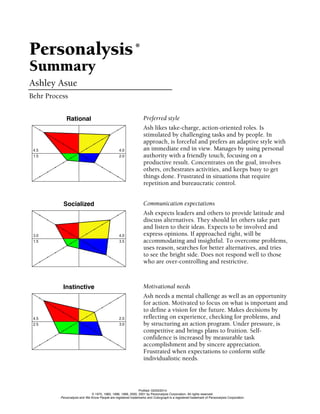
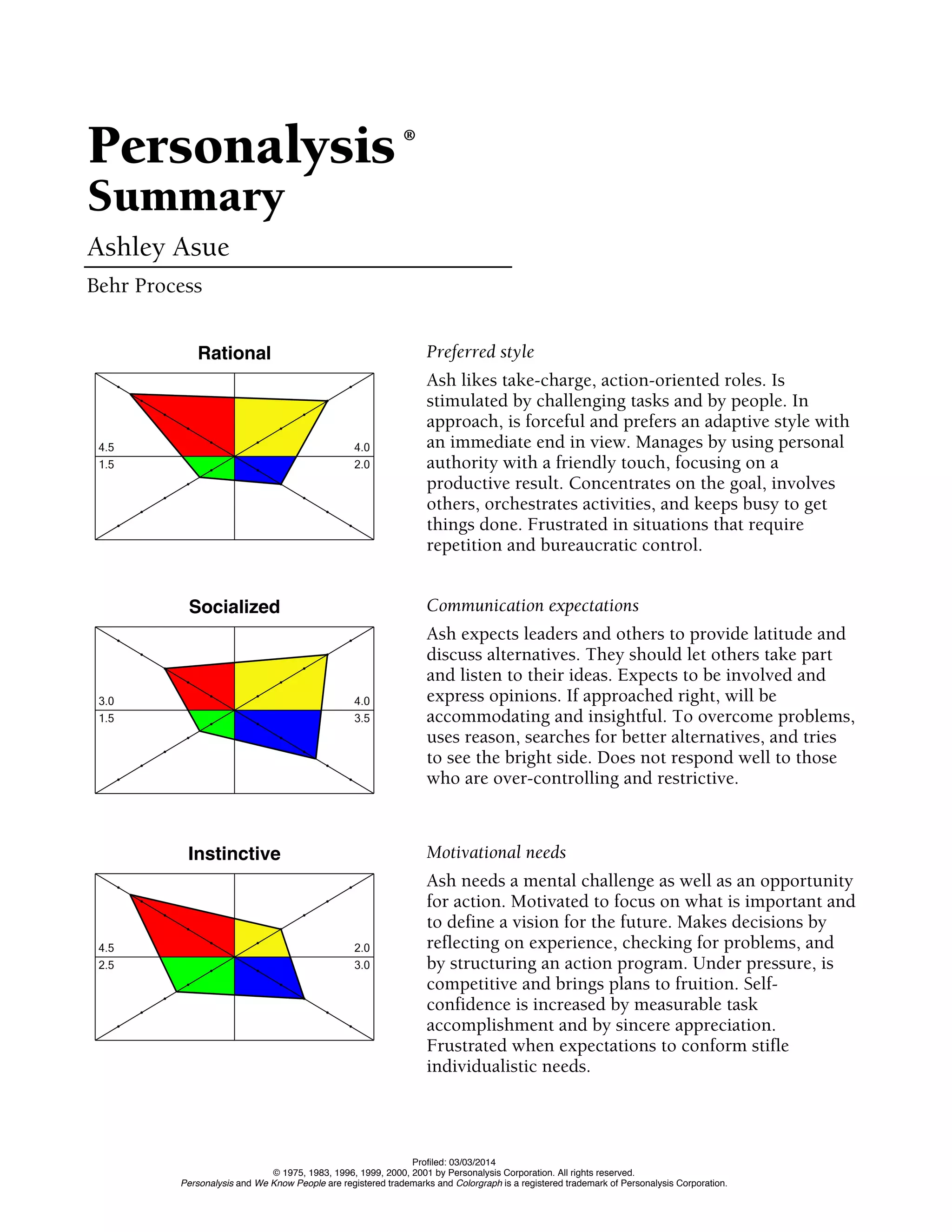
Rational Preferred style
Ash likes take-charge, action-oriented roles. Is
stimulated by challenging tasks and by people. In
approach, is forceful and prefers an adaptive style with
an immediate end in view. Manages by using personal
authority with a friendly touch, focusing on a
productive result. Concentrates on the goal, involves
others, orchestrates activities, and keeps busy to get
things done. Frustrated in situations that require
repetition and bureaucratic control.
Socialized Communication expectations
Ash expects leaders and others to provide latitude and
discuss alternatives. They should let others take part
and listen to their ideas. Expects to be involved and
express opinions. If approached right, will be
accommodating and insightful. To overcome problems,
uses reason, searches for better alternatives, and tries
to see the bright side. Does not respond well to those
who are over-controlling and restrictive.
Instinctive Motivational needs
Ash needs a mental challenge as well as an opportunity
for action. Motivated to focus on what is important and
to define a vision for the future. Makes decisions by
reflecting on experience, checking for problems, and
by structuring an action program. Under pressure, is
competitive and brings plans to fruition. Self-
confidence is increased by measurable task
accomplishment and by sincere appreciation.
Frustrated when expectations to conform stifle
individualistic needs.
Profiled: 03/03/2014
© 1975, 1983, 1996, 1999, 2000, 2001 by Personalysis Corporation. All rights reserved.
Personalysis and We Know People are registered trademarks and Colorgraph is a registered trademark of Personalysis Corporation.
Personalysis
Ashley Asue
Behr Process
© 1975, 1983, 1996, 1999, 2000, 2001 Personalysis Corporation. All rights reserved.
Personalysis and We Know People are registered trademarks and Colorgraph is a trademark of Personalysis Corporation.
about your personalysis report
Your Personalysis Report is based upon answers you provided in the Personalysis Questionnaire, and
it is not influenced by age, race, sex, education, or religion. It is a scientific management tool that
explains why and how you feel, think, and act under varying levels of pressure.
Personalysis is an assessment of your unique personality. It is composed of a complex mix of
behaviors that you use to create success and to be effective. There is no single perfect, ideal, average,
or standard profile. Your personality is very special -- neither better nor worse than any other. It is
simply different.
To get more from your Personalysis report, view the interactive guide at
www.personalysis.com/guide. Your user code for the guide is: sqzk ztjs jysq
The animated graphics, interactive exercises, and video segments reinforce key elements of
your report.
what you will find in your report
preview (on the facing page):
a one-page summary that captures the essential themes of your personality.
colors, numbers, clusters and dimensions (pages 2-3):
basic information necessary to understand your behavior under various levels of stress, the
color-coded behavioral shorthand of your personality, how colors are measured, and how two
colors together form a cluster with special meaning.
instinctive dimension (pages 4-5):
identifies the powerful motivating forces that affect your self-esteem and sense of well-being.
Your basic needs must be met for you to feel effective and secure. When you are upset or
concerned, look to this dimension to define the underlying cause, and then identify a solution.
socialized dimension (pages 6-7):
describes how you learned to interact with others. It defines the expectations you have of
yourself as well as of others. This is the dimension you use to gather information and to extend
cooperation.
rational dimension (pages 8-9):
reveals the way you most enjoy interacting with your world. You use this information to identify
both appealing and frustrating job activities.
negative behaviors (pages 10-11):
provides insight into your defensive and self-defeating behaviors.
peak performance (pages 12-13):
offers strategies to enhance your personal and professional success.
Personalysis Corporation 1© 1975, 1983, 1996, 1999, 2000, 2001 by Personalysis Corporation.
colors, numbers, and clusters
The colors
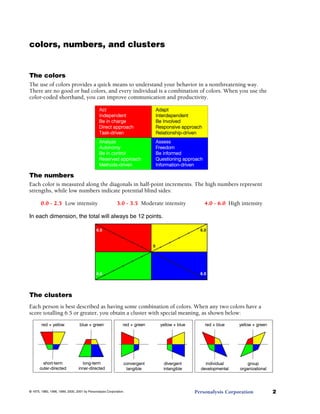
The use of colors provides a quick means to understand your behavior in a nonthreatening way.
There are no good or bad colors, and every individual is a combination of colors. When you use the
color-coded shorthand, you can improve communication and productivity.
Act
Independent
Be in charge
Direct approach
Task-driven
Adapt
Interdependent
Be Involved
Responsive approach
Relationship-driven
Analyze
Autonomy
Be in control
Reserved approach
Methods-driven
Assess
Freedom
Be informed
Questioning approach
Information-driven
The clusters
Each person is best described as having some combination of colors. When any two colors have a
score totalling 6.5 or greater, you obtain a cluster with special meaning, as shown below:
red + yellow blue + green
short-term
outer-directed
long-term
inner-directed
red + green yellow + blue
convergent
tangible
divergent
intangible
red + blue yellow + green
individual
developmental
group
organizational
The numbers
Each color is measured along the diagonals in half-point increments. The high numbers represent
strengths, while low numbers indicate potential blind sides:
0.0 - 2.5 Low intensity 3.0 - 3.5 Moderate intensity 4.0 - 6.0 High intensity
In each dimension, the total will always be 12 points.
Personalysis Corporation 2© 1975, 1983, 1996, 1999, 2000, 2001 by Personalysis Corporation.
dimensions
Personalysis offers a more complete picture of your personality. Where other profiling instruments
provide data on one or two levels of personality, Personalysis captures three productive and two
negative dimensions. The result is a more accurate assessment. The Personalysis difference is the
ability to go further, provide greater detail, and give a more thorough interpretation.
Rational
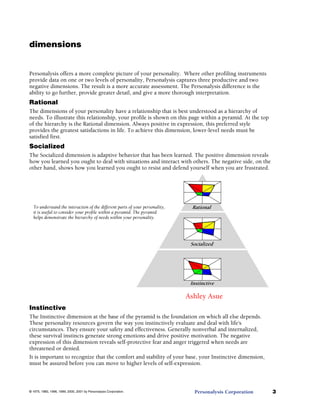
The dimensions of your personality have a relationship that is best understood as a hierarchy of
needs. To illustrate this relationship, your profile is shown on this page within a pyramid. At the top
of the hierarchy is the Rational dimension. Always positive in expression, this preferred style
provides the greatest satisfactions in life. To achieve this dimension, lower-level needs must be
satisfied first.
Socialized
The Socialized dimension is adaptive behavior that has been learned. The positive dimension reveals
how you learned you ought to deal with situations and interact with others. The negative side, on the
other hand, shows how you learned you ought to resist and defend yourself when you are frustrated.
RationalTo understand the interaction of the different parts of your personality,
it is useful to consider your profile within a pyramid. The pyramid
helps demonstrate the hierarchy of needs within your personality.
Socialized
Instinctive
Ashley Asue
Instinctive
The Instinctive dimension at the base of the pyramid is the foundation on which all else depends.
These personality resources govern the way you instinctively evaluate and deal with life's
circumstances. They ensure your safety and effectiveness. Generally nonverbal and internalized,
these survival instincts generate strong emotions and drive positive motivation. The negative
expression of this dimension reveals self-protective fear and anger triggered when needs are
threatened or denied.
It is important to recognize that the comfort and stability of your base, your Instinctive dimension,
must be assured before you can move to higher levels of self-expression.
Personalysis Corporation 3© 1975, 1983, 1996, 1999, 2000, 2001 by Personalysis Corporation.
basic information about the instinctive dimension
Your Instinctive dimension—your basic nature—is the foundation of personality. It is the core of
your survival needs, concerns, and motivating forces. Largely subconscious and intense, these
feelings usually are not verbalized, yet they influence all activity in your life. These explain why you
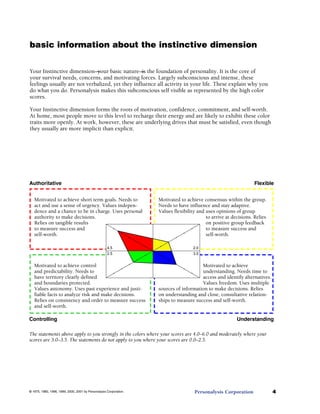
do what you do. Personalysis makes this subconscious self visible as represented by the high color
scores.
Your Instinctive dimension forms the roots of motivation, confidence, commitment, and self-worth.
At home, most people move to this level to recharge their energy and are likely to exhibit these color
traits more openly. At work, however, these are underlying drives that must be satisfied, even though
they usually are more implicit than explicit.
Authoritative Flexible
Motivated to achieve short term goals. Needs to
act and use a sense of urgency. Values indepen-
dence and a chance to be in charge. Uses personal
authority to make decisions.
Relies on tangible results
to measure success and
self-worth.
Motivated to achieve consensus within the group.
Needs to have influence and stay adaptive.
Values flexibility and uses opinions of group
to arrive at decisions. Relies
on positive group feedback
to measure success and
self-worth.
Motivated to achieve control
and predictability. Needs to
have territory clearly defined
and boundaries protected.
Values autonomy. Uses past experience and justi-
fiable facts to analyze risk and make decisions.
Relies on consistency and order to measure success
and self-worth.
Motivated to achieve
understanding. Needs time to
access and identify alternatives.
Values freedom. Uses multiple
sources of information to make decisions. Relies
on understanding and close, consultative relation-
ships to measure success and self-worth.
Controlling Understanding
The statements above apply to you strongly in the colors where your scores are 4.0–6.0 and moderately where your
scores are 3.0–3.5. The statements do not apply to you where your scores are 0.0–2.5.
Personalysis Corporation 4© 1975, 1983, 1996, 1999, 2000, 2001 by Personalysis Corporation.
instinctive
Ashley Asue
Motivation
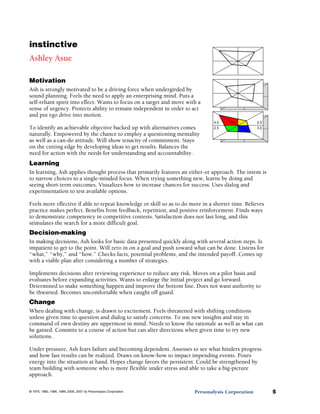
Ash is strongly motivated to be a driving force when undergirded by
sound planning. Feels the need to apply an enterprising mind. Puts a
self-reliant spirit into effect. Wants to focus on a target and move with a
sense of urgency. Protects ability to remain independent in order to act
and put ego drive into motion.
To identify an achievable objective backed up with alternatives comes
naturally. Empowered by the chance to employ a questioning mentality
as well as a can-do attitude. Will show tenacity of commitment. Stays
on the cutting edge by developing ideas to get results. Balances the
need for action with the needs for understanding and accountability.
Learning
In learning, Ash applies thought process that primarily features an either-or approach. The intent is
to narrow choices to a single-minded focus. When trying something new, learns by doing and
seeing short-term outcomes. Visualizes how to increase chances for success. Uses dialog and
experimentation to test available options.
Feels more effective if able to repeat knowledge or skill so as to do more in a shorter time. Believes
practice makes perfect. Benefits from feedback, repetition, and positive reinforcement. Finds ways
to demonstrate competency in competitive contests. Satisfaction does not last long, and this
stimulates the search for a more difficult goal.
Decision-making
In making decisions, Ash looks for basic data presented quickly along with several action steps. Is
impatient to get to the point. Will zero in on a goal and push toward what can be done. Listens for
“what,” “why,” and “how.” Checks facts, potential problems, and the intended payoff. Comes up
with a viable plan after considering a number of strategies.
Implements decisions after reviewing experience to reduce any risk. Moves on a pilot basis and
evaluates before expanding activities. Wants to enlarge the initial project and go forward.
Determined to make something happen and improve the bottom line. Does not want authority to
be thwarted. Becomes uncomfortable when caught off guard.
Change
When dealing with change, is drawn to excitement. Feels threatened with shifting conditions
unless given time to question and dialog to satisfy concerns. To use new insights and stay in
command of own destiny are uppermost in mind. Needs to know the rationale as well as what can
be gained. Commits to a course of action but can alter directions when given time to try new
solutions.
Under pressure, Ash fears failure and becoming dependent. Assesses to see what hinders progress
and how fast results can be realized. Draws on know-how to impact impending events. Pours
energy into the situation at hand. Hopes change favors the persistent. Could be strengthened by
team building with someone who is more flexible under stress and able to take a big-picture
approach.
Personalysis Corporation 5© 1975, 1983, 1996, 1999, 2000, 2001 by Personalysis Corporation.
basic information about the socialized dimension
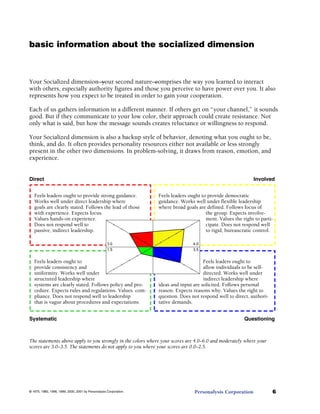
Your Socialized dimension—your second nature—comprises the way you learned to interact
with others, especially authority figures and those you perceive to have power over you. It also
represents how you expect to be treated in order to gain your cooperation.
Each of us gathers information in a different manner. If others get on “your channel,” it sounds
good. But if they communicate to your low color, their approach could create resistance. Not
only what is said, but how the message sounds creates reluctance or willingness to respond.
Your Socialized dimension is also a backup style of behavior, denoting what you ought to be,
think, and do. It often provides personality resources either not available or less strongly
present in the other two dimensions. In problem-solving, it draws from reason, emotion, and
experience.
Direct Involved
Feels leaders ought to provide strong guidance.
Works well under direct leadership where
goals are clearly stated. Follows the lead of those
with experience. Expects focus.
Values hands-on experience.
Does not respond well to
passive, indirect leadership.
Feels leaders ought to provide democratic
guidance. Works well under flexible leadership
where broad goals are defined. Follows focus of
the group. Expects involve-
ment. Values the right to parti-
cipate. Does not respond well
to rigid, bureaucratic control.
Feels leaders ought to
provide consistency and
uniformity. Works well under
structured leadership where
systems are clearly stated. Follows policy and pro-
cedure. Expects rules and regulations. Values com-
pliance. Does not respond well to leadership
that is vague about procedures and expectations.
Feels leaders ought to
allow individuals to be self-
directed. Works well under
indirect leadership where
ideas and input are solicited. Follows personal
reason. Expects reasons why. Values the right to
question. Does not respond well to direct, authori-
tative demands.
Systematic Questioning
The statements above apply to you strongly in the colors where your scores are 4.0–6.0 and moderately where your
scores are 3.0–3.5. The statements do not apply to you where your scores are 0.0–2.5.
Personalysis Corporation 6© 1975, 1983, 1996, 1999, 2000, 2001 by Personalysis Corporation.
socialized
Ashley Asue
Self-expectations
Ash expects to extend a helping hand and cooperate with those in
authority. Without experience, thinks you should assist those in charge
in a willing way while promoting their agenda. Believes you ought to
look with favor to the requests and appeals of those who need help.
With experience, takes initiative and uses organizational talent to affect
what happens. To employ thought, speech, and action to achieve a
joint goal is a strong expectation. When given a chance to be included,
has the power to be enterprising, make an impression, and expand the
activity or service. Will be generous with time, energy, and resources.
Expectations of others
Ash expects that leaders and others ought to be accommodating. They should encourage input and
maintain positive relationships. Follows the lead of those who value participation and show it by
utilizing a group process. Expects those in charge to delegate, demonstrate commitment to
training, and work for a coordinated action.
Those who trust their fellow associates and use a wide span of control will be respected. An
effective response is made possible, therefore, by leaders who ask associates for help, advocate a
team effort, and inspire by example. Does not react well to those who do not take a democratic
approach and fail to involve others.
Cooperative response
When others have an attitude of inclusion, Ash will extend self to share the task. Has learned you
should be an enabler and avoid guilt by quickly responding to the needs of others. Feels you ought
to be helpful and try to solve any problems. It is second nature to offer assistance and cultivate
friendship as a part of the business of life.
To overcome problems, Ash thinks creatively, considers the options, and makes changes. Pursues
constructive alternatives and tries to achieve a workable consensus. May resist those who do not
seek buy-in; but, if approached right, will take a lively interest and push for a team-based
performance.
Communication: right and wrong approaches
We learn how to gather information and interact with others early in life. Ash can readily relate to
those who are open, sociable, and supportive. But may misread those who are reserved, careful,
and detail-oriented. May distort their behavior as unfriendly, legalistic, and nitpicking.
Their tendency to be logical and particular may be mistaken as being hairsplitting. Is not at ease
with people who are systematic and procedure-oriented, and may misperceive them as inflexible.
To relate to Ash, remember to spend time developing the relationship, be interactive, and
demonstrate responsiveness.
Personalysis Corporation 7© 1975, 1983, 1996, 1999, 2000, 2001 by Personalysis Corporation.
basic information about the rational dimension
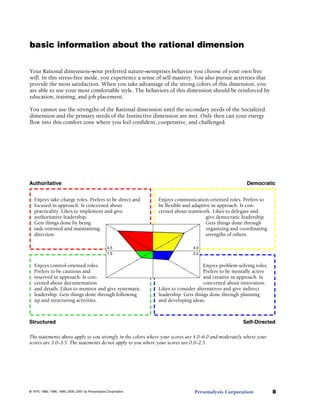
Your Rational dimension—your preferred nature—comprises behavior you choose of your own free
will. In this stress-free mode, you experience a sense of self-mastery. You also pursue activities that
provide the most satisfaction. When you take advantage of the strong colors of this dimension, you
are able to use your most comfortable style. The behaviors of this dimension should be reinforced by
education, training, and job placement.
You cannot use the strengths of the Rational dimension until the secondary needs of the Socialized
dimension and the primary needs of the Instinctive dimension are met. Only then can your energy
flow into this comfort zone where you feel confident, cooperative, and challenged.
Authoritative Democratic
Enjoys take-charge roles. Prefers to be direct and
focused in approach. Is concerned about
practicality. Likes to implement and give
authoritative leadership.
Gets things done by being
task-oriented and maintaining
direction.
Enjoys communication-oriented roles. Prefers to
be flexible and adaptive in approach. Is con-
cerned about teamwork. Likes to delegate and
give democratic leadership.
Gets things done through
organizing and coordinating
strengths of others.
Enjoys control-oriented roles.
Prefers to be cautious and
reserved in approach. Is con-
cerned about documentation
and details. Likes to monitor and give systematic
leadership. Gets things done through following
up and structuring activities.
Enjoys problem-solving roles.
Prefers to be mentally active
and creative in approach. Is
concerned about innovation.
Likes to consider alternatives and give indirect
leadership. Gets things done through planning
and developing ideas.
Structured Self-Directed
The statements above apply to you strongly in the colors where your scores are 4.0–6.0 and moderately where your
scores are 3.0–3.5. The statements do not apply to you where your scores are 0.0–2.5.
Personalysis Corporation 8© 1975, 1983, 1996, 1999, 2000, 2001 by Personalysis Corporation.
rational
Ashley Asue
Preferred style
Ash is an outgoing person who likes to organize and superintend a
program of work. Employs an outspoken but friendly style and takes
the lead while involving others. Comes across in a frank but tactful
fashion. Tends to focus on explicit information and may lose patience
with people who overload with background data.
Takes pleasure in ability to take charge and get associates to be
responsive. To state opinions clearly yet be open to talk about the
issues are strengths. Does not draw back from conflict but does try to
maintain harmony. These behaviors, as well as the ability to meet
specifications and produce growth, foster a sense of self-mastery.
Style limitations
Because Ash is so forceful and expansive, others at times may interpret this as being too direct,
domineering, or insensitive. Such an enthusiastic style could be misunderstood when a judicious
and insightful approach may be indicated. There is a time to take charge and be task focused, and
there is a time to let up, listen, and hear what others say.
Since a confrontational mode of action is not always appropriate, Ash may need to shift styles
consciously. Find behaviors in other dimensions that show more caution and discernment and are
less likely to be perceived as too excitatory, bossy, or the like. Another option is to team build with
someone who comes across as more reserved and prudent.
Satisfying job activities
We are able to operate in our comfort zone when we have had our basic needs met and are in
positions that utilize the strengths of our preferred style. Broadly speaking, Ash prefers
management and relationship-driven roles. Enjoys job functions that call for using personal
authority, orchestrating activities, and being productive. Values a chance to persuade and to
encourage people to act in concert.
Is challenged when directing, managing, and coordinating a team. Likes to be physically active and
work for a socially useful purpose. To be habitually occupied and in command of what happens
give a sense of satisfaction. These talents, as well as potential to increase the size, extent, and range
of an enterprise, contribute to peak performance.
Frustrating job functions
Generally, Ash should not choose roles that require a bureaucratic turn of mind. Dislikes needless
paperwork. Should keep clear of duties that are methodical or repetitious. Does not enjoy time-
consuming, procedure-oriented work. Assignments that emphasize rigid rules and policies rather
than productivity should be avoided.
In addition, has a distaste for jobs that call for slowing down once a decision has been reached.
Cannot readily wait once a goal has been identified. Any functions that accent controlling rather
than directing, monitoring instead of acting, or structuring as opposed to initiating tasks do not
draw on Ash's strengths.
Personalysis Corporation 9© 1975, 1983, 1996, 1999, 2000, 2001 by Personalysis Corporation.
basic information about negative behaviors
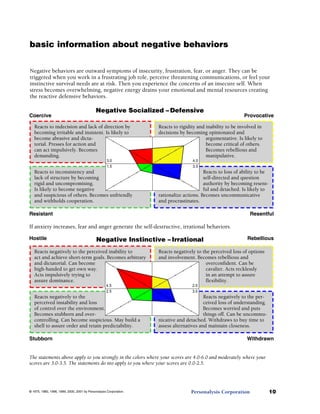
Negative behaviors are outward symptoms of insecurity, frustration, fear, or anger. They can be
triggered when you work in a frustrating job role, perceive threatening communications, or feel your
instinctive survival needs are at risk. Then you experience the concerns of an insecure self. When
stress becomes overwhelming, negative energy drains your emotional and mental resources creating
the reactive defensive behaviors.
Coercive
Negative Socialized – Defensive
Provocative
Reacts to indecision and lack of direction by
becoming irritable and insistent. Is likely to
become abrasive and dicta-
torial. Presses for action and
can act impulsively. Becomes
demanding.
Reacts to rigidity and inability to be involved in
decisions by becoming opinionated and
argumentative. Is likely to
become critical of others.
Becomes rebellious and
manipulative.
Reacts to inconsistency and
lack of structure by becoming
rigid and uncompromising.
Is likely to become negative
and suspicious of others. Becomes unfriendly
and withholds cooperation.
Reacts to loss of ability to be
self-directed and question
authority by becoming resent-
ful and detached. Is likely to
rationalize actions. Becomes uncommunicative
and procrastinates.
Resistant Resentful
If anxiety increases, fear and anger generate the self-destructive, irrational behaviors.
Hostile Negative Instinctive – Irrational Rebellious
Reacts negatively to the perceived inability to
act and achieve short-term goals. Becomes arbitrary
and dictatorial. Can become
high-handed to get own way.
Acts impulsively trying to
assure dominance.
Reacts negatively to the perceived loss of options
and involvement. Becomes rebellious and
overconfident. Can be
cavalier. Acts recklessly
in an attempt to assure
flexibility.
Reacts negatively to the
perceived instability and loss
of control over the environment.
Becomes stubborn and over-
controlling. Can become suspicious. May build a
shell to assure order and retain predictability.
Reacts negatively to the per-
ceived loss of understanding.
Becomes worried and puts
things off. Can be uncommu-
nicative and detached. Withdraws to buy time to
assess alternatives and maintain closeness.
Stubborn Withdrawn
The statements above apply to you strongly in the colors where your scores are 4.0-6.0 and moderately where your
scores are 3.0-3.5. The statements do nto apply to you where your scores are 0.0-2.5.
Personalysis Corporation 10© 1975, 1983, 1996, 1999, 2000, 2001 by Personalysis Corporation.
negative behaviors
Ashley Asue
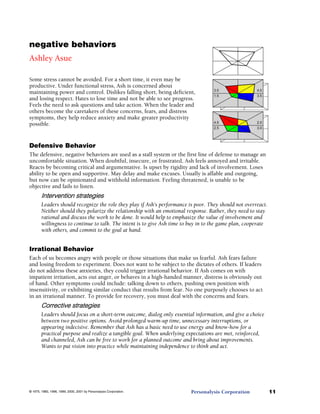
Some stress cannot be avoided. For a short time, it even may be
productive. Under functional stress, Ash is concerned about
maintaining power and control. Dislikes falling short, being deficient,
and losing respect. Hates to lose time and not be able to see progress.
Feels the need to ask questions and take action. When the leader and
others become the caretakers of these concerns, fears, and distress
symptoms, they help reduce anxiety and make greater productivity
possible.
Defensive Behavior
The defensive, negative behaviors are used as a stall system or the first line of defense to manage an
uncomfortable situation. When doubtful, insecure, or frustrated, Ash feels annoyed and irritable.
Reacts by becoming critical and argumentative. Is upset by rigidity and lack of involvement. Loses
ability to be open and supportive. May delay and make excuses. Usually is affable and outgoing,
but now can be opinionated and withhold information. Feeling threatened, is unable to be
objective and fails to listen.
Intervention strategies
Leaders should recognize the role they play if Ash's performance is poor. They should not overreact.
Neither should they polarize the relationship with an emotional response. Rather, they need to stay
rational and discuss the work to be done. It would help to emphasize the value of involvement and
willingness to continue to talk. The intent is to give Ash time to buy in to the game plan, cooperate
with others, and commit to the goal at hand.
Irrational Behavior
Each of us becomes angry with people or those situations that make us fearful. Ash fears failure
and losing freedom to experiment. Does not want to be subject to the dictates of others. If leaders
do not address these anxieties, they could trigger irrational behavior. If Ash comes on with
impatient irritation, acts out anger, or behaves in a high-handed manner, distress is obviously out
of hand. Other symptoms could include: talking down to others, pushing own position with
insensitivity, or exhibiting similar conduct that results from fear. No one purposely chooses to act
in an irrational manner. To provide for recovery, you must deal with the concerns and fears.
Corrective strategies
Leaders should focus on a short-term outcome, dialog only essential information, and give a choice
between two positive options. Avoid prolonged warm-up time, unnecessary interruptions, or
appearing indecisive. Remember that Ash has a basic need to use energy and know-how for a
practical purpose and realize a tangible goal. When underlying expectations are met, reinforced,
and channeled, Ash can be free to work for a planned outcome and bring about improvements.
Wants to put vision into practice while maintaining independence to think and act.
Personalysis Corporation 11© 1975, 1983, 1996, 1999, 2000, 2001 by Personalysis Corporation.
applying personalysis for peak performance
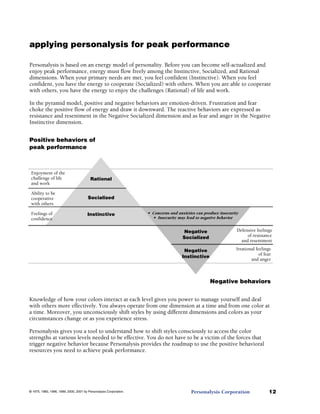
Personalysis is based on an energy model of personality. Before you can become self-actualized and
enjoy peak performance, energy must flow freely among the Instinctive, Socialized, and Rational
dimensions. When your primary needs are met, you feel confident (Instinctive). When you feel
confident, you have the energy to cooperate (Socialized) with others. When you are able to cooperate
with others, you have the energy to enjoy the challenges (Rational) of life and work.
In the pyramid model, positive and negative behaviors are emotion-driven. Frustration and fear
choke the positive flow of energy and draw it downward. The reactive behaviors are expressed as
resistance and resentment in the Negative Socialized dimension and as fear and anger in the Negative
Instinctive dimension.
Positive behaviors of
peak performance
Negative behaviors
Knowledge of how your colors interact at each level gives you power to manage yourself and deal
with others more effectively. You always operate from one dimension at a time and from one color at
a time. Moreover, you unconsciously shift styles by using different dimensions and colors as your
circumstances change or as you experience stress.
Personalysis gives you a tool to understand how to shift styles consciously to access the color
strengths at various levels needed to be effective. You do not have to be a victim of the forces that
trigger negative behavior because Personalysis provides the roadmap to use the positive behavioral
resources you need to achieve peak performance.
Rational
Enjoyment of the
challenge of life
and work
Ability to be
cooperative
with others
Feelings of
confidence
Defensive feelings
of resistance
and resentment
Irrational feelings
of fear
and anger
Socialized
Instinctive
Negative
Socialized
Negative
Instinctive
• Concerns and anxieties can produce insecurity
• Insecurity may lead to negative behavior
Personalysis Corporation 12© 1975, 1983, 1996, 1999, 2000, 2001 by Personalysis Corporation.
peak performance
Ashley Asue
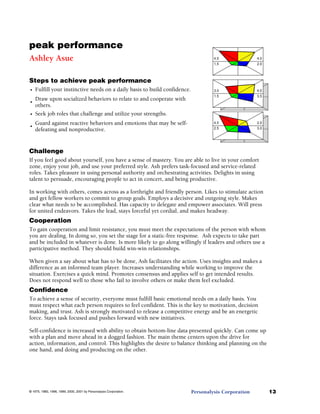
Steps to achieve peak performance
• Fulfill your instinctive needs on a daily basis to build confidence.
•
Draw upon socialized behaviors to relate to and cooperate with
others.
• Seek job roles that challenge and utilize your strengths.
•
Guard against reactive behaviors and emotions that may be self-
defeating and nonproductive.
Challenge
If you feel good about yourself, you have a sense of mastery. You are able to live in your comfort
zone, enjoy your job, and use your preferred style. Ash prefers task-focused and service-related
roles. Takes pleasure in using personal authority and orchestrating activities. Delights in using
talent to persuade, encouraging people to act in concert, and being productive.
In working with others, comes across as a forthright and friendly person. Likes to stimulate action
and get fellow workers to commit to group goals. Employs a decisive and outgoing style. Makes
clear what needs to be accomplished. Has capacity to delegate and empower associates. Will press
for united endeavors. Takes the lead, stays forceful yet cordial, and makes headway.
Cooperation
To gain cooperation and limit resistance, you must meet the expectations of the person with whom
you are dealing. In doing so, you set the stage for a static-free response. Ash expects to take part
and be included in whatever is done. Is more likely to go along willingly if leaders and others use a
participative method. They should build win-win relationships.
When given a say about what has to be done, Ash facilitates the action. Uses insights and makes a
difference as an informed team player. Increases understanding while working to improve the
situation. Exercises a quick mind. Promotes consensus and applies self to get intended results.
Does not respond well to those who fail to involve others or make them feel excluded.
Confidence
To achieve a sense of security, everyone must fulfill basic emotional needs on a daily basis. You
must respect what each person requires to feel confident. This is the key to motivation, decision
making, and trust. Ash is strongly motivated to release a competitive energy and be an energetic
force. Stays task focused and pushes forward with new initiatives.
Self-confidence is increased with ability to obtain bottom-line data presented quickly. Can come up
with a plan and move ahead in a dogged fashion. The main theme centers upon the drive for
action, information, and control. This highlights the desire to balance thinking and planning on the
one hand, and doing and producing on the other.
Personalysis Corporation 13© 1975, 1983, 1996, 1999, 2000, 2001 by Personalysis Corporation.

Ashley Asue Personalysis Report

  • 1.
    Summary Personalysis® Ashley Asue Behr Process RationalPreferred style Ash likes take-charge, action-oriented roles. Is stimulated by challenging tasks and by people. In approach, is forceful and prefers an adaptive style with an immediate end in view. Manages by using personal authority with a friendly touch, focusing on a productive result. Concentrates on the goal, involves others, orchestrates activities, and keeps busy to get things done. Frustrated in situations that require repetition and bureaucratic control. Socialized Communication expectations Ash expects leaders and others to provide latitude and discuss alternatives. They should let others take part and listen to their ideas. Expects to be involved and express opinions. If approached right, will be accommodating and insightful. To overcome problems, uses reason, searches for better alternatives, and tries to see the bright side. Does not respond well to those who are over-controlling and restrictive. Instinctive Motivational needs Ash needs a mental challenge as well as an opportunity for action. Motivated to focus on what is important and to define a vision for the future. Makes decisions by reflecting on experience, checking for problems, and by structuring an action program. Under pressure, is competitive and brings plans to fruition. Self- confidence is increased by measurable task accomplishment and by sincere appreciation. Frustrated when expectations to conform stifle individualistic needs. Profiled: 03/03/2014 © 1975, 1983, 1996, 1999, 2000, 2001 by Personalysis Corporation. All rights reserved. Personalysis and We Know People are registered trademarks and Colorgraph is a registered trademark of Personalysis Corporation.
  • 2.
    Personalysis Ashley Asue Behr Process ©1975, 1983, 1996, 1999, 2000, 2001 Personalysis Corporation. All rights reserved. Personalysis and We Know People are registered trademarks and Colorgraph is a trademark of Personalysis Corporation.
  • 3.
    about your personalysisreport Your Personalysis Report is based upon answers you provided in the Personalysis Questionnaire, and it is not influenced by age, race, sex, education, or religion. It is a scientific management tool that explains why and how you feel, think, and act under varying levels of pressure. Personalysis is an assessment of your unique personality. It is composed of a complex mix of behaviors that you use to create success and to be effective. There is no single perfect, ideal, average, or standard profile. Your personality is very special -- neither better nor worse than any other. It is simply different. To get more from your Personalysis report, view the interactive guide at www.personalysis.com/guide. Your user code for the guide is: sqzk ztjs jysq The animated graphics, interactive exercises, and video segments reinforce key elements of your report. what you will find in your report preview (on the facing page): a one-page summary that captures the essential themes of your personality. colors, numbers, clusters and dimensions (pages 2-3): basic information necessary to understand your behavior under various levels of stress, the color-coded behavioral shorthand of your personality, how colors are measured, and how two colors together form a cluster with special meaning. instinctive dimension (pages 4-5): identifies the powerful motivating forces that affect your self-esteem and sense of well-being. Your basic needs must be met for you to feel effective and secure. When you are upset or concerned, look to this dimension to define the underlying cause, and then identify a solution. socialized dimension (pages 6-7): describes how you learned to interact with others. It defines the expectations you have of yourself as well as of others. This is the dimension you use to gather information and to extend cooperation. rational dimension (pages 8-9): reveals the way you most enjoy interacting with your world. You use this information to identify both appealing and frustrating job activities. negative behaviors (pages 10-11): provides insight into your defensive and self-defeating behaviors. peak performance (pages 12-13): offers strategies to enhance your personal and professional success. Personalysis Corporation 1© 1975, 1983, 1996, 1999, 2000, 2001 by Personalysis Corporation.
  • 4.
    colors, numbers, andclusters The colors The use of colors provides a quick means to understand your behavior in a nonthreatening way. There are no good or bad colors, and every individual is a combination of colors. When you use the color-coded shorthand, you can improve communication and productivity. Act Independent Be in charge Direct approach Task-driven Adapt Interdependent Be Involved Responsive approach Relationship-driven Analyze Autonomy Be in control Reserved approach Methods-driven Assess Freedom Be informed Questioning approach Information-driven The clusters Each person is best described as having some combination of colors. When any two colors have a score totalling 6.5 or greater, you obtain a cluster with special meaning, as shown below: red + yellow blue + green short-term outer-directed long-term inner-directed red + green yellow + blue convergent tangible divergent intangible red + blue yellow + green individual developmental group organizational The numbers Each color is measured along the diagonals in half-point increments. The high numbers represent strengths, while low numbers indicate potential blind sides: 0.0 - 2.5 Low intensity 3.0 - 3.5 Moderate intensity 4.0 - 6.0 High intensity In each dimension, the total will always be 12 points. Personalysis Corporation 2© 1975, 1983, 1996, 1999, 2000, 2001 by Personalysis Corporation.
  • 5.
    dimensions Personalysis offers amore complete picture of your personality. Where other profiling instruments provide data on one or two levels of personality, Personalysis captures three productive and two negative dimensions. The result is a more accurate assessment. The Personalysis difference is the ability to go further, provide greater detail, and give a more thorough interpretation. Rational The dimensions of your personality have a relationship that is best understood as a hierarchy of needs. To illustrate this relationship, your profile is shown on this page within a pyramid. At the top of the hierarchy is the Rational dimension. Always positive in expression, this preferred style provides the greatest satisfactions in life. To achieve this dimension, lower-level needs must be satisfied first. Socialized The Socialized dimension is adaptive behavior that has been learned. The positive dimension reveals how you learned you ought to deal with situations and interact with others. The negative side, on the other hand, shows how you learned you ought to resist and defend yourself when you are frustrated. RationalTo understand the interaction of the different parts of your personality, it is useful to consider your profile within a pyramid. The pyramid helps demonstrate the hierarchy of needs within your personality. Socialized Instinctive Ashley Asue Instinctive The Instinctive dimension at the base of the pyramid is the foundation on which all else depends. These personality resources govern the way you instinctively evaluate and deal with life's circumstances. They ensure your safety and effectiveness. Generally nonverbal and internalized, these survival instincts generate strong emotions and drive positive motivation. The negative expression of this dimension reveals self-protective fear and anger triggered when needs are threatened or denied. It is important to recognize that the comfort and stability of your base, your Instinctive dimension, must be assured before you can move to higher levels of self-expression. Personalysis Corporation 3© 1975, 1983, 1996, 1999, 2000, 2001 by Personalysis Corporation.
  • 6.
    basic information aboutthe instinctive dimension Your Instinctive dimension—your basic nature—is the foundation of personality. It is the core of your survival needs, concerns, and motivating forces. Largely subconscious and intense, these feelings usually are not verbalized, yet they influence all activity in your life. These explain why you do what you do. Personalysis makes this subconscious self visible as represented by the high color scores. Your Instinctive dimension forms the roots of motivation, confidence, commitment, and self-worth. At home, most people move to this level to recharge their energy and are likely to exhibit these color traits more openly. At work, however, these are underlying drives that must be satisfied, even though they usually are more implicit than explicit. Authoritative Flexible Motivated to achieve short term goals. Needs to act and use a sense of urgency. Values indepen- dence and a chance to be in charge. Uses personal authority to make decisions. Relies on tangible results to measure success and self-worth. Motivated to achieve consensus within the group. Needs to have influence and stay adaptive. Values flexibility and uses opinions of group to arrive at decisions. Relies on positive group feedback to measure success and self-worth. Motivated to achieve control and predictability. Needs to have territory clearly defined and boundaries protected. Values autonomy. Uses past experience and justi- fiable facts to analyze risk and make decisions. Relies on consistency and order to measure success and self-worth. Motivated to achieve understanding. Needs time to access and identify alternatives. Values freedom. Uses multiple sources of information to make decisions. Relies on understanding and close, consultative relation- ships to measure success and self-worth. Controlling Understanding The statements above apply to you strongly in the colors where your scores are 4.0–6.0 and moderately where your scores are 3.0–3.5. The statements do not apply to you where your scores are 0.0–2.5. Personalysis Corporation 4© 1975, 1983, 1996, 1999, 2000, 2001 by Personalysis Corporation.
  • 7.
    instinctive Ashley Asue Motivation Ash isstrongly motivated to be a driving force when undergirded by sound planning. Feels the need to apply an enterprising mind. Puts a self-reliant spirit into effect. Wants to focus on a target and move with a sense of urgency. Protects ability to remain independent in order to act and put ego drive into motion. To identify an achievable objective backed up with alternatives comes naturally. Empowered by the chance to employ a questioning mentality as well as a can-do attitude. Will show tenacity of commitment. Stays on the cutting edge by developing ideas to get results. Balances the need for action with the needs for understanding and accountability. Learning In learning, Ash applies thought process that primarily features an either-or approach. The intent is to narrow choices to a single-minded focus. When trying something new, learns by doing and seeing short-term outcomes. Visualizes how to increase chances for success. Uses dialog and experimentation to test available options. Feels more effective if able to repeat knowledge or skill so as to do more in a shorter time. Believes practice makes perfect. Benefits from feedback, repetition, and positive reinforcement. Finds ways to demonstrate competency in competitive contests. Satisfaction does not last long, and this stimulates the search for a more difficult goal. Decision-making In making decisions, Ash looks for basic data presented quickly along with several action steps. Is impatient to get to the point. Will zero in on a goal and push toward what can be done. Listens for “what,” “why,” and “how.” Checks facts, potential problems, and the intended payoff. Comes up with a viable plan after considering a number of strategies. Implements decisions after reviewing experience to reduce any risk. Moves on a pilot basis and evaluates before expanding activities. Wants to enlarge the initial project and go forward. Determined to make something happen and improve the bottom line. Does not want authority to be thwarted. Becomes uncomfortable when caught off guard. Change When dealing with change, is drawn to excitement. Feels threatened with shifting conditions unless given time to question and dialog to satisfy concerns. To use new insights and stay in command of own destiny are uppermost in mind. Needs to know the rationale as well as what can be gained. Commits to a course of action but can alter directions when given time to try new solutions. Under pressure, Ash fears failure and becoming dependent. Assesses to see what hinders progress and how fast results can be realized. Draws on know-how to impact impending events. Pours energy into the situation at hand. Hopes change favors the persistent. Could be strengthened by team building with someone who is more flexible under stress and able to take a big-picture approach. Personalysis Corporation 5© 1975, 1983, 1996, 1999, 2000, 2001 by Personalysis Corporation.
  • 8.
    basic information aboutthe socialized dimension Your Socialized dimension—your second nature—comprises the way you learned to interact with others, especially authority figures and those you perceive to have power over you. It also represents how you expect to be treated in order to gain your cooperation. Each of us gathers information in a different manner. If others get on “your channel,” it sounds good. But if they communicate to your low color, their approach could create resistance. Not only what is said, but how the message sounds creates reluctance or willingness to respond. Your Socialized dimension is also a backup style of behavior, denoting what you ought to be, think, and do. It often provides personality resources either not available or less strongly present in the other two dimensions. In problem-solving, it draws from reason, emotion, and experience. Direct Involved Feels leaders ought to provide strong guidance. Works well under direct leadership where goals are clearly stated. Follows the lead of those with experience. Expects focus. Values hands-on experience. Does not respond well to passive, indirect leadership. Feels leaders ought to provide democratic guidance. Works well under flexible leadership where broad goals are defined. Follows focus of the group. Expects involve- ment. Values the right to parti- cipate. Does not respond well to rigid, bureaucratic control. Feels leaders ought to provide consistency and uniformity. Works well under structured leadership where systems are clearly stated. Follows policy and pro- cedure. Expects rules and regulations. Values com- pliance. Does not respond well to leadership that is vague about procedures and expectations. Feels leaders ought to allow individuals to be self- directed. Works well under indirect leadership where ideas and input are solicited. Follows personal reason. Expects reasons why. Values the right to question. Does not respond well to direct, authori- tative demands. Systematic Questioning The statements above apply to you strongly in the colors where your scores are 4.0–6.0 and moderately where your scores are 3.0–3.5. The statements do not apply to you where your scores are 0.0–2.5. Personalysis Corporation 6© 1975, 1983, 1996, 1999, 2000, 2001 by Personalysis Corporation.
  • 9.
    socialized Ashley Asue Self-expectations Ash expectsto extend a helping hand and cooperate with those in authority. Without experience, thinks you should assist those in charge in a willing way while promoting their agenda. Believes you ought to look with favor to the requests and appeals of those who need help. With experience, takes initiative and uses organizational talent to affect what happens. To employ thought, speech, and action to achieve a joint goal is a strong expectation. When given a chance to be included, has the power to be enterprising, make an impression, and expand the activity or service. Will be generous with time, energy, and resources. Expectations of others Ash expects that leaders and others ought to be accommodating. They should encourage input and maintain positive relationships. Follows the lead of those who value participation and show it by utilizing a group process. Expects those in charge to delegate, demonstrate commitment to training, and work for a coordinated action. Those who trust their fellow associates and use a wide span of control will be respected. An effective response is made possible, therefore, by leaders who ask associates for help, advocate a team effort, and inspire by example. Does not react well to those who do not take a democratic approach and fail to involve others. Cooperative response When others have an attitude of inclusion, Ash will extend self to share the task. Has learned you should be an enabler and avoid guilt by quickly responding to the needs of others. Feels you ought to be helpful and try to solve any problems. It is second nature to offer assistance and cultivate friendship as a part of the business of life. To overcome problems, Ash thinks creatively, considers the options, and makes changes. Pursues constructive alternatives and tries to achieve a workable consensus. May resist those who do not seek buy-in; but, if approached right, will take a lively interest and push for a team-based performance. Communication: right and wrong approaches We learn how to gather information and interact with others early in life. Ash can readily relate to those who are open, sociable, and supportive. But may misread those who are reserved, careful, and detail-oriented. May distort their behavior as unfriendly, legalistic, and nitpicking. Their tendency to be logical and particular may be mistaken as being hairsplitting. Is not at ease with people who are systematic and procedure-oriented, and may misperceive them as inflexible. To relate to Ash, remember to spend time developing the relationship, be interactive, and demonstrate responsiveness. Personalysis Corporation 7© 1975, 1983, 1996, 1999, 2000, 2001 by Personalysis Corporation.
  • 10.
    basic information aboutthe rational dimension Your Rational dimension—your preferred nature—comprises behavior you choose of your own free will. In this stress-free mode, you experience a sense of self-mastery. You also pursue activities that provide the most satisfaction. When you take advantage of the strong colors of this dimension, you are able to use your most comfortable style. The behaviors of this dimension should be reinforced by education, training, and job placement. You cannot use the strengths of the Rational dimension until the secondary needs of the Socialized dimension and the primary needs of the Instinctive dimension are met. Only then can your energy flow into this comfort zone where you feel confident, cooperative, and challenged. Authoritative Democratic Enjoys take-charge roles. Prefers to be direct and focused in approach. Is concerned about practicality. Likes to implement and give authoritative leadership. Gets things done by being task-oriented and maintaining direction. Enjoys communication-oriented roles. Prefers to be flexible and adaptive in approach. Is con- cerned about teamwork. Likes to delegate and give democratic leadership. Gets things done through organizing and coordinating strengths of others. Enjoys control-oriented roles. Prefers to be cautious and reserved in approach. Is con- cerned about documentation and details. Likes to monitor and give systematic leadership. Gets things done through following up and structuring activities. Enjoys problem-solving roles. Prefers to be mentally active and creative in approach. Is concerned about innovation. Likes to consider alternatives and give indirect leadership. Gets things done through planning and developing ideas. Structured Self-Directed The statements above apply to you strongly in the colors where your scores are 4.0–6.0 and moderately where your scores are 3.0–3.5. The statements do not apply to you where your scores are 0.0–2.5. Personalysis Corporation 8© 1975, 1983, 1996, 1999, 2000, 2001 by Personalysis Corporation.
  • 11.
    rational Ashley Asue Preferred style Ashis an outgoing person who likes to organize and superintend a program of work. Employs an outspoken but friendly style and takes the lead while involving others. Comes across in a frank but tactful fashion. Tends to focus on explicit information and may lose patience with people who overload with background data. Takes pleasure in ability to take charge and get associates to be responsive. To state opinions clearly yet be open to talk about the issues are strengths. Does not draw back from conflict but does try to maintain harmony. These behaviors, as well as the ability to meet specifications and produce growth, foster a sense of self-mastery. Style limitations Because Ash is so forceful and expansive, others at times may interpret this as being too direct, domineering, or insensitive. Such an enthusiastic style could be misunderstood when a judicious and insightful approach may be indicated. There is a time to take charge and be task focused, and there is a time to let up, listen, and hear what others say. Since a confrontational mode of action is not always appropriate, Ash may need to shift styles consciously. Find behaviors in other dimensions that show more caution and discernment and are less likely to be perceived as too excitatory, bossy, or the like. Another option is to team build with someone who comes across as more reserved and prudent. Satisfying job activities We are able to operate in our comfort zone when we have had our basic needs met and are in positions that utilize the strengths of our preferred style. Broadly speaking, Ash prefers management and relationship-driven roles. Enjoys job functions that call for using personal authority, orchestrating activities, and being productive. Values a chance to persuade and to encourage people to act in concert. Is challenged when directing, managing, and coordinating a team. Likes to be physically active and work for a socially useful purpose. To be habitually occupied and in command of what happens give a sense of satisfaction. These talents, as well as potential to increase the size, extent, and range of an enterprise, contribute to peak performance. Frustrating job functions Generally, Ash should not choose roles that require a bureaucratic turn of mind. Dislikes needless paperwork. Should keep clear of duties that are methodical or repetitious. Does not enjoy time- consuming, procedure-oriented work. Assignments that emphasize rigid rules and policies rather than productivity should be avoided. In addition, has a distaste for jobs that call for slowing down once a decision has been reached. Cannot readily wait once a goal has been identified. Any functions that accent controlling rather than directing, monitoring instead of acting, or structuring as opposed to initiating tasks do not draw on Ash's strengths. Personalysis Corporation 9© 1975, 1983, 1996, 1999, 2000, 2001 by Personalysis Corporation.
  • 12.
    basic information aboutnegative behaviors Negative behaviors are outward symptoms of insecurity, frustration, fear, or anger. They can be triggered when you work in a frustrating job role, perceive threatening communications, or feel your instinctive survival needs are at risk. Then you experience the concerns of an insecure self. When stress becomes overwhelming, negative energy drains your emotional and mental resources creating the reactive defensive behaviors. Coercive Negative Socialized – Defensive Provocative Reacts to indecision and lack of direction by becoming irritable and insistent. Is likely to become abrasive and dicta- torial. Presses for action and can act impulsively. Becomes demanding. Reacts to rigidity and inability to be involved in decisions by becoming opinionated and argumentative. Is likely to become critical of others. Becomes rebellious and manipulative. Reacts to inconsistency and lack of structure by becoming rigid and uncompromising. Is likely to become negative and suspicious of others. Becomes unfriendly and withholds cooperation. Reacts to loss of ability to be self-directed and question authority by becoming resent- ful and detached. Is likely to rationalize actions. Becomes uncommunicative and procrastinates. Resistant Resentful If anxiety increases, fear and anger generate the self-destructive, irrational behaviors. Hostile Negative Instinctive – Irrational Rebellious Reacts negatively to the perceived inability to act and achieve short-term goals. Becomes arbitrary and dictatorial. Can become high-handed to get own way. Acts impulsively trying to assure dominance. Reacts negatively to the perceived loss of options and involvement. Becomes rebellious and overconfident. Can be cavalier. Acts recklessly in an attempt to assure flexibility. Reacts negatively to the perceived instability and loss of control over the environment. Becomes stubborn and over- controlling. Can become suspicious. May build a shell to assure order and retain predictability. Reacts negatively to the per- ceived loss of understanding. Becomes worried and puts things off. Can be uncommu- nicative and detached. Withdraws to buy time to assess alternatives and maintain closeness. Stubborn Withdrawn The statements above apply to you strongly in the colors where your scores are 4.0-6.0 and moderately where your scores are 3.0-3.5. The statements do nto apply to you where your scores are 0.0-2.5. Personalysis Corporation 10© 1975, 1983, 1996, 1999, 2000, 2001 by Personalysis Corporation.
  • 13.
    negative behaviors Ashley Asue Somestress cannot be avoided. For a short time, it even may be productive. Under functional stress, Ash is concerned about maintaining power and control. Dislikes falling short, being deficient, and losing respect. Hates to lose time and not be able to see progress. Feels the need to ask questions and take action. When the leader and others become the caretakers of these concerns, fears, and distress symptoms, they help reduce anxiety and make greater productivity possible. Defensive Behavior The defensive, negative behaviors are used as a stall system or the first line of defense to manage an uncomfortable situation. When doubtful, insecure, or frustrated, Ash feels annoyed and irritable. Reacts by becoming critical and argumentative. Is upset by rigidity and lack of involvement. Loses ability to be open and supportive. May delay and make excuses. Usually is affable and outgoing, but now can be opinionated and withhold information. Feeling threatened, is unable to be objective and fails to listen. Intervention strategies Leaders should recognize the role they play if Ash's performance is poor. They should not overreact. Neither should they polarize the relationship with an emotional response. Rather, they need to stay rational and discuss the work to be done. It would help to emphasize the value of involvement and willingness to continue to talk. The intent is to give Ash time to buy in to the game plan, cooperate with others, and commit to the goal at hand. Irrational Behavior Each of us becomes angry with people or those situations that make us fearful. Ash fears failure and losing freedom to experiment. Does not want to be subject to the dictates of others. If leaders do not address these anxieties, they could trigger irrational behavior. If Ash comes on with impatient irritation, acts out anger, or behaves in a high-handed manner, distress is obviously out of hand. Other symptoms could include: talking down to others, pushing own position with insensitivity, or exhibiting similar conduct that results from fear. No one purposely chooses to act in an irrational manner. To provide for recovery, you must deal with the concerns and fears. Corrective strategies Leaders should focus on a short-term outcome, dialog only essential information, and give a choice between two positive options. Avoid prolonged warm-up time, unnecessary interruptions, or appearing indecisive. Remember that Ash has a basic need to use energy and know-how for a practical purpose and realize a tangible goal. When underlying expectations are met, reinforced, and channeled, Ash can be free to work for a planned outcome and bring about improvements. Wants to put vision into practice while maintaining independence to think and act. Personalysis Corporation 11© 1975, 1983, 1996, 1999, 2000, 2001 by Personalysis Corporation.
  • 14.
    applying personalysis forpeak performance Personalysis is based on an energy model of personality. Before you can become self-actualized and enjoy peak performance, energy must flow freely among the Instinctive, Socialized, and Rational dimensions. When your primary needs are met, you feel confident (Instinctive). When you feel confident, you have the energy to cooperate (Socialized) with others. When you are able to cooperate with others, you have the energy to enjoy the challenges (Rational) of life and work. In the pyramid model, positive and negative behaviors are emotion-driven. Frustration and fear choke the positive flow of energy and draw it downward. The reactive behaviors are expressed as resistance and resentment in the Negative Socialized dimension and as fear and anger in the Negative Instinctive dimension. Positive behaviors of peak performance Negative behaviors Knowledge of how your colors interact at each level gives you power to manage yourself and deal with others more effectively. You always operate from one dimension at a time and from one color at a time. Moreover, you unconsciously shift styles by using different dimensions and colors as your circumstances change or as you experience stress. Personalysis gives you a tool to understand how to shift styles consciously to access the color strengths at various levels needed to be effective. You do not have to be a victim of the forces that trigger negative behavior because Personalysis provides the roadmap to use the positive behavioral resources you need to achieve peak performance. Rational Enjoyment of the challenge of life and work Ability to be cooperative with others Feelings of confidence Defensive feelings of resistance and resentment Irrational feelings of fear and anger Socialized Instinctive Negative Socialized Negative Instinctive • Concerns and anxieties can produce insecurity • Insecurity may lead to negative behavior Personalysis Corporation 12© 1975, 1983, 1996, 1999, 2000, 2001 by Personalysis Corporation.
  • 15.
    peak performance Ashley Asue Stepsto achieve peak performance • Fulfill your instinctive needs on a daily basis to build confidence. • Draw upon socialized behaviors to relate to and cooperate with others. • Seek job roles that challenge and utilize your strengths. • Guard against reactive behaviors and emotions that may be self- defeating and nonproductive. Challenge If you feel good about yourself, you have a sense of mastery. You are able to live in your comfort zone, enjoy your job, and use your preferred style. Ash prefers task-focused and service-related roles. Takes pleasure in using personal authority and orchestrating activities. Delights in using talent to persuade, encouraging people to act in concert, and being productive. In working with others, comes across as a forthright and friendly person. Likes to stimulate action and get fellow workers to commit to group goals. Employs a decisive and outgoing style. Makes clear what needs to be accomplished. Has capacity to delegate and empower associates. Will press for united endeavors. Takes the lead, stays forceful yet cordial, and makes headway. Cooperation To gain cooperation and limit resistance, you must meet the expectations of the person with whom you are dealing. In doing so, you set the stage for a static-free response. Ash expects to take part and be included in whatever is done. Is more likely to go along willingly if leaders and others use a participative method. They should build win-win relationships. When given a say about what has to be done, Ash facilitates the action. Uses insights and makes a difference as an informed team player. Increases understanding while working to improve the situation. Exercises a quick mind. Promotes consensus and applies self to get intended results. Does not respond well to those who fail to involve others or make them feel excluded. Confidence To achieve a sense of security, everyone must fulfill basic emotional needs on a daily basis. You must respect what each person requires to feel confident. This is the key to motivation, decision making, and trust. Ash is strongly motivated to release a competitive energy and be an energetic force. Stays task focused and pushes forward with new initiatives. Self-confidence is increased with ability to obtain bottom-line data presented quickly. Can come up with a plan and move ahead in a dogged fashion. The main theme centers upon the drive for action, information, and control. This highlights the desire to balance thinking and planning on the one hand, and doing and producing on the other. Personalysis Corporation 13© 1975, 1983, 1996, 1999, 2000, 2001 by Personalysis Corporation.