Context:
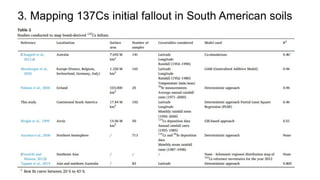
3. Mapping 137Cs initial fallout in South American soils
1- Studies carried out during
the period of nuclear
weapons tests, by AMAP,
1955-1985
2- Work carried out with the
spatial variation in the
global precipitation of
Cs137 in Iceland
3- Study with co-simulation
of indicators among 141
inventories in reference soil
locations
4- Study with Digital Soil
Mapping Approach to Predict
Proportions and Sources of
Artificial Radionuclides in
Western European Soils
3. Mapping 137Cs initial fallout in South American soils
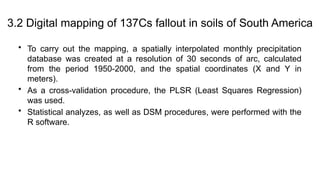
3.2 Digital mapping of 137Cs fallout in soils of South America
• To carry out the mapping, a spatially interpolated monthly precipitation
database was created at a resolution of 30 seconds of arc, calculated
from the period 1950-2000, and the spatial coordinates (X and Y in
meters).
• As a cross-validation procedure, the PLSR (Least Squares Regression)
was used.
• Statistical analyzes, as well as DSM procedures, were performed with the
R software.
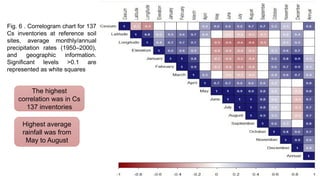
Fig. 6 . Correlogram chart for 137
Cs inventories at reference soil
sites, average monthly/annual
precipitation rates (1950–2000),
and geographic information.
Significant levels >0.1 are
represented as white squares
The highest
correlation was in Cs
137 inventories
Highest average
rainfall was from
May to August
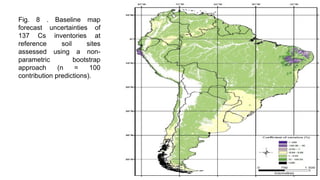
Fig. 8 . Baseline map
forecast uncertainties of
137 Cs inventories at
reference soil sites
assessed using a non-
parametric bootstrap
approach (n = 100
contribution predictions).
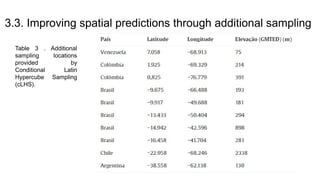
3.3. Improving spatial predictions through additional sampling
Table 3 . Additional
sampling locations
provided by
Conditional Latin
Hypercube Sampling
(cLHS).
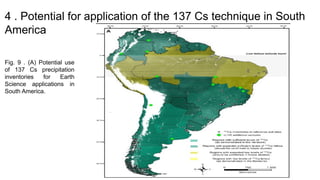
4 . Potential for application of the 137 Cs technique in South
America
Fig. 9 . (A) Potential use
of 137 Cs precipitation
inventories for Earth
Science applications in
South America.

artigo cientifico de revisãokfnerkfnrekfnerkfnerkfn

  • 1.
    Context: 3. Mapping 137Csinitial fallout in South American soils 1- Studies carried out during the period of nuclear weapons tests, by AMAP, 1955-1985 2- Work carried out with the spatial variation in the global precipitation of Cs137 in Iceland 3- Study with co-simulation of indicators among 141 inventories in reference soil locations 4- Study with Digital Soil Mapping Approach to Predict Proportions and Sources of Artificial Radionuclides in Western European Soils
  • 2.
    3. Mapping 137Csinitial fallout in South American soils
  • 3.
    3.2 Digital mappingof 137Cs fallout in soils of South America • To carry out the mapping, a spatially interpolated monthly precipitation database was created at a resolution of 30 seconds of arc, calculated from the period 1950-2000, and the spatial coordinates (X and Y in meters). • As a cross-validation procedure, the PLSR (Least Squares Regression) was used. • Statistical analyzes, as well as DSM procedures, were performed with the R software.
  • 4.
    Fig. 6 .Correlogram chart for 137 Cs inventories at reference soil sites, average monthly/annual precipitation rates (1950–2000), and geographic information. Significant levels >0.1 are represented as white squares The highest correlation was in Cs 137 inventories Highest average rainfall was from May to August
  • 5.
    Fig. 8 .Baseline map forecast uncertainties of 137 Cs inventories at reference soil sites assessed using a non- parametric bootstrap approach (n = 100 contribution predictions).
  • 6.
    3.3. Improving spatialpredictions through additional sampling Table 3 . Additional sampling locations provided by Conditional Latin Hypercube Sampling (cLHS).
  • 7.
    4 . Potentialfor application of the 137 Cs technique in South America Fig. 9 . (A) Potential use of 137 Cs precipitation inventories for Earth Science applications in South America.