Arrays in C Programming
Presented By: Prof. Pawan H. Raut
Dept. of CSE
GNIT, Nagpur
2
Arrays
 Arrays are objects that help us organize large
amounts of information
 focuses on:
• array declaration and use
• passing arrays and array elements as parameters
• One Dimensional arrays
• Two dimensional array
• multidimensional arrays
3
Arrays
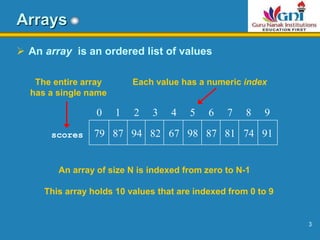
 An array is an ordered list of values
0 1 2 3 4 5 6 7 8 9
79 87 94 82 67 98 87 81 74 91
An array of size N is indexed from zero to N-1
scores
The entire array
has a single name
Each value has a numeric index
This array holds 10 values that are indexed from 0 to 9
4
Arrays
 A particular value in an array is referenced using the
array name followed by the index in brackets
 For example, the expression
scores[2]
refers to the value 94 (the 3rd value in the array)
 That expression represents a place to store a single
integer and can be used wherever an integer variable
can be used
5
Arrays
 For example, an array element can be assigned a
value, printed, or used in a calculation:
scores[2] = 89;
sum = (scores[0]+scores[1] + scores[2] +
score[3] + score[4] + score[5] + score[6]
+ score[7] + score[8] + scores[9]);
6
Arrays
 The values held in an array are called array elements
 An array stores multiple values of the same type (the
element type)
 The element type can be a primitive type or an object
reference
 Therefore, we can create an array of integers, or an
array of characters, or an array of String objects,
etc.
 In Java, the array itself is an object
 Therefore the name of the array is a object reference
variable, and the array itself must be instantiated
7
Declaring Arrays
 The scores array could be declared as follows:
int scores[10];
 The type of the variable scores is int[] (an array of
integers)
 The array variable scores can hold 10 integers
8
Declaring Arrays
 Some examples of array declarations:
int scores[10];
float bcost[5];
char name[30];
 Once an array is created, it has a fixed size
 An index used in an array reference must specify a
valid element
9
Array Initialization
 The values are delimited by braces and separated by
commas
 Examples:
int[] units = {147, 323, 89, 933, 540,
269, 97, 114, 298, 476};
char[] letterGrades = {'A', 'B', 'C', 'D', ’F'};
10
Two-Dimensional Arrays
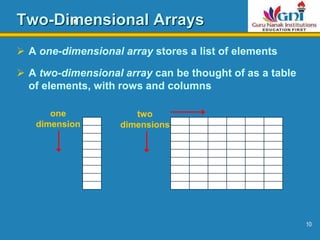
 A one-dimensional array stores a list of elements
 A two-dimensional array can be thought of as a table
of elements, with rows and columns
one
dimension
two
dimensions
11
Two-Dimensional Arrays
 A two-dimensional array is declared by specifying
the size of each dimension separately:
int s[4][4];
 The array stored in one row or column can be
specified using one index
12
Multidimensional Arrays
 An array can have many dimensions
 If it has more than one dimension, it is called a
multidimensional array
13
Summary
 focused on:
• array declaration and use
• passing arrays and array elements as parameters
• arrays of objects
• One Diamensional array
• Two Diamensional array
• multidimensional arrays
• ……………………..Thank You…………………………………

Arrays in C Programming

  • 1.
    Arrays in CProgramming Presented By: Prof. Pawan H. Raut Dept. of CSE GNIT, Nagpur
  • 2.
    2 Arrays  Arrays areobjects that help us organize large amounts of information  focuses on: • array declaration and use • passing arrays and array elements as parameters • One Dimensional arrays • Two dimensional array • multidimensional arrays
  • 3.
    3 Arrays  An arrayis an ordered list of values 0 1 2 3 4 5 6 7 8 9 79 87 94 82 67 98 87 81 74 91 An array of size N is indexed from zero to N-1 scores The entire array has a single name Each value has a numeric index This array holds 10 values that are indexed from 0 to 9
  • 4.
    4 Arrays  A particularvalue in an array is referenced using the array name followed by the index in brackets  For example, the expression scores[2] refers to the value 94 (the 3rd value in the array)  That expression represents a place to store a single integer and can be used wherever an integer variable can be used
  • 5.
    5 Arrays  For example,an array element can be assigned a value, printed, or used in a calculation: scores[2] = 89; sum = (scores[0]+scores[1] + scores[2] + score[3] + score[4] + score[5] + score[6] + score[7] + score[8] + scores[9]);
  • 6.
    6 Arrays  The valuesheld in an array are called array elements  An array stores multiple values of the same type (the element type)  The element type can be a primitive type or an object reference  Therefore, we can create an array of integers, or an array of characters, or an array of String objects, etc.  In Java, the array itself is an object  Therefore the name of the array is a object reference variable, and the array itself must be instantiated
  • 7.
    7 Declaring Arrays  Thescores array could be declared as follows: int scores[10];  The type of the variable scores is int[] (an array of integers)  The array variable scores can hold 10 integers
  • 8.
    8 Declaring Arrays  Someexamples of array declarations: int scores[10]; float bcost[5]; char name[30];  Once an array is created, it has a fixed size  An index used in an array reference must specify a valid element
  • 9.
    9 Array Initialization  Thevalues are delimited by braces and separated by commas  Examples: int[] units = {147, 323, 89, 933, 540, 269, 97, 114, 298, 476}; char[] letterGrades = {'A', 'B', 'C', 'D', ’F'};
  • 10.
    10 Two-Dimensional Arrays  Aone-dimensional array stores a list of elements  A two-dimensional array can be thought of as a table of elements, with rows and columns one dimension two dimensions
  • 11.
    11 Two-Dimensional Arrays  Atwo-dimensional array is declared by specifying the size of each dimension separately: int s[4][4];  The array stored in one row or column can be specified using one index
  • 12.
    12 Multidimensional Arrays  Anarray can have many dimensions  If it has more than one dimension, it is called a multidimensional array
  • 13.
    13 Summary  focused on: •array declaration and use • passing arrays and array elements as parameters • arrays of objects • One Diamensional array • Two Diamensional array • multidimensional arrays • ……………………..Thank You…………………………………