Tagg, John (1988)
“Evidence, Truth and Order: Photographic
Records and the Growth of the State”.
The photograph, it seemed, could be:

      Manipulated
             And as
MANIPULATIVE
  as any other form of representation.
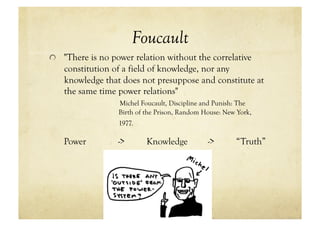
Foucault
!   "There is no power relation without the correlative
   constitution of a field of knowledge, nor any
   knowledge that does not presuppose and constitute at
   the same time power relations"
                  Michel Foucault, Discipline and Punish: The
                  Birth of the Prison, Random House: New York,
                  1977.

   Power          ->       Knowledge           ->       “Truth”
!   “Photography as such has as no
  identity. Its status as a technology varies
  with the power relations which invest it.
  Its nature as a practice depends on the
  institutions and agents which define it
  and set it to work”. (Tagg, 1988: 63)
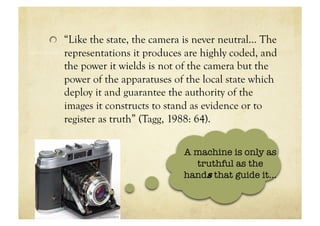
!   “Like the state, the camera is never neutral… The
   representations it produces are highly coded, and
   the power it wields is not of the camera but the
   power of the apparatuses of the local state which
   deploy it and guarantee the authority of the
   images it constructs to stand as evidence or to
   register as truth” (Tagg, 1988: 64).

                               A machine is only as
                                 truthful as the
                               hands that guide it…
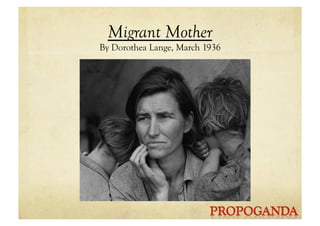
Migrant Mother
By Dorothea Lange, March 1936
Susan Sontag, On Photography
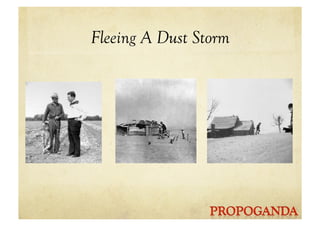
Fleeing A Dust Storm
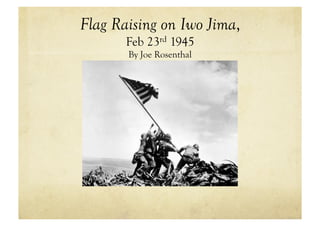
Flag Raising on Iwo Jima,
       Feb 23rd 1945
       By Joe Rosenthal
Sontag


“bureaucratic cataloguing”
       Susan Sontag, On Photography,
       Farrar, Straus and Giroux: New
       York, 1977.
“Falsify Reality”
!   Photographs do not detail history, however
   they are to be studied as historical. It is in what
   they “do and do not do, in what they
   encompass and exclude” (Tagg, 1988: 65) that
   establishes them as a subjective truth and
   delivers an artificial order of life.
Ten years ago, an article in the magazine Whole Earth
    Review predicted:


          "the end of
         photography as
           evidence of
           anything!"
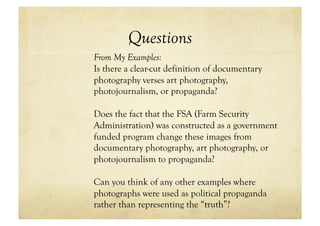
Questions
From My Examples:
Is there a clear-cut definition of documentary
photography verses art photography,
photojournalism, or propaganda?

Does the fact that the FSA (Farm Security
Administration) was constructed as a government
funded program change these images from
documentary photography, art photography, or
photojournalism to propaganda?

Can you think of any other examples where
photographs were used as political propaganda
rather than representing the “truth”?
Bibliography
Tagg, John (1988), “Evidence, Truth and Order: Photographic Records and the
Growth of the State”, in John Tagg (1993) The Burden of Representation: Essays on
Photographies and Histories, Minneapolis: University of Minnesota Press, pp. 60-65.

Batchen, Geoffrey (1977), ‘Epitaph’ in Burning With Desire: The Conception of
Photography, Cambridge, MA: MIT Press, pp. 206-216.

Sontag, Susan (1977) On Photography", Penguin, London.

Foucault, Michel (1975). Discipline and Punish: the Birth of the Prison, New York:
Random House.

ARIN6903 Wk4 Presentation

  • 1.
    Tagg, John (1988) “Evidence,Truth and Order: Photographic Records and the Growth of the State”.
  • 2.
    The photograph, itseemed, could be: Manipulated And as MANIPULATIVE as any other form of representation.
  • 3.
    Foucault !   "Thereis no power relation without the correlative constitution of a field of knowledge, nor any knowledge that does not presuppose and constitute at the same time power relations" Michel Foucault, Discipline and Punish: The Birth of the Prison, Random House: New York, 1977. Power -> Knowledge -> “Truth”
  • 4.
    !   “Photographyas such has as no identity. Its status as a technology varies with the power relations which invest it. Its nature as a practice depends on the institutions and agents which define it and set it to work”. (Tagg, 1988: 63)
  • 5.
    !   “Likethe state, the camera is never neutral… The representations it produces are highly coded, and the power it wields is not of the camera but the power of the apparatuses of the local state which deploy it and guarantee the authority of the images it constructs to stand as evidence or to register as truth” (Tagg, 1988: 64). A machine is only as truthful as the hands that guide it…
  • 7.
    Migrant Mother By DorotheaLange, March 1936
  • 8.
    Susan Sontag, OnPhotography
  • 9.
  • 10.
    Flag Raising onIwo Jima, Feb 23rd 1945 By Joe Rosenthal
  • 11.
    Sontag “bureaucratic cataloguing” Susan Sontag, On Photography, Farrar, Straus and Giroux: New York, 1977.
  • 12.
    “Falsify Reality” !  Photographs do not detail history, however they are to be studied as historical. It is in what they “do and do not do, in what they encompass and exclude” (Tagg, 1988: 65) that establishes them as a subjective truth and delivers an artificial order of life.
  • 13.
    Ten years ago,an article in the magazine Whole Earth Review predicted: "the end of photography as evidence of anything!"
  • 14.
    Questions From My Examples: Isthere a clear-cut definition of documentary photography verses art photography, photojournalism, or propaganda? Does the fact that the FSA (Farm Security Administration) was constructed as a government funded program change these images from documentary photography, art photography, or photojournalism to propaganda? Can you think of any other examples where photographs were used as political propaganda rather than representing the “truth”?
  • 15.
    Bibliography Tagg, John (1988),“Evidence, Truth and Order: Photographic Records and the Growth of the State”, in John Tagg (1993) The Burden of Representation: Essays on Photographies and Histories, Minneapolis: University of Minnesota Press, pp. 60-65. Batchen, Geoffrey (1977), ‘Epitaph’ in Burning With Desire: The Conception of Photography, Cambridge, MA: MIT Press, pp. 206-216. Sontag, Susan (1977) On Photography", Penguin, London. Foucault, Michel (1975). Discipline and Punish: the Birth of the Prison, New York: Random House.