All characters referenced in this
presentation are fictitious. Any
resemblance to the real persons,
living, or dead, predestined, or
reprobate, is purely coincidental.
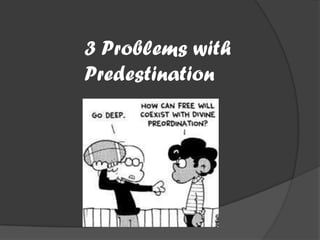
3 Problems with
Predestination
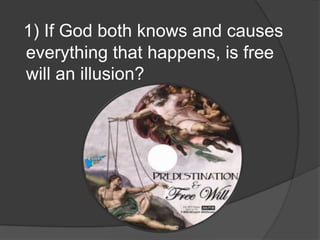
1) If God both knows and causes
everything that happens, is free
will an illusion?
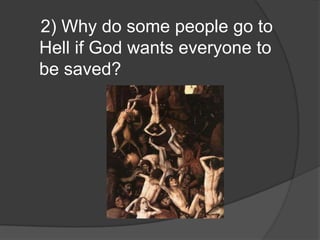
2) Why do some people go to
Hell if God wants everyone to
be saved?
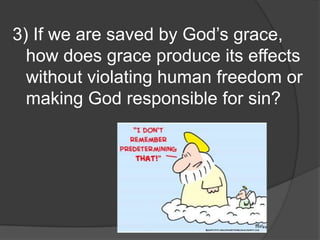
3) If we are saved by God’s grace,
how does grace produce its effects
without violating human freedom or
making God responsible for sin?
The Catholic Church’s Dogmatic
Teaching on Grace + Free Will
 God has eternally predestined some men to
heaven.
 God has eternally reprobated some men to
hell on account of their sins.
 Man needs actual grace to begin, perform,
and complete meritorious actions, especially
unto final perseverance.
 God gives sufficient grace for all to be saved.
 Efficacious grace is not irresistible. Grace
does not destroy freedom.
What is Divine Providence?
 Divine Providence = God’s government
of all created things toward their ultimate
perfection.
 Eternal
 Universal
 Infallible
 Immutable
What is Predestination?
 Predestination = a mode of Divine
Providence whereby a man is
infallibly guided by God towards his
supernatural end in heaven through
both God’s grace and man’s free will.
 “For those he foreknew he also
predestined to be conformed to the
image of his Son.”
– Romans 8:29

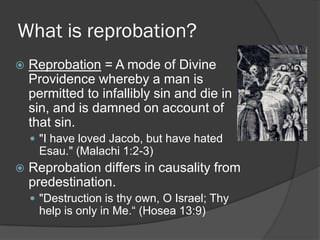
What is reprobation?
 Reprobation = A mode of Divine
Providence whereby a man is
permitted to infallibly sin and die in
sin, and is damned on account of
that sin.
 "I have loved Jacob, but have hated
Esau." (Malachi 1:2-3)
 Reprobation differs in causality from
predestination.
 "Destruction is thy own, O Israel; Thy
help is only in Me.“ (Hosea 13:9)
What is Free Will?
 Free will is man's power to act or not to
act, without compulsion from within or
coercion from without.
 “God left [man] in the hand of his own
counsel.” – Sirach 15:14
BUT, how can God’s grace
infallibly produce consent in
man’s will without violating
his freedom?
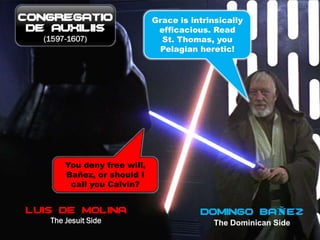
Luis de MOLINA
The Jesuit Side
Domingo BAÑEZ
The Dominican Side
Grace is intrinsically
efficacious. Read
St. Thomas, you
Pelagian heretic!
You deny free will,
Bañez, or should I
call you Calvin?
Congregatio
de Auxiliis
(1597-1607)
How does God infallibly foreknow our
free acts?
 1) By physically premoving our free acts.
(Thomism)
 2) By foreseeing what a man would freely
choose under various circumstances/graces.
(Molinism)
 3) By foreseeing whether a man will resist or
not resist divine motions. (Mostism)
Thomism
 God is the first cause of all creatures, sustaining and
operating within each creature according to its nature.
 God moves man’s free will from potency to act. Man
moves himself as a secondary cause.
(physical premotion, ie. secondary freedom)
 “For God is the one who, for his good purpose, works in you both
to desire and to work.” (Phil 2:13)
 Man is free because he is rational.
 Man’s will is not free relative to God, but relative to the
inability of any finite good to compel the will to choose it.
 Nothing would be better than anything else if it were not
loved more by God.
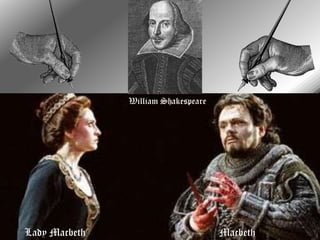
Lady Macbeth Macbeth
William Shakespeare
Thomism (cont.)
 Two types of Graces:
 Sufficient graces confer merely the power to
perform a good act.
 Efficacious graces confer both the power and the
application of that power for a good act.
 God predestines before prevision of merits.
 God negatively reprobates before prevision of
demerits by permitting man's resistance, and
positively reprobates to hell after prevision of
demerits.
Thomism (cont.)
 Man’s non-consideration of the rule of
reason, not God, is the cause of sin.
 Human beings do not deserve to be
preserved from rational defect. It is God’s
free gift to give or take away.
 Evil and defect are permitted for the sake
of a greater good.
Thomism (cont.)
 In God’s antecedent will, abstracted from concrete
circumstances, God wills all men to be saved.
 In God’s consequent will, taking into account the
concrete circumstances, God wills that some men
be punished for their permitted sins and others be
rewarded for their predestined good works.
 God abandons some men in order to manifest his
justice, and saves others in order to manifest his
mercy, as a potter makes some vessels for glory
and others for destruction. (Romans 9)
 Predestination is a MYSTERY.
Molinism
Starting Points:
 Libertarian freedom= Nothing and
no-one except the free agent
determines whether or not the free
agent acts.
 Divine Sovereignty = God has
complete control over what comes
to pass, precisely because he has
willed the current state of affairs.
Molinism (cont.)
Logical Priority in God’s Knowledge
 1) God knows all necessary truths and creative
possibilities. (Natural Knowledge)
○ 1+1=2 ; purple cows could exist
 2) God knows what any free creature would choose in
the context of any circumstances. (Middle Knowledge)
○ If Al Gore were given a bribe, he would freely accept it.
-------------CREATIVE ACT OF THE WILL----------------
 3) God infallibly knows what he freely decides to
create in light of possibilities known to him by his
natural and middle knowledge. (Free Knowledge)
○ God knew that you would be freely be listening to this
presentation from eternity because he willed it.
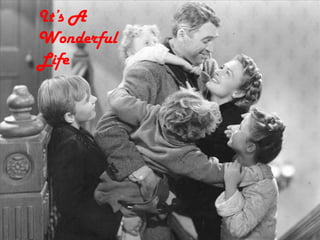
It’s A
Wonderful
Life
Molinism (cont.)
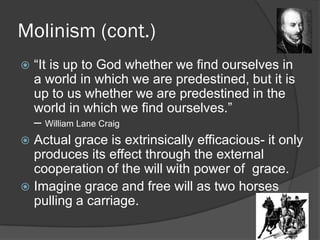
 “It is up to God whether we find ourselves in
a world in which we are predestined, but it is
up to us whether we are predestined in the
world in which we find ourselves.”
– William Lane Craig
 Actual grace is extrinsically efficacious- it only
produces its effect through the external
cooperation of the will with power of grace.
 Imagine grace and free will as two horses
pulling a carriage.
Molinism - Predestination
 Strict Molinism
 God predestines after the prevision of merits---because he
foresees that this individual will respond to his graces.
 Congruism
 God predestines and negatively reprobates before
prevision of merits. God can tailor graces to save any
person by making the graces congruent with a persons
circumstances, habits, etc.
 A grace is given because God foresees his elect will use it.
 Craigism
 The circumstances necessary for obtaining the
predestination of many include the damnation of some who
suffer transworld damnation.
Mostism
 Man can distinguish himself for heaven or hell
by negative motions.
 1) God sends a shatterable motion which
inclines man toward good. The default is good.
 2) Man can resist or not resist this motion.
 3) God sends an unshatterable motion on the
condition of non-resistance to produce the
good act in man.
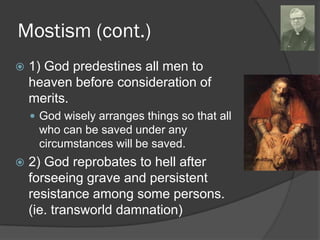
Mostism (cont.)
 1) God predestines all men to
heaven before consideration of
merits.
 God wisely arranges things so that all
who can be saved under any
circumstances will be saved.
 2) God reprobates to hell after
forseeing grave and persistent
resistance among some persons.
(ie. transworld damnation)
Difficulties with each System
 Most’s account fails because in a real being
undergoing a real motion
Not resisting = not negating = consenting
 Molinism fails to metaphysically explain how the will
can move itself from potency to act without a prior
activating Divine motion.
 Thomism some difficulties, too.
 Do lovers do not abandon their beloved for higher goods.
Does God really love the reprobate for their own sake?
 Why would God create a bike without pedals, and then
punish people for falling when they ride it?
 What is the basis for hope in God when he can withdraw
his sustaining grace at any point, even without our fault.
My Position
 Thomism is metaphysically defensible, yet
seems implausible given God’s revealed will
to save all men.
 Molinism seems to introduce an uncaused
effect, which is bad metaphysics.
 Mostism seems to confuse logical and a
metaphysical double negative.
 Perhaps a solution will be discovered in the
future.
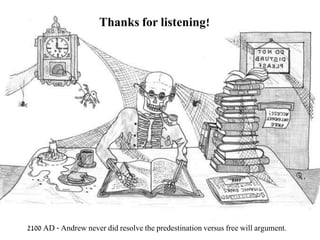
2100 AD - Andrew never did resolve the predestination versus free will argument.
Thanks for listening!

Are you predestined

  • 3.
    All characters referencedin this presentation are fictitious. Any resemblance to the real persons, living, or dead, predestined, or reprobate, is purely coincidental.
  • 4.
  • 5.
    1) If Godboth knows and causes everything that happens, is free will an illusion?
  • 6.
    2) Why dosome people go to Hell if God wants everyone to be saved?
  • 7.
    3) If weare saved by God’s grace, how does grace produce its effects without violating human freedom or making God responsible for sin?
  • 9.
    The Catholic Church’sDogmatic Teaching on Grace + Free Will  God has eternally predestined some men to heaven.  God has eternally reprobated some men to hell on account of their sins.  Man needs actual grace to begin, perform, and complete meritorious actions, especially unto final perseverance.  God gives sufficient grace for all to be saved.  Efficacious grace is not irresistible. Grace does not destroy freedom.
  • 10.
    What is DivineProvidence?  Divine Providence = God’s government of all created things toward their ultimate perfection.  Eternal  Universal  Infallible  Immutable
  • 11.
    What is Predestination? Predestination = a mode of Divine Providence whereby a man is infallibly guided by God towards his supernatural end in heaven through both God’s grace and man’s free will.  “For those he foreknew he also predestined to be conformed to the image of his Son.” – Romans 8:29 
  • 12.
    What is reprobation? Reprobation = A mode of Divine Providence whereby a man is permitted to infallibly sin and die in sin, and is damned on account of that sin.  "I have loved Jacob, but have hated Esau." (Malachi 1:2-3)  Reprobation differs in causality from predestination.  "Destruction is thy own, O Israel; Thy help is only in Me.“ (Hosea 13:9)
  • 13.
    What is FreeWill?  Free will is man's power to act or not to act, without compulsion from within or coercion from without.  “God left [man] in the hand of his own counsel.” – Sirach 15:14
  • 14.
    BUT, how canGod’s grace infallibly produce consent in man’s will without violating his freedom?
  • 16.
    Luis de MOLINA TheJesuit Side Domingo BAÑEZ The Dominican Side Grace is intrinsically efficacious. Read St. Thomas, you Pelagian heretic! You deny free will, Bañez, or should I call you Calvin? Congregatio de Auxiliis (1597-1607)
  • 17.
    How does Godinfallibly foreknow our free acts?  1) By physically premoving our free acts. (Thomism)  2) By foreseeing what a man would freely choose under various circumstances/graces. (Molinism)  3) By foreseeing whether a man will resist or not resist divine motions. (Mostism)
  • 18.
    Thomism  God isthe first cause of all creatures, sustaining and operating within each creature according to its nature.  God moves man’s free will from potency to act. Man moves himself as a secondary cause. (physical premotion, ie. secondary freedom)  “For God is the one who, for his good purpose, works in you both to desire and to work.” (Phil 2:13)  Man is free because he is rational.  Man’s will is not free relative to God, but relative to the inability of any finite good to compel the will to choose it.  Nothing would be better than anything else if it were not loved more by God.
  • 19.
  • 20.
    Thomism (cont.)  Twotypes of Graces:  Sufficient graces confer merely the power to perform a good act.  Efficacious graces confer both the power and the application of that power for a good act.  God predestines before prevision of merits.  God negatively reprobates before prevision of demerits by permitting man's resistance, and positively reprobates to hell after prevision of demerits.
  • 21.
    Thomism (cont.)  Man’snon-consideration of the rule of reason, not God, is the cause of sin.  Human beings do not deserve to be preserved from rational defect. It is God’s free gift to give or take away.  Evil and defect are permitted for the sake of a greater good.
  • 22.
    Thomism (cont.)  InGod’s antecedent will, abstracted from concrete circumstances, God wills all men to be saved.  In God’s consequent will, taking into account the concrete circumstances, God wills that some men be punished for their permitted sins and others be rewarded for their predestined good works.  God abandons some men in order to manifest his justice, and saves others in order to manifest his mercy, as a potter makes some vessels for glory and others for destruction. (Romans 9)  Predestination is a MYSTERY.
  • 23.
    Molinism Starting Points:  Libertarianfreedom= Nothing and no-one except the free agent determines whether or not the free agent acts.  Divine Sovereignty = God has complete control over what comes to pass, precisely because he has willed the current state of affairs.
  • 24.
    Molinism (cont.) Logical Priorityin God’s Knowledge  1) God knows all necessary truths and creative possibilities. (Natural Knowledge) ○ 1+1=2 ; purple cows could exist  2) God knows what any free creature would choose in the context of any circumstances. (Middle Knowledge) ○ If Al Gore were given a bribe, he would freely accept it. -------------CREATIVE ACT OF THE WILL----------------  3) God infallibly knows what he freely decides to create in light of possibilities known to him by his natural and middle knowledge. (Free Knowledge) ○ God knew that you would be freely be listening to this presentation from eternity because he willed it.
  • 25.
  • 26.
    Molinism (cont.)  “Itis up to God whether we find ourselves in a world in which we are predestined, but it is up to us whether we are predestined in the world in which we find ourselves.” – William Lane Craig  Actual grace is extrinsically efficacious- it only produces its effect through the external cooperation of the will with power of grace.  Imagine grace and free will as two horses pulling a carriage.
  • 27.
    Molinism - Predestination Strict Molinism  God predestines after the prevision of merits---because he foresees that this individual will respond to his graces.  Congruism  God predestines and negatively reprobates before prevision of merits. God can tailor graces to save any person by making the graces congruent with a persons circumstances, habits, etc.  A grace is given because God foresees his elect will use it.  Craigism  The circumstances necessary for obtaining the predestination of many include the damnation of some who suffer transworld damnation.
  • 28.
    Mostism  Man candistinguish himself for heaven or hell by negative motions.  1) God sends a shatterable motion which inclines man toward good. The default is good.  2) Man can resist or not resist this motion.  3) God sends an unshatterable motion on the condition of non-resistance to produce the good act in man.
  • 29.
    Mostism (cont.)  1)God predestines all men to heaven before consideration of merits.  God wisely arranges things so that all who can be saved under any circumstances will be saved.  2) God reprobates to hell after forseeing grave and persistent resistance among some persons. (ie. transworld damnation)
  • 30.
    Difficulties with eachSystem  Most’s account fails because in a real being undergoing a real motion Not resisting = not negating = consenting  Molinism fails to metaphysically explain how the will can move itself from potency to act without a prior activating Divine motion.  Thomism some difficulties, too.  Do lovers do not abandon their beloved for higher goods. Does God really love the reprobate for their own sake?  Why would God create a bike without pedals, and then punish people for falling when they ride it?  What is the basis for hope in God when he can withdraw his sustaining grace at any point, even without our fault.
  • 31.
    My Position  Thomismis metaphysically defensible, yet seems implausible given God’s revealed will to save all men.  Molinism seems to introduce an uncaused effect, which is bad metaphysics.  Mostism seems to confuse logical and a metaphysical double negative.  Perhaps a solution will be discovered in the future.
  • 32.
    2100 AD -Andrew never did resolve the predestination versus free will argument. Thanks for listening!

Editor's Notes

  • #4 -My canon lawyer made me put this in.
  • #7 WHY IS JULIAN DAMNED BUT NICK PREDESTINED?????
  • #11 “By his providence God protects and governs all things which he has made, "reaching mightily from one end of the earth to the other, and ordering all things well". For "all are open and laid bare to his eyes", even those things which are yet to come into existence through the free action of creatures.” - CCC 302.ARROW ANALOGY
  • #12 “God created us without us: but he did not will to save us without us.” – St. Augustine We are free arrows.2 parts to Predestination: 1) The giving of a series of graces to make final perseverance possible.2) The foreknowledge of man’s free consent to the graces.
  • #17 On this very question, in the 16th century, a heated controversy erupted between the Jesuits and the Dominicans, with the Jesuits calling the Dominicans Calvinists and the Dominicans calling the Jesuits Semi-Pelagians. Things got so out of hand in 1594 that the Pope banned all further discussion of efficacious grace under penalty of excommunication, and he summoned the best representatives from both orders to Rome to debate the issue in a commission that became known as the Congregatio De Auxiliis. Both sides argued fiercely for ten years, from 1597 to 1607, until finally the weary Pope Paul V decided to permit both sides, forbidding further charges of heresy, and temporarily banning further publications on the subject. LUCKILY FOR US, THIS BAN IS NO LONGER IN PLACE.
  • #18 Whence comes the infallibility of Divine Providence with respect to human acts?
  • #19 What hast thou that thou hast not received?” (I Cor. 4:7) – Humility“For God is the one who, for his good purpose, works in you both to desire and to work.” (Phil 2:13)THE TERMS USED TO DESCRIBE THE ARTWORK DO NOT APPLY TO THE ARTIST.Aquinas argues that man’s decisions are not random or spontaneous, but rather the will moves as “an inclination following the form of reason.” The will, of necessity hungers for the good in general as its object, but it depends on the intellect to tell it what is good in particular. Playing football, for instance, can be thought of as good exercise or as a bad health risk. Listening to a lecture can be boring if one compares it with watching movies or it can be fascinating if the topic is about free will. Grace too, taken only as a finite object proposed to the intellect (and not as Divine motion), may be resisted by man’s free will if it is thought of as a lesser good or evil, or accepted if it thought of as good. The root of freedom is the intellect’s power of deliberation, by which the intellect presents a finite object to the will as good or bad, for the will to choose or reject accordingly. Long, What about freedom being the ability to do otherwise?According to the Thomists, even when God moves the human will to freely choose something, the will retains the real ability to do otherwise.The will simply cannot perform two things at once. But the fact that one cannot, for example, stand and sit simultaneously does not mean one does not have the real ability to stand or to sit when one is in the act of standing or sitting.
  • #20 Analogy: On a horizontal level, man is free because he is not determined by any finite good. On a vertical level, man is not likewise undetermined because God is the transcendental first cause of the actions to be free horizontally speaking. Shakespeare perhaps had something like this in mind when he wrote: “All the world's a stage, / And all the men and women merely players.” We can compare God to a playwright who knows what his creatures will choose to do because has written the script of the universe through the motions imparted to creatures. When Macbeth murders Duncan, for instance, he does so not because anything within the elements of the play itself forced him to murder Duncan. Vertically speaking, however, Macbeth cannot do other than murder Duncanbecause Shakespeare has written Duncan’s murder as part of the play, in light of the permitted moral defect in Macbeth, all in order to manifest a greater moral purpose by the end of the play.
  • #21 God does not command the impossibleDistinction between “could” and “is.” Sufficient graces could be efficacious, if it were not for the defect in the creature.
  • #22 Could God have made Adolf Hitler holier than Mother Teresa with intrinsically efficacious graces (and thus saved six million Jews in the process)? Yes, say the Thomists, but he permitted all of Hitler’s horrible sins so that a greater good may be accomplished in “the big picture” such as the justice of Hitler being damned (assumed only for the benefit of an example), through the consequent holiness of the elect like St. Maximillian Kolbe, and countless others reasons embedded in the contingency of the created order. St. Thomas argues that evil is permitted for the common good of the universe, for the purification of the elect, for the manifestation of the brilliance of good in contrast with evil, and finally the glorification of divine wisdom which is so wise as to put evil at the service of good. No matter what we do for good or evil, therefore, is part of God’s perfect plan. Of course, this does not mean that God wants people to sin in order to accomplish his plan, but rather that he wants to permit sin so that he can bring a greater good out of it.
  • #23 Is there injustice on the part of God? Of course not! For he says to Moses: “I will show mercy to whom I will, I will take pity on whom I will.”…Will what is made say to its maker, “Why have you created me so?” – Romans 9:13-15 GOD DISTINGUISHES ONE MAN FROM ANOTHER
  • #24 Thomism admits God has libertarian freedom. Molinism claims that free creatures have it too.
  • #25 Here’s another one: If I were in circumstances where I was presenting a senior thesis with my Dad in the audience, I would not tell you that his feet smell.God has no control over natural + middle knowledge, but he does have control over his free knowledge.The key point for the entire Molinist system is that God’s knowledge of how creatures would freely act if given certain graces or placed under certain circumstances precedes the decrees of His will, thus allowing the infallible accomplishing of God’s plan without violating creaturelylibertarianfreedom.
  • #26 One outstanding example of Molinist philosophy at work can be seen in the American classic film, It’s A Wonderful Life. George Bailey, on the brink of suicide after losing all the money in his lending firm, wishes that he had never been born. To prove to him the value of his life, George’s guardian angel, Clarence, grants him a vision of how badly things would have played out for everyone if George had, in fact, never existed. Without George to be there, Bedford Falls’ industry falls into the hands of the cruel businessman Potter. George’s brother Harry drowns in his childhood, along with two Navy ships full of men Harry was no longer there to save years later on in World War II. George’s wife Mary works as an old maid at the library, and his partner, Uncle Billy, lives in an insane asylum. The list goes on of what would have happened, and what people would have freely done without George in the picture. The implication of the film is that different free actions under different circumstances are indeed real possibilities, yet unrealized and consequently unknown to us. Presumably however, such counterfactuals involving our free actions are known to God.
  • #27 God is not surprised by our free acts because he forknows them by middle knowledge. If we were to do otherwise in that circumstance, God would have eternally known it differently.
  • #28 Therefore it is God’s will which distinguishes one man from another.(Congruous vs Incongruous Graces)
  • #29 “Without me you can do nothing.”
  • #30 FATHER ANALOGYPuts those with most transworld need in more opportunities for grace.