Architecting
Disruption
Rethink business, technology and data
to build a platform for the future of
your business
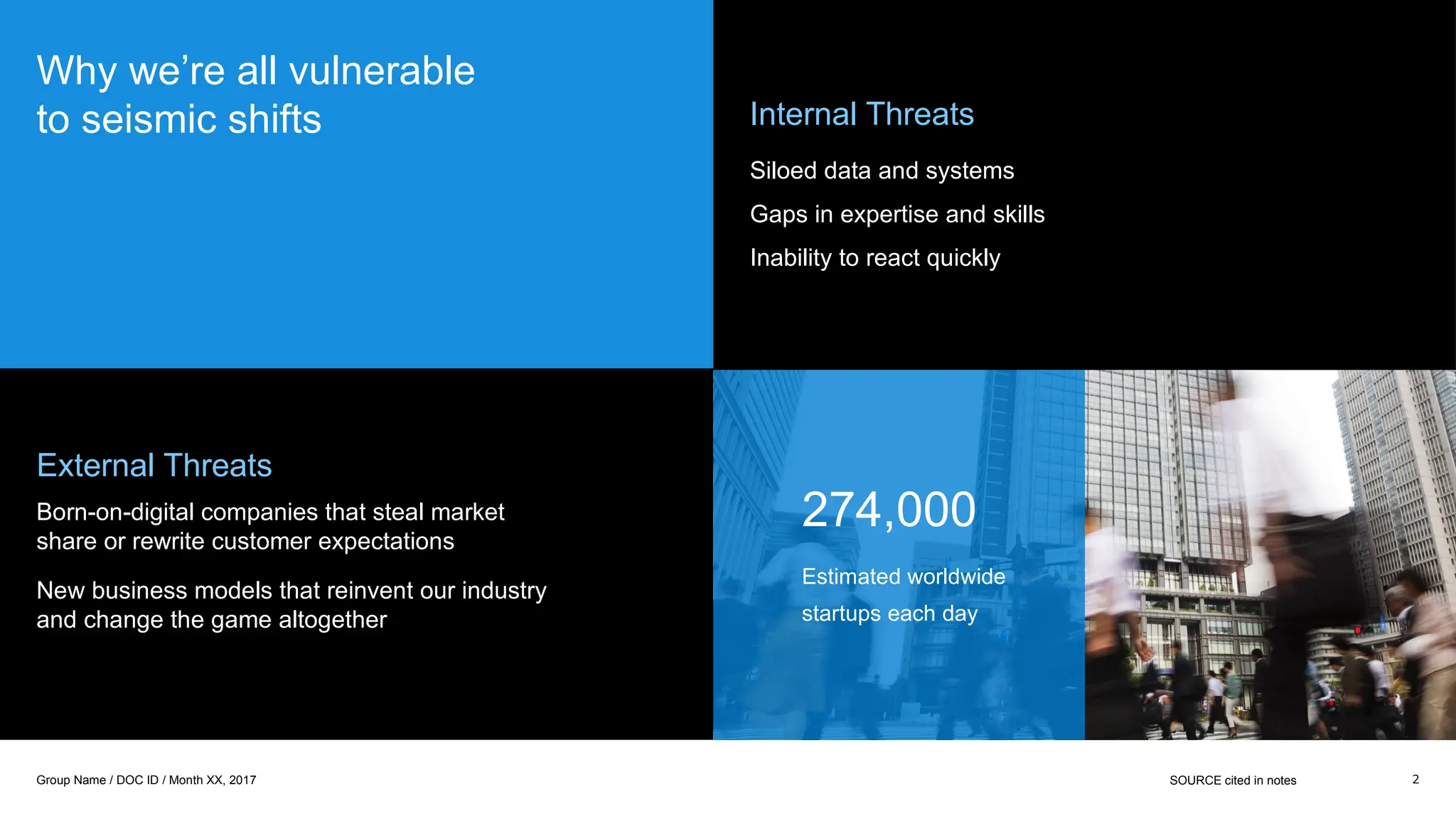
Estimated worldwide
startups each day
274,000
Why we’re all vulnerable
to seismic shifts
External Threats
Born-on-digital companies that steal market
share or rewrite customer expectations
New business models that reinvent our industry
and change the game altogether
Internal Threats
Siloed data and systems
Gaps in expertise and skills
Inability to react quickly
2
Group Name / DOC ID / Month XX, 2017 SOURCE cited in notes
You’re thinking about
disruption all wrong…
Be an opportunist – not a
victim.
3
Group Name / DOC ID / Month XX, 2017
Innovators are using
cloud and cognitive
technologies to transform
essential experiences.
4
Group Name / DOC ID / Month XX, 2017
Reinventing
industries
one app at
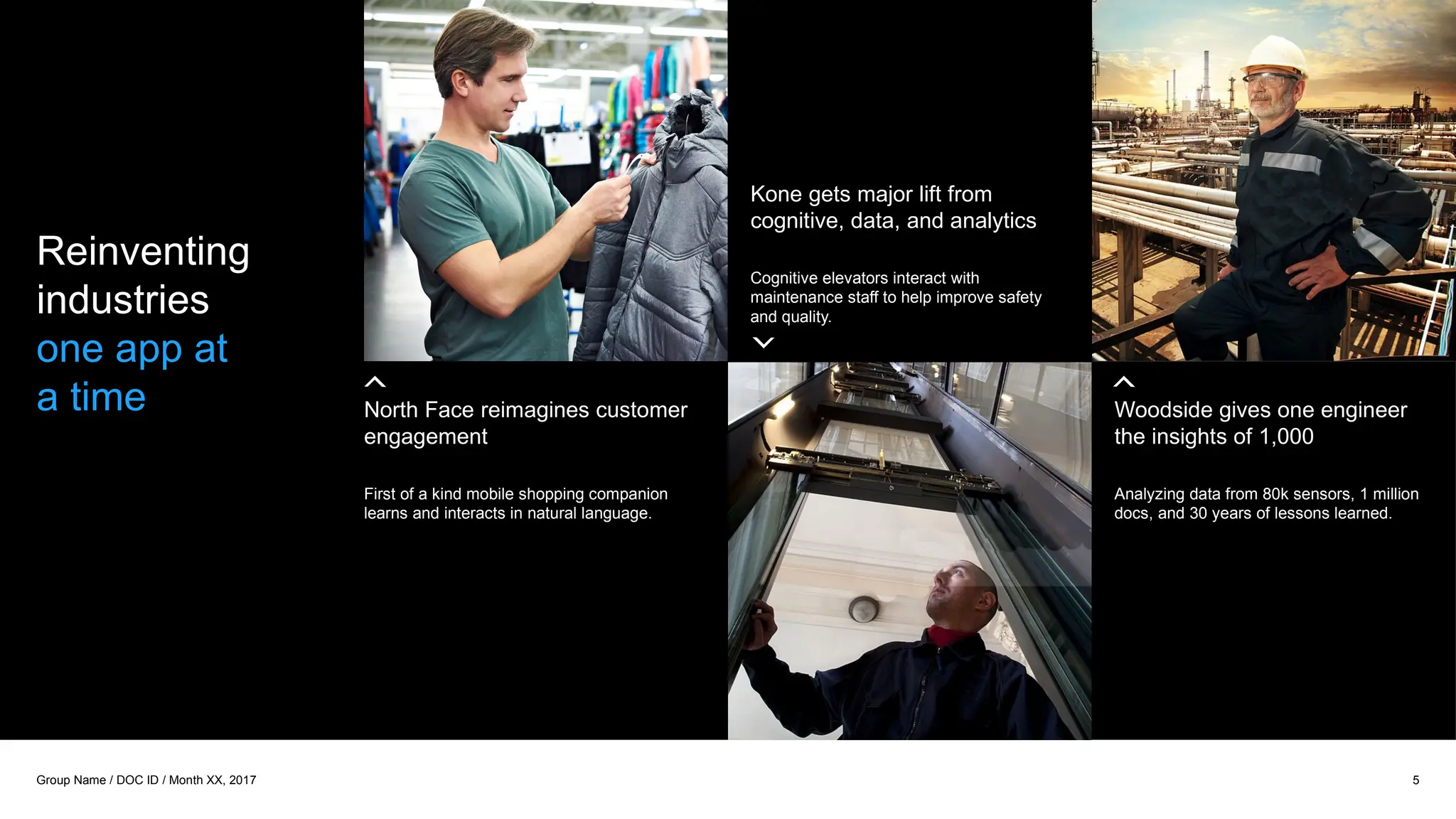
a time North Face reimagines customer
engagement
First of a kind mobile shopping companion
learns and interacts in natural language.
Kone gets major lift from
cognitive, data, and analytics
Cognitive elevators interact with
maintenance staff to help improve safety
and quality.
Woodside gives one engineer
the insights of 1,000
Analyzing data from 80k sensors, 1 million
docs, and 30 years of lessons learned.
5
Group Name / DOC ID / Month XX, 2017
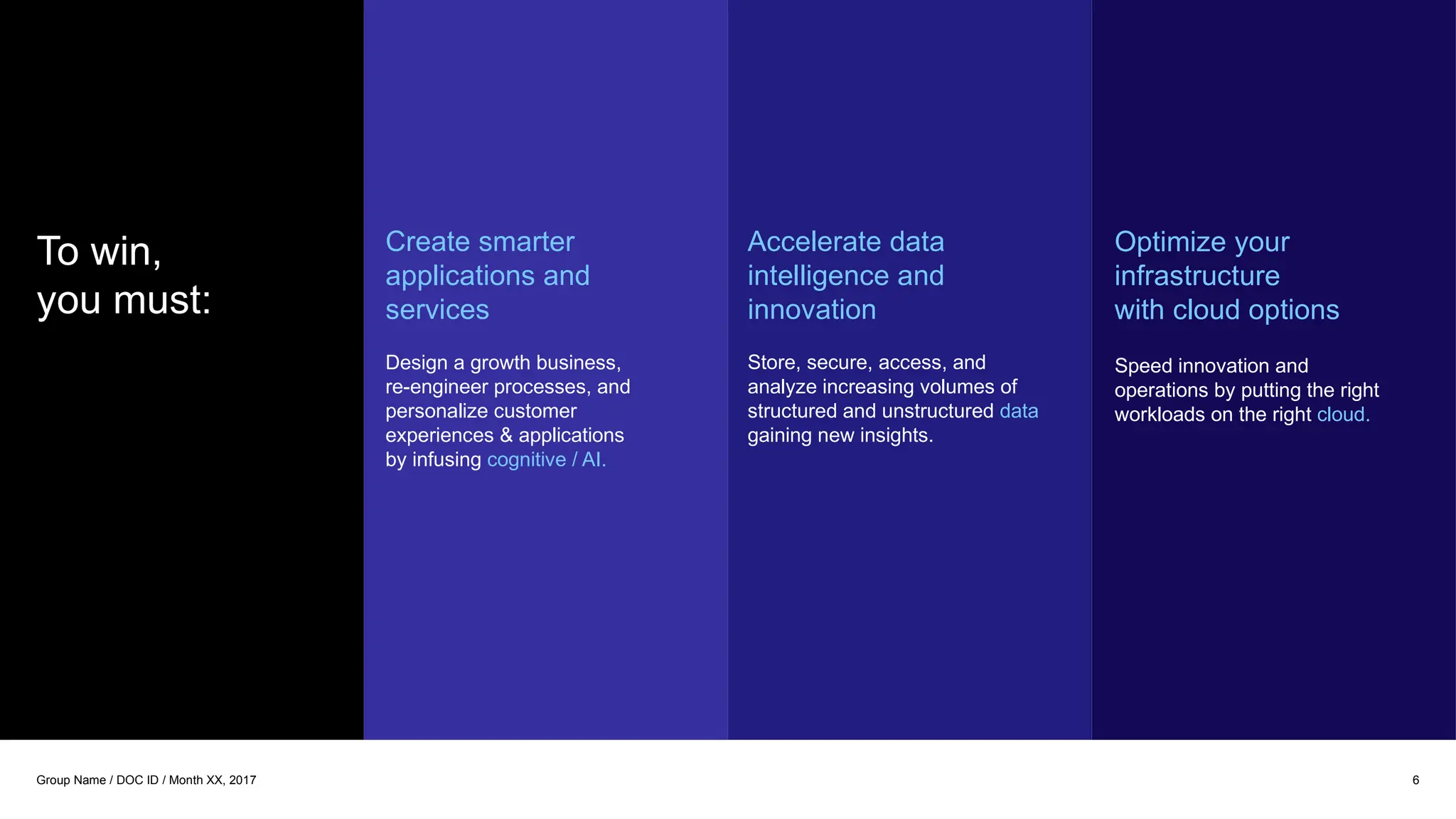
To win,
you must:
Optimize your
infrastructure
with cloud options
Speed innovation and
operations by putting the right
workloads on the right cloud.
Design a growth business,
re-engineer processes, and
personalize customer
experiences & applications
by infusing cognitive / AI.
Create smarter
applications and
services
Store, secure, access, and
analyze increasing volumes of
structured and unstructured data
gaining new insights.
Accelerate data
intelligence and
innovation
6
Group Name / DOC ID / Month XX, 2017
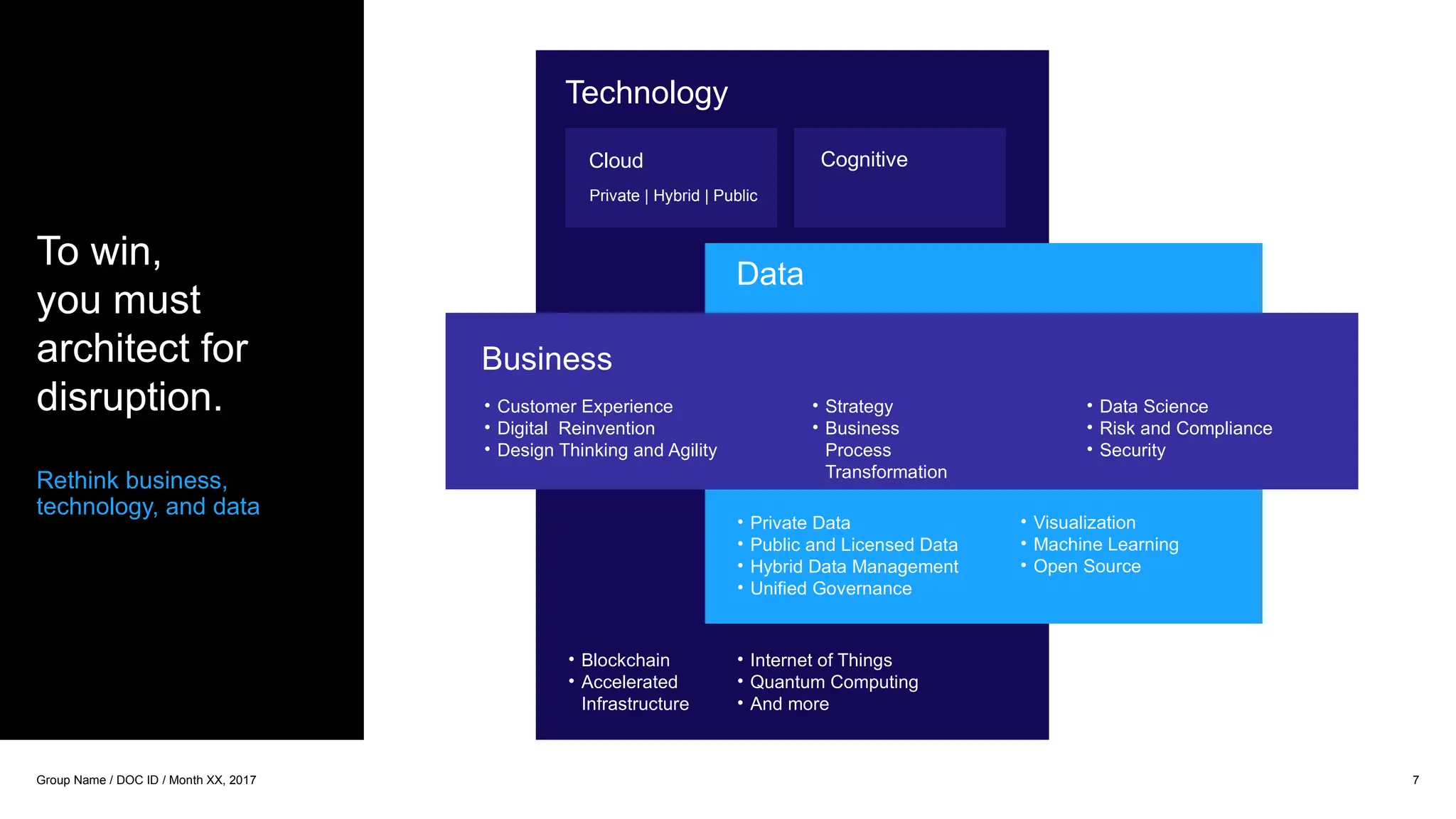
• Blockchain
• Accelerated
Infrastructure
• Private Data
• Public and Licensed Data
• Hybrid Data Management
• Unified Governance
• Visualization
• Machine Learning
• Open Source
• Internet of Things
• Quantum Computing
• And more
Technology
Data
• Strategy
• Business
Process
Transformation
• Customer Experience
• Digital Reinvention
• Design Thinking and Agility
• Data Science
• Risk and Compliance
• Security
Business
Cloud
Private | Hybrid | Public
To win,
you must
architect for
disruption.
7
Group Name / DOC ID / Month XX, 2017
Rethink business,
technology, and data
Cognitive
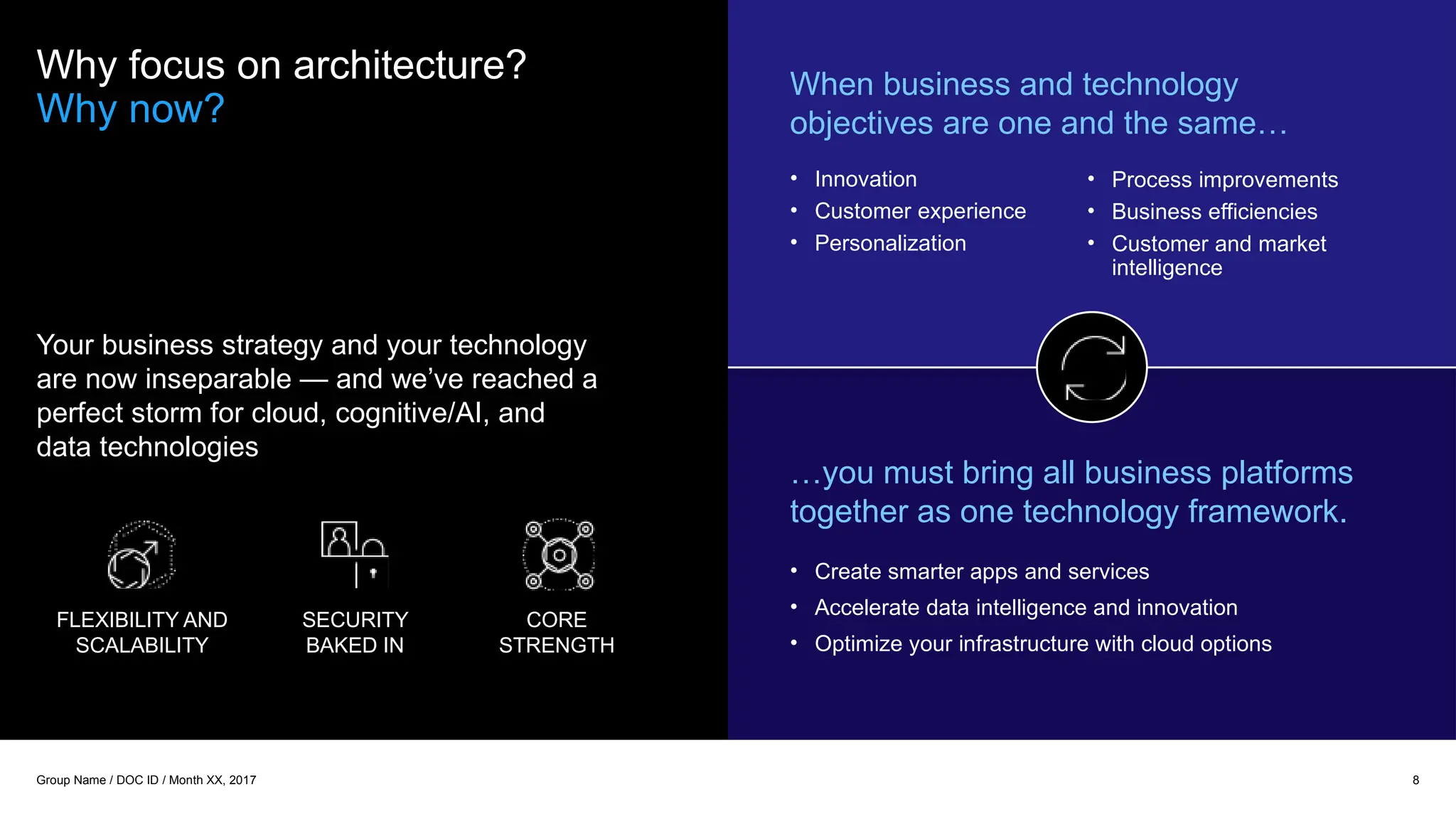
When business and technology
objectives are one and the same…
FLEXIBILITY AND
SCALABILITY
SECURITY
BAKED IN
CORE
STRENGTH
Why focus on architecture?
Why now?
…you must bring all business platforms
together as one technology framework.
• Innovation
• Customer experience
• Personalization
• Create smarter apps and services
• Accelerate data intelligence and innovation
• Optimize your infrastructure with cloud options
Your business strategy and your technology
are now inseparable — and we’ve reached a
perfect storm for cloud, cognitive/AI, and
data technologies
• Process improvements
• Business efficiencies
• Customer and market
intelligence
8
Group Name / DOC ID / Month XX, 2017
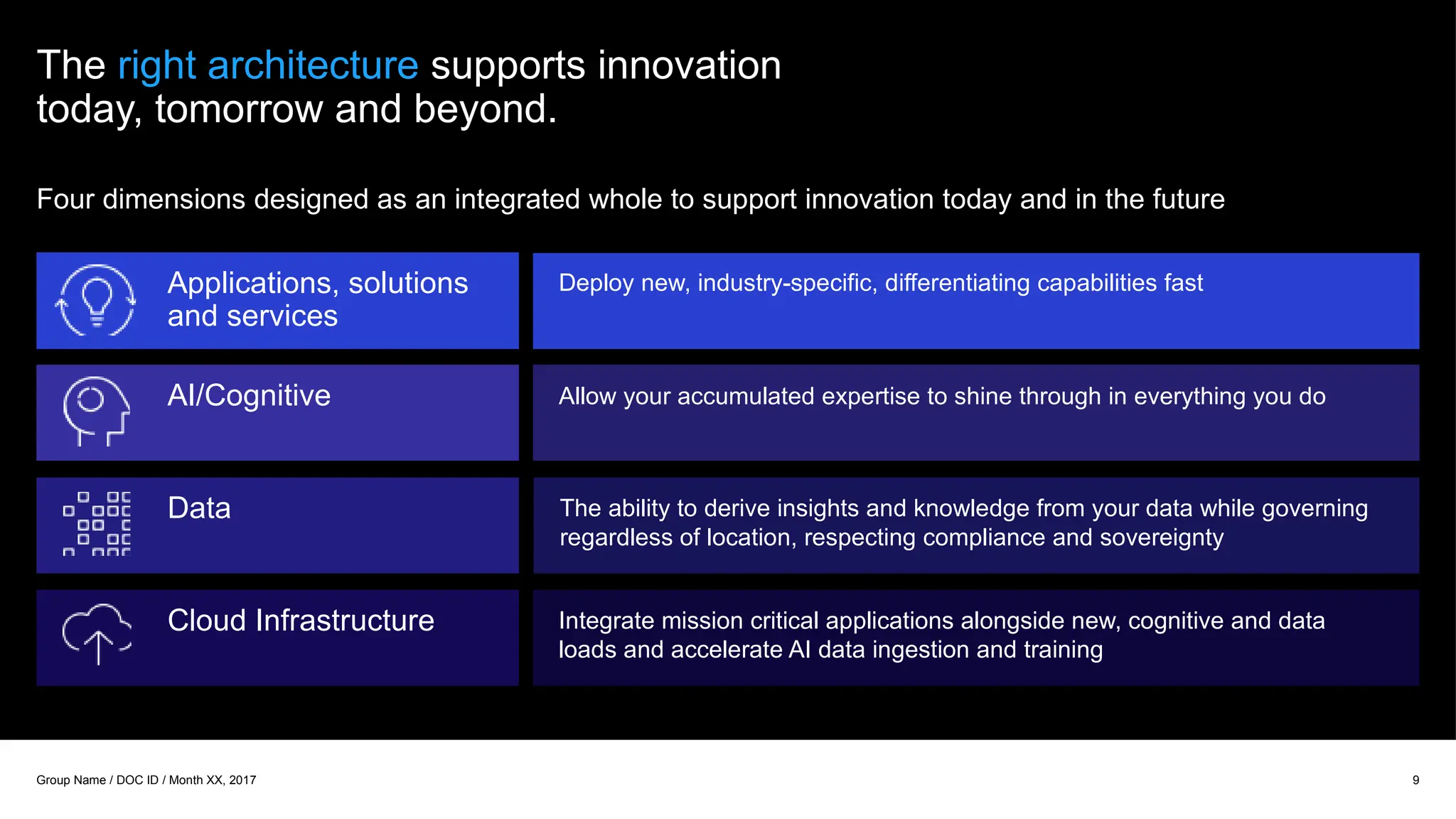
The right architecture supports innovation
today, tomorrow and beyond.
Four dimensions designed as an integrated whole to support innovation today and in the future
Deploy new, industry-specific, differentiating capabilities fast
Allow your accumulated expertise to shine through in everything you do
The ability to derive insights and knowledge from your data while governing
regardless of location, respecting compliance and sovereignty
Integrate mission critical applications alongside new, cognitive and data
loads and accelerate AI data ingestion and training
9
Group Name / DOC ID / Month XX, 2017
Cloud Infrastructure
Data
AI/Cognitive
Applications, solutions
and services
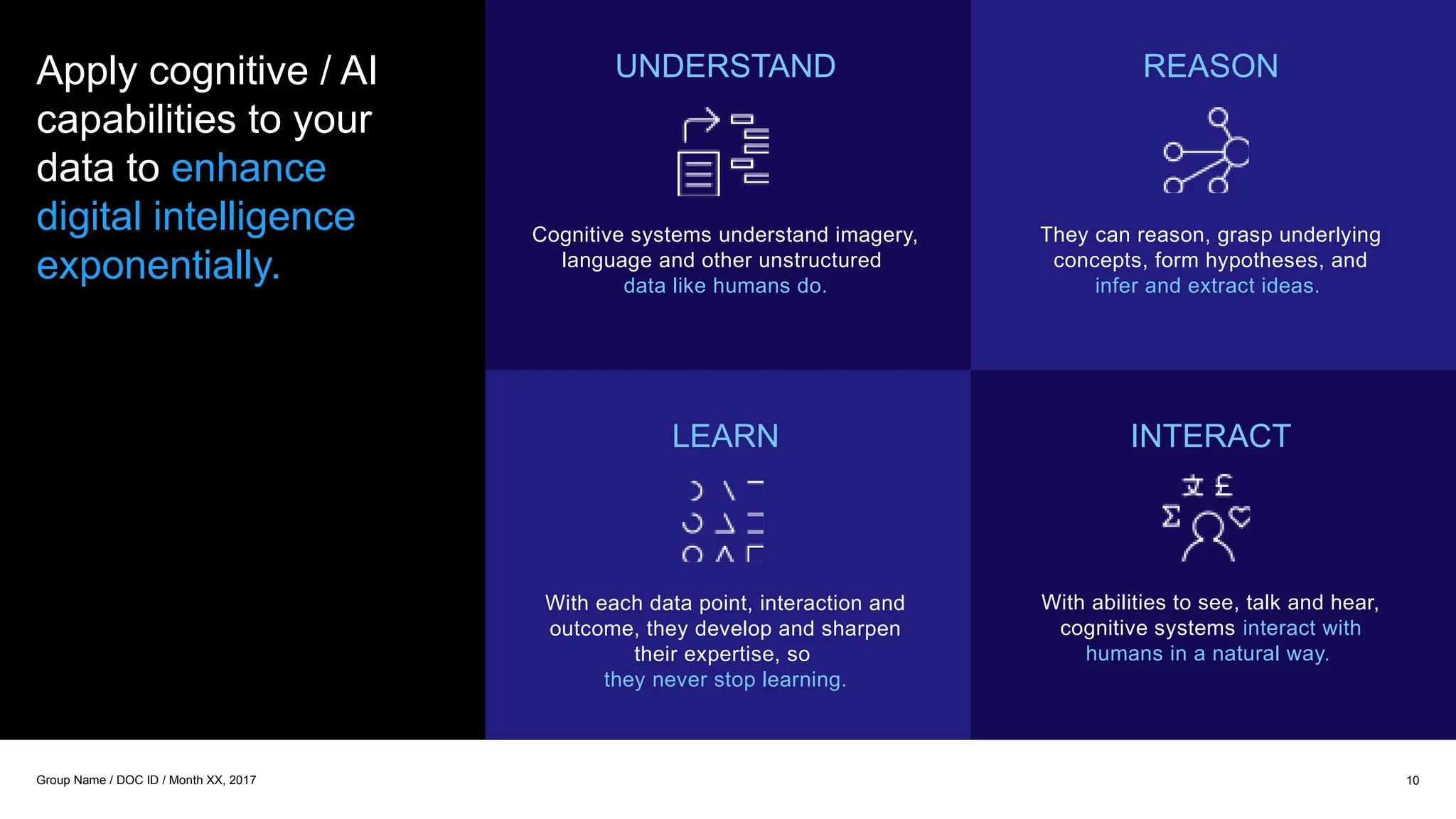
Apply cognitive / AI
capabilities to your
data to enhance
digital intelligence
exponentially.
REASON
They can reason, grasp underlying
concepts, form hypotheses, and
infer and extract ideas.
UNDERSTAND
Cognitive systems understand imagery,
language and other unstructured
data like humans do.
LEARN
With each data point, interaction and
outcome, they develop and sharpen
their expertise, so
they never stop learning.
INTERACT
With abilities to see, talk and hear,
cognitive systems interact with
humans in a natural way.
10
Group Name / DOC ID / Month XX, 2017
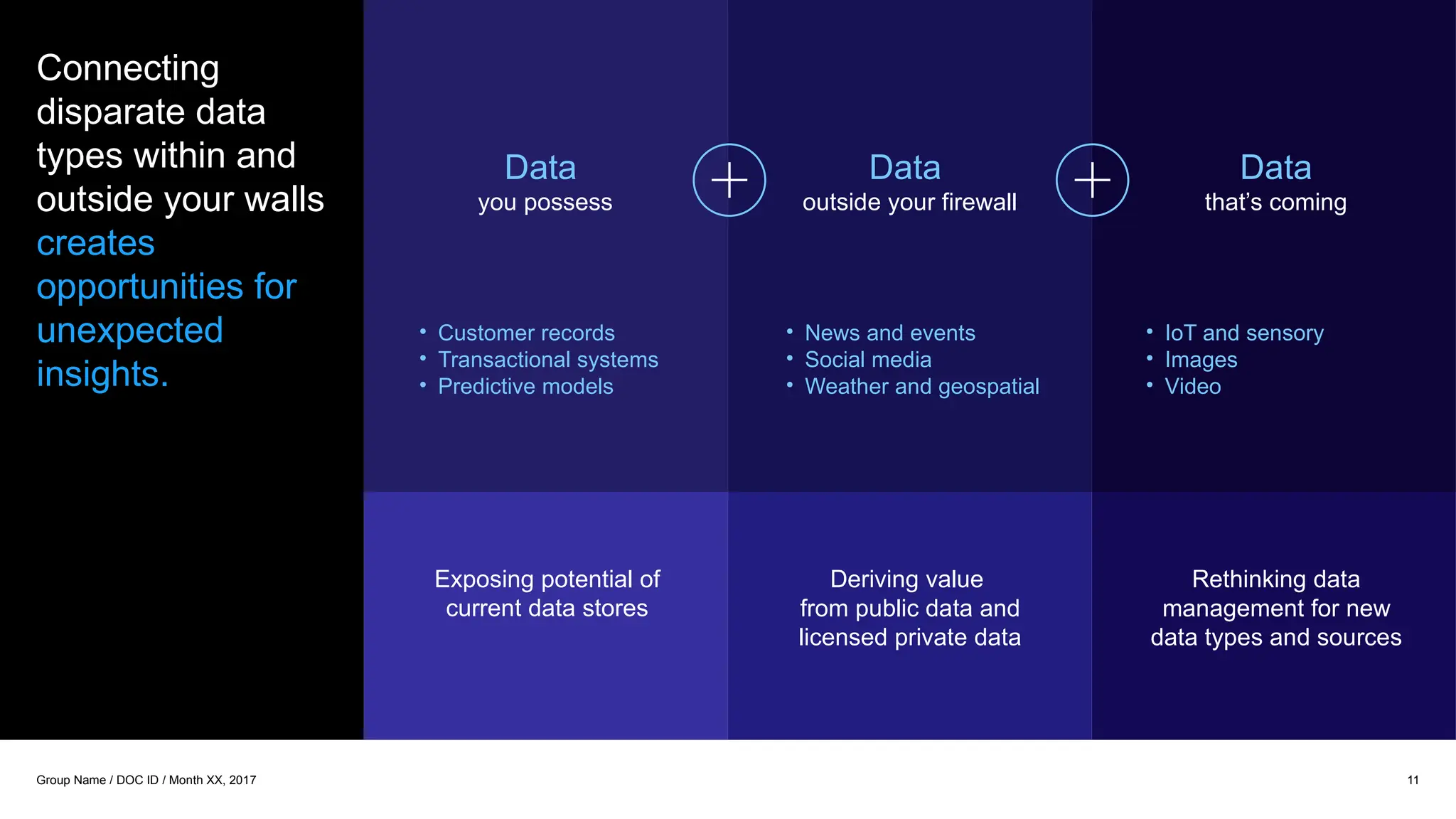
• Customer records
• Transactional systems
• Predictive models
• News and events
• Social media
• Weather and geospatial
• IoT and sensory
• Images
• Video
Data
that’s coming
Data
outside your firewall
Data
you possess
Connecting
disparate data
types within and
outside your walls
creates
opportunities for
unexpected
insights.
11
Group Name / DOC ID / Month XX, 2017
Exposing potential of
current data stores
Rethinking data
management for new
data types and sources
Deriving value
from public data and
licensed private data
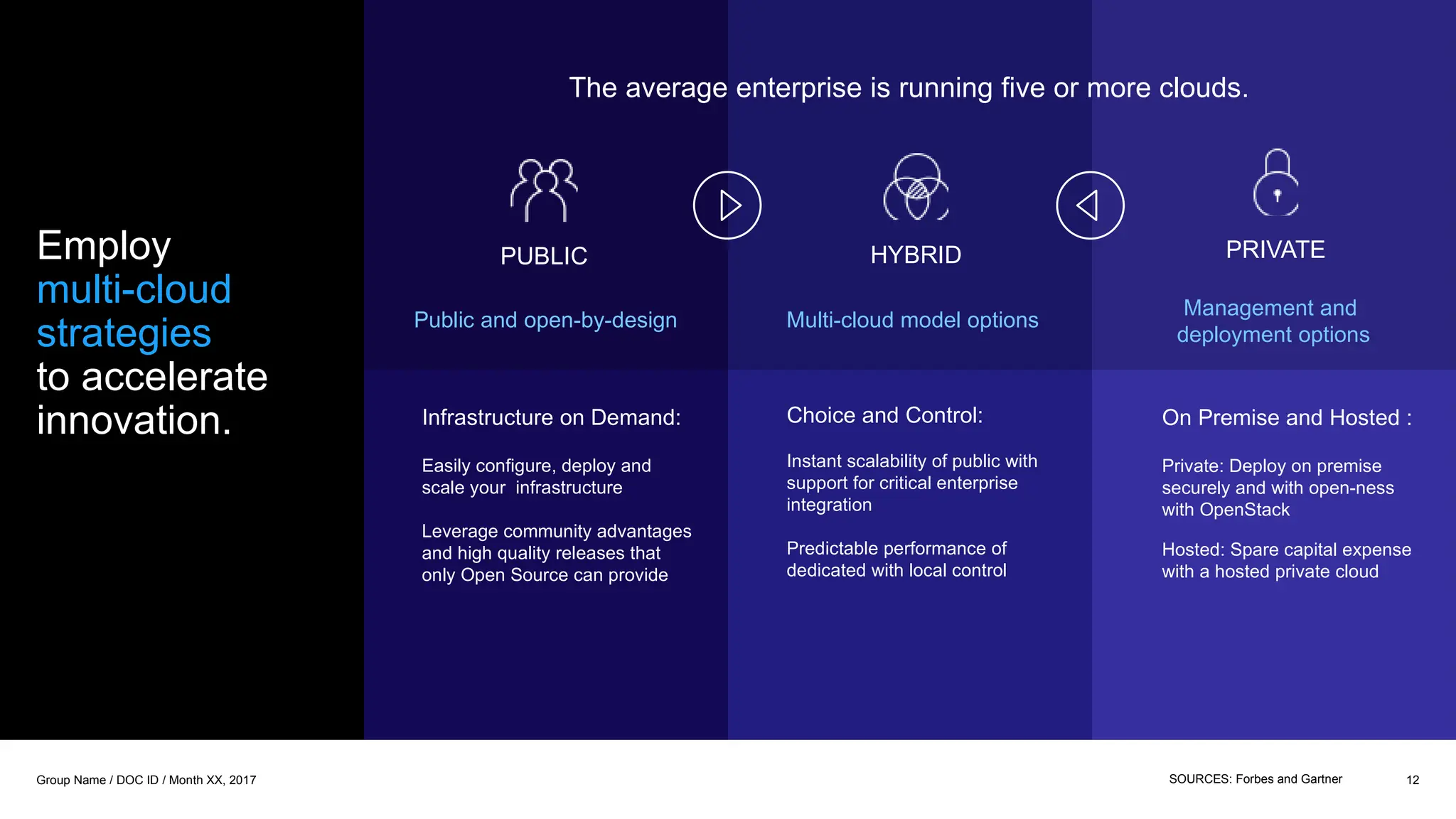
Employ
multi-cloud
strategies
to accelerate
innovation.
The average enterprise is running five or more clouds.
Management and
deployment options
PRIVATE
Infrastructure on Demand:
Easily configure, deploy and
scale your infrastructure
Leverage community advantages
and high quality releases that
only Open Source can provide
Public and open-by-design
PUBLIC
Choice and Control:
Instant scalability of public with
support for critical enterprise
integration
Predictable performance of
dedicated with local control
Multi-cloud model options
HYBRID
12
Group Name / DOC ID / Month XX, 2017 SOURCES: Forbes and Gartner
On Premise and Hosted :
Private: Deploy on premise
securely and with open-ness
with OpenStack
Hosted: Spare capital expense
with a hosted private cloud
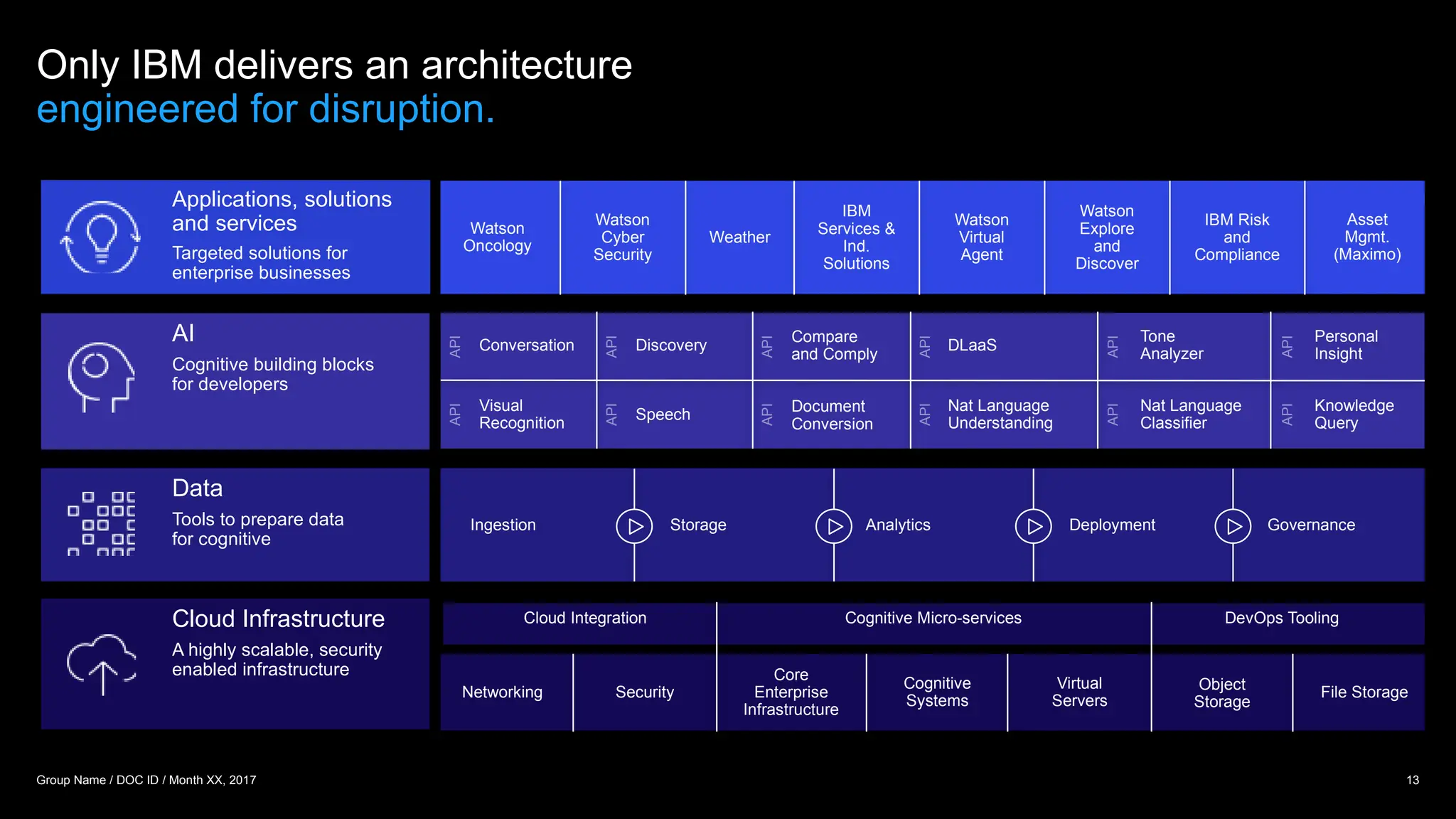
Only IBM delivers an architecture
engineered for disruption.
13
Group Name / DOC ID / Month XX, 2017
Cloud Infrastructure
A highly scalable, security
enabled infrastructure
Data
Tools to prepare data
for cognitive
AI
Cognitive building blocks
for developers
Applications, solutions
and services
Targeted solutions for
enterprise businesses
Ingestion
Conversation
API
Storage Analytics Deployment Governance
Visual
Recognition
API
Discovery
API
Speech
API
Compare
and Comply
API
Document
Conversion
API
DLaaS
API
Nat Language
Understanding
API
Nat Language
Classifier
API
Tone
Analyzer
API
Personal
Insight
API
Knowledge
Query
API
Cloud Integration
Networking Security
Core
Enterprise
Infrastructure
Cognitive
Systems
Virtual
Servers
File Storage
Object
Storage
Cognitive Micro-services DevOps Tooling
Watson
Oncology
Watson
Cyber
Security
Weather
IBM
Services &
Ind.
Solutions
Watson
Virtual
Agent
Watson
Explore
and
Discover
IBM Risk
and
Compliance
Asset
Mgmt.
(Maximo)
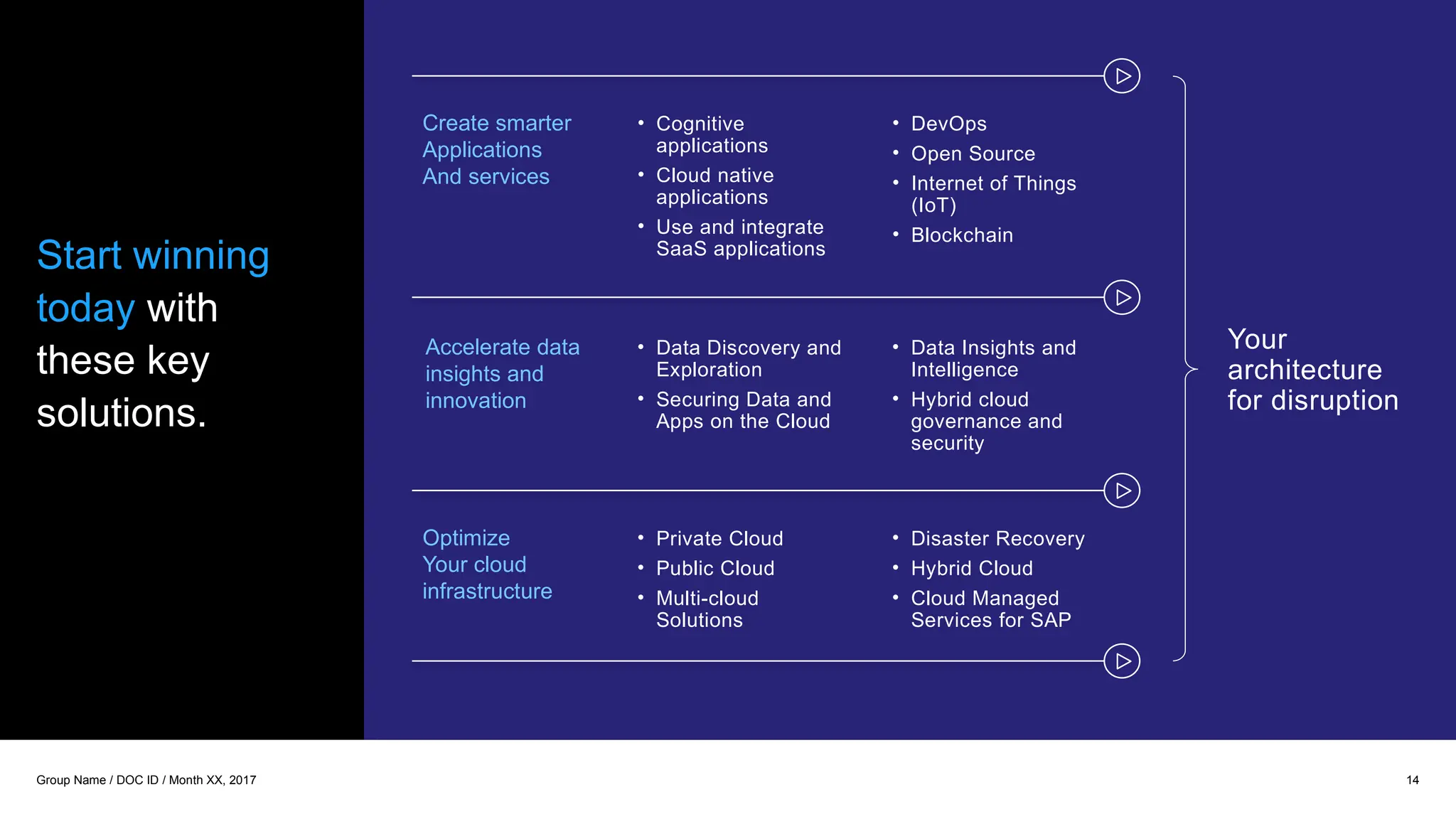
Create smarter
Applications
And services
• Cognitive
applications
• Cloud native
applications
• Use and integrate
SaaS applications
• DevOps
• Open Source
• Internet of Things
(IoT)
• Blockchain
Optimize
Your cloud
infrastructure
Accelerate data
insights and
innovation
• Data Discovery and
Exploration
• Securing Data and
Apps on the Cloud
• Data Insights and
Intelligence
• Hybrid cloud
governance and
security
• Private Cloud
• Public Cloud
• Multi-cloud
Solutions
• Disaster Recovery
• Hybrid Cloud
• Cloud Managed
Services for SAP
Your
architecture
for disruption
Start winning
today with
these key
solutions.
14
Group Name / DOC ID / Month XX, 2017
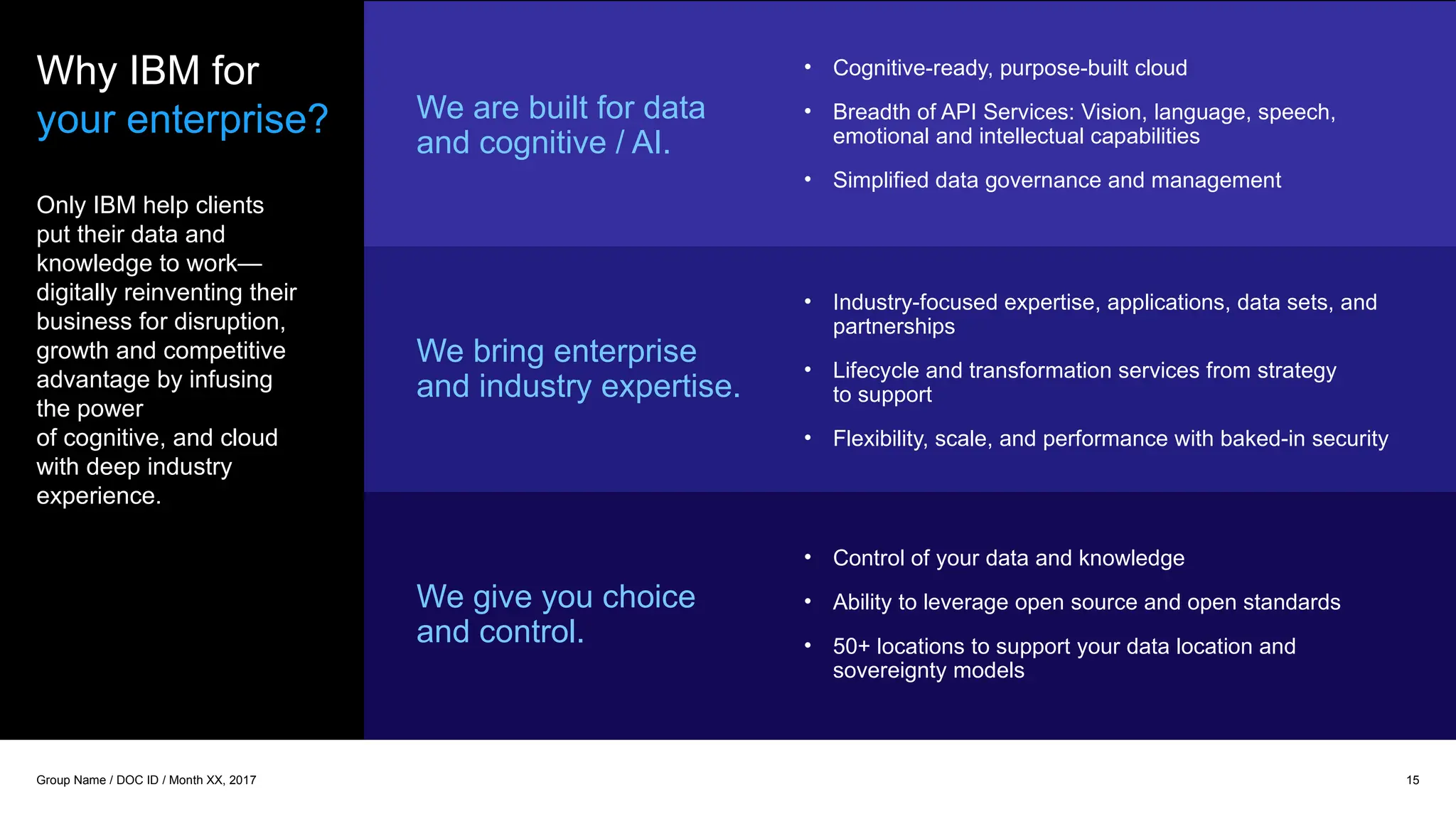
Why IBM for
your enterprise?
Only IBM help clients
put their data and
knowledge to work—
digitally reinventing their
business for disruption,
growth and competitive
advantage by infusing
the power
of cognitive, and cloud
with deep industry
experience.
We are built for data
and cognitive / AI.
• Cognitive-ready, purpose-built cloud
• Breadth of API Services: Vision, language, speech,
emotional and intellectual capabilities
• Simplified data governance and management
We bring enterprise
and industry expertise.
• Industry-focused expertise, applications, data sets, and
partnerships
• Lifecycle and transformation services from strategy
to support
• Flexibility, scale, and performance with baked-in security
We give you choice
and control.
• Control of your data and knowledge
• Ability to leverage open source and open standards
• 50+ locations to support your data location and
sovereignty models
15
Group Name / DOC ID / Month XX, 2017
[Case study subhead
goes here]
Innovation at scale
[Name of case company] anticipates these
key benefits:
• [Case study key benefits bullet points go
here]
[Case study body text goes here]
16
Group Name / DOC ID / Month XX, 2017
INSERT WHITE
VERSION OF
CASE COMPANY’S
LOGO HERE
REPLACE THIS
PHOTO WITH AN
IMAGE RELEVANT
TO THIS CASE
Thank you
17
Group Name / DOC ID / Month XX, 2017
First Lastname
Job Title
—
firstlastname@us.ibm.com
+1-555-985-4721
ibm.com
Thank you
© IBM Corporation 2017
IBM, the IBM logo, ibm.com, and Watson are trademarks or registered trademarks of International Business
Machines Corporation in the United States, other countries, or both. If these and other IBM trademarked terms are
marked on their first occurrence in this information with the appropriate symbol (®
or ™), these symbols indicate U.S.
registered or common law trademarks owned by IBM at the time this information was published. Such trademarks
may also be registered or common law trademarks in other countries. A current list of IBM trademarks is available on
the Web at “Copyright and trademark information.”
• Other company, product, and service names may be trademarks or service marks of others.
• References in this publication to IBM products or services do not imply that IBM intends to make them available in
all countries in which IBM operates.
Trademarks and notes
18
Group Name / DOC ID / Month XX, 2017
Architecting Disruption - Rethink business, technology and data to build a platform for the future of your business

Architecting Disruption - Rethink business, technology and data to build a platform for the future of your business

  • 1.
    Architecting Disruption Rethink business, technologyand data to build a platform for the future of your business
  • 2.
    Estimated worldwide startups eachday 274,000 Why we’re all vulnerable to seismic shifts External Threats Born-on-digital companies that steal market share or rewrite customer expectations New business models that reinvent our industry and change the game altogether Internal Threats Siloed data and systems Gaps in expertise and skills Inability to react quickly 2 Group Name / DOC ID / Month XX, 2017 SOURCE cited in notes
  • 3.
    You’re thinking about disruptionall wrong… Be an opportunist – not a victim. 3 Group Name / DOC ID / Month XX, 2017
  • 4.
    Innovators are using cloudand cognitive technologies to transform essential experiences. 4 Group Name / DOC ID / Month XX, 2017
  • 5.
    Reinventing industries one app at atime North Face reimagines customer engagement First of a kind mobile shopping companion learns and interacts in natural language. Kone gets major lift from cognitive, data, and analytics Cognitive elevators interact with maintenance staff to help improve safety and quality. Woodside gives one engineer the insights of 1,000 Analyzing data from 80k sensors, 1 million docs, and 30 years of lessons learned. 5 Group Name / DOC ID / Month XX, 2017
  • 6.
    To win, you must: Optimizeyour infrastructure with cloud options Speed innovation and operations by putting the right workloads on the right cloud. Design a growth business, re-engineer processes, and personalize customer experiences & applications by infusing cognitive / AI. Create smarter applications and services Store, secure, access, and analyze increasing volumes of structured and unstructured data gaining new insights. Accelerate data intelligence and innovation 6 Group Name / DOC ID / Month XX, 2017
  • 7.
    • Blockchain • Accelerated Infrastructure •Private Data • Public and Licensed Data • Hybrid Data Management • Unified Governance • Visualization • Machine Learning • Open Source • Internet of Things • Quantum Computing • And more Technology Data • Strategy • Business Process Transformation • Customer Experience • Digital Reinvention • Design Thinking and Agility • Data Science • Risk and Compliance • Security Business Cloud Private | Hybrid | Public To win, you must architect for disruption. 7 Group Name / DOC ID / Month XX, 2017 Rethink business, technology, and data Cognitive
  • 8.
    When business andtechnology objectives are one and the same… FLEXIBILITY AND SCALABILITY SECURITY BAKED IN CORE STRENGTH Why focus on architecture? Why now? …you must bring all business platforms together as one technology framework. • Innovation • Customer experience • Personalization • Create smarter apps and services • Accelerate data intelligence and innovation • Optimize your infrastructure with cloud options Your business strategy and your technology are now inseparable — and we’ve reached a perfect storm for cloud, cognitive/AI, and data technologies • Process improvements • Business efficiencies • Customer and market intelligence 8 Group Name / DOC ID / Month XX, 2017
  • 9.
    The right architecturesupports innovation today, tomorrow and beyond. Four dimensions designed as an integrated whole to support innovation today and in the future Deploy new, industry-specific, differentiating capabilities fast Allow your accumulated expertise to shine through in everything you do The ability to derive insights and knowledge from your data while governing regardless of location, respecting compliance and sovereignty Integrate mission critical applications alongside new, cognitive and data loads and accelerate AI data ingestion and training 9 Group Name / DOC ID / Month XX, 2017 Cloud Infrastructure Data AI/Cognitive Applications, solutions and services
  • 10.
    Apply cognitive /AI capabilities to your data to enhance digital intelligence exponentially. REASON They can reason, grasp underlying concepts, form hypotheses, and infer and extract ideas. UNDERSTAND Cognitive systems understand imagery, language and other unstructured data like humans do. LEARN With each data point, interaction and outcome, they develop and sharpen their expertise, so they never stop learning. INTERACT With abilities to see, talk and hear, cognitive systems interact with humans in a natural way. 10 Group Name / DOC ID / Month XX, 2017
  • 11.
    • Customer records •Transactional systems • Predictive models • News and events • Social media • Weather and geospatial • IoT and sensory • Images • Video Data that’s coming Data outside your firewall Data you possess Connecting disparate data types within and outside your walls creates opportunities for unexpected insights. 11 Group Name / DOC ID / Month XX, 2017 Exposing potential of current data stores Rethinking data management for new data types and sources Deriving value from public data and licensed private data
  • 12.
    Employ multi-cloud strategies to accelerate innovation. The averageenterprise is running five or more clouds. Management and deployment options PRIVATE Infrastructure on Demand: Easily configure, deploy and scale your infrastructure Leverage community advantages and high quality releases that only Open Source can provide Public and open-by-design PUBLIC Choice and Control: Instant scalability of public with support for critical enterprise integration Predictable performance of dedicated with local control Multi-cloud model options HYBRID 12 Group Name / DOC ID / Month XX, 2017 SOURCES: Forbes and Gartner On Premise and Hosted : Private: Deploy on premise securely and with open-ness with OpenStack Hosted: Spare capital expense with a hosted private cloud
  • 13.
    Only IBM deliversan architecture engineered for disruption. 13 Group Name / DOC ID / Month XX, 2017 Cloud Infrastructure A highly scalable, security enabled infrastructure Data Tools to prepare data for cognitive AI Cognitive building blocks for developers Applications, solutions and services Targeted solutions for enterprise businesses Ingestion Conversation API Storage Analytics Deployment Governance Visual Recognition API Discovery API Speech API Compare and Comply API Document Conversion API DLaaS API Nat Language Understanding API Nat Language Classifier API Tone Analyzer API Personal Insight API Knowledge Query API Cloud Integration Networking Security Core Enterprise Infrastructure Cognitive Systems Virtual Servers File Storage Object Storage Cognitive Micro-services DevOps Tooling Watson Oncology Watson Cyber Security Weather IBM Services & Ind. Solutions Watson Virtual Agent Watson Explore and Discover IBM Risk and Compliance Asset Mgmt. (Maximo)
  • 14.
    Create smarter Applications And services •Cognitive applications • Cloud native applications • Use and integrate SaaS applications • DevOps • Open Source • Internet of Things (IoT) • Blockchain Optimize Your cloud infrastructure Accelerate data insights and innovation • Data Discovery and Exploration • Securing Data and Apps on the Cloud • Data Insights and Intelligence • Hybrid cloud governance and security • Private Cloud • Public Cloud • Multi-cloud Solutions • Disaster Recovery • Hybrid Cloud • Cloud Managed Services for SAP Your architecture for disruption Start winning today with these key solutions. 14 Group Name / DOC ID / Month XX, 2017
  • 15.
    Why IBM for yourenterprise? Only IBM help clients put their data and knowledge to work— digitally reinventing their business for disruption, growth and competitive advantage by infusing the power of cognitive, and cloud with deep industry experience. We are built for data and cognitive / AI. • Cognitive-ready, purpose-built cloud • Breadth of API Services: Vision, language, speech, emotional and intellectual capabilities • Simplified data governance and management We bring enterprise and industry expertise. • Industry-focused expertise, applications, data sets, and partnerships • Lifecycle and transformation services from strategy to support • Flexibility, scale, and performance with baked-in security We give you choice and control. • Control of your data and knowledge • Ability to leverage open source and open standards • 50+ locations to support your data location and sovereignty models 15 Group Name / DOC ID / Month XX, 2017
  • 16.
    [Case study subhead goeshere] Innovation at scale [Name of case company] anticipates these key benefits: • [Case study key benefits bullet points go here] [Case study body text goes here] 16 Group Name / DOC ID / Month XX, 2017 INSERT WHITE VERSION OF CASE COMPANY’S LOGO HERE REPLACE THIS PHOTO WITH AN IMAGE RELEVANT TO THIS CASE
  • 17.
    Thank you 17 Group Name/ DOC ID / Month XX, 2017 First Lastname Job Title — firstlastname@us.ibm.com +1-555-985-4721 ibm.com Thank you
  • 18.
    © IBM Corporation2017 IBM, the IBM logo, ibm.com, and Watson are trademarks or registered trademarks of International Business Machines Corporation in the United States, other countries, or both. If these and other IBM trademarked terms are marked on their first occurrence in this information with the appropriate symbol (® or ™), these symbols indicate U.S. registered or common law trademarks owned by IBM at the time this information was published. Such trademarks may also be registered or common law trademarks in other countries. A current list of IBM trademarks is available on the Web at “Copyright and trademark information.” • Other company, product, and service names may be trademarks or service marks of others. • References in this publication to IBM products or services do not imply that IBM intends to make them available in all countries in which IBM operates. Trademarks and notes 18 Group Name / DOC ID / Month XX, 2017

Editor's Notes

  • #2 MKM Research, "Worldwide Business Start-Ups," Moya K. Mason, accessed February 28, 2017, http://www.moyak.com/papers/business-startups-entrepreneurs.html
  • #3 EVERY DAY, COMPANIES USE THE POWER OF DATA, AI AND CLOUD TECHNOLOGIES TO MAKE THEIR EMPLOYEES, ORGANIZATIONS AND INDUSTRIES STRONGER. NATIONAL RETAILER Link to Reference Profile: http://w3-01.ibm.com/sales/ssi/cgi-bin/ssialias?infotype=CR&subtype=NA&htmlfid=0CRDD-ADSP3L&appname=crmd A large retailer, with stores in more than 40 US states, operates both traditional and online retail stores under various brands. The company had fiscal 2015 sales of more than USD 20 billion and more than 100,000 employees. Business challenge The omnichannel retail model arose and thrived because customers have different preferences about how and where they want to shop. The retailers that have succeeded are those that recognized and reacted to what shoppers wanted and continue to look for the next shift in shopping behavior. The company’s strategists saw the emergence of a subsegment of consumers looking for the speed and convenience afforded by online shopping channels—think instant inventory searches—within a traditional physical retail setting. A major driver for these consumers is the desire to circumvent the need for in-store assistance. Some shoppers don’t want assistance at all, but the largest share are those who become frustrated if they have to wait for assistance and are at a high risk of simply walking out of the store unsatisfied, perhaps for good. To meet the needs of this emerging group of in-store self-service seekers, the retailer sought to develop a highly personalized, mobile tool to assist them—and thereby engage them more deeply. Solution The company engaged IBM Business Partner Satisfi Inc. to develop and test a first-of-a-kind mobile shopping companion that uses natural language processing (NLP) technology to enable customers to interact with a physical store in a question-and-answer format. Initially rolled out at 10 retail locations around the US, the solution is accessed through a mobile web browser as opposed to requiring the customer to download a specialized app. The shopping tool uses the deep learning capabilities of a cognitive natural language classification engine to sort questions submitted by customers into different categories or classes with a high level of confidence. To initially train the solution, the retailer gathered the most common inquires from sales associates and fed them into the system, along with the answers. In the first phase of the project, the solution was designed to focus on three core categories—products, services and store layout—for each store location. As the solution captures more customer queries, it uses deep learning to continually refine the information it provides to customers. Based on how the classifying algorithms categorize the customer inquiry, the solution responds by delivering the most appropriate trained response. For Spanish-speaking customers, cognitive translation algorithms translate queries from Spanish to English and translate the tool’s responses from English to Spanish. In a subgroup of test locations, the tool accesses cognitive sentiment analysis tools to analyze the text of the customer’s query to look for clues to the customer’s mood or emotion. If the solution detects that the customer is upset, it can automatically alert an onsite associate to quickly address the question or problem. Quantifiable benefits As the solution is rolled out to a large number of store locations and refined along the way, it is ultimately expected to increase average revenue per store by reducing the number of customers that leave stores frustrated, without purchasing anything. From the customer’s standpoint, the solution is also expected to enable deeper and more satisfying in-store engagement, thereby increasing the likelihood and frequency of return visits. Over the long term, the solution has the potential to provide insights on customer preferences that can be translated into personalized recommendations. What makes the solution cognitive? Game-changing outcome - The solution is game-changing because it uses NLP and deep learning technology to create an interactive in-store shopping experience that emulates the best aspects of the online shopping experience: speed and convenience. In effect, cognitive computing technology enabled the retailer to fuse its in-store and online channel into a kind of “hybrid channel” experience. Before-after impact - Under the traditional retail model, customers who shop in physical stores need to ask sales associates questions ranging from product availability to the location of the restroom. When an associate can’t be found, frustration and lost sales often follow. With the new solution, customers can follow a digital self-service model within stores, reducing the likelihood of losing customers. Data sources and characteristics - The solution relies on two main data sources, both unstructured. To perform natural language classification, it accesses a corpus of questions and answers developed from interviews with sales associates. This corpus is continually refined over time. To characterize the emotional tone of messages, the solution uses the existing corpus of the IBM cognitive solution, which is pre-trained. KONE: easing elevator maintenance, expanding product offerings, and energizing developers Cognitive elevators interact with maintenance staff to help improve safety and quality. KONE is in the business of People Flow. KONE started their journey with IBM over a year ago. For KONE, the customer was the beginning. When KONE began to see disruption in their space, they saw an opportunity to use technology from IBM Watson IoT to take advantage of this disruption. As KONE started to connect their escalators and elevators to IoT, the data started to grow exponentially. From all of this data, KONE has been able to create new services using live machine conversations – to tailor specific maintenance for elevators based on real data. These new services will range from solutions which improve people flow in buildings and new smart building applications; to others that advance the speed, reliability and safety for elevator maintenance, remote monitoring and servicing, and remote diagnostics and predictability. Ultimately, these capabilities translate into improved services for customers and great experiences for the people using KONE equipment. WOODSIDE is one of Australia’s largest independent oil and gas producers, with engineering projects that range from AUD 1 billion to tens of billions of dollars.   THE PROBLEM: The smallest engineering decisions for Woodside can cost millions of dollars. Valuable knowledge is developed during virtually every project, but that expertise was tough to share across years, let alone across decades. And when engineers left the company, their knowledge left with them. The company knew it was reworking old problems, but it couldn’t plug the knowledge drain.   THE SOLUTION: Woodside used IBM Watson™ Engagement Advisor to create a cognitive advisory service called “Lesson Learned.”   Grow knowledge from data To give Lesson Learned the knowledge it needed, the Watson software culled through 30 years of documented expertise that encompasses thousands of documents per project—engineering studies, environmental reports, risk analyses, developmental concepts and so on.   Enhance expertise Now a new project engineer asks Lesson Learned a plain language question: “What design features have we put in offshore platforms to deter birds?” Lesson Learned provides evidence-based answers from a project completed 10 years before. The expertise of engineers that might not even be around anymore is now the new engineer’s as well.   Learn and adapt When that engineer puts her insight from the past together with the new materials available today, Lesson Learned will take note. And six months later, when a Woodside engineer looks into a similar problem, Lesson Learned will provide the newly adapted knowledge, along with the chain of authors, reviewers and approvers, making it easier to consult and collaborate. ADDITIONAL INFORMATION: Woodside energy: https://www.youtube.com/watch?v=GFZ2IaTVkY8
  • #4 EVERY DAY, COMPANIES USE THE POWER OF DATA, AI AND CLOUD TECHNOLOGIES TO MAKE THEIR EMPLOYEES, ORGANIZATIONS AND INDUSTRIES STRONGER. NATIONAL RETAILER Link to Reference Profile: http://w3-01.ibm.com/sales/ssi/cgi-bin/ssialias?infotype=CR&subtype=NA&htmlfid=0CRDD-ADSP3L&appname=crmd A large retailer, with stores in more than 40 US states, operates both traditional and online retail stores under various brands. The company had fiscal 2015 sales of more than USD 20 billion and more than 100,000 employees. Business challenge The omnichannel retail model arose and thrived because customers have different preferences about how and where they want to shop. The retailers that have succeeded are those that recognized and reacted to what shoppers wanted and continue to look for the next shift in shopping behavior. The company’s strategists saw the emergence of a subsegment of consumers looking for the speed and convenience afforded by online shopping channels—think instant inventory searches—within a traditional physical retail setting. A major driver for these consumers is the desire to circumvent the need for in-store assistance. Some shoppers don’t want assistance at all, but the largest share are those who become frustrated if they have to wait for assistance and are at a high risk of simply walking out of the store unsatisfied, perhaps for good. To meet the needs of this emerging group of in-store self-service seekers, the retailer sought to develop a highly personalized, mobile tool to assist them—and thereby engage them more deeply. Solution The company engaged IBM Business Partner Satisfi Inc. to develop and test a first-of-a-kind mobile shopping companion that uses natural language processing (NLP) technology to enable customers to interact with a physical store in a question-and-answer format. Initially rolled out at 10 retail locations around the US, the solution is accessed through a mobile web browser as opposed to requiring the customer to download a specialized app. The shopping tool uses the deep learning capabilities of a cognitive natural language classification engine to sort questions submitted by customers into different categories or classes with a high level of confidence. To initially train the solution, the retailer gathered the most common inquires from sales associates and fed them into the system, along with the answers. In the first phase of the project, the solution was designed to focus on three core categories—products, services and store layout—for each store location. As the solution captures more customer queries, it uses deep learning to continually refine the information it provides to customers. Based on how the classifying algorithms categorize the customer inquiry, the solution responds by delivering the most appropriate trained response. For Spanish-speaking customers, cognitive translation algorithms translate queries from Spanish to English and translate the tool’s responses from English to Spanish. In a subgroup of test locations, the tool accesses cognitive sentiment analysis tools to analyze the text of the customer’s query to look for clues to the customer’s mood or emotion. If the solution detects that the customer is upset, it can automatically alert an onsite associate to quickly address the question or problem. Quantifiable benefits As the solution is rolled out to a large number of store locations and refined along the way, it is ultimately expected to increase average revenue per store by reducing the number of customers that leave stores frustrated, without purchasing anything. From the customer’s standpoint, the solution is also expected to enable deeper and more satisfying in-store engagement, thereby increasing the likelihood and frequency of return visits. Over the long term, the solution has the potential to provide insights on customer preferences that can be translated into personalized recommendations. What makes the solution cognitive? Game-changing outcome - The solution is game-changing because it uses NLP and deep learning technology to create an interactive in-store shopping experience that emulates the best aspects of the online shopping experience: speed and convenience. In effect, cognitive computing technology enabled the retailer to fuse its in-store and online channel into a kind of “hybrid channel” experience. Before-after impact - Under the traditional retail model, customers who shop in physical stores need to ask sales associates questions ranging from product availability to the location of the restroom. When an associate can’t be found, frustration and lost sales often follow. With the new solution, customers can follow a digital self-service model within stores, reducing the likelihood of losing customers. Data sources and characteristics - The solution relies on two main data sources, both unstructured. To perform natural language classification, it accesses a corpus of questions and answers developed from interviews with sales associates. This corpus is continually refined over time. To characterize the emotional tone of messages, the solution uses the existing corpus of the IBM cognitive solution, which is pre-trained. KONE: easing elevator maintenance, expanding product offerings, and energizing developers Cognitive elevators interact with maintenance staff to help improve safety and quality. KONE is in the business of People Flow. KONE started their journey with IBM over a year ago. For KONE, the customer was the beginning. When KONE began to see disruption in their space, they saw an opportunity to use technology from IBM Watson IoT to take advantage of this disruption. As KONE started to connect their escalators and elevators to IoT, the data started to grow exponentially. From all of this data, KONE has been able to create new services using live machine conversations – to tailor specific maintenance for elevators based on real data. These new services will range from solutions which improve people flow in buildings and new smart building applications; to others that advance the speed, reliability and safety for elevator maintenance, remote monitoring and servicing, and remote diagnostics and predictability. Ultimately, these capabilities translate into improved services for customers and great experiences for the people using KONE equipment. WOODSIDE is one of Australia’s largest independent oil and gas producers, with engineering projects that range from AUD 1 billion to tens of billions of dollars.   THE PROBLEM: The smallest engineering decisions for Woodside can cost millions of dollars. Valuable knowledge is developed during virtually every project, but that expertise was tough to share across years, let alone across decades. And when engineers left the company, their knowledge left with them. The company knew it was reworking old problems, but it couldn’t plug the knowledge drain.   THE SOLUTION: Woodside used IBM Watson™ Engagement Advisor to create a cognitive advisory service called “Lesson Learned.”   Grow knowledge from data To give Lesson Learned the knowledge it needed, the Watson software culled through 30 years of documented expertise that encompasses thousands of documents per project—engineering studies, environmental reports, risk analyses, developmental concepts and so on.   Enhance expertise Now a new project engineer asks Lesson Learned a plain language question: “What design features have we put in offshore platforms to deter birds?” Lesson Learned provides evidence-based answers from a project completed 10 years before. The expertise of engineers that might not even be around anymore is now the new engineer’s as well.   Learn and adapt When that engineer puts her insight from the past together with the new materials available today, Lesson Learned will take note. And six months later, when a Woodside engineer looks into a similar problem, Lesson Learned will provide the newly adapted knowledge, along with the chain of authors, reviewers and approvers, making it easier to consult and collaborate. ADDITIONAL INFORMATION: Woodside energy: https://www.youtube.com/watch?v=GFZ2IaTVkY8
  • #5 EVERY DAY, COMPANIES USE THE POWER OF DATA, AI AND CLOUD TECHNOLOGIES TO MAKE THEIR EMPLOYEES, ORGANIZATIONS AND INDUSTRIES STRONGER. NATIONAL RETAILER Link to Reference Profile: http://w3-01.ibm.com/sales/ssi/cgi-bin/ssialias?infotype=CR&subtype=NA&htmlfid=0CRDD-ADSP3L&appname=crmd A large retailer, with stores in more than 40 US states, operates both traditional and online retail stores under various brands. The company had fiscal 2015 sales of more than USD 20 billion and more than 100,000 employees. Business challenge The omnichannel retail model arose and thrived because customers have different preferences about how and where they want to shop. The retailers that have succeeded are those that recognized and reacted to what shoppers wanted and continue to look for the next shift in shopping behavior. The company’s strategists saw the emergence of a subsegment of consumers looking for the speed and convenience afforded by online shopping channels—think instant inventory searches—within a traditional physical retail setting. A major driver for these consumers is the desire to circumvent the need for in-store assistance. Some shoppers don’t want assistance at all, but the largest share are those who become frustrated if they have to wait for assistance and are at a high risk of simply walking out of the store unsatisfied, perhaps for good. To meet the needs of this emerging group of in-store self-service seekers, the retailer sought to develop a highly personalized, mobile tool to assist them—and thereby engage them more deeply. Solution The company engaged IBM Business Partner Satisfi Inc. to develop and test a first-of-a-kind mobile shopping companion that uses natural language processing (NLP) technology to enable customers to interact with a physical store in a question-and-answer format. Initially rolled out at 10 retail locations around the US, the solution is accessed through a mobile web browser as opposed to requiring the customer to download a specialized app. The shopping tool uses the deep learning capabilities of a cognitive natural language classification engine to sort questions submitted by customers into different categories or classes with a high level of confidence. To initially train the solution, the retailer gathered the most common inquires from sales associates and fed them into the system, along with the answers. In the first phase of the project, the solution was designed to focus on three core categories—products, services and store layout—for each store location. As the solution captures more customer queries, it uses deep learning to continually refine the information it provides to customers. Based on how the classifying algorithms categorize the customer inquiry, the solution responds by delivering the most appropriate trained response. For Spanish-speaking customers, cognitive translation algorithms translate queries from Spanish to English and translate the tool’s responses from English to Spanish. In a subgroup of test locations, the tool accesses cognitive sentiment analysis tools to analyze the text of the customer’s query to look for clues to the customer’s mood or emotion. If the solution detects that the customer is upset, it can automatically alert an onsite associate to quickly address the question or problem. Quantifiable benefits As the solution is rolled out to a large number of store locations and refined along the way, it is ultimately expected to increase average revenue per store by reducing the number of customers that leave stores frustrated, without purchasing anything. From the customer’s standpoint, the solution is also expected to enable deeper and more satisfying in-store engagement, thereby increasing the likelihood and frequency of return visits. Over the long term, the solution has the potential to provide insights on customer preferences that can be translated into personalized recommendations. What makes the solution cognitive? Game-changing outcome - The solution is game-changing because it uses NLP and deep learning technology to create an interactive in-store shopping experience that emulates the best aspects of the online shopping experience: speed and convenience. In effect, cognitive computing technology enabled the retailer to fuse its in-store and online channel into a kind of “hybrid channel” experience. Before-after impact - Under the traditional retail model, customers who shop in physical stores need to ask sales associates questions ranging from product availability to the location of the restroom. When an associate can’t be found, frustration and lost sales often follow. With the new solution, customers can follow a digital self-service model within stores, reducing the likelihood of losing customers. Data sources and characteristics - The solution relies on two main data sources, both unstructured. To perform natural language classification, it accesses a corpus of questions and answers developed from interviews with sales associates. This corpus is continually refined over time. To characterize the emotional tone of messages, the solution uses the existing corpus of the IBM cognitive solution, which is pre-trained. KONE: easing elevator maintenance, expanding product offerings, and energizing developers Cognitive elevators interact with maintenance staff to help improve safety and quality. KONE is in the business of People Flow. KONE started their journey with IBM over a year ago. For KONE, the customer was the beginning. When KONE began to see disruption in their space, they saw an opportunity to use technology from IBM Watson IoT to take advantage of this disruption. As KONE started to connect their escalators and elevators to IoT, the data started to grow exponentially. From all of this data, KONE has been able to create new services using live machine conversations – to tailor specific maintenance for elevators based on real data. These new services will range from solutions which improve people flow in buildings and new smart building applications; to others that advance the speed, reliability and safety for elevator maintenance, remote monitoring and servicing, and remote diagnostics and predictability. Ultimately, these capabilities translate into improved services for customers and great experiences for the people using KONE equipment. WOODSIDE is one of Australia’s largest independent oil and gas producers, with engineering projects that range from AUD 1 billion to tens of billions of dollars.   THE PROBLEM: The smallest engineering decisions for Woodside can cost millions of dollars. Valuable knowledge is developed during virtually every project, but that expertise was tough to share across years, let alone across decades. And when engineers left the company, their knowledge left with them. The company knew it was reworking old problems, but it couldn’t plug the knowledge drain.   THE SOLUTION: Woodside used IBM Watson™ Engagement Advisor to create a cognitive advisory service called “Lesson Learned.”   Grow knowledge from data To give Lesson Learned the knowledge it needed, the Watson software culled through 30 years of documented expertise that encompasses thousands of documents per project—engineering studies, environmental reports, risk analyses, developmental concepts and so on.   Enhance expertise Now a new project engineer asks Lesson Learned a plain language question: “What design features have we put in offshore platforms to deter birds?” Lesson Learned provides evidence-based answers from a project completed 10 years before. The expertise of engineers that might not even be around anymore is now the new engineer’s as well.   Learn and adapt When that engineer puts her insight from the past together with the new materials available today, Lesson Learned will take note. And six months later, when a Woodside engineer looks into a similar problem, Lesson Learned will provide the newly adapted knowledge, along with the chain of authors, reviewers and approvers, making it easier to consult and collaborate. ADDITIONAL INFORMATION: Woodside energy: https://www.youtube.com/watch?v=GFZ2IaTVkY8
  • #6 TO WIN, YOU MUST: Turn increasing volumes of structured and unstructured data into new, easily accessible insights. Continually improve and personalize customer experiences and applications by infusing AI. Speed operations by putting the right workloads on the right cloud.
  • #8 Success in this age looks like a list of impossible tasks, especially given that we want all of these to happen at the same time: Provide more capabilities to the business every day while you reduce your unit cost of delivery Increase the insights you can produce against your data, while simultaneously expanding your universe of data Get continuously better at everything, by letting no opportunity to learn pass you by All of this requires a cloud-native platform that is cognitive-ready and essentially comes together as one piece of technology to be both powerful and secure enough. And now that we have machine learning and we are AI and are able to infuse that in to our applications, the workloads get infinitely more complex. All of this data that we will bring in, the data scientists bringing in more data and seeking those insights and trying to find the next nugget. Exposing petabytes of data not internally to teams but to Watson as well and to do that and to do that well requires a very different architecture: Flexible, scalable cloud native architecture that supports the full spectrum of cloud delivery, from on-prem and private, to public and hybrid. Security that’s baked in, not bolted on as an afterthought. Core strength that supports the high-performance GPUs, applications and network mesh required by cognitive systems and augmented intelligence An architecture that can scale, an architecture that has security baked and not bolted on. Security can't be an afterthought. It can't be something that we look at after we have launched. Security has to be at the core of you and you manage your data and how you look at the insights and how your data scientists now what access they have and how can they use appropriately each of the datasets that they have acquired. So we believe that this cloud platform, this journey you are on has to come together as one piece of technology. An architecture that we have defined that you are defining with us that we are working on together that provides an end‑to‑end combination of capabilities.
  • #9 Talking Points: Our architecture is designed as an integrated whole across 4 dimensions. Applications and solutions for business and industries trained with deeper data experience and industry expertise than any competitor, including a broad portfolio of cognitive applications. Sophisticated AI services and accelerators, foundational to the architecture, that give you the ability to contextualize across a corpus of data. Our competitors only offer low-level AI without industry-specificity. The ability to manage and govern your data regardless of location, respecting compliance and sovereignty . Your data is your data—the right architecture prevents the use of your data to train another client’s AI. A complete spectrum of options for cloud infrastructure, from private (on premise) to hybrid (integration) to public (native) cloud. Public Cloud with GPUs and network mesh to accelerate AI training is critical to enable speed-to-market and scale. Discussion Prompts: Address the questions on the right-hand side of the page within the context of your geo/ BU/function Engage in discussion around the importance of cloud native as a destination—for cognitive computing at speed and scale, for security. Ask: how can we help accelerate the adoption of cloud native as a destination, at IBM and with our clients?
  • #10 The four core capabilities of a cognitive system Together, these capabilities will reshape the possibilities for how you solve problems and work with your data. Key to attaining a richer digital intelligence are cognitive systems. With analytics, we get key insights from data, but with cognitive systems, we can turn those key insights into knowledge. Traditional computing is programmed (rules-based, logic-driven, dependent on organized information), but cognitive systems are probabilistic (they learn systematically, they are not dependent on rules, they handle disparate and varied data). Cognitive systems can understand unstructured information such as the imagery, natural language and sounds in books, emails, tweets, journals, blogs, images, sound and videos. They unlock meaning because they can reason through it, giving us new contexts to weigh and consider. Cognitive systems also learn continually, honing our own expertise so we can immediately take more informed actions. And they interact with us and with our customers, dissolving barriers between humans and machine, fueling unique, essential user experiences.
  • #11 WE NEED TO WEAVE IN THE THOUGHTS ABOUT HOW ENTERPRISES ARE FLUSH WITH HIGH VALUE DATA – ADD THOUGHTS ON DATA SOVEREIGNTY AND LOCATION COGNITIVE BUSINESSES CAN ACCESS AND USE VIRTUALLY ALL TYPES OF DATA.   With the right cognitive solutions, your business systems will understand data—structured and unstructured, text-based or sensory—in context and meaning, at astonishing speeds and volumes. IBM Watson software reads 800 million pages per second, for example. With one client, Watson technology initially ingested 80 million documents and is incrementally adding 30,000 additional documents every day. So in what intersections of what deep or wide data pools is your differentiated insight hiding?
  • #13 Talking Points: Our architecture is designed as an integrated whole across 4 dimensions. Our Cognitive applications are trained with more data and expertise than any competitor. Our sophisticated AI services are foundational to our architecture, and we allow for customized models. Our competitors only offer low-level AI without industry-specificity. Client data will never be used to train another client’s AI. Our architecture allows for data use that is both open and with regulatory governance. Our cloud has been purpose-built to allow for accelerated AI training. Discussion Prompts: Address the questions on the right-hand side of the page within the context of your geo/ BU/function Engage in discussion around the importance of cloud native as a destination—for cognitive computing at speed and scale, for security. Ask: how can we help accelerate the adoption of cloud native as a destination, at IBM and with our clients?
  • #15 We are built for data and cognitive Cloud & cognitive architecture and technologies truly built for scale and industry applications Strongest capabilities in vision, language, speech, emotional and intellectual intelligence Simplified end-to-end data governance and management We deliver enterprise and industry expertise Built for enterprise flexibility and scale with baked in security Industry-focused applications, data sets, expertise & partnerships Life-cycle services from strategy to support We give clients choice and control Control of their data and knowledge Leverage open source and open standards Over 50 locations supporting necessary data location and sovereignty models (Hybrid)
  • #16 http://w3-01.ibm.com/sales/ssi/cgi-bin/ssialias?appname=crmd&subtype=wn&infotype=rf&htmlfid=0CRDD-AELNBG