16
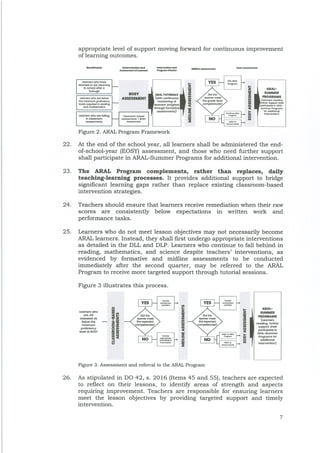
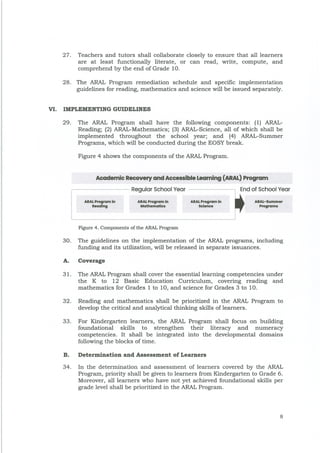
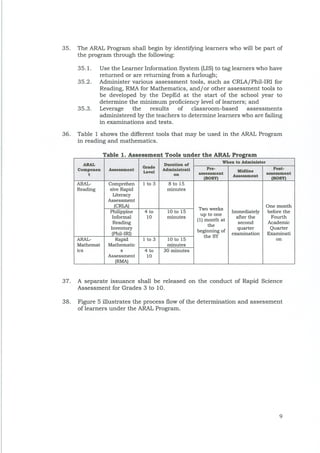
43. Progress checks/assessmentsin the form of teacher-made formative tests
will be conducted to determine whether a learner has acquired the
necessary competencies to advance to the next level or to exit the ARAL
Program. At the end of each quarter or whenever necessary, teachers shall
administer midline assessments to evaluate the learners' progress.
Learners will receive intervention until they reach grade-level
competencies.
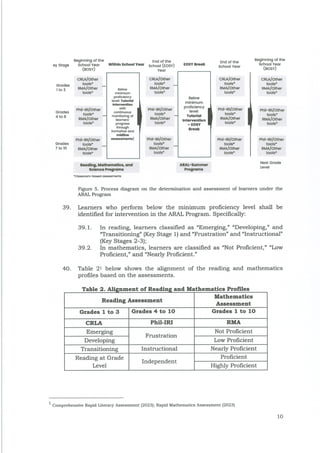
44. Based on the results of progress checks/assessments, tutors and teachers
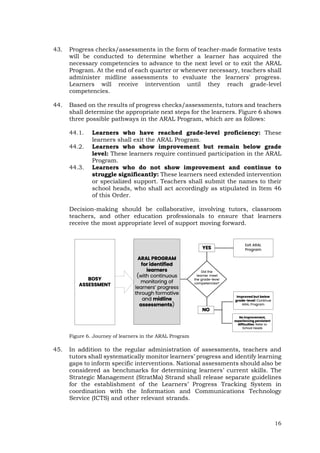
shall determine the appropriate next steps for the learners. Figure 6 shows
three possible pathways in the ARAL Program, which are as follows:
44.1. Learners who have reached grade-level proficiency: These
learners shall exit the ARAL Program.
44.2. Learners who show improvement but remain below grade
level: These learners require continued participation in the ARAL
Program.
44.3. Learners who do not show improvement and continue to
struggle significantly: These learners need extended intervention
or specialized support. Teachers shall submit the names to their
school heads, who shall act accordingly as stipulated in Item 46
of this Order.
Decision-making should be collaborative, involving tutors, classroom
teachers, and other education professionals to ensure that learners
receive the most appropriate level of support moving forward.
Figure 6. Journey of learners in the ARAL Program
45. In addition to the regular administration of assessments, teachers and
tutors shall systematically monitor learners’ progress and identify learning
gaps to inform specific interventions. National assessments should also be
considered as benchmarks for determining learners’ current skills. The
Strategic Management (StratMa) Strand shall release separate guidelines
for the establishment of the Learners’ Progress Tracking System in
coordination with the Information and Communications Technology
Service (ICTS) and other relevant strands.
30.
28
LEVEL OF
GOVERNANCE DUTIESAND RESPONSIBILITIES
● Ensure that the program is seamlessly implemented with the support
of non-teaching personnel, parents/parent-substitutes, tutors, and
other education stakeholders;
● Participate in the learning and development activities (e.g.,
collaborative expertise sessions, benchmarking, etc.) and suggest
relevant training that may be provided on the teaching of Reading,
Mathematics, and Science as necessary; and
● Submit relevant information to the SDO, such as the learners’
progress report, challenges encountered, and actions taken in the
implementation of the program.
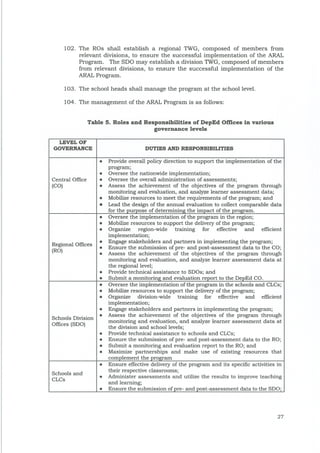
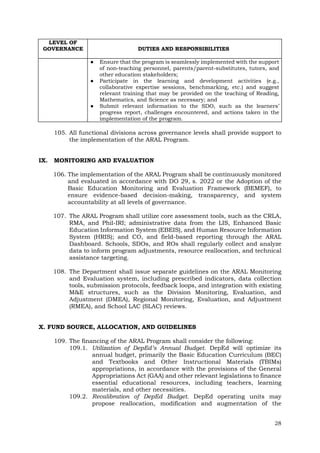
105. All functional divisions across governance levels shall provide support to
the implementation of the ARAL Program.
IX. MONITORING AND EVALUATION
106. The implementation of the ARAL Program shall be continuously monitored
and evaluated in accordance with DO 29, s. 2022 or the Adoption of the
Basic Education Monitoring and Evaluation Framework (BEMEF), to
ensure evidence-based decision-making, transparency, and system
accountability at all levels of governance.
107. The ARAL Program shall utilize core assessment tools, such as the CRLA,
RMA, and Phil-IRI; administrative data from the LIS, Enhanced Basic
Education Information System (EBEIS), and Human Resource Information
System (HRIS); and CO, and field-based reporting through the ARAL
Dashboard. Schools, SDOs, and ROs shall regularly collect and analyze
data to inform program adjustments, resource reallocation, and technical
assistance targeting.
108. The Department shall issue separate guidelines on the ARAL Monitoring
and Evaluation system, including prescribed indicators, data collection
tools, submission protocols, feedback loops, and integration with existing
M&E structures, such as the Division Monitoring, Evaluation, and
Adjustment (DMEA), Regional Monitoring, Evaluation, and Adjustment
(RMEA), and School LAC (SLAC) reviews.
X. FUND SOURCE, ALLOCATION, AND GUIDELINES
109. The financing of the ARAL Program shall consider the following:
109.1. Utilization of DepEd’s Annual Budget. DepEd will optimize its
annual budget, primarily the Basic Education Curriculum (BEC)
and Textbooks and Other Instructional Materials (TBIMs)
appropriations, in accordance with the provisions of the General
Appropriations Act (GAA) and other relevant legislations to finance
essential educational resources, including teachers, learning
materials, and other necessities.
109.2. Recalibration of DepEd Budget. DepEd operating units may
propose reallocation, modification and augmentation of the
31.
29
budget based onthe priorities of the ARAL Program and subject
to the rules governing the modification of allotments.
109.3. Utilization of Special Education Fund (SEF). The SDOs, in
collaboration with the Local School Board, may utilize the SEF to
support the operations of schools/CLCs and the implementation
of interventions subject to the relevant issuances and circulars on
the use of SEF.
109.4. Request for Supplemental Budget. When necessary, DepEd, in
coordination with the Department of Budget and Management,
may propose additional funding to support the implementation of
the ARAL Program.
109.5. Other Fund Sources. Supplementary funds may be sourced from
engagement with LGUs through its Special Education Fund (SEF)
and its other fund sources, enhanced engagement with
development partners, civil society organizations, and other
stakeholders to address funding gaps.
110. The specific fund allocation will be outlined in the fund utilization
guidelines to be released.
111. Under no circumstance shall a learner or teacher be required to shoulder
the undue burden or be compelled to pay for teaching-learning resources
or any activity in place of a performance task or project in any learning
area.
112. Use of funds shall be in accordance with the existing budgeting,
accounting, auditing, and procurement laws, rules and regulations.
X. REFERENCES
113. The following were the references that guided the development of this
policy:
Becker, K. & Park, K. (2011). “Effects of integrative approaches among
science, technology, engineering, and mathematics (STEM) subjects
on students’ learning: A preliminary meta-analysis.” Journal of STEM
Education, Volume 12.
Black, P., & Wiliam, D. (1998). Assessment and Classroom Learning.
Assessment in Education. Assessment in Education, 5, 7-74.
http://dx.doi.org/10.1080/0969595980050102.
De Lange, Jan. (2006). Mathematical Literacy for Living from OECD-PISA
Perspective.
https://www.criced.tsukuba.ac.jp/math/sympo_2006/lange.pdf
Department of Education. (2024). DepEd Order No. 22, s. 2024, Revised
Guidelines on Class and Work Suspension in Schools During
Disasters and Emergencies.
Department of Education. (2024). DepEd Order No. 014, s. 2024, Policy
Guidelines on the Implementation of the MATATAG Curriculum.