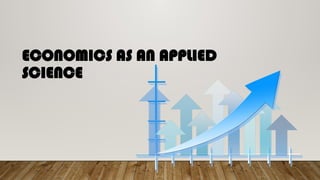
ECONOMICS AS AN APPLIED
SCIENCE
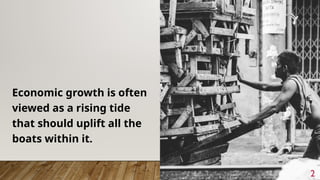
Economic growth is often
viewed as a rising tide
that should uplift all the
boats within it.
2
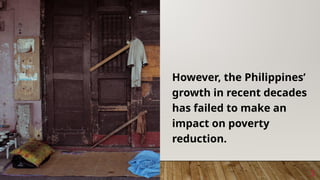
However, the Philippines’
growth in recent decades
has failed to make an
impact on poverty
reduction.
3
3
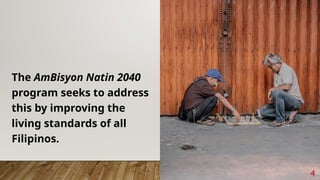
The AmBisyon Natin 2040
program seeks to address
this by improving the
living standards of all
Filipinos.
4
The questions is, how do we achieve this?
5
5
6
Define basic terms in applied economics
(ABM_AE12-Ia-d-1).
7
● Define and understand the concepts of the
three economic questions and the different
factors of production.
● Differentiate the concepts of economic
growth and economic development.
● Understand the value of sustainable
development and inclusive growth.
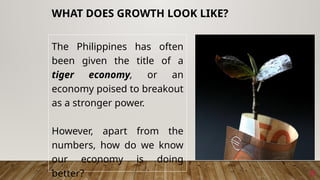
The Philippines has often
been given the title of a
tiger economy, or an
economy poised to breakout
as a stronger power.
However, apart from the
numbers, how do we know
our economy is doing
better? 8
WHAT DOES GROWTH LOOK LIKE?
1. Form groups of three members each. Each
trio is required to prepare a presentation of
three to five slides showing how they
perceive economic growth.
2. Each group will prepare the first two slides
without researching the definition of
economic growth.
9
WHAT DOES GROWTH LOOK LIKE?
3. For the first two slides, students should
include an image (sourced from the internet)
that explains what economic growth looks
like. After preparing the initial two slides,
students can then conduct a brief research
on the definition of economic growth and the
indicators used to measure economic growth.
10
WHAT DOES GROWTH LOOK LIKE?
4. After their brief research, students will prepare
the last few slides to include an image of what
economic growth should look like. The images
should be based on the information they
researched. Students may reuse an image from
their first two slides if applicable.
5. Allow each trio one to two minutes to briefly
share their findings.
11
WHAT DOES GROWTH LOOK LIKE?
12
1. WHAT IS ECONOMIC GROWTH?
2. BASED ON YOUR RESEARCH, WHAT ARE THE
INDICATORS USED TO MEASURE ECONOMIC
GROWTH?
3. BASED ON YOUR RESEARCH, WHAT DID YOU
NOTICE ABOUT HOW ECONOMIC GROWTH IS
MEASURED?
13
How does studying economics as an applied
science bring value to the society I belong to?
14
ECONOMICS AS AN APPLIED SCIENCE
The economic problem forces
people to make choices, and this
same obstacle affects societies,
nations, and the world itself.
Three Economic Questions
15
ECONOMICS AS AN APPLIED SCIENCE
In addressing this problem,
societies are met with three
economic questions of what, how,
and for whom.
Three Economic Questions
16
THREE ECONOMIC QUESTIONS
1. What should we produce?
● Asks what products and services an economy
should focus on producing.
● Forces societies to consider which of their
members’ needs they will prioritize.
17
THREE ECONOMIC QUESTIONS
2. How should we produce it?
● Asks what methods will be used in order to produce
the goods and services needed.
● Considerations include the use of manual labor,
automation, or a mix of both.
18
THREE ECONOMIC QUESTIONS
3. For whom should we produce it?
● Asks who should receive the final goods and
services produced by the economy.
● Goods can be given to all equally, or given to those
who need it most.
● Another consideration is whether goods should be
given to those who can afford it.
19
ECONOMICS AS AN APPLIED SCIENCE
All three economic questions
focus on proper resource
allocation.
This enables society to make
choices in consideration of their
scarce resources.
Three Economic Questions
20
ECONOMICS AS AN APPLIED SCIENCE
Factors of Production
● On a micro level, scarce resources refer to time,
money, and opportunities for new experiences.
● On a macro level, there are four resources that
societies have to properly allocate.
21
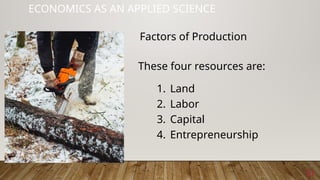
ECONOMICS AS AN APPLIED SCIENCE
These four resources are:
1. Land
2. Labor
3. Capital
4. Entrepreneurship
Factors of Production
22
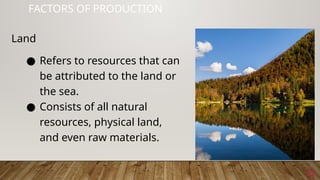
FACTORS OF PRODUCTION
● Refers to resources that can
be attributed to the land or
the sea.
● Consists of all natural
resources, physical land,
and even raw materials.
Land
23
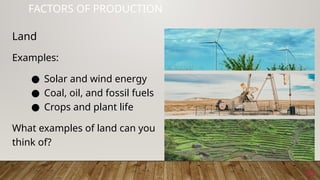
FACTORS OF PRODUCTION
Examples:
● Solar and wind energy
● Coal, oil, and fossil fuels
● Crops and plant life
What examples of land can you
think of?
Land
24
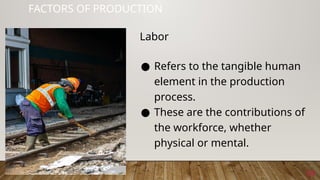
FACTORS OF PRODUCTION
● Refers to the tangible human
element in the production
process.
● These are the contributions of
the workforce, whether
physical or mental.
Labor
25
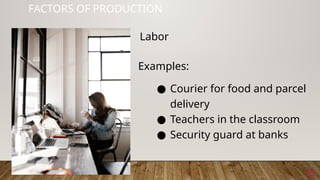
FACTORS OF PRODUCTION
Examples:
● Courier for food and parcel
delivery
● Teachers in the classroom
● Security guard at banks
Labor
26
FACTORS OF PRODUCTION
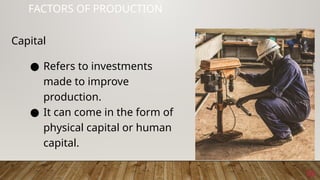
● Refers to investments
made to improve
production.
● It can come in the form of
physical capital or human
capital.
Capital
27
FACTORS OF PRODUCTION: CAPITAL
Physical Capital
● Physical tools and
equipment that make
production more efficient
Examples are heavy
machinery, vehicles, and
improved technology.
● Investments made toward
improving the human
element of production
Examples are better
healthcare and improvements
to education.
Human Capital
28
FACTORS OF PRODUCTION
The intellectual capacity to
organize and put together other
factors of production to produce
goods and services the society
needs.
Entrepreneurship
29
FACTORS OF PRODUCTION
CEOs and founders of private
businesses in different sectors
Entrepreneurship
30
Provide a unique example for each of the four
factors of production. Avoid using examples
already provided in the text.
30
31
ECONOMICS AS AN APPLIED SCIENCE
● The overall expansion of an
economy
● Measured by an increase in
gross domestic product
(GDP)
Economic Growth
32
ECONOMICS AS AN APPLIED SCIENCE
Economic Growth
● Considered as one of the most important goals
that an economy should strive for.
● However, it has its issues:
○ An increase in military spending can cause GDP
to rise but yield no improvements in living
conditions.
○ Increase in wealth can be concentrated among
a small group of elites.
33
ECONOMICS AS AN APPLIED SCIENCE
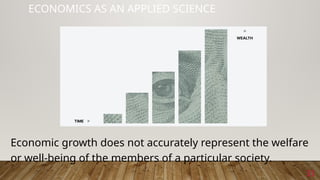
Economic growth does not accurately represent the welfare
or well-being of the members of a particular society.
34
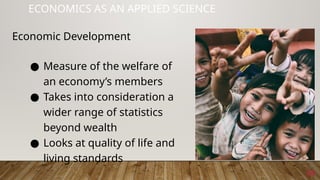
ECONOMICS AS AN APPLIED SCIENCE
● Measure of the welfare of
an economy’s members
● Takes into consideration a
wider range of statistics
beyond wealth
● Looks at quality of life and
living standards
Economic Development
35
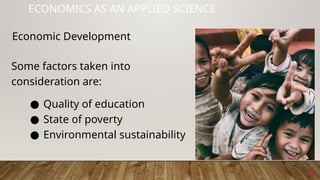
ECONOMICS AS AN APPLIED SCIENCE
Some factors taken into
consideration are:
● Quality of education
● State of poverty
● Environmental sustainability
Economic Development
36
ECONOMICS AS AN APPLIED SCIENCE
Economic Growth & Development
● Economic growth can contribute to economic
development.
● An increase in an economy’s wealth may create
more jobs and opportunities.
37
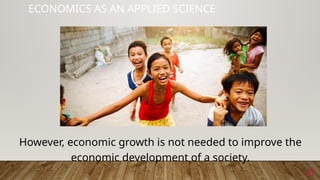
ECONOMICS AS AN APPLIED SCIENCE
However, economic growth is not needed to improve the
economic development of a society.
38
What other factors would you take into
consideration when measuring economic
development?
38
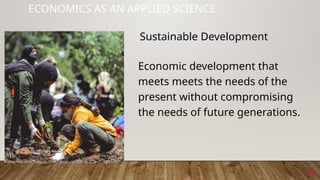
39
ECONOMICS AS AN APPLIED SCIENCE
Economic development that
meets meets the needs of the
present without compromising
the needs of future generations.
Sustainable Development
40
ECONOMICS AS AN APPLIED SCIENCE
Inclusive Growth
● One of the key goals of AmBisyon 2040
● Growth that not only benefits the elite but helps all
members of a society
● Helps eliminate poverty and improves living
standards
41
ECONOMICS AS AN APPLIED SCIENCE
● You will learn to discern
decisions (by governments
and societies) not just by
their explicit costs but also
their opportunity costs.
● It will enable you to make
well-informed opinions and
decisions.
IT WILL HELP YOU
MAKE BETTER
DECISIONS NOT
JUST FOR YOURSELF
OR FOR THOSE
AROUND YOU, BUT
ALSO FOR FUTURE
GENERATIONS.
Why study economics?
42
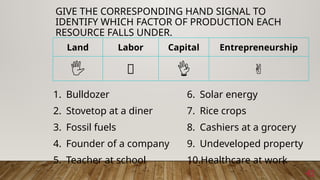
GIVE THE CORRESPONDING HAND SIGNAL TO
IDENTIFY WHICH FACTOR OF PRODUCTION EACH
RESOURCE FALLS UNDER.
Land Labor Capital Entrepreneurship
🖐 ✊ 👌 ✌
1. Bulldozer
2. Stovetop at a diner
3. Fossil fuels
4. Founder of a company
5. Teacher at school
6. Solar energy
7. Rice crops
8. Cashiers at a grocery
9. Undeveloped property
10.Healthcare at work
Apart from environmental considerations,
what is another threat to sustainable
development?
44
● The three economic questions are “what should
be produced?”, “how should they be
produced?”, and “for whom should they be
produced?”
● The four factors of production that societies try
to allocate are land, labor, capital, and
entrepreneurship.
45
● Economic growth refers to an increase in the
GDP of a country within a specific time period.
Economic development focuses on the
improvement of the welfare of a country’s
citizens.
● Economics is valuable as a discipline because of
how it teaches you to make better decisions for
yourself, the people around you, and future
generations.

Applied-Economics-2 (1).ppttytuyiuiyhttrt

  • 1.
    ECONOMICS AS ANAPPLIED SCIENCE
  • 2.
    Economic growth isoften viewed as a rising tide that should uplift all the boats within it. 2
  • 3.
    However, the Philippines’ growthin recent decades has failed to make an impact on poverty reduction. 3 3
  • 4.
    The AmBisyon Natin2040 program seeks to address this by improving the living standards of all Filipinos. 4
  • 5.
    The questions is,how do we achieve this? 5 5
  • 6.
    6 Define basic termsin applied economics (ABM_AE12-Ia-d-1).
  • 7.
    7 ● Define andunderstand the concepts of the three economic questions and the different factors of production. ● Differentiate the concepts of economic growth and economic development. ● Understand the value of sustainable development and inclusive growth.
  • 8.
    The Philippines hasoften been given the title of a tiger economy, or an economy poised to breakout as a stronger power. However, apart from the numbers, how do we know our economy is doing better? 8 WHAT DOES GROWTH LOOK LIKE?
  • 9.
    1. Form groupsof three members each. Each trio is required to prepare a presentation of three to five slides showing how they perceive economic growth. 2. Each group will prepare the first two slides without researching the definition of economic growth. 9 WHAT DOES GROWTH LOOK LIKE?
  • 10.
    3. For thefirst two slides, students should include an image (sourced from the internet) that explains what economic growth looks like. After preparing the initial two slides, students can then conduct a brief research on the definition of economic growth and the indicators used to measure economic growth. 10 WHAT DOES GROWTH LOOK LIKE?
  • 11.
    4. After theirbrief research, students will prepare the last few slides to include an image of what economic growth should look like. The images should be based on the information they researched. Students may reuse an image from their first two slides if applicable. 5. Allow each trio one to two minutes to briefly share their findings. 11 WHAT DOES GROWTH LOOK LIKE?
  • 12.
    12 1. WHAT ISECONOMIC GROWTH? 2. BASED ON YOUR RESEARCH, WHAT ARE THE INDICATORS USED TO MEASURE ECONOMIC GROWTH? 3. BASED ON YOUR RESEARCH, WHAT DID YOU NOTICE ABOUT HOW ECONOMIC GROWTH IS MEASURED?
  • 13.
    13 How does studyingeconomics as an applied science bring value to the society I belong to?
  • 14.
    14 ECONOMICS AS ANAPPLIED SCIENCE The economic problem forces people to make choices, and this same obstacle affects societies, nations, and the world itself. Three Economic Questions
  • 15.
    15 ECONOMICS AS ANAPPLIED SCIENCE In addressing this problem, societies are met with three economic questions of what, how, and for whom. Three Economic Questions
  • 16.
    16 THREE ECONOMIC QUESTIONS 1.What should we produce? ● Asks what products and services an economy should focus on producing. ● Forces societies to consider which of their members’ needs they will prioritize.
  • 17.
    17 THREE ECONOMIC QUESTIONS 2.How should we produce it? ● Asks what methods will be used in order to produce the goods and services needed. ● Considerations include the use of manual labor, automation, or a mix of both.
  • 18.
    18 THREE ECONOMIC QUESTIONS 3.For whom should we produce it? ● Asks who should receive the final goods and services produced by the economy. ● Goods can be given to all equally, or given to those who need it most. ● Another consideration is whether goods should be given to those who can afford it.
  • 19.
    19 ECONOMICS AS ANAPPLIED SCIENCE All three economic questions focus on proper resource allocation. This enables society to make choices in consideration of their scarce resources. Three Economic Questions
  • 20.
    20 ECONOMICS AS ANAPPLIED SCIENCE Factors of Production ● On a micro level, scarce resources refer to time, money, and opportunities for new experiences. ● On a macro level, there are four resources that societies have to properly allocate.
  • 21.
    21 ECONOMICS AS ANAPPLIED SCIENCE These four resources are: 1. Land 2. Labor 3. Capital 4. Entrepreneurship Factors of Production
  • 22.
    22 FACTORS OF PRODUCTION ●Refers to resources that can be attributed to the land or the sea. ● Consists of all natural resources, physical land, and even raw materials. Land
  • 23.
    23 FACTORS OF PRODUCTION Examples: ●Solar and wind energy ● Coal, oil, and fossil fuels ● Crops and plant life What examples of land can you think of? Land
  • 24.
    24 FACTORS OF PRODUCTION ●Refers to the tangible human element in the production process. ● These are the contributions of the workforce, whether physical or mental. Labor
  • 25.
    25 FACTORS OF PRODUCTION Examples: ●Courier for food and parcel delivery ● Teachers in the classroom ● Security guard at banks Labor
  • 26.
    26 FACTORS OF PRODUCTION ●Refers to investments made to improve production. ● It can come in the form of physical capital or human capital. Capital
  • 27.
    27 FACTORS OF PRODUCTION:CAPITAL Physical Capital ● Physical tools and equipment that make production more efficient Examples are heavy machinery, vehicles, and improved technology. ● Investments made toward improving the human element of production Examples are better healthcare and improvements to education. Human Capital
  • 28.
    28 FACTORS OF PRODUCTION Theintellectual capacity to organize and put together other factors of production to produce goods and services the society needs. Entrepreneurship
  • 29.
    29 FACTORS OF PRODUCTION CEOsand founders of private businesses in different sectors Entrepreneurship
  • 30.
    30 Provide a uniqueexample for each of the four factors of production. Avoid using examples already provided in the text. 30
  • 31.
    31 ECONOMICS AS ANAPPLIED SCIENCE ● The overall expansion of an economy ● Measured by an increase in gross domestic product (GDP) Economic Growth
  • 32.
    32 ECONOMICS AS ANAPPLIED SCIENCE Economic Growth ● Considered as one of the most important goals that an economy should strive for. ● However, it has its issues: ○ An increase in military spending can cause GDP to rise but yield no improvements in living conditions. ○ Increase in wealth can be concentrated among a small group of elites.
  • 33.
    33 ECONOMICS AS ANAPPLIED SCIENCE Economic growth does not accurately represent the welfare or well-being of the members of a particular society.
  • 34.
    34 ECONOMICS AS ANAPPLIED SCIENCE ● Measure of the welfare of an economy’s members ● Takes into consideration a wider range of statistics beyond wealth ● Looks at quality of life and living standards Economic Development
  • 35.
    35 ECONOMICS AS ANAPPLIED SCIENCE Some factors taken into consideration are: ● Quality of education ● State of poverty ● Environmental sustainability Economic Development
  • 36.
    36 ECONOMICS AS ANAPPLIED SCIENCE Economic Growth & Development ● Economic growth can contribute to economic development. ● An increase in an economy’s wealth may create more jobs and opportunities.
  • 37.
    37 ECONOMICS AS ANAPPLIED SCIENCE However, economic growth is not needed to improve the economic development of a society.
  • 38.
    38 What other factorswould you take into consideration when measuring economic development? 38
  • 39.
    39 ECONOMICS AS ANAPPLIED SCIENCE Economic development that meets meets the needs of the present without compromising the needs of future generations. Sustainable Development
  • 40.
    40 ECONOMICS AS ANAPPLIED SCIENCE Inclusive Growth ● One of the key goals of AmBisyon 2040 ● Growth that not only benefits the elite but helps all members of a society ● Helps eliminate poverty and improves living standards
  • 41.
    41 ECONOMICS AS ANAPPLIED SCIENCE ● You will learn to discern decisions (by governments and societies) not just by their explicit costs but also their opportunity costs. ● It will enable you to make well-informed opinions and decisions. IT WILL HELP YOU MAKE BETTER DECISIONS NOT JUST FOR YOURSELF OR FOR THOSE AROUND YOU, BUT ALSO FOR FUTURE GENERATIONS. Why study economics?
  • 42.
    42 GIVE THE CORRESPONDINGHAND SIGNAL TO IDENTIFY WHICH FACTOR OF PRODUCTION EACH RESOURCE FALLS UNDER. Land Labor Capital Entrepreneurship 🖐 ✊ 👌 ✌ 1. Bulldozer 2. Stovetop at a diner 3. Fossil fuels 4. Founder of a company 5. Teacher at school 6. Solar energy 7. Rice crops 8. Cashiers at a grocery 9. Undeveloped property 10.Healthcare at work
  • 43.
    Apart from environmentalconsiderations, what is another threat to sustainable development?
  • 44.
    44 ● The threeeconomic questions are “what should be produced?”, “how should they be produced?”, and “for whom should they be produced?” ● The four factors of production that societies try to allocate are land, labor, capital, and entrepreneurship.
  • 45.
    45 ● Economic growthrefers to an increase in the GDP of a country within a specific time period. Economic development focuses on the improvement of the welfare of a country’s citizens. ● Economics is valuable as a discipline because of how it teaches you to make better decisions for yourself, the people around you, and future generations.

Editor's Notes

  • #12 For the answer key, please refer to the answer key of the study guide provided in the Teacher's Content.
  • #30 For the answer key, please refer to the answer key of the study guide provided in the Teacher's Content.
  • #38 For the answer key, please refer to the answer key of the study guide provided in the Teacher's Content.
  • #42 For the answer key, please refer to the answer key of the study guide provided in the Teacher's Content.
  • #43 For the suggested rubric, please refer to the study guide.