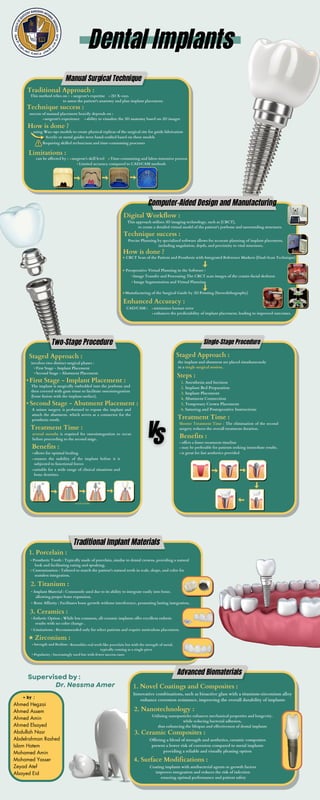
Dental Implants
Manual Surgical Technique
Computer-Aided Design and Manufacturing
Manufacturing of the Surgical Guide by 3D Printing (Stereolithography)
This approach utilizes 3D imaging technology, such as (CBCT),
to create a detailed virtual model of the patient's jawbone and surrounding structures.
Precise Planning by specialized software allows for accurate planning of implant placement,
including angulation, depth, and proximity to vital structures.
CAD/CAM : minimizes human error
enhances the predictability of implant placement, leading to improved outcomes.
Prosthetic Tooth : Typically made of porcelain, similar to dental crowns, providing a natural
look and facilitating eating and speaking.
Customization : Tailored to match the patient's natural teeth in scale, shape, and color for
seamless integration.
Implant Material : Commonly used due to its ability to integrate easily into bone,
allowing proper bone expansion.
Strength and Realism : Resembles real teeth like porcelain but with the strength of metal,
typically coming as a single piece
Single-Stage Procedure
Two-Stage Procedure
Advanced Biomaterials
Traditional Implant Materials
by :
Ahmed Hegzai
Ahmed Assem
Ahmed Amin
Ahmed Elsayed
Abdullah Nasr
Abdelrahman Rashed
Islam Hatem
Mohamed Amin
Mohamed Yasser
Zeyad Atef
Alsayed Eid
★
1. Novel Coatings and Composites :
Innovative combinations, such as bioactive glass with a titanium-zirconium alloy
enhance corrosion resistance, improving the overall durability of implants
2. Nanotechnology :
Utilizing nanoparticles enhances mechanical properties and longevity.
while reducing bacterial adhesion,
thus enhancing the lifespan and effectiveness of dental implants
3. Ceramic Composites :
Offering a blend of strength and aesthetics, ceramic composites
present a lower risk of corrosion compared to metal implants
providing a reliable and visually pleasing option
4. Surface Modifications :
Coating implants with antibacterial agents or growth factors
improves integration and reduces the risk of infection
ensuring optimal performance and patient safety
1. Porcelain :
•
•
2. Titanium :
Bone Affinity : Facilitates bone growth without interference, promoting lasting integration.
•
•
3. Ceramics :
Esthetic Option : While less common, all-ceramic implants offer excellent esthetic
results with no color change .
Limitations : Recommended only for select patients and require meticulous placement.
•
•
Zirconium :
Popularity : Increasingly used but with fewer success cases
•
•
Traditional Approach :
This method relies on :
to assess the patient's anatomy and plan implant placement.
• surgeon's expertise • 2D X-rays
Digital Workflow :
Technique success :
success of manual placement heavily depends on :
surgeon's experience ability to visualize the 3D anatomy based on 2D images
• •
Technique success :
How is done ?
using Wax-ups models to create physical replicas of the surgical site for guide fabrication
Acrylic or metal guides were hand-crafted based on these models
Requiring skilled technicians and time-consuming processes
How is done ?
CBCT Scan of the Patient and Prosthesis with Integrated Reference Markers (Dual-Scan Technique)
Preoperative Virtual Planning in the Software :
Image Transfer and Processing The CBCT scan images of the cranio-facial skeleton
Image Segmentation and Virtual Planning
•
•
★
★
★
Limitations :
can be affected by : • surgeon's skill level • Time-consuming and labor-intensive process
• Limited accuracy compared to CAD/CAM methods
Enhanced Accuracy :
•
•
Staged Approach :
involves two distinct surgical phases :
First Stage - Implant Placement
Second Stage - Abutment Placement
•
•
Staged Approach :
the implant and abutment are placed simultaneously
in a single surgical session.
First Stage - Implant Placement :
The implant is surgically embedded into the jawbone and
then covered with gum tissue to facilitate osseointegration
(bone fusion with the implant surface).
Second Stage - Abutment Placement :
A minor surgery is performed to expose the implant and
attach the abutment, which serves as a connector for the
prosthetic tooth.
★
★
★
Treatment Time :
several months is required for osseointegration to occur
before proceeding to the second stage.
Benefits :
allows for optimal healing
suitable for a wide range of clinical situations and
bone densities.
ensures the stability of the implant before it is
subjected to functional forces
•
•
•
Steps :
1. Anesthesia and Incision
2. Implant Bed Preparation
3. Implant Placement
4. Abutment Connection
5. Temporary Crown Placement
6. Suturing and Postoperative Instructions
Treatment Time :
Shorter Treatment Time : The elimination of the second
surgery reduces the overall treatment duration.
Benefits :
offers a faster treatment timeline
is great for fast aesthetics provided
may be preferable for patients seeking immediate results.
•
•
•
several months
Supervised by :
Dr. Nessma Amer

Applied BioMaterials [ Dental implants ] , Final Edition.pdf

  • 1.
    Dental Implants Manual SurgicalTechnique Computer-Aided Design and Manufacturing Manufacturing of the Surgical Guide by 3D Printing (Stereolithography) This approach utilizes 3D imaging technology, such as (CBCT), to create a detailed virtual model of the patient's jawbone and surrounding structures. Precise Planning by specialized software allows for accurate planning of implant placement, including angulation, depth, and proximity to vital structures. CAD/CAM : minimizes human error enhances the predictability of implant placement, leading to improved outcomes. Prosthetic Tooth : Typically made of porcelain, similar to dental crowns, providing a natural look and facilitating eating and speaking. Customization : Tailored to match the patient's natural teeth in scale, shape, and color for seamless integration. Implant Material : Commonly used due to its ability to integrate easily into bone, allowing proper bone expansion. Strength and Realism : Resembles real teeth like porcelain but with the strength of metal, typically coming as a single piece Single-Stage Procedure Two-Stage Procedure Advanced Biomaterials Traditional Implant Materials by : Ahmed Hegzai Ahmed Assem Ahmed Amin Ahmed Elsayed Abdullah Nasr Abdelrahman Rashed Islam Hatem Mohamed Amin Mohamed Yasser Zeyad Atef Alsayed Eid ★ 1. Novel Coatings and Composites : Innovative combinations, such as bioactive glass with a titanium-zirconium alloy enhance corrosion resistance, improving the overall durability of implants 2. Nanotechnology : Utilizing nanoparticles enhances mechanical properties and longevity. while reducing bacterial adhesion, thus enhancing the lifespan and effectiveness of dental implants 3. Ceramic Composites : Offering a blend of strength and aesthetics, ceramic composites present a lower risk of corrosion compared to metal implants providing a reliable and visually pleasing option 4. Surface Modifications : Coating implants with antibacterial agents or growth factors improves integration and reduces the risk of infection ensuring optimal performance and patient safety 1. Porcelain : • • 2. Titanium : Bone Affinity : Facilitates bone growth without interference, promoting lasting integration. • • 3. Ceramics : Esthetic Option : While less common, all-ceramic implants offer excellent esthetic results with no color change . Limitations : Recommended only for select patients and require meticulous placement. • • Zirconium : Popularity : Increasingly used but with fewer success cases • • Traditional Approach : This method relies on : to assess the patient's anatomy and plan implant placement. • surgeon's expertise • 2D X-rays Digital Workflow : Technique success : success of manual placement heavily depends on : surgeon's experience ability to visualize the 3D anatomy based on 2D images • • Technique success : How is done ? using Wax-ups models to create physical replicas of the surgical site for guide fabrication Acrylic or metal guides were hand-crafted based on these models Requiring skilled technicians and time-consuming processes How is done ? CBCT Scan of the Patient and Prosthesis with Integrated Reference Markers (Dual-Scan Technique) Preoperative Virtual Planning in the Software : Image Transfer and Processing The CBCT scan images of the cranio-facial skeleton Image Segmentation and Virtual Planning • • ★ ★ ★ Limitations : can be affected by : • surgeon's skill level • Time-consuming and labor-intensive process • Limited accuracy compared to CAD/CAM methods Enhanced Accuracy : • • Staged Approach : involves two distinct surgical phases : First Stage - Implant Placement Second Stage - Abutment Placement • • Staged Approach : the implant and abutment are placed simultaneously in a single surgical session. First Stage - Implant Placement : The implant is surgically embedded into the jawbone and then covered with gum tissue to facilitate osseointegration (bone fusion with the implant surface). Second Stage - Abutment Placement : A minor surgery is performed to expose the implant and attach the abutment, which serves as a connector for the prosthetic tooth. ★ ★ ★ Treatment Time : several months is required for osseointegration to occur before proceeding to the second stage. Benefits : allows for optimal healing suitable for a wide range of clinical situations and bone densities. ensures the stability of the implant before it is subjected to functional forces • • • Steps : 1. Anesthesia and Incision 2. Implant Bed Preparation 3. Implant Placement 4. Abutment Connection 5. Temporary Crown Placement 6. Suturing and Postoperative Instructions Treatment Time : Shorter Treatment Time : The elimination of the second surgery reduces the overall treatment duration. Benefits : offers a faster treatment timeline is great for fast aesthetics provided may be preferable for patients seeking immediate results. • • • several months Supervised by : Dr. Nessma Amer