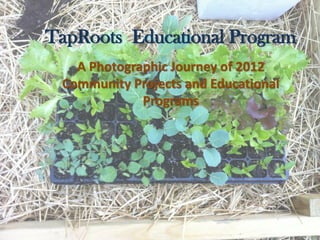
TapRoots Educational Program
   A Photographic Journey of 2012
 Community Projects and Educational
             Programs
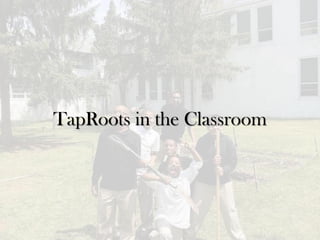
TapRoots in the Classroom
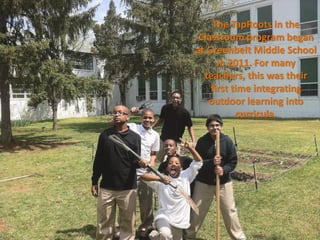
The TapRoots in the
 Classroom program began
at Greenbelt Middle School
      in 2011. For many
  teachers, this was their
    first time integrating
   outdoor learning into
           curricula.
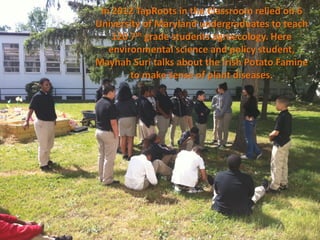
In 2012 TapRoots in the Classroom relied on 6
University of Maryland undergraduates to teach
    120 7th grade students agroecology. Here
   environmental science and policy student,
Mayhah Suri talks about the Irish Potato Famine
        to make sense of plant diseases.
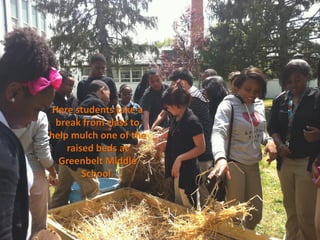
Here students take a
  break from class to
help mulch one of the
    raised beds at
   Greenbelt Middle
        School.
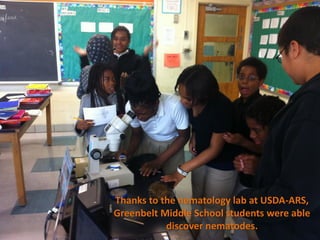
Thanks to the nematology lab at USDA-ARS,
Greenbelt Middle School students were able
           discover nematodes.
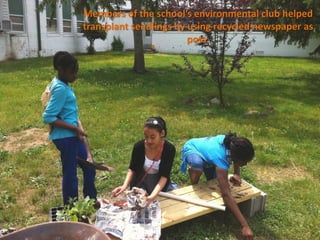
Members of the school’s environmental club helped
transplant seedlings by using recycled newspaper as
                        pots.
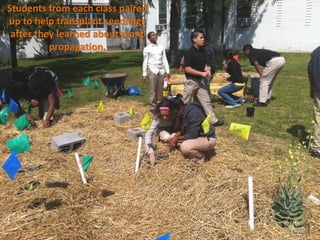
Students from each class paired
up to help transplant seedlings
 after they learned about plant
          propagation.
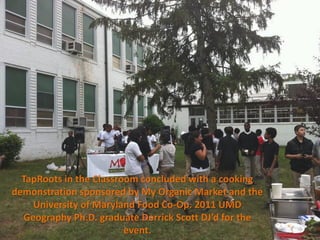
TapRoots in the Classroom concluded with a cooking
demonstration sponsored by My Organic Market and the
    University of Maryland Food Co-Op. 2011 UMD
  Geography Ph.D. graduate Derrick Scott DJ’d for the
                         event.
Young Ecological Stewards
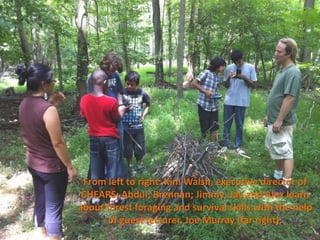
From left to right: Kim Walsh, executive director of
 CHEARS; Abdul; Brennan; Jimmy; Jay and Alex learn
about forest foraging and survival skills with the help
      of guest lecturer, Joe Murray (far right).
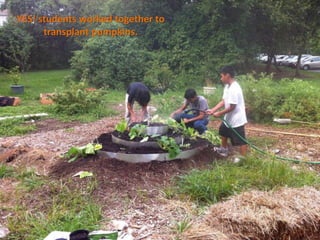
YES! students worked together to
      transplant pumpkins.
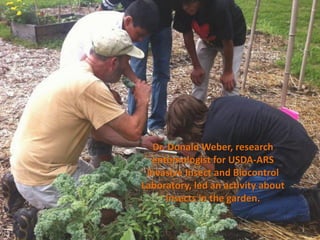
Dr. Donald Weber, research
  entomologist for USDA-ARS
 Invasive Insect and Biocontrol
Laboratory, led an activity about
      insects in the garden.
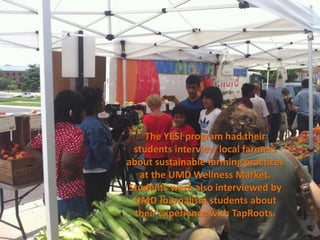
The YES! program had their
 students interview local farmers
about sustainable farming practices
   at the UMD Wellness Market.
Students were also interviewed by
 UMD Journalism students about
  their experience with TapRoots.
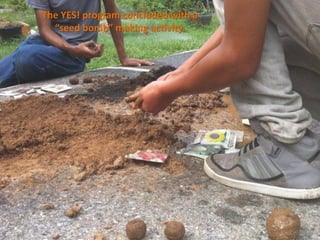
The YES! program concluded with a
  “seed bomb” making activity.
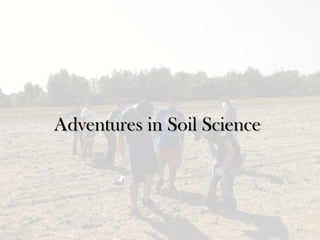
Adventures in Soil Science
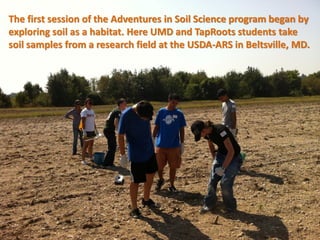
The first session of the Adventures in Soil Science program began by
exploring soil as a habitat. Here UMD and TapRoots students take
soil samples from a research field at the USDA-ARS in Beltsville, MD.
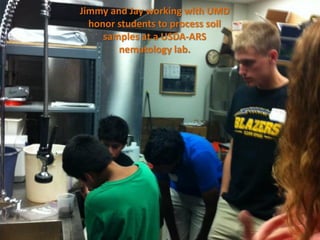
Jimmy and Jay working with UMD
  honor students to process soil
     samples at a USDA-ARS
        nematology lab.
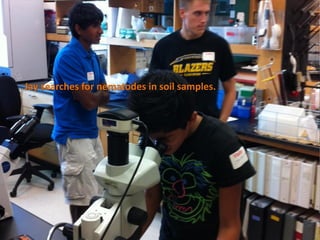
Jay searches for nematodes in soil samples.
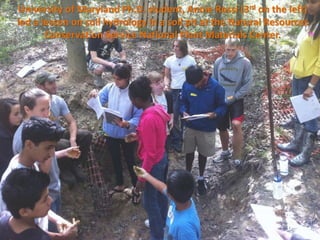
University of Maryland Ph.D. student, Annie Rossi (3rd on the left)
led a lesson on soil hydrology in a soil pit at the Natural Resources
       Conservation Service National Plant Materials Center.
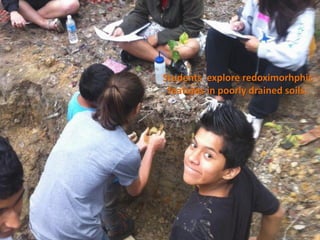
Students explore redoximorhphic
 features in poorly drained soils.
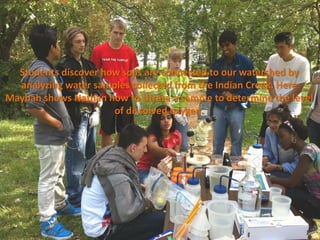
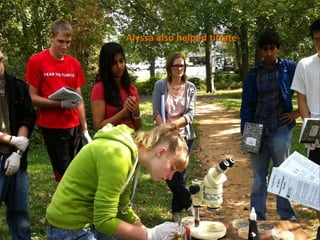
Students discover how soils are connected to our watershed by
  analyzing water samples collected from the Indian Creek. Here
Mayhah shows Nathan how to titrate a sample to determine the level
                      of dissolved oxygen.
Alyssa also helped titrate.
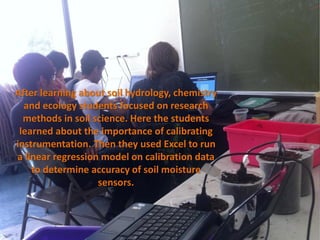
After learning about soil hydrology, chemistry
  and ecology students focused on research
  methods in soil science. Here the students
 learned about the importance of calibrating
instrumentation. Then they used Excel to run
a linear regression model on calibration data
    to determine accuracy of soil moisture
                   sensors.
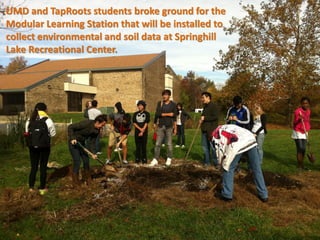
UMD and TapRoots students broke ground for the
Modular Learning Station that will be installed to
collect environmental and soil data at Springhill
Lake Recreational Center.
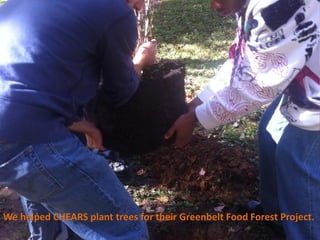
We helped CHEARS plant trees for their Greenbelt Food Forest Project.
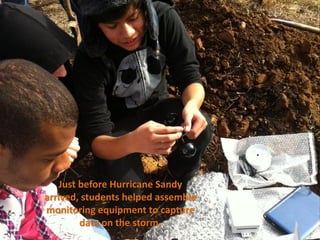
Just before Hurricane Sandy
arrived, students helped assemble
monitoring equipment to capture
         data on the storm.
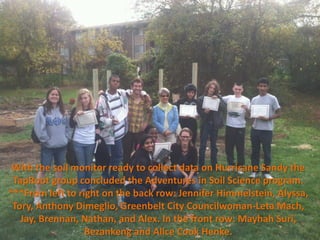
With the soil monitor ready to collect data on Hurricane Sandy the
 TapRoot group concluded the Adventures in Soil Science program.
***From left to right on the back row: Jennifer Himmelstein, Alyssa,
 Tory, Anthony Dimeglio, Greenbelt City Councilwoman-Leta Mach,
   Jay, Brennan, Nathan, and Alex. In the front row: Mayhah Suri,
                  Bezankeng and Alice Cook Henke.
Conversations with TapRoots
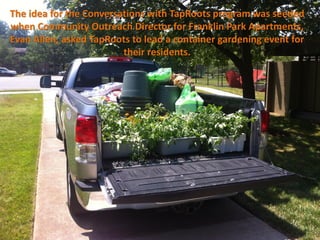
The idea for the Conversations with TapRoots program was seeded
when Community Outreach Director for Franklin Park Apartments,
Evan Allen, asked TapRoots to lead a container gardening event for
                         their residents.
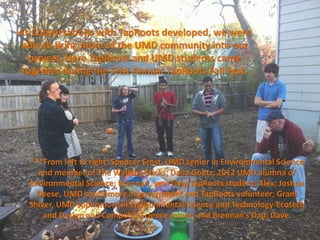
As Conversations with TapRoots developed, we were
 able to bring more of the UMD community into our
   project. Here TapRoots and UMD students came
 together during the Frist Annual TapRoots Fall Fest.


  ***From left to right: Spencer Ernst, UMD senior in Environmental Science
    and member of The Walking Sticks; Dana Goetz, 2012 UMD alumna of
  Environmental Science; Brennan, year long TapRoots student; Alex; Joshua
    Deese, UMD sophomore in government and TapRoots volunteer; Grant
  Shiver, UMD sophomore in Environmental Science and Technology-Ecotech
      and Design and Computer Science minor; and Brennan’s Dad, Dave.
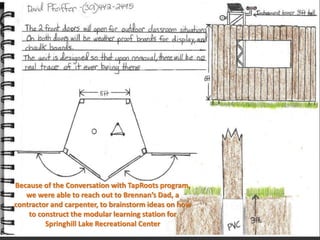
Because of the Conversation with TapRoots program,
   we were able to reach out to Brennan’s Dad, a
contractor and carpenter, to brainstorm ideas on how
    to construct the modular learning station for
         Springhill Lake Recreational Center
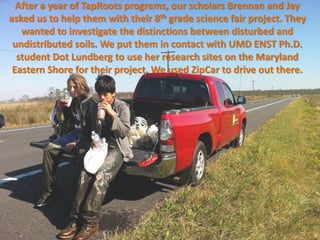
After a year of TapRoots programs, our scholars Brennan and Jay
asked us to help them with their 8th grade science fair project. They
   wanted to investigate the distinctions between disturbed and
 undistributed soils. We put them in contact with UMD ENST Ph.D.
  student Dot Lundberg to use her research sites on the Maryland
 Eastern Shore for their project. We used ZipCar to drive out there.
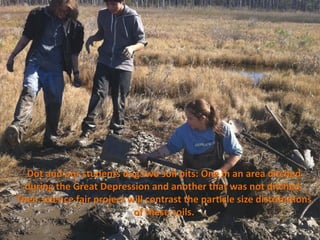
Dot and our students dug two soil pits: One in an area ditched
  during the Great Depression and another that was not ditched.
Their science fair project will contrast the particle size distributions
                            of these soils.
With the help of NRCS soil scientist, Jim Brewers, we were able to
              extract monoliths from each soil pit.
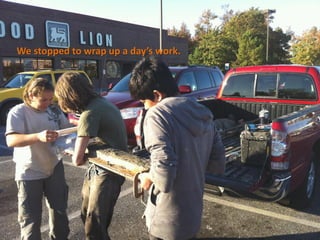
We stopped to wrap up a day’s work.
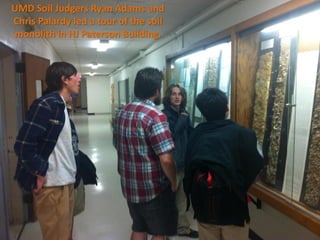
UMD Soil Judgers Ryan Adams and
Chris Palardy led a tour of the soil
monolith in HJ Paterson Building.
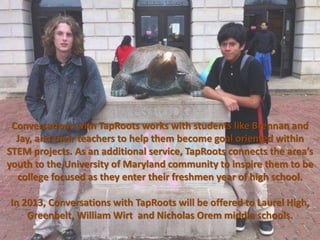
Conversations with TapRoots works with students like Brennan and
  Jay, and their teachers to help them become goal oriented within
STEM projects. As an additional service, TapRoots connects the area’s
youth to the University of Maryland community to inspire them to be
  college focused as they enter their freshmen year of high school.

In 2013, Conversations with TapRoots will be offered to Laurel High,
    Greenbelt, William Wirt and Nicholas Orem middle schools.

Appendix ii a photo essay

  • 1.
    TapRoots Educational Program A Photographic Journey of 2012 Community Projects and Educational Programs
  • 2.
    TapRoots in theClassroom
  • 3.
    The TapRoots inthe Classroom program began at Greenbelt Middle School in 2011. For many teachers, this was their first time integrating outdoor learning into curricula.
  • 4.
    In 2012 TapRootsin the Classroom relied on 6 University of Maryland undergraduates to teach 120 7th grade students agroecology. Here environmental science and policy student, Mayhah Suri talks about the Irish Potato Famine to make sense of plant diseases.
  • 5.
    Here students takea break from class to help mulch one of the raised beds at Greenbelt Middle School.
  • 6.
    Thanks to thenematology lab at USDA-ARS, Greenbelt Middle School students were able discover nematodes.
  • 7.
    Members of theschool’s environmental club helped transplant seedlings by using recycled newspaper as pots.
  • 8.
    Students from eachclass paired up to help transplant seedlings after they learned about plant propagation.
  • 9.
    TapRoots in theClassroom concluded with a cooking demonstration sponsored by My Organic Market and the University of Maryland Food Co-Op. 2011 UMD Geography Ph.D. graduate Derrick Scott DJ’d for the event.
  • 10.
  • 11.
    From left toright: Kim Walsh, executive director of CHEARS; Abdul; Brennan; Jimmy; Jay and Alex learn about forest foraging and survival skills with the help of guest lecturer, Joe Murray (far right).
  • 12.
    YES! students workedtogether to transplant pumpkins.
  • 13.
    Dr. Donald Weber,research entomologist for USDA-ARS Invasive Insect and Biocontrol Laboratory, led an activity about insects in the garden.
  • 14.
    The YES! programhad their students interview local farmers about sustainable farming practices at the UMD Wellness Market. Students were also interviewed by UMD Journalism students about their experience with TapRoots.
  • 15.
    The YES! programconcluded with a “seed bomb” making activity.
  • 16.
  • 17.
    The first sessionof the Adventures in Soil Science program began by exploring soil as a habitat. Here UMD and TapRoots students take soil samples from a research field at the USDA-ARS in Beltsville, MD.
  • 18.
    Jimmy and Jayworking with UMD honor students to process soil samples at a USDA-ARS nematology lab.
  • 19.
    Jay searches fornematodes in soil samples.
  • 20.
    University of MarylandPh.D. student, Annie Rossi (3rd on the left) led a lesson on soil hydrology in a soil pit at the Natural Resources Conservation Service National Plant Materials Center.
  • 21.
    Students explore redoximorhphic features in poorly drained soils.
  • 22.
    Students discover howsoils are connected to our watershed by analyzing water samples collected from the Indian Creek. Here Mayhah shows Nathan how to titrate a sample to determine the level of dissolved oxygen.
  • 23.
  • 24.
    After learning aboutsoil hydrology, chemistry and ecology students focused on research methods in soil science. Here the students learned about the importance of calibrating instrumentation. Then they used Excel to run a linear regression model on calibration data to determine accuracy of soil moisture sensors.
  • 25.
    UMD and TapRootsstudents broke ground for the Modular Learning Station that will be installed to collect environmental and soil data at Springhill Lake Recreational Center.
  • 26.
    We helped CHEARSplant trees for their Greenbelt Food Forest Project.
  • 27.
    Just before HurricaneSandy arrived, students helped assemble monitoring equipment to capture data on the storm.
  • 28.
    With the soilmonitor ready to collect data on Hurricane Sandy the TapRoot group concluded the Adventures in Soil Science program. ***From left to right on the back row: Jennifer Himmelstein, Alyssa, Tory, Anthony Dimeglio, Greenbelt City Councilwoman-Leta Mach, Jay, Brennan, Nathan, and Alex. In the front row: Mayhah Suri, Bezankeng and Alice Cook Henke.
  • 29.
  • 30.
    The idea forthe Conversations with TapRoots program was seeded when Community Outreach Director for Franklin Park Apartments, Evan Allen, asked TapRoots to lead a container gardening event for their residents.
  • 31.
    As Conversations withTapRoots developed, we were able to bring more of the UMD community into our project. Here TapRoots and UMD students came together during the Frist Annual TapRoots Fall Fest. ***From left to right: Spencer Ernst, UMD senior in Environmental Science and member of The Walking Sticks; Dana Goetz, 2012 UMD alumna of Environmental Science; Brennan, year long TapRoots student; Alex; Joshua Deese, UMD sophomore in government and TapRoots volunteer; Grant Shiver, UMD sophomore in Environmental Science and Technology-Ecotech and Design and Computer Science minor; and Brennan’s Dad, Dave.
  • 32.
    Because of theConversation with TapRoots program, we were able to reach out to Brennan’s Dad, a contractor and carpenter, to brainstorm ideas on how to construct the modular learning station for Springhill Lake Recreational Center
  • 33.
    After a yearof TapRoots programs, our scholars Brennan and Jay asked us to help them with their 8th grade science fair project. They wanted to investigate the distinctions between disturbed and undistributed soils. We put them in contact with UMD ENST Ph.D. student Dot Lundberg to use her research sites on the Maryland Eastern Shore for their project. We used ZipCar to drive out there.
  • 34.
    Dot and ourstudents dug two soil pits: One in an area ditched during the Great Depression and another that was not ditched. Their science fair project will contrast the particle size distributions of these soils.
  • 35.
    With the helpof NRCS soil scientist, Jim Brewers, we were able to extract monoliths from each soil pit.
  • 36.
    We stopped towrap up a day’s work.
  • 37.
    UMD Soil JudgersRyan Adams and Chris Palardy led a tour of the soil monolith in HJ Paterson Building.
  • 38.
    Conversations with TapRootsworks with students like Brennan and Jay, and their teachers to help them become goal oriented within STEM projects. As an additional service, TapRoots connects the area’s youth to the University of Maryland community to inspire them to be college focused as they enter their freshmen year of high school. In 2013, Conversations with TapRoots will be offered to Laurel High, Greenbelt, William Wirt and Nicholas Orem middle schools.