Apoptosis and developmentFirst Edition Steller
download
https://ebookultra.com/download/apoptosis-and-development-first-
edition-steller/
Explore and download more ebooks or textbooks
at ebookultra.com
2.
We have selectedsome products that you may be interested in
Click the link to download now or visit ebookultra.com
for more options!.
Apoptosis Methods and Protocols Second Edition Sharad
Kumar
https://ebookultra.com/download/apoptosis-methods-and-protocols-
second-edition-sharad-kumar/
Apoptosis Methods and Protocols 1st Edition Demetrius
Matassov
https://ebookultra.com/download/apoptosis-methods-and-protocols-1st-
edition-demetrius-matassov/
Apoptosis Physiology and Pathology 1st Edition Douglas R.
Green
https://ebookultra.com/download/apoptosis-physiology-and-
pathology-1st-edition-douglas-r-green/
Apoptosis Senescence and Cancer 2nd Edition. Edition David
A. Gewirtz
https://ebookultra.com/download/apoptosis-senescence-and-cancer-2nd-
edition-edition-david-a-gewirtz/
3.
Apoptosis Senescence andCancer 2nd Edition Scott H.
Kaufmann Md
https://ebookultra.com/download/apoptosis-senescence-and-cancer-2nd-
edition-scott-h-kaufmann-md/
Genetics of Apoptosis 1st Edition Stefan Grimm (Editor)
https://ebookultra.com/download/genetics-of-apoptosis-1st-edition-
stefan-grimm-editor/
Apoptosis and Its Relevance to Autoimmunity 1st Edition
Keith B. Elkon
https://ebookultra.com/download/apoptosis-and-its-relevance-to-
autoimmunity-1st-edition-keith-b-elkon/
Apoptosis Senescence and Cancer 2nd ed. Edition David A
Gewirtz (Editor)
https://ebookultra.com/download/apoptosis-senescence-and-cancer-2nd-
ed-edition-david-a-gewirtz-editor/
Visual Development for Web and Mobile Games First Edition
Chris Carman
https://ebookultra.com/download/visual-development-for-web-and-mobile-
games-first-edition-chris-carman/
5.
Apoptosis and developmentFirst Edition Steller Digital
Instant Download
Author(s): Steller, Hermann
ISBN(s): 9780124104259, 0124104258
Edition: First edition
File Details: PDF, 11.46 MB
Year: 2015
Language: english
6.
CURRENT TOPICS IN
DEVELOPMENTALBIOLOGY
“A meeting-ground for critical review and discussion of developmental processes”
A.A. Moscona and Alberto Monroy (Volume 1, 1966)
SERIES EDITOR
Paul M. Wassarman
Department of Developmental and Regenerative Biology
Icahn School of Medicine at Mount Sinai
New York, NY, USA
CURRENT ADVISORY BOARD
Blanche Capel
Wolfgang Driever
Denis Duboule
Anne Ephrussi
Susan Mango
Philippe Soriano
Cliff Tabin
Magdalena Zernicka-Goetz
FOUNDING EDITORS
A.A. Moscona and Alberto Monroy
FOUNDING ADVISORY BOARD
Vincent G. Allfrey
Jean Brachet
Seymour S. Cohen
Bernard D. Davis
James D. Ebert
Mac V. Edds, Jr.
Dame Honor B. Fell
John C. Kendrew
S. Spiegelman
Hewson W. Swift
E.N. Willmer
Etienne Wolff
CONTRIBUTORS
Allyson L. Anding
Departmentof Molecular, Cell, and Cancer Biology, University of Massachusetts Medical
School, Worcester, Massachusetts, USA
Eric H. Baehrecke
Department of Molecular, Cell, and Cancer Biology, University of Massachusetts Medical
School, Worcester, Massachusetts, USA
Andreas Bergmann
Department of Molecular, Cell, and Cancer Biology, University of Massachusetts Medical
School, Worcester, Massachusetts, USA
Meike Broemer
German Center for Neurodegenerative Diseases (DZNE), Bonn, Germany
Katrin Domsch
Centre for Organismal Studies (COS) Heidelberg, Heidelberg University, Heidelberg,
Germany
Caitlin E. Fogarty
Department of Molecular, Cell, and Cancer Biology, University of Massachusetts Medical
School, Worcester, Massachusetts, USA
Estee Kurant
Department of Genetics and Developmental Biology, The Rappaport Family Institute for
Research in the Medical Sciences, Faculty of Medicine, Technion—Israel Institute of
Technology, Haifa, Israel
Flonia Levy-Adam
Department of Genetics and Developmental Biology, The Rappaport Family Institute for
Research in the Medical Sciences, Faculty of Medicine, Technion—Israel Institute of
Technology, Haifa, Israel
Ingrid Lohmann
Centre for Organismal Studies (COS) Heidelberg, Heidelberg University, Heidelberg,
Germany
Jennifer Zuckerman Malin
Laboratory of Developmental Genetics, The Rockefeller University, New York, USA
Kimberly McCall
Department of Biology, Boston University, Boston, Massachusetts, USA
Pascal Meier
The Breakthrough Toby Robins Breast Cancer Research Centre, Chester Beatty
Laboratories, Institute of Cancer Research, London, UK
xi
9.
Masayuki Miura
Department ofGenetics, Graduate School of Pharmaceutical Sciences, The University of
Tokyo, Bunkyo-ku, and Core Research for Evolutional Science and Technology, Japan
Agency for Medical Research and Development, Chiyoda-ku, Tokyo, Japan
Albert A. Mondragon
Department of Biology, Boston University, Boston, Massachusetts, USA
Bruno Monier
Université de Toulouse, UPS, and CNRS, LBCMCP, Toulouse, France
Otto Morris
The Breakthrough Toby Robins Breast Cancer Research Centre, Chester Beatty
Laboratories, Institute of Cancer Research, London, UK
Shigekazu Nagata
Laboratory of Biochemistry and Immunology, Immunology Frontier Research Center,
Osaka University, Osaka, Japan
Chihiro Nishi
Laboratory of Biochemistry and Immunology, Immunology Frontier Research Center,
Osaka University, Osaka, Japan
Fani Papagiannouli
Centre for Organismal Studies (COS) Heidelberg, Heidelberg University, Heidelberg,
Germany
Jeanne S. Peterson
Department of Biology, Boston University, Boston, Massachusetts, USA
Hyung Don Ryoo
Department of Cell Biology, New York University School of Medicine, New York,
New York, USA
Mahendra Seervi
Department of Molecular, Cellular, and Developmental Biology, University of Colorado,
Boulder, Colorado, USA, and DBT-PU-IPLS Program, Department of Biotechnology/
Botany, Patna University, Patna, Bihar, India
Katsumori Segawa
Laboratory of Biochemistry and Immunology, Immunology Frontier Research Center,
Osaka University, Osaka, Japan
Shai Shaham
Laboratory of Developmental Genetics, The Rockefeller University, New York, USA
Jeny Shklover
Department of Genetics and Developmental Biology, The Rappaport Family Institute for
Research in the Medical Sciences, Faculty of Medicine, Technion—Israel Institute of
Technology, Haifa, Israel
Magali Suzanne
Université de Toulouse, UPS, and CNRS, LBCMCP, Toulouse, France
xii Contributors
10.
Allison K. Timmons
Departmentof Biology, Boston University, Boston, Massachusetts, USA
Satoshi Toda
Laboratory of Biochemistry and Immunology, Immunology Frontier Research Center,
Osaka University, Osaka, Japan
Deepika Vasudevan
Department of Cell Biology, New York University School of Medicine, New York,
New York, USA
Ding Xue
Department of Molecular, Cellular, and Developmental Biology, University of Colorado,
Boulder, Colorado, USA
Yoshifumi Yamaguchi
Department of Genetics, Graduate School of Pharmaceutical Sciences, The University of
Tokyo, Bunkyo-ku, and Precursory Research for Embryonic Science and Technology,
Japan Science and Technology Agency, Chiyoda-ku, Tokyo, Japan
Yuichi Yanagihashi
Laboratory of Biochemistry and Immunology, Immunology Frontier Research Center,
Osaka University, Osaka, Japan
xiii
Contributors
11.
PREFACE
Programmed cell death(PCD) plays important roles in animal development,
and its original discovery dates back to 1842 when Karl Vogt reported that
cell death is associated with the removal of the notochord during amphibian
metamorphosis. During the past two decades, dramatic progress has been
made in understanding the biochemical basis of the most prominent form
of naturally occurring PCD, termed apoptosis. At the same time, much
remains to be learned about the physiological roles and regulation of apo-
ptosis in vivo, and how diverse signaling pathways are integrated to select spe-
cific cells fated to die during organismal development. Work primarily from
three major model systems, the nematode Caenorhabditis elegans, the fruit fly
Drosophila melanogaster, and the mouse Musmusculus, has revealed a remark-
able complexity in how apoptotic cells interact with their cellular environ-
ment during normal development. These interactions play critical roles in
the decision of cells to die, and in the recognition and clearance of apoptotic
cells by phagocytes. Surprisingly, apoptotic cells were also found to be the
source of diverse signals that profoundly influence the fate of surviving
neighbors and can affect tissue growth and morphogenesis. This issue of Cur-
rent Topics in Developmental Biology reviews some of the exciting recent
advances in this field. The first two chapters focus on the nematode
C. elegans, where the conserved core pathway for apoptosis was originally
discovered. Zuckerman Malin and Shai Shaham review both the classic
work and also discuss new findings indicating that the interaction between
dying and engulfing cells is more complex than originally thought, and that
PCD, at least in some cells, requires more than one death program. The next
chapter by Seervi and Xue details the roles of mitochondrial proteins in the
execution of cell death in C. elegans, including chromosome fragmentation,
phosphatidylserine externalization, and elimination of mitochondria. We
then have a series of chapters devoted to work on Drosophila. Anding and
Baehrecke review the complex roles of macroautophagy in cell survival
and death, and what is known about autophagic cell death in vivo. Peterson
et al. highlight advances in our understanding of cell death in the germline,
focusing on the Drosophila ovary. This is followed by a review from Domsch
et al. on the regulation of apoptosis by HOX genes, covering work from
worms, flies, and mice. Miura and Yamaguchi discuss the role of caspases
during neural development, both in the context of apoptosis and the
xv
12.
nonlethal action ofcaspases for the pruning of axons and dendrites. This is
followed by two chapters on the regulation of apoptosis by the ubiquitin-
proteasome system. Vasudevan and Ryoo review regulation of cell death
by Inhibitor of Apoptosis Proteins, a conserved family of E3 ubiquitin ligases
that includes the major known direct negative regulators of caspases. Meier
et al. expand on the roles of the ubiquitin system in the regulation of cell
death, inflammation, and immunity. The next chapter by Fogarty and
Bergmann summarizes our current knowledge about signaling by apoptotic
cells, an unexpected and rapidly expanding field. The following two chap-
ters are devoted to the final step in the execution of apoptosis, the engulf-
ment, and clearance of apoptotic cells. The chapter by Nagata and colleagues
provides a comprehensive review on the clearance of apoptotic cells by mac-
rophages, with an emphasis on mammals and human disease. Shklover et al.
discuss advances from different genetic model organisms, such as C. elegans,
Drosophila, zebrafish, and mouse. Despite a wealth of information on these
pathways, many fundamental questions regarding apoptotic cell clearance
during development still remain unclear. The final chapter by Monier
and Suzanne discusses the morphogenetic role of apoptosis and the crucial
role of live imaging for these studies. One of the unexpected new concepts
emerging here is the idea that apoptosis may be a source of mechanical force
for morphogenetic movements.
Collectively, this series of reviews illustrates both the remarkable
advances that have been made in elucidating pathways and detailed bio-
chemical mechanisms to explain key events during apoptosis, but they also
reveal the many unresolved questions and unexpected new opportunities
that we still face for understanding the physiological regulation and function
of PCD.
HERMANN STELLER
xvi Preface
13.
CHAPTER ONE
Cell Deathin C. elegans
Development
Jennifer Zuckerman Malin, Shai Shaham1
Laboratory of Developmental Genetics, The Rockefeller University, New York, USA
1
Corresponding author: e-mail address: shaham@rockefeller.edu
Contents
1. Introduction 2
2. Core Apoptosis Regulators in C. elegans 4
2.1 CED-3/Caspase 4
2.2 CED-4 10
2.3 CED-9 12
2.4 EGL-1 14
3. The Core Apoptotic Pathway of C. elegans 16
3.1 CED-4!CED-3 16
3.2 CED-9-jCED-4 17
3.3 EGL-1-jCED-9 18
4. Regulating Apoptosis 20
4.1 Control of egl-1 Expression 20
4.2 egl-1 Is Not Alone 21
4.3 egl-1 Is Not Always Required 22
5. The Engulfment Genes and Their Roles in Cell Death 24
6. Linker Cell Death 30
7. Looking Ahead 33
Acknowledgments 34
References 34
Abstract
Cell death is a common and important feature of animal development, and cell death
defects underlie many human disease states. The nematode Caenorhabditis elegans has
proven fertile ground for uncovering molecular and cellular processes controlling
programmed cell death. A core pathway consisting of the conserved proteins EGL-1/
BH3-only, CED-9/BCL2, CED-4/APAF1, and CED-3/caspase promotes most cell death
in the nematode, and a conserved set of proteins ensures the engulfment and degra-
dation of dying cells. Multiple regulatory pathways control cell death onset in C. elegans,
and many reveal similarities with tumor formation pathways in mammals, supporting
the idea that cell death plays key roles in malignant progression. Nonetheless, a number
of observations suggest that our understanding of developmental cell death in
Current Topics in Developmental Biology, Volume 114 # 2015 Elsevier Inc.
ISSN 0070-2153 All rights reserved.
http://dx.doi.org/10.1016/bs.ctdb.2015.07.018
1
14.
C. elegans isincomplete. The interaction between dying and engulfing cells seems to be
more complex than originally appreciated, and it appears that key aspects of cell death
initiation are not fully understood. It has also become apparent that the conserved apo-
ptotic pathway is dispensable for the demise of the C. elegans linker cell, leading to the
discovery of a previously unexplored gene program promoting cell death. Here, we
review studies that formed the foundation of cell death research in C. elegans and
describe new observations that expand, and in some cases remodel, this edifice. We
raise the possibility that, in some cells, more than one death program may be needed
to ensure cell death fidelity.
1. INTRODUCTION
Cell death is a widespread process that is essential for life. Tissue
sculpting, organ morphogenesis, and organ size control are but a few of
the developmental events that integrally utilize programmed cell death
to generate a functioning adult animal. It is therefore not surprising that
many things go wrong when cell death goes awry (Fuchs & Steller,
2011). Indeed, neurodegeneration and tumorigenesis, disease states against
which armies of researchers have been amassed, result from too much or
too little cell culling, respectively (Hanahan & Weinberg, 2011; Youle &
van der Bliek, 2012). While the hypothesis that cell death is a regulated
phenomenon in animal development was first experimentally addressed
in vertebrates (Hamburger & Levi-Montalcini, 1949) and insects
(Lockshin & Williams, 1965), the first systematic studies aimed at deci-
phering the molecular program promoting cell demise employed the
free-living soil nematode Caenorhabditis elegans (Horvitz, 2003). Early
observations of the cellular complement of adult C. elegans revealed little
variation in the number and position of cells between individuals of
similar ages, leading to the proposal that cell lineage in this animal may
be invariant. This prediction was largely borne out by taking advantage
of the transparent cuticle of the animal to observe cell divisions in vivo
(Kimble & Hirsh, 1979; Sulston, Albertson, & Thomson, 1980;
Sulston & Horvitz, 1977; Sulston, Schierenberg, White, & Thomson,
1983). This heroic effort culminated in a complete cell lineage tree docu-
menting a generally predictable pattern of divisions that generate adult
somatic tissue from the zygote. These studies demonstrated that precisely
1090 and 1178 somatic cells must be generated to produce a C. elegans
hermaphrodite and male, respectively.
2 Jennifer Zuckerman Malin and Shai Shaham
15.
Among the generatedcells, a small but substantial set (12%) are elim-
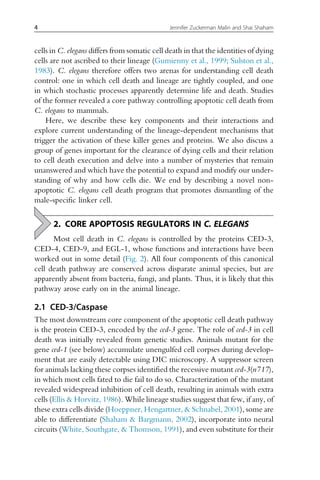
inated. These cells become refractile under differential interference contrast
(DIC) optics (Fig. 1), acquire a rounded morphology, and eventually disap-
pear. Ultrastructural studies reveal that these dying cells are engulfed by
neighboring cells (Sulston et al., 1983), and possess characteristics of apopto-
tic cell death, such as condensed nuclear chromatin, and reduced cytoplas-
mic volume (Shaham Horvitz, 1996b; Sulston et al., 1983) (Fig. 1). Like
the lineage itself, these cell death events are essentially invariant between
individuals and target the same cells at the same time in development. In
the hermaphrodite and male, 131 and 147 somatic cells are eliminated,
respectively. Subsequent studies demonstrated that cell death is highly prev-
alent during germline development and maintenance, with roughly 50% of
female meiosis products succumbing to apoptosis (Gumienny, Lambie,
Hartwieg, Horvitz, Hengartner, 1999). Developmental death of germ
A B
C D
Figure 1 Apoptotic developmental cell death in C. elegans. (A) Differential interference
contrast (DIC) image of a dying cell (arrow) in a developing embryo. Scale bar, 2.5 μm.
(B) Electron micrograph of a dying embryonic cell. Note dark staining, condensed chro-
matin (asterisk) within the nucleus and shrunken cytoplasm. Arrowhead, nuclear enve-
lope. Scale bar, 400 nm. (C) DIC image of dying cells in the developing gonad (arrows).
(D) Fluorescence image of animal in (C) stained with the cell death marker SYTO12. Scale
bar, 8 μm.
3
Cell Death in C. elegans Development
16.
cells in C.elegans differs from somatic cell death in that the identities of dying
cells are not ascribed to their lineage (Gumienny et al., 1999; Sulston et al.,
1983). C. elegans therefore offers two arenas for understanding cell death
control: one in which cell death and lineage are tightly coupled, and one
in which stochastic processes apparently determine life and death. Studies
of the former revealed a core pathway controlling apoptotic cell death from
C. elegans to mammals.
Here, we describe these key components and their interactions and
explore current understanding of the lineage-dependent mechanisms that
trigger the activation of these killer genes and proteins. We also discuss a
group of genes important for the clearance of dying cells and their relation
to cell death execution and delve into a number of mysteries that remain
unanswered and which have the potential to expand and modify our under-
standing of why and how cells die. We end by describing a novel non-
apoptotic C. elegans cell death program that promotes dismantling of the
male-specific linker cell.
2. CORE APOPTOSIS REGULATORS IN C. ELEGANS
Most cell death in C. elegans is controlled by the proteins CED-3,
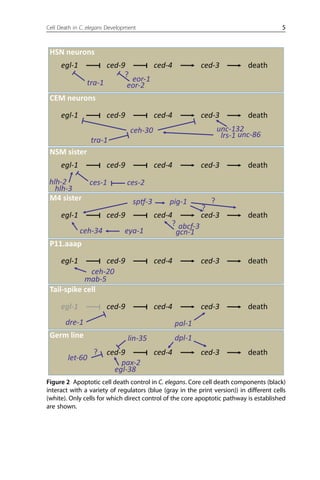
CED-4, CED-9, and EGL-1, whose functions and interactions have been
worked out in some detail (Fig. 2). All four components of this canonical
cell death pathway are conserved across disparate animal species, but are
apparently absent from bacteria, fungi, and plants. Thus, it is likely that this
pathway arose early on in the animal lineage.
2.1 CED-3/Caspase
The most downstream core component of the apoptotic cell death pathway
is the protein CED-3, encoded by the ced-3 gene. The role of ced-3 in cell
death was initially revealed from genetic studies. Animals mutant for the
gene ced-1 (see below) accumulate unengulfed cell corpses during develop-
ment that are easily detectable using DIC microscopy. A suppressor screen
for animals lacking these corpses identified the recessive mutant ced-3(n717),
in which most cells fated to die fail to do so. Characterization of the mutant
revealed widespread inhibition of cell death, resulting in animals with extra
cells (Ellis Horvitz, 1986). While lineage studies suggest that few, if any, of
these extra cells divide (Hoeppner, Hengartner, Schnabel, 2001), some are
able to differentiate (Shaham Bargmann, 2002), incorporate into neural
circuits (White, Southgate, Thomson, 1991), and even substitute for their
4 Jennifer Zuckerman Malin and Shai Shaham
17.
Figure 2 Apoptoticcell death control in C. elegans. Core cell death components (black)
interact with a variety of regulators (blue (gray in the print version)) in different cells
(white). Only cells for which direct control of the core apoptotic pathway is established
are shown.
5
Cell Death in C. elegans Development
18.
surviving sister cells,if those are experimentally ablated (Avery Horvitz,
1987). ced-3 mutant animals are alive, suggesting that at least under labora-
tory conditions cell death is not essential (Ellis Horvitz, 1986). However,
some ced-3 animals exhibit defects in chemotaxis to attractive odors, and
some exhibit pronounced developmental delay (Ellis, Yuan, Horvitz,
1991), suggesting that in the wild, cell death likely confers a survival
advantage.
The CED-3 protein is a founding member, together with mammalian
caspase-1, of the caspase family of proteases (Yuan, Shaham, Ledoux,
Ellis, Horvitz, 1993). Active CED-3 is derived from a precursor that is
cleaved to generate three fragments. The N-terminal fragment, which has
sequence homology to caspase recruitment domains (CARD), is not
required for protease activity, while the middle and C-terminal fragments
associate in pairs to form a tetramer, which is the active protease (Huang
et al., 2013; Thornberry et al., 1992). Protease function is effected by an
active-site cysteine residue that cleaves target proteins after the amino acid
aspartate. Aspartate residues also define the junctions between subunits in the
precursor form, and biochemical studies have revealed a role for cross-
catalysis in protease activation (Qi et al., 2010; Thornberry et al., 1992).
Supporting this notion, the ability of the CED-3 precursor to trigger cell
death in vivo is apparently positively correlated with CED-3 protein concen-
tration (Shaham Horvitz, 1996b). Expression of middle and C-terminal
fragments from separate mRNAs does not generally yield active protease,
suggesting that cross-catalysis yields concerted structural changes that form
the active moiety. However, for CED-3, and caspase-1, tagging each sub-
unit with an N-terminal leucine zipper domain does result in the formation
of active protease (Chelur Chalfie, 2007), presumably because the leucine
zipper facilitates co-translational interactions that promote folding into the
active structure. As with caspase-3, a key mammalian effector caspase
required for cell elimination in many natural and disease settings, CED-3
shows a preference for cleavage after the sequence DEVD (Xue,
Shaham, Horvitz, 1996).
Insertion of the gene encoding green fluorescent protein (GFP) into a
genomic fragment containing the ced-3 locus reveals widespread expression
in early embryos prior to the onset of most cell death events (Maurer,
Chiorazzi, Shaham, 2007). Expression then recedes and disappears in most
cells, but turns on in the tail-spike cell (see below), which undergoes apo-
ptosis just prior to hatching. Expression in larvae is generally undetectable,
even though ced-3-dependent cell death takes place in early larval stages. Just
6 Jennifer Zuckerman Malin and Shai Shaham
19.
before molting intothe adult stage, GFP expression can be detected in the
male tail (Maurer et al., 2007). As in the embryo, GFP here is expressed in
many cells not fated to die. With few exceptions, therefore, expression of
GFP is not detected in cells that die. This observation seemingly contradicts
results that suggest a cell-autonomous role for CED-3 in cell death execu-
tion. Mosaic analysis demonstrates that ced-3 expression is required in line-
ages of dying cells (Yuan Horvitz, 1990), and ectopic expression studies
suggest that only ced-3-expressing cells, but not their neighbors, can be
induced to die (Shaham Horvitz, 1996b). While it is possible that the
genomic fragment used to drive GFP expression in the studies of Maurer
et al. is missing enhancer elements, and therefore generates expression below
the threshold of detection, this seems unlikely as the fragment confers rescue
in the absence of GFP, and GFP can be detected at high levels in many cells
(Maurer et al., 2007). This puzzling observation may, therefore, suggest that
turnover of GFP and the CED-3 precursor protein differs markedly, with
CED-3 having a much longer half-life. If this is the case, then CED-3 pro-
tein expressed in early embryos must be maintained in most or all cells
through early larval development.
While caspase enzymology and activity have been studied in C. elegans
and many other organisms, the mechanism by which these proteases bring
upon cellular demise is an enduring mystery. Are there many or few relevant
targets? Are there many or few cellular processes that must be blocked or
activated to ensure cell death? While a plethora of vertebrate caspase sub-
strates have been described (Poreba, Strozyk, Salvesen, Drag, 2013), their
relevance to cell death is generally not understood. One exception is the
ICAD DNase inhibitory subunit, whose inactivation by caspase-mediated
cleavage leads to DNA degradation in mammalian cells (Enari et al.,
1998; Liu et al., 1998). Proteins related to ICAD or CAD, the active nucle-
ase, are not encoded by the C. elegans genome. An RNAi screen for
increased TUNEL staining isolated a number of nucleases (designated
crn-1 to crn-6) that may be involved in DNA degradation following death.
While RNAi against each gene weakly affects DNA end accumulation and
cell death kinetics, no surviving cells are seen, suggesting that these nucleases
are not essential for cell death (Parrish Xue, 2003). The DNAse II homo-
log, NUC-1, however, does play a key role in C. elegans DNA degradation
during apoptosis (Hevelone Hartman, 1988; Sulston, 1976; Wu,
Stanfield, Horvitz, 2000). C. elegans apoptotic DNA is cleaved into
10 bp fragments (Aruscavage, Hellwig, Bass, 2010), and nuc-1 mutants
lack these fragments and accumulate larger DNA in dying cells, as well as
7
Cell Death in C. elegans Development
20.
undegraded bacterial DNAin the gut (Aruscavage et al., 2010; Sulston,
1976). nuc-1 mutant embryos stained using the TUNEL method
(Gavrieli, Sherman, Ben-Sasson, 1992) display an accumulation of
DNA ends (Wu et al., 2000), suggesting that NUC-1 degrades TUNEL-
positive intermediates produced by another nuclease. One candidate may
be the microRNA processing enzyme Dicer, which can be cleaved by
CED-3, and may, surprisingly, itself promote DNA cleavage (Nakagawa,
Shi, Kage-Nakadai, Mitani, Xue, 2010). It is therefore possible that a
DNA degradation system analogous to that in mammals is targeted by
caspases in C. elegans.
Mutations in C. elegans ced-8, encoding an Xk-family protein, result in
transient accumulation of cell corpses during embryogenesis (Ellis,
Jacobson, Horvitz, 1991; Stanfield Horvitz, 2000). Two recent studies
suggest that CED-8 protein is also a caspase target and that its cleavage allows
exposure of phosphatidyl serine (PS) on the surface of dying cells (Chen,
Mapes, Lee, Skeen-Gaar, Xue, 2013; Suzuki, Denning, Imanishi,
Horvitz, Nagata, 2013). PS then acts as one of multiple eat-me signals that
promote the engulfment of dying cells by their neighbors (Venegas Zhou,
2007). A similar set of events takes place in mammalian cells, where the
CED-8-related protein Xkr8 is a target of caspase cleavage (Suzuki
et al., 2013).
A recent study also suggests that the fidelity of some cell death in
C. elegans is enhanced by CED-3 cleavage of the GTPase-activating protein
CNT-1 (Nakagawa, Sullivan, Xue, 2014). Cleaved CNT-1 can translo-
cate to the cell membrane where it may control apoptotic signaling.
Although transient effects on cell death are observed in the relevant mutants,
nearly all cells fated to die eventually succumb. Thus, it remains unclear
whether caspase cleavage of CNT-1 is an integral aspect of cell death
execution.
C. elegans CED-11 may also function downstream of CED-3 caspase.
Defects in this protein, a TRPM-related channel, do not block cell death,
but result in a profound change in dying cell appearance under DIC optics
(Strange, 2003). Instead of acquiring a refractile appearance, cell corpses
appear swollen and vacuolated, a defect that is perhaps not unexpected from
a membrane channel mutant. Whether CED-11 is activated by CED-3
cleavage is not known.
In addition to CED-3, the C. elegans genome encodes three other
caspase-related proteins: CSP-1, -2, and -3 (Shaham, 1998). The csp-1 locus
generates at least two functional transcripts, one encoding a zymogen with a
8 Jennifer Zuckerman Malin and Shai Shaham
very likely havegot as wet as if he had gone in swimming for it with
his clothes on!”
After digesting this explanation, Henry proposed that they also
should go home. Will and Stephen were agreed, and the trio slunk
off towards the village as fearfully as if a minion of the law were in
hot pursuit. Now that their plot was an accomplished fact, it would
be very unfortunate if they should be caught napping.
After supper Henry was joined by Stephen, and the two
archplotters set out for “Nobody’s House” in the most exuberant
spirits. Already Henry felt a little tired, (let it be remembered that he
had not yet recovered from the effects of the preceding day’s
journey,) and he was obliged to get Stephen to carry a mysterious-
looking bundle which he had brought away from his aunt’s. This
bundle contained the fantastic “disguise” in which Henry was to
figure as Sauterelle.
From the tender age of two years, Stephen had been a regular
attendant of picnics, where he had imbibed many extravagant
notions, and arrived at a very boyish and extremely absurd
conclusion respecting lovers. According to his views, a lover is a
young man, who, after perfuming his handkerchief and smearing his
head with hair-oil, escorts a young lady to a picnic, breaks her
parasol, fails to provide ice-cream enough, and finally sees her
escorted home under the protection of his hated rival.
“Henry,” he said, as they hurried on, “I saw Marmaduke tricked
out for the rescue, and, he didn’t mean me to find it out, but I did;
he had put hair-oil on his head, and, as he had no scent, on his
handkerchief, too! Henry, I was so—so—”
“Demoralized?”
“That’s the word, Henry. I was so demoralized that I said, without
thinking: ‘why, Marmaduke,’ said I, ‘you look more like a genuine
lover than any boy I ever saw!’”
“And what did he say to that?”
23.
“Nothing; but helooked so insulted and heart-broken that I
apologized, and told him he was a bully boy, and I always was a
fool, anyway. Well, Henry, when he comes to the rescue, things will
be lively, according to that, eh?”
“Well, Steve, I once cured a brave boy of his bravery, and if I don’t
cure this fellow of his romance and credulousness, I shall at least
make awful fools of us both.”
“How did you cure a boy of being brave?” Stephen asked eagerly,
regarding Henry with respect and admiration.
But here the writer remorselessly shifts the scene to the others.
As soon after the departure of Henry and Stephen as was prudent,
the “brave men” who were to be the rescuers—Will, Charles,
George, Jim, and the heroic “leader,” Marmaduke—assembled and
set out for the rendezvous, armed very much as Stephen had
suggested.
Visions of figuring on future battle-fields of Europe as Marshal
Marmaduke Fitz-Williams flitted through the hero’s brain, and he
strove to deport himself with as martial an air as possible. But such
an air hardly ever sits easy on a school-boy’s shoulders.
“Comrades,” he began, using, as far as he knew how, the identical
phraseology of a French soldier when addressing his companions in
arms, “comrades, we are embarking in a hazardous undertaking, but
the nobleness of our work will spur us on to deeds of victory. It is a
noble deed that we are called on to perform—the release of a
daughter of one of the potentates of earth! Let this thought inspire
us with enthusiasm! Let us fly to the rescue, fixed in the resolution
to win or die! We shall warrior like the doughty knights of old!”
Poor hero! he had yet to learn that warrior is not used in that way.
His eloquence, however, was entirely lost on his hearers, it being too
grandiloquent for even the Sage to appreciate; and like many
another orator, he but “wasted his sweetness on the desert air.”
24.
“Fellow-soldiers,” he continued,“I will use my influence to procure
your promotion, and you will all one day be renowned generals of
the empire.”
Alas! about the time the speaker took to singing love-songs and
reading love-stories that empire was disrupted!
“That about the emperor’s wanting one more general was a good
stroke, eh, Will?” Charles whispered.
It would be foreign from the purpose to record all Marmaduke’s
bombastic speeches as he and his fellows marched to the field of
battle. Let it be taken for granted that in due time they drew up
before the fortress.
Marmaduke reconnoitred the grim old building with its grated
windows and formidable door, and soon decided that here was the
prison, though it was patent to all that he was disappointed, having
expected greater things—having, in short, expected to see a
structure bearing more or less resemblance to the Bastile itself.
Marmaduke screened himself behind the dilapidated fence, and
called out, in commanding tones: “Hist! I call a halt!”
As his troops had already halted, they sat down, thinking that if
Henry and Stephen were not yet prepared to receive them this delay
would be in their favour.
“Corporal James Horner, do you perceive a sentinel on guard
before the prison?” the would-be commander asked.
“Corporal Horner,” who could not see that part of the prison so
well as the questioner himself, was struck with awe, and answered
timidly, “No, sir, I don’t see nobody.”
“Sir to me! You would do better to call me General.”
“Yes, sir,” Jim returned, feeling his terrible chills creeping on.
“Lieutenant Lawrence,” said the young general, “keep order
among your forces! Positively, no straggling!”
25.
The newly-made lieutenantexecuted his superior’s orders
promptly and effectually. “If he keeps on at this rate,” he whispered
to George, “there will be fun enough to last for a year! Oh, if Henry
and Steve were only here to enjoy it!”
“Silence in the ranks!” roared the general. “Commodore Charles
Growler, I call a council of war.”
This was too much for the more deeply read George, and he cut
short the general’s programme, saying: “A commodore commands a
squadron of ships. There are no ships here that I know of—only a
squad of boys.”
The general was nonplussed. He even felt inclined to dismiss this
arrogant fellow from the service; but fears of encountering a swarm
of armed jailers induced him not to dismiss so good a warrior as the
Sage was known to be. So, after deliberating a moment, he said,
meekly enough, “Boys, we are only losing time here. Let us make a
charge, and burst the door open, and then we can fight our way
right on.”
Burst open the door! Then indeed the timbers of their raft would
be destroyed! But this was no time to reason with Marmaduke, and
they consented to the sacrifice cheerfully.
Charles very readily came upon what had once been a pump; and
after great and violent efforts the corporals, lieutenants,
commodores, generals, etc., succeeded in raising it to their
shoulders; and then, with soldier-like disregard for the hideous grubs
which nestled on it, they marched, with martial tread, to force an
entrance into the prison.
“This will do instead of a genuine ram,” the general observed
deprecatingly. “Such people as we are often have to resort to various
shifts to do what they wish to do.”
“So do boys,” Charles commented sarcastically, but without a
smile.
26.
“Charge!” cried thegeneral valiantly, when about thirty feet from
the door.
A blind rush was made; but barely five steps had been taken when
the general, who of course led, tripped over a stone, and the entire
“squad” fell headlong, the “ram” and its grisly inhabitants
descending on their backs with a cruel thud.
Of course no bones were broken, gentle reader, for it is impossible
to kill a hero, and, as a general rule, impossible to hurt one. And all
these were heroes.
Yet much of their enthusiasm escaped with the “ohs!” that started
from each pair of lips.
“Such little accidents are disheartening,” the general gasped, as he
struggled to his feet; “but we are above letting them deter us from
our duty. Charge again! Only, be more careful.”
As he alone was blamable for the mishap, this advice was
superfluous.
The ram was shouldered again, somewhat reluctantly; a furious
charge was made; and the ram was brought against the “blood-
bought” door with considerable force. A peal of thunder ensued, and
the nowise strong door was shattered, fatally. Truly, this was
effecting an entrance in warlike style.
But a catastrophe might have been the result. Henry was seated
in the hall, not aware that the besiegers were at hand, and little
dreaming that they intended to force an entrance. When the door
was suddenly burst open, he was started into action in an unlooked
for manner—the flying timbers striking his crazy chair so forcibly that
it gave way, flinging him headlong to the floor.
More startled than hurt, Henry sprang to his feet, and recognizing
Will and some of the others, shrieked, in accents unmistakably
English: “Saved! Saved!”
The appearance presented by the rescued one was superlatively
ridiculous. None of the boys had seen him attired in this disguise,
27.
and they werethunder-struck at the metamorphosis. Even
Marmaduke stared aghast at the sight he beheld.
In a spirit of mischief Stephen had clothed Henry thus, saying,
“Poor Marmaduke; he’ll never know; he’ll think you’re dressed up in
the height of fashion. But he will think that Paris fashions, in
crossing the seas, lose much of their beauty; and while your
costume is all right, other people’s must be all wrong!”
As a hoodlum boy would have put it: He looked like all possessed!
28.
Chapter XXXVII.
Marmaduke Struggleswith Romance.
Kings, ghosts, sea-nymphs, heroes, heroines, all beings, are made
to act and speak in romance just as the exigencies of the plot
demand; and yet it is intimated, in the same breath, that “it is all
quite natural, just as it would be in real life!” In this story every one
certainly acts as the writer pleases, but, so far as he knows, these
boys behave as like boys under similar circumstances would behave.
In this chapter, however, there is an exception, where a change from
nature is necessary; and without a moment’s hesitation, they are
made to throw off all restraint, and talk and act as befits the
occasion. In a word, the boys are here no longer boys, but the noble
beings of romance.
We do not pretend that any boys would carry on a conversation in
their high-swelling strains, the narrative being couched under such
strains for a particular and well-meant purpose. The object being,
throughout the story, to cast ridicule on all sorts of things, this
freedom to write in whatever style is most pertinent to the matter
under discussion is our prerogative, and we use it. In short, we act
here on the principle, that a writer should be hampered by no
conventionalities or restrictions that interfere with the plan of his
story.
It seems to be a well-established principle, that love cannot be
expressed in romance except in a poetic form. We do not believe
this holds good in real life, yet, wishing this story to be accounted a
romance, we have thought it well to abide by the rule in this
instance. After a short deliberation, we have decided to write their
passionate colloquy as though it were only prose; but the intelligent
reader can easily read it as verse—in fact, if he chooses, he can set
it all to music.
29.
After digesting thispreamble in connection with what goes before,
the reader of mature years, if not entirely witless, will be able to
grasp our meaning and discern our motive—or motives, for in this
chapter the aim is to kill several birds with one stone. But the boys—
for whom, after all, the story is written principally—had better skip
this turgid preamble, because a boy always likes to believe a story is
more or less true, and we should be grossly insulted if any one
should insinuate that this story is true.
Considered in this light, the chapter appears to be only a piece of
foolishness, after all. But, in a measure, it may be considered
logically also. For instance, there seems to be a “vein of reason”
running through it all, and if the reader is on the watch, he will see
that this “vein of reason” crops out frequently. After this preamble it
opens very rationally.
“Considered logically,” says the reader, “how could this Henry, a
veritable lover, stoop to play the fool, as he did? How could he do
this, if he had any respect for his passion, or for the one whom he
loved?”
Considered logically, gentle reader, Henry was a boy; his heart was
sore from fancied slights; he was desperate; it occurred to him that,
placed as he was, he might “view the question from the other side!”
Furthermore, although he and Stephen had conspired to torment
Marmaduke, it is plain that almost everything he said, he said
extempore.
As for Marmaduke, he had no sisters, was scarcely ever in the
society of young ladies, and knew nothing of their ways.
“These are but sorry excuses,” sighs the reader, “unworthy of even
a school-boy!”
Very true. But they are the best that we can trump up, and
therefore it would be better for you to consider this chapter as
founded on the opposite of reason and logic.
Marmaduke was anxious that he alone should be recognized as
the liberator, for he wished to receive all the glory of rescuing the
30.
captive. With thatintent he pressed nearer Sauterelle, directing his
followers, by an imperious wave of the hand, to disperse in search of
the enemy, and, when found, to give them battle.
Interpreted into language, that command would have run: Hound
down the mercenary crew, and spare them not! Their evil deeds
have brought this fate upon their heads!
The avenging party understood this, and, thirsting for blood and
glory, they hurled themselves out of the apartment, whilst
Marmaduke turned his attention to the captive. He saw gratitude,
admiration, even reverence, in the two blue eyes that looked at him.
No fear of not being acknowledged as the rescuer-in-chief: Henry
would acknowledge him, and him only.
“Ah, my deliverer!” he cried, in so-called French; “you have come
to rescue me, to restore me to freedom! You have found my appeal
for help, and these brave men are your followers?”
Marmaduke tried hard to understand this, but was obliged to ask if
the conversation could not be carried on in English.
“Yes, yes, I can speak English,” came the reply. “The good priest
has taught me English.”
At that instant a fierce combat was heard in an adjoining room,
and horrisonous cries of rage and terror filled the whole building.
The hero knew at once that his followers had encountered, and were
waging deadly contest with, the wicked jailers, and his heart swelled
with emotion.
He was right; his followers had drawn their home-made weapons,
and while Charles, Steve, and Jim, personated these wicked jailers,
Will and George personated the gallant liberators. Having had a
rehearsal a few days previous, they now fought easily and
systematically, and with such heroism and fury that victory must
inevitably perch upon their standard. But, after all (and in this they
were quite right), they fought as much with their lungs as with their
arms, so that the din was tremendous. For full five minutes the
combat raged without abatement. The gray light coming in through
31.
the open doorwaycast a greenish and peculiar hue over our hero’s
grand face, and he stood stock-still, collected but voiceless; while
the other, wholly unprepared for such an uproar, longed to thrust his
fingers into his ears, and pitied himself with all his heart as he
thought of the racking headache that must soon seize him.
But finally they vanquished the enemy, and all except Stephen,
who had not yet turned priest, rushed into the presence of the hero
and heroine, shouting wildly: “Routed! Worsted! Slain!”
“All? Are all slain? And is the battle past?”
“All; one and all; and we have won.”
“And so my freedom comes to me again!” cried Sauterelle. “And I
am free, free as the birds, for all his evil schemes are baffled now!”
Then, as was right on such an occasion, Sauterelle sank at our
hero’s feet, and began in the “bursting heart” style, without which
no such scene ought to be drawn: “Oh, my deliverer, accept my
thanks! Through you I thus am freed! through you I once again shall
see dear France,—dear France, that land of heroes!—Heroes? Ah! all
are heroes here, in this, the land of liberty! Oh, gallant men, you
have done well!”
“Ah, yes, ’tis for the brave to battle for the fair in every land,” our
hero said, as though he, too, had fought.
Sauterelle still kneeled before our hero, expecting to be lifted up.
But an immense, pyramidal head-dress, many inches high, which
only Steve could construct, towered upwards till almost on a level
with our hero’s eyes, bewildering him.
“Noble American, this is a rescue worthy of a prince!” Sauterelle
cried, suddenly rising and grasping our hero’s hands in a bear-like
grip.
“Your ladyship—”
“No, no! My title here is but an empty sound, so call me simply
Sauterelle.”
32.
“Sau-ter-elle Hi-ron-delle. Whatsweet and pretty names!” our
hero murmured softly, as Sauterelle let go his hands.
“What is the name of him who sets me free?”
“Fitz-Williams is my name; my first name, Marmaduke.”
Our hero’s followers, still hot, exhausted, and bruised, but not
particularly blood-stained, now rose and stole away, and presently
another great uproar was heard from them. They had seized the
impostor and were carrying it, or him, roughly along.
“Here is the great chief villain and arch-plotter of them all! Here is
Bélître Scélérat himself!” they roared.
“Bélître Scélérat? How comes he here? I understood that he was
far away,” our hero said, much puzzled.
They paused in doubt and consternation. Then a flash of reason
penetrated to their darkened intellect, and dimly conscious that
some one had plotted too much, or not enough, they started into
action and pressed tumultuously on with their captive.
“Oh, for a sword, that I might pierce the monster’s heart!” our
hero sighed, but sighed in vain.
At that instant, Steve, now the priest, passed pompously through
the room, and catching our hero’s last words, replied: “No, no! Soil
not thy hands with such a perjured wretch, nor soil thy sword. These
soldiers here should pierce his ears, not thee,” wilfully mistaking the
word heart for ears—or perhaps he did not understand English so
well as his pupil. “Brave men, go forth and hang this captured knave
from some great height, and leave him there to crumble into dust.”
Our hero’s blood-thirsty followers lugged Bélître Scélérat out of the
room and up the stairs with a haste that proved how well and
strongly he was made, and remorselessly prepared to consign him to
his ignominious fate.
Then our hero and heroine again broke out into their poetry, the
latter saying, “And now, my freedom is achieved. Ah me! I almost
33.
now regret thatwe should leave these shores, this land of blessèd
liberty, and travel back alone to our loved France! Ah, in my hour of
triumph am I sad? Yes, woe is me, I am!—Oh, Marmaduke, there is
no need of this! The priest is here, the bridegroom and the bride! Oh
Marmaduke, there is no cause why I should go alone. Ah, thou wilt
soon be mine, and I shall soon be thine! Thy husband,—wife, I
mean. Oh, Marmaduke, dear Marmaduke!”
As Sauterelle ran on in this strain our hero grew pale and sick with
dismay. Was he to be made a sacrifice of thus? Must the rescue of
necessity lead to this? Oh, it was too awful!
“A beauty here that would befit a queen; and, yes, I feel love
springing in my heart! But should I marry? I, a boy, and this, the
daughter of a duke? Oh, that it might be so! As I have said, the
French are more excitable than we. But am I not the rescuer-in-
chief? In such a case as this, what should I do?”
A triumphant shout of sated vengeance now rang through the
building. Bélître Scélérat was securely fastened, not exactly hanged,
out of an upper window. A minute later the executioners came
clattering noisily down stairs, then filed respectfully past our hero
and heroine into another room, and took up a position where they
were screened, but from which they could see and hear all that was
going on. This action on their part was more conformable to human
nature than to the laws of romance or the dignity of heroes.
A sidelong glance disclosed the fact that our hero’s face was of the
hue of polished marble, and that large tears of heartfelt emotion
were starting from his eyes, while other tears were welling from the
pores of his neck and forehead.
“Père Tortenson, Père Tortenson,” cried Sauterelle. “Is he not
here? Then go, some one, to look for him, and bring him here to
me. The marriage may take place without delay.”
“Dear Sauterelle,” our hero said, “I feel I love thee well indeed,
but yet I may not marry thee. Thy friend, thy humble servant, guide,
and helper, I will ever be; thy husband—ah!”
34.
Our hero’s grammarsays mine and thine are used only in solemn
style. Our hero and heroine were aware of this—they were but
paying tribute to the solemnity of the occasion.
“No! say not that! You own that you love me as I love thee. What
is there then to come between us and our happiness? Is it, alas! my
title and my rank? Think not of them; they shall be nought to us. My
Marmaduke, I’d lay them all aside for thee. Or what is it? Speak,
Marmaduke; I wait to hear thee speak.”
“Alas, dear Sauterelle,—if really I may call thee so,—I am not
worthy thee. It is indeed thy title and thy rank. How couldst thou
wed a non-commissioned officer like me?”
“Perhaps you are the kidnapped heir of some great English lord.”
“Oh, could it be? Oh, would it were! Then I thy equal—Oh, say not
that! No; do not torture me.”
“I understand it now,—my love is not returned,—you do not care
for me.”
“Love thee! Indeed I love thee well—love thee, as boy never loved
before—love thee, as I ne’er can love again!”
“Oh, Marmaduke! dear Marmaduke! you cause me joy. My
Marmaduke, I’ll call again the priest.”
“Thy father!—No, no! I dare not meet thy father!”
“Dread not my father’s ire. He loves his child; his child loves thee.
Ah, thou art all mine own, for all that thou hast urged is but a paper
wall.”
“Dear Sauterelle, I must admit I love thee well. To be thine own—
oh, joy! But no; it cannot be. I have no wealth, no heritage at all. A
wife is far from me.”
“Wealth? What is wealth to me? Wealth is an idle word—non-
entity—a gin—a snare—a clap-trap. How should we live? Let no such
thoughts occur to thee. Though wealth is nought, ’tis true, my father
hath it, and thou couldst have enough to live as princes live.”
35.
“‘Alas,’ you said,‘perhaps my father lives no more.’”
“Ah, then am I his heir, and all his riches ours. Oh, Marmaduke,
why should you longer hesitate to take this step, or longer pause for
foolish whims? Then call again the priest. Why loiters he?”
But our hero was not yet sensible of the duty that devolved upon
him—he did not yet fully realize his position—he still hung back—and
his poetical objections having been one by one confuted, he now
had the excess of baseness to offer another.
“Alas, I know not well thy foreign tongue. How couldst thou hear
me always in my rough tongue, when thine, so sweet, so soft, so
beautiful—”
“No! speak not so!” cried Sauterelle. “I will not hear thee speak
so! Oh, slander not the language that is thine. And, ah!—thou art a
ready youth, I see it in thine eye,—how sweet the task of teaching
thee my polished mode of thought and speech! But yet, even as it is,
we can converse quite easily! Père Tortenson, the time for marrying
is here.”
“Ah, that is truth!” our hero cried. “You speak my English quite as
well as I!”
Then, in a rational moment, he said rationally, “As you have said,
dear Sauterelle, we love each other well; but being still so young, so
very young, we must not think of marriage yet a while. ’Tis hard to
part with thee,—our lot is doubly hard,—but fate is ever merciless.
Farewell, my love, we part.”
He tore himself away, as though he would have fled.
“’Tis true that we are young,” said Sauterelle. “Our hearts are
warm and young, not chilled and seared with age and woe. To leave
me? No! it shall not be! Thou must not go!”
“To love is either happiness or pain; to love, and to be loved
again,—oh, this is ecstasy!”
“Oh, Marmaduke, you thrill my heart with joy!”
36.
“Alas, dear Sauterelle,that love and duty should thus clash! But,
oh, I must not marry thee; I am so far beneath thee. Dear
Sauterelle, thou wilt return to France and be the wife of some great
prince, while I, alas! shall wear my life away in hopelessness and
grief. And yet, oh Sauterelle, I love thee so! I love thee so! I fear I
yet shall yield to love, forgetting duty.”
Then Charles stepped out of his lurking-place, and said
respectfully:
“Forgive me, sir, that I should speak to you, but duty is not always
what it seems. How can this helpless one return to France alone! A
priest at hand, a marriage, sir, is duty in this case. Your father’s
house is near—live there till Duke Chaloupe hears of this rescue and
this marriage. Then Duke Chaloupe will send us funds for all to go to
France.”
“Oh, would that I could think that you are right! I should no
longer hesitate.”
Then, forgetting himself and his position, he fell back on prose.
“Why should not Lady Sauterelle and the priest return? Are there no
hoards of jewels and treasure here in this building, that would pay
the passage, at least? Scélérat, perhaps, has millions buried here,
which can be found.”
“No he hasn’t,” said Will, thrusting his head into the room. “Not a
cent. What did you expect the captive to do after the rescue? What
were your ideas on that point?”
“Alas,” groaned Marmaduke, “I had none! I never thought what
any of us would do immediately after the rescue; my thoughts were
far ahead in the future. Oh, if I had only sent that letter to the
Government!”
At that moment a person with majestic mien strode into the room,
saying, “I come, I come; who calls Père Tortenson? Is it a marriage,
lovely Sauterelle? If so, quite right. Who is the honored
bridegroom?”
37.
As Marmaduke’s chivalricnotions of right and wrong still
admonished him not to enter into marriage with a person of noble
birth, he had the uprightness to resist the feelings of his heart once
more, though it cost him a hard struggle to do so.
Then the other, casting on a tragic air, said, “Alas for the decay of
chivalry! In the old days it was not thus. Then no weak whim of
fancied right e’er came between two loving hearts.”
Charles whispered to our hero’s followers, and then, having
stepped into the room, they chorused, their voices, attuned by war
and conquest, filling the place with harmony: “Your duty, sir, is very
plain, and we are grieved that we should have to point it out: a
marriage, as you are. A few years hence, and you will be the mighty
king of some great land.”
Then Marmaduke shone forth in all his native nobleness. He
reverently took Sauterelle’s hand in his own, but before giving the
word to the priest he chanted: “In rank, in ti-tle, and in birth; in rich-
es, age, and clime; in all things, thou surpassest me, O lovely
Sauterelle.”
“Yea, even in height!” chimed in Père Tortenson.
“Proceed, sir priest,” said Marmaduke.
The plot was now, they supposed, at an end. It would be as well
to consider its framers as boys again.
Henry did not wish to prolong the scene, and he whispered to
Will: “This is as far as I dare go; but try to think of something—
anything—to keep up the fun a little longer.”
Stephen pretended to be fumbling in the pockets of his robe.
Turning to the Sage, he whispered imploringly, “Oh, George, can’t
you ‘ventriloquism’ a little—ever so little?”
“The ghost!” George muttered. “Let us bring in the ghost!”
38.
“The ghost? Mystars! we never settled how that was to be done!”
Steve said blankly.
“Oh, Steve, I wish you were free to play the spectre!” Will sighed.
“What was it that we intended the ghost to do, anyway?”
“Oh, my gracious, I don’t know; I’m all a muddle!”
But the moments were slipping away very fast. Marmaduke heard
their mutterings, though he did not understand them, and he was
becoming uneasy.
“Proceed with the ceremony,” he repeated.
39.
Chapter XXXVIII.
The StartlersThemselves are Startled.
But the tables were to be turned in a startling and wholly
unlooked-for manner. The boys had had their day of imposing on
simple Marmaduke; and now, in their turn, they were destined to
suffer acutely from uneasiness and remorse for several hours.
Such a sentence always finds a place in romances at certain
conjunctures, and, if judiciously worded, reflects great credit on the
romancer. But the reader cannot always perceive the beauty of such
a sentence, and therefore it would be showing more respect for his
feelings to follow our Jim.
This hero had slipped away from his companions shortly before
Stephen at last appeared as priest. Being only a figure-head on this
occasion, his absence or presence did not concern them in the least,
and he was suffered to slip out of the backdoor without comment.
He wished to make his way into the upper story without going up
the stairs, as to do that it would be necessary to pass the hero and
heroine. However, being well-acquainted with the building, and
knowing how to climb, he easily made his way into the upper story
from the rear. Then he stole noiselessly across the gloomy chamber,
and felt his way to the window, where the “imposter,” Bélître
Scélérat, hung in state.
It is a fundamental principle that villains, when about to
perpetrate their dark crimes, should express their wicked thoughts in
“hurried whispers.” This is very foolish on the part of the villains; but
it is not easy to see how novels could be written if it were otherwise.
Of course the romancers do not always overhear these “hurried
whispers,” but the walls in the vicinity have ears, and probably the
romancers get at them in that way.
40.
“Now, then,” mutteredJim, “I’ll teach ’em better than to leave me
out of their plots till they have to let me in. Charley and Steve intend
to come along for this to-morrow, do they, and take it away, and
float it burning down the river? I’ll bet they won’t! I’ll burn it all to
smoke and ashes now, as it hangs on its pins, and serve ’em right!”
“Hum, this is Jim’s treachery!” sneers the reader. “I was led to
expect something better; I am disappointed.”
Gentle reader, if you are a faithful peruser of novels, you must
have a great fund of patience. Draw, then, on that fund, and more
of Jim’s designs will presently be unfolded. Draw on your
imagination, also; for his treachery was never fully made known.
Suiting the action to the word, Jim fumbled in his pocket and took
out a bunch of matches, which he had put there for this very
purpose. He knew he was doing wrong, and his hand trembled as he
struck a light. He knew that his terrible disease might seize him at
any moment; and so, fearing to stay longer where he was, he hastily
applied the light to the spectral figure, and turned to steal away.
The inflammable material of Bélître Scélérat’s clothes instantly
caught fire, and he himself was soon ablaze.
“Now to run and tell Marmaduke he is fooled,” Jim muttered.
In this way, poor simpleton, he thought to ease his conscience!
But the “still small voice” will be deceived by no such flimsy excuses.
“Then to yell ‘Fire!’—Oh, if any ghost should be up here, now,—if
there are such things as ghosts,—this is the place for them! Now, to
get away.——Ow! Ow! Ouowh!”
The cause of these unmusical yells from Jim was that he heard
hasty footsteps issuing from a room to the left, and then a ghost-like
figure appeared in the flaring light of the burning impostor.
Jim had almost expected to encounter something horrible, and
when this apparition hove in sight his terror was all the more
intense.
41.
Setting up horrisonoushowls, that would have been a credit to
Bob Herriman himself, he forgot all about the dangerous place in the
floor,—which, as has been said, the explorers discovered, carefully
marked out, and avoided,—and rushed blindly upon it. A groan, a
trembling, and it gave way beneath him with the crash of an
earthquake.
Marmaduke had just given the word to the priest for the second
time, when a succession of frightful howls and yells of agony struck
their ears, and a moment later a blinding cloud of dust, plaster, and
splinters, pervaded the apartment.
Jim, a scratched and woe-begone object, also fell.
Thus the plotters’ little difficulty was obviated; thus a ghost came
to them.
But that was not all. It so happened (rather, of course it
happened) that Sauterelle and the general were in the course of the
faller.
Before any of the demoralized plotters could think what was the
matter, or even think at all, Jim dropped heavily downward, and his
feet caught in the rescued one’s outlandish headdress. It was rudely
torn off, and Henry’s aching head received so violent a wrench that
he could have roared with the pain.
Although Jim’s fall was not stopped, its course was deflected, and
his head and body were thrown furiously into Marmaduke’s and
Stephen’s arms. He thus escaped with sundry painful bruises, owing
perhaps his life to the accident of striking Henry’s headdress and
being thrown upon Marmaduke and Stephen.
These two, also, were stunned and slightly hurt; and a pair of
unique goggles, that Steve wore as a partial disguise, went the way
of the hammer, the axe, and the band-box full of rusty tools.
Confusion reigned for a few moments; but as soon as the general
could think at all, his thoughts reverted to Sauterelle.
“Oh, where is Lady Sauterelle?” he cried.
42.
He flew toHenry’s side, to behold—oh what?
Henry had seized his opportunity to strip off his disguise, and now
stood revealed in coat, vest, and pants—a very boy-like boy.
The plotters, somewhat recovered from their surprise, and seeing
that no one was much the worse for the fright, saw the dupe’s look
of horror and consternation, and could restrain themselves no
longer. The long pent-up laughter burst from each mouth in one
deafening roar. This was what they had plotted for, and it had come.
With a tragic and truly pathetic air, Marmaduke threw up his
hands, cried, in piteous tones, that the plotters will remember till
their last hour, “I am betrayed!” and fled out of the house like a
madman.
For the first time the boys felt heartily ashamed of themselves.
They all ran out to call him back and beg his forgiveness, and
discovered what they would have known before, if they had not
been so engrossed with Jim’s fall and Henry’s unmasking.
The building was on fire and burning furiously! Though it was not
five minutes since Jim struck his match, the fire had gained too
great a hold to be extinguished.
Jim was appalled. Nothing was further from his thoughts than the
burning of the prison-house; though a little reflection would have
shown him that a figure fashioned of greasy clothes, and stuffed
with rags, straw, shavings, and sundry valuables that slipped in
unawares, could not burn within a few inches of a wooden building
without setting it on fire.
“Fire! fire!” yelled the heroes, hardly knowing whether to be
delighted or otherwise at the prospect of such a bon-fire.
In the excitement of the moment the search after Marmaduke was
given up.
“Are—are we all out, or is somebody burnt up?” Will asked, wildly,
but with rare presence of mind.
43.
“Oh, boys, Idid it, but I didn’t mean to burn the house,” Jim
confessed. “All I wanted was to burn your impostor, and tell
Marmaduke the truth, and—Ou! ou! ou! ou!” he shrieked. “There it is
again! ou, ou!” and the boy with the chills took to his heels.
Jim practised running: on this occasion he was soon out of sight.
The rest looked in the direction pointed out by Jim, and beheld a
figure in white gliding towards them. Was it a ghost, or some one
wrapped up in a sheet, so foolish as to play the part of a ghost?
“Oh, dear;” gasped Steve, “what is going to happen next?”
All the boys were wrought up to a pitch of great excitement, and
were more terrified than they cared to acknowledge. Henry’s
thoughts reverted to his Greek history and Nemesis.
But after a moment the Sage observed, with his habitual
philosophy, “Well, if it’s the ghost that inhabited that house, he is
wise in seeking other quarters, for it will soon be nothing but red-hot
ashes.”
Then, afraid that Henry might think him weak enough to believe in
ghosts, he added, hastily, “Of course, you know, boys, that there are
no such creatures as ghosts; only—”
At this juncture the speaker broke off abruptly, and whatever
information he had to impart was lost. The apparition was now quite
close to the boys, and as the last words left George’s lips, it flung off
something very much like a sheet, and exclaimed, in a voice quite as
human as ghostly:
“Well, young gentlemen, since you hesitate to take me for a
supernatural being, I shall reveal myself to you.”
“Do it, then,” said Steve, in street Arab style. “Do it, for we must
be off to look for a comrade.”
“This to me!” cried the new-comer, angrily. “I’d have you know
that I am Benjamin Stolz.”
44.
“Oh, horrors!” groanedSteve. “It’s the man that owns ‘Nobody’s
House.’”
Mr. Stolz spoke again. (By the way, his full name was Benjamin
Franklin Stolz.) Laying aside the bantering tones in which he first
addressed them, he spoke fiercely:
“Young men, I want to know who owns that burning house?”
“The one straight ahead of us?” Will asked, as if they were in the
midst of a burning city, with buildings on fire on every side.
Mr. Stolz stooped, picked up a small stone, and flung it towards
the fire, saying, “That is the building I have reference to, unhappy
youth. If you can’t see it yet, I will carry you up to it. I repeat, who
is supposed to own that place?”
“I am to blame for all this, Mr. Stolz,” Charles had the courage to
say. “I persuaded the boys to come and make use of it; but I
thought it was so useless, and had been left idle so many years, that
no one valued it. I beg pardon, Mr. Stolz.”
Stolz hesitated. The boy’s willingness to receive all the blame
touched him. “He is a fine little fellow,” he said to himself, “but now
that I have started this I must go through it.”
Charles gained, rather than lost, by his confession, yet he did not
escape punishment. Perhaps he did not expect that.
“Well,” began Mr. Stolz, “think twice, or even four or five times,
before you plan to ‘make use of’ the property of others again. When
I choose to burn down my establishments, I shall do it myself, and
not call in schoolboys to do it for me. Did any of you ever hear what
the law says about burning a man’s house? Law, and the
newspapers, and insurance agents, call it incendiarism. Judges and
juries call incendiarism a very nefarious occupation. Now, don’t wait
to see the walls collapse—begone! all of you! To-morrow I shall send
a writ of summons to each of you! Begone! Good night.”
Having discharged his horrible threat about the writ of summons,
Stolz turned and strode towards the blazing and roaring fire, a very
45.
odd smile onhis lips.
The “incendiaries” did not see that smile, and they stood staring
at his retreating figure, speechless and hopeless. This was the end
of their plot! Ah, its growth had been difficult and uneven—its end
was sublimely tragical!
Not one of them had accused Jim of firing the building, though,
from his own confession, each one knew that Jim only was guilty of
the deed. However, they deserve no praise for this, since they were
all so utterly confounded that not one of them remembered it. But
as Mr. Stolz was the ghost that caused Jim’s panic, flight, and fall, he
must certainly have known all about it, and consequently it was
better that they should hold their peace.
After a solemn silence, Stephen asked faintly, “Boys, what’s a writ
of summons? Isn’t it something awful?”
The Sage brightened and answered him thus: “Yes, Steve, it is a
dreadful instrument of justice to deliver culprits up to the fury of Law
—to trial, punishment, and torture.”
Steve, who had a very vague notion of what the word instrument
means, instantly thought of thumb-screws, racks, and divers other
engines of torture, that our “chivalrous” forefathers were so
ingenious as to invent and so diabolical as to use.
“Boys,” said Charles, “we are in a worse scrape than ever before.
It would be an awful thing if we should be sent to prison! Oh, it
would kill my mother! Henry, do you really think Stolz could send us
to prison?”
“I don’t know,” said Henry, in a mournful voice, little above a
whisper.
“Look here, boys,” spoke the Sage, with his time-honored
phraseology, “we have lost track of Marmaduke altogether. We must
find out what has become of him.”
“O dear, if he is missing, I shall not care to live!” Henry declared
sincerely. “Where do you suppose he is, boys? Is he a boy to take
46.
such a thingvery much to heart?”
“I’m afraid he is,” Will acknowledged. “He takes everything so
seriously that this will be almost too much for him.”
“Why didn’t you tell me that before?” Henry asked bitterly.
With wildly beating hearts the little band began to search for the
missing one, calling him imploringly by name and begging his
forgiveness. The search was continued till Henry became so
completely exhausted that he could no longer drag himself along;
and then it was incumbent on the others to take him home.
As they drew near the village, one of them proposed to stop at
Marmaduke’s home and inquire after him, in the faint hope that he
might be there. The others agreed to this, but with little hope of
receiving a favorable answer.
“Is Marmaduke at home?” Charles asked timidly, as Mr. Fitz-
Williams opened the door.
“No, he is not,” came the answer, “and we are very uneasy about
him.”
The plotters did not explain themselves, but turned away, more
heart-sick than before. Suppose that he should wander off, and be
found dead some time afterwards, would not they be held guilty?
Would not they be goaded by remorse to the end of their days? Or
suppose that he should follow the slighted schoolboy’s bent, run
away to sea, and never be heard of again for twenty years.
Stephen was so distressed that he actually said to his fellow-
sufferers: “Boys, if he would only come back, I wouldn’t tease him
about getting married. I intended to tease him about it for months;
but I won’t now, if he will only come back; I won’t, not a bit!”
Stephen was a boy of boys; and for him to say that was to
express his contrition in the strongest possible terms.
48.
Chapter XXXIX.
Repentant Plotters.—TheHeroes Re-
united.
The discomfited plotters were forced into a confession of all their
deeds for the past few days, and a party headed by Mr. Fitz-Williams
set out to scour the country for the missing boy. Then, contrite and
woebegone, the evildoers slunk into their respective homes, there to
receive what punishment their outraged parents should see fit to
inflict.
It is not best to enter into details; it would be too harrowing. It is
sufficient to say that when their weary heads at length sought their
pillows, sleep refused to come to their relief, and such a night of
torture few of them ever passed.
“If it wouldn’t make us appear guiltier than we are,” Henry said,
with feverishly bright eyes, “you and I would pack up, too, Will, and
run away, and travel all around the world.”
As Henry did not deign to state how this might be accomplished,
we are left to infer that he had an idea of a flying-machine in his
mind.
Stephen and Charles wore out the night in wondering what they
should do with themselves if sent to prison. The former resolved that
he would undermine the prison foundations with his jack-knife, and
make his escape to Robinson Crusoe’s island.
“There I shall spend my life,” he sighed heroically, “thinking of
Marmaduke. Robinson lived alone twenty-eight years; I’m only
sixteen, I shall probably live alone about sixty years, if the cannibals
don’t catch me and eat me up.”
49.
Poor dreamer! Hewas not sufficiently well versed in geography to
know that Robinson Crusoe’s island is not now so desirable a place
to play the hermit in as it was in the seventeenth century.
George, who was of an inquisitive disposition, finally left his bed,
broke into the lumber-room of his ancestral home, and after diligent
search, found a bulky tome, which, years before, had been
consigned to that dreary region as being more learned than
intelligible. This tome was entitled “Every Man his own Lawyer.”
With this prize he returned to his bedroom, muttering, “Now I
shall see just what the law can do to us boys, and all about the
whole business, and what we ought to do and say.”
After an hour’s careful study of this neglected “Mine of Wealth,”
the Sage let it slip out of his hands, and tumbled into bed again,
muttering: “Yes, one of us is guilty of the crime of arson. That is
very clear. All of us are liable to be sent to prison. That is pretty
clear. As I make it out, the sentence ranges between six months and
a hundred years. Which will the judge conclude we deserve, six or
one hundred? Oh, well, it will be hideous to live in a prison at all, for
there will be no books there!”
According to the Sage’s notions, the worst fate that could possibly
overtake him would be to be deprived of his books.
“But, O dear,” he pursued, “I should be willing to give up all my
books if Marmaduke could be found.”
Morning dawned on the reformed plotters with mocking serenity.
There could be no enjoyment for them while such a cloud of mystery
hung over their companion’s fate.
The searchers were not so successful on this occasion as when
they used to rove over land and sea for Will and his companions; not
the slightest clew to Marmaduke’s whereabouts being found.
The news of the preceding day’s doings was already known
throughout the neighborhood, and the boys were spoken of in no
flattering terms. Those villagers whose phraseology was refined,
50.
called them “whimsicaljuveniles, wise beyond their years;” while
those villagers whose phraseology was terse and expressive, brutally
gave them Greek and Japanese nick-names for the Evil One.
As the hour of dinner approached, a grim-visaged man, who
looked like the descendant of a long line of executioners and
muleteers, so grave and stern were his features, called on each one
of the five boys who had had an interview with Mr. Stolz, and
delivered to each one a formidable envelope that bore the impress
of the Law, and a single glance at which was sufficient to freeze
one’s blood. Having done this, the “minion of the law,” as the
terrified boys supposed he was, left the village at a round pace,
looking less and less grave with every step. Reader, this person was
a bosom-friend of B. F. Stolz’s, disguised with a lawyer’s neck-tie,
hat, and cane, or cudgel.
Fearfully the awe-inspiring seals were broken, and the legal
missives were found to run as follows:
51.
“Having observed aparty of urchins prowling around
my place up stream, and having, by the merest
accident, learned the contents of a certain ‘letter’
written by a certain William, I was so long-headed as
to put this and that together; and I resolved to make
myself acquainted with what was going on.
Accordingly, I watched, and waited, and hovered
lovingly near you, when you knew it not. I discovered
your plot. Last night I was hidden away up-stairs,
within earshot, prepared to spring among you
suddenly as a ghost, when I had an unexpected
meeting with Jim. The rest I believe you know. Don’t
be at all alarmed about the fire; Jim alone is
responsible for that; I will take no further notice of the
affair. I wished to punish you, however, and hit on this
little plan. Whether I have succeeded or not, you
yourselves know best. If you were kept awake by
uneasiness last night as much as I was by laughter, I
am more than indemnified for the loss of ‘Nobody’s
House.’
“In the matter of Marmaduke, I believe he is keeping
house in the big barn on the road to——. I have
already notified his parents of this. To the Rescue, O
ye Heroes!
“I have the honor, your excellencies, to sign myself
your humble servant.
“B. F. Stolz.”
This Stolz was a remarkable man—almost a genius. Professionally
a farmer, he was wholly taken up with the pastime of playing
practical jokes. No subject, no person, was too exalted to escape
him; and, as his letter proves, he stooped to play off his tricks on
even boys! In this instance he had actually spied on them, and let
them make free with his house, intending to electrify them as a
52.
hobgoblin when theyshould have worked themselves up to a proper
pitch of excitement.
But, like every one else concerned in this scheme, he himself was
a sufferer.
The boys were relieved. No more haunting fears of being sent to
penitentiary; no more ingenious speculations as to how they should
occupy themselves there. Better than all else, they had news of
Marmaduke.
When Marmaduke discovered the imposition, and fled, he was
almost beside himself with grief, horror, and anger. It seemed to him
that boys who could deliberately contrive and execute so base a
scheme must be exceedingly depraved—cruel, and lost to all sense
of honor. It seemed to him, in short, that they were worse than they
were. After having been duped so completely by them, he could not
endure the thought of ever seeing them again, and so resolved to
abandon his country.
Poor Marmaduke! He was of a sensitive temperament, and
believed that his heartless school-fellows would ridicule him for
evermore.
He wandered on till he came to a large and empty barn, and then
it occurred to him that it would be proper for him, as an exile, to
take up his quarters in it for a short time. He reasoned, also, that if
he should be looked for, it would be well to keep hidden till the
search was over, when he could continue his flight towards the sea-
coast, or any other place, in peace and safety.
“I am resolved that they shall not take me,” he said in himself, “for
I could not survive another attack from those boys. No, I shall
wander off to some happy land, where my merit will be appreciated.
Then I shall set to work, become rich and famous, and after long
years have passed I shall return for a few days to my insulting
countrymen, a great man! Then people that think it is hardly worth
while to say ‘good-day’ to me now, will be glad to catch a glimpse of
me from behind a window-curtain; and that horrible old woman that
53.
says I looka little like her son, the carter, will discover that the
Governor of the State looks just like me! Then those boys—they will
be men then—will remember that I used to be Marmaduke, that
they used to sit in the same seat with me, and that they used to
study out of my books sometimes; and they will come around me,
humble and cringing, and try to get me to recognize them. But I
won’t recognize them—by even a look or a turn!”
Full of his future triumph and of his most original manner of
slighting his persecutors, Marmaduke effected an entry into the old
barn in a very burglarious way, not at all compatible with his dignity.
To speak plainly, he picked the lock with a pair of tweezers, which he
had used a few hours previous for a different, a very different
purpose.
Here he spent the night, dozing, fuming against his school-fellows,
and speculating on his future glory; while his nearly distracted
parent was dragging ponds, snappishly replying to the impertinent
questions of curious old women, sending little boys and big men
hither and thither on a fool’s errand, and goading sleepy knights of
the telegraph almost to frenzy.
Next morning as Mr. Stolz was passing the old barn, he fancied he
heard strange sounds within. He slid off his horse, warily drew near,
and looking through a knot-hole, discovered the missing boy lying on
the floor, holding quiet converse with himself, as he matured his
plans for the future.
Stolz hurried back to his horse, almost beside himself with
laughter, and thinking that the boys’ plot was most sublimely
ridiculous.
Just as the dreamer was in the midst of composing an elaborate
letter of farewell to his mother, his sterner parent appeared on the
scene, and poor Marmaduke’s trip to “some happy land” was
postponed indefinitely.
Strange as it may at first seem, Marmaduke was more pleased to
return home than he cared to acknowledge. Life as an exile in a
54.
gloomy old barnwas decidedly monotonous; and his curiosity as to
who the prisoner represented by Sauterelle could be, was becoming
excited. It was a mystery which he must fathom.
His poor mother and his remorseful companions welcomed him
with heart-felt joy; and twenty-four hours after he and Henry first
met, they were debating—with considerable constraint, it is true—
whether there is more fun in fishing with a spear than with a pole
and line.
Such is life—among school-boys.
What effect did this have on the tricksters, in a moral point of
view? Only a slight one, certainly not a lasting one. Though shocked
and conscience-smitten for a time, they were soon as reckless and
perverse as ever; and the lesson their suffering should have taught
them was unheeded.
Considering the leniency with which Mr. Stolz treated them, they
should have felt grateful towards him. On the contrary, whenever
this practical joker hove in sight on his goggle-eyed old charger,
instead of advancing to touch their hats to him respectfully, they
regarded him with such deep-seated rancour that they invariably
jumped over the handiest fence, and strolled off somewhere through
the fields.
The gossiping villagers had a new subject of comment, and they
took delight in jeering at the “French lords,” as they insultingly called
the ex-plotters. For that reason it was dangerous, as long as the
holidays lasted, to say anything to them about France or Frenchmen;
and Stephen fell into such a habit of looking furious that his left eye
was permanently injured.
As for Henry, he became so home-sick and heart-sick that, after a
visit of only ten days, he packed his valise and returned.
55.
Chapter XL.
The HeroesFigure as Hunters.
Perhaps the reader may think that while the seven heroes were
together, instead of packing Henry, the seventh (observe the comma
immediately after Henry; observe, also, that it is not written Henry
VII.), off home, it would have been better to relate a few more of
their exploits. Not so. In imposing on Marmaduke, each one was
guilty of a breach of trust, so that it would not be right to have them
appear with such a stain on their reputation. As for Jim, he
premeditated villainy; and in good romances no villain can long be
regarded as a hero—unless he happens to be a highwayman, and it
would be preposterous to attempt to have Jim play the highwayman.
Now, the intention is to write this story on a moral basis; therefore,
a few years are suffered to elapse, and they are supposed to reform
in that time.
Marmaduke did no wrong, so that his history might be continued,
without doubt. But this story could not go on, unless all the boys,
Jim included, were in it.
Suppose, therefore, that six years have passed since the burning
of “Nobody’s House.” The boys, now men, are still alive, and in good
health and spirits. How they have spent those six years is not
difficult to imagine. All of them regularly attended school till they
were big and awkward, when most of them were sent to a
university, to complete their education.
It was originally the intention to relate some thrilling incidents that
took place while they were students; but being too lazy to collect
sufficient scientific facts to do so with effect, that intention was
reluctantly given up.
56.
Gentle reader, ifyou are ever at a loss for something to sigh
about, just think what you have missed in not reading how four
sophomores barely escaped blowing themselves and a leaky
steamboat up into the clouds, fancying that they understood the
theory of working a steam-engine. To torture you still further,
imagine, also, a scene in which a learned professor’s “focus cannon”
mysteriously, unadvisedly, and to the heroes’ amazement and horror,
shot a ball into a pair of glass globes, which the affectionate
students were about to present to him.
It was autumn; and the seven young men, heroes still, were
preparing to journey far northward, to hunt deer, or whatever else
their bullets might chance to strike.
Will and Henry prevailed on Uncle Dick to accompany them—
greatly to the satisfaction of the elders, who fondly hoped he would
keep a fatherly eye on the reckless hunters, and prevent them from
destroying themselves.
Fully equipped, the party of eight set out for the “happy hunting
grounds,” firm in the resolution to kill all the game still remaining in
the great northwest. If plenty of ammunition and fire-arms would
avail, then certainly they should bring home a great supply of animal
food.
But whether the fourfooted creatures of the forest were
forewarned that a band of mighty hunters was on the war-trail, and
fled from their sylvan haunts, or whether they obstinately remained,
and bade defiance to the Nimrods’ balls, is a mooted point, which
the intensely interested reader may set at rest as he pleases.
Having arrived at the outskirts of a growing settlement, close to a
genuine forest, the eight hunters fell to work, and soon built an
uncomfortable and unsafe little shanty.
“This will be life in earnest,” Charles observed joyously.
The young ladies of his native village politely spoke of him as “Mr.
Growler;” but his moustache was still so white that we should not be
justified in so honoring him.
57.
Welcome to ourwebsite – the ideal destination for book lovers and
knowledge seekers. With a mission to inspire endlessly, we offer a
vast collection of books, ranging from classic literary works to
specialized publications, self-development books, and children's
literature. Each book is a new journey of discovery, expanding
knowledge and enriching the soul of the reade
Our website is not just a platform for buying books, but a bridge
connecting readers to the timeless values of culture and wisdom. With
an elegant, user-friendly interface and an intelligent search system,
we are committed to providing a quick and convenient shopping
experience. Additionally, our special promotions and home delivery
services ensure that you save time and fully enjoy the joy of reading.
Let us accompany you on the journey of exploring knowledge and
personal growth!
ebookultra.com