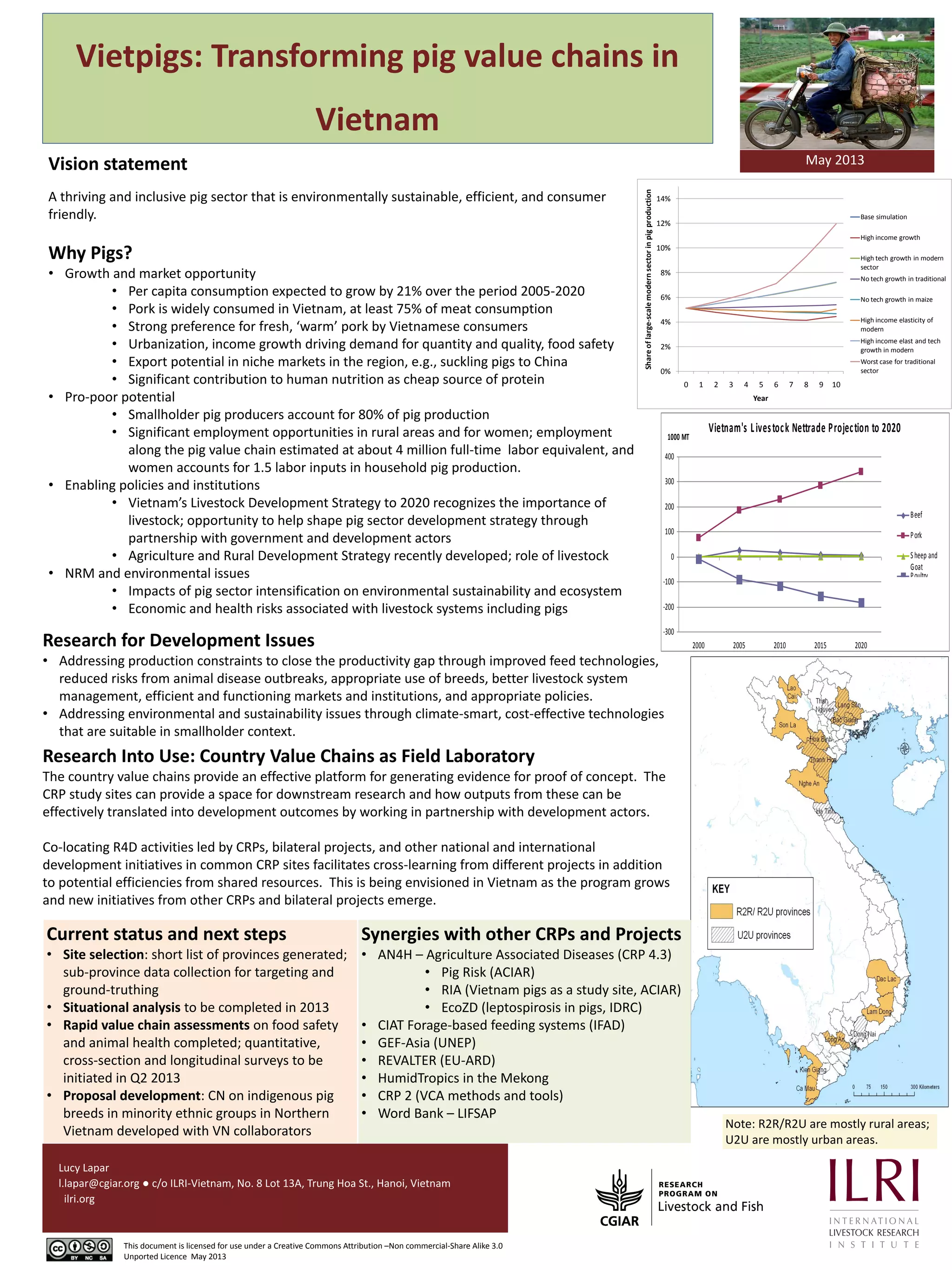
Vietpigs: Transforming pig value chains in
Vietnam
Pictures
Current status and next steps
• Site selection: short list of provinces generated;
sub-province data collection for targeting and
ground-truthing
• Situational analysis to be completed in 2013
• Rapid value chain assessments on food safety
and animal health completed; quantitative,
cross-section and longitudinal surveys to be
initiated in Q2 2013
• Proposal development: CN on indigenous pig
breeds in minority ethnic groups in Northern
Vietnam developed with VN collaborators
Lucy Lapar
l.lapar@cgiar.org ● c/o ILRI-Vietnam, No. 8 Lot 13A, Trung Hoa St., Hanoi, Vietnam
ilri.org
This document is licensed for use under a Creative Commons Attribution –Non commercial-Share Alike 3.0
Unported Licence May 2013
May 2013
Research Into Use: Country Value Chains as Field Laboratory
The country value chains provide an effective platform for generating evidence for proof of concept. The
CRP study sites can provide a space for downstream research and how outputs from these can be
effectively translated into development outcomes by working in partnership with development actors.
Co-locating R4D activities led by CRPs, bilateral projects, and other national and international
development initiatives in common CRP sites facilitates cross-learning from different projects in addition
to potential efficiencies from shared resources. This is being envisioned in Vietnam as the program grows
and new initiatives from other CRPs and bilateral projects emerge.
Vision statement
A thriving and inclusive pig sector that is environmentally sustainable, efficient, and consumer
friendly.
Why Pigs?
• Growth and market opportunity
• Per capita consumption expected to grow by 21% over the period 2005-2020
• Pork is widely consumed in Vietnam, at least 75% of meat consumption
• Strong preference for fresh, ‘warm’ pork by Vietnamese consumers
• Urbanization, income growth driving demand for quantity and quality, food safety
• Export potential in niche markets in the region, e.g., suckling pigs to China
• Significant contribution to human nutrition as cheap source of protein
• Pro-poor potential
• Smallholder pig producers account for 80% of pig production
• Significant employment opportunities in rural areas and for women; employment
along the pig value chain estimated at about 4 million full-time labor equivalent, and
women accounts for 1.5 labor inputs in household pig production.
• Enabling policies and institutions
• Vietnam’s Livestock Development Strategy to 2020 recognizes the importance of
livestock; opportunity to help shape pig sector development strategy through
partnership with government and development actors
• Agriculture and Rural Development Strategy recently developed; role of livestock
• NRM and environmental issues
• Impacts of pig sector intensification on environmental sustainability and ecosystem
• Economic and health risks associated with livestock systems including pigs
0%
2%
4%
6%
8%
10%
12%
14%
0 1 2 3 4 5 6 7 8 9 10
Shareoflarge-scalemodernsectorinpigproduction
Year
Base simulation
High income growth
High tech growth in modern
sector
No tech growth in traditional
No tech growth in maize
High income elasticity of
modern
High income elast and tech
growth in modern
Worst case for traditional
sector
Vietnam's Livestock Nettrade Projection to 2020
-300
-200
-100
0
100
200
300
400
2000 2005 2010 2015 2020
1000 MT
Beef
Pork
Sheep and
Goat
Poultry
Research for Development Issues
• Addressing production constraints to close the productivity gap through improved feed technologies,
reduced risks from animal disease outbreaks, appropriate use of breeds, better livestock system
management, efficient and functioning markets and institutions, and appropriate policies.
• Addressing environmental and sustainability issues through climate-smart, cost-effective technologies
that are suitable in smallholder context.
Note: R2R/R2U are mostly rural areas;
U2U are mostly urban areas.
Synergies with other CRPs and Projects
• AN4H – Agriculture Associated Diseases (CRP 4.3)
• Pig Risk (ACIAR)
• RIA (Vietnam pigs as a study site, ACIAR)
• EcoZD (leptospirosis in pigs, IDRC)
• CIAT Forage-based feeding systems (IFAD)
• GEF-Asia (UNEP)
• REVALTER (EU-ARD)
• HumidTropics in the Mekong
• CRP 2 (VCA methods and tools)
• Word Bank – LIFSAP

Vietpigs: Transforming pig value chains in Vietnam

  • 1.
    Vietpigs: Transforming pigvalue chains in Vietnam Pictures Current status and next steps • Site selection: short list of provinces generated; sub-province data collection for targeting and ground-truthing • Situational analysis to be completed in 2013 • Rapid value chain assessments on food safety and animal health completed; quantitative, cross-section and longitudinal surveys to be initiated in Q2 2013 • Proposal development: CN on indigenous pig breeds in minority ethnic groups in Northern Vietnam developed with VN collaborators Lucy Lapar l.lapar@cgiar.org ● c/o ILRI-Vietnam, No. 8 Lot 13A, Trung Hoa St., Hanoi, Vietnam ilri.org This document is licensed for use under a Creative Commons Attribution –Non commercial-Share Alike 3.0 Unported Licence May 2013 May 2013 Research Into Use: Country Value Chains as Field Laboratory The country value chains provide an effective platform for generating evidence for proof of concept. The CRP study sites can provide a space for downstream research and how outputs from these can be effectively translated into development outcomes by working in partnership with development actors. Co-locating R4D activities led by CRPs, bilateral projects, and other national and international development initiatives in common CRP sites facilitates cross-learning from different projects in addition to potential efficiencies from shared resources. This is being envisioned in Vietnam as the program grows and new initiatives from other CRPs and bilateral projects emerge. Vision statement A thriving and inclusive pig sector that is environmentally sustainable, efficient, and consumer friendly. Why Pigs? • Growth and market opportunity • Per capita consumption expected to grow by 21% over the period 2005-2020 • Pork is widely consumed in Vietnam, at least 75% of meat consumption • Strong preference for fresh, ‘warm’ pork by Vietnamese consumers • Urbanization, income growth driving demand for quantity and quality, food safety • Export potential in niche markets in the region, e.g., suckling pigs to China • Significant contribution to human nutrition as cheap source of protein • Pro-poor potential • Smallholder pig producers account for 80% of pig production • Significant employment opportunities in rural areas and for women; employment along the pig value chain estimated at about 4 million full-time labor equivalent, and women accounts for 1.5 labor inputs in household pig production. • Enabling policies and institutions • Vietnam’s Livestock Development Strategy to 2020 recognizes the importance of livestock; opportunity to help shape pig sector development strategy through partnership with government and development actors • Agriculture and Rural Development Strategy recently developed; role of livestock • NRM and environmental issues • Impacts of pig sector intensification on environmental sustainability and ecosystem • Economic and health risks associated with livestock systems including pigs 0% 2% 4% 6% 8% 10% 12% 14% 0 1 2 3 4 5 6 7 8 9 10 Shareoflarge-scalemodernsectorinpigproduction Year Base simulation High income growth High tech growth in modern sector No tech growth in traditional No tech growth in maize High income elasticity of modern High income elast and tech growth in modern Worst case for traditional sector Vietnam's Livestock Nettrade Projection to 2020 -300 -200 -100 0 100 200 300 400 2000 2005 2010 2015 2020 1000 MT Beef Pork Sheep and Goat Poultry Research for Development Issues • Addressing production constraints to close the productivity gap through improved feed technologies, reduced risks from animal disease outbreaks, appropriate use of breeds, better livestock system management, efficient and functioning markets and institutions, and appropriate policies. • Addressing environmental and sustainability issues through climate-smart, cost-effective technologies that are suitable in smallholder context. Note: R2R/R2U are mostly rural areas; U2U are mostly urban areas. Synergies with other CRPs and Projects • AN4H – Agriculture Associated Diseases (CRP 4.3) • Pig Risk (ACIAR) • RIA (Vietnam pigs as a study site, ACIAR) • EcoZD (leptospirosis in pigs, IDRC) • CIAT Forage-based feeding systems (IFAD) • GEF-Asia (UNEP) • REVALTER (EU-ARD) • HumidTropics in the Mekong • CRP 2 (VCA methods and tools) • Word Bank – LIFSAP