1
Ideas around
automating API
Management
March 2020 by Matt Tanner
2
Product Evangelist @ Tyk
Matt
3
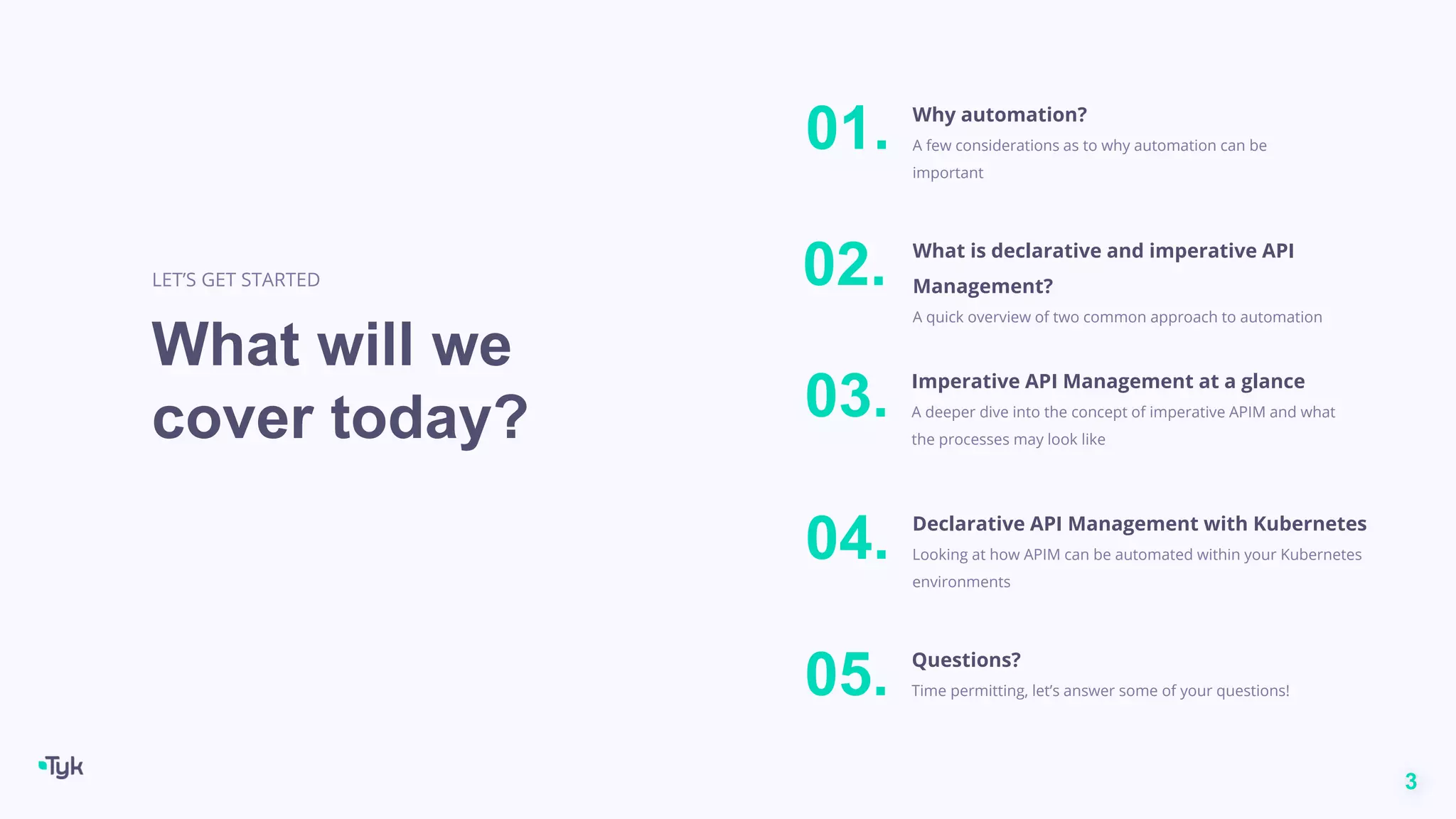
What will we
cover today?
LET’S GET STARTED
Why automation?
A few considerations as to why automation can be
important
01.
Questions?
Time permitting, let’s answer some of your questions!
05.
Imperative API Management at a glance
A deeper dive into the concept of imperative APIM and what
the processes may look like
03.
Declarative API Management with Kubernetes
Looking at how APIM can be automated within your Kubernetes
environments
04.
What is declarative and imperative API
Management?
A quick overview of two common approach to automation
02.
What do I mean by automation?
Infrastructure as code, CI/CD, and managing code and infrastructure as it moves from
low to high environments
LET’S GET ON THE SAME PAGE!
4
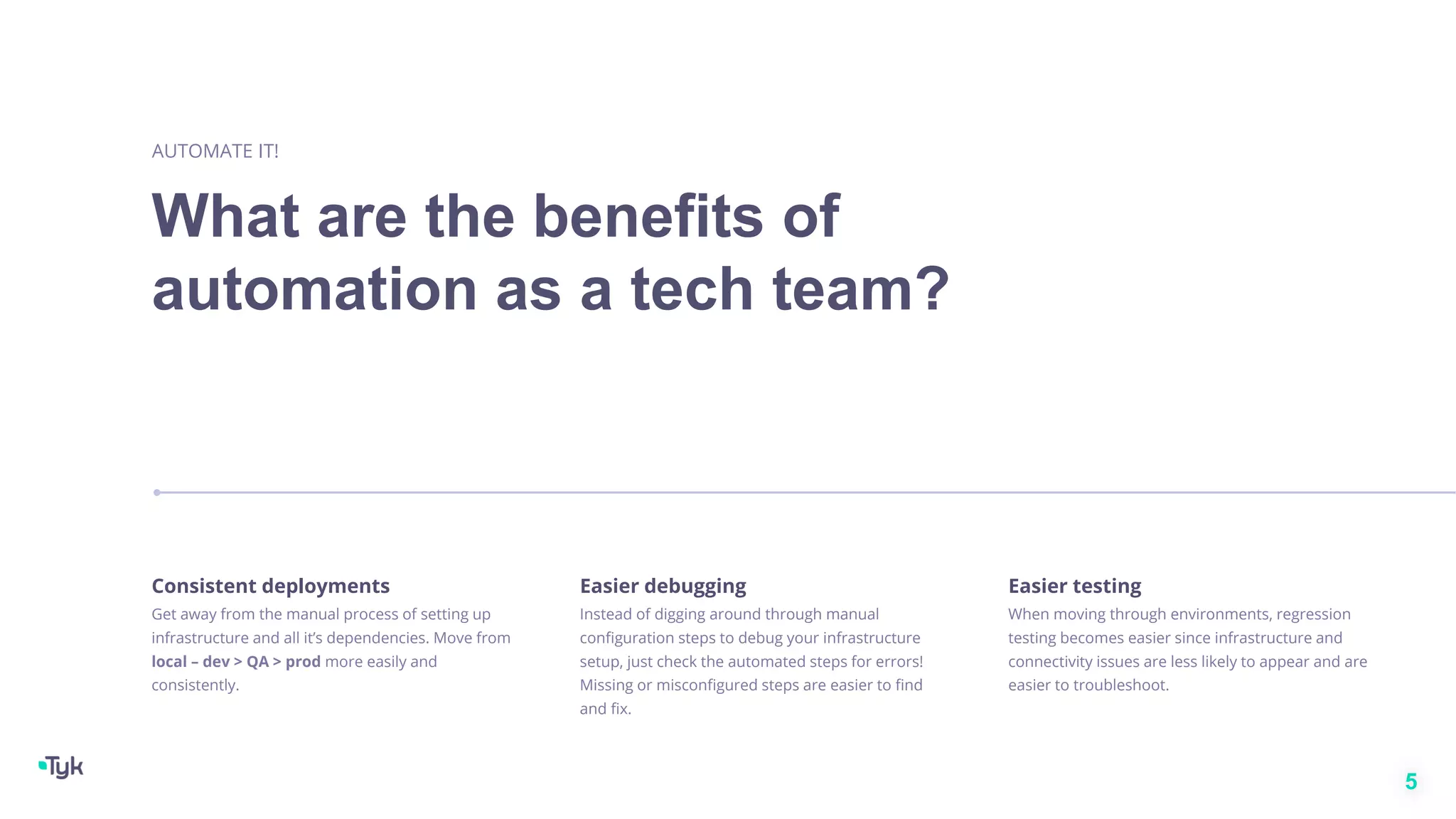
What are the benefits of
automation as a tech team?
AUTOMATE IT!
5
Consistent deployments
Get away from the manual process of setting up
infrastructure and all it’s dependencies. Move from
local – dev > QA > prod more easily and
consistently.
Easier debugging
Instead of digging around through manual
configuration steps to debug your infrastructure
setup, just check the automated steps for errors!
Missing or misconfigured steps are easier to find
and fix.
Easier testing
When moving through environments, regression
testing becomes easier since infrastructure and
connectivity issues are less likely to appear and are
easier to troubleshoot.
What are the potential
business benefits of strong
automation within the
organization?
THE OTHER SIDE
6
Less risk
Misconfiguration of infrastructure and the security
associated with it can be a massive risk for
organizations. Automation reduces risk by removing
the human error factor and easily interpreted
configuration files
Lower project cost
Setting up environments and troubleshooting any
errors that occur can lead to higher project costs.
Create your deployment configurations and scripts
once, then repeat throughout the rest of the project.
Faster time to market
Don’t have your tech team get bogged down in
setting up environment's multiple times, burning up
project $. Create your environment config and
continue to use it to setup higher environments
quickly and automatically.
7
What is GitOps?
A QUICK ASIDE
Infrastructure as Code
Certain tasks which are traditionally handled by IT
Operations teams can now be handled and
automated by developers via code.
Declarative syntax
Using git and declarative syntax to describe how a
system/infrastructure should be created allows for
reproducible results. Consistently create the
infrastructure you need, more easily.
Continuous Everything!
Moving to a GitOps workflow for infrastructure
means that organizations can now embrace
Continuous Everything!
8
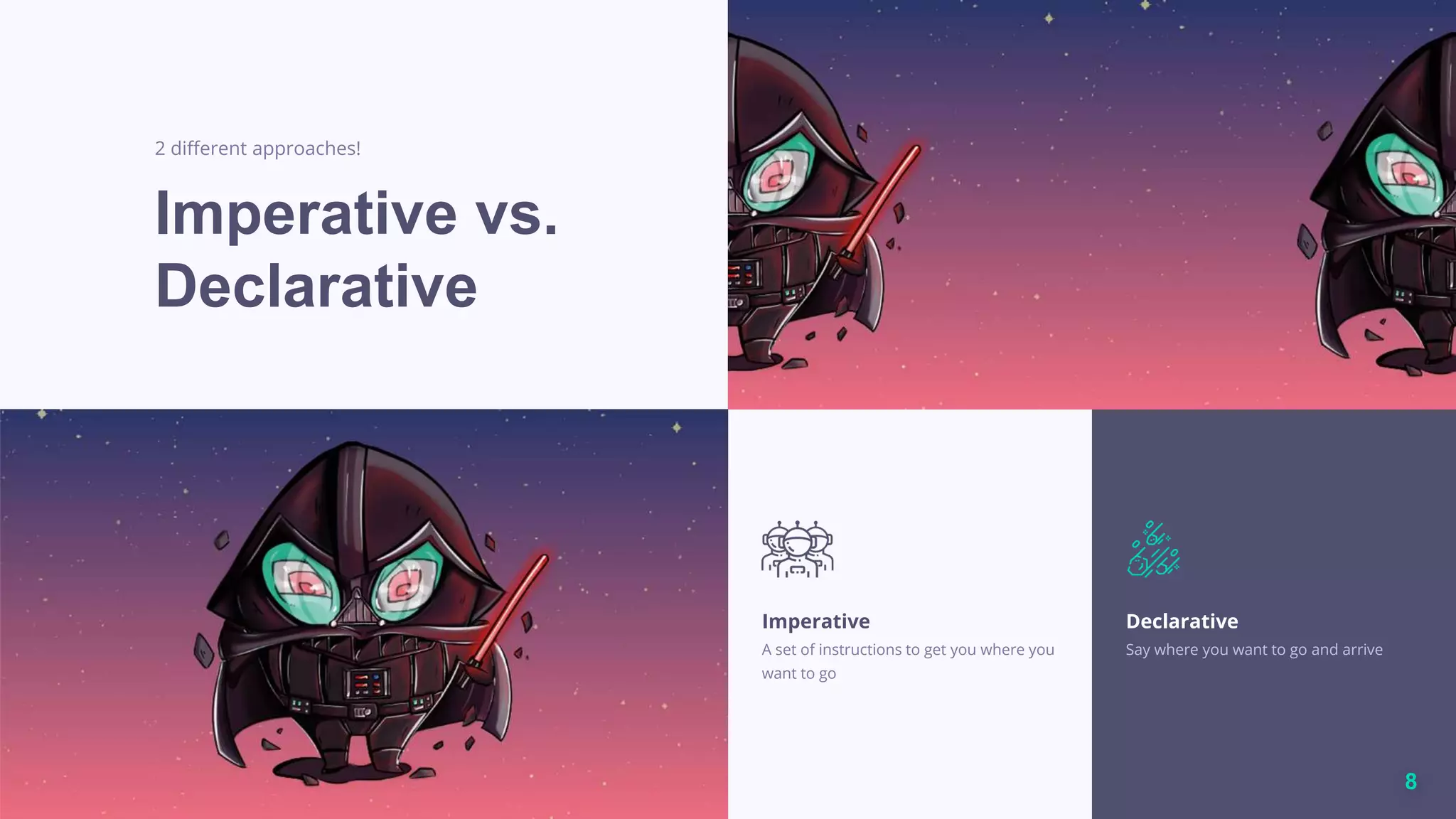
Imperative vs.
Declarative
2 different approaches!
Imperative
A set of instructions to get you where you
want to go
Declarative
Say where you want to go and arrive
9
Imperative APIM at a
glance
SOME CONSIDERATIONS
Who’s involved?
Product Developers
DevOps
What’s required?
APIM solution must have
imperative interface (available
API’s, etc)
Issues?
Can be brittle until common
issues are found
Outcome
Reproducible infrastructure
with varying consistency
(depending on deployment
method)
Pro/Cons
+Lots of tools support this
approach
- Dependent on infrastructure
state
10
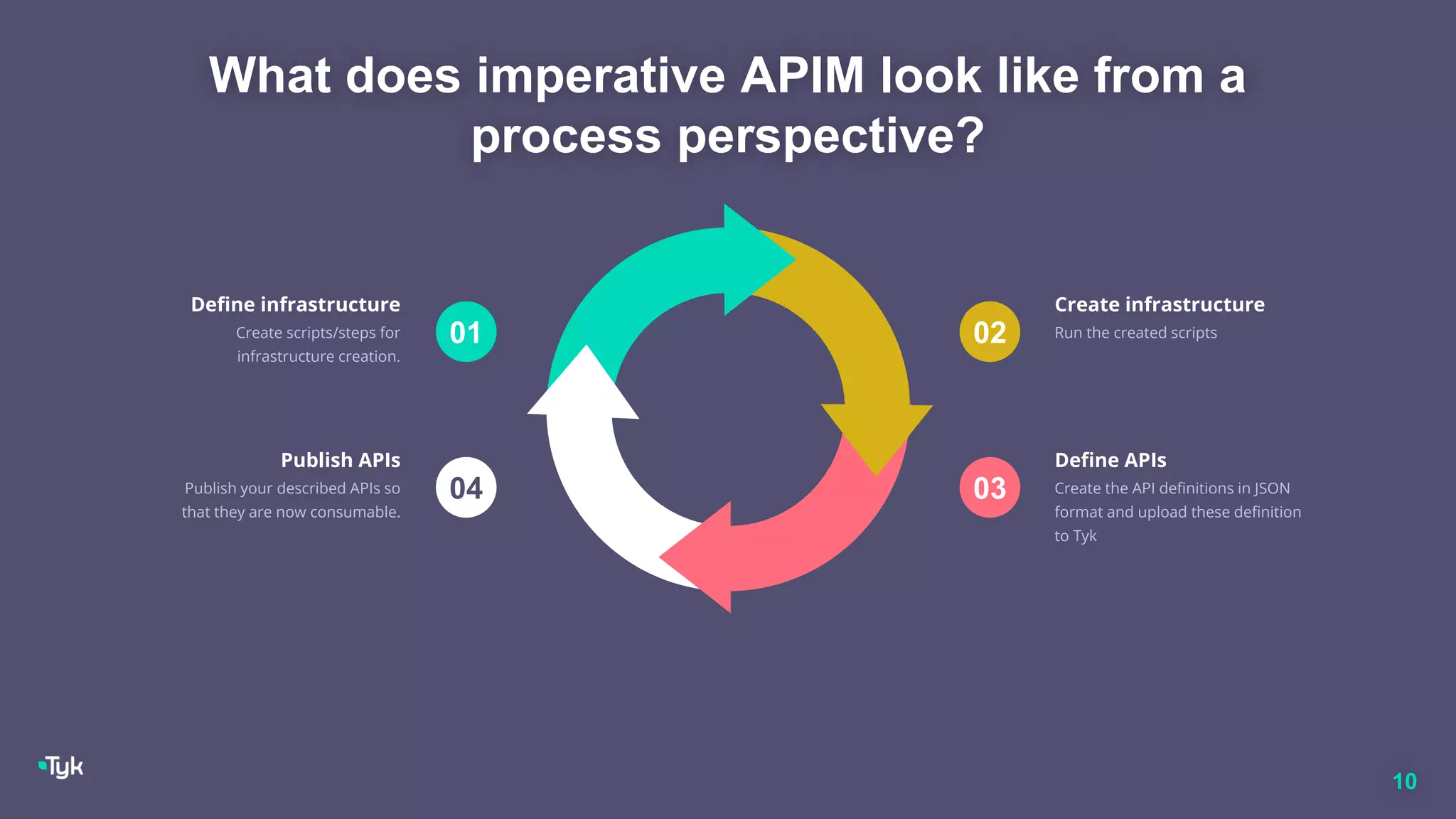
02
Create infrastructure
Run the created scripts
03
Define APIs
Create the API definitions in JSON
format and upload these definition
to Tyk
01
Define infrastructure
Create scripts/steps for
infrastructure creation.
04
Publish APIs
Publish your described APIs so
that they are now consumable.
What does imperative APIM look like from a
process perspective?
1
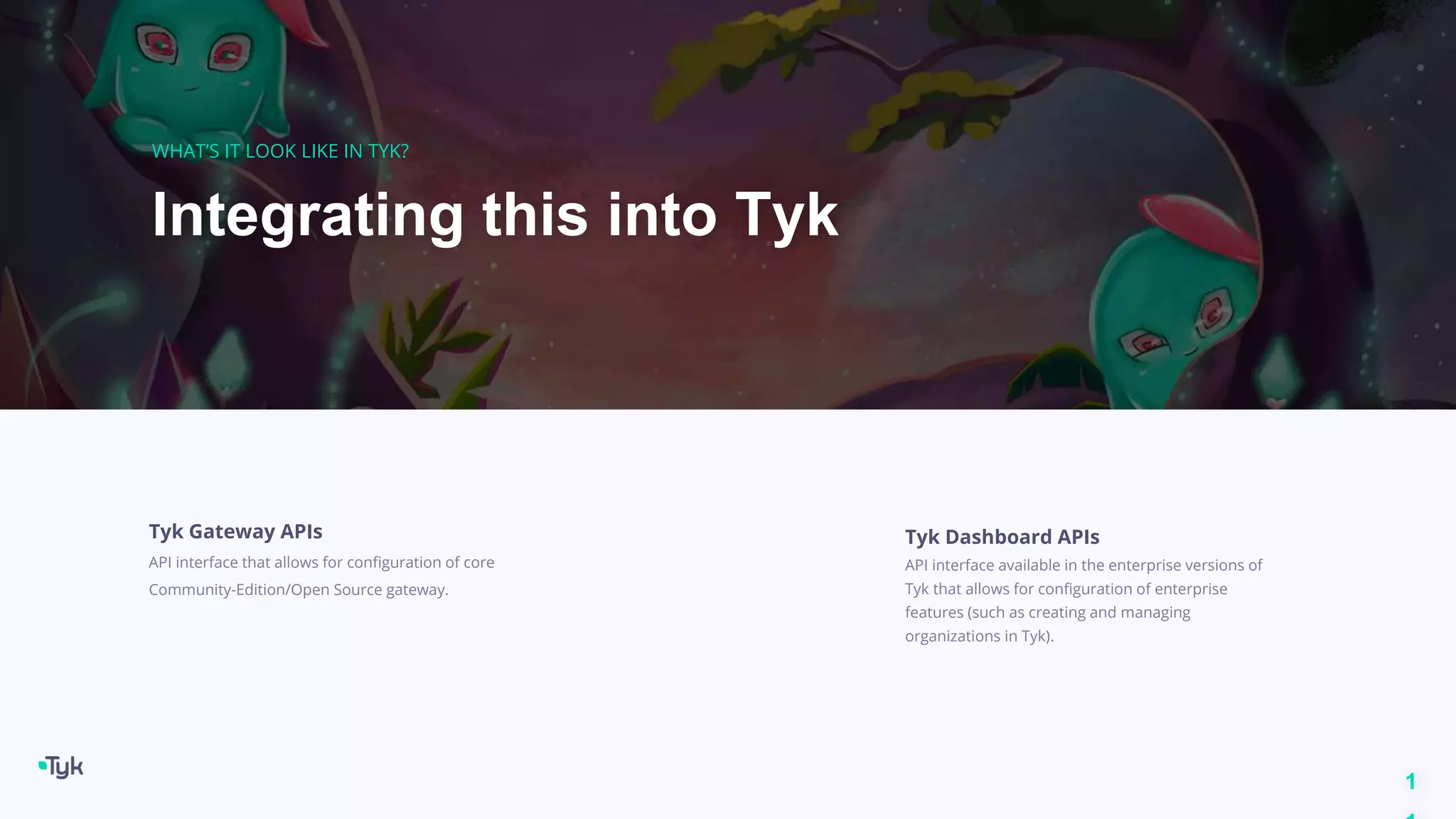
Integrating this into Tyk
WHAT’S IT LOOK LIKE IN TYK?
Tyk Gateway APIs
API interface that allows for configuration of core
Community-Edition/Open Source gateway.
Tyk Dashboard APIs
API interface available in the enterprise versions of
Tyk that allows for configuration of enterprise
features (such as creating and managing
organizations in Tyk).
1
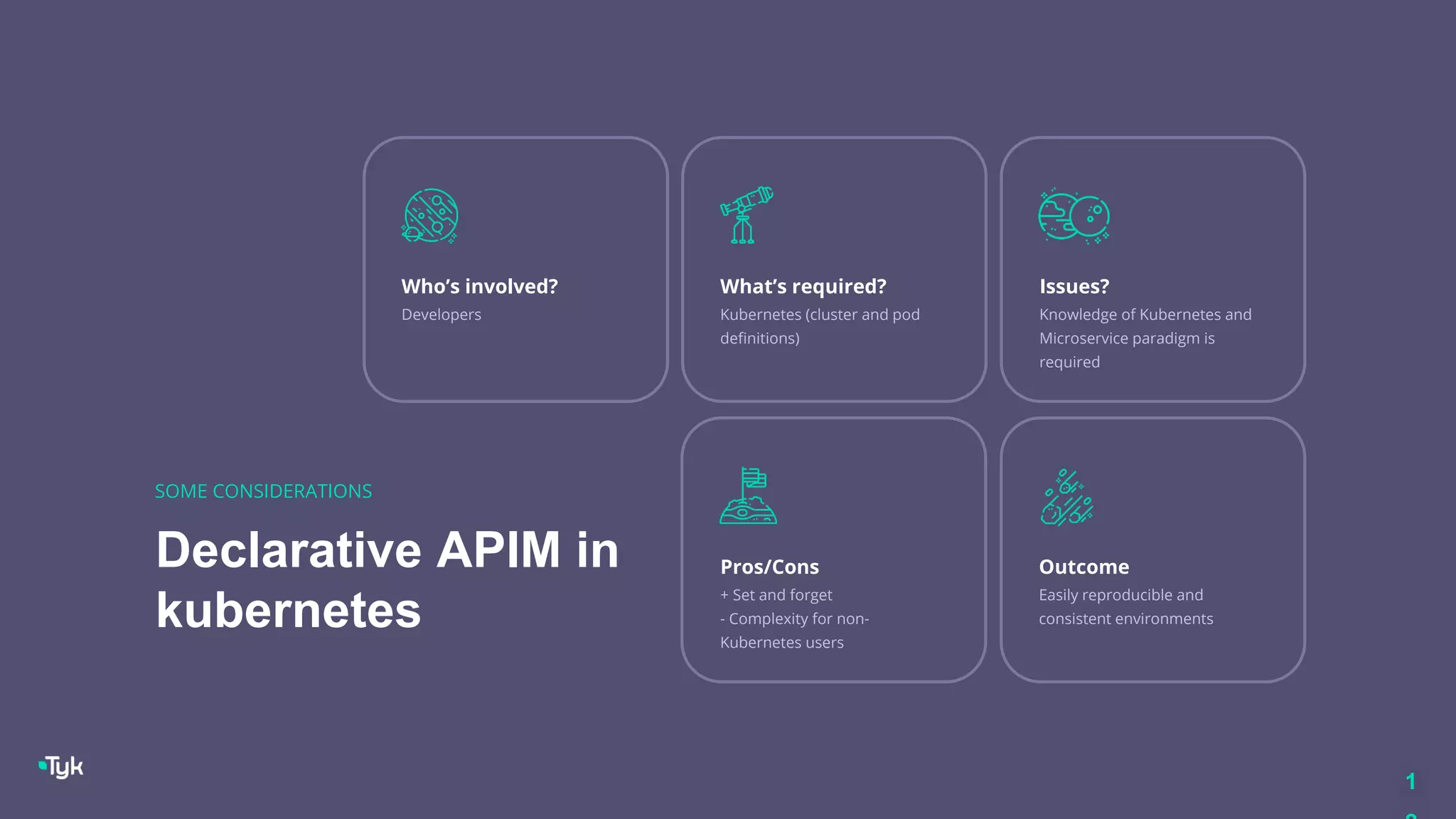
Declarative APIM in
kubernetes
SOME CONSIDERATIONS
Who’s involved?
Developers
What’s required?
Kubernetes (cluster and pod
definitions)
Issues?
Knowledge of Kubernetes and
Microservice paradigm is
required
Outcome
Easily reproducible and
consistent environments
Pros/Cons
+ Set and forget
- Complexity for non-
Kubernetes users
13
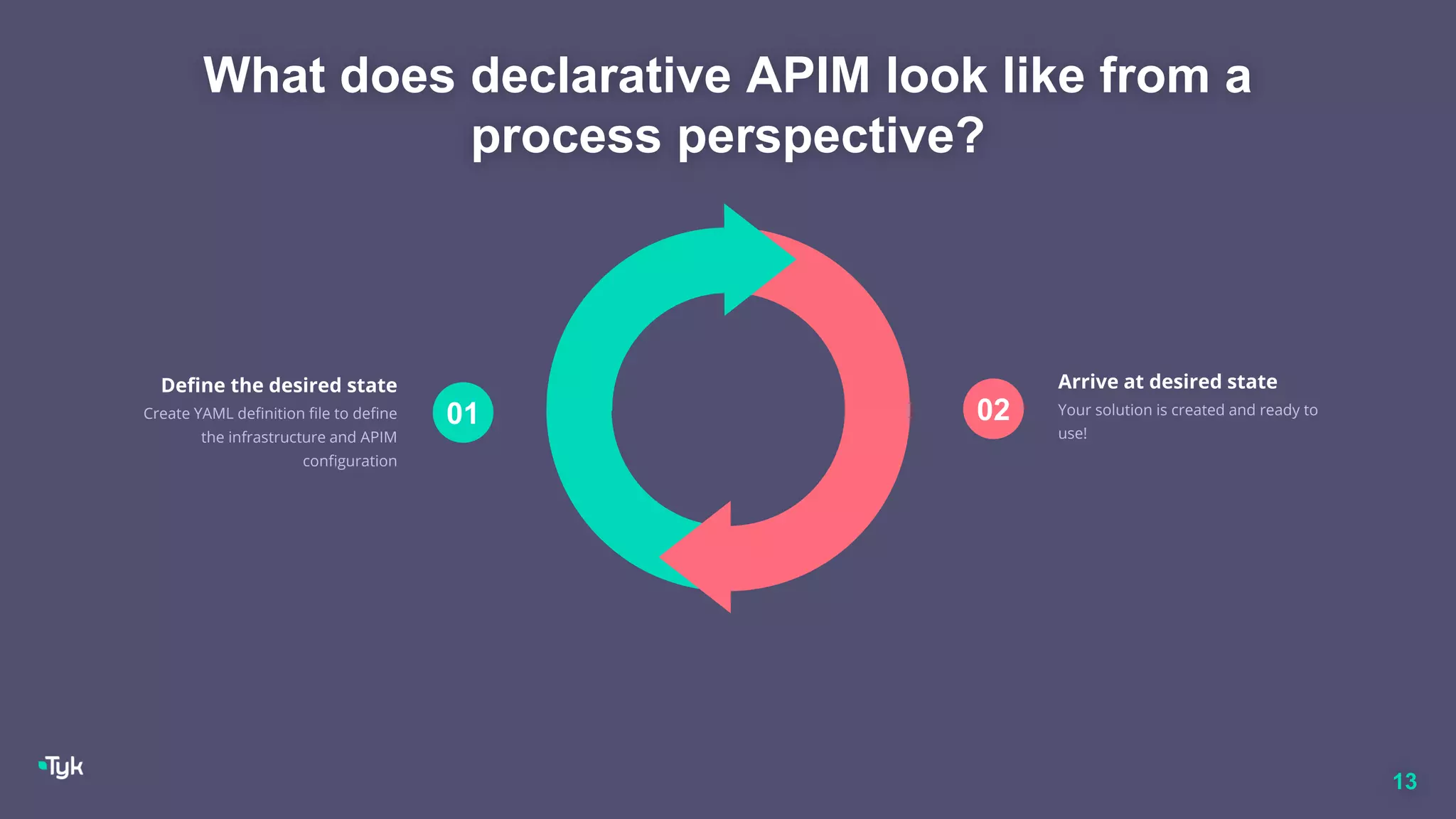
02
Arrive at desired state
Your solution is created and ready to
use!
01
Define the desired state
Create YAML definition file to define
the infrastructure and APIM
configuration
What does declarative APIM look like from a
process perspective?
1
Integrating this into Tyk
WHAT’S IT LOOK LIKE IN TYK?
Tyk Operator
Our newest feature to support declarative APIM
right within Tyk.
Use the Tyk Operator to declaratively automate your
APIM experience in Kubernetes!
15
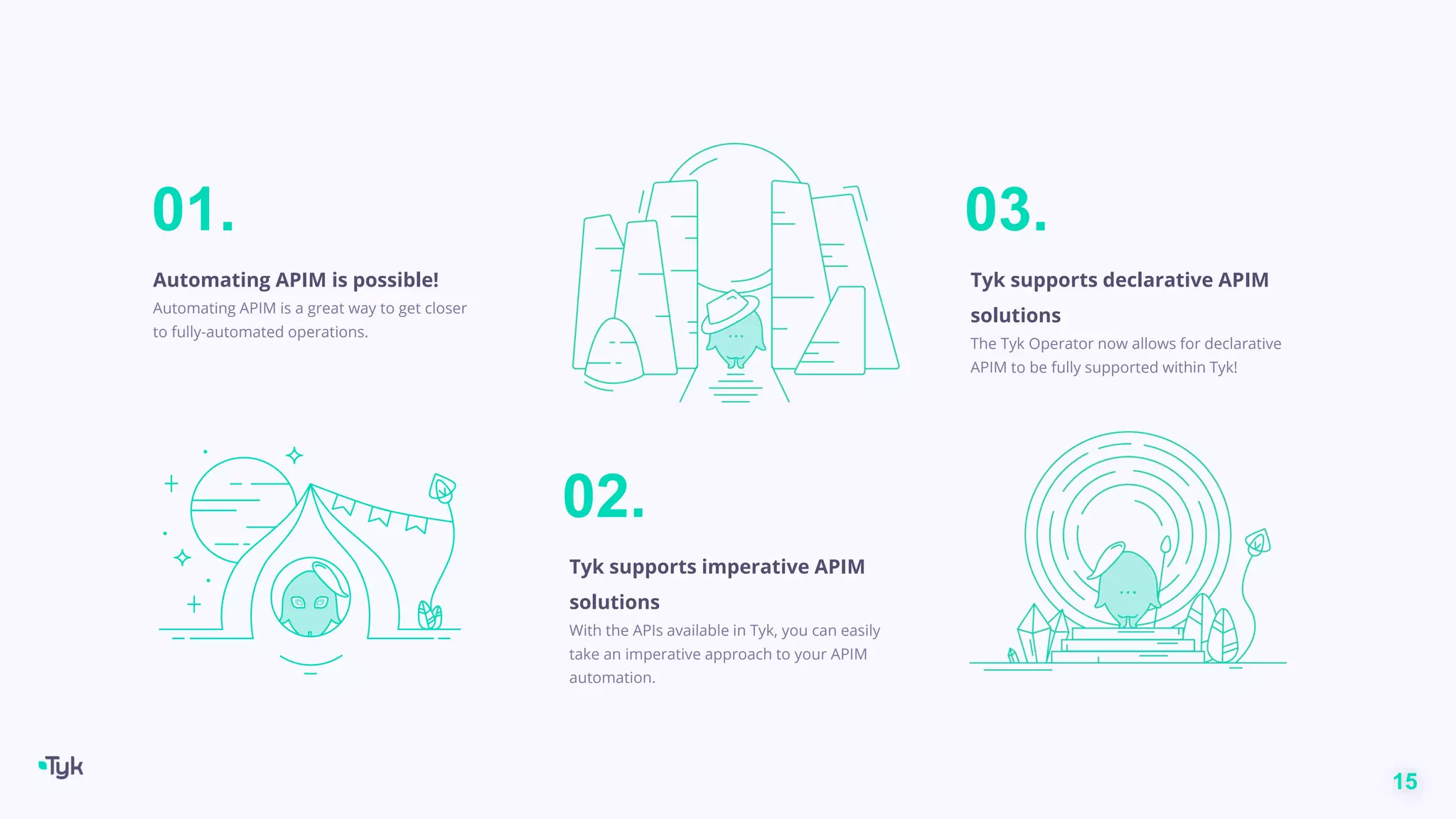
01.
Automating APIM is possible!
Automating APIM is a great way to get closer
to fully-automated operations.
02.
Tyk supports imperative APIM
solutions
With the APIs available in Tyk, you can easily
take an imperative approach to your APIM
automation.
03.
Tyk supports declarative APIM
solutions
The Tyk Operator now allows for declarative
APIM to be fully supported within Tyk!
Try it out today!
If you want to automate your API management platform, give us a try!
THE TYK PLUG
1
17
Questions or
comments?
LET’S HEAR IT!
Thanks for joining!
MERCI BEAUCOUP
18
Try it out with a trial license and see for yourself just how
easy it is.

apidays LIVE Helsinki & North - Ideas around automating API Management by Matt Tanner, Tyk

  • 1.
  • 2.
  • 3.
    3 What will we covertoday? LET’S GET STARTED Why automation? A few considerations as to why automation can be important 01. Questions? Time permitting, let’s answer some of your questions! 05. Imperative API Management at a glance A deeper dive into the concept of imperative APIM and what the processes may look like 03. Declarative API Management with Kubernetes Looking at how APIM can be automated within your Kubernetes environments 04. What is declarative and imperative API Management? A quick overview of two common approach to automation 02.
  • 4.
    What do Imean by automation? Infrastructure as code, CI/CD, and managing code and infrastructure as it moves from low to high environments LET’S GET ON THE SAME PAGE! 4
  • 5.
    What are thebenefits of automation as a tech team? AUTOMATE IT! 5 Consistent deployments Get away from the manual process of setting up infrastructure and all it’s dependencies. Move from local – dev > QA > prod more easily and consistently. Easier debugging Instead of digging around through manual configuration steps to debug your infrastructure setup, just check the automated steps for errors! Missing or misconfigured steps are easier to find and fix. Easier testing When moving through environments, regression testing becomes easier since infrastructure and connectivity issues are less likely to appear and are easier to troubleshoot.
  • 6.
    What are thepotential business benefits of strong automation within the organization? THE OTHER SIDE 6 Less risk Misconfiguration of infrastructure and the security associated with it can be a massive risk for organizations. Automation reduces risk by removing the human error factor and easily interpreted configuration files Lower project cost Setting up environments and troubleshooting any errors that occur can lead to higher project costs. Create your deployment configurations and scripts once, then repeat throughout the rest of the project. Faster time to market Don’t have your tech team get bogged down in setting up environment's multiple times, burning up project $. Create your environment config and continue to use it to setup higher environments quickly and automatically.
  • 7.
    7 What is GitOps? AQUICK ASIDE Infrastructure as Code Certain tasks which are traditionally handled by IT Operations teams can now be handled and automated by developers via code. Declarative syntax Using git and declarative syntax to describe how a system/infrastructure should be created allows for reproducible results. Consistently create the infrastructure you need, more easily. Continuous Everything! Moving to a GitOps workflow for infrastructure means that organizations can now embrace Continuous Everything!
  • 8.
    8 Imperative vs. Declarative 2 differentapproaches! Imperative A set of instructions to get you where you want to go Declarative Say where you want to go and arrive
  • 9.
    9 Imperative APIM ata glance SOME CONSIDERATIONS Who’s involved? Product Developers DevOps What’s required? APIM solution must have imperative interface (available API’s, etc) Issues? Can be brittle until common issues are found Outcome Reproducible infrastructure with varying consistency (depending on deployment method) Pro/Cons +Lots of tools support this approach - Dependent on infrastructure state
  • 10.
    10 02 Create infrastructure Run thecreated scripts 03 Define APIs Create the API definitions in JSON format and upload these definition to Tyk 01 Define infrastructure Create scripts/steps for infrastructure creation. 04 Publish APIs Publish your described APIs so that they are now consumable. What does imperative APIM look like from a process perspective?
  • 11.
    1 Integrating this intoTyk WHAT’S IT LOOK LIKE IN TYK? Tyk Gateway APIs API interface that allows for configuration of core Community-Edition/Open Source gateway. Tyk Dashboard APIs API interface available in the enterprise versions of Tyk that allows for configuration of enterprise features (such as creating and managing organizations in Tyk).
  • 12.
    1 Declarative APIM in kubernetes SOMECONSIDERATIONS Who’s involved? Developers What’s required? Kubernetes (cluster and pod definitions) Issues? Knowledge of Kubernetes and Microservice paradigm is required Outcome Easily reproducible and consistent environments Pros/Cons + Set and forget - Complexity for non- Kubernetes users
  • 13.
    13 02 Arrive at desiredstate Your solution is created and ready to use! 01 Define the desired state Create YAML definition file to define the infrastructure and APIM configuration What does declarative APIM look like from a process perspective?
  • 14.
    1 Integrating this intoTyk WHAT’S IT LOOK LIKE IN TYK? Tyk Operator Our newest feature to support declarative APIM right within Tyk. Use the Tyk Operator to declaratively automate your APIM experience in Kubernetes!
  • 15.
    15 01. Automating APIM ispossible! Automating APIM is a great way to get closer to fully-automated operations. 02. Tyk supports imperative APIM solutions With the APIs available in Tyk, you can easily take an imperative approach to your APIM automation. 03. Tyk supports declarative APIM solutions The Tyk Operator now allows for declarative APIM to be fully supported within Tyk!
  • 16.
    Try it outtoday! If you want to automate your API management platform, give us a try! THE TYK PLUG 1
  • 17.
  • 18.
    Thanks for joining! MERCIBEAUCOUP 18 Try it out with a trial license and see for yourself just how easy it is.