API TESTING
USING PYTEST
Why We Need API Testing:
• Verify functionality: Ensure API behaves as expected.
• Performance & load testing: Check how well the API handles high traffic.
• Security: Identify vulnerabilities in the API.
• Integration testing: Ensure smooth interaction with other services or systems.
How API Testing Works:
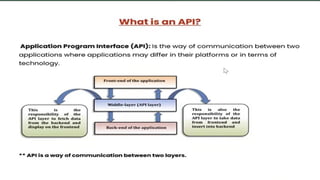
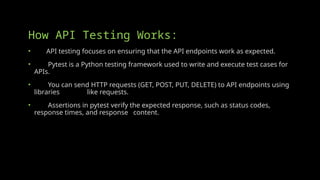
• API testing focuses on ensuring that the API endpoints work as expected.
• Pytest is a Python testing framework used to write and execute test cases for
APIs.
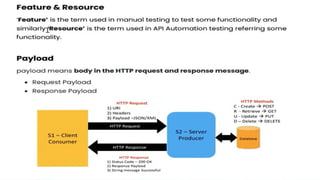
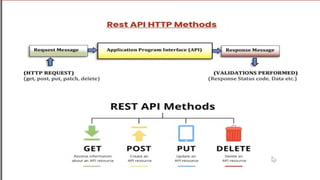
• You can send HTTP requests (GET, POST, PUT, DELETE) to API endpoints using
libraries like requests.
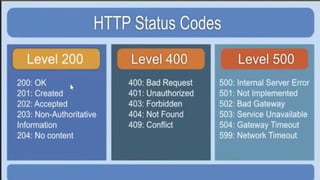
• Assertions in pytest verify the expected response, such as status codes,
response times, and response content.
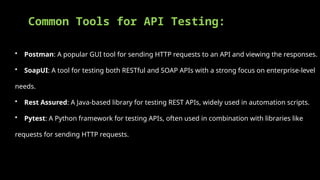
Common Tools for API Testing:
• Postman: A popular GUI tool for sending HTTP requests to an API and viewing the responses.
• SoapUI: A tool for testing both RESTful and SOAP APIs with a strong focus on enterprise-level
needs.
• Rest Assured: A Java-based library for testing REST APIs, widely used in automation scripts.
• Pytest: A Python framework for testing APIs, often used in combination with libraries like
requests for sending HTTP requests.
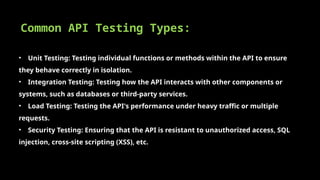
Common API Testing Types:
• Unit Testing: Testing individual functions or methods within the API to ensure
they behave correctly in isolation.
• Integration Testing: Testing how the API interacts with other components or
systems, such as databases or third-party services.
• Load Testing: Testing the API's performance under heavy traffic or multiple
requests.
• Security Testing: Ensuring that the API is resistant to unauthorized access, SQL
injection, cross-site scripting (XSS), etc.
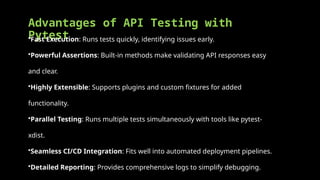
Advantages of API Testing with
Pytest
•Fast Execution: Runs tests quickly, identifying issues early.
•Powerful Assertions: Built-in methods make validating API responses easy
and clear.
•Highly Extensible: Supports plugins and custom fixtures for added
functionality.
•Parallel Testing: Runs multiple tests simultaneously with tools like pytest-
xdist.
•Seamless CI/CD Integration: Fits well into automated deployment pipelines.
•Detailed Reporting: Provides comprehensive logs to simplify debugging.
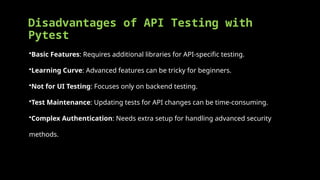
Disadvantages of API Testing with
Pytest
•Basic Features: Requires additional libraries for API-specific testing.
•Learning Curve: Advanced features can be tricky for beginners.
•Not for UI Testing: Focuses only on backend testing.
•Test Maintenance: Updating tests for API changes can be time-consuming.
•Complex Authentication: Needs extra setup for handling advanced security
methods.

API TESTING USING PYTEST IN PYCHARMPRESENTENTION.pptx

  • 1.
  • 3.
    Why We NeedAPI Testing: • Verify functionality: Ensure API behaves as expected. • Performance & load testing: Check how well the API handles high traffic. • Security: Identify vulnerabilities in the API. • Integration testing: Ensure smooth interaction with other services or systems.
  • 4.
    How API TestingWorks: • API testing focuses on ensuring that the API endpoints work as expected. • Pytest is a Python testing framework used to write and execute test cases for APIs. • You can send HTTP requests (GET, POST, PUT, DELETE) to API endpoints using libraries like requests. • Assertions in pytest verify the expected response, such as status codes, response times, and response content.
  • 9.
    Common Tools forAPI Testing: • Postman: A popular GUI tool for sending HTTP requests to an API and viewing the responses. • SoapUI: A tool for testing both RESTful and SOAP APIs with a strong focus on enterprise-level needs. • Rest Assured: A Java-based library for testing REST APIs, widely used in automation scripts. • Pytest: A Python framework for testing APIs, often used in combination with libraries like requests for sending HTTP requests.
  • 10.
    Common API TestingTypes: • Unit Testing: Testing individual functions or methods within the API to ensure they behave correctly in isolation. • Integration Testing: Testing how the API interacts with other components or systems, such as databases or third-party services. • Load Testing: Testing the API's performance under heavy traffic or multiple requests. • Security Testing: Ensuring that the API is resistant to unauthorized access, SQL injection, cross-site scripting (XSS), etc.
  • 11.
    Advantages of APITesting with Pytest •Fast Execution: Runs tests quickly, identifying issues early. •Powerful Assertions: Built-in methods make validating API responses easy and clear. •Highly Extensible: Supports plugins and custom fixtures for added functionality. •Parallel Testing: Runs multiple tests simultaneously with tools like pytest- xdist. •Seamless CI/CD Integration: Fits well into automated deployment pipelines. •Detailed Reporting: Provides comprehensive logs to simplify debugging.
  • 12.
    Disadvantages of APITesting with Pytest •Basic Features: Requires additional libraries for API-specific testing. •Learning Curve: Advanced features can be tricky for beginners. •Not for UI Testing: Focuses only on backend testing. •Test Maintenance: Updating tests for API changes can be time-consuming. •Complex Authentication: Needs extra setup for handling advanced security methods.