API Test Automation Best Practices for Scalable Products.pdf
1.
API Test AutomationBest Practices for
Scalable Products
In today’s digital world, APIs (Application Programming Interfaces) have
become the backbone of modern applications, powering everything from
e-commerce platforms and mobile apps to financial services and IoT systems.
As businesses grow, the performance and reliability of these APIs directly
impact user experience and product scalability. That’s why API test
automation plays a critical role; it ensures faster feedback, reduces manual
effort, and makes it possible to deliver high-quality products that can scale
with increasing demands. In this blog, we’ll explore the best practices for API
test automation, focusing on strategies that help teams build reliable, scalable,
and future-ready products.
Understanding API Test Automation
What is API testing?
API testing is all about checking whether the communication between
different software systems works correctly. Since APIs act as messengers that
allow applications, services, or platforms to talk to each other, testing them
2.
ensures that thedata passed through these interfaces is accurate, secure,
and reliable. Unlike UI testing, which focuses on how the end-user interacts
with the application, API testing goes one level deeper and validates the logic
and functionality behind the scenes. For example, when you book a flight on a
travel app, APIs fetch seat availability, process payments, and confirm
reservations. If those APIs fail, the entire booking experience collapses, no
matter how polished the app’s design looks.
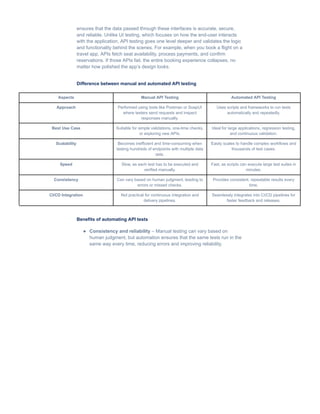
Difference between manual and automated API testing
Aspects Manual API Testing Automated API Testing
Approach Performed using tools like Postman or SoapUI
where testers send requests and inspect
responses manually.
Uses scripts and frameworks to run tests
automatically and repeatedly.
Best Use Case Suitable for simple validations, one-time checks,
or exploring new APIs.
Ideal for large applications, regression testing,
and continuous validation.
Scalability Becomes inefficient and time-consuming when
testing hundreds of endpoints with multiple data
sets.
Easily scales to handle complex workflows and
thousands of test cases.
Speed Slow, as each test has to be executed and
verified manually.
Fast, as scripts can execute large test suites in
minutes.
Consistency Can vary based on human judgment, leading to
errors or missed checks.
Provides consistent, repeatable results every
time.
CI/CD Integration Not practical for continuous integration and
delivery pipelines.
Seamlessly integrates into CI/CD pipelines for
faster feedback and releases.
Benefits of automating API tests
● Consistency and reliability – Manual testing can vary based on
human judgment, but automation ensures that the same tests run in the
same way every time, reducing errors and improving reliability.
3.
● Scalability –As products grow, APIs often need to handle higher traffic
and more complex workflows. Automated tests can simulate these
conditions and validate performance under load, making sure the
system remains stable.
● Early defect detection – Since APIs connect multiple services, a single
error can break critical functionalities. Automated testing helps detect
these defects early in the development cycle before they impact
end-users.
● Support for Agile and DevOps – Automated tests integrate
seamlessly with CI/CD pipelines, providing continuous feedback and
enabling rapid, safe deployments. This is especially important in agile
environments where speed and adaptability matter most.
● Speed and efficiency – Automated scripts can validate hundreds or
thousands of requests in a fraction of the time it would take manually.
This speed is crucial when businesses need to release updates
frequently.
In short, API test automation not only improves product quality but also builds
a strong foundation for scalability, ensuring that applications can grow
smoothly while delivering a consistent user experience.
Automating API testing provides significant advantages that make it essential
for scalable products.
Planning for Scalable API Test Automation
4.
Building scalable APItest automation doesn’t start with tools or frameworks, it
begins with the right planning. Without a proper strategy, tests can become
fragmented, redundant, or miss critical scenarios that impact scalability.
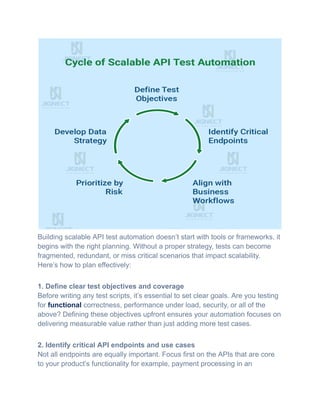
Here’s how to plan effectively:
1. Define clear test objectives and coverage
Before writing any test scripts, it’s essential to set clear goals. Are you testing
for functional correctness, performance under load, security, or all of the
above? Defining these objectives upfront ensures your automation focuses on
delivering measurable value rather than just adding more test cases.
2. Identify critical API endpoints and use cases
Not all endpoints are equally important. Focus first on the APIs that are core
to your product’s functionality for example, payment processing in an
5.
e-commerce app orauthentication in a financial platform. Cover the most
common and business-critical use cases to ensure stability where it matters
most.
3. Align with business workflows and user journeys
API testing shouldn’t exist in isolation. Tests should mirror real-world business
workflows, such as logging in, placing an order, or retrieving customer data.
By aligning with end-to-end user journeys, you can validate not only individual
APIs but also how they work together to deliver value to the user.
4. Risk-based prioritization
It’s not always practical to test everything at once. That’s where risk-based
prioritization helps. Rank your APIs by their impact on business, likelihood of
failure, and complexity. High-risk APIs should have more extensive automated
coverage, while low-risk ones can be tested with lighter strategies.
5. Test data strategy
A scalable test automation framework needs a robust test data plan. Static or
hardcoded data quickly becomes a bottleneck. Instead, use dynamic data
generation, parameterization, or dedicated test data services to simulate
realistic scenarios. This ensures that tests remain reusable, flexible, and
effective as the product grows.
By combining these practices, teams can build a strong foundation for API test
automation that scales with the product, reduces risks, and supports faster,
more confident releases.
Best Practices for Scalable API Test Automation:
6.
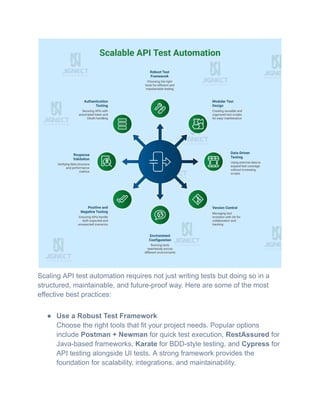
Scaling API testautomation requires not just writing tests but doing so in a
structured, maintainable, and future-proof way. Here are some of the most
effective best practices:
● Use a Robust Test Framework
Choose the right tools that fit your project needs. Popular options
include Postman + Newman for quick test execution, RestAssured for
Java-based frameworks, Karate for BDD-style testing, and Cypress for
API testing alongside UI tests. A strong framework provides the
foundation for scalability, integrations, and maintainability.
7.
● Follow ModularTest Design
Instead of writing lengthy, repetitive scripts, design your tests in a
modular way. Use reusable functions, shared environment
configurations, and a common base setup. This reduces duplication and
makes your test suite easier to maintain as it grows.
● Implement Data-Driven Testing
Hardcoding values in test scripts limits flexibility. Instead, pull test data
from external sources like CSV, JSON, or databases. Data-driven
testing allows the same script to validate multiple input/output
combinations, expanding coverage without increasing script count.
● Version Control of API Tests
Treat your tests like code. Store them in Git – version control systems
to enable collaboration, change tracking, and rollback options. This
ensures test evolution keeps pace with product updates.
● Use Environment Configuration and Variables
APIs often run across multiple environments development, staging,
production. By using environment variables, you can run the same tests
seamlessly against different environments without rewriting scripts.
● Test for Both Positive and Negative Scenarios
Don’t just validate successful responses. Include negative tests such as
invalid inputs, expired tokens, or missing fields. This ensures APIs
handle unexpected cases gracefully and improves fault tolerance.
● Add Validation for Response Structure & Time
A passing status code alone doesn’t guarantee quality. Validate JSON
schemas, headers, and response structures. Also, track response times
to ensure APIs perform well under load, not just functionally.
● Incorporate Authentication/Authorization Testing
Most modern APIs require authentication. Automate token handling,
OAuth workflows, or API key validation to ensure secure
communication. This prevents security gaps from being overlooked in
automation.
Scaling API test automation requires not just writing tests but doing so in a
structured, maintainable, and future-proof way. Here are some of the most
effective best practices:
8.
By applying thesepractices, teams can build an API test automation
framework that is not only scalable but also reliable, efficient, and aligned with
real-world business needs.
Incorporating API Testing in CI/CD Pipelines
One of the most effective ways to make API test automation scalable is to
integrate it directly into the CI/CD pipeline. This ensures that APIs are
validated continuously, providing fast feedback and preventing faulty code
from reaching production. Here’s how to do it:
READ THE FULL BLOG: https://tinyurl.com/m7n8fpf9