Il moderno Data Center: come estendere i benefici della virtualizzazione aumentando l’efficienza energeticaVincenzo SpagnolettiDirector of SMB South Sales and Gov7 Giungo 2010Città della Scienza, Napoli
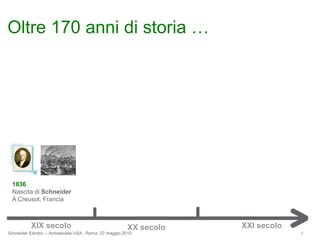
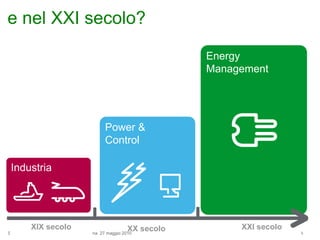
Oltre 170 anni di storia …1836Nascita di SchneiderA Creusot, FranciaXIX secoloXXI secoloXX secolo
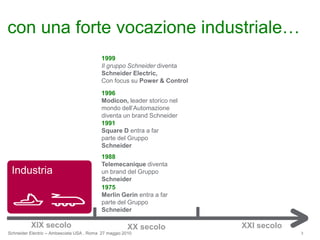
Industriacon una forte vocazione industriale…1999Il gruppo SchneiderdiventaSchneider Electric,Con focus su Power & Control1996Modicon, leader storiconelmondodell’Automazionediventa un brand Schneider1991Square Dentra a far parte del GruppoSchneider1988Telemecaniquediventa un brand del GruppoSchneider1836Nascita di SchneiderA Creusot, Francia1975Merlin Gerinentra a far parte del GruppoSchneiderXIX secoloXXI secoloXX secolo
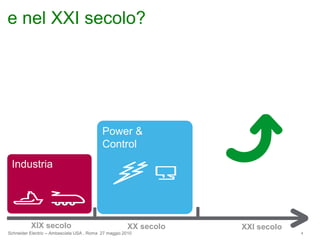
Power &ControlIndustriae nel XXI secolo?1991Square D entra a far parte del Gruppo Schneider1988Telemecanique diventa un brand del Gruppo Schneider1836Nascita di SchneiderA Creusot, Francia1975Merlin Gerin entra a far parte del Gruppo SchneiderXIX secoloXX secoloXXI secolo
Energy ManagementPower &ControlIndustriae nel XXI secolo?XIX secoloXXI secoloXX secolo
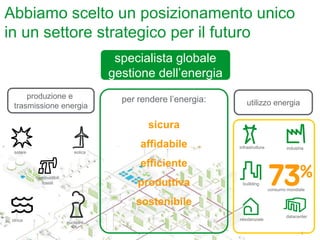
produzione e trasmissione energiautilizzo energiainfrastruttureindustriaeolicasolarecombustibilifossiliconsumo mondialedatacenterbuilldingidricanucleareresidenzialeAbbiamo scelto un posizionamento unico in un settore strategico per il futurospecialista globalegestione dell’energiaper renderel’energia:sicuraaffidabileefficienteproduttivasostenibile
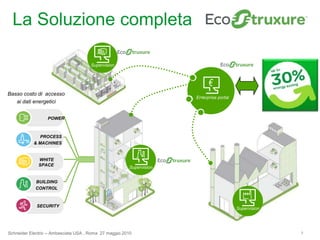
SupervisionLa Soluzione completaSupervision€Basso costo di  accesso ai dati energetici Enterprise portalPOWER PROCESS& MACHINESWHITE SPACEBUILDINGCONTROLSECURITYSupervision
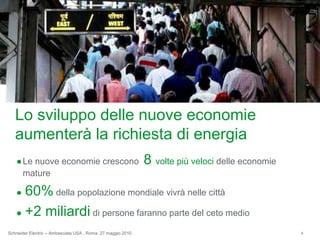
Lo sviluppo delle nuove economie aumenterà la richiesta di energiaLe nuove economie crescono 8 volte più veloci delle economie mature60%della popolazione mondiale vivrà nelle città+2 miliardi di persone faranno parte del ceto medio
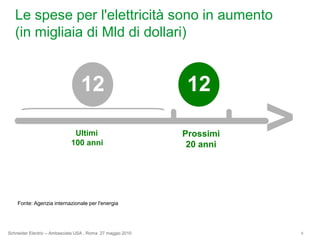
Lespeseperl'elettricitàsonoinaumento(inmigliaiadiMlddidollari)1212  Ultimi100anniProssimi20anni>Fonte:Agenziainternazionaleperl'energia
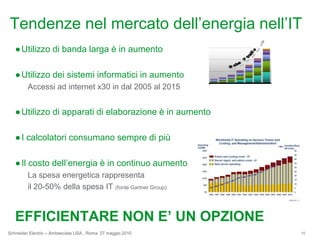
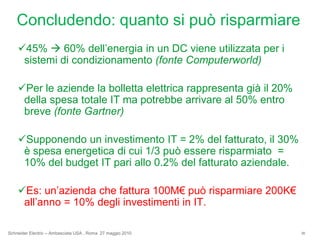
Tendenze nel mercato dell’energia nell’ITUtilizzo di banda larga è in aumentoUtilizzo dei sistemi informatici in aumentoAccessi ad internet x30 in dal 2005 al 2015Utilizzo di apparati di elaborazione è in aumentoI calcolatori consumano sempre di piùIl costo dell’energia è in continuo aumentoLa spesa energetica rappresenta  il 20-50% della spesa IT (fonte Gartner Group)EFFICIENTARE NON E’ UN OPZIONE
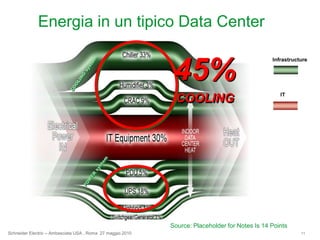
InfrastructureITCOOLING systemPOWER systemEnergia in un tipico Data Center45%COOLINGSubtitle: Size 24, Left AlignedSource: Placeholder for Notes Is 14 Points
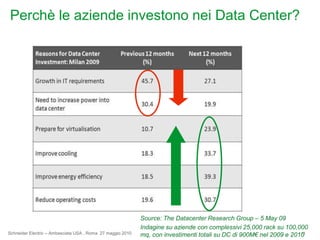
Perchè le aziendeinvestononei Data Center?Source: The Datacenter Research Group – 5 May 09 Indagine su aziende con complessivi 25,000 rack su 100,000 mq, con investimenti totali su DC di 900M€ nel 2009 e 2010Cisco ConfidentialCisco Confidential
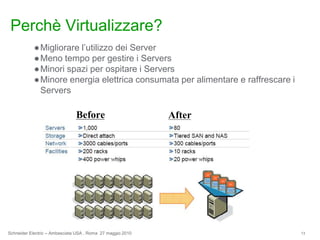
PerchèVirtualizzare?Migliorarel’utilizzodei Server
Meno tempo per gestirei Servers
Minorispazi per ospitarei Servers
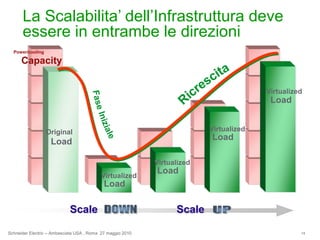
Minoreenergiaelettricaconsumata per alimentare e raffrescarei Servers Power/coolingCapacityVirtualizedLoadOriginalLoadVirtualizedVirtualizedLoadLoadLa Scalabilita’ dell’Infrastrutturadeveessere in entrambe le direzioniRicrescitaFase InizialeLoadLoadLoadVirtualizedLoadScale Scale DOWNUP
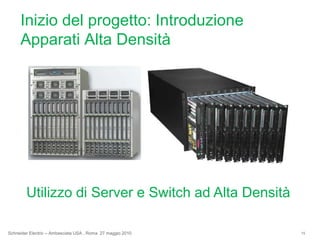
Inizio del progetto: IntroduzioneApparati Alta DensitàUtilizzodiServer e Switch ad Alta Densità
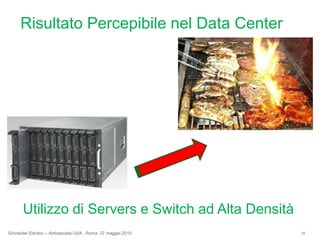
RisultatoPercepibilenel Data CenterUtilizzodiServers e Switch ad Alta Densità
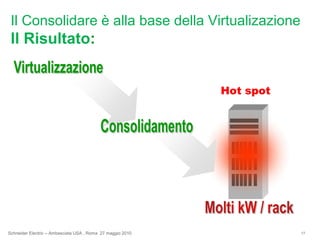
Il Consolidare è alla base dellaVirtualizazioneIl Risultato:VirtualizzazioneHot spotConsolidamentoMolti kW / rack
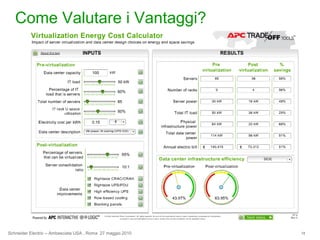
Come ValutareiVantaggi?
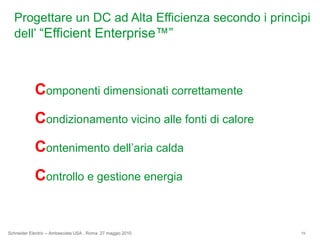
Progettare un DC ad Alta Efficienzasecondoiprincìpi dell’ “Efficient Enterprise™” Componenti dimensionati correttamente
 Condizionamento vicino alle fonti di calore
 Contenimento dell’aria calda
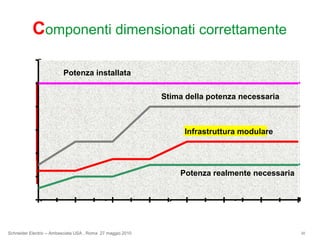
Controllo e gestione energia Componenti dimensionati correttamenteINEFFICIENZA DEL SISTEMA
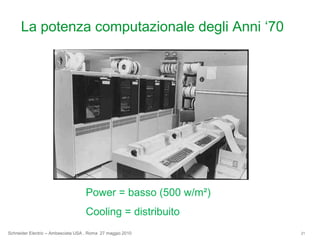
La potenza computazionale degli Anni ‘70Power = basso (500 w/m²)Cooling = distribuito
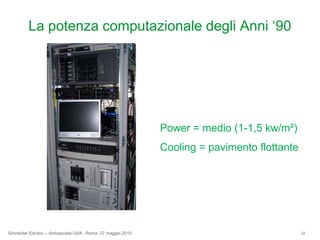
La potenza computazionale degli Anni ‘90Power = medio (1-1,5 kw/m²)Cooling = pavimento flottante
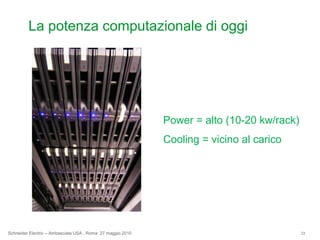
La potenza computazionale di oggiPower = alto (10-20 kw/rack)Cooling = vicino al carico
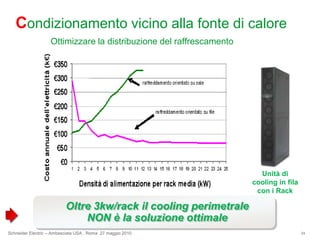
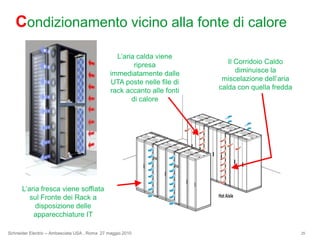
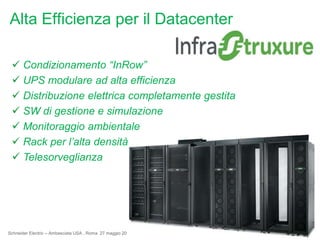
CondizionamentovicinoallafontedicaloreOttimizzare la distribuzione del raffrescamentoUnitàdi cooling in fila con i RackOltre 3kw/rack il cooling perimetrale NON è la soluzioneottimale
CondizionamentovicinoallafontedicaloreL’ariacaldavieneripresaimmediatamentedalle UTA postenelle file di rack accantoallefontidicaloreIl CorridoioCaldodiminuisce la miscelazionedell’ariacalda con quellafreddaL’ariafrescavienesoffiatasulFrontedei Rack a disposizionedelleapparecchiature IT
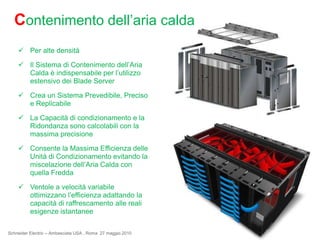
Contenimentodell’ariacaldaPer alte densità
Il Sistema di Contenimento dell’Aria Calda è indispensabile per l’utilizzo estensivo dei Blade Server
Crea un Sistema Prevedibile, Preciso e Replicabile
La Capacità di condizionamento e la Ridondanza sono calcolabili con la massima precisione
Consente la Massima Efficienza delle Unità di Condizionamento evitando la miscelazione dell’Aria Calda con quella Fredda
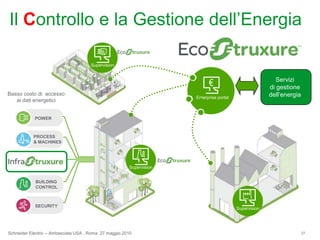
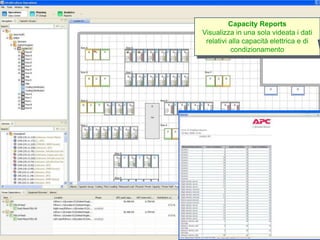
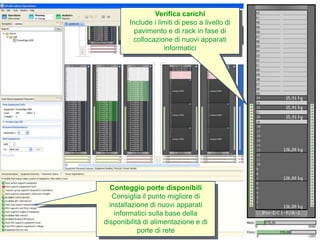
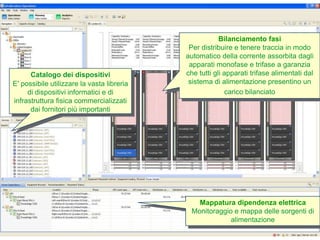
Ventole a velocità variabile ottimizzano l’efficienza adattando la capacità di raffrescamento alle reali esigenze istantaneeSupervisionIl Controllo e la Gestione dell’EnergiaSupervisionServizidi gestionedell’energia€Basso costo di  accesso ai dati energetici Enterprise portalPOWER PROCESS& MACHINESWHITE SPACEBUILDINGCONTROLSECURITYSupervision
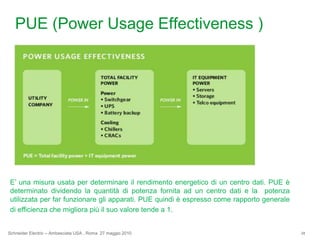
PUE (Power Usage Effectiveness )E’ unamisurausata per determinareilrendimentoenergeticodi un centrodati. PUE è determinatodividendo la quantitàdipotenzafornita ad un centrodati e la  potenzautilizzata per far funzionaregliapparati. PUE quindi è espresso come rapportogeneralediefficienzachemigliorapiùilsuovaloretende a 1.
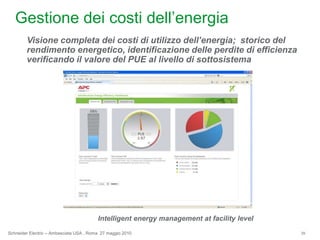
Gestionedeicostidell’energiaVisionecompletadeicostidiutilizzodell’energia;  storico del rendimentoenergetico, identificazionedelleperditediefficienzaverificandoilvalore del PUE al livellodisottosistemaUpdateIntelligent energy management at facility level
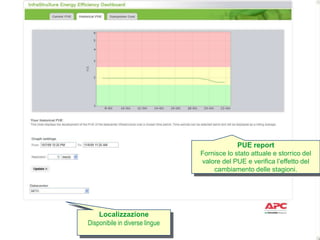
PUE reportFornisce lo stato attuale e storrico del valore del PUE e verifica l’effetto del cambiamento delle stagioni.LocalizzazioneDisponibile in diverse lingue
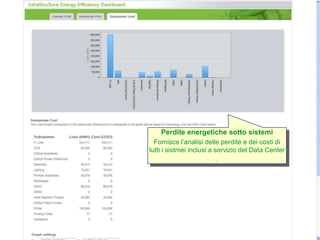
Perdite energetiche sotto sistemiFornisce l’analisi delle perdite e dei costi di tutti i sistmei inclusi a servizio del Data Center.

Apc - Il moderno Data Center

Editor's Notes

  • #14 In essence, virtualization allows IT Managers to transform hardware into software to transform or “virtualize” the hardware resources of an x86-based computer—including the CPU, RAM, hard disk and network controller—to create a fully functional virtual machine that can run its own operating system and applications just like a “real” computer. Multiple virtual machines share hardware resources without interfering with each other so that you can safely run several operating systems and applications at the same time on a single computer. Businesses can virtualizeindvidual computers or their entire infrastruture. In essence, a virtual infrastructure is a dynamic mapping of physical resources to business needs. While a virtual machine represents the physical resources of a single computer, a virtual infrastructure represents the physical resources of the entire IT environment, aggregating x86 computers and their attached network and storage into a unified pool of IT resources. (VM Ware)Virtual technology enables customers to consolidate workloads onto a smaller number of more fully-used physical machines. This implies fewer people to manage those computers, less space to house them, and fewer kilowatt hours of power to run them, all of which saves money. In a nutshell virtualization allows businesses to “right size” their processing power to the processing need Server virtualization also makes restoring failed systems easier. Virtual Machines are stored as files, and so restoring a failed system can be as simple as copying its file onto a new machine. Since VMs can have different hardware configurations from the physical machine on which they're running, this approach also allows restoring a failed system onto any available machine. There's no requirement to use a physically identical system.
  • #15 Virtualization is a new opportunity to take advantage of scalable infrastructure.But in this case, you scale DOWN when with initial virtualization...
  • #18 Let’s take a look at how customers are virtualizing and what that means to their organizations. Virtualization is being used to push everything from improved operational efficiency to reducing power and cooling cost. When a server or infrastructure is virtualized the virtual systems can be used to their maximum capacity. Organizations virtualize their computer rooms and data centers in three common ways. The first example - A customer can virtualize a medium or large server room data center down to a higher density small to medium data center. The second example - A customers can take a distributed organization and consolidate to a single centralized data center. In this case, the end data center is likely to be a high output medium or large data center.The third common trend is for organizations to virtualize an area within a large data center creating a zone of highly agile, highly dense systems. In all three examples consolidation is occurring. Let’s talk a little more about that now.
  • #19 When looking at virtualized environments in a holistic view, the Physical Infrastructure is an important component to ensure manageability, agility and the efficiency expected. To ensure the environments are capable of realizing these benefits APC has defined seven principles of High Density and Virtualized environments. Through out the following sections we will discuss each principle, how it is related to virtualization and what questions you may want to ask customers when they are considering Virtualized and High density deployments. The seven principles are-Rack enclosures that are HD readyMetered power distribution to the rack levelTemperature monitoring in the rackCentralized Monitoring SystemOperations Software with predictive capacity managementCooling in the rowUPS power that is flexible, scalable and efficient
  • #31 Refer to the features on the screen – clockwise
  • #32 Refer to the features on the screen – clockwise