• Wheel lockup during braking causes skidding which in turn cause a loss of
traction and vehicle control
• This reduces the steering ability to change direction. So the car slides out
of control
• With ABS system, the driver can brake hard, take the evasive action and
still be in control of the vehicle in any road condition at any speed and
under any load.
Introduction
• A skidding wheel (where the tire contact patch is sliding relative
to the road) has less traction than a non-skidding wheel
• By keeping the wheels from skidding while you slow down, anti-
lock brakes benefit you in two ways:
• You'll stop faster, and you'll be able to steer while you stop
Concept of ABS
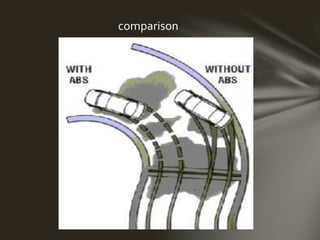
comparison
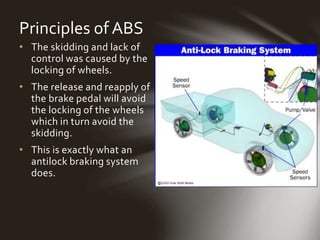
Principles of ABS
• The skidding and lack of
control was caused by the
locking of wheels.
• The release and reapply of
the brake pedal will avoid
the locking of the wheels
which in turn avoid the
skidding.
• This is exactly what an
antilock braking system
does.
• When the brake pedal is pumped or pulsed the pressure is
quickly applied and released at the wheels. This is called
pressure modulation. Pressure modulation works to
prevent the wheel locking.
• ABS can modulate the pressure to the brake as often as
15 times per seconds
• ABS precisely controls the slip rate of the wheels to
ensure maximum grip force from the tyre and it there by
ensures maneuverability and stability of the vehicle
Pressure modulation
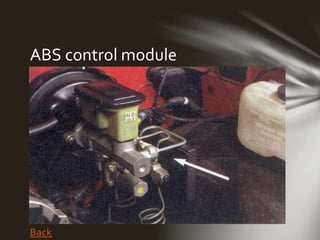
1. ABS control module fig
This small computer is normally mounted inside the trunk on
the wheel housing ,mounted to the master cylinder or is part of
the hydraulic control unit. It monitors system operation and
controls antilock function when needed
2. Brake pedal sensor
The antilock brake pedal sensor switch is normally closed. when
the brake pedal exceeds the antilock brake pedal sensor switch
setting during an antilock stop , the antilock brake control
module senses that the antilock brake pedal sensor switch is
open
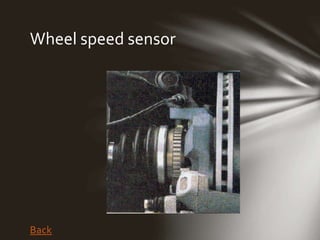
3. Wheel speed sensor fig
It is mounted near the different toothed ring . as the rings teeth
rotate past the sensor an ac voltage is generated
Electrical electronic components
1. Four channel, four sensor ABS
This is the best scheme. there is speed sensor on all four
wheels and a separate valve for all the four wheels.
2. Three channel , three sensor ABS
This scheme is commonly found on pick up trucks with four
wheels ABS, has a speed sensor and a valve for each of the front
wheels, with one valve and one sensor for both rear wheels.
3. One channel , one sensor ABS
it has one valve ,which controls both rear wheels , and one
speed sensor, located in the rear axle.
Types of antilock brake systems
• It allows the driver to maintain directional stability and
control over steering during braking
• Safe and effective
• Automatically changes the brake fluid pressure at each
wheel to maintain optimum brake performance.
• ABS absorbs the unwanted turbulence shock waves
and modulates the pulses thus permitting the wheel to
continue turning under maximum braking pressure.
Advantages
• It is very costly
• Maintenance cost of a car equipped with ABS is more.
Disadvantages
• Statistics show that approximately 40 % of automobile accidents are due
to skidding.
• These problems commonly occur on vehicle with conventional brake
system which can be avoided by adding devices called ABS
• If there is an ABS failure, the system will revert to normal brake
operation. Normally the ABS warning light will turn on and let the driver
know there is a fault
Conclusion
THANK YOU……!
Wheel speed sensor
Back
ABS control module
Back

ANTI LOCK BRAKING SYSTEM

  • 2.
    • Wheel lockupduring braking causes skidding which in turn cause a loss of traction and vehicle control • This reduces the steering ability to change direction. So the car slides out of control • With ABS system, the driver can brake hard, take the evasive action and still be in control of the vehicle in any road condition at any speed and under any load. Introduction
  • 3.
    • A skiddingwheel (where the tire contact patch is sliding relative to the road) has less traction than a non-skidding wheel • By keeping the wheels from skidding while you slow down, anti- lock brakes benefit you in two ways: • You'll stop faster, and you'll be able to steer while you stop Concept of ABS
  • 4.
  • 5.
    Principles of ABS •The skidding and lack of control was caused by the locking of wheels. • The release and reapply of the brake pedal will avoid the locking of the wheels which in turn avoid the skidding. • This is exactly what an antilock braking system does.
  • 6.
    • When thebrake pedal is pumped or pulsed the pressure is quickly applied and released at the wheels. This is called pressure modulation. Pressure modulation works to prevent the wheel locking. • ABS can modulate the pressure to the brake as often as 15 times per seconds • ABS precisely controls the slip rate of the wheels to ensure maximum grip force from the tyre and it there by ensures maneuverability and stability of the vehicle Pressure modulation
  • 7.
    1. ABS controlmodule fig This small computer is normally mounted inside the trunk on the wheel housing ,mounted to the master cylinder or is part of the hydraulic control unit. It monitors system operation and controls antilock function when needed 2. Brake pedal sensor The antilock brake pedal sensor switch is normally closed. when the brake pedal exceeds the antilock brake pedal sensor switch setting during an antilock stop , the antilock brake control module senses that the antilock brake pedal sensor switch is open 3. Wheel speed sensor fig It is mounted near the different toothed ring . as the rings teeth rotate past the sensor an ac voltage is generated Electrical electronic components
  • 8.
    1. Four channel,four sensor ABS This is the best scheme. there is speed sensor on all four wheels and a separate valve for all the four wheels. 2. Three channel , three sensor ABS This scheme is commonly found on pick up trucks with four wheels ABS, has a speed sensor and a valve for each of the front wheels, with one valve and one sensor for both rear wheels. 3. One channel , one sensor ABS it has one valve ,which controls both rear wheels , and one speed sensor, located in the rear axle. Types of antilock brake systems
  • 9.
    • It allowsthe driver to maintain directional stability and control over steering during braking • Safe and effective • Automatically changes the brake fluid pressure at each wheel to maintain optimum brake performance. • ABS absorbs the unwanted turbulence shock waves and modulates the pulses thus permitting the wheel to continue turning under maximum braking pressure. Advantages
  • 10.
    • It isvery costly • Maintenance cost of a car equipped with ABS is more. Disadvantages
  • 11.
    • Statistics showthat approximately 40 % of automobile accidents are due to skidding. • These problems commonly occur on vehicle with conventional brake system which can be avoided by adding devices called ABS • If there is an ABS failure, the system will revert to normal brake operation. Normally the ABS warning light will turn on and let the driver know there is a fault Conclusion
  • 12.
  • 13.
  • 14.