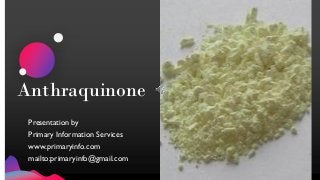
Anthraquinone
Presentation by
Primary Information Services
www.primaryinfo.com
mailto:primaryinfo@gmail.com
Jens
Martensson
2
Jens
Martensson
3
There are several current industrial
methods to produce 9,10-
Anthraquinone:
• The oxidation of anthracene, a reaction that is
localized at the central ring. Chromium(VI) is the
typical oxidant.
• The Friedel-Crafts reaction of benzene and phthalic
anhydride in presence of AlCl3 producing o-
benzoylbenzoic acid which then undergoes
cyclization, forming anthraquinone. This reaction is
useful for producing substituted anthraquinones.
• The Diels-Alder reaction of naphthoquinone and
butadiene followed by oxidative dehydrogenation
• The acid-catalyzed dimerization of styrene to give a
1,3-diphenylbutene, which then can be transformed to
the anthraquinone.
• This process was pioneered by BASF.
Jens
Martensson
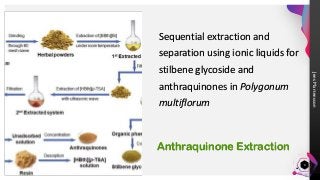
Sequential extraction and
separation using ionic liquids for
stilbene glycoside and
anthraquinones in Polygonum
multiflorum
Anthraquinone Extraction
4
Jens
Martensson
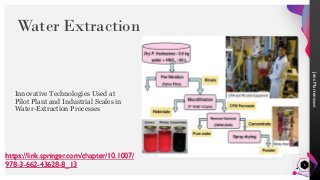
Water Extraction
https://link.springer.com/chapter/10.1007/
978-3-662-43628-8_13
Innovative Technologies Used at
Pilot Plant and Industrial Scales in
Water-Extraction Processes
5
Jens
Martensson
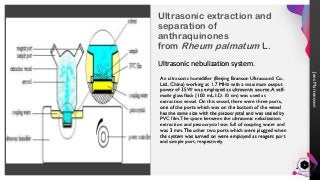
Ultrasonic extraction and
separation of
anthraquinones
from Rheum palmatum L.
Ultrasonic nebulization system.
An ultrasonic humidifier (Beijing Branson Ultrasound Co.,
Ltd., China) working at 1.7 MHz with a maximum output
power of 35 W was employed as ultrasonic source.A self-
made glass flask (100 mL, I.D. 10 cm) was used as
extraction vessel. On this vessel, there were three ports,
one of the ports which was on the bottom of the vessel
has the same size with the piezocrystal and was sealed by
PVC film.The space between the ultrasonic nebulization
extraction and piezocrystal was full of coupling water and
was 3 mm.The other two ports which were plugged when
the system was turned on were employed as reagent port
and sample port, respectively.
6
Jens
Martensson
7
Jens
Martensson
8
Jens
Martensson
9
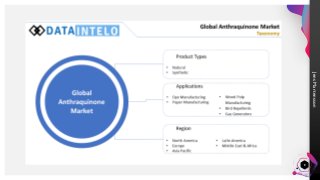
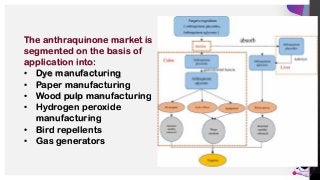
The anthraquinone market is
segmented on the basis of
application into:
• Dye manufacturing
• Paper manufacturing
• Wood pulp manufacturing
• Hydrogen peroxide
manufacturing
• Bird repellents
• Gas generators
Jens
Martensson
10
Jens
Martensson
Project
Information
11
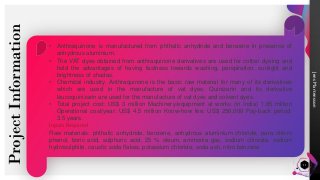
• Anthraquinone is manufactured from phthalic anhydride and benzene in presence of
anhydrous aluminium.
• The VAT dyes obtained from anthraquinone derivatives are used for cotton dyeing and
hold the advantages of having fastness towards washing, perspiration, sunlight and
brightness of shades.
• Chemical industry. Anthraquinone is the basic raw material for many of its derivatives
which are used in the manufacture of vat dyes. Quinizarin and its derivative
leucoquinizarin are used for the manufacture of vat dyes and solvent dyes.
• Total project cost: US$ 3 million Machinery/equipment at works (in India) 1.85 million
Operational cost/year: US$ 4.5 million Know-how fee: US$ 250,000 Pay-back period:
3.5 years.
Inputs Required
Raw materials: phthalic anhydride, benzene, anhydrous aluminium chloride, para chloro
phenol, boric acid, sulphuric acid, 25 % oleum, ammonia gas, sodium chlorate, sodium
hydrosulphite, caustic soda flakes, potassium chloride, soda ash, nitro benzene
Jens
Martensson
12
Jens
Martensson
13
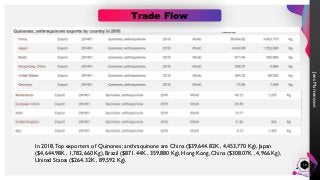
In 2018,Top exporters of Quinones; anthraquinone are China ($39,644.82K , 4,453,770 Kg), Japan
($4,644.98K , 1,782,660 Kg), Brazil ($871.44K , 359,880 Kg), Hong Kong, China ($308.07K , 4,966 Kg),
United States ($264.32K , 89,592 Kg).
Trade Flow
Jens
Martensson
14
Database offer:
Anthraquinone
Technology , Products, Patents, Process, Study, Company
Profiles, Consultants, Reports
Primary Information Services
https://www.primaryinfo.com/scope/anthraquinone.htm
Thank
You
Primaryinfo.com
primaryinfo@gmail.com
Anthraquinone

Anthraquinone

  • 1.
    Anthraquinone Presentation by Primary InformationServices www.primaryinfo.com mailto:primaryinfo@gmail.com
  • 2.
  • 3.
    Jens Martensson 3 There are severalcurrent industrial methods to produce 9,10- Anthraquinone: • The oxidation of anthracene, a reaction that is localized at the central ring. Chromium(VI) is the typical oxidant. • The Friedel-Crafts reaction of benzene and phthalic anhydride in presence of AlCl3 producing o- benzoylbenzoic acid which then undergoes cyclization, forming anthraquinone. This reaction is useful for producing substituted anthraquinones. • The Diels-Alder reaction of naphthoquinone and butadiene followed by oxidative dehydrogenation • The acid-catalyzed dimerization of styrene to give a 1,3-diphenylbutene, which then can be transformed to the anthraquinone. • This process was pioneered by BASF.
  • 4.
    Jens Martensson Sequential extraction and separationusing ionic liquids for stilbene glycoside and anthraquinones in Polygonum multiflorum Anthraquinone Extraction 4
  • 5.
  • 6.
    Jens Martensson Ultrasonic extraction and separationof anthraquinones from Rheum palmatum L. Ultrasonic nebulization system. An ultrasonic humidifier (Beijing Branson Ultrasound Co., Ltd., China) working at 1.7 MHz with a maximum output power of 35 W was employed as ultrasonic source.A self- made glass flask (100 mL, I.D. 10 cm) was used as extraction vessel. On this vessel, there were three ports, one of the ports which was on the bottom of the vessel has the same size with the piezocrystal and was sealed by PVC film.The space between the ultrasonic nebulization extraction and piezocrystal was full of coupling water and was 3 mm.The other two ports which were plugged when the system was turned on were employed as reagent port and sample port, respectively. 6
  • 7.
  • 8.
  • 9.
    Jens Martensson 9 The anthraquinone marketis segmented on the basis of application into: • Dye manufacturing • Paper manufacturing • Wood pulp manufacturing • Hydrogen peroxide manufacturing • Bird repellents • Gas generators
  • 10.
  • 11.
    Jens Martensson Project Information 11 • Anthraquinone ismanufactured from phthalic anhydride and benzene in presence of anhydrous aluminium. • The VAT dyes obtained from anthraquinone derivatives are used for cotton dyeing and hold the advantages of having fastness towards washing, perspiration, sunlight and brightness of shades. • Chemical industry. Anthraquinone is the basic raw material for many of its derivatives which are used in the manufacture of vat dyes. Quinizarin and its derivative leucoquinizarin are used for the manufacture of vat dyes and solvent dyes. • Total project cost: US$ 3 million Machinery/equipment at works (in India) 1.85 million Operational cost/year: US$ 4.5 million Know-how fee: US$ 250,000 Pay-back period: 3.5 years. Inputs Required Raw materials: phthalic anhydride, benzene, anhydrous aluminium chloride, para chloro phenol, boric acid, sulphuric acid, 25 % oleum, ammonia gas, sodium chlorate, sodium hydrosulphite, caustic soda flakes, potassium chloride, soda ash, nitro benzene
  • 12.
  • 13.
    Jens Martensson 13 In 2018,Top exportersof Quinones; anthraquinone are China ($39,644.82K , 4,453,770 Kg), Japan ($4,644.98K , 1,782,660 Kg), Brazil ($871.44K , 359,880 Kg), Hong Kong, China ($308.07K , 4,966 Kg), United States ($264.32K , 89,592 Kg). Trade Flow
  • 14.
    Jens Martensson 14 Database offer: Anthraquinone Technology ,Products, Patents, Process, Study, Company Profiles, Consultants, Reports Primary Information Services https://www.primaryinfo.com/scope/anthraquinone.htm
  • 15.