BINESWAR BRAHMA ENGINEERING COLLEGE
subject: Electromagnetic field theory
Department Of Electrical Engineering
6th
Semester
The Cylindrical Coordinate System
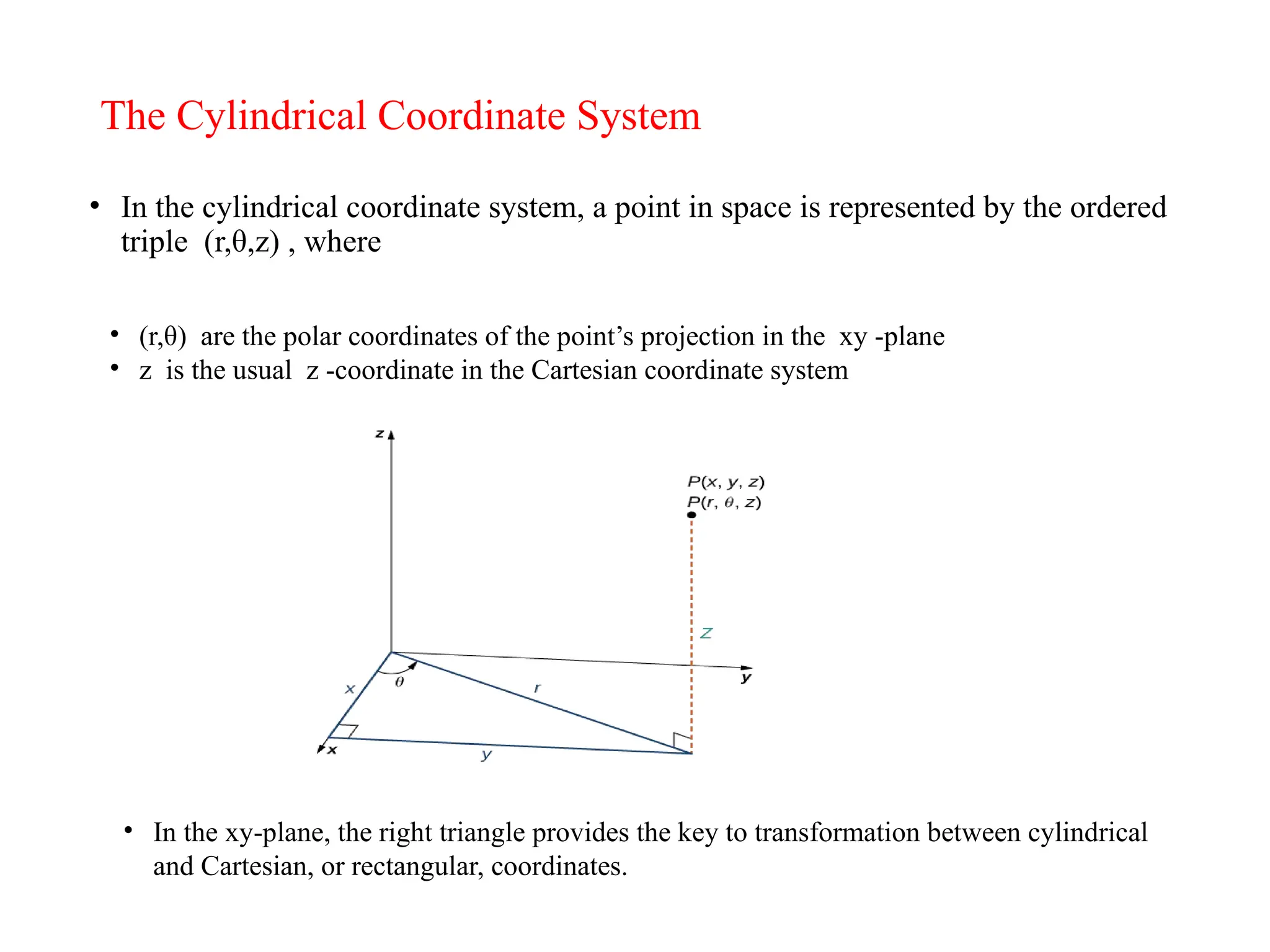
• In the cylindrical coordinate system, a point in space is represented by the ordered
triple (r,θ,z) , where
• (r,θ) are the polar coordinates of the point’s projection in the xy -plane
• z is the usual z -coordinate in the Cartesian coordinate system
• In the xy-plane, the right triangle provides the key to transformation between cylindrical
and Cartesian, or rectangular, coordinates.
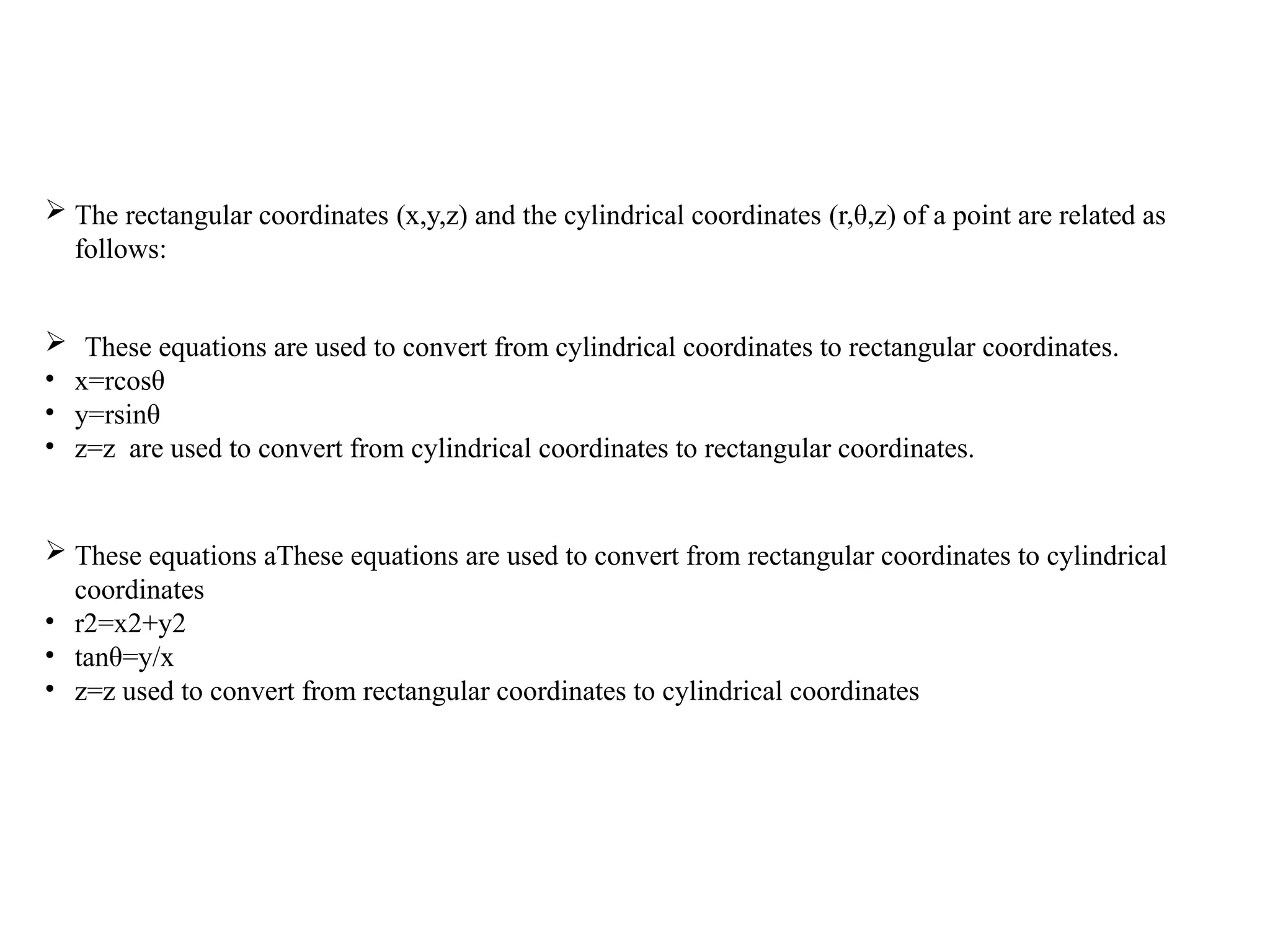
 The rectangular coordinates (x,y,z) and the cylindrical coordinates (r,θ,z) of a point are related as
follows:
 These equations are used to convert from cylindrical coordinates to rectangular coordinates.
• x=rcosθ
• y=rsinθ
• z=z are used to convert from cylindrical coordinates to rectangular coordinates.
 These equations aThese equations are used to convert from rectangular coordinates to cylindrical
coordinates
• r2=x2+y2
• tanθ=y/x
• z=z used to convert from rectangular coordinates to cylindrical coordinates
Spherical coordinate system
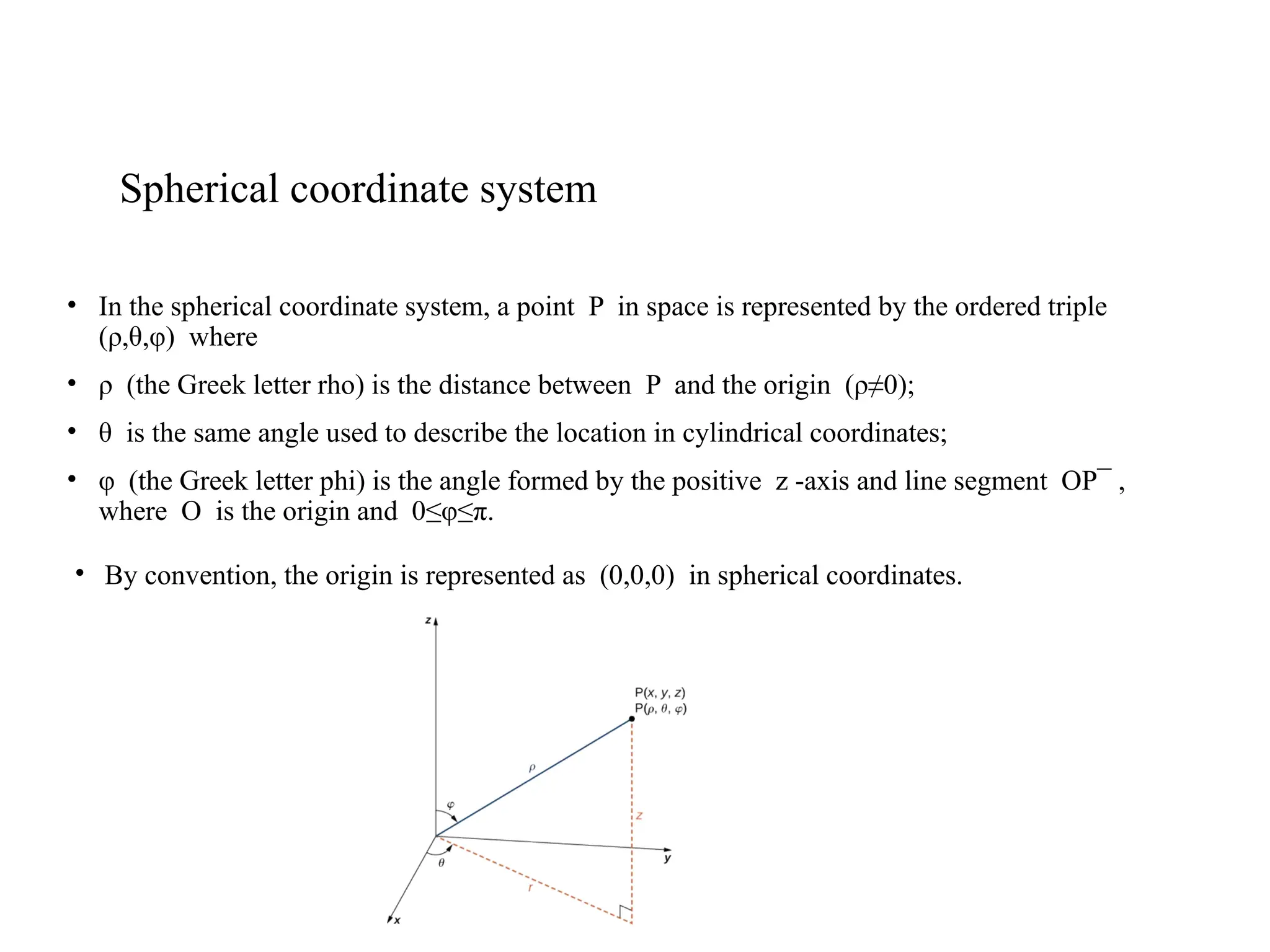
• In the spherical coordinate system, a point P in space is represented by the ordered triple
(ρ,θ,φ) where
• ρ (the Greek letter rho) is the distance between P and the origin (ρ≠0);
• θ is the same angle used to describe the location in cylindrical coordinates;
• φ (the Greek letter phi) is the angle formed by the positive z -axis and line segment OP¯ ,
where O is the origin and 0≤φ≤π.
• By convention, the origin is represented as (0,0,0) in spherical coordinates.
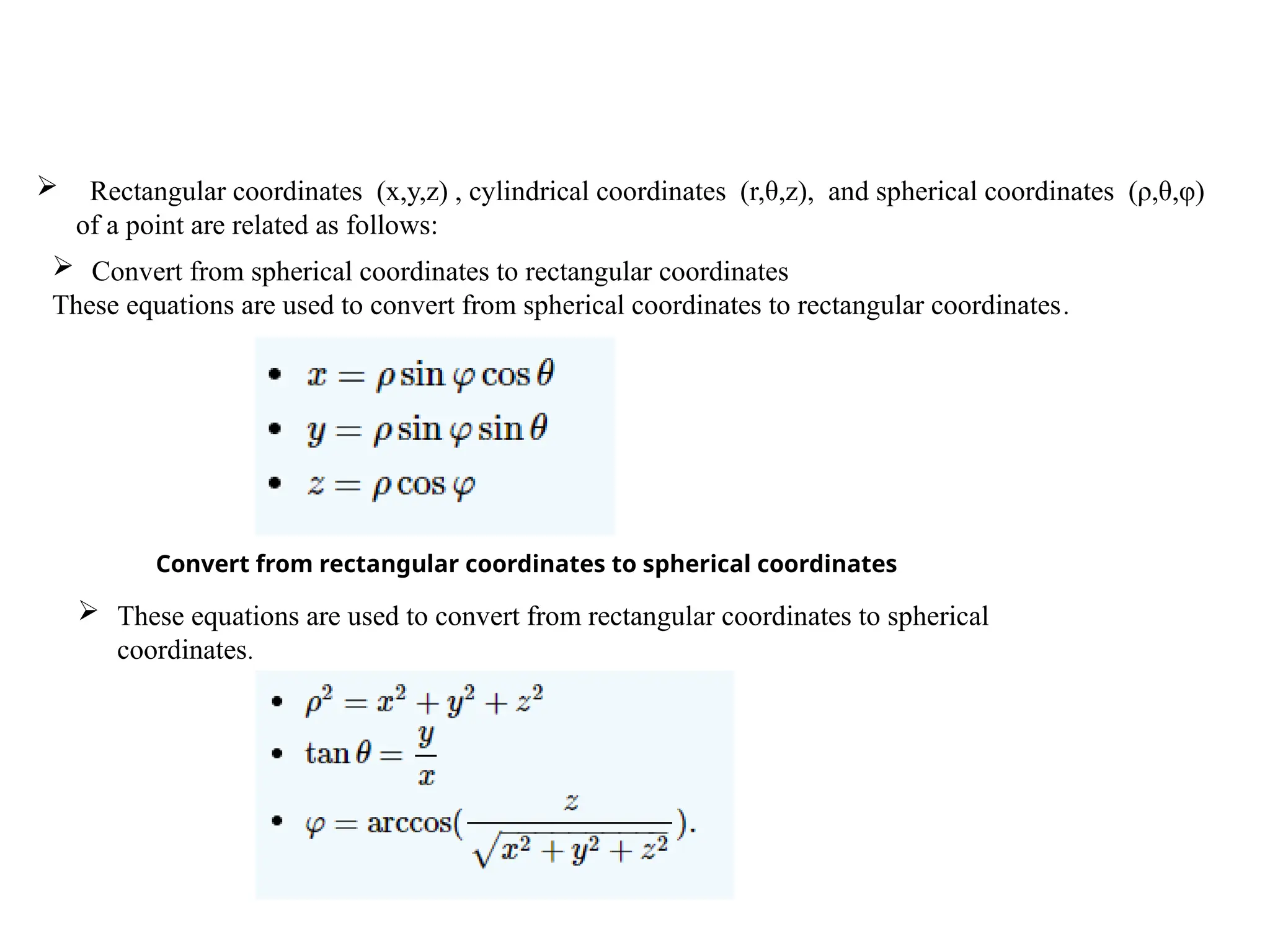
 Rectangular coordinates (x,y,z) , cylindrical coordinates (r,θ,z), and spherical coordinates (ρ,θ,φ)
of a point are related as follows:
 Convert from spherical coordinates to rectangular coordinates
These equations are used to convert from spherical coordinates to rectangular coordinates.
Convert from rectangular coordinates to spherical coordinates
 These equations are used to convert from rectangular coordinates to spherical
coordinates.
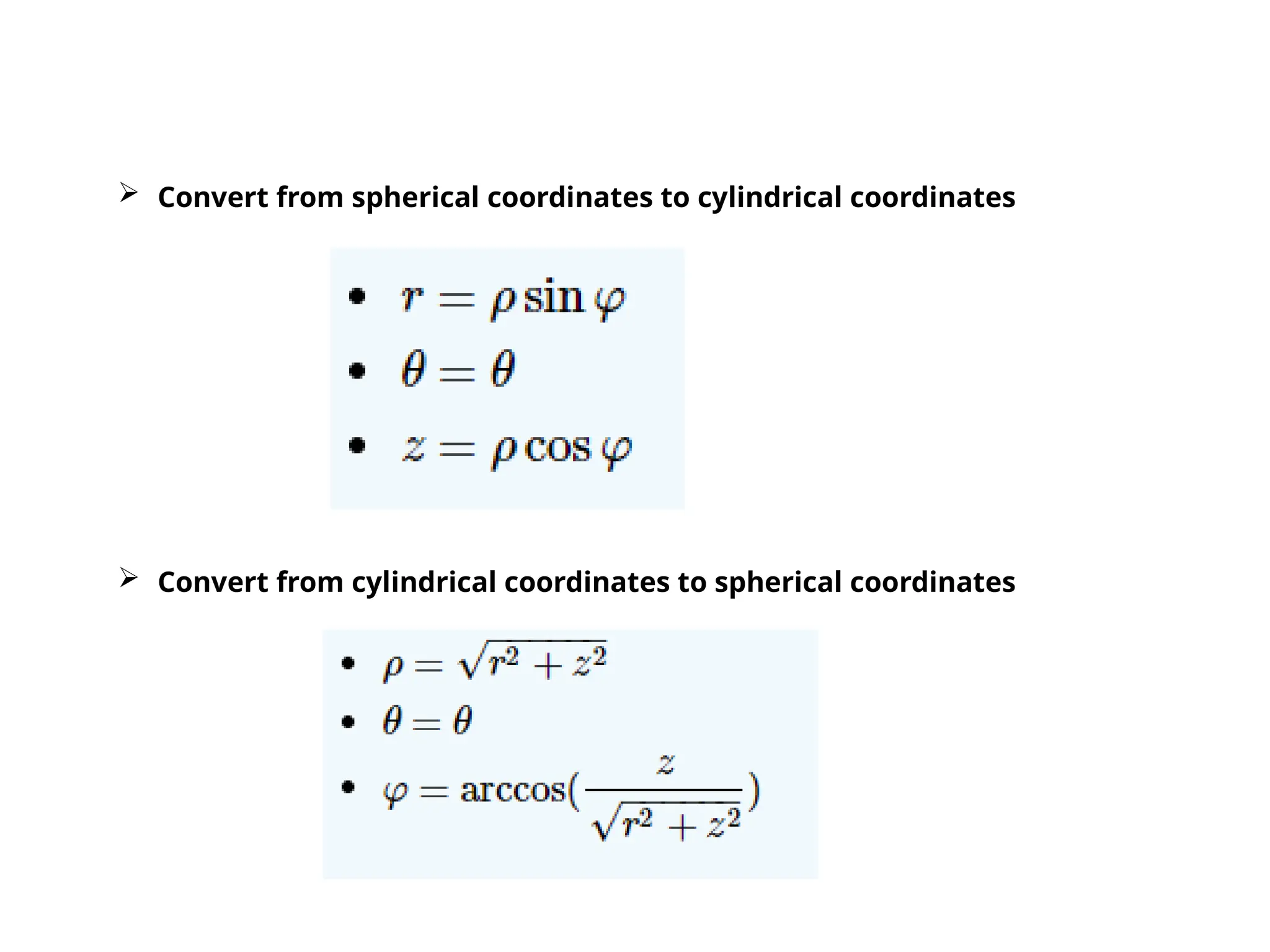
 Convert from spherical coordinates to cylindrical coordinates
 Convert from cylindrical coordinates to spherical coordinates
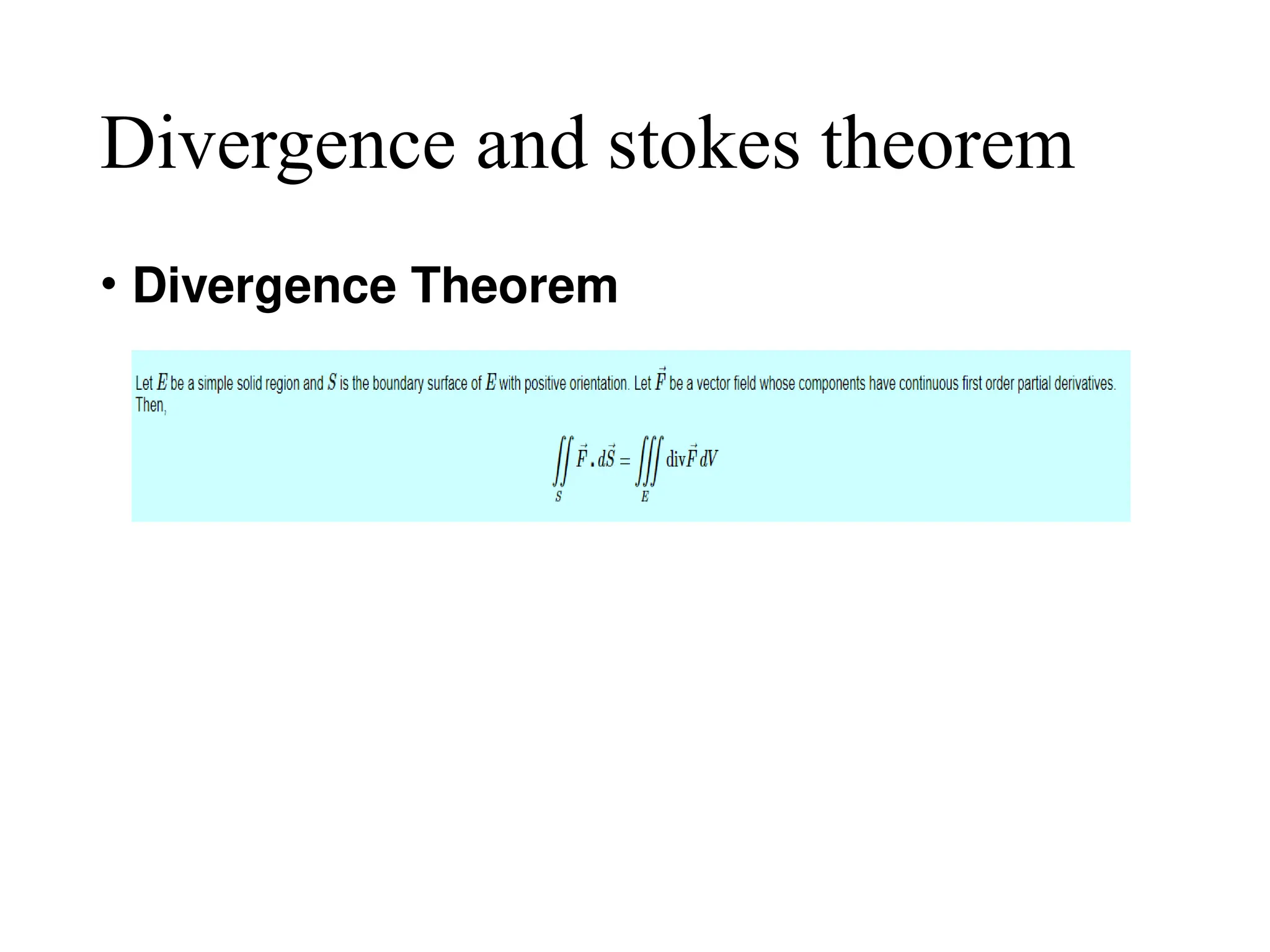
Divergence and stokes theorem
• Divergence Theorem
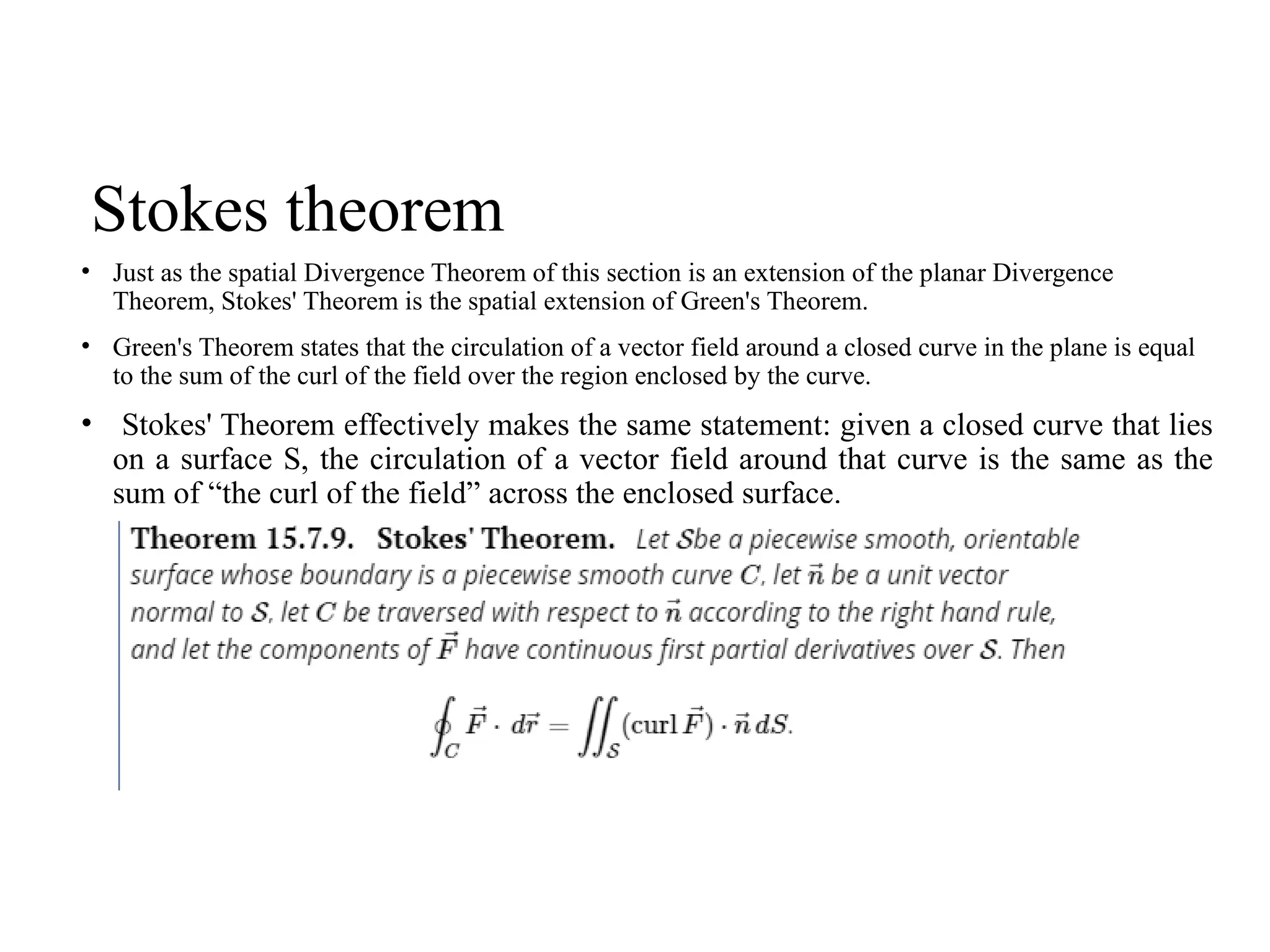
Stokes theorem
• Just as the spatial Divergence Theorem of this section is an extension of the planar Divergence
Theorem, Stokes' Theorem is the spatial extension of Green's Theorem.
• Green's Theorem states that the circulation of a vector field around a closed curve in the plane is equal
to the sum of the curl of the field over the region enclosed by the curve.
• Stokes' Theorem effectively makes the same statement: given a closed curve that lies
on a surface S, the circulation of a vector field around that curve is the same as the
sum of “the curl of the field” across the enclosed surface.
THANK YOU

Antenna Wave Propagation and Basic Parameters

  • 1.
    BINESWAR BRAHMA ENGINEERINGCOLLEGE subject: Electromagnetic field theory Department Of Electrical Engineering 6th Semester
  • 2.
    The Cylindrical CoordinateSystem • In the cylindrical coordinate system, a point in space is represented by the ordered triple (r,θ,z) , where • (r,θ) are the polar coordinates of the point’s projection in the xy -plane • z is the usual z -coordinate in the Cartesian coordinate system • In the xy-plane, the right triangle provides the key to transformation between cylindrical and Cartesian, or rectangular, coordinates.
  • 3.
     The rectangularcoordinates (x,y,z) and the cylindrical coordinates (r,θ,z) of a point are related as follows:  These equations are used to convert from cylindrical coordinates to rectangular coordinates. • x=rcosθ • y=rsinθ • z=z are used to convert from cylindrical coordinates to rectangular coordinates.  These equations aThese equations are used to convert from rectangular coordinates to cylindrical coordinates • r2=x2+y2 • tanθ=y/x • z=z used to convert from rectangular coordinates to cylindrical coordinates
  • 4.
    Spherical coordinate system •In the spherical coordinate system, a point P in space is represented by the ordered triple (ρ,θ,φ) where • ρ (the Greek letter rho) is the distance between P and the origin (ρ≠0); • θ is the same angle used to describe the location in cylindrical coordinates; • φ (the Greek letter phi) is the angle formed by the positive z -axis and line segment OP¯ , where O is the origin and 0≤φ≤π. • By convention, the origin is represented as (0,0,0) in spherical coordinates.
  • 5.
     Rectangular coordinates(x,y,z) , cylindrical coordinates (r,θ,z), and spherical coordinates (ρ,θ,φ) of a point are related as follows:  Convert from spherical coordinates to rectangular coordinates These equations are used to convert from spherical coordinates to rectangular coordinates. Convert from rectangular coordinates to spherical coordinates  These equations are used to convert from rectangular coordinates to spherical coordinates.
  • 6.
     Convert fromspherical coordinates to cylindrical coordinates  Convert from cylindrical coordinates to spherical coordinates
  • 7.
    Divergence and stokestheorem • Divergence Theorem
  • 8.
    Stokes theorem • Justas the spatial Divergence Theorem of this section is an extension of the planar Divergence Theorem, Stokes' Theorem is the spatial extension of Green's Theorem. • Green's Theorem states that the circulation of a vector field around a closed curve in the plane is equal to the sum of the curl of the field over the region enclosed by the curve. • Stokes' Theorem effectively makes the same statement: given a closed curve that lies on a surface S, the circulation of a vector field around that curve is the same as the sum of “the curl of the field” across the enclosed surface.
  • 9.