Anova With Dependent Errors Yuichi Goto Hideaki
Nagahata Masanobu Taniguchi download
https://ebookbell.com/product/anova-with-dependent-errors-yuichi-
goto-hideaki-nagahata-masanobu-taniguchi-50863742
Explore and download more ebooks at ebookbell.com
Here are some recommended products that we believe you will be
interested in. You can click the link to download.
Permutation Tests For Stochastic Ordering And Anova Theory And
Applications With R 1st Edition Aldo Solari
https://ebookbell.com/product/permutation-tests-for-stochastic-
ordering-and-anova-theory-and-applications-with-r-1st-edition-aldo-
solari-2249476
Design And Analysis Of Gauge Rr Studies Making Decisions With
Confidence Intervals In Random And Mixed Anova Models Asasiam Series
On Statistics And Applied Probability Richard K Burdick
https://ebookbell.com/product/design-and-analysis-of-gauge-rr-studies-
making-decisions-with-confidence-intervals-in-random-and-mixed-anova-
models-asasiam-series-on-statistics-and-applied-probability-richard-k-
burdick-1381270
Mastering Neural Network Computer Vision With Tensorflow And Keras A
Practical Guide To Image Use Cases Like Object Detection 1st Jean
Anoma
https://ebookbell.com/product/mastering-neural-network-computer-
vision-with-tensorflow-and-keras-a-practical-guide-to-image-use-cases-
like-object-detection-1st-jean-anoma-232051424
I Wish I Was Revised Edition 1st Edition Anona Coates
https://ebookbell.com/product/i-wish-i-was-revised-edition-1st-
edition-anona-coates-51573568
Anova And Mixed Models A Short Introduction Using R Lukas Meier
https://ebookbell.com/product/anova-and-mixed-models-a-short-
introduction-using-r-lukas-meier-46502138
Anova And Ancova A Glm Approach 2nd Edition Andrew Rutherford
https://ebookbell.com/product/anova-and-ancova-a-glm-approach-2nd-
edition-andrew-rutherford-4673912
Introducing Anova And Ancova A Glm Approach Introducing Statistical
Methods Series 1st Edition Dr Andrew Rutherford
https://ebookbell.com/product/introducing-anova-and-ancova-a-glm-
approach-introducing-statistical-methods-series-1st-edition-dr-andrew-
rutherford-2098050
Experimental Designs Using Anova Computerassisted Research Design And
Analysis Barbara G Tabachnick
https://ebookbell.com/product/experimental-designs-using-anova-
computerassisted-research-design-and-analysis-barbara-g-
tabachnick-45447214
Smoothing Spline Anova Models Chong Gu Auth
https://ebookbell.com/product/smoothing-spline-anova-models-chong-gu-
auth-4271780
SpringerBriefs in Statistics
JSS Research Series in Statistics
Yuichi Goto · Hideaki Nagahata ·
Masanobu Taniguchi · Anna Clara Monti · Xiaofei Xu
ANOVA with Dependent
Errors
SpringerBriefs in Statistics
JSS Research Series in Statistics
Editors-in-Chief
Naoto Kunitomo, The Institute of Mathematical Statistics, Tachikawa, Tokyo, Japan
Akimichi Takemura, The Center for Data Science Education and Research, Shiga
University, Hikone, Shiga, Japan
Series Editors
Shigeyuki Matsui, Graduate School of Medicine, Nagoya University, Nagoya,
Aichi, Japan
Manabu Iwasaki, School of Data Science, Yokohama City University, Yokohama,
Kanagawa, Japan
Yasuhiro Omori, Graduate School of Economics, The University of Tokyo,
Bunkyo-ku, Tokyo, Japan
Masafumi Akahira, Institute of Mathematics, University of Tsukuba, Tsukuba,
Ibaraki, Japan
Masanobu Taniguchi, School of Fundamental Science and Engineering, Waseda
University, Shinjuku-ku, Tokyo, Japan
Hiroe Tsubaki, The Institute of Statistical Mathematics, Tachikawa, Tokyo, Japan
Satoshi Hattori, Faculty of Medicine, Osaka University, Suita, Osaka, Japan
Kosuke Oya, School of Economics, Osaka University, Toyonaka, Osaka, Japan
Taiji Suzuki, School of Engineering, University of Tokyo, Tokyo, Japan
Kunio Shimizu, The Institute of Mathematical Statistics, Tachikawa, Tokyo, Japan
The current research of statistics in Japan has expanded in several directions in
line with recent trends in academic activities in the area of statistics and statistical
sciences over the globe. The core of these research activities in statistics in Japan has
been the Japan Statistical Society (JSS). This society, the oldest and largest academic
organizationforstatisticsinJapan,wasfoundedin1931byahandfulofpioneerstatis-
ticians and economists and now has a history of about 80 years. Many distinguished
scholars have been members, including the influential statistician Hirotugu Akaike,
who was a past president of JSS, and the notable mathematician Kiyosi Itô, who was
an earlier member of the Institute of Statistical Mathematics (ISM), which has been
a closely related organization since the establishment of ISM. The society has two
academic journals: the Journal of the Japan Statistical Society (English Series) and
the Journal of the Japan Statistical Society (Japanese Series). The membership of JSS
consistsofresearchers,teachers,andprofessionalstatisticiansinmanydifferentfields
including mathematics, statistics, engineering, medical sciences, government statis-
tics, economics, business, psychology, education, and many other natural, biological,
and social sciences. The JSS Series of Statistics aims to publish recent results of
current research activities in the areas of statistics and statistical sciences in Japan
that otherwise would not be available in English; they are complementary to the two
JSS academic journals, both English and Japanese. Because the scope of a research
paper in academic journals inevitably has become narrowly focused and condensed
in recent years, this series is intended to fill the gap between academic research
activities and the form of a single academic paper. The series will be of great interest
to a wide audience of researchers, teachers, professional statisticians, and graduate
students in many countries who are interested in statistics and statistical sciences, in
statistical theory, and in various areas of statistical applications.
Yuichi Goto · Hideaki Nagahata ·
Masanobu Taniguchi · Anna Clara Monti ·
Xiaofei Xu
ANOVA with Dependent
Errors
Yuichi Goto
Faculty of Mathematics
Kyushu University
Fukuoka, Japan
Masanobu Taniguchi
Waseda University
Shinjuku City, Tokyo, Japan
Xiaofei Xu
Department of Probability and Statistics
School of Mathematics and Statistics
Wuhan University
Wuhan, Hubei, China
Hideaki Nagahata
Risk Analysis Research Center
The Institute of Statistical Mathematics
Tachikawa, Tokyo, Japan
Anna Clara Monti
Department of Law, Economics
Management and Quantitative Methods
Università degli Studi del Sannio
Benevento, Italy
ISSN 2191-544X ISSN 2191-5458 (electronic)
SpringerBriefs in Statistics
ISSN 2364-0057 ISSN 2364-0065 (electronic)
JSS Research Series in Statistics
ISBN 978-981-99-4171-1 ISBN 978-981-99-4172-8 (eBook)
https://doi.org/10.1007/978-981-99-4172-8
© The Author(s), under exclusive license to Springer Nature Singapore Pte Ltd. 2023
This work is subject to copyright. All rights are solely and exclusively licensed by the Publisher, whether
the whole or part of the material is concerned, specifically the rights of translation, reprinting, reuse
of illustrations, recitation, broadcasting, reproduction on microfilms or in any other physical way, and
transmission or information storage and retrieval, electronic adaptation, computer software, or by similar
or dissimilar methodology now known or hereafter developed.
The use of general descriptive names, registered names, trademarks, service marks, etc. in this publication
does not imply, even in the absence of a specific statement, that such names are exempt from the relevant
protective laws and regulations and therefore free for general use.
The publisher, the authors, and the editors are safe to assume that the advice and information in this book
are believed to be true and accurate at the date of publication. Neither the publisher nor the authors or
the editors give a warranty, expressed or implied, with respect to the material contained herein or for any
errors or omissions that may have been made. The publisher remains neutral with regard to jurisdictional
claims in published maps and institutional affiliations.
This Springer imprint is published by the registered company Springer Nature Singapore Pte Ltd.
The registered company address is: 152 Beach Road, #21-01/04 Gateway East, Singapore 189721,
Singapore
To our families
Preface
The analysis of variance (ANOVA) is a statistical method for assessing the impact
of multiple factors and their interactions when there are three or more factors. The
method was first developed by R. A. Fisher in the 1910s and since then has been
studied extensively by many authors.
Inthecaseofi.i.d.data,mostliteraturehasfocusedonthesettingwherethenumber
of groups (a) and the number of observations in each group (n) are small, referred to
as fixed-a and -n asymptotics. ANOVA for time series data, commonly referred to as
longitudinal or panel data analysis, has been extensively studied in econometrics. In
thisfield,large-a andfixed-nasymptoticsorlarge-a and-nasymptoticsarecommonly
examined, with a primary focus on the regression coefficient. Consequently, results
regarding the existence of fixed and random effects of factors have been hardly
developed.
This monograph aims to present the recent developments related to one- and two-
way models mainly for time series data under the framework of fixed-a and large-n
asymptotics. Especially, we focus on (i) the testing problems for the existence of fixed
and random effects of factors and interactions among factors under various settings,
including uncorrelated and correlated groups, fixed and random effects, multi- and
high-dimension, parametric and nonparametric spectral densities, and (ii) the local
asymptotic normality (LAN) property for one-way models on i.i.d. data.
This book is suitable for statisticians and economists as well as psychologists and
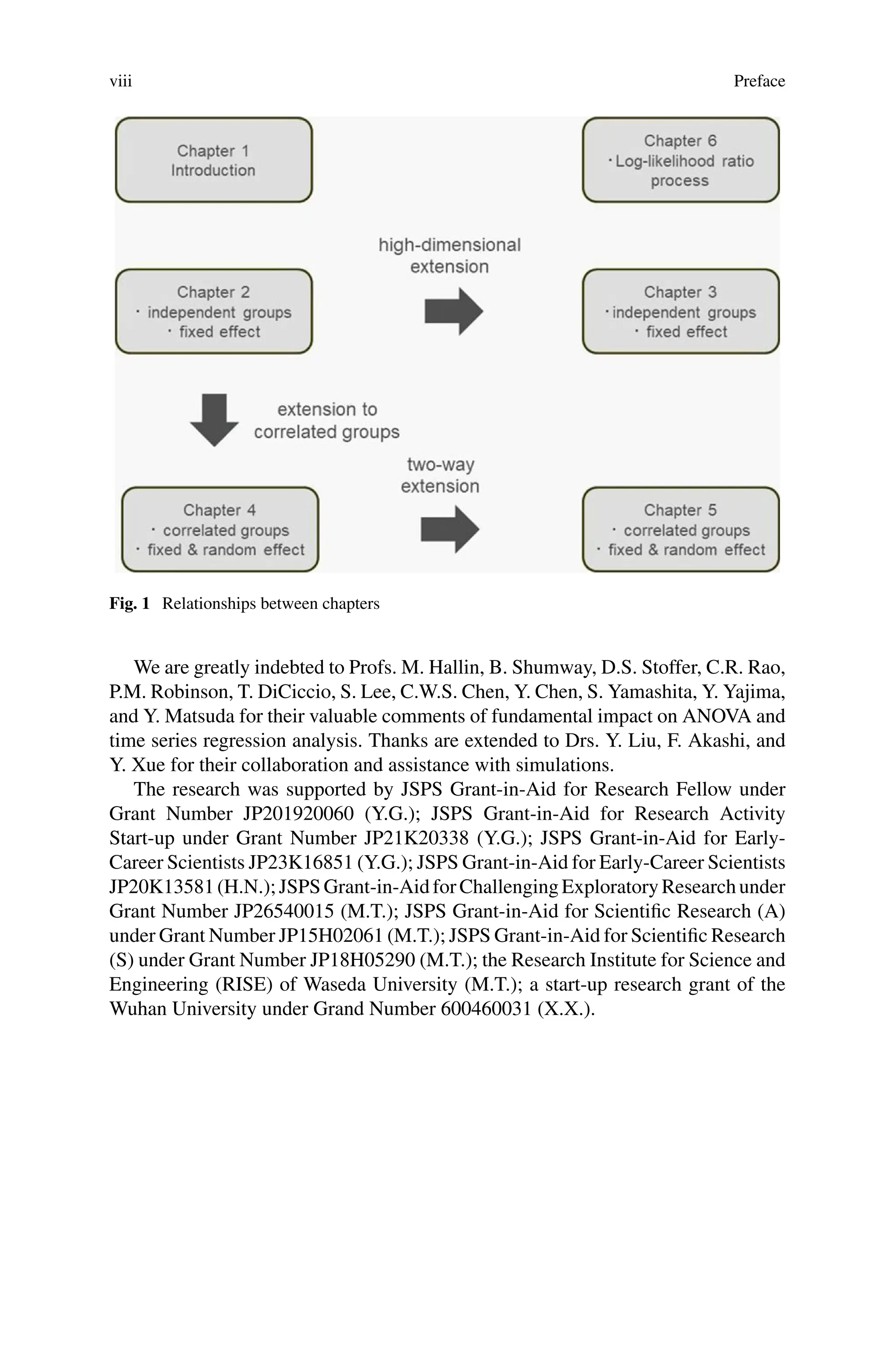
data analysts. Figure 1 illustrates the relationships between the chapters. In Chapter 1,
a historical overview of ANOVA and the fundamentals of time series analysis are
provided, along with motivation and concise summary of the content covered in the
book. Chapter 2 examines a test for the presence of fixed effects in the one-way
model with independent groups. Chapter 3 extends the analysis to high-dimensional
settings. Chapters 4 and 5 address correlated groups in one-way and two-way models,
respectively. Lastly, Chapter 6 explores the log-likelihood ratio process to construct
optimal tests in the context of i.i.d. settings.
vii
viii Preface
Fig. 1 Relationships between chapters
We are greatly indebted to Profs. M. Hallin, B. Shumway, D.S. Stoffer, C.R. Rao,
P.M. Robinson, T. DiCiccio, S. Lee, C.W.S. Chen, Y. Chen, S. Yamashita, Y. Yajima,
and Y. Matsuda for their valuable comments of fundamental impact on ANOVA and
time series regression analysis. Thanks are extended to Drs. Y. Liu, F. Akashi, and
Y. Xue for their collaboration and assistance with simulations.
The research was supported by JSPS Grant-in-Aid for Research Fellow under
Grant Number JP201920060 (Y.G.); JSPS Grant-in-Aid for Research Activity
Start-up under Grant Number JP21K20338 (Y.G.); JSPS Grant-in-Aid for Early-
Career Scientists JP23K16851 (Y.G.); JSPS Grant-in-Aid for Early-Career Scientists
JP20K13581(H.N.);JSPSGrant-in-AidforChallengingExploratoryResearchunder
Grant Number JP26540015 (M.T.); JSPS Grant-in-Aid for Scientific Research (A)
under Grant Number JP15H02061 (M.T.); JSPS Grant-in-Aid for Scientific Research
(S) under Grant Number JP18H05290 (M.T.); the Research Institute for Science and
Engineering (RISE) of Waseda University (M.T.); a start-up research grant of the
Wuhan University under Grand Number 600460031 (X.X.).
Preface ix
Last but certainly not the least, we extend our sincerest appreciation to Mr. Yutaka
Hirachi of Springer Japan and Mrs. Kavitha Palanisamy of Springer Nature for their
assistance and patience.
Fukuoka, Japan
Tokyo, Japan
Tokyo, Japan
Benevento, Italy
Wuhan, China
February 2023
Yuichi Goto
Hideaki Nagahata
Masanobu Taniguchi
Anna Clara Monti
Xiaofei Xu
Contents
1 Introduction . . . . . . . . . . . . . . . . . . . . . . . . . . . . . . . . . . . . . . . . . . . . . . . . . . . . 1
1.1 Foundations . . . . . . . . . . . . . . . . . . . . . . . . . . . . . . . . . . . . . . . . . . . . . . . . 1
1.2 Overview of Chapters . . . . . . . . . . . . . . . . . . . . . . . . . . . . . . . . . . . . . . . . 6
References . . . . . . . . . . . . . . . . . . . . . . . . . . . . . . . . . . . . . . . . . . . . . . . . . . . . . . 7
2 One-Way Fixed Effect Model . . . . . . . . . . . . . . . . . . . . . . . . . . . . . . . . . . . . . 9
2.1 Tests for Time-Dependent Errors . . . . . . . . . . . . . . . . . . . . . . . . . . . . . . 9
2.1.1 Three Classical and Famous Test Statistics . . . . . . . . . . . . . . . . 10
2.1.2 Likelihood Ratio Test Based on Whittle Likelihood . . . . . . . . 12
References . . . . . . . . . . . . . . . . . . . . . . . . . . . . . . . . . . . . . . . . . . . . . . . . . . . . . . 16
3 One-Way Fixed Effect Model for High-Dimensional Time Series . . . . . 19
3.1 Tests for High-Dimensional Time-Dependent Errors . . . . . . . . . . . . . . 19
3.1.1 Asymptotics of Fundamental Statistics
for High-Dimensional Time Series . . . . . . . . . . . . . . . . . . . . . . 22
3.1.2 Test Statistics for High-Dimensional Time Series . . . . . . . . . . 25
References . . . . . . . . . . . . . . . . . . . . . . . . . . . . . . . . . . . . . . . . . . . . . . . . . . . . . . 28
4 One-Way Fixed and Random Effect Models
for Correlated Groups . . . . . . . . . . . . . . . . . . . . . . . . . . . . . . . . . . . . . . . . . . . 29
4.1 Test for the Existence of Fixed Effects . . . . . . . . . . . . . . . . . . . . . . . . . . 29
4.1.1 Classical Test Statistics . . . . . . . . . . . . . . . . . . . . . . . . . . . . . . . . 30
4.1.2 A Test Statistic for Correlated Groups . . . . . . . . . . . . . . . . . . . . 32
4.2 Test for the Existence of Random Effects . . . . . . . . . . . . . . . . . . . . . . . 39
References . . . . . . . . . . . . . . . . . . . . . . . . . . . . . . . . . . . . . . . . . . . . . . . . . . . . . . 41
5 Two-Way Random Effect Model for Correlated Cells . . . . . . . . . . . . . . . 43
5.1 Test for the Existence of Random Effects . . . . . . . . . . . . . . . . . . . . . . . 43
5.2 Test for the Existence of Random Interactions . . . . . . . . . . . . . . . . . . . 50
References . . . . . . . . . . . . . . . . . . . . . . . . . . . . . . . . . . . . . . . . . . . . . . . . . . . . . . 53
xi
Random documents with unrelated
content Scribd suggests to you:
divergent flames of a comet described by, 364;
his treatise on comets, 368;
nature of comet’s light determined by, 380, 381;
numbers of comets computed, 381, 382;
remark of, on fixed stars, 405.
Arc, the Voltaic, 303-305.
Arcet, M. d’, vibration of fibres of the retina according to, 178.
Archer, Scott, stimulus given to photography by, 207.
Arcs of the meridian, mode of measuring, 47.
Arctic Sea, depth of the zone of constant temperature, 101.
—— regions, vegetation found in, 249.
Arcturus, comet bearing comparison with, 379;
rank of, 384.
Areas, described by the radii vectores of planets, a test of disturbing
forces, 10;
unequable description of, 15.
Argelander, M., period of a comet calculated by, 370;
his mode of estimating distance of fixed stars, 389;
periods of fluctuation in stars computed by, 390, 391;
sun’s motion proved, 405.
Argentine preparations in photography, chemical energy varying
with, 207, 208;
changes effected by washing with alkalies, 210, 211.
Argo, variable star in, 393.
Aries, season of the sun’s entrance into, in Hipparchus’ age, 80.
Arseniate of soda, its crystals, 109.
Artesian wells, mode of sinking, origin of the name, 230.
Asia, indigenous productions of, 249.
Assyrians, the, division of time by, 85.
Astronomers, fruits of their labours, 3;
question still to be resolved by, 24;
terrestrial orbit differently measured by, 36.
Astronomical distances, method of measuring, 43;
tables, method of forming, 58-64.
Astronomy, its rank in the physical sciences, an important office of,
1;
studies necessary to the study of, 2;
the key to divers problems in physical science, 3;
the two greatest discoveries in, 23;
the three departments of, 58;
standards for measurement afforded by, 83;
application of, to chronology, 87-89;
furnishing standards of weights and measures, 89, 90;
atmospheric effects connecting the laws of molecular attraction
with, 102;
progress lately made by, 419, 420.
Atalanta, diameter of, 56.
Atlantic Ocean, direction of tidal waves in, 93;
conditions modifying tides, 94;
depth of, 96;
currents, 100;
origin of hurricanes, 126;
superficial temperature of, 244;
distinct vegetation of the polar basin, 252;
beds of algæ in, 253;
meteors falling in, 421.
—— telegraph, 325, 326;
terrestrial magnetism disturbing, 346.
Atmosphere of nebulous stars, 411, 412.
—— of planets, 226, 227.
—— of the sun, its constitution, 42;
indications of an absorptive surrounding the luminous, 213;
the true, 224.
—— terrestrial, solar rays bent by, in lunar eclipses, 40;
influence of, in solar eclipses, 41;
its analysis, pressure on the surface of the globe, 117;
form of, gradual decrease in density of its strata, 117, 118;
influence of temperature on its density, 119;
mean pressure of, variable, 120;
the medium conveying sound, 129;
sympathetic vibrations transmitted by, 147, 148;
its action on light, falsifying vision, 153;
phenomena produced by accidental
changes in its strata, 155-156;
effects of increased density in the stratum in the horizon, 157,
158;
lunar heat absorbed by, 227;
cause of the cooler air in higher regions of, 240, 241;
sun’s heat modified by, 244;
action of electricity in, 284;
transmission of electricity by induction, 286;
periodical variations of electricity in, 291;
accidental developments of electricity, 291, 292;
cause of variations in its magnetism, 344, 345;
nebulous bodies made visible by, 421-423.
Atmospheric air, extreme elasticity of, 105.
—— pressure, effect of, on electricity, 288.
Atomic constitution determining crystalline forms, 109.
Atoms, qualities of, determining the nature of substances, 110;
differences in weight of, 111.
Attraction, modes of, in spheres, in the celestial bodies, 4;
determining the forms of planets, 6;
determining the motions of planets, 7;
solar, compelling the elliptical revolutions of planets, 8;
mutual, of planets, complicating their motions, 10;
interference of, disturbing the motions of heavenly bodies, 11;
disturbances from the operation of reciprocal, 13;
disturbances from inequality of, 14;
of satellites to primaries, little disturbed, 26;
disturbing force of, in spheroids, 27;
its effects on Jupiter’s satellites, 28;
sun’s, of the moon, 34;
principle modifying the earth’s, 37;
local, affecting the plumb-line, 48;
comparative force of the sun’s, 57;
of an external body affecting a spheroid, 79;
producing tides, 91, 92;
of particles of matter, 103;
capillary, 113;
producing annual atmospheric undulations, 121;
the lunar atmosphere affected by, 226;
expansive force of heat overcoming, 271;
of electricities, 283;
destruction of, producing electricity, 284;
laws of electrical, 286-288;
modes of, in static and in voltaic electricity, 317;
action of planetary, on comet’s orbits, 361-363;
range of solar, 365.
Aurora, the, affecting the compass, 312.
Australia, evidence of deserts in the interior of, 124;
species of plants common to Europe and, 251.
Auvergne, temperature of hot springs in, 231.
Axes, change in form of masses revolving round, 6.
——, major, length of, in orbits, invariable, 20;
of the orbits of Jupiter’s satellites, cause of the direct motion
observed in, 28;
position of, in the solar system, 65;
a nutation in planetary, 66;
of the moon, 68, 69;
mechanical law affecting, 76.
——, optic, of crystals, 183.
Axis, greater, of the earth’s orbit, period of its revolution, 38;
period of the earth’s revolution, 58;
excess of Jupiter’s equatorial over his polar, 66;
of rotation, proof of its being invariable, 76, 77.
——, major, of a planet’s orbit, distance from the sun measured by,
8;
designation of its extremities, 9;
length of, determining the form of the orbit, 10;
periods of its revolutions, 17;
length of, not permanently changed, 20;
Jupiter’s periodically diminished, Saturn’s increased, 26;
of the solar ellipse, period of its revolution, 86.
——, magnecrystallic, 349.
Azores, the, icebergs reaching, 100.
Babbage, Charles, his theory of volcanic action, 235-237;
quotation from, on the nature of force, 353.
Babinet, M., his theory of dark lines observed in the solar spectrum,
163;
comet’s light computed by, 359.
Babylon, eclipse observed at, 36.
Bacon, Francis, anticipation of discovery by, 32.
Baily, Mr., compression of the terrestrial spheroid calculated by, 50;
density of the earth determined, 57;
fictitious antiquity ascribed to Indian astronomical observations,
88.
Bali, volcanic eruption in, 233.
Balloon, rarity of the air felt in a, 118;
observations made from, 119.
Baltic, the, a tideless sea, 98;
decreased atmospheric pressure on the shores of, 120.
Barlow, Mr., observations supporting his theory of electric currents,
346.
Barometer, the, principles of cohesion and attraction applied to the
construction of, 113;
density of the atmosphere measured by, 117;
mean heights of, varying with atmospheric densities, 118;
mountain heights measured by, 119, 120;
atmospheric phenomena affecting, 120;
used to trace the course of atmospheric waves, 121;
cause of sudden fall in, before hurricanes, 127;
refraction varying with, 154.
Barrow, Cape, observations on magnetic storms at, 345, 346.
Battery, voltaic, construction of, 298, 299;
Professor Daniell’s improvements, 299, 300;
action of, charged with water, 300;
constant flow of electricity obtained by means of, 312.
——, magnetic, constructed by Dr. Faraday, 324, 325;
Mr. Henley’s magneto-electric, 325;
Atlantic telegraph, 326;
structure of, for land telegraphs, 328;
relation of heat to power of, 329;
thermo-electric, 333.
Batsha, port of, tides neutralised in, 99.
Bayle, comparative density of the atmosphere in interplanetary
space according to his law, 356.
Bear, Little, the, the polar star in, 82.
Becquerel, M. E., unexplained photographic phenomenon observed
by, 213;
phosphorescent property in the solar spectrum discovered, 216;
cause of phosphorescence, 217;
electricity excited by pressure, 283;
light attributed to electricity by, 284;
cause of phosphorescence investigated, 296;
instrument comparing intensities of electricities invented, 300;
crystals formed by agency of electricity, 308;
thermo-electric battery constructed by, 333;
effect of atmospheric on terrestrial magnetism estimated, 345.
Beehive, the, a nebulous star, 415.
Berard, M., experiments of, in polarizing heat, 264.
Berlin, line of coincidence in temperature passing through, 238.
Berne, increasing temperature of a deserted mine in, 230.
Berre, Dr., photographic pictures perfected by, 205.
Bessel, M., his calculations from measurements of arcs of the
meridian, 48;
calculation of the sun’s mean apparent diameter, 56;
his computation of the mass of Saturn’s ring, 68;
diminished obliquity of the ecliptic observed by, 81;
parallax calculated, 389;
his theory of Sirius’s irregular motions, 392;
catalogue of double stars, 396;
mass of 61 Cygni found by, 404.
Beta Lyræ, a variable star, 391;
nebula between γ Lyræ and, 410.
Benzenberg, M., velocities of falling stars computed by, 423.
Biela, M., date of the discovery of his comet, 367;
possibility of collision with the earth, 368;
present and prospective planetary influence on, 369;
becoming two distinct bodies, 369, 370.
Binary systems of stars, 395-406.
See Double stars.
Biot, M., his ascent in a balloon, 118;
experiments of, on the transmission of sounds through pipes, 137;
liquids possessing the power of circular polarization discovered by,
190;
his theory of circular polarization, 191;
cause of phosphorescence in the solar spectrum investigated by,
217.
Birds, distribution of distinct species of, 255.
Birt, Mr., atmospheric waves measured by, 121, 122.
Bise, in Switzerland, cause of, 242.
Bismuth, its magnetic and electric properties, 347.
Black Sea, the, scarcely affected by tides, 98.
Bode, Baron, law of, assumed in computing Neptune’s position, 61;
failing in the case of Neptune, 63.
Bond, Mr., satellite of Saturn discovered by, 32;
elliptical nebula resolved, 413.
Bonnycastle, Captain, phosphorescent phenomenon observed by,
295, 296.
Bonpland, M., identical productions of the Old and New World found
by, 251.
Boötes, nebulous system in, 417.
Bore, the, of the Hoogly, its origin, 94.
Botanical districts, distinct, of the globe, 251, 252.
Botto, M., thermo-electricity used in decomposition by, 333.
Bouguer, degrees of the meridian measured by, 48.
Boussingault, M., depth of the underground stratum of constant heat
calculated by, 228.
Bouvard, M., atmospheric undulations estimated by, 121.
Bradley, Dr., motion of the pole of the equator discovered by, 84;
his tables of refraction, 155.
Brahmins, measurement of time by, 85.
Brand, M., observation of, on meteors, 423.
Brewster, Sir David, his analysis of the solar spectrum, 161;
experiments on rayless lines, 163;
experiments on spectra of flames, 164;
law discovered by, determining angles of polarization for light,
183;
experiments on fluorescence of light, 197;
line of coincidence in temperature of springs and of the
atmosphere determined by, 238;
temperature of a pole of maximum cold determined, 245;
isogeothermal lines determined by, 246;
observations on the light of fixed stars, 402.
Brighton, phenomenon caused by reflection observed from, 157.
Brinkley, Bishop, mass of the moon determined by, 56.
British Channel, height of tides in, 98.
—— Isles, atmospheric wave passing over, 121.
Brorsen, M., periods of comets discovered by, 370.
Brown, Dr. Robert, peculiar vegetation found by, in Australia, 251.
Buchan, Dr., phenomenon caused by reflection observed by, 157.
Cæsar, Julius, era computed from his reign, 85.
Cagniard de la Tour, M., instrument designed by, measuring musical
notes, 143.
Calms produced by the trade-winds, 122, 123.
Calorific rays.
See Rays of heat.
Calotype, the invention of, 204.
Camelopard, nebulous system in, 417.
Canaries, the, vegetation of, 252.
Canary-glass, fluorescence of light in, 196.
Cancer, the calms of, 123;
the tropic of, marking the limit of the trade-winds, 126;
nebulous cluster in, 415.
Canis Major, position of, 390.
—— Venatica, nebulous system in, 417.
Capillarity, theory of, 113;
forces producing, 114;
familiar examples of, 115;
curious phenomena, 115, 116.
Capricorn, the calms of, 123;
the tropic of, hurricanes changing their direction at, 126.
Carbon, its powers contrasted as a crystal and as an opaque
amorphous substance, 302, 303.
Carbonate of lime.
See Lime.
Carbonic oxide, its constituent parts, 111.
—— acid, proportion of, in the atmosphere, 117.
Cardinal points, the, position of continental masses with regard to,
influencing temperature, 244.
Caribbean Islands, hurricanes beginning at, 126.
Castor, discovered by Sir William Herschel, 396.
Cassiopeia, star appearing and vanishing in, 392, 393.
Categat, the, consequence of its narrowness, 98.
Cauchy, M., data furnished by, for investigation of the theory of light,
201.
Cayenne, variation in length of the pendulum between Paris and, 51.
Celestial bodies:
law of their mutual attraction, 4;
of the solar system:
law determining their attraction to the sun, 5;
problem to fix the positions of, on occurrence of disturbance in
their motions through counteracting attractions, 11;
theory of their mutual connection and dependence, 24;
mode of finding the absolute distances of, 43;
distances of, computed from their parallax, 52, 54;
apparent position of, affected by refraction, 153, 154;
apparent infinity of, 420.
Centaur, position of, 390;
brilliant double star in, 399.
Central Asia, the mountains of, their ascent by Marco Polo, 118.
Centre of gravity.
See Gravity.
Centrifugal force, moon’s motions modified by, 5;
influence of, on planet-forms, 6;
retarding oscillations of the pendulum, 32;
action of, in determining the figure of the earth, 44, 45;
measurement of its intensity, 49;
resolved into two forces, its action on the sea, 100.
Ceres, astronomical tables of, 63;
height of her atmosphere, 226;
comet of 1770 revolving beyond the orbit of, 361.
Cetus, nebulous patches crossing, 417.
Chaldeans, the, mean longitude found from observations of, 36;
result of comparison of their observations with modern, 38.
Challis, Professor, Brewster’s analysis of light questioned by, 161.
Charcoal, light produced by electricity from, 302-303.
Charles V., the Emperor, observations on comets, made in his reign,
370.
Chaudes Aigues, temperature of, 231.
Chemical action of rays of the solar spectrum, 203, 207;
varying maximum of energy, 208;
action varying with refrangibility, 209-212;
action in luminous spectrum not continuous, 213;
energy an independent property of rays, 214;
properties of the parathermic rays, 219;
action of light maintaining vegetation, 249;
affinities the source of the power of steam, 278;
of electricity on oxygen, 284;
eliciting voltaic electricity, 297, 300;
voltaic electricity, an agent in, analysis, 307, 308.
—— combinations, theory of, 110;
invariable proportions of, 111;
cohesive force inducing, 112;
producing combustion, 270.
—— force, the power of, 112.
—— rays, causing the deposition of dew, 269.
Chile, elevation of land by an earthquake in, 234.
China, distinct flora of, 251.
—— Sea, the, monsoons blowing over, 124.
—— ink, polarized light reflected from, 193.
Chinese, the, observations of, on the mean motions of Jupiter and
Saturn, 25;
proof of their early study of astronomy, 88;
decimal divisions used by, 90;
elements of comets computed from their observation, 365;
comet of 1264 recorded by, 370.
—— Tartary, herbarium collected in, 250, 251.
Chladni, discovery of, in musical science, 145.
Christian era, traces of astronomical records before, 365.
Chromatype, the invention of, 206.
Chronology, dependent on astronomy, 87-89.
Chrysotype, the, coloured photographs obtained from, 206.
Circuit, galvanic, modes of obtaining, 332.
Circular arcs, principle with regard to their sines and cosines, a
pledge for the stability of the solar system, 20.
—— motion, ratio of forces procuring, 382.
—— orbits of planets distinguished from elliptical, 8;
of satellites, 27.
—— polarization of light, 189-192;
of heat, 266.
Circumference of the earth, 49.
Civil time, measure of its periods, 83;
not precisely adjusted to solar revolutions, 85.
Clairaut, periodic time of Halley’s comet computed by, 362, 363.
Cleavages of crystals, 109;
position of, affecting the intensity of magnetic action, 350.
Climates, planetary, 225, 226;
cause of the different terrestrial, 237;
phenomena affecting, 239, 240;
causes of variety of, 243, 244;
milder, of the Polar Ocean, 245, 246;
like mean annual temperatures not ensuring like, 246;
compensations of irregularities, 247.
Clocks, showing apparent sidereal time, 83;
regulated to show decimal time, 84;
irregular action of, corrected by the laws of unequal expansion,
272.
Clouds, circling the belt of equatorial calms, 123;
region of, 124;
electricity evolved from, 291-292.
Cloyne, Bishop of, his calculation of the moon’s mass, 56.
Coal-measures, tropical plants in, 72, 73;
age of their formation, 75.
Coal, chemical force evolved from, by combustion, 278;
source of its combustible qualities, 279, 280.
“Coal Sacks” in the Milky Way, 386.
Cohesion, influence of, on matter, 105;
phenomena arising from its force, 106;
attraction of, overcome by the expansive power of heat, 271.
Cohesive force, properties of material molecules constituting, 103;
effectual only to unite particles of like nature, 110;
inducing chemical combination, 112;
capillary attraction, an action of, 113.
Coins, impressions taken from, by contact, 220;
by electricity, 221.
Cold, contraction caused by, 271, 272;
mitigated by slow propagation of heat in air, 273;
generated by voltaic electricity, 302;
increasing the conducting power of the air, 345.
Colladon, M., experiments of, testing the velocity of sound, 135.
Collision between the earth and comets, possibilities, possible effects
of, 367, 369.
Collodion, sensitiveness of, to light, 203;
properties of, as an agent in photography, 207.
Colours, seven primary, 159;
theory of the decomposition of white light into, 160;
degree of refrangibility not invariable, 161;
three primary, ib.;
new, discovered by Sir John Herschel, 162;
rays refracted without, 164;
rarely homogeneous, 165;
experiments on accidental and complementary, 165, 166;
determined by undulations of ether, experiments, 170-175;
of material substances, whence derived, 175;
produced by analyzing polarized light, 186-188;
varying with refrangibility of rays, 198;
obtained in photography, 206;
images of the solar spectrum imitating the prismatic, 208-209;
of seaweeds, 253;
not invariably dependent on light, ib.;
affected by absorption and reflection, 268;
of the electric spark, affected by the atmosphere, 289;
of the voltaic spectrum, 303;
of the electric spark, 304;
produced by oxidation on silver, 305;
of the fixed stars, 401, 402;
of planetary nebulæ, 412;
of nebulous clusters, 415.
Columbus, beds of algæ found by, 253.
Column, capillary, forces producing changes in its form, 114, 115.
Coma Berenices, a nebulous cluster, 415;
nebulous zone passing, 416, 417.
Combustion, cause of, 270;
defined, 304.
Comets, attraction by the sun of, 5;
disturbances in the motion of, a key to the nature of the ethereal
medium, 22;
retrograde motion in, 33;
passing through Jupiter’s satellites, 69;
return of, to their perihelia, furnishing historical data, 88;
existence of the luminous ether demonstrated by, 168, 169;
terrestrial atmosphere unaffected by, 358;
amount of their light computed, 358, 359;
passages of, through the solar system, 359;
velocity, paths of, 359, 360;
proof of the return of, 360;
disturbing action of planets on their orbits, 361;
of 1770, an example, 361, 362;
computed return of Halley’s, 362, 363;
aspects, records of Halley’s, 363-365;
discoveries made by the revolutions of, 365;
of the solar system, Encke’s, 365, 366;
Biela’s, possibility of collision with, 367, 370;
periods of various, 370;
cause of their brilliancy, 371;
velocity, sun’s influence on, 371, 372;
of 1843, 372, 373;
their constitution, 373, 374;
of 1811, its luminous envelopes, 374, 375;
sudden convulsions in, 375;
tails, 375-377;
causes assigned for contraction of diameter in, 377, 378;
Donati’s, 378, 379;
nature of their light, 379-381;
computations of their numbers, 381, 382;
orbits of, 383;
nebula resembling, 413.
Compass, mariner’s, phenomena disturbing, 312;
intensity of a galvanic current measured by, 315.
Compression of the terrestrial spheroid, calculations of, 48-51;
cause of the great, in Jupiter, 66;
measures of, from pressure of superincumbent mass, 78;
effect of, on magnetic action, 351.
Concord, a, in music, 142.
Conductors of electricity, 284, 285;
lightning, 293;
molecular structure determining the power of, 303.
Conic sections, conditions compelling bodies in space to move in, 5;
principle determining their nature, 11.
Constellations, nearest the sun, 390;
where the orbit of the solar system lies, 406;
occupied by the nebulous system, 417.
Contraction caused by cold, 271, 272.
Cook, Captain, object of his first voyage, 53.
Cooper, Mr., list of missing stars drawn up by, 395.
Copper, electricity communicated to plates of, 220;
lightning-conductors of, 293;
action of an electro-magnet on, 351, 352.
Cordier, temperature of mines observed by, 228.
Cordilleras, effect on temperature of their table-lands, 241.
Corn, a, field used to illustrate the propagation of sound, 129, 130.
Cornwall, hot-springs in mines of, 229.
Corona Australis, nebula in, 414.
Corpuscular theory of light, 167;
phenomena disproving, 171, 175, 176.
Coseguina, volcanic irruption of, 233.
Coulomb, instrument measuring electrical intensity, invented by, 287.
Creation, vastness and magnificence of, 2.
Crimea, cause of the great storm in the, 122.
Cross, Mr., voltaic battery with constant action invented by, 300.
Cross, the Southern, vacant patches of the Milky Way near, 386.
Crystallization defined, 106;
forms of, their variety affected by temperature, 107, 108;
permanent and variable forms, 108, 109;
cleavages in, 109;
common to all substances, ib.;
by the agency of electricity, 308, 309.
Crystals, conditions determining their forms, 107-109;
optic axes of, 183;
used in polarizing light, 186, 188;
changes in, effected by compression, 189;
transmission of rays of heat by, 258;
expansion of, by heat, 272, 273;
formed by electricity, 308;
action of magnetism in, 349, 350;
circumstances determining the set of, 350, 351;
effect of temperature on magnetized, 352.
Cumming, Professor, experiments of, in thermo-electricity, 333.
Currents, two great, setting from each pole towards the equator,
100;
proving the rotation of winds, 124, 125.
——, electric, flow of, regulated by Volta, 297-299;
characteristics of Voltaic, 301;
conductors, non-conductors of, 309;
continuous flow of Voltaic, 312;
action of, on magnets, 313-315;
reciprocal and mutual action of magnetic and electric, 316, 317;
Ampère’s theory of, unsolved difficulties, 317, 318;
effect of, on polarized rays, 319;
electric, evolved by magnets, 322, 323;
their power of producing induction, 324;
direction of, produced by rotation, 330-332;
evolved by application of heat, 332, 333;
produced by intersecting magnetic curves, 339;
induced by crossing terrestrial lines of magnetic force, 342.
Curves, described by bodies projected in space, 5.
——, magnetic, 338;
electricity produced by intersecting, 339;
nature of, proved by Dr. Faraday, 339, 340;
terrestrial, 341, 342;
extent of the range of terrestrial, 344;
complete connected system of the terrestrial, 345;
inductive effect on the Atlantic telegraph, 346;
diamagnetic, 348.
Cyanite, changes effected in, by magnetism, 349.
Cyanotypes, coloured photographs obtained by, 206.
Cygni 61, distance from the sun of, 389;
orbit and mass of, 398, 399;
colours, 401;
mass, 404;
proper motion, 405.
Cygnus, portion of the Milky Way lying between α Centauri and, 386.
Cylinders, rotating by electricity, 313;
electro-dynamic, 316.
Dalcoath copper-mine, its temperature, 228.
Daguerre, M., his inventions in photography, 205;
action of light on the iodide of silver explained by, 219.
Daguerreotype, the, invention of, 205.
Dalton, Dr., law of definite proportion established by, 111;
law of the wind’s rotation observed by, 125.
Damoiseau, M., perturbations of a comet computed by, 367.
Daniell, Professor, Voltaic battery improved by, 299.
Daubuisson, M., observations of, in mines, 228.
Davy, Sir Humphry, his first attempts to produce photographic
pictures, 203-204;
experiment of, proving identity of heat and motion, 275;
experiments on the electric spectrum, 289;
alkalies, earths decomposed by, 307.
Days, law determining the length of, 71;
period of the mean sidereal and solar, 83;
varying with the seasons, 84;
decimal division of, 84;
seven, the most permanent division of time, 85.
Deccan, the, wheat ripening in, 250.
December, 1832, disappearance of Saturn’s rings in, 67;
coincidence of mean and apparent time in, 84;
date of Christ’s nativity, 85;
the astronomical year beginning in, 86.
Decimal division of time, 84.
Declinations of the moon, 97.
Decomposition, effected by electricity, 307-308;
by magnetism, 323;
by thermo-electricity, 333.
Delambre, his computations of the length of the year, 359.
Delta Cephei, a variable star, 391.
Denmark, course of the tidal wave to, 94.
Density, variable, impeding sound, 135, 136:
of media, modifying refraction, 153.
Densities of heavenly bodies, formula finding, 56;
experiments, 57, 58;
comparative of the terrestrial globe, 77, 78.
Deserts, causing monsoons, 124;
influence of, on temperature, 243.
Dew, cause of its deposition, 269.
Diamagnetic substances, 335, 336.
Diamagnetism defined, 335;
substances it is resident in, 336;
discovery, characteristics of, 347;
neutral substances obtained by proportionate combination of, with
paramagnetism, ib.;
polarity of, 348;
connected with arrangement of molecules, 350-351;
affected by division and compression, 351;
possibly identical with paramagnetism, 356, 357.
Diameter of the earth, 21;
Jupiter’s polar, 27;
excess of his equatorial, 39;
apparent, of the sun and moon, nearly equal, 40;
of the earth, 49;
of bodies composing the solar system, 56;
of Neptune, 63;
comets lacking a sensible, 373;
contraction of, in comets, 377;
causes assigned for, 377, 378.
—— of an annular nebula, 410;
sensible, of a planetary nebula, 412.
Diamond, the, polarized light reflected from, 193.
Dielectrics in electricity, 286.
Dieppe, seen from Hastings, 157.
Differential telescope, the, experiments to be made by, 227.
Discord, a, in music, 142.
Diurnal tides of the atmosphere, their duration, 121.
—— variations in mean values of the magnetic elements, 343.
Dœbereiner, M., spontaneous combustion discovered by, 112.
Doldrums, region of the, 123.
Dollond, Mr., achromatic telescope perfected by, 165.
Donati, Signore, discovery of his comet, 378;
changes in, its irregularities, 379.
Doradus, nebulous patches on, 417.
Dorpat, occultation of a star observed from, 364.
Double nebulæ, 411.
Double stars, catalogues of, 395, 396;
formulæ obtaining the relative position and motions, 396, 397;
eclipse in γ Virginis, 397;
orbit of, determined, 398;
eclipse in ζ Herculis, ib.;
orbits and periodic times of, 398, 399;
anomalies in motions, 400;
optically double, 400, 401;
colours of, 401;
rays composing the light of, 401, 402;
passage of light from, furnishing data to ascertaining their actual
distance, 402, 403;
data for finding their masses, 403, 404;
calculations founded on the quantity of light emitted from, 404;
real and apparent motions of, 404-406;
apparent periodic time, 406, 407;
connection of elliptical nebulæ with, 411.
Dove, Professor, law of the wind’s rotation developed by, 125;
average temperature of the earth’s surface estimated by, 237.
Draco, nebulous system in, 417.
Draper, Professor, experiments of, on fluorescence of light, 198;
experiments in photography, 213;
properties of parathermic rays discovered by, 219;
spectrum produced from diffracted light, 223;
theory of heat propagated by undulations, 267.
Dunlop, Mr., revolution of a double star calculated by, 400.
Dusejour, M., distances of comets computed by, 359.
Dynamic electricity, 297.
See Voltaic.
—— theory of heat, fundamental principle of, 357.
Dynamic equator of the earth, 343.
Dynamical theory of heat, 274, 275;
illustrated by liquefaction and condensation, 278;
by generation of steam, 276, 277;
power of nature, 279-281.
Dynamics, principle in, a law, with regard to the earth’s rotation, 72;
electro, discovery of action of currents in, 316;
the theory of, universal application of, 426, 427.
Earth, the, influence of its form on attraction, 4;
square of the moon’s distance from, 5;
form of, 6, 7;
moon’s influence on its rotations, 7;
diameter of, 21;
mean distance from the sun, ib. note;
permanence of revolution in its times and seasons, 23;
perturbation in the mean motion of Venus and, 26;
proof of the motion of, in its orbit, of its rotation, 32;
variations in its attraction of the moon, 37;
compression of its spheroid, 38;
internal structure of, 39;
its mean distance from the sun, 43;
theoretical investigation of its figure, 44-46;
dimensions of, determined, 48, 49;
figure of, found by calculating its variations in gravitation, 49-51;
density compared with the sun, 56;
experiments finding its mean density, 57, 58;
rate of revolution round its axis, 58;
its diurnal rotation immutable, 71, 72;
changes in temperature and their causes, 73, 74;
nature of the revolutions producing geological changes, 76, 77;
conjectures touching its internal structure, 78;
effects produced by solar and lunar attraction affecting its equator,
79-81;
its form furnishing standards of weight and measure, 89;
rotation of, acting on tides, 92;
attraction of, affecting the lunar atmosphere, 226;
conjectured constitution of its interior, 231, 232;
principles regulating the diffusion of solar heat, 237-247;
distribution of known species of plants over, 249-252;
electric tension of, 291;
lines of magnetic force issuing from, 341;
magnetic properties of, 342, 343;
effect of its collision with a comet, 368;
nearest approach of comets to, 369;
passage of light from α Centauri to, 388;
theories of meteors falling on, 421-423.
Earthquakes in South America, 234.
Earths, decomposed by voltaic electricity, 307.
Eastern coasts, cause of their colder climates, 244.
Ebb, see Tides.
Éboulemens of mountains in Switzerland, cause of, 271.
Echoes, theory of their origin, 137, 138.
Eclipses, lunar, accelerated revolutions proved by observations of,
36;
observations of, confirming results of analysis, 38;
principle regulating their return, 39;
refraction of rays by the terrestrial atmosphere, 40.
——, solar, 40;
effects of light in, 41.
——, planetary, 42;
the solar atmosphere visible in, 224;
of double stars, 397, 398.
Ecliptic, the, forming the equinoxes, 9;
latitude reckoned from the plane of, ib.;
deviations of planetary orbits from, 10;
forces affecting their position towards, 15;
their compensated and uncompensated variations to the plane of,
18, 19;
secular variation in the plane of, 23;
orbits of satellites, nearly perpendicular to, 33;
lunar motions towards, 35;
inclination of the sun’s plane of rotation to, 65;
inclination of the plane of Saturn’s rings, 67;
inclination of the plane of the terrestrial equator, 79;
tendency of its plane to coincide with the equatorial, ib.;
retrograde motion of the equinoctial points on, 80;
obliquity of, affecting the duration of time, 84.
Edinburgh, comparatively equal mean annual temperature of, 246.
Egypt, hieroglyphic manuscript from, interpreted by astronomy, 89.
Egyptians, the civil year of, 85.
Elastic impact, the foundation of dynamical theories, 357.
Elasticity, property of, resisting compression, 105.
Electric telegraphs, experiment suggesting the principle of, 323;
construction of, 325-328.
Electricity assumed as the medium attracting particles of matter,
103, 104;
identical with chemical affinity, 110;
in composition and decomposition, subject to laws of definite
proportion, 112;
Welcome to our website – the perfect destination for book lovers and
knowledge seekers. We believe that every book holds a new world,
offering opportunities for learning, discovery, and personal growth.
That’s why we are dedicated to bringing you a diverse collection of
books, ranging from classic literature and specialized publications to
self-development guides and children's books.
More than just a book-buying platform, we strive to be a bridge
connecting you with timeless cultural and intellectual values. With an
elegant, user-friendly interface and a smart search system, you can
quickly find the books that best suit your interests. Additionally,
our special promotions and home delivery services help you save time
and fully enjoy the joy of reading.
Join us on a journey of knowledge exploration, passion nurturing, and
personal growth every day!
ebookbell.com


Anova With Dependent Errors Yuichi Goto Hideaki Nagahata Masanobu Taniguchi

  • 1.
    Anova With DependentErrors Yuichi Goto Hideaki Nagahata Masanobu Taniguchi download https://ebookbell.com/product/anova-with-dependent-errors-yuichi- goto-hideaki-nagahata-masanobu-taniguchi-50863742 Explore and download more ebooks at ebookbell.com
  • 2.
    Here are somerecommended products that we believe you will be interested in. You can click the link to download. Permutation Tests For Stochastic Ordering And Anova Theory And Applications With R 1st Edition Aldo Solari https://ebookbell.com/product/permutation-tests-for-stochastic- ordering-and-anova-theory-and-applications-with-r-1st-edition-aldo- solari-2249476 Design And Analysis Of Gauge Rr Studies Making Decisions With Confidence Intervals In Random And Mixed Anova Models Asasiam Series On Statistics And Applied Probability Richard K Burdick https://ebookbell.com/product/design-and-analysis-of-gauge-rr-studies- making-decisions-with-confidence-intervals-in-random-and-mixed-anova- models-asasiam-series-on-statistics-and-applied-probability-richard-k- burdick-1381270 Mastering Neural Network Computer Vision With Tensorflow And Keras A Practical Guide To Image Use Cases Like Object Detection 1st Jean Anoma https://ebookbell.com/product/mastering-neural-network-computer- vision-with-tensorflow-and-keras-a-practical-guide-to-image-use-cases- like-object-detection-1st-jean-anoma-232051424 I Wish I Was Revised Edition 1st Edition Anona Coates https://ebookbell.com/product/i-wish-i-was-revised-edition-1st- edition-anona-coates-51573568
  • 3.
    Anova And MixedModels A Short Introduction Using R Lukas Meier https://ebookbell.com/product/anova-and-mixed-models-a-short- introduction-using-r-lukas-meier-46502138 Anova And Ancova A Glm Approach 2nd Edition Andrew Rutherford https://ebookbell.com/product/anova-and-ancova-a-glm-approach-2nd- edition-andrew-rutherford-4673912 Introducing Anova And Ancova A Glm Approach Introducing Statistical Methods Series 1st Edition Dr Andrew Rutherford https://ebookbell.com/product/introducing-anova-and-ancova-a-glm- approach-introducing-statistical-methods-series-1st-edition-dr-andrew- rutherford-2098050 Experimental Designs Using Anova Computerassisted Research Design And Analysis Barbara G Tabachnick https://ebookbell.com/product/experimental-designs-using-anova- computerassisted-research-design-and-analysis-barbara-g- tabachnick-45447214 Smoothing Spline Anova Models Chong Gu Auth https://ebookbell.com/product/smoothing-spline-anova-models-chong-gu- auth-4271780
  • 5.
    SpringerBriefs in Statistics JSSResearch Series in Statistics Yuichi Goto · Hideaki Nagahata · Masanobu Taniguchi · Anna Clara Monti · Xiaofei Xu ANOVA with Dependent Errors
  • 6.
    SpringerBriefs in Statistics JSSResearch Series in Statistics Editors-in-Chief Naoto Kunitomo, The Institute of Mathematical Statistics, Tachikawa, Tokyo, Japan Akimichi Takemura, The Center for Data Science Education and Research, Shiga University, Hikone, Shiga, Japan Series Editors Shigeyuki Matsui, Graduate School of Medicine, Nagoya University, Nagoya, Aichi, Japan Manabu Iwasaki, School of Data Science, Yokohama City University, Yokohama, Kanagawa, Japan Yasuhiro Omori, Graduate School of Economics, The University of Tokyo, Bunkyo-ku, Tokyo, Japan Masafumi Akahira, Institute of Mathematics, University of Tsukuba, Tsukuba, Ibaraki, Japan Masanobu Taniguchi, School of Fundamental Science and Engineering, Waseda University, Shinjuku-ku, Tokyo, Japan Hiroe Tsubaki, The Institute of Statistical Mathematics, Tachikawa, Tokyo, Japan Satoshi Hattori, Faculty of Medicine, Osaka University, Suita, Osaka, Japan Kosuke Oya, School of Economics, Osaka University, Toyonaka, Osaka, Japan Taiji Suzuki, School of Engineering, University of Tokyo, Tokyo, Japan Kunio Shimizu, The Institute of Mathematical Statistics, Tachikawa, Tokyo, Japan
  • 7.
    The current researchof statistics in Japan has expanded in several directions in line with recent trends in academic activities in the area of statistics and statistical sciences over the globe. The core of these research activities in statistics in Japan has been the Japan Statistical Society (JSS). This society, the oldest and largest academic organizationforstatisticsinJapan,wasfoundedin1931byahandfulofpioneerstatis- ticians and economists and now has a history of about 80 years. Many distinguished scholars have been members, including the influential statistician Hirotugu Akaike, who was a past president of JSS, and the notable mathematician Kiyosi Itô, who was an earlier member of the Institute of Statistical Mathematics (ISM), which has been a closely related organization since the establishment of ISM. The society has two academic journals: the Journal of the Japan Statistical Society (English Series) and the Journal of the Japan Statistical Society (Japanese Series). The membership of JSS consistsofresearchers,teachers,andprofessionalstatisticiansinmanydifferentfields including mathematics, statistics, engineering, medical sciences, government statis- tics, economics, business, psychology, education, and many other natural, biological, and social sciences. The JSS Series of Statistics aims to publish recent results of current research activities in the areas of statistics and statistical sciences in Japan that otherwise would not be available in English; they are complementary to the two JSS academic journals, both English and Japanese. Because the scope of a research paper in academic journals inevitably has become narrowly focused and condensed in recent years, this series is intended to fill the gap between academic research activities and the form of a single academic paper. The series will be of great interest to a wide audience of researchers, teachers, professional statisticians, and graduate students in many countries who are interested in statistics and statistical sciences, in statistical theory, and in various areas of statistical applications.
  • 8.
    Yuichi Goto ·Hideaki Nagahata · Masanobu Taniguchi · Anna Clara Monti · Xiaofei Xu ANOVA with Dependent Errors
  • 9.
    Yuichi Goto Faculty ofMathematics Kyushu University Fukuoka, Japan Masanobu Taniguchi Waseda University Shinjuku City, Tokyo, Japan Xiaofei Xu Department of Probability and Statistics School of Mathematics and Statistics Wuhan University Wuhan, Hubei, China Hideaki Nagahata Risk Analysis Research Center The Institute of Statistical Mathematics Tachikawa, Tokyo, Japan Anna Clara Monti Department of Law, Economics Management and Quantitative Methods Università degli Studi del Sannio Benevento, Italy ISSN 2191-544X ISSN 2191-5458 (electronic) SpringerBriefs in Statistics ISSN 2364-0057 ISSN 2364-0065 (electronic) JSS Research Series in Statistics ISBN 978-981-99-4171-1 ISBN 978-981-99-4172-8 (eBook) https://doi.org/10.1007/978-981-99-4172-8 © The Author(s), under exclusive license to Springer Nature Singapore Pte Ltd. 2023 This work is subject to copyright. All rights are solely and exclusively licensed by the Publisher, whether the whole or part of the material is concerned, specifically the rights of translation, reprinting, reuse of illustrations, recitation, broadcasting, reproduction on microfilms or in any other physical way, and transmission or information storage and retrieval, electronic adaptation, computer software, or by similar or dissimilar methodology now known or hereafter developed. The use of general descriptive names, registered names, trademarks, service marks, etc. in this publication does not imply, even in the absence of a specific statement, that such names are exempt from the relevant protective laws and regulations and therefore free for general use. The publisher, the authors, and the editors are safe to assume that the advice and information in this book are believed to be true and accurate at the date of publication. Neither the publisher nor the authors or the editors give a warranty, expressed or implied, with respect to the material contained herein or for any errors or omissions that may have been made. The publisher remains neutral with regard to jurisdictional claims in published maps and institutional affiliations. This Springer imprint is published by the registered company Springer Nature Singapore Pte Ltd. The registered company address is: 152 Beach Road, #21-01/04 Gateway East, Singapore 189721, Singapore
  • 10.
  • 11.
    Preface The analysis ofvariance (ANOVA) is a statistical method for assessing the impact of multiple factors and their interactions when there are three or more factors. The method was first developed by R. A. Fisher in the 1910s and since then has been studied extensively by many authors. Inthecaseofi.i.d.data,mostliteraturehasfocusedonthesettingwherethenumber of groups (a) and the number of observations in each group (n) are small, referred to as fixed-a and -n asymptotics. ANOVA for time series data, commonly referred to as longitudinal or panel data analysis, has been extensively studied in econometrics. In thisfield,large-a andfixed-nasymptoticsorlarge-a and-nasymptoticsarecommonly examined, with a primary focus on the regression coefficient. Consequently, results regarding the existence of fixed and random effects of factors have been hardly developed. This monograph aims to present the recent developments related to one- and two- way models mainly for time series data under the framework of fixed-a and large-n asymptotics. Especially, we focus on (i) the testing problems for the existence of fixed and random effects of factors and interactions among factors under various settings, including uncorrelated and correlated groups, fixed and random effects, multi- and high-dimension, parametric and nonparametric spectral densities, and (ii) the local asymptotic normality (LAN) property for one-way models on i.i.d. data. This book is suitable for statisticians and economists as well as psychologists and data analysts. Figure 1 illustrates the relationships between the chapters. In Chapter 1, a historical overview of ANOVA and the fundamentals of time series analysis are provided, along with motivation and concise summary of the content covered in the book. Chapter 2 examines a test for the presence of fixed effects in the one-way model with independent groups. Chapter 3 extends the analysis to high-dimensional settings. Chapters 4 and 5 address correlated groups in one-way and two-way models, respectively. Lastly, Chapter 6 explores the log-likelihood ratio process to construct optimal tests in the context of i.i.d. settings. vii
  • 12.
    viii Preface Fig. 1Relationships between chapters We are greatly indebted to Profs. M. Hallin, B. Shumway, D.S. Stoffer, C.R. Rao, P.M. Robinson, T. DiCiccio, S. Lee, C.W.S. Chen, Y. Chen, S. Yamashita, Y. Yajima, and Y. Matsuda for their valuable comments of fundamental impact on ANOVA and time series regression analysis. Thanks are extended to Drs. Y. Liu, F. Akashi, and Y. Xue for their collaboration and assistance with simulations. The research was supported by JSPS Grant-in-Aid for Research Fellow under Grant Number JP201920060 (Y.G.); JSPS Grant-in-Aid for Research Activity Start-up under Grant Number JP21K20338 (Y.G.); JSPS Grant-in-Aid for Early- Career Scientists JP23K16851 (Y.G.); JSPS Grant-in-Aid for Early-Career Scientists JP20K13581(H.N.);JSPSGrant-in-AidforChallengingExploratoryResearchunder Grant Number JP26540015 (M.T.); JSPS Grant-in-Aid for Scientific Research (A) under Grant Number JP15H02061 (M.T.); JSPS Grant-in-Aid for Scientific Research (S) under Grant Number JP18H05290 (M.T.); the Research Institute for Science and Engineering (RISE) of Waseda University (M.T.); a start-up research grant of the Wuhan University under Grand Number 600460031 (X.X.).
  • 13.
    Preface ix Last butcertainly not the least, we extend our sincerest appreciation to Mr. Yutaka Hirachi of Springer Japan and Mrs. Kavitha Palanisamy of Springer Nature for their assistance and patience. Fukuoka, Japan Tokyo, Japan Tokyo, Japan Benevento, Italy Wuhan, China February 2023 Yuichi Goto Hideaki Nagahata Masanobu Taniguchi Anna Clara Monti Xiaofei Xu
  • 14.
    Contents 1 Introduction .. . . . . . . . . . . . . . . . . . . . . . . . . . . . . . . . . . . . . . . . . . . . . . . . . . . 1 1.1 Foundations . . . . . . . . . . . . . . . . . . . . . . . . . . . . . . . . . . . . . . . . . . . . . . . . 1 1.2 Overview of Chapters . . . . . . . . . . . . . . . . . . . . . . . . . . . . . . . . . . . . . . . . 6 References . . . . . . . . . . . . . . . . . . . . . . . . . . . . . . . . . . . . . . . . . . . . . . . . . . . . . . 7 2 One-Way Fixed Effect Model . . . . . . . . . . . . . . . . . . . . . . . . . . . . . . . . . . . . . 9 2.1 Tests for Time-Dependent Errors . . . . . . . . . . . . . . . . . . . . . . . . . . . . . . 9 2.1.1 Three Classical and Famous Test Statistics . . . . . . . . . . . . . . . . 10 2.1.2 Likelihood Ratio Test Based on Whittle Likelihood . . . . . . . . 12 References . . . . . . . . . . . . . . . . . . . . . . . . . . . . . . . . . . . . . . . . . . . . . . . . . . . . . . 16 3 One-Way Fixed Effect Model for High-Dimensional Time Series . . . . . 19 3.1 Tests for High-Dimensional Time-Dependent Errors . . . . . . . . . . . . . . 19 3.1.1 Asymptotics of Fundamental Statistics for High-Dimensional Time Series . . . . . . . . . . . . . . . . . . . . . . 22 3.1.2 Test Statistics for High-Dimensional Time Series . . . . . . . . . . 25 References . . . . . . . . . . . . . . . . . . . . . . . . . . . . . . . . . . . . . . . . . . . . . . . . . . . . . . 28 4 One-Way Fixed and Random Effect Models for Correlated Groups . . . . . . . . . . . . . . . . . . . . . . . . . . . . . . . . . . . . . . . . . . . 29 4.1 Test for the Existence of Fixed Effects . . . . . . . . . . . . . . . . . . . . . . . . . . 29 4.1.1 Classical Test Statistics . . . . . . . . . . . . . . . . . . . . . . . . . . . . . . . . 30 4.1.2 A Test Statistic for Correlated Groups . . . . . . . . . . . . . . . . . . . . 32 4.2 Test for the Existence of Random Effects . . . . . . . . . . . . . . . . . . . . . . . 39 References . . . . . . . . . . . . . . . . . . . . . . . . . . . . . . . . . . . . . . . . . . . . . . . . . . . . . . 41 5 Two-Way Random Effect Model for Correlated Cells . . . . . . . . . . . . . . . 43 5.1 Test for the Existence of Random Effects . . . . . . . . . . . . . . . . . . . . . . . 43 5.2 Test for the Existence of Random Interactions . . . . . . . . . . . . . . . . . . . 50 References . . . . . . . . . . . . . . . . . . . . . . . . . . . . . . . . . . . . . . . . . . . . . . . . . . . . . . 53 xi
  • 15.
    Random documents withunrelated content Scribd suggests to you:
  • 16.
    divergent flames ofa comet described by, 364; his treatise on comets, 368; nature of comet’s light determined by, 380, 381; numbers of comets computed, 381, 382; remark of, on fixed stars, 405. Arc, the Voltaic, 303-305. Arcet, M. d’, vibration of fibres of the retina according to, 178. Archer, Scott, stimulus given to photography by, 207. Arcs of the meridian, mode of measuring, 47. Arctic Sea, depth of the zone of constant temperature, 101. —— regions, vegetation found in, 249. Arcturus, comet bearing comparison with, 379; rank of, 384. Areas, described by the radii vectores of planets, a test of disturbing forces, 10; unequable description of, 15. Argelander, M., period of a comet calculated by, 370; his mode of estimating distance of fixed stars, 389; periods of fluctuation in stars computed by, 390, 391; sun’s motion proved, 405. Argentine preparations in photography, chemical energy varying with, 207, 208; changes effected by washing with alkalies, 210, 211. Argo, variable star in, 393. Aries, season of the sun’s entrance into, in Hipparchus’ age, 80. Arseniate of soda, its crystals, 109. Artesian wells, mode of sinking, origin of the name, 230. Asia, indigenous productions of, 249. Assyrians, the, division of time by, 85.
  • 17.
    Astronomers, fruits oftheir labours, 3; question still to be resolved by, 24; terrestrial orbit differently measured by, 36. Astronomical distances, method of measuring, 43; tables, method of forming, 58-64. Astronomy, its rank in the physical sciences, an important office of, 1; studies necessary to the study of, 2; the key to divers problems in physical science, 3; the two greatest discoveries in, 23; the three departments of, 58; standards for measurement afforded by, 83; application of, to chronology, 87-89; furnishing standards of weights and measures, 89, 90; atmospheric effects connecting the laws of molecular attraction with, 102; progress lately made by, 419, 420. Atalanta, diameter of, 56. Atlantic Ocean, direction of tidal waves in, 93; conditions modifying tides, 94; depth of, 96; currents, 100; origin of hurricanes, 126; superficial temperature of, 244; distinct vegetation of the polar basin, 252; beds of algæ in, 253; meteors falling in, 421. —— telegraph, 325, 326; terrestrial magnetism disturbing, 346. Atmosphere of nebulous stars, 411, 412. —— of planets, 226, 227. —— of the sun, its constitution, 42;
  • 18.
    indications of anabsorptive surrounding the luminous, 213; the true, 224. —— terrestrial, solar rays bent by, in lunar eclipses, 40; influence of, in solar eclipses, 41; its analysis, pressure on the surface of the globe, 117; form of, gradual decrease in density of its strata, 117, 118; influence of temperature on its density, 119; mean pressure of, variable, 120; the medium conveying sound, 129; sympathetic vibrations transmitted by, 147, 148; its action on light, falsifying vision, 153; phenomena produced by accidental changes in its strata, 155-156; effects of increased density in the stratum in the horizon, 157, 158; lunar heat absorbed by, 227; cause of the cooler air in higher regions of, 240, 241; sun’s heat modified by, 244; action of electricity in, 284; transmission of electricity by induction, 286; periodical variations of electricity in, 291; accidental developments of electricity, 291, 292; cause of variations in its magnetism, 344, 345; nebulous bodies made visible by, 421-423. Atmospheric air, extreme elasticity of, 105. —— pressure, effect of, on electricity, 288. Atomic constitution determining crystalline forms, 109. Atoms, qualities of, determining the nature of substances, 110; differences in weight of, 111. Attraction, modes of, in spheres, in the celestial bodies, 4; determining the forms of planets, 6; determining the motions of planets, 7; solar, compelling the elliptical revolutions of planets, 8;
  • 19.
    mutual, of planets,complicating their motions, 10; interference of, disturbing the motions of heavenly bodies, 11; disturbances from the operation of reciprocal, 13; disturbances from inequality of, 14; of satellites to primaries, little disturbed, 26; disturbing force of, in spheroids, 27; its effects on Jupiter’s satellites, 28; sun’s, of the moon, 34; principle modifying the earth’s, 37; local, affecting the plumb-line, 48; comparative force of the sun’s, 57; of an external body affecting a spheroid, 79; producing tides, 91, 92; of particles of matter, 103; capillary, 113; producing annual atmospheric undulations, 121; the lunar atmosphere affected by, 226; expansive force of heat overcoming, 271; of electricities, 283; destruction of, producing electricity, 284; laws of electrical, 286-288; modes of, in static and in voltaic electricity, 317; action of planetary, on comet’s orbits, 361-363; range of solar, 365. Aurora, the, affecting the compass, 312. Australia, evidence of deserts in the interior of, 124; species of plants common to Europe and, 251. Auvergne, temperature of hot springs in, 231. Axes, change in form of masses revolving round, 6. ——, major, length of, in orbits, invariable, 20; of the orbits of Jupiter’s satellites, cause of the direct motion observed in, 28; position of, in the solar system, 65;
  • 20.
    a nutation inplanetary, 66; of the moon, 68, 69; mechanical law affecting, 76. ——, optic, of crystals, 183. Axis, greater, of the earth’s orbit, period of its revolution, 38; period of the earth’s revolution, 58; excess of Jupiter’s equatorial over his polar, 66; of rotation, proof of its being invariable, 76, 77. ——, major, of a planet’s orbit, distance from the sun measured by, 8; designation of its extremities, 9; length of, determining the form of the orbit, 10; periods of its revolutions, 17; length of, not permanently changed, 20; Jupiter’s periodically diminished, Saturn’s increased, 26; of the solar ellipse, period of its revolution, 86. ——, magnecrystallic, 349. Azores, the, icebergs reaching, 100. Babbage, Charles, his theory of volcanic action, 235-237; quotation from, on the nature of force, 353. Babinet, M., his theory of dark lines observed in the solar spectrum, 163; comet’s light computed by, 359. Babylon, eclipse observed at, 36. Bacon, Francis, anticipation of discovery by, 32. Baily, Mr., compression of the terrestrial spheroid calculated by, 50; density of the earth determined, 57; fictitious antiquity ascribed to Indian astronomical observations, 88. Bali, volcanic eruption in, 233.
  • 21.
    Balloon, rarity ofthe air felt in a, 118; observations made from, 119. Baltic, the, a tideless sea, 98; decreased atmospheric pressure on the shores of, 120. Barlow, Mr., observations supporting his theory of electric currents, 346. Barometer, the, principles of cohesion and attraction applied to the construction of, 113; density of the atmosphere measured by, 117; mean heights of, varying with atmospheric densities, 118; mountain heights measured by, 119, 120; atmospheric phenomena affecting, 120; used to trace the course of atmospheric waves, 121; cause of sudden fall in, before hurricanes, 127; refraction varying with, 154. Barrow, Cape, observations on magnetic storms at, 345, 346. Battery, voltaic, construction of, 298, 299; Professor Daniell’s improvements, 299, 300; action of, charged with water, 300; constant flow of electricity obtained by means of, 312. ——, magnetic, constructed by Dr. Faraday, 324, 325; Mr. Henley’s magneto-electric, 325; Atlantic telegraph, 326; structure of, for land telegraphs, 328; relation of heat to power of, 329; thermo-electric, 333. Batsha, port of, tides neutralised in, 99. Bayle, comparative density of the atmosphere in interplanetary space according to his law, 356. Bear, Little, the, the polar star in, 82.
  • 22.
    Becquerel, M. E.,unexplained photographic phenomenon observed by, 213; phosphorescent property in the solar spectrum discovered, 216; cause of phosphorescence, 217; electricity excited by pressure, 283; light attributed to electricity by, 284; cause of phosphorescence investigated, 296; instrument comparing intensities of electricities invented, 300; crystals formed by agency of electricity, 308; thermo-electric battery constructed by, 333; effect of atmospheric on terrestrial magnetism estimated, 345. Beehive, the, a nebulous star, 415. Berard, M., experiments of, in polarizing heat, 264. Berlin, line of coincidence in temperature passing through, 238. Berne, increasing temperature of a deserted mine in, 230. Berre, Dr., photographic pictures perfected by, 205. Bessel, M., his calculations from measurements of arcs of the meridian, 48; calculation of the sun’s mean apparent diameter, 56; his computation of the mass of Saturn’s ring, 68; diminished obliquity of the ecliptic observed by, 81; parallax calculated, 389; his theory of Sirius’s irregular motions, 392; catalogue of double stars, 396; mass of 61 Cygni found by, 404. Beta Lyræ, a variable star, 391; nebula between γ Lyræ and, 410. Benzenberg, M., velocities of falling stars computed by, 423. Biela, M., date of the discovery of his comet, 367; possibility of collision with the earth, 368; present and prospective planetary influence on, 369; becoming two distinct bodies, 369, 370.
  • 23.
    Binary systems ofstars, 395-406. See Double stars. Biot, M., his ascent in a balloon, 118; experiments of, on the transmission of sounds through pipes, 137; liquids possessing the power of circular polarization discovered by, 190; his theory of circular polarization, 191; cause of phosphorescence in the solar spectrum investigated by, 217. Birds, distribution of distinct species of, 255. Birt, Mr., atmospheric waves measured by, 121, 122. Bise, in Switzerland, cause of, 242. Bismuth, its magnetic and electric properties, 347. Black Sea, the, scarcely affected by tides, 98. Bode, Baron, law of, assumed in computing Neptune’s position, 61; failing in the case of Neptune, 63. Bond, Mr., satellite of Saturn discovered by, 32; elliptical nebula resolved, 413. Bonnycastle, Captain, phosphorescent phenomenon observed by, 295, 296. Bonpland, M., identical productions of the Old and New World found by, 251. Boötes, nebulous system in, 417. Bore, the, of the Hoogly, its origin, 94. Botanical districts, distinct, of the globe, 251, 252. Botto, M., thermo-electricity used in decomposition by, 333. Bouguer, degrees of the meridian measured by, 48. Boussingault, M., depth of the underground stratum of constant heat calculated by, 228.
  • 24.
    Bouvard, M., atmosphericundulations estimated by, 121. Bradley, Dr., motion of the pole of the equator discovered by, 84; his tables of refraction, 155. Brahmins, measurement of time by, 85. Brand, M., observation of, on meteors, 423. Brewster, Sir David, his analysis of the solar spectrum, 161; experiments on rayless lines, 163; experiments on spectra of flames, 164; law discovered by, determining angles of polarization for light, 183; experiments on fluorescence of light, 197; line of coincidence in temperature of springs and of the atmosphere determined by, 238; temperature of a pole of maximum cold determined, 245; isogeothermal lines determined by, 246; observations on the light of fixed stars, 402. Brighton, phenomenon caused by reflection observed from, 157. Brinkley, Bishop, mass of the moon determined by, 56. British Channel, height of tides in, 98. —— Isles, atmospheric wave passing over, 121. Brorsen, M., periods of comets discovered by, 370. Brown, Dr. Robert, peculiar vegetation found by, in Australia, 251. Buchan, Dr., phenomenon caused by reflection observed by, 157. Cæsar, Julius, era computed from his reign, 85. Cagniard de la Tour, M., instrument designed by, measuring musical notes, 143. Calms produced by the trade-winds, 122, 123. Calorific rays.
  • 25.
    See Rays ofheat. Calotype, the invention of, 204. Camelopard, nebulous system in, 417. Canaries, the, vegetation of, 252. Canary-glass, fluorescence of light in, 196. Cancer, the calms of, 123; the tropic of, marking the limit of the trade-winds, 126; nebulous cluster in, 415. Canis Major, position of, 390. —— Venatica, nebulous system in, 417. Capillarity, theory of, 113; forces producing, 114; familiar examples of, 115; curious phenomena, 115, 116. Capricorn, the calms of, 123; the tropic of, hurricanes changing their direction at, 126. Carbon, its powers contrasted as a crystal and as an opaque amorphous substance, 302, 303. Carbonate of lime. See Lime. Carbonic oxide, its constituent parts, 111. —— acid, proportion of, in the atmosphere, 117. Cardinal points, the, position of continental masses with regard to, influencing temperature, 244. Caribbean Islands, hurricanes beginning at, 126. Castor, discovered by Sir William Herschel, 396. Cassiopeia, star appearing and vanishing in, 392, 393. Categat, the, consequence of its narrowness, 98.
  • 26.
    Cauchy, M., datafurnished by, for investigation of the theory of light, 201. Cayenne, variation in length of the pendulum between Paris and, 51. Celestial bodies: law of their mutual attraction, 4; of the solar system: law determining their attraction to the sun, 5; problem to fix the positions of, on occurrence of disturbance in their motions through counteracting attractions, 11; theory of their mutual connection and dependence, 24; mode of finding the absolute distances of, 43; distances of, computed from their parallax, 52, 54; apparent position of, affected by refraction, 153, 154; apparent infinity of, 420. Centaur, position of, 390; brilliant double star in, 399. Central Asia, the mountains of, their ascent by Marco Polo, 118. Centre of gravity. See Gravity. Centrifugal force, moon’s motions modified by, 5; influence of, on planet-forms, 6; retarding oscillations of the pendulum, 32; action of, in determining the figure of the earth, 44, 45; measurement of its intensity, 49; resolved into two forces, its action on the sea, 100. Ceres, astronomical tables of, 63; height of her atmosphere, 226; comet of 1770 revolving beyond the orbit of, 361. Cetus, nebulous patches crossing, 417. Chaldeans, the, mean longitude found from observations of, 36; result of comparison of their observations with modern, 38.
  • 27.
    Challis, Professor, Brewster’sanalysis of light questioned by, 161. Charcoal, light produced by electricity from, 302-303. Charles V., the Emperor, observations on comets, made in his reign, 370. Chaudes Aigues, temperature of, 231. Chemical action of rays of the solar spectrum, 203, 207; varying maximum of energy, 208; action varying with refrangibility, 209-212; action in luminous spectrum not continuous, 213; energy an independent property of rays, 214; properties of the parathermic rays, 219; action of light maintaining vegetation, 249; affinities the source of the power of steam, 278; of electricity on oxygen, 284; eliciting voltaic electricity, 297, 300; voltaic electricity, an agent in, analysis, 307, 308. —— combinations, theory of, 110; invariable proportions of, 111; cohesive force inducing, 112; producing combustion, 270. —— force, the power of, 112. —— rays, causing the deposition of dew, 269. Chile, elevation of land by an earthquake in, 234. China, distinct flora of, 251. —— Sea, the, monsoons blowing over, 124. —— ink, polarized light reflected from, 193. Chinese, the, observations of, on the mean motions of Jupiter and Saturn, 25; proof of their early study of astronomy, 88; decimal divisions used by, 90; elements of comets computed from their observation, 365;
  • 28.
    comet of 1264recorded by, 370. —— Tartary, herbarium collected in, 250, 251. Chladni, discovery of, in musical science, 145. Christian era, traces of astronomical records before, 365. Chromatype, the invention of, 206. Chronology, dependent on astronomy, 87-89. Chrysotype, the, coloured photographs obtained from, 206. Circuit, galvanic, modes of obtaining, 332. Circular arcs, principle with regard to their sines and cosines, a pledge for the stability of the solar system, 20. —— motion, ratio of forces procuring, 382. —— orbits of planets distinguished from elliptical, 8; of satellites, 27. —— polarization of light, 189-192; of heat, 266. Circumference of the earth, 49. Civil time, measure of its periods, 83; not precisely adjusted to solar revolutions, 85. Clairaut, periodic time of Halley’s comet computed by, 362, 363. Cleavages of crystals, 109; position of, affecting the intensity of magnetic action, 350. Climates, planetary, 225, 226; cause of the different terrestrial, 237; phenomena affecting, 239, 240; causes of variety of, 243, 244; milder, of the Polar Ocean, 245, 246; like mean annual temperatures not ensuring like, 246; compensations of irregularities, 247.
  • 29.
    Clocks, showing apparentsidereal time, 83; regulated to show decimal time, 84; irregular action of, corrected by the laws of unequal expansion, 272. Clouds, circling the belt of equatorial calms, 123; region of, 124; electricity evolved from, 291-292. Cloyne, Bishop of, his calculation of the moon’s mass, 56. Coal-measures, tropical plants in, 72, 73; age of their formation, 75. Coal, chemical force evolved from, by combustion, 278; source of its combustible qualities, 279, 280. “Coal Sacks” in the Milky Way, 386. Cohesion, influence of, on matter, 105; phenomena arising from its force, 106; attraction of, overcome by the expansive power of heat, 271. Cohesive force, properties of material molecules constituting, 103; effectual only to unite particles of like nature, 110; inducing chemical combination, 112; capillary attraction, an action of, 113. Coins, impressions taken from, by contact, 220; by electricity, 221. Cold, contraction caused by, 271, 272; mitigated by slow propagation of heat in air, 273; generated by voltaic electricity, 302; increasing the conducting power of the air, 345. Colladon, M., experiments of, testing the velocity of sound, 135. Collision between the earth and comets, possibilities, possible effects of, 367, 369. Collodion, sensitiveness of, to light, 203; properties of, as an agent in photography, 207.
  • 30.
    Colours, seven primary,159; theory of the decomposition of white light into, 160; degree of refrangibility not invariable, 161; three primary, ib.; new, discovered by Sir John Herschel, 162; rays refracted without, 164; rarely homogeneous, 165; experiments on accidental and complementary, 165, 166; determined by undulations of ether, experiments, 170-175; of material substances, whence derived, 175; produced by analyzing polarized light, 186-188; varying with refrangibility of rays, 198; obtained in photography, 206; images of the solar spectrum imitating the prismatic, 208-209; of seaweeds, 253; not invariably dependent on light, ib.; affected by absorption and reflection, 268; of the electric spark, affected by the atmosphere, 289; of the voltaic spectrum, 303; of the electric spark, 304; produced by oxidation on silver, 305; of the fixed stars, 401, 402; of planetary nebulæ, 412; of nebulous clusters, 415. Columbus, beds of algæ found by, 253. Column, capillary, forces producing changes in its form, 114, 115. Coma Berenices, a nebulous cluster, 415; nebulous zone passing, 416, 417. Combustion, cause of, 270; defined, 304. Comets, attraction by the sun of, 5; disturbances in the motion of, a key to the nature of the ethereal medium, 22;
  • 31.
    retrograde motion in,33; passing through Jupiter’s satellites, 69; return of, to their perihelia, furnishing historical data, 88; existence of the luminous ether demonstrated by, 168, 169; terrestrial atmosphere unaffected by, 358; amount of their light computed, 358, 359; passages of, through the solar system, 359; velocity, paths of, 359, 360; proof of the return of, 360; disturbing action of planets on their orbits, 361; of 1770, an example, 361, 362; computed return of Halley’s, 362, 363; aspects, records of Halley’s, 363-365; discoveries made by the revolutions of, 365; of the solar system, Encke’s, 365, 366; Biela’s, possibility of collision with, 367, 370; periods of various, 370; cause of their brilliancy, 371; velocity, sun’s influence on, 371, 372; of 1843, 372, 373; their constitution, 373, 374; of 1811, its luminous envelopes, 374, 375; sudden convulsions in, 375; tails, 375-377; causes assigned for contraction of diameter in, 377, 378; Donati’s, 378, 379; nature of their light, 379-381; computations of their numbers, 381, 382; orbits of, 383; nebula resembling, 413. Compass, mariner’s, phenomena disturbing, 312; intensity of a galvanic current measured by, 315. Compression of the terrestrial spheroid, calculations of, 48-51; cause of the great, in Jupiter, 66; measures of, from pressure of superincumbent mass, 78;
  • 32.
    effect of, onmagnetic action, 351. Concord, a, in music, 142. Conductors of electricity, 284, 285; lightning, 293; molecular structure determining the power of, 303. Conic sections, conditions compelling bodies in space to move in, 5; principle determining their nature, 11. Constellations, nearest the sun, 390; where the orbit of the solar system lies, 406; occupied by the nebulous system, 417. Contraction caused by cold, 271, 272. Cook, Captain, object of his first voyage, 53. Cooper, Mr., list of missing stars drawn up by, 395. Copper, electricity communicated to plates of, 220; lightning-conductors of, 293; action of an electro-magnet on, 351, 352. Cordier, temperature of mines observed by, 228. Cordilleras, effect on temperature of their table-lands, 241. Corn, a, field used to illustrate the propagation of sound, 129, 130. Cornwall, hot-springs in mines of, 229. Corona Australis, nebula in, 414. Corpuscular theory of light, 167; phenomena disproving, 171, 175, 176. Coseguina, volcanic irruption of, 233. Coulomb, instrument measuring electrical intensity, invented by, 287. Creation, vastness and magnificence of, 2. Crimea, cause of the great storm in the, 122. Cross, Mr., voltaic battery with constant action invented by, 300.
  • 33.
    Cross, the Southern,vacant patches of the Milky Way near, 386. Crystallization defined, 106; forms of, their variety affected by temperature, 107, 108; permanent and variable forms, 108, 109; cleavages in, 109; common to all substances, ib.; by the agency of electricity, 308, 309. Crystals, conditions determining their forms, 107-109; optic axes of, 183; used in polarizing light, 186, 188; changes in, effected by compression, 189; transmission of rays of heat by, 258; expansion of, by heat, 272, 273; formed by electricity, 308; action of magnetism in, 349, 350; circumstances determining the set of, 350, 351; effect of temperature on magnetized, 352. Cumming, Professor, experiments of, in thermo-electricity, 333. Currents, two great, setting from each pole towards the equator, 100; proving the rotation of winds, 124, 125. ——, electric, flow of, regulated by Volta, 297-299; characteristics of Voltaic, 301; conductors, non-conductors of, 309; continuous flow of Voltaic, 312; action of, on magnets, 313-315; reciprocal and mutual action of magnetic and electric, 316, 317; Ampère’s theory of, unsolved difficulties, 317, 318; effect of, on polarized rays, 319; electric, evolved by magnets, 322, 323; their power of producing induction, 324; direction of, produced by rotation, 330-332; evolved by application of heat, 332, 333;
  • 34.
    produced by intersectingmagnetic curves, 339; induced by crossing terrestrial lines of magnetic force, 342. Curves, described by bodies projected in space, 5. ——, magnetic, 338; electricity produced by intersecting, 339; nature of, proved by Dr. Faraday, 339, 340; terrestrial, 341, 342; extent of the range of terrestrial, 344; complete connected system of the terrestrial, 345; inductive effect on the Atlantic telegraph, 346; diamagnetic, 348. Cyanite, changes effected in, by magnetism, 349. Cyanotypes, coloured photographs obtained by, 206. Cygni 61, distance from the sun of, 389; orbit and mass of, 398, 399; colours, 401; mass, 404; proper motion, 405. Cygnus, portion of the Milky Way lying between α Centauri and, 386. Cylinders, rotating by electricity, 313; electro-dynamic, 316. Dalcoath copper-mine, its temperature, 228. Daguerre, M., his inventions in photography, 205; action of light on the iodide of silver explained by, 219. Daguerreotype, the, invention of, 205. Dalton, Dr., law of definite proportion established by, 111; law of the wind’s rotation observed by, 125. Damoiseau, M., perturbations of a comet computed by, 367. Daniell, Professor, Voltaic battery improved by, 299.
  • 35.
    Daubuisson, M., observationsof, in mines, 228. Davy, Sir Humphry, his first attempts to produce photographic pictures, 203-204; experiment of, proving identity of heat and motion, 275; experiments on the electric spectrum, 289; alkalies, earths decomposed by, 307. Days, law determining the length of, 71; period of the mean sidereal and solar, 83; varying with the seasons, 84; decimal division of, 84; seven, the most permanent division of time, 85. Deccan, the, wheat ripening in, 250. December, 1832, disappearance of Saturn’s rings in, 67; coincidence of mean and apparent time in, 84; date of Christ’s nativity, 85; the astronomical year beginning in, 86. Decimal division of time, 84. Declinations of the moon, 97. Decomposition, effected by electricity, 307-308; by magnetism, 323; by thermo-electricity, 333. Delambre, his computations of the length of the year, 359. Delta Cephei, a variable star, 391. Denmark, course of the tidal wave to, 94. Density, variable, impeding sound, 135, 136: of media, modifying refraction, 153. Densities of heavenly bodies, formula finding, 56; experiments, 57, 58; comparative of the terrestrial globe, 77, 78. Deserts, causing monsoons, 124;
  • 36.
    influence of, ontemperature, 243. Dew, cause of its deposition, 269. Diamagnetic substances, 335, 336. Diamagnetism defined, 335; substances it is resident in, 336; discovery, characteristics of, 347; neutral substances obtained by proportionate combination of, with paramagnetism, ib.; polarity of, 348; connected with arrangement of molecules, 350-351; affected by division and compression, 351; possibly identical with paramagnetism, 356, 357. Diameter of the earth, 21; Jupiter’s polar, 27; excess of his equatorial, 39; apparent, of the sun and moon, nearly equal, 40; of the earth, 49; of bodies composing the solar system, 56; of Neptune, 63; comets lacking a sensible, 373; contraction of, in comets, 377; causes assigned for, 377, 378. —— of an annular nebula, 410; sensible, of a planetary nebula, 412. Diamond, the, polarized light reflected from, 193. Dielectrics in electricity, 286. Dieppe, seen from Hastings, 157. Differential telescope, the, experiments to be made by, 227. Discord, a, in music, 142. Diurnal tides of the atmosphere, their duration, 121. —— variations in mean values of the magnetic elements, 343.
  • 37.
    Dœbereiner, M., spontaneouscombustion discovered by, 112. Doldrums, region of the, 123. Dollond, Mr., achromatic telescope perfected by, 165. Donati, Signore, discovery of his comet, 378; changes in, its irregularities, 379. Doradus, nebulous patches on, 417. Dorpat, occultation of a star observed from, 364. Double nebulæ, 411. Double stars, catalogues of, 395, 396; formulæ obtaining the relative position and motions, 396, 397; eclipse in γ Virginis, 397; orbit of, determined, 398; eclipse in ζ Herculis, ib.; orbits and periodic times of, 398, 399; anomalies in motions, 400; optically double, 400, 401; colours of, 401; rays composing the light of, 401, 402; passage of light from, furnishing data to ascertaining their actual distance, 402, 403; data for finding their masses, 403, 404; calculations founded on the quantity of light emitted from, 404; real and apparent motions of, 404-406; apparent periodic time, 406, 407; connection of elliptical nebulæ with, 411. Dove, Professor, law of the wind’s rotation developed by, 125; average temperature of the earth’s surface estimated by, 237. Draco, nebulous system in, 417. Draper, Professor, experiments of, on fluorescence of light, 198; experiments in photography, 213; properties of parathermic rays discovered by, 219;
  • 38.
    spectrum produced fromdiffracted light, 223; theory of heat propagated by undulations, 267. Dunlop, Mr., revolution of a double star calculated by, 400. Dusejour, M., distances of comets computed by, 359. Dynamic electricity, 297. See Voltaic. —— theory of heat, fundamental principle of, 357. Dynamic equator of the earth, 343. Dynamical theory of heat, 274, 275; illustrated by liquefaction and condensation, 278; by generation of steam, 276, 277; power of nature, 279-281. Dynamics, principle in, a law, with regard to the earth’s rotation, 72; electro, discovery of action of currents in, 316; the theory of, universal application of, 426, 427. Earth, the, influence of its form on attraction, 4; square of the moon’s distance from, 5; form of, 6, 7; moon’s influence on its rotations, 7; diameter of, 21; mean distance from the sun, ib. note; permanence of revolution in its times and seasons, 23; perturbation in the mean motion of Venus and, 26; proof of the motion of, in its orbit, of its rotation, 32; variations in its attraction of the moon, 37; compression of its spheroid, 38; internal structure of, 39; its mean distance from the sun, 43; theoretical investigation of its figure, 44-46; dimensions of, determined, 48, 49; figure of, found by calculating its variations in gravitation, 49-51;
  • 39.
    density compared withthe sun, 56; experiments finding its mean density, 57, 58; rate of revolution round its axis, 58; its diurnal rotation immutable, 71, 72; changes in temperature and their causes, 73, 74; nature of the revolutions producing geological changes, 76, 77; conjectures touching its internal structure, 78; effects produced by solar and lunar attraction affecting its equator, 79-81; its form furnishing standards of weight and measure, 89; rotation of, acting on tides, 92; attraction of, affecting the lunar atmosphere, 226; conjectured constitution of its interior, 231, 232; principles regulating the diffusion of solar heat, 237-247; distribution of known species of plants over, 249-252; electric tension of, 291; lines of magnetic force issuing from, 341; magnetic properties of, 342, 343; effect of its collision with a comet, 368; nearest approach of comets to, 369; passage of light from α Centauri to, 388; theories of meteors falling on, 421-423. Earthquakes in South America, 234. Earths, decomposed by voltaic electricity, 307. Eastern coasts, cause of their colder climates, 244. Ebb, see Tides. Éboulemens of mountains in Switzerland, cause of, 271. Echoes, theory of their origin, 137, 138. Eclipses, lunar, accelerated revolutions proved by observations of, 36; observations of, confirming results of analysis, 38; principle regulating their return, 39; refraction of rays by the terrestrial atmosphere, 40.
  • 40.
    ——, solar, 40; effectsof light in, 41. ——, planetary, 42; the solar atmosphere visible in, 224; of double stars, 397, 398. Ecliptic, the, forming the equinoxes, 9; latitude reckoned from the plane of, ib.; deviations of planetary orbits from, 10; forces affecting their position towards, 15; their compensated and uncompensated variations to the plane of, 18, 19; secular variation in the plane of, 23; orbits of satellites, nearly perpendicular to, 33; lunar motions towards, 35; inclination of the sun’s plane of rotation to, 65; inclination of the plane of Saturn’s rings, 67; inclination of the plane of the terrestrial equator, 79; tendency of its plane to coincide with the equatorial, ib.; retrograde motion of the equinoctial points on, 80; obliquity of, affecting the duration of time, 84. Edinburgh, comparatively equal mean annual temperature of, 246. Egypt, hieroglyphic manuscript from, interpreted by astronomy, 89. Egyptians, the civil year of, 85. Elastic impact, the foundation of dynamical theories, 357. Elasticity, property of, resisting compression, 105. Electric telegraphs, experiment suggesting the principle of, 323; construction of, 325-328. Electricity assumed as the medium attracting particles of matter, 103, 104; identical with chemical affinity, 110; in composition and decomposition, subject to laws of definite proportion, 112;
  • 41.
    Welcome to ourwebsite – the perfect destination for book lovers and knowledge seekers. We believe that every book holds a new world, offering opportunities for learning, discovery, and personal growth. That’s why we are dedicated to bringing you a diverse collection of books, ranging from classic literature and specialized publications to self-development guides and children's books. More than just a book-buying platform, we strive to be a bridge connecting you with timeless cultural and intellectual values. With an elegant, user-friendly interface and a smart search system, you can quickly find the books that best suit your interests. Additionally, our special promotions and home delivery services help you save time and fully enjoy the joy of reading. Join us on a journey of knowledge exploration, passion nurturing, and personal growth every day! ebookbell.com