
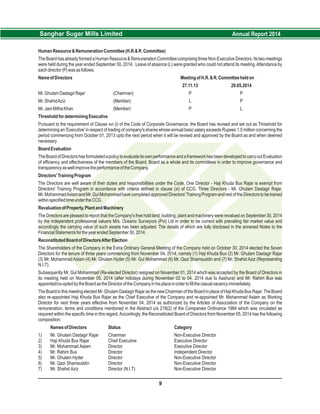
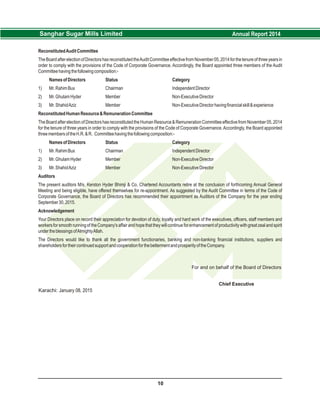
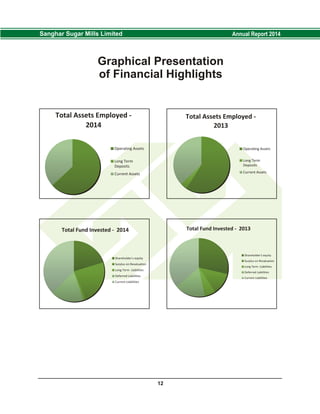
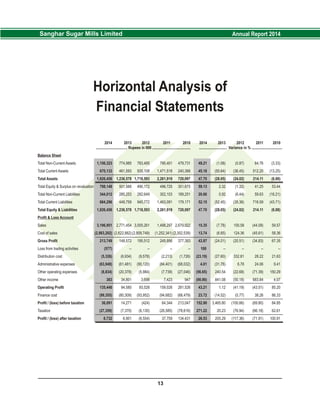
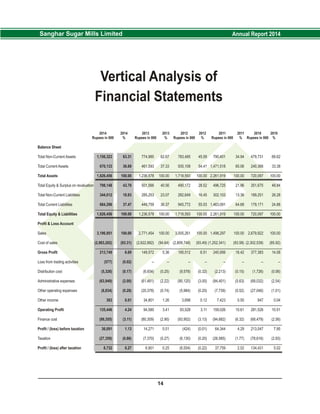


Stakeholders Information
Stock Exchange Listing
Sanghar Sugar Mills Limited is a listed Company and its shares are traded on Karachi and Lahore Stock
Exchanges. The Company’s shares are quoted in leading newspapers under Sugar Sector.
Communication with Users of Financial Statements
Communication with users of financial statements is given high priority. Annual, half yearly and quarterly
reports are distributed to the shareholders and provided to other users within the time specified in the
Companies Ordinance, 1984. There is also an opportunity for individual shareholder to participate at the
annual general meetings to ensure high level of accountability.
Shareholders Information
Enquiries concerning verification of transfer deeds, transfer of share certificates, change of address etc.,
should be directed to the Shares Registrar, Hameed Majeed Associates (Pvt) Ltd. Karachi Chambers,
Hasrat Mohani Road, Karachi Phone No: 021- 32424826, Fax No: 021-32424835.
Public Information
Financial analysts, stock brokers, interested investors and financial media desiring information about
Sanghar Sugar Mills Limited and its products should contact the Executive Director/Chief Financial Officer at
Registered Office, Karachi Phone: 021-35371441 to 43 (03 lines), Fax: 021-35371444.
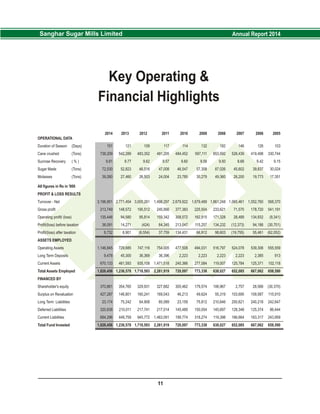
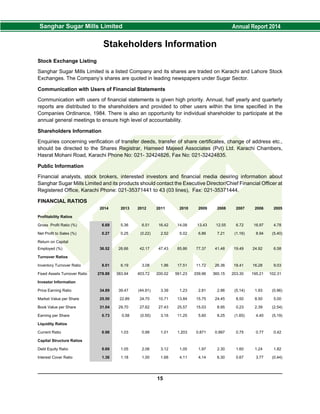
FINANCIAL RATIOS
2014 2013 2012 2011 2010 2009 2008 2007 2006 2005
Profitability Ratios
Gross Profit Ratio (%) 6.69 5.36 6.51 16.42 14.08 13.43 12.55 6.72 16.97 4.78
Net Profit to Sales (%) 0.27 0.25 (0.22) 2.52 5.02 6.86 7.21 (1.16) 8.94 (5.40)
Return on Capital
Employed (%) 36.52 26.66 42.17 47.43 85.86 77.37 41.48 19.49 24.92 6.58
Turnover Ratios
Inventory Turnover Ratio 8.01 6.19 3.08 1.96 17.51 11.72 26.36 18.41 16.28 9.03
Fixed Assets Turnover Ratio 278.88 383.94 403.72 200.02 561.23 339.96 360.15 203.30 195.21 102.31
Investor Information
Price Earning Ratio 34.89 39.47 (44.91) 3.39 1.23 2.81 2.96 (5.14) 1.93 (0.96)
Market Value per Share 25.50 22.89 24.70 10.71 13.84 15.75 24.45 8.50 8.50 5.00
Book Value per Share 31.04 29.70 27.62 27.43 25.57 15.03 8.95 0.23 2.39 (2.54)
Earning per Share 0.73 0.58 (0.55) 3.16 11.25 5.60 8.25 (1.65) 4.40 (5.19)
Liquidity Ratios
Current Ratio 0.98 1.03 0.99 1.01 1.203 0.871 0.997 0.75 0.77 0.42
Capital Structure Ratios
Debt Equity Ratio 0.69 1.05 2.06 3.12 1.05 1.97 2.30 1.60 1.24 1.82
Interest Cover Ratio 1.36 1.18 1.00 1.68 4.11 4.14 6.30 0.67 3.77 (0.44)
15
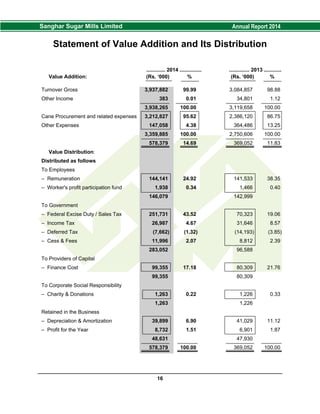
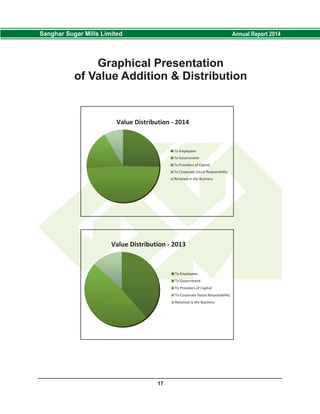
Statement of Value Addition and Its Distribution
............. 2014 ............... .............. 2013 ............
Value Addition: (Rs. ‘000) % (Rs. ‘000) %
Turnover Gross 3,937,882 99.99 3,084,857 98.88
Other Income 383 0.01 34,801 1.12
3,938,265 100.00 3,119,658 100.00
Cane Procurement and related expenses 3,212,827 95.62 2,386,120 86.75
Other Expenses 147,058 4.38 364,486 13.25
3,359,885 100.00 2,750,606 100.00
578,379 14.69 369,052 11.83
Value Distribution:
Distributed as follows
To Employees
– Remuneration 144,141 24.92 141,533 38.35
– Worker's profit participation fund 1,938 0.34 1,466 0.40
146,079 142,999
To Government
– Federal Excise Duty / Sales Tax 251,731 43.52 70,323 19.06
– Income Tax 26,987 4.67 31,646 8.57
– Deferred Tax (7,662) (1.32) (14,193) (3.85)
– Cess & Fees 11,996 2.07 8,812 2.39
283,052 96,588
To Providers of Capital
– Finance Cost 99,355 17.18 80,309 21.76
99,355 80,309
To Corporate Social Responsibility
– Charity & Donations 1,263 0.22 1,226 0.33
1,263 1,226
Retained in the Business
– Depreciation & Amortization 39,899 6.90 41,029 11.12
– Profit for the Year 8,732 1.51 6,901 1.87
48,631 47,930
578,379 100.00 369,052 100.00
16
Statement of Compliance with the Code of
Corporate Governance
Name of company: SANGHAR SUGAR MILLS LIMITED
Year ended: September 30, 2014
This statement is being presented to comply with the Code of Corporate Governance (CCG) contained
in listing regulations of Karachi and Lahore Stock Exchanges Limited for the purpose of establishing a
framework of good governance, whereby a listed company is managed in compliance with the best practices
of corporate governance.
The Company has applied the principles contained in the CCG in the following manner:
1. The Company encourages representation of independent, non-executive directors and directors
representing minority interests on its Board of Directors. At present the Board includes:
Category Name
(i) Independent Directors —
(ii) Executive Directors 1. Haji Khuda Bux Rajar
2. Mr. Mohammad Aslam
3. Mr. Gul Mohammad
(iii) Non-Executive Directors 1. Mr. Ghulam Dastagir Rajar
2. Mr. Qazi Shamsuddin
3. Mr. Jam Mitha Khan
4. Mr. Shahid Aziz
5. Mr. Irshad Husain
The condition of clause i(b) of the CCG in relation to independent director, have been complied with
effect from Election of Board of Directors i.e. November 03, 2014 as provided under proviso of the
clause (vi) of the CCG and new Board has been reconstituted which includes an Independent
Director.
2. The directors have confirmed that none of them is serving as a director on more than seven listed
companies, including this Company.
3. All the resident directors of the Company are registered as taxpayers and none of them has defaulted
in payment of any loan to a banking company, a DFI or an NBFI. None of the directors of the Company
is a member of the stock exchange.
4. No casual vacancy occurred on the Board during the current year.
5. The Company has prepared a “Code of Conduct” and has ensured that appropriate steps have been
taken to disseminate it throughout the Company along with its supporting policies and procedures.
6. The Board has developed a vision/mission statement, overall corporate strategy and significant
policies of the Company. A complete record of particulars of significant policies along with the dates
on which they were approved or amended has been maintained.
7. All the powers of the Board have been duly exercised and decisions on material transactions,
including appointment and determination of remuneration and terms and conditions of employment
of the Chief Executive, other executive and non-executive directors, have been taken by the Board.
8. The meetings of the Board were presided over by the Chairman and, in his absence, by a Director
elected by the Board for this purpose and the Board met at least once in every quarter. Written notices
of the Board meetings, along with agenda and working papers, were circulated at least seven days
before the meetings. The minutes of the meetings were appropriately recorded and circulated. The
Chairman Audit Committee attended the preceding Annual General Meeting of the Company.
19
9. The Board is well aware of their duties and responsibilities under the Code. One Director - Haji Khuda
Bux Rajar is exempt from Directors’ Training Program in accordance with criteria defined in clause (xi)
of CCG. Three Directors - Mr. Ghulam Dastagir Rajar, Mr. Mohammad Aslam and Mr. Gul
Mohammad have completed approved Directors’ Training Program and rest of the Directors to be
trained within specified time under the CCG.
10. During the year, the Board has approved appointment of Chief Financial Officer including his
remuneration, terms and conditions of employment. The Company Secretary and Head of Internal
Audit continued their services. Further their appointment including remuneration, terms and
conditions of employment have been approved by the Board.
11. The Directors’ Report for this year has been prepared in compliance with the requirements of the
CCG and fully describes the salient matters required to be disclosed.
12. The Financial Statements of the Company were duly endorsed by CEO and CFO before approval of
the Board.
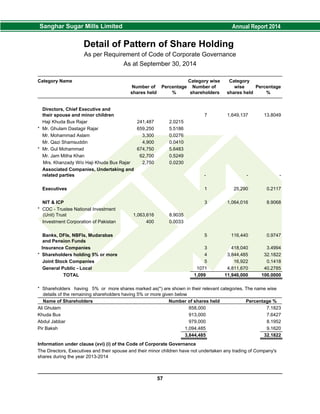
13. The Directors, Chief Executive and Executives do not hold any interest in the shares of the Company
other than that disclosed in the pattern of shareholding.
14. The Company has complied with all the corporate and financial reporting requirements of the CCG.
15. The Board has formed the Audit Committee. It comprises three members who are non-executive
directors including the Chairman of the Committee. The condition of independent director as the
Chairman of the Committee under clause 1(b) of the CCG have been complied with by inducting an
independent director as the member of Audit Committee with effect from election of Directors i.e.
November 03, 2014, as provided under proviso of clause (vi) of the CCG.
16. The meetings of the Audit Committee were held at least once every quarter prior to approval of
interim and final results of the Company and as required by the CCG. The terms of reference of the
Committee have been formed and advised to the Committee for compliance.
17. The Board has formed a Human Resource & Remuneration Committee. It comprises three members
who are non-executive directors including the Chairman of the Committee. However, after election of
Directors, it was reconstituted on November 05, 2014 and comprises three members, of whom two
are non-executive directors and the Chairman of the Committee is an independent director.
18. The Board has set up an effective internal audit function.
19. The statutory auditors of the Company have confirmed that they have been given a satisfactory rating
under the quality control review program of Institute of Chartered Accountants of Pakistan (the ICAP),
that they or any of the partners of the firm, their spouses and minor children do not hold shares of the
Company and that the firm and all its partners are in compliance with International Federation of
Accountants (IFAC) guidelines on code of ethics as adopted by the ICAP.
20. The statutory auditors or the persons associated with them have not been appointed to provide other
services except in accordance with the listing regulations and the auditors have confirmed that they
have observed IFAC guidelines in this regard.
21. The ‘closed period’, prior to the announcement of interim/final results, and business decisions,
which may materially affect the market price of Company’s securities, was determined and
intimated to directors, employees and stock exchange(s).
22. Material/price sensitive information has been disseminated among all market participants at once
through stock exchange(s).
23. We confirm that all other material principles enshrined in the CCG have been complied with.
For and On Behalf of Board of Directors
KARACHI: January 08, 2015 Chief Executive Officer
20
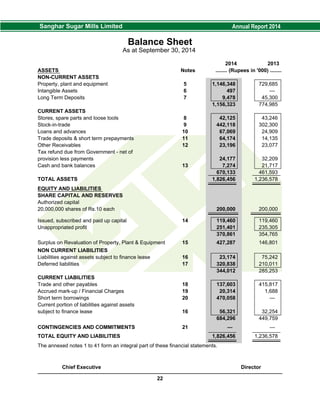
Balance Sheet
As at September 30, 2014
2014 2013
ASSETS Notes ........ (Rupees in '000) ........
NON-CURRENT ASSETS
Property, plant and equipment 5 1,146,348 729,685
Intangible Assets 6 497 —
Long Term Deposits 7 9,478 45,300
1,156,323 774,985
CURRENT ASSETS
Stores, spare parts and loose tools 8 42,125 43,246
Stock-in-trade 9 442,118 302,300
Loans and advances 10 67,069 24,909
Trade deposits & short term prepayments 11 64,174 14,135
Other Receivables 12 23,196 23,077
Tax refund due from Government - net of
provision less payments 24,177 32,209
Cash and bank balances 13 7,274 21,717
670,133 461,593
TOTAL ASSETS 1,826,456 1,236,578
EQUITY AND LIABILITIES
SHARE CAPITAL AND RESERVES
Authorized capital
20,000,000 shares of Rs.10 each 200,000 200,000
Issued, subscribed and paid up capital 14 119,460 119,460
Unappropriated profit 251,401 235,305
370,861 354,765
Surplus on Revaluation of Property, Plant & Equipment 15 427,287 146,801
NON CURRENT LIABILITIES
Liabilities against assets subject to finance lease 16 23,174 75,242
Deferred liabilities 17 320,838 210,011
344,012 285,253
CURRENT LIABILITIES
Trade and other payables 18 137,603 415,817
Accrued mark-up / Financial Charges 19 20,314 1,688
Short term borrowings 20 470,058 —
Current portion of liabilities against assets
subject to finance lease 16 56,321 32,254
684,296 449,759
CONTINGENCIES AND COMMITMENTS 21 — —
TOTAL EQUITY AND LIABILITIES 1,826,456 1,236,578
The annexed notes 1 to 41 form an integral part of these financial statements.
Chief Executive Director
22
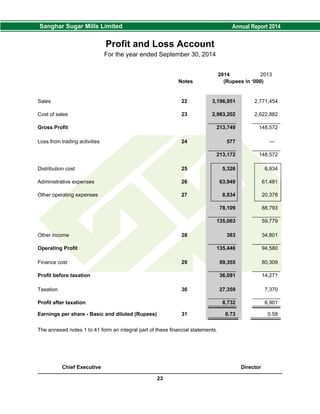
Profit and Loss Account
For the year ended September 30, 2014
2014 2013
Notes (Rupees in ‘000)
Sales 22 3,196,951 2,771,454
Cost of sales 23 2,983,202 2,622,882
Gross Profit 213,749 148,572
Loss from trading activities 24 577 —
213,172 148,572
Distribution cost 25 5,326 6,934
Administrative expenses 26 63,949 61,481
Other operating expenses 27 8,834 20,378
78,109 88,793
135,063 59,779
Other income 28 383 34,801
Operating Profit 135,446 94,580
Finance cost 29 99,355 80,309
Profit before taxation 36,091 14,271
Taxation 30 27,359 7,370
Profit after taxation 8,732 6,901
Earnings per share - Basic and diluted (Rupees) 31 0.73 0.58
The annexed notes 1 to 41 form an integral part of these financial statements.
Chief Executive Director
23
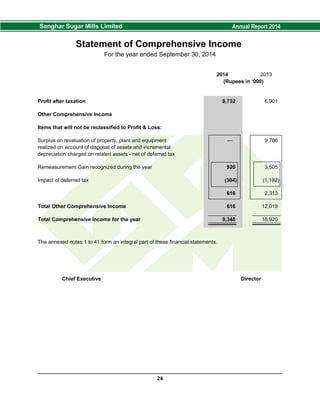
Statement of Comprehensive Income
For the year ended September 30, 2014
2014 2013
(Rupees in ‘000)
Profit after taxation 8,732 6,901
Other Comprehensive Income
Items that will not be reclassified to Profit & Loss:
Surplus on revaluation of property, plant and equipment — 9,706
realized on account of disposal of assets and incremental
depreciation charged on related assets - net of deferred tax
Remeasurement Gain recognized during the year 920 3,505
Impact of deferred tax (304) (1,192)
616 2,313
Total Other Comprehensive Income 616 12,019
Total Comprehensive Income for the year 9,348 18,920
The annexed notes 1 to 41 form an integral part of these financial statements.
Chief Executive Director
24
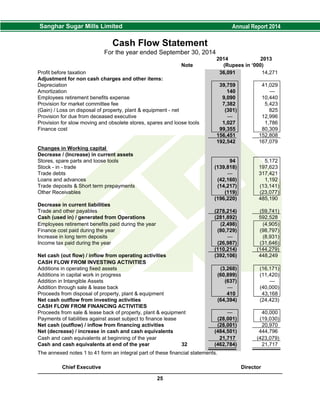
Cash Flow Statement
For the year ended September 30, 2014
2014 2013
Note (Rupees in ‘000)
Profit before taxation 36,091 14,271
Adjustment for non cash charges and other items:
Depreciation 39,759 41,029
Amortization 140 —
Employees retirement benefits expense 9,090 10,440
Provision for market committee fee 7,382 5,423
(Gain) / Loss on disposal of property, plant & equipment - net (301) 825
Provision for due from deceased executive — 12,996
Provision for slow moving and obsolete stores, spares and loose tools 1,027 1,786
Finance cost 99,355 80,309
156,451 152,808
192,542 167,079
Changes in Working capital
Decrease / (Increase) in current assets
Stores, spare parts and loose tools 94 5,172
Stock - in - trade (139,818) 197,623
Trade debts — 317,421
Loans and advances (42,160) 1,192
Trade deposits & Short term prepayments (14,217) (13,141)
Other Receivables (119) (23,077)
(196,220) 485,190
Decrease in current liabilities
Trade and other payables (278,214) (59,741)
Cash (used in) / generated from Operations (281,892) 592,528
Employees retirement benefits paid during the year (2,498) (4,905)
Finance cost paid during the year (80,729) (98,797)
Increase in long term deposits — (8,931)
Income tax paid during the year (26,987) (31,646)
(110,214) (144,279)
Net cash (out flow) / inflow from operating activities (392,106) 448,249
CASH FLOW FROM INVESTING ACTIVITIES
Additions in operating fixed assets (3,268) (16,171)
Additions in capital work in progress (60,899) (11,420)
Addition in Intangible Assets (637) —
Addition through sale & lease back — (40,000)
Proceeds from disposal of property, plant & equipment 410 43,168
Net cash outflow from investing activities (64,394) (24,423)
CASH FLOW FROM FINANCING ACTIVITIES
Proceeds from sale & lease back of property, plant & equipment — 40,000
Payments of liabilities against asset subject to finance lease (28,001) (19,030)
Net cash (outflow) / inflow from financing activities (28,001) 20,970
Net (decrease) / increase in cash and cash equivalents (484,501) 444,796
Cash and cash equivalents at beginning of the year 21,717 (423,079)
Cash and cash equivalents at end of the year 32 (462,784) 21,717
The annexed notes 1 to 41 form an integral part of these financial statements.
Chief Executive Director
25
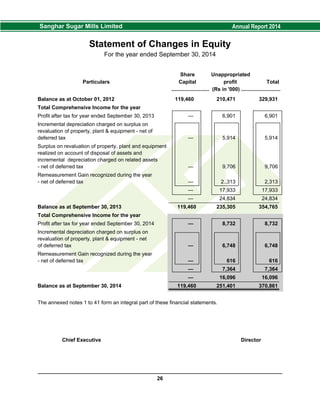
Statement of Changes in Equity
For the year ended September 30, 2014
Share Unappropriated
Particulars Capital profit Total
.......................... (Rs in '000) ...........................
Balance as at October 01, 2012 119,460 210,471 329,931
Total Comprehensive Income for the year
Profit after tax for year ended September 30, 2013 — 6,901 6,901
Incremental depreciation charged on surplus on
revaluation of property, plant & equipment - net of
deferred tax — 5,914 5,914
Surplus on revaluation of property, plant and equipment
realized on account of disposal of assets and
incremental depreciation charged on related assets
- net of deferred tax — 9,706 9,706
Remeasurement Gain recognized during the year
- net of deferred tax — 2.,313 2,313
— 17,933 17,933
— 24,834 24,834
Balance as at September 30, 2013 119,460 235,305 354,765
Total Comprehensive Income for the year
Profit after tax for year ended September 30, 2014 — 8,732 8,732
Incremental depreciation charged on surplus on
revaluation of property, plant & equipment - net
of deferred tax — 6,748 6,748
Remeasurement Gain recognized during the year
- net of deferred tax — 616 616
— 7,364 7,364
— 16,096 16,096
Balance as at September 30, 2014 119,460 251,401 370,861
The annexed notes 1 to 41 form an integral part of these financial statements.
Chief Executive Director
26
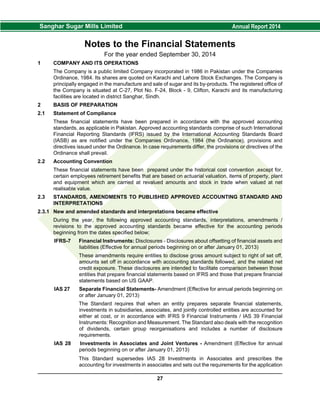
Notes to the Financial Statements
For the year ended September 30, 2014
1 COMPANY AND ITS OPERATIONS
The Company is a public limited Company incorporated in 1986 in Pakistan under the Companies
Ordinance, 1984. Its shares are quoted on Karachi and Lahore Stock Exchanges. The Company is
principally engaged in the manufacture and sale of sugar and its by-products. The registered office of
the Company is situated at C-27, Plot No. F-24, Block - 9, Clifton, Karachi and its manufacturing
facilities are located in district Sanghar, Sindh.
2 BASIS OF PREPARATION
2.1 Statement of Compliance
These financial statements have been prepared in accordance with the approved accounting
standards, as applicable in Pakistan. Approved accounting standards comprise of such International
Financial Reporting Standards (IFRS) issued by the International Accounting Standards Board
(IASB) as are notified under the Companies Ordinance, 1984 (the Ordinance), provisions and
directives issued under the Ordinance. In case requirements differ, the provisions or directives of the
Ordinance shall prevail.
2.2 Accounting Convention
These financial statements have been prepared under the historical cost convention ,except for,
certain employees retirement benefits that are based on actuarial valuation, items of property, plant
and equipment which are carried at revalued amounts and stock in trade when valued at net
realisable value.
2.3 STANDARDS, AMENDMENTS TO PUBLISHED APPROVED ACCOUNTING STANDARD AND
INTERPRETATIONS
2.3.1 New and amended standards and interpretations became effective
During the year, the following approved accounting standards, interpretations, amendments /
revisions to the approved accounting standards became effective for the accounting periods
beginning from the dates specified below;
IFRS-7 Financial Instruments: Disclosures - Disclosures about offsetting of financial assets and
liabilities (Effective for annual periods beginning on or after January 01, 2013)
These amendments require entities to disclose gross amount subject to right of set off,
amounts set off in accordance with accounting standards followed, and the related net
credit exposure. These disclosures are intended to facilitate comparison between those
entities that prepare financial statements based on IFRS and those that prepare financial
statements based on US GAAP.
IAS 27 Separate Financial Statements- Amendment (Effective for annual periods beginning on
or after January 01, 2013)
The Standard requires that when an entity prepares separate financial statements,
investments in subsidiaries, associates, and jointly controlled entities are accounted for
either at cost, or in accordance with IFRS 9 Financial Instruments / IAS 39 Financial
Instruments: Recognition and Measurement. The Standard also deals with the recognition
of dividends, certain group reorganisations and includes a number of disclosure
requirements.
IAS 28 Investments in Associates and Joint Ventures - Amendment (Effective for annual
periods beginning on or after January 01, 2013)
This Standard supersedes IAS 28 Investments in Associates and prescribes the
accounting for investments in associates and sets out the requirements for the application
27
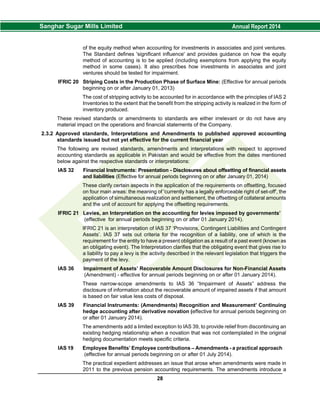
of the equity method when accounting for investments in associates and joint ventures.
The Standard defines 'significant influence' and provides guidance on how the equity
method of accounting is to be applied (including exemptions from applying the equity
method in some cases). It also prescribes how investments in associates and joint
ventures should be tested for impairment.
IFRIC 20 Striping Costs in the Production Phase of Surface Mine: (Effective for annual periods
beginning on or after January 01, 2013)
The cost of stripping activity to be accounted for in accordance with the principles of IAS 2
Inventories to the extent that the benefit from the stripping activity is realized in the form of
inventory produced.
These revised standards or amendments to standards are either irrelevant or do not have any
material impact on the operations and financial statements of the Company.
2.3.2 Approved standards, Interpretations and Amendments to published approved accounting
standards issued but not yet effective for the current financial year
The following are revised standards, amendments and interpretations with respect to approved
accounting standards as applicable in Pakistan and would be effective from the dates mentioned
below against the respective standards or interpretations:
IAS 32 Financial Instruments: Presentation - Disclosures about offsetting of financial assets
and liabilities (Effective for annual periods beginning on or after January 01, 2014)
These clarify certain aspects in the application of the requirements on offsetting, focused
on four main areas: the meaning of 'currently has a legally enforceable right of set-off', the
application of simultaneous realization and settlement, the offsetting of collateral amounts
and the unit of account for applying the offsetting requirements.
IFRIC 21 Levies, an Interpretation on the accounting for levies imposed by governments’
(effective for annual periods beginning on or after 01 January 2014).
IFRIC 21 is an interpretation of IAS 37 ‘Provisions, Contingent Liabilities and Contingent
Assets’. IAS 37 sets out criteria for the recognition of a liability, one of which is the
requirement for the entity to have a present obligation as a result of a past event (known as
an obligating event). The Interpretation clarifies that the obligating event that gives rise to
a liability to pay a levy is the activity described in the relevant legislation that triggers the
payment of the levy.
IAS 36 Impairment of Assets’ Recoverable Amount Disclosures for Non-Financial Assets
(Amendment) - effective for annual periods beginning on or after 01 January 2014).
These narrow-scope amendments to IAS 36 “Impairment of Assets” address the
disclosure of information about the recoverable amount of impaired assets if that amount
is based on fair value less costs of disposal.
IAS 39 Financial Instruments: (Amendments) Recognition and Measurement’ Continuing
hedge accounting after derivative novation (effective for annual periods beginning on
or after 01 January 2014).
The amendments add a limited exception to IAS 39, to provide relief from discontinuing an
existing hedging relationship when a novation that was not contemplated in the original
hedging documentation meets specific criteria.
IAS 19 Employee Benefits’ Employee contributions – Amendments - a practical approach
(effective for annual periods beginning on or after 01 July 2014).
The practical expedient addresses an issue that arose when amendments were made in
2011 to the previous pension accounting requirements. The amendments introduce a
28
relief that will reduce the complexity and burden of accounting for certain contributions
from employees or third parties. The amendments are relevant only to defined benefit
plans that involve contributions from employees or third parties meeting certain criteria.
IAS 38 & Amendments to IAS 38 ‘Intangible Assets’ and IAS 16 ‘Property, Plant and
IAS-16 Equipment’ (effective for annual periods beginning on or after 01 January 2016)
This amendment introduces severe restrictions on the use of revenue-based amortization
for intangible assets and explicitly state that revenue-based methods of depreciation
cannot be used for property, plant and equipment. The rebuttable presumption that the
use of revenue-based amortization methods for intangible assets is inappropriate can be
overcome only when revenue and the consumption of the economic benefits of the
intangible asset are ‘highly correlated’, or when the intangible asset is expressed as a
measure of revenue.
IFRS 10 Consolidated Financial Statements
This is a new standard that replaces the consolidation requirements in SIC - 12
Consolidation: Special Purpose Entities and IAS 27 - Consolidated and Separate
Financial Statements. The proposed standard builds on existing principles by identifying
the concept of control as the determining factor in whether an entity should be included
within the consolidated financial statements of the parent company and provides
additional guidance to assist in the determination of control where this is difficult to assess.
IFRS 11 Joint Arrangements
This is a new standard that deals with the accounting for joint arrangements and focuses
on the rights and obligations of the arrangements, rather than its legal form. Standard
requires a single method for accounting for interests in jointly controlled entities.
IFRS 12 Disclosure of Interest in Other Entities
This is a new and comprehensive standard on disclosure requirements for all forms of
interests in other entities including joint arrangements, associates, special purpose
vehicles and other off balance sheet vehicles.
IFRS 13 Fair Value Measurement
This standard applies to IFRSs that require or permit fair value measurement or
disclosures and provides a single IFRS framework for measuring fair value and requires
disclosures about fair value measurement. The standard defines fair value on the basis of
an 'exit-price' notion and uses 'a fair value hierarchy', which results in market-based,
rather than entity-specific measurement.
The above amendments, revisions and interpretations are either irrelevant to the company or their
adoption will not have material impact on the Company's financial statements except for additional
disclosures.
2.3.3 Annual Improvements 2010-2012 and 2011-2013 cycles (most amendments will apply
prospectively for annual period beginning on or after 01 July 2014). The new cycle of improvements
contain amendments to the following standards:
IFRS - 2 Share-based Payment
IFRS 2 has been amended to clarify the definition of ‘vesting condition’ by separately
defining ‘performance condition’ and ‘service condition’. The amendment also clarifies
both how to distinguish between a market condition and a non-market performance
condition and the basis on which a performance condition can be differentiated from a
vesting condition.
29
IFRS - 3 Business Combinations
These amendments clarify the classification and measurement of contingent
consideration in a business combination. Further IFRS 3 has also been amended to clarify
that the standard does not apply to the accounting for the formation of all types of joint
arrangements including joint operations in the financial statements of the joint
arrangement themselves.
IFRS - 8 IFRS 8 ‘Operating Segments
IFRS 8 has been amended to explicitly require the disclosure of judgments made by
management in applying the aggregation criteria. In addition, this amendment clarifies
that a reconciliation of the total of the reportable segment’s assets to the entity assets is
required only if this information is regularly provided to the entity’s chief operating decision
maker. This change aligns the disclosure requirements with those for segment liabilities.
IAS 16 & Amendments to IAS 16 ‘Property, plant and equipment’; and IAS 38 ‘Intangible
Assets’
The amendments clarify the requirements of the revaluation model in IAS 16 and IAS 38,
recognizing that the restatement of accumulated depreciation (amortization) is not always
proportionate to the change in the gross carrying amount of the asset.
IAS - 24 Related Party Disclosure
The definition of related party is extended to include a management entity that provides
key management personnel services to the reporting entity, either directly or through a
group entity.
IAS - 40 Investment Property
IAS 40 has been amended to clarify that an entity should: assess whether an acquired
property is an investment property under IAS 40 and perform a separate assessment
under IFRS 3 to determine whether the acquisition of the investment property constitutes
a business combination.
These amendments / clarification are not likely to have any material impact on the company's
financial statements.
2.3.4 New standards not yet adopted by SECP
Following new standards issued by IASB but have not yet been notified by the Securities and
Exchange Commission of Pakistan.
IFRS 1 First-time Adoption of International Financial Reporting Standards (Effective for
annual periods beginning on or after July 01, 2009)
IFRS 1 First-time Adoption of International Financial Reporting Standards sets out the
procedures that an entity must follow when it adopts IFRSs for the first time as the basis for
preparing its general purpose financial statements. The IFRS grants limited exemptions
from the general requirement to comply with each IFRS effective at the end of its first IFRS
reporting period.
IFRS 14 Regulatory Deferral Accounts (Effective for annual periods beginning on or after
Jan 01, 2016)
IFRS 14 Regulatory Deferral Accounts permits an entity which is a first-time adopter of
International Financial Reporting Standards to continue to account, with some limited
changes, for 'regulatory deferral account balances' in accordance with its previous GAAP,
both on initial adoption of IFRS and in subsequent financial statements. Regulatory
deferral account balances, and movements in them, are presented separately in the
statement of financial position and statement of profit or loss and other comprehensive
income, and specific disclosures are required.
30
IAS 38
IFRS 15 Revenue from Contracts with Customers (Effective for annual periods beginning on or
after Jan 01, 2017)
IFRS 15 specifies how and when an IFRS reporter will recognise revenue as well as
requiring such entities to provide users of financial statements with more informative,
relevant disclosures. The standard provides a single, principles based five-step model to
be applied to all contracts with customers.
These new standards are either irrelevant or will not have any material effect on the Company’s
financial statements.
3 Critical accounting estimates, judgments and assumptions
The preparation of these financial statements in conformity with the approved accounting standards
requires management to make judgments, estimates and assumptions that affects the application of
policies and reported amounts of assets and liabilities, income and expenses. The estimates and
associated assumptions are based on historical experience and various other factors that are
believed to be reasonable under that circumstances, the results of which form the basis of making
judgment about carrying value of assets and liabilities that are not readily apparent from other
sources. However, uncertainty about these assumptions and estimates could result in outcome that
require material adjustment to the carrying amount of the asset or liability affected in future periods.
The estimates and underlying assumptions are reviewed on an ongoing basis. Revision to accounting
estimates are recognized in the period in which estimates are revised if the revision affects only that
period, or in the period of the revision and any future period affected.
Judgments made by the management in the application of approved accounting standards that have
significant effect on the financial statements and estimates with a significant risk of material
adjustment in the next year are discussed in the ensuing paragraphs.
In the process of applying the accounting policies, management has made the following estimates,
judgments and assumptions which are significant to the financial statements:
— Taxation :
In making the estimates of the income tax liabilities, the management considers current income
tax law and decisions of appellate authorities. Deferred tax estimate is made considering future
applicable tax rate.
— Defined Benefit Plan
Certain actuarial assumptions have been adopted as disclosed in these financial statements
for valuation of present value of defined benefit obligation. Any changes in these assumptions
in future years might effect gains and losses in those years. The actuarial valuation involves
making assumptions about discount rates, future salary increases and mortality rates.
— Property, Plant and Equipment
The Company's management determines the estimated useful lives and related depreciation
charge for its property, plant and equipment. The Company reviews the value of assets for
possible impairment on financial year end. Any change in the estimate in the future years might
effect the carrying amounts of the respective items of property, plant and equipment with a
corresponding affect on the depreciation charge and impairment.
— Stock in trade
The Company reviews the net realizable value of stock in trade to assess any diminution in the
respective carrying values. Net realizable value is determined with reference to the estimated
selling price in the ordinary course of business less the estimated cost necessary to make the
sale.
31
— Contingencies
The assessment of the contingencies inherently involves the exercise of significant judgemen
as the outcome of the future events cannot be predicted with certainty. The Company, based
on the availability of the latest information, estimates the value of contingent assets and
liabilities which may differ on the occurance/non-occurance of the uncertain future event(s).
— Provision against trade debts, deposits, advances and other receivables
The Company reviews the recoverability of its trade debts, deposits, advances and other
receivables to assess amount of doubt full & bad debts and provision required there against.
— Slow Moving and Stores Obsolescence
In making estimates of quantum of slow moving and obsolescence, the aging analysis, current
condition of various items component of realization and expected use in future are considered.
— Impairment
The Company reviews carrying amount of assets annually to determine whether there is any
indication of impairment. If any such indication exists, the assets recoverable amount is
estimated and impairment losses are recognized in the profit and loss account.
4 SIGNIFICANT ACCOUNTING POILICIES
4.1 Taxation
4.1.1 Current
The Company falls under the final tax regime under section 154 and 169 of the Income Tax
Ordinance, 2001 to the extent of export sales. For sales other than export sales, the charge for current
taxation is based on taxable income at the current rate of taxation after taking into account applicable
tax credits, rebates and exemptions available, if any, or minimum tax under section 113 & 113 (c) of
the Income Tax Ordinance, 2001, whichever is higher. The charge for current tax also includes
adjustments, where considered necessary, to provision for taxation made in previous years arising
from assessments framed during the year for such years.
4.1.2 Deferred
Deferred tax is recognized using the balance sheet liability method in respect of all temporary
differences arising between the carrying amount of assets and liabilities in the financial statements
and their tax base and is recognized on the basis of the expected manner of the realization or
settlement of the carrying amount of assets and liabilities using the tax rates enacted or substantially
enacted at the balance sheet date. Deferred tax asset is recognized to the extent that it is probable
that the future taxable profit will be available against which the deductible temporary differences can
be utilized. Deferred tax asset is reduced to the extent that is no longer probable that the related tax
benefit will be realized.
4.1.3 Sales tax and Federal Excise Duty (FED)
Revenues, expenses and assets are recognized net off amount of sales tax/FED except:
— Where amount incurred on a purchase of asset or service is not recoverable from the taxation
authorities, in which case the tax / duty is recognized as part of the cost of the acquisition of the
assets or as part of the expense item as applicable; and
— Receivables or payables that are stated with the amount of Sales tax / FED included.
The net amount of sales tax and FED recoverable from, or payable to, the taxation authority is
included as part of receivables or payables in the balance sheet.
32
4.2 Employees Retirement benefits:
4.2.1 Defined benefit plan
The Company operates an unfunded gratuity scheme for all employees eligible to the scheme with
qualifying service period. Provision is made annually to cover the obligation on the basis of actuarial
valuation carried out using Projected Unit Credit Method, and is charged to profit and loss account,
related details of which are given in the respective note to the financial statements. Actuarial gains or
losses are recognized in full as and when arise and are charged to other comprehensive income.
4.3 Property, plant and equipment
4.3.1 Owned assets
These are stated at cost less accumulated depreciation and impairment, if any, except for free hold
land, buildings and plant and machinery which are stated at revalued amounts.
Depreciation is charged, on a systematic basis over the economic useful life of the asset, on reducing
balance method, which reflects the pattern in which the assets economic benefits are consumed by
the Company, at the rates specified in respective note. Depreciation on additions is charged from the
month in which the assets are put to use while no depreciation is charged in the month in which the
assets are disposed off.
The Surplus on revaluation of Property, Plant and Equipment is recognized in accordance with
section 235 of the Companies Ordinance, 1984. The surplus on revaluation of Property, Plant and
Equipment to the extent of incremental depreciation net of deferred tax thereon charged on the
related assets is transferred by the Company to statement of changes in equity under unappropriated
profit. In case of disposal of revalued Property, Plant and Equipment, any revaluation surplus is
directly transferred to retained earning through statement of Other Comprehensive Income. The
assets' residual values and useful lives are reviewed, and adjusted if appropriate, at each balance
sheet date.
Maintenance and normal repairs are charged to income as and when incurred. Major renewals and
improvements are capitalized and the assets so replaced, if any, are retired.
Profit or loss on disposal of property, plant and equipment, if any, is taken to profit and loss account.
4.3.2 Assets subject to finance lease
Assets held under finance lease are stated at cost less accumulated depreciation and accumulated
impairment losses, if any. These are accounted for by recording the assets at the lower of present
value of minimum lease payments under the lease agreements and the fair value of assets acquired.
Depreciation is charged to the profit and loss account using the same basis as for owned assets.
4.3.3 Capital work-in-progress
Capital work-in-progress is stated at cost accumulated up to the balance sheet date less impairment
if any and represents expenditure incurred on property, plant and equipment in the course of
construction / installation / implementation / development. These expenditures are transferred to
relevant category of property, plant and equipment as and when the assets becomes available for
use.
4.4 Intangible Assets
Computer software are stated at cost less accumulated amortisation. Software cost are only
capitalized when it is probable that future economic benefits attributable to the software will flow to the
Company and the same is amortised applying the straight line method at the rate stated in respective
note to these financial statements.
33
4.5 Stores, spare parts and loose tools
These are valued at cost calculated on moving average basis less provision for obsolescence, and
slow moving items, except for the items in transit, which are valued at cost accumulated upto the
balance sheet date.
4.6 Stock in trade
Stock of sugar is valued at lower of the weighted average cost and net realizable value. By products
i.e. Molasses and Baggasse are valued at net realizable value (NRV). Cost in relation to work in
process and finished goods consists of material cost, proportionate manufacturing overheads.
Net realizable value signifies the estimated selling price in the ordinary course of business less the
estimated costs of completion and the estimated cost necessary to be incurred to make the sale.
4.7 Trade debts
Trade debts are carried at original invoice amount less provision if any. Provision for doubtful debts is
based on management's assessment of customers and their credit worthiness. Bad debts are written
off when there is no realistic prospect of recovery.
4.8 Trade and other payables
Liabilities for trade and other payables are carried at cost which is the fair value of the consideration
to be paid in the future for goods and services received.
4.9 Finance Lease
Leases are classified as finance leases whenever the terms of the lease transfer substantially all the
risks and rewards of ownership to the lessee. All other leases are classified as operating lease.
Assets held under finance lease are recognized as items of property, plant & equipment of the
company at their fair value at the inception of the lease or, if lower, at the present value of the
minimum lease payments. The corresponding liability to the lessor is included in the balance sheet as
“Liabilities against asset subject to finance lease”. Lease payments are apportioned between finance
charges and reduction of the liabilities against assets subject to finance lease so as to achieve a
constant rate of interest on the remaining balance of the liability. Finance charges are charged to
profit & loss account unless they are directly attributable to qualifying assets in which case they are
capitalized in accordance with the company's general policy on borrowing cost.
4.10 Ijarah Lease contracts
Leases, where a significant portion of the risk and rewards of ownership are retained by the lessor,
are classified as Ijarah lease. Payments made under the Ijarah lease agreements are charged to
profit & loss account on a straight line basis over the lease term.
4.11 Revenue recognition
Revenue is recognized to the extent that it is probable that the future economic benefits will flow to the
Company and the revenue can be measured reliably. Revenue is measured at the fair value of the
consideration received or receivable, excluding discounts, rebates and government levies.
Revenue from sale of goods is recognized when the significant risks and rewards of ownership of the
goods have passed to the buyer, usually on dispatch of the goods to customers.
4.12 Functional and presentation currency
These financial statements are presented in Pakistan Rupee which is the Company’s functional and
presentation currency.
4.13 Foreign currency transaction and translation
Transactions in foreign currencies are translated into reporting currency at the rates of exchange
prevailing on the date of transactions. Monetary assets and liabilities denominated in foreign
currencies are translated into reporting currency using year-end spot foreign exchange rates. Non-
monetary assets and liabilities are translated using exchange rates that existed when the values were
determined. Exchange differences on foreign currency translations are included in profit and loss
account.
34
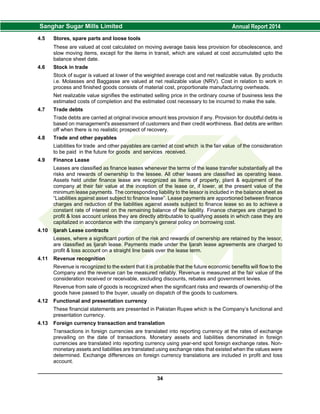
4.14 Provisions
Provisions are recognized in the balance sheet when the Company has present legal or constructive
obligation as a result of past event, and it is probable that outflow of economic benefits will be
required to settle the obligation. However, provisions are reviewed at each balance sheet date and
adjusted to reflect current best estimate.
4.15 Borrowing cost
Mark-up, interest and other charges on loans are capitalized upto the date of commissioning of the
respective qualifying assets. All other mark-up, interest, profit and other charges are charged to profit
& loss account.
4.16 Financial Instruments
Financial assets and liabilities are recognized at the time when the Company becomes a party to the
contractual provisions of the instrument and derecognized when the Company loses control of
contractual rights that comprise the financial assets and in the case of financial liability when the
obligation specified in the contract is discharged, cancelled or expired. Any gain or loss, if any, on
derecognition of financial assets and financial liabilities is included in the profit and loss account
currently.
4.17 Offsetting of financial assets and liabilities
All financial assets and financial liabilities are offset and the net amount is reported in the balance
sheet if the Company has a legal enforceable right to set off the recognized amounts and intends
either to settle on net basis or to realize the assets and settle the liabilities simultaneously.
4.18 Cash and cash equivalents
Cash and cash equivalents are carried at cost. For the purpose of the cash flow statement, cash and
cash equivalents consist of cash in hand and bank balances net of short term borrowings.
4.19 Dividend and appropriation to reserves
Dividend and appropriation to reserve are recognized in the financial statements in the period in
which these are approved.
4.20 Impairment
Financial assets
A financial asset is assessed at each reporting date to determine whether there is any objective
evidence that it is impaired. A financial asset is considered to be impaired if objective evidence
indicated that one or more events have had a negative effect on the estimated future cash flows of
that asset.
The company considers evidence of impairment for receivable and other financial assets at specific
asset level. Impairment losses are recognized as expense in profit and loss account. An impairment
loss is reversed only to the extent that the asset's carrying amount does not exceed the carrying
amount that would have been determined, net of depreciation or amortization, if no impairment loss
had been recognized.
Non-Financial assets
The carrying amount of non-financial assets is assessed at each reporting date to determine whether
there is any indication of impairment. If any such indication exists, then the assets recoverable
amount of such assets is estimated. Recoverable amount is higher of an asset's fair value less cost to
sell and value in use. An impairment loss is recognized as expense in the profit and loss account for
the amount by which asset's carrying amount exceeds its recoverable amount.
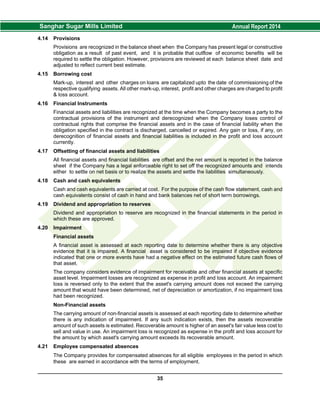
4.21 Employee compensated absences
The Company provides for compensated absences for all eligible employees in the period in which
these are earned in accordance with the terms of employment.
35
2014 2013
5 PROPERTY, PLANT AND EQUIPMENT (Rupees in ‘000)
These are comprised as under:
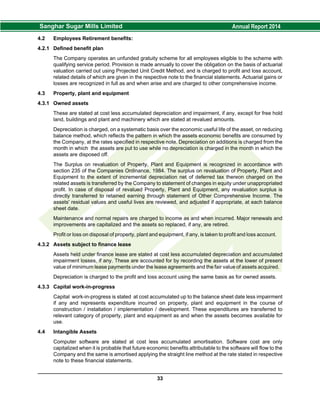
Operating fixed assets Note - 5.1 1,086,312 721,841
Capital work-in-progress Note - 5.2 60,036 7,844
1,146,348 729,685
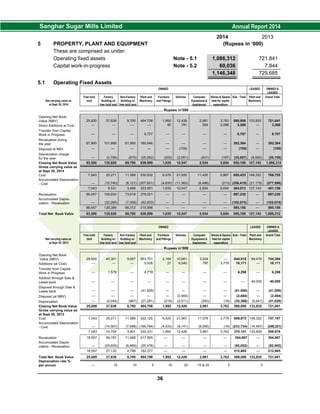
5.1 Operating Fixed Assets
OWNED LEASED OWNED &
LEASED
Net carrying value as
at Sept 30, 2014
Free hold
land
Factory
Building on
free hold land
Non-Factory
Building on
free hold land
Plant and
Machinery
Furniture
and Fittings
Vehicles Computer
Equipment &
Appliances
Stores & Spares
held for capital
expenditure
Sub - Total Plant and
Machinery
Grand Total
.................................................................................. Rupees in’000 ...........................................................................................
Opening Net Book
Value (NBV) 25,600 37,836 8,700 494,708 1,992 12,426 2,981 3,763 588,006 133,835 721,841
Direct Additions at Cost — — — — 45 781 354 2,088 3,268 — 3,268
Transfer from Capital
Work in Progress — — — 8,707 — — — — 8,707 — 8,707
Revaluation during
the year 67,900 101,868 61,950 160,646 — — — — 392,364 — 392,364
Disposal at NBV — — — — — (109) — — (109) — (109)
Depreciation charge
for the year — (3,784) (870) (25,062) (202) (2,551) (401) (197) (33,067) (6,692) (39,759)
Closing Net Book Value 93,500 135,920 69,780 638,999 1,835 10,547 2,934 5,654 959,169 127,143 1,086,312
Gross carrying value as
at Sept 30, 2014
Cost 7,043 25,271 11,589 530,832 6,470 21,930 11,430 5,867 620,433 148,322 768,755
Accumulated Depreciation
- Cost — (15,740) (8,121) (207,831) (4,635) (11,383) (8,496) (213) (256,419) (21,179) (277,598)
7,043 9,531 3,468 323,001 1,835 10,547 2,934 5,654 364,013 127,143 491,156
Revaluation 86,457 158,654 73,618 378,501 — — — — 697,230 — 697,230
Accumulated Depre-
ciation - Revaluation — (32,265) (7,306) (62,503) — — — — (102,074) — (102,074)
86,457 126,389 66,312 315,998 — — — — 595,156 — 595,156
Total Net Book Value 93,500 135,920 69,780 638,999 1,835 10,547 2,934 5,654 959,169 127,143 1,086,312
OWNED LEASED OWNED &
LEASED
Net carrying value as
at Sept 30, 2013
Free hold
land
Factory
Building on
free hold land
Non-Factory
Building on
free hold land
Plant and
Machinery
Furniture
and Fittings
Vehicles Computer
Equipment &
Appliances
Stores & Spares
held for capital
expenditure
Sub - Total Plant and
Machinery
Grand Total
.................................................................................. Rupees in’000 ...........................................................................................
Opening Net Book
Value (NBV) 25,600 40,301 9,667 553,751 2,184 10,881 2,534 — 644,918 99,476 744,394
Additions (at Cost) — — — 5,028 27 6,540 797 3,779 16,171 — 16,171
Transfer from Capital
Work in Progress — 1,579 — 4,719 — — — — 6,298 — 6,298
Addition through Sale &
Lease back — — — — — — — — — 40,000 40,000
Disposal through Sale &
Lease back — — — (41,509) — — — — (41,509) — (41,509)
Disposal (at NBV) — — — — — (2,484) — — (2,484) — (2,484)
Depreciation — (4,044) (967) (27,281) (219) (2,511) (350) (16) (35,388) (5,641) (41,029)
Closing Net Book Value 25,600 37,836 8,700 494,708 1,992 12,426 2,981 3,763 588,006 133,835 721,841
Gross carrying value as
at Sept 30, 2013
Cost 7,043 25,271 11,589 522,125 6,425 21,567 11,076 3,779 608,875 148,322 757,197
Accumulated Depreciation
- Cost — (14,567) (7,688) (189,794) (4,433) (9,141) (8,095) (16) (233,734) (14,487) (248,221)
7,043 10,704 3,901 332,331 1,992 12,426 2,981 3,763 375,141 133,835 508,976
Revaluation 18,557 56,787 11,668 217 855 — — — — 304,867 — 304,867
Accumulated Depre-
ciation - Revaluation — (29,655) (6,869) (55,478) — — — — (92,002) — (92,002)
18,557 27,132 4,799 162,377 — — — — 212,865 — 212,865
Total Net Book Value 25,600 37,836 8,700 494,708 1,992 12,426 2,981 3,763 588,006 133,835 721,841
Depreciation rate %
per annum — 10 10 5 10 20 10 & 20 5 5
36
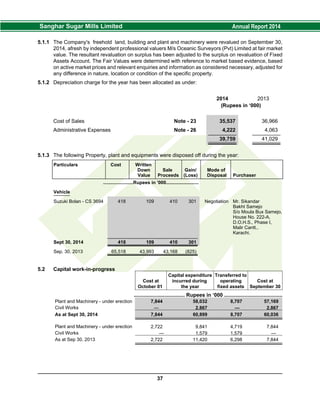
5.1.1 The Company's freehold land, building and plant and machinery were revalued on September 30,
2014, afresh by independent professional valuers M/s Oceanic Surveyors (Pvt) Limited at fair market
value. The resultant revaluation on surplus has been adjusted to the surplus on revaluation of Fixed
Assets Account. The Fair Values were determined with reference to market based evidence, based
on active market prices and relevant enquiries and information as considered necessary, adjusted for
any difference in nature, location or condition of the specific property.
5.1.2 Depreciation charge for the year has been allocated as under:
2014 2013
(Rupees in ‘000)
Cost of Sales Note - 23 35,537 36,966
Administrative Expenses Note - 26 4,222 4,063
39,759 41,029
5.1.3 The following Property, plant and equipments were disposed off during the year:
Particulars Cost Written
Down Sale Gain/ Mode of
Value Proceeds (Loss) Disposal Purchaser
.......................Rupees in '000.........................
Vehicle
Suzuki Bolan - CS 3694 418 109 410 301 Negotiation Mr. Sikandar
Bakht Samejo
S/o Moula Bux Samejo,
House No. 222-A,
D.O.H.S., Phase I,
Malir Cantt.,
Karachi.
Sept 30, 2014 418 109 410 301
Sep. 30, 2013 65,518 43,993 43,168 (825)
5.2 Capital work-in-progress
Cost at
October 01
Capital expenditure
incurred during
the year
Transferred to
operating
fixed assets
Cost at
September 30
................................... Rupees in ‘000 ........................................
Plant and Machinery - under erection 7,844 58,032 8,707 57,169
Civil Works — 2,867 — 2,867
As at Sept 30, 2014 7,844 60,899 8,707 60,036
Plant and Machinery - under erection 2,722 9,841 4,719 7,844
Civil Works — 1,579 1,579 —
As at Sep 30, 2013 2,722 11,420 6,298 7,844
37
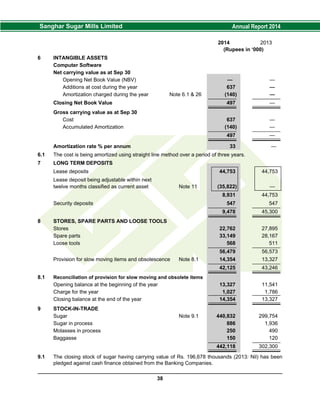
2014 2013
(Rupees in ‘000)
6 INTANGIBLE ASSETS
Computer Software
Net carrying value as at Sep 30
Opening Net Book Value (NBV) — —
Additions at cost during the year 637 —
Amortization charged during the year Note 6.1 & 26 (140) —
Closing Net Book Value 497 —
Gross carrying value as at Sep 30
Cost 637 —
Accumulated Amortization (140) —
497 —
Amortization rate % per annum 33 —
6.1 The cost is being amortized using straight line method over a period of three years.
7 LONG TERM DEPOSITS
Lease deposits 44,753 44,753
Lease deposit being adjustable within next
twelve months classified as current asset Note 11 (35,822) —
8,931 44,753
Security deposits 547 547
9,478 45,300
8 STORES, SPARE PARTS AND LOOSE TOOLS
Stores 22,762 27,895
Spare parts 33,149 28,167
Loose tools 568 511
56,479 56,573
Provision for slow moving items and obsolescence Note 8.1 14,354 13,327
42,125 43,246
8.1 Reconciliation of provision for slow moving and obsolete items
Opening balance at the beginning of the year 13,327 11,541
Charge for the year 1,027 1,786
Closing balance at the end of the year 14,354 13,327
9 STOCK-IN-TRADE
Sugar Note 9.1 440,832 299,754
Sugar in process 886 1,936
Molasses in process 250 490
Baggasse 150 120
442,118 302,300
9.1 The closing stock of sugar having carrying value of Rs. 196,678 thousands (2013: Nil) has been
pledged against cash finance obtained from the Banking Companies.
38
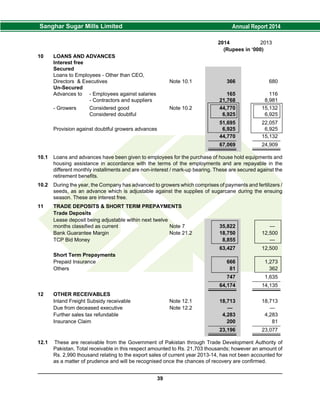
2014 2013
(Rupees in ‘000)
10 LOANS AND ADVANCES
Interest free
Secured
Loans to Employees - Other than CEO,
Directors & Executives Note 10.1 366 680
Un-Secured
Advances to - Employees against salaries 165 116
- Contractors and suppliers 21,768 8,981
- Growers Considered good Note 10.2 44,770 15,132
Considered doubtful 6,925 6,925
51,695 22,057
Provision against doubtful growers advances 6,925 6,925
44,770 15,132
67,069 24,909
10.1 Loans and advances have been given to employees for the purchase of house hold equipments and
housing assistance in accordance with the terms of the employments and are repayable in the
different monthly installments and are non-interest / mark-up bearing. These are secured against the
retirement benefits.
10.2 During the year, the Company has advanced to growers which comprises of payments and fertilizers /
seeds, as an advance which is adjustable against the supplies of sugarcane during the ensuing
season. These are interest free.
11 TRADE DEPOSITS & SHORT TERM PREPAYMENTS
Trade Deposits
Lease deposit being adjustable within next twelve
months classified as current Note 7 35,822 —
Bank Guarantee Margin Note 21.2 18,750 12,500
TCP Bid Money 8,855 —
63,427 12,500
Short Term Prepayments
Prepaid Insurance 666 1,273
Others 81 362
747 1,635
64,174 14,135
12 OTHER RECEIVABLES
Inland Freight Subsidy receivable Note 12.1 18,713 18,713
Due from deceased executive Note 12.2 — —
Further sales tax refundable 4,283 4,283
Insurance Claim 200 81
23,196 23,077
12.1 These are receivable from the Government of Pakistan through Trade Development Authority of
Pakistan. Total receivable in this respect amounted to Rs. 21,703 thousands; however an amount of
Rs. 2,990 thousand relating to the export sales of current year 2013-14, has not been accounted for
as a matter of prudence and will be recognised once the chances of recovery are confirmed.
39
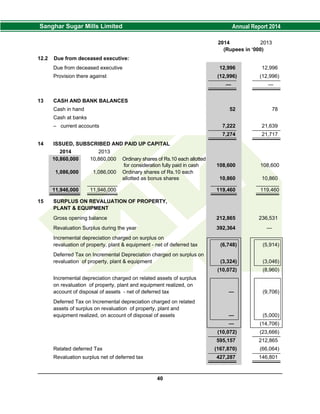
2014 2013
(Rupees in ‘000)
12.2 Due from deceased executive:
Due from deceased executive 12,996 12,996
Provision there against (12,996) (12,996)
— —
13 CASH AND BANK BALANCES
Cash in hand 52 78
Cash at banks
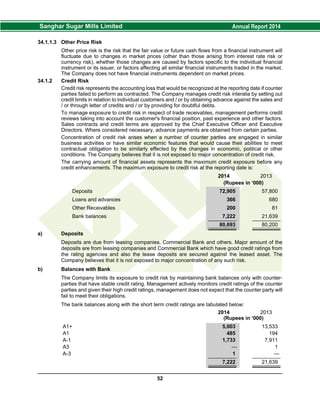
– current accounts 7,222 21,639
7,274 21,717
14 ISSUED, SUBSCRIBED AND PAID UP CAPITAL
2014 2013
10,860,000 10,860,000 Ordinary shares of Rs.10 each allotted
for consideration fully paid in cash 108,600 108,600
1,086,000 1,086,000 Ordinary shares of Rs.10 each
allotted as bonus shares 10,860 10,860
11,946,000 11,946,000 119,460 119,460
15 SURPLUS ON REVALUATION OF PROPERTY,
PLANT & EQUIPMENT
Gross opening balance 212,865 236,531
Revaluation Surplus during the year 392,364 —
Incremental depreciation charged on surplus on
revaluation of property, plant & equipment - net of deferred tax (6,748) (5,914)
Deferred Tax on Incremental Depreciation charged on surplus on
revaluation of property, plant & equipment (3,324) (3,046)
(10,072) (8,960)
Incremental depreciation charged on related assets of surplus
on revaluation of property, plant and equipment realized, on
account of disposal of assets - net of deferred tax — (9,706)
Deferred Tax on Incremental depreciation charged on related
assets of surplus on revaluation of property, plant and
equipment realized, on account of disposal of assets — (5,000)
— (14,706)
(10,072) (23,666)
595,157 212,865
Related deferred Tax (167,870) (66,064)
Revaluation surplus net of deferred tax 427,287 146,801
40
2014 2013
(Rupees in ‘000)
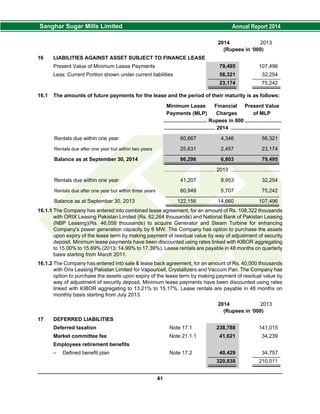
16 LIABILITIES AGAINST ASSET SUBJECT TO FINANCE LEASE
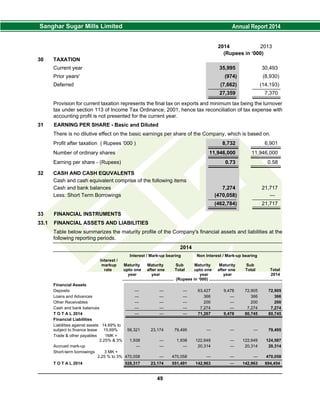
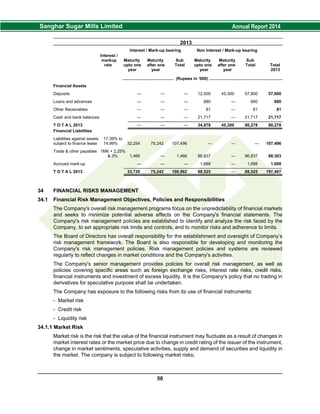
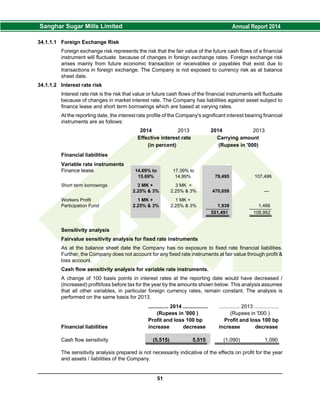
Present Value of Minimum Lease Payments 79,495 107,496
Less: Current Portion shown under current liabilities 56,321 32,254
23,174 75,242
16.1 The amounts of future payments for the lease and the period of their maturity is as follows:
Minimum Lease Financial Present Value
Payments (MLP) Charges of MLP
.............................. Rupees in 000 .........................
................................... 2014 ..................................
Rentals due within one year 60,667 4,346 56,321
Rentals due after one year but within two years 25,631 2,457 23,174
Balance as at September 30, 2014 86,298 6,803 79,495
................................... 2013 ..................................
Rentals due within one year 41,207 8,953 32,254
Rentals due after one year but within three years 80,949 5,707 75,242
Balance as at September 30, 2013 122,156 14,660 107,496
16.1.1 The Company has entered into combined lease agreement, for an amount of Rs. 108,322 thousands
with ORIX Leasing Pakistan Limited (Rs. 62,264 thousands) and National Bank of Pakistan Leasing
(NBP Leasing)(Rs. 46,058 thousands) to acquire Generator and Steam Turbine for enhancing
Company's power generation capacity by 6 MW. The Company has option to purchase the assets
upon expiry of the lease term by making payment of residual value by way of adjustment of security
deposit. Minimum lease payments have been discounted using rates linked with KIBOR aggregating
to 15.00% to 15.69% (2013: 14.99% to 17.39%). Lease rentals are payable in 48 months on quarterly
basis starting from March 2011.
16.1.2 The Company has entered into sale & lease back agreement, for an amount of Rs. 40,000 thousands
with Orix Leasing Pakistan Limited for Vapourcell, Crystallizers and Vaccum Pan. The Company has
option to purchase the assets upon expiry of the lease term by making payment of residual value by
way of adjustment of security deposit. Minimum lease payments have been discounted using rates
linked with KIBOR aggregating to 13.21% to 15.17%. Lease rentals are payable in 48 months on
monthly basis starting from July 2013.
2014 2013
(Rupees in ‘000)
17 DEFERRED LIABILITIES
Deferred taxation Note 17.1 238,788 141,015
Market committee fee Note 21.1.1 41,621 34,239
Employees retirement benefits
– Defined benefit plan Note 17.2 40,429 34,757
320,838 210,011
41
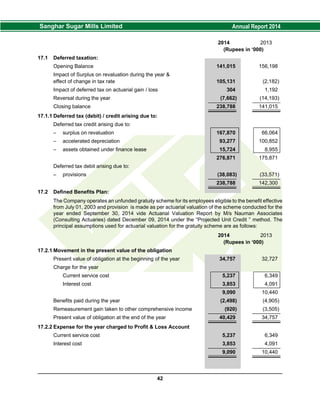
2014 2013
(Rupees in ‘000)
17.1 Deferred taxation:
Opening Balance 141,015 156,198
Impact of Surplus on revaluation during the year &
effect of change in tax rate 105,131 (2,182)
Impact of deferred tax on actuarial gain / loss 304 1,192
Reversal during the year (7,662) (14,193)
Closing balance 238,788 141,015
17.1.1 Deferred tax (debit) / credit arising due to:
Deferred tax credit arising due to:
– surplus on revaluation 167,870 66,064
– accelerated depreciation 93,277 100,852
– assets obtained under finance lease 15,724 8,955
276,871 175,871
Deferred tax debit arising due to:
– provisions (38,083) (33,571)
238,788 142,300
17.2 Defined Benefits Plan:
The Company operates an unfunded gratuity scheme for its employees eligible to the benefit effective
from July 01, 2003 and provision is made as per actuarial valuation of the scheme conducted for the
year ended September 30, 2014 vide Actuarial Valuation Report by M/s Nauman Associates
(Consulting Actuaries) dated December 09, 2014 under the “Projected Unit Credit ” method. The
principal assumptions used for actuarial valuation for the gratuity scheme are as follows:
2014 2013
(Rupees in ‘000)
17.2.1 Movement in the present value of the obligation
Present value of obligation at the beginning of the year 34,757 32,727
Charge for the year
Current service cost 5,237 6,349
Interest cost 3,853 4,091
9,090 10,440
Benefits paid during the year (2,498) (4,905)
Remeasurement gain taken to other comprehensive income (920) (3,505)
Present value of obligation at the end of the year 40,429 34,757
17.2.2 Expense for the year charged to Profit & Loss Account
Current service cost 5,237 6,349
Interest cost 3,853 4,091
9,090 10,440
42
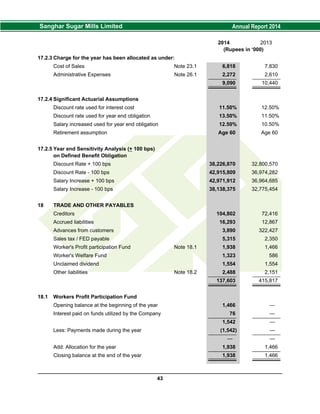
2014 2013
(Rupees in ‘000)
17.2.3 Charge for the year has been allocated as under:
Cost of Sales Note 23.1 6,818 7,830
Administrative Expenses Note 26.1 2,272 2,610
9,090 10,440
17.2.4 Significant Actuarial Assumptions
Discount rate used for interest cost 11.50% 12.50%
Discount rate used for year end obligation 13.50% 11.50%
Salary increased used for year end obligation 12.50% 10.50%
Retirement assumption Age 60 Age 60
17.2.5 Year end Sensitivity Analysis (+ 100 bps)
on Defined Benefit Obligation
Discount Rate + 100 bps 38,226,870 32,800,570
Discount Rate - 100 bps 42,915,809 36,974,282
Salary Increase + 100 bps 42,971,912 36,964,685
Salary Increase - 100 bps 38,138,375 32,775,454
18 TRADE AND OTHER PAYABLES
Creditors 104,802 72,416
Accrued liabilities 16,293 12,867
Advances from customers 3,890 322,427
Sales tax / FED payable 5,315 2,350
Worker's Profit participation Fund Note 18.1 1,938 1,466
Worker's Welfare Fund 1,323 586
Unclaimed dividend 1,554 1,554
Other liabilities Note 18.2 2,488 2,151
137,603 415,817
18.1 Workers Profit Participation Fund
Opening balance at the beginning of the year 1,466 —
Interest paid on funds utilized by the Company 76 —
1,542 —
Less: Payments made during the year (1,542) —
— —
Add: Allocation for the year 1,938 1,466
Closing balance at the end of the year 1,938 1,466
43
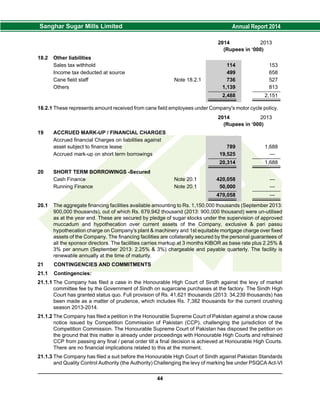
2014 2013
(Rupees in ‘000)
18.2 Other liabilities
Sales tax withhold 114 153
Income tax deducted at source 499 658
Cane field staff Note 18.2.1 736 527
Others 1,139 813
2,488 2,151
18.2.1 These represents amount received from cane field employees under Company's motor cycle policy.
2014 2013
(Rupees in ‘000)
19 ACCRUED MARK-UP / FINANCIAL CHARGES
Accrued financial Charges on liabilities against
asset subject to finance lease 789 1,688
Accrued mark-up on short term borrowings 19,525 —
20,314 1,688
20 SHORT TERM BORROWINGS -Secured
Cash Finance Note 20.1 420,058 —
Running Finance Note 20.1 50,000 —
470,058 —
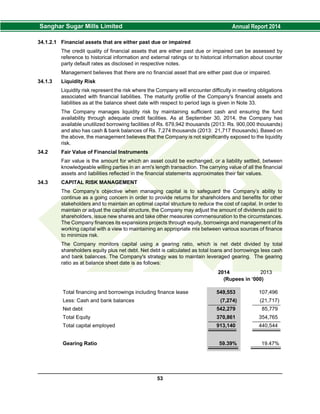
20.1 The aggregate financing facilities available amounting to Rs. 1,150,000 thousands (September 2013:
900,000 thousands), out of which Rs. 679,942 thousand (2013: 900,000 thousand) were un-utilised
as at the year end. These are secured by pledge of sugar stocks under the supervision of approved
muccadum and hypothecation over current assets of the Company, exclusive & pari passu
hypothecation charge on Company's plant & machinery and 1st equitable mortgage charge over fixed
assets of the Company. The financing facilities are collaterally secured by the personal guarantees of
all the sponsor directors. The facilities carries markup at 3 months KIBOR as base rate plus 2.25% &
3% per annum (September 2013: 2.25% & 3%) chargeable and payable quarterly. The facility is
renewable annually at the time of maturity.
21 CONTINGENCIES AND COMMITMENTS
21.1 Contingencies:
21.1.1 The Company has filed a case in the Honourable High Court of Sindh against the levy of market
committee fee by the Government of Sindh on sugarcane purchases at the factory. The Sindh High
Court has granted status quo. Full provision of Rs. 41,621 thousands (2013: 34,239 thousands) has
been made as a matter of prudence, which includes Rs. 7,382 thousands for the current crushing
season 2013-2014.
21.1.2 The Company has filed a petition in the Honourable Supreme Court of Pakistan against a show cause
notice issued by Competition Commission of Pakistan (CCP), challenging the jurisdiction of the
Competition Commission. The Honourable Supreme Court of Pakistan has disposed the petition on
the ground that this matter is already under proceedings with Honourable High Courts and refrained
CCP from passing any final / penal order till a final decision is achieved at Honourable High Courts.
There are no financial implications related to this at the moment.
21.1.3 The Company has filed a suit before the Honourable High Court of Sindh against Pakistan Standards
and Quality Control Authority (the Authority) Challenging the levy of marking fee under PSQCA Act-VI
44
of 1996. The Authority has demanded a fee payment @ 0.1% of ex-factory price for the year 2008-
2009 amounting to Rs. 1,915 thousands. The Company is of the view that demand notifications so
raised are without any lawful authority under the PSQCA Act-VI of 1996 and are in violation of the
constitution. The Honourable High Court of Sindh has accepted the petition and termed that
impugned notifications have been issued without lawful authority and suspended the operation of the
impugned notifications. The constitutional petition filed before the Honourable High Court of Sindh
has allowed in favour of the Company. In the meantime the legal counsel of the Company has filed
caveat in respect of an appeal to be filed by PSQCA against the judgment in the Honourable Supreme
Court of Pakistan. The Pakistan Standards and Quality Control Authority have filed an appeal before
the Honourable Supreme Court of Pakistan against the decision of the Honourable High Court of
Sindh. No provision has been made in this respect.
21.1.4 A show cause notice has been issued by the department of Inland Revenue Service-LTU against the
company regarding the reduced rate of Federal Excise Duty availed by the company amounting to
Rs. 58,106 thousands under SRO 77(1)/ 2013 dated 7th February 2013. The Company has filed an
appeal before the Honourable High Court of Sindh against the show cause notice and the Honourable
High Court of Sindh has issued stay order against the proceedings on the show cause notice.
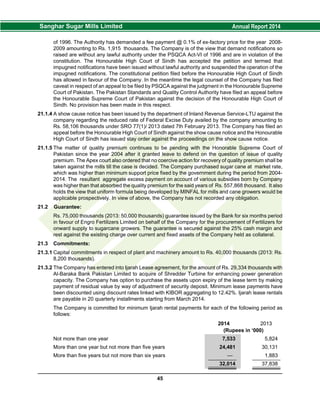
21.1.5 The matter of quality premium continues to be pending with the Honorable Supreme Court of
Pakistan since the year 2004 after it granted leave to defend on the question of issue of quality
premium. The Apex court also ordered that no coercive action for recovery of quality premium shall be
taken against the mills till the case is decided. The Company purchased sugar cane at market rate,
which was higher than minimum support price fixed by the government during the period from 2004-
2014. The resultant aggregate excess payment on account of various subsidies born by Company
was higher than that absorbed the quality premium for the said years of Rs. 557,868 thousand. It also
holds the view that uniform formula being developed by MINFAL for mills and cane growers would be
applicable prospectively. In view of above, the Company has not recorded any obligation.
21.2 Guarantee:
Rs. 75,000 thousands (2013: 50,000 thousands) guarantee issued by the Bank for six months period
in favour of Engro Fertilizers Limited on behalf of the Company for the procurement of Fertilizers for
onward supply to sugarcane growers. The guarantee is secured against the 25% cash margin and
rest against the existing charge over current and fixed assets of the Company held as collateral.
21.3 Commitments:
21.3.1 Capital commitments in respect of plant and machinery amount to Rs. 40,000 thousands (2013: Rs.
8,200 thousands).
21.3.2 The Company has entered into Ijarah Lease agreement, for the amount of Rs. 29,334 thousands with
Al-Baraka Bank Pakistan Limited to acquire of Shredder Turbine for enhancing power generation
capacity. The Company has option to purchase the assets upon expiry of the lease term by making
payment of residual value by way of adjustment of security deposit. Minimum lease payments have
been discounted using discount rates linked with KIBOR aggregating to 12.42%. Ijarah lease rentals
are payable in 20 quarterly installments starting from March 2014.
The Company is committed for minimum Ijarah rental payments for each of the following period as
follows:
2014 2013
(Rupees in ‘000)
Not more than one year 7,533 5,824
More than one year but not more than five years 24,481 30,131
More than five years but not more than six years — 1,883
32,014 37,838
45
2014 2013
(Rupees in ‘000)
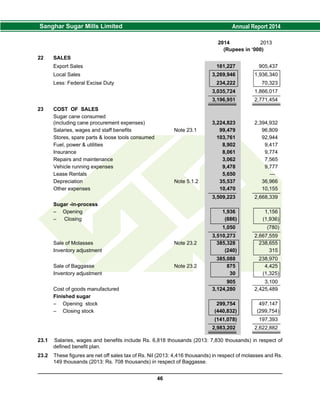
22 SALES
Export Sales 161,227 905,437
Local Sales 3,269,946 1,936,340
Less: Federal Excise Duty 234,222 70,323
3,035,724 1,866,017
3,196,951 2,771,454
23 COST OF SALES
Sugar cane consumed
(including cane procurement expenses) 3,224,823 2,394,932
Salaries, wages and staff benefits Note 23.1 99,479 96,809
Stores, spare parts & loose tools consumed 103,761 92,944
Fuel, power & utilities 8,902 9,417
Insurance 8,061 9,774
Repairs and maintenance 3,062 7,565
Vehicle running expenses 9,478 9,777
Lease Rentals 5,650 —
Depreciation Note 5.1.2 35,537 36,966
Other expenses 10,470 10,155
3,509,223 2,668,339
Sugar -in-process
– Opening 1,936 1,156
– Closing (886) (1,936)
1,050 (780)
3,510,273 2,667,559
Sale of Molasses Note 23.2 385,328 238,655
Inventory adjustment (240) 315
385,088 238,970
Sale of Baggasse Note 23.2 875 4,425
Inventory adjustment 30 (1,325)
905 3,100
Cost of goods manufactured 3,124,280 2,425,489
Finished sugar
– Opening stock 299,754 497,147
– Closing stock (440,832) (299,754)
(141,078) 197,393
2,983,202 2,622,882
23.1 Salaries, wages and benefits include Rs. 6,818 thousands (2013: 7,830 thousands) in respect of
defined benefit plan.
23.2 These figures are net off sales tax of Rs. Nil (2013: 4,416 thousands) in respect of molasses and Rs.
149 thousands (2013: Rs. 708 thousands) in respect of Baggasse.
46
2014 2013
(Rupees in ‘000)
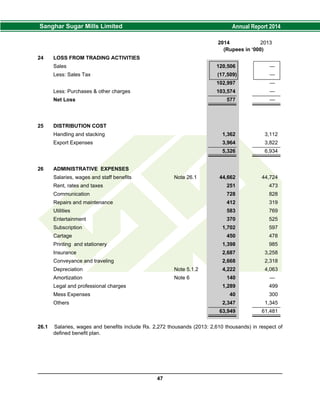
24 LOSS FROM TRADING ACTIVITIES
Sales 120,506 —
Less: Sales Tax (17,509) —
102,997 —
Less: Purchases & other charges 103,574 —
Net Loss 577 —
25 DISTRIBUTION COST
Handling and stacking 1,362 3,112
Export Expenses 3,964 3,822
5,326 6,934
26 ADMINISTRATIVE EXPENSES
Salaries, wages and staff benefits Note 26.1 44,662 44,724
Rent, rates and taxes 251 473
Communication 728 828
Repairs and maintenance 412 319
Utilities 583 769
Entertainment 370 525
Subscription 1,702 597
Cartage 450 478
Printing and stationery 1,398 985
Insurance 2,687 3,258
Conveyance and traveling 2,668 2,318
Depreciation Note 5.1.2 4,222 4,063
Amortization Note 6 140 —
Legal and professional charges 1,289 499
Mess Expenses 40 300
Others 2,347 1,345
63,949 61,481
26.1 Salaries, wages and benefits include Rs. 2,272 thousands (2013: 2,610 thousands) in respect of
defined benefit plan.
47
2014 2013
(Rupees in ‘000)
27 OTHER OPERATING EXPENSES
Auditors' remuneration Note 27.1 710 642
Corporate social responsibility costs Note 27.2 1,263 1,226
Loss on sale and lease back of property,
plant and equipment — 1,509
Workers Profit Participation Fund 1,938 1,466
Provision for due from deceased executive — 12,996
Workers Welfare Fund 737 586
Exchange Loss on Export proceeds 3,159 —
Provision for slow moving and obsolete items 1,027 1,786
Others — 167
8,834 20,378
27.1 Auditors' remuneration
Statutory Auditors - Kreston Hyder Bhimji and Co.
Audit fee 545 500
Half yearly review fee 30 25
Code of corporate governance certification 20 15
595 540
Cost Auditors - Siddiqi and Co.
Audit fee 100 90
Out of pocket expenses 15 12
115 102
710 642
27.2 Corporate social responsibility costs do not include any amount paid to any person or organization in
which any director or their spouse had any interest.
2014 2013
(Rupees in ‘000)
28 OTHER INCOME
Income from financial assets:
Exchange gain realized during the year — 5,305
Income from non financial assets:
Inland freight subsidy — 18,713
Scrap Sales — 8,627
Gain on sale of property, plant and equipment 301 683
Others - Rent & Miscellaneous receipts 82 1,473
383 34,801
29 FINANCE COST
Mark-up on short-term borrowings 86,043 69,664
Financial charges on liabilities against
asset subject to finance lease 7,314 7,816
Bank charges 1,538 2,829
Mark-up on Bank Guarantee 4,384 —
Interest on Workers Profit Participation Fund 76 —
99,355 80,309
48
2014 2013
(Rupees in ‘000)
30 TAXATION
Current year 35,995 30,493
Prior years' (974) (8,930)
Deferred (7,662) (14,193)
27,359 7,370
Provision for current taxation represents the final tax on exports and minimum tax being the turnover
tax under section 113 of Income Tax Ordinance, 2001, hence tax reconciliation of tax expense with
accounting profit is not presented for the current year.
31 EARNING PER SHARE - Basic and Diluted
There is no dilutive effect on the basic earnings per share of the Company, which is based on.
Profit after taxation ( Rupees '000 ) 8,732 6,901
Number of ordinary shares 11,946,000 11,946,000
Earning per share - (Rupees) 0.73 0.58
32 CASH AND CASH EQUVALENTS
Cash and cash equivalent comprise of the following items
Cash and bank balances 7,274 21,717
Less: Short Term Borrowings (470,058) —
(462,784) 21,717
33 FINANCIAL INSTRUMENTS
33.1 FINANCIAL ASSETS AND LIABILITIES
Table below summarizes the maturity profile of the Company's financial assets and liabilities at the
following reporting periods.
2014
Interest / Mark-up bearing Non Interest / Mark-up bearing
Interest /
markup Maturity Maturity Sub Maturity Maturity Sub
rate upto one after one Total upto one after one Total Total
year year year year 2014
............................................ (Rupees in ‘000) ...............................................................
Financial Assets
Deposits — — — 63,427 9,478 72,905 72,905
Loans and Advances — — — 366 — 366 366
Other Receivables — — — 200 — 200 200
Cash and bank balances — — — 7,274 — 7,274 7,274
T O T A L 2014 — — — 71,267 9,478 80,745 80,745
Financial Liabilities
Liabilities against assets 14.69% to
subject to finance lease 15.69% 56,321 23,174 79,495 — — — 79,495
Trade & other payables 1MK +
2.25% & 3% 1,938 — 1,938 122,649 — 122,649 124,587
Accrued mark-up — — — 20,314 — 20,314 20,314
Short-term borrowings 3 MK +
2.25 % to 3% 470,058 — 470,058 — — — 470,058
T O T A L 2014 528,317 23,174 551,491 142,963 — 142,963 694,454
49
2013
Interest / Mark-up bearing Non Interest / Mark-up bearing
Interest /
markup Maturity Maturity Sub Maturity Maturity Sub
rate upto one after one Total upto one after one Total Total
year year year year 2013
............................................ (Rupees in ‘000) ...............................................................
Financial Assets
Deposits — — — 12,500 45,300 57,800 57,800
Loans and advances — — — 680 — 680 680
Other Receivables — — — 81 — 81 81
Cash and bank balances — — — 21,717 — 21,717 21,717
T O T A L 2013 — — — 34,978 45,300 80,278 80,278
Financial Liabilities
Liabilities against assets 17.39% to
subject to finance lease 14.99% 32,254 75,242 107,496 — — — 107,496
Trade & other payables 1MK + 2.25%
& 3% 1,466 — 1,466 86,837 — 86,837 88,303
Accrued mark-up — — — 1,688 — 1,688 1,688
T O T A L 2013 33,720 75,242 108,962 88,525 — 88,525 197,487
34 FINANCIAL RISKS MANAGEMENT
34.1 Financial Risk Management Objectives, Policies and Responsibilities
The Company's overall risk management programs focus on the unpredictability of financial markets
and seeks to minimize potential adverse effects on the Company's financial statements. The
Company's risk management policies are established to identify and analyze the risk faced by the
Company, to set appropriate risk limits and controls, and to monitor risks and adherence to limits.
The Board of Directors has overall responsibility for the establishment and oversight of Company’s
risk management framework. The Board is also responsible for developing and monitoring the
Company's risk management policies. Risk management policies and systems are reviewed
regularly to reflect changes in market conditions and the Company's activities.
The Company's senior management provides policies for overall risk management, as well as
policies covering specific areas such as foreign exchange risks, interest rate risks, credit risks,
financial instruments and investment of excess liquidity. It is the Company's policy that no trading in
derivatives for speculative purpose shall be undertaken.
The Company has exposure to the following risks from its use of financial instruments:
- Market risk
- Credit risk
- Liquidity risk
34.1.1 Market Risk
Market risk is the risk that the value of the financial instrument may fluctuate as a result of changes in
market interest rates or the market price due to change in credit rating of the issuer of the instrument,
change in market sentiments, speculative activities, supply and demand of securities and liquidity in
the market. The company is subject to following market risks;
50
34.1.1.1 Foreign Exchange Risk
Foreign exchange risk represents the risk that the fair value of the future cash flows of a financial
instrument will fluctuate because of changes in foreign exchange rates. Foreign exchange risk
arises mainly from future economic transaction or receivables or payables that exist due to
transactions in foreign exchange. The Company is not exposed to currency risk as at balance
sheet date.
34.1.1.2 Interest rate risk
Interest rate risk is the risk that value or future cash flows of the financial instruments will fluctuate
because of changes in market interest rate. The Company has liabilities against asset subject to
finance lease and short term borrowings which are based at varying rates.
At the reporting date, the interest rate profile of the Company's significant interest bearing financial
instruments are as follows:
2014 2013 2014 2013
Effective interest rate Carrying amount
(in percent) (Rupees in '000)
Financial liabilities
Variable rate instruments
Finance lease 14.69% to 17.39% to
15.69% 14.99% 79,495 107,496
Short term borrowings 3 MK + 3 MK +
2.25% & 3% 2.25% & 3% 470,058 —
Workers Profit 1 MK + 1 MK +
Participation Fund 2.25% & 3% 2.25% & 3% 1,938 1,466
551,491 108,962
Sensitivity analysis
Fairvalue sensitivity analysis for fixed rate instruments
As at the balance sheet date the Company has no exposure to fixed rate financial liabilities.
Further, the Company does not account for any fixed rate instruments at fair value through profit &
loss account.
Cash flow sensitivity analysis for variable rate instruments.
A change of 100 basis points in interest rates at the reporting date would have decreased /
(increased) profit/loss before tax for the year by the amounts shown below. This analysis assumes
that all other variables, in particular foreign currency rates, remain constant. The analysis is
performed on the same basis for 2013.
.............. 2014 ................. .............. 2013 .................
(Rupees in '000 ) (Rupees in '000 )
Profit and loss 100 bp Profit and loss 100 bp
Financial liabilities increase decrease increase decrease
Cash flow sensitivity (5,515) 5,515 (1,090) 1,090
The sensitivity analysis prepared is not necessarily indicative of the effects on profit for the year
and assets / liabilities of the Company.
51
34.1.1.3 Other Price Risk
Other price risk is the risk that the fair value or future cash flows from a financial instrument will
fluctuate due to changes in market prices (other than those arising from interest rate risk or
currency risk), whether those changes are caused by factors specific to the individual financial
instrument or its issuer, or factors affecting all similar financial instruments traded in the market.
The Company does not have financial instruments dependent on market prices.
34.1.2 Credit Risk
Credit risk represents the accounting loss that would be recognized at the reporting date if counter
parties failed to perform as contracted. The Company manages credit risk interalia by setting out
credit limits in relation to individual customers and / or by obtaining advance against the sales and
/ or through letter of credits and / or by providing for doubtful debts.
To manage exposure to credit risk in respect of trade receivables, management performs credit
reviews taking into account the customer's financial position, past experience and other factors.
Sales contracts and credit terms are approved by the Chief Executive Officer and Executive
Directors. Where considered necessary, advance payments are obtained from certain parties.
Concentration of credit risk arises when a number of counter parties are engaged in similar
business activities or have similar economic features that would cause their abilities to meet
contractual obligation to be similarly effected by the changes in economic, political or other
conditions. The Company believes that it is not exposed to major concentration of credit risk.
The carrying amount of financial assets represents the maximum credit exposure before any
credit enhancements. The maximum exposure to credit risk at the reporting date is:
2014 2013
(Rupees in ‘000)
Deposits 72,905 57,800
Loans and advances 366 680
Other Receivables 200 81
Bank balances 7,222 21,639
80,693 80,200
a) Deposits
Deposits are due from leasing companies, Commercial Bank and others. Major amount of the
deposits are from leasing companies and Commercial Bank which have good credit ratings from
the rating agencies and also the lease deposits are secured against the leased asset. The
Company believes that it is not exposed to major concentration of any such risk.
b) Balances with Bank
The Company limits its exposure to credit risk by maintaining bank balances only with counter-
parties that have stable credit rating. Management actively monitors credit ratings of the counter
parties and given their high credit ratings, management does not expect that the counter party will
fail to meet their obligations.
The bank balances along with the short term credit ratings are tabulated below:
2014 2013
(Rupees in ‘000)
A1+ 5,003 13,533
A1 485 194
A-1 1,733 7,911
A3 — 1
A-3 1 —
7,222 21,639
52
34.1.2.1 Financial assets that are either past due or impaired
The credit quality of financial assets that are either past due or impaired can be assessed by
reference to historical information and external ratings or to historical information about counter
party default rates as disclosed in respective notes.
Management believes that there are no financial asset that are either past due or impaired.
34.1.3 Liquidity Risk
Liquidity risk represent the risk where the Company will encounter difficulty in meeting obligations
associated with financial liabilities. The maturity profile of the Company's financial assets and
liabilities as at the balance sheet date with respect to period lags is given in Note 33.
The Company manages liquidity risk by maintaining sufficient cash and ensuring the fund
availability through adequate credit facilities. As at September 30, 2014, the Company has
available unutilized borrowing facilities of Rs. 679,942 thousands (2013: Rs. 900,000 thousands)
and also has cash & bank balances of Rs. 7,274 thousands (2013: 21,717 thousands). Based on
the above, the management believes that the Company is not significantly exposed to the liquidity
risk.
34.2 Fair Value of Financial Instruments
Fair value is the amount for which an asset could be exchanged, or a liability settled, between
knowledgeable willing parties in an arm's length transaction. The carrying value of all the financial
assets and liabilities reflected in the financial statements approximates their fair values.
34.3 CAPITAL RISK MANAGEMENT
The Company’s objective when managing capital is to safeguard the Company’s ability to
continue as a going concern in order to provide returns for shareholders and benefits for other
stakeholders and to maintain an optimal capital structure to reduce the cost of capital. In order to
maintain or adjust the capital structure, the Company may adjust the amount of dividends paid to
shareholders, issue new shares and take other measures commensuration to the circumstances.
The Company finances its expansions projects through equity, borrowings and management of its
working capital with a view to maintaining an appropriate mix between various sources of finance
to minimize risk.
The Company monitors capital using a gearing ratio, which is net debt divided by total
shareholders equity plus net debt. Net debt is calculated as total loans and borrowings less cash
and bank balances. The Company's strategy was to maintain leveraged gearing. The gearing
ratio as at balance sheet date is as follows:
2014 2013
(Rupees in ‘000)
Total financing and borrowings including finance lease 549,553 107,496
Less: Cash and bank balances (7,274) (21,717)
Net debt 542,279 85,779
Total Equity 370,861 354,765
Total capital employed 913,140 440,544
Gearing Ratio 59.39% 19.47%
53
35 REMUNERATION OF CHIEF EXECUTIVE, DIRECTORS AND EXECUTIVES
The aggregate amount charged in the accounts for the year for remuneration, including all benefits to
the Chief Executive, Directors and Executives of the Company were as follows:
Chief Executive Directors Executives Total
2014 2013 2014 2013 2014 2013 2014 2013
............................................................ (Rupees in ‘000) ................................................................
Non executive
Directors' fee
- 5 Directors — — 170 145 — — 170 145
Managerial remuneration 5,383 5,106 1,236 1,236 7,142 5,398 13,761 11,740
Allowances & Others 1,827 1,827 804 804 2,708 2,230 5,339 4,861
7,210 6,933 2,040 2,040 9,850 7,628 19,100 16,601
Number of persons 1 1 2 2 3 4 6 7
The Chief Executive, two Executive Directors and Executives as stated above are provided with the
Company maintained cars for the business and personal use and the Chief Executive and two
Executive Directors are also provided with telephone facilities for the business and personal use.
36 RELATED PARTY TRANSACTIONS
The Company in the normal course of business carried out transactions with related parties as
detailed below:
Relationship with Company Nature of Transaction 2014 2013
(Rupees in '000)
Key Management Personnel and
their relatives Purchase of sugarcane 105,620 93,643
Transactions, as applicable in relation to Directors of the Company and Key Management Personnel
(KMP) have been disclosed in note # 35. Key Management Personnel are those persons having
authority and responsibility for planning, directing and controlling the activities of the entity directly or
indirectly.
Receivable / payables as at the balance sheet date are disclosed in the respective notes to the
financial statements.
37 ENTITY - WIDE INFORMATION
37.1 The Company constitutes of a single reportable segment, the principal class of product is Sugar and
by products are Molasses and Baggasse.
54
37.2 Information about geographical areas
The Company does not hold non-current assets in any foreign country. Revenues from external
customers attributed to foreign countries in aggregate are not material in the overall context of these
financial statements. The analysis of sugar sales, by products and sales of trading activities are as
follows:
2014 2013
(Rupees in ‘000)
Export Sales 161,227 905,437
Local Sales - net 3,524,924 3,975,114
3,686,151 4,880,551
(In percentage)
Export Sales 4.37% 18.55%
Local Sales - net 95.63% 81.45%
100.00% 100.00%
38 CAPACITY AND PRODUCTION
2014 2013
Quantity No. of Quantity No. of
M. Tons days M. Tons days
Crushing capacity 6,000 Per day 6,000 Per day
Capacity based on actual
working days 906,000 151 726,000 121
Actual Crushing 738,209 151 542,289 121
Sucrose recovery ( in %) 9.81 9.77
Sugar production from cane 72,530 52,823
38.1 Main reason for under utilization of production capacity is lesser availability of sugarcane during the
season.
39 DATE OF AUTHORIZATION FOR ISSUE
These financial statements were authorized for issue on January 08, 2015 by the Board of Directors
of the Company.
40 NUMBER OF EMPLOYEES
The number of employees as at year end was 532 (2013: 534 ) and average number of employees
during the year was 748 (2013: 741) included seasonal employees.
41 GENERAL
Figures have been rounded off to nearest thousand of rupees.
Chief Executive Director
55
Pattern of Share Holding
As at September 30, 2014
Number of Share Holding Total
Shareholders From To Shares Held
757 1 100 22,668
111 101 500 30,889
85 501 1000 52,133
69 1001 5000 153,179
39 5001 10000 244,650
4 10001 15000 50,890
3 15001 20000 56,000
3 20001 25000 73,000
3 25001 30000 79,940
1 35001 40000 35,500
2 40001 45000 89,650
1 55001 60000 55,750
1 60001 65000 62,700
3 95001 100000 289,140
1 240001 245000 241,487
1 360001 365000 360,179
1 400001 405000 403,100
2 410001 415000 821,722
1 415001 420000 417,000
1 495001 500000 496,000
1 520001 525000 522,600
2 570001 575000 1,145,722
1 655001 660000 659,250
1 670001 675000 674,750
1 855001 860000 858,000
1 910001 915000 913,000
1 975001 980000 979,000
1 1060001 1065000 1,063,616
1 1090001 1095000 1,094,485
1,099 11,946,000
* There is no shareholding in the slab not mentioned
Category of Shareholders Number of
Shares Held
Percentage
%
01 Directors, Chief Executive Officer, and
their spouse and minor children 1,649,137 13.8049
02 Associated Companies, undertakings
and related parties
– –
03 Executives 25,290 0.2117
04 NIT & ICP 1,064,016 8.9068
05 Banks, DFIs, NBFIs, Mudarabas and
Pension Fund 116,440 0.9747
06 Insurance Companies 418,040 3.4994
07 Shareholders holding 5% or more 3,844,485 32.1822
08 Joint Stock Companies 16,922 0.1418
09 General Public - Local 4,811,670 40.2785
TOTAL 11,946,000 100.0000
56
Detail of Pattern of Share Holding
As per Requirement of Code of Corporate Governance
As at September 30, 2014
Category Name Category wise Category
Number of Percentage Number of wise Percentage
shares held % shareholders shares held %
Directors, Chief Executive and
their spouse and minor children 7 1,649,137 13.8049
Haji Khuda Bux Rajar 241,487 2.0215
* Mr. Ghulam Dastagir Rajar 659,250 5.5186
Mr. Mohammad Aslam 3,300 0.0276
Mr. Qazi Shamsuddin 4,900 0.0410
* Mr. Gul Mohammad 674,750 5.6483
Mr. Jam Mitha Khan 62,700 0.5249
Mrs. Khanzady W/o Haji Khuda Bux Rajar 2,750 0.0230
Associated Companies, Undertaking and
related parties - - -
Executives 1 25,290 0.2117
NIT & ICP 3 1,064,016 8.9068
* CDC - Trustee National Investment
(Unit) Trust 1,063,616 8.9035
Investment Corporation of Pakistan 400 0.0033
Banks, DFIs, NBFIs, Mudarabas 5 116,440 0.9747
and Pension Funds
Insurance Companies 3 418,040 3.4994
* Shareholders holding 5% or more 4 3,844,485 32.1822
Joint Stock Companies 5 16,922 0.1418
General Public - Local 1071 4,811,670 40.2785
TOTAL 1,099 11,946,000 100.0000
* Shareholders having 5% or more shares marked as(*) are shown in their relevant categories. The name wise
details of the remaining shareholders having 5% or more given below
Name of Shareholders Number of shares held Percentage %
Ali Ghulam 858,000 7.1823
Khuda Bux 913,000 7.6427
Abdul Jabbar 979,000 8.1952
Pir Baksh 1,094,485 9.1620
3,844,485 32.1822
Information under clause (xvi) (i) of the Code of Corporate Governance
The Directors, Executives and their spouse and their minor children have not undertaken any trading of Company's
shares during the year 2013-2014
57
sanghar sugar mills Annual report 2014

sanghar sugar mills Annual report 2014

  • 16.
    Stakeholders Information Stock ExchangeListing Sanghar Sugar Mills Limited is a listed Company and its shares are traded on Karachi and Lahore Stock Exchanges. The Company’s shares are quoted in leading newspapers under Sugar Sector. Communication with Users of Financial Statements Communication with users of financial statements is given high priority. Annual, half yearly and quarterly reports are distributed to the shareholders and provided to other users within the time specified in the Companies Ordinance, 1984. There is also an opportunity for individual shareholder to participate at the annual general meetings to ensure high level of accountability. Shareholders Information Enquiries concerning verification of transfer deeds, transfer of share certificates, change of address etc., should be directed to the Shares Registrar, Hameed Majeed Associates (Pvt) Ltd. Karachi Chambers, Hasrat Mohani Road, Karachi Phone No: 021- 32424826, Fax No: 021-32424835. Public Information Financial analysts, stock brokers, interested investors and financial media desiring information about Sanghar Sugar Mills Limited and its products should contact the Executive Director/Chief Financial Officer at Registered Office, Karachi Phone: 021-35371441 to 43 (03 lines), Fax: 021-35371444. FINANCIAL RATIOS 2014 2013 2012 2011 2010 2009 2008 2007 2006 2005 Profitability Ratios Gross Profit Ratio (%) 6.69 5.36 6.51 16.42 14.08 13.43 12.55 6.72 16.97 4.78 Net Profit to Sales (%) 0.27 0.25 (0.22) 2.52 5.02 6.86 7.21 (1.16) 8.94 (5.40) Return on Capital Employed (%) 36.52 26.66 42.17 47.43 85.86 77.37 41.48 19.49 24.92 6.58 Turnover Ratios Inventory Turnover Ratio 8.01 6.19 3.08 1.96 17.51 11.72 26.36 18.41 16.28 9.03 Fixed Assets Turnover Ratio 278.88 383.94 403.72 200.02 561.23 339.96 360.15 203.30 195.21 102.31 Investor Information Price Earning Ratio 34.89 39.47 (44.91) 3.39 1.23 2.81 2.96 (5.14) 1.93 (0.96) Market Value per Share 25.50 22.89 24.70 10.71 13.84 15.75 24.45 8.50 8.50 5.00 Book Value per Share 31.04 29.70 27.62 27.43 25.57 15.03 8.95 0.23 2.39 (2.54) Earning per Share 0.73 0.58 (0.55) 3.16 11.25 5.60 8.25 (1.65) 4.40 (5.19) Liquidity Ratios Current Ratio 0.98 1.03 0.99 1.01 1.203 0.871 0.997 0.75 0.77 0.42 Capital Structure Ratios Debt Equity Ratio 0.69 1.05 2.06 3.12 1.05 1.97 2.30 1.60 1.24 1.82 Interest Cover Ratio 1.36 1.18 1.00 1.68 4.11 4.14 6.30 0.67 3.77 (0.44) 15
  • 17.
    Statement of ValueAddition and Its Distribution ............. 2014 ............... .............. 2013 ............ Value Addition: (Rs. ‘000) % (Rs. ‘000) % Turnover Gross 3,937,882 99.99 3,084,857 98.88 Other Income 383 0.01 34,801 1.12 3,938,265 100.00 3,119,658 100.00 Cane Procurement and related expenses 3,212,827 95.62 2,386,120 86.75 Other Expenses 147,058 4.38 364,486 13.25 3,359,885 100.00 2,750,606 100.00 578,379 14.69 369,052 11.83 Value Distribution: Distributed as follows To Employees – Remuneration 144,141 24.92 141,533 38.35 – Worker's profit participation fund 1,938 0.34 1,466 0.40 146,079 142,999 To Government – Federal Excise Duty / Sales Tax 251,731 43.52 70,323 19.06 – Income Tax 26,987 4.67 31,646 8.57 – Deferred Tax (7,662) (1.32) (14,193) (3.85) – Cess & Fees 11,996 2.07 8,812 2.39 283,052 96,588 To Providers of Capital – Finance Cost 99,355 17.18 80,309 21.76 99,355 80,309 To Corporate Social Responsibility – Charity & Donations 1,263 0.22 1,226 0.33 1,263 1,226 Retained in the Business – Depreciation & Amortization 39,899 6.90 41,029 11.12 – Profit for the Year 8,732 1.51 6,901 1.87 48,631 47,930 578,379 100.00 369,052 100.00 16
  • 20.
    Statement of Compliancewith the Code of Corporate Governance Name of company: SANGHAR SUGAR MILLS LIMITED Year ended: September 30, 2014 This statement is being presented to comply with the Code of Corporate Governance (CCG) contained in listing regulations of Karachi and Lahore Stock Exchanges Limited for the purpose of establishing a framework of good governance, whereby a listed company is managed in compliance with the best practices of corporate governance. The Company has applied the principles contained in the CCG in the following manner: 1. The Company encourages representation of independent, non-executive directors and directors representing minority interests on its Board of Directors. At present the Board includes: Category Name (i) Independent Directors — (ii) Executive Directors 1. Haji Khuda Bux Rajar 2. Mr. Mohammad Aslam 3. Mr. Gul Mohammad (iii) Non-Executive Directors 1. Mr. Ghulam Dastagir Rajar 2. Mr. Qazi Shamsuddin 3. Mr. Jam Mitha Khan 4. Mr. Shahid Aziz 5. Mr. Irshad Husain The condition of clause i(b) of the CCG in relation to independent director, have been complied with effect from Election of Board of Directors i.e. November 03, 2014 as provided under proviso of the clause (vi) of the CCG and new Board has been reconstituted which includes an Independent Director. 2. The directors have confirmed that none of them is serving as a director on more than seven listed companies, including this Company. 3. All the resident directors of the Company are registered as taxpayers and none of them has defaulted in payment of any loan to a banking company, a DFI or an NBFI. None of the directors of the Company is a member of the stock exchange. 4. No casual vacancy occurred on the Board during the current year. 5. The Company has prepared a “Code of Conduct” and has ensured that appropriate steps have been taken to disseminate it throughout the Company along with its supporting policies and procedures. 6. The Board has developed a vision/mission statement, overall corporate strategy and significant policies of the Company. A complete record of particulars of significant policies along with the dates on which they were approved or amended has been maintained. 7. All the powers of the Board have been duly exercised and decisions on material transactions, including appointment and determination of remuneration and terms and conditions of employment of the Chief Executive, other executive and non-executive directors, have been taken by the Board. 8. The meetings of the Board were presided over by the Chairman and, in his absence, by a Director elected by the Board for this purpose and the Board met at least once in every quarter. Written notices of the Board meetings, along with agenda and working papers, were circulated at least seven days before the meetings. The minutes of the meetings were appropriately recorded and circulated. The Chairman Audit Committee attended the preceding Annual General Meeting of the Company. 19
  • 21.
    9. The Boardis well aware of their duties and responsibilities under the Code. One Director - Haji Khuda Bux Rajar is exempt from Directors’ Training Program in accordance with criteria defined in clause (xi) of CCG. Three Directors - Mr. Ghulam Dastagir Rajar, Mr. Mohammad Aslam and Mr. Gul Mohammad have completed approved Directors’ Training Program and rest of the Directors to be trained within specified time under the CCG. 10. During the year, the Board has approved appointment of Chief Financial Officer including his remuneration, terms and conditions of employment. The Company Secretary and Head of Internal Audit continued their services. Further their appointment including remuneration, terms and conditions of employment have been approved by the Board. 11. The Directors’ Report for this year has been prepared in compliance with the requirements of the CCG and fully describes the salient matters required to be disclosed. 12. The Financial Statements of the Company were duly endorsed by CEO and CFO before approval of the Board. 13. The Directors, Chief Executive and Executives do not hold any interest in the shares of the Company other than that disclosed in the pattern of shareholding. 14. The Company has complied with all the corporate and financial reporting requirements of the CCG. 15. The Board has formed the Audit Committee. It comprises three members who are non-executive directors including the Chairman of the Committee. The condition of independent director as the Chairman of the Committee under clause 1(b) of the CCG have been complied with by inducting an independent director as the member of Audit Committee with effect from election of Directors i.e. November 03, 2014, as provided under proviso of clause (vi) of the CCG. 16. The meetings of the Audit Committee were held at least once every quarter prior to approval of interim and final results of the Company and as required by the CCG. The terms of reference of the Committee have been formed and advised to the Committee for compliance. 17. The Board has formed a Human Resource & Remuneration Committee. It comprises three members who are non-executive directors including the Chairman of the Committee. However, after election of Directors, it was reconstituted on November 05, 2014 and comprises three members, of whom two are non-executive directors and the Chairman of the Committee is an independent director. 18. The Board has set up an effective internal audit function. 19. The statutory auditors of the Company have confirmed that they have been given a satisfactory rating under the quality control review program of Institute of Chartered Accountants of Pakistan (the ICAP), that they or any of the partners of the firm, their spouses and minor children do not hold shares of the Company and that the firm and all its partners are in compliance with International Federation of Accountants (IFAC) guidelines on code of ethics as adopted by the ICAP. 20. The statutory auditors or the persons associated with them have not been appointed to provide other services except in accordance with the listing regulations and the auditors have confirmed that they have observed IFAC guidelines in this regard. 21. The ‘closed period’, prior to the announcement of interim/final results, and business decisions, which may materially affect the market price of Company’s securities, was determined and intimated to directors, employees and stock exchange(s). 22. Material/price sensitive information has been disseminated among all market participants at once through stock exchange(s). 23. We confirm that all other material principles enshrined in the CCG have been complied with. For and On Behalf of Board of Directors KARACHI: January 08, 2015 Chief Executive Officer 20
  • 23.
    Balance Sheet As atSeptember 30, 2014 2014 2013 ASSETS Notes ........ (Rupees in '000) ........ NON-CURRENT ASSETS Property, plant and equipment 5 1,146,348 729,685 Intangible Assets 6 497 — Long Term Deposits 7 9,478 45,300 1,156,323 774,985 CURRENT ASSETS Stores, spare parts and loose tools 8 42,125 43,246 Stock-in-trade 9 442,118 302,300 Loans and advances 10 67,069 24,909 Trade deposits & short term prepayments 11 64,174 14,135 Other Receivables 12 23,196 23,077 Tax refund due from Government - net of provision less payments 24,177 32,209 Cash and bank balances 13 7,274 21,717 670,133 461,593 TOTAL ASSETS 1,826,456 1,236,578 EQUITY AND LIABILITIES SHARE CAPITAL AND RESERVES Authorized capital 20,000,000 shares of Rs.10 each 200,000 200,000 Issued, subscribed and paid up capital 14 119,460 119,460 Unappropriated profit 251,401 235,305 370,861 354,765 Surplus on Revaluation of Property, Plant & Equipment 15 427,287 146,801 NON CURRENT LIABILITIES Liabilities against assets subject to finance lease 16 23,174 75,242 Deferred liabilities 17 320,838 210,011 344,012 285,253 CURRENT LIABILITIES Trade and other payables 18 137,603 415,817 Accrued mark-up / Financial Charges 19 20,314 1,688 Short term borrowings 20 470,058 — Current portion of liabilities against assets subject to finance lease 16 56,321 32,254 684,296 449,759 CONTINGENCIES AND COMMITMENTS 21 — — TOTAL EQUITY AND LIABILITIES 1,826,456 1,236,578 The annexed notes 1 to 41 form an integral part of these financial statements. Chief Executive Director 22
  • 24.
    Profit and LossAccount For the year ended September 30, 2014 2014 2013 Notes (Rupees in ‘000) Sales 22 3,196,951 2,771,454 Cost of sales 23 2,983,202 2,622,882 Gross Profit 213,749 148,572 Loss from trading activities 24 577 — 213,172 148,572 Distribution cost 25 5,326 6,934 Administrative expenses 26 63,949 61,481 Other operating expenses 27 8,834 20,378 78,109 88,793 135,063 59,779 Other income 28 383 34,801 Operating Profit 135,446 94,580 Finance cost 29 99,355 80,309 Profit before taxation 36,091 14,271 Taxation 30 27,359 7,370 Profit after taxation 8,732 6,901 Earnings per share - Basic and diluted (Rupees) 31 0.73 0.58 The annexed notes 1 to 41 form an integral part of these financial statements. Chief Executive Director 23
  • 25.
    Statement of ComprehensiveIncome For the year ended September 30, 2014 2014 2013 (Rupees in ‘000) Profit after taxation 8,732 6,901 Other Comprehensive Income Items that will not be reclassified to Profit & Loss: Surplus on revaluation of property, plant and equipment — 9,706 realized on account of disposal of assets and incremental depreciation charged on related assets - net of deferred tax Remeasurement Gain recognized during the year 920 3,505 Impact of deferred tax (304) (1,192) 616 2,313 Total Other Comprehensive Income 616 12,019 Total Comprehensive Income for the year 9,348 18,920 The annexed notes 1 to 41 form an integral part of these financial statements. Chief Executive Director 24
  • 26.
    Cash Flow Statement Forthe year ended September 30, 2014 2014 2013 Note (Rupees in ‘000) Profit before taxation 36,091 14,271 Adjustment for non cash charges and other items: Depreciation 39,759 41,029 Amortization 140 — Employees retirement benefits expense 9,090 10,440 Provision for market committee fee 7,382 5,423 (Gain) / Loss on disposal of property, plant & equipment - net (301) 825 Provision for due from deceased executive — 12,996 Provision for slow moving and obsolete stores, spares and loose tools 1,027 1,786 Finance cost 99,355 80,309 156,451 152,808 192,542 167,079 Changes in Working capital Decrease / (Increase) in current assets Stores, spare parts and loose tools 94 5,172 Stock - in - trade (139,818) 197,623 Trade debts — 317,421 Loans and advances (42,160) 1,192 Trade deposits & Short term prepayments (14,217) (13,141) Other Receivables (119) (23,077) (196,220) 485,190 Decrease in current liabilities Trade and other payables (278,214) (59,741) Cash (used in) / generated from Operations (281,892) 592,528 Employees retirement benefits paid during the year (2,498) (4,905) Finance cost paid during the year (80,729) (98,797) Increase in long term deposits — (8,931) Income tax paid during the year (26,987) (31,646) (110,214) (144,279) Net cash (out flow) / inflow from operating activities (392,106) 448,249 CASH FLOW FROM INVESTING ACTIVITIES Additions in operating fixed assets (3,268) (16,171) Additions in capital work in progress (60,899) (11,420) Addition in Intangible Assets (637) — Addition through sale & lease back — (40,000) Proceeds from disposal of property, plant & equipment 410 43,168 Net cash outflow from investing activities (64,394) (24,423) CASH FLOW FROM FINANCING ACTIVITIES Proceeds from sale & lease back of property, plant & equipment — 40,000 Payments of liabilities against asset subject to finance lease (28,001) (19,030) Net cash (outflow) / inflow from financing activities (28,001) 20,970 Net (decrease) / increase in cash and cash equivalents (484,501) 444,796 Cash and cash equivalents at beginning of the year 21,717 (423,079) Cash and cash equivalents at end of the year 32 (462,784) 21,717 The annexed notes 1 to 41 form an integral part of these financial statements. Chief Executive Director 25
  • 27.
    Statement of Changesin Equity For the year ended September 30, 2014 Share Unappropriated Particulars Capital profit Total .......................... (Rs in '000) ........................... Balance as at October 01, 2012 119,460 210,471 329,931 Total Comprehensive Income for the year Profit after tax for year ended September 30, 2013 — 6,901 6,901 Incremental depreciation charged on surplus on revaluation of property, plant & equipment - net of deferred tax — 5,914 5,914 Surplus on revaluation of property, plant and equipment realized on account of disposal of assets and incremental depreciation charged on related assets - net of deferred tax — 9,706 9,706 Remeasurement Gain recognized during the year - net of deferred tax — 2.,313 2,313 — 17,933 17,933 — 24,834 24,834 Balance as at September 30, 2013 119,460 235,305 354,765 Total Comprehensive Income for the year Profit after tax for year ended September 30, 2014 — 8,732 8,732 Incremental depreciation charged on surplus on revaluation of property, plant & equipment - net of deferred tax — 6,748 6,748 Remeasurement Gain recognized during the year - net of deferred tax — 616 616 — 7,364 7,364 — 16,096 16,096 Balance as at September 30, 2014 119,460 251,401 370,861 The annexed notes 1 to 41 form an integral part of these financial statements. Chief Executive Director 26
  • 28.
    Notes to theFinancial Statements For the year ended September 30, 2014 1 COMPANY AND ITS OPERATIONS The Company is a public limited Company incorporated in 1986 in Pakistan under the Companies Ordinance, 1984. Its shares are quoted on Karachi and Lahore Stock Exchanges. The Company is principally engaged in the manufacture and sale of sugar and its by-products. The registered office of the Company is situated at C-27, Plot No. F-24, Block - 9, Clifton, Karachi and its manufacturing facilities are located in district Sanghar, Sindh. 2 BASIS OF PREPARATION 2.1 Statement of Compliance These financial statements have been prepared in accordance with the approved accounting standards, as applicable in Pakistan. Approved accounting standards comprise of such International Financial Reporting Standards (IFRS) issued by the International Accounting Standards Board (IASB) as are notified under the Companies Ordinance, 1984 (the Ordinance), provisions and directives issued under the Ordinance. In case requirements differ, the provisions or directives of the Ordinance shall prevail. 2.2 Accounting Convention These financial statements have been prepared under the historical cost convention ,except for, certain employees retirement benefits that are based on actuarial valuation, items of property, plant and equipment which are carried at revalued amounts and stock in trade when valued at net realisable value. 2.3 STANDARDS, AMENDMENTS TO PUBLISHED APPROVED ACCOUNTING STANDARD AND INTERPRETATIONS 2.3.1 New and amended standards and interpretations became effective During the year, the following approved accounting standards, interpretations, amendments / revisions to the approved accounting standards became effective for the accounting periods beginning from the dates specified below; IFRS-7 Financial Instruments: Disclosures - Disclosures about offsetting of financial assets and liabilities (Effective for annual periods beginning on or after January 01, 2013) These amendments require entities to disclose gross amount subject to right of set off, amounts set off in accordance with accounting standards followed, and the related net credit exposure. These disclosures are intended to facilitate comparison between those entities that prepare financial statements based on IFRS and those that prepare financial statements based on US GAAP. IAS 27 Separate Financial Statements- Amendment (Effective for annual periods beginning on or after January 01, 2013) The Standard requires that when an entity prepares separate financial statements, investments in subsidiaries, associates, and jointly controlled entities are accounted for either at cost, or in accordance with IFRS 9 Financial Instruments / IAS 39 Financial Instruments: Recognition and Measurement. The Standard also deals with the recognition of dividends, certain group reorganisations and includes a number of disclosure requirements. IAS 28 Investments in Associates and Joint Ventures - Amendment (Effective for annual periods beginning on or after January 01, 2013) This Standard supersedes IAS 28 Investments in Associates and prescribes the accounting for investments in associates and sets out the requirements for the application 27
  • 29.
    of the equitymethod when accounting for investments in associates and joint ventures. The Standard defines 'significant influence' and provides guidance on how the equity method of accounting is to be applied (including exemptions from applying the equity method in some cases). It also prescribes how investments in associates and joint ventures should be tested for impairment. IFRIC 20 Striping Costs in the Production Phase of Surface Mine: (Effective for annual periods beginning on or after January 01, 2013) The cost of stripping activity to be accounted for in accordance with the principles of IAS 2 Inventories to the extent that the benefit from the stripping activity is realized in the form of inventory produced. These revised standards or amendments to standards are either irrelevant or do not have any material impact on the operations and financial statements of the Company. 2.3.2 Approved standards, Interpretations and Amendments to published approved accounting standards issued but not yet effective for the current financial year The following are revised standards, amendments and interpretations with respect to approved accounting standards as applicable in Pakistan and would be effective from the dates mentioned below against the respective standards or interpretations: IAS 32 Financial Instruments: Presentation - Disclosures about offsetting of financial assets and liabilities (Effective for annual periods beginning on or after January 01, 2014) These clarify certain aspects in the application of the requirements on offsetting, focused on four main areas: the meaning of 'currently has a legally enforceable right of set-off', the application of simultaneous realization and settlement, the offsetting of collateral amounts and the unit of account for applying the offsetting requirements. IFRIC 21 Levies, an Interpretation on the accounting for levies imposed by governments’ (effective for annual periods beginning on or after 01 January 2014). IFRIC 21 is an interpretation of IAS 37 ‘Provisions, Contingent Liabilities and Contingent Assets’. IAS 37 sets out criteria for the recognition of a liability, one of which is the requirement for the entity to have a present obligation as a result of a past event (known as an obligating event). The Interpretation clarifies that the obligating event that gives rise to a liability to pay a levy is the activity described in the relevant legislation that triggers the payment of the levy. IAS 36 Impairment of Assets’ Recoverable Amount Disclosures for Non-Financial Assets (Amendment) - effective for annual periods beginning on or after 01 January 2014). These narrow-scope amendments to IAS 36 “Impairment of Assets” address the disclosure of information about the recoverable amount of impaired assets if that amount is based on fair value less costs of disposal. IAS 39 Financial Instruments: (Amendments) Recognition and Measurement’ Continuing hedge accounting after derivative novation (effective for annual periods beginning on or after 01 January 2014). The amendments add a limited exception to IAS 39, to provide relief from discontinuing an existing hedging relationship when a novation that was not contemplated in the original hedging documentation meets specific criteria. IAS 19 Employee Benefits’ Employee contributions – Amendments - a practical approach (effective for annual periods beginning on or after 01 July 2014). The practical expedient addresses an issue that arose when amendments were made in 2011 to the previous pension accounting requirements. The amendments introduce a 28
  • 30.
    relief that willreduce the complexity and burden of accounting for certain contributions from employees or third parties. The amendments are relevant only to defined benefit plans that involve contributions from employees or third parties meeting certain criteria. IAS 38 & Amendments to IAS 38 ‘Intangible Assets’ and IAS 16 ‘Property, Plant and IAS-16 Equipment’ (effective for annual periods beginning on or after 01 January 2016) This amendment introduces severe restrictions on the use of revenue-based amortization for intangible assets and explicitly state that revenue-based methods of depreciation cannot be used for property, plant and equipment. The rebuttable presumption that the use of revenue-based amortization methods for intangible assets is inappropriate can be overcome only when revenue and the consumption of the economic benefits of the intangible asset are ‘highly correlated’, or when the intangible asset is expressed as a measure of revenue. IFRS 10 Consolidated Financial Statements This is a new standard that replaces the consolidation requirements in SIC - 12 Consolidation: Special Purpose Entities and IAS 27 - Consolidated and Separate Financial Statements. The proposed standard builds on existing principles by identifying the concept of control as the determining factor in whether an entity should be included within the consolidated financial statements of the parent company and provides additional guidance to assist in the determination of control where this is difficult to assess. IFRS 11 Joint Arrangements This is a new standard that deals with the accounting for joint arrangements and focuses on the rights and obligations of the arrangements, rather than its legal form. Standard requires a single method for accounting for interests in jointly controlled entities. IFRS 12 Disclosure of Interest in Other Entities This is a new and comprehensive standard on disclosure requirements for all forms of interests in other entities including joint arrangements, associates, special purpose vehicles and other off balance sheet vehicles. IFRS 13 Fair Value Measurement This standard applies to IFRSs that require or permit fair value measurement or disclosures and provides a single IFRS framework for measuring fair value and requires disclosures about fair value measurement. The standard defines fair value on the basis of an 'exit-price' notion and uses 'a fair value hierarchy', which results in market-based, rather than entity-specific measurement. The above amendments, revisions and interpretations are either irrelevant to the company or their adoption will not have material impact on the Company's financial statements except for additional disclosures. 2.3.3 Annual Improvements 2010-2012 and 2011-2013 cycles (most amendments will apply prospectively for annual period beginning on or after 01 July 2014). The new cycle of improvements contain amendments to the following standards: IFRS - 2 Share-based Payment IFRS 2 has been amended to clarify the definition of ‘vesting condition’ by separately defining ‘performance condition’ and ‘service condition’. The amendment also clarifies both how to distinguish between a market condition and a non-market performance condition and the basis on which a performance condition can be differentiated from a vesting condition. 29
  • 31.
    IFRS - 3Business Combinations These amendments clarify the classification and measurement of contingent consideration in a business combination. Further IFRS 3 has also been amended to clarify that the standard does not apply to the accounting for the formation of all types of joint arrangements including joint operations in the financial statements of the joint arrangement themselves. IFRS - 8 IFRS 8 ‘Operating Segments IFRS 8 has been amended to explicitly require the disclosure of judgments made by management in applying the aggregation criteria. In addition, this amendment clarifies that a reconciliation of the total of the reportable segment’s assets to the entity assets is required only if this information is regularly provided to the entity’s chief operating decision maker. This change aligns the disclosure requirements with those for segment liabilities. IAS 16 & Amendments to IAS 16 ‘Property, plant and equipment’; and IAS 38 ‘Intangible Assets’ The amendments clarify the requirements of the revaluation model in IAS 16 and IAS 38, recognizing that the restatement of accumulated depreciation (amortization) is not always proportionate to the change in the gross carrying amount of the asset. IAS - 24 Related Party Disclosure The definition of related party is extended to include a management entity that provides key management personnel services to the reporting entity, either directly or through a group entity. IAS - 40 Investment Property IAS 40 has been amended to clarify that an entity should: assess whether an acquired property is an investment property under IAS 40 and perform a separate assessment under IFRS 3 to determine whether the acquisition of the investment property constitutes a business combination. These amendments / clarification are not likely to have any material impact on the company's financial statements. 2.3.4 New standards not yet adopted by SECP Following new standards issued by IASB but have not yet been notified by the Securities and Exchange Commission of Pakistan. IFRS 1 First-time Adoption of International Financial Reporting Standards (Effective for annual periods beginning on or after July 01, 2009) IFRS 1 First-time Adoption of International Financial Reporting Standards sets out the procedures that an entity must follow when it adopts IFRSs for the first time as the basis for preparing its general purpose financial statements. The IFRS grants limited exemptions from the general requirement to comply with each IFRS effective at the end of its first IFRS reporting period. IFRS 14 Regulatory Deferral Accounts (Effective for annual periods beginning on or after Jan 01, 2016) IFRS 14 Regulatory Deferral Accounts permits an entity which is a first-time adopter of International Financial Reporting Standards to continue to account, with some limited changes, for 'regulatory deferral account balances' in accordance with its previous GAAP, both on initial adoption of IFRS and in subsequent financial statements. Regulatory deferral account balances, and movements in them, are presented separately in the statement of financial position and statement of profit or loss and other comprehensive income, and specific disclosures are required. 30 IAS 38
  • 32.
    IFRS 15 Revenuefrom Contracts with Customers (Effective for annual periods beginning on or after Jan 01, 2017) IFRS 15 specifies how and when an IFRS reporter will recognise revenue as well as requiring such entities to provide users of financial statements with more informative, relevant disclosures. The standard provides a single, principles based five-step model to be applied to all contracts with customers. These new standards are either irrelevant or will not have any material effect on the Company’s financial statements. 3 Critical accounting estimates, judgments and assumptions The preparation of these financial statements in conformity with the approved accounting standards requires management to make judgments, estimates and assumptions that affects the application of policies and reported amounts of assets and liabilities, income and expenses. The estimates and associated assumptions are based on historical experience and various other factors that are believed to be reasonable under that circumstances, the results of which form the basis of making judgment about carrying value of assets and liabilities that are not readily apparent from other sources. However, uncertainty about these assumptions and estimates could result in outcome that require material adjustment to the carrying amount of the asset or liability affected in future periods. The estimates and underlying assumptions are reviewed on an ongoing basis. Revision to accounting estimates are recognized in the period in which estimates are revised if the revision affects only that period, or in the period of the revision and any future period affected. Judgments made by the management in the application of approved accounting standards that have significant effect on the financial statements and estimates with a significant risk of material adjustment in the next year are discussed in the ensuing paragraphs. In the process of applying the accounting policies, management has made the following estimates, judgments and assumptions which are significant to the financial statements: — Taxation : In making the estimates of the income tax liabilities, the management considers current income tax law and decisions of appellate authorities. Deferred tax estimate is made considering future applicable tax rate. — Defined Benefit Plan Certain actuarial assumptions have been adopted as disclosed in these financial statements for valuation of present value of defined benefit obligation. Any changes in these assumptions in future years might effect gains and losses in those years. The actuarial valuation involves making assumptions about discount rates, future salary increases and mortality rates. — Property, Plant and Equipment The Company's management determines the estimated useful lives and related depreciation charge for its property, plant and equipment. The Company reviews the value of assets for possible impairment on financial year end. Any change in the estimate in the future years might effect the carrying amounts of the respective items of property, plant and equipment with a corresponding affect on the depreciation charge and impairment. — Stock in trade The Company reviews the net realizable value of stock in trade to assess any diminution in the respective carrying values. Net realizable value is determined with reference to the estimated selling price in the ordinary course of business less the estimated cost necessary to make the sale. 31
  • 33.
    — Contingencies The assessmentof the contingencies inherently involves the exercise of significant judgemen as the outcome of the future events cannot be predicted with certainty. The Company, based on the availability of the latest information, estimates the value of contingent assets and liabilities which may differ on the occurance/non-occurance of the uncertain future event(s). — Provision against trade debts, deposits, advances and other receivables The Company reviews the recoverability of its trade debts, deposits, advances and other receivables to assess amount of doubt full & bad debts and provision required there against. — Slow Moving and Stores Obsolescence In making estimates of quantum of slow moving and obsolescence, the aging analysis, current condition of various items component of realization and expected use in future are considered. — Impairment The Company reviews carrying amount of assets annually to determine whether there is any indication of impairment. If any such indication exists, the assets recoverable amount is estimated and impairment losses are recognized in the profit and loss account. 4 SIGNIFICANT ACCOUNTING POILICIES 4.1 Taxation 4.1.1 Current The Company falls under the final tax regime under section 154 and 169 of the Income Tax Ordinance, 2001 to the extent of export sales. For sales other than export sales, the charge for current taxation is based on taxable income at the current rate of taxation after taking into account applicable tax credits, rebates and exemptions available, if any, or minimum tax under section 113 & 113 (c) of the Income Tax Ordinance, 2001, whichever is higher. The charge for current tax also includes adjustments, where considered necessary, to provision for taxation made in previous years arising from assessments framed during the year for such years. 4.1.2 Deferred Deferred tax is recognized using the balance sheet liability method in respect of all temporary differences arising between the carrying amount of assets and liabilities in the financial statements and their tax base and is recognized on the basis of the expected manner of the realization or settlement of the carrying amount of assets and liabilities using the tax rates enacted or substantially enacted at the balance sheet date. Deferred tax asset is recognized to the extent that it is probable that the future taxable profit will be available against which the deductible temporary differences can be utilized. Deferred tax asset is reduced to the extent that is no longer probable that the related tax benefit will be realized. 4.1.3 Sales tax and Federal Excise Duty (FED) Revenues, expenses and assets are recognized net off amount of sales tax/FED except: — Where amount incurred on a purchase of asset or service is not recoverable from the taxation authorities, in which case the tax / duty is recognized as part of the cost of the acquisition of the assets or as part of the expense item as applicable; and — Receivables or payables that are stated with the amount of Sales tax / FED included. The net amount of sales tax and FED recoverable from, or payable to, the taxation authority is included as part of receivables or payables in the balance sheet. 32
  • 34.
    4.2 Employees Retirementbenefits: 4.2.1 Defined benefit plan The Company operates an unfunded gratuity scheme for all employees eligible to the scheme with qualifying service period. Provision is made annually to cover the obligation on the basis of actuarial valuation carried out using Projected Unit Credit Method, and is charged to profit and loss account, related details of which are given in the respective note to the financial statements. Actuarial gains or losses are recognized in full as and when arise and are charged to other comprehensive income. 4.3 Property, plant and equipment 4.3.1 Owned assets These are stated at cost less accumulated depreciation and impairment, if any, except for free hold land, buildings and plant and machinery which are stated at revalued amounts. Depreciation is charged, on a systematic basis over the economic useful life of the asset, on reducing balance method, which reflects the pattern in which the assets economic benefits are consumed by the Company, at the rates specified in respective note. Depreciation on additions is charged from the month in which the assets are put to use while no depreciation is charged in the month in which the assets are disposed off. The Surplus on revaluation of Property, Plant and Equipment is recognized in accordance with section 235 of the Companies Ordinance, 1984. The surplus on revaluation of Property, Plant and Equipment to the extent of incremental depreciation net of deferred tax thereon charged on the related assets is transferred by the Company to statement of changes in equity under unappropriated profit. In case of disposal of revalued Property, Plant and Equipment, any revaluation surplus is directly transferred to retained earning through statement of Other Comprehensive Income. The assets' residual values and useful lives are reviewed, and adjusted if appropriate, at each balance sheet date. Maintenance and normal repairs are charged to income as and when incurred. Major renewals and improvements are capitalized and the assets so replaced, if any, are retired. Profit or loss on disposal of property, plant and equipment, if any, is taken to profit and loss account. 4.3.2 Assets subject to finance lease Assets held under finance lease are stated at cost less accumulated depreciation and accumulated impairment losses, if any. These are accounted for by recording the assets at the lower of present value of minimum lease payments under the lease agreements and the fair value of assets acquired. Depreciation is charged to the profit and loss account using the same basis as for owned assets. 4.3.3 Capital work-in-progress Capital work-in-progress is stated at cost accumulated up to the balance sheet date less impairment if any and represents expenditure incurred on property, plant and equipment in the course of construction / installation / implementation / development. These expenditures are transferred to relevant category of property, plant and equipment as and when the assets becomes available for use. 4.4 Intangible Assets Computer software are stated at cost less accumulated amortisation. Software cost are only capitalized when it is probable that future economic benefits attributable to the software will flow to the Company and the same is amortised applying the straight line method at the rate stated in respective note to these financial statements. 33
  • 35.
    4.5 Stores, spareparts and loose tools These are valued at cost calculated on moving average basis less provision for obsolescence, and slow moving items, except for the items in transit, which are valued at cost accumulated upto the balance sheet date. 4.6 Stock in trade Stock of sugar is valued at lower of the weighted average cost and net realizable value. By products i.e. Molasses and Baggasse are valued at net realizable value (NRV). Cost in relation to work in process and finished goods consists of material cost, proportionate manufacturing overheads. Net realizable value signifies the estimated selling price in the ordinary course of business less the estimated costs of completion and the estimated cost necessary to be incurred to make the sale. 4.7 Trade debts Trade debts are carried at original invoice amount less provision if any. Provision for doubtful debts is based on management's assessment of customers and their credit worthiness. Bad debts are written off when there is no realistic prospect of recovery. 4.8 Trade and other payables Liabilities for trade and other payables are carried at cost which is the fair value of the consideration to be paid in the future for goods and services received. 4.9 Finance Lease Leases are classified as finance leases whenever the terms of the lease transfer substantially all the risks and rewards of ownership to the lessee. All other leases are classified as operating lease. Assets held under finance lease are recognized as items of property, plant & equipment of the company at their fair value at the inception of the lease or, if lower, at the present value of the minimum lease payments. The corresponding liability to the lessor is included in the balance sheet as “Liabilities against asset subject to finance lease”. Lease payments are apportioned between finance charges and reduction of the liabilities against assets subject to finance lease so as to achieve a constant rate of interest on the remaining balance of the liability. Finance charges are charged to profit & loss account unless they are directly attributable to qualifying assets in which case they are capitalized in accordance with the company's general policy on borrowing cost. 4.10 Ijarah Lease contracts Leases, where a significant portion of the risk and rewards of ownership are retained by the lessor, are classified as Ijarah lease. Payments made under the Ijarah lease agreements are charged to profit & loss account on a straight line basis over the lease term. 4.11 Revenue recognition Revenue is recognized to the extent that it is probable that the future economic benefits will flow to the Company and the revenue can be measured reliably. Revenue is measured at the fair value of the consideration received or receivable, excluding discounts, rebates and government levies. Revenue from sale of goods is recognized when the significant risks and rewards of ownership of the goods have passed to the buyer, usually on dispatch of the goods to customers. 4.12 Functional and presentation currency These financial statements are presented in Pakistan Rupee which is the Company’s functional and presentation currency. 4.13 Foreign currency transaction and translation Transactions in foreign currencies are translated into reporting currency at the rates of exchange prevailing on the date of transactions. Monetary assets and liabilities denominated in foreign currencies are translated into reporting currency using year-end spot foreign exchange rates. Non- monetary assets and liabilities are translated using exchange rates that existed when the values were determined. Exchange differences on foreign currency translations are included in profit and loss account. 34
  • 36.
    4.14 Provisions Provisions arerecognized in the balance sheet when the Company has present legal or constructive obligation as a result of past event, and it is probable that outflow of economic benefits will be required to settle the obligation. However, provisions are reviewed at each balance sheet date and adjusted to reflect current best estimate. 4.15 Borrowing cost Mark-up, interest and other charges on loans are capitalized upto the date of commissioning of the respective qualifying assets. All other mark-up, interest, profit and other charges are charged to profit & loss account. 4.16 Financial Instruments Financial assets and liabilities are recognized at the time when the Company becomes a party to the contractual provisions of the instrument and derecognized when the Company loses control of contractual rights that comprise the financial assets and in the case of financial liability when the obligation specified in the contract is discharged, cancelled or expired. Any gain or loss, if any, on derecognition of financial assets and financial liabilities is included in the profit and loss account currently. 4.17 Offsetting of financial assets and liabilities All financial assets and financial liabilities are offset and the net amount is reported in the balance sheet if the Company has a legal enforceable right to set off the recognized amounts and intends either to settle on net basis or to realize the assets and settle the liabilities simultaneously. 4.18 Cash and cash equivalents Cash and cash equivalents are carried at cost. For the purpose of the cash flow statement, cash and cash equivalents consist of cash in hand and bank balances net of short term borrowings. 4.19 Dividend and appropriation to reserves Dividend and appropriation to reserve are recognized in the financial statements in the period in which these are approved. 4.20 Impairment Financial assets A financial asset is assessed at each reporting date to determine whether there is any objective evidence that it is impaired. A financial asset is considered to be impaired if objective evidence indicated that one or more events have had a negative effect on the estimated future cash flows of that asset. The company considers evidence of impairment for receivable and other financial assets at specific asset level. Impairment losses are recognized as expense in profit and loss account. An impairment loss is reversed only to the extent that the asset's carrying amount does not exceed the carrying amount that would have been determined, net of depreciation or amortization, if no impairment loss had been recognized. Non-Financial assets The carrying amount of non-financial assets is assessed at each reporting date to determine whether there is any indication of impairment. If any such indication exists, then the assets recoverable amount of such assets is estimated. Recoverable amount is higher of an asset's fair value less cost to sell and value in use. An impairment loss is recognized as expense in the profit and loss account for the amount by which asset's carrying amount exceeds its recoverable amount. 4.21 Employee compensated absences The Company provides for compensated absences for all eligible employees in the period in which these are earned in accordance with the terms of employment. 35
  • 37.
    2014 2013 5 PROPERTY,PLANT AND EQUIPMENT (Rupees in ‘000) These are comprised as under: Operating fixed assets Note - 5.1 1,086,312 721,841 Capital work-in-progress Note - 5.2 60,036 7,844 1,146,348 729,685 5.1 Operating Fixed Assets OWNED LEASED OWNED & LEASED Net carrying value as at Sept 30, 2014 Free hold land Factory Building on free hold land Non-Factory Building on free hold land Plant and Machinery Furniture and Fittings Vehicles Computer Equipment & Appliances Stores & Spares held for capital expenditure Sub - Total Plant and Machinery Grand Total .................................................................................. Rupees in’000 ........................................................................................... Opening Net Book Value (NBV) 25,600 37,836 8,700 494,708 1,992 12,426 2,981 3,763 588,006 133,835 721,841 Direct Additions at Cost — — — — 45 781 354 2,088 3,268 — 3,268 Transfer from Capital Work in Progress — — — 8,707 — — — — 8,707 — 8,707 Revaluation during the year 67,900 101,868 61,950 160,646 — — — — 392,364 — 392,364 Disposal at NBV — — — — — (109) — — (109) — (109) Depreciation charge for the year — (3,784) (870) (25,062) (202) (2,551) (401) (197) (33,067) (6,692) (39,759) Closing Net Book Value 93,500 135,920 69,780 638,999 1,835 10,547 2,934 5,654 959,169 127,143 1,086,312 Gross carrying value as at Sept 30, 2014 Cost 7,043 25,271 11,589 530,832 6,470 21,930 11,430 5,867 620,433 148,322 768,755 Accumulated Depreciation - Cost — (15,740) (8,121) (207,831) (4,635) (11,383) (8,496) (213) (256,419) (21,179) (277,598) 7,043 9,531 3,468 323,001 1,835 10,547 2,934 5,654 364,013 127,143 491,156 Revaluation 86,457 158,654 73,618 378,501 — — — — 697,230 — 697,230 Accumulated Depre- ciation - Revaluation — (32,265) (7,306) (62,503) — — — — (102,074) — (102,074) 86,457 126,389 66,312 315,998 — — — — 595,156 — 595,156 Total Net Book Value 93,500 135,920 69,780 638,999 1,835 10,547 2,934 5,654 959,169 127,143 1,086,312 OWNED LEASED OWNED & LEASED Net carrying value as at Sept 30, 2013 Free hold land Factory Building on free hold land Non-Factory Building on free hold land Plant and Machinery Furniture and Fittings Vehicles Computer Equipment & Appliances Stores & Spares held for capital expenditure Sub - Total Plant and Machinery Grand Total .................................................................................. Rupees in’000 ........................................................................................... Opening Net Book Value (NBV) 25,600 40,301 9,667 553,751 2,184 10,881 2,534 — 644,918 99,476 744,394 Additions (at Cost) — — — 5,028 27 6,540 797 3,779 16,171 — 16,171 Transfer from Capital Work in Progress — 1,579 — 4,719 — — — — 6,298 — 6,298 Addition through Sale & Lease back — — — — — — — — — 40,000 40,000 Disposal through Sale & Lease back — — — (41,509) — — — — (41,509) — (41,509) Disposal (at NBV) — — — — — (2,484) — — (2,484) — (2,484) Depreciation — (4,044) (967) (27,281) (219) (2,511) (350) (16) (35,388) (5,641) (41,029) Closing Net Book Value 25,600 37,836 8,700 494,708 1,992 12,426 2,981 3,763 588,006 133,835 721,841 Gross carrying value as at Sept 30, 2013 Cost 7,043 25,271 11,589 522,125 6,425 21,567 11,076 3,779 608,875 148,322 757,197 Accumulated Depreciation - Cost — (14,567) (7,688) (189,794) (4,433) (9,141) (8,095) (16) (233,734) (14,487) (248,221) 7,043 10,704 3,901 332,331 1,992 12,426 2,981 3,763 375,141 133,835 508,976 Revaluation 18,557 56,787 11,668 217 855 — — — — 304,867 — 304,867 Accumulated Depre- ciation - Revaluation — (29,655) (6,869) (55,478) — — — — (92,002) — (92,002) 18,557 27,132 4,799 162,377 — — — — 212,865 — 212,865 Total Net Book Value 25,600 37,836 8,700 494,708 1,992 12,426 2,981 3,763 588,006 133,835 721,841 Depreciation rate % per annum — 10 10 5 10 20 10 & 20 5 5 36
  • 38.
    5.1.1 The Company'sfreehold land, building and plant and machinery were revalued on September 30, 2014, afresh by independent professional valuers M/s Oceanic Surveyors (Pvt) Limited at fair market value. The resultant revaluation on surplus has been adjusted to the surplus on revaluation of Fixed Assets Account. The Fair Values were determined with reference to market based evidence, based on active market prices and relevant enquiries and information as considered necessary, adjusted for any difference in nature, location or condition of the specific property. 5.1.2 Depreciation charge for the year has been allocated as under: 2014 2013 (Rupees in ‘000) Cost of Sales Note - 23 35,537 36,966 Administrative Expenses Note - 26 4,222 4,063 39,759 41,029 5.1.3 The following Property, plant and equipments were disposed off during the year: Particulars Cost Written Down Sale Gain/ Mode of Value Proceeds (Loss) Disposal Purchaser .......................Rupees in '000......................... Vehicle Suzuki Bolan - CS 3694 418 109 410 301 Negotiation Mr. Sikandar Bakht Samejo S/o Moula Bux Samejo, House No. 222-A, D.O.H.S., Phase I, Malir Cantt., Karachi. Sept 30, 2014 418 109 410 301 Sep. 30, 2013 65,518 43,993 43,168 (825) 5.2 Capital work-in-progress Cost at October 01 Capital expenditure incurred during the year Transferred to operating fixed assets Cost at September 30 ................................... Rupees in ‘000 ........................................ Plant and Machinery - under erection 7,844 58,032 8,707 57,169 Civil Works — 2,867 — 2,867 As at Sept 30, 2014 7,844 60,899 8,707 60,036 Plant and Machinery - under erection 2,722 9,841 4,719 7,844 Civil Works — 1,579 1,579 — As at Sep 30, 2013 2,722 11,420 6,298 7,844 37
  • 39.
    2014 2013 (Rupees in‘000) 6 INTANGIBLE ASSETS Computer Software Net carrying value as at Sep 30 Opening Net Book Value (NBV) — — Additions at cost during the year 637 — Amortization charged during the year Note 6.1 & 26 (140) — Closing Net Book Value 497 — Gross carrying value as at Sep 30 Cost 637 — Accumulated Amortization (140) — 497 — Amortization rate % per annum 33 — 6.1 The cost is being amortized using straight line method over a period of three years. 7 LONG TERM DEPOSITS Lease deposits 44,753 44,753 Lease deposit being adjustable within next twelve months classified as current asset Note 11 (35,822) — 8,931 44,753 Security deposits 547 547 9,478 45,300 8 STORES, SPARE PARTS AND LOOSE TOOLS Stores 22,762 27,895 Spare parts 33,149 28,167 Loose tools 568 511 56,479 56,573 Provision for slow moving items and obsolescence Note 8.1 14,354 13,327 42,125 43,246 8.1 Reconciliation of provision for slow moving and obsolete items Opening balance at the beginning of the year 13,327 11,541 Charge for the year 1,027 1,786 Closing balance at the end of the year 14,354 13,327 9 STOCK-IN-TRADE Sugar Note 9.1 440,832 299,754 Sugar in process 886 1,936 Molasses in process 250 490 Baggasse 150 120 442,118 302,300 9.1 The closing stock of sugar having carrying value of Rs. 196,678 thousands (2013: Nil) has been pledged against cash finance obtained from the Banking Companies. 38
  • 40.
    2014 2013 (Rupees in‘000) 10 LOANS AND ADVANCES Interest free Secured Loans to Employees - Other than CEO, Directors & Executives Note 10.1 366 680 Un-Secured Advances to - Employees against salaries 165 116 - Contractors and suppliers 21,768 8,981 - Growers Considered good Note 10.2 44,770 15,132 Considered doubtful 6,925 6,925 51,695 22,057 Provision against doubtful growers advances 6,925 6,925 44,770 15,132 67,069 24,909 10.1 Loans and advances have been given to employees for the purchase of house hold equipments and housing assistance in accordance with the terms of the employments and are repayable in the different monthly installments and are non-interest / mark-up bearing. These are secured against the retirement benefits. 10.2 During the year, the Company has advanced to growers which comprises of payments and fertilizers / seeds, as an advance which is adjustable against the supplies of sugarcane during the ensuing season. These are interest free. 11 TRADE DEPOSITS & SHORT TERM PREPAYMENTS Trade Deposits Lease deposit being adjustable within next twelve months classified as current Note 7 35,822 — Bank Guarantee Margin Note 21.2 18,750 12,500 TCP Bid Money 8,855 — 63,427 12,500 Short Term Prepayments Prepaid Insurance 666 1,273 Others 81 362 747 1,635 64,174 14,135 12 OTHER RECEIVABLES Inland Freight Subsidy receivable Note 12.1 18,713 18,713 Due from deceased executive Note 12.2 — — Further sales tax refundable 4,283 4,283 Insurance Claim 200 81 23,196 23,077 12.1 These are receivable from the Government of Pakistan through Trade Development Authority of Pakistan. Total receivable in this respect amounted to Rs. 21,703 thousands; however an amount of Rs. 2,990 thousand relating to the export sales of current year 2013-14, has not been accounted for as a matter of prudence and will be recognised once the chances of recovery are confirmed. 39
  • 41.
    2014 2013 (Rupees in‘000) 12.2 Due from deceased executive: Due from deceased executive 12,996 12,996 Provision there against (12,996) (12,996) — — 13 CASH AND BANK BALANCES Cash in hand 52 78 Cash at banks – current accounts 7,222 21,639 7,274 21,717 14 ISSUED, SUBSCRIBED AND PAID UP CAPITAL 2014 2013 10,860,000 10,860,000 Ordinary shares of Rs.10 each allotted for consideration fully paid in cash 108,600 108,600 1,086,000 1,086,000 Ordinary shares of Rs.10 each allotted as bonus shares 10,860 10,860 11,946,000 11,946,000 119,460 119,460 15 SURPLUS ON REVALUATION OF PROPERTY, PLANT & EQUIPMENT Gross opening balance 212,865 236,531 Revaluation Surplus during the year 392,364 — Incremental depreciation charged on surplus on revaluation of property, plant & equipment - net of deferred tax (6,748) (5,914) Deferred Tax on Incremental Depreciation charged on surplus on revaluation of property, plant & equipment (3,324) (3,046) (10,072) (8,960) Incremental depreciation charged on related assets of surplus on revaluation of property, plant and equipment realized, on account of disposal of assets - net of deferred tax — (9,706) Deferred Tax on Incremental depreciation charged on related assets of surplus on revaluation of property, plant and equipment realized, on account of disposal of assets — (5,000) — (14,706) (10,072) (23,666) 595,157 212,865 Related deferred Tax (167,870) (66,064) Revaluation surplus net of deferred tax 427,287 146,801 40
  • 42.
    2014 2013 (Rupees in‘000) 16 LIABILITIES AGAINST ASSET SUBJECT TO FINANCE LEASE Present Value of Minimum Lease Payments 79,495 107,496 Less: Current Portion shown under current liabilities 56,321 32,254 23,174 75,242 16.1 The amounts of future payments for the lease and the period of their maturity is as follows: Minimum Lease Financial Present Value Payments (MLP) Charges of MLP .............................. Rupees in 000 ......................... ................................... 2014 .................................. Rentals due within one year 60,667 4,346 56,321 Rentals due after one year but within two years 25,631 2,457 23,174 Balance as at September 30, 2014 86,298 6,803 79,495 ................................... 2013 .................................. Rentals due within one year 41,207 8,953 32,254 Rentals due after one year but within three years 80,949 5,707 75,242 Balance as at September 30, 2013 122,156 14,660 107,496 16.1.1 The Company has entered into combined lease agreement, for an amount of Rs. 108,322 thousands with ORIX Leasing Pakistan Limited (Rs. 62,264 thousands) and National Bank of Pakistan Leasing (NBP Leasing)(Rs. 46,058 thousands) to acquire Generator and Steam Turbine for enhancing Company's power generation capacity by 6 MW. The Company has option to purchase the assets upon expiry of the lease term by making payment of residual value by way of adjustment of security deposit. Minimum lease payments have been discounted using rates linked with KIBOR aggregating to 15.00% to 15.69% (2013: 14.99% to 17.39%). Lease rentals are payable in 48 months on quarterly basis starting from March 2011. 16.1.2 The Company has entered into sale & lease back agreement, for an amount of Rs. 40,000 thousands with Orix Leasing Pakistan Limited for Vapourcell, Crystallizers and Vaccum Pan. The Company has option to purchase the assets upon expiry of the lease term by making payment of residual value by way of adjustment of security deposit. Minimum lease payments have been discounted using rates linked with KIBOR aggregating to 13.21% to 15.17%. Lease rentals are payable in 48 months on monthly basis starting from July 2013. 2014 2013 (Rupees in ‘000) 17 DEFERRED LIABILITIES Deferred taxation Note 17.1 238,788 141,015 Market committee fee Note 21.1.1 41,621 34,239 Employees retirement benefits – Defined benefit plan Note 17.2 40,429 34,757 320,838 210,011 41
  • 43.
    2014 2013 (Rupees in‘000) 17.1 Deferred taxation: Opening Balance 141,015 156,198 Impact of Surplus on revaluation during the year & effect of change in tax rate 105,131 (2,182) Impact of deferred tax on actuarial gain / loss 304 1,192 Reversal during the year (7,662) (14,193) Closing balance 238,788 141,015 17.1.1 Deferred tax (debit) / credit arising due to: Deferred tax credit arising due to: – surplus on revaluation 167,870 66,064 – accelerated depreciation 93,277 100,852 – assets obtained under finance lease 15,724 8,955 276,871 175,871 Deferred tax debit arising due to: – provisions (38,083) (33,571) 238,788 142,300 17.2 Defined Benefits Plan: The Company operates an unfunded gratuity scheme for its employees eligible to the benefit effective from July 01, 2003 and provision is made as per actuarial valuation of the scheme conducted for the year ended September 30, 2014 vide Actuarial Valuation Report by M/s Nauman Associates (Consulting Actuaries) dated December 09, 2014 under the “Projected Unit Credit ” method. The principal assumptions used for actuarial valuation for the gratuity scheme are as follows: 2014 2013 (Rupees in ‘000) 17.2.1 Movement in the present value of the obligation Present value of obligation at the beginning of the year 34,757 32,727 Charge for the year Current service cost 5,237 6,349 Interest cost 3,853 4,091 9,090 10,440 Benefits paid during the year (2,498) (4,905) Remeasurement gain taken to other comprehensive income (920) (3,505) Present value of obligation at the end of the year 40,429 34,757 17.2.2 Expense for the year charged to Profit & Loss Account Current service cost 5,237 6,349 Interest cost 3,853 4,091 9,090 10,440 42
  • 44.
    2014 2013 (Rupees in‘000) 17.2.3 Charge for the year has been allocated as under: Cost of Sales Note 23.1 6,818 7,830 Administrative Expenses Note 26.1 2,272 2,610 9,090 10,440 17.2.4 Significant Actuarial Assumptions Discount rate used for interest cost 11.50% 12.50% Discount rate used for year end obligation 13.50% 11.50% Salary increased used for year end obligation 12.50% 10.50% Retirement assumption Age 60 Age 60 17.2.5 Year end Sensitivity Analysis (+ 100 bps) on Defined Benefit Obligation Discount Rate + 100 bps 38,226,870 32,800,570 Discount Rate - 100 bps 42,915,809 36,974,282 Salary Increase + 100 bps 42,971,912 36,964,685 Salary Increase - 100 bps 38,138,375 32,775,454 18 TRADE AND OTHER PAYABLES Creditors 104,802 72,416 Accrued liabilities 16,293 12,867 Advances from customers 3,890 322,427 Sales tax / FED payable 5,315 2,350 Worker's Profit participation Fund Note 18.1 1,938 1,466 Worker's Welfare Fund 1,323 586 Unclaimed dividend 1,554 1,554 Other liabilities Note 18.2 2,488 2,151 137,603 415,817 18.1 Workers Profit Participation Fund Opening balance at the beginning of the year 1,466 — Interest paid on funds utilized by the Company 76 — 1,542 — Less: Payments made during the year (1,542) — — — Add: Allocation for the year 1,938 1,466 Closing balance at the end of the year 1,938 1,466 43
  • 45.
    2014 2013 (Rupees in‘000) 18.2 Other liabilities Sales tax withhold 114 153 Income tax deducted at source 499 658 Cane field staff Note 18.2.1 736 527 Others 1,139 813 2,488 2,151 18.2.1 These represents amount received from cane field employees under Company's motor cycle policy. 2014 2013 (Rupees in ‘000) 19 ACCRUED MARK-UP / FINANCIAL CHARGES Accrued financial Charges on liabilities against asset subject to finance lease 789 1,688 Accrued mark-up on short term borrowings 19,525 — 20,314 1,688 20 SHORT TERM BORROWINGS -Secured Cash Finance Note 20.1 420,058 — Running Finance Note 20.1 50,000 — 470,058 — 20.1 The aggregate financing facilities available amounting to Rs. 1,150,000 thousands (September 2013: 900,000 thousands), out of which Rs. 679,942 thousand (2013: 900,000 thousand) were un-utilised as at the year end. These are secured by pledge of sugar stocks under the supervision of approved muccadum and hypothecation over current assets of the Company, exclusive & pari passu hypothecation charge on Company's plant & machinery and 1st equitable mortgage charge over fixed assets of the Company. The financing facilities are collaterally secured by the personal guarantees of all the sponsor directors. The facilities carries markup at 3 months KIBOR as base rate plus 2.25% & 3% per annum (September 2013: 2.25% & 3%) chargeable and payable quarterly. The facility is renewable annually at the time of maturity. 21 CONTINGENCIES AND COMMITMENTS 21.1 Contingencies: 21.1.1 The Company has filed a case in the Honourable High Court of Sindh against the levy of market committee fee by the Government of Sindh on sugarcane purchases at the factory. The Sindh High Court has granted status quo. Full provision of Rs. 41,621 thousands (2013: 34,239 thousands) has been made as a matter of prudence, which includes Rs. 7,382 thousands for the current crushing season 2013-2014. 21.1.2 The Company has filed a petition in the Honourable Supreme Court of Pakistan against a show cause notice issued by Competition Commission of Pakistan (CCP), challenging the jurisdiction of the Competition Commission. The Honourable Supreme Court of Pakistan has disposed the petition on the ground that this matter is already under proceedings with Honourable High Courts and refrained CCP from passing any final / penal order till a final decision is achieved at Honourable High Courts. There are no financial implications related to this at the moment. 21.1.3 The Company has filed a suit before the Honourable High Court of Sindh against Pakistan Standards and Quality Control Authority (the Authority) Challenging the levy of marking fee under PSQCA Act-VI 44
  • 46.
    of 1996. TheAuthority has demanded a fee payment @ 0.1% of ex-factory price for the year 2008- 2009 amounting to Rs. 1,915 thousands. The Company is of the view that demand notifications so raised are without any lawful authority under the PSQCA Act-VI of 1996 and are in violation of the constitution. The Honourable High Court of Sindh has accepted the petition and termed that impugned notifications have been issued without lawful authority and suspended the operation of the impugned notifications. The constitutional petition filed before the Honourable High Court of Sindh has allowed in favour of the Company. In the meantime the legal counsel of the Company has filed caveat in respect of an appeal to be filed by PSQCA against the judgment in the Honourable Supreme Court of Pakistan. The Pakistan Standards and Quality Control Authority have filed an appeal before the Honourable Supreme Court of Pakistan against the decision of the Honourable High Court of Sindh. No provision has been made in this respect. 21.1.4 A show cause notice has been issued by the department of Inland Revenue Service-LTU against the company regarding the reduced rate of Federal Excise Duty availed by the company amounting to Rs. 58,106 thousands under SRO 77(1)/ 2013 dated 7th February 2013. The Company has filed an appeal before the Honourable High Court of Sindh against the show cause notice and the Honourable High Court of Sindh has issued stay order against the proceedings on the show cause notice. 21.1.5 The matter of quality premium continues to be pending with the Honorable Supreme Court of Pakistan since the year 2004 after it granted leave to defend on the question of issue of quality premium. The Apex court also ordered that no coercive action for recovery of quality premium shall be taken against the mills till the case is decided. The Company purchased sugar cane at market rate, which was higher than minimum support price fixed by the government during the period from 2004- 2014. The resultant aggregate excess payment on account of various subsidies born by Company was higher than that absorbed the quality premium for the said years of Rs. 557,868 thousand. It also holds the view that uniform formula being developed by MINFAL for mills and cane growers would be applicable prospectively. In view of above, the Company has not recorded any obligation. 21.2 Guarantee: Rs. 75,000 thousands (2013: 50,000 thousands) guarantee issued by the Bank for six months period in favour of Engro Fertilizers Limited on behalf of the Company for the procurement of Fertilizers for onward supply to sugarcane growers. The guarantee is secured against the 25% cash margin and rest against the existing charge over current and fixed assets of the Company held as collateral. 21.3 Commitments: 21.3.1 Capital commitments in respect of plant and machinery amount to Rs. 40,000 thousands (2013: Rs. 8,200 thousands). 21.3.2 The Company has entered into Ijarah Lease agreement, for the amount of Rs. 29,334 thousands with Al-Baraka Bank Pakistan Limited to acquire of Shredder Turbine for enhancing power generation capacity. The Company has option to purchase the assets upon expiry of the lease term by making payment of residual value by way of adjustment of security deposit. Minimum lease payments have been discounted using discount rates linked with KIBOR aggregating to 12.42%. Ijarah lease rentals are payable in 20 quarterly installments starting from March 2014. The Company is committed for minimum Ijarah rental payments for each of the following period as follows: 2014 2013 (Rupees in ‘000) Not more than one year 7,533 5,824 More than one year but not more than five years 24,481 30,131 More than five years but not more than six years — 1,883 32,014 37,838 45
  • 47.
    2014 2013 (Rupees in‘000) 22 SALES Export Sales 161,227 905,437 Local Sales 3,269,946 1,936,340 Less: Federal Excise Duty 234,222 70,323 3,035,724 1,866,017 3,196,951 2,771,454 23 COST OF SALES Sugar cane consumed (including cane procurement expenses) 3,224,823 2,394,932 Salaries, wages and staff benefits Note 23.1 99,479 96,809 Stores, spare parts & loose tools consumed 103,761 92,944 Fuel, power & utilities 8,902 9,417 Insurance 8,061 9,774 Repairs and maintenance 3,062 7,565 Vehicle running expenses 9,478 9,777 Lease Rentals 5,650 — Depreciation Note 5.1.2 35,537 36,966 Other expenses 10,470 10,155 3,509,223 2,668,339 Sugar -in-process – Opening 1,936 1,156 – Closing (886) (1,936) 1,050 (780) 3,510,273 2,667,559 Sale of Molasses Note 23.2 385,328 238,655 Inventory adjustment (240) 315 385,088 238,970 Sale of Baggasse Note 23.2 875 4,425 Inventory adjustment 30 (1,325) 905 3,100 Cost of goods manufactured 3,124,280 2,425,489 Finished sugar – Opening stock 299,754 497,147 – Closing stock (440,832) (299,754) (141,078) 197,393 2,983,202 2,622,882 23.1 Salaries, wages and benefits include Rs. 6,818 thousands (2013: 7,830 thousands) in respect of defined benefit plan. 23.2 These figures are net off sales tax of Rs. Nil (2013: 4,416 thousands) in respect of molasses and Rs. 149 thousands (2013: Rs. 708 thousands) in respect of Baggasse. 46
  • 48.
    2014 2013 (Rupees in‘000) 24 LOSS FROM TRADING ACTIVITIES Sales 120,506 — Less: Sales Tax (17,509) — 102,997 — Less: Purchases & other charges 103,574 — Net Loss 577 — 25 DISTRIBUTION COST Handling and stacking 1,362 3,112 Export Expenses 3,964 3,822 5,326 6,934 26 ADMINISTRATIVE EXPENSES Salaries, wages and staff benefits Note 26.1 44,662 44,724 Rent, rates and taxes 251 473 Communication 728 828 Repairs and maintenance 412 319 Utilities 583 769 Entertainment 370 525 Subscription 1,702 597 Cartage 450 478 Printing and stationery 1,398 985 Insurance 2,687 3,258 Conveyance and traveling 2,668 2,318 Depreciation Note 5.1.2 4,222 4,063 Amortization Note 6 140 — Legal and professional charges 1,289 499 Mess Expenses 40 300 Others 2,347 1,345 63,949 61,481 26.1 Salaries, wages and benefits include Rs. 2,272 thousands (2013: 2,610 thousands) in respect of defined benefit plan. 47
  • 49.
    2014 2013 (Rupees in‘000) 27 OTHER OPERATING EXPENSES Auditors' remuneration Note 27.1 710 642 Corporate social responsibility costs Note 27.2 1,263 1,226 Loss on sale and lease back of property, plant and equipment — 1,509 Workers Profit Participation Fund 1,938 1,466 Provision for due from deceased executive — 12,996 Workers Welfare Fund 737 586 Exchange Loss on Export proceeds 3,159 — Provision for slow moving and obsolete items 1,027 1,786 Others — 167 8,834 20,378 27.1 Auditors' remuneration Statutory Auditors - Kreston Hyder Bhimji and Co. Audit fee 545 500 Half yearly review fee 30 25 Code of corporate governance certification 20 15 595 540 Cost Auditors - Siddiqi and Co. Audit fee 100 90 Out of pocket expenses 15 12 115 102 710 642 27.2 Corporate social responsibility costs do not include any amount paid to any person or organization in which any director or their spouse had any interest. 2014 2013 (Rupees in ‘000) 28 OTHER INCOME Income from financial assets: Exchange gain realized during the year — 5,305 Income from non financial assets: Inland freight subsidy — 18,713 Scrap Sales — 8,627 Gain on sale of property, plant and equipment 301 683 Others - Rent & Miscellaneous receipts 82 1,473 383 34,801 29 FINANCE COST Mark-up on short-term borrowings 86,043 69,664 Financial charges on liabilities against asset subject to finance lease 7,314 7,816 Bank charges 1,538 2,829 Mark-up on Bank Guarantee 4,384 — Interest on Workers Profit Participation Fund 76 — 99,355 80,309 48
  • 50.
    2014 2013 (Rupees in‘000) 30 TAXATION Current year 35,995 30,493 Prior years' (974) (8,930) Deferred (7,662) (14,193) 27,359 7,370 Provision for current taxation represents the final tax on exports and minimum tax being the turnover tax under section 113 of Income Tax Ordinance, 2001, hence tax reconciliation of tax expense with accounting profit is not presented for the current year. 31 EARNING PER SHARE - Basic and Diluted There is no dilutive effect on the basic earnings per share of the Company, which is based on. Profit after taxation ( Rupees '000 ) 8,732 6,901 Number of ordinary shares 11,946,000 11,946,000 Earning per share - (Rupees) 0.73 0.58 32 CASH AND CASH EQUVALENTS Cash and cash equivalent comprise of the following items Cash and bank balances 7,274 21,717 Less: Short Term Borrowings (470,058) — (462,784) 21,717 33 FINANCIAL INSTRUMENTS 33.1 FINANCIAL ASSETS AND LIABILITIES Table below summarizes the maturity profile of the Company's financial assets and liabilities at the following reporting periods. 2014 Interest / Mark-up bearing Non Interest / Mark-up bearing Interest / markup Maturity Maturity Sub Maturity Maturity Sub rate upto one after one Total upto one after one Total Total year year year year 2014 ............................................ (Rupees in ‘000) ............................................................... Financial Assets Deposits — — — 63,427 9,478 72,905 72,905 Loans and Advances — — — 366 — 366 366 Other Receivables — — — 200 — 200 200 Cash and bank balances — — — 7,274 — 7,274 7,274 T O T A L 2014 — — — 71,267 9,478 80,745 80,745 Financial Liabilities Liabilities against assets 14.69% to subject to finance lease 15.69% 56,321 23,174 79,495 — — — 79,495 Trade & other payables 1MK + 2.25% & 3% 1,938 — 1,938 122,649 — 122,649 124,587 Accrued mark-up — — — 20,314 — 20,314 20,314 Short-term borrowings 3 MK + 2.25 % to 3% 470,058 — 470,058 — — — 470,058 T O T A L 2014 528,317 23,174 551,491 142,963 — 142,963 694,454 49
  • 51.
    2013 Interest / Mark-upbearing Non Interest / Mark-up bearing Interest / markup Maturity Maturity Sub Maturity Maturity Sub rate upto one after one Total upto one after one Total Total year year year year 2013 ............................................ (Rupees in ‘000) ............................................................... Financial Assets Deposits — — — 12,500 45,300 57,800 57,800 Loans and advances — — — 680 — 680 680 Other Receivables — — — 81 — 81 81 Cash and bank balances — — — 21,717 — 21,717 21,717 T O T A L 2013 — — — 34,978 45,300 80,278 80,278 Financial Liabilities Liabilities against assets 17.39% to subject to finance lease 14.99% 32,254 75,242 107,496 — — — 107,496 Trade & other payables 1MK + 2.25% & 3% 1,466 — 1,466 86,837 — 86,837 88,303 Accrued mark-up — — — 1,688 — 1,688 1,688 T O T A L 2013 33,720 75,242 108,962 88,525 — 88,525 197,487 34 FINANCIAL RISKS MANAGEMENT 34.1 Financial Risk Management Objectives, Policies and Responsibilities The Company's overall risk management programs focus on the unpredictability of financial markets and seeks to minimize potential adverse effects on the Company's financial statements. The Company's risk management policies are established to identify and analyze the risk faced by the Company, to set appropriate risk limits and controls, and to monitor risks and adherence to limits. The Board of Directors has overall responsibility for the establishment and oversight of Company’s risk management framework. The Board is also responsible for developing and monitoring the Company's risk management policies. Risk management policies and systems are reviewed regularly to reflect changes in market conditions and the Company's activities. The Company's senior management provides policies for overall risk management, as well as policies covering specific areas such as foreign exchange risks, interest rate risks, credit risks, financial instruments and investment of excess liquidity. It is the Company's policy that no trading in derivatives for speculative purpose shall be undertaken. The Company has exposure to the following risks from its use of financial instruments: - Market risk - Credit risk - Liquidity risk 34.1.1 Market Risk Market risk is the risk that the value of the financial instrument may fluctuate as a result of changes in market interest rates or the market price due to change in credit rating of the issuer of the instrument, change in market sentiments, speculative activities, supply and demand of securities and liquidity in the market. The company is subject to following market risks; 50
  • 52.
    34.1.1.1 Foreign ExchangeRisk Foreign exchange risk represents the risk that the fair value of the future cash flows of a financial instrument will fluctuate because of changes in foreign exchange rates. Foreign exchange risk arises mainly from future economic transaction or receivables or payables that exist due to transactions in foreign exchange. The Company is not exposed to currency risk as at balance sheet date. 34.1.1.2 Interest rate risk Interest rate risk is the risk that value or future cash flows of the financial instruments will fluctuate because of changes in market interest rate. The Company has liabilities against asset subject to finance lease and short term borrowings which are based at varying rates. At the reporting date, the interest rate profile of the Company's significant interest bearing financial instruments are as follows: 2014 2013 2014 2013 Effective interest rate Carrying amount (in percent) (Rupees in '000) Financial liabilities Variable rate instruments Finance lease 14.69% to 17.39% to 15.69% 14.99% 79,495 107,496 Short term borrowings 3 MK + 3 MK + 2.25% & 3% 2.25% & 3% 470,058 — Workers Profit 1 MK + 1 MK + Participation Fund 2.25% & 3% 2.25% & 3% 1,938 1,466 551,491 108,962 Sensitivity analysis Fairvalue sensitivity analysis for fixed rate instruments As at the balance sheet date the Company has no exposure to fixed rate financial liabilities. Further, the Company does not account for any fixed rate instruments at fair value through profit & loss account. Cash flow sensitivity analysis for variable rate instruments. A change of 100 basis points in interest rates at the reporting date would have decreased / (increased) profit/loss before tax for the year by the amounts shown below. This analysis assumes that all other variables, in particular foreign currency rates, remain constant. The analysis is performed on the same basis for 2013. .............. 2014 ................. .............. 2013 ................. (Rupees in '000 ) (Rupees in '000 ) Profit and loss 100 bp Profit and loss 100 bp Financial liabilities increase decrease increase decrease Cash flow sensitivity (5,515) 5,515 (1,090) 1,090 The sensitivity analysis prepared is not necessarily indicative of the effects on profit for the year and assets / liabilities of the Company. 51
  • 53.
    34.1.1.3 Other PriceRisk Other price risk is the risk that the fair value or future cash flows from a financial instrument will fluctuate due to changes in market prices (other than those arising from interest rate risk or currency risk), whether those changes are caused by factors specific to the individual financial instrument or its issuer, or factors affecting all similar financial instruments traded in the market. The Company does not have financial instruments dependent on market prices. 34.1.2 Credit Risk Credit risk represents the accounting loss that would be recognized at the reporting date if counter parties failed to perform as contracted. The Company manages credit risk interalia by setting out credit limits in relation to individual customers and / or by obtaining advance against the sales and / or through letter of credits and / or by providing for doubtful debts. To manage exposure to credit risk in respect of trade receivables, management performs credit reviews taking into account the customer's financial position, past experience and other factors. Sales contracts and credit terms are approved by the Chief Executive Officer and Executive Directors. Where considered necessary, advance payments are obtained from certain parties. Concentration of credit risk arises when a number of counter parties are engaged in similar business activities or have similar economic features that would cause their abilities to meet contractual obligation to be similarly effected by the changes in economic, political or other conditions. The Company believes that it is not exposed to major concentration of credit risk. The carrying amount of financial assets represents the maximum credit exposure before any credit enhancements. The maximum exposure to credit risk at the reporting date is: 2014 2013 (Rupees in ‘000) Deposits 72,905 57,800 Loans and advances 366 680 Other Receivables 200 81 Bank balances 7,222 21,639 80,693 80,200 a) Deposits Deposits are due from leasing companies, Commercial Bank and others. Major amount of the deposits are from leasing companies and Commercial Bank which have good credit ratings from the rating agencies and also the lease deposits are secured against the leased asset. The Company believes that it is not exposed to major concentration of any such risk. b) Balances with Bank The Company limits its exposure to credit risk by maintaining bank balances only with counter- parties that have stable credit rating. Management actively monitors credit ratings of the counter parties and given their high credit ratings, management does not expect that the counter party will fail to meet their obligations. The bank balances along with the short term credit ratings are tabulated below: 2014 2013 (Rupees in ‘000) A1+ 5,003 13,533 A1 485 194 A-1 1,733 7,911 A3 — 1 A-3 1 — 7,222 21,639 52
  • 54.
    34.1.2.1 Financial assetsthat are either past due or impaired The credit quality of financial assets that are either past due or impaired can be assessed by reference to historical information and external ratings or to historical information about counter party default rates as disclosed in respective notes. Management believes that there are no financial asset that are either past due or impaired. 34.1.3 Liquidity Risk Liquidity risk represent the risk where the Company will encounter difficulty in meeting obligations associated with financial liabilities. The maturity profile of the Company's financial assets and liabilities as at the balance sheet date with respect to period lags is given in Note 33. The Company manages liquidity risk by maintaining sufficient cash and ensuring the fund availability through adequate credit facilities. As at September 30, 2014, the Company has available unutilized borrowing facilities of Rs. 679,942 thousands (2013: Rs. 900,000 thousands) and also has cash & bank balances of Rs. 7,274 thousands (2013: 21,717 thousands). Based on the above, the management believes that the Company is not significantly exposed to the liquidity risk. 34.2 Fair Value of Financial Instruments Fair value is the amount for which an asset could be exchanged, or a liability settled, between knowledgeable willing parties in an arm's length transaction. The carrying value of all the financial assets and liabilities reflected in the financial statements approximates their fair values. 34.3 CAPITAL RISK MANAGEMENT The Company’s objective when managing capital is to safeguard the Company’s ability to continue as a going concern in order to provide returns for shareholders and benefits for other stakeholders and to maintain an optimal capital structure to reduce the cost of capital. In order to maintain or adjust the capital structure, the Company may adjust the amount of dividends paid to shareholders, issue new shares and take other measures commensuration to the circumstances. The Company finances its expansions projects through equity, borrowings and management of its working capital with a view to maintaining an appropriate mix between various sources of finance to minimize risk. The Company monitors capital using a gearing ratio, which is net debt divided by total shareholders equity plus net debt. Net debt is calculated as total loans and borrowings less cash and bank balances. The Company's strategy was to maintain leveraged gearing. The gearing ratio as at balance sheet date is as follows: 2014 2013 (Rupees in ‘000) Total financing and borrowings including finance lease 549,553 107,496 Less: Cash and bank balances (7,274) (21,717) Net debt 542,279 85,779 Total Equity 370,861 354,765 Total capital employed 913,140 440,544 Gearing Ratio 59.39% 19.47% 53
  • 55.
    35 REMUNERATION OFCHIEF EXECUTIVE, DIRECTORS AND EXECUTIVES The aggregate amount charged in the accounts for the year for remuneration, including all benefits to the Chief Executive, Directors and Executives of the Company were as follows: Chief Executive Directors Executives Total 2014 2013 2014 2013 2014 2013 2014 2013 ............................................................ (Rupees in ‘000) ................................................................ Non executive Directors' fee - 5 Directors — — 170 145 — — 170 145 Managerial remuneration 5,383 5,106 1,236 1,236 7,142 5,398 13,761 11,740 Allowances & Others 1,827 1,827 804 804 2,708 2,230 5,339 4,861 7,210 6,933 2,040 2,040 9,850 7,628 19,100 16,601 Number of persons 1 1 2 2 3 4 6 7 The Chief Executive, two Executive Directors and Executives as stated above are provided with the Company maintained cars for the business and personal use and the Chief Executive and two Executive Directors are also provided with telephone facilities for the business and personal use. 36 RELATED PARTY TRANSACTIONS The Company in the normal course of business carried out transactions with related parties as detailed below: Relationship with Company Nature of Transaction 2014 2013 (Rupees in '000) Key Management Personnel and their relatives Purchase of sugarcane 105,620 93,643 Transactions, as applicable in relation to Directors of the Company and Key Management Personnel (KMP) have been disclosed in note # 35. Key Management Personnel are those persons having authority and responsibility for planning, directing and controlling the activities of the entity directly or indirectly. Receivable / payables as at the balance sheet date are disclosed in the respective notes to the financial statements. 37 ENTITY - WIDE INFORMATION 37.1 The Company constitutes of a single reportable segment, the principal class of product is Sugar and by products are Molasses and Baggasse. 54
  • 56.
    37.2 Information aboutgeographical areas The Company does not hold non-current assets in any foreign country. Revenues from external customers attributed to foreign countries in aggregate are not material in the overall context of these financial statements. The analysis of sugar sales, by products and sales of trading activities are as follows: 2014 2013 (Rupees in ‘000) Export Sales 161,227 905,437 Local Sales - net 3,524,924 3,975,114 3,686,151 4,880,551 (In percentage) Export Sales 4.37% 18.55% Local Sales - net 95.63% 81.45% 100.00% 100.00% 38 CAPACITY AND PRODUCTION 2014 2013 Quantity No. of Quantity No. of M. Tons days M. Tons days Crushing capacity 6,000 Per day 6,000 Per day Capacity based on actual working days 906,000 151 726,000 121 Actual Crushing 738,209 151 542,289 121 Sucrose recovery ( in %) 9.81 9.77 Sugar production from cane 72,530 52,823 38.1 Main reason for under utilization of production capacity is lesser availability of sugarcane during the season. 39 DATE OF AUTHORIZATION FOR ISSUE These financial statements were authorized for issue on January 08, 2015 by the Board of Directors of the Company. 40 NUMBER OF EMPLOYEES The number of employees as at year end was 532 (2013: 534 ) and average number of employees during the year was 748 (2013: 741) included seasonal employees. 41 GENERAL Figures have been rounded off to nearest thousand of rupees. Chief Executive Director 55
  • 57.
    Pattern of ShareHolding As at September 30, 2014 Number of Share Holding Total Shareholders From To Shares Held 757 1 100 22,668 111 101 500 30,889 85 501 1000 52,133 69 1001 5000 153,179 39 5001 10000 244,650 4 10001 15000 50,890 3 15001 20000 56,000 3 20001 25000 73,000 3 25001 30000 79,940 1 35001 40000 35,500 2 40001 45000 89,650 1 55001 60000 55,750 1 60001 65000 62,700 3 95001 100000 289,140 1 240001 245000 241,487 1 360001 365000 360,179 1 400001 405000 403,100 2 410001 415000 821,722 1 415001 420000 417,000 1 495001 500000 496,000 1 520001 525000 522,600 2 570001 575000 1,145,722 1 655001 660000 659,250 1 670001 675000 674,750 1 855001 860000 858,000 1 910001 915000 913,000 1 975001 980000 979,000 1 1060001 1065000 1,063,616 1 1090001 1095000 1,094,485 1,099 11,946,000 * There is no shareholding in the slab not mentioned Category of Shareholders Number of Shares Held Percentage % 01 Directors, Chief Executive Officer, and their spouse and minor children 1,649,137 13.8049 02 Associated Companies, undertakings and related parties – – 03 Executives 25,290 0.2117 04 NIT & ICP 1,064,016 8.9068 05 Banks, DFIs, NBFIs, Mudarabas and Pension Fund 116,440 0.9747 06 Insurance Companies 418,040 3.4994 07 Shareholders holding 5% or more 3,844,485 32.1822 08 Joint Stock Companies 16,922 0.1418 09 General Public - Local 4,811,670 40.2785 TOTAL 11,946,000 100.0000 56
  • 58.
    Detail of Patternof Share Holding As per Requirement of Code of Corporate Governance As at September 30, 2014 Category Name Category wise Category Number of Percentage Number of wise Percentage shares held % shareholders shares held % Directors, Chief Executive and their spouse and minor children 7 1,649,137 13.8049 Haji Khuda Bux Rajar 241,487 2.0215 * Mr. Ghulam Dastagir Rajar 659,250 5.5186 Mr. Mohammad Aslam 3,300 0.0276 Mr. Qazi Shamsuddin 4,900 0.0410 * Mr. Gul Mohammad 674,750 5.6483 Mr. Jam Mitha Khan 62,700 0.5249 Mrs. Khanzady W/o Haji Khuda Bux Rajar 2,750 0.0230 Associated Companies, Undertaking and related parties - - - Executives 1 25,290 0.2117 NIT & ICP 3 1,064,016 8.9068 * CDC - Trustee National Investment (Unit) Trust 1,063,616 8.9035 Investment Corporation of Pakistan 400 0.0033 Banks, DFIs, NBFIs, Mudarabas 5 116,440 0.9747 and Pension Funds Insurance Companies 3 418,040 3.4994 * Shareholders holding 5% or more 4 3,844,485 32.1822 Joint Stock Companies 5 16,922 0.1418 General Public - Local 1071 4,811,670 40.2785 TOTAL 1,099 11,946,000 100.0000 * Shareholders having 5% or more shares marked as(*) are shown in their relevant categories. The name wise details of the remaining shareholders having 5% or more given below Name of Shareholders Number of shares held Percentage % Ali Ghulam 858,000 7.1823 Khuda Bux 913,000 7.6427 Abdul Jabbar 979,000 8.1952 Pir Baksh 1,094,485 9.1620 3,844,485 32.1822 Information under clause (xvi) (i) of the Code of Corporate Governance The Directors, Executives and their spouse and their minor children have not undertaken any trading of Company's shares during the year 2013-2014 57