Annie Leibovitz
Annie Leibovitz
• She was born in October 2, 1949 in Waterbury, Connecticut.
• When Leibovitz returned to the United States in 1970, she started her career as staff photographer, working for the just
launched Rolling Stone magazine. In 1973, publisher Jann Wenner named Leibovitz chief photographer of Rolling
Stone, a job she would hold for 10 years. Leibovitz worked for the magazine until 1983, and her intimate photographs
of celebrities helped define the Rolling Stone look. While working for Rolling Stone, Leibovitz became more aware of
the other magazines. Richard Avedon's portraits were an important and powerful example in her life. She learned that
she could work for magazines and still create personal work, which for her was the most important. She sought
intimate moments with her subjects, who "open their hearts and souls and lives to you." She was awarded The Royal
Photographic Society's Centenary Medal and Honorary Fellowship in recognition of a sustained, significant
contribution to the art of photography in 2009. Photographers such as Robert Frank and Henri Cartier-Bresson
influenced her during her time at the San Francisco Art Institute. "Their style of personal reportage - taken in a graphic
way - was what we were taught to emulate."When Leibovitz returned to the United States in 1970, she started her
career as staff photographer, working for the just launched Rolling Stone magazine. In 1973, publisher Jann Wenner
named Leibovitz chief photographer of Rolling Stone, a job she would hold for 10 years. Leibovitz worked for the
magazine until 1983, and her intimate photographs of celebrities helped define the Rolling Stone look.While working
for Rolling Stone, Leibovitz became more aware of the other magazines. Richard Avedon's portraits were an important
and powerful example in her life. She learned that she could work for magazines and still create personal work, which
for her was the most important. She sought intimate moments with her subjects, who "open their hearts and souls and
lives to you." She was awarded The Royal Photographic Society's Centenary Medal and Honorary Fellowship (HonFRPS)
in recognition of a sustained, significant contribution to the art of photography in 2009. Photographers such as Robert
Frank and Henri Cartier-Bresson influenced her during her time at the San Francisco Art Institute. "Their style of
personal reportage - taken in a graphic way - was what we were taught to emulate."
•
• i picked this photo because it shows that they are scared.
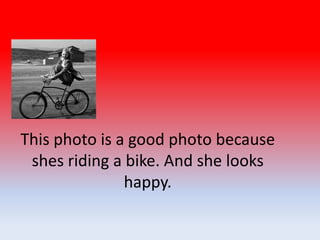
This photo is a good photo because
shes riding a bike. And she looks
happy.
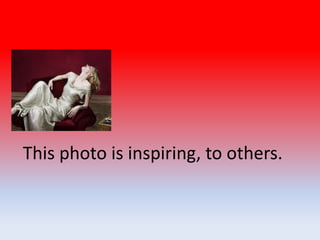
This photo is inspiring, to others.

Annie

  • 1.
  • 2.
    Annie Leibovitz • Shewas born in October 2, 1949 in Waterbury, Connecticut. • When Leibovitz returned to the United States in 1970, she started her career as staff photographer, working for the just launched Rolling Stone magazine. In 1973, publisher Jann Wenner named Leibovitz chief photographer of Rolling Stone, a job she would hold for 10 years. Leibovitz worked for the magazine until 1983, and her intimate photographs of celebrities helped define the Rolling Stone look. While working for Rolling Stone, Leibovitz became more aware of the other magazines. Richard Avedon's portraits were an important and powerful example in her life. She learned that she could work for magazines and still create personal work, which for her was the most important. She sought intimate moments with her subjects, who "open their hearts and souls and lives to you." She was awarded The Royal Photographic Society's Centenary Medal and Honorary Fellowship in recognition of a sustained, significant contribution to the art of photography in 2009. Photographers such as Robert Frank and Henri Cartier-Bresson influenced her during her time at the San Francisco Art Institute. "Their style of personal reportage - taken in a graphic way - was what we were taught to emulate."When Leibovitz returned to the United States in 1970, she started her career as staff photographer, working for the just launched Rolling Stone magazine. In 1973, publisher Jann Wenner named Leibovitz chief photographer of Rolling Stone, a job she would hold for 10 years. Leibovitz worked for the magazine until 1983, and her intimate photographs of celebrities helped define the Rolling Stone look.While working for Rolling Stone, Leibovitz became more aware of the other magazines. Richard Avedon's portraits were an important and powerful example in her life. She learned that she could work for magazines and still create personal work, which for her was the most important. She sought intimate moments with her subjects, who "open their hearts and souls and lives to you." She was awarded The Royal Photographic Society's Centenary Medal and Honorary Fellowship (HonFRPS) in recognition of a sustained, significant contribution to the art of photography in 2009. Photographers such as Robert Frank and Henri Cartier-Bresson influenced her during her time at the San Francisco Art Institute. "Their style of personal reportage - taken in a graphic way - was what we were taught to emulate."
  • 3.
    • • i pickedthis photo because it shows that they are scared.
  • 4.
    This photo isa good photo because shes riding a bike. And she looks happy.
  • 5.
    This photo isinspiring, to others.