
Dive in
Two way bindings
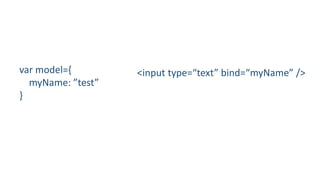
var model={
myName: ”test”
}
<input type=“text” bind=“myName” />
Dirty checking vs. Observables
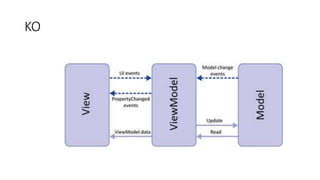
KO
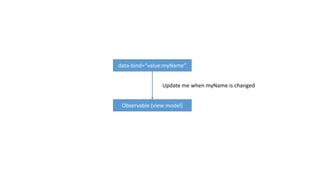
Update me when myName is changed
data-bind=“value:myName”
Observable (view model)
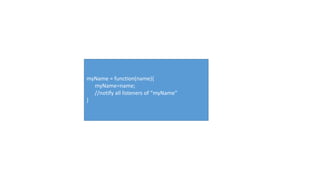
myName = function(name){
myName=name;
//notify all listeners of “myName”
}
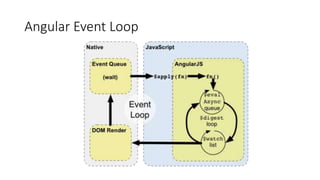
Angular Event Loop
Digest
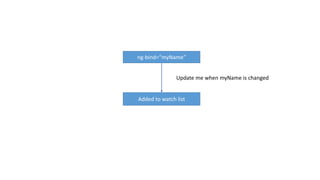
ng-bind=“myName”
Update me when myName is changed
Added to watch list
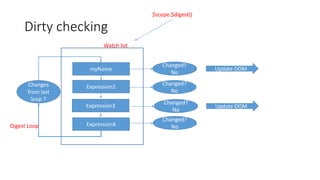
Dirty checking
Expression3
myName
Expression2
Expression4
Changed?
yes
Update DOM
Changed?
No
Changed?
yes
Update DOM
Changed?
No
Changes
from last
loop ?
Watch list
Digest Loop
$scope.$digest()
Changed?
No
Changed?
No
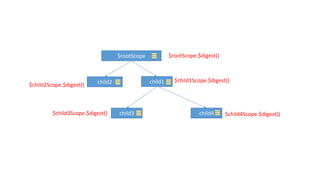
$rootScope
child1child2
child3 child4
$rootScope.$digest()
$child1Scope.$digest()
$child2Scope.$digest()
$child4Scope.$digest()$child3Scope.$digest()
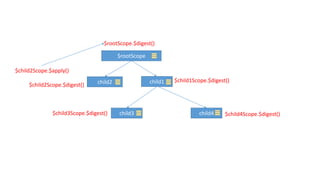
$rootScope.$digest()
$child1Scope.$digest()
$child2Scope.$digest()
$child4Scope.$digest()$child3Scope.$digest()
$child2Scope.$apply()
$rootScope
child1child2
child3 child4
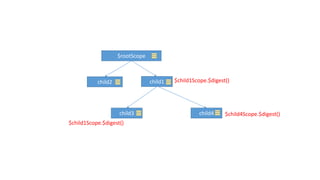
$child1Scope.$digest()
$child4Scope.$digest()
$child1Scope.$digest()
$rootScope
child1child2
child3 child4
Rendering lists KO vs Angular
• Demo
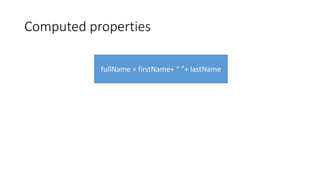
Computed properties
fullName = firstName+ “ ”+ lastName
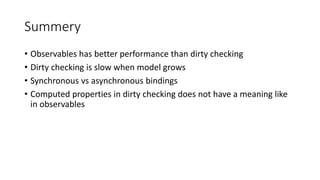
Summery
• Observables has better performance than dirty checking
• Dirty checking is slow when model grows
• Synchronous vs asynchronous bindings
• Computed properties in dirty checking does not have a meaning like
in observables
Performance considerations and best
practices
• When it is slow ?
$scope.$apply() > 25ms
Efficient $watch function
• dirty checking function must be efficient
• Will be evaluated large number of times
• Do not do DOM access (DOM => cost ) inside the $watch functions
$digest vs. $apply
• Use $digest whenever it’s possible
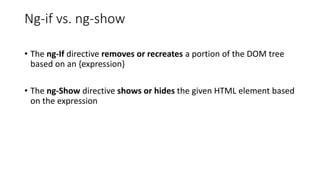
Ng-if vs. ng-show
• The ng-If directive removes or recreates a portion of the DOM tree
based on an {expression}
• The ng-Show directive shows or hides the given HTML element based
on the expression
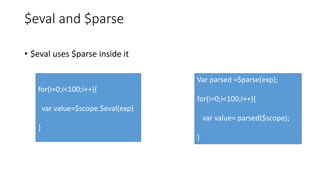
$eval and $parse
• $eval uses $parse inside it
for(i=0;i<100;i++){
var value=$scope.$eval(exp)
}
Var parsed =$parse(exp);
for(i=0;i<100;i++){
var value= parsed($scope);
}
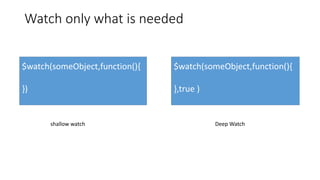
Watch only what is needed
$watch(someObject,function(){
})
$watch(someObject,function(){
},true )
Deep Watchshallow watch
$watch vs. $watchCollection
• $watchCollection will watch only one step deep
• Use $watchCollection if possible
Directives for Performance improvements
• Bind once
• Fast-bind , notify –bind
• Bind sometimes ,not all the time ?
Angular 2.0
• AngularJS 2 is a framework for mobile apps. It is for desktop as well,
but mobile is the hard bit that we will get right first.
• All code in AngularJS 2 is already being written in ES6.
• Faster change detection (Object.observe())
References
• https://docs.angularjs.org/api/ng/type/$rootScope.Scope
• http://www.youtube.com/watch?v=zyYpHIOrk_Y
• http://knockoutjs.com/documentation/observables.html
• http://blog.angularjs.org/2014/03/angular-20.html

AngularJs , How it works

Editor's Notes

  • #5 http://plnkr.co/edit/Mxhf1m3ae4dlZKk370Dh?p=preview --- angular http://plnkr.co/edit/2DViEccXH1049GsTxFho?p=preview ---- knockout
  • #10  $evalAsync ; it should run after the DOM has been manipulated by Angular, but before the browser renders
  • #13 http://plnkr.co/edit/Mxhf1m3ae4dlZKk370Dh?p=info http://plnkr.co/edit/2DViEccXH1049GsTxFho?p=preview user interaction, timer event, or network event https://docs.angularjs.org/guide/scope
  • #16 http://plnkr.co/edit/Mxhf1m3ae4dlZKk370Dh?p=info http://plnkr.co/edit/2DViEccXH1049GsTxFho?p=preview
  • #17  http://plnkr.co/edit/Mxhf1m3ae4dlZKk370Dh?p=info http://plnkr.co/edit/2DViEccXH1049GsTxFho?p=preview myViewModel.personName.extend({ rateLimit: 50 });
  • #18 Angular : http://plnkr.co/edit/dCO08T0tQfNTqZtkOaLd?p=preview Knockout : http://plnkr.co/edit/BL7tpnHFRL6X5dHSHY9C?p=preview
  • #25 Will create a deep copy of the object as well ,if it is true http://www.youtube.com/watch?v=zyYpHIOrk_Y
  • #27 https://github.com/kseamon/fast-bind
  • #28 http://blog.angularjs.org/2014/03/angular-20.html