ANGULARTS(TYPESCRIPT)
Ivan Stepic, Senior software engineer at Comtrade
WHY NOT ANGULARJS
Many OO developers hates JavaScript (I got you ).
Why?
• No static typing's
• Hard to refactor
• No reliable code completition (you can rely on IDE’s completation,
but in most cases it will not work properly)
• No structuring mechanisms like Interfaces, Classes, Modules
• AngularJS 2.0 is written in Typescript
• Future migration to Angular 2.0 will be extremely hard
HOW DIFFICULT IS TO ADOPT AND USE IT?
• Superset of JavaScript
• All JavaScript is valid TypeScript
• Provides static type checking at compile time
• Created by Microsoft and used for building Angular 2.
Any FE developer that came from Java or .net wouldn't need more then
couple days
TYPESCRIPT TO THE RESCUE
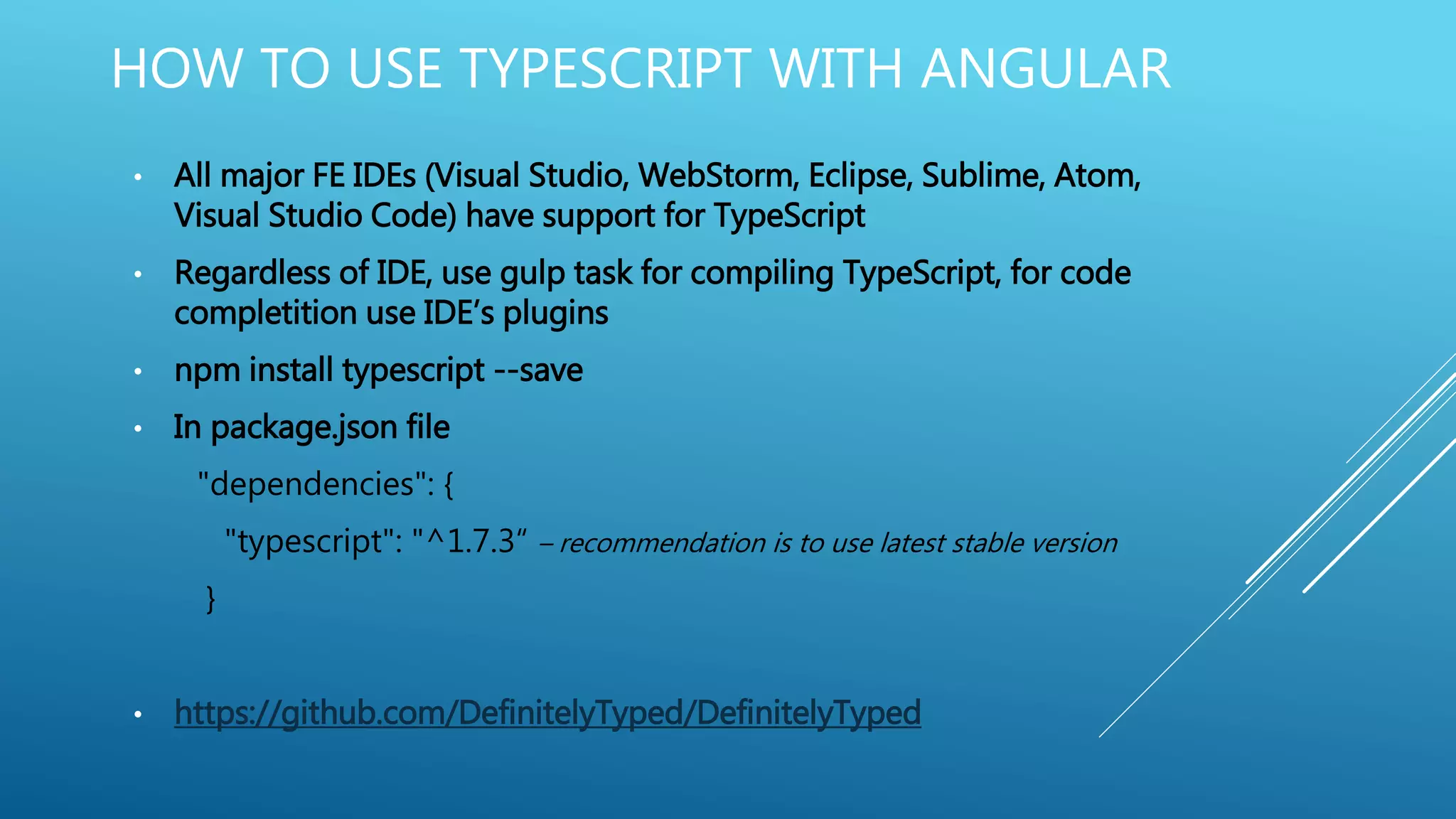
• All major FE IDEs (Visual Studio, WebStorm, Eclipse, Sublime, Atom,
Visual Studio Code) have support for TypeScript
• Regardless of IDE, use gulp task for compiling TypeScript, for code
completition use IDE’s plugins
• npm install typescript --save
• In package.json file
"dependencies": {
"typescript": "^1.7.3“ – recommendation is to use latest stable version
}
• https://github.com/DefinitelyTyped/DefinitelyTyped
HOW TO USE TYPESCRIPT WITH ANGULAR
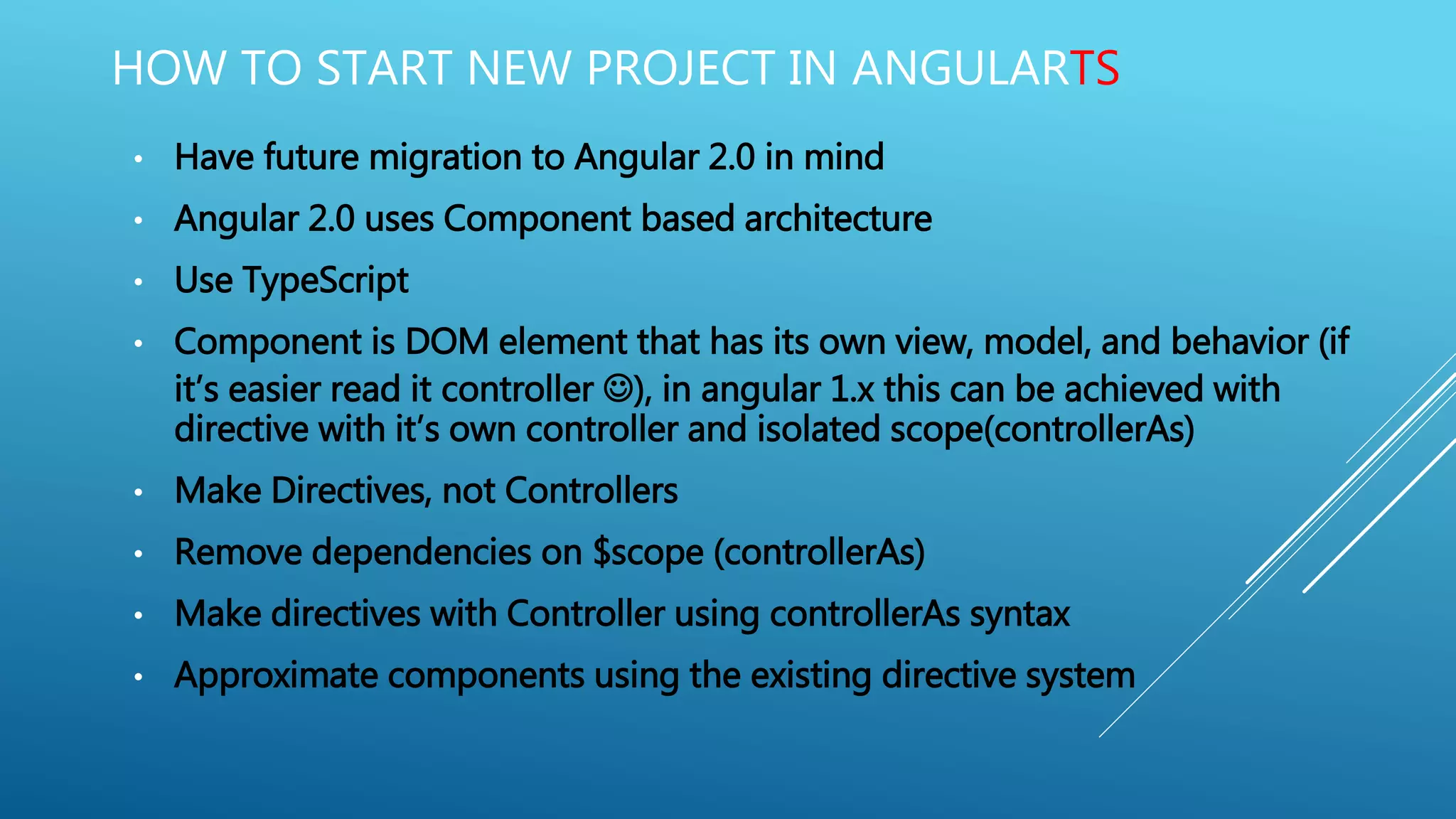
• Have future migration to Angular 2.0 in mind
• Angular 2.0 uses Component based architecture
• Use TypeScript
• Component is DOM element that has its own view, model, and behavior (if
it’s easier read it controller ), in angular 1.x this can be achieved with
directive with it’s own controller and isolated scope(controllerAs)
• Make Directives, not Controllers
• Remove dependencies on $scope (controllerAs)
• Make directives with Controller using controllerAs syntax
• Approximate components using the existing directive system
HOW TO START NEW PROJECT IN ANGULARTS
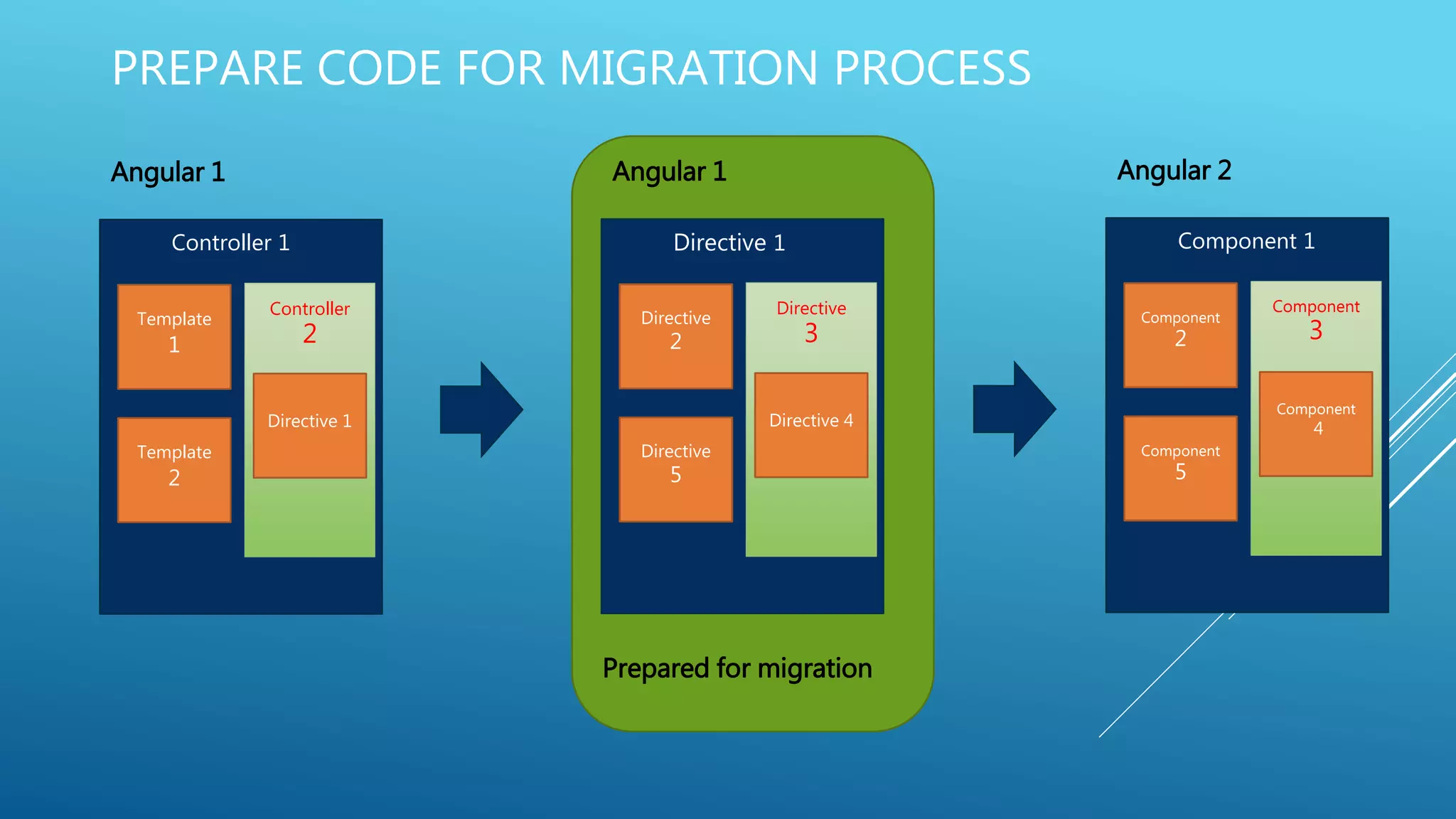
Template
1
Template
2
Directive 1
Controller 1
Controller
2
Angular 1
PREPARE CODE FOR MIGRATION PROCESS
Component
2
Component
5
Component
4
Component 1
Component
3
Angular 2
Directive
2
Directive
5
Directive 4
Directive 1
Directive
3
Angular 1
Prepared for migration
BRIEF ARCHITECTURE
https://github.com/johnpapa/angular-styleguide
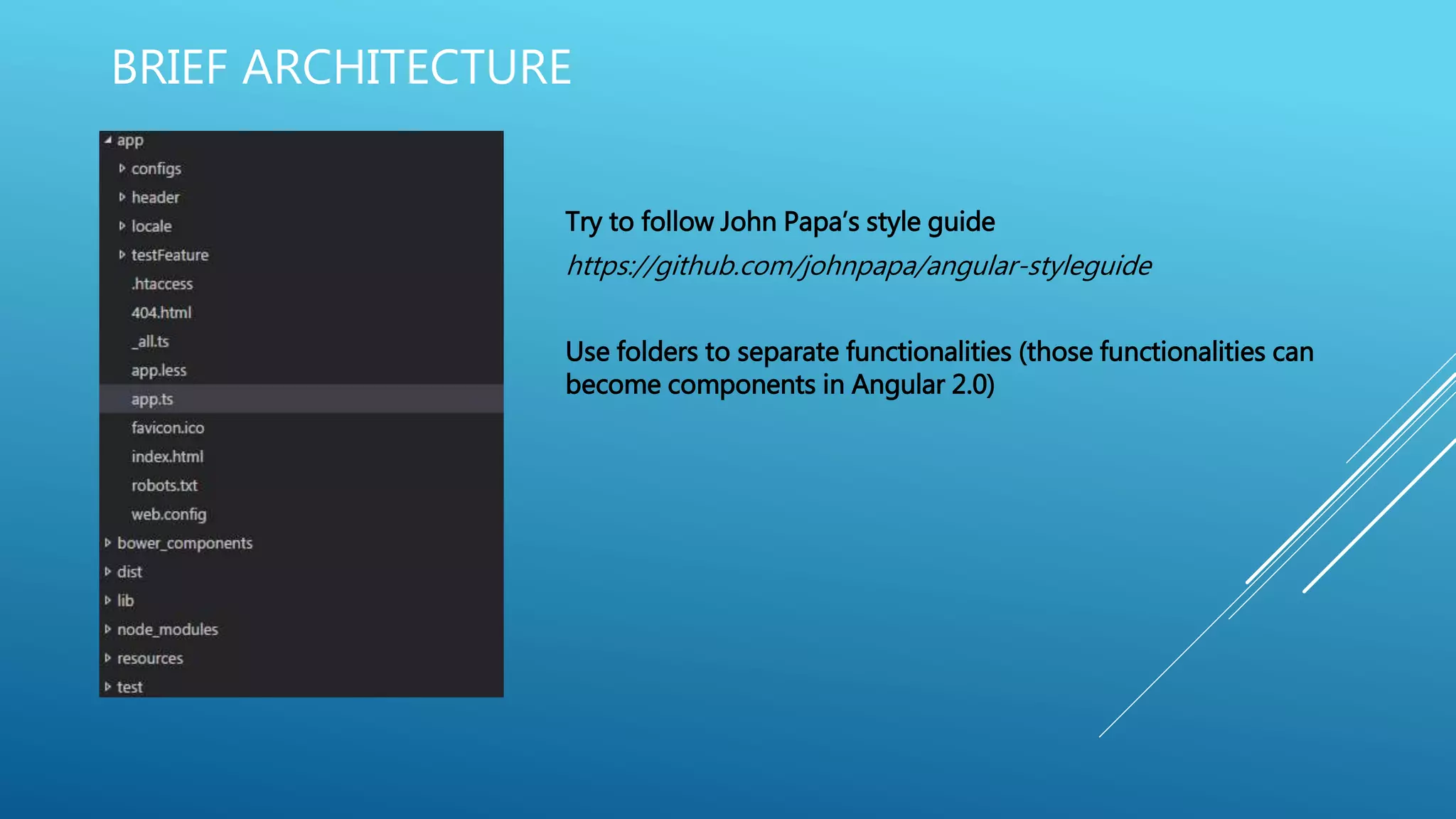
Use folders to separate functionalities (those functionalities can
become components in Angular 2.0)
Try to follow John Papa’s style guide
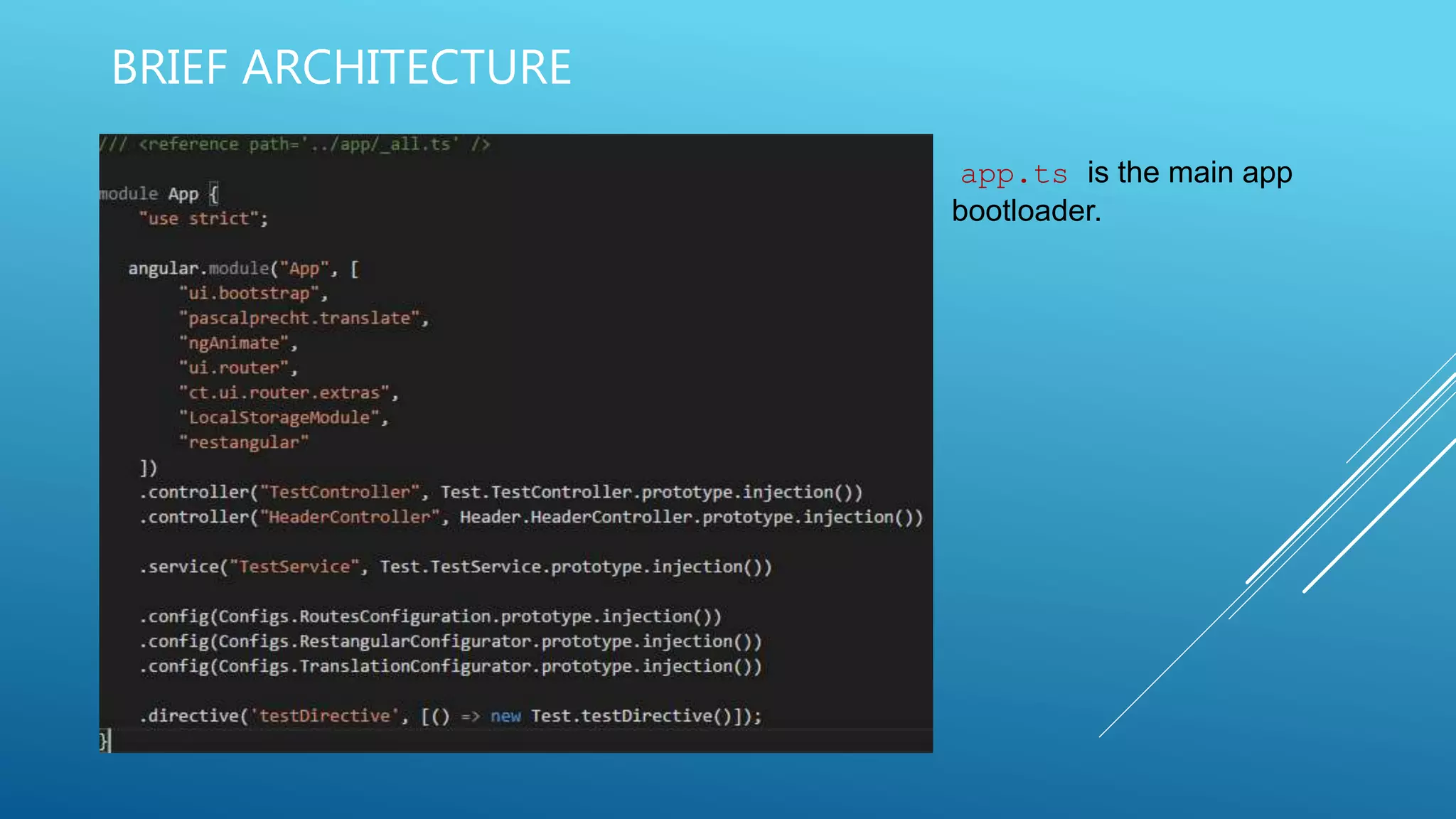
app.ts is the main app
bootloader.
BRIEF ARCHITECTURE
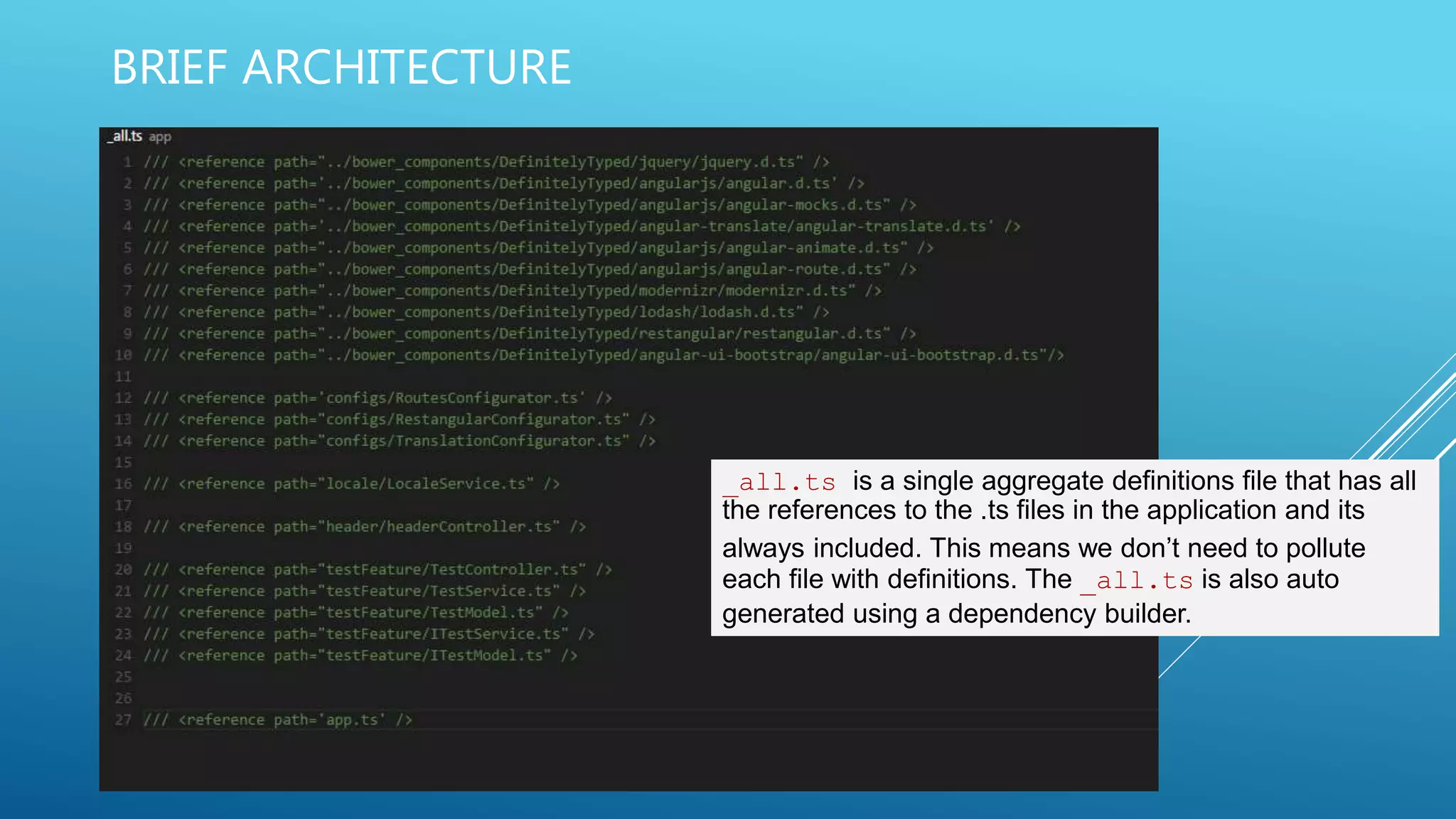
_all.ts is a single aggregate definitions file that has all
the references to the .ts files in the application and its
always included. This means we don’t need to pollute
each file with definitions. The _all.ts is also auto
generated using a dependency builder.
BRIEF ARCHITECTURE
BRIEF ARCHITECTURE
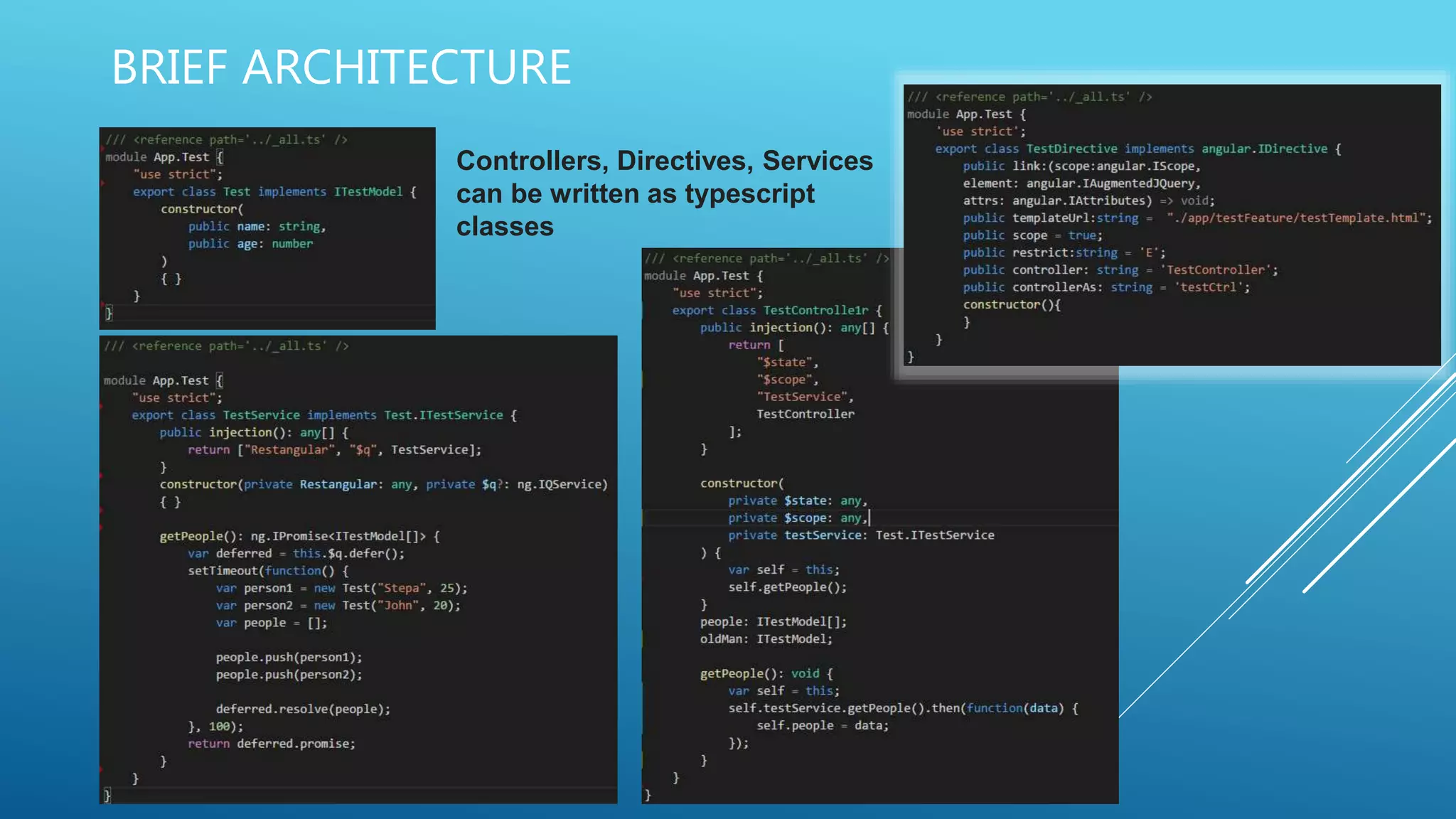
Controllers, Directives, Services
can be written as typescript
classes
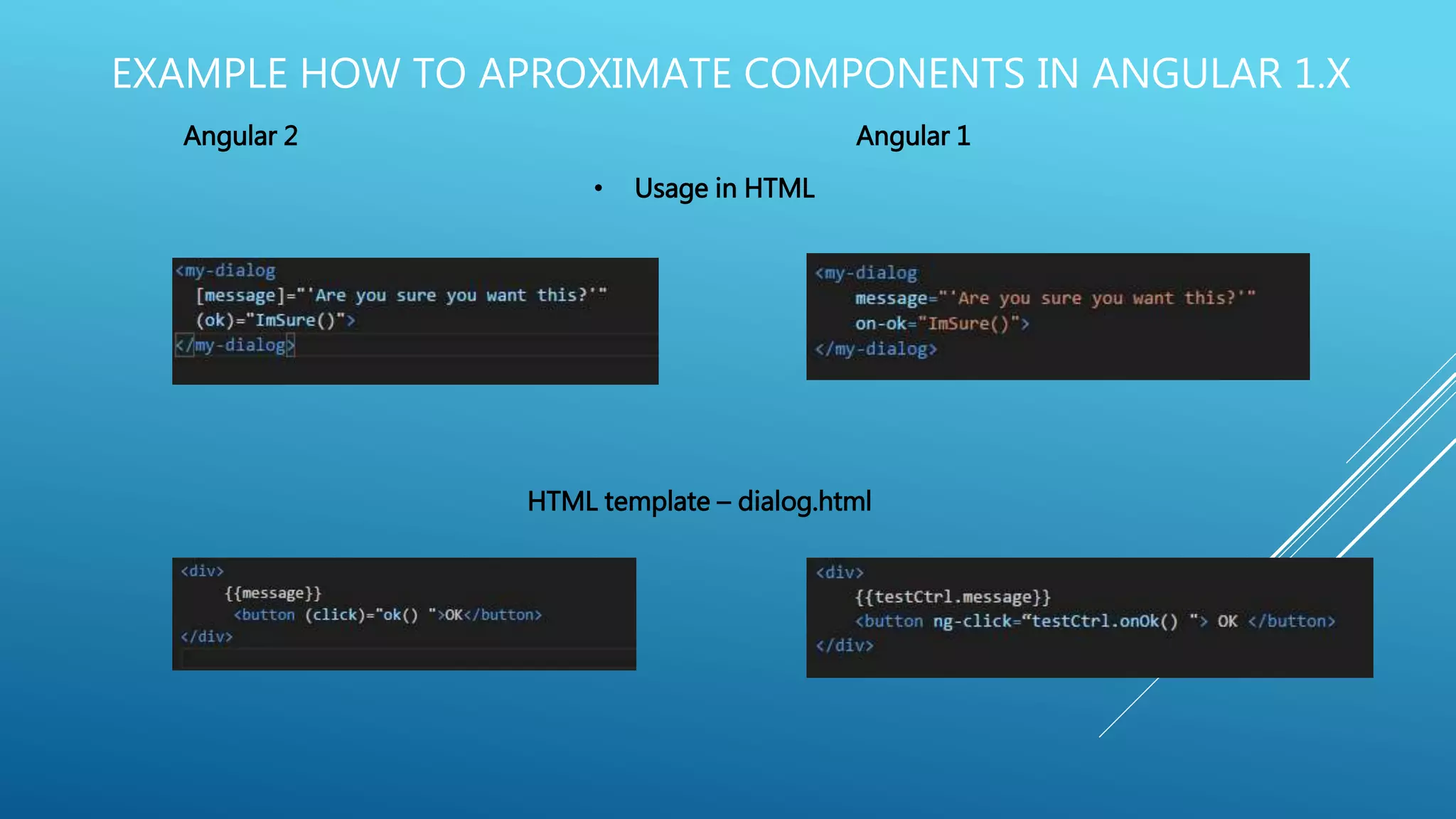
EXAMPLE HOW TO APROXIMATE COMPONENTS IN ANGULAR 1.X
HTML template – dialog.html
Angular 2 Angular 1
• Usage in HTML
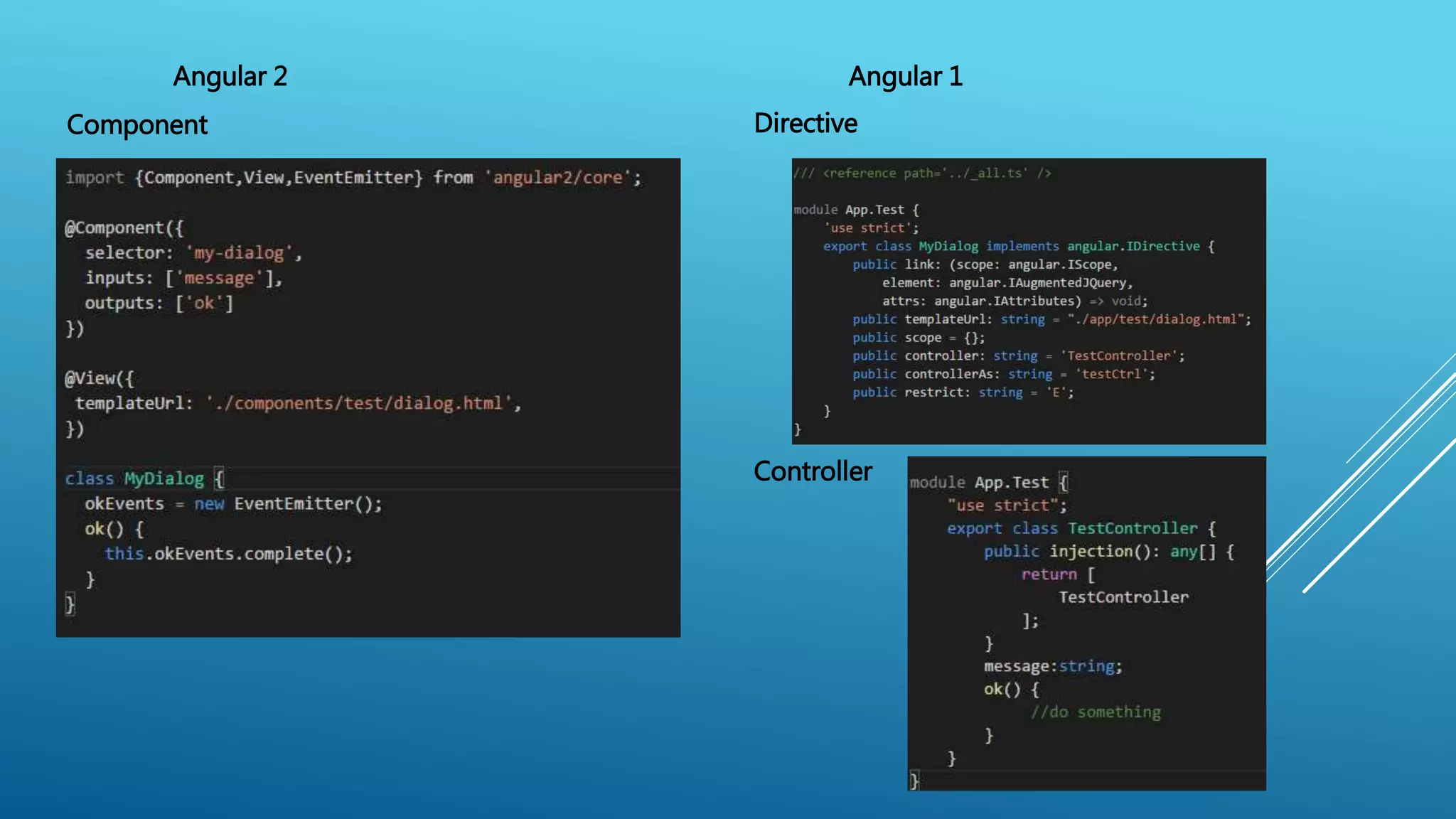
Angular 2 Angular 1
DirectiveComponent
Controller
MODIFY EXITING PROJECT TO ANGULARTS AND PREPARE
IT FOR MIGRATION TO ANGULAR 2.O
• First migrate templates and already isolated parts of code
• Second Refactor Data Flows
The most important refactoring is about finding references to external data or functions from
inside components, and getting rid of them by replacing them with explicit, bound inputs.
Not all external references inside components are logical inputs. Some of them are logical
outputs, this is most often the case with event handlers(ng-click, ng-change)
• Components should not refer to external scope data. All data that they use from the
surrounding context should be explicitly passed in as scope bindings.
• Introduce a binding (=binding or &binding) for external reference or effect, and put it in
the bindToController section of the component directive.
• Find a template expression, a $watch expression, or a $scope access that is referencing
data inherited from a parent scope , or in case of outputs replace the external function call
or reassignment with an invocation of the new binding.
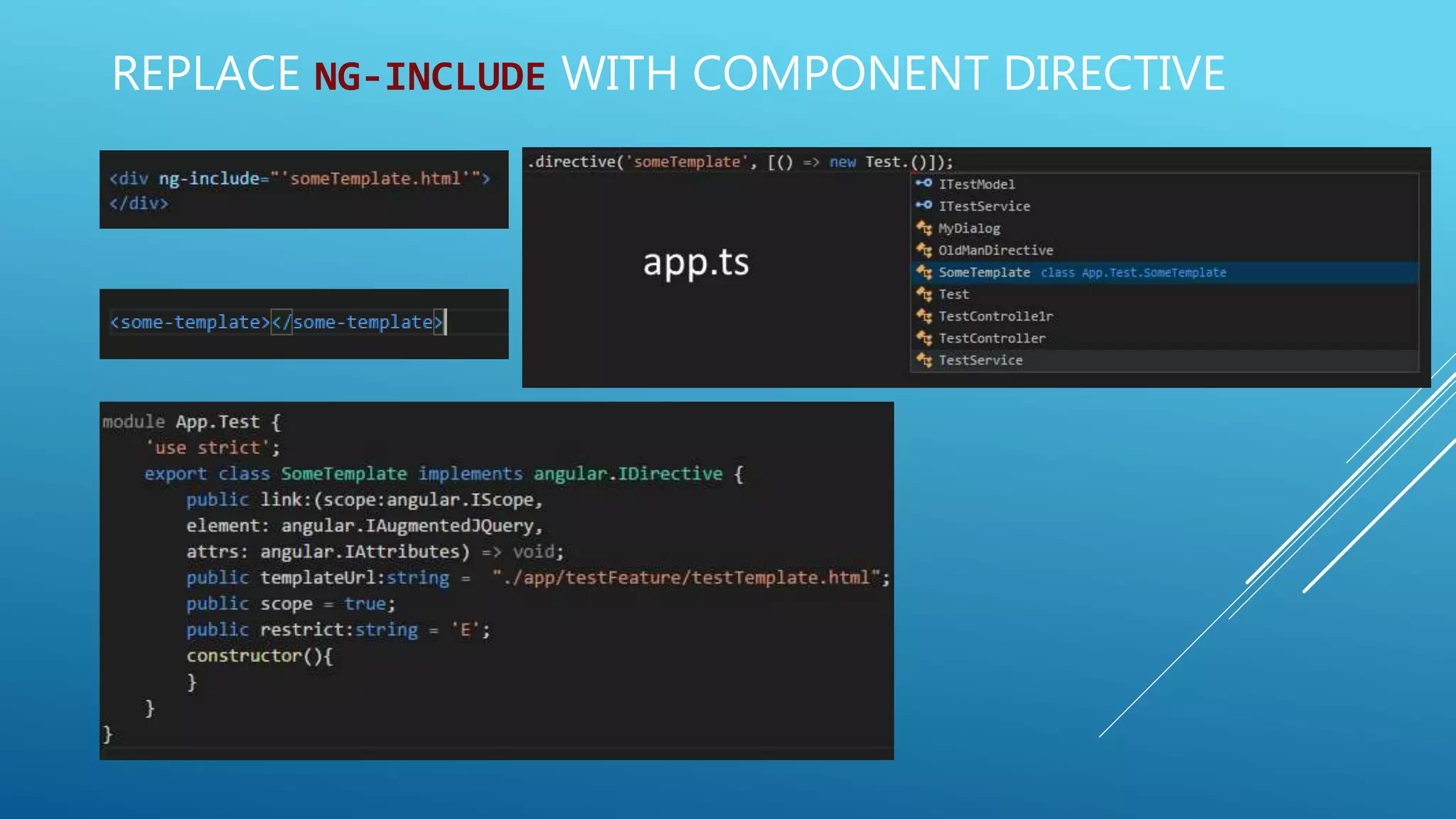
REPLACE NG-INCLUDE WITH COMPONENT DIRECTIVE
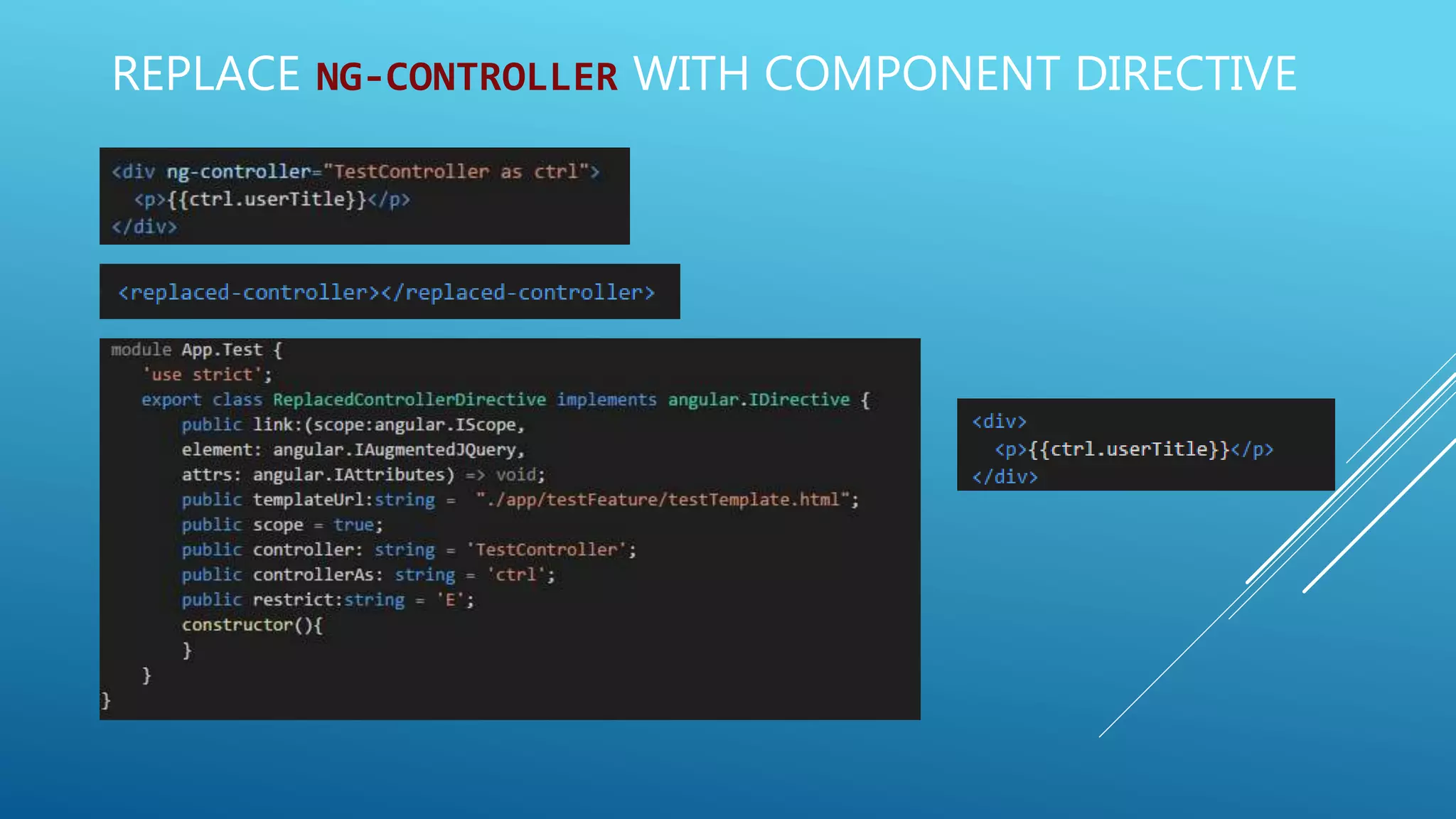
REPLACE NG-CONTROLLER WITH COMPONENT DIRECTIVE
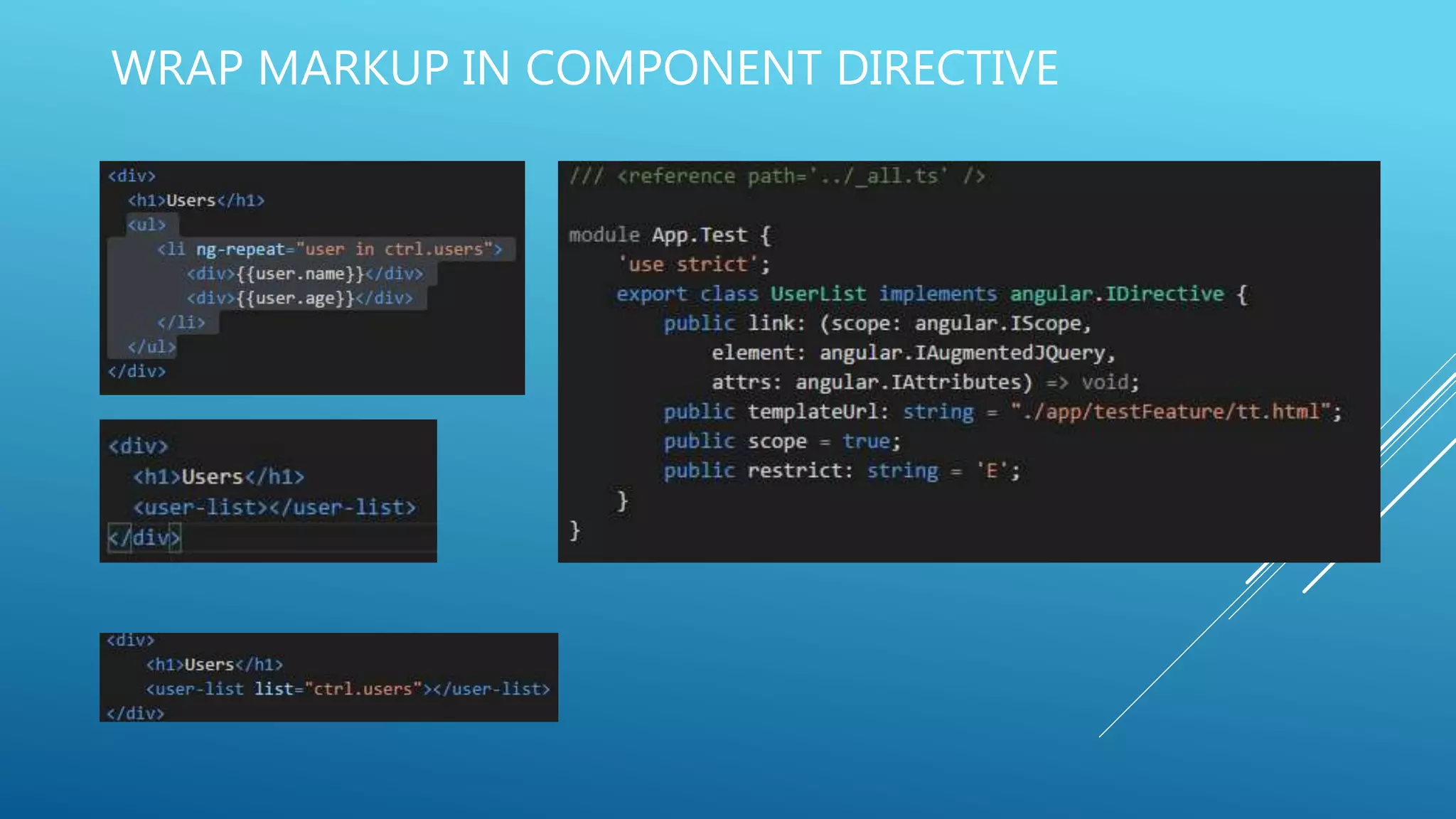
WRAP MARKUP IN COMPONENT DIRECTIVE
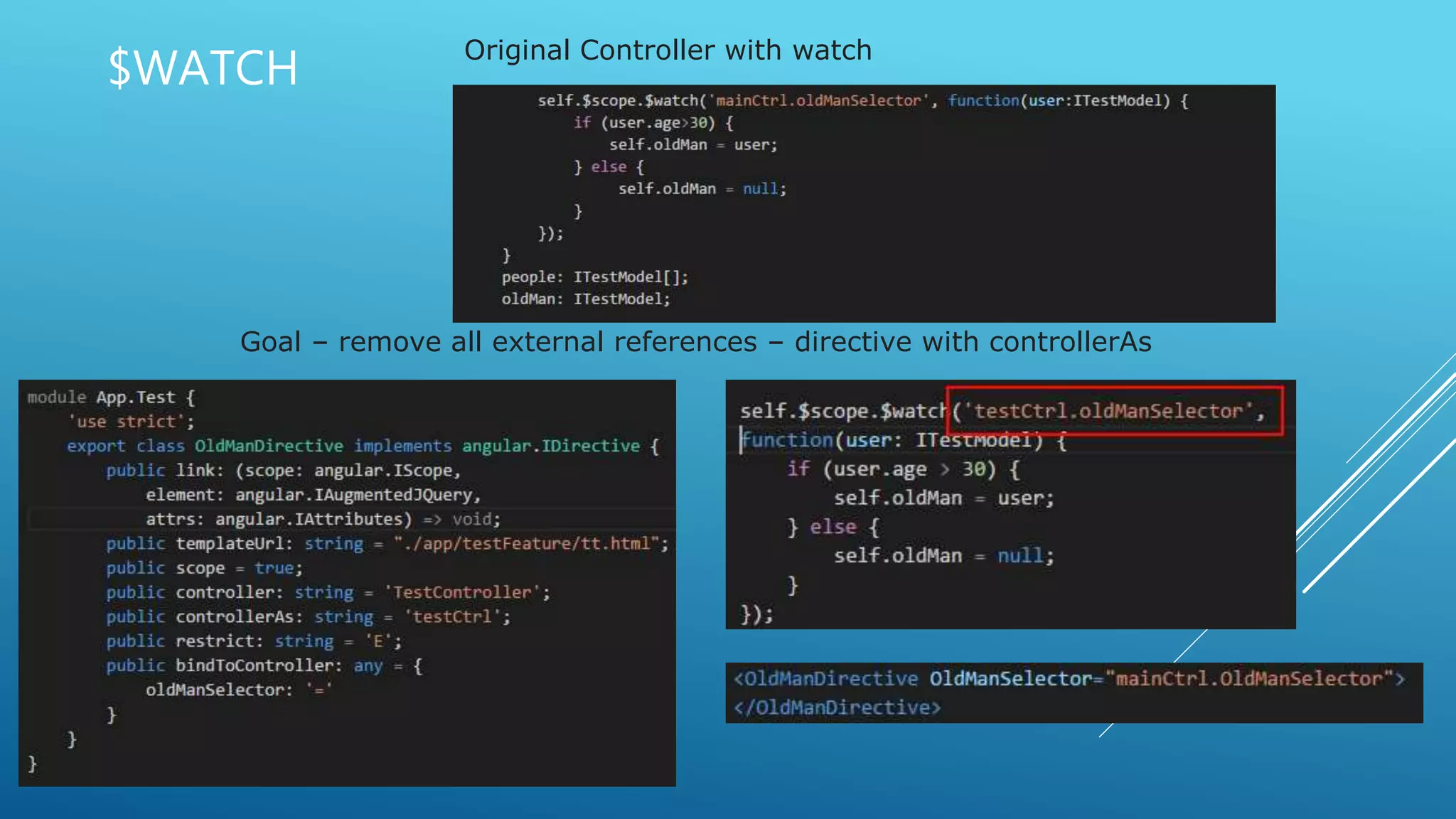
$WATCH
Original Controller with watch
Goal – remove all external references – directive with controllerAs
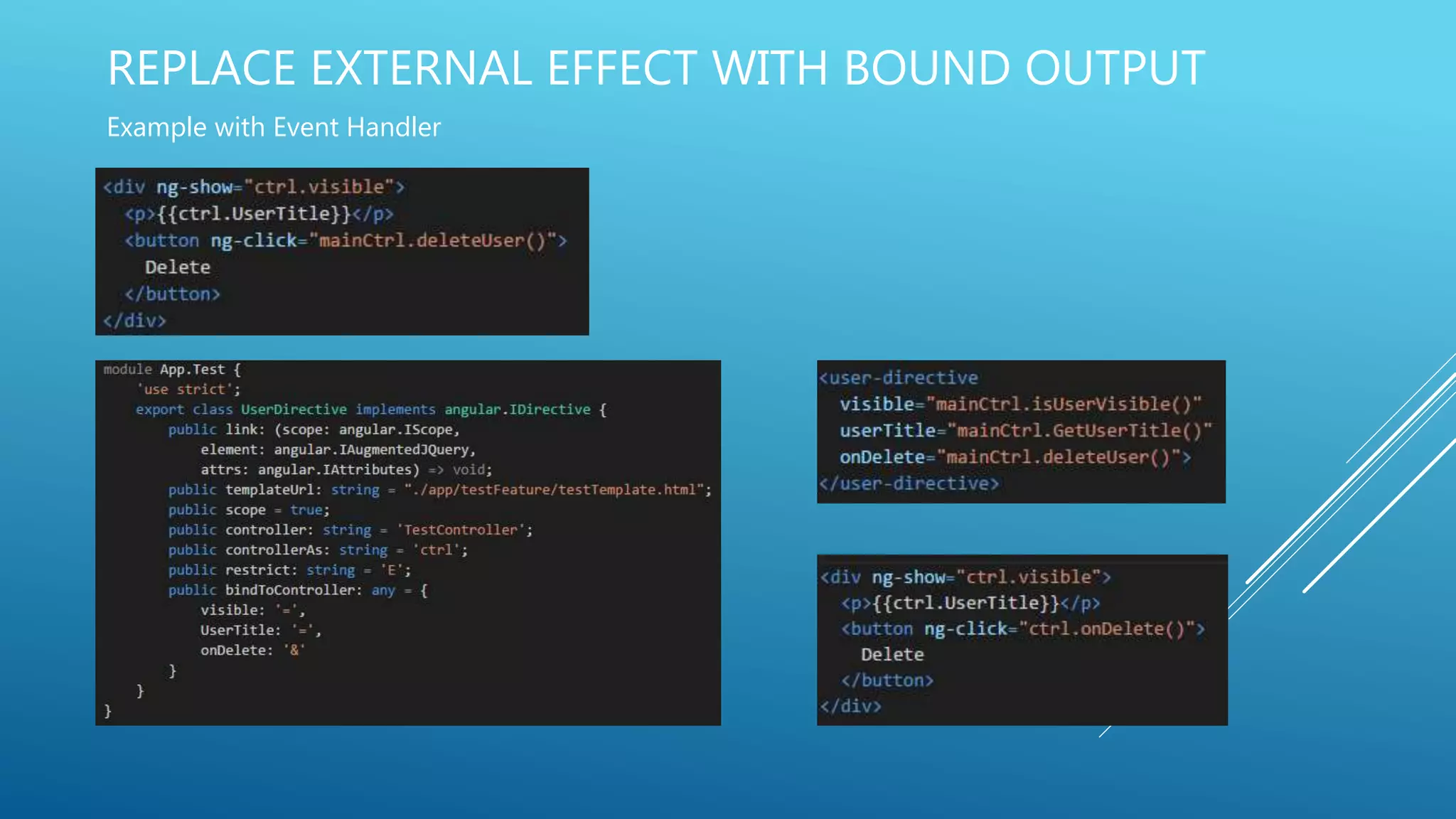
REPLACE EXTERNAL EFFECT WITH BOUND OUTPUT
Example with Event Handler
REPLACE EXTERNAL EFFECT WITH BOUND OUTPUT
Replace Two-way Binding with One-way Binding
If you want to make sure that data flows only in one direction through these
bindings, you can replace them with one-way bindings. The expression binding
syntax '&' can be used here. We've only used it for outputs so far, but it can
also be used for one-way inputs.
UPGRADING FROM ANGULAR 1
ngUpgrade
Write Angular 2 code in that app, without changing your working/tested angular 1 code
lets you mix Angular 2 into your existing Angular 1 application. You'll get to take advantage of
Angular 2's improved speed and APIs immediately as you replace components a bit at a time over
the course of your releases.
ngForward
lets you write Angular 1 applications in the syntax of Angular 2. This lets your team get used Angular
2 conventions and styles in your apps today and shorten the distance to doing the full upgrade to
Angular 2 when you're ready.
http://teropa.info/blog/2015/10/18/refactoring-angular-apps-to-components.html
http://www.syntaxsuccess.com/viewarticle/upgrading-angular-1.x-to-2.0
http://angularjs.blogspot.si/
https://angular.io/docs/ts/latest/guide/architecture.html
INSPIRED BY

Angular TS(typescript)

  • 1.
    ANGULARTS(TYPESCRIPT) Ivan Stepic, Seniorsoftware engineer at Comtrade
  • 2.
    WHY NOT ANGULARJS ManyOO developers hates JavaScript (I got you ). Why? • No static typing's • Hard to refactor • No reliable code completition (you can rely on IDE’s completation, but in most cases it will not work properly) • No structuring mechanisms like Interfaces, Classes, Modules • AngularJS 2.0 is written in Typescript • Future migration to Angular 2.0 will be extremely hard
  • 3.
    HOW DIFFICULT ISTO ADOPT AND USE IT? • Superset of JavaScript • All JavaScript is valid TypeScript • Provides static type checking at compile time • Created by Microsoft and used for building Angular 2. Any FE developer that came from Java or .net wouldn't need more then couple days TYPESCRIPT TO THE RESCUE
  • 4.
    • All majorFE IDEs (Visual Studio, WebStorm, Eclipse, Sublime, Atom, Visual Studio Code) have support for TypeScript • Regardless of IDE, use gulp task for compiling TypeScript, for code completition use IDE’s plugins • npm install typescript --save • In package.json file "dependencies": { "typescript": "^1.7.3“ – recommendation is to use latest stable version } • https://github.com/DefinitelyTyped/DefinitelyTyped HOW TO USE TYPESCRIPT WITH ANGULAR
  • 5.
    • Have futuremigration to Angular 2.0 in mind • Angular 2.0 uses Component based architecture • Use TypeScript • Component is DOM element that has its own view, model, and behavior (if it’s easier read it controller ), in angular 1.x this can be achieved with directive with it’s own controller and isolated scope(controllerAs) • Make Directives, not Controllers • Remove dependencies on $scope (controllerAs) • Make directives with Controller using controllerAs syntax • Approximate components using the existing directive system HOW TO START NEW PROJECT IN ANGULARTS
  • 6.
    Template 1 Template 2 Directive 1 Controller 1 Controller 2 Angular1 PREPARE CODE FOR MIGRATION PROCESS Component 2 Component 5 Component 4 Component 1 Component 3 Angular 2 Directive 2 Directive 5 Directive 4 Directive 1 Directive 3 Angular 1 Prepared for migration
  • 7.
    BRIEF ARCHITECTURE https://github.com/johnpapa/angular-styleguide Use foldersto separate functionalities (those functionalities can become components in Angular 2.0) Try to follow John Papa’s style guide
  • 8.
    app.ts is themain app bootloader. BRIEF ARCHITECTURE
  • 9.
    _all.ts is asingle aggregate definitions file that has all the references to the .ts files in the application and its always included. This means we don’t need to pollute each file with definitions. The _all.ts is also auto generated using a dependency builder. BRIEF ARCHITECTURE
  • 10.
    BRIEF ARCHITECTURE Controllers, Directives,Services can be written as typescript classes
  • 11.
    EXAMPLE HOW TOAPROXIMATE COMPONENTS IN ANGULAR 1.X HTML template – dialog.html Angular 2 Angular 1 • Usage in HTML
  • 12.
    Angular 2 Angular1 DirectiveComponent Controller
  • 13.
    MODIFY EXITING PROJECTTO ANGULARTS AND PREPARE IT FOR MIGRATION TO ANGULAR 2.O • First migrate templates and already isolated parts of code • Second Refactor Data Flows The most important refactoring is about finding references to external data or functions from inside components, and getting rid of them by replacing them with explicit, bound inputs. Not all external references inside components are logical inputs. Some of them are logical outputs, this is most often the case with event handlers(ng-click, ng-change) • Components should not refer to external scope data. All data that they use from the surrounding context should be explicitly passed in as scope bindings. • Introduce a binding (=binding or &binding) for external reference or effect, and put it in the bindToController section of the component directive. • Find a template expression, a $watch expression, or a $scope access that is referencing data inherited from a parent scope , or in case of outputs replace the external function call or reassignment with an invocation of the new binding.
  • 14.
    REPLACE NG-INCLUDE WITHCOMPONENT DIRECTIVE
  • 15.
    REPLACE NG-CONTROLLER WITHCOMPONENT DIRECTIVE
  • 16.
    WRAP MARKUP INCOMPONENT DIRECTIVE
  • 17.
    $WATCH Original Controller withwatch Goal – remove all external references – directive with controllerAs
  • 18.
    REPLACE EXTERNAL EFFECTWITH BOUND OUTPUT Example with Event Handler
  • 19.
    REPLACE EXTERNAL EFFECTWITH BOUND OUTPUT Replace Two-way Binding with One-way Binding If you want to make sure that data flows only in one direction through these bindings, you can replace them with one-way bindings. The expression binding syntax '&' can be used here. We've only used it for outputs so far, but it can also be used for one-way inputs.
  • 20.
    UPGRADING FROM ANGULAR1 ngUpgrade Write Angular 2 code in that app, without changing your working/tested angular 1 code lets you mix Angular 2 into your existing Angular 1 application. You'll get to take advantage of Angular 2's improved speed and APIs immediately as you replace components a bit at a time over the course of your releases. ngForward lets you write Angular 1 applications in the syntax of Angular 2. This lets your team get used Angular 2 conventions and styles in your apps today and shorten the distance to doing the full upgrade to Angular 2 when you're ready.
  • 22.