Androgen excess Treatment &
Medication
Androgen Excess (cont’d)
Treatment
Treatment & Medication
• Medical Care
• Medical treatment
• Needs to be maintained for a long time
(satisfactory clinical effects of drugs appear after several months)
• Pharmacologic measures
• Aim to correct symptoms by lowering
 Serum-free androgen levels and
 Blocking the peripheral androgen action
Androgen Excess
Treatment (cont’d)
• Suppression of ovarian androgens by administration of
• Estrogens and/or progestins (ie, contraceptive pill) or
• GnRH agonist and add-back estrogen therapy
• Suppression of adrenal androgens by administration of
• Glucocorticoids (dexamethasone, prednisolone)
• Use of antiandrogens
• Spironolactone, flutamide, cyproterone acetate
• Use of the 5 α -reductase inhibitor
• finasteride
• Use of bromocriptine in hyperprolactinemia
• Use of insulin-sensitizing drugs
• metformin, thiazolidinediones
– Oral contraceptive (OC) combined with antiandrogens is the first-line approach to nonadrenal hyperandrogenism. OCs alone
have limited efficacy in treating androgen excess; however, they provide reliable contraception, help in the treatment of acne,
and counteract the risk of endometrial cancer associated with anovulation and unopposed estrogen stimulation.
Antiandrogens are best added to OC therapy to maximize the results in hirsutism treatment.
– Progestins in adequate doses suppress the ovarian function and, therefore, reduce hirsutism. Progestins do not offer additional
advantages and are used only in patients in whom combined OCs are not indicated.
– Adrenal hyperandrogenism (CAH, Cushing syndrome), respond to glucocorticoid treatment with prednisolone or
dexamethasone in a low dose. The long-term effect of low-dose glucocorticoid therapy on the bone metabolism and
dysmetabolic syndrome is not entirely clear; therefore, the steroid dose should be lowered or discontinued after 3 months.
– Suppression of androgen secretion has limited efficacy on hair growth and the best results are obtained by using
antiandrogens. Antiandrogen drug availability in different countries is inconsistent; the US Food and Drug Administration (FDA)
does not approve the use of the antiandrogen cyproterone acetate in hyperandrogenism.
– Antiandrogens alone or in combination with OC pills are effective treatments of hyperandrogenism. Spironolactone,
finasteride, flutamide, and cyproterone acetate have all been demonstrated to be equally effective. Antiandrogens are class D
or X in pregnancy; therefore, an effective form of contraception is required when using these drugs. They can cause ambiguous
genitalia and feminization of a male fetus.
– GnRH agonists are effective in severe hirsutism and virilism secondary to ovarian hyperandrogenism. The GnRH agonist
suppresses the ovarian androgen production by inhibiting the gonadotrophin secretion. Hormone replacement therapy (HRT)
add back can be used to relieve the symptoms of hypoestrogenism. HRT also increases SHBG and decreases free testosterone.
The HRT add back can be any HRT, either sequential or continuous combined. For the initial few months, the addition of 100-
200 mg/d of spironolactone may help. After improvement of both the serum testosterone values and hirsutism, these patients
can stop the GnRH agonist and switch to an OC with or without spironolactone.
– Insulin-sensitizing drugs have a role in hyperandrogenism associated with PCOS because they decrease hyperinsulinemia and
insulin resistance.
Androgen Excess
Treatment (cont’d)
Hirsutism treatment
• A combination of both mechanical and medical methods best treats hirsutism
• Medical therapy does not work on terminal hairs
• First-line approach to hirsutism
 OC combined with an antiandrogen
Progestin lowers both the
Ovarian androgen production and
Adrenal DHEAS production
Estrogene increases
SHBG production
thus lowering the free androgens
• Depo-Provera is also good choice
Androgen Excess
Treatment (cont’d)
• A GnRH agonist
Severe hirsutism and virilism secondary to hyperthecosis
• Adrenal hyperandrogenism responds to glucocorticoid (prednisolone or dexamethasone )
• Monotherapy with spironolactone, finasteride, flutamide, and cyproterone acetate is equally effective
An effective form of contraception is required when using these drugs.
• Spironolactone
• Cyproterone acetate
• Topical eflornithine (Vaniqa)- ( blocks the ornithine carboxylase in the hair follicle)
For the treatment of facial hirsutism
• Insulin-sensitizing drugs on hirsutism ( efficacy appears limited)
Androgen Excess
Treatment (cont’d)
Acne treatment
• Directed to reduce the
 sebum production
 normalize the keratin production
 clear comedones, and
 eliminate the propionibacterium acne colonization
Androgen Excess
Treatment (cont’d)
• Topical and systemic treatment exists
• The drugs that decrease hirsutism also decrease acne
 mild-to-moderate acne has been shown to improve with OCs
(a review of the literature indicates that all OCs studied are efficacious)
Androgen Excess
Treatment (cont’d)
• Topical retinoids
 help to normalize keratinocyte differentiation and reduce cell proliferation and inflammation
 the first choices in patients with comedonal acne (should be applied at bedtime)
• Oral isotretinoin (Accutane)
 useful in severe inflammatory acne and in cases that are unresponsive to other treatments
 It is category X and teratogenetic, therefore 2 effective forms of contraception are required.
• Antibacterial drugs can be used alone or in association with topical retinoid
 Topical or oral
 tetracycline
 erythromycin, and
 clindamycin can all be used effectively
Androgen Excess
Treatment (cont’d)
Ovulatory dysfunction and infertility treatment
 Clomiphene citrate 50-200 mg/d for 5 days, commencing on day 2 or 3 of the
menstrual cycle
(25% do not respond to clomiphene)
 Can be treated with gonadotrophins
hyperstimulation syndrome and multiple pregnancy rates of up to 25% are
recognized complications
 Dexamethasone (short course) can be added to clomiphene to restore ovulation
 Metformin
Androgen Excess
Treatment (cont’d)
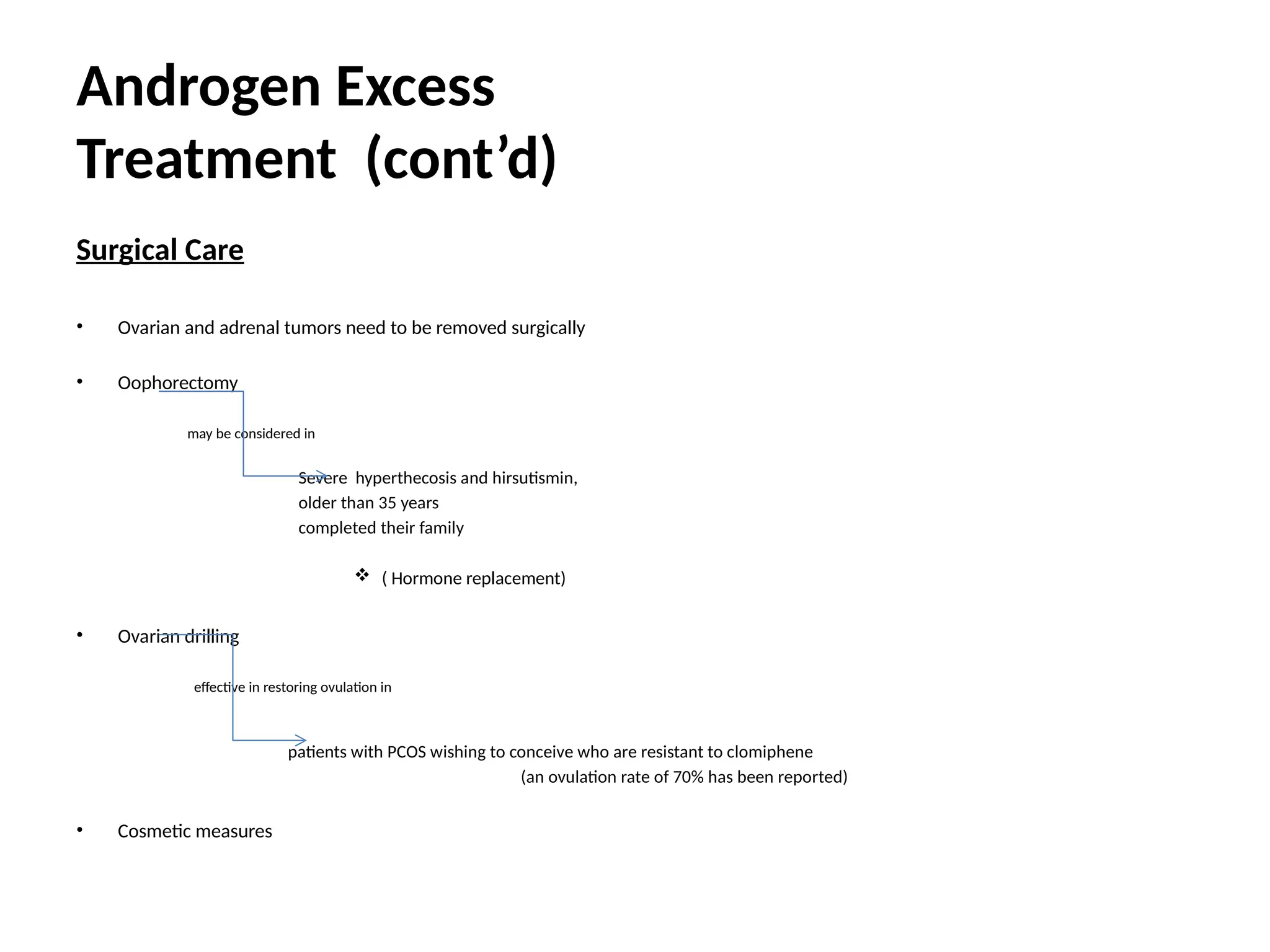
Surgical Care
• Ovarian and adrenal tumors need to be removed surgically
• Oophorectomy
may be considered in
Severe hyperthecosis and hirsutismin,
older than 35 years
completed their family
 ( Hormone replacement)
• Ovarian drilling
effective in restoring ovulation in
patients with PCOS wishing to conceive who are resistant to clomiphene
(an ovulation rate of 70% has been reported)
• Cosmetic measures
Androgen Excess
Treatment (cont’d)
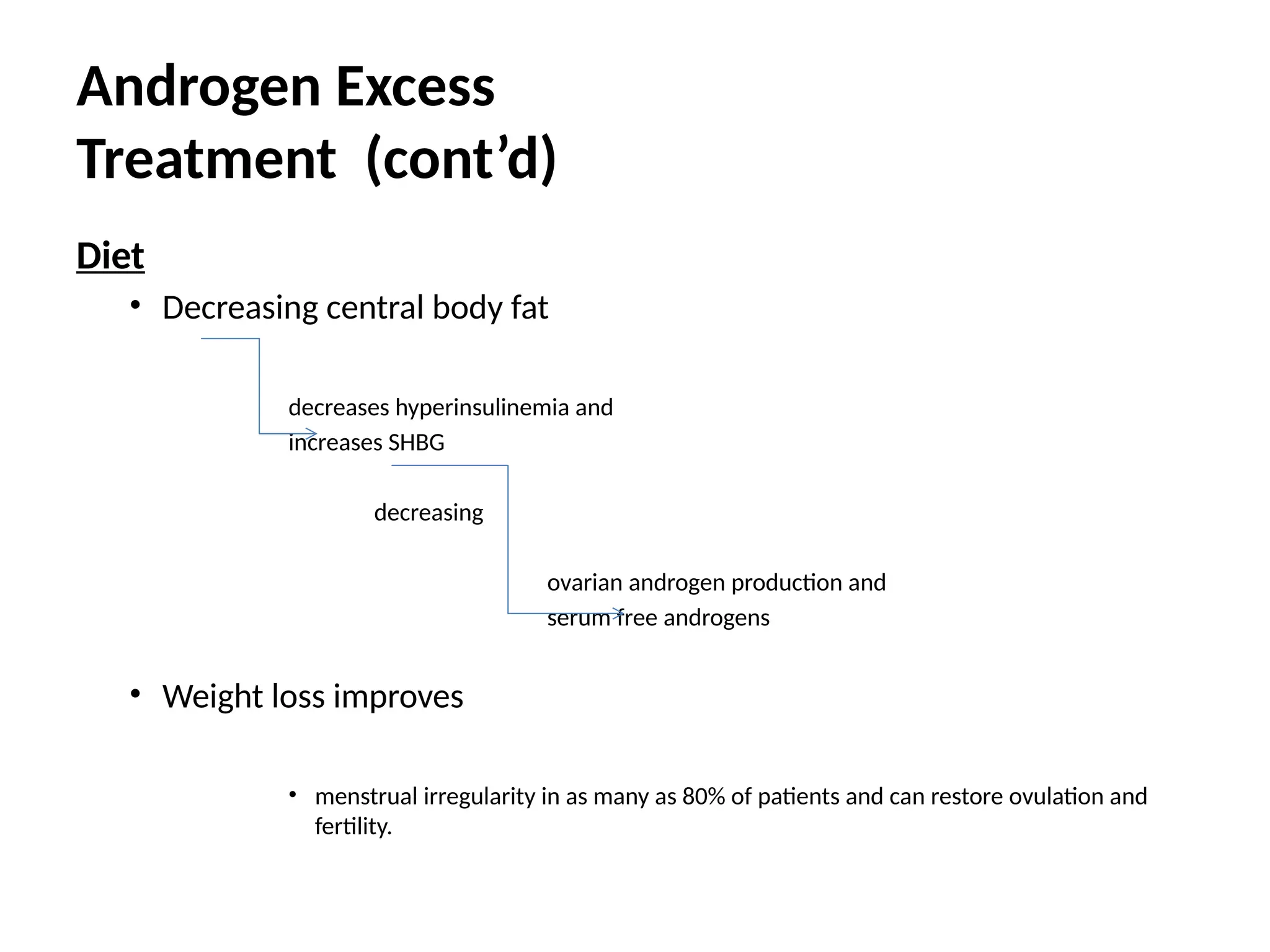
Diet
• Decreasing central body fat
decreases hyperinsulinemia and
increases SHBG
decreasing
ovarian androgen production and
serum free androgens
• Weight loss improves
• menstrual irregularity in as many as 80% of patients and can restore ovulation and
fertility.
• Treatment & Medication

androgen excess & treatment e-medicine.pptx

  • 1.
  • 2.
    Androgen Excess (cont’d) Treatment Treatment& Medication • Medical Care • Medical treatment • Needs to be maintained for a long time (satisfactory clinical effects of drugs appear after several months) • Pharmacologic measures • Aim to correct symptoms by lowering  Serum-free androgen levels and  Blocking the peripheral androgen action
  • 3.
    Androgen Excess Treatment (cont’d) •Suppression of ovarian androgens by administration of • Estrogens and/or progestins (ie, contraceptive pill) or • GnRH agonist and add-back estrogen therapy • Suppression of adrenal androgens by administration of • Glucocorticoids (dexamethasone, prednisolone) • Use of antiandrogens • Spironolactone, flutamide, cyproterone acetate • Use of the 5 α -reductase inhibitor • finasteride • Use of bromocriptine in hyperprolactinemia • Use of insulin-sensitizing drugs • metformin, thiazolidinediones
  • 4.
    – Oral contraceptive(OC) combined with antiandrogens is the first-line approach to nonadrenal hyperandrogenism. OCs alone have limited efficacy in treating androgen excess; however, they provide reliable contraception, help in the treatment of acne, and counteract the risk of endometrial cancer associated with anovulation and unopposed estrogen stimulation. Antiandrogens are best added to OC therapy to maximize the results in hirsutism treatment. – Progestins in adequate doses suppress the ovarian function and, therefore, reduce hirsutism. Progestins do not offer additional advantages and are used only in patients in whom combined OCs are not indicated. – Adrenal hyperandrogenism (CAH, Cushing syndrome), respond to glucocorticoid treatment with prednisolone or dexamethasone in a low dose. The long-term effect of low-dose glucocorticoid therapy on the bone metabolism and dysmetabolic syndrome is not entirely clear; therefore, the steroid dose should be lowered or discontinued after 3 months. – Suppression of androgen secretion has limited efficacy on hair growth and the best results are obtained by using antiandrogens. Antiandrogen drug availability in different countries is inconsistent; the US Food and Drug Administration (FDA) does not approve the use of the antiandrogen cyproterone acetate in hyperandrogenism. – Antiandrogens alone or in combination with OC pills are effective treatments of hyperandrogenism. Spironolactone, finasteride, flutamide, and cyproterone acetate have all been demonstrated to be equally effective. Antiandrogens are class D or X in pregnancy; therefore, an effective form of contraception is required when using these drugs. They can cause ambiguous genitalia and feminization of a male fetus. – GnRH agonists are effective in severe hirsutism and virilism secondary to ovarian hyperandrogenism. The GnRH agonist suppresses the ovarian androgen production by inhibiting the gonadotrophin secretion. Hormone replacement therapy (HRT) add back can be used to relieve the symptoms of hypoestrogenism. HRT also increases SHBG and decreases free testosterone. The HRT add back can be any HRT, either sequential or continuous combined. For the initial few months, the addition of 100- 200 mg/d of spironolactone may help. After improvement of both the serum testosterone values and hirsutism, these patients can stop the GnRH agonist and switch to an OC with or without spironolactone. – Insulin-sensitizing drugs have a role in hyperandrogenism associated with PCOS because they decrease hyperinsulinemia and insulin resistance.
  • 5.
    Androgen Excess Treatment (cont’d) Hirsutismtreatment • A combination of both mechanical and medical methods best treats hirsutism • Medical therapy does not work on terminal hairs • First-line approach to hirsutism  OC combined with an antiandrogen Progestin lowers both the Ovarian androgen production and Adrenal DHEAS production Estrogene increases SHBG production thus lowering the free androgens • Depo-Provera is also good choice
  • 6.
    Androgen Excess Treatment (cont’d) •A GnRH agonist Severe hirsutism and virilism secondary to hyperthecosis • Adrenal hyperandrogenism responds to glucocorticoid (prednisolone or dexamethasone ) • Monotherapy with spironolactone, finasteride, flutamide, and cyproterone acetate is equally effective An effective form of contraception is required when using these drugs. • Spironolactone • Cyproterone acetate • Topical eflornithine (Vaniqa)- ( blocks the ornithine carboxylase in the hair follicle) For the treatment of facial hirsutism • Insulin-sensitizing drugs on hirsutism ( efficacy appears limited)
  • 7.
    Androgen Excess Treatment (cont’d) Acnetreatment • Directed to reduce the  sebum production  normalize the keratin production  clear comedones, and  eliminate the propionibacterium acne colonization
  • 8.
    Androgen Excess Treatment (cont’d) •Topical and systemic treatment exists • The drugs that decrease hirsutism also decrease acne  mild-to-moderate acne has been shown to improve with OCs (a review of the literature indicates that all OCs studied are efficacious)
  • 9.
    Androgen Excess Treatment (cont’d) •Topical retinoids  help to normalize keratinocyte differentiation and reduce cell proliferation and inflammation  the first choices in patients with comedonal acne (should be applied at bedtime) • Oral isotretinoin (Accutane)  useful in severe inflammatory acne and in cases that are unresponsive to other treatments  It is category X and teratogenetic, therefore 2 effective forms of contraception are required. • Antibacterial drugs can be used alone or in association with topical retinoid  Topical or oral  tetracycline  erythromycin, and  clindamycin can all be used effectively
  • 10.
    Androgen Excess Treatment (cont’d) Ovulatorydysfunction and infertility treatment  Clomiphene citrate 50-200 mg/d for 5 days, commencing on day 2 or 3 of the menstrual cycle (25% do not respond to clomiphene)  Can be treated with gonadotrophins hyperstimulation syndrome and multiple pregnancy rates of up to 25% are recognized complications  Dexamethasone (short course) can be added to clomiphene to restore ovulation  Metformin
  • 11.
    Androgen Excess Treatment (cont’d) SurgicalCare • Ovarian and adrenal tumors need to be removed surgically • Oophorectomy may be considered in Severe hyperthecosis and hirsutismin, older than 35 years completed their family  ( Hormone replacement) • Ovarian drilling effective in restoring ovulation in patients with PCOS wishing to conceive who are resistant to clomiphene (an ovulation rate of 70% has been reported) • Cosmetic measures
  • 12.
    Androgen Excess Treatment (cont’d) Diet •Decreasing central body fat decreases hyperinsulinemia and increases SHBG decreasing ovarian androgen production and serum free androgens • Weight loss improves • menstrual irregularity in as many as 80% of patients and can restore ovulation and fertility.
  • 30.
    • Treatment &Medication