ANCOP Int’l (Canada)  is a registered Christian humanitarian non-profit charitable organization VISION/MISSION: To make better the quality of life  of poor families. To improve the communities where they  live through a holistic approach.
What is GK? (Level 1 Definition: Restoring Dignity and Hope) GK  is an acronym for “ Gawad Kalinga ”, meaning  “giving care”. Restoring dignity of the poor Bringing back hope for the poor Changing poor people’s lives for the better
What is GK? (Level 2 Definition: Transformation) Physical transformation: Slums and shanties   Clean beautiful homes with hygienic surroundings. Attitude transformation: Law-abiding citizens Nurturing values of respect, compassion, sharing Control and elimination of vices (drunkenness, gambling, drugs, violence) Industrious and hardworking
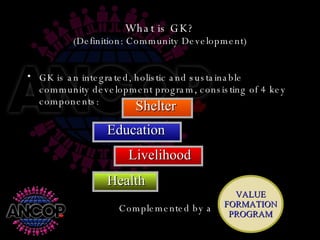
What is GK? (Definition: Community Development) GK is an integrated, holistic and sustainable community development program, consisting of 4 key components: Complemented by a VALUE FORMATION PROGRAM Shelter Livelihood Health Education
What is GK 777? The vision of building  700,000  homes in  7,000  communities in  7  years The miraculous revolution presently transforming the Philippines from a nation of slums to a peaceful, clean and beautiful community. An ambitious project that is now a growing multi-sectoral partnership driven by a vision of a country with  “No More Slums” .
What is a GK home? A GK home is a modest 200-250 sq. ft home, with the following: Concrete flooring (paved, not finished) Galvanized iron roofing 1 enclosed room 1 toilet A small kitchen Access to potable water
The GK Home: Why paint with bright colors? Bright colors are the colors of hope. Deep psychological impact on the poor: constant reminder that their lives have changed.
The GK Home: Why landscaped gardens? They contribute to clean and green surroundings The practice of tending to the gardens strengthens sense of ownership, and personal satisfaction. The collective effort of all families gardening, fosters the sense of community.
What is a GK Village? A GK Village is a community composed of 50 to 100 homes of poor families living in a clustered or contiguous area.
Why is “cluster” development important? Provides maximum visual impact (vs. sporadic, fragmented building) Facilitates the set-up and mobilization of the Neighborhood Association Speeds up physical and attitude transformation
What is the Cost of a GK Home? $ 1,500 Canadian, which covers basic material cost of a 200-250 sq. ft. home. Labor cost comes from sweat equity: beneficiary and volunteer labor. Site development costs ( deep wells, pavements) and peripheral costs (multi-purpose halls, playgrounds) come on top of the $1,500.
What are the criteria for GK area selection? Poor and marginalized area in a locality Land issues resolved Existence of a dedicated GK Caretaker team: - to oversee implementation - to mobilize volunteer resources - to provide feedback to donors - to ensure value formation program is carried out Willingness to set up a neighborhood association
What are the criteria for GK beneficiary selection? Poorest of the poor  ( survey conducted to determine incomes, source of livelihood, family size) Willingness to give sweat equity payback Willingness to abide by the rules, and be active members of, the Neighborhood association Willingness to go through the value formation program
What is the “Kapitbahayan” Neigborhood Association? “ Kapitbahayan” means Neighborhood The association of resident beneficiaries who become responsible for: - cleanliness - peace and order - conflict resolution - community mobilization The entity to which the GK Caretaker team passes on the know-how to manage and sustain the GK village. The vehicle for community empowerment and self-reliance.
Who owns the land on which GK homes are built? Land donated to GK Foundation: usufruct agreement entered into between the foundation and beneficiaries Land donated to the GK “Kapitbahayan” Association: communal ownership by all beneficiaries. Beneficiaries amortizing land with NHA, local government, private owner (owned by beneficiaries) GK never builds on land where people are squatting. The neighborhood association has controls in place to prevent selling land for a 5 year period.
How do donors know where their money goes? What kind of feedback do they get? Feedback on GK home or village construction: - Profile of GK community project - Bi-annual Progress report - Completion report Feedback on Child Sponsorship: - Profile of child and family - Thank you letter - Annual progress report on child Donors encouraged to visit GK site ANCOP is subject to CCRA Audit in Canada
How much of the donor’s money reaches the GK site? ANCOP-GK overheads are about 10% of the donation. However, the value of what is done in the GK site is much more than the amount given!! - Donation goes to material purchases. - Labor is free (Sweat equity). - Architects, engineers, designers are volunteer resources. - Land is usually donated. - Site development usually donated by partners. $1500 Canadian donation results in a home with a value of about $2500 Canadian!!
What GK livelihood programs are in place? Slum living breeds laziness and vices. Living in a new GK community raises productivity, and motivation to work. Livelihood programs are in place in various GK areas: - Small enterprise (chicken retailing, soapmaking, etc) - Agriculture - Caregiving - Construction Interest-free microfinancing program
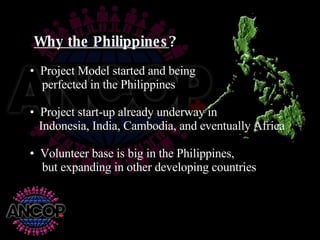
Project Model started and being    perfected in the Philippines Project start-up already underway in    Indonesia, India, Cambodia, and eventually Africa Volunteer base is big in the Philippines,    but expanding in other developing countries Why the Philippines ?
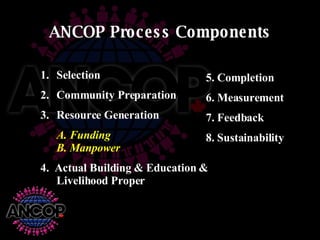
Selection Community Preparation Resource Generation A. Funding  B. Manpower 4.  Actual Building & Education &  Livelihood Proper ANCOP Process Components 5. Completion 6. Measurement 7. Feedback 8. Sustainability
 
END

Ancop Gk Visual1

  • 1.
  • 2.
    ANCOP Int’l (Canada) is a registered Christian humanitarian non-profit charitable organization VISION/MISSION: To make better the quality of life of poor families. To improve the communities where they live through a holistic approach.
  • 3.
    What is GK?(Level 1 Definition: Restoring Dignity and Hope) GK is an acronym for “ Gawad Kalinga ”, meaning “giving care”. Restoring dignity of the poor Bringing back hope for the poor Changing poor people’s lives for the better
  • 4.
    What is GK?(Level 2 Definition: Transformation) Physical transformation: Slums and shanties  Clean beautiful homes with hygienic surroundings. Attitude transformation: Law-abiding citizens Nurturing values of respect, compassion, sharing Control and elimination of vices (drunkenness, gambling, drugs, violence) Industrious and hardworking
  • 5.
    What is GK?(Definition: Community Development) GK is an integrated, holistic and sustainable community development program, consisting of 4 key components: Complemented by a VALUE FORMATION PROGRAM Shelter Livelihood Health Education
  • 6.
    What is GK777? The vision of building 700,000 homes in 7,000 communities in 7 years The miraculous revolution presently transforming the Philippines from a nation of slums to a peaceful, clean and beautiful community. An ambitious project that is now a growing multi-sectoral partnership driven by a vision of a country with “No More Slums” .
  • 7.
    What is aGK home? A GK home is a modest 200-250 sq. ft home, with the following: Concrete flooring (paved, not finished) Galvanized iron roofing 1 enclosed room 1 toilet A small kitchen Access to potable water
  • 8.
    The GK Home:Why paint with bright colors? Bright colors are the colors of hope. Deep psychological impact on the poor: constant reminder that their lives have changed.
  • 9.
    The GK Home:Why landscaped gardens? They contribute to clean and green surroundings The practice of tending to the gardens strengthens sense of ownership, and personal satisfaction. The collective effort of all families gardening, fosters the sense of community.
  • 10.
    What is aGK Village? A GK Village is a community composed of 50 to 100 homes of poor families living in a clustered or contiguous area.
  • 11.
    Why is “cluster”development important? Provides maximum visual impact (vs. sporadic, fragmented building) Facilitates the set-up and mobilization of the Neighborhood Association Speeds up physical and attitude transformation
  • 12.
    What is theCost of a GK Home? $ 1,500 Canadian, which covers basic material cost of a 200-250 sq. ft. home. Labor cost comes from sweat equity: beneficiary and volunteer labor. Site development costs ( deep wells, pavements) and peripheral costs (multi-purpose halls, playgrounds) come on top of the $1,500.
  • 13.
    What are thecriteria for GK area selection? Poor and marginalized area in a locality Land issues resolved Existence of a dedicated GK Caretaker team: - to oversee implementation - to mobilize volunteer resources - to provide feedback to donors - to ensure value formation program is carried out Willingness to set up a neighborhood association
  • 14.
    What are thecriteria for GK beneficiary selection? Poorest of the poor ( survey conducted to determine incomes, source of livelihood, family size) Willingness to give sweat equity payback Willingness to abide by the rules, and be active members of, the Neighborhood association Willingness to go through the value formation program
  • 15.
    What is the“Kapitbahayan” Neigborhood Association? “ Kapitbahayan” means Neighborhood The association of resident beneficiaries who become responsible for: - cleanliness - peace and order - conflict resolution - community mobilization The entity to which the GK Caretaker team passes on the know-how to manage and sustain the GK village. The vehicle for community empowerment and self-reliance.
  • 16.
    Who owns theland on which GK homes are built? Land donated to GK Foundation: usufruct agreement entered into between the foundation and beneficiaries Land donated to the GK “Kapitbahayan” Association: communal ownership by all beneficiaries. Beneficiaries amortizing land with NHA, local government, private owner (owned by beneficiaries) GK never builds on land where people are squatting. The neighborhood association has controls in place to prevent selling land for a 5 year period.
  • 17.
    How do donorsknow where their money goes? What kind of feedback do they get? Feedback on GK home or village construction: - Profile of GK community project - Bi-annual Progress report - Completion report Feedback on Child Sponsorship: - Profile of child and family - Thank you letter - Annual progress report on child Donors encouraged to visit GK site ANCOP is subject to CCRA Audit in Canada
  • 18.
    How much ofthe donor’s money reaches the GK site? ANCOP-GK overheads are about 10% of the donation. However, the value of what is done in the GK site is much more than the amount given!! - Donation goes to material purchases. - Labor is free (Sweat equity). - Architects, engineers, designers are volunteer resources. - Land is usually donated. - Site development usually donated by partners. $1500 Canadian donation results in a home with a value of about $2500 Canadian!!
  • 19.
    What GK livelihoodprograms are in place? Slum living breeds laziness and vices. Living in a new GK community raises productivity, and motivation to work. Livelihood programs are in place in various GK areas: - Small enterprise (chicken retailing, soapmaking, etc) - Agriculture - Caregiving - Construction Interest-free microfinancing program
  • 20.
    Project Model startedand being perfected in the Philippines Project start-up already underway in Indonesia, India, Cambodia, and eventually Africa Volunteer base is big in the Philippines, but expanding in other developing countries Why the Philippines ?
  • 21.
    Selection Community PreparationResource Generation A. Funding B. Manpower 4. Actual Building & Education & Livelihood Proper ANCOP Process Components 5. Completion 6. Measurement 7. Feedback 8. Sustainability
  • 22.
  • 23.