Next
Ancient Rome
Ancient Rome
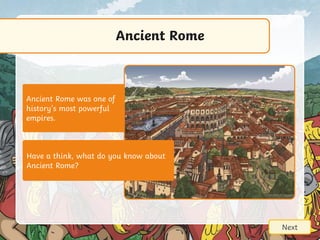
Ancient Rome was one of
history’s most powerful
empires.
Have a think, what do you know about
Ancient Rome?
There are many theories on
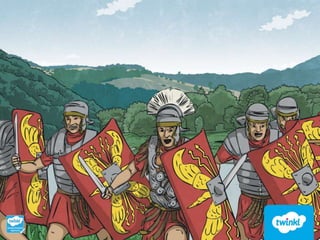
how Ancient Rome was
founded.
Next
The Origins of Ancient Rome
Romulus and Remus
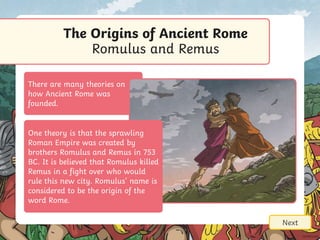
One theory is that the sprawling
Roman Empire was created by
brothers Romulus and Remus in 753
BC. It is believed that Romulus killed
Remus in a fight over who would
rule this new city. Romulus’ name is
considered to be the origin of the
word Rome.
Next
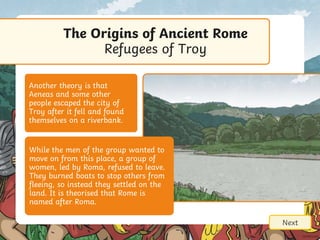
Another theory is that
Aeneas and some other
people escaped the city of
Troy after it fell and found
themselves on a riverbank.
While the men of the group wanted to
move on from this place, a group of
women, led by Roma, refused to leave.
They burned boats to stop others from
fleeing, so instead they settled on the
land. It is theorised that Rome is
named after Roma.
The Origins of Ancient Rome
Refugees of Troy
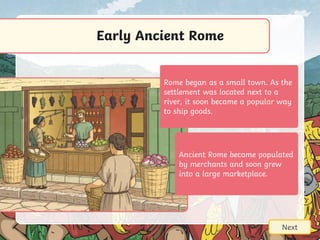
Early Ancient Rome
Next
Ancient Rome became populated
by merchants and soon grew
into a large marketplace.
Rome began as a small town. As the
settlement was located next to a
river, it soon became a popular way
to ship goods.
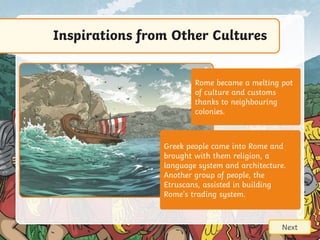
Inspirations from Other Cultures
Next
Rome became a melting pot
of culture and customs
thanks to neighbouring
colonies.
Greek people came into Rome and
brought with them religion, a
language system and architecture.
Another group of people, the
Etruscans, assisted in building
Rome’s trading system.
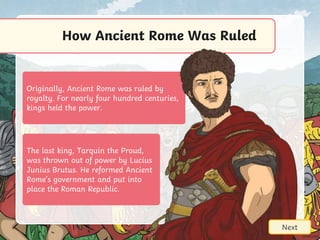
Originally, Ancient Rome was ruled by
royalty. For nearly four hundred centuries,
kings held the power.
How Ancient Rome Was Ruled
Next
The last king, Tarquin the Proud,
was thrown out of power by Lucius
Junius Brutus. He reformed Ancient
Rome’s government and put into
place the Roman Republic.
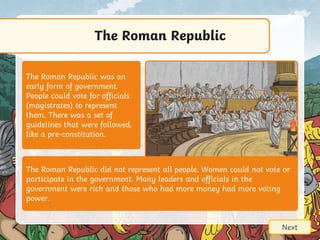
The Roman Republic
Next
The Roman Republic did not represent all people. Women could not vote or
participate in the government. Many leaders and officials in the
government were rich and those who had more money had more voting
power.
The Roman Republic was an
early form of government.
People could vote for officials
(magistrates) to represent
them. There was a set of
guidelines that were followed,
like a pre-constitution.
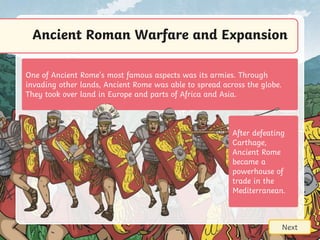
Ancient Roman Warfare and Expansion
One of Ancient Rome’s most famous aspects was its armies. Through
invading other lands, Ancient Rome was able to spread across the globe.
They took over land in Europe and parts of Africa and Asia.
Next
After defeating
Carthage,
Ancient Rome
became a
powerhouse of
trade in the
Mediterranean.
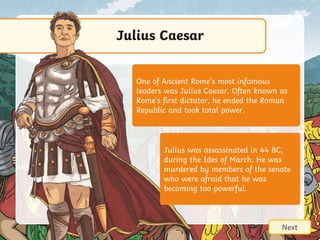
Julius Caesar
Next
One of Ancient Rome’s most infamous
leaders was Julius Caesar. Often known as
Rome’s first dictator, he ended the Roman
Republic and took total power.
Julius was assassinated in 44 BC,
during the Ides of March. He was
murdered by members of the senate
who were afraid that he was
becoming too powerful.
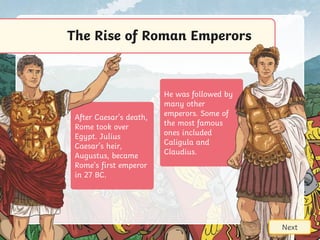
After Caesar's death,
Rome took over
Egypt. Julius
Caesar’s heir,
Augustus, became
Rome’s first emperor
in 27 BC.
He was followed by
many other
emperors. Some of
the most famous
ones included
Caligula and
Claudius.
The Rise of Roman Emperors
Next
Nero’s Reign and the Great Fire of Rome
Next
There are many rumours on
how this fire started. Some
ancient historians believe that
the emperor at the time, Nero,
had the fire started on purpose
to build a palace on the
cleared space.
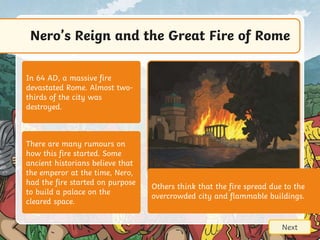
In 64 AD, a massive fire
devastated Rome. Almost two-
thirds of the city was
destroyed.
Others think that the fire spread due to the
overcrowded city and flammable buildings.
Building the Colosseum
Next
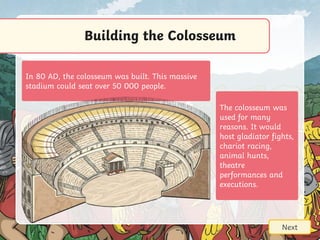
In 80 AD, the colosseum was built. This massive
stadium could seat over 50 000 people.
The colosseum was
used for many
reasons. It would
host gladiator fights,
chariot racing,
animal hunts,
theatre
performances and
executions.
Constantine and Christianity
Next
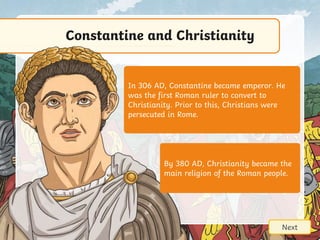
In 306 AD, Constantine became emperor. He
was the first Roman ruler to convert to
Christianity. Prior to this, Christians were
persecuted in Rome.
By 380 AD, Christianity became the
main religion of the Roman people.
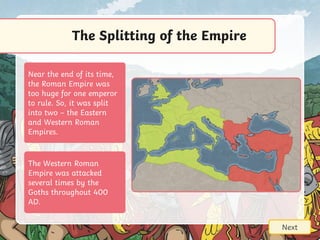
Near the end of its time,
the Roman Empire was
too huge for one emperor
to rule. So, it was split
into two – the Eastern
and Western Roman
Empires.
The Splitting of the Empire
Next
The Western Roman
Empire was attacked
several times by the
Goths throughout 400
AD.
The Fall of the Roman Empire
The Eastern Roman Empire continued to survive as the Byzantine Empire
until the 15th century when it was taken over by the Ottoman Turks.
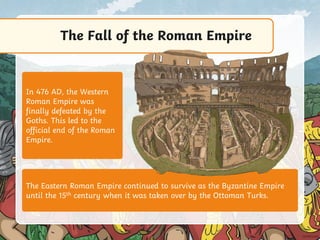
In 476 AD, the Western
Roman Empire was
finally defeated by the
Goths. This led to the
official end of the Roman
Empire.
Ancient Rome

Ancient Rome

  • 2.
    Next Ancient Rome Ancient Rome AncientRome was one of history’s most powerful empires. Have a think, what do you know about Ancient Rome?
  • 3.
    There are manytheories on how Ancient Rome was founded. Next The Origins of Ancient Rome Romulus and Remus One theory is that the sprawling Roman Empire was created by brothers Romulus and Remus in 753 BC. It is believed that Romulus killed Remus in a fight over who would rule this new city. Romulus’ name is considered to be the origin of the word Rome.
  • 4.
    Next Another theory isthat Aeneas and some other people escaped the city of Troy after it fell and found themselves on a riverbank. While the men of the group wanted to move on from this place, a group of women, led by Roma, refused to leave. They burned boats to stop others from fleeing, so instead they settled on the land. It is theorised that Rome is named after Roma. The Origins of Ancient Rome Refugees of Troy
  • 5.
    Early Ancient Rome Next AncientRome became populated by merchants and soon grew into a large marketplace. Rome began as a small town. As the settlement was located next to a river, it soon became a popular way to ship goods.
  • 6.
    Inspirations from OtherCultures Next Rome became a melting pot of culture and customs thanks to neighbouring colonies. Greek people came into Rome and brought with them religion, a language system and architecture. Another group of people, the Etruscans, assisted in building Rome’s trading system.
  • 7.
    Originally, Ancient Romewas ruled by royalty. For nearly four hundred centuries, kings held the power. How Ancient Rome Was Ruled Next The last king, Tarquin the Proud, was thrown out of power by Lucius Junius Brutus. He reformed Ancient Rome’s government and put into place the Roman Republic.
  • 8.
    The Roman Republic Next TheRoman Republic did not represent all people. Women could not vote or participate in the government. Many leaders and officials in the government were rich and those who had more money had more voting power. The Roman Republic was an early form of government. People could vote for officials (magistrates) to represent them. There was a set of guidelines that were followed, like a pre-constitution.
  • 9.
    Ancient Roman Warfareand Expansion One of Ancient Rome’s most famous aspects was its armies. Through invading other lands, Ancient Rome was able to spread across the globe. They took over land in Europe and parts of Africa and Asia. Next After defeating Carthage, Ancient Rome became a powerhouse of trade in the Mediterranean.
  • 10.
    Julius Caesar Next One ofAncient Rome’s most infamous leaders was Julius Caesar. Often known as Rome’s first dictator, he ended the Roman Republic and took total power. Julius was assassinated in 44 BC, during the Ides of March. He was murdered by members of the senate who were afraid that he was becoming too powerful.
  • 11.
    After Caesar's death, Rometook over Egypt. Julius Caesar’s heir, Augustus, became Rome’s first emperor in 27 BC. He was followed by many other emperors. Some of the most famous ones included Caligula and Claudius. The Rise of Roman Emperors Next
  • 12.
    Nero’s Reign andthe Great Fire of Rome Next There are many rumours on how this fire started. Some ancient historians believe that the emperor at the time, Nero, had the fire started on purpose to build a palace on the cleared space. In 64 AD, a massive fire devastated Rome. Almost two- thirds of the city was destroyed. Others think that the fire spread due to the overcrowded city and flammable buildings.
  • 13.
    Building the Colosseum Next In80 AD, the colosseum was built. This massive stadium could seat over 50 000 people. The colosseum was used for many reasons. It would host gladiator fights, chariot racing, animal hunts, theatre performances and executions.
  • 14.
    Constantine and Christianity Next In306 AD, Constantine became emperor. He was the first Roman ruler to convert to Christianity. Prior to this, Christians were persecuted in Rome. By 380 AD, Christianity became the main religion of the Roman people.
  • 15.
    Near the endof its time, the Roman Empire was too huge for one emperor to rule. So, it was split into two – the Eastern and Western Roman Empires. The Splitting of the Empire Next The Western Roman Empire was attacked several times by the Goths throughout 400 AD.
  • 16.
    The Fall ofthe Roman Empire The Eastern Roman Empire continued to survive as the Byzantine Empire until the 15th century when it was taken over by the Ottoman Turks. In 476 AD, the Western Roman Empire was finally defeated by the Goths. This led to the official end of the Roman Empire.